Wednesday, April 11, 2012
"If we can just get rid of these actors and directors, maybe we've got something here."
"It's just a satire on the way people behave in the movie studios. There was such a fuss started about it. People started saying, 'Oh people are afraid you are going to do this and do this.' So the more afraid they got, the more ideas they gave me. Looking back on this whole picture, it's a pretty tame satire. It's no big indictment. Things are much, much worse than this picture seems to say." — Robert Altman on the DVD commentary for The Player
By Edward Copeland
To begin a post on the 20th anniversary of Robert Altman's film The Player by showing the clip of his fabled eight-minute, one-take opening and then waxing rhapsodic about all manners of ingenuity in that shot puts me at risk of sounding like Fred Ward's character in that sequence, railing about how everything in movies these days is "cut cut cut cut" and teaching Jimmy the bike messenger (Paul Hewitt) about Orson Welles' famous tracking shot that started Touch of Evil (Unlike Ward's studio security head Walter Stuckel though, I would recognize Absolute Beginners when Jimmy brings it up). Despite any negative connotation I may endure for choosing the most obvious part of Altman's 1992 film to launch my tribute to The Player, I stand by my decision and commence my piece discussing those eight glorious minutes, not only because the work that went into creating that sequence still amazes me two decades later, but because that bite-size morsel of cinematic art serves as a microcosm of the entire film. As Altman himself said in a video interview on the DVD, "The film actually is like a snail — it kind of turns in on itself and becomes itself." When Francis Ford Coppola held a news conference at the Cannes Film Festival to tout Apocalypse Now, he famously declared, "My film is not about Vietnam. It is Vietnam." You could say that Altman's film isn't about Hollywood either — it is Hollywood — and who truly can determine on which battleground more blood has been shed. Watching The Player now, you discover (as you find in many Altman films) that wily director had been operating on several planes at the same time during filming and, as funny and dead-on as its humor may be, The Player doesn't exist exclusively as a satire. An audience's boisterous laughter distracts a viewer from noticing Altman's use of some directorial sleight-of-hand. When the humor subsides, a surprised viewer realizes that the film now plumbs much darker depths. That Altman successfully coordinated all these disparate instruments into the orchestral composition we know as The Player remains miraculous. Now, about that opening shot…

Assuming anyone reading this watched the clip or has seen The Player, the actual preparations that Altman, his crew and the actors involved in the sequence took required planning — lots of meticulous planning. Often, you hear people mistakenly
 refer to this eight-minute take as a tracking shot when that isn't the case. A camera didn't run on rails as Akira Kurosawa did for The Woodcutter's long walk in Rashomon and isn't exactly equivalent to the move Martin Scorsese loves to do as in Raging Bull and Goodfellas, to name just two of his. Even a casual observer, seeing how the camera moves in those eight minutes, would realize that laying down tracks for all those angles and positions without any being caught on film by the camera as it switched heights and directions would be damn near impossible. No crews could remove or replace tracks that fast. On the DVD commentary track, Altman explains the steps he went through to achieve the scene. The director actually built a scale model of the studio set along with a scale-size crane that allowed him to see where he would be able to travel and reach and where he couldn't go. Using the model, he visualized roughly how the crane would circulate based on which characters and cameo players should appear in what order. "I had to set up the movie studio
 and I wanted to set up the characters that we were going to be dealing with and I wanted to get the audience's attention," Altman said. The director went to the real set with the real crane and choreographed the take. While he knew who would be in the scene, Altman hadn't the slightest idea what words would emanate from their mouths as everyone with a speaking part in the opening improvised his or her dialogue. The amount of time on a single reel of film determined the take's total length, so they had to plan how much time to spend at each spot. Altman said everyone rehearsed for a day while the actual filming took half a day, employing 11 microphones and a mere 15 takes. For such a complicated undertaking, while it required intricate preparations, they managed to lock it down rather quickly. It's far from the only time The Player displays a self-reflexive moment — that happens in the film's first image as a hand enters the frame with a clapboard (and if that's an honest clapboard, it means take 10 ended up being used in the film) as you hear offscreen voices asking for quiet on the set, marking the scene and, finally, calling, "Action" so the film can begin — and similar instances occur all the way to its final frame. For his part, Altman emphasized the show in his showpiece. "It's a very conceited thing — this shot with no cuts in it.…It draws attention to it. It's showing off.…It got attention to the picture," he admits.
What Altman set out to do in that scene — the setting-up-the-characters-and-the-studio part, not the garnering-attention-for-the-film part — he accomplished quite efficiently. We begin with the woman who, truth-be-told, keeps the studio running through who knows how many regimes, the studio president's executive secretary Claire (Dina Merrill) telling the studio president's receptionist Sandy (Leah Ayres) the proper things to say about the boss's whereabouts; we hear the first mention of a name of a rival that will haunt our protagonist, Larry Levy; Speaking of our protagonist, he arrives. One of the top executives, Griffin Mill (Tim Robbins) pulls on to the lot in his Range Rover and we get an immediate sense of his importance as he gets a movie pitch from real-life writer-director Adam Simon before he's even closed the vehicle's door. Griffin tells Simon to talk to his assistant, Bonnie Sherow; next we see Walter and Jimmy have their tracking shot discussion and pass Griffin's office window where he gets updates from his secretary Jan (Angela Hall) and receives his first official pitch from Buck Henry and we get our first reference to a possible part for Julia Roberts; Adam Simon reappears and we meet Bonnie (Cynthia Stevenson) who begs him to slow down and write it down for her. A shriek is heard and they run over to find that a man driving a golf cart has run over Jimmy on his bicycle, scattering a huge pile of mail. On top of one stack, a postcard with drawings of old movie stars and the words YOUR [SIC] HOLLYWOOD IS DEAD; a young man (Randall Batinkoff) in a sports car pulls up to a young blonde sitting on the hood of a car and purposely mistakes her as Rebecca De Mornay in an attempt to pick her up; a low level exec (Jeremy Piven) sucks up to a group of Japanese visitors touring the studio; studio president Joel Levison (Brion James) arrives, driving to the door of his office and asking Sandy
 to park his car for him; three other executives talk about the bank that owns much of the studio "putting the screws" to them and sending the owner's son out from Boston. They talk about how it happens at all studios every few years and rumors that Griffin may be replaced by someone else, maybe even Larry Levy; Griffin hears his second pitch of the day; Director Alan Rudolph asks Jimmy where Griffin's office is and Jimmy tells him and also mistakes him as Martin Scorsese. Rudolph goes in the door as Jan comes out and collects Griffin's mail from Jimmy; Walter now bends Buck Henry's ear, this time going on about Hitchcock's Rope while continuing to gripe about all those cuts. Henry brings up Bernardo Bertolucci's great tracking shot to Debra Winger in The Sheltering Sky. Walter, of course, hasn't seen it; Bonnie chastises her assistant Whitney Gersh (Gina Gershon) for having coffee with Alan Rudolph; Rudolph sees Griffin and gives him his final pitch of the opening scene as well as the film's first mention of Bruce Willis. Mill receives his mail, including that postcard which reads on the other side, "I HATE YOUR GUTS ASSHOLE!" Rudolph hasn't stopped pitching about his cynical political thriller comedy that's "got heart in the right spot" but he gets the last line of that bravura opening, "Of course someone dies in the end. They always do in thrillers." Beyond the technical virtuosity displayed in that opening
 take, what an efficient introduction of most of the important characters and plot strands for the film. The single take goes beyond being a clever filmmaking stunt and prepares a viewer for most of what will be coming. If they didn't know what a movie pitch was, now they do. The film establishes the basic hierarchy of the studio's power structure. We know that shaky financial times embroil the studio and that its top development executive, Griffin Mill, could lose his job over it, perhaps to an executive who works elsewhere named Larry Levy. We've learned that someone representing the bank that owns most of the studio will be arriving to look things over. Griffin also has to contend with someone sending him threatening postcards. The movie even has laid the groundwork for the joke that leads to the final punchline. More ominously, as Rudolph says in the context of his movie idea, "Of course someone dies in the end. They always do in thrillers" as Griffin stares out the window after receiving his hate mail, the first scene of The Player doesn't end on a satirical note, but a suspenseful one, indicating the thriller blood flowing through its celluloid veins. Rudolph's description of the movie he wants to make inspires laughter, but it comes damn close to describing The Player as well: a cynical political thriller with its heart in the right spot, only its office politics and while the film does have heart in the right spot, the right spots occur only in isolated moments and not in the film overall.
One final paragraph related to the opening, since it affords me the opportunity to share an anecdote from my days long past as a pseudo-professional film critic as well as illustrates that some of the funniest dialogue that just screams satire — well, as animated Springfield mob boss Fat Tony (voiced by Joe Mantegna) once said on The Simpsons, "It's funny 'cause it's true." Altman says in his commentary that the performers improvised all the dialogue in that sequence, including creating their own movie pitches. It shouldn't be surprising then that Buck Henry delivers the funniest one with his idea for a sequel to The Graduate. The other two pitches speak the ridiculous language that most assume has to be exaggerated. In Griffin's second meeting, he listens to writer-directors Patricia Resnick (on left in photo), and
 Joan Tewksbury try to sell an idea about a television actress who takes a trip to Africa where a local tribe begins to worship her as an idol. "Kind of like The Gods Must Be Crazy, only instead of a Coke bottle, you have a television actress," Griffin says when he finally catches on to their concept. "It's like Out of Africa meets Pretty Woman," Resnick sums up. When Alan Rudolph spells out the basics of his story concerning a senator who develops the power to see what's inside a person's mind, his pithy summation of the film describes it as "Ghost meets The Manchurian Candidate." On Jan. 31, 1992, less than four months before The Player opened, another film finally made it to movie theaters. Originally scheduled as one of its studio's big year-end releases, the studio punted it to the January dumping ground because even they recognized how bad it was. If you review films outside of major markets, studios either contract local agencies to handle publicity and press relations or use regional offices, if they have one in close proximity. (At least, they did this once upon a time. Now, smaller markets get frozen out, if their newspapers haven't axed their film critics first.) In late summer 991, this studio's regional rep drove up to give me and my paper's other reviewer a preview of the studio's fall and winter releases. As he flipped through large photos featuring images from the films, he came to Shining Through starring Melanie Griffith and Michael Douglas. After a brief synopsis, the man described Shining Through in a way that forced me to summon every ounce of strength in my 21-year-old body not to burst into tears of laughter. "It's like Working Girl goes to war," he said with a straight face. Yes Virginia, movie folk do talk this way.

"As a screenwriter, one gets used to sitting in the backseat on a film. One reason the writer is usually banned from the set by directors is so the writer's screams aren't heard on the soundtrack when they listen to all the changes being made," said Michael Tolkin, who wrote the screenplay for The Player, on the DVD commentary. Tolkin wasn't just writing the script for The Player, he was adapting it from his own novel and serving as one of the film's producers as well. Neither Altman nor Tolkin mention a Tolkin ban from The Player set on the DVD (in fact, he appears late in the movie with his brother Stephen as screenwriting siblings trying to make a deal). I guess Michael Mann kicking David Milch off the Luck set wasn't that unusual, but they both held executive producer titles, so how did that work? Oh well — horses under the tarp. While Hollywood at large goes beneath the microscope in The Player, how the film industry treats writers garners the bulk of the feature's focus — somewhat ironic given how often
 Altman allows improvisation or creates scenes on the fly. (I just noticed how easily I slip into present tense when I write about what Altman "does." He died more than five years ago, but when you watch his best films again, the man seems so vibrant, vital and alive.) In the sidebar I posted Tuesday called Untold Stories of Robert Altman's The Player or Who the Hell is Thereza Ellis?, I covered many details of this, especially concerning the great scene at the Pasadena police station between the police (Whoopi Goldberg, Lyle Lovett and Susan Emshwiller) and Griffin that Altman acknowledges the actors worked out on their own and that Goldberg should be credited as the scene's writer and director. Despite the fact that Griffin keeps getting threatening notes from a pissed-off screenwriter whose calls he didn't return, his reputation has earned the label of "the writer's executive" in Hollywood. Though Griffin ends up physically killing a screenwriter, the rival executive, Larry Levy (Peter Gallagher) plays the role of the man who would kill them all symbolically if he could. One fateful night, Griffin drives to Pasadena looking for screenwriter David Kahane (Vincent D'Onofrio), the man he believes to be behind the threats. Mill learns he's gone to a movie theater to see The Bicycle Thief from his girlfriend June Gudmundsdottir (Greta Scacchi), who Griffin shares an odd and
 voyeuristic phone call where he watches her through her windows while talking on his unbelievably large 1990s-era cell phone. He asks why she didn't go with David, but June doesn't go to movies. "Why?" Mill truly wants to know. "Life's too short," she answers. Griffin tries to calm Kahane after he locates him, dangling the possibility of deals and apologizing for not calling him back. Kahane won't allow Griffin's belated asskissing — June told Griffin on the phone his nickname for him was The Dead Man. Since Griffin found Kahane at the movie theater, he deduces June told Mill where he went. "Talk to the Ice Queen? You'd like her Mill — she's a lot like you — all heart," Kahane says before walking out on Griffin. Mill gives up and heads toward his Range Rover when Kahane, pissing in a corner, calls to him and taunts him about Larry Levy, who he has heard will make meaningful films again, and the impending loss of Griffin's job. His paranoia drives Griffin to follow Kahane to his parking lot in an attempt to get him not to tell anyone at the studio they spoke and to stop the postcards. "I don't write postcards! I write scripts!" Kahane yells when Griffin grabs his car door and Kahane shoves him, sending him sailing over a railing onto a loading ramp. Kahane checks to see if Griffin is OK, but Mill snaps and starts bashing Kahane's head into the cement, holding it beneath the water until the bubbles stop, quietly sneering, "Keep it to yourself! Keep it to yourself!" As Griffin snaps back into focus, realizing what he did and trying to fake a robbery, dialogue from the next scene, which takes place the following morning, bleeds into the murder cleanup. "Who wrote the new ending to Fatal Attraction?" Larry Levy asks. "The audience did," he responds to his own question.
Levy's conversation turn out to come from his first meeting as a newly hired executive at the studio. It hasn't quite started as Levison waits in his office and Griffin hasn't shown up on the lot. Claire tells Levison that with or without Griffin, they should begin and he agrees, telling Walter, whom we've learned by now runs the studio's security department to "keep our noses clean, Walter." Levy complains to everyone about the high fees paid to writers and how they should make pictures the people want not the type writers want to give them when Griffin shows up. Levy asks everyone when was the last time they paid to see a movie. "Last night. The Bicycle Thief," Griffin replies. "It's an art movie. It doesn't count. We're talking movie movies," Levy says dismissively. As an exercise, Levy passes a newspaper to different executives and tells them to pick a story. Steve Reeves (Jeremy Piven) reads, "Immigrants protest budget cuts in literacy program." "Human spirit overcoming human adversity. Sounds like Horatio Alger in the barrio. Put Jimmy Smits in it and you've got a sexy Stand and Deliver," Levy smiles. It goes on for a while, but a headline that says “Man Found Dead in Theater Parking Lot” distracts Griffin. When
 they capture his attention, he focuses enough to zing Levy back at least. "I was just thinking what an interesting concept it is to eliminate the writer from the artistic process. If we can just get rid of these actors and directors, maybe we've got something here," Mill suggests sardonically. The frightening thing to me comes from the possibility that with the state of digital effects now, getting rid of the actors could be highly plausible. After the meeting, when Griffin returns to his office where Walter confronts him about David Kahane, he receives a fax with bad news. "SURPRISE!" it reads. Kahane wasn't
 the screenwriter sending him the postcards. At another time, Griffin again shows himself to be a bit of a writer's defender when he sends Bonnie to New York to look at the new Tom Wolfe novel and discern if it could be a movie. If it does, he tells her to offer $1 million, which makes Levy choke over the price. "It's Tom Wolfe," Griffin says, as if that's the only explanation needed. There's a catch that comes with Griffin's "writer's executive" reputation. The script still must fall within the proper parameters. He isn't a risk taker. When he becomes involved with June, she asks him what he needs to make a good movie and he rattles off a list of attributes. "Suspense, laughter, violence, hope, heart, nudity, sex, happy endings. Mostly happy endings," he tells her. Damn if Altman — the maverick, the Hollywood outsider — doesn't manage to include every single one of those elements in The Player. "When people ask me, 'How much did Altman change the script into the movie?' I would honestly say if anyone betrayed me, it was me. As the screenwriter, I betrayed the novel much more than the director," Tolkin admits on the DVD. Altman also offers some words on his reputation as an outsider.
and the kind of movies that I can make and like to make and make are not the type of films they know how to distribute.
So basically, we aren't in the same business. There's no point in calling me to make a pair of gloves for you when I make shoes."
Labels: 90s, Altman, Buck Henry, Coppola, Debra Winger, Fiction, Hitchcock, Julia Roberts, Kurosawa, Luck, M. Douglas, Michael Mann, Milch, Movie Tributes, Scorsese, The Simpsons, Tim Robbins, Welles, Willis
TO READ ON, CLICK HERE


Monday, September 26, 2011
All Things Being Equal

By Josh R
It would be comforting, if more than a little naïve, to imagine that we live in truly equitable society. Certain politicians insist that the existence of what is broadly outlined as “The Welfare State” robs people of the initiative to strive and achieve — an assertion that would only make sense if everyone started out at the same place, with identical advantages and without the kind of obstacles that apply only under given sets of circumstances. That’s a nice way of saying that most people’s futures are predetermined by factors completely beyond their control — for all but a select few, the future is less about choice than the choices that have been made for you.
The Help, based on the controversial best-selling novel by Kathryn Stockett, is a film that examines the imbalances created by a society that insists on keeping all its members in their “proper place,” and the toll such casual dispensation of injustice can take on the human soul. Specifically, the film is dealing with racial inequality in the American South in the early 1960s — but the mere existence of this film testifies to another, perhaps even more startling imbalance of the type that Hollywood usually pretends not to notice. It isn’t difficult to reel off a list of films which not only feature predominantly male casts, but feature strong, complex roles for multiple cast members; I can think of at least five or six films released in the past year which gave as many male actors the chance to shine. There are certainly female-driven ensemble films being made — this summer alone, the vastly overrated Bridesmaids has seemingly tapped into a new market by proving that women can do lame-brained, frat-boy type humor just as successfully as men do — but how many films can you name that furnish fully realized, challenging and provocative female roles for all but a few of its members? How many films have ever featured not one, nor even two, but an entire gallery of great female performances? A handful of classics stand out — Stage Door and The Women remain the gold standard, more than 70 years after their initial releases — but for the most part, great female ensemble pieces have been few and far between. While there have been notable recent exceptions — the films of Rodrigo Garcia have showcased several of our best contemporary actresses to terrific effect — The Help may be the first big-budget, mass-market film in many a year that has made full and glorious use of a large, diverse and extremely talented collection of female performers. It is due to their efforts that The Help — a good film, if hardly a great one — transcends whatever limitations the material may have and provides an eminently satisfying, emotionally rewarding filmgoing experience.
The Help of the title are African-American women employed as domestic servants in the households of young, pampered white socialites in Jackson, Miss., at the dawning of the Civil Rights era. The mistresses — who seem mostly to regard things such as marriage and parenting as tiresome, unwelcome distractions from the unending cycle of events on the Junior League social calendar — regard their maids with equal measures of indifference and suspicion. Skeeter Phelan (Emma Stone), a recent college graduate and aspiring journalist, returns to her childhood home in Jackson to work at a local newspaper. Returning to one’s roots inevitably entails reverting to old patterns; her social life is quickly commandeered by a circle of former high school friends, presided over with an iron fist by Hilly Holbrook (Bryce Dallas Howard), an unctuous queen bee who spends the bulk of her time cheerfully campaigning for the installation of separate toilets in households that employ black servants. Uncomfortable with the behaviors and attitudes she encounters, Skeeter decides to write an expose of Jackson society, as told from the point of view of the help. To that end, she persuades two domestic servants — the cautious, reserved Aibileen Clark (Viola Davis) and feisty, indignant Minny Jackson (Octavia Spencer) — to share their experiences working in various households, providing a glimpse into what happens behind closed doors, drawn curtains and the pretense of Southern gentility. Although the women are initially reluctant to participate, they eventually find a sense of purpose in revealing both the casual indignities and more harrowing instances of degradation and cruelty they witness and experience as second-class citizens in a segregated culture. When the book is published, it creates shockwaves felt both far and wide; once the truth has been dragged out in the open, no one is entirely prepared to deal with the repercussions.
The Help is directed by Tate Taylor, who also penned its screenplay. While the film represents a competent effort, it inevitably feels like the work of a novice filmmaker; it’s not particularly interesting from a visual standpoint, the tone is uncertain throughout (not all of its scenes seem to belong in the same film) and the pacing is slightly off, with certain scenes feeling oddly truncated while others seem hyper-extended. Many cast members have been coaxed in the direction of caricature — making it all the more remarkable how successfully they avoid the trap of existing on a one-dimensional level. There are exaggerated aspects to all but a handful of the performances, but the exaggeration doesn’t upset the balance of characterization — even when Spencer (a previously unheralded talent who is a delight from start to finish) is dispensing cantankerous sass in a manner which may bring to mind Hattie McDaniel, it doesn’t come across as stereotypical behavior — there’s still the sense of a real person behind the bulging eyes and grumbling retorts.
The well-meaning, conscientious Skeeter is the kind of role that almost never works; the character’s unvarying decency is like a salve for liberal guilt. Fortunately, Emma Stone is a creative, resourceful actress capable of projecting genuine personality even in less-than-ideal circumstances; she has some of Debra Winger’s off-the-cuff spontaneity, and invests the role with enough in the way of quirky intelligence to make you (mostly) forget how narrowly conceived the character is. On the other side of the spectrum, the vile, epithetic-spewing Hilly is writ so large, and in such a poisonous hand, that the easy choice for Bryce Dallas Howard would have been to render her as a vessel of pure, unadulterated evil — whereas Stone has to whip up something from nothing, Howard has to avoid the temptation to oversimplify matters. Thankfully, she doesn’t fall into that trap — her Hilly is suitably detestable, but not a cardboard villainess with a one-dimensional pathology. The audience has to want this Southern-fried witch, with her steely beauty-pageant smile and propensity for making people suffer, to get what’s coming to her; at the same time, Howard clues you in to where Hilly’s rottenness originates (racists are made, not born), and what it has cost her to preserve it. The hatred and fear that have been instilled in Hilly from birth, and that she carries around with her day after grinding day without reprieve or relief, is so corrosive that it’s eating her alive. The character may be rendered in very broad strokes, but she’s recognizably, pitiably human. The same holds true for the insecure blonde bombshell Celia Foote (Jessica Chastain), a social pariah who forms an unlikely bond with Minny. The ubiquitous Chastain — whose distant, ethereal quality works much more effectively in this context than in the suspense thriller The Debt — has the sweet, slightly dazed manner of Marilyn Monroe in her post-Strasberg years, and delivers a genuinely affecting performance that appeals to the audience’s sympathy without begging for it. Like Howard, she has a fine line to walk — Celia could easily come across as a pathetic dingaling, all curves and nervous giggles — but the performance, while exaggerated, never feels fake or forced.
The efforts of the younger cast members are nicely offset by the contributions of a trio of scene-stealing veterans. The redoubtable Sissy Spacek, who is no stranger to playing Southern eccentrics (but is usually pitch-perfect no matter what she’s doing), delivers a master class in how to play a smallish role for all it’s worth. As Hilly’s dotty mother, she has some choice bits of comic business, and handles the assignment with unflagging aplomb; so well-enshrined is Spacek’s reputation as a dramatic actress, it’s easy to forget how comfortably comedy falls into her wheelhouse. Allison Janney, who is given considerably more screen time, has a qualified success in the role of Skeeter’s evasive, cancer-riddled mother, a woman too image-conscious to act on the courage of her convictions. The performance is a bit more vivid than it needs to be — while all of the actors flirt dangerously with caricature, Janney is the only who takes it past the tipping point — but she handles the quieter moments well, and she and Stone strike up a crackling combative rhythm in their confrontation scenes. Cicely Tyson has a lovely, heart-rending cameo as Skeeter’s beloved childhood nanny, who is nowhere in evidence when her former charge returns to Jackson; her unexplained absence preys on Skeeter’s thoughts even as she trains her gaze on the goings-on in other peoples’ houses.
As strong as the ensemble work is, one performer deserves (at the very least) a paragraph all to herself. As Aibileen, Viola Davis pushes beyond the film’s comfort zone, bringing the hard, cold realities of its subject matter into razor-sharp focus. It isn’t a noisy, flashy performance; you have only to look in Aibileen’s sad, weary eyes to feel the crushing weight of her circumscribed, hardscrabble life of backbreaking labor and heartbreaking compromise, absorbing daily blows to her dignity in soul-killing silence. Without that anchoring presence, The Help would probably exist on the same level as Beaches or Steel Magnolias — a glossy, feel-good product that deals with big emotions in a facile, airbrushed manner, with swelling musical cues to signal when to reach for the Kleenex. The other actresses (all terrific) lend it tartness and sweetness, but Davis is the one who gives it gravity — she delves deep below the surface to unearth a rawness that feels at once both universal and intensely personal; the sense of hurt and suppressed anger she brings to the part cuts right to the bone. It remains to be seen whether Hollywood will afford her the chance to plumb these depths on a consistent basis — as stated previously, it would be foolish to assume that, even in The Age of Obama, the same range of opportunities are available to everyone. On the evidence of The Help, it is clear that Viola Davis is more than willing to go to those places — if she gets more parts like this, the results will be riveting.
On the merits of the performances, there can be little room for doubt; still, it is probably worth questioning whether an African-American author or filmmaker would have placed the character of Skeeter so firmly at the center of the narrative. For the record, The Help is not the story of a courageous, selfless white woman coming to the aid of helpless black people; nor is fair to say that Stockett and Taylor treat their subject matter with any lack of intelligence and sensitivity. Nevertheless, The Help isn’t really as tough-minded as it pretends to be — it cheats on the side of entertainment. I’m not enough of an authority to say whether or not it qualifies as good history; it certainly provides the occasion for some great ensemble acting. The women of The Help are totally invested in their roles, and thoroughly engaged with one another — that, in and of itself, provides cause for celebration.
Tweet
Labels: 10s, Debra Winger, Marilyn, Spacek, Viola Davis
TO READ ON, CLICK HERE
Friday, May 06, 2011
As good as he seems to get anymore

By Edward Copeland
Last year's How Do You Know is the first feature James L. Brooks has written and directed in 23 years that almost works. Actually, I'm just being kind because I still have affection for the man. What the hell happened to him that I have to rate his work now on how much more or less painful than Spanglish it is?
Brooks wrote and directed two of my favorite films, Terms of Endearment and the even better Broadcast News. He also produced films such as Say Anything, The War of the Roses and Bottle Rocket. On television, he co-created The Mary Tyler Moore Show, Taxi and The Simpsons.
So went wrong? It's not that the movies he's made since 1987 were without charms. I enjoyed many parts of the de-musicalized I'll Do Anything starring Nick Nolte, but it was a miss (even though I'd still love to see those cut musical numbers. DVDs were invented for extras like that.)
As Good As It Gets had very good performances by Jack Nicholson and Greg Kinnear, but the storyline was very unfocused and the film as a whole was sunk when it hit the iceberg known as Helen Hunt's Oscar-winning performance, with its Bronx accent that would appear, then disappear, then reappear, then turn into some other sort of accent altogether. Supposedly, the point was that her character makes Nicholson's a better man. Honestly, I imagine she would add to his mental problems.
Then came Spanglish. Adam Sandler is unbearable enough in his comedies that give lowbrow a bad name, but somehow he becomes even worse when he tries to play it straight and serious as he does in Spanglish. What makes this mess of a movie even more of an amazing achievement (in a negative way) is that Sandler isn't its most annoying character. That title goes to Tea Leoni as Sandler's messed-up wife Deborah who fluctuates between shrew, politically concerned citizen, manic depressive and so many other troublesome traits I'm surprised her character wasn't named Sybil.
Coming from Brooks, who created or brought to the big and small screen so many great female characters such as Holly Hunter's Jane Craig in Broadcast News, Shirley MacLaine and Debra Winger's Aurora and Emma in Terms of Endearment and Mary Tyler Moore and Valerie Harper's Mary Richards and Rhoda Morgenstern on The Mary Tyler Moore Show and Rhoda, to name a few. As A.O. Scott wrote in his review of Spanglish, describing Leoni's Deborah:
...Deborah, a creature whose flailing awfulness goes beyond the requirements of comic villainy and exposes an ugly, punitive strain of misogyny at the heart of a movie that basks in its own sense of decency. Coming from Mr. Brooks, this is more than a little shocking, since strong, interesting, complicated women have been something of a specialty for him.
The longer you get away from your viewing of How Do You Know, the more it dissipates in your mind, but while you watch it, it's pleasant and entertaining enough not to cause the viewer anguish. Much of the credit for this shouldn't go to Brooks' screenplay, but to the charming presences of stars Reese Witherspoon, Owen Wilson and, most particularly, Paul Rudd.
Rudd and Witherspoon really have the lead roles of How Do You Know in parts that run on parallel tracks for much of the film while Wilson serves a mostly supporting function.
Witherspoon stars as Lisa, a legendary member of the U.S. Olympic softball team, but she's aging (all of 31!) and though she's worshipped by her younger teammates, the new coach (Dean Norris, Hank on "I can't wait until July" Breaking Bad) decides it's time to cut her loose. On the rebound. she throws herself into dating Matty (Wilson), a hugely successful Major League Baseball player who always offers a fun time but who doesn't seem to have an idea about the concept of monogamy.
Rudd plays George, who has the top job at his father Charles' financial firm, though one gets the impression that George functions largely as a figurehead while those below him and his father (Jack Nicholson) above do the heavy lifting. This changes when he's hit with a federal subpoena indicating that George may be the target of a criminal investigation. The screenplay keeps the details very sketchy but it's obvious early on who is really responsible for wrongdoing, especially by the constant hints his very pregnant assistant Annie (Kathryn Hahn) keeps trying to make.
The unraveling of George's life does serve as a catalyst for him to start doing things differently, especially after his girlfriend (Shelley Conn), who never had any interest in his life anyway, dumps him when his legal problems start, promising to return when they are over.
What starts as a strange call where George apologizes to Lisa for not calling to ask her out because a mutual friend gave him her number later turns into the predictable platonic path between the two as Lisa tries hard to make it work with Matty. The steps of the film aren't surprising in the least and Brooks really doesn't come up with any lines close to the classics he produced in his first two films as a director, but Rudd, Witherspoon and Wilson make it watchable. (Hahn deserves kudos as well.)
Nicholson, who remains one of my all-time favorites and has been served well by Brooks, who directed him to two Oscar wins and a fun extended cameo in Broadcast News, seems adrift in How Do You Know. Except for his speech that was played to overkill in ads and trailers about how he can't trust himself not to manipulate his son and that he could be doing it right then.
Rudd, who finally broke out once he pretty much devoted himself as a comic actor, keeps How Do You Know going. He can get laughs just from facial expressions, as if his face were made of rubber. Witherspoon and Wilson also have moments, but Rudd helps you forget while you watch that you know everything that is going to happen and the film lacks inspiration.
I've already forgotten most of How Do You Know and it's highly unlikely that I'll ever see it again, but at least it's no Spanglish.
Tweet
Labels: 10s, Breaking Bad, Debra Winger, Holly Hunter, MacLaine, Nicholson, Nolte, O. Wilson, Oscars, Paul Rudd
TO READ ON, CLICK HERE
Tuesday, June 15, 2010
Where have you gone, Paul Brickman?

By Edward Copeland
Two films. Two wonderful films are all that Paul Brickman has directed for the world. The first was the smart teen sex comedy Risky Business in 1983 that launched the career of Tom Cruise and the second was the equally good dramedy Men Don't Leave, which was released 20 years ago today in 1990. That's it. It's how it was waiting between Kubrick or Kurosawa projects toward the end of their careers or, if you are so inclined (and I'm not) being impatient for a new Terrence Malick offering after Days of Heaven, though now he seems to have picked up his pace.
No one speaks with bated breath about Brickman. Though he has written or co-written two scripts in the past two decades: Clint Eastwood's True Crime in 1998 and the NBC 2001 miniseries Uprising about the (thanks to Peter Nellhaus for catching that I'd typed the wrong article here originally) Jewish revolt in the Warsaw ghetto during World War II (You can't say his subject matters aren't eclectic), I still feel his absence. Until (or unless) Mr. Brickman graces us with another of his own projects, we'll need to keep celebrating the two gifts he's given us, especially the underrated and neglected gem that turns 20 today.
Nothing in Brickman's pre-directing career as a screenwriter prepared the world for his deliverance of two works
 of near perfection, separated by seven years, that couldn't be more dissimilar. He wrote The Bad News Bears in Breaking Training, one of the ill-conceived sequels to the original 1976 classic, in 1977. That same year he wrote the screenplay for Jonathan Demme's Handle With Care, which alas I have not seen. Released a few months after Risky Business in 1983 came William Friedkin's troubled production Deal of the Century starring Chevy Chase, Sigourney Weaver and Gregory Hines and though Brickman got sole screenplay credit, it included uncredited work by Robert Towne. Despite that, Brickman alone gave us Risky Business and then, working with Barbara Benedek who wrote the screen story and co-wrote the screenplay, the remarkable Men Don't Leave which I salute today.
Men Don't Leave tells with humor and pathos what happens to a nuclear family such as the Macauleys when they are hit by an unexpected rupture. As the film opens, they are family of four: father John (Tom Mason), mom Beth (Jessica Lange), teenage son Chris (Chris O'Donnell) and youngest son Matt (Charlie Korsmo). As young Matt says in a brief opening narration, when he has those moments when the family are together, "Then I was saved." John
 is a home builder. In fact, he's not even done with the family's own homestead as plastic covers the unfinished kitchen wall. In a sly joke in the movie's first few minutes that I'd either forgotten or slipped by me on previous viewings, dad takes the kids to a movie which Chris describes as being about a fat kid "who hasn't done it" so his friends hire him a prostitute and then hide in a closet and watch. Quickly realizing the film might not be something his mother would approve of, Chris tries to pass it off as "educational." John tries to assure Beth that it's no big deal and was harmless before eventually relenting and admitting "It was shit." If it's a reference to Brickman's previous film (In the early going, Thomas Newman's nice score even has echoes of Tangerine Dream) or, more likely, the many awful movies lumped in the same genre, it's just a brief moment of levity before the real story starts. A call takes John away before dinner can even be served because of a problem at the construction site. A little while later, it's not John who returns, but a police officer with the news that John has been killed in an accident at the site. The four now are three.
I've never been the biggest fan of Jessica Lange as an actress (though I'm downright charitable when compared to how fellow ECOF contributor Josh R feels about her). I think she
 has won two Oscars for roles she didn't deserve to win for in Tootsie and Blue Sky, but didn't get a nomination here for Men Don't Leave which, in my opinion, is the best work she's ever put on film. She's completely believable as the small-town housewife. Her portrayal of a woman being forced to keep her family intact when burdened with unexpected debt and the loss of the love of her life while adjusting to a new city when the family is forced to move to Baltimore where a job awaits her, plays as achingly real and heartbreaking, with just the right mixture of humor, sadness and, when it is called for, even indignation. Watching Beth, in a state of shock, trying to navigate the maze of a hospital after getting cold directions from a nurse as to where to go to identify John's body, Lange really delivers the goods. Brickman helps her as well with his dizzying direction in this sequence, even returning to it in a flashback.
Beth's uncertainty as to how to react to John's death extends to the boys as well. The stoic Matt tells her he won't cry and wanders through groups of mourners with a plate of food some man gave to him. Chris tries to hold it in because he thinks it's the right thing to do, though he lashes out a bit at times, as when he discovers that Beth has put the truck up for sale, a truck he feels is rightfully his and that she has no right to sell no matter how deep their money problems are. When Beth first suggests the idea of moving to Baltimore for a better job, neither child understands why she just can't get a better job where they are. When Chris catches Beth with a cigarette, he chastises her like a parent would, asking her if she's trying to kill herself, something that has a deeper meaning now in a one-parent household.
Despite the kids' misgivings (as well as her own), Beth and the family relocate to an apartment in Baltimore where they begin to encounter new people who will become important parts of their lives. An accidental meeting
 in the building elevator thanks to a prank by Matt leads to a lengthy ride for Chris and a woman who appears to be a nurse (the always quirky and wonderful Joan Cusack in one of her very best performances). After the elevator finally gets to the ground floor, Chris makes a point of explaining to the woman that his little brother was the one who had pressed all the buttons and it wasn't him. He just wanted her to know that he wouldn't do something like that. Cusack is intrigued. "Why do you care what I think?" Cusack possesses such a unique talent and brings such a special quality to nearly every film she's in, that it's a shame that she doesn't work more, but it's understandable how she's difficult to cast consistently. She's one of a kind, be it here or in Broadcast News, Working Girl, In & Out or School of Rock, she's always a welcome addition to the movie in question.
Beth meets her new employer at the job that was arranged for her in a bake shop/catering service run by Lisa Coleman, a divorced, chain-smoking bitch-on-wheels (Kathy Bates, who actually won the best actress
 Oscar the same year for Misery) who didn't plan to train someone on the job, but reluctantly agrees to hire Beth anyway and immediately starts barking orders for what she needs her to run and fetch for her at the nearby grocery. Beth's determined to keep smiling' through, though you can sense the misgivings lurking beneath the surface of her new situation, though she eventually starts baking her own recipes at home and bringing them in to sell. Her first delivery doesn't go especially well as she hauls a large lunch basket up and down the stairs of a building, losing many pieces of fruit along the way, to feed lunch to a group of very unusual musicians who use, in addition to more typical instruments, typewriters and egg beaters. By the time she reaches them, both she and the basket collapse, but one of the musicians (Arliss Howard) comes to her aid and invites her to their performance.

At his new school, the always understated Matt doesn't have much to say when the teacher asks all the kids in class to share their summer memories since his is particularly painful. He does make a new friend, Winston (Corey Carrier), but unfortunately he is going to turn out to be a bad influence, showing Matt how to shoplift candy from stores. This leads to learning to break into homes and steals their VCRs and sell them to a guy named Mike (Kevin Corrigan), who likes to remove the dialogue from porn but keep or add musical soundtracks such as the theme from Rawhide. Matt sees this as a way to raise money to buy lottery tickets in the hopes he can buy back his mom's house.

The thrust of Men Don't Leave concerns the process of moving on and with the loss of a lifemate or a parent, no stores stock road maps, no clocks show timetables and life certainly doesn't hit the pause button to stop
 other events from interferring in the time one needs since every single case is a unique one and Brickman and Benedek's script paints this beautifully without being maudlin but with the right mix of humor and sadness but, more importantly, the palpable pulse of truth. In other hands, the relationship that develops between the 17-year-old Chris and the adult Jody (Cusack) could play as sleazy or unreal, but it feels completely plausible here thanks to Cusack's performance. Jody might not be a nurse (in fact, she's an X-ray technician), but when she says she likes to help people, you take her at her word. Who knows how long her romance with Chris will last once the movie ends, but no matter how it ends you get the feeling that it will wind up being a positive force in his life at a crucial moment.
Understandably, Beth isn't thrilled that her teenage son is sleeping with an older woman, but then she finds trepidations about most aspects of her new life. She's hesitant to begin any sort of relationship with the musician Charles (Howard, a great actor who is almost as rare a sight as his wife Debra Winger), but yet she's clearly attracted to him and finds a need for his emotional support. Chris disapproves at first, especially when he thinks he's bringing Beth home too late following a
 concert, prompting Charles to ask, "Is your father this rough on all the guys?" When they do actually have a real date at her apartment and he moves in for a kiss, Beth resists, telling him that having an affair is not high on her list of priorities. Charles reassures her about the relationship that, "If it can't be physical, let's go bowling." At one point, she shows up at the divorced father's door and says nothing more than, "I'm very sad." Charles tries his best to be a comfort and they even begin to kiss until a poorly timed nosebleed gets in the way. She also tires of Lisa's barked orders and finally snaps one day when Lisa tells her to run and get her something, telling her if she wanted someone to run, she should have hired a thoroughbred. Lisa fires her and Beth's unraveling really begins. Matt, despite his new criminal life, always tries to be the good son, but watching Winston's full and fun family life with both a mother and a father, starts longing to live there and even runs away to spend the night there.
Beth takes to bed for days and despite the best efforts of Matt and Chris, they can't seem to get through to her. Since she's essentially cut off contact from the world, a desperate Chris even goes to visit Charles,
 begging him to come see her, assuming that the way he acted was the reason he doesn't come around anymore, but he can't stand seeing his mom so sad and alone and she was happy when he was around. Charles and a friend do their best, coming by to serenade her through the door, but though Beth is on the other side listening, it fails to get her to respond. It takes Jody, the woman sleeping with her son, the woman she hates, to get through to Beth, simply because she refuses to take no for an answer, dragging her out of bed, pushing her into the shower, pouring coffee down her throat and talking with her. Jody tells her of a story Chris told her about John carrying Beth around a park when she broke her foot and she hoped to have someone love her that much someday. If someone loved me that much and he died, Jody says, "I'd be so sad, I'd get very tired.
Of course, it's often the person who is the quietest who really needs the help and that turns out to be Matt who turns up missing. They eventually get a call and find that somehow he made his way back to their
 old house in their old town, where they find him sobbing in the little house his dad helped him build. His mom reassures him that he doesn't always have to be such a good boy. Through tears, Matt says, "I want to see him again — just one more time," a sentiment that anyone who has ever lost anyone dear to them can relate to completely. The family returns to Baltimore again and Beth resumes baking goodies, which she takes to Lisa to sell on consignment. In a soft moment, Lisa tells her that while it's hard to have been left alone with two kids, when Lisa's husband divorced her two years ago, it's even harder to have been left alone. I don't know which is harder, but I do know that Paul Brickman has left movie lovers in the lurch by only leaving us his two gems. What are you waiting for, Paul? Please sir, we want some more, especially if they are as great as Men Don't Leave.
Tweet
Labels: 90s, Cruise, Debra Winger, Demme, Eastwood, J. Lange, K. Bates, Kubrick, Kurosawa, Malick, Movie Tributes, Sigourney Weaver, Towne
TO READ ON, CLICK HERE
Tuesday, December 16, 2008
Can We Skip the Reception?

By Josh R
There are moments when I get why people — specifically, the sort of people who exult the virtues of “the heartland” — can’t stand all us crackpot, bleeding heart, hippy-dippy liberals. I had one of those moments watching Jonathan Demme’s Rachel Getting Married, ostensibly a film about dysfunctional family relationships but really more of a patchwork paean to multiculturalism and progressive left-wing attitudes, and a rather self-congratulatory one at that.
As the title suggests, the film takes place at a wedding — not just any wedding, mind you, but the kind that would send an over-the-hill ACLU lawyer still pining for the glory days of Ann Arbor into fits of ecstasy. The bride is white, the groom is black, the guests represent every color and creed under the sun, the theme is Indian (as in: the bridesmaids wear saris and the wedding cake is adorned with the figure of a large spangled elephant), and the guitars and tambourines are out in full force. Seemingly every musician and performance artist from within a 12 mile radius of Ulster County has been recruited to participate in the nuptial festivities — this means we hear everything from reggae music performed on kettle drums to modern indie folk rock to wailing Yoko Ono types. Basically, it’s Woodstock with place settings and a good champagne. Now, all of this might make sense in a film that was sending up the pretensions of liberalism as a cultural attitude, but Rachel is enacted with an entirely straight face and without a trace of irony. The kids who are too cool for school (but took tons of critical theory courses) are showing us how hip and evolved they are, and patting themselves on the back for it. As someone who’s been to a few Williamsburg coffee houses in my time, I can tell you that a little of this particular brand of self-absorption goes a long way — and is fairly intolerable in large quantities. By the time the Brazilian Carnivale dancers in feather headdresses arrive to form a conga line, I would have welcomed a canned recording of Karen Carpenter singing “Close to You” as if someone had tossed me a life ring.
The plot of Rachel Getting Married is virtually beside the point; it’s hard to avoid the feeling that the movie Demme really wanted to make was a concert film, until some savvy producer badgered him into padding it out with an actual storyline. Kym, played by Anne Hathaway (with badly cropped hair and raccoon-eye makeup to let us know she’s edgy, misunderstood and has tons of emotional baggage), is a recovering druggie just sprung from rehab to participate in her sister’s wedding. Old wounds are reopened and administered with heaping spoonfuls of salt en route to the big day, as Kym must confront the sins of her past and her unresolved feelings toward her nearest and dearest. Hathaway is fine in what seems like a foolproof role for an actress aiming to show that she can stretch. It’s one that’s been played so many times that it contains very little surprise at this point, and to be honest, the performance doesn’t have a fraction of the depth or originality that, say, Jennifer Jason Leigh brought to Georgia. Whenever a squeaky-clean good girl takes on an edgy bad girl role, critical hosannahs are never far behind; Hathaway is not a bad actress, but Rachel Getting Married doesn’t reveal any new wrinkles to her talent — and really, given what an attention-grabing role it is, it doesn’t really represent much of a risk for her. Better is Rosemarie De Witt as the titular bride, although the character is outlined in such vague terms that there really isn’t very much she can do with it. Lagging far behind the women is Bill Irwin, a very fine stage actor whose performance as the father is a bit too ingratiating to be entirely convincing; Anna Deveare Smith is thoroughly wasted in the role of the sympathetic stepmother.
The most interesting performance in the film is given by Debra Winger as Abby, the curiously detached mother who has withdrawn from her family to such an extent that her appearance at her own daughter’s wedding has an uncomfortable air of formality. Abby is hardly the emotionally barren, tightly wound bitch from Ordinary People — it is clear that she still loves her daughters, and still feels the tug of the parent-child bond; she has simply compartmentalized her feelings to such an extent that she can no longer comfortably acknowledge them. Winger could do wonders with this role — frankly, she does small wonders with what little she has — but is both criminally underused and badly betrayed by the film’s editing. The most loaded scene in Rachel Getting Married is the inevitable confrontation between Kym and Abby; Demme abruptly cuts away from it before it’s reached a natural conclusion, leaving both the actresses and the audiences high and dry. Ultimately, I’m not sure drama has very much place in Rachel Getting Married — it would detract too much focus from the kettle drums, the Bollywood decor and the conga line.
Tweet
Labels: 00s, Anne Hathaway, Debra Winger, Demme, J.J. Leigh
TO READ ON, CLICK HERE
Sunday, November 23, 2008
It's not a chick flick, but it is a damn good movie

By Edward Copeland
Before I begin expounding in earnest about why I love Terms of Endearment (which turns 25 today) so much, I'd like to talk about an old bugaboo of mine that I haven't spoken of at length on these virtual pages: There is no such thing as a chick flick. There are merely good movies, bad movies and those in between and Terms of Endearment is a very good movie and if you disagree as astronaut Garrett Breedlove so memorably says, "You need a lot of drinks." Not to break the ice, but to kill the bug you have up your ass.
Let's get this chick flick nonsense out of the way quickly so we can get on to the movie. I've enumerated my points against the phrase.
It's insulting to say something that has subject matter about women (which nine times out of 10 are written by men) will not be understood or appreciated by men if the movie is a good one. The corollary also is true as there is no such thing as a "guy movie." I've known plenty of women who have loved Die Hard as much as men.
If a male critic reviews a movie (let's say Beaches) and says it's bad, some will try to dismiss the criticism because "it's a chick flick" as if that makes it some sort of special needs child that needs its own grading scale. No. Terms of Endearment succeeds as a great movie. Beaches just sucks in a supremely mediocre way (and I'm being kind in only calling it that).
In much the same way, it assumes a "chick flick" won't appeal to any man, it assumes that all women have the same tastes. All movie opinions are subjective. I'm sure there are women who don't like Terms or Beaches or countless others saddled with that label. There's nothing wrong with them but there is something wrong with people who want to pigeonhole every member of an entire gender into one way of thinking on a subject.

Meanwhile, on to more important matters, namely the film writing and directing debut of James L. Brooks. His mark on television itself was fairly impressive: producing and writing on The Mary Tyler Moore Show and Taxi among others and later going on to executive produce The Simpsons. Very few people win three Oscars for the same movie, so Brooks' achievement with his adaptation of Larry McMurtry's novel Terms of Endearment proves quite an impressive film directing debut. His second writing-directing effort, Broadcast News, would turn out even better though Oscar failed to smile on it. Brooks' big-screen efforts since have ranged from middling (As Good As It Gets) to downright awful (Spanglish). Though
 Terms has a reputation as one of the great tearjerkers — and don't get me wrong, unless you are made of stone, tears will be shed — its essence is more that of a comedy. Brooks builds to the tonal shift quite stealthily, adding the elements of dysfunction in the marriage of Emma and Flap Horton (the too-seldom-seen Debra Winger and the underappreciated Jeff Daniels) but using the comic courtship of Aurora (Shirley MacLaine) and Garrett Breedlove (Jack Nicholson) as a counterbalance to keep it light. Brooks admits in the DVD commentary that in many ways he felt he had to do it that way so he could use the word cancer to cause a spit take late in the film. He does and it works. Perhaps Brooks' greatest feat was his invention of Breedlove, who didn't exist in McMurtry's novel, where Aurora was pursued by a vast array of suitors, a little bit of which remains in the film, but Nicholson's Oscar-winning astronaut is one of the many ingredients that lifts the movie into the stratosphere. (It's interesting that two of the best films of 1983 involved astronauts, the fictional one here and the real ones in The Right Stuff.)
In fact, Brooks' achievement would have been impossible without the cast he assembled. Some find MacLaine's Oscar-winning turn too shrill and over-the-top, but Aurora Greenway is shrill and over-the-top and, to me at least, it was the performance of MacLaine's career. Her only serious competition that year was in the very same movie and in an ideal world, she and Debra Winger would have tied because every time I watch Terms of Endearment, Winger's performance impresses me more than the last time. Watching her again, parts of Emma reminded me of a friend I loved dearly and still miss and whose birthday would have been tomorrow. Whether it's expressing pure joy or pure anger, she never strikes a false note. Bob Newhart has a reputation for doing the greatest comic telephone call routines ever. I'd make the case that Winger is the greatest telephone scene actress ever, making every one of the numerous calls between Aurora and Emma seem real and punctuating them with wit and pathos. While those three principals snagged Oscar nominations (and two won), John Lithgow also grabbed a nomination for his small but sweet role as an Iowa banker who has an affair with Emma. Jeff Daniels as Emma's disappointing husband Flap didn't earn as much attention as he should have, something that seems to have plagued Daniels to this day. Will he ever earn an Oscar nomination for anything?
The smaller roles largely were cast with local Houston-area actors and wise selections were made such as Lisa Hart Carroll as Patsy and Betty R. King as Rosie. They didn't reprise their roles in the sequel, The Evening Star, which holds the distinction of being the worst sequel ever made to an Oscar-winning best picture. Actually, I've never seen The Sting II, where Jackie Gleason and Mac Davis took over the Newman and Redford roles, but I'll give it the benefit of the doubt that it can't be worse than The Evening Star. I'd rather stick needles in my eyes than sit through The Evening Star again. Terms of Endearment, however, always will hold a place in my heart.
Tweet
Labels: 80s, Books, Debra Winger, Fiction, Jeff Daniels, Lithgow, MacLaine, Movie Tributes, Newman, Nicholson, Redford, Sequels, Television, The Simpsons
TO READ ON, CLICK HERE
Saturday, June 24, 2006
Is Michael Douglas a Male Chauvinist Pig?
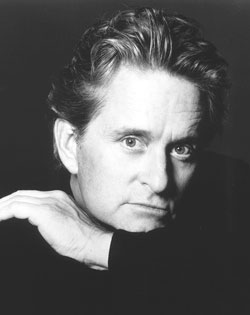
By Josh R
Did that get your attention?
When Mr. Copeland enlisted me as a contributor to this forum, he probably didn’t anticipate a post such as this — I think I’m supposed to be more informative than confrontational (trusting sort that he is, he overestimates my better instincts). Well, I can’t always take the classy route. This piece may contain some actual information, but it’s mostly just an old-fashioned hatchet job. Sometimes I like to get up on my high horse and kick up a little mud in people’s faces, especially when I feel such a response is merited.
I guess we’re at the point now where we can legitimately (if somewhat grudgingly) refer to Michael Douglas as a Hollywood legend. So maybe the guy doesn’t have the acting chops of a Dustin Hoffman or a Robert De Niro — or the sex appeal and glamour of a Robert Redford or Warren Beatty. Perhaps he can’t rival any of these gentlemen in terms of old-fashioned movie star charisma. OK, he definitely can’t. Still, one can make the fair argument that he’s earned his place in the pantheon. He is an Academy Award-winning actor and producer whose career spans more than 30 years. In a business where the careers of many actors of his generation have fallen by the wayside, he has weathered an unusual number of flops and misfires to retain his status as an A-List marquee attraction. His résumé also has included its fair share of hits, of both the critical and commercial variety. If the bulk of his work hasn’t demonstrated much beyond a solid professionalism, he has, on occasion, shown himself to be a talented and resourceful actor. He is a mainstay of Hollywood social circles, a mover-and-a-shaker, son of Kirk, and husband to Catherine Zeta-Jones. Whether you like the guy or not, he is, without question, a star.
Which is why it may come as something of a surprise that the man has been rejected by more women than any other man in the history of Hollywood.
It’s not his love life I’m referring to — in fact, reputation holds that he’s done fairly well in that department (to the point that his pre-nuptial agreement with Ms. Zeta-Jones is known to include an infidelity clause). The rejection that Mr. Douglas has suffered at the hands of Hollywood’s female acting elite has been of a professional nature — and, on at least three (and possibly four) occasions, it appears to have been deserved.
The lead role in One Flew Over the Cuckoo’s Nest, produced by Mr. Douglas and for which he received the Academy Award for best picture, was turned down by (in alphabetical order) Anne Bancroft, Ellen Burstyn, Colleen Dewhurst, Faye Dunaway, Jane Fonda, Angela Lansbury, Jeanne Moreau and Geraldine Page. Most of the actresses cited personal reasons for their refusal, ostensibly because of the nature of the material.
Ken Kesey’s novel had ignited a firestorm of controversy upon its publication in 1963, mainly due to its depiction of the character often referred to only as "Big Nurse," the sadistic ogre who presides over a mental ward populated by male patients. In Nurse Ratched, whose ugly countenance was described in almost as much detail (if not as frequently referenced) as her large, fleshy tits, Kesey had fashioned an interpretation of the female authority figure as an emasculating control freak, with no attempt to understand or get to the root of her behavior. As written by Kesey, critics observed that the character had about as much dimension as the Wicked Witch of the West. Since the novel’s debut on the best seller list coincided with the advent of the women’s movement, feminist activists had a field day denouncing what they (correctly) perceived as a monstrous disservice to the cause of women’s advancement in the professional arena. At the end of the novel, Ratched is raped by McMurphy — as imagined by Kesey, the assault is less an act of violence than an act of justice, retribution for her "rape" of the inmates in her charge. It’s a rape that the reader is supposed to cheer for.
Needless to say, by 1975, this wasn’t going to fly, so Douglas and his collaborators had to soften the material considerably. The character’s fiendish, subhuman bullying (with accompanying grunting) was replaced with a more subtle form of villainy, and the rape was jettisoned in favor of strangulation. Nevertheless, no major actress of the period was willing to go anywhere near it — some demurring politely, others expressing
 indignation that the film was being made in the first place. Joanne Woodward was never offered the role of Nurse Ratched — the story goes that she’d already taken herself out the running with a preemptive strike before the production team had even had the chance to approach her. Having gotten wind of the fact that her name had been bandied about in a casting session, she reportedly told Douglas that not only had she no intention of taking the role, she had no desire of even seeing the finished product. The role eventually was filled by an unknown, Louise Fletcher, who won an Academy Award for her performance before promptly returning to obscurity. The previous year’s winner, Ellen Burstyn (who had been among the first to take a pass on the film), went on television and asked Academy members not to vote in the best actress category to protest the lack of good roles for women. Fletcher later related to The New York Times, in reference to a conversation she’d had with Burstyn after the latter’s comments, “She hadn’t even seen Cuckoo’s Nest because she thought it would be too painful an experience. I told her that I thought it would have been nicer if she’d said what she said in a year when she had been nominated.”
Fatal Attraction is perhaps Mr. Douglas’ best-known and most influential film as an actor — for you young’uns out there, it’s about a basically decent guy who cheats on his angelic, idealized homemaker wife with a high-powered cosmopolitan book editor who turns out to be a raving psychopath. General chaos ensues — knives are wielded, children are kidnapped, cars are splashed with acid and beloved household pets are tossed into the crock pot. The role was turned down by Isabelle Adjani, Barbara Hershey, Miranda Richardson and Debra Winger. Richardson, a relative unknown whose involvement with the film might have propelled her to stardom, publicly stated that she found the script “regressive in its attitudes.” While the LA Reader’s John Powers was among those who saw the film as being “about men’s fear and hatred of women,” The New Yorker’s Pauline Kael went a step further in declaring “the film is about men seeing feminists as witches, and the way she’s presented here, the woman is a witch…she parrots the aggressively angry, self-righteous statements that have become commonplaces of feminist fiction, and they’re so inappropriate to the circumstances that they’re proof she’s loco.”
Unlike Cuckoo’s Nest (and Basic Instinct, which I’ll discuss presently), the producers didn’t have to resort to drafting an unknown actress to fill their star role. Glenn Close, who found herself in a bit of a career cul-de-sac after being typecast as the virgin mother (The World According to Garp), the nurturing, all-giving earth mother (The Big Chill), and quite literally, a glowing Madonna (the living embodiment of goodness and decency in The Natural), was desperate to break out of the holding pattern. She aggressively courted the role in a calculated risk that paid big dividends, earning an Oscar nomination for the performance. She’s been happily playing bitches ever since.

The impetus for this piece was seeing Basic Instinct again fairly recently — Douglas’ next monster hit after Fatal Attraction. I’m not sure what I was expecting, although it seemed diverting enough way back in good old 1992. For anyone who hasn’t had the “pleasure,” it’s basically the same deal as Fatal Attraction, only with an S&M twist and a cold-blooded gal who has no ability to love instead of a pathetic one who loves too much. Once again, audiences encountered a high-powered professional woman (in this case, a best-selling author) who is a sexual predator and sick as all get-out. Sharon Stone deservedly became an overnight sensation on the strength of her performance as Catherine Tramell, the ice-pick-wielding loony/white-hot fuck machine who inspired a thousand beaver jokes, thanks to the infamous and oft-parodied scene where director Paul Verhoeven invites the audience to rubberneck his leading lady’s privates. The actress had been knocking around Hollywood for many years, getting regular work without getting anywhere in particular, until she landed the role that would vault her into the bigtime.
As good as she was, her casting probably represented the last resort of an increasingly desperate production team. Kim Basinger, Michelle Pfeiffer, Julia Roberts, Demi Moore, Meg Ryan, Virginia Madsen, Lena Olin, Greta Scacchi and Emma Thompson all said no — whether their reluctance had more to do with the copious amount of female nudity the job required than the quality of the script and the nature of the character remains to be seen. In any event, the film became the subject of much protest as the result the character’s sexual orientation — which could be more accurately described as pansexual than bi. The film’s detractors claimed that the filmmakers not only viewed bisexuality as a perversion, but went so far as to equate it with sociopathic behavior. Gay and lesbian activists picketed while the film was shooting on location in San Francisco, requiring the deployment of police riot squads, and the controversy had already gotten a great deal of coverage before the film had even opened.
Having seen the film again recently, I do not find that it is offensive to gay people. I believe that it is offensive to all people. Not surprisingly, given the participation of Mr. Douglas, it is particularly insulting to women, particularly of the white-collar working variety. In addition to its insistence that there is something inherently evil about female sexuality, the film presents us with a secondary female character, a psychologist played by Jeanne Tripplehorn, who is not only completely incompetent in a professional capacity but a total doormat in her off hours. Her irrational attachment to Douglas’ character, who treats her like shit even when he’s making love to her (if that’s what it can be called, given the rough and graphic nature of their sex scenes), not only overrules her judgment and professional code of ethics, but leads to her eventual demise. And, yeah, turns out she also swings both ways. Dude…it’s hot!

If these three films provide us with a virtual who’s who of Hollywood actresses (at least in terms of who had the good sense not to bite), they don’t represent the only contribution Mr. Douglas has made to advancement of women’s rights during his long tenure as a leading man. As far as I know, Demi Moore was the first choice for the lead in Disclosure, which would serve to reason given her status as the top female box office attraction of the early '90s, after Julia Roberts. As such, there is no list of conscientious objectors to report, which might create the false impression that the film’s content is of a less incendiary nature than the other films discussed here. Actually, it’s probably the most corrosive of the bunch. Barry Levinson’s adaptation of the Michael Crichton novel plays to the popular male paranoia that not only are women trying to take away their jobs, they want to rip off their balls in the process. Once again, Douglas plays a basically decent guy who is passed over for a promotion in favor of the castrating bitch essayed by Ms. Moore, who becomes his new boss. Prowling through the corridors of power in stiletto heels and leaving a tiny trail of stab wounds in her wake, this dragon lady has no sooner started lashing the whip than she initiates an aggressive campaign to get into Mr. Douglas’ pants…much to his discomfort and embarrassment. It’s an exercise in role reversal that actually serves to trivialize the issue of workplace sexual harassment rather than shed any new light on the subject. The scene in which Ms. Moore throws Douglas up against a desk and starts shoving his cock in her mouth above his protests would be ludicrously funny in a high-camp way if it didn’t leave such a foul aftertaste (no pun intended).
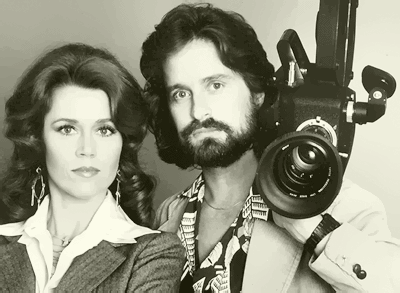
The tenor of this piece might suggest that I nurse a deep and abiding hatred for Michael Douglas — as both an actor and as a member of the human race. This is not the case — I have nothing against the guy. He has made some highly enjoyable films — Romancing the Stone and The War of the Roses always have been particular favorites of mine — and his turn as a rumpled professor experiencing a midlife crisis in Curtis Hanson’s Wonder Boys probably represents his best acting work to date (although his performance as greed incarnate in Oliver Stone’s Wall Street still commands a devoted following). I’m not really even trying to suggest that Michael Douglas actually is sexist. Putting aside the content of these films, there really isn’t anything to indicate that, as a private citizen, the man has a lack of respect for women and isn’t sympathetic to the issues that affect them. In his defense, it should be noted that he also produced The China Syndrome, which showed a strong, sympathetic female protagonist who refuses to accept the limitations imposed upon her by the powers-that-be, and proves her mettle and her integrity as a journalist.
That said, there’s no denying the fact that Michael Douglas has been involved with some of the most blatant exercises in anti-woman propaganda that the modern cinema has produced. I’m not one of those watchdogs who goes into a tizzy over any perceived instance of political incorrectness — frankly, I think most people are waaaay oversensitive about that kind of thing — but when you look at the kinds of films Michael Douglas has done, you’ve gotta wonder what’s going on in his head (beyond “Damn, I’m married to Catherine Zeta-Jones!”). If he had made just one of these films, I probably wouldn’t think much of it, but the fact is, he was involved with all four of them — and you’d be hard-pressed to find any four films made in the last 30 years which provoked more outrage on the part of feminist advocates. Whether this particular feature of Mr. Douglas’s career is the result of bad judgment or simply bad taste is open to debate, but in any event, it does seem to indicate a certain level of insensitivity (or at least lack of consideration) on his part. He seems to have been on his best behavior for the past decade or so…maybe Catherine managed to get some veto power to go along with the infidelity clause.
Tweet
Labels: B. Levinson, Bancroft, Barbara Hershey, Burstyn, Debra Winger, Demi, Dunaway, Emma Thompson, Geraldine Page, Glenn Close, J. Fonda, Julia Roberts, Kael, Lansbury, Pfeiffer, Sharon Stone
TO READ ON, CLICK HERE



