Monday, April 02, 2012
The Larry Sanders Show Season 3 Ep. 10: Like No Business I Know

By Edward Copeland
Forgive my tardiness. So many projects and real-life issues injected themselves in the way that now, nearly a year later, I'm finally getting around to recapping the second half of the third season of The Larry Sanders Show. I've set a deadline for myself, so I WILL finish this and the remaining three seasons before August. It's been such a long time since I recapped a Larry Sanders season, I can't remember if I made this point before: How can anyone who watched this show then go on and on about the pale imitation that's called 30 Rock? Since it has been a long time, you can read Part I of Season 3 by clicking here. Also, I'm shaking things up a bit. Instead of trying to cover an entire season in one post, I may cover a single episode or just a few episodes, as I'm doing with this first one back, the memorable "Like No Business I Know" that plays off the then-recent incident of comedian Bobcat Goldthwait setting the guest chair on fire on The Tonight Show With Jay Leno at the same time that Hank's wife Margaret pushes him to look toward greener pastures when Regis Philbin tries to steal him to be his sidekick on a late night talk show that Philbin has been offered. It's yet another great third season showcase for Jeffrey Tambor with a lot of classic Artie moments for Rip Torn to bite into as well. That way, for the particularly great episodes — which we see with increasing frequency as the show goes on (something rare for most series) — I can go into more detail instead of the paragraph or two summaries I had to make do with in the recaps of Season 1 and Season 2 but which I'd moved away from in the first half of Season 3. It won't take me any longer (as when I do a detailed Boardwalk Empire or Treme recap or what I could have done with Luck recaps if the behind-the-scenes situation wasn't such a chaotic mess that I lacked the necessary support to do them the way I like) and probably will encourage me to conclude them faster.
We open with the TV in Larry's office playing the May 1994 Tonight Show With Jay Leno incident when Bobcat Goldthwait (once Larry's choice to host the talk show that follows him, if you recall) set the guest chair on fire and Leno tries to force him to sit in it. Larry comments with a smile on how pissed off Leno seems to be. (The YouTube clip above covers most of this.) "That Bobcat has serious mental problems," Artie says. "I think he's got incredible balls," Paula adds. "He's got something," Artie replies as he stops the tape and turns to Paula and urges her not to say "balls." "Men find that off-putting," he advises. (YouTube clip ends here.) Larry posits that what happened was that Goldthwait went on Arsenio, ransacked the set and the show received lots of press and that's why Leno booked him. Paula begins as each of the trio refers to the NBC show's staff as "whores" winding up with Artie asking, "Is Bobcat here yet?"
It's that rhythm, timing and straight-faced hypocrisy that continues to make this series my favorite comedy of all time. Certainly some of the specific references might have grown dated, but because the actors develop actual characters, if you don't know the incident in question, it doesn't matter. As Rex Reed tells Larry King on the radio at the opening of Albert Brooks' Lost in America, "If it's really funny, I'll laugh." This episode was co-written by Peter Tolan, executive producer and writer or co-writer of many of the classic episodes, and Mike Martineau, writing only his second teleplay ever, the first being the episode "You're Having My Baby" from earlier in the season. The show's most frequent director, Todd Holland, handled the helming duties.
Continuing the conversation, Paula informs Artie that Goldthwait has arrived as well as the night's other guests — Michael Bolton and Regis Philbin. Artie sternly wants to make sure that Paula emphasizes to Bobcat to behave himself and she tells him the comic promised he'll be zany and wacky but the sets will remain intact. "Well, I like pranky stunts — you know that — but if I wanted to see furniture destroyed or our set ablaze, I'd go over to Jimmy Caan's place," Artie declares, prompting a quizzical look from Larry.

What would an episode of Larry Sanders be without at least one classic Hank Kingsley line delivered by the masterful Jeffrey Tambor. Hank has enlisted some of the crew to inspect the couch on the set because, according to Kingsley, last night during the middle of the Helen Hunt segment a spring "went straight up my ass." Hank finds it and asks the men to fix it for him before the night's show. "Thank you. My ass is my fortune," he tells them. Hank then goes to complain about the microphone he uses to
 warm up the audience before the show starts, claiming there's a lot of treble, but no bass. Before he can go off on the sound guy, Regis Philbin wanders onto the stage to greet him. Regis asks if he can speak with Hank somewhere privately. Once the two get behind the seats, Philbin inquires as to how things have been going for Hank on the show. "Well, I'm the luckiest man in show business. Everyone says so and I have to agree," Hank responds. Regis informs Hank that he's been offered his own late-night talk show because his demographics rank better than any of these "young punks" such as Leno and Letterman and it would be a network show covering 85% of the country in three weeks. Hank congratulates him, but Philbin hasn't finished — he wants Hank to be his sidekick. Hank reluctantly declines, telling him that he's honored even when Philbin tells him that he can top whatever he makes with Larry. Hank gets nervous and tells Regis that he's running late for lunch with his better half. "Larry?" Regis assumes. Hank corrects that he meant his wife, Margaret, who gets mad, which he quickly amends to disappointed. Philbin asks him to keep thinking about his offer.
Larry and Artie take turns coming in to kiss Bobcat's ass in his dressing room. Sanders wants to know all the gritty details about The Tonight Show incident and Goldthwait shares them, including some slight burns he got on his ass. "I don't want to toot my own horn, but I was pretty proud that I could get some jokes off while all this was going on," Goldthwait admits. Larry asks if he'll want to talk about The Tonight Show incident on the show and Bobcat tells him that his lawyers have advised him that he shouldn't say anymore about it. Larry claims that he understands and doesn't get what the big deal was anyway, though he can't help but ask how pissed Leno got. "He fuckin' snapped," Goldthwait tells him. Rip Torn does his best twirling Artie, buttering the comic up one minute about how he loved his movie about the clown. "I'm just a sucker for drunk clowns" before switching emotional gears and threatening him because the fabric on the guest chairs isn't manufactured any longer, those giant letters that spell out LARRY cost more than you'd think and "Don't get near my fuckin' plants. They're my babies." Then, in a split-second, glad-handing Artie returns to exit the room with a cherry, "See you on television," leaving the comic on the couch stunned and muttering, "Jesus Christ."

Hank, of course, dances his way to his office thinking he could be king of the world and we get another great appearance by the late longtime character actor Phil Leeds (78 when this episode aired) as Hank's agent Sid Bessell. Hank sings his way to his agent and kisses him. "Hank, please, I'm your agent, not your mother," Sid protests. "You're my mother," Hank responds. "OK, I'm your mother," Sid relents. Hank asks why Sid has made an appearance and the agent tells him that Kingsley's wife Margaret called and said
 that he wanted to see him. Hank pauses before unconvincingly claiming that he asked her to do that. He then fills Sid in on Regis' job offer, but Hank isn't considering taking that. He suggests to Sid that if Regis leaves his morning show maybe it could become Live With Hank and Kathie Lee. Sid tells him that wouldn't be a smart move since The Larry Sanders Show is his base. "Where did you come up with such a farkuckt idea?" Sid asks. Hank tells Sid he came up with it over lunch and Sid guesses correctly that Hank's wife was present. "The last time I had lunch with my wife we ended up redoing the living room in a pattern that I'm not allowed to sit down on," Sid tells him. Hank insists that the decision comes from him when his phone beeps and Darlene announces that Margaret is on the line. Hank tries to whisper to her, but then asks Sid for privacy. "You realize I'll have to get up," the old man complains, but Hank makes Sid go and the agent slowly treks to the office door.
Artie briefs Larry before the show with some classic Artie lines. "If he touches my plants, he dies. I will move swiftly. He will be dead," Artie tells Larry. "Good. So you gave him just the normal welcoming speech," Larry says. Artie then lets Larry know that he has Hank news to share. "What's wrong with him?" Larry asks. "Not enough oxygen to the brain as a fetus. That's my first guess," Artie replies before telling him the real story about Regis trying to steal him away because of Margaret's meddling. Larry, always content to stay out of the loop, tells Artie just to handle it. "You don't want to know how I handle it?" Artie asks the host. "No — just handle it," Larry replies as he steps into the makeup chair, having finished one of the show's almost-patented

(for TV at least at that time) tracking shots. Larry wonders aloud what happened to Margaret — he thought she was quiet and sweet. "She was," Artie agrees. "What changed?" Larry asks. "He married her," the producer answers. Artie then calls Hank into Larry's office (without Larry) and demonstrates his amazing ability to know everything that's going on with Hank, much to Hank's amazement. Kingsley keeps trying to leave, but Artie continues to order him to sit back down. Anytime you get one-on-one scenes between Torn and Tambor, the viewer knows that hilarity, often painful hilarity, awaits. I imagine writers on the show felt blessed anytime they could put these two actors in a room together alone. "If I was pussy-whipped, you'd be talking to me the way I'm talking to you
 now," Artie tells Hank, setting Kingsley off. Artie doesn't relent, admitting he never liked Margaret. "She looks at you like you she has X-ray vision. Gives me the creeps," he tells Hank. Hank defends Margaret, saying she loves him very much and thinks he deserves more than he's getting and he thinks she's right. "And that thing with her eyes — that is a severe astigmatism, OK?" Hank proclaims. "I'm sorry. Don't get me wrong. She's a lovely girl — but I can't allow her to lift her skirt for every other show that comes along!" Artie shouts. Hank quits. He says he'll do that night's show because he's a pro but then he's gone. "And let me tell you another thing. You do not apply the term pussy-whipped to Hank Kingsley. He has never been nor never will be whipped by anything — let alone a pussy," Hank declares just as Beverly hands Kingsley a note from Margaret that she says is urgent. Artie grins widely. Hank crumples the note and throws it on the floor. "See that? I'm really pussy whipped," Hank says to Artie before quietly asking Beverly if Margaret called from home or the car then saying loudly, "Like I give a shit."
Of course, the funniest recurring gag of the episode turns out to be making Bobcat Goldthwait appear to be the most normal person in the Larry Sanders studio and offices. As Hank storms back to his office, Phil and Bobcat walk in and Goldthwait innocently asks Hank how it's going and how his wife is. Hank stops. "You're the one who plays a real kooky guy, right? In your act? Now, you wanna see something really kooky? Ask me about my lady again," Kingsley snarls at him and stares for a moment before walking off. Bobcat whispers to Phil, "Guy's a fuckin' wingnut." In his office, Sid gives Hank the bad news that he phoned Kathie Lee and she doesn't think their pairing would work because she hates Hank and she made reference to a 1979 auto show in Buffalo where Kingsley locked her in the trunk of a Camaro "for laughs." Hank melts down because he thought that was Cathy Lee Crosby. Hank tells Sid he already quit, so his agent suggests that he go to Regis and take the sidekick job. "Can you live with that? More importantly, can your wife live with that?" Sid asks his client.

Backstage, preparing for the show, Bobcat entertains Beverly and Darlene informing them that he may face community service such as visiting children in a burn ward to warn them about the dangers of fire. Wouldn't I be the last person you'd want to see coming down the hall if you are in a burn ward, the comic suggests when Larry drops in on the gathering, sending the female staffers scattering. Goldthwait notices that Regis also will be a guest and mentions that he really wants to do his show. Larry asks why. First, Bobcat claims it's because he's a morning person. "No. Actually I want to do the show because I have this idea. What I want to do is I'm gonna have a big meal — a big Denny's Grand Slam — eat as much as I can. Eat some pork and everything 'cause I'm a vegetarian. And then the idea is I'm gonna have some ipecac in a coffee mug — that's the stuff that induces vomiting, So the first time, you know, I hear 'Cody,' I'm just gonna take a big fuckin' swig off it and boom! I'm gonna projectile-vomit all over Kathie Lee," he explains to Larry. "Hilarious," Larry says nervously. Aside from the basic thrill it would be to see that happen, Garry Shandling actually rules this scene by his reactions which begin as polite listening then slowly turn to a horror that he tries to mask behind his smile. Shandling's wordless acting makes me laugh almost as much as Bobcat's proposed prank. Goldthwait adds that he wants to hit Regis as well so he isn't perceived as sexist and Larry suggests trying to get Gelman while he's at it. "No, I don't have that kind of range," Bobcat admits.

Sanders wanders over to the other Sid, his cue card guy, to go over the monologue and again touches base with Artie on how things seem to be going. "Michael Bolton has a slight head cold. He's going to sing anyway," Arthur informs him. You really had to endure the awfulness of Bolton's songs to get the subtlety of that joke. Imagine if American Idol had existed when Bolton tried to leap from songwriting to performer. How fast do you think his ass would have been kicked out? William Hung would have lasted longer. Larry asks about the Hank situation and Artie cryptically tells him the situation has been resolved. "He offered a solution. I accepted," Artie says. Larry inquires about anything else and Artie informs him that his fly is open. Larry thanks him as he zips up. "Don't mention it. Part of my job," Artie declares. "Looking at my crotch?" Larry responds. "I consider it a perk," Artie replies before disappearing behind the curtain. Hank comes skipping by and lets Larry know that what has transpired has nothing to do with the two of them and he will go out there and give it his all. Larry, clueless as to what's really going on, tells Hank that he knows that there was a problem but a solution was found and he couldn't be happier with the outcome. "You are cold, baby," Hank declares before heading through the curtains.

Larry finishes his segment with Regis and makes a beeline to Artie at his monitor. He tells his producer that Philbin made him really uncomfortable and he doesn't want to have him on anymore if he's going to come and try to steal Hank. Artie seems more concerned that Bobcat is up next and could be "a loose cannon." He seeks permission to "get my baby elephant palm off the set. I raised it from a mere nut." On the couch, Hank tells Regis he's been thinking about it and he's in. Regis is thrilled. Hank asks when he's signing the contract and Regis says next week as Artie appears behind them half-listening, half-arriving to secure his plant. Once Artie exits again, Hank says he's ready to start as soon as Philbin wants him. "That's great. We're going to start in fall of '97," Regis informs him as Hank gets a stricken look on his face (this was taking place in 1994). Hank asks when he's leaving the morning show and Regis answers when his contract expires — in the fall of '97. Regis wouldn't leave now — that's his base. Hank, looking sicker and sicker, inquires if Regis' wife ever gives him advice and Philbin replies, "No, never. Why?" Hank wanders off the set looking as if he's about to vomit — which he does — right in Artie's precious elephant palm.


They return from commercial and Bobcat has taken his place in the guest chair. Of course, despite what they agreed upon earlier, the first thing Larry brings up is The Tonight Show. "Well, to be honest, I'm facing a year in jail and I didn't really think you were going to bring it up," Goldthwait responds. "Well, we don't have to if you don't want to," Larry says. "No — I distinctly said I didn't want to," Bobcat declares, sounding angrier — or is it an act? Larry smiles and suggests they talk about something else then but still adds, "I was just curious why you did that thing on The Tonight Show." Goldthwait starts rolling his eyes. "Well, it worked.…That's why you have me here now," he says. Larry swears that's not true and that they are big fans of his. "Oh, that's bullBLEEP," Bobcat replies. You gotta love it. The show's language has no boundaries but since this takes place during the mock talk show part, they do censor the shit. Goldthwait starts knocking a plate off Sanders' desk. "See that's why you had me on. Here go crazy. Go nuts," he yells as he overturns Larry's desk. "Dance for us, monkey boy, dance!" he sings as he bounces around sending Larry to the edge of the set and getting Regis to his feet. Bobcat then throws Larry's chair through the set's backdrop, but when he grabs one of the plants, Artie appears like a lightning bolt and tackles the comic to the couch. "This is usually when they go to a commercial," Goldthwait declares as Artie glares down at him. "We'll be right back with Michael Bolton. Right after this break, Michael Bolton," Larry announces.


Backstage, Larry lectures Bobcat, telling him that Leno was right. He thought he would stick to the questions. Someone could have been hurt. Goldthwait apologizes, saying he thought it would be funny. "Here's the man you should be apologizing to," Artie tells Bobcat as Hank brings Sid up in a wheelchair. "I'm sorry. I didn't know you were there," Goldthwait admits to Sid. "One minute I'm standing behind the curtain eating a mint. The next thing I know I've got a cardboard mountain up my ass. You young people don't know what funny is. Eddie Cantor was funny. If I didn't have arthritis, I'd knock you right on your ass," Hank's agent declares, pointing a judgmental finger at Bobcat. Artie decides to escort Bobcat to his dressing room "in case you get the urge to push a Coke machine over on Michael Bolton." Goldthwait, still shy and regretful, admits, "I wouldn't do it if it wasn't televised." After they leave, Sid tells Larry that Hank has something to say. He tries to get words out about being a mess and about his marriage but Larry tells him everything is fine and he'll see him tomorrow night, still completely in the dark as to what has transpired. Hank asks Larry to tell Artie for him.
When Larry gets to his office, Artie awaits. "So you know Hank is staying. Does that mean something to you?" Larry asks. "I'll bet he is. He found out Regis' show doesn't go for three years. What did you do — hire him back?" Artie inquires. Larry stops for clarification and Artie
 explains that Hank quit earlier that morning. Larry complains that he didn't know that. Artie reminds him that he didn't want to know about things like that, though Larry amends that to people quitting. When Artie starts to give the pussy-whipped play-by-play, Larry doesn't want to know anymore as long as Artie handled it. Regis pops his head in and comes in to tell the two what a great time he had on the show. "Hey, that Bobcat is wild. You know what I did? I asked him to come on our show in New York next week," Regis shares. "Oh good. You're gonna have fun," Larry says with a devilish grin. Philbin adds that he can't do the same kind of stuff since they are a morning show, but he's promised to be a good boy. "Well, if he promised you, I don't think you have anything to worry about, but I'd tell Kathie Lee to stay about 10 feet back," Larry suggests. As Regis leaves, Paula comes in swearing that Goldthwait promised he wouldn't do anything, but Artie tells her that they'll talk about it in the morning. Larry shuts the door. "This is going to be all over the press in the morning. How is that going to make us look?" Larry asks. Pause. Artie grins and laughs and the producer and the host shake hands over the success of a job well done. Another keeper from the third season.
Tweet
Labels: 90s, Albert Brooks, Boardwalk Empire, Caan, HBO, Larry Sanders, Letterman, Luck, Rip Torn, Shandling, Tambor, Treme, TV Recap
TO READ ON, CLICK HERE


Thursday, February 09, 2012
Gosling stays in right acting lane

By Edward Copeland
When I reviewed The Ides of March about two-and-a-half weeks ago, what impressed me most was the re-emergence of the old Ryan Gosling, the talented actor who captured everyone's attention in the first place before his performances became lost in a torrent of tics that blanketed his characters behind a shroud of phony fog. Now I've caught up with Drive and am pleased to report that The Ides of March wasn't a one-film fluke. I wonder if this means I should give Crazy, Stupid, Love a chance.
Gosling was great in Ides and he's great in a completely different type of role in Drive. I haven't caught up with The Artist yet, but Gosling's character in Drive (known simply as the Driver) is a man of so few words, he could be from a silent film. He's a man of few words, making his living as a movie stunt driver by day, a getaway driver by night.
Driver never carries a gun and Shannon (Bryan Cranston), the crippled body shop owner who sets him up with his daytime and nighttime gigs, provides the cars Driver uses for his getaway work. Shannon also can't give up on dreams — and he's never seen someone who drives as well as Driver — so Shannon envisions him as his ticket to a successful stock car career. All that's missing is the money to fund it. There's good news and bad news on that front. The good news is that Shannon has a longtime friendship with a businessman with deep pockets. The bad news is that he's Bernie Ross (Albert Brooks), a big time mobster in the L.A. area who also has friends such as the shady Nick (Ron Perlman), who uses a pizzeria as a front for his many criminal operations and broke Shannon's body in the first place.
Bernie insists on meeting Driver first, so he gives him a demonstration of his driving skills. He impresses Bernie — not enough to give Shannon all the money he wants, but $300,000. After his display, Shannon introduces Driver to Bernie, who extends his hand. Driver just stands silent, not moving to take it. After an awkward moment or two, Driver says, "My hands are dirty." Ross smiles and replies, "So are mine" and they shake.
Driver's mysterious existence has grown more complicated on a personal level. He has taken a liking to Irene (Carey Mulligan), a woman who lives on the same floor of his apartment building, and her young son, Benicio (Kaden Leos). Driver and Irene inevitably end up involved, though soon her husband Standard (Oscar Isaac) gets released from jail and returns home. One thing that's refreshing about Drive, which was written by Hossein Amini and based on a novel by James Sallis, is that it doesn't follow the usual template where the ex-con husband is an abusive ass. Instead, upon Standard's release, he's hassled by hoods who want either his money or his criminal help.
To go much further into the details of the jagged twists that connect all the characters, would ruin much of the the movie's suspenseful fun. Director Nicolas Winding Refn doesn't let Drive sit in idle for long (if ever) from the moment it starts. Some of the violence proves to be quite shocking while Amini's screenplay comes loaded with quite a few laughs (It's also a big change of pace for the writer whose first feature credits were Jude and The Wings of the Dove).
The cast gives Drive the fuel it needs to really power this vehicle, especially from the performers going against type. Cranston already has wowed TV viewers his amazing range when he went from the loopy dad on Malcolm in the Middle to one of dramatic television's all-time acting tours de force as Walter White on Breaking Bad. Shannon allows him the opportunity to create yet another original character in the body shop owner with big dreams and worse luck.
Perlman has a knack of creating scarier roles when he's not wearing any makeup and just playing a world-class asshole such as Nico as he does here. There are a couple scenes that bounce Cranston, Perlman and Albert Brooks off each other that are just hysterical.
Which brings us to Brooks, cast against type as a smooth, intimidating criminal kingpin. When I wrote my 25th anniversary tribute to Lost in America, in describing Brooks' character David's meltdown after his wife loses their savings at roulette:
It might seem an odd comparison, but many critics always made much of the slow burn Joe Pesci can make as an actor, from calm to explosive and in at least one scene here, I'd argue that Albert Brooks is the comic equivalent of that turn-on-a-dime Pesci skill. After the Howards exit Vegas, they head out in the RV, uncertain of where to go or how to make do with a little more than $800 left to their name. Linda keeps apologizing profusely, but David stays eerily calm — until they arrive at the Hoover Dam and Linda suggests they stop and check it out. "Nice dam, huh?" David says. "Do you want to go first, or should I?" The dam doesn't burst, but boy does David, first outside and then inside the Winnebago, when Linda insists the public not watch the fight.
Interestingly enough, as great as Brooks is as Bernie Ross in Drive, that's not exactly how he chooses to play him. Brooks isn't just cast against type, but he plays him in a way that I didn't expect him to either.
The only person who disappointed me to some extent was Carey Mulligan. After her star-making turn in An Education brought her to prominence and her solid followup work in the so-so Never Let Me Go, Irene seemed an underwritten, underdeveloped role for her to take. I haven't seen what she's like in Shame yet.
Gosling though steers Drive from beginning to end. His portrayal of Driver can be downright chilling when that stillness and silence suddenly erupts. I hope Drive and The Ides of March really shows that Gosling has realigned his craft, though I do worry about that new Terrence Malick film in which he's been cast.
Tweet
Labels: 10s, Albert Brooks, Breaking Bad, Carey Mulligan, Cranston, Gosling, Malick, Pesci
TO READ ON, CLICK HERE
Saturday, September 10, 2011
How did you like the tribute to Garry's show?

By Edward Copeland
What's fascinating about diving into your past via episodes of a television series you remember fondly but have had no contact with in decades is knowing that you've changed, but the show hasn't. The moments of "It's Garry Shandling's Show." that I've treasured the most tend to retain what I liked originally, but watching the entire series in a compressed period of time really exposes its flaws. Hearing so many of the creative people echo my thoughts in commentary tracks that sometimes are brutal in their honesty made me feel that this particular side of a look back at the show required a separate post. If you missed the first part, where I discussed the show's ingenuity and my favorite episodes of season one, click here. For my favorite moments in season two, click here.
Before getting into the creative slide of "It's Garry Shandling's Show.", I thought it would be worthwhile to remember what scripted series on pay cable looked like when this show premiered 25 years ago today. At the time, it was Showtime's second original sitcom following Brothers, which premiered in 1984 and ran through 1989, and starred Robert Walden (Rossi on Lou Grant) as the owner of a bar trying to deal with the fact that his youngest brother (Paul Regina) has come out of the closet. Though HBO would eventually become the pay cable channel most associated with original series, their only sitcom venture to this point was the football comedy 1st & Ten, which also debuted in 1984, and ran for seven seasons with many incarnations and cast changes, including some seasons starring O.J. Simpson. Still, in the beginning, it was little more than an excuse to add nude women to the channel much like its thriller anthology The Hitchhiker, since its debut in 1983, was more about sex scenes than stories. Prior to those shows, both networks tended only to attempt scripted series of the sketch variety such as HBO's Not Necessarily the News and Showtime's Bizarre hosted by John Byner and co-created by Bob Einstein (best known now as the hilarious Marty Funkhouser on Curb Your Enthusiasm), which introduced Einstein's Super Dave Osborne character.
Now that I've watched or re-watched all 72 episodes of this series, I'm even more certain than I was in this tribute's first part that, not only has it been decades since I've seen the episodes I recall most fondly, but that many of the episodes, particularly in the mess that is the fourth season (something some of the show's writers openly acknowledge on commentary tracks), I never saw at all, since I was in college by that time, and I bet I'd given up on "It's Garry Shandling's
 Show." by then. My memory probably had chosen to block this out and only remember the show's early days of brilliance and innovation, forgetting when the series' nose-dive began. Plus, my memory of the six seasons of greatness that Shandling came up with soon after on The Larry Sanders Show made even the best of "It's Garry Shandling's Show." resemble an amusing trifle by comparison. I have to be honest: When I looked back at my notes on some episodes I watched just within the past few weeks, neither the titles nor my words registered details that reminded me what happened in that show. However, the series' importance can't be ignored even if it didn't maintain its initial level of excellence. That's because in many ways "It's Garry Shandling's Show." serves as a bridge between television's past, present (as in the mid- to late '80s) and future, not only in form but behind-the-scenes personnel as well. Between creators Garry Shandling and Alan Zweibel, Shandling actually had more experience when it came to writing situation comedies since that's how he started before he decided to become a standup comic, penning episodes of Sanford & Son and Welcome Back Kotter. In a way, "It's Garry Shandling's Show." resembled a half-hour sitcom version of an hour-long network series that premiered the year before — Moonlighting, which similarly broke the fourth wall and could change its format from week to week. I've already mentioned its link back to Burns and Allen, but in some respects it foretold the coming of Seinfeld. Two of its writers and later producers, Tom Gammill and Max Pross, who came from writing for Late Night With David Letterman, would go on to be writers and producers on Seinfeld, but even the premise of "It's Garry Shandling's Show." bears some resemblance to the later megahit. Garry Shandling plays a fictionalized version of himself, a standup comic, on a show that truly could be said to be about "nothing" and, as in the early days of Seinfeld, Shandling opened and closed each episode with a monologue, only instead of it being in a comedy club setting, he'd perform it for the audience in the "living room of his condo" in Sherman Oaks, California.
Others who worked on the show at one time or another who spanned generations of television comedy included veteran director Alan Rafkin, who directed every episode of the first three seasons of "It's Garry Shandling's Show." except for the last three episodes of the third season, and whose credits included work on The Andy Griffith Show, The Dick Van Dyke Show, Bewitched, I Dream of Jeannie, Get Smart, M*A*S*H, The Mary Tyler Moore Show, The Bob Newhart Show and many, many more, including an Emmy win for One Day at a Time. The legendary writer Sam Denoff, who died in July, served as a supervising producer in the second season. Actor-comedian-writer Jack Burns, who early in his career was part of a comedy act with George Carlin, and wrote The Muppet Movie, served as executive story supervisor in the first season and wrote its first really great episode, the fourth installment, "Foul Ball." In the final season, Albert Brooks' frequent writing partner Monica Johnson, who died last year, was a creative consultant and wrote two episodes. Merrill Markoe, David Letterman's one-time longtime girlfriend and a writer on both of his NBC shows as well as the attempt to revive Laugh-In in 1977, penned the "It's Garry Shandling's Christmas Show" episode that aired Dec. 17, 1987, which included a gag where Garry had to turn his living room upside down to search for a missing watch that was very reminiscent of Letterman's "360 Degree Rotation Show" from the NBC Late Night show on Dec. 8, 1986, though Markoe had left the Late Night staff by August 1986.


Of the younger crop of writers on the show or those who passed through and went on to bigger success later, in addition to the aforementioned team of Gammill & Pross, the show also welcomed the team of Al Jean & Michael Reiss, who had previously written for the short-lived cult fave Sledge Hammer! In a funny story on a commentary track, they tell how, while they worked on that show but before they were on staff at "It's Garry Shandling's Show.", Shandling was running himself ragged by being one of two regular guest hosts for Johnny Carson on The Tonight Show while working long hours on the sitcom. As a result, he often didn't have time to stay fresh on the news, so Jean & Reiss would sneak jokes to him at his real Sherman Oaks condo in the wee hours of the morning, scared to death that their Sledge Hammer! boss Alan Spencer would find out and fire
 them. Later they leaned that Spencer was doing the same thing. (One thing I learned that I didn't realize was the set for Shandling's condo was for the most part designed as an exact replica of the real place where he lived in Sherman Oaks at the time.) During the summer hiatus between the third and fourth seasons of "It's Garry Shandling's Show.", Reiss & Jean got work on a new upstart animated series called The Simpsons and they stayed with it through 2001. Gammill & Pross also would work as producers on The Simpsons, though they didn't come on board until 1999. One of Jean & Reiss' bosses at The Simpsons, co-creator and executive producer Sam Simon, passed through "It's Garry Shandling's Show." as a creative consultant and co-writer of three episodes in the second season, though Simon could hardly be called a newcomer since his TV sitcom credits stretched back to Cheers, Taxi and even episodes of Barney Miller and Fat Albert and the Cosby Kids. Another of the main writers, Ed Solomon, came with his main credit being the screenplay for Bill and Ted's Excellent Adventure, and he later wrote Men in Black. Many of the writers mocked writer-producer Jeff Franklin (previously a writer-producer on Laverne & Shirley and Bosom Buddies) for choosing to leave early in the second season to head a new family-oriented comedy for ABC, but Full House probably made him richer than all of them except Sam Simon. Of course, many episodes were written by Zweibel and Shandling, who had final call on the scripts no matter who wrote them. One person who didn't write any episodes but appeared as a whacked out character in the fourth season was none other than Paul Feig. On the show, he appears three times as the loony Chester, half-brother of the girlfriend (and later wife), Phoebe (Jessica Harper), that Garry gets that season. Feig still acts, but his writing is really what we treasure. He created the irreplaceable Freaks & Geeks and has directed episodes of many other TV series including Mad Men, Undeclared, The Office and Arrested Development. Earlier this year, he helmed the feature film Bridesmaids. The series was executive produced by Shandling, the late Bernie Brillstein and Brad Grey. Though Shandling and Grey later had legal fights, Grey also produced The Larry Sanders Show and The Sopranos.
In one of the interviews on the DVDs with Zweibel and Shandling, Shandling admits that the wacky tone of the show sort of grew organically. There hadn't been a grand plan to toss in crazy plot devices such as the way they played with time, like having Garry sit on his couch and suddenly be struck by a pile of rolled up newspapers, after which he'd say, "Two weeks have passed." The idea for Garry to have a tiny car came about when Zweibel just said at one point, "What if Garry had a small car that he drove from set to set?" These things added to the hilarity
 in the beginning as long as there was an underlying story that worked, but by the fourth season when Garry suddenly had a fly hat that turned him into the size of the insect so he could literally be "a fly on the wall," it just seemed to be an act of desperation because the episode's story wasn't working. In one of the commentary tracks, Ed Solomon admits that many of the writers "were ashamed" when they had to resort to devices and liked it better without the gimmicks. The freedom to do just about anything, Shandling says, meant that each week it felt as if they were re-inventing the wheel. Those out-of-nowhere moments in the first couple of seasons really added to what made the show so much fun. The car always worked and the way they accounted for time lapses were clever in the beginning, but by the time Garry had a "Flying Clock" (get it? "Time flies") to move things along in a fourth season episode, instead of laughing you were more likely to roll your eyes.
While the fourth season was more or less a complete loss, the show truly started losing steam in the latter part of the third season after two nearly peerless seasons. There were the inexplicable problems in the two really good years that seem to come with a lot of series, such as airing episodes out of order for no apparent reason. Now, in the case of "It's Garry Shandling's Show.", continuity wasn't really a concern the way it was when a series such as Homicide: Life on the Street did that and characters would be referred to as dead before the episode aired telling the audience they died. However, viewers could still tell as Scott Nemes, who played young
 Grant Schumaker, injured himself and had to use crutches, which would appear in some episodes, disappear, then reappear again, much like the year on The Larry Sanders Show when Janeane Garofalo's hair bounced back and forth between blonde and brunette. Zweibel and Shandling agreed during the third season that the show seemed to be in a rut and decided that in the fourth season, Garry needed to get a girlfriend who eventually would become his wife. On one of their commentary tracks, Al Jean and Michael Reiss are quite open about how they and most of the other writers on staff thought it was a bad idea, taking a certain pride that 20 years later (from the end of the series until they taped the commentary), they turned out to be right. I got confused whether it was Jean's voice or Reiss' who says it, but he describes it as looking like "a hack move by a conventional show." That's how the decision was made to add the talented Jessica Harper as interior decorator Phoebe Bass. Again, I can't be sure if it's Jean or Reiss who said this, but he describes Harper as always looking sad and unhappy to be there between takes. It probably didn't help that inside jokes started being sneaked into the show referring to the fact that in real life Harper was married to top Fox executive Tom Rothman. In the most blatant example, they had taken actor Richard Fancy (Mr. Lippman at Pendant Publishing on Seinfeld), who had been the all-purpose boss or bureaucrat (at the DMV or a travel agency), and turned him into the network president Mr. Stravely. In the fourth season episode where Phoebe's half-brother Chester (Paul Feig) talks him into giving him a TV show, Stravely insists that he work in a role for his new wife Edie Adams. (In another Stravely moment from the first episode of the fourth season that coincidentally foresees a Seinfeld storyline, Stravely objects to the idea of Garry getting a girlfriend and suggests that he add a butler character instead.)
Jean and Reiss also blame the show's eventual airing on Fox as well as Showtime as part of what ultimately doomed the series. It showed first as reruns in 1988, but eventually to the point that Fox caught up, though the network killed it in March 1990 and Showtime continued to air some new episodes after that. Prior to that, the creative team behind "It's Garry Shandling's Show." didn't worry about ratings or where commercials would go. In that same commentary track, they recall Zweibel coming to the set one day lamenting that in the Nielsen ratings the show ranked 99 out of 100 shows. You could even tell by the way Garry the character
 spoke to the camera that he had regrets about the way things had gone, saying things such as "If you've been keeping up with the show and I assume that you haven't," or during another fourth season episode, declaring in a scene, "People are at home switching the channel right now." In fact, in some episodes it could hardly be called Garry Shandling's Show because he seemed to make sure to have as little to do with it as possible, making brief appearances at the beginning and end of two episodes when he was supposed to be opening for Guns 'N' Roses, and in the second-to-last episode appearing at the opening in a hot tub and shutting a TV off, not to reappear until after the final credit had rolled and he switched it back on, realizing he missed the entire episode. (Stravely complains when he goes off with Guns 'N' Roses, saying he has a show to do, and that the network was nice enough to let him off to perform Gypsy but they never bought the maternity leave story.) Zweibel does commentary on the fourth season episode "Family Man," which is the only thing he's ever directed, and the episode that contains that flying clock that allows Garry to speed up time, though it's accidentally set for years instead of minutes. The premise is that Garry wants to speed up the time it takes to get the results of Phoebe's home pregnancy test but instead he goes far into the future where they have teenage children. Zweibel admits that all the tricks they did at this point were no longer a novelty and complains that they didn't really put their own twist on the time travel idea, making it appear like just another sitcom. The funniest part of the commentary is that the storyline has Garry and Phoebe's future son really depressed and thinking his life is worthless, so Garry brings him back to witness the day they found out Phoebe was pregnant with him so he can see how excited they were. Garry goes inside to celebrate with Phoebe and the future son waves from outside (with the flying clock in his hand), and Zweibel on the commentary obsesses about what happened to him, wondering how he get back to his own time. That episode does have one of the funniest fourth season lines, since it was clear by then that it would be the last season, when Garry says the first thing he's going to do when the show ends is put that fourth wall back up.
Of the 19 episodes in the fourth season, there were two episodes that almost worked: the 17th episode, "The Last Show," which was intended to be just what its title suggests, and the final episode, "Driving Miss Garry," which simply was a broad spoof of the movie Driving Miss Daisy with Garry taking the Jessica Tandy role. First though, two photos that are worth showing from other fourth season episodes. The first: When Garry mentions private things about Phoebe on a morning talk show, she becomes publicly humiliated and gets asked personal questions by a woman played by Linda Doucett (Shandling's real-life girlfriend then and for several years, including when she played Darlene on The Larry Sanders Show), who says she would "never date a comedian." The second: To try to stop a fight between Phoebe and his mom over wedding plans, Garry reads them a fable about a time when a man named Howard brought peace to Happy Pilgrim Estates, and it's none other than Howard Sprague (Jack Dodson) from The Andy Griffith Show.


Apparently, what messed up "The Last Show" was that the actor originally hired to play the condo complex's new gardener, Lucas Death, turned out to be nothing but trouble and had to be replaced at the last minute by Stuart Pankin, the same actor who in an earlier episode had played Garry's brain. Also, the episode's director,
 Shandling's revered acting coach Roy London, had never directed a sitcom before, creating more problems. Otherwise, for such a meta-series, this would have been a great ending. At a meeting of the condo homeowners association, the homeowners vote to change the name of Happy Pilgrim Estates to Nelson Mandela Estates. Leonard then introduces the new gardener who isn't just named Death, he IS Death and he's come to collect Garry since the show is ending. Garry doesn't believe him, wondering if he's there for his mom since she's older, but no, he says it's Garry. Garry phones Bob Newhart, who shows up in split screen from his Newhart set. At first, Newhart does one of his phone routines until Garry reminds him that he's on the other end of the line so he doesn't have to do that, but Newhart confirms that he knows about Lucas Death because Newhart is also ending, and he's
 toast as well. Death finally convinces Garry as he shows him his body on the floor. They have his funeral which includes Dabney Coleman and Tony Danza, who breaks down because he kept blowing Garry off about making an appearance on the show. Coleman tries to talk to Garry's manager Brad (a recurring character the late Bruno Kirby had been playing) about taking him on as a client. After the funeral ends, it shows Garry back on the couch telling the audience that he's not really dead but he just thought that would be a good way to end the show, when an angry Mr. Stravely comes in, complaining about him leaving the coffin after they'd arranged for those guest stars. He tells Garry that now he owes the network two more episodes. Garry says he's out of ideas, but Stravely tells him to do a talent show or a movie spoof. He doesn't care. (The next episode, "The Talent Show," might be the absolute worst episode they ever did.)
What ended up being the final episode, "Driving Miss Garry," almost seems to have nothing to do with "It's Garry Shandling's Show." since it doesn't even have that 41 second theme song we've come to know and love. Instead, just a few months after winning the Oscar for best picture, they were able to license Hans Zimmer's actual score for Driving Miss Daisy. The episode begins much like the movie — only Garry drives his little car in reverse when he meant to go forward, destroying his kitchen. Then, in an even more amazing casting coup, mere months after his Oscar nomination for supporting actor, Dan Aykroyd shows up as Boolie, who is supposed to be Garry's brother, and brings with him a driver named Hoke (the late Paul Winfield). (Hoke's best comment as he drives around town: "Don't any of you folks have walls on your houses?") It pretty much follows the Daisy template,
 but sadly the regulars get left on the sidelines. The spoof does make some changes, such as having Hoke, once Garry teaches him to read, pick up The Autobiography of Malcolm X and become more assertive. When Boolie visits again, Hoke says he deserves a raise above $80 a week (apparently Billy Crystal's family has made a nice offer) and gets Boolie to give him a salary of $200,000 a year. Boolie tells Hoke not to let anyone know how much he makes. "I only pay Pete fifty thousand a year to be Garry's best friend," Boolie says. They age Hoke and Garry (complete with white wig) and Hoke feeds him. The ending is sad because the regular Garry thanks everyone for watching then rides by all the sets in his car waving at all the cast members. That's how the series ends.
What presented the biggest problem to the series in terms of being able to sustain itself over the long haul is something that Shandling, Zweibel and all the writers who contribute commentaries to the DVD set admit, even when discussing the classic episodes. While they had a talented cast of performers from the beginning in Molly Cheek as Nancy, Michael Tucci, Bernadette Birkett and Scott Nemes as the Schumakers, Barbara Cason as Garry's mom Ruth, Paul Willson as Leonard Smith and a good addition in the third season with Ian Buchanan as
 Ian, not to mention Shandling himself, with the quirky nature of the show, character development wasn't going to happen so the only character who showed any growth during the four-year run would be Nemes' Grant, and that was thanks to puberty, not writing. It's another reason that the fourth season threw everything so off-kilter. A show with crazy objects, minicars and which had a premise where it was a TV show in which everyone realized they lived in a TV show wasn't built to suddenly transform into a relationship comedy. It also did a disservice to the characters who'd been there since season one. Trying to build Phoebe from girlfriend to wife in a compressed amount of time left the other characters on the sidelines during most of the fourth season. On the infamous commentary track I keep referring to, either Jean or Reiss said that as outlandish as the show could be, most of the ideas were inspired by things that really happened to Shandling, but by the third season, his life was the show, so those stories didn't come as easily. As one of the writing team members said, "No wonder it took 20 years to reach DVD. It just wasn't that good." I wouldn't go that far. Those early episodes mostly hold up. There is one conversation in a fourth season episode, where Garry goes to meet Phoebe's family and talks with her father, Gil (Edward Penn), that I thought was sort of telling.
GIL: Tell me about your show.
GARRY: It's about my life.
GIL: You must have an interesting life.
GARRY: I really don't — it's been a stumbling block for the whole series.
Tweet
Labels: 80s, Albert Brooks, Animation, Aykroyd, Carlin, Carson, Curb Your Enthusiasm, Dabney Coleman, HBO, Homicide, Larry Sanders, Letterman, Oscars, Seinfeld, Shandling, Tandy, The Simpsons, The Sopranos, TV Tribute
TO READ ON, CLICK HERE
Tuesday, March 22, 2011
This one's for all us little brains


By Edward Copeland
Six years had transpired since Albert Brooks released the last film he co-wrote and directed, Lost in America, when Defending Your Life opened 20 years ago today. This time, he was the sole screenwriter, absent his usual partner, Monica Johnson (who died in late 2010), but from the film's beginning, it's almost as if Brooks is reprising his Lost in America role. He's again playing an L.A. advertising executive on his way to pick up a brand new car. This time his name is Daniel Miller, he's divorced and the car is a present to himself for his birthday, not an anticipated promotion. He's also bypassing the Mercedes of the previous film for a BMW convertible. Daniel also isn't about to drop out of society as David Howard and his wife did in Lost in America, he's going to drop out of life — and not by choice.
Daniel's co-workers have thrown him a small office party and, as a gift for his new car, they've gone in on a car CD player with an assortment of CDs unaware (as is Daniel) that the BMW already comes equipped with one. One of his co-workers (James Eckhouse) drives Daniel to the dealership in his large Jeep, which puzzles Daniel who doesn't understand why everyone has begun driving such vehicles. "What do you know that I don't?" Daniel asks. "Are floods coming? Hoover Dam broke? What's going on?" His friend asks about his birthday plans, but Daniel lacks any. He tries to say that birthdays are for being alone. "You are born alone, you should celebrate alone," Daniel tells him. His co-worker says he never thought of it like that. "It's a pitiful theory," Daniel responds.

When Daniel gets to the dealership, the salesman (Gary Beach) is on the phone with a troublesome customer without a sense of humor, but keeps complimenting Daniel on how much weight he's taken off. Daniel doesn't understand what he's talking about since he just saw him three days earlier, then again he just did write the man a check for $39,000. "That's it. You look $39,000 lighter." Once the car is his, he tries out that CD player, inserting Barbra Streisand's The Broadway Album. Soon, he's grooving along as Babs sings "Could be, who knows," Sondheim's lyrics from "Something's Coming" in West Side Story. The stack of CDs slides off the
 box containing the other player on the passenger seat and Daniel reflexively leans over to retrieve them. When he rises back up, he screams in horror at the sight of what's coming: a large bus which will take him to his next stop, Judgment City. What's so fascinating about the afterlife Brooks creates in Defending Your Life is that the world he's envisioned really is quite comforting. The prospect of what happens after death usually instills people with such a fear of the unknown, even if it's just the idea of ceasing to be, that Judgment City looks like a place you wouldn't mind spending some time in, even if within the contours of the film's plot Judgment City only serves as an intermediary stop between something unknown or a return trip to Earth and while you are there the decision on where you go next is decided based on how you handled fear in the life you just lived.

After being steered through hallways in wheelchairs, the newly deceased get grouped together on trams like you'd find in amusement parks. Too weakened by the transformation to communicate yet, they listen as the tour guide (Julie Cobb) describes Judgment City to them with its championship golf courses and they pass billboards touting great restaurants ("Still eat meat? We have the best! Sid's Steakhouse") and 24-hour bowling alleys. The entire place seems scarily reminiscent of one of those gated retirement villages you'd find in Florida. Where Daniel has landed has been designed to seem familiar to people such as Daniel hailing from Southern California as they service all the Western United States' dead. They get to their destination, the Continental Hotel, where the hotel's manager, Stan (Peter Schuck), greets the new
 arrivals and tells them that because of what they've just been through, they'll want to go straight to their room and go fast asleep. "You're already checked in. You have nothing to worry about," Stan tells them. "Everything will be explained to you in the morning." He says if they have any questions, he's there to help and gives a big grin. A porter (Time Winters) takes Daniel to his room, which resembles a simple motel room you'd find anywhere on Earth. The porter shows him a closet full of "tupas," the white, caftan-like garments that all the dead wear in Judgment City. He also informs Daniel that the TV has five channels of programming and channel 3 tells him all he needs to know about Judgment City. The still-catatonic Daniel tries to find a pocket so he can tip the man for bringing him to his room, but of course there isn't one. The man tells him he'd be surprised if he found anything in there, but he appreciates the attempt and then leaves to let Daniel rest, which Daniel promptly does by passing out across the bed and falling into slumber.
Elsewhere in Judgment City, a man (Rip Torn) resembling a typical businessman on Earth walks briskly through a rather typical-looking office setting, greeting his co-workers good morning. As he approaches his office, his assistant Susan (Sharlie Stuart) says, "Good morning, Mr. Diamond" and hands him the file on his latest client. He gives the file a quick perusal and doesn't look happy. Diamond asks who is prosecuting. "Lena Foster," Susan tells him. "She's gonna have a field day with this one," Diamond says grimly until Susan tells him that Foster lost a case
 last Thursday. "Really? There is a God," he responds and tells Susan to call Daniel. Still groggy, Daniel doesn't immediately recognize the noise as a ringing phone, but he eventually rolls over and picks it up. After Susan tells him to hold for Bob Diamond, Bob gets on the phone and asks if he had a good sleep. He then tells Daniel that he is going to get up and shower, put on some of those nice clothes, catch a tram downtown and come see him this morning. "Do you have any idea what's going on?" Bob asks him. Daniel has no idea. "Well, in a nutshell, you are here to defend your life and I'm going to help you," "Defend my life?" Daniel asks, continuing to be dazed and confused. "In a few hours," Bob continues, "you are going to be smarter than anyone you've ever met in your entire life. Sound exciting?" "I guess," the puzzled Daniel says. Then Bob hits Daniel with the best fringe benefit of Judgment City. He asks if he's had breakfast yet, which Daniel hasn't since Bob woke him up, and Bob informs him that not only will the food be the best he's ever tasted but as long as he's there he can eat as much as he wants and it won't affect him physically and he won't gain any weight. "So pig-out," Diamond suggests.
 Daniel rises and does a quick flip through the TV dial (You'd think if Judgment City had been designed to resemble the Western U.S. in the early '90s they could have sprung for remote controls). First, he sees a
 Judgment City soap where a woman (Beth Black) accuses a man (Clayton Norcross) of not even remembering her middle name. He claims she never told him. She says it was the first thing she told him. "Oh yeah. In which life?" he replies archly. A game show is ending on the next station where a very upset woman (Sage Allen) has apparently just lost and the host (James MacKrell) is waiting on the other contestant's decision and the man (Wil Albert) decides to go for it: He's going to face his greatest fear. The next channel gives a primer on Judgment City's golf course, riding stables and buffet where the "chefs will cook all you want, but they won't look." The final channel is The Weather Channel which simply scrolls the ideal conditions of Judgment City: "74
 degrees. Perfectly clear. All the time." After he's cleaned and put on his tupa, Daniel goes to the diner in the hotel lobby. He asks the waitress (Mary Pat Gleason) what's good. "Everything." Daniel goes with a cheese omelet and orange juice, which she delivers almost instantly. Daniel asks her if it had been made for someone else because he can't understand how it was prepared so quickly, but she insists it was made specifically for him. He takes a bite and it tastes as good as advertised. He doesn't get to stuff himself as Bob suggested because the porter comes in and tells him a red tram is about to leave for downtown and will get him there by 11 and he should take this one. "These are the best eggs I've ever tasted," Daniel tells the porter. "Of course," he replies. Daniel steals another quick bite and boards the tram to go meet Bob Diamond in person.

On the tram, an old woman (Maxine Elliott) takes an interest in Daniel. "So young. AIDS?" she asks. He tells her no, it was a car accident. The old woman asks if it still hurts but he says no. "Amazing," she says before asking Daniel if this is what he thought the afterlife would be like and he says he he's not sure what it is. The woman says she guesses she doesn't either and then starts touching his hair, saying it reminds her of her poodle before going on a long ramble about her pet that continues until they get to Daniel's stop. A woman introduces herself as Helen (Marilyn Rockafellow), one of Diamond's assistants, and escorts Daniel toward Diamond's office, telling him they always are looking for suggestions to make Judgment City look more Earth-like. Daniel suggests building some of those mini-malls
 and Helen tells him it's funny he should say that, because they just put six up but she has no use for it because, "I don't like yogurt and I do my own nails." She then sits him outside Diamond's office where there are assortment of coffee table books such as Above Hawaii and the one Daniel grabs, Above Judgment City. Daniel doesn't have long to peruse the book as Bob Diamond comes out to introduce himself and take Daniel into his office. At first, Bob just looks at Daniel contemplatively, so much so that Daniel begins to look around him to see if he's staring at something else before he finally asks if something's wrong. Bob tells him he was just admiring how the tupa looks on him. Some people don't look good in them, but it looks flattering on you, Bob says. Diamond asks Daniel if he has a better idea yet what is going on and Daniel admits not. "Is this Heaven?" he asks Bob, but Diamond answers, "No." Lowering his voice, Daniel then
 whispers, "Is it Hell?" "Actually, there is no Hell, though I hear Los Angeles is getting close," Bob laughs. Then he goes on to explain what goes on in Judgment City and how it fits into the cycle of life. "When you are born into this universe, you are in it for a very long time," Bob explains to Daniel. "You have many different lifetimes. After each one, there is an examining period, which you're in now. Every second of every lifetime is always recorded. As each one ends, we sort of look at it. Look at a few of the days, examine it and if everyone agrees, you move forward." The concept still puzzles Daniel who asks what he means about moving forward. "The point of this whole thing is to keep getting smarter, to keep growing, to use as much of your brain as possible. For instance, I use 48 percent of my brain." Bob then asks Daniel how much of his brain Daniel thinks he uses. Daniel sort of smiles and guesses, "47?" Smiling, Bob simply says, "Three." The number shocks Daniel. "Excuse me? Three?" He holds up three fingers. Bob tries to reassure him that it isn't unusual because no one on Earth uses more than 3-5% of their
 brains. "When you use more than five percent of your brain, you don't want to be on Earth. Not that some of your takeout places aren't lovely, but there are many more exciting destinations for smarter people," Diamond tells him. Daniel's defense attorney continues: "Being from Earth as you are and using as little of your brain as you do, your life has been pretty much devoted to dealing with fear." Diamond asks Daniel if any of his friends have stomach pains. He tells him all of them do. That's fear, Diamond tells him. "Fear is like a giant fog. It sits on your brain and blocks everything. Real feelings, true happiness, real joy. They can't get through that fog. But you lift it, you're in for the ride of your life. Everybody on Earth deals with fear. That's what little brains do," Bob tells him. "Little brains?" Daniel asks. "That's what we call you
 behind your backs," Bob cackles, before asking Daniel to forgive him. Daniel notices that Diamond is reading a paper and asks what it is. Bob says he wouldn't understand because it's just numbers. "You read numbers?" "Yes sir!" Daniel finally begins to grasp what faces him: He's being tried for being afraid. Bob objects to the term trial, but agrees yes, that's what it is. Daniel asks if there's a prosecutor and Bob tells him she's a damn good one. They call her "The Dragon Lady." "Who does she work for?" Daniel wants to know. The Universe, Bob tells him. They all are parts of the Universe to make sure nothing breaks down. The trial will last four days and examine nine days of Daniel's life. Daniel asks if nine days is a normal number. "Very concerned about normal, aren't you? Kind of cute," Bob says, though he disappoints Daniel by telling him he can't give him any details on what days they will be looking at. Daniel incorrectly assumes that he'll be found guilty or innocent. Bob says at worse he'll be sent back to Earth. Daniel asks if that just keeps happening, but Bob says that eventually the Universe will throw you away. Daniel asks if he's been to Earth before and Bob tells him he's approaching 20. He asks how many times Bob was on Earth. "Six." "I am the dunce of the universe," Daniel declares. Bob tells him that some people have been there 100 times, but he wouldn't want to hang out with them. Bob asks if Daniel is hungry and Daniel tells him he didn't get to finish breakfast before he had to leave so Diamond takes Daniel out to lunch.
When I saw Defending Your Life, I knew who Rip Torn was, though admittedly I think it was based more on his unusual name than any performance I could remember. Seeing him here was a revelation and this was before The Larry Sanders Show premiered and he became one of my idols with his Emmy-winning turn as the
 irreplaceable Artie. Later, I was even more fortunate to see him live on Broadway opposite the equally sublime Shirley Knight in Horton Foote's The Young Man From Atlanta and though I'm not usually an autograph hound, I had to wait by the stage door afterward so I could meet Torn and have him sign my Playbill. However, the origin of my Rip Torn love began with his work as Bob Diamond in this Albert Brooks film. He deserved an Oscar nomination. He's riotously funny and, as he would show on Larry Sanders, he could get laughs just from the spin he placed on certain words. He also scored with the difficult task of explaining the exposition of how things work in Judgment City without it ever coming off as dry. He even gets to be comforting and touching when the moment is called for late in the film. I'm not saying Torn deserved a win but he turned in at least a 24-karat performance as Diamond.

Bob fills Daniel in on a few more details about the judgment process over their lunch, since Daniel proves to be quite inquisitive. Daniel learns that children who die don't have to defend themselves, they simply move on. Teenagers, on the other hand, are a different story. Diamond says they tried them for awhile, but the teens proved to be too rowdy, always damaged the tupas, so now they go elsewhere. Bob asks how Daniel likes his chicken and he admits it's delicious, but he wonders what Bob's eating, a brown, gristle-like substance that appears to have a small portion of gravy on it. Diamond likes Daniel's curiosity, but assures him he wouldn't
 like it, but asks if he wants to try it anyway. Daniel takes a bite and almost immediately spits it out. Diamond cackles, "Tastes a little like horseshit, huh?" Bob tells him that as you use more of your brain, you learn to manipulate your senses. "This tastes a lot different to me than it does to you," Diamond tells his client. Still partially
 gagging, Daniel asks, "This is what smart people eat?" Bob asks Daniel to tell him a bit about himself. Did he have problems? "Of course, doesn't everybody?" "Everybody on Earth anyway," Bob responds, then asks about charity, wondering if he gave much. Daniel immediately leaps to the conclusion that the amount he gave to charity will play a role in the verdict. Daniel supposes he could have given more. He insists he gave money to people on the street, but they never give you a receipt, but Bob tells him not to worry about it, but there was one person he was particularly cheap with over and over again. The statement puzzles Daniel until Bob points at him.
 "You." Diamond recommends that Daniel spend the rest of the day enjoying himself and relaxing. He even suggests checking out the Past Lives Pavilion where you can see who you were in previous lives. "Most people really enjoy it. Some it just makes nauseous," Bob laughs before telling him he'll see him tomorrow morning, but if he needs him just call anytime. "I never sleep," Bob says. "Never?" Daniel asks but before Daniel can get an answer, Diamond is waving goodbye. Daniel heads back to the Continental where Stan is greeting a new batch of arrivals and Daniel tosses his head back with disdain as if he's an upperclassmen looking down on all the freshmen who don't know how things work yet. He notes a sign near the elevator greetng a special class of newly arrived dead. During the ride up on the elevator, he sees announcements for two possible activities: One for a show on "The universe as it really is" at a planetarium and another hyping The Bomb Shelter, Judgment City's oldest comedy club. He decides to check out the stand up comic.

When I first saw Defending Your Life soon after it opened in 1991, I thought it was entertaining, but slight. In the intervening years, it only has grown in my estimation because not only is it funny, but it's touching and creates such an inviting concept, that you want to re-visit it again. It also contains one of the earliest examples of Meryl Streep showing her comic side. Defending Your Life followed the disaster of She-Devil and the seriocomic Postcards From the Edge (though 1986's Heartburn did have many comic moments), but this marked her first flat-out comedy (or good comedy, I should say) and she's having a blast, as well she should. Her character, Julia, hooks up with Daniel as they both go to the comedy club. Julia actually spots Daniel first, as both listen to the awful comedian (Roger Behr). The comic asks an old man in the front row how he died and the man says he was in a coma. "How long?" The man doesn't know. "Elvis — alive or dead?" the comic asks. The man answers alive. "Long coma." He
 continues with more lame jokes, then he spots Daniel and asks him how he died. "On stage — like you." The comedian invites Daniel on stage, but he declines, which the comic says he understands, "because this is hard work." Julia cracks up and comes over to his table, believing she recognizes Daniel, who immediately charms her with more jokes. She suggests a walk and the two make plans to exit, but the comedian pleads with them to stay for his song, so they do. The song, unfortunately, is a play on "That's Life" with lyrics to the effect "That was life/and that's how you lived it/and now you little brains/have to defend it/" That's enough for them and Julia and Daniel do indeed leave. As they leave the club, Julia tells Daniel that he carries himself very stiffly. "Leave me alone — I'm dead," Daniel
 whines. They get to know the basic facts of each other's lives: Julia was married with two children, a 7-year-old daughter and an adopted 9-year-old boy. "I bet they miss you," Daniel says. Julia admits to missing them, but she's OK with it, saying they make it that way so they aren't distracted and concentrated on their work, but isn't this flirtation a distraction, Julia suggests. Not to mention being able to eat all you want, Daniel adds. "Isn't it the best?" Julia exclaims. "Six months ago I had a dream about a place where I ate all I wanted." Daniel asks if she thinks she foresaw this but she says no, she thinks she was just
 dreaming of Sizzler. Julia asks about Daniel's wife. He says they married too young and she was too pretty for him. It's his theory that you should only marry someone just attractive enough to turn you on. Any extra causes problem Daniel asks how many days they are examining of Julia's and she says four, so Daniel guesses that means she's moving on. Julia says Sam thinks so. Daniel asks who that is and is shocked to learn she calls her defense attorney by his first name. "His brain is so big," she tells him. "I just
 left a world with penis envy, now it's brain envy," Daniel complains. "How big is it?" She outstretches her hands. They arrive at Julia's hotel and Daniel finds himself shocked by its lavishness. It's called The Majestic and it looks like it. She asks where he's staying. "Obviously at the
 place for people that weren't very generous and didn't adopt anybody. I'm at the Continental. Come over one day; we'll paint it." He asks if she wants to go to dinner the next night, but she says she can't. Daniel can't believe she already has plans. Sam is holding a small dinner party with some really smart people and invited her. "Please don't tell me you're sleeping with your defense attorney. I know on some level that is wrong." She laughs and tells him to call her after that so they can talk. As she goes up to her room, the intercom announces that they are now serving champagne and caviar in the Blue Room. In the classic romantic comedies of old, people fell in love at insanely fast speeds, but it's believable here. You wouldn't necessarily think chemistry when the names Meryl Streep and Albert Brooks come up, but they have it. The romantic strand also sets up another aspect of the film that makes it so universal: the idea of how inconveniently timed falling in love can be sometimes.
The next morning, Bob Diamond greets Daniel as he gets off his tram at the Judgment Center. He asks him how his night went and Daniel giddily tells him he met a girl, which tickles Bob. Two days ago, Daniel had been crushed by a bus, now he's in love. He then leads Daniel into his courtroom. In addition to Bob and Daniel, the other players are gathered: the prosecutor Lena "The Dragon Lady" Foster (Lee Grant) and the two judges (George D. Wallace and Lillian Lehman).


While defending your life — even with the slight risk that you will be thrown away if you've been unable to overcome your fears after too many unsuccessful tries — would seem a daunting prospect, the trial itself even provides an enticing concept as both the prosecution and the defense present videos of scenes from your past, which one of the judges has been told is a similar
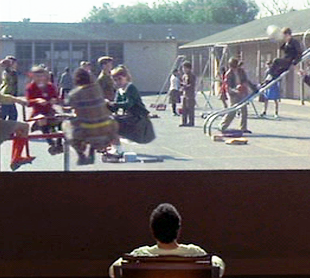 experience to 3D. Imagine what that would be like to actually see yourself at a younger age going through previous experiences, even if they might be painful ones. It's even possible to re-visit events that you saw as an infant in a way more realistic than any home movie could ever be. It's another example of the concepts that Brooks fabricated for Defending Your Life that are downright ingenious. That he was able to spin these fantastic ideas in the form of a romantic comedy really seems more astounding today than when I first saw it in 1991 — and even without the romantic element, it's damn funny. The trial actually plays like a courtroom scene, with Lena going after him for not standing up to a
 playground bully and Diamond defending him for using restraint by showing him as a baby when his crying stopped his father from getting physical in a fight with his mother. Lena asks if that's what he was doing on the playground, or if he wanted to hit the kid back. He says of course he wanted to strike back, but he chose restraint. Diamond tries to show the generosity of Daniel's spirit, even as a child, by showing when he took the blame for a friend who always was in trouble at school and forgot his art supplies, giving him his and saying he lost his. Lena undermines this by
 showing later when he caves to his dad by telling him that the other boy really lost his and he was just covering for him. Diamond tries to make the case that Daniel had such a bond with his dad that he couldn't lie to him. "Did we ever stop to think that this young boy had a bond with his father? I don't think it had anything to do with the friend. I just think Daniel couldn't lie to his dad. That's all," Diamond tells the court. Daniel figures that sounds good and nods, forgetting that his whole life has been documented. "You're nodding, Mr. Miller," Lena says. "Does that mean you agree with Mr. Diamond?" Fortunately, this isn't a court of law with perjury counts because Daniel goes on to say "Oh, yes. I had a bond with my father. I pretty much never lied to him." An incredulous Lena spits back, "You never lied to your father? Would you like me to show you at least 500 examples?" Daniel tries to talk himself out of it, going on so long that Diamond finally steps in and says, "Psst, wrap it up." With the first day done, Diamond's initial assessment that Lena would "have a field day" with Daniel seems to be coming true and they haven't even entered scenes from his adulthood into evidence yet.
Since Daniel won't be able to see Julia after his first day in court, he wanders around downtown Judgment City until he finds a sushi bar and steps inside where he's greeted by one of its several overly exuberant chefs. Daniel orders a sake but after the man serving him asks him how many days they are looking at and he tells them nine and all the eatery's employees shout in unison, "NINE DAYS," the man suggests more sake. It does raise one of the questions I've always had about Defending Your Life (and part of what makes it so much more than the average comedy). If the point of the Universe is to keep getting smarter and you either move on or go back to Earth, how do you end up staying in Judgment City in essentially a bureauratic role such as Bob or Lena serves or as a sushi chef? Will they ever get the chance to move on or are they stuck in these jobs for eternity? When Daniel returns to the Continental, he gets a phone message from Julia asking him where he is and, with longing in her voice, telling him she misses him.

The second day of Daniel's trial springs an unhappy surprise as he arrives to find that Diamond couldn't make it and he has a substitute defender, Dick Stanley (Buck Henry). Daniel thinks this should be grounds for a mistrial since Stanley doesn't know anything about him, but Stanley begs to differ. "I use 51 percent of my brain, Mr.
 Miller. I know everything about you," Stanley tells him, though he adds, "I operate a little differently than Mr. Diamond." By operating differently, what Stanley means is that he barely says a word and never offers a defense the way Diamond does. Up first on day two, they examine a time when Daniel had just graduated college and had $10,000 to invest. A friend's father worked for Casio in its early days and recommended getting in before it took off. Daniel is skeptical, arguing that the Japanese are not a society that knows about precision so they'd know nothing about watchmaking. If his friend told him that the Germans were making a watch, then he'd be interested. As a result, he lost out on what would be worth $37.2 million today. Lena questions him as to what he did invest
 in and he admits it was cattle and as she asks what happened to them, he replies, "I never did get a straight answer. Something about their teeth falling out." The judges ask Stanley if he'd like to counter, but he says he's fine, puzzling Daniel even further. Lena next shows a time when he prepped for a job interview with his wife (Susan Walters) about how he wouldn't accept less than $65,000 a year in salary. Of course, when he goes to the real thing the next day, the interviewer (Michael Durrell) offers $49,000 and Daniel immediately says yes. Lena grills Daniel about why he didn't stand up to his boss the way he did with his wife the night before. "First of all, it wasn't my wife, it was a man in a a suit and the suit had a odor and the odor said $49,000." Stanley interjects, "I like that very much." Daniel, still stunned by Stanley's relative silence, sarcastically says, "Oh, you are good."
After that day's trial, Daniel spots Julia in the crowded halls of the Judgment Center and she's as excited to see him as he is to see her. She's surrounded by what appears to be one of her judges and a tall man who when Daniel gets to the group Julia introduces as Sam (Leonard O. Turner). Sam tells Daniel that Julia has told him a lot about him, but Daniel says Julia doesn't know that much about him. Julia reminds him that Sam uses 56% of his brain. Sam says he heard Dick Stanley was defending Daniel today and sings his praises as a very smart man, adding that he's quiet. "You could say that," Daniel replies. Sam excuses himself and Daniel and Julia make plans for the evening. Julia wants to go to the Past
 Lives Pavilion, not only because it sounds neat but because she's heard they have
 the best hot dogs there. Daniel has hesitations, but agrees to go. In the Past Lives Pavilion, the film contains one of the funniest film cameos of all time, but as has been a subject circulating in my writings recently and a piece that Matt Zoller Seitz wrote for Salon concerning whether future generations will get the pop culture references on The Simpsons. While the person in the cameo certainly retains their recognizability, even 20 years out what makes the appearance funny isn't as well-known as it was back then. I wonder in another 20 years if that aspect — what makes the cameo so brilliant and funny — will be lost. Jokes tend not to work if you have to explain why they are funny. Are movies going to need to come with something like Cliff Notes for full appreciation? Even if they did, I doubt Defending Your Life would make the cut for a study guide. As you might expect, Daniel and Julia have vastly different reactions to seeing who they were in the past: Julia thinks it's a hoot as she sees she was some sort of knight leading a battle on his trusted steed while Daniel grimaces in horror as he sees he was an African running in terror from some unseen animal on the attack. He asks Julia who she was. "I'm Prince Valiant. Who are you?" "Dinner."
The downside to movies such as Defending Your Life in which you find yourself becoming more enamored each time you see it over the course of many years (especially if you happen to be a writer who tends to
 celebrate the anniversaries of signficant movies on his blog), you have a tendency to want to recount everything to your readers, simply because seeing the film has so excited you that you want to tell your audience about every favorite moment, every memorable line. Now, Defending Your Life isn't a spoiler-heavy film, but there's no need for me to to delve into the rest of the plot's details, not only because I imagine many of you haven't seen the film but more importantly because I'd like to discuss overall aspects of the film before this piece grows any more insanely long than it already has. I do have one last piece for the movie that I do feel compelled to mention. When Daniel demands to know why Diamond missed the second day of the trial, Bob tells him he wouldn't understand. Daniel tells him not to treat him like a moron. "I was trapped near the inner circle of thought," Diamond tells him. "I don't understand," Daniel replies.
While Albert Brooks' great mind gets the credit for the idea of Judgment City, it's the work of people behind-the-scenes who brought it to such wonderful life. Production designer Ida Random, art director Richard Reynolds and set decorator Linda DeScenna with the aid of their crews realized Brooks' vision and played a large role in making Judgment City look like such an appealing place. Random's resume proves quite eclectic,
 earning an Oscar nomination (which she shared with DeScenna) for Rain Man as well as serving as production designer on films as diverse as The War of the Roses, Hoffa, Wyatt Earp, Kevin Costner's The Postman and two of the Fast and Furious films. Reynolds has gained the new title of "digital set designer" for films such as Avatar and Minority Report, but his credits for art direction or production design are relatively few outside Defending Your Life. In addition to the Oscar nomination she shared with Random for Rain Man, DeScenna has been nominated four other times for Star Trek: The Motion Picture, Blade Runner, The Color Purple and Toys. Those sets wouldn't look half as enticing as they do if it weren't for the great cinematography of D.P. Allen Daviau, one of the best in the business. Daviau received an Oscar nomination in 1991, but it was for the great-looking Bugsy, not Defending Your Life. He also earned nominations for three Spielberg films: E.T.: the Extra-Terrestrial, The Color Purple and Empire of the Sun. His fifth nomination came for Avalon. For some reason, Daviau has sort of dropped off the radar for the most part. His output since the early 1990s has slowed and usually has been on films you've never heard about. The most recent notable movie he served as d.p. on was 2004's Van Helsing.
Kudos to one other particularly important behind-the-scenes player contributing to the success of the Defending Your Life go to composer Michael Gore for his marvelous score which hits the right notes at the right times, be it comic or touching, but always infectious. Gore has quite a track record as it is, providing the great score for Terms of Endearment and winning two Oscars for Fame, for its original score and its title song. He also wrote the music for most of the songs in the film, including the Oscar-nominated "Out Here on My Own" whose lyrics were provided by his sister Lesley of "It's My Party" fame.

I've already sung the praises of the delightful Rip Torn and could go on doing so for quite some time, but I figure this actress named Meryl Streep hardly ever gets any praise, so I'd toss her a bone. It's not unusual now, but in 1991, to see her play such a relaxed, comic role truly was a relevation. It wasn't a surprise that she could do it well, it just was remarkable to see her go down that road at all. You believe she's falling for Albert Brooks' Daniel but he deserves as much credit as she does. While Daniel worries about details elsewhere, when he's with her, everything's OK and he's completely charming and funny. The cliche goes that women love men who make them laugh (Oh, but if only that were an across-the-board truism). Even when his insecurities do pop up, as when Lena Foster happens to be eating at the same restaurant that Daniel and Julia are and Daniel proposes bolting, Julia still stands by him, though when she excuses herself to go the bathroom she does tell him, "I pray to God when I get back, you've changed." When she passes Lena's table though, she makes a point of telling her what a great guy Daniel is.

That chemistry between Brooks and Streep does come off as very real and a big reason for that is that Brooks doesn't get the credit he deserves as an actor. I think he's perceived as a comedian who makes movies, but when you look at his body of work, not only in the films he's directed himself but in the ones where he's just been an actor-for-hire, Brooks does not repeat the same persona each time, as compared to Woody Allen who usually stays rather close to the same area in the characters he plays. Compare the roles he created for himself in the films he directed from 1981-1991. In Modern Romance, Brooks really takes a chance by playing a character as neurotic and obsessively jealousy as Robert Cole. He risks alienating the audience by making his character do things that make you want to hate him. Brooks tells a story that after he made it he received a phone call from Stanley
 Kubrick wanting to know how he did it because Kubrick had always wanted to make a film about jealousy. David Miller in Lost in America really had little in common with Robert Cole. He was an arrogant yuppie, obsessed with the trappings of upward mobility and happily married until his world gets tossed asunder because he doesn't get the specific promotion he expected. Superficially, Daniel Miller here resembles David Howard, except that he settles easily and avoids conflict. When you add in Brooks' roles in movies he didn't write or direct such as his great Oscar-nominated turn as the ethical reporter in love with his platonic friend in Broadcast News as well as roles in good movies such as My First Mister and Out of Sight and the best part hidden under old age makeup, in the misfire Critical Care. Don't forget, before he started making his own movies, he had a significant part in Scorsese's Taxi Driver too. Brooks may be one of the funniest men on the planet, but he also can act.
As I've said so far in this remembrance, what really bowled me over in this return visit to Judgment City is how much better it plays now than it did even in its original release 20 years ago. Perhaps it's the cultural
 climate, where ignorance seems to have become something that is lauded as a positive and intellectuals are freely mocked as "elitist" and somehow not "real Americans." (Using more of your brain has even resurfaced as a plot point in the new Bradley Cooper thriller Limitless.) Now, when Rip Torn talks about all the "little brains" on Earth, it seems sadly true and while you might not want to go rushing toward the afterlife, the concept of being welcomed by people who use more of their brains seems quite pleasing, even if that means you'll just be stuck as a hotel porter in Judgment City. That could be quite pleasant if you snag a job at the Majestic. Hell, which sounds more enticing — watching the horrors of Japan, Libya, the Gulf Coast, etc., as our political leaders in both parties can't accomplish a damn thing (Man, how many of them even hit 3% of brain usage?) or somehow getting trapped in the inner circle of thought?
Throughout the history of cinema, many films have served the purpose of what you would call conversation starters, but how many light romantic comedies have fallen into that realm the way Defending Your Life does? Remember, it pre-dates all those Charlie Kaufman and Kaufman-esque films as well. It contains ideas on
 a philosphical level, but doesn't fudge it up by tossing religion in the mix, and still has time to throw in the timeless story of falling in love, if not with the wrong person, but at the wrong time. As he opens his heart to Julia, Daniel confesses, "You know these screenings are so tough for me. And yet when I see you I instantly feel OK... I don't think it has anything to do with me, that's what worries me. I think you're doing it." Julia wants to know what she's doing. "I'm not sure, but I always read that you had to be OK with yourself first before you could be OK with another person," Daniel tells her. "Now I feel OK with you, but I don't know how OK I was with myself before I met you, so maybe you're making me OK." Julia has fallen for him too, but she's not above admitting, "You're not that OK." Daniel laments that it appears they'll just have these few days together and they've found a love that eluded them on Earth, "Where do we find it? In the pit stop. Thanks God."
"We have nothing to fear but fear itself," FDR famously said. Maybe he knew something we don't. It's almost comforting to think that if there is an afterlife that this would be how it works, instead of all the scary nonsense of pits of fire for the bad or heavenly choirs. Of course, Defending Your Life doesn't show you what those other destinations for smarter people are, but just the concept that the universe has a point at all and that the point is to get smarter soothes an old secular cynic such as myself. It doesn't hurt that Defending Your Life also happens to be damn funny. As the years pass, I think this film's reputation will keep growing, unless all of us little brains just keep getting stupider which may be the greatest fear I still have to overcome.
Tweet
Labels: 90s, Albert Brooks, Awards, Buck Henry, Costner, Kubrick, Larry Sanders, Movie Tributes, Oscars, Rip Torn, Scorsese, Sondheim, Spielberg, Streep, Streisand, Television, The Simpsons, Theater, Woody
TO READ ON, CLICK HERE


