Friday, March 16, 2012
Only Connect

By Josh R
Adapting a classic novel to the screen is a delicate proposition; with so many ways to go wrong, it’s always slightly unexpected when someone manages to get it entirely right. In many cases, filmmakers adopt an overly reverential stance to their source material; the approach is typified by lavish sets, swelling scores, and resplendently costumed actors speaking as though they’d learned all their lines in elocution class. The screenplays can be slavishly faithful to their source material, to the extent that the end product feels like a pop-up edition of Cliff's Notes. On the opposite end of the spectrum, there will always be certain filmmakers (or auteurs, if you please) who feel compelled to make radical departures from the original, to the point that the resulting film bears only a passing resemblance to the book that inspired it. The mentality that inspires these modifications is somewhat peculiar, in that it smacks of both overconfidence in one’s own interpretive abilities, and lack of confidence in the book. It is very rare — too rare, if we’re going to be honest — that filmmakers trust and appreciate their source material enough to bring it to the screen without treating it like a sacred relic to be handled with kid gloves, or putting it through the ringer and revamping, augmenting and revising the content beyond the point of recognition (or at least beyond the point where the authors — if still living — could resist the urge to sue.) That’s the reason why Merchant Ivory’s superlative production of Howards End, based on E.M. Forster's 1910 novel, stands as one of the best and most satisfying examples of literary adaptation ever produced for the screen. Celebrating the 20th anniversary of its U.S. release this week, it exemplifies how rich an experience a great writing-directing team can create for an audience, merely by respecting the material and keeping things simple.
Howards End followed 1986’s A Room With a View and 1987’s Maurice as the third film adapted from a Forster novel by the veteran team of producer Ismail Merchant, director James Ivory and screenwriter Ruth Prawer Jhabvala. Their affinity and affection for the material is unmistakable; one of the chief distinctions of Howards End is the ease with which the filmmakers capture the style and tone of Forster’s prose, without getting tangled up in the pursuit of trying to replicate it too faithfully. It should be said that the book — a beautifully written, thematically complex evocation of the rapidly changing social climate of late-Edwardian England — is not an ideal candidate for cinematic adaptation. While not exactly short on plot, much of the action takes the form of conversation, with Forster’s own observations about class, social politics and assorted esoterica (the magical properties of Beethoven’s compositions, for example) taking up a fair amount of space. Jhabvala’s elegant treatment expertly condenses the content of the novel without narrowing its scope; the screenplay manages to be economical without feeling cursory or abridged, or giving short shrift to any of the points the Forster hoped to convey in his illustration of the clashing temperaments, ideas and values of two very different families merging into one.

The repercussions of the unlikely, somewhat uncomfortable union of the Wilcoxes and Schlegels are mordantly humorous on one level, tragic on another. In a way, the novel anticipates what was to happen to Britain in the years immediately following its publication — while Forster couldn’t have augured what was on the horizon (the rumblings were felt in 1910, but the wolf had yet to arrive at the door), his considerations hearken to an impending war abroad that would change forever the rules at home. With the Victorian world poised on the brink of cataclysm, and its quaint, restrictive mandates about class, morality and gender roles being rendered increasingly obsolete, Howards End charts the fallout from a collision of the members of the old guard grounded in the traditions of the past with an intrepid new breed determined to topple the old world order. How far will people go in the vain attempt to hold on to what’s slipping from their grasp, Forster wonders, and how will they adapt in the face of inevitable change? Above all, how do the proponents of two wildly divergent philosophies and outlooks, meeting at the intersection of the death of an Empire and the dawn of a a new era characterized by turbulent social upheaval, not only coexist, but communicate, compromise and connect? The opening epigraph of Howards End is, in fact, “Only connect”; a simple directive in theory, if infinitely more complicated in practice.
The thorny considerations at the heart of the author’s scheme — in a work the critic and essayist Lionel Trilling, among others, considered to be Forster’s masterpiece — are neatly encapsulated in the dealings between a small circle of friends, relations and acquaintances representing three distinct social classes. At the center of the narrative are Margaret and Helen Schlegel (Emma Thompson and Helena
 Bonham Carter), two sisters with progressive leanings living on a genteel middle-class income in London — the bohemian social circle of writers, intellectuals and rabble-rousers they frequent is loosely modeled on The Bloomsbury Group, of which Forster was a member. Vacationing abroad, the Schlegels meet and befriend another pair of English tourists, the wealthy business magnate Henry Wilcox (Anthony Hopkins) and his wife Ruth (Vanessa Redgrave). When Helen accepts an invitation to join the Wilcoxes at Howards End, Mrs. Wilcox's pastoral childhood home in the English Countryside, she forms a hasty, impetuous attachment to their younger son, Paul (Joseph Bennett). When their short-lived flirtation concludes on an awkward, mutually embarrassing note, the two families are briefly estranged. Margaret reconnects with the frail Mrs. Wilcox in London, where their renewed acquaintance soon develops into a strong bond of friendship; Margaret is both intrigued and moved by Mrs. Wilcox’s deep connection to the traditions of the past and the natural world, represented by Howards End. Before her death, Ruth wills the house to Margaret — Mr. Wilcox and his two other adult children, Charles and Evie (James Wilby and Jemma Redgrave — daughter of Corin, niece to Vanessa), deliberately decide to withhold the existence of the will from Margaret’s attention, unwilling to cede ownership of what they consider to be theirs by familial right.
Through a chance encounter, Margaret and Helen strike up an acquaintance with Leonard Bast (Samuel West), a shy young clerk from a modest, lower-class background. Adopting him as a de facto protege and seeking to improve his prospects, the sisters apply to Mr. Wilcox for advice. Mr. Wilcox gives them a faulty piece of insider information about Leonard’s place of employment — which he believes to be on the brink of ruin — that will eventually result in Leonard leaving his job, and unable to obtain employment elsewhere. Meanwhile, Mr. Wilcox finds himself becoming increasingly drawn to Margaret and, after some tentative attempts at courtship, surprises her with an offer of marriage. She accepts his proposal, to the confusion and consternation of Helen, who struggles to comprehend how her sister can forsake their shared ideals to assume the mantle of a traditional wife and helpmate to a conservative capitalist.
While the prospective in-laws adjust to the shifting dynamics of their changing relationships, Helen learns that the unemployed Leonard and his wife, Jacky (Nicola Duffet), have been reduced to a life of subsistence-level poverty. An enraged Helen shows up unexpectedly at Evie’s wedding with the Basts in tow, and angrily confronts Margaret with the consequences of Mr. Wilcox’s casually given, ultimately very costly advice. Seeking to pacify Helen and avoid further conflict, Margaret applies to Henry for help — while he feels no personal responsibility for the Basts’ circumstances, Mr. Wilcox agrees to provide Leonard with a position at his company. When Mr. Wilcox and Mrs. Bast meet face-to-face, Jacky recognizes him as her former lover. A humiliated Mr. Wilcox is forced to admit to Margaret that he not only betrayed the trust of his previous wife, but did so with a woman far below his station in life, whom he subsequently (and rather callously) discarded after tiring of the relationship. Against her own misgivings, Margaret decides to forgive Henry and keep the engagement intact; in a curt, peremptory note to Helen, she informs her that Mr. Wilcox can be of no assistance to the Basts, and orders her sister to abandon her sponsorship of the couple.
As the now-married Margaret and increasingly rootless Helen drift further apart, the latter has a brief affair with Leonard, resulting in a pregnancy. Upon learning of Helen’s condition — and the status of social outcast conferred upon her as an unwed mother — Margaret asks Mr. Wilcox to allow her sister to stay at Howards End. Henry refuses, believing that Helen’s compromised position would bring disgrace
 upon the family. Margaret angrily confronts her husband with his hypocrisy, and repairs with Helen to Howards End in flagrant disregard for his instructions. When Leonard — whose identity as the father of Helen’s child has been ascertained by the Wilcoxes — arrives unexpectedly at Howards End in search of Helen, his appearance results in a violent confrontation with a tragic denouement. While no one emerges entirely unscathed, both the Schlegels and the Wilcoxes find there is room for reconciliation, forgiveness, renewal and — perhaps most critically of all — a fundamental shift in values, paired with hope for the future. While the two families, representing the traditional and the modern, will never view the world in exactly the same way, they have at least managed to achieve a measure of balance. Complete understanding can elude even the most devoted of friends, lovers and family members; if we can “only connect,” those who seek to bridge the gap can, at the very least, respect each other’s limitations and forgive each other’s frailties. Forster poses, but offers no definitive conclusion about, the question of who shall inherit England, and whose values and ideals shall give shape to the future; he only concludes that the future cannot improve upon the past in the absence of a true meeting of the minds.
 Whenever I watch Howards End — as I do periodically, when the depressingly reductive nature of most films based on books I love becomes too much for me to bear — I’m always struck by the naturalism of Ivory’s approach, atypical not only of literary adaptations, but period pieces in general. While the film certainly is beautiful to look at (Luciana Arrighi and Ian Whitaker’s production design received an Oscar, while Jenny Beaven and John Bright’s costumes and Tony Pierce-Roberts’ cinematography also were nominated), there’s nothing over-scaled, overwrought or just plain over-the-top about the visual component of the film. The world of the Howards End is drawn from recognizable reality, as opposed to a heightened fantasy version of Edwardian times (for a bit of comparison — start grinding your teeth now, Copeland — the design aspects of the following year’s The Age of Innocence were so damn amplified and prettified the thing might as well have been set in Disney World.) This blessedly unfettered approach extends to the way Ivory has managed the members of his cast. The film is refreshingly unencumbered by actors striking the romantic poses of Victorian thespians, or intoning their lines as if they were auditioning for the Royal Shakespeare Company; it seems hard for many contemporary directors to accept that, even a hundred years ago, people still spoke to each other in a conversational fashion. The characters of Howards End may find themselves in melodramatic situations, but their actions and behaviors never strike a false note, or smack of affectation. Likewise, the original score provided by Richard Robbins — augmented with a few selections by classical composer Percy Grainger — is richly evocative without being intrusive; the music underscores the action while resisting the urge to provide easy, obvious emotional cues.
It’s so easy — and really, a little exhausting — to enumerate and expound upon the plethora of acuminous decisions that went into the making of Howards End, and talk about how seamlessly its various elements fit together; but the creative team (with particular credit going to Merchant) most emphatically demonstrated their love and respect for the material in terms of their casting choices. When it comes to casting projects with ostensibly little in the way of commercial appeal, the standard practice involves enlisting the talents of bankable stars; had Howards End been made by a major Hollywood studio in the early '90s, Forster’s intrepid Schlegel sisters might well
 have been entrusted to Julia Roberts and Demi Moore (if that was the film that had been made, methinks yours truly would not be writing this 20th anniversary Tribute.) Certainly, Merchant Ivory wasn’t enough of a financial powerhouse — even in the wake of several notable successes — to afford the type of big names that a Tinseltown outfit might have foisted upon the project. Still, the men who controlled the purse strings could have advocated for more in the way of name recognition (The Silence of the Lambs had yet to be released at the time of the film’s shooting) in drafting the film’s ensemble. Instead, they chose to pair rich, challenging roles with actors of commensurate talent who fit the descriptions provided by Forster. Watching the film, you can’t shake the implausible impression that the author must have been writing these characters with these specific players in mind; every member of the cast delivers an emotionally authentic performance that not only highlights Forster’s keen observations on human nature, but embodies the descriptions contained in his prose with an uncanny degree of exactitude. Fresh from his lip-smacking tutorial on scenery-chewing as Hannibal Lecter, Hopkins showed that he was able to shift gears with surprising dexterity. His Henry Wilcox is a masterful study in restraint, rigidity and misplaced confidence. While he is often unlikable, his unflappable certainty and sense of masculine entitlement have a certain magnetic quality; an audience can still understand why the heroine would be drawn to him almost in spite of herself. It’s to the actor’s credit that by the end of the film, the viewer actually can feel a certain degree of sympathy for this hidebound specimen of Victorian prerogatives who can’t adjust to the changing times, or comprehend how little control he has over his own destiny. Samuel West, with his gawky gait and naturally downcast features, does a very fine job of fleshing out the inchoate yearnings of Leonard Bast, grounding a character conceived on a very romantic level. It would be easy for a more conventional performer to come across as too poetic and tragic for words — fortunately, West brings enough quirky specificity to his performance that he doesn’t simply register as delicate and doomed. James Wilby — who played the title role in Maurice — provides a nice vignette of unctuousness coupled with doltishness as the uncomprehending elder son, whose very lack of imagination renders him capable of destruction.
As fine as the male cast members are, Howards End really belongs to the women — and they are a wonder to behold. As the least-known member of the principal cast, Emma Thompson received fourth billing as Margaret Schlegel; for graciously ceding that status to Hopkins, Redgrave and Bonham Carter, she received the best actress Oscar, along with about every other prize the international awards-giving community had to offer. To many, her rapid ascent from virtual unknown to unstoppable trophy magnet registered as a bolt from the blue; while she had been impressive on previous occasions, most notably opposite her then-husband, Kenneth Branagh, in the BBC miniseries Fortunes of War, it was by virtue of her revelatory performance in Howards End that her film career was launched in earnest. Really, it’s very fortunate that 1992 was such a weak year for leading ladies, a fact Thompson tacitly commented on during her acceptance speech in wishing aloud for “the creation of more great female roles.” Performances this subtle don’t usually win Academy Awards; even before the voting began, the British novice already had a big advantage over her more established competition by virtue of being in the only film on voters’ radar screens (most of the people I went to school with in 1993 hadn’t even heard of the other nominees’ films, let alone seen them - I remain unconvinced that Love Field and Lorenzo’s Oil played on any screens outside of New York and Los Angeles.) In retrospect, it’s no surprise that the actress' career blossomed as quickly as it did in the wake of that acknowledgement — as Margaret Schlegel, she exhibited some of the special brand of self-possession, equal parts intelligence and radiance, that Deborah Kerr trafficked in so well for more than 20 years as a Hollywood staple, tempered with a quickness and quirkiness unique to Emma Thompson.
There are so many moments in Thompson’s performance to treasure — the staircase proposal scene alone is essential viewing for acting students — and her choices are disarmingly original. With the flashes of wit and halting sensuality she brings to the part, it’s fair to say that her creation is actually an improvement on Forster’s (the Margaret of the novel is a bit on the earnest side), and she brings a sense of dramatic coherency to a character whose motives are sometimes difficult to fully accept at the author’s insistence. Margaret is a spirited, independent woman with a lively, intelligent mind and a practical sensibility; in forsaking her values, she is not merely a sheep being led meekly to the slaughter, but the willing architect of her own moral compromise. It’s the shades of loneliness and yearning Thompson brings to the role, as well as her expert communication of Margaret’s dawning awareness of herself as a desirable, attractive woman and growing fascination with Wilcox’s dynamic clarity of mind and purpose, that make the transitions seem logical.

As great as Thompson is — and really, her performance is both the soul of the film and the motor that drives it — Bonham Carter’s contribution in the role of Helen was and remains greatly undervalued. I particularly appreciate her interplay with Thompson; the actresses complement each other beautifully, and strike up a rhythm that truly suggests (as Forster asserts) that the sisters are two halves of the same whole. When they’re finishing each other’s sentences, or reacting to things in unison with near identical physical responses, it seems natural to accept that these two women have been a constant presence in each other's lives since childhood. When the rift between the sisters goes into effect, Bonham Carter displays a fire and urgency unlike anything in her previous work. Helen’s dramatic flashes of temper, the product of being uncertain of her place in the world once she’s lost her moorings (you still feel the tug of symbiotic sibling relationships once you become a solo act), never seem overstated; the sense of hurt and confusion that fuel her character’s behavior are made explicit, without being hammered home too emphatically.

Finally, there is Vanessa Redgrave, who was initially noncommittal when offered the role of Ruth Wilcox. She relented when Merchant told her she could basically name her own price — a gutsy move for the producer of a film being made on a limited budget. Whatever figure the two resolved upon, her services were worth every pound of Merchant’s money; no other actress could have played the part with the same degree of luminousness and lyricism. There’s always been a vague, dreamy quality about Vanessa Redgrave, coupled with an air of inscrutability — a friend of mine once speculated it might be the product of her having dropped too much acid in the '60s (I don’t believe this for a second — but if drug use will help any of today’s young actresses approximate the qualities of Vanessa Redgrave, I say Get Thee to a Dealer.) The character of Ruth is more of a literary conceit than a flesh-and-blood woman; she’s a symbolic Earth Mother figure tied to the land, the properties of nature, and pre-Christian mysticism; ancestral voices are supposed to reverberate in her presence. With her lovely, elegiac performance, Vanessa Redgrave actually makes sense of Ruth as a person. The shades of wistfulness and melancholy she brings to the part lend Ruth’s predicament — that of an ethereal, isolated onlooker bewildered by the modern world, unknowable even to those who love her most — an almost unbearable element of poignancy. It’s a towering performance, delivered on a human scale.
After all this, it is with a certain degree of reluctance that I’ll admit that Howards End is not bound to be everyone’s cup of veddy British tea. For those who prefer films with less resonance — where everything is pitched faster, louder and without much in the way of subtlety — there are surely no lack of entertainments to provide satisfaction (and numbness). Speaking only for myself, I find it heartening to revisit Howards End — a prime example of how good filmmaking can be when a great director, screenwriter, producer and cast embrace and honor the novel they’re bringing from the page to the screen. Forster’s epigraph should serve as guidance for anyone attempting an exercise in literary adaptation: Only Connect.
Tweet
Labels: 90s, Books, Branagh, Deborah Kerr, Demi, Emma Thompson, Fiction, H.B. Carter, Hannibal Lecter, Hopkins, Julia Roberts, Merchant Ivory, Movie Tributes, Oscars, Vanessa Redgrave
TO READ ON, CLICK HERE


Monday, April 05, 2010
Live and learn

By Edward Copeland
You can never really claim that a year in movies has an overriding theme, but if you could, 2009's would be that so many of the better films were dependent on a single performance that almost single-handedly raised his or her film to a higher plane. You saw it with Jeff Bridges in Crazy Heart to Sam Rockwell in Moon and Tilda Swinton in Julia. This is most decidedly the case with An Education, which would probably be a fine film anyway but becomes an even better one with Carey Mulligan as its lead.
Mulligan stars as Jenny, a bright 16-year-old attending an all-girls school in the London suburbs in 1961 in presumed preparation for her eventual enrollment at Oxford. She's smart, funny and talented and can't help but show it, even if it means often offending those around her, including teachers such as Miss Stubbs (Olivia Williams, unrecognizable from those who only know her from Rushmore) and her stuck-in-the-mud father (Alfred Molina). As many smart teens can be, Jenny thinks she knows a lot more than she really does and, unfortunately, she suffers for it in the end.
One day, while walking home from concert rehearsal with her cello in a driving rainstorm, a handsome thirtysomething stranger named David (Peter Saarsgard) charms Jenny into his car and before long, despite the age difference, the two are dating, despite Jenny's insistence that she's hanging on to her virginity until she turns 17.
Jenny's classmates find it quite chic that she's seeing an older man while her teacher and especially the school's stern headmistress (the always reliable Emma Thompson) give her strong warnings, some threatening her future at the school. Her parents (Molina and Cara Seymour) would probably be similarly suspicious, but David manages to seduce them at a faster rate than he does Jenny. The sometimes veiled (and sometimes not-so-veiled) anti-Semitism doesn't even seem to factor in even though David is Jewish.
Before long, her parents are allowing Jenny to go on overnight trips with David and even a journey to Paris, all under the assumption that David's "aunt" will be along as a chaperon. David and Jenny's clubbing and traveling companions are usually Danny and Helen (Dominic Cooper and Rosamund Pike) and some of their actions, as well as David's, should clue Jenny in to the idea that her boyfriend might not be all that he claims to be, but the heart of a first love has a terrible defect that allows for the masking of a significant other's defects.
Everything hits the fan soon after David takes the big leap and proposes marriage to Jenny, who is torn since her whole life had been geared toward continuing her education at Oxford. Her father, who'd supported the idea her entire life, is quick to abandon it for a good marriage because, really, what career can she expect to have? Even Thompson's headmistress tells her there are more opportunities than just teaching for young women now: There's also the civil service.
The sparse, deliberate and well-written screenplay by Nick Hornby was adapted from the memoir by Lynn Barber and smoothly directed by Lone Scherfig. The performers all do well, especially Molina and Williams. Sarsgaard's British accent isn't even half bad. If the film has a weakness, its final scenes seem rushed to try to tack on somewhat of an unnecessary happy ending that seems out of place with what went before.
However, as far as Mulligan goes, a star is born. She is so beguiling that the overwhelming number of comparisons of her to Audrey Hepburn certainly seem earned. While you are watching Mulligan in An Education (and I don't recall any scene she's not in), you can't take your eyes off her. It's not often that you see a performance from a relative newcomer that immediately makes you anxious to see what she does next. Carey Mulligan is an actress to watch.
Tweet
Labels: 00s, A. Hepburn, Carey Mulligan, Emma Thompson, Jeff Bridges, Sam Rockwell, Tilda Swinton
TO READ ON, CLICK HERE
Sunday, August 30, 2009
From the Vault: The Remains of the Day

In many ways, The Remains of the Day, the latest effort from the team of James Ivory, Ismail Merchant and Ruth Prawer Jhabvala, surpasses the great achievement they made with last year's Howards End.
Anthony Hopkins stars as Stevens, a British butler who puts his work above all else. He's a great servant, but a sad, lonely man. He hires lovely women for the household staff then ignores them once they are there. His only loyalty belongs to Lord Darlington (James Fox), the master of the house.
Adapted from the award-winning novel by Kazuo Ishiguro, The Remains of the Day begins in flashback in 1958 as Stevens takes a journey to remedy past slights and to reminisce about life in Darlington Hall.
The mistakes that Stevens focuses on are the missed opportunity for love with the former housekeeper Miss Kenton (Emma Thompson) and his ambivalence to Lord Darlington's nature as a Nazi apologist.
The story's scope isn't of great importance but like The Age of Innocence, it is an excellent period piece about repressed emotions and social mores.
Hopkins creates as vivid a portrait of loneliness and devotion to one's job as I've ever seen.
The film, for me at least, marks the best Merchant Ivory production yet. Ivory's direction is at his most polished and as enchanting as he's ever achieved.
All technical aspects are top notch as well from sets to cinematography to musical score. The entire package achieves a hypnotic triumph.
In the end though, Hopkins' performance gives the film its most important lift. Stevens, who speaks through his eyes and facial expressions, would be difficult for anyone of lesser talent to pull off. Fortunately for The Remains of the Day — and for audiences — Hopkins remains one of the most talented actors working today.
Tweet
Labels: 90s, Emma Thompson, Hopkins, Merchant Ivory
TO READ ON, CLICK HERE
Friday, August 28, 2009
From the Vault: Howards End

For three decades, the team of producer Ismail Merchant, director James Ivory and screenwriter Ruth Prawer Jhabvala have collaborated on quality motion pictures. In 1992, they've produced their finest effort so far with Howards End.
Following adaptations of E.M. Forster novels "A Room With a View" and "Maurice," the Merchant-Ivory team finds their greatest source material in another of Forster's works.
From outward appearances, this production may look like something that belongs on PBS' "Masterpiece Theater," but the passions bubble beneath the surface of this drama of love, class and real estate, involving the viewer in a way few films do.
Emma Thompson proves effervescent in her role as Margaret Schlegel, the kind bridge between the aristocratic Wilcox family, her own clan and an unhappily married clerk named Leonard Best.
Helena Bonham-Carter portrays Margaret's sister Helen, the feisty center of all the conflicts that occur between the families, especially the initial romantic misunderstanding with one of the Wilcoxes' sons.
Margaret, concerned that the Wilcoxes think badly of her family, reaches out to the Wilcox matriarch Ruth (radiantly played by Vanessa Redgrave). Margaret's earthy goodness touches Ruth so deeply that she bequeaths the Wilcoxes' treasured homestead, Howards End, to Margaret.
The inheritance doesn't sit well with the Wilcox patriarch, the stiff Henry (Anthony Hopkins giving a superb performance that, in its own way, proves more frightening that Hannibal Lecter).
Determined not to lose the estate, Henry sets out to woo Margaret. The plot developments seem perfectly tuned as they subtly touch upon all the themes, especially the problems of conscience and class. The entire cast excels and the production values are exceedingly high. Don't miss the opportunity to see Howards End in a theater.
Labels: 90s, Emma Thompson, H.B. Carter, Hannibal Lecter, Hopkins, Merchant Ivory, Vanessa Redgrave
TO READ ON, CLICK HERE
Tuesday, December 30, 2008
Dancing with the stars

By Edward Copeland
When the waiters and the florists of the Hollywood Foreign Press Association announced nominations for a film called Last Chance Harvey, I thought this was another instance of the HFPA somehow being talked into nominating a film no one had ever heard of in exchange for ... whatever. The only difference was that Dustin Hoffman and Emma Thompson are bigger names than usual. Now though the film is gaining notoriety and I've seen it myself, so I do know it exists. I also know it's a charming, if slight, movie though I'm not sure it belongs in the comedy category.
Hoffman stars as Harvey Shine, a commercial jingle composer on a downward spiral in his career and his life who is heading to London for the wedding of his only daughter. His path briefly crosses with Thompson, a middle-age spinster who works at the airport in London trying to get passengers to take surveys while living with her constantly meddling mom (Eileen Atkins).
Harvey had been planning to return to New York immediately following the nuptials to personally oversee a commercial pitch, a decision cemented when he learns that his daughter wants her stepfather (James Brolin) to give her away instead of Harvey. Because he misses his flight, he gets stuck at the airport and again encounters Thompson and the two lonely souls strike up a tentative friendship.
Written and directed by Joel Hopkins, Last Chance Harvey isn't a particularly great film, but it's not a bad film either. It's really just a chance to watch two pros like Hoffman and Thompson bounce their bountiful skills off each other and there are worse ways to spend an hour and a half.
Tweet
Labels: 00s, Dustin Hoffman, Emma Thompson
TO READ ON, CLICK HERE
Monday, April 23, 2007
Tales Told By Idiots: Bad Bard, Bad Bard, Whatchagonnado?
This post is part of the Shakespeare Blog-a-Thon being coordinated at Coffee, Coffee and More Coffee. Check there for links to other posts.
By Odienator
Shakespeare wrote some of the most stirring and beautiful lines trapped in paper, but you wouldn't know it listening to some of the actors who tried to speak them. For every Gielgud, O'Toole and Olivier, there are double the number of actors who just couldn't get their mouths around that iambic pentameter. Why do they even try? Is it the paycheck? Or the notion that reciting Shakespeare will win you an Oscar, as it did for Sir Larry O and Richard Dreyfuss?
In honor of the Shakespeare-Blog-a-Thon, here is a brief list of actors who should never have attempted to tell us what a piece of work man is, or who did so for nefarious Oscar purposes. Who should have taken Shakespeare's "and the rest is silence" seriously?
Stunt Casting, Thy Name is Kenneth Branagh
I used to think Kenneth Branagh was a great Shakespearean actor, but I am starting to question if he seemed so good because he cast people who were so bad and played scenes with them. I appreciate how he tries to bring Shakespeare to the groundlings of today, and I've liked most of his adaptations, but he sure likes his stunt casting. The phenomenon is not new — John Wayne as Genghis Khan, anyone? — but Shakespeare's dialogue is a perilous mixture of rhythm, elocution and emotion. It is not about the physicality of the actor, it is about their vocal delivery. Director Branagh, in his admirable desire to make the teenagers saddled with reading Shakespeare grow to love it, apparently ignored the train wrecks he witnessed in his viewfinder. For every great performance he recorded (Derek Jacobi, Emma Thompson), Branagh gave us:
Believe it or not, Keanu Reeves can be an effective actor. I'm not one of those people who pick on "Mr. Whoa" because it's fashionable; credit is deserved where it is due. While he is nowhere as bad as some have reported, he is still out of his league. Reeves has a perpetual scowl and a flat delivery; he is a verbal deer caught in the Bard's headlights. Reeves would have benefited greatly if Ted Logan had met Shakespeare in that time-travelling phone booth. I had an easier time buying that Reeves and Denzel Washington were brothers than anything coming out of Reeves' mouth.
Jack Lemmon was so effective in Glengarry Glen Ross because his vocal pauses, stammers and ticks fit well with Mamet's "cuss cuss cuss pause cuss cuss pause pause cuss cuss cuss cuss pause" style of writing. Like the Bard, Mamet's dialogue is musical and needs the right interpreter to make it sing. Can you imagine Bob Newhart doing Marc Antony's speech in Julius Caesar or Christopher Walken doing Hamlet? ("What ... a piece of work is man How noble ... in reason...") Lemmon's tics and Shakespeare's verse fit as well as Slowpoke Rodriguez singing a rap by Krayzie Bone, or Shirley Bassey doing Metallica. Every line is delivered differently as Lemmon tries in vain to bend the Bard toward his Lemmon-isms. It's painful to watch him flail. As much as I love Jack Lemmon, his performance here lives up to his last name.
In the court of Hollywood, I propose the Cruz-Depardieu Law, which states that Gerard Depardieu and Penélope Cruz should NEVER act in English. In Hamlet, Depardieu becomes Depar-don't, an amazing feat since all he has to say is "Yes, my lord" about 12 times. While I'm proposing laws, might I add the "Williams Anti-Caricature Law," which states that, if clueless on how to play a role, Robin Williams must never fall back on stereotypical racial and homosexual voices. Williams' Osric has an odd gay vibe that thankfully distracts from his horrendous line readings. Perhaps he was trying to get an Oscar; it worked for Richard Dreyfuss' Chelsea boy Richard III.
As Felix Unger Would say: Oscar! Oscar! Oscar!
Sometimes actors think they can tackle Shakespeare simply because they have been praised or honored for other work. Others believe their star is so big that they are invincible. Still others believe that Shakespeare is the way to that elusive Oscar. This is why some of these actors tried their luck at the Bard.
Look up "feast or famine" in the dictionary and you'll find a picture of Jessica Lange. Either she's superb (Men Don't Leave, All That Jazz, Frances, Tootsie) or superbad (God, where do I start? Hush, Big Fish, King Kong). The failure of Titus rests on the shoulders of director Julie Taymor whose film completely misses the point of the Bard's play: this is a sick parody. She turns it into a sick ABC Afterschool Special Done by MTV. The play's violence is so gruesome and over-the-top, and the situations so telenovela-dramatic that it is impossible to take with the seriousness and the underlying social commentary Taymor tries to push. If any Bard adaptation screamed out for the geeky, caressing hands of Quentin Tarantino, it's this one. After Lange played Blanche DuBois opposite daughter cusser-outer Alec Baldwin, she started adding Blanche to almost every role she played afterward. As the Queen of the Goths, she looks less Goth and more Glam, like Ziggy Stardust crossed with Divine, and she attacks her lines as if she were the Queen of the Southern Gothics. Vengeful lines come out goofy, seductive lines come out cold, and she is histrionic in all the wrong places. There is no rhythm nor rhyme to her performance, and for Shakespeare, that's the kiss of death.
I once heard this anecdote about A Double Life: during the course of the film, one of the audience members turned to his wife and said "So when does he sing 'Mammy?'" Whether this is true I've no idea, but Colman's performance as an actor driven mad by his performance in Othello couldn't have been any worse had he done Jolson's signature tune. While there is less Shakespeare in this film than in the aforementioned adaptations, what's here plays an integral part in this loony film noir directed by George Cukor. Colman plays the original Method Actor, a man who becomes the characters he plays. Knowing this, someone still suggests he tackle Othello. (Why not Joan of Arc? At least he wouldn't kill anybody.) Colman starts spouting Othello's lines at inopportune moments, then takes his delusion to its logical conclusion by giving Shelley Winters a really effective neck rub. Colman's Othello is so hammy it makes Vincent Price's turn in the superior Theater of Blood look like vintage Gielgud, and I found myself feeling envious for Shelley — at least she didn't have to listen to him anymore. Oscar fell for it, and they gave him Best Actor. Colman strangled the Oscar onstage during the ceremony. (Just kidding.)
Unless you can give me another reason why the Washington Wizards player even attempted Shakespeare in this film, I'm going to have to go with the Dreyfuss Defense: Quoting Shakespeare gets you an Oscar nomination! At least he didn't play a rapping genie like that OTHER basketball player.
in A Midsummer Night's Dream
Both Flockhart and the usually reliable David Straithairn have a hard time convincingly spouting their dialogue. Straithairn is stiff and uncomfortable and Flockhart is an 18th century Ally McBeal clone, as if that series had been reimagined as Black Adder. Her last scene in the film made me want to poke my eyes out and ram Q-tips into my ears.
Peter O'Toole CAN do Shakespeare. My beef (and I realize I'm cheating here) is that he does it solely to get an Oscar nomination. There is no need for him to do it in this film, and considering that we already know how great he is at it, I saw his Venus recitation as a shameful pander. There really is nothing here that is Oscar worthy — O'Toole playing a dirty old boozy pussy hound actor is akin to me playing someone with a Y-chromosome — so this is thrown in to remind us how good O'Toole once was and why Oscar should be shamed into giving him the Oscar he so richly deserved elsewhere. Thankfully, it didn't work.
There are many others (Bruce Willis in Moonlighting's "Atomic Shakespeare" episode, to name one) but as Polonius said, "brevity is the soul of wit," so I shall exeunt here. Parting is such sweet sorrow.
Tweet
Labels: Blog-a-thons, Branagh, Cukor, Denzel, Emma Thompson, Gielgud, J. Lange, Lemmon, Mamet, O'Toole, Olivier, Penélope Cruz, R. Colman, Robin, Shakespeare, Shelley Winters, Television, Walken, Willis
TO READ ON, CLICK HERE
Monday, January 29, 2007
A whole new genre
It seems to me, and perhaps you could call them Kaufmanesque films though Charlie Kaufman certainly didn't create the genre, that you could label an entire section of video stores (while they still exist) as Better Ideas Than Movies. Stranger Than Fiction belongs in that section beside films such as Being John Malkovich and The Truman Show.
I liked Stranger Than Fiction quite a bit, helped in no small part by its solid ensemble of performers. Will Ferrell delivers his best-ever screen work as IRS auditor Harold Crick, a man who starts hearing a voice that seems to be narrating his life and realizes that he's both human and a character in the novel of reclusive writer Kay Eiffel (Emma Thompson).
The biggest downside: All her main characters die in the end, meaning Harold's days could well be as numbered as the pages on Eiffel's manuscript (God love her, she still uses a typewriter). When Harold's therapist can't convince him that he's just schizophrenic, she recommends that he seek out a prominent literature professor (Dustin Hoffman) who comes to believe that Harold isn't imagining things, especially when he identifies the voice as belonging to Eiffel, one of his favorite writers.
The premise certainly is an intriguing one, but like many films of this type, it's difficult to construct a conclusion to equal the original contrivance. It raises interesting questions and while billed as a comedy, it plays more bittersweet than boisterous, but the cast more than makes up for it.
Thompson really excels as the nervous, chain-smoking novelist torn between what's best for her book and what's best for another human being and Hoffman is fine as man whose life is literature. Maggie Gyllenhaal gives another standout turn as a woman who begins as someone Harold is auditing before becoming his unlikely girlfriend. She could have been justly nominated in both lead and supporting Oscar categories this year and the Academy should be ashamed for giving her neither.
Though his part is small, I must mention the presence of Tony Hale if only to lament the much-missed Arrested Development.
Director Marc Forster moves the film along well and certainly is building an eclectic body of work. To think the same director helmed Monster's Ball, Finding Neverland and Stranger Than Fiction is somewhat astounding.
Tweet
Labels: 00s, Dustin Hoffman, Emma Thompson, M. Gyllenhaal, Malkovich
TO READ ON, CLICK HERE
Saturday, June 24, 2006
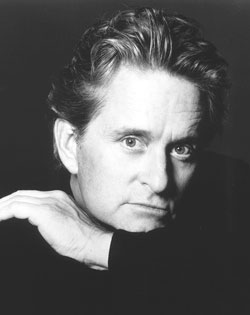
Is Michael Douglas a Male Chauvinist Pig?
By Josh R
Did that get your attention?
When Mr. Copeland enlisted me as a contributor to this forum, he probably didn’t anticipate a post such as this — I think I’m supposed to be more informative than confrontational (trusting sort that he is, he overestimates my better instincts). Well, I can’t always take the classy route. This piece may contain some actual information, but it’s mostly just an old-fashioned hatchet job. Sometimes I like to get up on my high horse and kick up a little mud in people’s faces, especially when I feel such a response is merited.
I guess we’re at the point now where we can legitimately (if somewhat grudgingly) refer to Michael Douglas as a Hollywood legend. So maybe the guy doesn’t have the acting chops of a Dustin Hoffman or a Robert De Niro — or the sex appeal and glamour of a Robert Redford or Warren Beatty. Perhaps he can’t rival any of these gentlemen in terms of old-fashioned movie star charisma. OK, he definitely can’t. Still, one can make the fair argument that he’s earned his place in the pantheon. He is an Academy Award-winning actor and producer whose career spans more than 30 years. In a business where the careers of many actors of his generation have fallen by the wayside, he has weathered an unusual number of flops and misfires to retain his status as an A-List marquee attraction. His résumé also has included its fair share of hits, of both the critical and commercial variety. If the bulk of his work hasn’t demonstrated much beyond a solid professionalism, he has, on occasion, shown himself to be a talented and resourceful actor. He is a mainstay of Hollywood social circles, a mover-and-a-shaker, son of Kirk, and husband to Catherine Zeta-Jones. Whether you like the guy or not, he is, without question, a star.
Which is why it may come as something of a surprise that the man has been rejected by more women than any other man in the history of Hollywood.
It’s not his love life I’m referring to — in fact, reputation holds that he’s done fairly well in that department (to the point that his pre-nuptial agreement with Ms. Zeta-Jones is known to include an infidelity clause). The rejection that Mr. Douglas has suffered at the hands of Hollywood’s female acting elite has been of a professional nature — and, on at least three (and possibly four) occasions, it appears to have been deserved.
The lead role in One Flew Over the Cuckoo’s Nest, produced by Mr. Douglas and for which he received the Academy Award for best picture, was turned down by (in alphabetical order) Anne Bancroft, Ellen Burstyn, Colleen Dewhurst, Faye Dunaway, Jane Fonda, Angela Lansbury, Jeanne Moreau and Geraldine Page. Most of the actresses cited personal reasons for their refusal, ostensibly because of the nature of the material.
Ken Kesey’s novel had ignited a firestorm of controversy upon its publication in 1963, mainly due to its depiction of the character often referred to only as "Big Nurse," the sadistic ogre who presides over a mental ward populated by male patients. In Nurse Ratched, whose ugly countenance was described in almost as much detail (if not as frequently referenced) as her large, fleshy tits, Kesey had fashioned an interpretation of the female authority figure as an emasculating control freak, with no attempt to understand or get to the root of her behavior. As written by Kesey, critics observed that the character had about as much dimension as the Wicked Witch of the West. Since the novel’s debut on the best seller list coincided with the advent of the women’s movement, feminist activists had a field day denouncing what they (correctly) perceived as a monstrous disservice to the cause of women’s advancement in the professional arena. At the end of the novel, Ratched is raped by McMurphy — as imagined by Kesey, the assault is less an act of violence than an act of justice, retribution for her "rape" of the inmates in her charge. It’s a rape that the reader is supposed to cheer for.
Needless to say, by 1975, this wasn’t going to fly, so Douglas and his collaborators had to soften the material considerably. The character’s fiendish, subhuman bullying (with accompanying grunting) was replaced with a more subtle form of villainy, and the rape was jettisoned in favor of strangulation. Nevertheless, no major actress of the period was willing to go anywhere near it — some demurring politely, others expressing
 indignation that the film was being made in the first place. Joanne Woodward was never offered the role of Nurse Ratched — the story goes that she’d already taken herself out the running with a preemptive strike before the production team had even had the chance to approach her. Having gotten wind of the fact that her name had been bandied about in a casting session, she reportedly told Douglas that not only had she no intention of taking the role, she had no desire of even seeing the finished product. The role eventually was filled by an unknown, Louise Fletcher, who won an Academy Award for her performance before promptly returning to obscurity. The previous year’s winner, Ellen Burstyn (who had been among the first to take a pass on the film), went on television and asked Academy members not to vote in the best actress category to protest the lack of good roles for women. Fletcher later related to The New York Times, in reference to a conversation she’d had with Burstyn after the latter’s comments, “She hadn’t even seen Cuckoo’s Nest because she thought it would be too painful an experience. I told her that I thought it would have been nicer if she’d said what she said in a year when she had been nominated.”
Fatal Attraction is perhaps Mr. Douglas’ best-known and most influential film as an actor — for you young’uns out there, it’s about a basically decent guy who cheats on his angelic, idealized homemaker wife with a high-powered cosmopolitan book editor who turns out to be a raving psychopath. General chaos ensues — knives are wielded, children are kidnapped, cars are splashed with acid and beloved household pets are tossed into the crock pot. The role was turned down by Isabelle Adjani, Barbara Hershey, Miranda Richardson and Debra Winger. Richardson, a relative unknown whose involvement with the film might have propelled her to stardom, publicly stated that she found the script “regressive in its attitudes.” While the LA Reader’s John Powers was among those who saw the film as being “about men’s fear and hatred of women,” The New Yorker’s Pauline Kael went a step further in declaring “the film is about men seeing feminists as witches, and the way she’s presented here, the woman is a witch…she parrots the aggressively angry, self-righteous statements that have become commonplaces of feminist fiction, and they’re so inappropriate to the circumstances that they’re proof she’s loco.”
Unlike Cuckoo’s Nest (and Basic Instinct, which I’ll discuss presently), the producers didn’t have to resort to drafting an unknown actress to fill their star role. Glenn Close, who found herself in a bit of a career cul-de-sac after being typecast as the virgin mother (The World According to Garp), the nurturing, all-giving earth mother (The Big Chill), and quite literally, a glowing Madonna (the living embodiment of goodness and decency in The Natural), was desperate to break out of the holding pattern. She aggressively courted the role in a calculated risk that paid big dividends, earning an Oscar nomination for the performance. She’s been happily playing bitches ever since.

The impetus for this piece was seeing Basic Instinct again fairly recently — Douglas’ next monster hit after Fatal Attraction. I’m not sure what I was expecting, although it seemed diverting enough way back in good old 1992. For anyone who hasn’t had the “pleasure,” it’s basically the same deal as Fatal Attraction, only with an S&M twist and a cold-blooded gal who has no ability to love instead of a pathetic one who loves too much. Once again, audiences encountered a high-powered professional woman (in this case, a best-selling author) who is a sexual predator and sick as all get-out. Sharon Stone deservedly became an overnight sensation on the strength of her performance as Catherine Tramell, the ice-pick-wielding loony/white-hot fuck machine who inspired a thousand beaver jokes, thanks to the infamous and oft-parodied scene where director Paul Verhoeven invites the audience to rubberneck his leading lady’s privates. The actress had been knocking around Hollywood for many years, getting regular work without getting anywhere in particular, until she landed the role that would vault her into the bigtime.
As good as she was, her casting probably represented the last resort of an increasingly desperate production team. Kim Basinger, Michelle Pfeiffer, Julia Roberts, Demi Moore, Meg Ryan, Virginia Madsen, Lena Olin, Greta Scacchi and Emma Thompson all said no — whether their reluctance had more to do with the copious amount of female nudity the job required than the quality of the script and the nature of the character remains to be seen. In any event, the film became the subject of much protest as the result the character’s sexual orientation — which could be more accurately described as pansexual than bi. The film’s detractors claimed that the filmmakers not only viewed bisexuality as a perversion, but went so far as to equate it with sociopathic behavior. Gay and lesbian activists picketed while the film was shooting on location in San Francisco, requiring the deployment of police riot squads, and the controversy had already gotten a great deal of coverage before the film had even opened.
Having seen the film again recently, I do not find that it is offensive to gay people. I believe that it is offensive to all people. Not surprisingly, given the participation of Mr. Douglas, it is particularly insulting to women, particularly of the white-collar working variety. In addition to its insistence that there is something inherently evil about female sexuality, the film presents us with a secondary female character, a psychologist played by Jeanne Tripplehorn, who is not only completely incompetent in a professional capacity but a total doormat in her off hours. Her irrational attachment to Douglas’ character, who treats her like shit even when he’s making love to her (if that’s what it can be called, given the rough and graphic nature of their sex scenes), not only overrules her judgment and professional code of ethics, but leads to her eventual demise. And, yeah, turns out she also swings both ways. Dude…it’s hot!

If these three films provide us with a virtual who’s who of Hollywood actresses (at least in terms of who had the good sense not to bite), they don’t represent the only contribution Mr. Douglas has made to advancement of women’s rights during his long tenure as a leading man. As far as I know, Demi Moore was the first choice for the lead in Disclosure, which would serve to reason given her status as the top female box office attraction of the early '90s, after Julia Roberts. As such, there is no list of conscientious objectors to report, which might create the false impression that the film’s content is of a less incendiary nature than the other films discussed here. Actually, it’s probably the most corrosive of the bunch. Barry Levinson’s adaptation of the Michael Crichton novel plays to the popular male paranoia that not only are women trying to take away their jobs, they want to rip off their balls in the process. Once again, Douglas plays a basically decent guy who is passed over for a promotion in favor of the castrating bitch essayed by Ms. Moore, who becomes his new boss. Prowling through the corridors of power in stiletto heels and leaving a tiny trail of stab wounds in her wake, this dragon lady has no sooner started lashing the whip than she initiates an aggressive campaign to get into Mr. Douglas’ pants…much to his discomfort and embarrassment. It’s an exercise in role reversal that actually serves to trivialize the issue of workplace sexual harassment rather than shed any new light on the subject. The scene in which Ms. Moore throws Douglas up against a desk and starts shoving his cock in her mouth above his protests would be ludicrously funny in a high-camp way if it didn’t leave such a foul aftertaste (no pun intended).
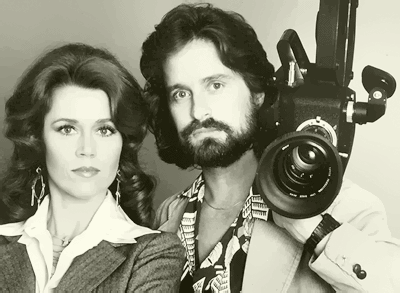
The tenor of this piece might suggest that I nurse a deep and abiding hatred for Michael Douglas — as both an actor and as a member of the human race. This is not the case — I have nothing against the guy. He has made some highly enjoyable films — Romancing the Stone and The War of the Roses always have been particular favorites of mine — and his turn as a rumpled professor experiencing a midlife crisis in Curtis Hanson’s Wonder Boys probably represents his best acting work to date (although his performance as greed incarnate in Oliver Stone’s Wall Street still commands a devoted following). I’m not really even trying to suggest that Michael Douglas actually is sexist. Putting aside the content of these films, there really isn’t anything to indicate that, as a private citizen, the man has a lack of respect for women and isn’t sympathetic to the issues that affect them. In his defense, it should be noted that he also produced The China Syndrome, which showed a strong, sympathetic female protagonist who refuses to accept the limitations imposed upon her by the powers-that-be, and proves her mettle and her integrity as a journalist.
That said, there’s no denying the fact that Michael Douglas has been involved with some of the most blatant exercises in anti-woman propaganda that the modern cinema has produced. I’m not one of those watchdogs who goes into a tizzy over any perceived instance of political incorrectness — frankly, I think most people are waaaay oversensitive about that kind of thing — but when you look at the kinds of films Michael Douglas has done, you’ve gotta wonder what’s going on in his head (beyond “Damn, I’m married to Catherine Zeta-Jones!”). If he had made just one of these films, I probably wouldn’t think much of it, but the fact is, he was involved with all four of them — and you’d be hard-pressed to find any four films made in the last 30 years which provoked more outrage on the part of feminist advocates. Whether this particular feature of Mr. Douglas’s career is the result of bad judgment or simply bad taste is open to debate, but in any event, it does seem to indicate a certain level of insensitivity (or at least lack of consideration) on his part. He seems to have been on his best behavior for the past decade or so…maybe Catherine managed to get some veto power to go along with the infidelity clause.
Tweet
Labels: B. Levinson, Bancroft, Barbara Hershey, Burstyn, Debra Winger, Demi, Dunaway, Emma Thompson, Geraldine Page, Glenn Close, J. Fonda, Julia Roberts, Kael, Lansbury, Pfeiffer, Sharon Stone
TO READ ON, CLICK HERE



