Wednesday, May 29, 2013
"A game-legged old man and a drunk. That's all you got?" "That's what I got."
BLOGGER'S NOTE: This post is part of The Howard Hawks Blogathon occurring through May at Seetimaar — Diary of a Movie Lover

By Edward Copeland
After the opening credits end, Howard Hawks begins Rio Bravo with a sequence somewhat unusual for a Western, or, for that matter, any film made in 1959. On the other hand, beneath the surface of Rio Bravo
 you'll find many more layers than your typical Western. The scene almost plays as if it hails from the silent era as a haggard-looking Dean Martin tentatively enters a large establishment providing libations, meals and even barber services. Martin's character's face tells you that he wants to resist liquor's siren call, but he's weak and he struggles. A man at the bar (Claude Akins) spots him after purchasing his own drink. He flashes Martin a smile, gestures at his glass and asks with his eyes whether Martin desires one. Aside from the film score and the ambient noise of the establishment's environs, no dialogue emanates from any of the characters that Hawks' camera focuses upon in this scene that's practically choreographed in mime. Martin's character replies with an eager but wordless "yes" and Akins
 tosses a coin — into a spittoon — laughing with his buddies (the closest thing to a human voice heard in this building) as Martin's character's desperation outweighs his pride and he
 gets down on his hands and knees, prepared to retrieve the money from the spit-out tobacco. Before he can, a foot kicks the spittoon out of the way and he looks up to see John Wayne towering above him in a great low-angle shot looking up at The Duke and giving him one of his many great screen entrances. His character's arrival also sets several of the story's strands into motion. You see, the man (Akins) taunting Dude (Martin) happens to be Joe Burdette, the blackest sheep of a powerful clan that gets away with practically anything it wants to do. Joe oversteps this time though as he continues to tease Dude after a brawl that includes the man who kicked over the spittoon, Sheriff John T. Chance (Wayne), Dude's boss when he's sober enough to carry out duties as deputy. Joe and his buddies keep harassing Dude when a sympathetic patron (Bing Russell) steps in, urging Joe to cut it out — still through gestures, not words. Joe Burdette doesn't take criticism well and shoots the unarmed man to death and exits the building to stagger to another saloon. Chance soon enters behind and speaks the film's first line, "Joe, you're under arrest."
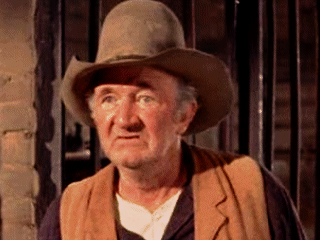
Burdette and his buddies don't take the sheriff seriously and seem intent to mow the lawman down when a still-shaky Dude arrives as backup, having composed himself enough to shoot the guns out of a couple of bad guys' hands. Seems Dude might have a drinking problem, but he's also Chance's deputy, and the lawmen take Joe into custody where the movie's waiting game begins. Can Chance, Duke (always battling the battle) and Chance's other deputy, Stumpy (Walter Brennan), aging and falling apart physically, keep Joe locked up until the U.S. marshal's arrival several days later to take Joe into custody for trial before Burdette's clan tries to free him In a few short minutes of screentime, the main story that drives most of Rio Bravo's 2 hours and 20 minutes has been set. Sideplots await, but all basically will converge in the main thread. Though nearly 2½ hours long, Hawks doesn't rush his film along, yet somehow he still keeps it moving and it holds its length incredibly well.
I'm not reporting earth-shattering news when I inform readers that Howard Hawks belongs to that select group of directors who excelled in every genre he attempted. One thing that sets Rio Bravo apart from Hawks' other works is that, while it resides in the Western genre, it snatches from many others — romantic comedies, war tales, detective stories, social dramas, even musicals. As film critic Richard Schickel says on a commentary track for Rio Bravo, Hawks liked saying
 that he loved to steal from himself. He'd do it again by practically remaking Rio Bravo as El Dorado eight years later, once again starring Wayne but with Robert Mitchum in the Dean Martin role. The plots diverge enough, as do the characters, (Mitchum plays a drunken sheriff as opposed to deputy while Wayne took on the role of gunfighter for hire helping a rancher's family get even with the rival rancher who killed their patriarch) to prevent it from being an exact facsimile. (Another shared aspect between the two films: screenwriter Leigh Brackett, who co-wrote Rio Bravo with Jules Furthman and wrote El Dorado by herself.) In the case of Rio Bravo, dialogue in the romantic sparring between Chance (Wayne) and possibly shady lady Feathers (Angie Dickinson) sounds lifted directly from To Have and Have Not, which Furthman co-wrote with William Faulkner. The relationship between Chance and Stumpy seems like a continuation of the one Wayne's Dunson and Brennan's Groot had in Red River, only minus Dunson's darkness. Part of Howard Hawks' greatness grew from his gift of swiping things from his previous films while changing the recipe just enough to make it fresh — a skill other self-plagiarists such as John Hughes never pulled off since they lacked Hawks' inherent talent, skill and imagination.
Hawks originally intended the action and imagery that runs beneath the opening credits to be its own sequence in the film, but later decided just to use it to accompany the list of cast and crew to a quieter piece of Dimitri Tiomkin's score before the set piece in the bar officially launches Rio Bravo. He films the footage of a wagon train caravan at such a distance that you can't readily identify its contents or characters, but a careful viewer connects it later as being the approach of the wagon train of Pat Wheeler
 (Ward Bond), who turns up shortly after the opening incident. At first, the audience can't be certain how to take the arrival of this man and his large crew, which includes a young gunman named Colorado (played by Ricky Nelson, teen idol and sitcom star at the time, who turns in a solid performance). For all the audience knows, these could be people sent to break Joe Burdette out of the jail where Stumpy handles most of his supervision. Dude, by then sobered up and handling more of his duties as deputy to Chance's Presidio County Texas sheriff, stops the wagon train in the middle of the town's main thoroughfare and insists that Wheeler and all of his men remove their weapons and hang them on a fence. They'll be free to collect the firearms when they depart the town again. (Wouldn't you love to watch Rio Bravo with the National Rifle Association's head flunky Wayne LaPierre and see how he reacts to law enforcement working for John Wayne in a Western that enforcing those rules?) Wheeler and those in his employ grumble at first, but soon comply. When Chance shows up, we realize he and Wheeler go way back on friendly terms, though Wheeler advises the sheriff they need to be careful where they store their cargo — it contains a large amount of dynamite. (Paging Chekhov if you don't think that's going to pay off somewhere down the road.)
 Labels: 50s, Angie Dickinson, Blog-a-thons, Dean Martin, Faulkner, Hawks, John Hughes, Mitchum, Movie Tributes, W. Brennan, Wayne
TO READ ON, CLICK HERE


Wednesday, March 23, 2011
When Mildred first met the masses

By Edward Copeland
In anticipation of Todd Haynes' new HBO miniseries adaptation of Mildred Pierce, which premieres Sunday and hews more closely to James M. Cain's original novel than Michael Curtiz's 1945 film did, I felt that it was worth re-visiting the first film take on the story since I've always loved it, before I start the process of comparing it to the new version.
Curtiz's film starts off with a bang or, more literally, three bangs as we hear three gunshots and Monte Beragon (Zachary Scott) hits the floor dead, the revolver that did him in tossed at his body, We see someone hastily exit the house and speed away. The next thing we see is Mildred Pierce Beragon herself (Oscar winner Joan Crawford), draped in her fur coat, wandering the pier past the restaurant that once was her own. She
 walks further down staring at the choppy waters below, looking as if she's considering taking a leap over the side until a beat cop (Garry Owen) notices what she seems to be up to and urges her to stop, telling her that if she jumps in then he'll have to jump in after her and he's not particularly in the mood for getting wet. Eventually the officer's jawing convinces Mildred to move along and she heads back. Wally Fay (the underrated and largely forgotten Jack Carson) knocks on the window of the restaurant and invites Mildred in for a free drink, saying it's the least he can do since buying her out of the place was the best investment he's ever made, so Mildred, still obviously preoccupied, agrees to sit for a drink. As he always has (since childhood apparently), Wally puts the moves on Mildred, but she brushes him off. As they are finishing their drink, Mildred suggests that they go to the beachhouse for a nightcap and Wally's all for it, seeing it as an opportunity to make his long-lingering dreams come true. They get in Wally's car and drive up to the house as Mildred unlocks the door, Wally asks where Monte is or if he has suddenly become broadminded.
Once inside, Wally finds a darkened house and heads straight to the bar to start preparing drinks for the two of them. Mildred still seems distracted. She finally pulls herself together and says she's going to go change clothes. Wally, who is quite the chatterbox, asks her to keep the door open so he can keep talking to her. "Something about the sound of my own voice just fascinates me," he tells her. She says she will, but as Wally prattles on, he notices the sound of her door closing. He goes to check it out. It's locked. He tries to get her attention but gets no answer. He checks the others doors but finds they are all locked — and then he stumbles across Monte's dead body.
Not thrilled that Mildred had tricked him into a locked beachhouse with the corpse of her murdered husband, Wally uses a chair to break a window and scramble down the side of the house — just as the police arrive. He
 doesn't make any effort to get away after they fire shots at him, at first assuming he's a burglar, but as one officer watches Wally while the other checks out the house Wally tells him that there's a stiff inside. The other cop returns and the policeman watching Wally tells his partner, "Say, he says there's a dead guy in the house." "You never saw deader," the other cop replies. Meanwhile, Mildred returns to her house where not only is her daughter Veda (Oscar nominee Ann Blyth) awaiting her but so are two detectives, who ask her to come with them. Once they get outside the residence, they tell her they didn't want to break the news in front of her daughter but her husband has been found murdered. They take her to the police station where, as her old friend and manager of her restaurant, Ida Corwin (the delightful Oscar-nominated Eve Arden) says, it looks like a class reunion. Present are Ida, Wally and Mildred's first husband Bert (Bruce Bennett) as well as Mildred. The remainder of Mildred Pierce unfolds in flashback to lead up to those shots someone pumped into Mildred's second husband Monty when Mildred objects when the police pin the crime on Bert.
I've seen Mildred Pierce probably about five or six times in my lifetime, including this week's viewing, and I've always liked it a lot even if I've never found it to be a perfect movie. All the previous times I watched it I came with zero knowledge of the Cain novel upon which it was based and I had not watched a new miniseries that stuck closer to Cain's original story. I did my best to view the 1945 film the way I had before and while I still like the 1945 Mildred Pierce a lot, it just pales when you know what they did to Cain's story and how much of an improvement the HBO miniseries turns out to be, but I swore this post would concentrate on Curtiz's film and not get into the comparison game. (That post comes Friday).
The one thing that always has bothered me about Mildred Pierce is that while it's mostly well acted, Joan Crawford's Oscar-winning turn as the title character actually turns out to be one of the least-interesting characters in the movie. I have only seen three of the five best actress nominees that year and Crawford deserved it over Ingrid Bergman for The Bells of St. Mary's, but I haven't seen Greer Garson in The Valley of Decision or Jennifer Jones in Love Letters to make judgments on them. I can say decisively though that of the three I have seen, it's not close — Gene Tierney deserved the prize for Leave Her to Heaven. Crawford's Mildred shows very little range, whether she's raging at a cheating spouse, losing her restaurant or a dying young daughter or her constant attempts to please her evil incarnate of a daughter named Veda. It's even more apparent when you put her in scenes with the likes of Arden, Carson, Blyth and, to a lesser extent, Scott, because they all wipe her off the screen.
Though it's structured as a noirish murder mystery, once Mildred Pierce goes into its flashback mode telling her story, the crime is mostly an afterthought as the film charts her rise and fall as a successful restaurateur, ruined by her need to give her grasping high maintenance daughter Veda everything Veda thinks the world owes her and the added burden of paying the bills of her second husband (Scott), once a rich, well-known playboy but now basically her gigolo. As Monte tells Mildred when she asks him what he does for a living, "I loaf, in a decorative and highly charming manner." Mildred finally does dump him for awhile, but in her neverending quest to keep Veda near, goes to the extreme of marrying him, hope his lifestyle, albeit a fake one, will lure the snobbish and superficial spawn back into her graces. Since Mildred is supposed to be talking to a police detective in her effort to convince him that Bert didn't kill Monte, we often hear her in voiceover, but it comes in so infrequently, that it's sometimes jarring.
The film glides along so well because it's been placed in the hands of one of Hollywood's best workman directors in Curtiz whose best film remains the incomparable Casablanca but also helmed movies as diverse as Captain Blood, The Adventures of Robin Hood, Angels With Dirty Faces, Yankee Doodle Dandy, Young Man With a Horn and White Christmas. He's really telling a story that's a melodrama, not a murder mystery. The other weakness Curtiz faces is the casting of Bruce Bennett as Mildred's first husband Bert. Bennett's acting not only is stiff, his character has to be portrayed as one of the most upstanding individuals that ever left his family for another woman.

The key to making it work are his supporting players and the dialogue, some of which comes from the Cain novel but a lot of the best lines whose credit goes to named screenwriter Ranald MacDougall, uncredited writers William Faulkner and Catherine Turney and improvs and ad libs from the cast themselves. Arden, who plays Ida who meets Mildred as a diner manager who hires her as a waitress and later becomes Mildred's business partner gets the bulk of the movie's best lines. When Monte says he's always tried to avoid work, Ida quips, "You were probably frightened by a callus at an early age." When Mildred complains about what she's going to do about Veda, Ida responds, "Personally, Veda's got me convinced that alligators have the right idea. They eat their young."
In the end, Mildred Pierce is not a movie trying to determine who killed someone but a story of a woman who builds a successful life for herself but ruins it with her unhealthy attachment to a spoiled, resentful shrew of an offspring. The 1945 film remains enjoyable, but it doesn't tell the true story that James M. Cain wrote, but that version will premiere Sunday. I'll tell you more about it Friday.
Tweet
Labels: 40s, Books, Crawford, Curtiz, Eve Arden, Faulkner, Fiction, G. Tierney, Garson, HBO, Ingrid Bergman, Oscars, Remakes
TO READ ON, CLICK HERE
Wednesday, March 04, 2009
Horton Foote (1916-2009)
When screenwriter and playwright Horton Foote passed away at 92, he was working on a collection of nine plays in what he called "The Orphans' Home Cycle" which was to premiere at the Hartford Stage next September. Unfortunately, it took death to finally slow the prolific Texan down.
While he achieved acclaim and fame as a writer, Foote's dream originally was to become an actor when he left his Texas home and that's how he made his Broadway debut, as an actor in 1939. His Broadway debut as a playwright would come a mere five years later with Only the Heart in 1944. He continued sporadically writing plays, winning the 1995 Pulitzer Prize for The Young Man From Atlanta, which I was fortunate enough to see when it reached Broadway in 1997 earning Tony nominations for best play and the superb, brilliant and luminous Shirley Knight, featured actor William "Biff" Maguire but none for equally great co-star Rip Torn. Foote had a comedy, Dividing the Estate, which played this season until Jan. 4., whose ensemble included Elizabeth Ashley, Gerald McRaney and his own daughter, Hallie Foote. Perhaps his most famous Broadway play premiered in 1953. The Trip to Bountiful and starred none other than Lillian Gish. It won Jo Van Fleet a featured actress Tony. When it became a film in 1985, it won Geraldine Page an Oscar on her eighth try and gave Foote his third Oscar nomination for screenplay and the only time he lost. He won for adapting Harper Lee's To Kill a Mockingbird and for his original screenplay, 1983's Tender Mercies. He also wrote for television, especially when televised plays were common, and won a 1997 Emmy for adapting a William Faulkner novella into Old Man. He also wrote the 1992 film adaptation of Of Mice and Men starring Gary Sinise and John Malkovich.
RIP Mr. Foote.
Tweet
TO READ ON, CLICK HERE
While he achieved acclaim and fame as a writer, Foote's dream originally was to become an actor when he left his Texas home and that's
 how he made his Broadway debut, as an actor in 1939. His Broadway debut as a playwright would come a mere five years later with Only the Heart in 1944. He continued sporadically writing plays, winning the 1995 Pulitzer Prize for The Young Man From Atlanta, which I was fortunate enough to see when it reached Broadway in 1997 earning Tony nominations for best play and the superb, brilliant and luminous Shirley Knight, featured actor William "Biff" Maguire but none for equally great co-star Rip Torn. Foote had a comedy, Dividing the Estate, which played this season until Jan. 4., whose ensemble included Elizabeth Ashley, Gerald McRaney and his own daughter, Hallie Foote. Perhaps his most famous Broadway play premiered in 1953. The Trip to Bountiful and starred none other than Lillian Gish. It won Jo Van Fleet a featured actress Tony. When it became a film in 1985, it won Geraldine Page an Oscar on her eighth try and gave Foote his third Oscar nomination for screenplay and the only time he lost. He won for adapting Harper Lee's To Kill a Mockingbird and for his original screenplay, 1983's Tender Mercies. He also wrote for television, especially when televised plays were common, and won a 1997 Emmy for adapting a William Faulkner novella into Old Man. He also wrote the 1992 film adaptation of Of Mice and Men starring Gary Sinise and John Malkovich.
 RIP Mr. Foote.
Tweet
Labels: Awards, E. Ashley, Faulkner, Geraldine Page, Malkovich, Obituary, Oscars, Rip Torn, Television, Theater
TO READ ON, CLICK HERE
Friday, December 02, 2005
From the Vault: Barton Fink

Ambition and aspirations can lead to widely divergent paths and that certainly shows in Barton Fink, the latest film by Joel and Ethan Coen.
Fink made headlines earlier this year by becoming the first film in Cannes Film Festival history to win best picture, best actor (John Turturro) and best director (for Joel, who helms the brothers' works). Its appeal to an international jury of film judges comes from the fact that it's a movie that doesn't spell everything out for the audience, something that American films do too often and seldom to good effect.
It remains to be seen whether deeper meanings lurk below the surface of this entertaining and disturbing film or if the Coens have created the film equivalent of those old Mad Lib games with the audience filling in the symbolism instead of parts of speech. Either way, Barton Fink's style and dialogue make it one of the best cinematic trips this year.
Turturro stars as the title character, a left-leaning playwright in the Clifford Odets vein who was making a name for himself in New York writing plays about "the common man." His being revolves around the espousing of his social and creative consciousness, though when it comes to actually listening to what the common man has to say, Fink's self-absorption keeps him from hearing the words.
Following the opening of his first substantial Broadway success, Barton's agent suggests that he head to Hollywood to find screenwriting work for awhile, if for no other reason than to make some good money to enable him to write more plays. Reluctantly, Barton listens, comforted by the idea that common people also live in California. Barton finds his first assignment to be writing a B-grade wrestling picture starring Wallace Beery, something he has no idea how to do.
For help, he turns to a prominent Southern novelist (nee William Faulkner, played wonderfully by John Mahoney) whose Hollywood career has pushed him inside the bottle while his faithful secretary (Judy Davis) does the actual work.
To say much more would not only be detrimental to the unfolding of the plot, but a synopsis would almost certainly be incoherent. The best explanation is that the story has two halves, one involving the seedy Hollywood hotel where Barton takes up residence and the insurance salesman (John Goodman) who lives next door, the other skewering formula filmmaking.
The main problem with Barton Fink is its inability to clearly link the relationship between the two halves, except by the loosest of associations of the creative process gone awry. Still, the film soars in spite of this, thanks to Goodman's excellent work and the amusing caricatures of studio executives, particularly Michael Lerner as the studio chief.
After sitting through this summer of failed formula films, the open ridicule the movie dumps on the process lifts the dispirited movie fan. When Lerner berates Barton about movie audiences wanting to see wrestling not soul searching, except for a little for the critics, any reviewer has to revel in a movie that expresses the same dissatisfaction with the bunk being churned out of Hollywood.
In the beginning, the style and camera acrobatics of Blood Simple made critics take notice of the Coens, but it's their words that have come to dominate their work. The understated ugliness of Blood Simple gave way to the humorous platitudes springing from the mouths of the low-rent characters in Raising Arizona.
Last year's Miller's Crossing painted its dialogue in strokes broad and terse but all infinitely memorable. Now comes Barton Fink and whatever weaknesses it might have, it's the words that hold the package together. The wonderfully rhythmic dialogue ranging from Lerner's deceptively self-effacing studio chief to the verbal volleys of a pair of detectives (Richard Portnow, Christopher Murney) mesmerize as much with speed as with content. The film's beautiful cinematography resembles the work of David Lynch — and that's not entirely out of place here.
As far as the meaning (or if there even is one), that's best left to the audience. Half the fun will be discussing Barton Fink afterward. Personally, I doubt the film has a deeper level, just fun references skewering all sides of the political spectrum on the eve of World War II, from the socialist, fascist and capitalist points of view. Barton Fink represents the Coens at their most ambitious, but its aspirations remain unclear and, I believe, that is precisely their point.
Tweet
Labels: 90s, Coens, Faulkner, John Goodman, John Turturro, Judy Davis, Lynch
TO READ ON, CLICK HERE


