Wednesday, May 09, 2012
Such a little word, but oh, the difference it makes!

As people who pay attention to these sorts of things know, for quite some time the Broadway season, and by that I mean in terms of Tony Award eligibility, usually ends toward the end of April with the awards given in June. However, that hasn't always been the case. For example, though A Funny Thing Happened on the Way to the Forum opened May 8, 1962, when it received its Tony nominations they belonged to the crop of 1963 Tony nominations with winners handed out nearly a year later on April 28, 1963. Furthermore, Forum's May 8 opening came a mere nine days after the previous Tony Awards held April 29, 1962 for 1961's Broadway season. On the musical side,
 Frank Loesser's How to Succeed in Business Without Really Trying, which had just opened Oct. 14, 1961, hauled away the most awards. It won best musical, best actor (Robert Morse), best featured actor (Charles Nelson Reilly), best director of a musical (Abe Burrows), best authors of a musical (Burrows, Jack Weinstock and Willie Gilbert), best producers of a musical (Cy Feuer and Ernest Martin) and best conductor and musical director (Elliot Lawrence). In fact, the only nomination that How to Succeed lost was Loesser's as best composer. Richard Rodgers won for No Strings, his first solo effort since Oscar Hammerstein's death. Loesser did receive the consolation of a Pulitzer Prize for his work — one of several parallels between his career and Stephen Sondheim's, one of which we'll be coming upon shortly. As far as when the Tonys switched their eligibility dates and started holding the awards in June, as near as I can determine (cross your fingers, I'm forced to use Wikipedia as a source), the first time that happened was 1977, the year before CBS began carrying the broadcast which it has ever since, heaven help theater fans (at least as far as the past decade or so has gone). I must note, as I return to the subject at hand, that the photo at the top as well as the one inset in this lead both came from the camera of Tony Walton, the scenic and costume designer of the 1962 production. The inset photo shows his model of what the set should look like when complete. Both come courtesy of Walton via an interview he did with examiner.com.
 When those 1963 Tony nominations did come out, A Funny Thing Happened on the Way to the Forum, despite having opened so long ago, did very well. It received a nomination for best musical, competing against Little Me, Oliver!, and Stop the World — I Want to Get Off. Sondheim might have felt guilty about lying to David Merrick but he produced the latter two musicals that would be competing against Forum. Merrick also garnered a nomination as best producer of a musical with Donald Albery for their work on Oliver! where the duo faced off against Hal Prince for Forum as well as last year's winners, Cy Feuer and Ernest Martin, for Little Me. Larry Gelbart and Burt Shevelove picked up a nomination as best authors of a musical for Forum and one of the competition happened to be another veteran from the days of writing for Sid Caesar on television like Gelbart once did — Neil Simon for Little Me. which Simon happened to
 write specifically for Caesar, who would face off against Zero Mostel's Pseudolus in Forum, Anthony Newley in Stop the World — I Want to Get Off and Clive Revill in Oliver! for lead actor in a musical. Lionel Bart (Oliver!) and Leslie Bricusse and Newley (Stop the World — I Want to Get Off) rounded out the author of a musical category. The venerable George Abbott's work on Forum earned him a best director of a musical nomination and he also landed a nomination as best director of a play for Never Too Late, a comedy that actually ran longer than Forum. In the musical direction category, others receiving recognition were Peter Coe (Oliver!), John Fearnley (Brigadoon) and Feuer and Bob Fosse (Little Me). (At right, we see Abbott at the 1994 Tony Awards at the age of 106 braced by Gwen Verdon and Jean Stapleton. He died in January 1995 at 107.) David Burns as the leering, patrician Senex and Jack Gilford as the nervous slave Hysterium took half the nominations in featured actor in a musical for Forum. Filling out the category were a young David Jones as the Artful Dodger in Oliver! The recently passed Jones became better known when he changed his first name to Davy and became part of The Monkees. Sven Svenson in Little Me took the fourth slot. The final nomination that A Funny Thing Happened on the Way to the Forum garnered was for Ruth Kobart, who played Senex's suspicious wife Domina, as featured actress in a musical alongside Virginia Martin (Little Me), Anna Quayle (Stop the World — I Want to Get Off) and Louise Troy (Tovarich). Sondheim's score got snubbed and wasn't nominated in the category for best composer and lyricist. The composers of the other three nominated best musicals made the cut but the fourth slot went to Milton Schafer and Ronny Graham for Bravo Giovanni, a musical that ran only 76 performances and received only two other nominations for choreography and conductor and musical director. Sondheim, who didn't get nominations for his lyrics for West Side Story or Gypsy either, remained in the ranks of those never nominated for Broadway's top honor. Boy, would he make up for that later.
When Tony night 1963 arrived, A Funny Thing Happened on the Way to the Forum won almost every award for which it was nominated. Mostel defeated Gelbart's former boss. Gilford lost — but he lost to co-star Burns. Abbott won for director of a musical, though he didn't take the prize in the play category. Gelbart and Shevelove took the prize for their book, so Gelbart beat his former co-worker as well. Prince won as producer. The American Theatre Wing crowned the show best musical meaning David Merrick went 0 for 2 in that category. Other than Gilford, the only Forum nominee that didn't score was Ruth Kobart, who lost to Anna Quayle for Stop the World — I Want to Get Off. (Shown in the photo at left are the 1963 winners in the lead acting categories. From left, Mostel, Vivien Leigh, lead actress in a musical for Tovarich; Uta Hagen, lead actress in a play and Arthur Hill, lead actor in a play, both for Who's Afraid of Virginia Woolf?) In Meryle Secrest's biography, Stephen Sondheim: A Life, the composer described watching the ceremony from home. Secrest writes, "Prince…thanked Abbott, Gelbart and Shevelove. Gelbart and Shevelove, who won book, thanked each other, Abbott and Prince. 'Nobody mentioned me on the program at all. As far as they were all concerned, my friends, my colleagues, I did not exist. That's what really hurt,' Sondheim said. 'Hal was the only one — Hal called me the next day and apologized. He said, 'I'm sorry, kid. I should have mentioned you and I didn't.'" The lack of acknowledgment did lead to some rifts such as when the hurt Sondheim confronted Shevelove and Shevelove lashed out at him, saying his songs almost killed the show before it ever got to New York. In an anecdote that appears in Secrest's book and Sondheim's Finishing the Hat, Sondheim shares the tale of a special letter he received that lifted his spirits, though it's unclear when Sondheim got the correspondence. Secrest's book says he received the letter shortly after Forum opened, but places the story right after the Tony story. Sondheim doesn't date it at all, though he adds the detail that Frank Loesser told him in the letter that he commiserated with him because he remembered the reception for his first Broadway musical, Where's Charley?, and wanted to let Sondheim know how good he thought the score of Forum was. Specifically quoted in both books, Loesser wrote, "Sometimes even a composer's working partners, to say nothing of the critics, fail to dig every level and facet of what he is doing. But I know, and I wanted you to know that I know."
Before I discuss the revivals, I've been looking for a place to work in talk of the song "Love, I Hear" somewhere and failed to accomplish my mission. Now, I adore "Comedy Tonight" and "Everybody Ought to Have a Maid" but I can't believe that no one mentions "Love, I Hear" anywhere. Hell, "Bring Me My Bride" found its way into a review. While Sondheim criticizes himself for being clever instead of funny, I love his wordplay (and he can't hide his pride in Finishing the Hat about the alliterative string of double consonants that he pulled off in one line of the song, "Today I woke too weak to walk." Links: First "Love, I Hear" from 1962 original cast recording; Second "Love, I Hear" and "Bring Me My Bride" both from 1996 revival original cast recording.

Like most Sondheim shows, Forum tends to add and subtract songs in later versions. After missing out on the original production because they wouldn't let him wear his glasses, that didn't seem to be a problem anymore and Phil Silvers took the role of Pseudolus in the show's first major revival, directed by Burt Shevelove himself. It actually started in October 1971 for a 47 performance run at the Ahmanson Theater in Los Angeles. I mentioned in the last part that Reginald Owen played Erronius. The cast also included Larry Blyden as Hysterium, veteran comic actor Carl Ballantine as Marcus Lycus and, the second biggest name in the show after Silvers, Nancy Walker in the role of Domina. In fact, she felt she needed another solo so Sondheim wrote "Farewell" for her. One of the courtesans happened to be Ann Jillian. The only song dropped was Philia's "That'll Show Him" and "Echo Song" put in its place. When they made the move to Broadway and opened March 30, 1972, Walker and Jillian didn't travel with them and another song got the axe. This time, they excised "Pretty Little Picture." Whatever the Tony eligibility dates were for the 1972 awards were, Forum must have cut it close since the awards were given April 23. Shevelove received a nomination for directing but, ironically, lost to Prince and Michael Bennett for their work on Follies. Silvers won lead actor in a musical and Blyden won featured actor as Hysterium. The revival won two of its three nominations. (They hadn't added a revival category yet.) The show seemed to be doing well until Silvers got sick, reportedly because of "food poisoning." An understudy filled in as they hurried to rehearse Tom Poston as a replacement, but ticket sales fell fast. The show only ran 156 performances and it turned out that Silvers had suffered a stroke. Links: "Farewell" info beneath video; "That'll Show Him" and "Pretty Little Picture" from 1962 cast recording.

When the next Broadway revival arrived in 1996, it did so during the era when the Broadway bug had bitten me badly so I actually got to see it soon after its April 18 opening. I had pretty good orchestra seats — I swear at one point it appeared as if Nathan Lane addressed me personally and we locked eyes at one point. Quite different from the couple of times I bumped into Lane accidentally in Manhattan when he always seemed to be the most annoyed, pissed-off man in the universe. Sure, he hammed it up like crazy as Pseudolus but that's a role that doesn't require nuance and it still won him his first Tony Award. Mark Linn-Baker did fine as Hysterium and, as I mentioned earlier, I got to see the late William Duell as Erronius. Ernie Sabella took on the role of Marcus Lycus and the long-cut song of "The House of Marcus Lycus" finally made the show. Lewis J. Stadlen received a Tony nomination for his portrayal of Senex, but he was out the night I was there so I saw Macintyre Dixon in the role. Mary Testa played Domina. The songs followed the 1962 set with the exception of the addition I mention and continuing to keep "Pretty Little Picture" out of the show, though Lane recorded it for the cast album. Jerry Zaks received a nomination for directing the musical, but lost to George C. Wolfe for Bring in 'da Noise, Bring in 'da Funk. By now, the Tonys did have revival categories but Forum lost to The King & I. The revival made a bit of history when it recast Pseudolus
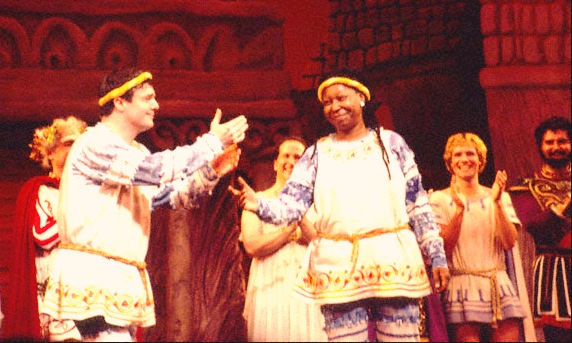 as Lane exited the show by installing Whoopi Goldberg in his place. Casting a woman, let alone an African-American one with Goldberg's reputation, made people wonder what she'd do. Ben Brantley wrote in The New York Times, "The work's authors, Burt Shevelove and Larry Gelbart, and its composer and lyricist, Stephen Sondheim, have always said they made a point of constructing a show true to its ancient sources and free of distracting anachronisms. But the leading role of Pseudolus, the wily slave in pursuit of freedom and a part that demands a manic comic spirit, has inevitably gone to wild-card performers unlikely to resist opportunities for their own shtick. As Mr. Gelbart said, in a recent interview with The Sondheim Review, 'after seeing Zero Mostel recite baseball scores in front of the House of Senex, there's not too much that would surprise me.' So there is Ms. Goldberg, queen of the devilish aside, firmly reminding you of just who she is in the production's opening moments. She finds comic fodder not only in her present personal life, but in her professional life in Hollywood as well.…That this occurs early raises delighted expectations that many audience members have brought with them: Just how bad, as in naughty, is their Whoopi going to be? Of course, others — that nasty breed of theatergoers who find Schadenfreude in seeing big stars blow it — are asking the same question with a different emphasis: Can this movie star-comedian possibly carry a musical? Sorry, guys, she can." Following Goldberg, David Alan Grier took on the role. The second revival ran for 715 performances.
The wreckage in that photo in 1993 represents the remains at the time of the outdoor amphitheater of Butler University in Indianapolis
 that for decades hosted Starlight Musicals every summer. Other cities around the Midwest also received visits from the touring program that would bring concerts, plays and musicals featuring celebrities. From
 the time I was a young child, each summer when we visited my grandma we would take in some shows. Many of the early things we saw tended to be concerts by people such as Mitzi Gaynor, Liberace and the tag team of Jim Nabors and Florence Henderson. In 1979 when I was 10, I got to see my first actual musical. I wish I could locate the program so I'd remember what songs were in that production of A Funny Thing Happened on the Way to the Forum. As a youngster, I tended to be an autograph hound so if we got there early, I'd either stake out the entrance to the backstage or I'd assault the performers after the show. For me, Forum boasted an all-star cast. Playing Pseudolus was none other than Arte Johnson from Rowan and Martin's
 Laugh-In. I'd see him again when I grew up and he appeared in the Broadway revival of Candide. Avery Schreiber portrayed Hysterium, but to me — unfamiliar with his comedy work with Jack Burns — he was the Doritos guy. When I got his autograph after the show, I even brought Doritos with me so when he
 stepped out I had one ready to take a big crunchy bite out of for him. Schreiber raised his hands and said to me, "You got me" then signed my autograph. John Carradine played the role he originated on Broadway, Marcus Lycus. I didn't know that at the time nor did I realize the breadth of his career, but at 73, he looked frail to me, though he'd live another eight years. The final big name belonged to Hans Conried who was cast as Senex. I didn't know at the time that he supplied the voice of Captain Hook in Disney's Peter Pan and I hadn't heard of The 5,000 Fingers of Dr. T. I knew Conried as Wrongway Feldman from an episode of Gilligan's Island. He died less than three years later. Johnson alone remains alive. Schreiber passed away in 2002. That same summer, I saw Rodgers and Hammerstein's Carousel starring a drunk-as-a-skunk Robert Goulet, who exited his limi when he arrived bellowing, "Nobody owns me!" However, that's another story. Tragedy tomorrow, comedy tonight.
Tweet
Labels: Awards, Books, Disney, Fosse, Frank Loesser, Gelbart, Hammerstein, J. Carradine, Music, Musicals, Neil Simon, Phil Silvers, Rodgers, Sid Caesar, Sondheim, Television, Theater Tribute, V. Leigh
TO READ ON, CLICK HERE


Monday, February 13, 2012
"I am a most strange and extraordinary person"

By Michael W. Phillips Jr.
Christopher Isherwood's Sally Bowles, first seen in an eponymous 1937 novella, has been around (if you know what I mean) for 75 years in a variety of media, perpetually on the lookout for a chance to become a star. A young British girl looking for fame and fortune in Berlin in the waning days of the Weimar Republic, just before the rise of the Nazi Party, Sally found her way to the stage with John Van Druten's 1951 play I Am a Camera, then to Broadway with John Kander and Fred Ebb's 1966 musical Cabaret, and finally to the screen with Bob Fosse's film, which turns 40 today. A bewildering array of actresses have inhabited her along the way, I'm sure to varying degrees of success: Julie Harris, Natasha Richardson, Jennifer Jason Leigh, Gina Gershon, Debbie Gibson, Teri Hatcher, Molly Ringwald, Brooke Shields, Lea Thompson, Judi Dench, Jane Horrocks. But perhaps to most people, Sally Bowles is Liza Minnelli and Liza Minnelli is Sally Bowles. Sally got her most memorable actress and Liza got an Oscar.
This wasn't Minnelli's first brush with the material: Darcie Denkert, in her lavish 2005 book A Fine Romance, tells us that Kander and Ebb had wanted Minnelli for the stage back in 1966, but director Harold Prince thought she was too young, too American, and too good a singer to play the young, British, barely talented denizen of the Berlin nightlife. In a way Prince was right: Minnelli is such an astoundingly good singer that Sally's self-confident assurances that she'll make the big time someday don't seem completely groundless. But it's still obvious that Sally won't make it, perhaps for the more subtle reason that her towering talent is unfortunately coupled with an utter lack of judgment, her impetuousness covering a sea of self-doubt.

Sally Bowles may be the focus of the film, but the most interesting character is Joel Grey's Emcee, an androgynous, grease-painted sprite with a wicked grin, which Grey originated on stage. Denkert speculates that the Emcee has his roots in a 1930 Thomas Mann novella called Mario and the Magician, about an Italian mesmerist who uses his powers to control his audience. But he reminded me more of another hypnotist, Dr. Woland (Satan in disguise) in Mikhail Bulgakov's The Master and Margarita, who, like the Emcee, seemed less of a fascist cheerleader than a bringer of chaos. The "decadence" of the Weimar Republic is on full display in the Kit Kat Club, and the Emcee gleefully whips his little corner of the world into increasing levels of the very things that the Nazis claimed to be so upset about. This connection is impossible, of course, since Bulgakov's novel wasn't published in English until after the Broadway run started, but I wouldn't be surprised to discover that Joel Grey had it in mind when he transferred his iconic character to the screen.
Because I've never seen or read any of its sources, questions of faithfulness or relative merit are thankfully not ones I can answer. Fosse and screenwriter Jay Presson Allen made several radical changes in transferring the story to the screen, starting with the music. They cut most of the "book" songs from the stage production, removing most of the secondary characters' vehicles for expression of their emotions, pushing them into the background and foregrounding Sally and the Emcee. Now all the songs (with one stunning exception) take place in the cabaret, and only Sally gets a traditional "book" song, wherein the singer gives voice to an inner monologue. This is the new addition "Maybe This Time," which Kander and Ebb had written for Minnelli back in 1963 and which, despite its magnificence, doesn't feel right in the film because Minnelli is unable to restrain her stupendous voice, and the scene starts to feel like she's making a statement about her talent in relation to her famous mother's instead of doing what's necessary for the character. Kander and Ebb wrote several other new songs, and a quick listen to the original cast recording tells me that I generally agree with the subtractions and additions.

From what I've read, this is less an adaptation than a reconceptualization into something that has roots on Broadway but also looks back to Isherwood's stories and forward into a radical new kind of film musical. It's a thing created from the raw material of the long-running Broadway sensation, but crafted into something that is first and foremost a film. Fosse uses his trademark abrupt editing to do something that would have been impossible on stage: by jarring cross-cutting between the stage and the outside world, he drives home the parallel between the increasing violence and decadence of the Emcee's show and the violence and decadence of the Nazis' rise to power. The boozers and good-time gals who hang out in the Kit Kat Club are there in part to escape reality, but Fosse and editor David Bretherton won't let us forget that the real world is still out there, and it's getting scarier by the measure. Kander and Ebb hated the film at first viewing because it wasn't what they had written, but gradually came to the conclusion that Fosse had created something completely new that was in fact a triumph.
The most triumphant thing for me is how deftly Fosse shrinks and expands the space of the stage. Most adaptations of musicals attempt to shed their "staginess" by setting scenes outdoors or adding new outdoor scenes, and this is no exception. But few, I think, play so adeptly with that staginess. Sometimes the Kit Kat Club seems as big as the Hollywood Bowl, packed to the gills with leering mutton-chopped men and bored women, and the stage seems like it's a tiny thing a mile away. Other times the club feels like it's the size of a telephone booth, and we can almost taste the sour sweat of the patrons and narrowly avoid the swinging limbs of the performers who loom above like giants. Sometimes the stage feels like the whole world. Fosse achieves this through camera placements and movements, use and eschewing of spotlights, and although it's not a perfect technique, it's more often than not a revelation. Much like the film itself: it's not the best musical ever made, and it has its flaws, but it's a wholly original creation that did much to clear away the big-budgeted, uncreative monstrosities that had come to characterize the genre in the late 1960s.
Michael W. Phillips Jr. is a Chicago-based film writer and programmer. He's the webmaster for Goatdog's Movies, and he programs films for the Chicago International Movies & Music Festival and the nonprofit film series South Side Projections.
Tweet
Labels: 70s, Dench, Ebb, Fiction, Fosse, H. Prince, J.J. Leigh, Kander, Liza, Movie Tributes, Musicals, Oscars, Theater
TO READ ON, CLICK HERE
Saturday, September 10, 2011
Cliff Robertson 1923-2011

Ordinarily, when someone with as long and as illustrious a career as Cliff Robertson passes away, I would try to be as comprehensive as possible in my appreciation. Unfortunately, because I've been so underwater in projects, I didn't receive the news until much later than I should have and the due dates of the projects require that I can't take myself away from them for too long a stretch. Before I write my short look at the career of Mr. Robertson, who died Saturday one day after his 88th birthday, I'd like to express regret for not finding a better photo of him as the slimy and manipulative presidential candidate Ben Cantwell in the 1964 film adaptation of Gore Vidal's play The Best Man. His at-any-costs maneuvers to wrestle the nomination away from Henry Fonda's William Russell, for me at least, was the best work Robertson ever did on screen.
Tweet
Labels: Aldrich, Crawford, De Palma, DeVito, Fosse, H. Fonda, John Carpenter, Mailer, Mankiewicz, Obituary, Oscars, Raimi, Redford, Television, Tennessee Williams, Theater, Vidal, Walken, Walsh
TO READ ON, CLICK HERE
Monday, February 11, 2008
Roy Scheider (1932-2008)

"We're gonna need a bigger boat." Just reading those words doesn't indicate that it would be one of the most famous lines of dialogue from a classic movie, but when you hear Roy Scheider's voice as Chief Brody speaking it with a mixture of fear and resignation, you know why it's worth repeating. It wasn't a shark that got the great actor, it was a long struggle with multiple myeloma before a staph infection took his life Sunday in Little Rock, Ark.
Jaws may be Scheider's lasting legacy, but his career went far beyond that. He was nominated for an Oscar twice, in 1971 as Popeye Doyle's partner in The French Connection and in 1979 as Bob Fosse's alter ego Joe Gideon in All That Jazz.
There could be an air of the sinister in his roles such as in Klute or as Dustin Hoffman's brother in Marathon Man, where Scheider took part in one of the great life-and-death struggles ever put on film.
Scheider also brought gravity to films that didn't really deserve them such as Blue Thunder or Listen to Me. He even helped the misguided sequel Jaws 2 work better than it should (as long as the teens weren't alone on the screen anyway). He even dared to take the lead in 2010, the sequel to 2001: A Space Odyssey.
Still, it's his first outing as Martin Brody, police chief of Amity Island, that's going to be the dearest in my heart and mind. An exiled N.Y. cop with a fear of water who moves to an island, which of course is only an island if you are looking at it from the ocean. No matter how you looked at Roy Scheider, he was an actor, and one of the most underrated.
RIP Mr. Scheider.
To read The New York Times obit, click here.
Tweet
Labels: Dustin Hoffman, Fosse, Obituary, Roy Scheider, Sequels
TO READ ON, CLICK HERE
Thursday, November 02, 2006
The name on everybody's lips...

By Edward Copeland
is going to be ... Roxie — or so goes the song in the Kander & Ebb/Bob Fosse Broadway musical turned Oscar-winning best picture Chicago. However, the story of "Roxie Hart," loosely based on a real 1924 murder trial of a woman named Beulah Annan, first began its fictional life as a play called Chicago before Wild Bill Wellman directed Ginger Rogers in a 1942 adaptation called Roxie Hart.
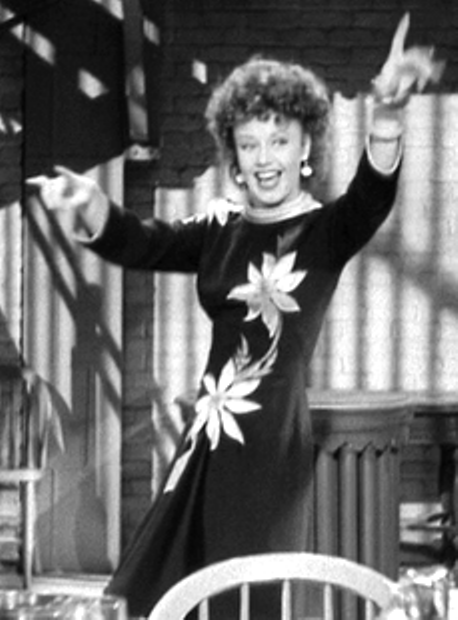
The movie, until the very end, bears striking similarities in tone and character to what eventually became the musical Chicago in 1975. While all the characters, like Roxie, are fictional pseudonyms, most of the characters will be familiar to viewers of the Broadway musical or the 2002 movie version. There's an Amos Hart (George Chandler in this case), a "Mama" Morton (Sara Algood, though the role is nowhere as pronounced as in the musical), a Mary Sunshine (Spring Byington) and a Billy Flynn (Adolphe Menjou). The murder victim even bears the same name of Fred Casely. The only notable absence: No Velma Kelly to be found. Roxie Hart tells its story in flashback as a reporter named Homer Howard (George Montgomery) recounts the case to a bar full of eager listeners 15 years after the event. Before the film even begins, a tongue-in-cheek title card dedicates the film to "all those women who filled their men full of holes in a fit of pique." Homer was a rookie reporter when the Roxie case happened and he found himself attracted to the vivacious murder defendant, though as he recounts the tale he's now a hard-drinking journalist — because that's what the public expects of reporters, he says. He also laments that Chicago hasn't had any good murder tales like Roxie's since "the Democrats took over."
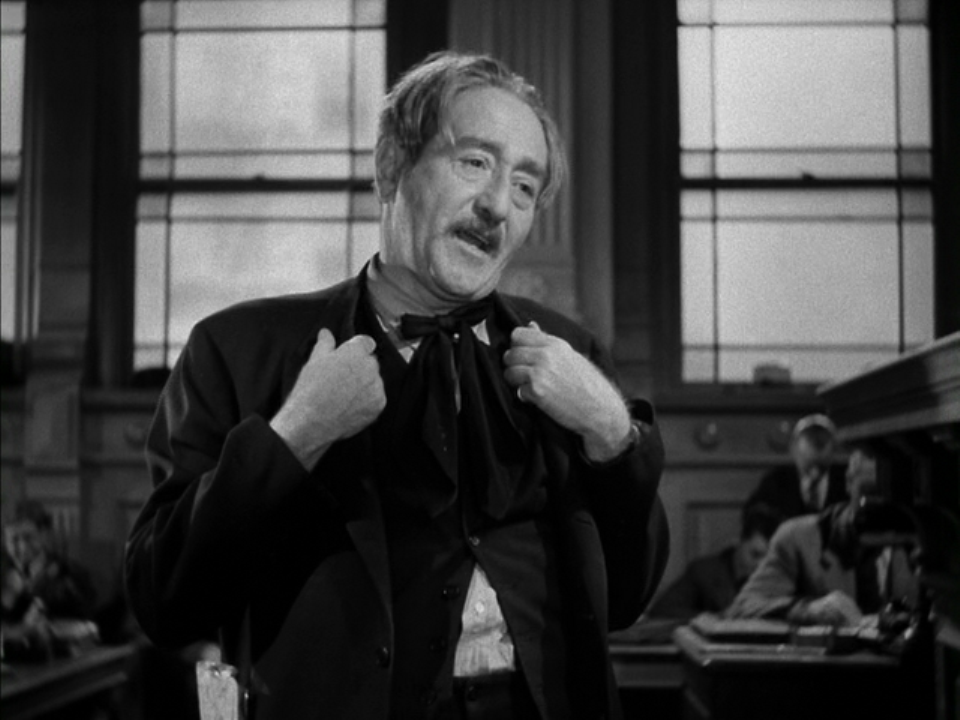
For moviegoers who only know Ginger Rogers from her classy dancing with Fred Astaire or maybe her noble Kitty Foyle, Roxie Hart is a gum-chomping, entertaining breath of fresh air from the actress. As I said previously, it is interesting how closely the outlines for the Chicago most viewers are familiar with now are clearly laid out in this film. Amos remains a milquetoast sap. Billy Flynn, though older in the form of Menjou, is nearly as manipulative, even if he lacks the razzle dazzle of the musical takes on the character. When he gets to court, he does put on the show and it's an entertaining farce, especially with the solid cast (including a small role by Phil Silvers as a newspaper photographer).
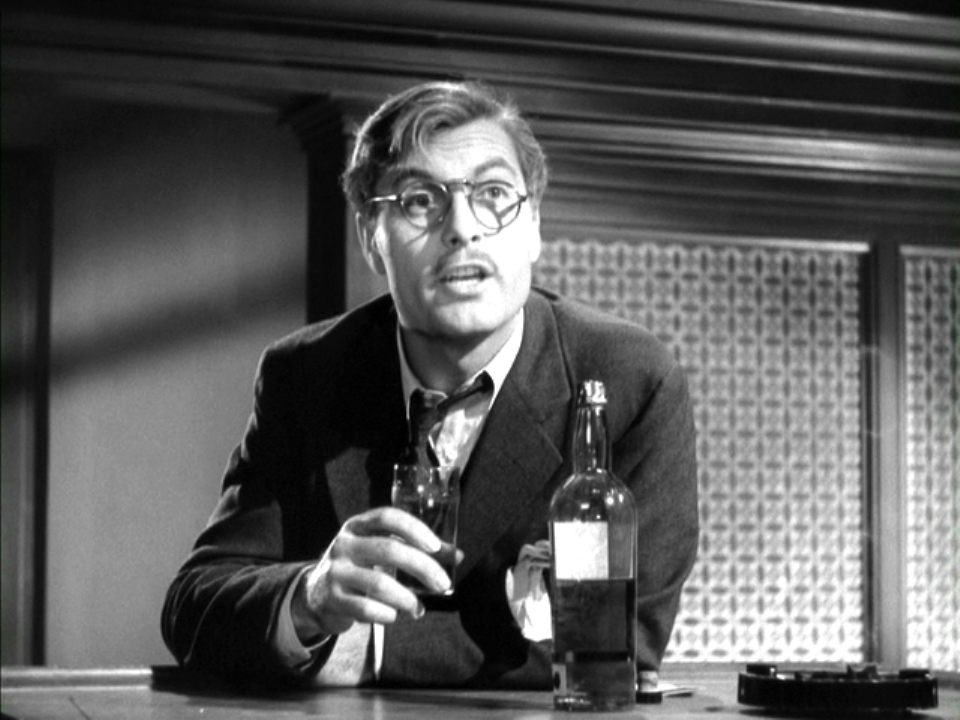
Pre-I Love Lucy William Frawley not only plays the barkeep that Homer shares his tale with, he turns out to be one of the jurors who heard Roxie's case. My good friend Josh R warned that the ending of Roxie Hart might be a disappointment, having to conform to the strict production codes of the day, but it didn't play that poorly for me. No, it's not the same cynical ending of the musical, but it is cynical in its own way, implying that Roxie ended up in a different sort of prison. All told though, Roxie Hart proves an entertaining film with a truly fun performance by Ginger Rogers. If you liked the movie or musical Chicago (or if you didn't), Roxie Hart is a fascinating artifact.
Tweet
Labels: 40s, Astaire, Ebb, Fosse, Ginger Rogers, Kander, Menjou, Musicals, Phil Silvers, Wellman
TO READ ON, CLICK HERE
Tuesday, June 06, 2006
Give my regards to Broadway

By Josh R
Now that the film awards-giving season is well behind us, and the Emmy nominations won’t be unveiled until July, the attention of awards-watchers like myself turns to the goings-on in the world of Broadway theater. I’m aware that people such as Edward and myself are members of a diminishing breed that actually pay attention to The American Theater Wing’s annual Tony Awards presentation honoring excellence on Broadway — though televised by CBS, the show’s ratings usually fall somewhere between a first-run episode of the least-watched Law & Order spin-off (whichever one that is) and a rerun of Walker, Texas Ranger airing on cable. This is understandable given that very few members of the television audience have actually seen or even heard of the shows and performers in contention. As opposed to films, which are available for viewing just about anywhere, live theater is a site-specific entertainment; either you see it in New York, or you wait for the touring production to make its way to a theater near you — usually sans members of the original Broadway cast.
While all of the media coverage surrounding this year’s Tony Awards seems to center on the non-nomination of Julia Roberts, whose Broadway debut in Three Days of Rain landed with a resounding thud at the Jacobs Theater to the gleefully misanthropic accompaniment of widespread critical guffawing (Clive Barnes of The New York Post likened her stage presence to that of a lamppost), the awards themselves will showcase a variety of interesting and worthwhile productions. This year, I’ve seen eight of the nominated shows, and a ninth off-B’way offering that will be headed to the Great White Way this fall and will doubtless figure prominently in next year’s Tony Awards.
The most celebrated of these is The History Boys, an import from Britain’s National Theater. Written by Alan Bennett, best known to American audiences for his play The Madness of King George (and its subsequent Oscar-nominated film adaptation starring Nigel Hawthorne), the play has received the kind of glowing notices that usually guarantee a production automatic commercial success and a long life beyond Broadway. Indeed, The History Boys has sold out its entire limited New York run, and a film version already has been made by Nicholas Hytner (who also directed this production), which may be released as early as this fall. It’s regarded as the prohibitive frontrunner in the best play category, and deservedly so.

As with any work of theater which takes on complicated issues, the plot is difficult to summarize. Basically, the story centers on a group of British schoolboys being prepared to take their college entrance exams by two teachers representing radically different approaches to education. The show has drawn some comparison to Dead Poets Society, although beyond their scholastic settings, I don’t think the two have very much in common (it’s a bit like comparing Network to Murphy Brown because they both take place in the world of televised news). History Boys uses this basic premise of a teacher inspiring his pupils as a jumping off place to tackle some thorny and provocative issues about the modern cultural approach to learning, and the way that institutional education can be damaging to those who seek to gain from it. The two teachers — played by Richard Griffiths (known to fans of the Harry Potter series as the title character’s portly muggle uncle) and Stephen Campbell Moore (Bright
 Young Things) — personify two radically different approaches to education. One represents the idea of learning for its own sake, the other views education as a commodity that can be parlayed into status, something to be used and exploited rather than to be enlightened by. The school's headmaster favors the latter approach since it produces "quantifiable" results — high test scores and Oxford scholarships. He prioritizes the well-being of the institution, and the prestige its pupils can bring to it, above the best interests of the people the institution exists to benefit — many critics have observed how this aspect of the play is really a metaphor for the self-serving politics of Thatcherite England (it's no accident that the play is set during Thatcher's tenure as prime minister). The "History Boys" are emerging from their education with a wealth of knowledge, but without any sense of how to apply it toward some meaningful purpose — all Moore's character has taught them how to do is to make flashy, subversive intellectual arguments that make them desirable to top universities. The scene where his character encourages his students to rationalize The Holocaust is chilling — it doesn't matter whether the students believe what they're saying or not, since (to Moore's way of thinking) perception is valued above truth.
The production has transferred from the 2005 National Theatre incarnation with its original cast intact. Griffiths, a marvelous character actor who handles both the play’s comic and tragic elements with equal aplomb, is likely to win best actor for his performance as the eccentric Hector — a maverick teacher in the Jean Brodie mold who isn’t above making inept advances toward his students when he’s not having them act out scenes from Now, Voyager and Brief Encounter. Frances de la Tour also is considered a strong contender in the featured category for her delightful deadpanning as Mrs. Lintott, who serves as the play’s wry, wary voice of reason, while young Samuel Barnett is nominated in the featured actor category as Posner, a desperately insecure student nursing a painful crush on his classmate, Dakin, played by Dominic Cooper. All five of the actors (Griffiths, Campbell Moore, de la Tour, Barnett, Cooper) were nominated for Drama Desk Awards — the Tony-nominated troika all won in their respective categories.

Just as it was beginning to look as if no new play could generate as much heat as the Bennett offering, an unlikely new entry arrived on the scene to rival The History Boys for critical enthusiasm. Irish playwright Martin McDonagh first achieved widespread recognition on Broadway for his 1998 critical and commercial hit The Beauty Queen of Leenane, a sort of Celtic variation on Whatever Happened to Baby Jane? with a mother and daughter wreaking havoc on each other’s lives in epic Grand Guignol fashion. Known for his penchant for shock value — startlingly violent imagery delivered with a twist of black humor — the playwright has been prolific in the years since, garnering four nominations in the best play category and winning an Oscar this past March for his short film, Six Shooter. His latest, The Lieutenant of Inishmore, has settled in for what appears to be a long run at the Lyceum Theater after an acclaimed engagement at off-Broadway’s Atlantic Theater Company.
Beauty Queen of Leenane is the only other work of McDonagh’s I’ve seen, and even though I had reservations about the play as a whole, I couldn’t help being impressed by the author’s undeniable talent and nerve; The Lieutenant of Inishmore, which is doubtless one of the outrageous spectacles
 ever to be presented on a Broadway stage, is a much more ambitious and impressive piece of work, and infinitely more satisfying. A sociopathic IRA gunman, played to the hilt by the charismatic Irish actor David Wilmot, leaves his cherished pet cat, Wee Thomas, in the care of his belligerent father (Peter Gerety), who is too fearful of his son’s wrath to decline the responsibility. When Wee Thomas meets his untimely demise, ostensibly at the hands of a dull-witted teenager on a bicycle (Tony-nominated Domhnall Gleeson), it sets off a bloody chain of events that is both appallingly funny and frighteningly absurd. A brickbat pitched squarely in the direction of the reigning powers-that-be and their disciples, McDonagh’s deliciously twisted take on the senselessness of terrorism exposes (and holds up for ridicule) the sheer lunacy of warfare fought on an ideological basis. The playwright has great fun at expense of his characters’ convoluted politics — they represent various splinter groups (and even splinter groups of splinter groups) and have become so warped by their own crazed rhetoric and wayward sense of moral imperative that they’ve forgotten exactly what the ideological basis of their positions are. No one seems to be able to pin down the specifics of their various agendas — even for the most fervent advocates of a particular cause, the rationale is murky at best. Ultimately, McDonagh suggests, it all just amounts to empty posturing.
The gore in Inishmore is amazingly graphic by Broadway standards, although relatively tame by Hollywood's. McDonagh has cited Quentin Tarantino as one of his influences, and the show’s frequent outbreaks of violence, abounding with gleefully gory imagery executed in a take-no-prisoners fashion, echo the highly stylized bouts of bloodletting on display in the Kill Bill films. Midway through the second act, the carnage starts to amass — the set is strewn with corpses in various states of dismemberment and the walls and floors have been liberally doused with blood. The audience response is one of shock, but there's also a fair amount of giggling — the visual is just so outrageous you can't help but laugh. It’s a brilliantly constructed play given an amazingly kinetic production by Wilson Milam, and I suspect that even the squeamish playgoers will be surprised to find themselves laughing along with the catalog of horrors on display.
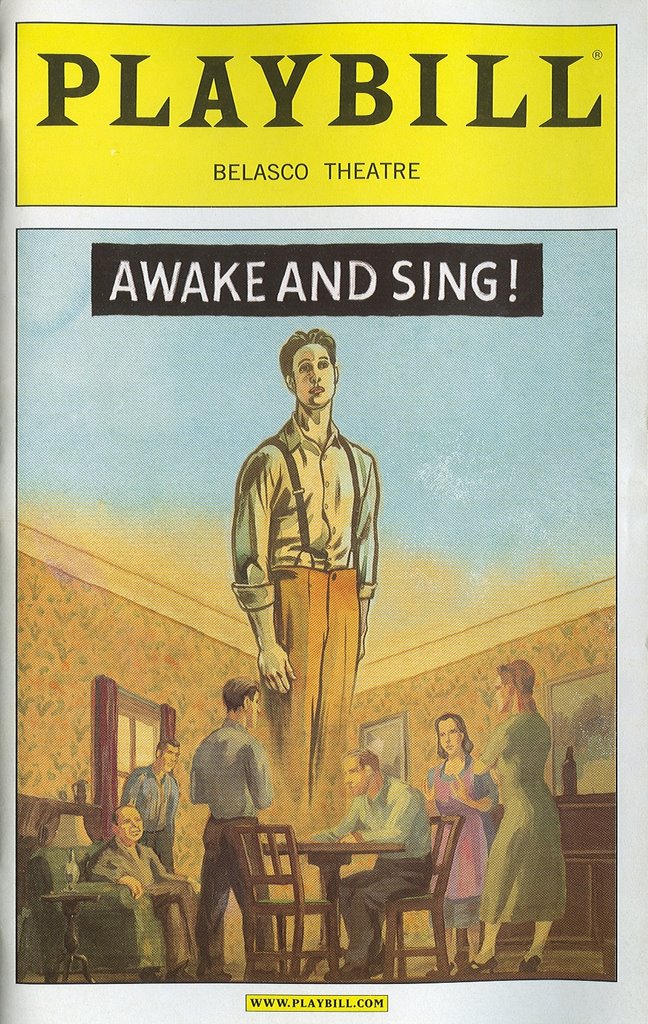
The two other dramatic offerings I’ve seen this year are not quite as successful, although both qualify as worthy endeavors. Lincoln Center Theater serves up a revival of the 1935 social polemic Awake and Sing!, the most celebrated work of playwright Clifford Odets. If you’ve never heard of it, there’s a reason: although regarded as a seminal work, it doesn’t fully measure up to its exalted reputation. Although given an intelligent production by director Bartlett Sher, and expertly performed by a star-studded cast featuring Ben Gazzara, Mark Ruffalo, Zoe Wanamaker and Lauren Ambrose, there’s very little that talent could have done to disguise both the play’s age and its obvious limitations. Written in tough-talking period slang so florid it would make James Cagney blush (clearly these characters hail from the same environs as The Dead End Kids), the play wears its social indignation and political agenda-pushing a little too prominently on its careworn sleeve. The characters, members of a downtrodden Jewish family living in the squalid tenement slums of lower Manhattan, exist as an illustration of the manner in which the proletariat is oppressed by the commercial classes. By the time the idealistic young hero is exhorting his fellow men to till the earth, the combination of hokiness and preachiness has become difficult to accept with a straight face. That said, the production is very well-acted, particularly by Ruffalo as a hard-bitten realist who actually manages to make his slang-heavy dialogue plausible, and by Wanamaker as the matriarch who has been made cynical and grasping by years of struggle and compromise.

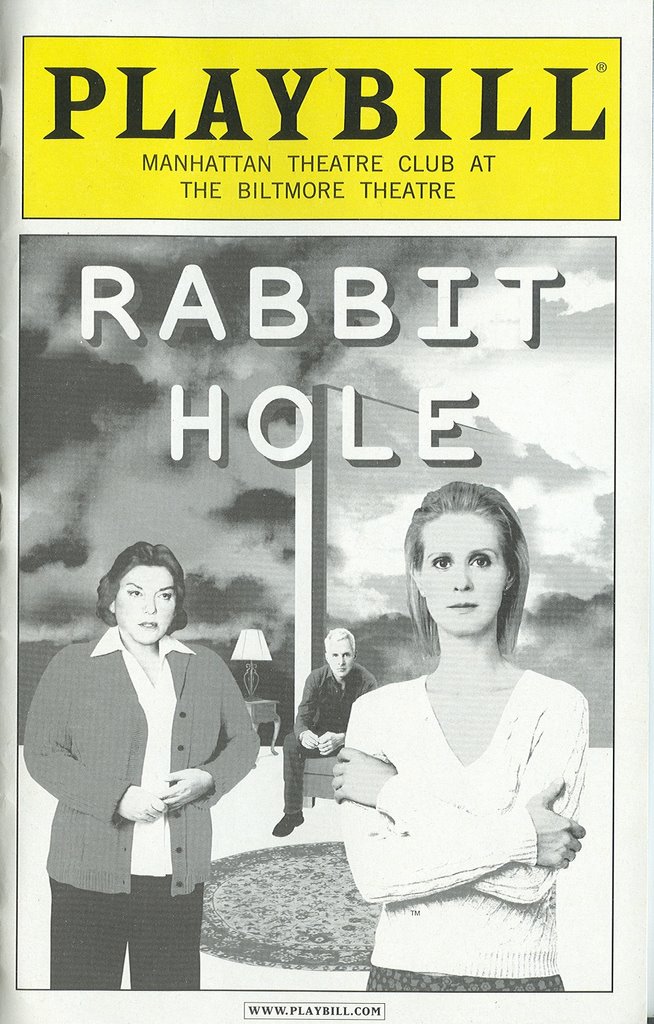 David Lindsay-Abaire’s Rabbit Hole has the rather dubious distinction of being the only work by an American playwright to be nominated in the best play category. The author became something of a critical darling for his unconventional, absurdist off-Broadway comedies Fuddy Meers and Kimberly Akimbo — for his Broadway debut, he apparently decided to make a 180 degree turn into the relative safety of poker-faced realism, and the result feels like a very calculated effort at mainstreaming (notice I didn’t say selling out, because the play is obviously a work of genuine feeling rather than a cynical concession to popular taste). To be fair, Lindsay-Abaire’s talent as a writer is clearly in evidence, which only partially serves to compensate for the rather uninspired subject matter he’s chosen to explore. The play is about two parents coping with the death of a young child and learning how to heal — if that sounds a bit Hallmark Hall of Fame, that’s sort of how it plays. The consummate skill of Cynthia Nixon, who plays the role of the grieving mother, lends emotional credibility to a play that is otherwise bogged down in what often borders on maudlin, movie-of-the-week style dramaturgy, while Tyne Daly contributes a welcome element of humor in a supporting role. Both women are nominated for Tony Awards — Nixon’s prospects for winning lead actress look very good in what is considered a rather weak category. Since Mr. Copeland and I are both card-carrying members of the Cynthia Nixon fan club — my admiration for the actress dating back to her stage work in the mid-'90s (particularly Phyllis Nagy’s avant-garde production of The Scarlet Letter at CSC in 1995), Edward having been in thrall to her charms ever since Sex & The City — this will provide us with a mutual rooting interest.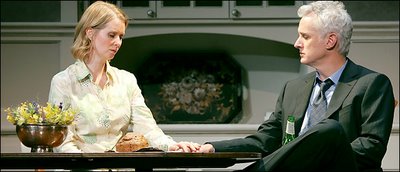
It’s become a favorite pastime of the critics to lament the state of the American musical. Such was the case a few weeks ago, when Ben Brantley wrote what amounted to an obituary for the Broadway tuner in The Sunday Times, summarily dismissing virtually every new show that opened during the 2005-2006 season while measuring them unfavorably against the two hit revivals. The response to the piece within the Broadway community was one of righteous indignation — at the Drama Desk Awards, one of the producers of The Drowsy Chaperone blasted the critic for his comments in his acceptance speech (telling Brantley he “needed to get out more”), to roars of approval from those in attendance — this despite the fact that Chaperone was just about the only new show Brantley didn’t run through the shredder.

While I appreciate many of Brantley’s points, and would certainly make no attempt to defend any season which inflicted upon the populace the likes of The Wedding Singer and Elton John’s Lestat (which I have not seen, but have heard enough about to steer well clear of), I think it’s a bit premature to sound the death knell for the Broadway musical — if anything, we’ve probably seen an upswing in recent years. Coming off the doldrums of the '90s, a decade which produced only two truly outstanding new musicals (City of Angels and Rent) wedged in between an assortment of qualified successes, outright turkeys, and innumerable revivals, 21st century Broadway has already given us The Producers, The Full Monty, Hairspray, Avenue Q, and The 25th Annual Putnam County Spelling Bee, plus the slight but enjoyably silly romp that is Monty Python’s Spamalot. While tourism-savvy Broadway still churns out a lamentable number of overproduced theme park rides masquerading as theater, or at the other end of the spectrum, cost-effective Lawrence Welk-style revues cobbled together from recycled Billboard hits of yesteryear, there are more interesting and worthy new shows out there today then there were ten years ago. Which is not to say that the Golden Age of the Broadway Musical isn’t already several decades behind us.
This being the case, it’s the revivals that are greeted with the most enthusiasm by contemporary critics, and the current season features two that have each drawn a great deal of praise.
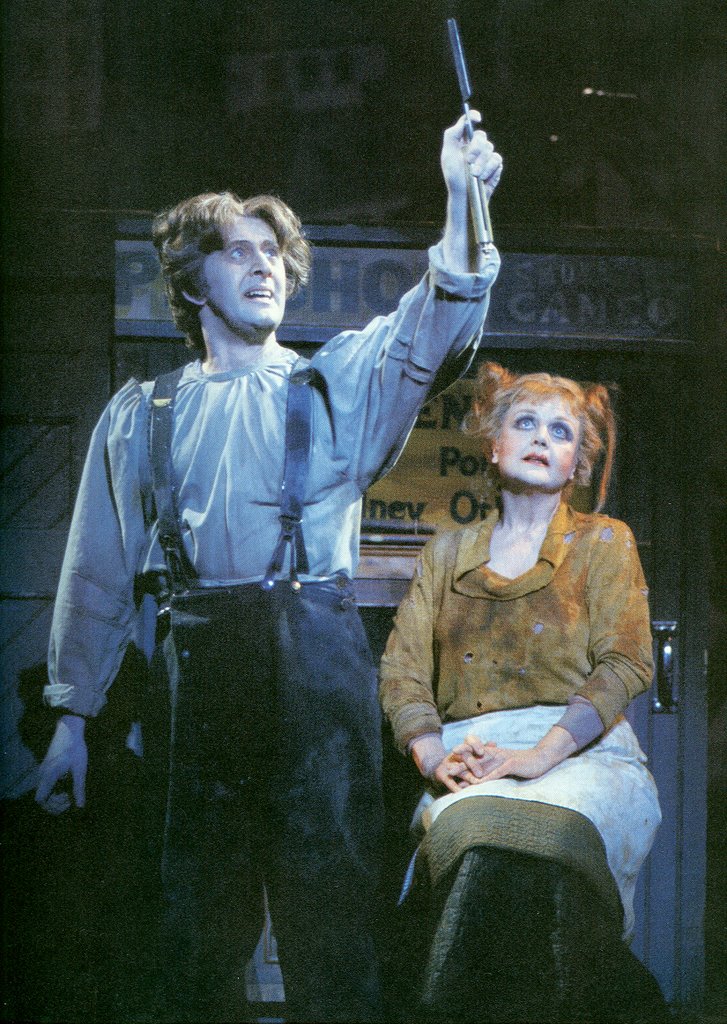
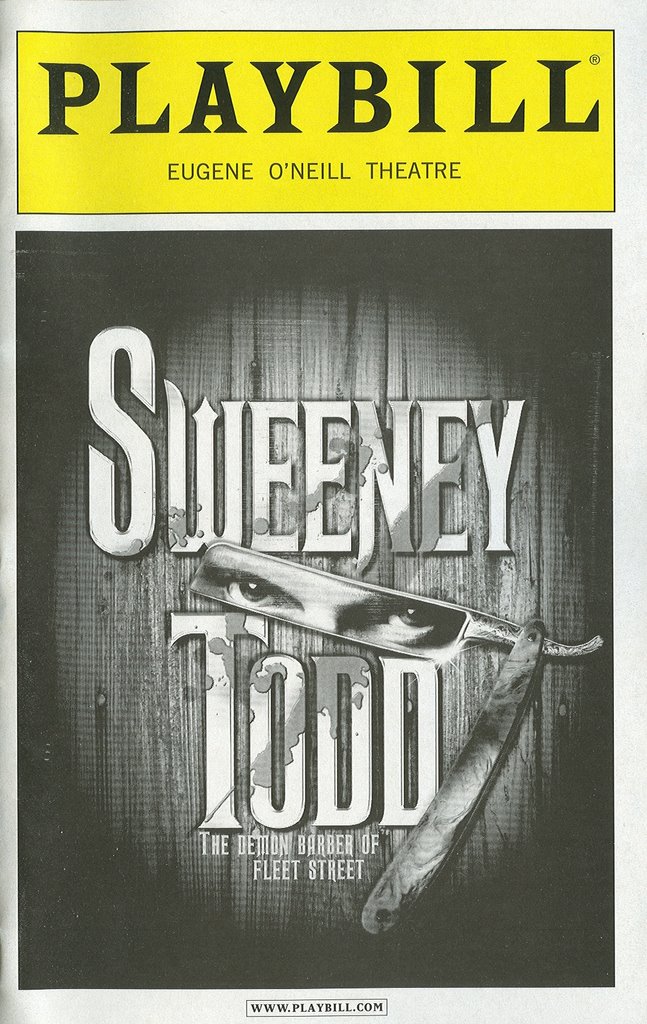
For anyone unfamiliar with Sweeney Todd, The Demon Barber of Fleet Street, I implore you on bended knee to put the American Playhouse filmed version of the stage production — featuring the show’s original star, Angela Lansbury — at the very top of your Netflix queue. If you don’t have Netflix (or something comparable), then take out your credit card credit card and buy the damn thing on amazon.com (or something comparable). And if you don’t have a credit card, steal one. It’s one of the two or three greatest works ever created for the American musical theater, and even you don’t like musicals, you’ll like this one. Either that, or you’ll have forfeited the right to consider yourself a person of taste (sorry, but there are some things I can’t be practical about, and Sweeney Todd is one of them).
I can’t do full justice to the intricately devised plot of the show without testing the patience of anyone reading this, but I’ll try to sum it up as best I can: in a nutshell, the show is based on a penny dreadful — the 18th century equivalent of the kind of grisly tales kids swap around campfires — about a demonic barber in the slums of Victorian England who kills his clients and sends their bodies to his sweetheart, the owner of an establishment which makes and sells meat pies. Which implies exactly what you think it does. Composer-lyricist Stephen Sondheim and librettist Hugh Wheeler tweaked the formula by fashioning their adaptation of the gory legend as a meditation on social inequity. It’s a classic revenge fantasy in which the haves, the people who have power and abuse it, get the comeuppance they deserve for shitting all over the have-nots. These tyrants, men of wealth and consequence who take gross liberties with the privileges birth and status have given them, are served to the victims of their oppression on a plate. Literally. In this version of events, Sweeney Todd, a poor barber, is framed for a crime he didn’t commit by a corrupt judge who covets his beautiful young wife. Sweeney is conveniently dispatched to a penal colony in Australia — he returns under an assumed identity many years later to be told of how his wife suffered at the hands of his nemesis, and subsequently committed suicide. This barber doesn’t kill people merely because he gets a kick out of it — unhinged by bitterness and grief, he seeks to exact revenge on those who ruined his life. When he meets up with the cheerfully amoral Mrs. Lovett, a wily opportunist with the good sense to utilize his bloodlust to maximize her profit margins, the diabolically enterprising team successfully convert half the population of London into unwitting cannibals.
 Hal Prince’s legendary 1979 staging was an elaborate spectacle done in period style with Victorian sets and costumes — most subsequent productions, though perhaps more modest in scale, haven’t made a radical departure from this template. John Doyle, who helmed the current Broadway revival, has opted for an entirely different approach — and to call it a radical departure would be an understatement. It’s a boldly minimalist staging which forgoes any attempt at realism — for starters, the actors double as the orchestra (the effect really has to be seen to be appreciated, but it involves some logistically complex stagecraft and dextrous multi-tasking by the cast). The production style is non-period-specific, and decidedly avant-garde; for those unfamiliar with the story, certain things may be a bit confusing, since this is not a literal-minded representation of the action. For example, each murder, rather than being acted out, is indicated when the actors pour quantities of blood from one bucket into another. The cast of ten actors double and triple in various roles without much in the way of costume changes, and often in ways the defy the specifications of gender or age. It’s a very conceptual approach, and one
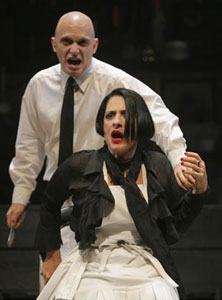 which produces very satisfying effects, although the lushness of Sondheim’s complex and melodic score is somewhat lost without the benefit of a full orchestra. If there’s anything missing from this production, it’s the element of gleeful black humor that Sondheim, Wheeler and Prince used in the original to balance out the bleak nature of the subject matter. The original Sweeney was blissfully funny, due in no small part to the performance of Angela Lansbury as the delightfully grotesque Mrs. Lovett. While her broadly comic creation was informed by the classic traditions of the English music hall (which involves plenty of mugging and exaggerated mannerism), the Mrs. Lovett of Patti LuPone is decidedly subdued, more hard-bitten pragmatist than Grand Guignol cut-up. What this does, in effect, is to rob the show of the required element of comic relief, a necessary function the character must serve in order to keep things from getting too depressing (which is exactly why Sondheim and Wheeler conceived the character in a comic vein). Still, the actress is widely considered the favorite to win her second Tony for the performance — her first having come for playing the title role in the 1980 Broadway premiere of Evita.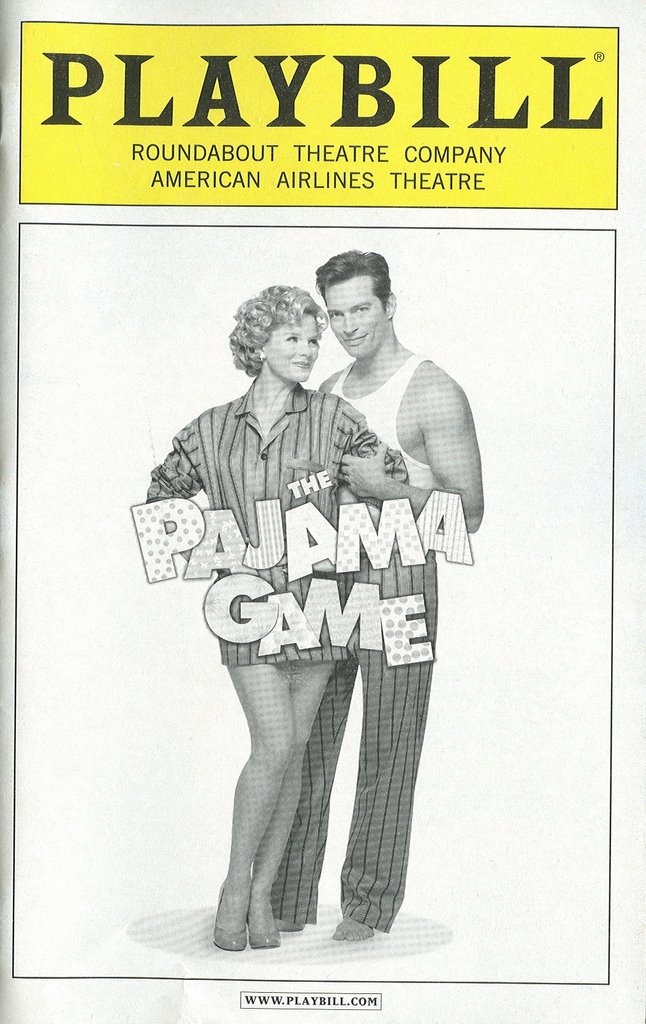
Whereas this production of Sweeney is defiantly nontraditional, the season’s other musical revival of note is decidedly square…which makes it no less of a triumph. The Pajama Game is the kind of kitschy, cornball entertainment that probably seemed clever and witty back in 1955 — by modern standards, it’s about as sophisticated in its attitudes as Pillow Talk, the squeaky-clean sex comedy of 1959 starring Rock Hudson and Doris Day (it’s no accident that Day top-lined the 1957 film version of The Pajama Game). It’s a cute boy-meets-girl tale set in a pajama factory — since the course of true love never did run smooth, she’s a union agitator, he’s management. A proposed strike presents an obstacle to their romance — boy loses girl, boy gets girl back.
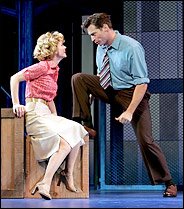
It’s the kind of sappy, precious material that really has no business working in a contemporary context — but never underestimate what a great chef can do with day-old bread. Nearly everything about the production confounds expectation; credit director-choreographer Kathleen Marshall (sister of filmmaker Rob) for sprucing up an old chestnut with style and verve. Her crackerjack production succeeds in making The Pajama Game seem less trite and coy than it actually is, while still managing to stay absolutely true to the spirit of source material. This is due in no small part to the presence of Harry Connick Jr., making a remarkably polished and assured Broadway debut as the show’s romantic lead. In additional to his sublime vocals, which capture the full vintage flavor of the Adler and Ross score, he creates a wonderful chemistry with golden-voiced leading lady Kelli O’Hara, who has an astute, knowing quality which gives her wholesome girl-next-door character a nice bit of an edge. The interplay between the two recalls classic scream teams like Hepburn & Tracy and Bogart & Bacall — it’s smart, sexy, and when they spark, it strikes just the right balance between sophistication and playfulness. The show has a lock on only one Tony (for best choreography), and looks likely to come up short in all the other categories in which it’s nominated. Still, if the production can only take home one award, it’s only right that Marshall’s dance routines should be the beneficiary. Worthy of special mention are her dizzy "Once-a-Year-Day" ballet, a nifty nod to the Fosse style with "Steam Heat", and above all, a dazzlingly staged and executed "Hernardo's Hideway" which weaves Connick's piano-playing skills seamlessly (and quite ingeniously) into the fabric of the dance.

One show that is canny enough to exploit the gap between the heyday of Cole Porter and what often passes for musical theater today has become the heavy favorite to win best musical. Instead of operating on the pretense that the state of contemporary musicals is right as rain, the show emphatically and hilariously insists that the celebrated hit of today doesn’t even stack up to yesterday’s mediocrity. The central character, billed only as Man in Chair, opens by the show by telling us he hates theater (“Well, it’s always so disappointing isn’t it…please, Elton John, must we continue with this charade?”). A middle-age musical theater buff of indeterminate sexuality and multiple neuroses, The Man holds court from his cluttered studio apartment, treating the audience as his guests and extolling the virtues of his favorite 1920s musical. The show is The Drowsy Chaperone, a madcap romp involving a dewy-eyed heroine, her stalwart suitor, a tippling grand dame, a dithery socialite, a supercilious butler, an anxious Broadway producer and a pair of gangsters who crash a wedding and pose as pastry chefs — the kind of frothy, featherweight concoction that was Broadway’s stock-in-trade during the era of Ziegfeld pastiche. The twist is that while Man in Chair plays the album for us, the show comes to life before our very eyes in his apartment (with various characters making their entrances from out of the refrigerator or whatever other ports of entry are available). The narrator doesn’t dematerialize, nor is he magically transported inside the show to become a participant, ala The Purple Rose of Cairo. Instead, he sits on the sidelines, commenting on what we’re seeing, offering amusing bits of trivia about the actors (for example, one earned the moniker The “Oops” Girl for her ability to cause men to suffer accidents, while another was apparently found dead in his Italian villa partially devoured by his own poodles), and occasionally singing along when not apologizing to the audience for parts of the show that are more ludicrous than others (“please do your best to ignore the lyrics and enjoy the melody” he says of a torch song that employs the awkward metaphor of monkey love to describe a relationship gone sour). I’m always slightly skeptical of shows built around a gimmick; but the witty conceit that provides the basis of The Drowsy Chaperone proves disarmingly effective — especially when it allows for riotously funny bits of business as a dance sequence that goes slightly amiss when the record begins to skip, or the moment when The Man inadvertently plays the record from a different show when changing LPs before going off on a bathroom break (what we get is a hilariously racist song from another 1920s show bearing a striking resemblance to The King and I).
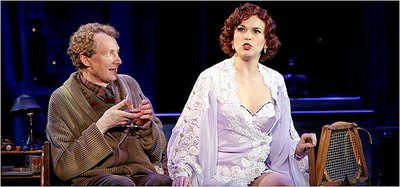
As Ben Brantley observes in his review, the show-within-a-show isn't as good as The Man's running commentary, but the flaw is hardly fatal. The music and lyrics, by a novice team, are undistinguished, but the libretto is strong throughout. Bob Martin is wonderful in the lead, while Sutton Foster makes the most of her two show-stopping numbers (one of which features her jumping through hoops, juggling plates, throwing her voice, and doing cartwheels while insisting she doesn’t want to be the center of attention). Beth Leavel, who plays the title role as a martini-soaked grand dame, is the heavy frontrunner in the featured actress category — that said, the performance is way too broad for my taste and the shtick wears thin rather quickly.

Needless to say, of all works of contemporary fiction, Alice Walker’s Pulitzer Prize-winning The Color Purple has always been the second most obvious candidate for adaptation into a crowd-pleasing Broadway musical (the first, I’m sure we can all agree, being The Bonfire of the Vanities). Produced for the stage by the all-powerful multimedia conglomerate known as Oprah, who not un-coincidentally played the role of Sofia in Steven Spielberg’s 1985 cinematic version, the show actually works better than one might expect — which is not to say that it was ever a good idea in the first place. This Color Purple seems to draw the bulk of its inspiration from the Spielberg film rather than the source novel; this being the case, it shares many of the movie’s flaws. It was always somewhat disheartening for lovers of the novel to see the mood created by Walker’s spare, gritty prose jettisoned in favor of a heartwarming, candy-colored tearjerker populated by exaggerated stereotypes. The show attempts to replicate the effect, and just as the film did, tries to shoehorn too many narrative threads into an overly condensed format. Still and all, it works on the level of entertainment, and provides two and half hours of pleasant, if ultimately unmemorable, diversion. The standouts from the large cast are Felicia P. Fields as the brash Sofia, Elisabeth Withers-Mendes as the sensual Shug, and the lumnious LaChanze, who navigates Celie's transition from meek acquiescent to independent spirit much more convincingly than Whoopi Goldberg did. Since the combination of brass lungs and power ballads usually carry some weight with voters (as was the case when Idina Menzel’s strenuous vocal pyrotechnics in Wicked helped her to vault past Donna Murphy and Tonya Pinkins two years ago), LaChanze's powerfully sung performance considered a strong contender for the win.
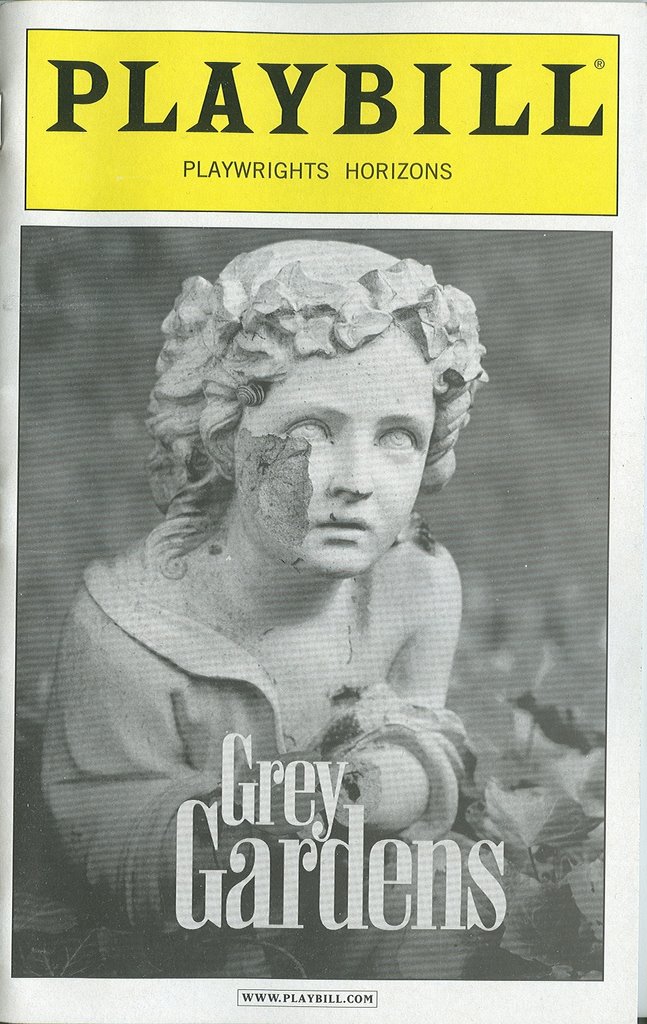
The most interesting and ambitious new musical I’ve seen this past year is Grey Gardens, which played a limited engagement at Playwright’s Horizons in preparation for a Broadway run. I’ll have a lot more to say about the production and the cult documentary film on which it is based when the show opens at the Walter Kerr Theater in the fall. The performance given by the production’s lead actress, Christine Ebersole, may qualify as the best I’ve seen on any stage this year, and would surely be considered a strong contender for a Tony if off-Broadway productions were eligible for consideration. The Tonys are produced by The League of American Theatres and Producers (jointly with the American Theatre Wing). As many critics of the Tony Awards have observed, the Broadway producers are resistant to the inclusion of off-B'way productions; as far as they're concerned, the Tonys exist first and foremost as an opportunity to promote their own product, to the exclusion of all else. That being the case, the nominations don't represent a fair sampling of what the season has to offer; Broadway shows account for only a small percentage of the productions that open each year. In view of these circumstances, one might be justified in viewing the Tony Awards as more of an industry trade show than a merit-based competition. But that’s a discussion for another day….and besides, even if you know the thing is rigged, it doesn’t make it any less fun to watch.
In speaking with friends about shows I've seen, I’ve encountered many cynics who assert that theater is no longer relevant as popular culture (we call these people philistines…just kidding). It doesn’t seem as if many younger actors of my acquaintance even aspire to be stage performers; the perception seems to be that theater is something you do to hone your craft while waiting for the big break to materialize — a launchpad to film and television work. It’s true that, in an age dominated by electronic media, the audience for theater has shrunk considerably. Broadway doesn’t have the same kind of prominence that it once did, when stage-based performers such as Mary Martin or Ethel Merman could attain the status of household names, or a new discovery such as Barbra Streisand or Carol Burnett could become an overnight sensation based on a Broadway success. People of my parents’ generation grew up with an awareness of theater — the original cast recording of My Fair Lady, for example, was one of the best selling albums of its year, and its score was almost universally heard and enjoyed even before the Warner Bros. film adaptation arrived on the scene. It’s hard to imagine something like that happening today, when instances of Broadway productions blossoming into pop culture phenomena are few and far between (the Lloyd Webber shows of the '80s may come the closest). But for those who are willing and able to take the time to look, the pleasures that this art form still affords are undeniable and, I would suggest, vital. Live theater can still take you places that movies and television never could. So if you can make it to New York, for gosh sakes, see a Broadway show — it’ll only cost you an arm and a leg. Which doesn't seem like too much of a sacrfice when you consider what certain characters in The Lieutenant of Inishmore and Sweeney Todd have to part with.
Tweet
Labels: Bacall, Bogart, Cagney, Cole Porter, Cynthia Nixon, Doris Day, Fosse, Julia Roberts, K. Hepburn, Lansbury, Law and Order, Musicals, Rock Hudson, Sondheim, Spielberg, Streisand, Tarantino, Theater
TO READ ON, CLICK HERE
Tuesday, February 07, 2006
The age-old argument: Which is better — the book or the movie?
Of course, the answer is that there is no set answer every situation is different. Sometimes movies completely blow the book, other times the movies are much better than the book. In rare instances, there seems to be a draw, where they seem to be perfect companions. I also wonder if the order one reads/sees them matter. If you read the book, then see the movie or vice versa, does that color your reactions? Of course, I've seen a lot more movies than I've read books, so I'm just choosing some where I've read the book and seen the movie and indicate which function came first. There is no set order. I'm also tossing in plays and/or musicals that became movies.
I read Larry McMurtry's Terms of Endearment after I had seen the movie and fallen in love with it. In this case, I think I would have preferred the movie to the book in either order. By creating Garrett Breedlove, James L. Brooks gives the character of Aurora Greenway a focus she lacks in the novel with her many suitors, even though they are still a minor presence in the movie.
I read the play Amadeus after the movie and once again, the movie to me seems much better. There is something wooden in some of the scenes in the play, at least for me, but perhaps that would have been different if I'd actually seen a performance of it.
In the case of On Golden Pond, I read the play second and, except for the scenes out on the lake when they are fishing, really both scripts are nearly identical. Again, I guess my preference leaned to the movie because I saw it fleshed out.
I have an interesting experience with Neil Simon's The Sunshine Boys. First, I saw the movie, then in junior high I read the play and performed a duet from it, shamelessly ripping off Walter Matthau. Finally, a few years ago, I saw a revival on Broadway with Tony Randall and Jack Klugman. My final conclusion: It's all about the performers. No matter whether it's read or watched, it is rather thin.
One other case which I'm sure I'll get a lot of arguments about is Cabaret. I've never been a fan of Bob Fosse's movie, but when I got a chance to see the Broadway revival with Alan Cumming and Natasha Richardson, it became all the clearer to me that the musical was stronger on stage than on screen. I had a similar reaction to Chicago, though I saw the revival first and still enjoyed the movie.
Short Cuts is an unusual case as well. I had read nearly all of Raymond Carver's short stories that inspired the film before seeing the movie, but Robert Altman's mixing and matching of them make it seem like an experience completely separate from its written source. Only "A Small, Good Thing," played out in the movie by Andie MacDowell, Bruce Davison and Lyle Lovett, sticks fairly close to the story that inspired it.
I read Edith Wharton's The Age of Innocence knowing that Martin Scorsese was working on a film version. Once the movie opened, I was amazed — this may well be the most faithful adaptation of a novel I've ever seen. There are very few changes, the trimming seems minimal and he even keeps much of the wonderful prose through Joanne Woodward's narration. In contrast, I saw the movie Casino before I read the book. I was disappointed in the movie and the book was much stronger — and it showed that the movie was made before the book was finished.
In 1999, I fell in love with Fight Club, but it was years later before I actually read the novel it was based on. It is good, but even though the twist was spoiled for me before I saw the movie and didn't affect my enjoyment of it, it did seem to affect my opinion of the book.
Curtis Hanson's adaptation of Michael Chabon's Wonder Boys is another example of a fairly faithful movie version. I had read the book first and loved it and the movie didn't disappoint, even allowing me to like a Michael Douglas performance — a rarity for me.
Ghost World was probably the first case of a movie I saw that had been based on a graphic novel I'd read. While Daniel Clowes' graphic novel is great and the movie follows pretty much the same story arc, the introduction of the Steve Buscemi character in the film functions much like Jack Nicholson's character in Terms of Endearment — it makes the movie a superior work.
Now for examples where I think it really made a notable difference.
I read Peter Benchley's Jaws after seeing Steven Spielberg's great film — and I don't think there can be any argument that Spielberg improved the material, taking a fairly trashy read and turning into so much more.
Much the same can be said of Mario Puzo's The Godfather. While in some respects, the novel isn't as bad as Jaws, in others, its tawdry nature borders on the juvenile. Francis Ford Coppola truly raised the film to a higher level.
When I saw The Prince of Tides, aside from Streisand's obvious massive ego, I thought the movie worked fairly well — then I read Pat Conroy's novel and realized what a mess had been made of his work.
Of course, the most notorious example of the destruction of a great novel by its movie version is Tom Wolfe's The Bonfire of the Vanities. Anyone who read the novel before seeing the film would have to be appalled by the ludicrous changes made for Brian De Palma's movie version. From changing a Jewish judge to an African-American one (named Judge White of all things), to dropping the British heritage of the tabloid reporter to nearly every casting decision — nothing was changed for the better. I can't imagine anyone would want to read the novel if they saw this monstrosity first.
To wrap up, since I could go on and on and I want others to get involved here, I thought it would be worth going through the Stephen King adaptations that I'd read before seeing the movie versions. The only exception is Carrie, which I read after seeing the movie. I'm also leaving out TV versions.
BOOK: Carrie
MOVIE:Carrie
VERDICT: Novel wins
BOOK: The Shining
MOVIE:The Shining
VERDICT: Novel wins
BOOK: The Dead Zone
MOVIE: The Dead Zone
VERDICT: Novel wins
BOOK: Firestarter
MOVIE: Firestarter
VERDICT: Novel — by far — and it's not that good
BOOK: Cujo
MOVIE: Cujo
VERDICT: Both suck
BOOK: Pet Sematary
MOVIE: Pet Sematary
VERDICT: Novel
BOOK: Christine
MOVIE: Christine
VERDICT: Draw
BOOK: Misery
MOVIE: Misery
VERDICT: Novel
STORY: Rita Hayworth and The Shawshank Redemption
MOVIE: The Shawshank Redemption
VERDICT: Movie
STORY: The Body
MOVIE:Stand By Me
VERDICT: Movie
STORY: Apt Pupil
MOVIE: Apt Pupil
VERDICT: Draw — not a big fan of either
NOVELLA: The Running Man
MOVIE: The Running Man
VERDICT: Movie
Tweet
Labels: Altman, Books, Buscemi, Chabon, Coppola, De Palma, Fosse, M. Douglas, Matthau, Neil Simon, Nicholson, Scorsese, Spielberg, Streisand
TO READ ON, CLICK HERE