Saturday, May 19, 2012
Centennial Tributes: Richard Brooks Part II

By Edward Copeland
We pick up our tribute to Richard Brooks in 1956. If you missed Part I, click here. Of Brooks' two 1956 releases, I've only seen one of them. The Last Hunt stars Stewart Granger as a rancher who loses all his cattle to a stampeding herd of buffalo. Robert Taylor plays a buffalo hunter who asks him to join in an expedition to slaughter the animals, but the rancher, an ex-buffalo hunter himself, had quit because he'd grown weary of the killing. Brooks may be the auteur of antiviolence. Filmed in Technicolor Cinemascope, I imagine it looked great on the big screen. Bosley Crowther wrote in his New York Times review, "Even so, the killing of the great bulls—the cold-blooded shooting down of them as they stand in all their majesty and grandeur around a water hole—is startling and slightly nauseating. When the bullets crash into their heads and they plunge to the ground in grotesque heaps it is not very pleasant to observe. Of course, that is as it was intended, for The Last Hunt is aimed to display the low and demoralizing influence of a lust for slaughter upon the nature of man." The second 1956 film I did see and given the talents involved and the paths it would take, it's a fairly odd tale. The Catered Affair was the third and last film in Richard Brooks' entire directing career that he also didn't write or co-write.

It began life as a teleplay by the great Paddy Chayefsky in 1955 called A Catered Affair starring Thelma Ritter, J. Pat O'Malley and Pat Henning before its adaptation for the big screen the following year, the same journey Chayefsky's Marty took that ended up in Oscar glory. This time, Chayefsky didn't adapt his work for the movies — Gore Vidal did. Articles of speech changed in its title as well as the teleplay A Catered Affair became The Catered Affair for Brooks' film. (Chayefsky apparently wasn't a particular fan of this work of his — it never was published or appeared in a collection of his scripts.) We're at the point where the project just got screwy. The simple story concerns an overbearing Irish mom in the Bronx determined to give her daughter a ritzy wedding because of the bragging she hears her future in-laws go on about describing the nuptials thrown for their girls. Despite the fact that the Hurley family lacks the funds for it, Mrs. Hurley stays determined while her husband Tom sighs — he's been saving to buy his own cab. On TV, the casting of Ritter and O'Malley for certain sounded appropriate. For the film, which added characters since it had to expand the length, the cast appeared to have been picked out of a hat because they certainly didn't seem related, most didn't register as Irish and as for being from the Bronx — fuhgeddaboudit. Meet Mr. and Mrs. Tom Hurley, better known to you as Ernest Borgnine and
 Bette Davis. Unlikely match though they be, somehow their genes combined and out popped the most Bronx-like of Irish girls — Debbie Reynolds. The new character of Uncle Jack does add a bit of real Irish flavor by tossing in Barry Fitzgerald for no apparent reason. Unbelievably, it made the list of the top 10 films of the year from the National Board of Review who also named Reynolds best supporting actress (nothing against Reynolds in general — just miscast here). You would think that this Affair would fade into oblivion, but you'd be wrong. In 2008, it changed articles again and re-emerged on the Broadway stage as the musical A Catered Affair. Faith
 Prince and Tom Wopat(Yes — that Tom Wopat of Luke Duke fame) earned Tony nominations as the parents, Harvey Fierstein wrote the book and played the uncle (named Winston) and John Bucchino wrote the score. Why did Brooks make this one? Easy. He was under contract. MGM told him to make it, so he had no choice. From Tough as Nails: The Life and Films of Richard Brooks, some of the cast talked on record about how Brooks could be a bit of a prick as a director. "I didn't know it at the time, but Brooks ate and digested actors for breakfast," Borgnine said later. "If things weren't working, he let you know it, and not gently." When a particular scene was not working to his satisfaction, (Brooks) ordered Borgnine and Davis to figure out the problem. Borgnine suggested a different pacing and Davis agreed the scene was better for it — as did (Brooks), though he offered Borgnine not praise but a putdown. 'Goddamn thinking actor.'" Reynolds also tells the author Douglass K. Daniel that from the first day she met Brooks he told her that he didn't want her in the part, but it wasn't his decision. "'He said he was stuck with me and he'd do the best he could with me,' Reynolds recalled. 'He hoped I could come through all right with him, because everybody else was so great, but he wasn't certain I could keep up with the others. He actually said he was stuck with me. And he said so in front of everybody, too. He was so cruel.'" Davis and Borgnine coached Reynolds on the side and Bette, not known to be a shrinking violet, told Reynolds once, according to the book, "'Don't pay any attention to him, the son of a bitch,' Davis told her. 'The only important thing is to work with the greats.'" Davis did get help from Brooks in her fight against the studio that a Bronx housewife shouldn't be wearing movie star costumes they wanted, so he supported her decision to buy clothes at a store like Mrs. Hurley would shop at in real life. Years later, Davis referred to Brooks as one of the greats. This wasn't the first time Brooks had treated a young actress oddly on a set, Anne Francis told Douglass Daniel for his book that he practically ignored her during the filming of Blackboard Jungle and she received no direction at all. Daniel suggests and, given the way Brooks ordered Borgnine and Davis to come up with an idea to fix a scene, that writing had been his greatest gift, he grew into a solid visual storyteller, but Brooks proved limited when it came to directing actors. Daniel wrote, "…(the accounts of Francis and Reynolds) suggested he had a limited ability to communicate what he wanted. He either paid them little attention…or tried to bully a performance from them." Despite that problem, 10 actors in Brooks-directed films earned Oscar nominations and three took home the statuette.
The following year, Brooks made another film that revolved around the hunt of an animal, though that just leads to much bigger issues in Something of Value, sometimes known as Africa Ablaze. Starring Rock Hudson and filmed in Kenya, the film, which I haven't seen, concerns tensions that erupt between formerly friendly colonial white settlers and the Kenyan tribesmen. It also began a run of films that Brooks adapted from serious literary sources. Something of Value had been written by Robert C. Ruark, a former journalist like Brooks, who fictionalized his experiences being present in Kenya during the Mau Mau rebellion. In 1958, the two authors he adapted carried names more prestigious and recognizable. The first movie released derived from a particularly literary source and Brooks didn't do all that heavy lifting alone. Julius and Philip Epstein did the original adaptation, working from the English translation of the novel by Constance Garnett before Brooks began his work writing a worthwhile screenplay that didn't run more than two-and-a-half hours out of Fyodor Dostoyevsky's The Brothers Karamazov. It wasn't easy. Brooks told Daniel that he "wrestled with the book for four months." What surprised me to learn, also according to what Brooks told Daniels, MGM assigned Karamazov to him. Brooks also said that he never initiated any of his films while under contract at MGM. I love Dostoyevsky. Hell, even a master such as Kurosawa couldn't pull off a screen adaptation of The Idiot. The only aspect of this film that holds your attention — actually it would be more accurate to say grabs you by your throat and keeps you awake for his moments — ends up being any scene with Lee J. Cobb playing the Father Karamazov. I don't know if Cobb realized that somebody needed to step up or what, but the brothers, with only Yul Brynner showing much charisma, also include William Shatner. It's almost embarrassing except for Cobb who got a deserved supporting actor Oscar nomination, the first of the 10 from Brooks-directed films.
The actor who Cobb lost that Oscar to that year had a major part in Brooks' other 1958 feature — the film adaptation of Tennessee Williams' Pulitzer Prize-winning play Cat on a Hot Tin Roof. However, Burl Ives didn't win the prize for his great turn as Big Daddy, but for his role as a ruthless cattle baron fighting with another rancher over land and water in The Big Country. As with nearly all of Williams' works, movie versions castrated his plays' subtext (and sometimes just plain text) and this proved true with Cat as well, though the cast and its overriding theme of greed kept it involving enough. The film scored at the box office for MGM, taking in a (big for 1958) haul of $8.8 million — Leo the Lion's biggest hit of the year and third-biggest of the 1950s. It scored six Oscar nominations: best picture, best actress for Elizabeth Taylor as Maggie the Cat, best director for Brooks, best adapted screenplay for Brooks and James Poe best color cinematography for William Daniels and best actor for Paul Newman as Brick, Newman's first nomination and the film that truly cemented him as a star.
After the success of Cat on a Hot Tin Roof, Brooks decided to take an ocean voyage to Europe as a vacation. The writer-director packed the essentials for a lengthy trip: some articles on evangelism, a Gideon Bible a copy of Sinclair Lewis' novel Elmer Gantry and Angie Dickinson. By the time the ship docked in Europe, a first draft of a screenplay, based on the novel by one of the men who stood ready to
 defend Brooks during The Brick Foxhole brouhaha with the Marines, lay finished. Dickinson, on the other hand, departed the cruise quite a while back, having grown annoyed by Brooks ignoring her for Elmer. For many lives, 1960 would prove quite eventful either professionally, personally or both. Brooks filmed the highly entertaining movie version of Elmer Gantry early in the year, directing one of his best friends, Burt Lancaster, for the first time in the title role, which is good since the film got made under the auspices of an independent Burt Lancaster/Richard Brooks Production. Lancaster gives one of his best performances and won his first Oscar. The film co-starred Jean Simmons, giving one of her greatest, most mesmerizing turns as Sister Sharon Falconer, the traveling tent show evangelist who gets Elmer into the biz. She fell for Brooks on the set. Within the calendar year, she ended her unhappy marriage to Stewart Granger and became Brooks' wife. Unfortunately, when the Oscar nominations came out the next year, Simmons got left out of the nominations for Elmer Gantry. It received five total. In addition to Lancaster's nomination and win for best actor, it received nominations for best picture; Shirley Jones as supporting actress, which she won; Andre Previn for best score for a drama or comedy; and Brooks for best adapted screenplay. That cruise paid off. Brooks won an Oscar and found a wife. Below, a bit of Lancaster at work — and singing too.
With his next film, Brooks finally received the key that unlocked the leg shackles that bound him to MGM. The studio once again assigned him to a Tennessee Williams play. Though Sweet Bird of Youth did moderately well on Broadway, it wasn't one of The Glorious Bird's triumphs and took a long time to get to New York, starting as a one-act, premiering as a full-length play with a reviled ending in Florida in 1956 and, finally, the revised version's
 opening in NY in 1959. (The play has yet to be revived on Broadway whereas, in contrast, Cat on a Hot Tin Roof has been revived four times, including twice in this young century, and A Streetcar Named Desire 's eighth Broadway revival currently runs.) Originally, its plot concerned a retired actress and a gigolo with dreams of Hollywood who brings her to his old Southern hometown to get away and runs into trouble with the town's corrupt political boss (Ed Begley) when he woos his daughter (Shirley Knight). Williams said he'd hoped for Brando and Magnani to play the parts on stage. Eventually, she became merely an aging actress and Geraldine Page and Paul Newman played the leads on Broadway. When it came time for the movie, according to legend, MGM desperately wanted Elvis for Newman's part, but the Colonel nixed that because he didn't like the character's morals. Instead, the great Page and Newman repeated their stage roles as did Rip Torn as the son of the political boss. Once again, Hollywood castrated a Williams play or, in this instance, literally didn't castrate it (people who know both the play and movie get that joke. Page and Knight received Oscar nominations in the lead and supporting actress categories, respectively, and Begley won as best supporting actor. In this clip, you can see Newman's Chance try to get a handle on Page's wasted Alexandra in their hotel room.
Now a free agent, Brooks decided to stay that way — in essence becoming an independent filmmaker toward the end of his career instead of the beginning, as the path usually goes. He also defied that typical indie move of starting small — this wasn't John Cassavetes — but beginning this stage of his career more like the final films (and current ones for 1965) of David Lean. He went BIG. He even nabbed Lean's Lawrence to star in his adaptation of Joseph Conrad's Lord Jim, a longtime obsession of Brooks that he bought the rights to in 1958 for a mere $6,500. The filming took place in Hong Kong, Singapore and, dangerously in Cambodia as things grew tense. The movie crew's interpreter happened to be Dith Pran, the man the late Haing S. Ngor won an Oscar for playing in Roland Joffe's 1984 film The Killing Fields. O'Toole hated his time there, complaining about the living conditions — he isn't a fan of mosquitoes and snakes. Later, he also admitted he thought he'd been wrong for the part itself. Portions of the film ended up shot in London's Shepperton Studios as Cambodia became full of anti-American rage. When the film opened, it bombed and badly. Sony put it on DVD briefly, but it's currently out of print so, alas, I've never seen this one. Brooks did make an impression on O'Toole though, who told Variety when he died that Brooks was "the man who lived at the top of his voice."

Having a flop on the scale of Lord Jim the first time you produce your own film could really discourage a guy. However, it sure didn't show in what he produced next because The Professionals turned out to be the most well-made, entertaining film he'd directed up until this point in his career. (His next film swipes the most well-made title, but The Professionals continues to hold the prize for being one hell of a ride.) Based on a novel by Frank O'Rourke, the movie teamed Brooks with his pal Lancaster again. Set soon after the 1917 Mexican Revolution, early in the 20th century when the Old West and modern movement intermingle near the U.S.-Mexican border, it almost plays like a rough draft for Sam Peckinpah's admittedly superior Wild Bunch. Ralph Bellamy plays a rich tycoon who hires a team of soldiers of fortune to go in to Mexico and rescue his daughter who has been kidnapped by a guerrilla bandit (Jack Palance, hysterically funny and good despite making no attempt to appear Mexican). The team consists of Lancaster as a dynamite expert, Lee Marvin as a professional soldier, Robert Ryan as a wrangler and packmaster and Woody Strode as the team's scout and tracker. The film turned out to be a huge hit with audiences and critics alike and earned Brooks Oscar nominations for directing and adapted screenplay. The Academy also cited the cinematography of its director of photography, the master Conrad L. Hall, who would do some of the finest work of his career in Brooks' next film. Below, one of The Professionals' action sequences.
I hoped to complete this in two parts and considered breaking out the next film as a separate review because In Cold Blood stands firmly as Richard Brooks' masterpiece (and then there remain some other films to mention after that). So, another temporary pause.
Tweet
Labels: Angie Dickinson, Bellamy, Bette, Borgnine, Chayefsky, Debbie Reynolds, Geraldine Page, Jean Simmons, Lancaster, Lee J. Cobb, Liz, Marvin, Newman, O'Toole, Peckinpah, Rip Torn, Shatner, Tennessee Williams, Vidal
TO READ ON, CLICK HERE


Sunday, January 08, 2012
Centennial Tributes: José Ferrer

By Edward Copeland
CYRANO: You may go. Or tell me, why are you staring at my nose?
THE MEDDLER: No!
CYRANO: It disgusts you, then? Does its color appear to you unwholesome? Or its form obscene?
THE MEDDLER: But I've been careful not to look!
CYRANO: And why not if you please? Possibly you find it just a trifle large!

José Ferrer played many roles throughout his lengthy career on stage, screen, television and even radio, but none loomed larger than Cyrano de Bergerac, who actually was a 17th century dramatist and swordsman but gained famed only in other authors' works loosely based on his life, most notably the 1897 play by Edmond Rostand. Without a doubt, Cyrano became Ferrer's signature role from the moment he placed the fake proboscis on his face and stepped onto the stage of The Alvin Theatre on Oct. 8, 1946 (Though on Nov. 18 of that year, the production moved to the Ethel Barrymore Theatre). His Roxane happened to be the late Frances Reid, best known for her 44-year-run as Alice Horton on the soap Days of Our Lives. I'll get back to Ferrer and Cyrano later in this tribute to the Oscar- and Tony-winning actor, Emmy and Directors Guild nominee and first actor to receive the U.S. National Medal of Arts, who was born 100 years ago today as José Vicente Ferrer de Otero y Cintrón in the Santurce district of San Juan, Puerto Rico.
Ferrer's father was a respected attorney and writer in San Juan. His parents sent José to the prestigious Swiss boarding school Institut Le Rosey, which was founded in 1880 and has educated children of royalty from all parts of the world. After his attendance there, Ferrer went to Princeton University, where he graduated either in 1933 or 1934 (depends which source you read at the time). While at Princeton, he was a member of its famous Princeton Triangle Club, the oldest collegiate musical-comedy theater troupe in the U.S. which was founded in 1891. Since its creation, the club has counted as members Booth Tarkington, F. Scott Fitzgerald, Joshua Logan, James Stewart, Wayne Rogers, David E. Kelley and Brooke Shields. Regardless of whether he graduated in '33 or '34, it didn't take Ferrer long to make his Broadway debut, even if it were merely the role of Second Policeman in the comedy A Slight Case of Murder. Written by Damon Runyon and Howard Lindsay, the play opened Sept. 11, 1935, and played for 69 performances at The 48th Street Theatre, a theater that
 hasn't been renamed but was destroyed when a water tower collapsed on Aug. 24, 1955. When A Slight Case of Murder closed, Ferrer moved almost directly into another comedy, Stick-in-the-Mud by Frederick Hazlitt Brennan which starred Thomas Mitchell, who also directed. Ferrer was cast as the chauffeur. The play's run was a brief one — it lasted only nine performances at the same 48th Street Theatre. It would be eight months before Ferrer would appear on The Great White Way again. When Ferrer tread the Broadway boards again in August 1936 in the Philip Barry comedy Spring Dance, another quick closer, lasting only 24 performances at The Empire Theatre, which was demolished in 1953 so an office tower could be built. His next Broadway role changed everything. The play was a huge hit and Ferrer got his largest part yet. The production was the comedy Brother Rat by John Monks Jr. and Fred F. Finklehoffe and was produced and directed by the legendary George Abbott, who was a spry 49 years old then (He was 107 when he died in 1995, outliving Ferrer by three years). The plot revolved around three senior cadets at the Virginia Military Institute where one is secretly married and about to be a father. Ferrer played Dan Crawford, one of the three, opposite Eddie Albert as Bing Edwards, the dad-to-be, and Frank Albertson as Billy Randolph. The show ran 577 performances at The Biltmore Theatre (now The Samuel J. Friedman Theatre) through May 1938. By October 1938, a movie version of Brother Rat had hit movie theaters, though only Albert re-created his stage role. Ferrer's part in the film went to Ronald Reagan, who met Jane Wyman on the film's production. It's unclear when
 Ferrer exited the Broadway production, but he appeared in two other Broadway plays while Brother Rat still was running. A very significant event occurred in Ferrer's life in 1938, the year Brother Rat did close though — he wed Uta Hagen, who would go on to become an esteemed actress herself and an even more legendary acting teacher. The next notable Broadway production in which Ferrer appeared was the debut of Maxwell Anderson's Key Largo on Nov. 27, 1939. Based on the Brooks Atkinson review of the play in The New York Times archives and the fact that none of the characters has the same names as the characters in John Huston's famous 1948 film version, it's difficult to tell who played what part. Paul Muni was the star of the Broadway production in what would seem to be the equivalent of the Humphrey Bogart role, though Ferrer plays a character named Frank (and received Atkinson's praise) as Bogie did in the film, though with a different last name. Hagen played Ferrer's Victor's sister. I can't be positive who plays the Johnny Rocco equivalent, but the play also featured Karl Malden as Hunk and James Gregory in his Broadway debut as Jerry. In October 1940, Ferrer received his first undisputed lead role in a smash as he starred in a revival of the drag farce Charley's Aunt under Joshua Logan's direction. The revival ran for 233 performances at The Cort Theatre, which still bears that name today.
Two days before Charley's Aunt opened on Oct. 17, 1940, Ferrer and Hagen premiered another collaboration: daughter Leticia Thyra. Ferrer stayed with Charley's Aunt through May 3, 1941. On Sept. 22, 1942, S.M. Herzig's Vickie debuted on Broadway, marking Ferrer's Broadway directing debut. He also played the husband of the title character, whose role was filled by Hagen. Also in the cast were Red Buttons and Mildred Dunnock. The comedy only played at The Plymouth Theatre (now The Gerald Schoenfeld Theatre) for 48 performances. Sometime in February 1943, Ferrer replaced Danny Kaye for the final month of performances of the hit musical Let's Face It! with songs by Cole Porter and a book by Herbert and Dorothy Fields.
 Ferrer's next Broadway engagement turned out to be a landmark in the history of that strip of Manhattan theater. Ferrer played Iago and Hagen played Desdemona opposite Paul Robeson in the title role as Shakespeare's Othello. The revival of the famous tragedy opened at The Shubert Theatre on Oct. 19, 1943 and ran 296 performances before taking a break to take the play on tour. The trio returned in May 22, 1945 for 24 more performances, this time at The City Center. To this date, it is the longest running Shakespeare production in Broadway history. While Ferrer was playing Iago, Billy Wilder pursued him because he wanted the actor to play the lead in The Lost Weekend, however Paramount refused to let Wilder hire him, insisting he cast a name. They pursued Cary Grant, who passed but finally got Ray Milland who won an Oscar for the role, despite his initial reluctance to take the part. On a personal level, Othello would leave to an unhappy side effect for Ferrer. Robeson and Hagen had an affair, leading the Ferrers to divorce in 1948. Before their split, Ferrer kept himself busy. On radio, he had a successful series playing detective Philo Vance in 1945. On Nov. 29, 1945, Lillian Smith's play Strange Fruit opened at The Royale Theatre (now the Bernard B. Jacobs Theatre). Ferrer produced and directed the production which starred a different though unrelated Ferrer — actor Mel Ferrer, still going by his full first name Melchor. Also in the cast were Murray Hamilton and Ralph Meeker. It ran 60 performances. The two Ferrers would swap roles in José's next Broadway production, though José would produce it while Melchor directed and José starred in the Oct. 8, 1946, premiere of Cyrano de Bergerac. Meeker also was part of the cast as was the actress Phyllis Hill, who would become Ferrer's second wife in 1948 soon after his divorce from Uta Hagen.
"José Ferrer has administered a lively draft of tonic to this season by staging Cyrano de Bergerac as though he meant it. Acting the part of the braggart romantic, he is appearing at the Alvin in a pulsating performance that makes full use of the modern theatre. Although Cyrano is no longer a modern play, it is still one of the most dashing ever written, particularly in the Brian Hooker version that preserves the bravura of the Rostand text in light verse of a modern idiom." That's how Brooks Atkinson began his review in The New York Times on Oct. 9, 1946. Atkinson heaped praise upon practically all aspects of the production — even giving a shout-out to the stage hands for moving the scenery, The critic closes by writing, "Mr. Ferrer has done Cyrano in the grand manner,
 like a man who gets fun as well as a living out of the theatre." Another notable name composed the incidental music for the production: the renaissance man Paul Bowles. Ferrer's revival ran 193 performances through March 22, 1947 and its run coincided with the inaugural year of the Antoinette Perry Awards, better known by its shorthand name, the Tony, presented by The American Theatre Wing. The Tonys were presented for the first time on April 6, 1947 at the Waldorf Astoria. The American Theatre Wing handed out 11 Tonys in seven categories that first evening. Ferrer's performance in Cyrano was honored for dramatic actor alongside Fredric March in Years Ago. Four others won for acting that first year, including Ingrid Bergman in Maxwell Anderson's Joan of Lorraine and Helen Hayes in Happy Birthday, both for dramatic actress. Shortly before Cyrano ended its run, Ferrer produced and directed a five-performance run of As We Forgive Our Debtors for the American National Theatre and Academy after originally being staged by The Experimental Theatre Inc. When the play closed, Ferrer finally prepared to leave New York, ironically in the film version of the play that won Ingrid Bergman her Tony. Retitled Joan of Arc, the Victor Fleming film premiered in 1948 with Ferrer portraying the Dauphin. He earned a supporting actor Oscar nomination for his film debut. It's been a long time since I've seen the film, but I remember him being the best thing in it other than the vibrant Technicolor cinematography.
Once Ferrer returned from California and making his first feature film, he started bouncing between the media of stage, screen and television. Between January 1948 and May 1949, Ferrer either starred, directed, produced, co-adapted or some combination of those in five Broadway shows. In January 1949, he appeared on The Philco Television Playhouse and reprised his role in a televised version of Cyrano de Bergerac. He returned to the same showcase in April to play Sammy Glick in Paddy Chayefsky's adaptation of Budd Schulberg's novel What Makes Sammy Run? In November 1949, he appeared in his second feature role, playing the manipulative hypnotist in Otto Preminger's thriller Whirlpool. Another fabled story has it that Ferrer was the first choice to play Addison De Witt in All About Eve, but the role went to George Sanders, who of course won the 1950 best supporting actor Oscar for the part. This time period wasn't an easy one for artists and like so many in his field, Ferrer found himself caught up in the Communist witchhunts of the time. Former co-star and friend Paul Robeson had his own problems above and beyond the run-of-the mill ones associated with others who ended up on HUAC-inspired blacklists when in March 1950, at the last minute, NBC canceled his planned appearance on Eleanor Roosevelt's program and banned him from its network while the U.S. State Department lifted his passport, effectively confining the Soviet-friendly artist from leaving the country. Red Channels, an anti-Communist pamphlet by the right-wing magazine Counterattack published on June 22, 1950, a list of 151 artists it claimed had Communist ties — including Ferrer and his ex-wife, Uta Hagen. It affected Hagen immediately and she never did much outside theater, but Ferrer held off repercussions for a bit as he had two films coming out in 1950.
A couple of weeks after his name appeared on the Red Channels list, the movie Crisis opened. Written and directed by Richard Brooks, Crisis starred Cary Grant as a brain surgeon on vacation with his wife in an unnamed Spanish-speaking country where Ferrer played its dictator, who happens to have a life-threatening tumor. Grant's doctor must decide whether he should keep his oath to save lives or let the tyrant die and give the country a chance at freedom. Later in 1950, Ferrer put on the big nose again in Michael Gordon's film version
 of Cyrano de Bergerac. Ferrer would win the best actor Oscar (so he and Sanders won in the same year) becoming the first Hispanic actor and first Puerto Rican actor to win an Academy Award. Ferrer is one of only nine performers to win both Oscars and Tonys for playing the same role, sharing that distinction with Jack Albertson (The Subject Was Roses). Anne Bancroft (The Miracle Worker), Shirley Booth (Come Back, Little Sheba), Yul Brynner (The King and I), Joel Grey (Cabaret), Rex Harrison (My Fair Lady). Lila Kedrova (Zorba the Greek/Zorba) and Paul Scofield (A Man for All Seasons). To honor his Puerto Rican roots, Ferrer donated his Oscar to the University of Puerto Rico. Ferrer played Cyrano in a television production again on Oct. 17, 1955, on Producers' Showcase and received an Emmy nomination for best actor — single performance. Because the Emmys always have been screwed up, Ferrer also was nominated as best actor in 1951, though even their official database doesn't know for what and the only TV credits IMDb shows prior to 1951 were those two appearances mentioned earlier. At any rate, Ferrer remains the only actor in history to be nominated for an Emmy, an Oscar and a Tony for playing the same role. He also returned to the Cyrano role in a 1953 production he directed at City Center in New York (the year his marriage to Phyllis Hill ended). In a March 1956 episode of the Burns and Allen show, he played Cyrano again, but only as a voice. Abel Gance directed him as Cyrano in French in the 1964 film Cyrano et d'Artagnan. He did Cyrano's voice again in a March 1974 ABC Afterschool Special. On a 1980s Tony telecast, Ferrer recited from the play a final time and then hung up the nose for good.
When Cyrano de Bergerac opened and throughout the time of his nomination and Oscar win, Ferrer had returned to New York where he produced, directed and starred in a revival of the comedy Twentieth Century opposite another 1950 Oscar nominee — Sunset Blvd.'s Norma Desmond herself, Gloria Swanson. In the 1951-52 Broadway season, Ferrer directed three big plays. In addition to directing, he produced the premiere of Stalag 17, staged the key Hume Cronyn-Jessica Tandy teaming in The Fourposter and directed, produced and starred in The Shrike. When the 1952 Tonys came out, Ferrer won best actor in a play for The Shrike as well as best director for all three plays. In Hollywood, he had two films come out. The first was the comedy Anything Can Happen. The second and far more important film was John Huston's
 Moulin Rouge where Ferrer played the famed painter Henri de Toulouse-Lautrec as well as The Comte de Toulouse-Lautrec, the painter's father. When Ferrer received an Oscar nomination, it was the first instance of a performer being nominated for portraying two distinct characters in the same film. Before that happened though, that Red Channels list controversy finally hit. As William O'Neill wrote in his chapter on The Blacklist in his book A Better World: Stalin and the American Intellectuals:
 On Dec. 27, 1952, the American Legion announced that it disapproved of…Moulin Rouge, starring José Ferrer, who used to be no more progressive than hundreds of other actors and had already been grilled by HUAC.…Nine members of the Legion had picketed it anyway, giving rise to the controversy. By this time, people were not taking any chances. Ferrer immediately wired the Legion's national commander that he would be glad to join the veterans in their "fight against communism." A few days later, Ferrer denounced Paul Robeson for accepting the Stalin Peace Prize. On Jan. 2, Leonard Lyons a columnist, wrote that the Legion opposed any further picketing of Moulin Rouge. Victor Lasky, another red-baiting columnist, was said to have withdrawn an article on Ferrer he had written for the Legion's magazine. On the 16th, Lyons reported the Ferrer had ironed out all his problems with Legion officials over lunch.

As I mentioned earlier, 1953 was the year when Ferrer and Phyllis Hill ended their marriage. It also was the year that Ferrer married his third wife, singer and actress Rosemary Clooney. The couple had three sons and two daughters. Their marriage ended eight years later in 1961, though they tried again and remarried in 1964 only
 to divorce again in 1967. Their first child, born in 1955, was son Miguel, who would become an actor in his own right, always will be treasured by Twin Peaks fans for his role as FBI Agent Albert Rosenfeld. The resemblance between father and son shows through clearly when you compare the b&w photo of José from Whirlpool three paragraphs above to the photo of Miguel as Albert in this paragraph. The marriage of José and Rosemary connected to branches of many entertainment families. It made José the uncle of George Clooney. Their son Gabriel married Debby Boone, who sang the 1977 pop hit "You Light Up My Life," which made Ferrer and Clooney the in-laws of Pat and Shirley Boone. While Ferrer only made one feature film with Rosemary Clooney (1954's Deep in My Heart), the spouses appeared on many entertainment TV shows together as well as The Ed Sullivan Show and an appearance on Person to Person with Edward R. Murrow. In 1964, competed against each other on an episode of the game show Password All-Stars. Even before he married Clooney though, Ferrer was somewhat of a regular fixture on all sorts of TV shows as himself as early as 1949 including The Milton Berle Show, Penthouse Party hosted by Betty Furness and three appearances on Your Show of Shows. Without his new bride, he appeared on shows including Tonight! when Steve Allen was host, two episodes of The Tennessee Ernie Ford Show and the game shows What's My Line? and I've Got a Secret.
For the most part, though Ferrer kept working nearly continuously until his death, the decade of the 1950s marked his heyday across all media. "The truth is I made a few good movies in the '50s, then went into freefall," Ferrer was quoted as saying, but his stage and television work didn't bring the acclaim they once did either. The Oscar nomination he received for Moulin Rouge was his third and final one, though I believe he should have been a contender for supporting actor for his role as Lt. Barney Greenwald, lawyer for the accused
 mutineers in 1954's The Caine Mutiny. The British Academy of Film nominated Ferrer as best foreign actor for his part, mainly for his superb drunken dressing down of his clients after he has cleared them and exposed Humphrey Bogart's Captain Queeg as a nutcase on the stand. Edward Dmytryk, the sole member of The Hollywood Ten who turned friendly HUAC witness after serving jail time, directed the film. The Oscars deservingly nominated Bogart as lead but from a supporting cast that also included fine work from Van Johnson and Fred MacMurray, instead nominated the milquetoast Tom Tully. In 1955, he made his film directing debut as he re-created his Tony-winning role The Shrike. He directed six feature films in total: The Cockleshell Heroes (1956); The Great Man (1957), which earned him a Directors Guild of America nomination alongside 16 other contenders though the prize went to David Lean for The Bridge on the River Kwai; I Accuse! (1958) where Ferrer played Capt. Dreyfuss in a screenplay by Gore Vidal; and The High Cost of Living (1958). The final two films Ferrer helmed didn't star him: 1961's Return to Peyton Place and the 1962 remake of State Fair starring future in-law Pat Boone. Other notable films in which Ferrer would appear throughout his life included Lawrence of Arabia, The Greatest Story Ever Told, Ship of Fools, the hilarious 1976 disaster spoof The Big Bus where Ferrer plays the villain who spends the film in an iron lung, Voyage of the Damned, finally got to work with Billy WIlder on Wilder's penultimate film, Fedora, made a disaster movie that meant to be serious — The Swarm, Woody Allen's A Midsummer Night's Sex Comedy, the remake of To Be or Not to Be and David Lynch's Dune.
Ferrer's theater career in New York for the remainder of the 1950s resembled reruns. Three days after Ferrer finished the 1953 revival of Cyrano he directed himself in at City Center, Ferrer did the same at City Center with The Shrike. Three days after The Shrike closed at the location, Ferrer acted there in the title role of Shakespeare's Richard III for The New York City Theatre Company with a cast that included Vincent Price and Maureen Stapleton. Two days after The Bard's work ended its run, Ferrer reached into his past again, starring and directing a revival of Charley's Aunt at City Center. One year and a day after the curtain fell on that revival, Ferrer directed Hume Cronyn and Jessica Tandy at City Center in a revival of The Fourposter. It took three years for Ferrer to return to work on something in New York theater. The project was the original musical comedy Oh Captain!, based on the 1953 comedy The Captain's Paradise starring Alec Guinness. Ferrer directed the musical and co-wrote the book with Al Morgan. Music and lyrics were by Jay Livingston and Ray Evans and Tony Randall played the Guinness
 role in the musical. The show received six Tony nominations, including the last Ferrer would ever receive for co-writing the book. Ferrer would direct three more shows in the 1950s, only one of which he would act in (Edwin Booth), the second which was the third director to work on a troubled musical (Juno) and the last was the play The Andersonville Trial where he butted heads with star George C. Scott. When he returned to Broadway in December 1963, it was in the original Noel Coward musical The Girl Who Came to Supper co-starring Florence Henderson. Ferrer briefly replaced Richard Kiley in the lead role of the gigantic hit Man of La Mancha in May 1966 and did well enough to lead the first national touring company of the musical. He wouldn't do any Broadway work again for 13 years, though he did some off-Broadway productions. In 1972, he directed The Web and the Rock. He succeeded Ellis Rabb in the role of Robert in the Gerald Gutierrez-directed production of David Mamet's A Life in the Theatre at some point in its run from Oct. 20, 1977-July 9, 1978. Finally, he produced and starred in White Pelicans, written and directed by Jay Broad, which ran for 14 performances beginning Oct. 19, 1978, at Theatre de Lys (now the Lucille Lortel Theatre). Ferrer's last work on Broadway was his direction of the new musical Carmelina with lyrics by Alan Jay Lerner (My Fair Lady, Camelot, On a Clear Day You Can See Forever, Brigadoon), music by Burton Lane (Finian's Rainbow, On a Clear Day You Can See Forever) and book by Lerner and Joseph Stein (Fiddler on the Roof, Zorba). It only ran 17 performances and received a single Tony nomination best original score. Ferrer was inducted into the Theater Hall of Fame in 1981. The hall's inductees' names get inscribed in gold lettering on the walls of the upper levels of the Gershwin Theatre, one of Broadway's largest houses.
From the 1960s on, the bulk of Ferrer's work came on television. In 1964, he was the uncredited narrator of the first three episodes of Bewitched, explaining the story of Samantha admitting to
 Darrin that she's a witch before they wed. Rumor has it that the producers of the TV series Batman pursued Ferrer first to play The Joker. He also provided the voice of Ben Haramed, the man who kidnaps Aaron to put in his act in the Rankin/Bass animated version of The Little Drummer Boy in 1968. His presence became a common one on episodic television such as The Name of the Game, The Marcus-Nelson Murders, the movie that served as the pilot for Kojak, the "Mind Over Mayhem" episode of Columbo, Banyon, Starsky and Hutch, Magnum, P.I., Quincy, M.E., Murder, She Wrote, Hotel, Matlock and the requisite appearances on The Love Boat and Fantasy Island. Ferrer took roles in many television movies
 and miniseries including A Case of Libel, The Rhinemann Exchange, Gideon's Trumpet, Evita Peron, Peter and Paul, Blood Feud, Samson and Delilah, George Washington, Hitler's S.S.: Portrait in Evil, Strange Interlude for PBS' American Playhouse. He also appeared on Sesame Street in 1988 as Tio Jose' to attend the wedding of Luis and Maria. Between 1985-87, he guest-starred eight times on Newhart as Arthur Vanderkellen, the father of spoiled maid/heiress Stephanie (Julia Duffy). Between 1989-91, he appeared on the soap opera Another World four times as Reuben Marino, an attorney involved in a custody suit. Ferrer's final work on film came out posthumously and only opened in Hong Kong. It's an action film called Lam Gong juen ji fan fei jo fung wan or Attack the Restless and starred Leslie Cheung.
 Ferrer was married for the fifth and final time to Stella Daphne Magee in 1977, a marriage that lasted until his death. In 1985, he was the first actor to receive the National Medal of Arts alongside the other honorees for that year composer Elliott Carter Jr., arts patron Dorothy Chandler, writer Ralph Ellison, dancer/choreographer Martha Graham, corporate arts patron Hallmark Cards, arts patron Lincoln Kirstein, arts patron Paul Mellon, sculptor Louise Nevelson, painter, Georgia O'Keeffe, soprano Leonytne Pryce and arts patron Alice Tully.
Ferrer passed away on Jan. 26, 1992, in Coral Gables, Fla., following a brief battle with colon cancer at 82. He is interred in Santa Maria Magdalena de Pazzis Cemetery in Old San Juan in his native Puerto Rico.
Tweet
Labels: blacklist, Chayefsky, Cole Porter, Cronyn, Fitzgerald, George C. Scott, Gloria Swanson, Huston, Ingrid Bergman, Lynch, Mamet, Morgan Freeman, Preminger, R. Brooks, T. Mitchell, Tandy, Tony Randall, Vidal, Wilder, Woody
TO READ ON, CLICK HERE
Sunday, October 02, 2011
Boardwalk Empire No. 14: Ourselves Alone
BLOGGER'S NOTE: This recap contains spoilers, so if you haven't seen the episode yet, move along.

By Edward Copeland
"Things seem to be changing faster than I realized," a character says at one point in tonight's episode of Boardwalk Empire. While this may be true in terms of the storyline, as for the series itself, it isn't and that's the main reason I find myself enjoying the show as much as I do. First and foremost — thank whatever higher power came up with the concept of screeners. My M.S. causes fatigue issues that prevent me from writing as fast as I used to, so when I pick a show to recap, it's because I have a real interest and without being able to see that week's show early, I can't do it, especially with a series such as Boardwalk Empire, where they rarely have a scene that isn't vital or might come into play later. (Bless HBO for all its support over the years, especially on Treme this year. I wanted badly to do recaps of Breaking Bad, but I'm not good enough for AMC though they still feel free to flood my email with press releases.) That's why my recaps grow so long — I don't want to risk leaving out something that might come prove pivotal down the road. For instance, tonight's episode brings back a character playing a crucial role who hasn't been mentioned since the very first episode. Recaps have become very prevalent on the Web, but it's almost a misnomer: I seem to be one of the few who actually tell what happened in the episode, sprinkling commentary throughout. The many characters and plots can prove complicated — even for me at times — so I try to help any confused fans there might be out there.
That being said, while I admit that I think Breaking Bad is the best series on television, Boardwalk Empire also is great and I love both shows for completely different reasons. It's not as if I can only pick one as in those silly debates where you can only love Chaplin or Keaton, Astaire or Kelly — as if they all can't be appreciated for their separate gifts. The same goes with great TV dramas. Breaking Bad is well acted, directed, written and plotted, as is Boardwalk Empire, but the shows appeal to me on completely different levels. Recently, Breaking Bad has been the narrative equivalent of the crystal meth Walter White manufactures (or did) and I love every minute. Boardwalk Empire also is well acted, written, directed and plotted (with some historical context tossed in), but I feel as if I'm luxuriating as I watch it. If Breaking Bad has been meth the
 past few weeks, Boardwalk Empire might be something like Dilaudid, easing your pain and letting you relax. Making a non-drug analogy, Breaking Bad is smart and visceral while Boardwalk Empire is cerebral and intuitive, rewarding those who pay close attention. It's similar to The Wire, not in terms of quality but in its novelistic approach where its fictional characters constantly cross paths with real people. It's as if E.L. Doctorow or Gore Vidal decided to create a TV series instead of writing another historical novel. As a writer, I love words and obviously Terence Winter, even if he's not the credited writer of the episode, sends out the memo, because scenes go on without becoming boring and with language that's just a pleasure to hear. For instance, on tonight's episode, the first 10 minutes essentially cover a mere three scenes. On a DVD commentary, David Duchovny says what a pleasure it is when actors get longer scenes that let them dig into the material and the character. You can tell by how much better actors are when they get those moments. Before I begin my recap of tonight's episode "Ourselves Alone," I want to go back to something pertaining to last week's episode "21." In the great sequence where Nucky addresses both black and white church congregations, telling each one what they want to hear, some questioned that word would get around that Nucky was speaking out of both sides of his mouth and that surely a newspaper would report it. I agreed at first but thinking more about it, it makes sense. It was 1921 after all and the races practically lived separate existences. There still was a high illiteracy rate because of the terrible schools blacks had to attend and African-American communities often had newspapers of their own for those blacks who could read. Besides, no white reporter would have dared stepped into the black church with what was going on and vice versa. I'm sure Nucky didn't pick his audiences by accident and there wasn't enough interracial mingling for word to get around unless Eli shared it with the Commodore or someone else.
"Ourselves Alone" was written by Howard Korder and directed by David Petrarca and adds some interesting layers to the plots going on right now, even if it isn't as kinetically exciting as the premiere, but it does have great moments once again for Michael Kenneth Williams as Chalky, good stuff for Kelly Macdonald as Margaret and the welcome return of the phenomenal Michael Stuhlbarg as Arnold Rothstein. Honestly, someone should do a spinoff movie on Rothstein that stars Stuhlbarg. The episode opens on Valentine's Day, so we have an exact date in 1921 where we are, as Margaret rises for the day and comes down the stairs to find her maids Katy (Heather Lind) and Pauline (Amy Warren) congregating with the children's nanny Lillian (Jacqueline Pennewill) at the first floor landing looking over a newspaper. She asks if the children are up and Katy tells her they are breakfasting. Margaret starts to walk away, but stops and asks the servants if that is this morning's paper. Pauline whispers that she's going to find out anyway and hands her the paper. It bears the headline, "TREASURER THOMPSON ARRESTED." Pauline asks if they will be having dinner and Margaret asks why they wouldn't. Margaret tells Katy to make sure that the hallway rug is taken out and beaten before Mr. McGarrigle's arrival that night. She then goes into another room to use the phone and calls Eddie. Kessler tells her the paper is a lie because they left out that Mr. Thompson is innocent, but he can't talk because it's mayhem at the Ritz suite as he watches an investigator slice open the bottom of the couch in Nucky's office. Katy sticks her head in and Margaret asks her what kind of coat she has.
Last week, Nucky had Eli arrest Chalky for his own protection. Today, the two men find themselves sharing a jail cell. "You understand you are in a precarious situation," Nucky tells Chalky as the two men light up smokes. Thompson explains he had Chalky jailed to keep him safe, but it can't be coincidental that they suddenly came after him as well. "The Klan could have come for me any time," Chalky says. "Not as long as I was there to protect you," Nucky insists. Chalky asks why they thought Nucky suddenly wouldn't be there. Nucky asks where Chalky was on election night. "In the basement of the A.M.E. Church, handing out dollar bills to every able-bodied negro who came in," he replies. Thompson inquires about the whereabouts of his ward bosses that night, but White has no idea — he wasn't in the wards. Nucky quizzes him about the bosses, but Chalky has little to say about any of them except Neary. "Neary's been a sonuvabitch ever since I ran numbers" in Georgia, Chalky tells Nucky that Neary would come around for collections and enjoyed using his nightstick while taking them. Nucky continues to go down the list of his alderman, but Chalky interrupts. "You askin' the wrong question. Not one of them pikers got it in 'em to put up a squeal unless someone put 'em to it." The jailer arrives to tell Nucky that his lawyer Isaac Ginsburg has put up his bail. As Nucky gets up to leave, he advises Chalky to be patient. "I get my own Jew lawyer," White says.

"I won't pretend you're inclined to be warm to me. I won't insult you like that because before anything else, I have great respect for you, your wisdom, your achievements," a sharply dressed Jimmy says to Arnold Rothstein (Michael Stuhlbarg) who sits at the desk in his New York office, Lucky Luciano (Vincent Piazza) standing at his side. Rothstein takes a sip of his milk and smiles. "You're better spoken than I expected," he tells Jimmy. Darmody mentions that's because they have never really met, but Rothstein brings up that he and Luciano are acquainted. "We have someone in common," Jimmy admits, referring to Gillian. Rothstein turns to Luciano. "You hear, Charlie — discretion. Charlie volunteered to absent himself from this meeting. He felt his presence might be disruptive, but I counseled what?" he asks Luciano. "Never let the past get in the way of the future," Luciano responds. Jimmy tells Rothstein that they are all learning to which Rothstein inquires what he can learn from Darmody. "That things are changing in Atlantic
 City. If you are in the market for quality liquor coming in off the beaches at a reasonable price and in good supply, I can get it for you," Jimmy offers. It seems with each episode not only does the character of Jimmy Darmody mature but so does the acting of Michael Pitt as well. Then again, it never hurts to be playing opposite Stuhlbarg's Rothstein who seems as if he were born for the role. He's so damn great that the initial amazement that he played Larry Gopnik in the Coens' A Serious Man vanished long ago. I don't know Stuhlbarg's exact age, but where has he been hiding? (I know — the theater.) How he missed out an Oscar nomination for A Serious Man boggles my mind when it managed a best picture nomination. He deserved Emmy consideration here as well, but with such a large cast and a flawed award, that's more understandable, though still infuriating. Rothstein asks Jimmy if he personally can do that and Jimmy assures that he and his associates can and explains how he's expanding his business "and you are precisely the type of discerning customer I'm looking for." Rothstein asks about Nucky, who Jimmy insists is "like a father to me." After a momentary pause, Rothstein poses a question that Jimmy seems not to expect. "Who are you, Mr. Darmody?…You show up well dressed with a silk cravat and a bold proposal. A
 year ago, you were a brigand in the woods. Who are you?" Rothstein repeats the question. "I'm a businessman, a veteran. I just got married," he replies to which Rothstein congratulates him. "I have a son. He's almost four." Rothstein interjects smiling, "Cart before the horse." Jimmy asks Rothstein if he has any children. "No, but I'm told they often say unexpected and amusing things," he replies. He tells Jimmy that he appreciates him coming to him with this offer. "I applaud your own destiny and I give you my word your offer remains in this room," Rothstein says before telling him that Luciano will show him out. Before Jimmy has left the office, Rothstein speaks again to him. "Mr. Darmody, don't you find it curious that neither of us has mentioned that Nucky Thompson spent last night in jail?" Jimmy appears to be surprised by the news. "He did?" "Election fraud, apparently," Rothstein informs him. "Things seem to be changing faster than I realized." Mystified by Rothstein's lack of any response to his proposal, Luciano tells Jimmy once they are outside the office, "He doesn't like to say no." Jimmy says it appears he doesn't like to say yes either. "Not unless he has to," Lucky responds. Luciano asks if Jimmy plays poker, inviting him to a game downtown, but Jimmy suspects a setup. Luciano assures him it's Meyer Lansky's game. "That doesn't make me a simp," Jimmy tells Lucky who shows a bit of his hot-headed nature, declaring, "Go fry a fuckin' egg, Farmer John" and begins to walk off. Jimmy stops him and asks him to just give him the straight dope. Lucky hands Jimmy a card. "Meyer thinks we should meet."
Eddie assists Nucky with his shave as Ginsburg (Peter Van Wagner) gives his client a rundown of what he knows about his legal situation thus far. The lawyer tells Thompson that it all stems from Gov. Edwards seeking to make a splash. As for Solomon Bishop, the state attorney: "The man is going to try very hard to put you in prison," Ginsburg tells him. "Fine. Tell me he's poor but honest," Nucky says. "He's married to a lesser Whitney and set his salary at one dollar anum, so he's certainly not poor. As for honest…you want to ask about the indictment. I do not have a copy of it yet. However, I gleaned from the court clerk that your ship is leaking," Ginsburg informs his client. Thompson wants to know who. Ginsburg can't provide names, but says there are two confidential witnesses prepared to testify to direct knowledge of voter intimidation, fraud, theft of ballot boxes and bribery. Ginsburg warns Nucky that reporters are swarming outside and asks if he wants a reporter by his side. "That's what guilty men do," Nucky responds. Ginsburg tells him he'll get to work. Eddie informs Nucky that Margaret has read the newspaper. Nucky asks about the children, but Eddie says she did not say. "The state police have banished me from the suite," Eddie tells his boss. "They were touching your possessions in ways I considered offensive." Nucky wipes his face, his shave completed, and asks Eddie, "Don't I have a treasurer's office somewhere?"
Nearly a century separates Walter and Skyler White of Albuquerque, N.M., on Breaking Bad and the couple Enoch "Nucky" Thompson and Margaret Schroeder of Atlantic City, N.J., and while both women certainly began their introduction (to us as television viewers at least) as moral, law-abiding citizens, both Skyler and Margaret have become embroiled in the seedier if not downright criminal side of the life of
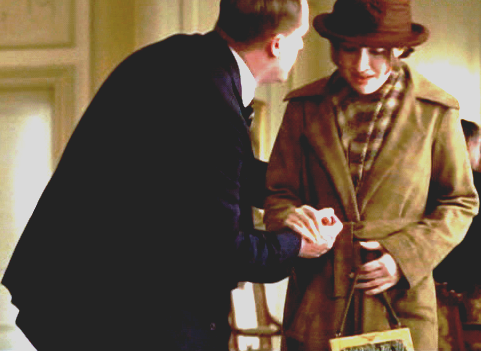 their respective mates. While Skyler still likes to get on her high horse and thinks she's smarter than she is, think how much better off Walt would be if his partner in crime were Margaret who has taken to the role as if it's her second nature. After hearing Eddie's brief description of the state investigators tearing up Nucky's suite at the Ritz, as soon as she was off the phone, she asked her maid Katy for her coat. Now, we know why. Solomon Bishop sits comfortably in Nucky's office chair reading documents when another investigator, Talmer (Alex Cranmer), tells him there's a woman outside. He goes to the office door to find Margaret who has dressed herself down and given the look of some poor downtrodden women who might be with child. When Bishop shows up at the opening to the office, she meekly says, "Mr. Thompson?" The deputy state's attorney says that no, he is not Mr. Thompson. She asks when he will return. "Do you read the papers, ma'am?" Bishop asks. "On Sundays, when the neighbors are done with it," she replies. Talmer suggests that she borrow their paper today, adding that Nucky's been arrested. Margaret starts putting on the waterworks, telling the men that she'd been told that Mr. Thompson might be able to help with her "wee ones." She begins to double over and Bishop suggests that Talmer get her a glass of water. "I think she may be with child," Talmer says as he tries to hold her up. She tells him what she really needs is to borrow their facilities and Talmer helps her in and toward the bathroom.
The Commodore has invited more officials to join his conspiracy against Nucky — all of his ward bosses: Boyd (Edward McGinty), Damian Flemming, Jim Neary and George O'Neill (William Hill) — and all four showed, discussing things with Eli in the Commodore's grand living room as they await the Commodore's arrival, that seven-plus foot grizzly overseeing the proceedings. "This is Nucky's town, Eli," Damian says as they question who takes over if Thompson goes away. Eli borrows the Commodore's line, telling them that Nucky was weaned on
 the Commodore's teat. "That's what I'm saying," Flemming continues. "It's a young man's game." At that moment, the Commodore enters, having dyed his white hair black. "How old are you, Damian?" he asks. Off to the side on a couch, Boyd whispers to O'Neill, "Is that shoe polish?" referring to whatever the Commodore used to color his hair. "Thirty-eight," Flemming answers the Commodore. The Commodore tells Flemming to pick up the large animal tusk that rests on a sofa table. Damian struggles with the bulky piece of bone but when the Commodore challenges him to lift it above his head, he can't do it. The Commodore takes it and raises the tusk over his head as if it were a broom. "You're half my age, son, I'm twice your age," the Commodore gloats. "I trust I made my point. You all showed up which says to me we all feel the same about a certain individual — the arrogance, the selfishness, the neglect." Neary interjects, "Let's me take the fall on Saint Paddy's Day." Eli piles on, "Such is his method, Jim, then a wave of his hand — 'All is forgiven.' Makes me sick — and I say this as a blood relation." Flemming remains skeptical, suggesting that it's just an indictment and Nucky's smart and could beat it. The Commodore smiles and shows the legal cards that he's holding. "Nucky Thompson is going to jail thanks to Jim Neary and —" he pauses, getting stuck
 on the name of the other man in the room who isn't a ward boss. "Patrick Ryan," the man (Samuel Taylor) says. "Patrick Ryan as eyewitnesses which nails him dead to rights on the election," the Commodore concludes. Again, Boardwalk Empire reaches into its past to reward viewers who pay attention, in this case, going all the way back to the very first episode. Ryan was the man who at that first meeting, celebrating the imminent start of Prohibition, was named the new senior county clerk by Nucky, an appointment that peeved Jimmy because he felt that he should start being more than Nucky's driver, indirectly leading Jimmy to his botched hijacking in the woods with Capone. "Which leaves the booze," Eli says. "How are you gonna handle that?" Hill asks. The Commodore explains that his role as president of the Yacht Club along with a solid guy working for them in the Coast Guard will take care of that. "What we ship comes in. What Nucky ships doesn't," he adds, telling them that his son Jimmy will run the operation. "Now this isn't going to be easy, but nothing worthwhile is," the Commodore says, winding up with the equivalent of a coach's half-time locker room speech. "Ask the man inside of you this: When you come face to face with destiny do you want to be the bear or do you want to be the one holding the shotgun?"
Lenore comes to visit Chalky at the jail saying their daughter Maybelle has a request: Her beau wants to call at the house. She asks when would be a good time. Chalky tells her a few days — he's awaiting advice of counsel. "Is he competent?" Lenore asks. Chalky tells her that he's a Hebrew gentleman. She says Lester was quite insistent about visiting him, but Chalky and Lenore agree that the teen shouldn't
 see his father behind bars. He sent his father something to read anyway: Charles Dickens' David Copperfield. We learn Chalky's real first name as the jailer tells his wife it's time for her to go and she says, "Albert, you have a family that loves you and is waiting." After Lenore has left, a prisoner (Erik LaRay Harvey) in the cell across from Chalky's starts whistling and asks, "Who is that fine piece of lambtail?" Chalky inquires if the man likes her looks to which he replies he surely does. "I'll tell my wife then the next time I see her," Chalky declares. "Meant no offense," the man says. "Got a pair of eyeballs. Can't help but use them. Name is Dunn Purnsley from Baltimore." Purnsley asks what he is reading and for the first time, we learn Chalky can't read. "Tom Sawyer." Purnsley says that he and the other men in his cell could use some entertainment, why doesn't he read to them? One of Dunn's cellmates tell Purnsley to leave him alone explaining that he is Chalky White, as if that will mean something to someone from Baltimore. "I had no idea," Purnsley replies sarcastically. "You tellin' me…walking around here like some old zip coon, fine high yellow bitch at his side — he called Chalky White 'cause that be the most bunk for a nigger horseshit I ever heard. What you say to that, Brother Tambo?" Chalky continues to pretend to read. "I say you heard my name." Purnsley shoots back, "I know you heard mine." The jailer returns with a white prisoner and tells Chalky that he must move to the other cell since they can't mix races so White joins Purnsley and the four other men.
Nucky and Eddie walk into his treasurer's office, shocking the secretary (Trisha McCormick) who Nucky mistakenly greets as Enid. She corrects him that her name is Eunice. He tells her to call the aldermen, the sheriff and the mayor and tell them to come at once. He then goes into his office and closes the door. After a moment, he opens it and adds, "I also need a florist."

As Margaret helps Katy with proper placing of the silverware, Pauline brings her a bouquet of roses for Valentine's Day, though the card isn't signed. Any joy at the gift doesn't last as Emily's shrieks interrupt the activities as her brother Teddy chases her with a hammer. Margaret grabs it and sends the boy to his room. Lillian comes in panting, saying they were building a birdhouse. A persistent knocking occurs at the back door. When Margaret answers it — hammer still in hand — a man with a thick Irish brogue (Charlie Cox) raises his hands in surrender. "I'm not a burglar, though I do confess to climbing out a window or two." He mistakes Margaret for a servant and asks for Mrs. Thompson. When told that there isn't one, he asks for the lady of the house and Margaret tells him that he's speaking to her. He introduces himself as Owen Sleater and says he works for Mr. McGarrigle. "You are quite early," Margaret declares. After Sleater puts his foot in his mouth a few more ways, Margaret asks what exactly he wants. "With your kind permission, I'm to ensure your house is secure for Mr. McGarrigle this evening," Owen replies. "We're not given to threatening our guests," Margaret tells him. "You do have a hammer." Margaret explains her son thinks it's a toy. Sleater asks where he is. "In his room," Margaret answers then, realizing that Sleater is making a serious inquiry. "He's seven." Sleater rules Teddy out as a threat and begins to survey the premises.
One cellmate's wheezing bothers a fellow prisoner, but the inmate doesn't get what he's saying at first. The wheezing inmate says he can't help it — he's catching a cold and asks where he's supposed to go. "He's got you there," Purnsley declares. "We're all in this together." Dunn describes the little place in his head where he goes that no one can get to and credits it for doing "three years in ankle chains like I was takin' a nap. Chalky White knows what I'm talkin' bout, don't he?" Chalky remains silent, keeping his book open as Purnsley continues. "I bet he up there right now, all soft and pillowy. Honeybee wife fetchin' plates of greens, roast beef, reading Tom Sawyer. Ain't that so, Chalky White?" Purnsley sits on the lower bunk next to Chalky who simply says, "Well, it could be." Purnsley deepens his voice to a threatening whisper, "Maybe I climb up there with you, jazz that woman up while you're lickin' the plate." Chalky calmly closes the novel. "You do what you want," Chalky says before turning and looking Dunn straight in the eye. "Just gonna be your right hand anyway." Purnsley pauses briefly before laughing and slapping Chalky on the arm. "That's how you play it, gentleman," Dunn proclaims as he stands. "Oh yeah, we gonna get along just fine."
Looking nervous, angry and hurt, Nucky looks out the window of the treasurer's office. He turns around as Mayor Bader rushes in asking, "Am I late?" Nucky isn't in good spirits, sternly inquiring, "Where the hell have you been?" Bader says he came as soon as he got the message. "Ninety minutes?" Bader tells him there are reporters everywhere and investigators snooping around. He's not proud to admit it, but Bader confesses that he's been hiding in his garage. Seeing only he and Nucky, he asks Thompson where everyone is. "I need you to tell me if you were approached about turning against me," Nucky states. The question stuns Bader who tells Nucky that he knows he's with him because of their business interests. "We're building things," Bader says. "Nobody came to you — not Neary, any of the bosses, not the Commodore?" Nucky asks. Nucky's nervousness infects Bader. "How bad is this?" Nucky admits he doesn't know yet while Bader wonders if they'll come after him. Nucky tries to calm Bader's worry about that. "I'm gonna beat this, Ed, and when I do I'm gonna remember who showed up here today and who didn't. Depend on that," Nucky tells him. As Nucky shows Bader out, Eunice tells him that Eddie called and that it's safe to return to the Ritz office.
After the meeting at the Commodore's, the four ward bosses hook up in an out-of-the-way spot to discuss the plot against Nucky. Neary remains the gung ho ringleader and Flemming the cautious naysayer with Boyd and O'Neill seeming to have no opinion of their own other than to end up on the winning side. "I don't see why things gotta change. Everybody's getting by," Flemming says. "Is that all you want from life, Damian?" Neary asks. "What else is there?" Flemming replies. "A pair of balls," Neary counters. Boyd questions Neary if there might be something more in it for him, but Neary says he'll get the same as everybody — "Less headaches, more green." O'Neill hasn't seen any problem with Nucky keeping the jack flowing. "Where were you last year?" Neary asks. "Armed robbery, shooting on the Boardwalk — that's not a man in control — and the election." O'Neil reminds him that they won. "Too goddamn close," Neary comments. Flemming doesn't see why a change in leadership means that Nucky has to go to jail. O'Neil wonders about the roads project that all of them have a stake in. Neary claims that will go on under the Commodore. "But it's Nucky's deal," Flemming says. Neary tells Flemming to get it through his skull — they aren't in charge. "The Commodore wants Nucky next to that fuckin' grizzly. That's what's gonna happen," Neary declares. "What's to keep us from winding up with him?" Flemming asks, referring to possible jail time. Neary assures them that the Commodore will put the fix in. Neary looks to each of the men. O'Neill and Boyd reluctantly nod that they are in while Flemming lights his cigarette and stays mum. "Damian, just say, 'Please' and 'Thank you,'" Neary tells him.
Jimmy heads to the Lower East Side where Meyer Lansky (Anatol Yusef) has set up an office for his continuous poker game behind the name of the business Schenkel & Bro. Darners & Weavers. Before he, Jimmy and Luciano begin their discussion, Meyer sends their teen worker Benny (Michael Zegen) out for cheese. The youth makes some odd noises, prompting Jimmy to ask if he's OK. Lansky assures him that he's fine, he just makes noises like that sometimes. Benny's last name happens to be Siegel. In the 1930s, he'll acquire a nickname he
 hates: Bugsy. Lansky tells Jimmy he runs the house for the poker game round the clock under Rothstein's protection. Luciano says that they have other enterprises as well. Jimmy asks if Rothstein has part of those, but the two remain silent. "You met with A.R.," Lansky says. "He can be a difficult man to read." Luciano chimes in. "That thing of yours this morning — I'd have said yes to that." Jimmy tells Luciano that he wouldn't have asked him though. "I need Rothstein, not the fella who carries his water," Darmody says. This sets Jimmy and Luciano off again, bringing Gillian into the conversation with Luciano saying she was "begging for it" and forcing Lansky to physically separate the men. "Gentlemen — I'm running a business here," Meyer tells them as they finally return to their corners. Lansky takes the seat on the other side of his desk next to Jimmy. "Charlie and I have learned a great deal from Mr. Rothstein as I'm sure you have from Mr. Thompson," Meyer says, "but nobody wants to be in school forever. As I see it, we have a lot in common. If we put aside our differences, things could happen." "Such as?" Jimmy asks. "Trading partners. We buy liquor from you, you buy something from us," Lansky answers. "What would that be?" Jimmy inquires. "We're thinking of getting into heroin," Luciano speaks up. Meyer cocks his head as he tells Jimmy, "When you run the numbers, it starts looking very attractive."
 Margaret tries to straighten the rug in the entry hall herself, unhappy with the job Katy did when Owen Sleater wanders by and lends a hand. She asks the Irishman if he's been traveling around the U.S. much. "With Mr. McGarrigle. Filling the coffers. New York, Boston, Philadelphia," he tells her of their journeys seeking support for the cause back home. "Ourselves alone," Margaret says. Sleater informs Margaret that her Gaelic translation is a bit off. "Sinn Féin — we ourselves. That's a bit closer," Sleater remarks. "Either case, that's what we're about — who else would fight for us?" Margaret inquires about what it is he does exactly for McGarrigle. "As you see — clear the path," he replies, adding that he was a livestock inspector prior to the rebellion, then he went to fight in the north. "I make you for the Lonesome West," Owen guesses about Margaret's Irish origins. She tells him she's from Kerry actually. He asks if any relatives remain in Ireland. "No — here apparently," she answers. "Then you won't have to choose sides."

Almost as soon as Nucky gets back to the Ritz, he makes a beeline for his closet but when he removes the false panel, he finds that both the ledger and the moneybag are missing. Eddie calls to him, announcing that Ward Boss Flemming has arrived to see him. Nucky returns to his office. "Nuck, I tried talking to them. I said they were making a mistake. I told them you were too smart to get sandbagged by something like this, They wouldn't listen. All they can see are dollar signs," Flemming tells Nucky. The phone on Nucky's desk begins to ring, but Flemming continues talking and Thompson seems in no rush to answer it. "It's like the Commodore has cast some voodoo spell on them," Damian says as Nucky answers the phone, "Yes." "All alone big brother?" Eli's voice can be heard. "How does it feel sitting at your fancy desk all by yourself?" Nucky speaks as calmly as he can muster. "Eli, please listen closely. If now, right now, you tell me you want to get out of this, I will help you.…I'm prepared to hear your side of it. I will help you — if you tell me right now because in a minute
 it's going to be too late." Silence. "Are you there?" Nucky asks. "The funny thing," Eli says, "nobody takes power. Nobody has to give it to them. Look around, big brother. What have you got?" Eli hangs up. Nucky tells Eddie and Flemming that he's late for a dinner engagement. Part of what pissed Eli off was when he was removed from the ballot for sheriff after his shooting at the casino. What would Eli think if Nucky told him that it was the Commodore who advised him to remove Eli from the party ticket even though Nucky felt it cold-blooded to do to his brother who was still recovering from a bullet wound? Eli made his phone call to Nucky from the Commodore's, with the Commodore watching. After he hangs up, the Commodore says, "Feels good to twist the knife." Eli smiles weakly. The Commodore tells him that now it's time for him to meet the men who built Atlantic City. He leads Eli into another room where about four bald and white-haired men sit. "Gentlemen, may I present Sheriff Elias Thompson," the Commodore announces. Leander Cephas Whitlock stands and raises his drink and says, "Propinate nobis similibusque," a Latin toast that translates to "Here's to us and those like us — damn few left." For regular viewers of The Sopranos, even with our first close-up of Dominic Chianese and his first spoken lines, albeit they are in Latin, you still can't spot Uncle Junior hidden anywhere within those muttonchops and behind that beard and mustache.
Jimmy has done well at Lansky's poker game, so he asks Benny Siegel to cash him out. He takes note of two men having a heated conversation with Meyer in his office. When they exit, one of the other players invites the pair to join the game as they are always looking for new victims. The taller Italian, Incrocci (Mario Macaluso), asks, "Why's every kike got to be a wise ass?" Benny fires back, "Why does every dago have to be dumb as fuck?" Incrocci threatens to bury Benny in his diaper and he starts making clucking noises again until Lansky comes out and says Benny's name and gets him to stop. Jimmy hands his chips to Benny who gives him a large wad of bills which he slides into his pocket. The other Italian man, Scarpelli (John Cenatiempo), distinguished by his hat and his silence, continues to stay mum. Lansky tries to keep the situation on a strictly business level, thanking them for their full and frank discussion. Incrocci isn't impressed. He's more interested in Lansky respecting the terms and tells Scarpelli they need to get going — "This place smells" — and report back to his uncle. Jimmy asks who they were after the men leave. Lansky explains that they represent Masseria. The name means nothing to Darmody. Benny describes him as a fat ass who thinks he owns the Lower East Side. "Just a simple misunderstanding," Lansky insists. Jimmy slips a tip to Benny and leaves.
*SPECIAL NOTE: Thanks to Mr. Barthelemy Atsin, who was kind enough to help me by telling me which actors played each of the other cellmates in the following scene with Chalky and Dunn Purnsley. In addition to acting, Atsin also is an artist so you might check out his website.
It's fairly clear that Purnsley, so well played by Erik LaRay Harvey, has keyed in on the fact that Chalky can't read so he decides to rub it in his face. Dunn asks Chalky, "What's that scamp Tom up to now?" Chalky points to an illustration in the copy of David Copperfield and says that Tom met this little one and they had a sweet time chatting and then she played the piano. Purnsley then sticks one of his digits into
 the text on the opposite page and asks Chalky what it says. It's the closest we've seen Chalky come to losing his cool with this man. "It say get your finger out of my face." Dunn places his hands on the top bunk and leans in to Chalky. "Know what I don't like about you? That fuckin' winged suit and that bright-skinned bitch you have with that uppity way you tell the world you better than Dunn Purnsley when all you be is a jigaboo in a jail cell," Purnsley sneers, ripping the book from Chalky and tossing it across the cell, leaving only the page with the drawing in Chalky's grasp. Chalky stays quiet for a moment, then a peaceful look crosses his face along with a smile. "Harold C. Madison, how your daddy keepin'?" Chalky asks. The inmate closest to Chalky with a sling on his arm (Omar Scroggins) stops leaning on the bunks and steps forward. "Tolerable, sir. He thanks you for the doctor bills," Harold says. "Noah Hookway, how are things going down at the Gold Room?" Chalky inquires. The prisoner wearing a wool cap and standing in the corner to Chalky's left moves to the center of the cell. "Supposed to be at work today," Noah (Bartelemy Atsin) tells him. "I'll talk to them," Chalky promises. Purnsley, standing in the cell's exact center, begins to realize what is happening. "Timothy. Cornelius," Chalky addresses the last two inmates who stand against the bars. "Mama grateful for the turkey, sir," Timothy
 (Truck Hudson) says. The four men have Dunn surrounded. "Alrighty then," Chalky declares. Purnsley isn't intent to wait and starts swinging, but it doesn't take long for the four inmates to overpower him, beating and strangling him unmercifully against the bars until he finally falls as a bloody heap to the floor. Cornelius (Jonathan Baston) retrieves David Copperfield and returns it to Chalky. "Which of you boys knows his letters?" Chalky asks. "I do," Noah replies. Chalky hands him the book and he begins to read as the camera remains glued on Michael Kenneth Williams' face.. "David Copperfield by Charles Dickens. Chapter One. I am born. Whether I shall be the hero of my own life or whether that station will be filled by anyone else…" It could be argued that these scenes with Dunn Purnsley added little and didn't forward the overall story, but look how many layers these jail scenes added to our understanding of Chalky White. Boardwalk Empire also knows how to add new shadings and depths to its characters through scenes that otherwise might not be essential to its ongoing plots.
Margaret finds herself playing hostess to John McGarrigle (Ted Rooney) and Ernie Moran alone as Nucky has yet to arrive home. Owen Sleater sits off to the side, not dining at the table but flirting with Katy each time she passes. The sour-looking McGarrigle hasn't eaten
 much, prompting Margaret to ask, "Is the lamb not to your liking, Mr. McGarrigle?" Solemnly, he replies, "I've no doubt it is properly prepared, but I eschew any flesh that walks on cloven hooves." Margaret apologizes, saying she had not been made aware of his preference. "It's no preference. It's an iron-clad principle," McGarrigle declares. Moran attempts to lighten the mood, saying John is a man with a bit of the devil in him, but McGarrigle misses the humor, insisting he would not tally with the devil at all. "It is a challenge in this town," Moran says and again the joke flies over the Irishman's head. "Mr. Moran refers to Atlantic City's reputation for pleasure," Margaret interjects. "The width of this country seems beset by licentiousness and turpitude," McGarrigle states. At this point, her guest is annoying Margaret. "Another thing not to your liking," she says. "It is none of my concern. My cause is to drive the English invaders out of a land he's occupied for 800 years. I assure you, we will succeed even if we're martyred along the way," the visitor sermonizes. Margaret calls that an extreme position. "Only to those who've forgotten from which they've come," he replies accusingly. "I know where I'm from — and where I am now," Margaret responds. "You're plainspoken — for a woman," McGarrigle says. Before tensions can get much higher, Nucky arrives to break them, apologizing for his tardiness, blaming a busy day. McGarrigle wants to discuss their business immediately, but Nucky tells him he needs to eat something first. "There's certainly plenty of lamb," Margaret grins mischievously.
As Jimmy prepares to exit the Lower East Side, he moves his knife from his boot to the back of his shirt. He must be prescient. As he walks through a park, he's confronted by Incrocci and Scarpelli, who demand his take from the poker game. Jimmy keeps his arms raised as Incrocci keeps a gun trained on him. He tells them he put the cash in his boot. As Scarpelli looks, Jimmy tells him it's in the other one. As Scarpelli switches, Jimmy kicks him hard, pulls the blade out and slits Incrocci's throat before doing the same to Scarpelli, whom he leaves bleeding into a fountain.
After Nucky and his guest have moved to another room to discuss the issues at hand, McGarrigle makes his appeal. "Mr. Thompson, the Irish people are at war against a barbaric form. The English murder us in our sleep. They set fire to our homes. Last month, they put the torch to Cork City and shot the firemen come to fight the blaze. We need guns and the money to buy them. Mr. Moran tells me you are a loyal son of Erin and I call upon that loyalty now," McGarrigle says. Nucky recommends that McGarrigle go to the next meeting of the Ancient Order of the Celts. A disappointed McGarrigle tells Nucky that "cash suits us better." Nucky says, "I say that myself, but today is not the day." Moran speaks up to inform Nucky that there is another matter. McGarrigle speaks of his man and Sleater steps forward to introduce himself. McGarrigle announces that Owen has decided to stay behind in the states. Moran asks Nucky if he might be able to help Sleater find employment. Thompson tells him to stop by the Ritz office tomorrow.

After the guests have left, Margaret sees Nucky slumping in the chair by the fireplace. She starts to leave him be, but he leans around and says they need to talk. Margaret asks if they have a case and Nucky admits that they do. "Who is against you?" she asks. "The ward bosses — all except Flemming. The Commodore is pulling the strings and I think he has Jimmy." Margaret notes that Nucky hasn't mentioned his brother. "Eli — Eli is betraying me," Nucky admits sadly. "I didn't hear a word from you since last night," Margaret says with a bit of anger in her voice. Nucky tells her that he didn't want her to find out. "How could I not?" she ask him. "I just keep people satisfied. That's what I do," Nucky justifies. Margaret tells him that he knows now that that's not possible. Nucky informs her
 that the investigators turned the suite upside down and some things are missing, including the ledger and about $20,000 in cash. Margaret walks over to a desk and unlocks it and then returns to Nucky, standing before him with the ledger and the moneybag in her hands. Nucky's eyes widen as he sees them in her hands. "You are smarter than your enemies and you will persevere, but you aren't thinking clearly now. You must concentrate and not give over to emotion," she tells him. "Where did you get those?" he asks. "From your closet today," she replies as she hands him the moneybag. She holds the ledger. "This must be burned and future transactions committed to memory, do you agree?" An amazed Nucky nods yes as Margaret pitches the ledger into the fireplace. She tells him he looks exhausted. "I sent you flowers for Valentine's. I never signed the card," Nucky tells her. "I knew who they were from," she says, adding how exhausted Nucky looks. She kisses him on the forehead. "Go get some sleep — in our bed." I told you — how much better off Walter White would be with Margaret at his side?
Tweet
Labels: Astaire, Awards, Boardwalk Empire, Books, Breaking Bad, Chaplin, Coens, Dickens, Fiction, Gene Kelly, HBO, Keaton, Oscars, The Sopranos, The Wire, Treme, TV Recap, Vidal
TO READ ON, CLICK HERE


