Saturday, March 31, 2012
The World is Yours

By Ivan G. Shreve, Jr.
Around my home base at Thrilling Days of Yesteryear, the “Gangster Trilogy” is the nickname assigned to the three movies that for many kicked off the crime film genre in the 1930s: Little Caesar (1931), The Public Enemy (1931) and Scarface (1932). The first of these films starred Edward G. Robinson in what has commonly been called his “breakout” role, and Enemy did likewise for James Cagney…making both actors silver screen legends. Though there are variances in the plots of each movie, they feature a unifying theme of a racketeer who rises to the top of his profession stealing, killing and plundering all the way…only to achieve his comeuppance before the lights in the theater come up and the second show begins.
Scarface — which at the time of its release 80 years ago on this date was subtitled “The Shame of a Nation” — also made veteran stage actor Paul Muni a household name among theatergoers, though his starring turn in I Am a Fugitive From a Chain Gang equally boosted his cinematic stature (he received an Oscar nomination for the role, and was soon signed to a long-term contract by Warner Bros.) as well. While both Caesar and Enemy were Warner releases, Scarface was an independent production funded by the deep-pocketed Howard Hughes (and released by United Artists) and as such it’s often the overlooked feature of the three. (At one time, the movie even was withdrawn from release and didn’t resurface until 1979.) If it’s remembered at all today, it’s probably because it was the inspiration for the 1983 Brian De Palma cult classic with Al Pacino as the lead. But there’s much more than meets the eye in the Howard Hawks-directed original. (Much more.)

Crime boss “Big” Louis Costillo (Harry J. Vegar) is gunned down by a mysterious assailant shortly after he’s thrown one of his impressive shindigs, and as dedicated police inspector Ben Guarino (C. Henry Gordon) has been instructed to round up the usual suspects, he brings in Antonio “Tony” Camonte (Muni) and Guino “Little Boy” Renaldo (George Raft), two lieutenants who work for one of Costillo’s rivals, Johnny Lovo (Osgood Perkins). Lovo gets both men released with writs of habeas corpus, and we learn that Tony was responsible for croaking Big Louie at the behest of Lovo. Johnny then informs his now second-in-command that they’ll be taking over the beer concession on the city’s South Side, selling illegal suds to speakeasies and squeezing out those bars owned by rival gangs. Lovo has specifically ordered the ambitious Camonte to leave the North Side operation (run by a hood named O’Brien) alone, because that’s just asking for trouble.

Tony’s stock starts to rise in the beer rackets, and he finds himself constantly trying to attract the attention of Poppy (Karen Morley), Lovo’s girlfriend. He’s also earned the disapproval of his mother (Inez Palange), who scolds Tony’s sister Francesca (Ann Dvorak) when she accepts her brother's “dirty” money. Tony has a rather unhealthy (and suggestively incestuous) relationship with “Cesca” to the point that he gets enraged when he sees her in the company of eligible men. Finally, the impatient Tony makes a bid for the North Side operation by having Little Boy “eliminate” O’Hara in his flower shop, and this stunt earns him both the disapproval of Lovo and the enmity of Gaffney (Boris Karloff), the hood who takes over for the deceased O’Hara. Tony and his men wage a full assault on Gaffney and the other gangs…and seeing that Camonte is consolidating his power, Lovo orders a hit on Tony. The attempt fails, and Tony (with the help of Little Boy) exacts swift retribution.

The forces of good beat their collective breasts at the lawlessness exhibited by Tony, who is now king of all he surveys, and despite increased pressure by the newspapers and law enforcement, there seems to be little that will stop him. His downfall comes when he shoots and kills Little Boy after finding him in the same apartment with Cesca, not knowing that they have secretly wed. Returning to his stronghold (his sidekick Angelo, played by Vince Barnett, also has been killed as a result) as the police close in, Cesca arrives to Tony's surprise; she had planned to kill him for revenge but now realizes that “you’re me and I’m you” and she agrees to hold them off, but she’s felled by a stray bullet, and tear gas drives the now abandoned Tony out of his hideout to face Guarino and two detectives downstairs. Camonte agrees to come quietly, but bolts from his captors at the last minute and ends up gunned down in the street.

W.R. Burnett, the author responsible for the novel on which Little Caesar was adapted, was one of several credited scribes who supplied dialogue and continuity for Scarface, along with Seton I. Miller and John Lee Mahin (with uncredited contributions from producer Hawks and Fred Pasley) — but the bulk of the screenplay was penned by old newspaper hand Ben Hecht, who adapted Armitage Trail’s 1929 novel of the same name. “Scarface” also was the well-known nickname of racketeer Al Capone, and concerned that the film might possibly portray him in a negative light, he supposedly sent a couple of his boys around to see Hecht, hoping to discourage him from finishing the project. But Hecht, being a veteran ink-stained wretch, was not an easy man to scare…and according to legend, not only did he convince Capone’s goombahs that the movie was not about their boss, but he called upon them as consultants. (Further legend states that the end result pleased Al so much that he later obtained a print of the film for his very own.)
At the time of Scarface’s release, a vocal faction of individuals, concerned that others might be having more fun than they were, decried the product coming out of Hollywood…and the Hawks-Hughes movie was one on which they complained the longest and loudest. The accusations claimed the film glamorized gangsters and crime, and that this might be a bad influence on impressionable minds. Most of the time, this was true — it’s what was known as the “sin-and-salvation” approach to filmmaking. Cecil B. DeMille mastered this; presenting sequences of immorality and debauchery in his silent epics (which he got away with provided the characters received their just deserts at the end). Many of the later “message” movies that tried to warn innocent dupes away from sex or drugs (such as Reefer Madness) also took the same approach…and you often have to wonder how effective that was, showing kids having the time of their lives drinking and partying while frowning upont this type of behavior to be frowned.

I don’t think anyone would ever emulate the onscreen conduct in Scarface, however. The main character, Tony Camonte, isn’t a particularly admirable role model — as played by Muni, he’s positively primal; at times it’s as if someone shaved a simian and forced him into a nice suit. (Critic Danny Peary once observed that Muni’s Tony is essentially Fredric March’s Mr. Hyde, only without the fangs.) Camonte is constantly in a state of macho swagger, thinking himself sophisticated (but he’s not) and like a 1930s Donald Trump, judges the quality of what he buys by how much it costs. “That’s pretty hot” proves to be the highest praise he can bestow upon any item or individual, proving that Paris Hilton didn’t just come up with that asinine catchphrase by her lonesome. And like James Cagney’s Cody Jarrett in White Heat, Tony Camonte has some serious psychological problems. Man, has he got it bad for his sister Cesca. Of the film's many elements, the incest theme intrigues the most in what I consider to be the best gangster movie of the 1930s, addressed in the uncomfortable familial relationship between brother and sister Camonte. Hecht based the characters on the Borgia family, making actress Ann Dvorak a delightfully slutty carbon copy of Lucretia and while Muni received many of the critical kudos for his performance in the film, I think Dvorak walks away with the picture. Scarface made me a huge fan of the underrated actress; her tantalizing dance moves and naughty double entendres (not to mention that unmistakable glint she gets in her eye when she talks to Muni’s Tony) no doubt concerned the censors more than the violence.

I also became a Karen Morley fan because of this film, even though I’ll certainly concede that Dvorak gets the showier role and makes much more of an impression. (Morley was an underrated thesp, often on the receiving end of static from the industry about her personal life and politics, all coming to a boil in 1947 with her blacklisting in the motion picture industry after testifying before the House Un-American Activities Committee.) As Poppy, the fair-weather bitch who switches her romantic allegiance to Tony when she’s able to read the tea leaves that Johnny Lovo hasn’t much of a future, I like her blasé responses to Camonte’s advances (“I’m nice with a lot of dressing”), and how at times it seems as if she’s having difficulty holding it in and not laughing at the jerk. Scarface also served as a breakout vehicle for actor George Raft, who had danced his way to fame on Broadway (under the tutelage of Texas Guinan) before venturing out to Hollywood to crash the movie business. Raft had appeared in films before Scarface but his “Little Boy” character in the picture really cemented his stature in the motion picture industry; during the 1930s he was the go-to individual for gangster portrayals alongside Cagney and Robinson. George was quite cozy with a number of real-life hoods (including Bugsy Siegel and Meyer Lansky), which led many people to speculate that he actually might have been in the mob at one time (he wasn’t). A bit of business performed by Raft — flipping a nickel in the air and catching it while never looking at the coin — soon became a trademark and even provided a hilarious in-joke in 1959’s Some Like It Hot, in which he had a nice comic (and menacing) turn as hood Spats Columbo.

The actor who wasn’t quite as convincing as Raft playing a gangster was Boris Karloff, who also had a small role in Scarface as Gaffney. Personally, I welcome Boris in any movie but the man was just a little too cultured and refined to play a hood. Be that as it may, Boris does get a memorable death scene in which he’s gunned down by Muni and his mob while bowling…and though he leaves this world having bowled a strike, the “kingpin” symbolically takes a little time to fall before finally doing so. Symbolism plays a large part in Scarface; director Hawks came up with an interesting motif in that all of the gangsters who are “rubbed out” are designated as such with an “X” visible onscreen. Hawks thought this great fun, even to the point of offering crew members $200 for each creative suggestion to allow him to present this. Scarface originally had been scheduled to be released in September 1931, but producer Hughes still was getting grief from the Hays’ Office about the movie’s violent content. In an attempt to pacify the censors, the producer had Richard Rosson shoot an alternate ending, one in which Muni doesn’t die in a hail of bullets at the end but gets taken into custody, tried and convicted by a judge (who gives Muni’s character a lecture though you never see the actor) and sentenced to hang by the neck until he’s really most sincerely dead. (This scene also was shot without Muni’s participation; a double was used in long shots.) The censors weren’t wild about this ending either so Hughes finally threw up his hands and just did an end run around them, releasing the movie in states where there were no censorship boards. (It did great box office and received positive critical reviews.) The “alternate ending” has survived and is available on Universal’s 2007 DVD release…but seeing as how they also eliminated some of the more overt sexual attraction between the Muni and Dvorak characters, I’m glad Hughes stuck to his guns and kept Ending A.
That stand-alone disc release of Scarface provided the best news a classic film fan could get in that before that DVD, the only way you could purchase a copy of the Hawks original was on a 2003 “Anniversary Edition” box set of the 1983 Brian De Palma version…and that’s a purchase I simply wasn’t capable of justifying. There’s even more bad news on the horizon in that Universal has got another remake of the film in the works (this was announced last year) that will combine elements of the 1932 and 1983 films…but as a cinematic British barrister once observed: “Is that really desirable?” Classic film fans can take solace in that the one-and-only original is being looked after; having been added to the Library of Congress’ National Film Registry in 1994. Otherwise I’d have no other recourse than to respond with one of Tony Camonte’s most memorable quips: “Get out of my way, Johnny…I’m gonna spit!”
Tweet
Labels: 30s, blacklist, Cagney, De Palma, Edward G., Fredric March, Hawks, Hecht, Howard Hughes, Karloff, Movie Tributes, Pacino, Raft
TO READ ON, CLICK HERE


Thursday, December 15, 2011
“Sitzen machen!”

By Ivan G. Shreve, Jr.
The very first Billy Wilder film I watched as part of my burgeoning film education wasn’t one of his acknowledged classics such as Double Indemnity (1944) or Sunset Blvd. (1950) — or even Some Like it Hot (1959) or The Apartment (1960) but a movie I consider “second-tier” Wilder, the 1961 Cold War comedy One, Two, Three. Keep in mind that I don’t refer to the film as second-tier because I dislike it or am trying to denigrate the work; it’s just that with the passage of time, the topicality of One, Two, Three hasn’t particularly worn well, something that I’ve also noticed in Ninotchka (1939), a Wilder-scripted comedy (but directed by Ernst Lubitsch) whose plot and themes are revisited in the later feature. (One, Two, Three also contains echoes of the filmmaker’s earlier Sabrina, the 1954 romantic comedy starring Audrey Hepburn, Humphrey Bogart and William Holden.)
The dated political content of One, Two, Three doesn’t do it any favors, but this is nevertheless going to be an enthusiastic review of a film that debuted in motion picture theaters 50 years ago on this date. “Second-tier” Wilder is miles and away better than the best movie helmed by any director today, and with his longtime partner I.A.L. “Izzy” Diamond, Billy crafted a fast, frenetic and funny farce (based on a 1929 play, Egy, kettö, három, by Ferenc Molnár) that still can leave an audience breathless with laughter. The icing on this cinematic cake is that, before he returned briefly to movies for Ragtime in 1981, One, Two, Three served as the penultimate cinematic swan song for the legendary James Cagney.
C.R. “Mac” MacNamara (Cagney) is head of operations for Coca-Cola in West Berlin, a month or two before the closing of the Brandenburg Gate (and subsequent construction of the Berlin Wall). Company man Mac is extremely loyal to the Pause That Refreshes, and has been working diligently to advance himself, with an eye on assuming the post of European operations in London by shrewdly brokering a deal to introduce the soft drink to the Soviet Union. (Mac was formerly in charge of Coca-Cola’s interests in the Middle East but a mishap involving Benny Goodman resulted in Mac’s demotion after the bottling plant was destroyed in a riot.) He’s scheduled to meet Soviet representatives Peripetchikoff (Leon Askin), Borodenko (Ralf Wolter) and Mishkin (Peter Capell) to discuss introducing the soft drink behind the Iron Curtain, and is juggling that conference with plans to further his “language lessons” with luscious secretary Fräulein Ingeborg (Lilo Pulver).
The roguish MacNamara is planning to take advantage of his wife Phyllis’ (Arlene Francis) scheduled trip to Venice with their two children to dally with Ingeborg, but those plans are put on hold when Mac receives a call from his boss, Wendell P. Hazeltine (Howard St. John), in Atlanta. Hazeltine’s daughter Scarlett (Pamela Tiffin) is en route to Berlin, and he’s entrusted Mac to keep close tabs on her since Scarlett is a bit of a shameless flirt (despite being only 17). As an example of her hot-blooded tempestuousness, Mac and Phyllis meet her at the airport just in time to find her awarding herself as a lottery prize to the flight crew (the winner is a man called Pierre, prompting Phyllis to dub him “Lucky Pierre”). What starts out as a two-week assignment stretches into two months, but Mac is pleased that he’s keeping Scarlett on a tight leash.

On the day before the Hazeltines travel to Berlin to collect their daughter, Scarlett turns up missing. Mac learns from his chauffeur (Karl Lieffen) that the girl has been bribing him to let her off at the Brandenburg Gate every night to allow her to cross the border into East Berlin. Devastated by this news, MacNamara expresses relief when Scarlett turns up at his office, but then is hit by a streetcar when she announces that she’s been spending all her time with an East German Communist named Otto Ludwig Piffl (Horst Buchholz), whose political philosophy fills Mac with utter revulsion. The problem for Mac is that the fling between Otto and Scarlett has gone beyond mere puppy love — they tied the knot in East Berlin — something that will no doubt go over with her parents like flatulence at a funeral. The devious MacNamara arranges for the young Commie to be picked up by the East German authorities after they find a “Russkie Go Home” balloon affixed to his motorcycle’s exhaust pipe and a cuckoo clock (that plays “Yankee Doodle” on the hour) wrapped in a copy of The Wall Street Journal in his sidecar.
Mac’s machinations even go as far as to arranging for the couple’s marriage license to disappear from the official record, and he gloats about his triumph to a furious Phyllis, who has finally had enough of her husband’s neglect of their marriage in his pursuit of Coke advancement. The popping of champagne corks is put on hold when Scarlett faints after hearing of Otto’s arrest. An examination by a physician reveals that the girl has a Communist “bun in the oven!” Racing against an ever-ticking clock before the Hazeltines touch down in Berlin, Mac manages to spring Otto and then embarks on an extreme makeover of the hostile Bolshevik to transform him into someone whom Scarlett’s parents will approve. Against all odds, McNamars’s scheme comes off without a hitch, but his dreams of taking over as head of Coke’s European office are dashed when Hazeltine announces the job will go to his new son-in-law! Kicked upstairs to a position in the home office in Atlanta, Mac will reconcile with Phyllis and will hopefully live happy ever after.
Because the emphasis in Ninotchka is primarily on the romance between stars Greta Garbo and Melvyn Douglas, that film hasn’t dated nearly as badly as One, Two, Three, whose jibes at Cold War politics make it more of a period piece, and is likely to appeal mostly to the history majors in the audience. (Wilder’s cynicism also comes to the fore in this film in that you never really believe the romance between Scarlett and Otto. They have to stay married because there’s a “bouncing baby Bolshevik” on the way.) But if you’re able to put its topicality on a back burner, there is much to enjoy in the film; it is a spirited farce, buoyed by the participation of Cagney as the main character of C.R. MacNamara. Mac is a typical Wilder hero: not the most admirable man (he’s cheating on his wife and comes across as a bit of a jerk) but an individual who rises to the occasion when faced with a crisis. Cagney, whose screen performances were usually marked by his established persona as a fast-talking wise guy, is a marvel to watch in this film, barking out orders and, in the words of a reviewer for Time magazine, “swatting flies with a pile driver.”
Cagney did not have an easy time making the film. He was no spring chicken at the time of its production, and having to spout Wilder’s rat-a-tat dialogue at a furious pace was often difficult, particularly in one scene where the director insisted on Jimmy’s completing it in one take. Cagney was tripped up continually by the line, “Where is the morning coat and striped trousers?” It was never explained to his satisfaction why Billy refused to let him paraphrase the dialogue, and so it took 57 takes to get it done (which might explain why the finished product comes off as a little mechanical). Cagney also was not enamored of co-star Buchholz and his scene-stealing antics; Jimmy had experienced a similar incident when making Yankee Doodle Dandy (1942) and had trouble with character actor S.Z. “Cuddles” Sakall upstaging him in a scene, but he overlooked it because Sakall “was an incorrigible old ham who was quietly and respectfully put in his place by [director] Michael Curtiz.” But if Wilder hadn’t exercised his director’s prerogative and discouraged Horst to stop with the same, Cagney “would have been forced to knock him on his ass, which I would have very much enjoyed doing.”
All in all, the experience of making One, Two, Three drained Cagney and made him realize that he’d rather be enjoying retirement, and upon the movie’s completion, the actor settled in for a second career as a gentleman farmer (though he did narrate a TV special and a 1968 Western, Arizona Bushwhackers, in the interim). He was coaxed out of retirement for a small role in Ragtime in 1981 (as the police commissioner, his last big-screen appearance and a final reunion with his longtime chum/movie co-star Pat O’Brien), and an additional role in a 1984 TV movie Terrible Joe Moran where he played a retired boxer forced to used a wheelchair, but still a fighter to the core. Having suffered a stroke affected Cagney's performance somewhat and it was the final project before his passing in 1986.
In watching One, Two, Three, it almost seems like Wilder and Diamond presciently knew it would be James Cagney’s last significant silver screen work, what with all the in-jokes and references pertaining to the actor sprinkled throughout. There’s the aforementioned cuckoo clock (Cagney’s best actor Oscar was awarded for his role as George M. Cohan in Dandy), but there’s also a scene in which Jimmy picks up a grapefruit half and moves menacingly toward Buchholz’s Otto (shades of The Public Enemy!) and a funny cameo by Red Buttons as an Army MP who imitates Cagney while having a conversation with Jimmy’s MacNamara. Of course, the self-referential jokes are a staple of Wilder’s film comedies; at one point in the movie Cagney cries out “Mother of mercy, is this the end of little [sic] Rico?” as a nod toward Edward G. Robinson’s memorable last line in Little Caesar (something Billy also did in Some Like It Hot, in which George Raft asks a coin-flipping Edward G. Robinson, Jr., “Where’d you pick up that cheap trick?”).
Wilder also recycled a line used by Bogart in Sabrina, “I wish I were in hell with my back broken” (a variation of this also turns up in Wilder’s Five Graves to Cairo) and in fact, borrowed Sabrina’s “switcheroo” ending (right down to the hat and umbrella) and use of the song “Yes, We Have No Bananas” (only it’s sung in German in One, Two, Three). Music is at the center of many of the gags in the film; in addition to “Bananas,” comic set pieces use Aram Khachaturian's “Sabre Dance” (the main theme that accompanies MacNamara’s breakneck activities, described by Wilder and Diamond to be played “110 miles an hour on the curves…140 miles an hour on the straightways”), Richard Wagner’s “Ride of the Valkyries” and Brian Hyland’s “Itsy Bitsy Teenie Weenie Yellow Polka Dot Bikini.”

Though watching Cagney go through his paces is the main draw of One, Two, Three, his co-stars also rise to the occasion. Arlene Francis is probably best known as a panelist on the longtime TV show What’s My Line?, but she provides solid support as the acid-tongued, long-suffering Phyllis (“Yes, Mein Führer!”). The real-life antagonism Cagney had for Buchholz works to the film’s advantage, of course, but Horst has a certain goofy charm that makes his Otto likable despite his political leanings, and Pamela Tiffin is delightful as the ditzy Scarlett — many a classic movie buff has wondered why, despite high-profile showcases in films such as Summer and Smoke (1961) and Harper (1966), Tiffin’s film career never reached its full potential. Fans of Hogan’s Heroes will recognize Leon Askin as Comrade Peripetchikoff, but you can also hear Askin’s fellow Hogan player John “Sgt. Schultz” Banner as the voice of two of the characters in the film — in fact, when I watched One, Two, Three the other day, it was the first time I noticed that the voice for Count von Droste Schattenburg (the aristocrat who “adopts” Otto, played by Hubert von Meyerinck) is dubbed by character great Sig Ruman!
Jules White, the head of Columbia Studios’ comedy shorts department, once described his directorial style as “mak(ing) those pictures move so fast that even if the gags didn’t work, the audiences wouldn’t get bored.” Wilder and Diamond upped that ante with One, Two, Three; the film not only moves at lightning speed, the gags remain funny today. (My particular favorite has MacNamara calling one of the Russians “Karl Marx,” and when the comrade gives Fräulein Ingeborg a generous swat on her fanny, he quips, “I said Karl Marx not Groucho.”) In Cameron Crowe’s book Conversations with Wilder, the legendary writer-director observed: “The general idea was, let's make the fastest picture in the world…And yeah, we did not wait, for once, for the big laughs. We went through the big laughs. A lot of lines that needed a springboard, and we just went right through the springboard…” The film may not have been a box-office smash (both in the U.S. or Germany) but the final gag left an impression on me when I first saw it as a kid (“Schlemmer!”), and 50 years later watching the great Jimmy Cagney rush pell mell through farcical circumstances beyond his control remains a Wilder devotee’s delight.
Tweet
Labels: 60s, A. Hepburn, Bogart, Books, Cagney, Curtiz, Edward G., Garbo, Holden, Lubitsch, Movie Tributes, Nonfiction, Oscars, Raft, Television, Wilder
TO READ ON, CLICK HERE
Tuesday, September 13, 2011
"I get paid for killing and this town is full of people who deserve to die."

By Edward Copeland
The title of Akira Kurosawa's Yojimbo fills nearly the entire expanse of its Tohoscope 2.35: 1 image in Japanese characters while mountains stand in the distance beyond the letters in Kazuo Miyagawa's crisp, stark
 black-and-white cinematography. Then he enters the frame behind the continuing credits, seen only from the back, though his sword is visible. He scratches his hair and proceeds to walk as the credits go on, still viewed from behind, accompanied by the drum-dominated pulsating portion of Masaru Satô's magnificent score. The samurai turns and we briefly see him in profile and, as if we didn't know already, we recognize the great Toshiro Mifune. Soon, Kurosawa films Mifune solely from the back again, only this time moving in closer, letting us see him only from the shoulders up. Every so often, Mifune does a little shoulder shrug reminiscent of the move people doing bad Cagney imitations make when they say, "You dirty rat." As he keeps moving on, the camera pans
 down to his feet and his sandals as he passes some markers. The credits end, the music stops and we see him in his entirety — he's come to a crossroads where he could take one of four paths. The samurai picks up a stick and tosses it in the air. letting it decide for him. That stick certainly selects a path that will prove challenging for the samurai but that piece of bark (a symbolic Kurosawa surrogate) also chose one helluva entertaining journey for the moviegoer when 50 years ago today, Yojimbo opened in the U.S., one of the rare times in Kurosawa's career when one of his films was released in the United States in the same calendar year as in Japan.

Technically, Mifune's samurai isn't a samurai since he no longer has a master, which means he should be called a ronin. He hasn't been on the path the stick chose for him that long when he comes across a farmer (Yoshio Tsuchiya) and his son (Yosuke Natsuki) arguing in the middle of the road. The son, probably in his late teens, insists to his father that something "could be chance for the battle of a lifetime." His father calls him a crazy fool, saying it's only going to be a chance to get killed and that a farmer's place is in the fields. The son tells him that if that means a lifetime of eating gruel, he can have it, adding that he's determined "to live well and die young" before he takes off. The ronin hasn't said a word this whole time, but when the son leaves, he
 asks the farmer if he can have a drink from his well. The farmer gives him a dirty look, but doesn't object as he goes into his house and blames his wife (Yoko Tsukasa) for not stopping the boy. She asks what she could have done. Gambling have driven all kids these days crazy, she declares. Besides, she worries about her and her husband's future. Who knows if there will ever be another silk market where they can sell their goods anyway as long as the gamblers fight for control of the town. The ronin moves on. When he arrives in the town the farmer's wife mentioned, the streets have emptied of any evidence of people, though as he walks, people spy through blinds on their windows. The only sign of life — and death — comes prancing down the dusty street in the form of a dog, a severed human hand clutched in his mouth. It's a more grotesque image than the panting, overheated dog that Kurosawa used to open his 1949 film Stray Dog, but somehow it comes off as more comical even this early in Yojimbo just as the Stray Dog image set the more serious tone for that film. David Lynch paid a kind of dark comic homage to the Yojimbo scene in Wild at Heart when a robbery goes wrong.
Though Yojimbo opened in the U.S. three years before Sergio Leone translated it into his spaghetti Western A Fistful of Dollars (which didn't open in the U.S. until 1967) and recast Mifune's mysterious ronin into Clint Eastwood's Man With No Name, more moviegoers even today probably have seen Leone's film, which is a shame. Not that A Fistful of Dollars isn't fine, but Leone's other spaghetti Westerns — the other two with Eastwood and Once Upon a Time in the West — are vastly superior to Fistful and Yojimbo leaves Fistful in the dust. Also, while there is much plot to comprehend in Yojimbo, for those who still frown on films with subtitles, Yojimbo actually can be followed fairly easily if you miss a few without losing the essential enjoyment of
 the film (Plus, it offers good practice for those who lack the subtitle reading skill required to truly appreciate movies in a language not their own). What many miss (mainly those who haven't seen Yojimbo) is that in essence, it is a Western. It contains mostly swords and merely one revolver, but it is set in the 1860s as opposed to Kurosawa's The Seven Samurai, which took place in the 16th century and the town's design purposely echoes the American West of that time more than it does Japan. Should it be called a sake Western? The funny thing about Leone's remake: It wasn't official and Kurosawa and co-writer Ryûzô Kikushima sued for copyright infringement, winning 15 percent of Fistful's worldwide gross in addition to distribution rights for Leone's film in Japan, Taiwan and South Korea. Later, Kurosawa said he made more money off A Fistful of Dollars than Yojimbo. Ironically, while the style of Yojimbo definitely shows the influence of Western movies Kurosawa had seen, some say he lifted its plot from Dashiell Hammett's 1929 detective novel Red Harvest, where a nameless private eye is hired by the president of a mining company to clean up a mining town overrun by mobsters the company had hired to break the union there. It's from that novel that the term Blood Simple originated.

As the ronin returns to his survey of the street after the dog with the unusual treat has moved along, he tries not to be obvious about all the gawkers hiding behind their windows. From behind a door, a small grinning man, eagerly rubs his hands together and practically dances over to the stranger in the street. He is Hansuke (Ikio Sawamura), the town's constable, and immediately tries to ascertain how much the ronin wants to be a bodyguard and asks whose side he's going to take. Mifune's ronin stays silent and ignores Hansuke, continuing to walk up the street,
 failing to notice the constable as he ducks inside a building behind him. Suddenly, a large group of swordsmen (they aren't all swordsmen — one carries a large mallet). No one says a word or makes a move until one of the group finally speaks up, "It's a public road — even dogs pass safely." The men all laugh and return inside as the ronin switches directions. The cagey constable comes out of hiding, criticizing the ronin's approach, telling him that no one will hire him that way. Those guys aren't that tough, he insists. You have to show them what you can do, cut an arm off or something, Hansuke suggests. The ronin continues to ignore him, especially when he spots a sign that the subtitle reads as RESTAURANT, though in all the reference sources they refer to it as a tavern. The tavern's owner, Gonji (Eijiro Tono) sticks his head out. Hansuke keeps babbling. "Mind your own business, you bastard," Gonji says as he allows the ronin inside and closes the door.
The tavern owner asks the ronin if he wants sake, but he seeks only food. Gonji informs him because of the way business has been, he doesn't have anything except for rice and it's cold. The ronin tells him that it will be fine, but that he doesn't have any money so he offers his services in exchange. This sets Gonji off. He tells his
 visitor that he'll feed him for free, but that this town has seen enough fighting, blood and death so he has to promise to leave afterward. The ronin asks what happened to turn this town into this cesspool. "One boss in a town we can tolerate, but two is a disaster," Gonji says. For a scene of exposition, Kurosawa, through the vehicle of the actor Eijoro Tono, handles it quite efficiently and makes it visually interesting. Instead of just sitting next to Mifune and spilling the entire story, the tavern's design comes with shutters on most sides that Gonji can slide up quickly with a zipper-like sound to point out not just the plot points and the characters but the town's geography as well. First, before the details begin, a pounding from next door gets to Gonji. Only the casket maker prospers now, he says. What started the trouble was when Seibei (Seizaburo Kawazu), who ran the gambling and the brothel, decided to step back a bit from the day-to-day running of all his territory. His right-hand man Ushitora (Kyu Sazanka) assumed he'd be the natural successor,
 but Seibei passed a large part of his territory on to his son Yoichiro (Hiroshi Tachikawa). A furious Ushitora left and started his own regime, taking about half of Seibei's men with him and the fighting began. Gonji ceases his tale as he hears an arrival next door greeting the casket maker (Atsushi Watanabe). Gonji's tavern has an open window that looks directly into the neighboring business and they watch as a rotund fighter with three other men gets the body count for his side and the other. When they leave, Gonji explains that the man doing the talking was Inokichi (Daisuke Kato), Ushitora's brother. Inokichi means wild boar, Gonji says, and never has a name been more appropriate. "He's a half-wit and he's brought three more fighters back with him," the tavern owner sighs. "Instead of buying silk, they're buying thugs." Hearing talk, Gongi peeks outside and sees Hansuke laughing and bowing to Inokichi. Gonji despises the constable,
 who should be arresting these people, he spits. When they've moved on, he raises the shutters all the way and points to the building across the street. Tazaemon (Kamatari Fujiwara) is the mayor, but a silk merchant by trade, he tells the increasingly intrigued ronin, but when the split occurred, he sided with Seibei. Gonji leads his guest to the opposite side of the tavern and raises those shutters. As a result, the sake merchant Tokuemon (Takashi Shimura) took Ushitora's side and declared himself mayor. Now, Gonji says, "Tazaemon beats on his prayer drum all day, hoping Seibei wins." Gonji sits down next to the ronin. "This town is doomed," he laments. "You gain nothing getting sucked into this evil." His patron puts down his rice bowl. "I like it here. I think I'll stay," he declares. Gonji asks if he didn't just hear what he told him. He'd be nuts to want to stay. Mifune, who I once argued may be the greatest screen actor of all time, explains why in a nice, pithy speech.
"That's why I'm staying. Listen, old man. Think about it. I get paid for killing and this town is full of people who deserve to die. Seibei, Ushitora, the gamblers and drifters — with them gone, the town could have a new start."
Gonji calls him crazy again — it's not as if he has nine lives. The ronin says he's not going to do it alone. Gonji asks who would help. He responds, "Sake. I think while I drink." The ronin and the audience now know the players (for the most part: a major one will appear later and lesser roles will be introduced), so the game can begin. Basically, the ronin with no name will use the town as a chessboard, Seibei's gang vs. Ushitora's, only he will be the one moving their pieces. (Actually, he will give a name, though obviously a fake one, when Seibei asks what it is when hiring him as a bodyguard. The ronin sees something out the window and calls himself Sanjuro Kuwabatake, though he tells Seibei it doesn't matter since he doesn't know him. Sanjuro, of course, became the title of the 1962 sequel.) Yojimbo (which translates to the bodyguard) has the look and feel of a Western set in Japan, but it also carries elements of gangster films since what are Seibei and Ushitora, who
 make their livings off vice and destroy people through their weaknesses, but mobsters. It's as if more than 40 years ahead of time, Kurosawa told the story of the blood grudge between New York and New Jersey in the last year of The Sopranos , only an entire town of innocent people pay a price and both families are headed by Phil Leotardo. When you get down to it though, the genre that Yojimbo belongs to is that of the dark comedy. While preparing to write this tribute, I stumbled upon a well-sourced article on the Web called "Yojimbo: Study of a Disintegrating Society" written by Joaquín da Silva in 2004. It makes a reasoned case that Yojimbo represents Kurosawa's criticism of changes in Japan in both the 1860s when the film is set and the late 1950s and early 1960s when Yojimbo was written and made and how they led to the breakdown of traditional Japanese society and values, and that every character in the film essentially is disreputable or evil and that Seibei and Ushitora actually are just henchmen for the silk and sake merchants, respectively. Since I know next to nothing about Japanese history in that sort of detail, I can't argue for or against the case but just watching and enjoying Yojimbo as many times as I have, I don't sense a message movie lurking beneath the surface and given the portrayal of the cowardly silk merchant, beating his prayer drum all day, he doesn't strike me as someone who's capable of pulling anyone's strings. It is an interesting read though if you have the time. What I do see in Yojimbo is a great filmmaker indulging himself in a masterful romp following more than a decade of cinematic
 excellence that, for the most part, dwelled in darkness. Remember, this followed films dating back to his first international hit in 1950, Rashomon, and others such as The Idiot, Ikiru, Throne of Blood, The Lower Depths and The Bad Sleep Well. The Seven Samurai came in this period as well, but it freely mixed the dark with the light. In an essay called "West Meets East" by the late Alexander Sesonske in the booklet that accompanies the Criterion DVD of Yojimbo, Sesonske wrote, "Kurosawa, often called the most Western of Japanese directors, now seems to have thought, 'Enough moral fervor, I'll show you how Western I can be.'" In The Films of Akira Kurosawa by Donald Richie, Kurosawa is quoted as saying about his inspiration for Yojimbo, "The idea is about rivalry on both sides, and both sides are equally bad. We all know what that is like. Here we are, weakly caught in the middle, and it is impossible to choose between evils. Myself, I've always wanted to somehow or other stop these senseless battles of bad against bad, but we're all more or less weak — I've never been able to. And that is why the hero of this picture is different from us. He is able to stand squarely in the middle and stop the fight. And it is this — him — that I thought of first. That was the beginning of the film in my mind."
While Mifune has given some of the best performances in the history of film, with Yojimbo he also has a part that lets him have fun. He's a thinker surrounded by idiots, carrying a perpetual look of bemusement on his
 face, usually with a toothpick dancing in his mouth. When it comes time to fight, his skills border on the supernatural, quick and deadly, but later in the film, when his sympathy for a broken family gets the better of him and the sharpest of the bad guys — Tatsuya Nakadai as Unosuke, Ushitora's younger brother who has returned from a long trip elsewhere — learns of his deception, they savagely beat and torture our ronin, who shows the effects of the pummeling, until he manages to escape and gets help from Gonji and the casket member to spend time in a faraway temple to heal for awhile. It makes him reminiscent in a way of Bruce Willis' John McClane in Die Hard who achieves the amazing when outnumbered, but shows the lumps for
 it. A piece in the Criterion booklet describes Unosuke's outfit as well as I possibly could. "Unosuke makes his screen entrance with a Springfield revolver stuck in the breast of his kimono and a red plaid scarf wrapped around his neck." Though Yojimbo was shot in black-and-white, his costume is so vivid you can almost tell that the scarf is red, much in the same way you saw the red in Bette Davis' dress in William Wyler's black-and-white Jezebel in 1938. That same article in the booklet recounts a reporter asking Kurosawa about the outfit's accuracy for its era, he replied, "Unosuke spent time in the international port town of Yokohama, so it's not all that unbelievable. Besides, a costume works when an audience looks at it and — wham! — something about the character sinks in. It's a mistake to get too caught up in whether it's historically accurate or not." The Criterion booklet also contains a 2002 conversation with Nakadai, who played Unosuke, and he shared how Kurosawa explained the relationship between his character and Mifune's and how
 heroes and villains should be portrayed generally. "'Mifune's Sanjuro and your Unosuke are like a stray dog and a snake' Kurosawa told me. 'Some films place the hero above the villain from the beginning, but that's just boring. If you're going to set two characters against each other they should be equal strength…No, the bad guy should be made to look even stronger,'" Nakadi retold. "Kurosawa flashed me a really cool smile when he said that." That always has been the case, no matter what type of genre. The film is only as good as its villain. Die Hard wouldn't be the classic it is without Alan Rickman's Hans Gruber (You have 60 seconds — without using any sort of reference material, name or describe the villain in Renny Harlin's godawful Die Hard 2. Thought so.) and you can go down the list of Bond films and the best ones inevitably have the greatest bad guys, which is why nearly everyone loves Goldfinger the most.
While Yojimbo has its share of action scenes, by today's ADD generation's standards, there aren't that many. This isn't Michael Bay explosion-filled building-crushing nonsense with a brain the size of a gnat (all the better to match the audience's attention span). More than an endless series of skirmishes, Yojimbo's greatness lies in its embrace
 of strategizing over mindless killing. When Mifune's ronin says, "I drink while I think" the strength of the line doesn't lie in its humor but in the fact that he thinks. That's something getting excised further and further from action films as filmmaking goes on. As recently as Die Hard in 1988, while it's a different breed of film than Yojimbo, it still slowed down long enough for McClane to contemplate what his next move should be against Hans and his gang. Twenty-two years later, we get crap such as Taken which should carry a warning label that logic and rationality will not be allowed during viewing of the film. What’s funny about that is that Mifune’s character, until the late arrival of Unosuke, truly exists as the only character in Yojimbo who uses his brain (unless you count the previous ronin that Seibei employed, Homma (Susumu Fujita), who gets offended that Seibei hires Sanjuro at such a higher rate and hightails it out of town
 before a planned face-off between the gangs). As Sesonske wrote, "Sanjuro is a supersamurai, a whirlwind in combat; the village gangs are so grotesquely wicked they become ludicrous and enlist neither our sympathy nor our belief. By the film's end, most are dead, but we feel no regret at the slaughter nor do we cringe at its execution. The exaggerated evil of the gangs leaves them no other appropriate fate, and theirs is achieved with such style and cinematic verve that we are exhilarated by the spectacle and not at all dismayed by its content." While you can't disagree with Sesonske's assessment that the two groups of villains that Sanjuro so skillfully plays off each other are absurd to the point of silliness at times, Kurosawa compensates by distinguishing so many of them. Seibei and Ushitora are quite distinct from one another. You won't confuse Ushitora's brother Inokichi with the giant Kannuki (Tsunagoro Rashomon), who resembles a Japanese Richard Kiel. They may be cartoons, but they aren't just blank slates biding time until termination.

We shouldn't neglect the cinematic magic that Akira Kurosawa's collaborators behind the camera brought to the film. Upon this viewing, what stood out more strongly than it ever had before was Masaru Satô's eclectic and multifaceted musical score. For every sequence and emotion, Satô composes themes that perfectly
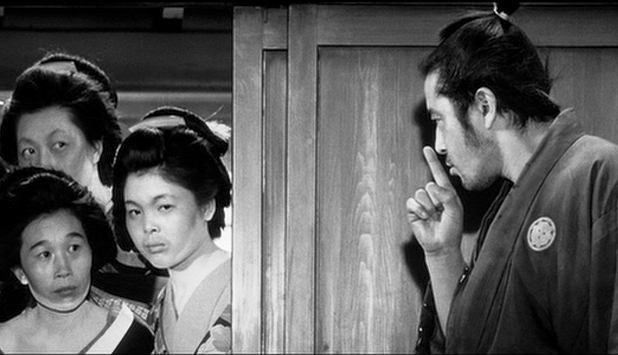 complement the action without overwhelming or undercutting them. From comical or suspenseful, to lush and portentous, it's as if Satô wrote scores for a dozen films yet they all fit. As I mentioned in the beginning, there's also the vivid black-and-white cinematography of Kazuo Miyagawa who, in a 1993 conversation also in the Criterion booklet, spoke of the difficulties he had with the pan focus that Kurosawa insisted upon for Yojimbo. "Everything had to be in perfect focus, whether it was right in front of you or at the very rear of the shot," the d.p. said. "So we decided to work in a spectrum of tones that would accentuate that would accentuate the contrast as much as possible and give objects a hard, metallic edge. We aimed at the kind of atmosphere you get at high noon, when shadows are at their most intense.…it was what we needed to match Yojimbo's hard-boiled subject matter."
In the end, Yojimbo offers as its greatest strength Mifune and Kurosawa, arguably the greatest actor-director team in film history with Mifune clearly relishing his role as the cleverest and bravest character in the film, and Kurosawa delivering many astounding shots and unique framing of scenes. Together, the vitality this duo brings to Yojimbo makes it play as fresh today as it must have 50 years ago.
Tweet
Labels: 60s, Bette, Cagney, Eastwood, Fiction, Foreign, Kurosawa, Leone, Lynch, Mifune, Movie Tributes, Ray Top 100, Remakes, Rickman, Sequels, The Sopranos, Willis, Wyler
TO READ ON, CLICK HERE
Monday, August 08, 2011
Nursing has always seemed like a second nature to me

By Edward Copeland
Sometimes you have to wonder what made some of the pre-Code Hollywood classics such as Night Nurse, which turns 80 years old today, so shocking. Sure, Barbara Stanwyck and Joan Blondell spend an inordinate amount of time in various states of undress, but the subject matter doesn't approach the lurid level of a Baby Face (also with Stanwyck) or Red-Headed Woman with Jean Harlow. Maybe it's because even then it raised questions about the motives of some involved in the health care system or the practice of medicine. Whatever the reason, what's most important about Night Nurse is that just 20 years shy of being a century old, it remains a damn good movie.
Directed by William "Wild Bill" Wellman, Night Nurse begins in an almost comic tone before it takes a suspenseful turn in its second half. Wellman brings a lot of nice touches to the film visually. It opens from the point-of-view of an ambulance speeding through city streets on its way to a hospital's emergency's room.
Ambulance is spelled in reverse inside the driver's window. They were aiming to be reversed as many used to be so they would read correctly in other vehicles' rear-view mirrors, only they have it backward and it's written forward on the front of the ambulance. As the injured man is unloaded, the orderly guesses correctly that he's been in a car wreck. "Cement truck hit one of those Baby Austins," the ambulance driver tells him as they wheel him into the hospital. The orderly comments that you'd never catch him in one of those little cars, but the ambulance driver corrects him that the injured man was driving the cement truck. As they move through the hall, the pass a nervous father-to-be letting go of his wife's hand as she heads to the delivery room. A nurse places a screen around another man in the crowded ward and a woman asks her, "Why can't my son have a screen?" The nurse explains that it's against the rules. The woman points out that she just placed one around the other man and the nurse explains that's because that man is dying.

The camera finally moves past all the chaos as we see sharp dark shoes entering the office of Miss Dillon (Vera Lewis), the superintendent of nurses to apply for a nursing job. Her name is Lora Hart and she's played by the great Barbara Stanwyck. Miss Dillon is a bit of a harridan, barely taking her eyes off what she's doing to give Lora much attention. Her education doesn't impress her and she asks her why in the world she would want to be a nurse. Lora tries not to laugh as she notices that the woman has a habit of making a grotesque throat-clearing sound ever few seconds. "Nursing people has always seemed liked a second nature to me," Lora tells the superintendent of nurses, but she seems less than impressed and dismisses her out of hand. As Lora marches out of the woman's office, she makes certain to stop at the door and clear her throat with a smile before she leaves.
When she's exiting the hospital, a preoccupied man bumps into her, spilling the contents of Lora's purse and falling on his ass. Lora takes the stance that he was trying to be fresh with her, but he gets up and reassures her that isn't the case. He introduces himself as Dr. Arthur Bell (Charles Winninger) and asks why she was
 there. She tells him she had hoped to get a job as a nurse, but that Miss Dillon didn't seem interested. Bell offers to take her back and asks her name. When she shares that her name is Lora Hart, Bell replies, "Hart — that's a good name for a nurse." Lora, escorted by Dr. Bell, returns to Miss Dillon's office. When she sees Lora with the doctor, the superintendent gets tongue-tied, but Bell doesn't give Dillon much of a chance to say anything anyway, just tells her to treat Miss Hart well and find a place for her and perhaps she can help improve things around then. He wishes Lora good luck and departs, leaving her to have a real interview with Miss Dillon. While Miss Dillon's attitude toward Lora improves slightly, mainly she wants to know why she didn't tell her before that she was acquainted with Dr. Bell. She explains that she will begin work as a probationary nurse, which means she will live in a dorm and have a curfew (in bed with lights out by 10). Because she'll just be on probation on first, she must pay strict attention to the rules or she could be let go. "Rules mean something — you'll be told about them later," Miss Dillon tells her.
The superintendent sees another probationary nurse passing and calls out, "Maloney." Maloney (Joan Blondell) enters and Miss Wilson introduces her to Lora and says since Maloney (the film never gives her a first name,
 just the initial B.) doesn't have a roommate, she should get Lora a uniform and show her the ropes. At first, Maloney isn't very friendly, seeing any new probationary nurse as competition, even handing her a uniform several sizes too large at first, but soon the girls hit it off and Maloney warns her about the different types of men to watch out for, such as interns. Just as she says that, an intern named Eagan (Edward Nugent) sticks his head in the dressing room and acts generally obnoxious. Maloney makes no attempt to hide her disdain. "Sometimes I don't like you, Maloney," Eagan tells her. "I wish I could find a way to make that permanent," she replies. What do you say newcomer?" he asks Lora. "Two-nothin' in favor of the lady," Lora concludes. Eagan knows when he's licked and leaves. "Take my advice and stay away from interns," Maloney reiterates. "They're like cancer. The disease you know, but there ain't no cure."
It must be said that while Night Nurse would barely be classified as a B picture by most at the time it was made, the movie not only surpasses that level in terms of quality, but in Wellman's distinctive touches and Barney McGill's cinematography. For instance, in one particularly effective sequence, Maloney and Lora must assist a surgery as one of their final tasks before they can take the oath and be full-fledged nurses. Lora, as we will learn, can be a bit skittish (though the growth of her strength marks the journey of both her character and the film). Maloney warns her that if she faints or messes up, she's done so hang on. They stage the scene in a large operating theater and Wellman films most of the sequence in overhead shots. The surgery doesn't go well and there's blood as the surgeon's try to save the man. Lora almost buckles, but Maloney gives her her hand. As the man dies, they show a series of almost ritualistic shots as the body gets slowly covered. The OR clears out but Lora lingers behind, waiting until the room has emptied to collapse to the floor which Wellman again captures in an overhead shot.


What's interesting is that while William A. Wellman had a reputation prior to Night Nurse (he did direct Oscar's first best picture (Wings) after all and would go on to make many more notable films), the other members of the creative team really didn't have that much else of note on their filmographies. McGill's only other significant films as a d.p. were Svengali starring John Barrymore and Michael Curtiz's The Cabin in the Cotton that kick-started Bette Davis' career. The movie was based on a novel of the same name by Dora Macy (a pen name used by writer Grace Perkins) and written by Oliver H.P. Garrett who was prolific but only made noise as a co-writer on Manhattan Melodrama (with Joseph L. Mankiewicz), Duel in the Sun (with David O. Selznick and uncredited work by Ben Hecht) and Dead Reckoning (with four other men). On Night Nurse, additional dialogue was credited to Charles Kenyon, who was just as prolific as Garrett. His most recognizable credits were helping to adapt Shakespeare's A Midsummer Night's Dream in 1935 and Robert Sherwood's play The Petrified Forest in 1936. Somehow though these people pooled together to produce crackling dialogue, memorable images and efficient storytelling out of a movie that most viewed as filler. It's a minor miracle.


Perhaps what makes Night Nurse one of those daring pre-Code pictures is that, while it never shows Lora or Maloney leading a loose lifestyle, the young single gals do sneak out of the dorm and come back in after curfew drunk. Presumably Maloney has dragged Lora out on a manhunting expedition since what type of mate
 to pursue tends to be all Maloney talks about. In addition to interns being a no-no, she warns against doctors as well, saying that you'd just end up running their office while they chase other women. As for patients, for some reason Maloney thinks that "appendicitis cases are best." However, for Maloney, only one male is ideal. "There's only one guy in the world that can do a nurse any good and that's a patient with dough!" she says. "Just catch one of them with a high fever and a low pulse and make him think you saved his life and you'll be getting somewhere." Those conversations are for another time. Right now, the pie-eyed pals are more concerned with getting undressed
 in the dark and climbing into bed without tipping off Miss Dillon that they'd broken curfew. That plan goes bust thanks to Eagan, who left a surprise under Lora's blanket — a skeleton from the anatomy class that causes Lora to let out a shriek. Maloney tells her to hurry and get under the covers and act asleep, in case Dillon comes in. Lora doesn't want to be that close to the bones, but she does it. Sure enough, Miss Dillon comes in and flips the lights on. Maloney tries to fake that she just woke them up but the superintendent throws back the blanket and exclaims, "I thought so" as she sees that Maloney still has part of her clothing on. The girls fear that a firing is coming, but instead as punishment Dillon assigns them to the night shift working with the worst cases that come in off the streets: drunks, beatings, etc. As she leaves them to get some sleep, Eagan drops by to taunt them and they yell at him. Lora continues to lack the nerve to sleep where the skeleton was, so Maloney lets her crawl into bed with her for the night.
The "punishment" that Miss Dillon gives Lara and Maloney actually only serves to forward the plot. They only work there long enough to meet a new character who will play an important role going forward (and it's neither the drunk nor the intern helping to treat those coming in for help). A sharp-dressed man comes
 staggering in, having lost some blood. Lora gets to work patching him up which necessitates cutting his shirt. "Hey! That's silk!" the man (Ben Lyon) objects. "That's how I knew you were a bootlegger," Lora tells him, but then she realizes his injury is a bullet wound. "That looks like it's a bullet wound!" Lora says. "Well, it's a cinch it's not a vaccination mark," he replies. By law, nurses are required to report all bullet wounds to the police, but the man begs her not to do it. Lora finds herself torn because she likes this nameless bootlegger. Maloney comes up and spots the bullet wound and tells them they have to report it — they can't risk their jobs before they even officially start them. "Maybe 56 bucks a week isn't much but it's 56 bucks," Maloney says. Eventually, Maloney gives in and she and Lora fix the bootlegger up and keep his secret. After that is when the operating room test comes and Lora and Maloney pass. The pals join the other probies and take the Florence Nightingale Pledge and become full-fledged nurses.
"I solemnly pledge myself before God and in the presence of this assembly, to pass my life in purity and to practice my profession faithfully. I will abstain from whatever is deleterious and mischievous, and will not take or knowingly administer any harmful drug. I will do all in my power to maintain and elevate the standard of my profession, and will hold in confidence all personal matters committed to my keeping and all family affairs coming to my knowledge in the practice of my calling. With loyalty will I endeavor to aid the physician in his work, and devote myself to the welfare of those committed to my care."

It's at this point that Night Nurse makes its pivot. Aside from the great opening, when we saw anonymous characters doing their work, Lora and Maloney patching up the bootlegger and the OR scene, we've really witnessed little in the way of the practice of medicine. That pledge the newly minted nurses took (at least as far as Lora is concerned — aside from a couple of brief appearances by Maloney, Joan Blondell mostly vanishes from the film, unfortunately) means something to them, It wasn't just a line that Lora was trying to pull on Miss Dillon when she told her that "nursing has always seemed like a second nature to me." Skittishness over
 skeletons and blood aside, Lora has only grown stronger and she will need that strength for what she confronts next. At the hospital, she had assisted Dr. Bell in the treatment of two sick little girls, Desney and Nanny Richey (Betty Jane Graham, Marcia Mae Jones). For some reason though, their widowed mother (Charlotte Merriam) removed Bell from the case and took them home for
 treatment there under a Dr. Milton Ranger (Ralf Harolde) and an ever-rotating staff of nurses who keep quitting or getting fired. Maloney currently holds the daytime shift and when the latest night nurse exits, Lora gets the job and hits it off with the children who are ecstatic, to their detriment, one falling to the floor in weakness over the excitement. The housekeeper Mrs. Maxwell (Blanche Frederici) enters to put a stop to it. Lora had been warned to be wary of the household staff, particularly Nick the chauffeur (Clark Gable, who got the role which originally was intended for James Cagney. However, when The Public Enemy hit so big earlier in 1931, the studio and Cagney agreed he shouldn't play such a small role as a hood now). Gable gets the most unintentionally funny introductions in the movie (or just about any movie). After Lora had been specifically warned about "Nick the chauffeur," when she encounters him and asks who he is he actually says in complete monotone, "I'm Nick — the chauffeur." The way that moment plays could only have been sillier if it had been followed by ominous organ music.

Lora attempts to find Mrs. Richey somewhere within the mansion to tell her what dire straits her children are in and finds that she appears to be either drunk or passed out 24 hours a day, usually on the arm of her equally inebriated boyfriend Mack (Walter McGrail). Often, the place overflows with many partying friends in a scene of bacchanalia. When Mrs. Richey nods off one time, Mack makes moves on Lora should Lora parries his pawing fairly well, but the first time she meets Nick is when he shows up and lays Mack out with a punch. Lora and Nick don't maintain a friendly relationship for long as she tells him she's calling a doctor. He warns her not to unless Dr. Ranger has given her orders to that effect. She ignores him and proceeds to the phone. Nick shouts that he runs this place, but Lora gets someone on the line so Nick knocks her out and carries her unconscious into another room.
The next day, Lora goes to see this Dr. Ranger to report what's going on, but it soon becomes clear to her that he's not particularly interested in the welfare of the children and she puts together what must be going on: The children must have a trust fund that will pass on to their tipsy mother if they die and they'll have Nick marry her and he and the doctor will steal the fortune. She threatens to report Ranger to the authorities. He
 seems unconcerned, telling her she has no proof and to make such allegations will just end her career. Lora storms out and goes to see Dr. Bell who, to her surprise, agrees with everything she says but doesn't want to lift a finger to help her either since, even though he's long had suspicions about Ranger, "he is a colleague." Not much has changed in 80 years: Doctors always protect one another no matter how bad they know the other doctor is. Bell tries to put his inability to report Ranger off on "ethics." This really sets Lora off. "Oh, ethic, ethics. That's all I've heard in this business. Isn't there any humanity left? Aren't there any ethics about letting little babies be murdered?" she yells at him. Bell advises that if she really wants to help the children, she should go back and apologize to Ranger so she can keep working. Lora agrees, but first she stops for a soda and happens to run into the bootlegger and tells him her story. When he hears what Nick did, he offers to talk to a couple of guys to take care of him. Lora learns his name is Mortie and he promises that he's out of the bootlegging business now, but he agrees to help her anyway he can. The bootlegger would be more ethical than the doctors.
Now, I won't tell you how Night Nurse resolves itself, but it packs so much into its running time that it's damn remarkable it all got squeezed in. Logically, Night Nurse shouldn't be the gem that it is, but lightning struck. Not the type that wins awards but the more important type of electricity — bolts that go off in one time period and continue to reverberate decades later. I do have to share a couple of other favorite moments before I wrap it up though. Wellman put so much effort into this programmer with the different way he set up shots and another of my favorites is the perspective he uses when Mack comes on to Lora again and she lays him out with a punch of her own. It almost looks like 3-D. Then, for comedy, we get to see Mack crawl on the floor to take refuge behind the bar.

Soon after that, Lora tries to physically drag Mrs. Richey so she can see how her daughter is but the drunken women isn't cooperating. Lora even drags her by the throat at one point until Mrs. Richey finally collapses on the floor, passed out. Lora tosses a bucket of ice water on her trying to wake her up to no avail. As she walks away, Lora almost give us some pre-Code profanity as she mutters, "You mothers." The young Stanwyck amazes and this was only her third year making movies and she also scored with another brilliant turn in 1931 in Frank Capra's The Miracle Woman — and so many more and greater performances were still on the way.
Tweet
Labels: 30s, Bette, Blondell, Cagney, Capra, Curtiz, Gable, Harlow, Hecht, Movie Tributes, Oscars, Selznick, Shakespeare, Stanwyck, Wellman
TO READ ON, CLICK HERE


