Wednesday, May 09, 2012
Such a little word, but oh, the difference it makes!

As people who pay attention to these sorts of things know, for quite some time the Broadway season, and by that I mean in terms of Tony Award eligibility, usually ends toward the end of April with the awards given in June. However, that hasn't always been the case. For example, though A Funny Thing Happened on the Way to the Forum opened May 8, 1962, when it received its Tony nominations they belonged to the crop of 1963 Tony nominations with winners handed out nearly a year later on April 28, 1963. Furthermore, Forum's May 8 opening came a mere nine days after the previous Tony Awards held April 29, 1962 for 1961's Broadway season. On the musical side,
 Frank Loesser's How to Succeed in Business Without Really Trying, which had just opened Oct. 14, 1961, hauled away the most awards. It won best musical, best actor (Robert Morse), best featured actor (Charles Nelson Reilly), best director of a musical (Abe Burrows), best authors of a musical (Burrows, Jack Weinstock and Willie Gilbert), best producers of a musical (Cy Feuer and Ernest Martin) and best conductor and musical director (Elliot Lawrence). In fact, the only nomination that How to Succeed lost was Loesser's as best composer. Richard Rodgers won for No Strings, his first solo effort since Oscar Hammerstein's death. Loesser did receive the consolation of a Pulitzer Prize for his work — one of several parallels between his career and Stephen Sondheim's, one of which we'll be coming upon shortly. As far as when the Tonys switched their eligibility dates and started holding the awards in June, as near as I can determine (cross your fingers, I'm forced to use Wikipedia as a source), the first time that happened was 1977, the year before CBS began carrying the broadcast which it has ever since, heaven help theater fans (at least as far as the past decade or so has gone). I must note, as I return to the subject at hand, that the photo at the top as well as the one inset in this lead both came from the camera of Tony Walton, the scenic and costume designer of the 1962 production. The inset photo shows his model of what the set should look like when complete. Both come courtesy of Walton via an interview he did with examiner.com.
 When those 1963 Tony nominations did come out, A Funny Thing Happened on the Way to the Forum, despite having opened so long ago, did very well. It received a nomination for best musical, competing against Little Me, Oliver!, and Stop the World — I Want to Get Off. Sondheim might have felt guilty about lying to David Merrick but he produced the latter two musicals that would be competing against Forum. Merrick also garnered a nomination as best producer of a musical with Donald Albery for their work on Oliver! where the duo faced off against Hal Prince for Forum as well as last year's winners, Cy Feuer and Ernest Martin, for Little Me. Larry Gelbart and Burt Shevelove picked up a nomination as best authors of a musical for Forum and one of the competition happened to be another veteran from the days of writing for Sid Caesar on television like Gelbart once did — Neil Simon for Little Me. which Simon happened to
 write specifically for Caesar, who would face off against Zero Mostel's Pseudolus in Forum, Anthony Newley in Stop the World — I Want to Get Off and Clive Revill in Oliver! for lead actor in a musical. Lionel Bart (Oliver!) and Leslie Bricusse and Newley (Stop the World — I Want to Get Off) rounded out the author of a musical category. The venerable George Abbott's work on Forum earned him a best director of a musical nomination and he also landed a nomination as best director of a play for Never Too Late, a comedy that actually ran longer than Forum. In the musical direction category, others receiving recognition were Peter Coe (Oliver!), John Fearnley (Brigadoon) and Feuer and Bob Fosse (Little Me). (At right, we see Abbott at the 1994 Tony Awards at the age of 106 braced by Gwen Verdon and Jean Stapleton. He died in January 1995 at 107.) David Burns as the leering, patrician Senex and Jack Gilford as the nervous slave Hysterium took half the nominations in featured actor in a musical for Forum. Filling out the category were a young David Jones as the Artful Dodger in Oliver! The recently passed Jones became better known when he changed his first name to Davy and became part of The Monkees. Sven Svenson in Little Me took the fourth slot. The final nomination that A Funny Thing Happened on the Way to the Forum garnered was for Ruth Kobart, who played Senex's suspicious wife Domina, as featured actress in a musical alongside Virginia Martin (Little Me), Anna Quayle (Stop the World — I Want to Get Off) and Louise Troy (Tovarich). Sondheim's score got snubbed and wasn't nominated in the category for best composer and lyricist. The composers of the other three nominated best musicals made the cut but the fourth slot went to Milton Schafer and Ronny Graham for Bravo Giovanni, a musical that ran only 76 performances and received only two other nominations for choreography and conductor and musical director. Sondheim, who didn't get nominations for his lyrics for West Side Story or Gypsy either, remained in the ranks of those never nominated for Broadway's top honor. Boy, would he make up for that later.
When Tony night 1963 arrived, A Funny Thing Happened on the Way to the Forum won almost every award for which it was nominated. Mostel defeated Gelbart's former boss. Gilford lost — but he lost to co-star Burns. Abbott won for director of a musical, though he didn't take the prize in the play category. Gelbart and Shevelove took the prize for their book, so Gelbart beat his former co-worker as well. Prince won as producer. The American Theatre Wing crowned the show best musical meaning David Merrick went 0 for 2 in that category. Other than Gilford, the only Forum nominee that didn't score was Ruth Kobart, who lost to Anna Quayle for Stop the World — I Want to Get Off. (Shown in the photo at left are the 1963 winners in the lead acting categories. From left, Mostel, Vivien Leigh, lead actress in a musical for Tovarich; Uta Hagen, lead actress in a play and Arthur Hill, lead actor in a play, both for Who's Afraid of Virginia Woolf?) In Meryle Secrest's biography, Stephen Sondheim: A Life, the composer described watching the ceremony from home. Secrest writes, "Prince…thanked Abbott, Gelbart and Shevelove. Gelbart and Shevelove, who won book, thanked each other, Abbott and Prince. 'Nobody mentioned me on the program at all. As far as they were all concerned, my friends, my colleagues, I did not exist. That's what really hurt,' Sondheim said. 'Hal was the only one — Hal called me the next day and apologized. He said, 'I'm sorry, kid. I should have mentioned you and I didn't.'" The lack of acknowledgment did lead to some rifts such as when the hurt Sondheim confronted Shevelove and Shevelove lashed out at him, saying his songs almost killed the show before it ever got to New York. In an anecdote that appears in Secrest's book and Sondheim's Finishing the Hat, Sondheim shares the tale of a special letter he received that lifted his spirits, though it's unclear when Sondheim got the correspondence. Secrest's book says he received the letter shortly after Forum opened, but places the story right after the Tony story. Sondheim doesn't date it at all, though he adds the detail that Frank Loesser told him in the letter that he commiserated with him because he remembered the reception for his first Broadway musical, Where's Charley?, and wanted to let Sondheim know how good he thought the score of Forum was. Specifically quoted in both books, Loesser wrote, "Sometimes even a composer's working partners, to say nothing of the critics, fail to dig every level and facet of what he is doing. But I know, and I wanted you to know that I know."
Before I discuss the revivals, I've been looking for a place to work in talk of the song "Love, I Hear" somewhere and failed to accomplish my mission. Now, I adore "Comedy Tonight" and "Everybody Ought to Have a Maid" but I can't believe that no one mentions "Love, I Hear" anywhere. Hell, "Bring Me My Bride" found its way into a review. While Sondheim criticizes himself for being clever instead of funny, I love his wordplay (and he can't hide his pride in Finishing the Hat about the alliterative string of double consonants that he pulled off in one line of the song, "Today I woke too weak to walk." Links: First "Love, I Hear" from 1962 original cast recording; Second "Love, I Hear" and "Bring Me My Bride" both from 1996 revival original cast recording.

Like most Sondheim shows, Forum tends to add and subtract songs in later versions. After missing out on the original production because they wouldn't let him wear his glasses, that didn't seem to be a problem anymore and Phil Silvers took the role of Pseudolus in the show's first major revival, directed by Burt Shevelove himself. It actually started in October 1971 for a 47 performance run at the Ahmanson Theater in Los Angeles. I mentioned in the last part that Reginald Owen played Erronius. The cast also included Larry Blyden as Hysterium, veteran comic actor Carl Ballantine as Marcus Lycus and, the second biggest name in the show after Silvers, Nancy Walker in the role of Domina. In fact, she felt she needed another solo so Sondheim wrote "Farewell" for her. One of the courtesans happened to be Ann Jillian. The only song dropped was Philia's "That'll Show Him" and "Echo Song" put in its place. When they made the move to Broadway and opened March 30, 1972, Walker and Jillian didn't travel with them and another song got the axe. This time, they excised "Pretty Little Picture." Whatever the Tony eligibility dates were for the 1972 awards were, Forum must have cut it close since the awards were given April 23. Shevelove received a nomination for directing but, ironically, lost to Prince and Michael Bennett for their work on Follies. Silvers won lead actor in a musical and Blyden won featured actor as Hysterium. The revival won two of its three nominations. (They hadn't added a revival category yet.) The show seemed to be doing well until Silvers got sick, reportedly because of "food poisoning." An understudy filled in as they hurried to rehearse Tom Poston as a replacement, but ticket sales fell fast. The show only ran 156 performances and it turned out that Silvers had suffered a stroke. Links: "Farewell" info beneath video; "That'll Show Him" and "Pretty Little Picture" from 1962 cast recording.

When the next Broadway revival arrived in 1996, it did so during the era when the Broadway bug had bitten me badly so I actually got to see it soon after its April 18 opening. I had pretty good orchestra seats — I swear at one point it appeared as if Nathan Lane addressed me personally and we locked eyes at one point. Quite different from the couple of times I bumped into Lane accidentally in Manhattan when he always seemed to be the most annoyed, pissed-off man in the universe. Sure, he hammed it up like crazy as Pseudolus but that's a role that doesn't require nuance and it still won him his first Tony Award. Mark Linn-Baker did fine as Hysterium and, as I mentioned earlier, I got to see the late William Duell as Erronius. Ernie Sabella took on the role of Marcus Lycus and the long-cut song of "The House of Marcus Lycus" finally made the show. Lewis J. Stadlen received a Tony nomination for his portrayal of Senex, but he was out the night I was there so I saw Macintyre Dixon in the role. Mary Testa played Domina. The songs followed the 1962 set with the exception of the addition I mention and continuing to keep "Pretty Little Picture" out of the show, though Lane recorded it for the cast album. Jerry Zaks received a nomination for directing the musical, but lost to George C. Wolfe for Bring in 'da Noise, Bring in 'da Funk. By now, the Tonys did have revival categories but Forum lost to The King & I. The revival made a bit of history when it recast Pseudolus
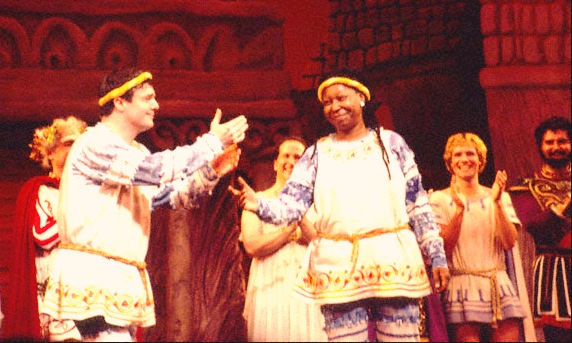 as Lane exited the show by installing Whoopi Goldberg in his place. Casting a woman, let alone an African-American one with Goldberg's reputation, made people wonder what she'd do. Ben Brantley wrote in The New York Times, "The work's authors, Burt Shevelove and Larry Gelbart, and its composer and lyricist, Stephen Sondheim, have always said they made a point of constructing a show true to its ancient sources and free of distracting anachronisms. But the leading role of Pseudolus, the wily slave in pursuit of freedom and a part that demands a manic comic spirit, has inevitably gone to wild-card performers unlikely to resist opportunities for their own shtick. As Mr. Gelbart said, in a recent interview with The Sondheim Review, 'after seeing Zero Mostel recite baseball scores in front of the House of Senex, there's not too much that would surprise me.' So there is Ms. Goldberg, queen of the devilish aside, firmly reminding you of just who she is in the production's opening moments. She finds comic fodder not only in her present personal life, but in her professional life in Hollywood as well.…That this occurs early raises delighted expectations that many audience members have brought with them: Just how bad, as in naughty, is their Whoopi going to be? Of course, others — that nasty breed of theatergoers who find Schadenfreude in seeing big stars blow it — are asking the same question with a different emphasis: Can this movie star-comedian possibly carry a musical? Sorry, guys, she can." Following Goldberg, David Alan Grier took on the role. The second revival ran for 715 performances.
The wreckage in that photo in 1993 represents the remains at the time of the outdoor amphitheater of Butler University in Indianapolis
 that for decades hosted Starlight Musicals every summer. Other cities around the Midwest also received visits from the touring program that would bring concerts, plays and musicals featuring celebrities. From
 the time I was a young child, each summer when we visited my grandma we would take in some shows. Many of the early things we saw tended to be concerts by people such as Mitzi Gaynor, Liberace and the tag team of Jim Nabors and Florence Henderson. In 1979 when I was 10, I got to see my first actual musical. I wish I could locate the program so I'd remember what songs were in that production of A Funny Thing Happened on the Way to the Forum. As a youngster, I tended to be an autograph hound so if we got there early, I'd either stake out the entrance to the backstage or I'd assault the performers after the show. For me, Forum boasted an all-star cast. Playing Pseudolus was none other than Arte Johnson from Rowan and Martin's
 Laugh-In. I'd see him again when I grew up and he appeared in the Broadway revival of Candide. Avery Schreiber portrayed Hysterium, but to me — unfamiliar with his comedy work with Jack Burns — he was the Doritos guy. When I got his autograph after the show, I even brought Doritos with me so when he
 stepped out I had one ready to take a big crunchy bite out of for him. Schreiber raised his hands and said to me, "You got me" then signed my autograph. John Carradine played the role he originated on Broadway, Marcus Lycus. I didn't know that at the time nor did I realize the breadth of his career, but at 73, he looked frail to me, though he'd live another eight years. The final big name belonged to Hans Conried who was cast as Senex. I didn't know at the time that he supplied the voice of Captain Hook in Disney's Peter Pan and I hadn't heard of The 5,000 Fingers of Dr. T. I knew Conried as Wrongway Feldman from an episode of Gilligan's Island. He died less than three years later. Johnson alone remains alive. Schreiber passed away in 2002. That same summer, I saw Rodgers and Hammerstein's Carousel starring a drunk-as-a-skunk Robert Goulet, who exited his limi when he arrived bellowing, "Nobody owns me!" However, that's another story. Tragedy tomorrow, comedy tonight.
Tweet
Labels: Awards, Books, Disney, Fosse, Frank Loesser, Gelbart, Hammerstein, J. Carradine, Music, Musicals, Neil Simon, Phil Silvers, Rodgers, Sid Caesar, Sondheim, Television, Theater Tribute, V. Leigh
TO READ ON, CLICK HERE


Wednesday, December 14, 2011
My Week with Halle

By Eddie Selover
Nobody knows about this but me and her. The tabloids never suspected. It was private, just between us. I want to protect that. But on the other hand, several days have passed since it ended, so I guess it’s OK to finally talk about it.
I spent a week with Halle Berry. Yes, me, Eddie Selover! Just a nobody. Until now.
It happened in Spain. Halle’s over there making a movie with Tom Hanks. She’ll be there for a while longer, because she broke her leg chasing a goat. Spain, ay caramba…there are goats everywhere. And the ground is so rocky! You really have to be careful. Anyway, she’s on the mend now, that’s the important thing. Heal fast, Baby.
On the set of this picture, I was at the bottom of the food chain. The lowest of the low. I mean even lower than the screenwriter. But there must have been something about me. Maybe because we’re the same age. Well, I’m ten years older, but you know. It was a chemistry we had, and I’m not just talking about the physical, though that was certainly there on my part. We had an understanding; we knew it the minute we looked in each other’s eyes. I’ll always remember how hers narrowed when she first looked at me. And her first words.
“Could you get me a cup of tea? Right away…?”
Soon we were inseparable. A gentleman doesn’t reveal the details, but there is one thing I want to talk about, and that was the night we watched a movie together. It was that new one about how Marilyn Monroe went to England back in the 1950s to make a film with Laurence Olivier. As an Academy member, Halle had a screener from Harvey Weinstein, and she insisted on watching it in bed. With me!
Who was I to refuse? So I climbed in with her.
“Watch my leg.”
“I can’t take my eyes off it.”
“And stop with the James Bond impression. It’s getting old.”
“Someone’s in a bad mood.”
She gave me that look I’d come to know so well. And then the movie began.

So turns out it’s about this guy, Colin Clark, who wangled a job as an assistant to Olivier and then worked on The Prince and the Showgirl, a film version of a play Sir Laurence had done on stage. In it, the Showgirl was played by Marilyn Monroe, who had bought the property, and hired Olivier to co-star and direct. Here, Olivier is played by Kenneth Branagh and Monroe by Michelle Williams.
I’ve seen The Prince and the Showgirl, actually. The plot is very thin: it’s a little one-situation comedy about a middle-European prince who invites a showgirl up to his chambers with the intention of seducing her, and how she evades him through a combination of innocence and guile. Olivier plays it with a monocle and a Dracula accent, very stiff and formal, and no humor whatsoever. Monroe looks fantastic, maybe the best she ever looked, and she’s very charming. But they don’t get any chemistry going. Partly because the film is nothing more than a very long tease (the best thing about it is the original poster, which shows Olivier pinning a ribbon on Monroe’s barely-there dress, and the words “Some countries have a medal for everything!”). Partly too it’s the difference in their acting styles: his all cold surface detail and polish; hers warm, spontaneous and messy.
The new movie gets a lot of comedy, in fact most of its comedy, out of this clash. The movie’s Olivier is arrogant, egomaniacal and rude — Monroe thwarts and frustrates him at every turn, and he’s driven half mad by her lateness, her poor memory, her retinue of coaches and enablers. What finally drives him over the brink is his realization that despite her lack of formal acting training, she wipes him off the screen when they’re on it together. (This isn’t really accurate; they both come across vividly in The Prince and the Showgirl, but the film is like a gleaming gold-plated serving dish with a mackerel and a marshmallow sitting on it.) Branagh makes a very funny Olivier, biting down on every last syllable and modulating his voice from a whisper to a roar. He takes many of the Great Man’s mannerisms and gives them a campy spin, for example rolling his eyes toward heaven in supplication, then lowering them suddenly and pursing his lips. He portrays Olivier and sends him up at the same time, and he’s the best thing in the movie.
Michelle Williams is not so juicy. She does an effective, almost eerie job of evoking Monroe, both the wide-eyed mock-innocent dumbbell and the pouting, soulful little-girl-lost. But it’s all evocation. Marilyn Monroe was ferociously, incandescently alive on the screen. It’s not just that Williams doesn’t have Monroe's looks or her amazing body. She doesn’t have her feral quality, the intense aggressive sexuality that flashes out in moments that are still startling to watch. Like Elvis Presley, Monroe was an extraordinary personality who bypassed traditional notions of “acting.” At her best, as with Olivier, she made conventional acting look stilted and contrived, but at her worst (usually in drama), with no real technique or training to draw on, she could be repetitive, self-involved, and amateurish. Williams is just the opposite — she’s all brains and technique, but no fire. It’s an Indie performance, small and readable and finely wrought. But this is a movie about giants (it also includes portraits of Vivien Leigh, Arthur Miller, Sybil Thorndike) and you can’t help noticing there are no giants around to play them.
In any case, the main character isn’t really Monroe, or Olivier. Like I said, it’s about this guy Colin Clark. The movie is supposedly based on his true story, as recounted in his published diary and in his book The Prince, the Showgirl, and Me. In Clark’s account, as a fresh-faced 24 year old, he was the only one on the set Monroe could relate to, and after her new husband Miller deserted her to return to America, she turned to Clark for comfort. The only person with no agenda, it seems (though he later went on to write two books and sell them to the movies). The central part of the movie is about Colin and Marilyn’s very special week, after they sneak away from the set to go frolicking around the English countryside. They walk aimlessly through a park, they go skinny dipping, she’s turned on by his innocence, and they share a kiss. If this seems like a particularly puerile fantasy involving borrowed bits of The Misfits, Something’s Got to Give, and Bus Stop, that’s because it is. You get tired of watching Eddie Redmayne's Colin stare wonderingly at Monroe, wet eyed and open mouthed, or for variety, the other way around. She opens herself up to him and reveals her hurts, her fears and insecurities, and they fall for each other, sort of. Alas, she has to go back to being Marilyn Monroe and he has to go back to being…well, who cares, really? All they had was their one magical time together, but it’s a time that changed them both. In fact, the movie is named for it: My Week with Marilyn.
What a coincidence, right? Especially considering who I watched it with! When it was over, Halle shifted discontentedly under the covers.
“This thing is unbelievable.”
“Why thank you.”
“Cut it out, Mr. Bond. I was talking about the movie. Harvey may manage to snag Michelle an Oscar, but I don’t buy a word of it.”
She saw my expression, and gave me one of her enigmatic smiles. Then she put her face close. The eternal temptress.
“Could you go for some popcorn?”
“Great idea, I’m starving!”
“No, seriously, I can’t get out of bed. Go get me some popcorn. Now.”
It was a long week we had together, Halle and me. But I will never, ever forget it.
Tweet
Labels: 10s, Arthur Miller, Books, Branagh, Elvis, H. Weinstein, Marilyn, Michelle Williams, Nonfiction, Olivier, V. Leigh
TO READ ON, CLICK HERE
Sunday, September 18, 2011
Relying on the Kindness of Strangers

By Phil
The transition from stage to screen can be a bumpy one. All too often, what worked in the comparatively intimate confines of a Broadway theater feels awkward and stilted when committed to celluloid. Narratives originally devised for limited sets and locations can seem claustrophobic and weirdly constricted. Or there is the temptation of moviemakers to make the play more “cinematic” and subsequently lose what made it so compelling — and worth doing — in the first place.
A Streetcar Named Desire is that rare masterwork to soar on both stage and film. Released theatrically 60 years ago today, that 1951 motion picture preserves the poignancy and brilliance of Tennessee Williams’ acclaimed stage play while accommodating nicely the advantages of the movies. It helped, of course, to have the talents of an extraordinary director and cast.
Set in a steamy New Orleans, Streetcar stars Vivien Leigh as Blanche DuBois, an aging Southern belle who leaves her Mississippi home to visit her younger sister, Stella (Kim Hunter). Things have not been easy for Blanche, whose airs of antebellum propriety appear at odds with her jitteriness and melancholy. She is a widow, her young husband of years ago, Allan, having committed suicide. More recently, Blanche has lost the family plantation, Belle Reve, as well as her job as a high school English teacher, although she’s fuzzy about the details of why.

Stella, who evidently left Mississippi long ago, tries to accommodate Blanche as best she can, even when the older sister expresses dismay with Stella’s blue-collar lifestyle. More specifically, Blanche disapproves of Stella’s blue-collar husband, Stanley Kowalski (Marlon Brando), a brutish lout who doesn’t appreciate it that his snooty sister-in-law has disrupted his card games and drunken rampages.
Tensions simmer, particularly after Stella reveals she is pregnant and Blanche captures the romantic interest of Stanley’s co-worker and poker buddy, Mitch (Karl Malden). Stanley digs deeper into the circumstances surrounding Blanche’s departure from Mississippi. He learns that she essentially was run out of town amid allegations of promiscuity and, most damning, an affair with a 17-year-old male student.
The battle between Blanche and Stanley reaches grotesque and tragic proportions when Stella goes to the hospital to give birth. Stanley rapes his sister-in-law, a trauma that sends her into a world of fantasy. Earlier in the film, Blanche shouts to her tormentor, “I don’t want reality; I want magic!” In a memorable ending, this woman, so wounded and guilt-ridden over Allan’s suicide, is ensconced in both as she is taken to a mental asylum.

Promiscuity, domestic violence, rape, mental illness, a teacher-student affair with shades of pedophilia — this was not necessarily run-of-the-mill movie fare at the dawn of the Eisenhower era — but the Pulitzer Prize-winning play had been a huge hit, and Hollywood was determined to bring it to the big screen. In April 1950, screenwriter Oscar Saul had crafted the first draft of a script for Warner Bros. Concessions were made to satisfy the Production Code. Blanche’s promiscuity was softened. Elia Kazan, who had helmed the Broadway production and was tapped to direct the film, excised all references to Allan’s homosexuality, a key component of the play. The climactic rape scene, however, would stay put. That did little to assuage fears at Warner Bros., that the Catholic Legion of Decency would condemn the movie, in effect ordering Catholic audiences to stay away. The studio ordered about four minutes to be cut, although the footage would be restored years later.
Perhaps the most immediate reaction to A Streetcar Named Desire was the caliber of its acting. That’s not exactly an insightful observation. Vivien Leigh won the Academy Award for best actress, while Hunter and Malden snagged Oscars for supporting performances. Leigh, who had portrayed Blanche in London’s West End production of Streetcar, is particularly remarkable, a fluttery belle whose affectation is belied by her sad, wounded eyes. Malden demonstrates strong comic timing — his initial meeting with Leigh injects the proceedings with welcome humor — and Hunter is fine, if overshadowed, as a woman caught between divided loyalties. The acting is theatrical and over the top, certainly, but it is undeniably mesmerizing.

Streetcar put Marlon Brando on the proverbial map. The role of Stanley already had been turned down by John Garfield, who deemed the part too minor. Although it’s intriguing to ponder what Garfield would have done with it, it’s nearly unfathomable to imagine anyone but Brando, then 27, as Stanley Kowalski. Crude, flippant and smoldering with a sexuality that hasn’t dulled with the passage of time, Brando is a force of nature onscreen. And his embrace of the Stanislavsky method ushered in a decade of acting by the likes of Montgomery Clift, James Dean and others. Kazan, to his credit, resisted whatever temptation there might have been to cram in more locations. While he opens it up a bit, most notably a bowling alley where Blanche meets up with Stella and Stanley, the director chiefly exploits the possibilities of cinema by keeping the lens closer to his remarkable cast. He knew what they were capable of bringing, certainly; Brando, Hunter and Malden had been in the Broadway production. Kazan frames the actors tightly together, amplifying the intensity of performances and overall sense of claustrophobia. Somehow, the heightened melodrama works well. Early on, Blanche briefly recalls Allan’s suicide. We hear the faded strains of courtly music, then a gunshot, as Blanche covers her ears with the painful remembrance. An overblown and dated device? Sure, but unequivocally effective.
Sixty years later, the haunting and harrowing A Streetcar Named Desire still resonates as one of the finest instances of translating a play into a film.
Tweet
Labels: 50s, Brando, Clift, James Dean, Kazan, Malden, Movie Tributes, Oscars, Tennessee Williams, Theater, V. Leigh
TO READ ON, CLICK HERE
Saturday, August 27, 2011
"No Cuffs!"

By M.A. Peel
Fred Astaire was born in the last year of the 19th century. Today, in the second decade of the 21st century, we pause for a moment to consider Swing Time — one of his greatest achievements — on its 75th anniversary.
The big assessments all are available to read: Arlene Croce’s The Fred Astaire and Ginger Rogers Book; John Mueller’s Astaire Dancing: The Musical Films; Hannah Hyman’s Fred and Ginger. There you can read about George Stevens and Howard Lindsay and all the formal calibrations and comparisons that are the world of film studies.
For myself, one question stuck in my head: What does Swing Time offer us in the 21st century?
Well, it is stunningly fresh in so many ways. It sweeps us into lush monochrome beauty, offering a respite from the glare of the colors of real life. The absurd storyline is not alien in the age of Wedding Crashers and The Hangover, not in plot points per se but in plot probability: man’s friends waylaid him from getting married because they don’t want him to leave the act, and twice — not once but twice — important things happen because characters aren't CERTAIN that men’s morning trousers shouldn't have cuffs.
Fred’s first entrance as Lucky Garnett in full wedding suit regalia sets up the distinctive tone for our time together. His uncanny ease in formal attire never loses its power: authority of place and time, conviction of character, and an understanding of the tools of his trade of dancing wrapped in genuine nonchalance. His waistcoat, top hat and spats are his second skin, and his understanding of this gives us all permission to simply enjoy the visual beauty of the lines of his exquisite suits rather than being put off by them.
Calling Judd Apatow, Jon Lucas, et al.: No one is watching Swing Time for the story, but it has charms to offer the 2011 viewer.
Lucky Garnett (Fred Astaire) has a best friend, Pop Cardetti (Victor Moore), which makes him a rich man in the important ways. But it’s 1936 and people are still reeling from the Depression.
The boys in the act take the cash Lucky gambled from them, but that doesn’t stop him. He wants to “go to New York” to make his fortune so that he can marry his fiancee. With no money for a ticket he hops a freight train. Pop runs along the train with a suitcase of all their clothes. It bursts open and they lose everything but a toothbrush. But since this is not a drama, they keep laughing. That’s part of the fantasy. In New York, they will have to talk their way into an apartment, and then Lucky tries to gamble a tuxedo off of a mark so that he go to the dance audition with Penny Carrol (Ginger Rogers). This ease in the face of serious issues — being broke — pulls you in. Yes, I want to have that much chutzpah and courage in the face of economic strain.
La Belle, La Perfectly Swell Romance: To try to capture the songs and the dance of Swing Time in words is a little painful: It earthbounds what lives on a celestial plain of motion and soundscape. But words (and YouTube) are the best we have to share the experience of this piece of art.
Pick Yourself Up: The most exuberant of the duo’s dances, perfectly punctuated by the flare of Rogers’s biased-cut dress. Astaire’s sheer lightness of movement creates a visual definition of “joyous” that never has been topped. The advice to “dust yourself, start all over again” is welcome to all ages at any age. The dance and the songs spark with optimism and confidence.
The Way You Look Tonight: The great nondanced song from the ultimate song-and-dance man. Its opening lines are in imprinted into the psyche of several generations. I love that Penny is not waitin' on no man, she’s going on with the details of life, such as touching up the dye job on her hair. Astaire needs only to sit and sing to exude his considerable charisma.
Waltz in Swing Time: One of the great orchestral pieces with big, pendulous declarative riffs which Astaire and Rogers dance around, between, amidst.
A Fine Romance: I love the snow. I love the fur coats. I love the inside joke of a “fine romance with no kisses,” given Astaire’s dislike of onscreen kissing. He said that his lovemaking onscreen was in dance. Oh yes.
Bojangles of Harlem: Fred and his three shadows. Another song with a bracing beat and an imaginative chorus line sequence. While a tribute to Bill "Bojangles" Robinson, as many have pointed out the flashy jacket is Sportin’ Life, not Bill who dressed very plainly. The challenge for some today is the blackface.
Never Gonna Dance: Even if you’d never read that this is considered the pinnacle of the Astaire/Rogers art, you would know it after one viewing. (Click here for proof.) More accessible and less fussy than Top Hat’s "Cheek to Cheek," it actually is more sophisticated and “deeper” in how it tells the whole story of “boy meets girl/loses girl/boy is crestfallen” in six exquisite minutes with a spectrum of moods, steps, and rhythms amid twinkling Art Deco splendor. Rogers’ gown is stunning: a simple satin slip dress with rhinestones crossing under the bust and across the bare back. When Rogers starts to walk away midpoint, Astaire pulls her back, just like the audience wants him too. Then the motion up the stairs to the big finish, with an amazing series of fast pirouettes from Ginger, until with one final pirouette she pivots away.
The plot then winds its way through more absurdity until Lucky and Penny find themselves with each other free and clear, with one boffo reprise singing “A Fine Romance” against “Just the Way You Look Tonight.”
You Do, Something to Me: The Astaire/Rogers team tantalizes because of how much more is their whole than the sum of their considerable and lovely parts. It’s the alchemy that happens when certain people are together: The Beatles, Vivien Leigh & Clark Gable, Crockett and Tubbs, Brangelina. There are pairings that just make people want more, want to know more, want to BE a part of the pair somehow. That phenomenon is in full force in Swing Time. Fred and Ginger are the most equal of partners; the synchronizing of their parallel steps is magical. For me, I can’t take my eyes off of Fred. For me his unfailing virtuosity overshines Ginger’s. I’m in the camp of “Eleanor Powell is a more accomplished dancer than Ginger Rogers.” But Powell never had the rapport with Astaire that Rogers did.
And so Rogers and Astaire are in a pantheon all their own. I hope that pop culture points the younger generation toward this artistry sometime in a big way. As I said, there’s lot that will make sense to The Hangover crowd, and much that would jazz them. What they might not know is just how hard Astaire worked at his art.
"This search for what you want is like tracking something that doesn't want to be tracked. It takes time to get a dance right, to create something memorable." — Fred Astaire
Best tribute, go watch the film!
Tweet
Labels: 30s, Apatow, Astaire, Beatles, G. Stevens, Gable, Ginger Rogers, Movie Tributes, Musicals, V. Leigh
TO READ ON, CLICK HERE
Monday, August 15, 2011
An American Masterpiece

“A Place in the Sun was done right before I met George. It hadn’t come out yet, when I came to Paramount, but it had been finished. I remember seeing that film and being devastated by it. It was different in many ways than any film I had seen before coming out of Hollywood — including the style of other films by George Stevens. The use of close-ups in that film, the use of that liquid dissolve on top of dissolve in the love scenes between Montgomery Clift and Elizabeth Taylor is the quintessential height of romantic filmmaking. And the scenes with Elizabeth Taylor are done with these extraordinary close-ups. The love scenes — I don’t think there are better kiss scenes in the history of film. It’s hard to do a kissing scene. It’s hard to do a love scene. First of all, kisses — especially in those days in Hollywood — when you could show nothing else, were supposed to indicate every kind of orgasmic pleasure, every kind of romantic fulfillment — and if lovers start to kiss too intensely on the screen, it can become embarrassing for the audience. What George did was that the camera came in and did a lot of the work. The camera came so close, dealing with two of the most beautiful faces in the world. I think the camera treasured those faces, and made them almost become one.” — director Alan J. Pakula
By John Cochrane
Today marks the 60th anniversary of the release of George Stevens’ 1951 film A Place in the Sun, a tragic romance that is one of the best motion pictures ever to come out of the Hollywood studio system. An updated abridgement of Theodore Dreiser’s epic novel An American Tragedy (1925) and its stage adaptation by Patrick Kearney, A Place in the Sun stars Montgomery Clift as George Eastman — a drifting, but earnest war veteran who seeks employment at his rich uncle’s clothing factory. George dreams of leaving his poor, staunchly religious upbringing behind and escaping into the privileged world of his relatives. Instead, he is ensnared in an ill-fated love triangle, and eventually accused of drowning of Alice Tripp — a plain co-worker that he once secretly dated and impregnated — so that he can be with Angela Vickers, a young and beautiful socialite with whom he has fallen deeply in love.
Based on the real life trial and execution of Chester Gillette in 1906, An American Tragedy is considered a classic of American fiction — its plot seemingly straight out of the murder ballads of American folk music. But its sprawling story already had been filmed by Josef von Sternberg in 1931, and Paramount was not eager to make the picture again. Using his already sizable talent and industry experience, producer/director George Stevens changed the characters names, recast the story after World War II, and cut the first third of the book — which depicts more of the protagonist’s youth and family life and his involvement as a passenger in a fatal car accident. Stevens also shifted the tone away from a more sympathetic tone for Alice and toward the blossoming relationship between George and Angela — capitalizing on the good looks and strong on-screen rapport of Clift and Elizabeth Taylor, in her first adult role. This change in audience identification becomes pivotal in the scene on the lake between George and Alice, where it becomes clear that although George has lured his ex-girlfriend to her demise, he does not have the heart to follow through with it.
Working with cinematographer William C. Mellor, Stevens avoids flashy photography, instead employing understated master shots — creating the feeling of an impartial observer who is watching fate play itself out. Only when George and Angela’s love affair takes off toward the middle of the film, do we really start to see
 intimate close-ups — including tight over-the-shoulder shots, which draw the audience into their doomed courtship. Stevens and his editor William Hornbeck also are very effective in their use of montages, dissolves and wipes to condense the story’s plot to its simple essence. Throughout the movie, we see images superimposed on top of one another, indicating what or who a character is thinking about, or what is going on simultaneously in the story. This creates a number of unforgettable images — including a repeated motif showing George as a trapped outsider, and a distant shot of Angela in her room after George has been put on trial for murder — his newspaper picture burning up in a fireplace in the foreground. Believing that preparation and editing are the key ingredients in creating an effective motion picture, Stevens shot a lot of footage to cover himself in post-production. The result paid off in one of the best looking, effortlessly paced films ever made in Hollywood.
 Beyond the technical aspects, much of the success of A Place in the Sun comes from its cast. Montgomery Clift plays George Eastman with the perfect amount of dread and vulnerability — damned by forces that are beyond his control, and in some cases by his own poor decisions that have come back to haunt him. In his book Who The Hell’s In It: Conversations with Hollywood's Legendary Actors, director, film historian and critic Peter Bogdanovich calls Clift, “the purest, least mannered of the method actors; perhaps the most sensitive, certainly the most poetic.” In addition to impossibly good looks, Montgomery Clift’s eyes are among the most tragic and unforgettable in the history of cinema. George truly sees himself as a victim of circumstance, but you can’t help but identify or feel sorry for his character. During the closing scenes in court and jail, as he comes to terms with his guilty conscience and accepts his fate, it’s impossible to imagine anyone else but Montgomery Clift in the part.

As the glamorous and energetic Angela Vickers, two-time Academy Award-winner Elizabeth Taylor — already considered one of the most beautiful women in the world at 17 — moves beyond the family films of her childhood to match Clift’s intensity and intuitive acting. Together, they create heart-rending scenes of initial hope and happiness, and then despair. Lines that might sound corny or false coming from others such as “It always seems like we spend the best part of our time saying goodbye” and “Love me for as long as I live, then forget me” ring true. You can feel the passion radiating from the screen. In an industry where genuine romantic chemistry is sought often and extremely hard to come by, they had it.

The third part of the triangle, Shelley Winters began her career as a blonde bombshell. She fought to be cast in the film against type — even going as far to attend a meeting with Stevens in drab disguise in order to get a screen test. She plays Alice as clingy, insecure and increasingly desperate — but not unreasonable or unsympathetic. Winters was so believable in the part that she would go onto play more vulnerable, doomed women who are manipulated by the men they love in Charles Laughton’s The Night of the Hunter (1955) and Stanley Kubrick’s Lolita (1962), eventually winning two supporting actress Oscars — including one for George Stevens’ The Diary of Anne Frank (1959). Rounding out the cast is a pre-Perry Mason Raymond Burr as the aggressive prosecutor Mr. Marlowe — in a righteously determined supporting role that would foreshadow his future career.
Despite the 12-year-age difference, Montgomery Clift and Elizabeth Taylor would remain great friends for life until Clift’s tragically early death in 1966. They would work together in two more pictures — once again as star-crossed lovers in Raintree County (1956) — a Gone With the Wind (1939) knock-off during which Taylor helped save a badly injured Clift’s life in a real-life car accident, and as a doctor and troubled patient in Suddenly Last Summer (1959) — a psychodrama based on the Tennessee Williams play. But neither film would approach the beauty of A Place in the Sun — which won six well-deserved Oscars at the Academy Awards for 1951, for directing, black & white cinematography, film editing, music score of a dramatic or comedy picture, black & white costume design, and writing (screenplay). Its only losses were actor (Clift) to Humphrey Bogart in The African Queen, actress (Winters) to Vivien Leigh in A Streetcar Named Desire, and picture to Vincente Minnelli’s musical An American in Paris.
George Stevens (1904-1975) is a figure whose name is not mentioned in film circles nowadays as often as it should be — probably because like other great directors such as Sidney Lumet and Louis Malle, he made terrific films in a number of different styles and genres, rather than developing an immediately identifiable brand — such as a John Ford or Alfred Hitchcock. Cutting his teeth as a cinematographer and gag writer for many of the Laurel & Hardy shorts, Stevens would go on to film such enduring pictures as the adventure movie Gunga
 Din (1939), staring Cary Grant and Douglas Fairbanks Jr., the classic Western Shane (1953), and Swing Time (1936) — considered by many of be the best of the Astaire and Rogers musicals. After volunteering and serving as a major in World War II, where he filmed vital, historic footage at Normandy and Dachau, his films show an increased depth and seriousness about the human condition. Nominated five times for best director, he won a second directing Oscar for Giant (1956), an epic soap opera with buried anti-racism themes which turned out to be James Dean's third and final film. It plays in many ways like a forerunner of such television shows as Dallas and Dynasty. In 1966, Stevens sued NBC Television and Paramount Pictures in an effort to prevent showing A Place in the Sun on television with commercials inserted — a battle that he would eventually lose, but that showed his commitment to the art of cinema — a gesture that was not lost on the other Hollywood filmmakers who had held him in high regard for years. Driving his family home from the Academy Awards — his best director Oscar for A Place in the Sun sitting between them — Stevens smiled at his over-excited son, George Jr., saying “We’ll have a better idea of what kind of picture this is, in about 25 years.” But the verdict on this timeless and distinctly American classic has never been in question.
 Tweet
Labels: 50s, Astaire, Bogart, Bogdanovich, Cary, Clift, G. Stevens, Ginger Rogers, Hitchcock, James Dean, John Ford, Kubrick, Laughton, Liz, Movie Tributes, Shelley Winters, Tennessee Williams, V. Leigh, von Sternberg
TO READ ON, CLICK HERE
Thursday, June 03, 2010
Centennial Tributes: Paulette Goddard

By Josh R
Depending upon which account you believe, there may have been a point at which Paulette Goddard was but a hair’s breadth away from landing the coveted role of Scarlett O’Hara. On paper, it made sense; she was the
 right age, she looked the part, and already was an established name with a few notable credits under her belt. Moreover, she had the right combination of kittenish sex appeal and dramatic presence that the role required. Very early on during the long, tortuous process of casting the most iconic character in all of American literature, it was abundantly clear that Paulette Goddard was more than just a pretty face. With talent, wit and beauty to spare, she was not only a credible seducer of men — she had the stubborn, willful insolence of a girl headstrong enough to think she could fight The Civil War all by herself, and enough in the way of fiery sexual bravado to reduce Atlanta to a pile of ashes without even striking a match. David O. Selznick, the impresario responsible for bringing the best-selling novel to the screen, tested her extensively for the part over a period of several months; by time she had made her final test, he was almost convinced that she could do it. Before long, the gossip columnists had already begin referring to her as “Scarlett O’Goddard.” While Wall Street had yet to recover from The Crash of `29, by 1937 Paulette Goddard had all the markings of a blue chip stock.
 Sure things have a way of falling through, and there are plenty of theories as to why Goddard’s promising forward march, with the magnolia-crested lawns of Tara well within her sight, ended just a few miles shy of glory. The publicity department was not in her corner; Paulette was known as a good-time girl, and was not particularly discreet about it. Her early life story makes for a colorful read — she began her career as a
 frolicsome teenage adventuress bound and determined to have as much fun as possible, without worrying too much about what sort of names she was called along the way. She started as a Ziegfeld chorine — probably lying about her age to get the gig — and by the time she was 17, she had married a middle-age lumber tycoon and set her sights West. By the time prep work had begun on Gone With the Wind, she was living with Charlie Chaplin in the Hollywood hills — the status of their relationship remained, at best, ambiguous (there were some farfetched stories circulated by anxious publicists about an impromptu wedding at sea, or perhaps even in China, but the confirming paperwork remained curiously absent). She was popular and well-liked within the Hollywood community, but did not fight as hard as she might have to get to the front of the line. As a result, the starmakers — studio chiefs, agents, publicists - were slightly wary of her. It’s not that she was problematic — a consummate professional, she showed up on time, got along well with others and did her work without causing any trouble — but she may have lacked something in terms of drive and ambition. Often, it seemed as though she was more interested in having a good time than in hunkering down and putting career first. If the press had paid closer attention and conducted its research a little more thoroughly, they would have discovered that the All-American beauty with the frilly Gallic moniker — “Paulette Goddard” could have just as easily suited a countess as courtesan –— was actually Marion Levy from Queens, New York. In the 1930s, it was one thing for a Jew to run a studio; if you aimed to be a movie star, certain things were best left unacknowledged.
 It is possible — even probable — that one or more of these factors contributed to the failure of Paulette Goddard’s candidacy for the most coveted acting assignment of the 20th century. Ultimately, they do not fully account for why she came up short. Simply put, Scarlett O’Hara was not a role that Paulette Goddard was ever meant to play. Certain things can be chalked up to exigent circumstances, bad timing, the vagaries of subjective taste. The casting of Scarlett O’Hara was not determined by any of those things; as ridiculous as it sounds, it was quite simply a matter of heavenly design. While Paulette Goddard had so many wonderful qualities working in her favor — beauty, talent, and a good head start on rest of the competition — the hand of divine providence had made its own selection. That’s what David O. Selznick saw in the screen tests of an unknown Englishwoman — who pursued the part not merely because she wanted it, but believed that it was hers by right — and what brought the impresario to the conclusion that there were greater forces at work than could be neatly attributed to luck and chance.

The loss of Scarlett was surely a huge professional disappointment, not least because of what came after — if destiny’s plans for Vivien Leigh were awesome in scope, they were much more modestly scaled for the second-place finisher. While there were hits aplenty — Goddard’s track record at the box office was, for a brief period, inspired — the great, career-defining role never materialized. The closest she came was Modern Times for Chaplin; while she played the sprightly gamine to perfection, it was not an assignment which utilized her full capabilities, or showed her for what she truly was — a fun-loving dame and an unpretentious sexpot. Chaplin liked her energy and pluck, but as a matter of personal vanity, insisted on keeping her wholesome; some men would prefer to believe their wives came to them as virgins (the same held true in The Great Dictator, in which Chaplin kept her light even more firmly under the bushel). At her best, Goddard could be slinky, sexy and sharp in the best sense of the word; she could land a
_01.jpg) zinger with the best of them, and was naturally funny without resorting to aggressive tactics. She had a special knack for portraying worldliness in a way that seemed playful and fun — no mean feat at a time when girls who’d been around the block were usually depicted as tawdry and sad. The best Goddard performances are built around the pleasures of foreplay — she’s not just a flirt, she’s a flirt who likes sex and the banter leading up to it, and can dish it out without feeling ashamed or sacrificing one ounce of self-respect; there are few actresses of the 1940s who portrayed so many smart-talking dames with such lightness of touch. In The Women and Hold Back the Dawn, she was a merry golddigger without a mean bone in her body, quick with a quip and entertaining enough to build an entire film around; but these were supporting roles, not leads. She would have been ideally cast in either The Lady Eve or Ball of Fire, both which went to Barbara Stanwyck — but Baby Stan had more variety as a performer and was the superior technician. Goddard might have played those parts for straight-up carnal humor, and would have done it brilliantly — Stanwyck had a great feel for comedy, but also understood complexity of characterization in a way Goddard may never fully have grasped. Sugarpuss O'Shea is Stanwyck's greatest comic creation, but there are occasional glimpses of hardness, cheapness and self-loathing in the mix as well. Goddard was great as a broad on the make, but she wasn't suited to noir — was she too expensive to play cheap?
zinger with the best of them, and was naturally funny without resorting to aggressive tactics. She had a special knack for portraying worldliness in a way that seemed playful and fun — no mean feat at a time when girls who’d been around the block were usually depicted as tawdry and sad. The best Goddard performances are built around the pleasures of foreplay — she’s not just a flirt, she’s a flirt who likes sex and the banter leading up to it, and can dish it out without feeling ashamed or sacrificing one ounce of self-respect; there are few actresses of the 1940s who portrayed so many smart-talking dames with such lightness of touch. In The Women and Hold Back the Dawn, she was a merry golddigger without a mean bone in her body, quick with a quip and entertaining enough to build an entire film around; but these were supporting roles, not leads. She would have been ideally cast in either The Lady Eve or Ball of Fire, both which went to Barbara Stanwyck — but Baby Stan had more variety as a performer and was the superior technician. Goddard might have played those parts for straight-up carnal humor, and would have done it brilliantly — Stanwyck had a great feel for comedy, but also understood complexity of characterization in a way Goddard may never fully have grasped. Sugarpuss O'Shea is Stanwyck's greatest comic creation, but there are occasional glimpses of hardness, cheapness and self-loathing in the mix as well. Goddard was great as a broad on the make, but she wasn't suited to noir — was she too expensive to play cheap? 
The lack of a great lead kept her from entering the pantheon of legends, but a handful of supporting parts kept her in play and gave her opportunities to shine. In addition to The Women and Hold Back the Dawn, there was her Oscar-nominated turn as the navy nurse in So Proudly We Hail, shuttling from Pearl Harbor to battle-scarred outposts of The Pacific theater while pausing just long enough for saucy interplay with appreciative servicemen. She was once again in her element as the kind of libidinous minx who keeps a lacy black negligee in her tack kit while the rest of the girls in the unit shuffle around in shapeless regulation uniforms, but was able to step out of the mold just long enough for some finely observed moments of toughness and tenderness — it was a more fully-defined character than she was generally allowed to play, and she rose to the occasion.
Part of the problem for Goddard was the fact that, after parting ways with Chaplin and Selznick, she ultimately landed at Paramount, a shop that did not do particularly well by actresses; this was the studio that ran out of things to do with that hyper-animated sparkplug Betty Hutton in five years, Veronica Lake in less than two, and never thought to do anything at all with Dorothy Lamour beyond sandwiching her between Crosby and Hope when she wasn’t on sarong duty (of all the major female contact players at The Mountain, only Claudette Colbert flourished for an extended period of time). Goddard did better than most of her stablemates — for starters, she avoided the type of poverty and obscurity that befell both Hutton or Lake in later years — but she never plucked any plums from the Paramount orchards on the order of Sullivan’s Travels or Miracle of Morgan’s Creek. The comedy leads that did come her way — in Pot O’Gold with Jimmy Stewart and Standing Room Only with Fred MacMurray — were not at the level of Preston Sturges, who might have made fantastic use of her if given the chance.
_01.jpg)
She was bolstered by a series of huge box office hits that have about as much of a claim on posterity as Demi Moore’s money-makers of the early 1990s. In fairness, nothing she did was as bad as Indecent Proposal or Disclosure; at least two were comparable in terms of frivolity. For Cecil B. DeMille she was photographed in gorgeous technicolor and wasted as The Girl — just The Girl, and nothing more — in two big-budget action-adventure films that were less concerned with drama than with spectacle. The first, 1942’s Reap the Wild Wind, played almost like a parody of Gone With the Wind, and at least permitted her some flashes of spirit as a Southern belle salvaging ships off the Florida Keys (she wasn’t responsible for that blockbuster status of that film; audiences came to see John Wayne wrestle a giant squid.) The pre-Revolutionary war epic Unconquered, in which her flame-haired ingénue was deported to the colonies, sold into indentured servitude, harassed by savage Indians, steered over a waterfall and repeatedly groped by Gary Cooper, was the top-grossing film of 1947, and really only served to illustrate how little DeMille’s concept of directing actors had evolved since the end of the silent era. Between the two behemoths was another, much better top-grossing outing, 1945’s Kitty, a dirty-minded reworking of Pygmalion in which the heroine not only learns to refine her vowel sounds, but dispenses sexual favors frequently and liberally in her ascent to titled nobility. Goddard enjoyed herself more as a rambunctious, barefooted cockney pickpocket than as a corseted duchess in cumbersome powdered wigs — the film had a cheekiness that suited her, but in its second act the performance got smothered in a swath of lavish costuming.
_01.jpg)
The decline of the film career was less a precipitous tumble than a slow fade-out; Hollywood hadn’t yet figured out what to do with sexpots of the '40s when they were nearing their 40s. Two ambitious projects,
_01S.jpg) Renoir’s Diary of a Chambermaid and Korda’s An Ideal Husband, were well-received but never quite connected with audiences, while the infamous Lucretia Borgia biopic, Bride of Vengeance, was hailed as an unqualified fiasco. She married and divorced Burgess Meredith, and the 1950s brought some B-grade films whose scripts were not commensurate with her talent. She wisely opted for retirement in favor of career rebirth in Grand Guignol; with a personality as light as a champagne cocktail, there was no sense in entering anything as heavy-handed as the Baby Jane sweepstakes. In the late '50s, she married her fourth husband, the novelist Erich Maria Remarque, amassed a modern art collection to rival J. Paul Getty’s, and wound up with more money than she really knew what to do with. She remained the life of the party well into her 60s and 70s. As a jet-setting socialite bedecked in jewels, she was just as likely to be seen on the arm of Andy Warhol at Studio 54 as she would be dining with French President Francois Mitterand on the eve of the Cannes Film Festival. Upon her death, she willed an unseemly amount of money to New York University; Goddard Hall in Washington Square is named in her honor.
Renoir’s Diary of a Chambermaid and Korda’s An Ideal Husband, were well-received but never quite connected with audiences, while the infamous Lucretia Borgia biopic, Bride of Vengeance, was hailed as an unqualified fiasco. She married and divorced Burgess Meredith, and the 1950s brought some B-grade films whose scripts were not commensurate with her talent. She wisely opted for retirement in favor of career rebirth in Grand Guignol; with a personality as light as a champagne cocktail, there was no sense in entering anything as heavy-handed as the Baby Jane sweepstakes. In the late '50s, she married her fourth husband, the novelist Erich Maria Remarque, amassed a modern art collection to rival J. Paul Getty’s, and wound up with more money than she really knew what to do with. She remained the life of the party well into her 60s and 70s. As a jet-setting socialite bedecked in jewels, she was just as likely to be seen on the arm of Andy Warhol at Studio 54 as she would be dining with French President Francois Mitterand on the eve of the Cannes Film Festival. Upon her death, she willed an unseemly amount of money to New York University; Goddard Hall in Washington Square is named in her honor. David Hinton’s documentary on the making of Gone With the Wind features footage of Goddard’s screen tests for the role of Scarlett O’Hara, as well as Vivien Leigh’s. These brief snippets bear out that fact that Selznick was right to entertain serious thoughts of casting Paulette Goddard. She read well for it, better even
 than her other performances might lead one to suspect. She was more than beautiful enough, and had enough spark and energy to serve the major demands of the role, if not to embody its contradictions as effortlessly as Leigh did. The biggest difference between the two women observed in the test footage can be summed up very succinctly: one is playing Scarlett O’Hara, and playing her well; the other is living and breathing the part — she is Scarlett. It is obvious that Paulette Goddard wanted very badly to play the role; it is equally clear that Vivien Leigh refused to be denied it. It’s that intensity and conviction that brought the novice Englishwoman to America on her own dime, before it had even occurred to anyone to offer her an audition; she recognized the character on the page as one created specifically for her, the role that she was born to play. The challenger was hopeful; the chosen one was certain. Certainty can be a form of madness — the voices whispering in Leigh’s ear may not have been so different from those heard by Joan of Arc. Fate’s blessing can bring it with a curse; the same type of madness that spurred Leigh on, that anointed her as the only person in the world who could possibly play that particular role in that particular film, overtook her in the end. It’s worth questioning who was the luckier of the two. The blessings that brought Leigh to Scarlett O’Hara also led her into darkness. Paulette Goddard always headed toward the light.
 Tweet
Labels: Burgess Meredith, Chaplin, Cooper, Demi, J. Stewart, MacMurray, Oscars, P. Sturges, Paulette Goddard, Renoir, Selznick, Stanwyck, V. Leigh, Wayne
TO READ ON, CLICK HERE
Tuesday, October 06, 2009
Capitalism: a love story

By Edward Copeland
The words that appear on the screen at the opening of Ernst Lubitsch's Ninotchka, 70 years old today, tells us that the film is set in Paris at the time when a siren was a brunette not an alarm and that when a Frenchman turned off a light, it wasn't because of an air raid. You have to think that those words came from the typewriters of Billy Wilder and Charles Brackett, who are credited with the screenplay along with Walter Reisch. Lubitsch, Wilder, Brackett and to top it all off, you've got Greta Garbo in a film that was marketed under the tag: Garbo Laughs. So will you. The tone in a way seems reminiscent of Wilder's classic from decades later, One, Two, Three. The story concerns a trio of bumbling of Soviets who come to Paris
 attempting to sell the jewels of a former grand duchess only to have the deal legally thwarted by the duchess's man in Paris, Leon (Melvyn Douglas), who gets an injunction saying the goods still belong to the woman (Ina Claire) and the Russians have no right to them. When he talks the trio (Sig Rumann, Felix Bressart and Alexander Granart) into messaging back to Moscow an agreement where the the duchess and the Soviets will split the proceeds of the sale, the communist superiors are furious and send a special envoy to straighten things out in the form of Garbo. Garbo plays Nina Yakushova Ivanoff or Ninotchka, a prim, pure committed communist, devoted to her country's ideals and the eventual fall of capitalism that its inherent corruption will bring. She's insulted that Parisians make an issue of her womanhood, feeling perfectly capable of carrying her own bags. She's shocked at the cost and extravagance of the hotel suite in which she's been booked, which could purchase seven cows for her Russian
 people a day. As she tours Paris, including the requisite trip to the Eiffel Tower, by coincidence she runs into Leon and the two competing economic systems can't get in the way of a mutual attraction, especially since Ninotchka doesn't know Leon is her legal rival at first. She appreciates he might have qualities despite being "the unfortunate product of a doomed culture." Ninotchka brought Garbo the third (or fourth, depending how you count the year she was nominated for two movies) and final Oscar nomination of her career and there is probably a good chance she might have won had she not been facing one of the all-time best actress juggernauts in Vivien Leigh's Scarlett O'Hara. Garbo is a wonder here, from her rigid beginnings, to the slow seduction the trappings of Parisian society and Douglas' flirtation make on her. Few times on film has such a humorless character been so hilarious, so much so that when Ninotchka finally lets loose with laughter, it is a true joy to behold. For many, Douglas also might prove to be a revelation as the charming Leon. Many may know him best from his Oscar-winning roles from much later in his career, as Paul Newman's tough, grizzled father in 1963's Hud and as the billionaire industrialist who takes a dim gardener under his wing in 1979's Being There. The younger Douglas is witty, charming, fleet on his feet and a great match with Garbo when the two do a drunken duet. Garbo and Douglas also get able support from the rest of the cast which includes Bela Lugosi who gets fourth billing for a single scene as a top Russian official. It's always nice to see Lugosi in a first-class production before his life and career fell apart. Still, it's Garbo and Douglas, with the strong underpinnings of Lubitsch's grace and Wilder and Brackett's wit, that make Ninotchka such a charmer, even 70 years later.
Tweet
Labels: 30s, Garbo, Lubitsch, Lugosi, Movie Tributes, Newman, V. Leigh, Wilder
TO READ ON, CLICK HERE
Monday, September 07, 2009
Centennial Tributes: Elia Kazan


By Edward Copeland
I can hear the grumbling already. Why does Elia Kazan deserve a tribute? He named names before the House Un-American Activities Committee hearings under Joseph McCarthy in the 1950s. It was the same cry that greeted him when he was given an honorary Oscar in 1998. (My own objection was that he didn't need one since he'd already won two Oscars competitively and there were plenty of film artists who'd received none who deserved honoring.) Was what he did honorable? No, but I was not in his position. Who knows what anyone would do in a similar position concerned about their family and their career? It also seems that he takes a worse beating than others involved in that despicable piece of American history. When Budd Schulberg recently died, little was made of his testimony. Jerome Robbins got a pass since Ed Sullivan basically blackmailed him into testifying by threatening to expose his homosexuality if he didn't. To me though, the greatest example of whitewashing is that of Robert Kennedy. He didn't testify, but he worked for McCarthy, believed in his cause and liked the man so much that he made McCarthy godfather to his daughter Kathleen. No one was pressuring him to do any of that and he never renounced McCarthy and only broke with the committee because he hated Roy Cohn. Anyway, let's face it: The true cowards were the studio heads and producers who didn't have the stones to stand up to intimidation and actually enforced the blacklist. Therefore, this tribute is not here to pass judgment on Kazan's character, because I didn't know him so I can't say. However, I do know Kazan as an artist and he made a lot of fine films and did a lot of legendary stage work I wish I could have seen. His work is what this tribute is about. So let's restrict the comments to that.

Kazan was born in Constantinople in the Ottoman Empire before it became Istanbul, Turkey. Kazan began his Broadway career as an actor, but once he became a director, that's when his career and legend took off. To read the list of plays that Kazan was the first to stage on the Great White Way is astounding. Works by Tennessee Williams: A Streetcar Named Desire, Camino Real, Cat on a Hot Tin Roof and Sweet Bird of Youth. Works by Arthur Miller: All My Sons, Death of a Salesman and After the Fall. There also was Tea and Sympathy, J.B., The Dark at the Top of the Stairs and The Skin of Our Teeth, to name but a few. If only I could have seen any of those, but not having been born yet does present that problem when it comes to live theater. His Broadway career began before the Tony Award did but he eventually earned nine nominations and won three for directing.

As for his Hollywood career, Kazan made a short documentary called The People of the Cumberland in 1937 but didn't really get things going until he made his first feature in 1945 with A Tree Grows in Brooklyn, a well-made melodrama about a young woman (Dorothy McGuire) and her dream growing up in the poverty of a Brooklyn tenement in the early 20th century. It also set the course for the great success Kazan had with his film actors and Oscar, winning James Dunn the supporting actor award for playing the girl's happy-go-lucky if undependable and alcoholic father. In 1947, Kazan helmed three films and won his first Oscar. He made the lesser Spencer Tracy-Katharine Hepburn vehicle The Sea of Grass, the noir courtroom drama Boomerang! and the year's best picture winner, Gentleman's Agreement. Gregory Peck starred as a reporter going undercover to investigate anti-Semitism. While certainly a noble topic, the film has not aged well and its best attributes today are Celeste Holm's Oscar-winning supporting performance and John Garfield. Ironically, one of the other best picture nominees that year, Crossfire, also dealt with anti-Semitism and holds up as a better film, though in the the story Crossfire was based on the murder victim wasn't Jewish, he was gay.
Two years later, Kazan returned with the overly melodramatic Pinky, the tale of a light-skinned African-American woman who has passed for white but who returns home to her grandmother's home, engaged to a white doctor who didn't know the truth of her racial identity. As in most Kazan's films, it has solid performances, particularly from Oscar nominees Ethel Waters as Pinky's grandmother and Ethel Barrymore as a wealthy woman that Pinky cares for as a nurse. The part that is hard to get past is that Pinky is played by Jeanne Crain (who also was nominated). No wonder it was so easy for her to pass. Whenever Hollywood either in its Golden Age or as recently as its adaptation of Philip Roth's The Human Stain casts a white actor to play an African American passing for white, it just can't help but feel off. The next year came Panic in the Streets, which I haven't seen, which starred Richard Widmark and Jack Palance in a suspense tale about a 48 hour search for a killer infected with the plague.

In 1951, Kazan got to re-create one of his Broadway triumphs when A Streetcar Named Desire came to the big screen with most of the Broadway cast, with the exception of Vivien Leigh replacing Jessica Tandy in the role of Blanche Du Bois. It made Marlon Brando a sensation as his stage triumph of Stanley Kowalski lit up movie theaters around the world. Ironically, of the four principles in the cast (Brando, Leigh, Karl Malden, Kim Hunter), Brando was the only member of the acting quartet to go home empty handed. Kazan had to tone down some of the sexuality due to the censors' restrictions of the day, though some of the moments were restored later and the version of the film you can see today is usually more daring than 1951 moviegoers were allowed to see.
Brando and Kazan teamed again the following year in quite a different setting with Viva Zapata! Brando played Mexican revolutionary Emiliano Zapata who led an uprising against the corrupt dictator Diaz in the early 20th century. Kazan's Oscar luck for actors continued as Anthony Quinn won his first supporting actor Oscar for the film. I haven't seen Kazan's next film, 1953's Man on a Tightrope starring Fredric March, but by the descriptions of it I could find, it would seem to line up with the change in his outlook on the Communist Party, coming the same year as his HUAC testimony. It details a circus trying to escape the oppressive boot of the Soviet Union by making an escape to Bavaria.
The following year brought what many consider to be Kazan's masterpiece, his film of Budd Schulberg's screenplay for On the Waterfront. With its story of a man standing up to the rackets running the waterfront, Kazan and Schulberg were obviously making an allegory for the McCarthy hearings, only making the person who named names (as Kazan and Schulberg both did) the hero who suffers for doing it. Even those who disapproved of their real-life actions, couldn't dispute the power of Kazan's images, Schulberg's words and that cast, led by Brando's Oscar-winning Terry Malloy and supported by Oscar winner Eva Marie Saint, Rod Steiger, Karl Malden and, most especially, Lee J. Cobb. It took the Oscar for best picture and earned Kazan his second directing Oscar.

In 1955, Kazan tackled the film adaptation of John Steinbeck's East of Eden which turned out to be one of the three feature films made by the legendary James Dean and, in my opinion, his best performance. It earned Dean the first of his two consecutive posthumous Oscar nominations for best actor and won the supporting actress honor for Jo Van Fleet. It's truly Dean who powers the film, which can be a bit plodding.

Next up, Kazan teamed with Tennessee Williams again as Williams reworked two of his one-act plays into one of the most bizarre and, for its time, controversial films of his career, Baby Doll. A steamy Southern gothic tale with Karl Malden in a rare unsympathetic role playing a failed businessman who weds a 19-year-old virgin temptress (Carroll Baker) who sucks her thumb and sleeps in a crib with the condition that the marriage cannot be consummated until "she is ready for marriage." Complicating matters is a rival cotton gin owner (Eli Wallach), out for revenge because Malden burned his gin down, blaming him for the loss of his business. Wallach's sleazy Sicilian sees Baker as the perfect vehicle for him to bring about Malden's comeuppance.
1957 brought the other Kazan/Schulberg collaboration, A Face in the Crowd, a decidedly underrated film that so wowed me upon re-watching it that I decided it deserves a separate review today. Kazan's film output slowed after that, directing only six more features between 1960 and 1976 of which I've only seen two. In 1961, there was the somewhat silly Natalie Wood-Warren Beatty vehicle Splendor in the Grass, which seems to send the message that sex makes young women CRAZY. In 1963, he adapted his own book about his uncle's 19th century immigrant experience in America, America, a filmwatching journey that's nearly as arduous as the real trip must have been except for Haskell Wexler's glorious cinematography. Kazan's final feature was an adaptation of F. Scott Fitzgerald's unfinished novel of Hollywood, The Last Tycoon, with a script by Harold Pinter and starring Robert De Niro, Robert Mitchum and Jack Nicholson, among others. Ever the actor's director to the end, he directed performers to 24 Oscar nominations and nine Oscar wins.
Tweet
Labels: Arthur Miller, blacklist, Brando, De Niro, Finney, Fitzgerald, Gregory Peck, Harold Pinter, James Dean, K. Hepburn, Lee J. Cobb, Malden, Mitchum, Nicholson, Tandy, Tennessee Williams, V. Leigh, W. Beatty, Wallach, Wexler
TO READ ON, CLICK HERE


