Tuesday, October 18, 2011
Let's talk about the black bird


By Edward Copeland
In 1941, one man's directing debut wowed the world — and with good reason — but Orson Welles' Citizen Kane wasn't the only impressive directing debut that year. Granted, John Huston grew up around movie sets as the son of actor Walter Huston and had a decade of screenwriting experience before he helmed his first feature, but it certainly could be argued that while The Maltese Falcon isn't as groundbreaking as Kane, it did launch a far more consistent directing career for Huston than Kane did for Welles. More importantly, Falcon served as the key film that transitioned Humphrey Bogart from the criminals and thugs that stereotyped his acting career into everybody's favorite antihero and a more multifaceted range of roles. Anyone who has read much of my writing or seen my comments in various venues know my typical disdain for remakes and my simple rule: Only remake movies that were flawed in the first place. Until recently, Huston's Maltese Falcon, marking its 70th anniversary today, happened to be the only film version of Dashiell Hammett's story that I'd seen. To be fair, I felt that I needed to watch director Roy Del Ruth's 1931 film of The Maltese Falcon. Boy, did my adage hold up. So much so that I'm running a separate review tomorrow of the 1931 film adaptation of Hammett's tale, which began as a five-part serial between September 1929 and January 1930 in the magazine Black Mask before being published as a hardback novel in February 1930.
to Charles V of Spain, by sending him a golden falcon
encrusted from beak to claw with the rarest jewels -----
but pirates seized the galley carrying the priceless token
and the fate of the Maltese Falcon
remains a mystery to this day ---
After this brief written prologue crawls up the screen following the opening credits, we get a panoramic shot of where our story takes place along with the superimposed words SAN FRANCISCO. Soon, we are inside the offices of SPADE AND ARCHER. Private detective Sam
 Spade (Bogart) sits behind his desk fiddling with a tea bag and trying to roll his own cigarette when his faithful secretary Effie (Lee Patrick) comes in and tells him that there's a girl who wants to see him. "Her name's Wonderly," Effie adds. "A customer?" Spade asks. "I guess so. You'll want to see her anyway. She's a knockout," Effie tells him. Sam says to send her in. Miss Wonderly (Mary Astor) shares with Spade her concerns about her sister Corinne, who has hooked up with a no-good guy named Floyd Thursby. She wants to take her sister back home to New York. She has spoken with Thursby, but he won't tell her with Corinne is and
  claims her sister doesn't want to speak with her. This Thursby frightens Miss Wonderly, the woman admits. As she spins her tale, Spade's partner, Miles Archer (Jerome Cowan), enters, practically salivating over their new client. He and Sam both agree that they should be able to handle Thursby and Miss Wonderly lays down two $100 bills for their services. When she leaves, Miles tells Sam, "Oh, she's sweet. Maybe you saw her first, Sam, but I spoke first." Never mind that Miles is married, especially since Sam and Miles' wife Iva (Gladys George) have been having an affair, which Spade very much has tried to sever. In a very interesting and foreshadowing shot, after Miles stakes his claim in the lustful pursuit of Miss Wonderly, the sun through the windows form a shadow of the SPADE AND ARCHER sign on the carpet of their office so that it resembles a tombstone. The very next scene happens to be the only one in the entire film in which Sam Spade isn't present. In a dark setting, a smiling Miles approaches someone who pulls a gun and shoots the private eye who then tumbles down the side of a cliff.

So begins the film's mystery and its first corpse, but as of yet there has been no mention of the fabled Maltese Falcon. I've never read Hammett's story to see how closely Huston's film, which he wrote as well as directed, follows it, though some reports I've read say it follows Hammett's work nearly scene for scene and line for line except for a couple of notable changes. In discussing the The Maltese Falcon, worrying about spelling out the plot or spilling its secrets hardly seems to matter because neither the story nor its resolution strengthens the spine of what makes this movie — pardon my French, but no more accurate way exists to describe it — what makes this movie so fucking great 70 years after its release. Since I've now seen the terrible 1931 film version which shares some of the same dialogue as Huston's film, I'm guessing those lines originated with Hammett, though in some cases it's clear how Huston took some words out of either the 1931 script or the Hammett story and rewrote them to make them better. The dialogue practically sparkles when you only read it. When it's placed in the mouths of the talented cast that was assembled for Huston's movie, it sings. In addition to the five performers that I would name as the principals — Bogart, Astor, Peter Lorre, Elisha Cook Jr. and, in his Oscar-nominated performance and, believe it or not, his film debut, the 61-year-old Sydney Greenstreet — The Maltese Falcon's ensemble boasted the aforementioned Lee Patrick, Gladys George and Jerome Cowan, Ward Bond, Barton McClane and, in a wordless cameo as the dying Captain Jacoby dumping the falcon at Sam's office before expiring, none other than John Huston's father Walter himself.

All that time on sets paid off for John Huston, who managed to include a lot of interesting touches the first time he got his chance to sit in the director's chair. I love the way he films Sam in his seedy apartment receiving the news of Miles' death. He goes directly from the darkness of Archer's tumble to a dark room where you can only see the outline of a phone on a bedside table because of a little light coming through the open window. The telephone rings and we simply see an arm extend into the shot to pick up the receiver and take it back out of the frame again. That's followed by Bogart's familiar voice saying, "Miles Archer — dead." After telling the cop on the other end of the line he'll be there soon, then Spade sits up and turns on the bedside lamp so he can call Effie to give her the news and assign her the task of informing
 the widow Archer so he doesn't have to face Iva. Another visual moment I love comes late in the film when Gutman's henchman Wilmer (Cook) comes to after being knocked out by the principals when they've sequestered themselves in a hotel room all night to keep an eye on one another. Wilmer's head still spins so he awakes to distorted close-ups of Spade, Gutman (Greenstreet) and Cairo (Lorre). Huston gave great thought to how the entire film would go. After he wrote the screenplay, Huston storyboarded the entire film to prepare for the composition of scenes and the movement of the camera. He also rehearsed for two days. As I wrote earlier, so many of the lines were nearly the same as the 1931 version but turned out better here, either Huston improved on Hammett or the 1931 screenplay by Maude Hulton (who wrote the titles on John Barrymore's silent Don Juan) & Brown Holmes (who would go on to co-write I Was a Fugitive From a Chain Gang as well as the other pre-Huston Maltese Falcon adaptation, 1936's Satan Met a Lady with Bette Davis) with uncredited help by Lucien Hubbard (whose most famous film work also went uncredited — editing and production work on Wings).
Now I don't know if Huston proved to be particularly gifted when it came to working with actors or he just lucked out in the casting or how big a part he played in the casting, but the film got stellar performances out of almost all of the players, even though some such as Lorre had given career-best performances elsewhere (in Fritz Lang's M). Though Elisha Cook Jr. had been acting on stage since he was 14 and full-time in movies since 1936, Wilmer in The Maltese Falcon truly proved to be the
 breakthrough role for the man who had a career in film and television that lasted until the late 1980s. Ward Bond and Barton McClane, who played the two police detectives always questioning Spade about his possible role in the murders of Archer and Thursby, both had careers that put them in ruts of sorts. Despite his police work here, Bond mainly would be recognized for his work in Westerns such as My Darling Clementine, Fort Apache, Johnny Guitar, The Searchers, Rio Bravo and the TV series Wagon Train, though he did go back on the beat as Bert the cop in It's a Wonderful Life. McClane did his share of Westerns, but he got to go to war a lot as well such as in The Glenn Miller Story. He worked with Bogart, director Huston and his dad again in Treasure of the Sierra Madre and thanks to reruns may be best known these days for his recurring role as General Peterson on I Dream of Jeannie. Lee Patrick worked steadily in roles such as Bert Pierce's mistress Maggie Biederhof in Mildred Pierce and did lots of TV work, most notably as Henrietta Topper in the 1950s sitcom version of Topper. Patrick and Cook also were the only original Falcon cast members to appear in the 1975 spoof The Black Bird starring George Segal as Sam Spade Jr.

Speaking of spoofs, though Gladys George's part as Iva Archer, widow of Miles and scorned lover of Sam Spade, isn't that large in Huston's version, if you've ever seen The Cheap Detective, it's hard not to envision
 Marsha Mason's Georgia Merkle, especially when Gladys George's Iva wears her full mourning gear. It doesn't help that Sam doesn't take Iva seriously in the Falcon when she enters in that outfit either. The scene, where Iva comes in and basically asks Sam if he killed Miles so they could be together and he lashes out because she acts as if she hopes he did, is a joy because of the way Bogart plays it. Bogie claps his hands and says to her, "You killed my husband. Be kind to me." For those unfamiliar with The Cheap Detective, it was the second parody that Neil Simon wrote directly for the screen that featured Peter Falk playing Bogart. The more famous (and better) film, Murder By Death, had him as Sam Diamond and he was part of an ensemble of "the world's greatest detectives." Falk's performance was so hysterical they built The Cheap Detective around him doing Bogart again, only as a spoof of all Bogie movies with Falk's character named Lou Peckinpaugh. Gladys George's career dated back to the silent era and she made some other notable films including The Hard Way with Ida Lupino, The Best Years of Our Lives and Detective Story. She also earned an Oscar nomination for supporting actress in 1936 for Valiant Is the Word for Carrie.
Though now (and with good reason), Bogart would be considered the biggest name in The Maltese Falcon (and he did receive top billing), at the time Mary Astor probably had the most star wattage in the cast. Astor begin working as an actress in silent films in 1921 and was one of the fortunate ones who had a voice and talent that allowed her to make the transfer to sound pictures easily. Astor also wrote the
 often used line (just change the name) that there are five stages in the career of an actor: "Who's Mary Astor? Get me Mary Astor. Get me a Mary Astor type. Get me a young Mary Astor. Who's Mary Astor?" One of her silent vehicles included that John Barrymore Don Juan whose title writer co-wrote the 1931 Maltese Falcon. In the sound era, she went a little crazy on a rubber plantation with Gable and Harlow in Red Dust; joined Walter Huston in the underrated classic Dodsworth; and showed her penchant for comedy as well in the Billy Wilder/Charles Bracket scripted Midnight. Her career would continue in film and television for another 23 years after The Maltese Falcon and include reteaming with Bogart, Greenstreet and Huston as director the following year in Across the Pacific; Preston Sturges' The Palm Beach Story; Meet Me in St. Louis; Act of Violence; and her final film, Robert Aldrich's Hush…Hush, Sweet Charlotte in 1964. She actually won the Oscar for supporting actress for 1941, but not for The Maltese Falcon but for the melodrama The Great Lie starring Bette Davis. The award was very much deserved, but that in no way diminishes her work as Miss Wonderly alias Brigid O'Shaughnessy. Astor proves superb at balancing the seductive side of Brigid with the admittedly deadly side. Yes, she's a killer and it isn't a sister she's after, it's the black bird. Some of the conversations between her and Spade just mesmerize.
(When Sam first learns of some of her lies and she tries to keep him on her side.)
BRIGID: I've got nobody to help me if you won't help me. Be generous, Mr. Spade. You're brave, you're strong. You can share some of that courage and strength. Help me, Mr. Spade. I need help so badly. I have no right to ask you, I know I haven't…
SAM: You won't need much of anybody's help. You're good. It's chiefly your eyes I think, and that throb you get in your voice. When you say things like, 'Be generous, Mr. Spade.'
BRIGID: I deserved that, but the lie was in the way I said it, not in the words. It's my own fault you can't trust me now.
SAM: Now you are dangerous.

Once Spade deduces that it was Brigid who killed his partner Miles in a botched plan where she thought that either he or Miles would kill Thursby or Thursby would kill one of them and she could send him to jail to get rid of him. Unfortunately, Thursby ended up being murdered by Wilmer before she could set him up. When Sam lets her know that he plans to turn her in for Miles' murder, Brigid can't believe her feminine wiles didn't win him over and Sam responds, quite cruelly at times.
SAM: I hope they don't hang you, precious, by that sweet neck. Yes, angel, I'm gonna send you over. The chances are you'll get off with life. That means if you're a good girl, you'll be out in 20 years. I'll be waiting for you. If they hang you, I'll always remember you.
BRIGID: (trying to laugh) Don't, Sam. Don't say it even in fun. Ha, ha, ha. Oh, I was frightened for a minute. I really thought … You do such wild and unpredictable things.
SAM: Don't be silly. You're taking the fall.
BRIGID: You've been playing with me. Just pretending you care to trap me like this. You didn't care at all. You don't love me!
SAM: I won't play the sap for you!
…
BRIGID: You know down deep in your heart and in spite of anything I've done I love you…How can you do this to me, Sam? Surely, Mr. Archer wasn't so much to you as…(crying)
SAM: When a man's partner is killed, he's supposed to do something about it. It doesn't make any difference what you thought of him. He was your partner and you're supposed to do something about it. And it happens we're in the detective business. Well, when one of your organization gets killed, it's — it's bad business to let the killer get away with it, bad all around, bad for every detective everywhere.

Outside of Spade, Sydney Greenstreet's Kaspar Gutman grabs the lion's share of memorable dialogue, often while conversing with Sam. As I mentioned earlier, the movie amazingly was Greenstreet's film debut at 61. He's spent considerable time in the theater, mostly on the English stage, but it's miraculous that he found his way to Hollywood. At one point, Gutman says of Spade, "By gad, sir, you are a character. There's never any telling what you'll say or do next, except that it's bound to be something astonishing." That applies to Greenstreet as well. He shows up in U.S. movies at 61-years-old, weighing around 300 pounds, earns an Oscar nomination for supporting actor for his film debut, makes 22 more films in the next eight years and dies 1ess than 13 years later. When his health prevented him from acting in film or television, he spent two years starring as Rex Stout's famous sleuth in "The New Adventures of Nero Wolfe" on NBC Radio. In his 23 movies, he made three that Huston directed, six that starred Bogart and nine that co-starred Lorre.
"I do like a man who tells you right out he's looking for himself. I do not trust a man who tells you he's not."
"I distrust a closed-mouthed man. He generally picks the wrong time to talk and says the wrong kind of things. I'll tell youright now I'm a man who likes talking to a man who likes to talk."
"There are other means of persuasion other than killing or threats of killing."
"I couldn't be fonder of you if you were my own son. But, well, if you lose a son, it's possible to get another. There's only one Maltese Falcon."
"I distrust a man who says 'when.' If he's got to be careful not to drink too much, it's because he's not to be trusted when he does."
"Seventeen years I've wanted that little item and I've been trying to get it. If we must spend another year on the quest…well, sir, it will be an additional expenditure in time of only…five and fifteen seventeenths percent."
"That's an attitude, sir, that calls for the most delicate judgment on both sides. 'Cause as you know, sir, in the heat of action men are likely to forget where their best interests lie and let their emotions carry them away."

Before discussing the most important ingredient in The Maltese Falcon, a few more quick general points about the movie. One aspect that slips my mind between viewings of the film concerns its structure. Now, as I wrote at the outset, the puzzle and the plot hardly
 matters but what's so unique for a detective story, especially one that many like to claim as the start date for film noir, it sets up its denouement almost like an Agatha Christie novel with all the central characters gathered in one room. What separates The Maltese Falcon from that type of mystery resolution is that Sam Spade in no way functions like a Hercule Poirot or a Miss Marple. What makes it daring in terms of filmmaking is that Falcon runs about one hour and 40 minutes long and nearly the last 30 minutes consists of Spade, Brigid, Gutman, Cairo and Wilmer all in the same room, explaining what happened and keeping an eye on each other until the bird gets delivered by Effie the next morning. It never loses the viewer during that time as it switches tones several times such as when Spade tries to convince the crooks that they need a fall guy to pin the murders on to an angry Wilmer who Sam teases that his associates plan to sell out and Gutman playing games, trying to make it look as if Brigid stole some cash. There's humor, suspense and, of course, the payoff — when the long-sought Maltese Falcon arrives and turns out to be a lead-based fake.
The most important element of The Maltese Falcon though has to be its impact on Humphrey Bogart's career. Brought to Hollywood to re-create his bad guy role in the film version of The Petrified Forest, Bogart had long been frustrated when his Warner Bros. contract stuck him in the rut of second-string hoods, often getting the roles George Raft refused. He knew he could do more and he wanted to do more. Through some chicanery on his part (and some help from John Huston who wrote the screenplay and may well be the person who wrote best for Bogart), Bogie started his transition earlier in 1941 by playing Roy "Mad Dog" Earle in Raoul Walsh's High Sierra. Earle may have been a lifetime crook just out of prison, but he planned a final job so he could go straight but finds his heart broken by a handicapped young woman who chooses to help. For the first time, he got to play a killer that was undeniably human, whose heart could break. Later that year, when Huston got his chance to direct, Bogart got to play Sam Spade (though Huston first sough Raft) and a world-class antihero was born. Bogart enjoys the chance to break the shackles of his stereotype so much, he literally leaps off the screen in The Maltese Falcon. It may have been Huston's directing debut and Greenstreet's film debut, but it might as well have been Bogart's introduction to the public as well because watching him as Sam Spade, he looks as if he is someone that has just been discovered. Bogart made fortysomething films prior to The Maltese Falcon, but Falcon may as well have been his start. I despise the phrase, since in its proper use it means something has gone terribly wrong with your computer, but the movie gave Bogart's film acting career one helluva reboot.

Bogart's Sam Spade lives and breathes cool and witty — or at least that's the image he projects. It's great to watch as he blows up at his first meeting with Gutman because he's not getting the answers he wants and storms out of his hotel room in a rage. Once he's in the hall though, he breaks into an immediate grin and claps his hands, practically skipping to the elevator. However, the meeting did get to him because when he reaches out to push the button, he sees that his hand has the shakes — yet he laughs at that. I've mentioned his sarcastic retorts to Iva and Brigid, but he gives it to everyone. When he's hauled in by the district attorney, hia assistant and a stenographer to answer questions, he unleashes a long and fast spiel, ranting, "Now, both you and the police have as much as accused me of being mixed up in the other night's murders. Well, I've had trouble with both of you before. And as far as I can see my best chance of clearing myself of the trouble you're trying to make for me, is by bringing in the murderers all tied up. And the only chance I've got of catching them, and tying them up, and bringing them in, is by staying as far away as possible from you and the police, because you'd only gum up the works." He then pauses and turns to the stenographer. "You getting this all right, son, or am I goin' too fast for ya?" he asks the stenographer. "No, sir, I'm getting it all right," the man answers. "Good work," Sam replies.

Of course, many of the funniest moments lie in Sam's run-ins with Wilmer, the tiniest, weakest tough guy in movie history. Spade always disarms him, knocks him around or belittles him. It's no wonder that Gutman is willing to sell him out at the end even though he thinks of him as a "son" and it's implied that he may be Gutman's gay lover. When Sam shows up for a meeting and Wilmer is waiting, he needles him as usual. "Keep on riding me and they're gonna be picking iron out of your liver," Wilmer threatens. "The cheaper the crook, the gaudier the patter, huh?" Sam responds. That's one change Huston made from Hammett's story: Wilmer still sneaks out but in the story, he kills Gutman out on the street. Another change concerns the film's famous closing line. When the cops ask Sam what the black bird is, he says, "The stuff that dreams are made of." Neither Hammett nor Huston wrote that, but Bogart improvised that reference to Shakespeare's The Tempest. In his book The Films in My Life, Francois Truffaut best summed up how big an impact this film had on Bogie's career. "Now the outlaw became private eye, with a police ID in his pocket just in case. He made the switch and added up the balance: in just under 40 films, he had died a dozen times in the electric chair, and had totaled more than 800 years at hard labor. Before, the only thing that spoke was his gun. Now, he spoke." Now look what we had to look forward to from Bogart: Casablanca, Sahara, To Have and Have Not, The Big Sleep, The Treasure of the Sierra Madre, Key Largo, In a Lonely Place, The African Queen, Beat the Devil, The Caine Mutiny and Sabrina, to name but a few.
John Huston's career went on even longer (and included some overlap) and acted as well as directed. The asterisks indicate films in which he acted only. Some examples: Across the Pacific, The Treasure of the Sierra Madre, Key Largo, The Asphalt Jungle, The African Queen, Moulin Rouge, Beat the Devil, The Misfits, Freud, The List of Adrian Messenger, The Cardinal*, The Night of the Iguana, Myra Breckenridge*, Fat City, The Life and Times of Judge Roy Bean, Chinatown*, Breakout*, The Man Who Would Be King, The Wind and the Lion*, Wise Blood, Winter Kills*, Lovesick*, Under the Volcano, Prizzi's Honor and The Dead.

At 70, The Maltese Falcon remains as great as ever and it created one of the great acting-directing teams in John Huston and Humphrey Bogart. Most of their films truly were the stuff that dreams are made of.
Tweet
Labels: 40s, Aldrich, Bette, Bogart, Falk, Harlow, Huston, Lorre, Lupino, Mary Astor, Movie Tributes, Neil Simon, P. Sturges, Raft, Remakes, Shakespeare, Truffaut, W. Huston, Walsh, Welles
TO READ ON, CLICK HERE


Saturday, September 10, 2011
Cliff Robertson 1923-2011

Ordinarily, when someone with as long and as illustrious a career as Cliff Robertson passes away, I would try to be as comprehensive as possible in my appreciation. Unfortunately, because I've been so underwater in projects, I didn't receive the news until much later than I should have and the due dates of the projects require that I can't take myself away from them for too long a stretch. Before I write my short look at the career of Mr. Robertson, who died Saturday one day after his 88th birthday, I'd like to express regret for not finding a better photo of him as the slimy and manipulative presidential candidate Ben Cantwell in the 1964 film adaptation of Gore Vidal's play The Best Man. His at-any-costs maneuvers to wrestle the nomination away from Henry Fonda's William Russell, for me at least, was the best work Robertson ever did on screen.
Tweet
Labels: Aldrich, Crawford, De Palma, DeVito, Fosse, H. Fonda, John Carpenter, Mailer, Mankiewicz, Obituary, Oscars, Raimi, Redford, Television, Tennessee Williams, Theater, Vidal, Walken, Walsh
TO READ ON, CLICK HERE
Wednesday, May 16, 2007
Playing dressup with De Palma

By Edward Copeland
My experiences with Brian De Palma, though I've certainly enjoyed some of his films, have usually fallen along the same line: He comes up with a couple of good sequences and then seems to blow off the rest of the movie. The Black Dahlia is the first time that I can recall that I've watched a De Palma movie where it seems as if after getting the look of the film set, he didn't bother with anything else that would be necessary for making an interesting film.
Certainly, the technical aspects are exceptional. Vilmos Zsigmond definitely deserved his Oscar nomination for cinematography, Dante Ferretti has assembled a great production design and Jenny Beavan's costumes are right on the mark. The same cannot be said for Mark Isham's suffocating musical score, which never seems to shut up and drowns out much of the dialogue which, admittedly, is a blessing at times.
Unfortunately, The Black Dahlia may well be one of the worst-cast films I've seen in some time. In telling the story of an infamous 1940s murder of an aspiring starlet in Los Angeles and based on the novel by James Ellroy (L.A. Confidential), it's obvious that De Palma and screenwriter Josh Friedman want to evoke the memories of classic noirs of Hollywood's past, but the hokey dialogue, poorly delivered by the likes of Josh Hartnett and Scarlett Johansson, don't make you yearn for Hollywood's glorious past but rather just reminds me you how superior more recent efforts such as L.A. Confidential and last year's Hollywoodland are.
Making matters worse is that the story is a muddle of nearly unparalleled proportions, involvings cops who sideline as prizefighters, an abusive ex-boyfriend set to be released from jail, a bank heist gone awry, police corruption and, of course, the central mystery and none of the stories make a lick of sense or hold your interest.
The actors who seem to be in the right place are few and far between. Aaron Eckhart does fine as one of the two central cops as does Mike Starr in a small role as a police superior. However, the rest of the cast flounders, partly by their own performances and partly by the dumb dialogue. Hartnett turns in a performance blander than usual. I know he can turn in an interesting performance: He was the best thing in Tim Blake Nelson's O, playing the modern equivalent of Iago. Here though, he's an emotionless blank slate and his voiceover work is even worse.
Johansson tries, but her mix of sophistication and naivete falls flat and she looks downright silly when she's got a cigarette holder in her hand. However, one of the film's two worst performances belongs to Hilary Swank in a mannered turn as a young socialite with a resemblance to the dead starlet and some sort of connection to the various crimes that I still can't figure out even after seeing the movie.
The other is what amounts to a cameo by the by the great Irish actress Fiona Shaw, who seems to have been teleported from the set of a 1960s Robert Aldrich movie. To say her climactic scene is over the top is to do a disservice to over-the-top performances, though I have to wonder if she just played it that way in the hopes she could get her involvement in the movie over more quickly.
Tweet
Labels: 00s, Aldrich, De Palma, Johansson
TO READ ON, CLICK HERE
Friday, November 10, 2006
Jack Palance (1919-2006)

The man who began his career as Walter Jack Palance but later dropped the Walter and went on to score three Oscar nominations and a win was a unique screen presence almost from the moment he stepped onto it. Sudden Fear opposite Joan Crawford was just his third feature film when he received his first Oscar nomination for
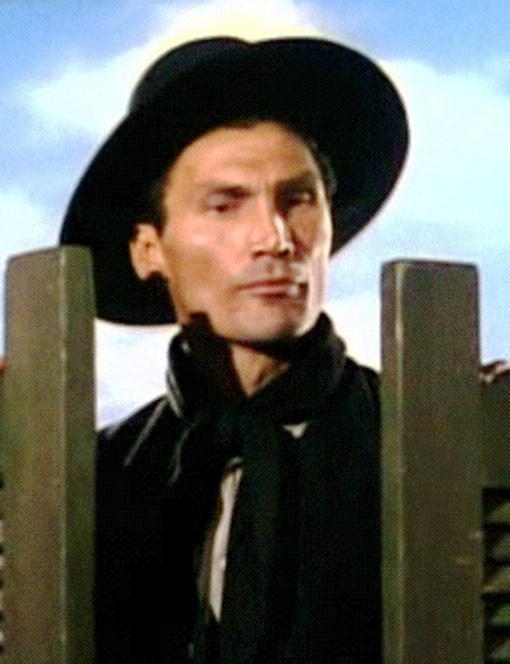 supporting actor in 1952 as the young cad out to scam the lonely older woman. He repeated the feat the following year with a role that couldn't have been more different but which really cemented the Palance image we know today in Shane. His Oscar-winning turn decades later in the comedy City Slickers couldn't have existed if he hadn't left an indelible impression as Jack Wilson back in 1953 first. Yet Palance, even if his style in his later years could somewhat lend itself to parody was much more multi-faceted than that, whether it be as a struggling actor in Robert Aldrich's 1955 potboiler The Big Knife or his work for Aldrich the following year in Attack, which Wagstaff recently wrote about during the Aldrich Blog-a-Thon, "Jack Palance’s performance in Attack is a revelation. What kid scared out of his wits by Palance’s portrait of an evil killer in Shane would ever guess that the actor could show the kind of tenderness and anguished vulnerability that he does here. Outside, Jack Palance looks like the perfect dogface grunt — his face and large presence look like they were carved from a block of granite by blasting it with dynamite — but inside, a sensitive soul that the heart aches for shines through." His great work wasn't limited to features either, as anyone who has had the chance to see his touching portrayal of an addled boxer in Rod Serling's television version of Requiem for a Heavyweight will tell you. For me, not the biggest fan of Jean-Luc Godard's work, Palance was the best thing about Godard's movie about movies, 1963's Contempt. He even brought grace to a miscast role as a Mexican bandit in Richard Brooks' The Professionals.
For many younger moviegoers out there, Palance will be best remembered for his work as a crime boss opposite another legendary screen Jack in 1989's Batman and for his Oscar-winning turn in 1991's City Slickers and its ill-advised sequel. I hope no one remembers him for missteps like the Chevy Chase misfire Cops and Robbersons and surely no one out there knows him solely as the host of TV's Ripley's Believe It or Not. He deserves much better remembrance than that — though, if only for a smile, it's worth remembering him for his one-armed pushups following his Oscar win and the comic goldmine they gave to Billy Crystal for the 1992 Oscarcast.
RIP Jack Palance.
Tweet
Labels: Aldrich, Crawford, Godard, Obituary, Oscars, R. Brooks, Television
TO READ ON, CLICK HERE
Tuesday, October 17, 2006
"I didn't know one man could bleed that much"
BLOGGER'S NOTE: We're a little late to the fest here, but Wagstaff has produced a great piece on Attack for the Robert Aldrich blog-a-thon being coordinated over at Sergio Leone and the Infield Fly Rule.
THIS IS A STORY OF MEN AT WAR… THE STORY EVERY SOLDIER KNEW, BUT NONE WOULD DARE TELL… THIS IS
THIS IS THE RAW, NAKED FACE OF
THIS IS WAR STRIPPED OF EVERYTHING BUT THE TRUTH! THE WAR STORY SO HOT NO ONE DARED FILM IT TILL NOW!

By Wagstaff
All caps aside, the preceding sales pitch that runs over the trailer for Attack! (1956) is remarkably accurate. Producer-director Robert Aldrich took Norman Brooks’ play Fragile Fox about men functioning (and not functioning) under the stress of war, and ventilated the drama with mortar shells and machine gun fire. In doing so, Aldrich turned this surprisingly frank and straight-forward war story into one of the best combat films of the 1950s.
The setting is the battle-torn Europe of 1944. Fox Company is having serious morale problems due to the incompetent leadership of Capt. Erskine Cooney (Eddie Albert). The captain’s fecklessness and ostrich-like dereliction of duty got several of his men killed during their last action, and has cost him the respect of his company.
It also has made him the target of the everlasting mistrust and vengeful wrath of one Lt. Joe Costa (Jack Palance). Lt. Costa’s pal, Lt. Woodruff, played by William Smithers, hatches a plan to convince the Battalion Commander, Lt. Col. Clyde Bartlett (Lee Marvin), to kick the captain upstairs with a promotion in order to get him out of the way. Lt. Costa, however, doesn’t see the efficacy of any of this; the political maneuvering of the officer class has increased his cynicism to the point where he only cares about the safety of his own men. Lt. Woodruff tries to convince the colonel anyway, over poker and a bottle of Kentucky bourbon, but fails. Lt. Col. Bartlett is a battle-hardened and competent soldier that harbors no illusions about Capt. Cooney’s character, but they both hail from the same small town; and Bartlett plans to use Cooney’s father’s political connections to run for office once the war is over. He tells the disappointed Woodruff not to worry, though; the scuttlebutt from on high says it’s a hundred-to-one that the company will see any more action. They’re out of the shooting for the rest of the war.
Lt. Costa doesn’t find any comfort in the hundred-to-one odds, and of course he’s right; that very day the company is ordered to take a town as part of a broader offensive. Capt. Cooney’s piss-poor plan is for Costa’s platoon to traverse 400 yards of open, vulnerable ground to test the enemy’s strength, and then to take refuge in an old farm house if things get hairy. If the operation does get ugly, he promises on his word to come in with reinforcements. Lt. Costa isn’t fooled by any of this, and promises to come back and kill Cooney if he goes back on his word. “I’ll shove this grenade down your throat and pull the pin.”
Things do go wrong and get plenty ugly. The town is heavily occupied by Germans, with mechanized support and Panzer tanks. Only five men from Costa’s platoon make it to the farmhouse. Lt. Costa’s desperate radio calls for reinforcements are ignored by Capt. Cooney, as he drowns his despicable inaction in a bottle of bourbon with deadly consequences. Lt. Costa’s men are surrounded — trapped; and I will stop here to keep from spoiling the rest of the movie.

Jack Palance’s performance in Attack! is a revelation. What kid scared out of his wits by Palance’s portrait of an evil killer in Shane would ever guess that the actor could show the kind of tenderness and anguished vulnerability that he does here. Outside, Jack Palance looks like the perfect dogface grunt — his face and large presence look like they were carved from a block of granite by blasting it with dynamite — but inside, a sensitive soul that the heart aches for shines through. When Jack Palance hobbles down a stairway, his arm badly mangled after being partially run over by a tank, and seeks his revenge on Capt. Cooney; his demeanor is positively ghostlike. The scene reminded me of a Creepshow-style tale of morality, comeuppance, and revenge. His acting is great even after his character’s demise; if they ever gave out Academy Awards for the best performance as a corpse, then Jack Palance would have won hands down in 1956.
Eddie Albert also is good in a way we’ve seldom seen him. His Capt. Cooney is a man eaten away by the consciousness of his own inadequacies and cowardice. He’s crippled by the fact that he never became the man his father wanted him to be. Imagine Maj. Frank Burns from the TV show M*A*S*H, subtract the humor and put him in a situation that makes him 20 times more dangerous to those around him, and you’ll get the idea of his characterization.
Lee Marvin is great as always. What couldn’t this actor do with the utmost naturalness? The movie’s trailer describes Lt. Col. Bartlett as “a cigar-chomping brass hat, who played war like he played poker: hard and dirty” and I can’t improve upon that description.
Robert Aldrich directs the combat scenes in a ways that are easy to follow. The soldier’s objectives are easy to grasp so that we can keep our bearings after the chaos of battle begins. Between the action scenes, he never soft-pedals the philosophical implications of the dramatic situations. During the climactic final act, there is a bewildering array of ethical conundrums, and nothing is black or white; yet the moral and philosophical conflicts remain clear. We witness how the agreed upon reality of what happens in combat goes through three or four drafts and revisions before it even leaves the principle players involved, and after that, once it leaves and goes out into the broader world… who knows? Attack ends on a righteous note of idealism and defiance, when Lt. Woodruff decides to tell the truth about what happened, against his own best interests, but I doubt the viewer carries this note away. After all we’ve seen preceding it — the twisting and turning of the officially sanctioned narrative of what transpired as reality, and the many conflicting agendas that are served by it — the whole riddle of perceived reality feels like it could go on ad infinitum.
Tweet
Labels: 50s, Aldrich, Blog-a-thons, Marvin
TO READ ON, CLICK HERE


