Friday, May 18, 2012
Centennial Tributes: Richard Brooks Part I

By Edward Copeland
"First comes the word, then comes the rest" might be the most famous quote attributed to Richard Brooks, who began his life 100 years ago today in Philadelphia as Ruben Sax, son of Jewish immigrants Hyman and Esther Sax. He wrote a lot of words too — sometimes using only images. In fact, too many to tell the story in a single post. so it will be three. His parents came from Crimea in 1908 when it belonged to the Russian Empire. Like the parents of a great director of a much later generation and an Italian Catholic heritage, Hyman and Esther Sax also worked in the textile and clothing industry. Sax's entire adult working life revolved around the written word — even while he busied himself with other tasks. “I write in toilets, on planes, when I’m
 walking, when I stop the car. I make notes. If I am working at a studio, I work at the studio in the morning, then come home. I am really writing two days instead of one. After the studio, I have my second day (at home). I write whenever I can,” Brooks said in an interview with Patrick McGilligan for his book Backstory 2: Interviews with Screenwriters of the 1940s and 1950s. After high school, he entered Temple University where he majored in journalism, though he left early when he realized the financial hardship that his tuition put on his parents. After drifting around the eastern half of the U.S. for a while by train, Sax returned to Philadelphia and got a job as s sports reporter at The Philadelphia Record where he first adopted the name of Richard Brooks. When he later got hired by The Atlantic City Press-Union, he met another reporter with an independent streak who would eventually make his way to Hollywood by the name of Samuel Fuller. Shortly after moving to New York for a job with that city's World Telegram newspaper, only leaving the sports beat behind for crime reporting. Brooks discovered that radio jobs provided bigger paychecks so he took a job at the 24-hour radio station WNEW, first as a disc jockey. "Played records 23 of those hours," McGilligan described in the introduction to his interview. Later, the station promoted him to news where he edited four news broadcasts a day newspaper jobs and wrote one. His work there led to a news job at NBC Radio's Blue Network where he also got to do commentary. At the same time, in 1938, Brooks tried his hand at playwriting, which led in 1940 to co-founding The Mill Pond Theater in Roslyn, N.Y., with David Loew. It's on that stage that Brooks made his debut as a director, taking turns with Loew helming productions at the summer theater. A falling out with other members of the theater sent Brooks to California where he worked for NBC Radio from the other coast. Among his duties was writing and directing the broadcast Richard Sands. Brooks also began writing a short story every day and reading it on air. “I’d written some short stories before, but none was published. Anyway, every day, another short story. Everything became grist for a short story. It began to drive me crazy…a different plotline every day. My ambition: write one story a week instead of a different story every day. In about 11 months, I wrote over 250 stories. I even devised a system whereby on Fridays I wouldn't have to write a short story. I called that day 'Heels of History.' I would take a fable and convert it. As a matter of fact, I used one afterwards in The Blackboard Jungle,” Brooks told McGilligan. Brooks gave the example of how he took the story of "Jack and the Beanstalk," citing how while he's portrayed as a hero, Jack's actually a dumb, bad kid who ignores his mother's order, shows little concern for an ailing fire and steal, even if it's from a giant. Granted, it doesn't appear to have been broadcast nationally but I wonder if Stephen Sondheim and James Lapine came across this when
 conceiving Into the Woods?. Witches can be right, giants can be good… Brooks, like what happened when he learned radio paid more than newspapers, discovered in California that screenwriters earned bigger paychecks than broadcasters. He set up a meeting with George Waggner at Universal, where Waggner — who later would direct The Wolf Man and much episodic TV including many installments of The Man from U.N.C.L.E. and Batman — was the assistant producer of White Savage, a Maria Montez film directed by Arthur Lubin. Waggner asked if Brooks wrote because they desperately needed a rewrite. It was his first movie job and Brooks made "$100 (weekly) plus a day or two prorated, and they put my name on (the screen) as 'additional dialogue,'" Brooks told McGilligan. White Savage wasn't the first film Brooks worked on to be released though — two others and a serial came first. He also hung on to the NBC gig and got the chance to write for Orson Welles' Mercury Theatre. Brooks produced countless sentences and paragraphs and but still lacked a "written by" credit on a screenplay credit. Once he did and, later, when he directed, he'd impact filmmaking both during and beyond his life, often with social themes few would touch (though occasionally in a heavy-handed way). He also managed to write some novels on the side — while with the Marines during World War II, where he'd also crank out a couple of screenplays (including his first credited one on Cobra Woman, directed by Robert Siodmak and again starring Montez) and report for Stars & Stripes as well while learning about filmmaking from Frank Capra's motion picture unit and eventually on his own editing combat footage into documentaries while attached to the 2nd Marines, Photographic Unit. If the Allies only needed a typewriter to defeat the Axis, Brooks might have been a good option for the weapon. First comes the word…
Though Brooks' legend derives predominantly from his film legacy, he experienced his first rush of acclaim with the publication of his debut novel, written while stationed at Quantico at night in the bathroom, according to the account in Tough as Nails: The Life and Films of Richard Brooks by Douglass K. Daniel. Several publishers rejected it until Edward Aswell at Harper & Brothers, who also edited Thomas Wolfe, agreed to take it — and he shocked Brooks further by telling him (after a few suggestions) they planned to publish in May 1945. This news flabbergasted Brooks who obtained a weekend pass to go to New York because Aswell insisted on informing him in person. Now Brooks had to return to Quantico where the top officers of the Corps about shit bricks when The New York Times published a big review of The Brick Foxhole soon after it hit shelves. (Orville Prescott's take was mixed, assessing it as compulsively readable but weak on characterization.) Its story of hate and intolerance within the Marines brought threats of court-martialing Brooks, since he'd ignored procedure and never submitted the novel to Marine officials for approval ahead of time. They wanted to avoid bad publicity, especially with all the good feelings as the war wound down. "There was nothing in that book that violated security, but their rules and regulations were not for that purpose alone," Brooks told Daniel. Aswell prepared to launch a P.R. counteroffensive with literary giants such as Sinclair Lewis and Richard Wright ready to stand by Brooks. In case you don't know the story of the novel, it concerns a Marine unit in its barracks and on leave in Washington. Through their wartime experiences, some of the men truly turned ugly, suspecting cheating wives and tossing hate against any non-white Christian. It turns out, though the real Marines let the matter drop, what bothered them
 about the book wasn't the anti-Semitism or racist tendencies of the characters but the murder of a Marine some of the other Marines learn is gay. The U.S. Marines didn't want to promote the idea there might be homosexuals serving in the military. Ironically, they got their wish when The Brick Foxhole transferred to the big screen in 1947 as Crossfire. Brooks wasn't involved in the film version, but they made the murdered Army (The Marines even got to toss it off to another military branch entirely) soldier Jewish in the film. The film actually happens to be very good and was nominated for best picture and earned Robert Ryan his only Oscar nomination ever as supporting actor. What's even sadder is that Crossfire ends up being a much more powerful film against anti-Semitism than the creaky Gentleman's Agreement that took on the same subject that year and won best picture. If there weren't already enough ironic twinges in that story for you, Gentleman's Agreement, probably the grandfather of that tried-and-true staple "let a white guy be the hero of a story about another ethnic group" with Gregory Peck playing a Christian going undercover as a Jew to learn about anti-Semitism, won Elia Kazan his first directing Oscar. Edward Dmytryk, one of The Hollywood Ten, directed Crossfire, which dealt straight on with anti-Semitism and the effects of warfare on men. Then again, once Dmytryk served his jail time, he became the only one of the 10 to name names to HUAC because he wanted to work again.
While he didn't want to make a movie of The Brick Foxhole himself, another former newspaperman turned socially conscious film artist met with Brooks about working with his independent production company. At first, Mark Hellinger tried to lure Brooks away from Universal with the promise of doubling his salary if he'd adapt a play he liked into a movie, but before Brooks could consider that offer, Hellinger called with a more pressing matter. He was producing an adaptation of Ernest Hemingway's famous short story The Killers. The problem: someone had to dream up what happened after the brief tale ends because it certainly wouldn't last 90 minutes otherwise. Hellinger flew Brooks out to meet Papa himself, but he didn't get much out of him but he did come up with an idea for what would happen after the story ends. Hellinger liked it and sent it to John Huston, who wrote the screenplay as a favor. Since both Brooks and Huston had contracts at other studios, neither got screen credits, so Ernest Hemingway's The Killers' official screenplay credit goes to Anthony Veiller, who received an Oscar nomination for best screenplay. He'd previously shared a nomination in the same category for Stage Door. The film also made a star out of Burt Lancaster, who would work with Brooks several times and be his lifelong friend. In fact, Lancaster would star in the next screenplay that Brooks wrote, a Mark Hellinger production directed by one of those people Edward Dmytryk eventually would name before the House Un-American Activities Committee. The film, of course, would be the still-powerful Brute Force, the director, Jules Dassin.


John Huston wasn't happy. Producer Jerry Wald called him, excitement in his voice, to tell him he'd secured the rights to Maxwell Anderson's Broadway play Key Largo for Huston to direct. This didn't thrill Huston, who thought the play gave new meaning to the word awful. Written in blank verse, Anderson's play concerned a deserter from the Spanish-American War. People at a hotel do get taken hostage, but by Mexican hostages. Essentially, Huston tossed the play in the trash bin. Huston hired Brooks to co-write an in-title only version and, still pissed at Wald, barred him from the set. Part of Huston's anger stemmed from the HUAC nonsense, (His outrage would drive him to move to Ireland for a large part of the 1950s.) so he couldn't stomach adapting a play by Anderson whom he considered a reactionary because of his hate of FDR. Despite Huston's distaste for the project, he
 turned it into a classic film with a little help from Humphrey Bogart, Lauren Bacall, Lionel Barrymore, Claire Trevor in her Oscar-winning role and, last but certainly not least, Edward G. Robinson as exiled mobster Johnny Rocco, who likes to brag about the power he used to wield. "I made 'em — like a tailor makes a suit of clothes," he tells a former associate. Knowing the story of what happened prior to filming makes you chuckle when you see the credit that reads, "As Produced on the Spoken Stage." It's great to watch Robinson and Bogart go toe-to-toe. Rocco makes a particularly memorable first appearance, lounging upstairs in a hotel bathtub, looking in a way like a prediction of that famous photo of Dalton Trumbo that would be taken decades later. Bogart, updated to a returning WWII veteran, perfectly plays his role of Frank McCloud so that you never know if he's being savvy or scared of the crimnals terrorizing them. "You don't like it, do you Rocco, the storm? Show it your gun, why don't you? If it doesn't stop, shoot it," Frank says at one point, but when he gets a chance to grab a gun and take him out (though Rocco's men would certainly finish Frank afterward), he nonchalantly declares, "One Rocco more or less isn't worth dying for." The script's dialogue crackles and for additional fun touches we get a great Max Steiner score and the multitalented German émigré Karl Freund as cinematographer. The most remarkable thing that Huston did though was to invite Brooks to stay on the set during the film's shooting, something he'd never done as a writer and that he talked about in this YouTube video in 1985.
While I would have liked to have viewed more of Brooks' work that I've never seen (and to re-visit some which I have), time and availability, combined with his prolific nature and the industry's increasingly cavalier willingness to let both old and recent films fade into oblivion, proved to be a problem. After Huston's generosity, Brooks' directing debut would arrive two years later. Four films where Brooks worked
 solely as a writer remained — the Paris-set spy thriller To the Victor; Any Number Can Play with Clark Gable as an underground casino owner advised by his doctor to get out of the business because of his heart disease; Mystery Street with detectives Ricardo Montalban and Wally Maher consult a Harvard forensics expert (Bruce Bennett) to solve a mystery when a decomposed body washes ashore; and Storm Warning, where model Ginger Rogers goes to visit her sister in a particularly unfriendly town and secretly witnesses a mob lynch a man that her sister (Doris Day) tells her was a reporter who denounced the KKK. Rogers' character gets a bigger shock when she realizes baby sis' husband participated in the lynching. After 1951, every film Brooks worked on he at least held the title of director, beginning with 1950's Crisis with Cary Grant as a doctor vacation with his wife in a small country when the dictator (José Ferrer) kidnaps them to force the doctor to treat his life-threatening condition. The doctor's ethics get tested by his oath and the idea that if he lets the man die, life for the country's people will improve. For a writing-directing debut, Brooks makes a pretty good start even if it doesn't come close to some of the films he wrote. His next four films as director and writer or co-writer I haven't seen, though I tried to watch the last one. The next film, The Light Touch (1952). starred George Sanders and Stewart Granger a collector of stolen art and an art thief, respectively, trying to get their hands on the masterpiece Granger stole and that his wife Pier Angeli stays busy counterfeiting
 enters their lives. At the time, Granger was married in real life to Jean Simmons, who would become Brooks' second wife about 10 years later. The next two films both starred Bogart. First came Deadline-U.S.A. with Bogie playing an investigative reporter trying to expose a gangster as his paper faces imminent closing followed by Battle Circus co-starring June Allyson where they played medical personnel at a MASH unit during the Korean War. The final film, which I almost watched, was The Last Time I Saw Paris, based on a story by F. Scott Fitzgerald and co-written by Brooks and the Epstein brothers, Van Johnson plays a former soldier returning to the city he liberated in the war, now despondent over his attempts to be a writer. He gets invited to parties with the city's beautiful people and finds one (Elizabeth Taylor) who enchants him. Unfortunately, the DVD transfer on Netflix’s rental copy proved abysmal. The Technicolor has faded beyond belief and it was filmed in an odd 1:75:1 spherical ratio, so every image looked distorted because they just flattened it full screen. After a few minutes, I had to shut it off. Apparently, it's a Warners Archive title now, but of course, they don't offer those for rental so the shitty DVDs will remain for people who don't believe in buying blind. I haven't caught his next two directing efforts either, but they stand out because they marked the first two times (and it only occurred three times) that Brooks directed screenplays written by someone else. In 1953, he directed Richard Widmark as a Korean War vet now serving as a tough drill instructor for new GIs bound for Korea while he's bitter that his request to return to Korea keeps being denied in Take the High Ground! In 1954, Brooks helmed Flame and the Flesh with Lana Turner as unlucky woman trying to get what she can for nothing visiting Europe who finds herself wooed by a gigolo.
With 1955, Brooks wrote and directed the first film that truly garnered him an identity as more than a writer who directs but as a director with Blackboard Jungle, a film that admittedly manages to look both dated and timely simultanouesly, First, as so many old films did, it had to start with a long scroll explaining that American schools maintain high standards, but we need to worry about these juvenile
 deliquents before this gets out of hand. It gets off to a rockin' start — literally — with opening credits that can't help but make you think of the original beginning to TV's Happy Days as Bill Haley and the Comets get everything moving to "Rock Around the Clock" as new English teacher Richard Dadier (Glenn Ford) arrives to work at all-boys high school North Manual Street. Most of the school overflows with miscreants, especially his class who start calling him "Daddy-O" to avoid pronouncing his name. (Though it's never been confirmed, many assume that the movie inspired Leiber & Stoller's lyric "Who called the English teacher Daddy-O?" in The Coasters' huge late '50s hit "Charlie Brown.") The ensemble Brooks assembled, including some of the "teens" who would make their names much later included Anne Francis as Dadier's pregnant (and, quite frankly, neurotic) wife; Louis Calhern as a veteran teacher left with nothing but cynicism and a
 desire to beat the crap out of the punks; Richard Kiley as a nerdy math teacher with a love for jazz; Margaret Hayes as another new teacher who doesn't think about how she's dressing and nearly pays for it; Sidney Poitier as a student who appears to be one of the delinquents yet practices playing the piano and singing hymns; and Vic Morrow as the worst kid in the school, a downright criminal. Also, look for appearances by future writer-director Paul Mazursky as a student, Richard Deacon as a teacher and Jamie Farr as another student when he acted using the name Jameel Farah. While Blackboard Jungle offers much to praise, at times it comes off as too simplistic. It did dare to tackle bigotry and use the epithets. Sometimes, it feels eerily like the awful 1984 film Teachers. I kept expecting Calhern to turn out to be like the Royal Dano character and drop dead at his desk. I wonder what Brooks would have thought if he'd seen The Wire's fourth season. Blackboard Jungle earned Brooks his first Oscar nomination for best screenplay. Brooks' competition consisted of Millard Kaufman (who wrote Take the High Ground!) for Bad Day at Black Rock, Paul Osborn for East of Eden, Daniel Fuchs and Isobel Lennart for Love Me or Leave Me and Paddy Chayefsky, who wrote the teleplay that would be the basis for one of Brooks' 1956 films, for Marty. Chayefsky won his first Oscar. Nearly the entire cast excels in spite of some of the weaker parts of Blackboard Jungle (except Francis, burdened with a thankless role) but Morrow stands out in the ensemble as the worst punk.
 Tweet
Labels: blacklist, Bogart, Capra, Cary, Dassin, Doris Day, Edward G., Fiction, Fitzgerald, Fuller, Ginger Rogers, Glenn Ford, Hemingway, Huston, Lancaster, Liz, Mazursky, Poitier, Robert Ryan, Widmark
TO READ ON, CLICK HERE


Wednesday, June 29, 2011
Centennial Tributes: Bernard Herrmann Part II
By Edward Copeland
So I had to divide this tribute to Bernard Herrmann in two parts. If somehow you started here and want to backtrack, click here. We pick up still in 1956 and I wanted to use two clips from Hitchcock's 1956 The Man Who Knew Too Much, but YouTube has removed both since I wrote this and I could find no good substitute.
A Hatful of Rain (1957) directed by Fred Zinnemann; Scene: Turning Johnny in
Have Gun — Will Travel was one of the most popular TV Westerns of its time starring Richard Boone as Paladin, a West Point grad turned gunfighter after the Civil War. It ran from 1957-1963. It managed to have two themes: the instrumental one that Herrmann wrote for its opening credits and a song "The Ballad of Paladin" that played over the closing credits. We, of course, are only interested in Herrmann's contribution.
1958 brings us back to Vertigo, whose opening credit sequence I used as the opening to Part I simply because I felt it was one of if not his greatest. Thankfully, it is not one of the movies. Unfortunately, another clip I planned to use from it from YouTube also disappeared that I wanted to include to show how his score worked within the context of the Hitchcock masterpiece, but most did not so I got to use one to top Part II and another for after this graf. There are so many choices because frankly I don't believe Vertigo would be as great as it is without Herrmann's contribution. I could have selected the opening rooftop chase, the first time Scottie sees Madeleine at Scotty's restaurant with those beautiful, vivid reds (which I took up top), the museum scene, or many others. I had settled on the scene where Scottie tails Madeleine and saves her after she jumps into the bay but that disappeared, so I went with the museum
The 7th Voyage of Sinbad (1958) directed by Nathan Juran; Piece: Skeleton fight
North by Northwest (1959) directed by Hitchcock; Piece: Title sequence
On Oct. 2, 1959, one of the most iconic television series of all times premiered on CBS: Rod Serling's The Twilight Zone. Bernard Herrmann wrote the show's theme, though not the famous one when you're familiar with and you could mimic right now. His intro music was only used for the first season, though he scored many individual episodes.
Here we have an interesting comparison of a Bernard Herrmann score that later is evoked in another composer's score either as homage or something else. You be the judge. First, listen to part of Herrmann's score for director Henry Levin's 1959 film Journey to the Center of the Earth. Then, listen to its echoes present in Danny Elfman's main title music for Tim Burton's 1989 Batman. Next in 1960, Herrmann and Hitch teamed again for the memorable Psycho. If I had my preference, I'd embed a clip of the Saul Bass title sequence with the score, but it's been disabled, so you'll have to click to hear it. However, I was able to embed the shower scene.
Tender Is the Night (1962) directed by Henry King; Pieces: 3 tracks
Here is one of the more interesting comparisons. First, we have Herrmann's original main theme for J. Lee Thompson's 1962 Cape Fear (but unfortunately not actual footage from the movie) and then we have Elmer Bernstein's adaptation of Herrmann's score for Martin Scorsese's 1991 remake of the film — complete with Saul Bass title sequence.
Marnie (1964) directed by Hitchcock; Piece: Prelude
Fahrenheit 411 (1966) directed by Francois Truffaut; Piece: Prelude
The Virginian TV series Episode: "The Reckoning (9/13/67); Piece: Title credits
What's next is something special. First, we have sequences from Truffaut's 1968 film The Bride Wore Black without dialogue, only Herrmann's score. After that, we have Herrmann himself discussing his work on the score of the film against scenes from it.
Director Roy Boulting made a thriller in 1968 called Twisted Nerve for which Herrmann composed a frightening, whistle for the film's killer to use. It has taken on a popularity greater than the film itself. So here are three takes on it. First, we have the whistle as it is emanates from Hywel Bennett as the killer in the movie. Second, we have how Herrmann incorporated the whistle into the movie's score. Lastly, we have Quentin Tarantino's homage to it in a scene in Kill Bill Vol. 1.
In 1974, Herrmann scored the schlocky horror film It's Alive, but I could find no samples of his work from that film. On Dec. 24, 1975, Bernard Herrmann died of a heart attack at the age of 64, but he left two scores behind, both of which received his final two Oscar nominations in 1976: Brian De Palma's Obsession and one of his greatest, Martin Scorsese's Taxi Driver. Both nominations lost to Jerry Goldsmith's score for The Omen.
First, from Obsession
Of course, it's nearly impossible to keep a clip from a Scorsese film up for long, but we've got the masterful Taxi Driver score, if not the images that go with them.
Ironic in a way, that Bernard Herrmann's film scoring career began with the ultimately lonely Charles Foster Kane and ended with the God's lonely man Travis Bickle. What range. What talent. Imagine if he had lived longer.
Tweet
Labels: De Niro, De Palma, Doris Day, Herrmann, Hitchcock, J. Stewart, Music, Oscars, Scorsese, Tarantino, Television, Tim Burton, Walsh
TO READ ON, CLICK HERE
Sunday, June 13, 2010
Centennial Tributes: Mary Wickes


By Edward Copeland
Where would entertainment be without the character actor or, in this case, actress? Mary Wickes, who was born 100 years ago today, spent nearly 60 years supporting the stars on the stage, big and small screens, usually with a crusty exterior and almost always leaving the audience laughing. Her Broadway debut came in 1936 in a play called Spring Dance written by Philip Barry of The Philadelphia Story fame and starring José Ferrer and her film debut came two years later in a comedy short titled Too Much Johnson that starred Joseph Cotten and was directed by none other than Orson Welles. Her name may never have reached household status, but at 5 feet 10 inches tall with a usual wisecracking demeanor, once someone showed you a photo or clip of her, you knew who Mary Wickes was.
Wickes was born Mary Isabelle Wickenhauser on June 13, 1910, in St. Louis, Mo., the daughter of well-off banker. While the vast majority of her roles came from the working class, Wickenhauser was a debutante who graduated from Washington University in St. Louis with a degree in political science with plans to pursue a law degree until the acting bug bit.

Her career began on the stage (to which she returned frequently) and she became part of Welles' Mercury players. She appeared in the original Broadway production of Stage Door. She originated the role of Miss Preen in the Kaufman/Hart hit The Man Who Came to Dinner opposite Monty Woolley. When Hollywood decided to adapt the play to film, they kept Wickes and Woolley in their roles, though they did add Bette Davis and Ann Sheridan to the cast. Though Wickes did frequently return to Broadway throughout the 1940s, her career remained firmly anchored on the West Coast after that, except for a return to the Great White Way in 1979 to play Aunt Eller in a revival of Oklahoma!

The movie of The Man Who Came to Dinner was released in 1942, a particularly busy year for Wickes who also co-starred with Bette Davis in Now, Voyager. She appeared in the short Keeping Fit which also featured Robert Stack, Broderick Crawford and Andy Devine as Wickes' husband. Wickes also landed in the cast of two musicals: Private Buckaroo with The Andrews Sisters and The Mayor of 44th Street starring George Murphy that was part musical, part gangster story. She aided Penny Singleton in her popular series with the installment Blondie's Blessed Event and she teamed with Bud Abbott and Lou Costello in their comic mystery Who Done It? All of those released in what was essentially her first year in movies. The following year brought fewer roles as she headed back East for more stage work. A couple of film roles went uncredited, but she did appear in three more musicals: another with Andrews Sisters (How's About It?), another that featured Andy Devine (Rhythm of the Islands) and a third that featured a young singer named Frank Sinatra (Higher and Higher). Wickes didn't make another film until 1948.
When she did return to the West Coast, her first feature in 1948 was June Bride, once again with Bette Davis (whom she'd work again with in 1952's The Actress), but she really began to make her mark in the fledgling medium of television, beginning with two appearances on The Actor's Studio. She appeared on many of the live theater shows, including re-creating her role of Miss Preen in a production of The Man Who Came to Dinner (and she reprised it again in a 1972 TV movie). A friendship with Lucille Ball led to her guest appearance on an infamous episode of I Love Lucy as the ballet instructor Madame Le Mond. Ball and Wickes' friendship led to frequent guest appearances on every TV series in which Ball ever starred.
On the feature side of things, she appeared with Doris Day in On Moonlight Bay, whom she teamed again with in I'll See You in My Dreams, By the Light of the Silvery Moon and two episodes of Day's TV show. Once someone met her, they seemed to develop a loyalty to Wickes, working with her again and again. She worked with Glenn Ford in five films, the most notable being 1957's Don't Go Near the Water and the 1960 remake of Cimarron.
Aside from guest shots, Wickes had many recurring and regular roles on television series throughout her long career including Make Room for Daddy, Dennis the Menace, Sigmund and the Sea Monsters, Doc, The Father Dowling Mysteries and, though some episodes appeared after her death, her voice was heard on the animated series Life with Louie featuring comic Louie Anderson. Two of her most memorable guest shots appeared on Sanford & Son as a housekeeper Fred and Lamont hire but can't bring themselves to fire, even though she's terrible and as Hot Lips' visiting supervising colonel on M*A*S*H who tries to seduce Frank.
Throughout her many decades an actress, there were still other notable feature films. She was housekeeper to Dean Jagger's general as Bing Crosby and Danny Kaye plotted to cheer the old man up in White Christmas. Her
 voice graced Disney's original animated 101 Dalmatians. She helped populate River City in The Music Man. She put on a nun's habit alongside Rosalind Russell in The Trouble With Angels directed by Ida Lupino and its sequel (though Lupino sat that one out). She played Meryl Streep's grandmother and Shirley MacLaine's mom in 1990's Postcards From the Edge. She strapped on a nun's habit again as Sister Mary Lazarus opposite Whoopi Goldberg in Sister Act and its sequel. In the 1994 Little Women with Winona Ryder, she played Aunt March. Her final film, released after her death, again featured only that remarkable voice as she gave life to the gargoyle Laverne in Disney's Hunchback of Notre Dame.
Tweet
Labels: Abbott and Costello, Animation, B. Crawford, Bette, Disney, Doris Day, Ferrer, Glenn Ford, Joseph Cotten, L. Ball, Lupino, MacLaine, Mary Wickes, Musicals, Roz Russell, Sinatra, Streep, Welles, Winona
TO READ ON, CLICK HERE
Friday, May 02, 2008
The Wow Factor

By Josh R
The clean-scrubbed, resolutely cheerful heroine of South Pacific describes herself — in song, no less — as “A Cockeyed Optimist.” Outside the rosy alternative reality of musical theater, I have heard that such people do, in fact exist — somewhat astonishing given how little there is in today’s socio-political and economic climate to inspire a sanguine frame of mind. As to all the optimists out there, cockeyed or not, I envy them fact that they can find things to sing about; optimism and I parted ways two presidential elections ago.
It might not sit well with those who prefer to view the world through rose-colored glasses, or with their heads buried deep in the sand, if I were to suggest that their outlooks could benefit greatly from of healthy injection of cynicism. Think of all the mess that could be avoided if our willingness to accept whatever we’re told by authority figures — parents, teachers, religious leaders and politicians — were tempered by skepticism and an element of suspicion? As both general virtues and qualities of citizenship, they get a bad rap.
When Lincoln Center’s revival of South Pacific, currently playing at The Vivian Beaumont Theatre, started reaping the kind of notices press agents dream about — and really, its reception by the New York theater critics has been no less enthusiastic than that accorded to the original 1949 production — I registered it all with a grain of salt. Richard Rodgers and Oscar Hammerstein’s seminal achievement, while outfitted with one of the greatest scores ever written for the musical stage, has never been entirely my cup of tea; in terms of its attitudes, which flirt dangerously with both corniness and preachiness, the material has always seemed so specific to the postwar era that it seemed worth questioning how much resonance it could have for a contemporary audience. Not even a show armed to the teeth with the sort of musical standards that never go out of style can necessarily make for a timeless work of theater.
By my estimation, my vast reserve of cynicism had thoroughly evaporated less than five minutes into Bartlett Sher’s breathtaking, bountiful and altogether extraordinary new production, which not only restores South Pacific to its former glory, but is one of the few musical productions in recent memory to qualify as a truly transcendent theatergoing experience. Not for a fraction of a second does the show betray its age, or feel even remotely like a relic of the past; delivered with gripping immediacy and an even more dazzling sense of theatricality, it is the kind of unqualified triumph that comes about as close to perfection as any show can be reasonably — or unreasonably — be expected to do. As an improbable side note, it’s also the first show I’ve seen in a long, long time that runs the risk of turning me into a cockeyed optimist; if South Pacific is any indication of what the theater is still capable of, I’d say that looking ahead, there’s every reason to look on the bright side.
Adapted from James Michener’s Pulitzer Prize-winning collection of short stories, the show is primarily a consideration of culture clash — and the conflicted impulses it can produce in those doing the clashing — set against the backdrop of World War II. The pert, positive-thinking Nellie Forbush, a Navy nurse stationed with American troops on a tropical South Seas island, has fallen in love with a middle-age French plantation owner, Emile De Becque. Their burgeoning romance hits a stumbling block when Nellie learns that Emile has fathered two bi-racial children by his late wife, a Polynesian native; her prejudice overrides her better instincts, and she rejects his proposal of marriage. In a parallel storyline, Lt. Joe Cable, the Ivy League scion of a wealthy Philadelphia family, becomes similarly enamored of a native girl. Like Nellie, he doesn’t trust his feelings enough to place them above his own unspoken fears and doubts about entering into an interracial marriage. While not the first Broadway musical to deal frankly with the subject of racism — Show Boat, Hammerstein’s landmark collaboration with Jerome Kern, preceded it by about 20 years — South Pacific was groundbreaking in terms of just how direct, and directly confrontational, it was in its approach. In putting racial prejudice under the microscope, the authors were also holding up a mirror to their audiences, in a manner not only intended to strike a chord of instant recognition but hit uncomfortably close to home. Complacent theatergoers were being asked not only to understand, but to identify with the behaviors being held up for scrutiny and condemnation. The practitioners of race prejudice here are not simply two-dimensional villains; they are fundamentally decent individuals grappling with feelings they cannot fully define or comprehend, which become a source of both shame and embarrassment. In “Carefully Taught,” one of the show’s most famous songs — and still incendiary stuff by modern standards — the authors trace the origins of prejudice back to formative experience and systematic indoctrination. Nellie insists that her inability to reconcile her understanding of right and wrong with the irrational fears that keep her in tether as “something that’s born in me.” Rodgers and Hammerstein know better — they contend that bigotry is the product of environment and upbringing, as opposed to biological instinct.
This being Rodgers and Hammerstein, whose most oft-revisited works are the family-friendly classics Oklahoma! and The Sound of Music, the vinegary content is diluted with ample quantities of sugar water. The marriage of sober social commentary and bright, crowd-pleasing entertainment has never seemed an altogether comfortable union — not even in Josh Logan’s enjoyably lavish 1958 film adaptation — but in Sher’s production they meld seamlessly into a remarkably balanced and unified whole. Just as very little in life is ever black-and-white, there is room in South Pacific for both light and dark, elements which are rendered here in ways that not only complement each other but have an effect of mutual enhancement. A big, brash production number such as “There is Nothing Like a Dame” is subtly informed by the way in which the African-American soldiers occupy a different part of the stage from their white counterparts, while the lush romanticism of “Younger than Springtime” also poses for a moment of reflection and foreboding — one in which it becomes all too apparent that nothing is quite as simple or as straightforward as it appears on the surface (a boy and girl are falling in love in the most blissful way imaginable, while at the same time a woman also is selling her daughter’s virtue to ensure her own survival). The comic and tragic elements are integrated in such a way that even the most stylized contrivances of South Pacific contain a kernel of reality; more impressively still, none of the entertainment value falls by the wayside in the process. Sher and his team don’t have to sacrifice any of the fun or the joy of South Pacific in order to get its message across — which they do, without pressing or in any way dampening the buoyant spirit of the material. Whether making a serious point, or simply trying to entertain the dickens out of its audience, everything taking place on the stage of The Vivian Beaumont exists in perfect harmony with everything else.
Harmony is the right word to describe the level on which Sher’s cast functions. There isn’t a single individual cavorting across the broad expanse of David Yeargan’s evocative set who seems in any way out of place, and the interplay between the actors — which extends right down to the minor members of the large ensemble — is nothing less than miraculous. The principals are so-well chosen that seem to inhabit their characters with an effortlessness that goes beyond natural instinct; often, it seems almost by chance.
The beguiling Kelli O’Hara has attracted a great deal of attention of late for her performances in celebrated
 musicals of yesteryear; in addition to her delectable Tony-nominated turn in The Pajama Game, this past year alone she has toplined a much-praised concert staging of My Fair Lady for The New York Philharmonic, and a revival of Oklahoma! as part of that state’s centennial festivities. With her performance in South Pacific, she confirms her status as one of the best interpreters of vintage material in contemporary musical theater. That distinction owes itself to more than just her mastery of period vocal style, for Ms. O’Hara is as fine an actress as she is a singer — and believe me, that’s saying something. It’s easy to judge musical theater performers on a different, and somewhat lesser scale than actors in straight plays; in most cases, their performances seem pitched squarely to the audience, with emotions delivered in all caps for exaggerated emphasis (or worse still, in hastily scrawled-out shorthand). From this point on, Ms. O’Hara can be held to a different standard entirely; if she ever decides to take a break from musical theater (hopefully, not a permanent one), there’s no danger of her seeming out of her depth should she decide to ply her talents elsewhere. As Nellie Forbush, she gets the quality of apple-pie wholesomeness absolutely right, but even when singing about being “as corny as Kansas in August” (the role seemingly screams out for the oblivious, white-washed sunniness of a latter-day Doris Day) there isn’t one aspect of her characterization that seems false, forced or in any way disingenuous. Her Nellie is an All-American sweetheart with girl-next-door charm to spare, but also a deeply conflicted woman, unsure of herself in unfamiliar surroundings, and coming face to face with inner demons that rattle her to the core. For bringing her character to three-dimensional life with such empathy and insight, and for never flinching when the material requires her to dig deeper below the surface, she ably demonstrates that the only limitations on her talent in future may be the lack of opportunity to exercise it. If some enterprising soul would write a new musical worthy of her, this wouldn’t be so conspicuous a challenge. It isn’t a problem here, though. Ms. O’Hara has shone brightly on previous occasions; in South Pacific, she has unmistakably attained the luster of a genuine star.
 Since one star does not a constellation make, Mr. Sher has populated his production with performers who can not only travel the same altitude as his leading lady, but radiate enough light and warmth on their own to illuminate the material in ways mere star turns seldom do. Brazilian opera star Paulo Szot, best known on these shores for his appearances with The New York City Opera, makes a stunning theatrical debut in the role of Emile. With his broad shoulders and soulful eyes, the matinee-idol handsome Mr. Szot is not only a believable object of romantic attraction; when he applies his rich, soaring baritone to that little ditty that launched a thousand sighs, “Some Enchanted Evening,” or the equally swoon-worthy “This Nearly Was Mine,” the lyrics have an emotional resonance that extends beyond the words themselves. Every phrase is invested with such tenderness and longing that everything around the actor seems to fade into soft focus; I swear that in the middle of his rendition of “This Nearly Was Mine,” time stopped — no mean feat, considering how swiftly this three-hour production, which cuts through the waves as smoothly as ocean liner, seems to glide by. The qualities that make his vocal performance so spectacular carry over to his acting scenes with Ms. O’Hara; the captivating chemistry they share is all the more disarming for its poignant delicacy. Is it unlikely that Mr. Szot, whose talents will doubtless be no less in demand in the wake of this most recent triumph, will become a frequent visitor to the Broadway stage. It can only be hoped that this appearance will not be his last.
The supporting cast is top-of-the-line, with each member given his or her chance to shine in turn. Danny Burstein is in great form as the mischief-making seabee Luther Billis — his “Honey Bun” routine with Ms. O’Hara provides the evening with its comedic high point. Matthew Morrison, who continues to move up quickly in the ranks of Broadway leading men, gives a thoughtful, sensitive account of the conflicted Lt. Cable, while Li Jun Li makes the piece’s most thinly conceived character, the fragile and pliant Liat, a genuinely touching figure. The Hawaiian actress Loretta Ables Sayre brings a sense of bare-knuckled desperation, as well as some intriguing hints of menace, to her depiction of the wily war profiteer Bloody Mary — a role usually played, in previous contexts, in the spirit of broad comic caricature. As for the remainder of the 40 person cast, there is nary a generic chorus kid in sight; each member of the energetic ensemble has been directed to give a highly individualized performance, while collectively they contribute immeasurably to the production's highly authentic sense of time and place — something abetted by Catherine Zuber’s pitch-perfect period costumes and Donald Holder’s sumptuous lighting design. The 30-piece orchestra, working from the original 1949 musical arrangements, does full and glorious justice to Rodgers’ rich, melodic score, which washes over the audience like a succession of waves breaking smoothly upon the sand.
So what’s wrong with South Pacific? The only thing I can come up with — and I’m reaching here — is that The Vivian Beaumont Theatre doesn’t seem to come equipped with enough seats. According to sources in the know, the ticketing crunch has grown to the point that there’s already a waiting list for Thanksgiving weekend (one can only imagine the boon this has been to the scalping industry). For anyone who cares about musical theater — heck, for anyone who cares about theater in general — do whatever you have to do in order to snag yourself a shore pass. Genuine wows are in short supply on Broadway these days. When one comes along…well, to paraphrase the song, once you have found it, never let it go.
Tweet
Labels: Doris Day, Hammerstein, Musicals, Rodgers, Theater
TO READ ON, CLICK HERE
Wednesday, March 19, 2008
A good 10 cent drunk

By Edward Copeland
If there has been a film that's a bigger triumph of innuendo than Lover Come Back, I haven't seen it. While as a movie, it's not as good as the Rock Hudson-Doris Day collaboration Pillow Talk, it's so kooky and full of double meanings, that it's hard not to love it. I have to wonder if it played the same way for audiences in 1961 who didn't know the truth about Rock Hudson's offscreen life.
Now, the none-too-subtle hints about Hudson's sexuality have been discussed before, most notably in the documentary Rock Hudson's Home Movies, which I've never seen. Still, I can't help but wonder how 1961 audiences could have missed them, though obviously they stand out more now going into a film such as Lover Come Back.
The plot is a rather simple one: Doris Day plays Carol Templeton, an ad executive who has recently been hired by a New York firm. Carol, as you'd expect, is prim and proper and likes to play by the rules.
Hudson is Jerry Webster, a rival ad exec as well as a hard-drinking lothario. When Webster manages to steal an account out from under her, Carol is determined to get even. Her boss advises her that Webster is like the common cold: Sooner or later, you catch it and it's best not to fight. "There are two ways to fight a cold," Carol replies. "You can fight it or you can go to bed with it." Of course, Carol doesn't recognize the double meaning of her words.
Webster has other problems to deal with: the ne'er-do-well son of his firm's founder. Peter Ramsey (Tony Randall) is determined to get more involved in the firm's operations, even though he's a coward with a spine of jelly. When Carol files a complaint with an ad board, Ramsey goes ballistic until Webster talks sense to him. To get around the board, Webster convinces Carol's prime witness, one of Webster's good time girls, Rebel Davis, to testify. Webster tells Rebel (Edie Adams) he'd been planning to use her for a brand new campaign, only there is no such thing. He shoots commercials for the nonexistent product VIP only to have Ramsey buy multiple ad time for the fraud.
Determined not to be beaten by Carol, Webster gets Nobel Prize-winning scientist Dr. Linus Tyler (Jack Kruschen) to come up with something that can become VIP. Tyler is a bit of a recluse who stays in his basement lab and despises humanity. When Carol catches wind of it, she's determined to steal the VIP account from Webster, only when she goes to see the scientist, she instead finds Webster.

Having no idea what Tyler really looks like, she accepts it as fact as Webster pretends to be the scientist to stall Carol. Once the charade begins, that's when the reading between the lines hits hyperdrive. Webster's Tyler is less a recluse than a shy man, unschooled in romance and the opposite sex. When Carol decides to hide him out in her apartment (under the pretense of keeping him from Webster), the innuendo gets to a hysterical level. Just a few samples of the lines the fake Tyler offers up: "Now you know why I'm afraid to be married, I'm afraid to be a failure." "What does a kiss mean? It's like being able to light a stove, it doesn't mean I know how to cook." "You deserve a man, not a mess of neurotic doubts." "I'd trade all my knowledge to learn one thing — how to make a woman love me!" The scene also ends up being hysterical as Day performs what is essentially a pantomime as a song asking whether "to surrender to love" plays. Carol has said before that alcohol undoes her, but she shows that she's ready for love herself as she brings out the champagne. No, nothing phallic in this screenshot.
The supporting cast is full of reliable fun including Ann B. Davis, Joe Flynn and the aforementioned Kruschen. There is even the running gag of two businessmen (Jack Albertson, Jack Oakie) who always spot Webster with various women and are green with envy. When circumstances force Webster to don a full-length fur coat, the pair comment that he's the last guy they'd ever expect to go that way.
The title of this post comes from what the real Dr. Tyler invents as VIP. It appears to be a mint, but it's really pure alcohol, prompting all who gobble them down to get sloshed, and no one does this better than Randall.
As I said, Lover Come Back isn't nearly as good as Pillow Talk, but director Delbert Mann keeps it moving fast and furious and it never stops entertaining. There is just one thing that doesn't fit to me and that's the title: Lover Come Back doesn't really seem to have anything to do with the story. Then again, there are lots of things hidden here, so maybe its meaning is as well.
Tweet
Labels: 60s, Doris Day, Rock Hudson, Tony Randall
TO READ ON, CLICK HERE
Tuesday, June 06, 2006
Give my regards to Broadway

By Josh R
Now that the film awards-giving season is well behind us, and the Emmy nominations won’t be unveiled until July, the attention of awards-watchers like myself turns to the goings-on in the world of Broadway theater. I’m aware that people such as Edward and myself are members of a diminishing breed that actually pay attention to The American Theater Wing’s annual Tony Awards presentation honoring excellence on Broadway — though televised by CBS, the show’s ratings usually fall somewhere between a first-run episode of the least-watched Law & Order spin-off (whichever one that is) and a rerun of Walker, Texas Ranger airing on cable. This is understandable given that very few members of the television audience have actually seen or even heard of the shows and performers in contention. As opposed to films, which are available for viewing just about anywhere, live theater is a site-specific entertainment; either you see it in New York, or you wait for the touring production to make its way to a theater near you — usually sans members of the original Broadway cast.
While all of the media coverage surrounding this year’s Tony Awards seems to center on the non-nomination of Julia Roberts, whose Broadway debut in Three Days of Rain landed with a resounding thud at the Jacobs Theater to the gleefully misanthropic accompaniment of widespread critical guffawing (Clive Barnes of The New York Post likened her stage presence to that of a lamppost), the awards themselves will showcase a variety of interesting and worthwhile productions. This year, I’ve seen eight of the nominated shows, and a ninth off-B’way offering that will be headed to the Great White Way this fall and will doubtless figure prominently in next year’s Tony Awards.
The most celebrated of these is The History Boys, an import from Britain’s National Theater. Written by Alan Bennett, best known to American audiences for his play The Madness of King George (and its subsequent Oscar-nominated film adaptation starring Nigel Hawthorne), the play has received the kind of glowing notices that usually guarantee a production automatic commercial success and a long life beyond Broadway. Indeed, The History Boys has sold out its entire limited New York run, and a film version already has been made by Nicholas Hytner (who also directed this production), which may be released as early as this fall. It’s regarded as the prohibitive frontrunner in the best play category, and deservedly so.

As with any work of theater which takes on complicated issues, the plot is difficult to summarize. Basically, the story centers on a group of British schoolboys being prepared to take their college entrance exams by two teachers representing radically different approaches to education. The show has drawn some comparison to Dead Poets Society, although beyond their scholastic settings, I don’t think the two have very much in common (it’s a bit like comparing Network to Murphy Brown because they both take place in the world of televised news). History Boys uses this basic premise of a teacher inspiring his pupils as a jumping off place to tackle some thorny and provocative issues about the modern cultural approach to learning, and the way that institutional education can be damaging to those who seek to gain from it. The two teachers — played by Richard Griffiths (known to fans of the Harry Potter series as the title character’s portly muggle uncle) and Stephen Campbell Moore (Bright
 Young Things) — personify two radically different approaches to education. One represents the idea of learning for its own sake, the other views education as a commodity that can be parlayed into status, something to be used and exploited rather than to be enlightened by. The school's headmaster favors the latter approach since it produces "quantifiable" results — high test scores and Oxford scholarships. He prioritizes the well-being of the institution, and the prestige its pupils can bring to it, above the best interests of the people the institution exists to benefit — many critics have observed how this aspect of the play is really a metaphor for the self-serving politics of Thatcherite England (it's no accident that the play is set during Thatcher's tenure as prime minister). The "History Boys" are emerging from their education with a wealth of knowledge, but without any sense of how to apply it toward some meaningful purpose — all Moore's character has taught them how to do is to make flashy, subversive intellectual arguments that make them desirable to top universities. The scene where his character encourages his students to rationalize The Holocaust is chilling — it doesn't matter whether the students believe what they're saying or not, since (to Moore's way of thinking) perception is valued above truth.
The production has transferred from the 2005 National Theatre incarnation with its original cast intact. Griffiths, a marvelous character actor who handles both the play’s comic and tragic elements with equal aplomb, is likely to win best actor for his performance as the eccentric Hector — a maverick teacher in the Jean Brodie mold who isn’t above making inept advances toward his students when he’s not having them act out scenes from Now, Voyager and Brief Encounter. Frances de la Tour also is considered a strong contender in the featured category for her delightful deadpanning as Mrs. Lintott, who serves as the play’s wry, wary voice of reason, while young Samuel Barnett is nominated in the featured actor category as Posner, a desperately insecure student nursing a painful crush on his classmate, Dakin, played by Dominic Cooper. All five of the actors (Griffiths, Campbell Moore, de la Tour, Barnett, Cooper) were nominated for Drama Desk Awards — the Tony-nominated troika all won in their respective categories.

Just as it was beginning to look as if no new play could generate as much heat as the Bennett offering, an unlikely new entry arrived on the scene to rival The History Boys for critical enthusiasm. Irish playwright Martin McDonagh first achieved widespread recognition on Broadway for his 1998 critical and commercial hit The Beauty Queen of Leenane, a sort of Celtic variation on Whatever Happened to Baby Jane? with a mother and daughter wreaking havoc on each other’s lives in epic Grand Guignol fashion. Known for his penchant for shock value — startlingly violent imagery delivered with a twist of black humor — the playwright has been prolific in the years since, garnering four nominations in the best play category and winning an Oscar this past March for his short film, Six Shooter. His latest, The Lieutenant of Inishmore, has settled in for what appears to be a long run at the Lyceum Theater after an acclaimed engagement at off-Broadway’s Atlantic Theater Company.
Beauty Queen of Leenane is the only other work of McDonagh’s I’ve seen, and even though I had reservations about the play as a whole, I couldn’t help being impressed by the author’s undeniable talent and nerve; The Lieutenant of Inishmore, which is doubtless one of the outrageous spectacles
 ever to be presented on a Broadway stage, is a much more ambitious and impressive piece of work, and infinitely more satisfying. A sociopathic IRA gunman, played to the hilt by the charismatic Irish actor David Wilmot, leaves his cherished pet cat, Wee Thomas, in the care of his belligerent father (Peter Gerety), who is too fearful of his son’s wrath to decline the responsibility. When Wee Thomas meets his untimely demise, ostensibly at the hands of a dull-witted teenager on a bicycle (Tony-nominated Domhnall Gleeson), it sets off a bloody chain of events that is both appallingly funny and frighteningly absurd. A brickbat pitched squarely in the direction of the reigning powers-that-be and their disciples, McDonagh’s deliciously twisted take on the senselessness of terrorism exposes (and holds up for ridicule) the sheer lunacy of warfare fought on an ideological basis. The playwright has great fun at expense of his characters’ convoluted politics — they represent various splinter groups (and even splinter groups of splinter groups) and have become so warped by their own crazed rhetoric and wayward sense of moral imperative that they’ve forgotten exactly what the ideological basis of their positions are. No one seems to be able to pin down the specifics of their various agendas — even for the most fervent advocates of a particular cause, the rationale is murky at best. Ultimately, McDonagh suggests, it all just amounts to empty posturing.
The gore in Inishmore is amazingly graphic by Broadway standards, although relatively tame by Hollywood's. McDonagh has cited Quentin Tarantino as one of his influences, and the show’s frequent outbreaks of violence, abounding with gleefully gory imagery executed in a take-no-prisoners fashion, echo the highly stylized bouts of bloodletting on display in the Kill Bill films. Midway through the second act, the carnage starts to amass — the set is strewn with corpses in various states of dismemberment and the walls and floors have been liberally doused with blood. The audience response is one of shock, but there's also a fair amount of giggling — the visual is just so outrageous you can't help but laugh. It’s a brilliantly constructed play given an amazingly kinetic production by Wilson Milam, and I suspect that even the squeamish playgoers will be surprised to find themselves laughing along with the catalog of horrors on display.
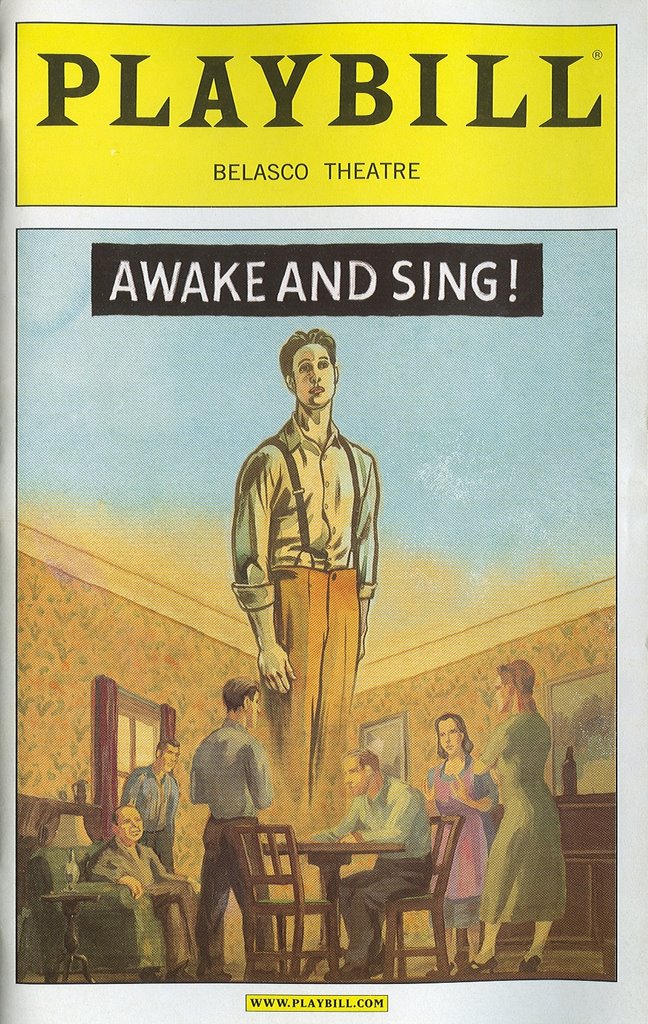
The two other dramatic offerings I’ve seen this year are not quite as successful, although both qualify as worthy endeavors. Lincoln Center Theater serves up a revival of the 1935 social polemic Awake and Sing!, the most celebrated work of playwright Clifford Odets. If you’ve never heard of it, there’s a reason: although regarded as a seminal work, it doesn’t fully measure up to its exalted reputation. Although given an intelligent production by director Bartlett Sher, and expertly performed by a star-studded cast featuring Ben Gazzara, Mark Ruffalo, Zoe Wanamaker and Lauren Ambrose, there’s very little that talent could have done to disguise both the play’s age and its obvious limitations. Written in tough-talking period slang so florid it would make James Cagney blush (clearly these characters hail from the same environs as The Dead End Kids), the play wears its social indignation and political agenda-pushing a little too prominently on its careworn sleeve. The characters, members of a downtrodden Jewish family living in the squalid tenement slums of lower Manhattan, exist as an illustration of the manner in which the proletariat is oppressed by the commercial classes. By the time the idealistic young hero is exhorting his fellow men to till the earth, the combination of hokiness and preachiness has become difficult to accept with a straight face. That said, the production is very well-acted, particularly by Ruffalo as a hard-bitten realist who actually manages to make his slang-heavy dialogue plausible, and by Wanamaker as the matriarch who has been made cynical and grasping by years of struggle and compromise.

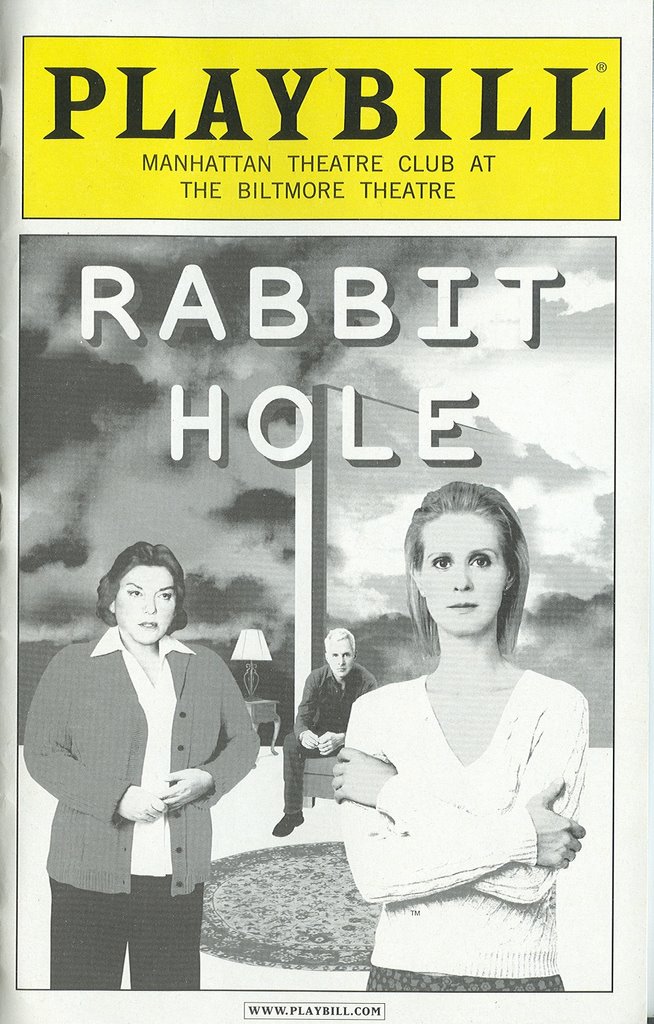 David Lindsay-Abaire’s Rabbit Hole has the rather dubious distinction of being the only work by an American playwright to be nominated in the best play category. The author became something of a critical darling for his unconventional, absurdist off-Broadway comedies Fuddy Meers and Kimberly Akimbo — for his Broadway debut, he apparently decided to make a 180 degree turn into the relative safety of poker-faced realism, and the result feels like a very calculated effort at mainstreaming (notice I didn’t say selling out, because the play is obviously a work of genuine feeling rather than a cynical concession to popular taste). To be fair, Lindsay-Abaire’s talent as a writer is clearly in evidence, which only partially serves to compensate for the rather uninspired subject matter he’s chosen to explore. The play is about two parents coping with the death of a young child and learning how to heal — if that sounds a bit Hallmark Hall of Fame, that’s sort of how it plays. The consummate skill of Cynthia Nixon, who plays the role of the grieving mother, lends emotional credibility to a play that is otherwise bogged down in what often borders on maudlin, movie-of-the-week style dramaturgy, while Tyne Daly contributes a welcome element of humor in a supporting role. Both women are nominated for Tony Awards — Nixon’s prospects for winning lead actress look very good in what is considered a rather weak category. Since Mr. Copeland and I are both card-carrying members of the Cynthia Nixon fan club — my admiration for the actress dating back to her stage work in the mid-'90s (particularly Phyllis Nagy’s avant-garde production of The Scarlet Letter at CSC in 1995), Edward having been in thrall to her charms ever since Sex & The City — this will provide us with a mutual rooting interest.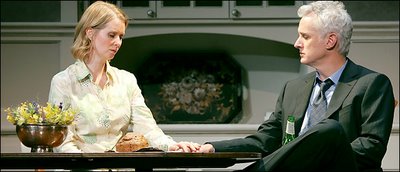
It’s become a favorite pastime of the critics to lament the state of the American musical. Such was the case a few weeks ago, when Ben Brantley wrote what amounted to an obituary for the Broadway tuner in The Sunday Times, summarily dismissing virtually every new show that opened during the 2005-2006 season while measuring them unfavorably against the two hit revivals. The response to the piece within the Broadway community was one of righteous indignation — at the Drama Desk Awards, one of the producers of The Drowsy Chaperone blasted the critic for his comments in his acceptance speech (telling Brantley he “needed to get out more”), to roars of approval from those in attendance — this despite the fact that Chaperone was just about the only new show Brantley didn’t run through the shredder.

While I appreciate many of Brantley’s points, and would certainly make no attempt to defend any season which inflicted upon the populace the likes of The Wedding Singer and Elton John’s Lestat (which I have not seen, but have heard enough about to steer well clear of), I think it’s a bit premature to sound the death knell for the Broadway musical — if anything, we’ve probably seen an upswing in recent years. Coming off the doldrums of the '90s, a decade which produced only two truly outstanding new musicals (City of Angels and Rent) wedged in between an assortment of qualified successes, outright turkeys, and innumerable revivals, 21st century Broadway has already given us The Producers, The Full Monty, Hairspray, Avenue Q, and The 25th Annual Putnam County Spelling Bee, plus the slight but enjoyably silly romp that is Monty Python’s Spamalot. While tourism-savvy Broadway still churns out a lamentable number of overproduced theme park rides masquerading as theater, or at the other end of the spectrum, cost-effective Lawrence Welk-style revues cobbled together from recycled Billboard hits of yesteryear, there are more interesting and worthy new shows out there today then there were ten years ago. Which is not to say that the Golden Age of the Broadway Musical isn’t already several decades behind us.
This being the case, it’s the revivals that are greeted with the most enthusiasm by contemporary critics, and the current season features two that have each drawn a great deal of praise.
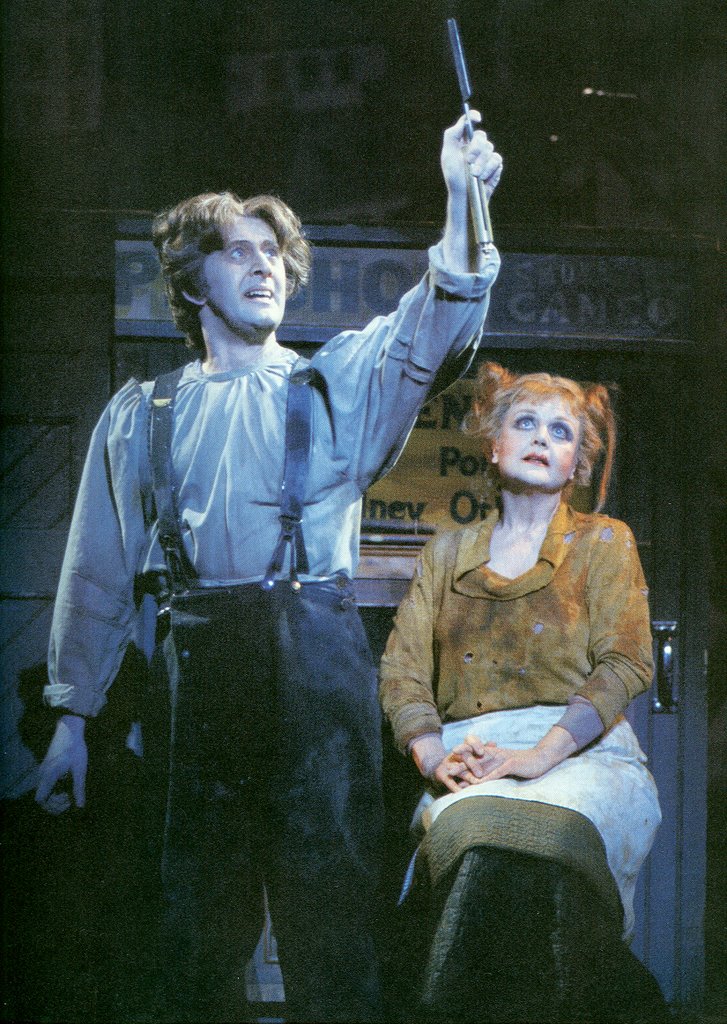
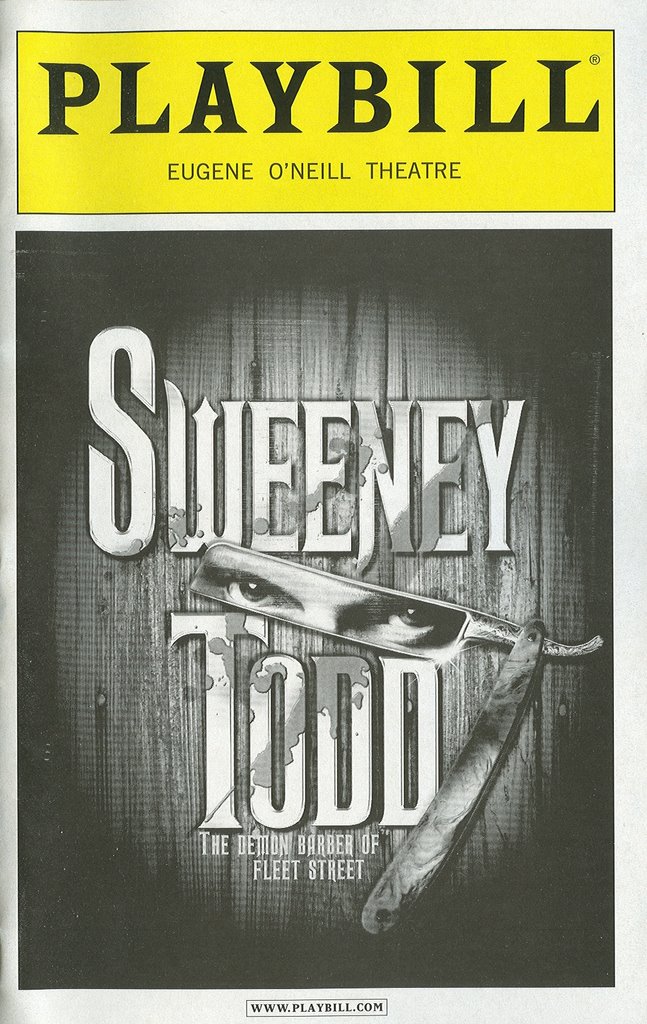
For anyone unfamiliar with Sweeney Todd, The Demon Barber of Fleet Street, I implore you on bended knee to put the American Playhouse filmed version of the stage production — featuring the show’s original star, Angela Lansbury — at the very top of your Netflix queue. If you don’t have Netflix (or something comparable), then take out your credit card credit card and buy the damn thing on amazon.com (or something comparable). And if you don’t have a credit card, steal one. It’s one of the two or three greatest works ever created for the American musical theater, and even you don’t like musicals, you’ll like this one. Either that, or you’ll have forfeited the right to consider yourself a person of taste (sorry, but there are some things I can’t be practical about, and Sweeney Todd is one of them).
I can’t do full justice to the intricately devised plot of the show without testing the patience of anyone reading this, but I’ll try to sum it up as best I can: in a nutshell, the show is based on a penny dreadful — the 18th century equivalent of the kind of grisly tales kids swap around campfires — about a demonic barber in the slums of Victorian England who kills his clients and sends their bodies to his sweetheart, the owner of an establishment which makes and sells meat pies. Which implies exactly what you think it does. Composer-lyricist Stephen Sondheim and librettist Hugh Wheeler tweaked the formula by fashioning their adaptation of the gory legend as a meditation on social inequity. It’s a classic revenge fantasy in which the haves, the people who have power and abuse it, get the comeuppance they deserve for shitting all over the have-nots. These tyrants, men of wealth and consequence who take gross liberties with the privileges birth and status have given them, are served to the victims of their oppression on a plate. Literally. In this version of events, Sweeney Todd, a poor barber, is framed for a crime he didn’t commit by a corrupt judge who covets his beautiful young wife. Sweeney is conveniently dispatched to a penal colony in Australia — he returns under an assumed identity many years later to be told of how his wife suffered at the hands of his nemesis, and subsequently committed suicide. This barber doesn’t kill people merely because he gets a kick out of it — unhinged by bitterness and grief, he seeks to exact revenge on those who ruined his life. When he meets up with the cheerfully amoral Mrs. Lovett, a wily opportunist with the good sense to utilize his bloodlust to maximize her profit margins, the diabolically enterprising team successfully convert half the population of London into unwitting cannibals.
 Hal Prince’s legendary 1979 staging was an elaborate spectacle done in period style with Victorian sets and costumes — most subsequent productions, though perhaps more modest in scale, haven’t made a radical departure from this template. John Doyle, who helmed the current Broadway revival, has opted for an entirely different approach — and to call it a radical departure would be an understatement. It’s a boldly minimalist staging which forgoes any attempt at realism — for starters, the actors double as the orchestra (the effect really has to be seen to be appreciated, but it involves some logistically complex stagecraft and dextrous multi-tasking by the cast). The production style is non-period-specific, and decidedly avant-garde; for those unfamiliar with the story, certain things may be a bit confusing, since this is not a literal-minded representation of the action. For example, each murder, rather than being acted out, is indicated when the actors pour quantities of blood from one bucket into another. The cast of ten actors double and triple in various roles without much in the way of costume changes, and often in ways the defy the specifications of gender or age. It’s a very conceptual approach, and one
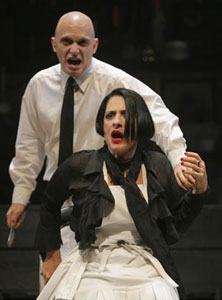 which produces very satisfying effects, although the lushness of Sondheim’s complex and melodic score is somewhat lost without the benefit of a full orchestra. If there’s anything missing from this production, it’s the element of gleeful black humor that Sondheim, Wheeler and Prince used in the original to balance out the bleak nature of the subject matter. The original Sweeney was blissfully funny, due in no small part to the performance of Angela Lansbury as the delightfully grotesque Mrs. Lovett. While her broadly comic creation was informed by the classic traditions of the English music hall (which involves plenty of mugging and exaggerated mannerism), the Mrs. Lovett of Patti LuPone is decidedly subdued, more hard-bitten pragmatist than Grand Guignol cut-up. What this does, in effect, is to rob the show of the required element of comic relief, a necessary function the character must serve in order to keep things from getting too depressing (which is exactly why Sondheim and Wheeler conceived the character in a comic vein). Still, the actress is widely considered the favorite to win her second Tony for the performance — her first having come for playing the title role in the 1980 Broadway premiere of Evita.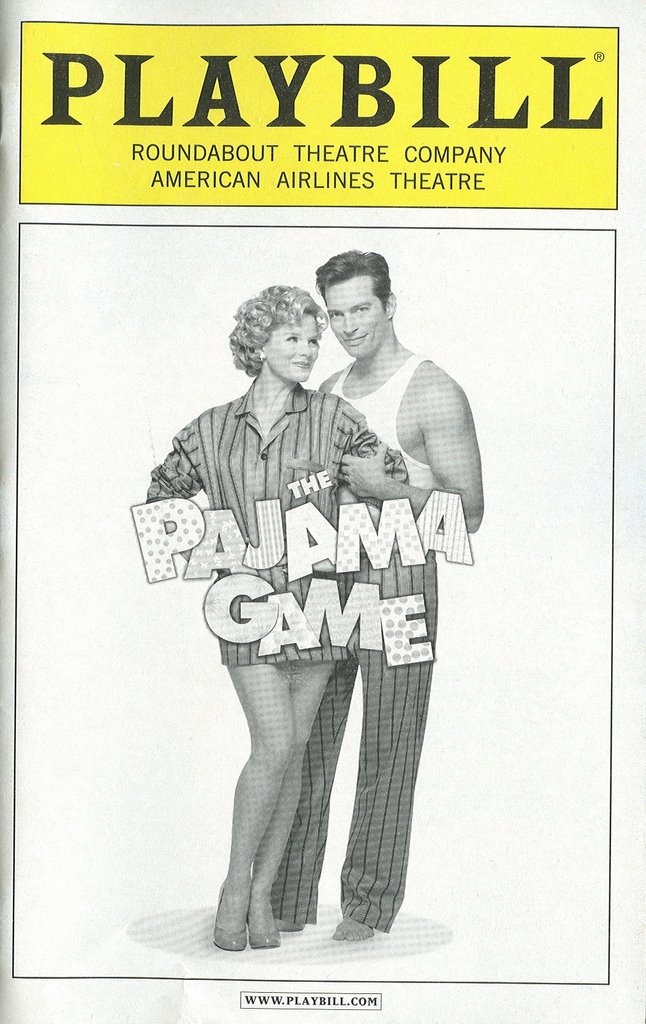
Whereas this production of Sweeney is defiantly nontraditional, the season’s other musical revival of note is decidedly square…which makes it no less of a triumph. The Pajama Game is the kind of kitschy, cornball entertainment that probably seemed clever and witty back in 1955 — by modern standards, it’s about as sophisticated in its attitudes as Pillow Talk, the squeaky-clean sex comedy of 1959 starring Rock Hudson and Doris Day (it’s no accident that Day top-lined the 1957 film version of The Pajama Game). It’s a cute boy-meets-girl tale set in a pajama factory — since the course of true love never did run smooth, she’s a union agitator, he’s management. A proposed strike presents an obstacle to their romance — boy loses girl, boy gets girl back.
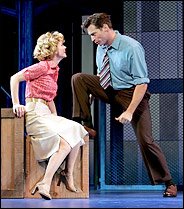
It’s the kind of sappy, precious material that really has no business working in a contemporary context — but never underestimate what a great chef can do with day-old bread. Nearly everything about the production confounds expectation; credit director-choreographer Kathleen Marshall (sister of filmmaker Rob) for sprucing up an old chestnut with style and verve. Her crackerjack production succeeds in making The Pajama Game seem less trite and coy than it actually is, while still managing to stay absolutely true to the spirit of source material. This is due in no small part to the presence of Harry Connick Jr., making a remarkably polished and assured Broadway debut as the show’s romantic lead. In additional to his sublime vocals, which capture the full vintage flavor of the Adler and Ross score, he creates a wonderful chemistry with golden-voiced leading lady Kelli O’Hara, who has an astute, knowing quality which gives her wholesome girl-next-door character a nice bit of an edge. The interplay between the two recalls classic scream teams like Hepburn & Tracy and Bogart & Bacall — it’s smart, sexy, and when they spark, it strikes just the right balance between sophistication and playfulness. The show has a lock on only one Tony (for best choreography), and looks likely to come up short in all the other categories in which it’s nominated. Still, if the production can only take home one award, it’s only right that Marshall’s dance routines should be the beneficiary. Worthy of special mention are her dizzy "Once-a-Year-Day" ballet, a nifty nod to the Fosse style with "Steam Heat", and above all, a dazzlingly staged and executed "Hernardo's Hideway" which weaves Connick's piano-playing skills seamlessly (and quite ingeniously) into the fabric of the dance.

One show that is canny enough to exploit the gap between the heyday of Cole Porter and what often passes for musical theater today has become the heavy favorite to win best musical. Instead of operating on the pretense that the state of contemporary musicals is right as rain, the show emphatically and hilariously insists that the celebrated hit of today doesn’t even stack up to yesterday’s mediocrity. The central character, billed only as Man in Chair, opens by the show by telling us he hates theater (“Well, it’s always so disappointing isn’t it…please, Elton John, must we continue with this charade?”). A middle-age musical theater buff of indeterminate sexuality and multiple neuroses, The Man holds court from his cluttered studio apartment, treating the audience as his guests and extolling the virtues of his favorite 1920s musical. The show is The Drowsy Chaperone, a madcap romp involving a dewy-eyed heroine, her stalwart suitor, a tippling grand dame, a dithery socialite, a supercilious butler, an anxious Broadway producer and a pair of gangsters who crash a wedding and pose as pastry chefs — the kind of frothy, featherweight concoction that was Broadway’s stock-in-trade during the era of Ziegfeld pastiche. The twist is that while Man in Chair plays the album for us, the show comes to life before our very eyes in his apartment (with various characters making their entrances from out of the refrigerator or whatever other ports of entry are available). The narrator doesn’t dematerialize, nor is he magically transported inside the show to become a participant, ala The Purple Rose of Cairo. Instead, he sits on the sidelines, commenting on what we’re seeing, offering amusing bits of trivia about the actors (for example, one earned the moniker The “Oops” Girl for her ability to cause men to suffer accidents, while another was apparently found dead in his Italian villa partially devoured by his own poodles), and occasionally singing along when not apologizing to the audience for parts of the show that are more ludicrous than others (“please do your best to ignore the lyrics and enjoy the melody” he says of a torch song that employs the awkward metaphor of monkey love to describe a relationship gone sour). I’m always slightly skeptical of shows built around a gimmick; but the witty conceit that provides the basis of The Drowsy Chaperone proves disarmingly effective — especially when it allows for riotously funny bits of business as a dance sequence that goes slightly amiss when the record begins to skip, or the moment when The Man inadvertently plays the record from a different show when changing LPs before going off on a bathroom break (what we get is a hilariously racist song from another 1920s show bearing a striking resemblance to The King and I).
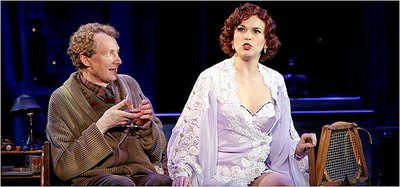
As Ben Brantley observes in his review, the show-within-a-show isn't as good as The Man's running commentary, but the flaw is hardly fatal. The music and lyrics, by a novice team, are undistinguished, but the libretto is strong throughout. Bob Martin is wonderful in the lead, while Sutton Foster makes the most of her two show-stopping numbers (one of which features her jumping through hoops, juggling plates, throwing her voice, and doing cartwheels while insisting she doesn’t want to be the center of attention). Beth Leavel, who plays the title role as a martini-soaked grand dame, is the heavy frontrunner in the featured actress category — that said, the performance is way too broad for my taste and the shtick wears thin rather quickly.

Needless to say, of all works of contemporary fiction, Alice Walker’s Pulitzer Prize-winning The Color Purple has always been the second most obvious candidate for adaptation into a crowd-pleasing Broadway musical (the first, I’m sure we can all agree, being The Bonfire of the Vanities). Produced for the stage by the all-powerful multimedia conglomerate known as Oprah, who not un-coincidentally played the role of Sofia in Steven Spielberg’s 1985 cinematic version, the show actually works better than one might expect — which is not to say that it was ever a good idea in the first place. This Color Purple seems to draw the bulk of its inspiration from the Spielberg film rather than the source novel; this being the case, it shares many of the movie’s flaws. It was always somewhat disheartening for lovers of the novel to see the mood created by Walker’s spare, gritty prose jettisoned in favor of a heartwarming, candy-colored tearjerker populated by exaggerated stereotypes. The show attempts to replicate the effect, and just as the film did, tries to shoehorn too many narrative threads into an overly condensed format. Still and all, it works on the level of entertainment, and provides two and half hours of pleasant, if ultimately unmemorable, diversion. The standouts from the large cast are Felicia P. Fields as the brash Sofia, Elisabeth Withers-Mendes as the sensual Shug, and the lumnious LaChanze, who navigates Celie's transition from meek acquiescent to independent spirit much more convincingly than Whoopi Goldberg did. Since the combination of brass lungs and power ballads usually carry some weight with voters (as was the case when Idina Menzel’s strenuous vocal pyrotechnics in Wicked helped her to vault past Donna Murphy and Tonya Pinkins two years ago), LaChanze's powerfully sung performance considered a strong contender for the win.
The most interesting and ambitious new musical I’ve seen this past year is Grey Gardens, which played a limited engagement at Playwright’s Horizons in preparation for a Broadway run. I’ll have a lot more to say about the production and the cult documentary film on which it is based when the show opens at the Walter Kerr Theater in the fall. The performance given by the production’s lead actress, Christine Ebersole, may qualify as the best I’ve seen on any stage this year, and would surely be considered a strong contender for a Tony if off-Broadway productions were eligible for consideration. The Tonys are produced by The League of American Theatres and Producers (jointly with the American Theatre Wing). As many critics of the Tony Awards have observed, the Broadway producers are resistant to the inclusion of off-B'way productions; as far as they're concerned, the Tonys exist first and foremost as an opportunity to promote their own product, to the exclusion of all else. That being the case, the nominations don't represent a fair sampling of what the season has to offer; Broadway shows account for only a small percentage of the productions that open each year. In view of these circumstances, one might be justified in viewing the Tony Awards as more of an industry trade show than a merit-based competition. But that’s a discussion for another day….and besides, even if you know the thing is rigged, it doesn’t make it any less fun to watch.
In speaking with friends about shows I've seen, I’ve encountered many cynics who assert that theater is no longer relevant as popular culture (we call these people philistines…just kidding). It doesn’t seem as if many younger actors of my acquaintance even aspire to be stage performers; the perception seems to be that theater is something you do to hone your craft while waiting for the big break to materialize — a launchpad to film and television work. It’s true that, in an age dominated by electronic media, the audience for theater has shrunk considerably. Broadway doesn’t have the same kind of prominence that it once did, when stage-based performers such as Mary Martin or Ethel Merman could attain the status of household names, or a new discovery such as Barbra Streisand or Carol Burnett could become an overnight sensation based on a Broadway success. People of my parents’ generation grew up with an awareness of theater — the original cast recording of My Fair Lady, for example, was one of the best selling albums of its year, and its score was almost universally heard and enjoyed even before the Warner Bros. film adaptation arrived on the scene. It’s hard to imagine something like that happening today, when instances of Broadway productions blossoming into pop culture phenomena are few and far between (the Lloyd Webber shows of the '80s may come the closest). But for those who are willing and able to take the time to look, the pleasures that this art form still affords are undeniable and, I would suggest, vital. Live theater can still take you places that movies and television never could. So if you can make it to New York, for gosh sakes, see a Broadway show — it’ll only cost you an arm and a leg. Which doesn't seem like too much of a sacrfice when you consider what certain characters in The Lieutenant of Inishmore and Sweeney Todd have to part with.
Tweet
Labels: Bacall, Bogart, Cagney, Cole Porter, Cynthia Nixon, Doris Day, Fosse, Julia Roberts, K. Hepburn, Lansbury, Law and Order, Musicals, Rock Hudson, Sondheim, Spielberg, Streisand, Tarantino, Theater
TO READ ON, CLICK HERE