Thursday, May 16, 2013
Leave the rooster story alone. That's human interest.
BLOGGER'S NOTE: This post originally appeared Jan. 18, 2010. I'm re-posting it as part of The Howard Hawks Blogathon occurring through May 31 at Seetimaar — Diary of a Movie Lover

By Edward Copeland
The list of remakes that exceed the original is a short one, especially when the original was a good one, but there never has been a better remake than Howard Hawks' His Girl Friday, which took the brilliance of The Front Page and turned it to genius by making its high-energy farce of an editor determined by hook or by crook to hang on to his star reporter by turning the roles of the two men into ex-spouses. Icing this delicious cake, which marks its 70th anniversary today, comes from casting Cary Grant and Rosalind Russell as the leads.
Words open His Girl Friday declaring that it takes place in the dark ages of journalism when getting that story justified anything short of murder, but insists that it bears no resemblance to the press of its day, 1940 in this case. What saddens me today is, despite the ethical lapses and underhandedness and downright lies
 committed by the reporters in this version (and really all versions based on the original play The Front Page by Ben Hecht and Charles MacArthur, themselves once Chicago journalists), their energetic devotion to capturing the story seems downright heroic compared to the herd mentality and lack of intellectual curiosity we see exhibited most of the time today by pack journalists such as the White House press corps. It's really why the first two film versions of the play are the only ones that work. The 1931 Lewis Milestone adaptation starring Adolphe Menjou definitely belonged to its time and Hawks' take with its inspired twist came along close enough to remain relevant. When Billy Wilder tried to remake the original in 1974 as a period piece with Jack Lemmon and Walter Matthau, it fell flat because in the era of Vietnam and Watergate, journalists actually existed in a moment of heroism for their profession. The 1988 disaster Switching Channels returned to the His Girl Friday model with Burt Reynolds and Kathleen Turner and tried to set it in the world of cable news but the only update they came up with was hiding the fugitive in a copy machine instead of a rolltop desk.
Each time I write one of these anniversary tributes, no matter how many times I've seen the film in question (and I can't count that high when we're discussing Friday, I try to watch the movie again, in a quest for fresh thoughts and reminders of lines that may have slipped my mind. In nearly every, case I notice something new (and with the rapid-fire pace of Friday's dialogue, remembering them all borders on impossible). What stood out as I
 started this salute wasn't just the work-a-day newshounds it depicts compared to the state of the industry today but the social subtext emerged more prominently this time. It's not that I've missed or ignored it before, but it's the light-speed comic hijinks that keeps me coming back. The story's main focus may concern Walter Burns (Grant), that sneaky editor of the Morning Post, trying to keep his ex-wife Hildy Johnson (Russell) from leaving the paper and his life to wed insurance agent Bruce Baldwin, who looks like that fellow in the movies, you know, Ralph Bellamy (who fortunately plays Bruce). However, the story Walter uses to keep his hooks into Hildy concerns that of Earl Williams (John Qualen), a man who killed a cop and received a ticket on a bullet train to the gallows by a politically hungry Republican mayor with an eye on unseating the Democratic, anti-death penalty governor, despite the fact the reporters and many others believe Earl's mental
 illness should stop his hanging. Qualen, a solid character actor in many films, and Mollie Malloy (Helen Mack), a woman who befriended Earl prior to the slaying and who the tabloids misrepresent as his lover and a prostitute, stand apart as the only characters in this screwball farce who play it completely straight. (In an all-time bit of miscasting, in the Wilder remake, Carol Burnett got the Mollie Malloy role. Of course, the nearly 50-year-old Jack Lemmon also was engaged to the 28-year-old Susan Sarandon in that film.) His Girl Friday requires neither Qualen nor Mack to garner laughs like every other character. As the courthouse reporters behave particularly cruelly to Mollie at one point, only Hildy comforts her. "They ain't human," Mollie cries. "I know," Hildy sympathizes. "They're newspapermen." Hildy realizes the jobless Earl spent too much time listening to socialist speeches in the park and his fascination with the concept of "production for use" led to his fatal error.
Social message aside, it's the earth-shattering cosmic comic chemistry of Grant and Russell, aided by Bellamy's perfect innocent foil and countless supporting vets. (One of them, Billy Gilbert, plays Mr. Pettibone (Roz holds his tie in the photo above) and I wish I could have found a good closeup photo of him because I think it's hysterical how much 9/11 mastermind/terrorist asshole Khalid Sheikh Mohammed resembles Gilbert in KSM's arrest mugshot.) The lines come fast and furious. While many do come from the original Hecht-MacArthur play, Hawks gets the credit for the film's amazing speed (though screenwriter Charles Lederer deserves more kudos). Still, in the end, Cary and Roz make the dialogue sizzle and Grant's physical touches serve as a master class in comic movement on film. Watch every little bounce he makes as Hildy kicks him beneath the table when he's trying to get things past poor Bruce and you'll crack up every time. Originally, I was writing down all my favorite lines, planning to try to work them all into this tribute, but then I thought: Maybe not everyone has seen His Girl Friday, even after 70 years,
_04.jpg)
Tweet
Labels: 40s, Bellamy, Burt Reynolds, Cary, Hawks, Hecht, K. Turner, Lemmon, Matthau, Menjou, Milestone, Movie Tributes, Remakes, Roz Russell, Susan Sarandon, Wilder
TO READ ON, CLICK HERE


Monday, April 04, 2011
This story is laid in a Mythical Kingdom

By Edward Copeland
Those words grace a title card before the credits for the 1931 version of The Front Page, literally set against the turning pages of a newspaper begin. The first screen version of the hit Broadway comedy (produced by Howard Hughes) about Chicago newspapermen covering an impending hanging written by former Chicago reporters Ben Hecht and Charles MacArthur turns 80 years old today. It would go on to be revived three times on Broadway and remade three times on film, in one case accomplishing the rarest of things. The 1931 version remains a very good film and, typically, remakes of good movies fall flat on their ass but its first remake, 1940's His Girl Friday, actually improved on it. The same could not be said for the two later remakes, one of which was even directed by Billy Wilder. We may speak of the other films later, but today we salute the first film incarnation with Adolphe Menjou as Walter Burns and Pat O'Brien as Hildy Johnson.
Since His Girl Friday is one of my favorite films of all time, the story of The Front Page plays quite familiarly to me and since I've the seen the original several times as well (though not recently), I decided to focus on different aspects upon my return trip for this 80th anniversary piece. First, for those who might know the story only through His Girl Friday or aren't acquainted with the story at all, a brief plot summary. The main conflict concerns Walter Burns, editor of The Morning Post, a Chicago tabloid, who doesn't want to lose his ace
 reporter Hildy Johnson, who is planning to leave the state and start a new life after getting married. It's set against the backdrop of the impending execution of a particularly controversial convicted killer that has been politicized by the town's mayor and sheriff who face re-election and the governor, who belongs to the opposite party. The key difference, and what really made His Girl Friday work even better, is that they made Hildy a woman and Walter's ex-wife. In the original, Hildy is a man and as great and funny as The Front Page is, something strange lurks in the idea that a newspaper editor would be so possessive of his reporter that he'd want to thwart his marriage and his exit to another state and a better job just to keep his hooks in him. It isn't just Hildy that the Walter of The Front Page acts this way about either. The boys in the criminal courts newsroom mention the time another reporter tried to leave the Post and Walter tricked him into a fight so he'd get arrested and thrown in jail on assault and battery charges and only Walter could bail him out provided he returned to his job.
Synopsis out of the way, what stood out the most to me this time about The Front Page was how exceptional Lewis Milestone's direction was. In the very first year of the Oscars, they had for the first and last time the category of best comedy direction and the prize went to Lewis Milestone for Two Arabian Knights, a silent which, despite its title, actually was set during World War I. To show how diverse he could be, he won best director again two years later for another WWI tale, that year's best picture, All Quiet on the Western Front. The following year, he received his third and final best director nomination for The Front Page and a quite deserved nomination it was. The fast-paced, overlapping dialogue that everyone tends to credit as an invention of Howard Hawks in His Girl
 Friday really can be found nine years earlier in Milestone's The Front Page, albeit not executed by as interesting actors as in His Girl Friday. In fact, I think the inability to match that pacing doomed Wilder's 1974 remake and was just one of the many reasons that the 1988 remake Switching Channels starring Burt Reynolds and Kathleen Turner resulted in such a disaster. That isn't Milestone's only contribution though. As he showed in Western Front, he also happened to be one of cinema's early visual masters. When it gets to the point in the story when condemned man Earl Williams (George E. Stone) escapes and the reporters in the criminal courts press room clear out, Milestone combines a wonderful montage of their editors back at their newspapers calling for them as he keeps cutting back to a continuous pan of the unmanned phones in the press room. One of my other favorite shots comes later in the film when Hildy and Walter (O'Brien, Menjou) try to keep everyone out because they are hiding Earl in the press room and Hildy's fiancee Peggy (Mary Brian) shows up to see why Hildy hasn't made it to the train station. Peggy argues with Hildy who tries to flee her walking backward, still clutching his typewriter, while they circle Burns who is giving orders over the phone at the same time he interjects his own comments in Hildy and Peggy's dispute.
This Front Page also existed in that glorious pre-Code era where it could get away with lots of things films just a handful of years later wouldn't be able to do. It opens with gallows humor — literally. We open with a closeup of a large sack of flour whose slogan reads "SUNSHINE FLOUR INSURES DOMESTIC HAPPINESS." The camera pulls back to show that it's being used to test the rope that will be used to hang Earl Williams the following morning. As it's released and the bag of flour drops through the platform, one man tells another to make certain that the rope works well enough this time. "Last time the guy bounced up and down like he was on a rubber band." The man insists he allowed for the proper weight, but the guy below says the last condemned inmate added weight like they all usually do by stuffing himself during his last meal and "The sheriff wants his neck to snap this time." The noise below disturbs the men of the press who can see and hear the scene a few stories above from the criminal courts press room. One thing that does set The Front Page apart from its remakes, even His Girl Friday, is that the other reporters are more distinctive as characters. Not that they have their own stories, but they stand out more as individuals, especially with standout character actors such as Edward Everett Horton, Frank McHugh, Slim Summerville and others filling the roles.

In another pre-Code touch, the character of Mollie Malloy, the woman abused by the members of the press by having befriended Williams, actually refers to herself as a streetwalker where I don't remember any of the other movie versions coming out and calling her a prostitute. I know they didn't in His Girl Friday and it's been a long time since I've seen the Wilder version with the horribly miscast Carol Burnett. Switching Channels is such a wretched piece of filmmaking that I only saw that once and checking IMDb, every character's name was changed and I don't recall a Mollie Malloy equivalent anyway since they tried to
 update it by setting it in the world of cable news. One other thing I always find interesting is the slight physical resemblance between Stone as Earl Williams here and John Qualen as Earl in His Girl Friday, though the characters are quite different otherwise. In the 1931 Front Page, Mae Clarke played Mollie and, as in the two other versions in which her character appears, she does take the dive out the window as a distraction, so it makes the grapefruit Clarke took to the face from James Cagney the same year in The Public Enemy not seem as bad. While the reporters' portrayal comes off as callous and cruel in His Girl Friday and even Wilder's 1974 version, they prove to be even harsher and more heartless in the original. As
 Mollie tells them at one point, "If you were worth breaking my fingernail on, I'd tear your faces off." In the very first scene of the film, we see the reporter McCue (Frank McHugh) calling a peeping tom victim on the phone and harassing her while the other newsmen in the room shout lewd remarks. She finally hangs up on him when he asks if she played Lady Godiva once for charity. The films, to say the least, do not offer the most noble or shining examples of The Fourth Estate. Even the ostensible hero of the piece, Hildy Johnson, who actually seems to be a good reporter who strives to get the facts right while the other reporters have no qualms about making up stories as trivial as what Williams will be having for his last meal, isn't above chicanery to get what he needs. Granted, it's a story from the days of yellow journalism, but one has to wonder if more truth managed to sneak out then than now when so many government reporters seem to be little more than stenographers.
The most famous supporting actor playing one of the reporters is the incomparable Edward Everett Horton and, as in many of his films such as the countless Astaire-Rogers musicals in which he took part, he's the standout here as Roy V. Bensinger, a germ-obsessed, prissy writer who isn't quite as nasty as the rest and who owns that rolltop desk that proves so pivotal in the plot (and holds his rhyming dictionary as well). We first meet Bensinger when he returns from a trip to the "death house" where Earl Williams awaits his execution and the conditions drive Bensinger batty, saying they are so awful they need to be reported to health authorities. "It's amazing these prisoners live long enough to be killed," he tells the other reporters. Of course, he becomes a victim of Walter Burns' scheming later when he and Hildy have hidden an escaped Earl Williams within his rolltop desk and need to sneak it out of the building, so Burns hires Bensinger to get him out of the building while telling his man Duffy to look over his work, tell him it stinks and stick him somewhere else. It's one of the things Walter does that makes Hildy want to get as far away from him as possible, though Burns argues than it will teach Bensinger for leaving his newspaper without giving notice.
What I'd also forgotten and that sets the 1931 Front Page apart from later versions stems from a racial undercurrent in the storyline. Now, no African-American characters appear in the film (though one slur term for them is used) but Earl Williams has been painted by the corrupt mayor and sheriff (James Gordon, Clarence H. Wilson) as a communist who took part in a demonstration and killed an African-American police officer as part of their plan to woo the black vote for re-election the week following Williams' execution. Of course, it's mostly lies, printed by the always willing-to-run-anything press. The truth comes out when a few hours before his execution, the sheriff is forced to make Williams meet with another psychologist, one Professor Englehoffer (Gustav von Seyffertitz), who suggests re-creating the crime so the sheriff hands Earl his gun and William promptly shoots the professor in the gut and escapes.
As Earl ends up being hidden by Hildy (with Mollie helping at first and eventually Burns), he tells his story. He was a man who had been fired from his job after 14 years and was at wit's end. He declares, "I'm not a Bolshevik, I'm an anarchist." Earl also begs for people to let him die. He wants to go back and await the hangman's noose, but there are too many people with too many agendas to let that happen. "Better to die for a cause than the way most people die — for no reason." Hildy's problem is that as much as he hates Burns and the job he does, he is addicted to the job and every time a new development falls into his lap, he can't stop himself from calling it in to Walter and trying to write it up so they can scoop everyone, even if it results in alienating fiancee Peggy further and even watching as Burns has his crooked henchman Diamond Louie (Maurice Black) abduct Hildy's future mother-in-law (Effie Esler).
Hildy tries his best to escape Walter's net, which starts out with Burns offering cash to anyone who can find Hildy, who at the time is obtaining his marriage license with Peggy. Hildy dreams of moving to New York where he has a job lined up with an ad agency for $150 a week. Peggy's bright enough to know that
 he's too addicted to the news game to give it up easily, no matter how hard Hildy tries to convince her. "Ever climbed out of the sewer and smelled the cool, fresh air? You are the cool, fresh air," Hildy tells her. When Peggy does bust in on the newsroom in that one scene and Hildy tries to explain that it's a big story, she does sort of put him in his place with a line of dialogue that seems particularly timely even today. "It's always a big story, the biggest story in the world and the next day you can't remember what it was about," she tells him. It reminds me of when we were transfixed as the Iranian people took to the streets protesting their stolen election and fraudulent dictatorship only to have it instantly vanish from view the moment Michael Jackson dropped dead and sucked all the air out of the news for a week or more. O'Brien does fine as Hildy, but it's Menjou's Burns who steals the show. It earned him an Oscar nomination, though as good as Menjou is, he's no Cary Grant. The Front Page itself also earned a best picture nomination. The only one of the five nominees from 1930-31 I haven't seen is East Lynne, but of the four I have, The Front Page wins by a mile and the fact that Cimarron won best picture at all is ridiculous. If not The Front Page, Skippy or Trader Horn deserved it before that dusty Western.
As The Front Page ends, Menjou's Burns even manages to charm Peggy and convince her that he's not all bad. As a wedding gift, he gives Hildy his golden pocketwatch engraved, "To the finest newspaperman I've ever known Walter Burns" and tells him he can scratch his name out and put in his if he likes. They drop the sound, so you can't hear the last word of the final punchline, which Walter Matthau at least got to deliver in Billy Wilder's version, when Burns calls Duffy and tells him to radio ahead to the train's first stop and give the sheriff Hildy's description and have him arrested. "The son of a bitch stole my watch."
His Girl Friday remains my favorite, but this 80-year-old version of a play which premiered in 1928 is pretty damn good as well. I've never seen The Front Page staged in its play form, but it would have been fun to see either of its last two Broadway revivals since the 1986 revival's Walter Burns was John Lithgow and, even more intriguing, the very successful 1969 revival starred Robert Ryan as its Walter Burns. When is that time machine getting built for me already?
Tweet
Labels: 30s, Astaire, Burt Reynolds, Cagney, Cary, Ginger Rogers, Hawks, Hecht, Howard Hughes, Lithgow, Matthau, Menjou, Milestone, Movie Tributes, Musicals, Oscars, Remakes, Robert Ryan, Silents, Wilder
TO READ ON, CLICK HERE
Tuesday, December 25, 2007
Into the trenches

By Edward Copeland
Seven years before movie fans met Gen. Jack D. Ripper and Gen. Buck Turgidson, Stanley Kubrick brought us another off-his-rocker military man, this time a French general named Paul Mireau who was introduced 50 years ago today in Paths of Glory, one of Kubrick's greatest films.

Paths of Glory takes place in 1916 France, not that any of the actors, especially lead Kirk Douglas as Colonel Dax, sound particularly French, but that hardly matters because this tale about the absurdity of war could have been set in any time in any country in any war. Kubrick's film is unusually short, at least for a war film, running less than 90 minutes. For those who haven't seen it (and shame on you who haven't), Paths of Glory centers on one particular battle between the French and the German, where the poor French troops are outmanned and outgunned, but that's no excuse for disobeying orders in the eyes of Gen. Mireau. Mireau believes anything is possible and some things aren't. When he asks a soldier if he's ready to kill more Germans and the catatonic man can't respond, he refuses to accept the explanation that the man suffers from shellshock because he doesn't believe there is such a thing as shellshock.

When the soldiers are forced to retreat, Mireau even orders his artillery men to unleash their barrage on his own troops. With most of his troops unable to take the hill he seeks and others under his command refusing to carry out his lunacy, Mireau smells mutiny in the air and demands satisfaction. "If those little sweethearts won't face German bullets, they'll face French ones," Mireau declares before meeting with his superior, Gen. Broulard (the great Adolphe Menjou) and Dax, who oversees the men, to start court-martial and execution proceedings. Dax clearly sees Mireau's derangement, as the general first asks to execute 100 of the surviving soldiers. Dax even volunteers to stand in for his men, before Menjou brokers a compromise, first getting the numbers down to 12 before settling on 3 (1 from each company). Mireau unhappily accepts, though he'd prefer to see more bloodshed instead of less. "Few things stimulate morale like seeing a man die," he insists. Dax, clearly the voice of reason and principle in the film, agrees to represent his men in the court-martial, a farce of a trial reminiscent of other court proceedings where the defense might as well not show up.
The focus of the movie, whose script was written by Kubrick, Jim Thompson (the famed cult crime novelist) and Calder Willingham (who would 10 years later co-write The Graduate), doesn't focus solely on the ranking officers involved, but also uses the fate of three soldiers: Pvt. Ferol (Timothy Carey), Pvt. Arnaud (Joseph Turkel) and Capt. Paris (Ralph Meeker) as an occasion to discuss a multitude of issues. The three were picked almost at random, with the brass passing on the decision of choosing "examples" to the leaders of their divisions. Ferol says he was picked because he was "undesirable." Paris was picked to cover the ass of his lieutenant (Wayne Morris), who he'd caught drunk on duty at the cost of several lives. Arnaud really doesn't know why he's facing a firing squad.

Once the men have been found guilty and spend their final night of life together in a cell, a priest comes to comfort them, but Paris turns justifiably angry when the clergyman tries to comfort him with the idea that, "We're all gonna die." His confrontation over the futility of religion finally gets to be too much for the other condemned men, one of whom attacks him, leading to an eventually fatal skull fracture. However, Mireau want his "examples" conscious for their executions, so they work to keep Paris alive with a plan of pinching his cheeks at the crucial moment so he'll be able to see the bullets coming. The message: Don't ask questions about religion or warfare. It's not really a plot spoiler to say that the three are executed. (Mireau thinks "the men died wonderfully.")
Prior to the firing squad, Dax learns of Mireau's order to fire on his own troops and brings it to the attention of Broulard, but he's reluctant to interfere. After the executions, Broulard meets again with Mireau and Dax and confronts Mireau about his order and of his intention that Mireau will face a court-martial, albeit too little, too late for the three soldiers. Mireau remains defiant, insisting he's "the only completely innocent man in this affair." While Dax is glad to see that Mireau won't get off scot-free, he's appalled when Broulard suggests that Dax reported Mireau's actions as a political move so he could get promoted to general. Broulard, in the end, might be even sicker than Mireau.
The final scene often seems out of place, but it really underscores the whole message. The tired soldiers gather in a dance hall where a captured German girl is forced to dance for them. Kubrick may well have been the master of making anti-war war films, be it Paths of Glory, the hilarious Dr. Strangelove or the underrated Full Metal Jacket. Paths of Glory is a great place to see Kubrick's talents really begin to emerge.
Tweet
Labels: 50s, Jim Thompson, K. Douglas, Kubrick, Menjou, Movie Tributes
TO READ ON, CLICK HERE
Monday, October 08, 2007
Calla lilies still in bloom at 70
One of the inviolable rules of acting — at least as far as stars are concerned — is to make a memorable entrance. As one of the foremost practitioners of the art of grabbing an audience’s attention with early and decisive action, Katharine Hepburn managed some spectacular entrances in her career — including a deliriously baroque one in Suddenly, Last Summer which saw her descending from the heavens, deux ex machina style, via hydraulics. In the 1937 film Stage Door, Gregory La Cava’s superlative comic drama set in a boarding house for women pursuing theatrical careers, her entrance is one that almost isn’t — or rather, one that isn’t executed without a certain degree of difficulty. As Terry Randall, the haughty blueblood looking to trade in her status as heir to a wheat empire for success on the boards, she literally shows up at the wrong door — one which is locked. After locating the correct entrance, she wonders aloud “How many doors are there in this place?” Ginger Rogers, as the acerbic chorine who has been warily appraising the new arrival from a few feet away, snaps back, “Well, there’s the trap door, the humidor and the cuspidor…how many doors would you like?”
This brief, yet barbed exchange sets the tone for Stage Door, in which the quips fly fast and furious — to say nothing of the fur.
Adapted from a hit play by George S. Kaufman and Edna Ferber, the film chronicles a year in the lives of the residents of The Footlights Club, a somewhat shabby theatrical boarding house where would-be actresses, dancers and musicians eat, sleep, bicker, dish and crack wise while waiting for their big break. To play this ragtag collection of bantering Broadway babies, RKO recruited (as Hepburn would describe them to her biographer) “all the good girls” from their stable of contract players — the result being a dazzling assembly of female talent practically unrivaled in the history of motion pictures. In addition to Hepburn and Rogers, the ensemble featured Lucille Ball as a smart-talking gal from Seattle who serves as a reluctant hostess to the lumbering lumbermen who visit from her old neck of the woods; Eve Arden, dryly deadpanning her way through entire conversations while draping her bedraggled pet feline around her shoulders like a mink stole; the 18-year-old Ann Miller as a gum-cracking hoofer who knows a wolf on the make when she sees one, even if her pals get taken in by the lamb’s clothing; Constance Collier as a preening has-been who comes equipped with a musty volume of moth-eaten press clippings; Gail Patrick as an opportunistic vamp milking her sugar daddy for all he’s worth; and Andrea Leeds, Oscar-nominated for her heart-rending turn as the fragile Kay, who finds that fledgling success in the capricious, cutthroat world of show business does not a future guarantee. Together, this brilliant company of actresses creates a memorable portrait of a makeshift family forged through boisterous camaraderie, a competitive instinct that fuels their creative impulses and their wits, and ultimately, a touching mutual dependency.
While the film is often uproariously funny — these gals can fire off epigrams at the rapid-fire pace of champion ping-pong players on an adrenaline high — the basic narrative structure is essentially tragic. What Stage Door does, that so few films have ever done as successfully, is address the doubts and anxieties experienced by struggling performers trying to keep their hopes and spirits intact in the face of an uncertain future. The action hinges on a crucial plot point: the casting of the lead role in a play. The arrival of Hepburn’s Terry Randall is greeted with suspicion by her housemates — they don’t know what to make of the imperious, well-heeled interloper who quotes Shakespeare at dinner and discusses her career goals will the brash certitude of one who considers success to be her natural due. Since the women at the Footlights Club must share rooms, Terry is paired with Rogers’ equally sharp-witted, if more rough-edged Jean Maitland — for both women, it’s hate at first sight, although they gradually come to respect each other. Just as their tentative cease-fire arrangement seems poised to develop into something resembling genuine friendship, Terry — who believes she is acting in the other’s best interest — deliberately sabotages Jean’s relationship with a caddish producer (Adolphe Menjou) who has been wooing her with the promise of financial support. She further estranges herself from Jean and the other residents of The Footlights Club by securing a part coveted by Kay — the lead role in a Broadway melodrama. Terry’s casting owes nothing to her merits as an actress; she proves to be woefully inadequate in rehearsals, much to the delight of her tycoon father, who has secretly bankrolled the production in the hope that his daughter’s eventual failure will permanently cure her of the acting bug. Meanwhile, Kay’s depression has deepened - her spirit broken by the indignities of destitution and rejection, she eventually commits suicide. Jean confronts Terry on the play’s opening night, charging her with responsibility for Kay’s death. A shattered Terry believes she can’t go on, but is convinced to do so as a tribute to Kay; finally able to connect with the emotions of the scenes she is playing, she gives the performance of a lifetime. After delivering a moving curtain speech in which she credits Kay as the guiding force behind her triumph, she and Jean are reunited backstage in a tearful embrace. Instead of being feted at her opening night party, Terry leaves with Jean so that they can quietly mourn the passing of their friend.
While the film is very much an ensemble piece, the most interesting aspect of the film has always been the relationship between the two central characters — the lead actresses play off of each other brilliantly. There’s a charge and intelligence to Rogers’ work in Stage Door that she would never again equal in her career — perhaps working alongside Katharine Hepburn brought out the best in her. They were the two biggest female stars at RKO in the 1930s — it was a notoriously unfriendly rivalry. Kate, along with everyone else, believed herself to be the better actress of the two, and made it known in subtle ways that she didn’t really consider Ginger an equal — or a threat. Ginger was self-conscious, insulted, and ultimately, not one to back down from a fight. When the two traded barbs in their scenes together, the audience was treated to an authentic battling rhythm fueled by genuine animosity and a spirit of competition. Maybe it took a slap in the face and a challenge to bring out both the toughness and the vulnerability in Ginger Rogers – whether that’s true or not, you’re glad it’s there, because her work in Stage Door unequivocally qualifies as a career-best performance. Always underrated as a comedienne during her tenure as one half of the century’s most famous dancing duo, she was able to demonstrate in the La Cava film what a devastating way she could have with a quip — her delivery of the film’s zingy one-liners is so quick, sharp and assured that it sounds like inspired improvisation. Jean Maitland is a tough cookie, to be sure, but not immune to experiencing disappointment, or worse still, losing hope. The aspiring actresses at The Footlights Club live a precarious, uncertain existence — Rogers, more than any of the other performers, allows us to understand that comic banter is a necessary distraction from the fact that, at any moment, the girls might have their dreams and livelihoods taken away from them and fall off the grid. It’s not that the actress simply lets us see the fear and fragility that exists behind the comic sensibilities and snazzy retorts of these tart-tongued dames; she shows just how inextricably linked those seemingly self-contradictory entities are. She’s a smart-aleck blonde with a chip on her shoulder — as with any stand-up comedian, it’s the chip that’s the source of her comedy, even if the reality behind it is a source of hurt.
For her part, Hepburn seemed to relish the opportunity of matching wits with an actress who could give as good as she got; also, to an uncanny extent, her assignment in Stage Door represented an unwitting exercise in autobiography. Perhaps no other role the actress played in her long and storied career spoke as much to her own personal experience, or mirrored it more closely. Like Terry, she was the product of a privileged upbringing and education — a flashy specimen of “good breeding”. She too had turned her back on a guaranteed life of comfort as a member of the social elite in order to realize her dream of becoming an actress. And she was confident, brash, even arrogant in the way she wore her independent spirit as a badge of honor. She was also — by her own admission — highly competitive. Very seldom in Hepburn’s career was she required to play opposite other actresses who could not only challenge her for attention, but create as strong a presence in HER presence (Vanessa Redgrave in The Trojan Women is the only other one who comes to mind). In her scenes with Rogers, there’s a fascinating dynamic at work — not only a fight for supremacy, but a crackling electric current born of two great talents at the pinnacle of their powers giving great performances that complement each other. A lesser competitor might have made no impact on Hepburn whatsoever — she reacts to Rogers because she has to; the signal she’s giving out is coming back strong and clear.
In addition to furnishing her with a great character and a formidable co-star, Stage Door provided Katharine Hepburn with one of her most iconic pieces of dialogue: “The calla lilies are in bloom again … such a strange flower, suitable to any occasion. I carried them on my wedding day, and now I place them here in memory of something that has died.” The lines are spoken in the context of the play that Terry Randall is appearing in, but they attain a different meaning after she learns that Kay is dead. In this, as in other respects, Stage Door illustrates the manner in which the act of giving a performance — whether on a stage in front of an audience, or by cracking jokes with your friends in a dormitory living room to keep despair at bay — can function as both something cathartic and as a means of survival.
In various critical discussions of Stage Door, the question has been posed as to whether the film is a comedy or a tragedy. Really, it represents the best of both worlds. Even its most cynical observations are delivered in a mordant vein of humor that tickle the funny bone even while they touch a nerve. Consider this exchange between Lucille Ball’s Judy and one of her lumbermen:
Man: “You know, I’ve known this little gal since she was that high, in pig tails…In those days, nobody ever thought that Pete Jones’ daughter would be an actress.”
Judy: “Well, the odds are still the same.”
The line isn’t delivered with any bitterness, but rather as a brightly self-mocking punchline. As Stage Door illustrates, sometimes the best way to cope with frustration and disappointment is to make light of it. Often, humor is the only defense against despair. Very few comedies have been brave enough to admit it.
Tweet
Labels: 30s, Eve Arden, Ginger Rogers, K. Hepburn, L. Ball, Menjou, Movie Tributes, Shakespeare, Vanessa Redgrave
TO READ ON, CLICK HERE
Thursday, March 01, 2007
What did Wilder do?
I thought I'd go through all of Billy Wilder's films as either writer and/or director that I've seen, omitting the titles being explored in greater detail elsewhere on this site today. Forgive our indulgence, but we love Billy and relished the opportunity to go overboard about him.
This film made in France was Wilder's first directing effort (actually, he co-directed with Alexander Esway) and is a fascinating artifact for any Wilder fan to check out. The only film he made in France after fleeing Germany following Hitler's election as chancellor, Mauvaise graine (translation: Bad seed) was based on a short story by Wilder. It tells the story of Henri (Pierre Mingand), a son of privilege cut off by his physician father (Paul Escoffier), who has tired of his son's playboy ways. Henri falls in with a colorful band of car thieves once he's forced to sell his own vehicle to cover debts. Though the film has a mostly light tone, it's hard not to see the path Wilder's life is to take as in the end, Henri flees Paris for parts unknown, just as Wilder did for Hollywood where he worked as a screenwriter, not directing another film for eight years.
Billy Wilder famously had a framed quote hanging on his office wall which read, "What would Lubitsch do?" and he got a chance to see his inspiration and mentor at work when he co-wrote the great Greta Garbo vehicle Ninotchka. Garbo is joyous to watch as a committed Russian communist sent to Paris to investigate the delay in the sale of some crown jewels by her emissaries only to discover that they've been seduced by capitalism, something she soon falls prey to as well in the form of the delightful Melvyn Douglas. This sparkling comedy is as witty today as I imagine it was in its original release. It could have been the role that finally got Garbo an Oscar, but the movie had the misfortune of being released in the same year as Gone With the Wind and nothing was gonna keep that Oscar away from Vivien Leigh's Scarlett O'Hara.
Has there ever been a more propitious alignment of talents than those that came together for Ball of Fire? Wilder and his co-writer Charles Brackett, after getting to work with the great Lubitsch on Ninotchka, not only get to see the great Howard Hawks in action but Wilder also gets to see the great Barbara Stanwyck up close and personal before she gets to work with Wilder in one of his greatest film achievements. I don't know whose inspiration it was to take a twist on Snow White and the Seven Dwarfs and transform it into a comedy where Snow White is anything but (a saucy moll in fact) and the dwarfs are a collection of eccentric professors working to compile a dictionary of American slang. What a year Stanwyck had in 1941 — this film, Capra's Meet John Doe and Preston Sturges' The Lady Eve. Stanwyck got her best actress nomination for Ball of Fire (the right choice of the three, I believe) but how she could lose to Joan Fontaine in Suspicion is downright criminal. How Stanwyck never won an Oscar period is unbelievable. If it were up to me, Stanwyck would have ended up with four Oscars in her lifetime instead of a mere honorary one.
Wilder got his chance to get back in the director's chair for the first time following his move to Hollywood with this charming but lightweight comedy starring Ginger Rogers who disguises herself as a 12-year-old to get a cut-rate train ticket home only to become embroiled with an Army major (Ray Milland), eager to get back into active service anticipating the war clouds on the horizon. Wilder and Charles Brackett's trademark wit certainly makes itself known (look for a great sight gag involving the students from an all-girls school that visit the military academy Milland works at for a dance). Rogers is fun and Rita Johnson makes a nice villain as Milland's fiancee. There also is a nice turn from the forgotten Diana Lynn as Johnson's little sister, though it's nothing compared to the great role she'd get in Preston Sturges' The Miracle of Morgan's Creek two years later.
This wasn't Wilder's first film as a director, but this is the one that put him on the map and one of the films that practically define film noir. Teaming again with the magnificent Stanwyck, a never-better Fred MacMurray (this is the kindly dad from My Three Sons and The Absent-Minded Professor?) and the great Edward G. Robinson. Stanwyck lost again, this time to Ingrid Bergman in Gaslight, who was at least worthy, even if she wasn't better that Stanwyck's indelible Phyllis Dietrichson. The bigger Oscar crimes this year were that Double Indemnity and Wilder lost to Going My Way and Leo McCarey and that MacMurray and Robinson didn't even earn nominations. Someone should swing from a star (or at least be pushed from a moving train) for those Oscar travesties. Sidenote for Twin Peaks fans: Another fun reference the series threw in in the first season happened when Catherine Martell (Piper Laurie) discovered that an insurance policy had been taken out on her life without her knowledge, thanks to an insurance agent whose last name just happened to be Neff, giving Laurie the chance to utter those famous words, "Are you an ambitious man, Mr. Neff?"
This at-the-time landmark portrayal of alcoholism won Billy Wilder his first two Oscars and while I'm happy he won Oscars, I've always felt this film was very dated and not one of his best. Ray Milland is fine and Howard da Silva as a bartender is even better, but this one has never really grabbed me. Of course, leave it to the Academy to honor a talent as deserving as Wilder for a lesser work. At least the next two years when he won Oscars were for two of his greatest films instead of something as creaky as this one.
This small gem is really one of Wilder's lesser-known efforts, but it shouldn't be, containing great work from Jean Arthur as a member of Congress investigating a singer (Marlene Dietrich) suspected of being a former Nazi. Complicating matters is an Army captain (John Lund) who is infatuated with both women. Like his later One, Two, Three, which also found ample comedy in post-war Berlin, and Stalag 17, which proved it's better to mock the Nazis than to fear them years before Mel Brooks practically made a career out of ridiculing the Third Reich, A Foreign Affair also finds a great deal of pathos in Dietrich's character, who is determined to go on despite the fact that the city she loves is still practically in ruins.
Raised expectations are a dangerous thing and that proved to be the case when, after years of lusting, I finally got to see Ace in the Hole aka The Big Carnival. Billy Wilder making a sharp satire about the media and in 1951 no less? Sign me up. However, once I did get to see the movie, I was disappointed. Perhaps it was inevitable. Perhaps it was the multitude of better movies that were made later that I'd already seen that made this feel like old hat. Certainly, it must have been groundbreaking and edgy in its time, but viewed now, many films have tackled the subject so much better. Admittedly, any film that Wilder made immediately after the incomparable Sunset Blvd. was going to be a letdown, but Ace in the Hole left me cold.
Wilder's next one was far from a disappointment and won William Holden his only Oscar. It also not only inspired TV's Hogan's Heroes but a lawsuit over them poaching from Stalag 17 to boot (Hell, one of the Germans running the camp is even named Sgt. Schulz, did they think no one would notice?). While set in a German POW camp, it certainly has its harrowing moments and death thanks to a mole within the prisoners' ranks, as one would expect from Wilder, it's also got plenty of laughs to offer, many from Robert Strauss in his Oscar-nominated performance.
When you have Audrey Hepburn, especially so early in her career, charm will turn out to be the operative word for the film and such is the case with Sabrina. Wilder worked with Holden yet again but also got Humphrey Bogart to appear in a rare romantic comedy, showing a different side to him late in Bogie's career. While Sabrina is certainly enjoyable, it's always seemed like a bit of an aberration in the Wilder canon. Then again, what is the Wilder canon? Like Howard Hawks, Wilder would take a shot at just about any genre. Let's just forget about the ill-advised remake that happened in the 1990s with Julia "Where is she now?" Ormond, Harrison Ford and Greg Kinnear.
This comedy, more famous for a subway grate blowing up Marilyn Monroe's skirt than anything else, was adapted from a stage play and its theatrical origins are glaringly obvious. Sure, Tom Ewell has some good moments, as does Monroe, but for the most part, this is a botch and not worthy of being part of the Billy Wilder filmography.
Billy sure was a busy boy in 1957, with three features coming out in the 12-month period, though the third was by far the best one. As for this biography of Charles Lindbergh, this may be the most un-Wilder movie that Wilder ever made. James Stewart seems to be sleepwalking through his role as the famed aviator and some of the ways they try to open the film up (I mean, can you really make a feature film about one man alone in a plane flying over the ocean when you know he's going to land safely?). There are flashbacks a-plenty, lots of internal monologues and, in foreshadowing of Tom Hanks' later conversations with a soccer ball in Cast Away, an extended one-way conversation with a fly. It's not bad, but it's not Wilder.
The second time working with Audrey Hepburn was not the charm as far as Wilder was concerned in this tale of an over-the-hill playboy (Gary Cooper, who if the part didn't call for an over-the-hill playboy, was certainly too old for Hepburn) targeted for death by the jealous husband of one of his many conquests. Hepburn plays the daughter of the detective hired by the angry spouse and she sets out to intervene by faking her own list of romantic liaisons and, of course, falling in love with Cooper herself. One of Wilder's most forgettable efforts.
As I alluded to earlier, Wilder saved the best of his 1957 films for last with this adaptation of Agatha Christie's novel. Sparked by the great interplay between real-life spouses Charles Laughton and Elsa Lanchester and another great performance under Wilder's direction from Marlene Dietrich, Witness for the Prosecution proves to be a true joy. It's not really a straight-forward whodunit as most of Christie's books were, but instead is a courtroom drama, and a riveting one at that. It was another genre that Wilder hadn't attempted before and with this film, he passed the test with flying colors.
Nobody may be perfect, but this film damn near is. This is the first film in a three-film streak that may be Wilder's best one, two, three punch ever (I explore the third film, One, Two, Three, in more detail elsewhere). He gets a good performance out of Marilyn Monroe and great ones out of Tony Curtis, dressing in drag and channeling Cary Grant. and Jack Lemmon. More than just a drag comedy, Some Like It Hot simply is one of the most entertaining films ever made.
I love Alfred Hitchcock and I know there are many out there who still are distressed that The Apartment beat Psycho for best picture (Actually, Psycho wasn't even nominated for picture, though Wilder did beat Hitch for director), but I think the best film won. A perfect blend of sophisticated comedy, some slapstick and ample pathos, The Apartment simply is sublime. Again, Wilder recognizes that Fred MacMurray can do wonders as a heel (though he almost didn't take the part since Disney had sunk its claws into him by now). Lemmon is note perfect and Shirley MacLaine really gets her first truly great role. For those who still harbor ill thoughts about Psycho's loss, shut up and deal with it.
It's rough sledding for the great Billy Wilder from here forward. Sure, there is one butchered classic to come, but for the most part, One, Two, Three marked the last high watermark of the great man's career. This comedy, and I use the term loosely, reunites Jack Lemmon and Shirley MacLaine and not to good effort, with Lemmon miscast as a Parisian cop who accidentally becomes pimp to MacLaine's sweet streetwalker. Of course, love is inevitable, slapstick is plentiful but unfortunately, wit and laughs are few and far between.
As Maxwell Smart used to say, "Missed it by that much" and that's certainly what I felt when I saw Kiss Me, Stupid. This film had so much potential, but somehow ended up missing the mark on multiple counts. Dean Martin, basically playing himself, finds himself stranded in a small Nevada town where he encounters a budding composer (Ray Walston) with a jealous streak concerning his wife Zelda (Felicia Farr) so he and his songwriting partner (Cliff Osmond) try to substitute the town's gorgeous hooker (Kim Novak) to satiate the perpetually horny Dino and protect Zelda's honor. Needless to say, hijinks and misunderstandings ensue but somehow the movie as a whole never clicks, despite Martin and Walston's great performances.
Of all the many accomplishments that Billy Wilder achieved in his long career, another he'll be remembered for is being the first to pair Jack Lemmon and Walter Matthau (for better and worse). The Fortune Cookie isn't a bad movie, but if it didn't contain Matthau's Oscar-winning performance as an ambulance-chasing lawyer, it'd be pretty forgettable. Matthau runs away with this movie (and some would argue that he shouldn't have been relegated to supporting actor when he's really a co-lead, but it's doubtful he would have topped Paul Scofield in A Man for All Seasons).
Every great filmmaker seems to have at least one case where a film he's worked long and hard on has fallen victim to others' butcher knives, making a negative reaction to the dismembered product inevitable. For Wilder, that came with The Private Life of Sherlock Holmes. Thanks to home video, at least one of the missing sequences have been found and restored and what remains is quite good and make Wilder fans (and movie buffs in general) salivate over what could have been. Robert Stephens is great as Holmes, as are Colin Blakely as Watson and Christopher Lee as Sherlock's brother Mycroft. The story doesn't revolve around your usual Holmes-style mysteries, but explores Sherlock's fleeting thoughts about having a child, espionage and even the Loch Ness monster. In a way, it's Wilder's Magnificent Ambersons — not what he intended, but great nonetheless.
Avanti! holds a unique place in Billy Wilder's filmography for me, at least of the ones I've seen. It's the only film of his that I gave up trying to finish. I got through an hour (and if Wilder's name hadn't been attached, I doubt I would have made it that far) but with nearly another hour and a half to go, I decided I'd seen enough to know that I didn't want to see anymore. Say what you will about Buddy Buddy, at least I finished that one. Jack Lemmon stars as an American businessman who flies to Italy to retrieve his father's body after he dies in a car crash while on vacation there. He soon discovers that his father had an Italian lover whom he met there frequently and who also died in the wreck. This brings him in contact with a woman (Juliet Mills) who happens to be the daughter of the late mistress. I'm guessing that some sort of romance develops between Lemmon and Mills but I didn't stick around to find out.
When I was a very young lad, I actually saw this movie in a theater. I didn't know who Billy Wilder was, let alone that the movie had been made before with Adolphe Menjou or as the incomparable His Girl Friday. I enjoyed it. Later, when I did see its predecessors, I realized that it ranked third of the three, but it seemed that some stories are strong enough to survive reintepretations (a theory destroyed once they tried to remake it again in the cable news era as Switching Channels with Burt Reynolds and Kathleen Turner). Once again, Matthau proves to be the biggest asset here, doing a more-than-respectable Walter Burns even when you put him up against Menjou and Cary Grant (though Grant will always be at the very top). Lemmon? Well, he's no Rosalind Russell (or Pat O'Brien for that matter). Most of the other casting in the 1973 version also pales alongside the other films and even at my young age I recognized that Carol Burnett was miscast and over-the-top as Mollie Malloy. It's pleasant enough, but there's nothing here that should make you see it over His Girl Friday or the original.
Wilder's final feature was far from one of his best, but it did team him once again with Lemmon and Matthau and once again, Matthau got the best of it. Matthau plays a hit man out to do a job when he encounters Lemmon (as yet another suicidally depressed man whose wife has left him) and finds himself distracted trying to save the man from doing himself in. Matthau gives it his best shot (no pun intended) but the gags are forced and tired. It's another American movie remade from a script by Francis Veber (while his script for La Cage Aux Folles turned into the acceptable Birdcage and a Broadway musical, he also led Hollywood to make such duds such as The Toy, The Man With One Red Shoe, Three Fugitives, Pure Luck and My Father the Hero. It's sad that a giant like Wilder had to end with this one, but what can you do? He still produced far more great movies than misfires.
Tweet
Labels: A. Hepburn, Bogart, Cary, Cooper, Dean Martin, Edward G., Garbo, Ginger Rogers, Holden, J. Stewart, Laughton, Lemmon, Lubitsch, MacLaine, MacMurray, Marilyn, Marlene, Matthau, Menjou, Tony Curtis
TO READ ON, CLICK HERE
Thursday, November 02, 2006
The name on everybody's lips...

By Edward Copeland
is going to be ... Roxie — or so goes the song in the Kander & Ebb/Bob Fosse Broadway musical turned Oscar-winning best picture Chicago. However, the story of "Roxie Hart," loosely based on a real 1924 murder trial of a woman named Beulah Annan, first began its fictional life as a play called Chicago before Wild Bill Wellman directed Ginger Rogers in a 1942 adaptation called Roxie Hart.
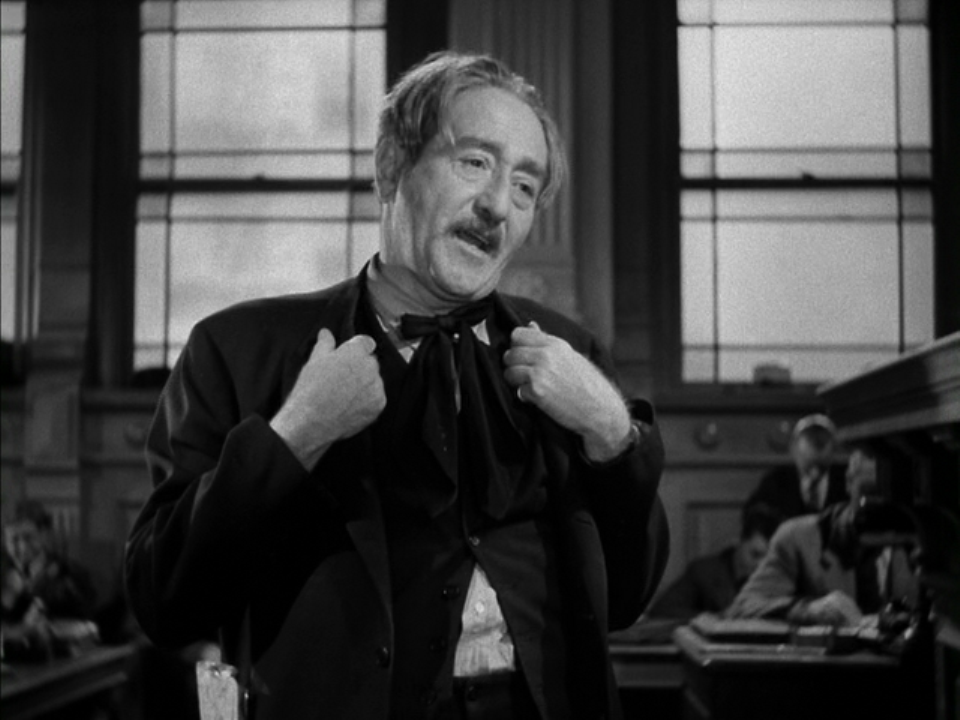
The movie, until the very end, bears striking similarities in tone and character to what eventually became the musical Chicago in 1975. While all the characters, like Roxie, are fictional pseudonyms, most of the characters will be familiar to viewers of the Broadway musical or the 2002 movie version. There's an Amos Hart (George Chandler in this case), a "Mama" Morton (Sara Algood, though the role is nowhere as pronounced as in the musical), a Mary Sunshine (Spring Byington) and a Billy Flynn (Adolphe Menjou). The murder victim even bears the same name of Fred Casely. The only notable absence: No Velma Kelly to be found. Roxie Hart tells its story in flashback as a reporter named Homer Howard (George Montgomery) recounts the case to a bar full of eager listeners 15 years after the event. Before the film even begins, a tongue-in-cheek title card dedicates the film to "all those women who filled their men full of holes in a fit of pique." Homer was a rookie reporter when the Roxie case happened and he found himself attracted to the vivacious murder defendant, though as he recounts the tale he's now a hard-drinking journalist — because that's what the public expects of reporters, he says. He also laments that Chicago hasn't had any good murder tales like Roxie's since "the Democrats took over."
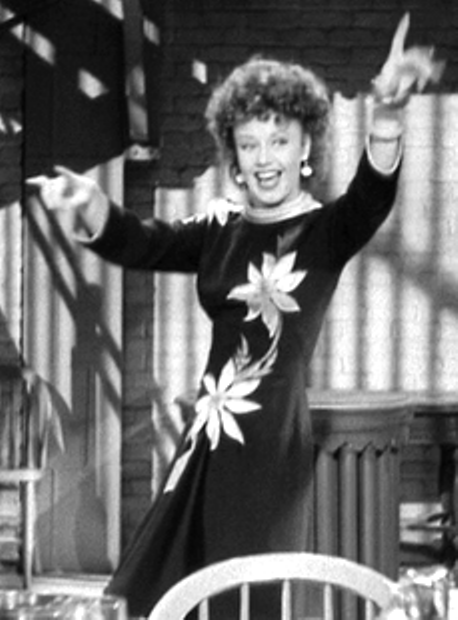
For moviegoers who only know Ginger Rogers from her classy dancing with Fred Astaire or maybe her noble Kitty Foyle, Roxie Hart is a gum-chomping, entertaining breath of fresh air from the actress. As I said previously, it is interesting how closely the outlines for the Chicago most viewers are familiar with now are clearly laid out in this film. Amos remains a milquetoast sap. Billy Flynn, though older in the form of Menjou, is nearly as manipulative, even if he lacks the razzle dazzle of the musical takes on the character. When he gets to court, he does put on the show and it's an entertaining farce, especially with the solid cast (including a small role by Phil Silvers as a newspaper photographer).
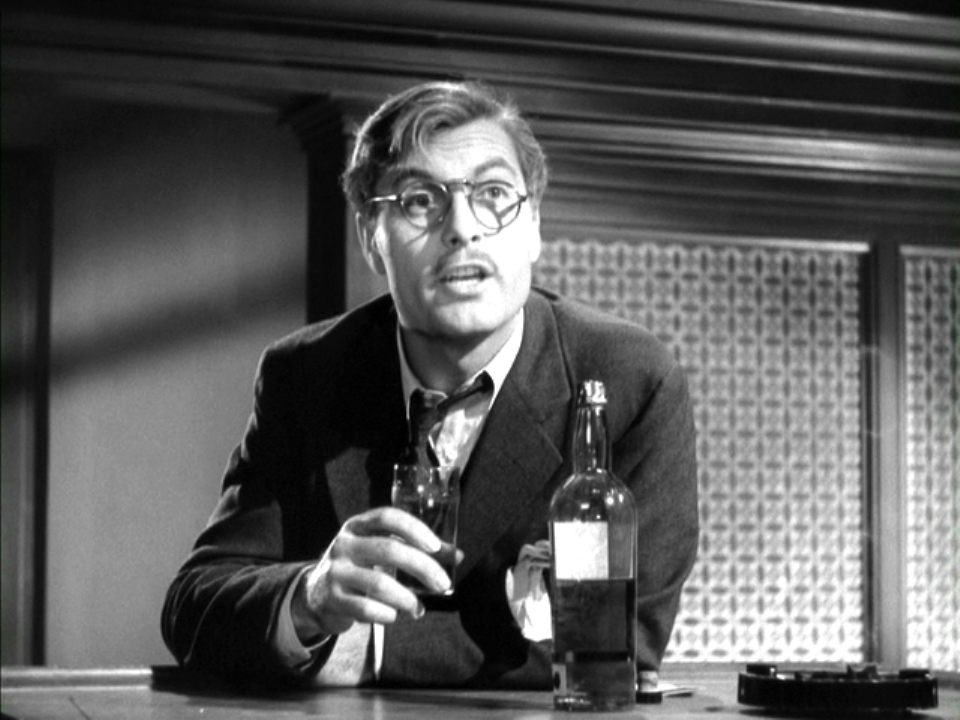
Pre-I Love Lucy William Frawley not only plays the barkeep that Homer shares his tale with, he turns out to be one of the jurors who heard Roxie's case. My good friend Josh R warned that the ending of Roxie Hart might be a disappointment, having to conform to the strict production codes of the day, but it didn't play that poorly for me. No, it's not the same cynical ending of the musical, but it is cynical in its own way, implying that Roxie ended up in a different sort of prison. All told though, Roxie Hart proves an entertaining film with a truly fun performance by Ginger Rogers. If you liked the movie or musical Chicago (or if you didn't), Roxie Hart is a fascinating artifact.
Tweet
Labels: 40s, Astaire, Ebb, Fosse, Ginger Rogers, Kander, Menjou, Musicals, Phil Silvers, Wellman
TO READ ON, CLICK HERE


