Wednesday, May 09, 2012
Such a little word, but oh, the difference it makes!

As people who pay attention to these sorts of things know, for quite some time the Broadway season, and by that I mean in terms of Tony Award eligibility, usually ends toward the end of April with the awards given in June. However, that hasn't always been the case. For example, though A Funny Thing Happened on the Way to the Forum opened May 8, 1962, when it received its Tony nominations they belonged to the crop of 1963 Tony nominations with winners handed out nearly a year later on April 28, 1963. Furthermore, Forum's May 8 opening came a mere nine days after the previous Tony Awards held April 29, 1962 for 1961's Broadway season. On the musical side,
 Frank Loesser's How to Succeed in Business Without Really Trying, which had just opened Oct. 14, 1961, hauled away the most awards. It won best musical, best actor (Robert Morse), best featured actor (Charles Nelson Reilly), best director of a musical (Abe Burrows), best authors of a musical (Burrows, Jack Weinstock and Willie Gilbert), best producers of a musical (Cy Feuer and Ernest Martin) and best conductor and musical director (Elliot Lawrence). In fact, the only nomination that How to Succeed lost was Loesser's as best composer. Richard Rodgers won for No Strings, his first solo effort since Oscar Hammerstein's death. Loesser did receive the consolation of a Pulitzer Prize for his work — one of several parallels between his career and Stephen Sondheim's, one of which we'll be coming upon shortly. As far as when the Tonys switched their eligibility dates and started holding the awards in June, as near as I can determine (cross your fingers, I'm forced to use Wikipedia as a source), the first time that happened was 1977, the year before CBS began carrying the broadcast which it has ever since, heaven help theater fans (at least as far as the past decade or so has gone). I must note, as I return to the subject at hand, that the photo at the top as well as the one inset in this lead both came from the camera of Tony Walton, the scenic and costume designer of the 1962 production. The inset photo shows his model of what the set should look like when complete. Both come courtesy of Walton via an interview he did with examiner.com.
When those 1963 Tony nominations did come out, A Funny Thing Happened on the Way to the Forum, despite having opened so long ago, did very well. It received a nomination for best musical, competing against Little Me, Oliver!, and Stop the World — I Want to Get Off. Sondheim might have felt guilty about lying to David Merrick but he produced the latter two musicals that would be competing against Forum. Merrick also garnered a nomination as best producer of a musical with Donald Albery for their work on Oliver! where the duo faced off against Hal Prince for Forum as well as last year's winners, Cy Feuer and Ernest Martin, for Little Me. Larry Gelbart and Burt Shevelove picked up a nomination as best authors of a musical for Forum and one of the competition happened to be another veteran from the days of writing for Sid Caesar on television like Gelbart once did — Neil Simon for Little Me. which Simon happened to
 write specifically for Caesar, who would face off against Zero Mostel's Pseudolus in Forum, Anthony Newley in Stop the World — I Want to Get Off and Clive Revill in Oliver! for lead actor in a musical. Lionel Bart (Oliver!) and Leslie Bricusse and Newley (Stop the World — I Want to Get Off) rounded out the author of a musical category. The venerable George Abbott's work on Forum earned him a best director of a musical nomination and he also landed a nomination as best director of a play for Never Too Late, a comedy that actually ran longer than Forum. In the musical direction category, others receiving recognition were Peter Coe (Oliver!), John Fearnley (Brigadoon) and Feuer and Bob Fosse (Little Me). (At right, we see Abbott at the 1994 Tony Awards at the age of 106 braced by Gwen Verdon and Jean Stapleton. He died in January 1995 at 107.) David Burns as the leering, patrician Senex and Jack Gilford as the nervous slave Hysterium took half the nominations in featured actor in a musical for Forum. Filling out the category were a young David Jones as the Artful Dodger in Oliver! The recently passed Jones became better known when he changed his first name to Davy and became part of The Monkees. Sven Svenson in Little Me took the fourth slot. The final nomination that A Funny Thing Happened on the Way to the Forum garnered was for Ruth Kobart, who played Senex's suspicious wife Domina, as featured actress in a musical alongside Virginia Martin (Little Me), Anna Quayle (Stop the World — I Want to Get Off) and Louise Troy (Tovarich). Sondheim's score got snubbed and wasn't nominated in the category for best composer and lyricist. The composers of the other three nominated best musicals made the cut but the fourth slot went to Milton Schafer and Ronny Graham for Bravo Giovanni, a musical that ran only 76 performances and received only two other nominations for choreography and conductor and musical director. Sondheim, who didn't get nominations for his lyrics for West Side Story or Gypsy either, remained in the ranks of those never nominated for Broadway's top honor. Boy, would he make up for that later.

When Tony night 1963 arrived, A Funny Thing Happened on the Way to the Forum won almost every award for which it was nominated. Mostel defeated Gelbart's former boss. Gilford lost — but he lost to co-star Burns. Abbott won for director of a musical, though he didn't take the prize in the play category. Gelbart and Shevelove took the prize for their book, so Gelbart beat his former co-worker as well. Prince won as producer. The American Theatre Wing crowned the show best musical meaning David Merrick went 0 for 2 in that category. Other than Gilford, the only Forum nominee that didn't score was Ruth Kobart, who lost to Anna Quayle for Stop the World — I Want to Get Off. (Shown in the photo at left are the 1963 winners in the lead acting categories. From left, Mostel, Vivien Leigh, lead actress in a musical for Tovarich; Uta Hagen, lead actress in a play and Arthur Hill, lead actor in a play, both for Who's Afraid of Virginia Woolf?) In Meryle Secrest's biography, Stephen Sondheim: A Life, the composer described watching the ceremony from home. Secrest writes, "Prince…thanked Abbott, Gelbart and Shevelove. Gelbart and Shevelove, who won book, thanked each other, Abbott and Prince. 'Nobody mentioned me on the program at all. As far as they were all concerned, my friends, my colleagues, I did not exist. That's what really hurt,' Sondheim said. 'Hal was the only one — Hal called me the next day and apologized. He said, 'I'm sorry, kid. I should have mentioned you and I didn't.'" The lack of acknowledgment did lead to some rifts such as when the hurt Sondheim confronted Shevelove and Shevelove lashed out at him, saying his songs almost killed the show before it ever got to New York. In an anecdote that appears in Secrest's book and Sondheim's Finishing the Hat, Sondheim shares the tale of a special letter he received that lifted his spirits, though it's unclear when Sondheim got the correspondence. Secrest's book says he received the letter shortly after Forum opened, but places the story right after the Tony story. Sondheim doesn't date it at all, though he adds the detail that Frank Loesser told him in the letter that he commiserated with him because he remembered the reception for his first Broadway musical, Where's Charley?, and wanted to let Sondheim know how good he thought the score of Forum was. Specifically quoted in both books, Loesser wrote, "Sometimes even a composer's working partners, to say nothing of the critics, fail to dig every level and facet of what he is doing. But I know, and I wanted you to know that I know."
Before I discuss the revivals, I've been looking for a place to work in talk of the song "Love, I Hear" somewhere and failed to accomplish my mission. Now, I adore "Comedy Tonight" and "Everybody Ought to Have a Maid" but I can't believe that no one mentions "Love, I Hear" anywhere. Hell, "Bring Me My Bride" found its way into a review. While Sondheim criticizes himself for being clever instead of funny, I love his wordplay (and he can't hide his pride in Finishing the Hat about the alliterative string of double consonants that he pulled off in one line of the song, "Today I woke too weak to walk." Links: First "Love, I Hear" from 1962 original cast recording; Second "Love, I Hear" and "Bring Me My Bride" both from 1996 revival original cast recording.

Like most Sondheim shows, Forum tends to add and subtract songs in later versions. After missing out on the original production because they wouldn't let him wear his glasses, that didn't seem to be a problem anymore and Phil Silvers took the role of Pseudolus in the show's first major revival, directed by Burt Shevelove himself. It actually started in October 1971 for a 47 performance run at the Ahmanson Theater in Los Angeles. I mentioned in the last part that Reginald Owen played Erronius. The cast also included Larry Blyden as Hysterium, veteran comic actor Carl Ballantine as Marcus Lycus and, the second biggest name in the show after Silvers, Nancy Walker in the role of Domina. In fact, she felt she needed another solo so Sondheim wrote "Farewell" for her. One of the courtesans happened to be Ann Jillian. The only song dropped was Philia's "That'll Show Him" and "Echo Song" put in its place. When they made the move to Broadway and opened March 30, 1972, Walker and Jillian didn't travel with them and another song got the axe. This time, they excised "Pretty Little Picture." Whatever the Tony eligibility dates were for the 1972 awards were, Forum must have cut it close since the awards were given April 23. Shevelove received a nomination for directing but, ironically, lost to Prince and Michael Bennett for their work on Follies. Silvers won lead actor in a musical and Blyden won featured actor as Hysterium. The revival won two of its three nominations. (They hadn't added a revival category yet.) The show seemed to be doing well until Silvers got sick, reportedly because of "food poisoning." An understudy filled in as they hurried to rehearse Tom Poston as a replacement, but ticket sales fell fast. The show only ran 156 performances and it turned out that Silvers had suffered a stroke. Links: "Farewell" info beneath video; "That'll Show Him" and "Pretty Little Picture" from 1962 cast recording.

When the next Broadway revival arrived in 1996, it did so during the era when the Broadway bug had bitten me badly so I actually got to see it soon after its April 18 opening. I had pretty good orchestra seats — I swear at one point it appeared as if Nathan Lane addressed me personally and we locked eyes at one point. Quite different from the couple of times I bumped into Lane accidentally in Manhattan when he always seemed to be the most annoyed, pissed-off man in the universe. Sure, he hammed it up like crazy as Pseudolus but that's a role that doesn't require nuance and it still won him his first Tony Award. Mark Linn-Baker did fine as Hysterium and, as I mentioned earlier, I got to see the late William Duell as Erronius. Ernie Sabella took on the role of Marcus Lycus and the long-cut song of "The House of Marcus Lycus" finally made the show. Lewis J. Stadlen received a Tony nomination for his portrayal of Senex, but he was out the night I was there so I saw Macintyre Dixon in the role. Mary Testa played Domina. The songs followed the 1962 set with the exception of the addition I mention and continuing to keep "Pretty Little Picture" out of the show, though Lane recorded it for the cast album. Jerry Zaks received a nomination for directing the musical, but lost to George C. Wolfe for Bring in 'da Noise, Bring in 'da Funk. By now, the Tonys did have revival categories but Forum lost to The King & I. The revival made a bit of history when it recast Pseudolus
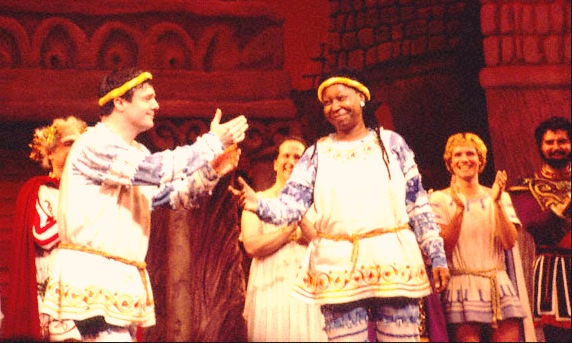 as Lane exited the show by installing Whoopi Goldberg in his place. Casting a woman, let alone an African-American one with Goldberg's reputation, made people wonder what she'd do. Ben Brantley wrote in The New York Times, "The work's authors, Burt Shevelove and Larry Gelbart, and its composer and lyricist, Stephen Sondheim, have always said they made a point of constructing a show true to its ancient sources and free of distracting anachronisms. But the leading role of Pseudolus, the wily slave in pursuit of freedom and a part that demands a manic comic spirit, has inevitably gone to wild-card performers unlikely to resist opportunities for their own shtick. As Mr. Gelbart said, in a recent interview with The Sondheim Review, 'after seeing Zero Mostel recite baseball scores in front of the House of Senex, there's not too much that would surprise me.' So there is Ms. Goldberg, queen of the devilish aside, firmly reminding you of just who she is in the production's opening moments. She finds comic fodder not only in her present personal life, but in her professional life in Hollywood as well.…That this occurs early raises delighted expectations that many audience members have brought with them: Just how bad, as in naughty, is their Whoopi going to be? Of course, others — that nasty breed of theatergoers who find Schadenfreude in seeing big stars blow it — are asking the same question with a different emphasis: Can this movie star-comedian possibly carry a musical? Sorry, guys, she can." Following Goldberg, David Alan Grier took on the role. The second revival ran for 715 performances.

The wreckage in that photo in 1993 represents the remains at the time of the outdoor amphitheater of Butler University in Indianapolis
 that for decades hosted Starlight Musicals every summer. Other cities around the Midwest also received visits from the touring program that would bring concerts, plays and musicals featuring celebrities. From
 the time I was a young child, each summer when we visited my grandma we would take in some shows. Many of the early things we saw tended to be concerts by people such as Mitzi Gaynor, Liberace and the tag team of Jim Nabors and Florence Henderson. In 1979 when I was 10, I got to see my first actual musical. I wish I could locate the program so I'd remember what songs were in that production of A Funny Thing Happened on the Way to the Forum. As a youngster, I tended to be an autograph hound so if we got there early, I'd either stake out the entrance to the backstage or I'd assault the performers after the show. For me, Forum boasted an all-star cast. Playing Pseudolus was none other than Arte Johnson from Rowan and Martin's
 Laugh-In. I'd see him again when I grew up and he appeared in the Broadway revival of Candide. Avery Schreiber portrayed Hysterium, but to me — unfamiliar with his comedy work with Jack Burns — he was the Doritos guy. When I got his autograph after the show, I even brought Doritos with me so when he
 stepped out I had one ready to take a big crunchy bite out of for him. Schreiber raised his hands and said to me, "You got me" then signed my autograph. John Carradine played the role he originated on Broadway, Marcus Lycus. I didn't know that at the time nor did I realize the breadth of his career, but at 73, he looked frail to me, though he'd live another eight years. The final big name belonged to Hans Conried who was cast as Senex. I didn't know at the time that he supplied the voice of Captain Hook in Disney's Peter Pan and I hadn't heard of The 5,000 Fingers of Dr. T. I knew Conried as Wrongway Feldman from an episode of Gilligan's Island. He died less than three years later. Johnson alone remains alive. Schreiber passed away in 2002. That same summer, I saw Rodgers and Hammerstein's Carousel starring a drunk-as-a-skunk Robert Goulet, who exited his limi when he arrived bellowing, "Nobody owns me!" However, that's another story. Tragedy tomorrow, comedy tonight.
Tweet
Labels: Awards, Books, Disney, Fosse, Frank Loesser, Gelbart, Hammerstein, J. Carradine, Music, Musicals, Neil Simon, Phil Silvers, Rodgers, Sid Caesar, Sondheim, Television, Theater Tribute, V. Leigh
TO READ ON, CLICK HERE


Tuesday, May 08, 2012
Something familiar, something peculiar, something for everyone


By Edward Copeland
If I'd located one, a photo of the number "Everybody Ought to Have a Maid" from the first Broadway revival of A Funny Thing Happened on the Way to the Forum in 1972 that starred Phil Silvers as Pseudolus would be resting between the still from the original 1962 production starring (from left to right) John Carradine as Marcus Lycus, Jack Gilford as Hysterium, David Burns as Senex and the magnificent Zero Mostel as Pseudolus, which opened 50 years ago tonight, and the photo below it showing the cast of the second Broadway revival in 1996 that starred (from left to right) Nathan Lane as Pseudolus, Mark Linn-Baker as Hysterium, Ernie Sabella as Marcus Lycus and Lewis J. Stadlen as Senex. (Sadly, not only could I only find two black-and-white photos from the 1972 revival, they
 never made a cast recording either, so we can't hear what Silvers sounded like singing the part. The song link takes you to the 1962 original Broadway cast recording) This musical comedy registers as a theatrical landmark on many levels, the most significant being that it marked the first time Stephen Sondheim wrote both the lyrics and the music for a Broadway musical. Stellar support surrounded Sondheim on all levels: I just named some of the cast, the future director of his landmark 1970s musicals, Harold Prince, produced Forum and the legendary George Abbott (then 75) directed. Jack Cole, currently undergoing a bit of a resurrection in terms of his reputation, choreographed the show and the book, based on three works by Plautus, famed playwright of ancient Rome (c. 254-184 B.C.). came from the pens of Burt Shevelove, a writer-director from early TV, and Larry Gelbart, whose best known credit at the time was as part of the many talented writers working for Sid Caesar on Your Show of Shows but who would go on to turn Robert Altman's MASH into the hit TV series M^A*S*H, be one of the Oscar-nominated (and credited) co-writers of Tootsie, writer of one of the first great HBO movies, Barbarians at the Gate, and author of the book for the Cy Coleman/David Zippel musical City of Angels. On a personal level, Forum holds a special place in my heart because it happens to be the first musical that I ever saw performed live — and Carradine played Marcus Lycus in the production. No, I'm not much older than you thought. I was only 10 at that time and it happened to be a touring summer stock production 17 years after he created the role in the original Broadway show. Somehow, it seems only appropriate that both the first Broadway musical and the last Broadway show I saw featured scores by Sondheim (Passion and Assassins, if you're curious) and so did my irst live musical, even if at 10 I hadn't the slightest notion who Sondheim was.
Anyone who knows me personally or has read this blog for any length of time realizes what a devoted Sondheim acolyte I am and, without question, A Funny Thing Happened on the Way to the Forum certainly must be considered the most entertaining and crowd-pleasing of all musicals for which he composed the score. As much as I love his music, it's also sadly true in far too many cases that Sondheim's scores often end up being vastly superior to the books of his musicals. With Forum, that cannot be said. When you read what Sondheim wrote in his book Finishing the Hat or heard what others said in reviews, Forum may stand as the rare instance of a Sondheim musical where the book actually supersedes the score in quality. Hey, it was Sondheim's first produced show as composer as well as lyricist after all. Before that, he'd only served both functions on his unproduced musical Saturday Night. His Broadway experiences had been limited to being the lyricist (to Leonard Bernstein's music) on West Side Story and (to Jule Styne's music) on Gypsy. As we begin, I should tell you that if you see a link, by all means click on it. For example, at the top the first link on a song title takes you to the original Broadway cast recording of that song from the 1962 production. Sometimes the links direct you to videos, other times just to the songs, but I wanted to get as much comparison in as I could.
Now, a lot of funny things did occur on the way to the Forum (though, technically speaking, no character in the show ever discusses a trip to that famous location in ancient Rome), but getting the musical to Broadway proved to be an entirely different matter. That trip encountered many bumps that threatened to scuttle the production before Forum ever crossed the New York state line, let alone landed on a Broadway stage. Those associated with the show who still walk among us might be able to look back with some relief now (though in Finishing the Hat, Sondheim does deal himself some heavy self-criticism about his work on the show even now, despite the fact that Forum remains the biggest hit of his career). Sondheim writes that he, Gelbart and Shevelove wrote Forum over a four-year period and that the show went through two major producers, two major directors and a major star before getting to the rehearsal stage. Meryle Secrest's biography, Stephen Sondheim: A Life, spells out the specifics of his statement.
 Secrest quotes Sondheim about the dogged pursuit of Jerome Robbins, who would never settle on a decision about whether to direct the show or not. "The problem was we went to numbers of producers and directors. Jerry Robbins kept saying yes, then no, and then yes, and then no. We went to Joshua Logan and he wanted more naked boys and things like that. I went to Hal (Prince) and he said, 'Listen, kid, you know me. I hate farce.'…David Merrick agreed to produce. Then we were trying to get Jerry Robbins again. And Jerry said, 'OK, I'll tell you what. I'll do it, but I won't do it with David Merrick. You have to get it away from him." In Secrest's book, Sondheim expresses guilt for making up a lie to Merrick about the show not happening and returning an advance to Merrick but it did convince Prince to sign on though Robbins bailed again. Evemtually, they got George Abbott on board as director, but Robbins would return to play a pivotal role. The search for a lead also proved difficult. Their first choice, Phil Silvers, who eventually would portray Marcus Lycus in Richard Lester's 1966 film version and Pseudolus in the 1972 revival, rejected it out of hand because he couldn't perform while wearing his glasses and he'd be unable to navigate without them. Milton Berle agreed to star but when Gelbart and Shevelove turned in a draft of the book that would have run about four hours and received orders to make cuts (which they did), Berle claimed they removed his best stuff and quit. That's how Mostel got the part. In Secrest's book, Sondheim said that years later Mostel would claim that he didn't want to do Forum, but the truth was he needed the work badly and leaped at the part. Mostel's career, as had many others, had suffered during the McCarthy era, the House Un-American Activities Committee hearings and the Hollywood blacklist. One hitch: When Robbins returned to help the troubled show later, he'd face the glare of Mostel because Robbins had served as a friendly witness at the HUAC hearings. To make things worse, one of the names he named was Madeline Gilford, wife of Jack Gilford, who was playing Hysterium. Sondheim though sensed other problems.

Sondheim sought the advice of his friend James Goldman, who at this point in his career had written an original play that made it to Broadway and later would pen both the play and movie of The Lion in Winter as well as the book for Sondheim's Follies. Goldman also did some songwriting, so Sondheim let him look at the book for Forum and listen to the songs he had at that point, when the opening number was a song called "Love Is in the Air." According to what Sondheim wrote in Finishing the Hat, Goldman labeled Gelbart and Shevelove's book as "brilliant" and expressed enthusiasm about Sondheim's score. "The problem," Goldman said, "is they don't go together." Sondheim knew what Goldman meant, but he didn't start doing anything about it right then. Sondheim wrote that he'd been "trained by (Oscar) Hammerstein to think of a song as a one-act play which either intensifies a moment or moves the story the forward.…Prodded by my academic musical training as well as by Oscar, I had become accustomed to thinking of songs as being structured in sonata form: statement, development and recapitulation. For Oscar, it was first act, second act, third act. He tried to avoid writing lyrics that confined themselves to one idea, the traditional approach of every lyricist in the theater and the standard function of songs before he came along and revolutionized the way writers thought about musicals. Show Boat hadn't convinced them but once Oklahoma!, Carousel and South Pacific had become enormous hits, most songwriters converted. The success of those were not entirely beneficial however." In Finishing the Hat, Sondheim noted something Gelbart wrote in his introduction to the published libretto of Forum. "Broadway in its development of musical comedy had improved the quality of the former at the expense of a great deal of the latter," Gelbart wrote.

At one point — frustrated as he tried to unlearn all he knew about composing and fearing he did the show more harm than good — Sondheim even suggested Forum should just be a straight play, but Shevelove said it would be too frenetic and the audience would have no space to breathe (without songs). He informed the composer that the few surviving plays by Plautus sll had songs. Sondheim did end up composing an opening song more in keeping with the spirit of the show that would follow called "Invocation." That also would be dropped but would return in a 1974 farce that Shevelove "freely adapted" from Aristophanes called The Frogs and to which Sondheim added "Instructions to the Audience," which is the only way you can listen to that number now, as in this cut from its 2004 Broadway debut sung by Nathan Lane, Roger Bart and the ensemble. Sondheim writes honestly in his book that he didn't think much of George Abbott's talent or sense of humor — saying they had to explain a joke to the old man once, but Abbott's reputation for saving shows had achieved legendary status and as the show suffered in Washington to scathing reviews and small audiences in big houses (50 people filling 1,000 seats) not laughing a bit, Sondheim described to Secrest the only time Abbott made him laugh "when he said, 'I dunno. You had better call in George Abbott.'" Obviously, that wasn't an option, but given Robbins' worship of Abbott, that made it easier to call him in, though they worried about Mostel's reaction. Part of this can be seen in a clip from a one-man show called Zero Hour written and performed by Jim Brochu and presented at the West Coast Jewish Theatre.
At the time Robbins named names before the House Un-American Activities Committee, he didn't really have a career beyond New York, so his motives always have proved puzzling and he never settled the question before his death, The most pervasive theory, as seen on an American Masters profile on PBS a couple of years ago and detailed in biographies such as this one on The Official Masterworks Broadway Site that he got blackmailed into testifying out of fear that the rather open secret of his homosexuality would be revealed. (He felt secure
 enough to declare himself gay to get out of service in World War II.) The site says, "Robbins was booked for an appearance on Ed Sullivan’s Sunday night variety show (The Toast of the Town), but three weeks before the event, Sullivan, convinced that Robbins was a Communist (he had attended the notorious Scientific and Cultural Conference for World Peace at the Waldorf-Astoria in 1949), canceled the contract. It was Sullivan — threatening at one point to expose him as a homosexual if he did not deliver (directly to Sullivan himself!) a list of names of leftists in show business — who set the machinery in motion that brought Robbins under investigation by the FBI and landed him, two years later, before the House Un-American Activities Committee." Whatever the truth might be, Robbins' uncredited contributions to Forum not only saved the musical, they also changed the way new musicals got their starts forever.
 Earlier in the flirtation process, before tryouts had started and Robbins continued to flirt with the idea of directing the show, he demanded that the principals cast the show, get them all in a room to read the script for him while Sondheim performed the songs. In essence, Robbins invented the theater workshop. Prince and Sondheim actually found it helpful at pointing out flaws in the show and repeated the process with their classic collaborations in the 1970s, though Sondheim doesn't like what the practice ended up evolving into later. "What had begun as a learning experience for the authors became transmogrified into thinly disguised backers' auditions," he wrote in Finishing the Hat. As for his contributions to Forum, as soon as he saw "Invocation," Robbins recognized the problem. Secrest wrote in her biography of Sondheim, According to Sondheim, (Robbins) said, "The opening
 number is killing the show. You open with a charming number and the audience does not know what it's in for, that it's a real farce. You've got to write an opening number that says baggy pants." Sondheim went back to the drawing board and the show's most famous song, "Comedy Tonight," was born and Robbins did the staging, specifically telling Sondheim to leave the jokes to him. Sondheim wrote in Finishing the Hat that Robbins also staged the massive Act II chase, meaning that though he received no official credit, Robbins essentially choreographed the two most important pieces of movement in the show. Still, it isn't as if no one realizes he did it. When Robbins directed his own tribute show, Jerome Robbins' Broadway, re-creating his most famous stage creations the show included "Comedy Tonight" with Jason Alexander taking on the Pseudolus role for that number. In fact, three men have been nominated for Tonys for playing Pseudolus in the three Broadway productions of Forum and a fourth inhabited the role for one scene in another show and all four — Zero Mostel, Phil Silvers, Jason Alexander and Nathan Lane — took home Tony Awards. No other part in theater history can make that claim. The song has attained a level of such popularity you'd be amazed by the permutations you can find on the Internet. In fact, I did a separate post on those alone. Unfortunately, no visual record of the 1962 version exists. Instead, we'll start with a poorly shot bootleg of the 1996 revival starring Nathan Lane as Pseudolus (and Prologus, the character the lead actor plays when introducing the show.) If unfamiliar with the show or what I'm talking about, the song spells it out pretty clearly. I actually got to see the 1996 revival.
After the disastrous runs in Washington and New Haven, Conn., once Robbins had put the bug in Sondheim's ear about the opening number, he writes in Finishing the Hat that "Comedy Tonight" was composed over the course of a weekend. What is it about pressure
 and/or inspiration that some of the greatest works seem to be created when it gets to be crunch time? Most people know the story of Arthur Miller writing the first act of Death of a Salesman in less than a day. Forum opened 50 years ago tonight at The Alvin Theatre where it played through March 7, 1864 when it transferred to The Mark Hellinger Theatre for two months before completing its run through Aug. 29, 1965 at The Majestic Theatre for a total of eight previews and 964 performances. In 1966, a film version with Mostel and Gilford repeating their stage roles and featuring future Phantom of the Opera Michael Crawford opened. Richard Lester, hot off directing The Beatles' films A Hard Day's Night and Help!, helmed the Forum movie. The film eliminated some songs but it also gave Sondheim his first opportunity to design a song specifically for a movie. In Finishing the Hat, he writes about penning a different version of "Free," heard here from the 1962 cast album. He confesses to being a lifelong movie buff and having made some home movies where he especially enjoyed the editing process. (Who doesn't want to see some of these as long as they're suitable for general audiences?) Lester told Sondheim, the composer wrote, that he approved and that his idea would work but Lester never filmed the sequence. "(A)lthough in the finished print, there's a curiously clumsy cut at the place where I'd cued the song, which makes me think it was at least planned. Rereading it now, I wish he had. I didn't get the chance to design another for 26 years, when I wrote two sequences for the movie of A Little Night Music, one of which was filmed the way I wrote it, one of which was not." This clip shows Mostel doing the song during the movie's opening credits.
While Sondheim accepted Shevelove's notion that the musical numbers allowed the audience a chance to take a breath from the chaos consuming the stage, he still disagrees to this day about the suitability of stopping a farce for a song. In Finishing the Hat, he wrote, "Although I do think that the book of Forum is the tightest, most satisfyingly plotted and gratifyingly written farce I've ever encountered, I don't think that farces can be transformed into musicals without damage — at least, not good musicals. The tighter the plotting, the better the farce, but the better the farce the more the songs interrupt the flow and pace. Farces are express trains; musicals are locals." We can't see what Mostel looked like onstage singing "Comedy Tonight" in 1962, but we do have a clip of him performing a condensed version of the song at the 1971 Tony Awards.
"I had to write one-joke songs so I picked spots for them where the situations would supply substance: Songs like 'Impossible' and the drag version of 'Lovely,' which were dramatically static but theatrically funny. My mistake was that in trying to unlearn everything Oscar (Hammerstein) had taught me and write static songs which were nothing more than playful, I felt I had to justify them with cleverness, by juggling with words, leaning on rhymes, puns, alliteration and all the other boilerplate devices of light verse," Sondheim wrote. (Links: "Impossible" and "Lovely (Reprise)" both from 1962 original cast album.) Both in his own book and Secrest's, Sondheim praises producer Hal Prince's faith in the show, saying that most producers who endured the tryouts that Forum did in New
 Haven and Washington would have closed the show down and never brought it to New York. Prince didn't — and it paid off. The show would turn out to be a blockbuster, admittedly one with a few more hurdles to clear before it reached that point. When Robbins came in to help, everyone worried about the volatile Mostel's reaction. However, he'd behaved as a complete professional with nary an explosion up to this point in the chaotic production, according to Secrest's book. As they hurriedly rehearsed "Comedy Tonight" in New York, the stress weighed on the actors as Sondheim recounted in Secrest's book. "'We got to the afternoon of the first preview with our opening number, the one we hoped would change the show. And we were rehearsing and Zero kept screwing up his lines.' So once when Robbins stopped to consult with Tony Walton, the set designer, Sondheim went down to the footlights — 'I never, never give an actor a critical note in front of other people' — to correct one of Mostel's lines. 'Right, right, right,' Mostel said impatiently. They began again, and again Robbins stopped. Mostel was still making mistakes. 'And I said, "Please, I know you've got a lot on your mind, but it's the plural, not the singular." "Yeah. Yeah." The third time, Jerry stops again — 'Zero, it's the plural!' — and Mostel says in a booming voice that fills the entire theater and makes everyone start and turn around, he says, "Well, maybe if you'd write me a funny line, you cocksucker!" In front of everybody.' There was a silence that lasted for about four seconds. 'And in the back of the house, Mr. Abbott went, "All right, from the top please" and clapped his hands." Sondheim goes on to describe how Abbott defuse the tension that quickly and he realized that was part of the man's greatness. He also believes that Mostel made him the scapegoat for the anger he wanted to hurl in Robbins' direction.

In wrapping up this tribute's first half, I must praise the invention of Twitter, which introduced me to a man who not only witnessed the original production of Forum (as well as other original Broadway shows such as South Pacific with Mary Martin and Ezio Pinza, Fiddler on the Roof, also starring Mostel and featuring Bea Arthur, Bert Convy, Leonard Frey and Austin Pendleton and, the one that makes me green with envy, Ethel Merman in Gypsy — with Jack Klugman along as Herbie), but whose father became Mostel's doctor and, because of similar backgrounds, eventually the actor's good friend. Pietr Hitzig, also a doctor, wrote me briefly about his memories of those days. "I am 70 years old and as a NYC child had no idea what fantastic theater I was seeing.…Zero died at only 62 years old and had his most productive years destroyed by the witch hunters at the HUAC but is immortal for Fiddler, Forum and The Producers.…Nobody can play any of those roles today without remembering the bushy eyebrows and satanic leer," Hitzig wrote. On Twitter, Hitzig tweeted that his father saw Fiddler on the Roof at least 100 times. Imagine how inexpensive Broadway tickets cost to allow that back in the 1960s. I only paid to see one Broadway show twice (Rent) and saw another a second time because one ticket came to me as a freebie (Ragtime). (Piotr corrected me after I posted this that his father didn't pay all those times. He got free tickets.) "My father was a renowned Park Avenue doctor but lonely as hell as was Zero. They, children of the shtetl loved each other like brothers. Both were funny but had an angry side that alienated their families. After a busy day, rather than come home, my dad would head for Broadway and stand backstage as his idealized childhood in Fiddler was played out once again," Hitzig wrote. In The New York Times archives, I found a funny story that did illustrate Mostel's tendency to get riled. The British comedian Frankie Howerd, who would play Pseudolus in the London premiere of Forum in fall 1963, came to see the U.S. version earlier in 1963. Seated in the front row, Howerd tended to cover his mouth when amused so Mostel misinterpreted that he wasn't laughing at the show at all. "He is not laughing." the article says Mostel complained between numbers. The next day, Howerd, in an apologetic tone, insisted that he enjoyed the show. "I'm not a laugher. I don't lean back and flash my teeth. Actually, if anyone was frightened that night it was me, seeing how good Mostel was," Howerd told Louis Calta at The Times.
Tweet
Labels: Altman, Arthur Miller, Awards, Beatles, blacklist, Books, Gelbart, H. Prince, Hammerstein, HBO, J. Carradine, J. Robbins, Merman, Music, Musicals, Phil Silvers, Sid Caesar, Sondheim, Theater Tribute
TO READ ON, CLICK HERE
Tuesday, September 27, 2011
Close Friends Get to Call Him T.C.

By Ivan G. Shreve, Jr.
In 1957, when Metro-Goldwyn-Mayer closed its animation department and informed loyal employees William Hanna and Joseph Barbera (the creative team behind MGM’s Oscar-winning cat-and-mouse duo, Tom & Jerry) of their decision with a single phone call, Bill and Joe found themselves at a literal crossroads. They could go back to honest work (Barbera, for example, had been in banking before landing a job in show biz) or they could soldier on in the burgeoning field of television animation — which, because of the medium’s restricted budgets, used fewer drawings than its theatrical brethren (even though this stylized method of cartooning had actually been put in practice earlier by U.P.A.). Hanna and Barbera decided that they loved creating, directing and producing cartoons too much to give it up, so ignoring naysayers who decried the “abomination” of limited animation, launched a successful cartoon conglomerate devoted to entertaining TV audiences…that, to its credit, also engaged many of their former and now unemployed colleagues when the other motion picture studios ceased their animation operations as well.
With Hanna-Barbera’s first success in The Ruff & Reddy Show in 1957, the two men began to create characters recognized as animation icons today: Huckleberry Hound, Yogi Bear, Quick Draw McGraw…I could name them all day long. Their most audacious endeavor came in the fall of 1960, when television’s first prime time animated situation comedy, The Flintstones, premiered on ABC and became a monster hit. Of course, in show business you’re only as good as your last success — so to prove that the modern Stone Age family’s series was no flash in the pan, the company premiered its second prime time cartoon project 50 years ago on this date on a Wednesday evening following The Steve Allen Show: the indisputable leader of the gang, Top Cat.
In discussing the history of their famous animated employees, Bill Hanna and Joe Barbera eventually became known for…well, hiding a few facts about the inspiration behind their creations — and Top Cat is no exception. Barbera once recalled in an interview that a single drawing of the titular character that was taking up space on his office desk provided the spark of genius. While I’m certainly not going to dispute Joe’s version of Top Cat's genesis, I think he’s holding back a little. Their previous foray into prime time, The Flintstones, was pretty much an animated version of The Honeymooners (and the only reason why Bill and Joe didn’t get a subpoena from Jackie Gleason challenging them on this is because Gleason didn’t want to become known as “the man who killed Fred Flintstone”). Top Cat followed the formula established by Flintstones by taking the main character and premise of The Phil Silvers Show (aka You’ll Never Get Rich and Sgt. Bilko) and transferring them to a fictional area of Manhattan (known as “Hoagy’s Alley”), staffed with a roster of supporting characters who might have answered a casting call for one of the Bowery Boys films had Monogram-Allied Artists still been cranking them out in 1961. T.C., as his chums called him (provided it was with dignity), was the major domo of a group of misfit feline denizens residing in the less tonier section of the Big Apple, and was constantly concocting various ways to earn a fast buck.
I wouldn’t be surprised to learn that a needlepoint framing of “Imitation is the sincerest form of flattery” hung in a prominent place in the offices of Hanna-Barbera, because so many of their creations featured voices (usually supplied by veteran voice artist Daws Butler) based on famous celebrities: Yogi Bear imitated Art Carney, Snagglepuss channeled Bert Lahr, Wally Gator was Ed Wynn incarnate. In fact, Bill and Joe had previously gone to the Phil Silvers Show well when they added conniving Hokey Wolf to The Huckleberry Hound Show cast (Hokey replaced the departing Yogi Bear, who left for the studio’s first spin-off series). Hanna-Barbera could just as easily prevailed upon Butler to recycle Hokey for Top Cat but instead they went with second banana and character actor Arnold Stang, who was no stranger to voice work (Stang had started out on radio, and was known for “sidekicking” the likes of Henry Morgan and Milton Berle) and whose Phil Silvers-like intonations were right on the money. To add a little authenticity to their Bilko rip-off…er, I mean homage, they also hired Maurice Gosfield to voice Top Cat’s “conscience,” Benny the Ball — Gosfield had been a cast member on Bilko, playing the part of Private Duane Doberman (both Doberman and Benny shared the same rotundity and good-natured, wide-eyed naiveté).
The choices of Stang and Gosfield to provide the voices for the program’s main characters were inspired ones and set Top Cat apart from the usual Hanna-Barbera fare in that more often than not, the studio would usually fall back on the services (talented though they were) on artists like Butler, Don Messick, Paul Frees, Hal Smith, Jean Vander Pyl, etc. These actors did contribute to the series in various guest star capacities, but Top Cat made offbeat and interesting casting decisions for its supporting cast such as tabbing veteran Warner Bros. character thesp Allen Jenkins to voice T.C.’s nemesis, cop-on-the-beat Charlie Dibble (Top Cat liked to avail himself of “Dribble’s” call-in box as his own personal telephone) and Marvin Kaplan (a film, TV and radio veteran best known as “Alfred Printzmetal” on the sitcom Meet Millie and later as the constantly complaining phone repairman Henry Beesmeyer on Alice) as Choo-Choo, the tall pink feline clad in a turtleneck sweater. Actor Leo DeLyon did double duty on the show, providing the speaking tones of the beatnik cat Spook and the stupefyingly dense Brain (whose nickname was most assuredly a misnomer). Stang, Gosfield, Jenkins, Kaplan and DeLyon no doubt landed their respective gigs because the feline characters needed Noo Yawk accents; only John Stephenson, who voiced the feline lothario known as Fancy Fancy (who sounded a great deal like Cary Grant), was a H-B veteran (best known for voicing Fred Flintstone’s boss, Mr. Slate).
The majority of the episode plots on Top Cat all dealt with a similar theme: T.C. and company hitting upon shady (and slightly illegal) ploys to make a little money and Officer Dibble’s attempting to foil Top Cat’s plans before he succeeded. Dibble, whose single-minded pursuit of a promotion often exceeded his grasp (he was a bit inept when it came to policing), would also look for a surefire method to evict Top Cat and his crew from the alley…and if he was stymied in that goal, he could at least insist that the rowdy ragtag bunch clean up their surroundings a little. Top Cat was formulaic, to be sure…but it also differed from some of the other Hanna-Barbera series in that it possessed a certain level of sophistication (no doubt influenced by its urban setting); it didn’t skimp on the sight gags but much more attention was given to characterization and witty dialogue. (The target audience for the show was both kids and adults, or as actor DeLyon humorously joshed in a featurette on the show’s DVD set, “kadults.”) Like The Flintstones, Top Cat often used then-current pop culture trends as fodder for episodes — one of my favorite outings spoofs the TV series Naked City (T.C., Dibble and the gang are duped by a crook into thinking his warehouse robbery is on-location shooting for the cop show “Naked Town”) and another one features the Hoagy’s Alley coterie as a mob known as “The Unscratchables.” (The show wasn’t immune to in-jokes, either: in “Rafeefleas,” Top Cat and his pals are walking through a museum and come across an exhibit entitled “Prehistoric Man” — statues of Fred Flintstone and Barney Rubble. “I seen those two before on television,” observes Choo-Choo.)
Sponsored by Kellogg’s and Bristol-Myers, Top Cat — despite tepid competition from CBS (Checkmate) and NBC (The Joey Bishop Show) — failed to duplicate the longevity of the more popular Flintstones, and so its 30 episodes were exiled to Saturday mornings to be rerun from 1962 to 1969. (Interestingly, Top Cat lasted longer in comic books than on the tube, his adventures being published by Dell, Gold Key and Charlton until 1973.) But despite getting a pink slip from the American Broadcasting Company, Top Cat and his associates would manage to find work in later Hanna-Barbera productions; they were featured among the cast of the 1972 cartoon special Yogi’s Ark Lark (but didn’t make the cut for the subsequent series, Yogi’s Gang) and T.C. himself was in charge (still the leader of the gang!) of handing out the titular assignments on the 1985 series Yogi’s Treasure Hunt. Two years later, the Hanna-Barbera folks produced a feature-length TV movie entitled Top Cat and the Beverly Hills Cats, and in the 1990s characters from the show would turn up in featured bits on Wake, Rattle and Roll and Yo Yogi! and cameos in such series as Harvey Birdman, Attorney at Law and The Powerpuff Girls.
Despite its limited success in the United States, the show later was sold to countries all over the world — in the United Kingdom, however, the series has to be rechristened “Boss Cat” so that the BBC wouldn’t inadvertently endorse a brand of cat food with the same name as the U.S. program. Top Cat was a major phenomenon in Mexico, Peru and Argentina…where Don Gato y su pandilla (translated: Mr. Cat and His Gang) enjoy celebrity fame equal to that of the Flintstones and who was just recently the subject of an animated feature film — released in 3-D, even, as another famous H-B feline might say.
Top Cat might very well be the least-remembered of Hanna-Barbera’s prime time animated series — it didn’t last as long as The Flintstones, and though its one season stint was later duplicated by The Jetsons and The Adventures of Jonny Quest, both of those series were later revisited with new episodes (between 1985 and 1987…with a revival series, The Real Adventures of Jonny Quest produced in the 1990s). It’s currently enjoying retirement on the cable channel Boomerang, however, and the program’s entire run was released to DVD in 2004. Personally, it’s my favorite of Bill and Joe’s “kadult” creations: the characterizations are timeless, the dialogue often hilarious and its theme song is one of those ditties that’s almost impossible to get out of your head once it’s in there (hey…Bob Dylan uses it on his radio show…you can’t get much cooler than that). As far as I’m concerned, he’s the boss, he’s the pip, he’s the championship. He’s the most tip top…Top Cat.
Tweet
Labels: 60s, Animation, Cary, Dylan, Hanna-Barbera, Phil Silvers, TV Tribute
TO READ ON, CLICK HERE
Saturday, September 17, 2011
There’s a holdup in the Bronx

By Ivan G. Shreve, Jr.
In the fall of 1960, the ABC crime drama Naked City — after a year’s hiatus, having been canceled officially after one season in 1959 — returned to TV screens Wednesday nights for an additional three-season stint as a gritty, realistic police procedural that also doubled as a dramatic anthology show, telling the stories of various disparate characters who came into contact with members of New York’s finest played by Paul Burke (as Detective Adam Flint), Horace McMahon (Lt. Mike Parker) and Harry Bellaver (Sgt. Frank Arcaro). The tagline to every episode of the critically-acclaimed drama — and a phrase that soon was adopted into the American vernacular — was that “there are eight million stories in the Naked City…this has been one of them.”
A year later, another TV series dealing with crime in the Big Apple premiered to TV audiences…and it demonstrated that of those eight million stories, some of them could be side-splittingly hilarious. The main characters of this show were simple uniformed patrolmen, but they served a purpose every bit as important as their Naked City brethren because as the lyrics in the show’s opening told us: “There’s a traffic jam in Harlem that’s backed up to Jackson Heights.” Fifty years ago on this very date, NBC presented us a different breed of cop in a situation comedy whose original run may have been brief but would soon to go on to be beloved by adoring fans as a genuine cult classic: Car 54, Where Are You?
Officer Gunther J. Toody (Joe E. Ross) was a short-and-squat chatterbox whose gravelly voice and constant exclamation of “Ooh! Ooh!” would get on the nerves of anyone after a fashion…with the exception of his best
 friend and longtime partner, Officer Francis A. Muldoon (Fred Gwynne), a tall, somber individual who was college-educated and had a bit more Moxie on the ball than his dimwitted pal. However, their precinct captain, Paul Block (Paul Reed), bemoaned the day he had partnered the two men because in the hopes that some of Francis would rub off on Gunther the end result was “two Toodys.” The two friends worked out of the mythical 53rd Precinct in the Bronx, and in fact had been partners practically from the day they joined the force. In one of Car 54's archetypal episodes, “Change Your Partner,” a police department researcher decides to split the two men up and pair them with different patrolmen because their lengthy association completely flies in the face of normality (most partnerships last only 16 months). This grand experiment doesn’t last long, however — no one is able to endure Toody’s garrulousness or Muldoon’s stony silences and so the two chums are reunited by the episode’s end.
Toody was the married one of the duo, happily-ever-after manacled to domineering Lucille (Beatrice Pons)…and though Lucille remained devoted to Gunther he constantly drove her to distraction with both his inattentiveness and idiocy, prompting her to frequently open the window of their apartment at various times and scream to the neighbors: “Listen up, America! My husband, Gunther Toody, is a nut!” Muldoon was a confirmed bachelor who lived with his mother (Ruth Masters) and two sisters (Nancy Donohue, Helene Parker)
 and did so because he was painfully shy around women (Toody once observed that his partner would run from the door if a Girl Scout was selling cookies)…not that Lucille didn’t make numerous attempts to fix him up with “some nice girl.” Toody and Muldoon’s beloved 53rd precinct was in turn populated with a motley crew of law enforcement misfits — the best remembered of which was the constantly kvetching Leo Schnauser (who looked just like his namesake), played by Al Lewis (Lewis’ character wasn’t introduced until the 13th episode, “Put It in the Bank” but he had guest-starred previously on the show in two episodes playing character roles) and his partner, muscle-bound Ed Nicholson (Hank Garrett)…who could usually be found admiring his physique in a mirror or making a date with some hot new prospect (Nicholson’s romantic conquests bugged Leo to the point where he would call his partner a “bum”). Presiding over the 53rd’s “thin blue line” was Captain Block, who was constantly frustrated by Toody and Muldoon’s unmatched talent for getting into trouble…though it was directed more toward Gunther than Francis because as Block once ordered Muldoon, “I want you to come into my office, too…you’re his interpreter.”
The comic concoction known as Car 54, Where are You? was created by television legend Nat Hiken — a name that might be unfamiliar to many today, but in an era when the concept of a Hollywood “hyphenate” (writer-director-producer) is quite commonplace nowadays, Hiken was one of the first and best of the lot. Nat got his big break in show business (after working previously in radio on the West Coast) in a job that I personally would have given my left earlobe for — he was the head writer on Fred Allen’s radio show, a position that had to be fraught with frustration because it was generally believed by the public that Allen wrote all of his own material. After additional radio assignments working on Milton Berle’s show and an underrated sitcom entitled The Magnificent Montague, Hiken moved into the new medium of television as the head writer of TV’s All Star Revue. He experienced a momentary setback when his name turned up in the infamous Red Channels pamphlet (Hiken had to take out an ad in Variety denouncing any Communist beliefs) but rebounded to write and direct Martha Raye’s popular comedy-variety hour in 1954, a program on which Nat also toiled with one of his future collaborators, Billy Friedberg.
The fall of 1955 saw the debut of Hiken’s most popular and lasting contribution to television: The Phil Silvers Show (aka You’ll Never Get Rich or as it is often referred to by fans, Sgt. Bilko). Silvers starred in this uproarious sitcom as Master Sergeant Ernest G. Bilko, a U.S. Army lifer who had developed a reputation in the service as a smooth-talking con man with an eye out to make a fast buck. The Phil Silvers Show became a huge favorite with audiences and Nat’s industry peers, so much so that he, Silvers and the show’s writers carted home several Emmy Awards for their achievements throughout the four-year-run of the series. But working 18-hour days on Bilko to make it the best that it was began to take a physical toll on Hiken, and he left the series after its second season, limiting himself afterward to hour-long specials (he also attempted to revive the Montague series for TV in 1958, but CBS lost interest in the idea). By 1961, Nat was ready to tackle a second sitcom (that would be handled through his own production company), based on an idea that he had had for several years that would satirize the then popular slew of TV crime shows with a pair of New York City cops and comic situations focusing on their day-to-day work routine and their lives outside the precinct.
The two actors originally considered for the lead roles were Mickey Shaughnessy (as Toody) and Jack Warden (Muldoon) — but when Hiken couldn’t come to terms with the two men he decided to poach a pair of thespians with whom he’d worked with on the Silvers show in the past. Joe E. Ross had been a third-rate burlesque and nightclub comic when Nat, liking Ross’ sandpaper voice and less-than-Hollywood-handsome looks, used him to replace Harry Clark (who played mess sergeant Stanley Sowici on Bilko, and who had passed away after the first season), casting Joe as Fort Baxter’s new mess sergeant, Rupert Ritzik. Ross’ Ritzik would prove to be the perfect comic foil for Silvers’ Bilko, often cast as the patsy in Bilko’s latest get-rich-quick scheme…and on occasions when Rupert’s shrewish better-half Emma figured in the plots, Hiken sent for Beatrice Pons — Pons’ stock-in-trade was sloppy bathrobe-and-curlers housewife roles, which Nat remembered when casting her as Mrs. Toody in Car 54.
Hiken had also used Fred Gwynne on Bilko on two occasions, memorably assigning to the actor the part of a gaunt soldier who habitually went on eating binges when depressed and who is enlisted by Bilko to use that expertise in an eating contest in the classic episode “The Stomach.” Hiken’s creation of Car 54’s Francis Muldoon was actually not too far a departure from Gwynne in real life; Muldoon was a cerebral and erudite college graduate, and Gwynne had attended Harvard, where he performed in both its amateur theatrical productions and a cappella singing groups (he was even president of the Harvard Lampoon, on which he worked as a cartoonist). Other former Bilko performers who turned up on Car 54 included Jimmy Little (who was Sgt, Grover on Bilko…and amusingly enough, often played desk sergeants on Naked City while simultaneously manning the 53rd’s desk as Sgt. McBride), Jack Healy (Private Mullen on Bilko, Patrolman Rodriguez on 54), Billy Sands, Maurice Brenner, John Gibson and Charlotte Rae…who made a memorable appearance on Bilko as the woman constantly adjusting her wardrobe in the classic episode “The Twitch” but who enjoyed a more prominent showcase on Car 54 as the high-strung Sylvia Schnauzer, wife of patrolman Leo. (Rae was tabbed for the part of Sylvia after a previous one-shot 54 appearance as a shell-shocked bank teller; the combustible relationship between the Schnausers — he called her “pussycat,” her nickname for him was “Daddy bear” — were often the highlights in some of the most memorable outings in the series.)

Other actors who appeared on Car 54 included Albert Henderson (O’Hara), Jim Gormley (Nelson), Bruce Kirby (Kissel), Joe Warren (Steinmetz), Mickey Deems (Fleischer) and Patricia Bright (who played Mrs. Captain Block). The disparate ethnic makeup of the 53rd Precinct reflected the diversity of the neighborhood they patrolled, and like he had previously done on Bilko, Hiken cast black actors in pivotal
 roles without calling attention to them — Frederick O’Neal and Nipsey Russell appeared on occasion as (respectively) Officers Wallace and Anderson, and other African-American members of the 53rd included at various times Ossie Davis, Mel Stewart and Godfrey Cambridge. Nat also favored casting unusual and offbeat guest stars; among the familiar faces to grace Car 54 episodes: Molly Picon (in three episodes as kindly Rachel Bronson), Jake La Motta, Jan Murray, Maureen Stapleton, Carl Ballantine, Tom Bosley, Wally Cox, Gene Baylos, Larry Storch, Alice Ghostley, Jules Munshin, Shari Lewis, Sugar Ray Robinson and Rocky Graziano (whom Hiken had miraculously transformed into a hilarious sidekick for Martha Raye on her variety series).
New York City, once the heart of television production, had acceded responsibility to Hollywood and the West Coast with each passing year so Car 54 was unusual in that it was one of the few TV series still being shot in the Big Apple (other series included The Defenders and Naked City) by the 1960s. The show was filmed at the Biograph Studios (where director D.W. Griffith got his start), and though some believe the show used canned laughter Hiken actually employed a technique from his days on Bilko in which he showed each finished episode of Car 54 to a live audience and recorded their laughter on the soundtrack. Whenever they had to shoot outside the studio in the Bronx, the patrol cars were painted red and black (which would go unnoticed when filmed in black-and-white) to distinguish them from the regulation green-and-white cars in use at the time (an apocryphal story goes that the switch was made after someone tried to flag down one of the faux patrol cars while filming, believing it to be the real deal). When the show premiered, Hiken was wearing many of the hats himself (writing, directing, and producing) but a number of outside factors gradually influenced him to start delegating those jobs to his collaborators (among the co-writers on Car 54 were Terry Ryan, Tony Webster, Gary Belkin, Art Baer and Ben Joelson).
Nat’s stormy relationship with actor Ross played a large role in his turning over the directorial reins of each episode to another former Bilko crony, Al De Caprio (and later Stanley Prager); while Ross’ participation on Car 54 had made him a household name, the actor started to develop delusions of grandeur, believing that he and he alone was responsible for the series’ success. He refused to learn his lines, squabbled with and belittled both crew members and his fellow actors and in short, became impossible to deal with — Ross’ unprofessional behavior finally reached its zenith where had the show been renewed for a third season Hiken would have fired Joe and re-focused the series on Gwynne and Lewis. The pressure of being Car 54’s “auteur” was simply too much for Hiken; he had a falling-out with Billy Friedman (and ended up firing him as a result) and NBC was also not doing Nat any favors by insisting the show both switch to color and ditch the live laughter track. Actor Hank Garrett says that what prevented Hiken from tackling a third season was NBC’s insistence that they own 50 percent of the show; other sources state that the man considered by many to be a “comic genius” had simply burned himself out.
Hiken, who created what I feel is one of the unsung situation comedies of all time (I really, really revere Car 54 for its deceptively simple plots that would explode without warning into Kafkaesque nightmares) busied himself with a few projects after pulling the plug on Car 54 (his last notable credit was as writer and director of the 1969 theatrical film The Love God, one of Don Knotts’ few box office flops) but years of trying to do it all finally did Nat in…he died at the age of 54 (there’s irony for you) in 1968 from a massive heart attack. The cast and crew of the series would of course go on to further triumphs: Fred Gwynne eventually did get the opportunity to collaborate with Al Lewis when the two actors starred in the CBS sitcom The Munsters (and Gwynne later distinguished himself with first-rate turns in such films as Simon, The Cotton Club and My Cousin Vinny). As for Joe E. Ross, whom one TV critic observed “has the air of an animal that has been stuffed into clothing and taught how to speak short bursts of dialogue,” his starring role as a prehistoric caveman in the short-lived It’s About Time was very appropriate; he later reprised the role of Toody in animated form in an episode of Hanna-Barbera’s Wait Till Your Father Gets Home (Ross had by that time started working for Bill and Joe, providing voices on such shows as Help!...It’s the Hair Bear Bunch and Hong Kong Phooey). For many years after its network run, Car 54 was kept alive through reruns and memories of its staunchly loyal fans; it experienced a brief reemergence in the late '80s when it was showcased on the once-proud Nick at Nite from 1987 to 1990 (it also turned up on Comedy Central for a short time afterward); the only cable outlet that I know of that’s showing it now is Me-TV, which runs an hour of repeats on Saturday nights. Fortunately for Car 54 aficionados, Shanachie Entertainment released the first season of the show to DVD in April 2011 and has promised the second season will follow soon.
I learned to my dismay sometime back that Car 54, Where are You? is for many people an acquired taste (some people will just sit through the show stone-faced — and I’ve observed that not coincidentally they are the same folks who never quite embraced the humor of Seinfeld)…and that only seems fitting because Hiken wrote for Fred Allen in his show business salad days, a humorist whose once bright star has lost its luster to a new generation who cannot grasp his topical humor. (I also attribute people’s dislike for the show with their associating it with the abysmal 1994 film based on the series…which despite having alums Nipsey Russell and Al Lewis in the cast should have been cut up and used for banjo picks.) But without realizing it, Hiken created out of a fitfully funny situation comedy an important social document of the 1960s; unlike the celebrated Mad Men, which more often than not plays more like a pastiche of that era, there’s an authenticity to Car 54 in its Bronx locations and people despite its tendency toward broad and often surrealistic burlesque. As TV critic Robert Lloyd comments: “…it comes out of the world it portrays, and though it favors the old ways — those early 20th-century ways of talking, walking, doing business — you can feel them giving way to new. There is a lot of small and careful detail dressing the laughs.” Ooh! Ooh! I couldn’t agree more.
Tweet
Labels: 60s, Animation, Hanna-Barbera, Jack Warden, Mad Men, Phil Silvers, Seinfeld, TV Tribute
TO READ ON, CLICK HERE
Friday, September 16, 2011
Committed to Controversy

By Ivan G. Shreve, Jr.
An August 2008 episode of AMC’s popular TV series Mad Men shares more than just a title — “The Benefactor” — with a 1962 episode of the seminal legal drama The Defenders. In the Mad Men episode, the Sterling Cooper ad agency attempts to interest one of its clients (a lipstick company) in to purchasing time on that very same CBS series when the show’s regular sponsors desert the program over the subject matter of the titular episode: an accused abortionist on trial for performing the procedure on a young woman who’s been raped. “Benefactor” marked a turning point in the direction of The Defenders in its first season which, despite its later reputation for tackling tough social issues, spent its freshman year mired in, according to TV historian Stephen Bowie, “silly melodrama or Perry Mason-style courtroom theatrics.” For the rest of The Defenders' four-year run (the show ended in 1965), the program fearlessly dealt with such hot-button and taboo-to-TV issues as capital punishment, the blacklist, child abuse, euthanasia, birth control and atheism, to name but a few.
Mad Men's producers may have whetted modern-day audiences’ appetites to get a gander at the inspiration for their homage to the program praised by The Museum of Broadcast Communications as “the most socially conscious series the medium has ever seen “…but if you’re looking to purchase or rent the show on home video you’re going to be sorely disappointed — and an online DVD search will more than likely result in the recently canceled Jim Belushi-Jerry O’Connell series that’s similar to the landmark 1960s program in name only. The last time The Defenders was seen on TV was in 1980 on a lesser-known (and now defunct) cable channel and according to Bowie: “It’s hard to think of another series made after 1960, even one in black and white, that ran for as long as The Defenders (four seasons, 132 episodes) and yet hasn’t been syndicated in nearly 30 years. And that’s not even taking into account the show’s acclaim and enormous historical relevance.” So on the occasion of its 50th anniversary of its television premiere, I’d like to pay tribute to a program that deserves to be better-known…and whose absence on home video is a crime that even the show’s stars (E.G. Marshall and Robert Reed) would have difficulty defending.
The origins of The Defenders begin with stage, screen and television writer Reginald Rose — we recognize him, of course, as the author of such screenplays as Crime in the Streets and 12 Angry Men as well as co-writing the screen adaptation of Whose Life Is
 It Anyway? with the play's author Brian Clark, but during television’s Golden Age he was one of the medium’s most respected scribes, with critically lauded teleplays such as Thunder on Sycamore Street and The Incredible World of Horace Ford to his credit. For the dramatic anthology series Studio One (which also presented 12 Angry Men before its silver screen adaptation), Rose penned a two-part episode entitled The Defender, in which the father-and-son legal team of Walter (Ralph Bellamy) and Kenneth Preston (William Shatner) defend Joseph Gordon (Steve McQueen), a young man accused of a crime he swears he didn’t commit. The Defender is the only incarnation of the series to be released to home video (on DVD in 2006); it also bears the distinction of inspiring an episode of Boston Legal (“Son of the Defender”) — in which clips from the live telecast are used to paint the portrait of Shatner’s Denny Crane as a young man.
Producer Herbert Brodkin had worked with Rose on both The Defender and previous Studio One presentations, and it was Brodkin who convinced the writer that a viable weekly series could be made from the two-parter, which premiered on CBS in fall 1961. The role of the elder Preston (rechristened “Lawrence”) was recast with actor E.G. Marshall and Robert Reed played his son Kenneth, a recent law school graduate. The senior Preston was a veteran attorney (more than 20 years before the bar) who acted as mentor to his greener and more idealistic son, though over the course of the show’s four-year run, Kenneth did become a more seasoned practitioner of the law. By that time on The Defenders, however, Ken’s progress as a litigator had taken a back seat to the complicated and controversial legal issues spotlighted in each episode and because this character development eventually was diminished, minor first season players such as the Prestons’ secretary Helen Donaldson (Polly Rowles) and Ken’s girlfriend Joan Miller (Joan Hackett) soon became inconsequential as well.
Though the show’s inaugural episode, “Quality of Mercy,” offered up a then-daring-for-its-time plot centering on a physician needing legal representation for mercy killing an infant with Down syndrome, many of the plots on The Defenders rarely deviated from the similar subject matter featured on its first season lead-in, Perry Mason, the only difference being that the celebrated Mason seldom lost any of his cases while the firm of Preston & Preston was more fallibly human, subject to the realities of the legal system in facing such factors as better-equipped or more skillful legal opponents and arbitrary judges and/or juries. “The Benefactor” was chiefly responsible for changing the direction of the series. Asked by an accused abortionist to defend him in court, Lawrence and Kenneth mount a defense that essentially argued in favored of legalized abortion nearly a decade before the landmark Supreme Court decision in Roe v. Wade. (Not surprisingly, the Prestons do not prevail at the show’s conclusion.) The Defenders' sponsors — a rotation that featured Lever Brothers, Kimberly-Clark and Brown & Williamson Tobacco — strongly objected to the episode’s content and decreed that they would have nothing to do with “Benefactor,” despite CBS’ defense that the installment was “a very fine, realistic and honest dramatization.” The network finally landed a backup sponsor in the Speidel Watch people (who probably obtained the ad time at bargain basement prices) and even though CBS exercised preliminary damage control by screening the episode via closed circuit television to its affiliates, 10 of the network’s 180 stations (including outlets in Boston, Buffalo and New Orleans) flatly stated “uh-uh.”
The sponsor defection during “Benefactor” did little to make CBS skittish about continuing with The Defenders. Despite the objections of network President James “The Smiling Cobra” Aubrey, who was against the series from the get-go, Defenders had a loyal ally in CBS Chairman William S. Paley — known for going to the mat for prestigious programs, a status he had acquired since his early days in radio. Paley and CBS executive Michael Dann also knew of both Brodkin and Rose’s reputations for program quality and the backlash after the telecast was relatively minimal — of the mail they received (close to a thousand letters) nearly 11 to one was in favor of the episode. The fact that The Defenders was CBS’ highest-rated new show of the season — not to mention its four Emmy Awards (including achievements in writing and directing, and acting honors for star Marshall) — surely didn’t hurt either. “Benefactor” galvanized the creative team behind Defenders, giving the program “the courage of its convictions” to address sensitive social issues of the day in a frank and unabashedly opinionated manner. As series creator Rose affirmed in an issue of The Viewer: “We’re committed to controversy.”
Regular TV viewers in the era of the 1960s knew instinctively that clients in need of the services of legal eagle Perry Mason rarely were guilty and just required Erle Stanley Gardner’s famous barrister to prove their innocence via his show-off courtroom histrionics. But the patrons hiring Preston & Preston were certainly no angels…and often misfits and societal outcasts; the father-and-son lawyers defended conscientious objectors ("The Objector"), illegal immigrants ("Stowaway"), civil rights demonstrators ("The Non-Violent"), pornographers ("A Book for Burning") and neo-Nazis ("The Indelible Silence"). One of the show’s most celebrated episodes — and one that garnered Emmys for author Ernest Kinoy and guest star Jack Klugman — was “Blacklist,” in which an actor (Klugman) who was blacklisted for alleged Communist affiliations is targeted by a group opposed to his hiring for a part after 10 years in “exile.” (Bowie points out that despite accepting the industry accolades for this entry, CBS continued to enforce a blacklist at least until The Defenders' final season, oblivious to any irony.) In short, The Defenders was never about justice but the pursuit of justice. As author Mark Alvey points out in a Museum of Broadcast Communications essay on the show, “The Defenders focused on the machinery of the law, the vagaries of the legal process, and system's capacity for justice.”
A final speech made by Larry Preston to his son at the end of “Blacklist” neatly provides a summation of the raison d’être for The Defenders: “The law is man-made, and therefore imperfect. We don't always have the answer. There are injustices in the world. And they're not always solved at the last minute by some brilliant point of law at a dramatic moment.” And that’s how the series built its reputation — addressing timely legal issues such as capital punishment, the insanity defense and illegal evidence searches while refusing to do so in a clear-cut, black-and-white manner — and taking judicious time to explore all the perspectives and gray areas present in the process. If you’re shrugging your shoulders in indifference because you’re witnessed this sort of thing on recent shows such as Law and Order and The Practice — where characters employed in the legal profession aren’t there to “win” but simply because it’s their job — this probably all seems tame. However, it’s important to remember that The Defenders not only broke the ground in establishing these now commonplace concepts, but it also ushered in a trend of series that focused on nonviolent “heroes” who usually possessed some sort of professional taint (doctors, teachers, etc.) and confronted important social concerns of the day. Its pedigree of writing and directing talent (Kinoy, David Shaw, Adrian Spies, Alvin Boretz) praised for their triumphs in live television ensured that the 1950s dramatic anthology tradition continued throughout the '60s (as marked by other shows such as Route 66 and Naked City) and though outside location shooting in the Big Apple was minimal, it provided a necessary shot in the arm to the once popular industry practice of producing TV shows in New York. The social relevance of The Defenders also inspired similar series attempting to trod the same ground (East Side/West Side, Slattery’s People) but in terms of critical attention and audience loyalty, The Defenders remained the champ.
During its four-year run, The Defenders received 20 Emmy Award nominations and collected 13 of those trophies, including outstanding drama series three years in a row. Among the episodes singled out for Emmy praise (either winning or being nominated): “Madman” (a two-part episode that probes the legal definition of insanity); “Moment of Truth” (son Kenneth is accused of bribing a juror); and “The 700 Year Old Gang” (also a two-parter, and a lighter-than-normal outing about an elderly vintner who’s being prosecuted for bootlegging). But author Stephen Bowie, who has described the series in past writings as “one of my pet TV history causes” draws attention to such integral Defenders outings as “Blood County,” which finds Preston pere and fils defending an accused murderer (a hunter) in an atmosphere of corruption set against a backwoods Pennsylvania burg; “A Man Against Himself,” a script about a black man (Ivan Dixon) who insists on defending himself on manslaughter charges (written by Raphael Hayes, the co-scenarist of the provocative independent film One Potato, Two Potato); and “Kill or Be Killed,” which focuses on the plight of a convicted murderer who killed a guard during his escape from prison, oblivious to the fact that he’s been cleared of the original murder charge. It was Stephen who brought to my attention that despite my previous belief that The Defenders had never been syndicated, the series did turn up in repeats on New York’s WPIX-TV (channel 11) in the late '60s; but its failure to establish itself in more markets could have something to do with the serious tone of the series (it’s probably not the sort of the show you’d program after, say, Gilligan’s Island on a five-days-a-week basis). The Defenders surfaced briefly during the home video era (circa 1980) on the Armed Forces Network and many of the “bootlegs” in circulation were culled from that AFN stint.
The Defenders now is in the control of CBS-Paramount, and though the rights to the series haven’t necessarily brought upon a legal entanglement that would require the services of Lawrence and Kenneth Preston, its DVD absence no doubt stems from the cardinal rule of home video: it’s not commercial enough to justify season-by-season releases. If shows such as The Streets of San Francisco or The Phil Silvers Show can be sidelined on DVD due to indifference and sluggish sales, the chances of The Defenders — which, despite its inclusion on TV Guide’s 50 Best Shows of All Time list (it ranked No. 31) in 2009, has been mostly unseen since its original network run (plus it’s a black-and-white series to boot) — being bought or rented becomes more remote with each passing year. (This may be pure speculation on my part, but if the show had the good fortune to have its rights controlled by NBC-Universal, it might be a different story — after all, that’s why the good Lord created Timeless Media Video.)
Stephen Bowie observes (courtesy of an e-mail exchange): “[I]f anything The Defenders not only meets but exceeds its original reputation as one of the greatest American television dramas. It is daring both dramatically (the Prestons lose a LOT of cases) and in its politics…in ways that no one in commercial television would be able to get away with today.” On a personal note, I can’t help but equate that the missed opportunity to see this extraordinary program (outside of bootleg copies) in its proper presentation virtually has played out like the conclusion to an episode of the series — and the earlier words of Lawrence Preston to son Ken keep ringing in my ears: “There are injustices in the world.”
Tweet
Labels: 60s, Awards, Bellamy, blacklist, E.G. Marshall, Mad Men, Phil Silvers, Shatner, Theater, TV Tribute
TO READ ON, CLICK HERE


