Wednesday, May 09, 2012
Such a little word, but oh, the difference it makes!

As people who pay attention to these sorts of things know, for quite some time the Broadway season, and by that I mean in terms of Tony Award eligibility, usually ends toward the end of April with the awards given in June. However, that hasn't always been the case. For example, though A Funny Thing Happened on the Way to the Forum opened May 8, 1962, when it received its Tony nominations they belonged to the crop of 1963 Tony nominations with winners handed out nearly a year later on April 28, 1963. Furthermore, Forum's May 8 opening came a mere nine days after the previous Tony Awards held April 29, 1962 for 1961's Broadway season. On the musical side,
 Frank Loesser's How to Succeed in Business Without Really Trying, which had just opened Oct. 14, 1961, hauled away the most awards. It won best musical, best actor (Robert Morse), best featured actor (Charles Nelson Reilly), best director of a musical (Abe Burrows), best authors of a musical (Burrows, Jack Weinstock and Willie Gilbert), best producers of a musical (Cy Feuer and Ernest Martin) and best conductor and musical director (Elliot Lawrence). In fact, the only nomination that How to Succeed lost was Loesser's as best composer. Richard Rodgers won for No Strings, his first solo effort since Oscar Hammerstein's death. Loesser did receive the consolation of a Pulitzer Prize for his work — one of several parallels between his career and Stephen Sondheim's, one of which we'll be coming upon shortly. As far as when the Tonys switched their eligibility dates and started holding the awards in June, as near as I can determine (cross your fingers, I'm forced to use Wikipedia as a source), the first time that happened was 1977, the year before CBS began carrying the broadcast which it has ever since, heaven help theater fans (at least as far as the past decade or so has gone). I must note, as I return to the subject at hand, that the photo at the top as well as the one inset in this lead both came from the camera of Tony Walton, the scenic and costume designer of the 1962 production. The inset photo shows his model of what the set should look like when complete. Both come courtesy of Walton via an interview he did with examiner.com.
 When those 1963 Tony nominations did come out, A Funny Thing Happened on the Way to the Forum, despite having opened so long ago, did very well. It received a nomination for best musical, competing against Little Me, Oliver!, and Stop the World — I Want to Get Off. Sondheim might have felt guilty about lying to David Merrick but he produced the latter two musicals that would be competing against Forum. Merrick also garnered a nomination as best producer of a musical with Donald Albery for their work on Oliver! where the duo faced off against Hal Prince for Forum as well as last year's winners, Cy Feuer and Ernest Martin, for Little Me. Larry Gelbart and Burt Shevelove picked up a nomination as best authors of a musical for Forum and one of the competition happened to be another veteran from the days of writing for Sid Caesar on television like Gelbart once did — Neil Simon for Little Me. which Simon happened to
 write specifically for Caesar, who would face off against Zero Mostel's Pseudolus in Forum, Anthony Newley in Stop the World — I Want to Get Off and Clive Revill in Oliver! for lead actor in a musical. Lionel Bart (Oliver!) and Leslie Bricusse and Newley (Stop the World — I Want to Get Off) rounded out the author of a musical category. The venerable George Abbott's work on Forum earned him a best director of a musical nomination and he also landed a nomination as best director of a play for Never Too Late, a comedy that actually ran longer than Forum. In the musical direction category, others receiving recognition were Peter Coe (Oliver!), John Fearnley (Brigadoon) and Feuer and Bob Fosse (Little Me). (At right, we see Abbott at the 1994 Tony Awards at the age of 106 braced by Gwen Verdon and Jean Stapleton. He died in January 1995 at 107.) David Burns as the leering, patrician Senex and Jack Gilford as the nervous slave Hysterium took half the nominations in featured actor in a musical for Forum. Filling out the category were a young David Jones as the Artful Dodger in Oliver! The recently passed Jones became better known when he changed his first name to Davy and became part of The Monkees. Sven Svenson in Little Me took the fourth slot. The final nomination that A Funny Thing Happened on the Way to the Forum garnered was for Ruth Kobart, who played Senex's suspicious wife Domina, as featured actress in a musical alongside Virginia Martin (Little Me), Anna Quayle (Stop the World — I Want to Get Off) and Louise Troy (Tovarich). Sondheim's score got snubbed and wasn't nominated in the category for best composer and lyricist. The composers of the other three nominated best musicals made the cut but the fourth slot went to Milton Schafer and Ronny Graham for Bravo Giovanni, a musical that ran only 76 performances and received only two other nominations for choreography and conductor and musical director. Sondheim, who didn't get nominations for his lyrics for West Side Story or Gypsy either, remained in the ranks of those never nominated for Broadway's top honor. Boy, would he make up for that later.
When Tony night 1963 arrived, A Funny Thing Happened on the Way to the Forum won almost every award for which it was nominated. Mostel defeated Gelbart's former boss. Gilford lost — but he lost to co-star Burns. Abbott won for director of a musical, though he didn't take the prize in the play category. Gelbart and Shevelove took the prize for their book, so Gelbart beat his former co-worker as well. Prince won as producer. The American Theatre Wing crowned the show best musical meaning David Merrick went 0 for 2 in that category. Other than Gilford, the only Forum nominee that didn't score was Ruth Kobart, who lost to Anna Quayle for Stop the World — I Want to Get Off. (Shown in the photo at left are the 1963 winners in the lead acting categories. From left, Mostel, Vivien Leigh, lead actress in a musical for Tovarich; Uta Hagen, lead actress in a play and Arthur Hill, lead actor in a play, both for Who's Afraid of Virginia Woolf?) In Meryle Secrest's biography, Stephen Sondheim: A Life, the composer described watching the ceremony from home. Secrest writes, "Prince…thanked Abbott, Gelbart and Shevelove. Gelbart and Shevelove, who won book, thanked each other, Abbott and Prince. 'Nobody mentioned me on the program at all. As far as they were all concerned, my friends, my colleagues, I did not exist. That's what really hurt,' Sondheim said. 'Hal was the only one — Hal called me the next day and apologized. He said, 'I'm sorry, kid. I should have mentioned you and I didn't.'" The lack of acknowledgment did lead to some rifts such as when the hurt Sondheim confronted Shevelove and Shevelove lashed out at him, saying his songs almost killed the show before it ever got to New York. In an anecdote that appears in Secrest's book and Sondheim's Finishing the Hat, Sondheim shares the tale of a special letter he received that lifted his spirits, though it's unclear when Sondheim got the correspondence. Secrest's book says he received the letter shortly after Forum opened, but places the story right after the Tony story. Sondheim doesn't date it at all, though he adds the detail that Frank Loesser told him in the letter that he commiserated with him because he remembered the reception for his first Broadway musical, Where's Charley?, and wanted to let Sondheim know how good he thought the score of Forum was. Specifically quoted in both books, Loesser wrote, "Sometimes even a composer's working partners, to say nothing of the critics, fail to dig every level and facet of what he is doing. But I know, and I wanted you to know that I know."
Before I discuss the revivals, I've been looking for a place to work in talk of the song "Love, I Hear" somewhere and failed to accomplish my mission. Now, I adore "Comedy Tonight" and "Everybody Ought to Have a Maid" but I can't believe that no one mentions "Love, I Hear" anywhere. Hell, "Bring Me My Bride" found its way into a review. While Sondheim criticizes himself for being clever instead of funny, I love his wordplay (and he can't hide his pride in Finishing the Hat about the alliterative string of double consonants that he pulled off in one line of the song, "Today I woke too weak to walk." Links: First "Love, I Hear" from 1962 original cast recording; Second "Love, I Hear" and "Bring Me My Bride" both from 1996 revival original cast recording.

Like most Sondheim shows, Forum tends to add and subtract songs in later versions. After missing out on the original production because they wouldn't let him wear his glasses, that didn't seem to be a problem anymore and Phil Silvers took the role of Pseudolus in the show's first major revival, directed by Burt Shevelove himself. It actually started in October 1971 for a 47 performance run at the Ahmanson Theater in Los Angeles. I mentioned in the last part that Reginald Owen played Erronius. The cast also included Larry Blyden as Hysterium, veteran comic actor Carl Ballantine as Marcus Lycus and, the second biggest name in the show after Silvers, Nancy Walker in the role of Domina. In fact, she felt she needed another solo so Sondheim wrote "Farewell" for her. One of the courtesans happened to be Ann Jillian. The only song dropped was Philia's "That'll Show Him" and "Echo Song" put in its place. When they made the move to Broadway and opened March 30, 1972, Walker and Jillian didn't travel with them and another song got the axe. This time, they excised "Pretty Little Picture." Whatever the Tony eligibility dates were for the 1972 awards were, Forum must have cut it close since the awards were given April 23. Shevelove received a nomination for directing but, ironically, lost to Prince and Michael Bennett for their work on Follies. Silvers won lead actor in a musical and Blyden won featured actor as Hysterium. The revival won two of its three nominations. (They hadn't added a revival category yet.) The show seemed to be doing well until Silvers got sick, reportedly because of "food poisoning." An understudy filled in as they hurried to rehearse Tom Poston as a replacement, but ticket sales fell fast. The show only ran 156 performances and it turned out that Silvers had suffered a stroke. Links: "Farewell" info beneath video; "That'll Show Him" and "Pretty Little Picture" from 1962 cast recording.

When the next Broadway revival arrived in 1996, it did so during the era when the Broadway bug had bitten me badly so I actually got to see it soon after its April 18 opening. I had pretty good orchestra seats — I swear at one point it appeared as if Nathan Lane addressed me personally and we locked eyes at one point. Quite different from the couple of times I bumped into Lane accidentally in Manhattan when he always seemed to be the most annoyed, pissed-off man in the universe. Sure, he hammed it up like crazy as Pseudolus but that's a role that doesn't require nuance and it still won him his first Tony Award. Mark Linn-Baker did fine as Hysterium and, as I mentioned earlier, I got to see the late William Duell as Erronius. Ernie Sabella took on the role of Marcus Lycus and the long-cut song of "The House of Marcus Lycus" finally made the show. Lewis J. Stadlen received a Tony nomination for his portrayal of Senex, but he was out the night I was there so I saw Macintyre Dixon in the role. Mary Testa played Domina. The songs followed the 1962 set with the exception of the addition I mention and continuing to keep "Pretty Little Picture" out of the show, though Lane recorded it for the cast album. Jerry Zaks received a nomination for directing the musical, but lost to George C. Wolfe for Bring in 'da Noise, Bring in 'da Funk. By now, the Tonys did have revival categories but Forum lost to The King & I. The revival made a bit of history when it recast Pseudolus
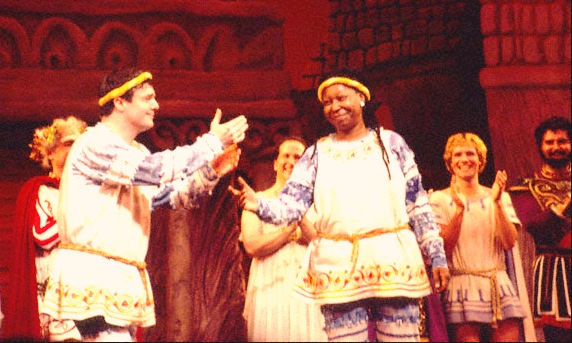 as Lane exited the show by installing Whoopi Goldberg in his place. Casting a woman, let alone an African-American one with Goldberg's reputation, made people wonder what she'd do. Ben Brantley wrote in The New York Times, "The work's authors, Burt Shevelove and Larry Gelbart, and its composer and lyricist, Stephen Sondheim, have always said they made a point of constructing a show true to its ancient sources and free of distracting anachronisms. But the leading role of Pseudolus, the wily slave in pursuit of freedom and a part that demands a manic comic spirit, has inevitably gone to wild-card performers unlikely to resist opportunities for their own shtick. As Mr. Gelbart said, in a recent interview with The Sondheim Review, 'after seeing Zero Mostel recite baseball scores in front of the House of Senex, there's not too much that would surprise me.' So there is Ms. Goldberg, queen of the devilish aside, firmly reminding you of just who she is in the production's opening moments. She finds comic fodder not only in her present personal life, but in her professional life in Hollywood as well.…That this occurs early raises delighted expectations that many audience members have brought with them: Just how bad, as in naughty, is their Whoopi going to be? Of course, others — that nasty breed of theatergoers who find Schadenfreude in seeing big stars blow it — are asking the same question with a different emphasis: Can this movie star-comedian possibly carry a musical? Sorry, guys, she can." Following Goldberg, David Alan Grier took on the role. The second revival ran for 715 performances.
The wreckage in that photo in 1993 represents the remains at the time of the outdoor amphitheater of Butler University in Indianapolis
 that for decades hosted Starlight Musicals every summer. Other cities around the Midwest also received visits from the touring program that would bring concerts, plays and musicals featuring celebrities. From
 the time I was a young child, each summer when we visited my grandma we would take in some shows. Many of the early things we saw tended to be concerts by people such as Mitzi Gaynor, Liberace and the tag team of Jim Nabors and Florence Henderson. In 1979 when I was 10, I got to see my first actual musical. I wish I could locate the program so I'd remember what songs were in that production of A Funny Thing Happened on the Way to the Forum. As a youngster, I tended to be an autograph hound so if we got there early, I'd either stake out the entrance to the backstage or I'd assault the performers after the show. For me, Forum boasted an all-star cast. Playing Pseudolus was none other than Arte Johnson from Rowan and Martin's
 Laugh-In. I'd see him again when I grew up and he appeared in the Broadway revival of Candide. Avery Schreiber portrayed Hysterium, but to me — unfamiliar with his comedy work with Jack Burns — he was the Doritos guy. When I got his autograph after the show, I even brought Doritos with me so when he
 stepped out I had one ready to take a big crunchy bite out of for him. Schreiber raised his hands and said to me, "You got me" then signed my autograph. John Carradine played the role he originated on Broadway, Marcus Lycus. I didn't know that at the time nor did I realize the breadth of his career, but at 73, he looked frail to me, though he'd live another eight years. The final big name belonged to Hans Conried who was cast as Senex. I didn't know at the time that he supplied the voice of Captain Hook in Disney's Peter Pan and I hadn't heard of The 5,000 Fingers of Dr. T. I knew Conried as Wrongway Feldman from an episode of Gilligan's Island. He died less than three years later. Johnson alone remains alive. Schreiber passed away in 2002. That same summer, I saw Rodgers and Hammerstein's Carousel starring a drunk-as-a-skunk Robert Goulet, who exited his limi when he arrived bellowing, "Nobody owns me!" However, that's another story. Tragedy tomorrow, comedy tonight.
Tweet
Labels: Awards, Books, Disney, Fosse, Frank Loesser, Gelbart, Hammerstein, J. Carradine, Music, Musicals, Neil Simon, Phil Silvers, Rodgers, Sid Caesar, Sondheim, Television, Theater Tribute, V. Leigh
TO READ ON, CLICK HERE


Tuesday, May 08, 2012
Something familiar, something peculiar, something for everyone


By Edward Copeland
If I'd located one, a photo of the number "Everybody Ought to Have a Maid" from the first Broadway revival of A Funny Thing Happened on the Way to the Forum in 1972 that starred Phil Silvers as Pseudolus would be resting between the still from the original 1962 production starring (from left to right) John Carradine as Marcus Lycus, Jack Gilford as Hysterium, David Burns as Senex and the magnificent Zero Mostel as Pseudolus, which opened 50 years ago tonight, and the photo below it showing the cast of the second Broadway revival in 1996 that starred (from left to right) Nathan Lane as Pseudolus, Mark Linn-Baker as Hysterium, Ernie Sabella as Marcus Lycus and Lewis J. Stadlen as Senex. (Sadly, not only could I only find two black-and-white photos from the 1972 revival, they
 never made a cast recording either, so we can't hear what Silvers sounded like singing the part. The song link takes you to the 1962 original Broadway cast recording) This musical comedy registers as a theatrical landmark on many levels, the most significant being that it marked the first time Stephen Sondheim wrote both the lyrics and the music for a Broadway musical. Stellar support surrounded Sondheim on all levels: I just named some of the cast, the future director of his landmark 1970s musicals, Harold Prince, produced Forum and the legendary George Abbott (then 75) directed. Jack Cole, currently undergoing a bit of a resurrection in terms of his reputation, choreographed the show and the book, based on three works by Plautus, famed playwright of ancient Rome (c. 254-184 B.C.). came from the pens of Burt Shevelove, a writer-director from early TV, and Larry Gelbart, whose best known credit at the time was as part of the many talented writers working for Sid Caesar on Your Show of Shows but who would go on to turn Robert Altman's MASH into the hit TV series M^A*S*H, be one of the Oscar-nominated (and credited) co-writers of Tootsie, writer of one of the first great HBO movies, Barbarians at the Gate, and author of the book for the Cy Coleman/David Zippel musical City of Angels. On a personal level, Forum holds a special place in my heart because it happens to be the first musical that I ever saw performed live — and Carradine played Marcus Lycus in the production. No, I'm not much older than you thought. I was only 10 at that time and it happened to be a touring summer stock production 17 years after he created the role in the original Broadway show. Somehow, it seems only appropriate that both the first Broadway musical and the last Broadway show I saw featured scores by Sondheim (Passion and Assassins, if you're curious) and so did my irst live musical, even if at 10 I hadn't the slightest notion who Sondheim was.
 Anyone who knows me personally or has read this blog for any length of time realizes what a devoted Sondheim acolyte I am and, without question, A Funny Thing Happened on the Way to the Forum certainly must be considered the most entertaining and crowd-pleasing of all musicals for which he composed the score. As much as I love his music, it's also sadly true in far too many cases that Sondheim's scores often end up being vastly superior to the books of his musicals. With Forum, that cannot be said. When you read what Sondheim wrote in his book Finishing the Hat or heard what others said in reviews, Forum may stand as the rare instance of a Sondheim musical where the book actually supersedes the score in quality. Hey, it was Sondheim's first produced show as composer as well as lyricist after all. Before that, he'd only served both functions on his unproduced musical Saturday Night. His Broadway experiences had been limited to being the lyricist (to Leonard Bernstein's music) on West Side Story and (to Jule Styne's music) on Gypsy. As we begin, I should tell you that if you see a link, by all means click on it. For example, at the top the first link on a song title takes you to the original Broadway cast recording of that song from the 1962 production. Sometimes the links direct you to videos, other times just to the songs, but I wanted to get as much comparison in as I could.
Now, a lot of funny things did occur on the way to the Forum (though, technically speaking, no character in the show ever discusses a trip to that famous location in ancient Rome), but getting the musical to Broadway proved to be an entirely different matter. That trip encountered many bumps that threatened to scuttle the production before Forum ever crossed the New York state line, let alone landed on a Broadway stage. Those associated with the show who still walk among us might be able to look back with some relief now (though in Finishing the Hat, Sondheim does deal himself some heavy self-criticism about his work on the show even now, despite the fact that Forum remains the biggest hit of his career). Sondheim writes that he, Gelbart and Shevelove wrote Forum over a four-year period and that the show went through two major producers, two major directors and a major star before getting to the rehearsal stage. Meryle Secrest's biography, Stephen Sondheim: A Life, spells out the specifics of his statement.
 Secrest quotes Sondheim about the dogged pursuit of Jerome Robbins, who would never settle on a decision about whether to direct the show or not. "The problem was we went to numbers of producers and directors. Jerry Robbins kept saying yes, then no, and then yes, and then no. We went to Joshua Logan and he wanted more naked boys and things like that. I went to Hal (Prince) and he said, 'Listen, kid, you know me. I hate farce.'…David Merrick agreed to produce. Then we were trying to get Jerry Robbins again. And Jerry said, 'OK, I'll tell you what. I'll do it, but I won't do it with David Merrick. You have to get it away from him." In Secrest's book, Sondheim expresses guilt for making up a lie to Merrick about the show not happening and returning an advance to Merrick but it did convince Prince to sign on though Robbins bailed again. Evemtually, they got George Abbott on board as director, but Robbins would return to play a pivotal role. The search for a lead also proved difficult. Their first choice, Phil Silvers, who eventually would portray Marcus Lycus in Richard Lester's 1966 film version and Pseudolus in the 1972 revival, rejected it out of hand because he couldn't perform while wearing his glasses and he'd be unable to navigate without them. Milton Berle agreed to star but when Gelbart and Shevelove turned in a draft of the book that would have run about four hours and received orders to make cuts (which they did), Berle claimed they removed his best stuff and quit. That's how Mostel got the part. In Secrest's book, Sondheim said that years later Mostel would claim that he didn't want to do Forum, but the truth was he needed the work badly and leaped at the part. Mostel's career, as had many others, had suffered during the McCarthy era, the House Un-American Activities Committee hearings and the Hollywood blacklist. One hitch: When Robbins returned to help the troubled show later, he'd face the glare of Mostel because Robbins had served as a friendly witness at the HUAC hearings. To make things worse, one of the names he named was Madeline Gilford, wife of Jack Gilford, who was playing Hysterium. Sondheim though sensed other problems.
Sondheim sought the advice of his friend James Goldman, who at this point in his career had written an original play that made it to Broadway and later would pen both the play and movie of The Lion in Winter as well as the book for Sondheim's Follies. Goldman also did some songwriting, so Sondheim let him look at the book for Forum and listen to the songs he had at that point, when the opening number was a song called "Love Is in the Air." According to what Sondheim wrote in Finishing the Hat, Goldman labeled Gelbart and Shevelove's book as "brilliant" and expressed enthusiasm about Sondheim's score. "The problem," Goldman said, "is they don't go together." Sondheim knew what Goldman meant, but he didn't start doing anything about it right then. Sondheim wrote that he'd been "trained by (Oscar) Hammerstein to think of a song as a one-act play which either intensifies a moment or moves the story the forward.…Prodded by my academic musical training as well as by Oscar, I had become accustomed to thinking of songs as being structured in sonata form: statement, development and recapitulation. For Oscar, it was first act, second act, third act. He tried to avoid writing lyrics that confined themselves to one idea, the traditional approach of every lyricist in the theater and the standard function of songs before he came along and revolutionized the way writers thought about musicals. Show Boat hadn't convinced them but once Oklahoma!, Carousel and South Pacific had become enormous hits, most songwriters converted. The success of those were not entirely beneficial however." In Finishing the Hat, Sondheim noted something Gelbart wrote in his introduction to the published libretto of Forum. "Broadway in its development of musical comedy had improved the quality of the former at the expense of a great deal of the latter," Gelbart wrote.

At one point — frustrated as he tried to unlearn all he knew about composing and fearing he did the show more harm than good — Sondheim even suggested Forum should just be a straight play, but Shevelove said it would be too frenetic and the audience would have no space to breathe (without songs). He informed the composer that the few surviving plays by Plautus sll had songs. Sondheim did end up composing an opening song more in keeping with the spirit of the show that would follow called "Invocation." That also would be dropped but would return in a 1974 farce that Shevelove "freely adapted" from Aristophanes called The Frogs and to which Sondheim added "Instructions to the Audience," which is the only way you can listen to that number now, as in this cut from its 2004 Broadway debut sung by Nathan Lane, Roger Bart and the ensemble. Sondheim writes honestly in his book that he didn't think much of George Abbott's talent or sense of humor — saying they had to explain a joke to the old man once, but Abbott's reputation for saving shows had achieved legendary status and as the show suffered in Washington to scathing reviews and small audiences in big houses (50 people filling 1,000 seats) not laughing a bit, Sondheim described to Secrest the only time Abbott made him laugh "when he said, 'I dunno. You had better call in George Abbott.'" Obviously, that wasn't an option, but given Robbins' worship of Abbott, that made it easier to call him in, though they worried about Mostel's reaction. Part of this can be seen in a clip from a one-man show called Zero Hour written and performed by Jim Brochu and presented at the West Coast Jewish Theatre.
At the time Robbins named names before the House Un-American Activities Committee, he didn't really have a career beyond New York, so his motives always have proved puzzling and he never settled the question before his death, The most pervasive theory, as seen on an American Masters profile on PBS a couple of years ago and detailed in biographies such as this one on The Official Masterworks Broadway Site that he got blackmailed into testifying out of fear that the rather open secret of his homosexuality would be revealed. (He felt secure
 enough to declare himself gay to get out of service in World War II.) The site says, "Robbins was booked for an appearance on Ed Sullivan’s Sunday night variety show (The Toast of the Town), but three weeks before the event, Sullivan, convinced that Robbins was a Communist (he had attended the notorious Scientific and Cultural Conference for World Peace at the Waldorf-Astoria in 1949), canceled the contract. It was Sullivan — threatening at one point to expose him as a homosexual if he did not deliver (directly to Sullivan himself!) a list of names of leftists in show business — who set the machinery in motion that brought Robbins under investigation by the FBI and landed him, two years later, before the House Un-American Activities Committee." Whatever the truth might be, Robbins' uncredited contributions to Forum not only saved the musical, they also changed the way new musicals got their starts forever.
 Earlier in the flirtation process, before tryouts had started and Robbins continued to flirt with the idea of directing the show, he demanded that the principals cast the show, get them all in a room to read the script for him while Sondheim performed the songs. In essence, Robbins invented the theater workshop. Prince and Sondheim actually found it helpful at pointing out flaws in the show and repeated the process with their classic collaborations in the 1970s, though Sondheim doesn't like what the practice ended up evolving into later. "What had begun as a learning experience for the authors became transmogrified into thinly disguised backers' auditions," he wrote in Finishing the Hat. As for his contributions to Forum, as soon as he saw "Invocation," Robbins recognized the problem. Secrest wrote in her biography of Sondheim, According to Sondheim, (Robbins) said, "The opening
 number is killing the show. You open with a charming number and the audience does not know what it's in for, that it's a real farce. You've got to write an opening number that says baggy pants." Sondheim went back to the drawing board and the show's most famous song, "Comedy Tonight," was born and Robbins did the staging, specifically telling Sondheim to leave the jokes to him. Sondheim wrote in Finishing the Hat that Robbins also staged the massive Act II chase, meaning that though he received no official credit, Robbins essentially choreographed the two most important pieces of movement in the show. Still, it isn't as if no one realizes he did it. When Robbins directed his own tribute show, Jerome Robbins' Broadway, re-creating his most famous stage creations the show included "Comedy Tonight" with Jason Alexander taking on the Pseudolus role for that number. In fact, three men have been nominated for Tonys for playing Pseudolus in the three Broadway productions of Forum and a fourth inhabited the role for one scene in another show and all four — Zero Mostel, Phil Silvers, Jason Alexander and Nathan Lane — took home Tony Awards. No other part in theater history can make that claim. The song has attained a level of such popularity you'd be amazed by the permutations you can find on the Internet. In fact, I did a separate post on those alone. Unfortunately, no visual record of the 1962 version exists. Instead, we'll start with a poorly shot bootleg of the 1996 revival starring Nathan Lane as Pseudolus (and Prologus, the character the lead actor plays when introducing the show.) If unfamiliar with the show or what I'm talking about, the song spells it out pretty clearly. I actually got to see the 1996 revival.
After the disastrous runs in Washington and New Haven, Conn., once Robbins had put the bug in Sondheim's ear about the opening number, he writes in Finishing the Hat that "Comedy Tonight" was composed over the course of a weekend. What is it about pressure
 and/or inspiration that some of the greatest works seem to be created when it gets to be crunch time? Most people know the story of Arthur Miller writing the first act of Death of a Salesman in less than a day. Forum opened 50 years ago tonight at The Alvin Theatre where it played through March 7, 1864 when it transferred to The Mark Hellinger Theatre for two months before completing its run through Aug. 29, 1965 at The Majestic Theatre for a total of eight previews and 964 performances. In 1966, a film version with Mostel and Gilford repeating their stage roles and featuring future Phantom of the Opera Michael Crawford opened. Richard Lester, hot off directing The Beatles' films A Hard Day's Night and Help!, helmed the Forum movie. The film eliminated some songs but it also gave Sondheim his first opportunity to design a song specifically for a movie. In Finishing the Hat, he writes about penning a different version of "Free," heard here from the 1962 cast album. He confesses to being a lifelong movie buff and having made some home movies where he especially enjoyed the editing process. (Who doesn't want to see some of these as long as they're suitable for general audiences?) Lester told Sondheim, the composer wrote, that he approved and that his idea would work but Lester never filmed the sequence. "(A)lthough in the finished print, there's a curiously clumsy cut at the place where I'd cued the song, which makes me think it was at least planned. Rereading it now, I wish he had. I didn't get the chance to design another for 26 years, when I wrote two sequences for the movie of A Little Night Music, one of which was filmed the way I wrote it, one of which was not." This clip shows Mostel doing the song during the movie's opening credits.
While Sondheim accepted Shevelove's notion that the musical numbers allowed the audience a chance to take a breath from the chaos consuming the stage, he still disagrees to this day about the suitability of stopping a farce for a song. In Finishing the Hat, he wrote, "Although I do think that the book of Forum is the tightest, most satisfyingly plotted and gratifyingly written farce I've ever encountered, I don't think that farces can be transformed into musicals without damage — at least, not good musicals. The tighter the plotting, the better the farce, but the better the farce the more the songs interrupt the flow and pace. Farces are express trains; musicals are locals." We can't see what Mostel looked like onstage singing "Comedy Tonight" in 1962, but we do have a clip of him performing a condensed version of the song at the 1971 Tony Awards.
"I had to write one-joke songs so I picked spots for them where the situations would supply substance: Songs like 'Impossible' and the drag version of 'Lovely,' which were dramatically static but theatrically funny. My mistake was that in trying to unlearn everything Oscar (Hammerstein) had taught me and write static songs which were nothing more than playful, I felt I had to justify them with cleverness, by juggling with words, leaning on rhymes, puns, alliteration and all the other boilerplate devices of light verse," Sondheim wrote. (Links: "Impossible" and "Lovely (Reprise)" both from 1962 original cast album.) Both in his own book and Secrest's, Sondheim praises producer Hal Prince's faith in the show, saying that most producers who endured the tryouts that Forum did in New
 Haven and Washington would have closed the show down and never brought it to New York. Prince didn't — and it paid off. The show would turn out to be a blockbuster, admittedly one with a few more hurdles to clear before it reached that point. When Robbins came in to help, everyone worried about the volatile Mostel's reaction. However, he'd behaved as a complete professional with nary an explosion up to this point in the chaotic production, according to Secrest's book. As they hurriedly rehearsed "Comedy Tonight" in New York, the stress weighed on the actors as Sondheim recounted in Secrest's book. "'We got to the afternoon of the first preview with our opening number, the one we hoped would change the show. And we were rehearsing and Zero kept screwing up his lines.' So once when Robbins stopped to consult with Tony Walton, the set designer, Sondheim went down to the footlights — 'I never, never give an actor a critical note in front of other people' — to correct one of Mostel's lines. 'Right, right, right,' Mostel said impatiently. They began again, and again Robbins stopped. Mostel was still making mistakes. 'And I said, "Please, I know you've got a lot on your mind, but it's the plural, not the singular." "Yeah. Yeah." The third time, Jerry stops again — 'Zero, it's the plural!' — and Mostel says in a booming voice that fills the entire theater and makes everyone start and turn around, he says, "Well, maybe if you'd write me a funny line, you cocksucker!" In front of everybody.' There was a silence that lasted for about four seconds. 'And in the back of the house, Mr. Abbott went, "All right, from the top please" and clapped his hands." Sondheim goes on to describe how Abbott defuse the tension that quickly and he realized that was part of the man's greatness. He also believes that Mostel made him the scapegoat for the anger he wanted to hurl in Robbins' direction.
In wrapping up this tribute's first half, I must praise the invention of Twitter, which introduced me to a man who not only witnessed the original production of Forum (as well as other original Broadway shows such as South Pacific with Mary Martin and Ezio Pinza, Fiddler on the Roof, also starring Mostel and featuring Bea Arthur, Bert Convy, Leonard Frey and Austin Pendleton and, the one that makes me green with envy, Ethel Merman in Gypsy — with Jack Klugman along as Herbie), but whose father became Mostel's doctor and, because of similar backgrounds, eventually the actor's good friend. Pietr Hitzig, also a doctor, wrote me briefly about his memories of those days. "I am 70 years old and as a NYC child had no idea what fantastic theater I was seeing.…Zero died at only 62 years old and had his most productive years destroyed by the witch hunters at the HUAC but is immortal for Fiddler, Forum and The Producers.…Nobody can play any of those roles today without remembering the bushy eyebrows and satanic leer," Hitzig wrote. On Twitter, Hitzig tweeted that his father saw Fiddler on the Roof at least 100 times. Imagine how inexpensive Broadway tickets cost to allow that back in the 1960s. I only paid to see one Broadway show twice (Rent) and saw another a second time because one ticket came to me as a freebie (Ragtime). (Piotr corrected me after I posted this that his father didn't pay all those times. He got free tickets.) "My father was a renowned Park Avenue doctor but lonely as hell as was Zero. They, children of the shtetl loved each other like brothers. Both were funny but had an angry side that alienated their families. After a busy day, rather than come home, my dad would head for Broadway and stand backstage as his idealized childhood in Fiddler was played out once again," Hitzig wrote. In The New York Times archives, I found a funny story that did illustrate Mostel's tendency to get riled. The British comedian Frankie Howerd, who would play Pseudolus in the London premiere of Forum in fall 1963, came to see the U.S. version earlier in 1963. Seated in the front row, Howerd tended to cover his mouth when amused so Mostel misinterpreted that he wasn't laughing at the show at all. "He is not laughing." the article says Mostel complained between numbers. The next day, Howerd, in an apologetic tone, insisted that he enjoyed the show. "I'm not a laugher. I don't lean back and flash my teeth. Actually, if anyone was frightened that night it was me, seeing how good Mostel was," Howerd told Louis Calta at The Times.
Tweet
Labels: Altman, Arthur Miller, Awards, Beatles, blacklist, Books, Gelbart, H. Prince, Hammerstein, HBO, J. Carradine, J. Robbins, Merman, Music, Musicals, Phil Silvers, Sid Caesar, Sondheim, Theater Tribute
TO READ ON, CLICK HERE
Monday, October 03, 2011
“Oh, Rob…”
BLOGGER'S NOTE: This post is our contribution to The Dick Van Dyke Show Blogathon being hosted by Ivan himself over at his home base at Thrilling Days of Yesteryear.

By Ivan G. Shreve, Jr.
It’s been observed by many boob tube historians that during the era fondly referred to as The Golden Age of Television “comedy was king”…in 1950, for example, audiences could catch The Colgate Comedy Hour on Sunday nights, with Tuesdays reserved for the wacky shenanigans of “Mr. Television” himself, Milton Berle and his Texaco Star Theater. Sprinkled throughout the week were radio sitcom holdovers such as The Aldrich Family, Beulah and The Goldbergs not to mention the early offerings from veterans Burns and Allen and Jack Benny. It all came to a boil on Saturdays with the 90 minute Your Show of Shows — which also presented music, opera and ballet in addition to the hilarity and made TV icons out of stars Sid Caesar and Imogene Coca, the headliners of its earlier incarnation, The Admiral Broadway Revue.
Caesar and Coca’s co-stars on Your Show of Shows included two other funny men, Howard Morris and Carl Reiner, the latter versatile enough to play any sort of role from villainous cad to roving reporter (he usually was Caesar’s straight man in Sid’s “Professor” sketches). Although billed as a performer (Reiner would win two Emmy Awards as outstanding supporting actor on Sid Caesar’s follow-up series, Caesar’s Hour and Sid Caesar Invites You), Carl also was an uncredited writer and it was the atmosphere of “the writer’s room” on Your Show of Shows (described by Reiner as “the most interesting room I’ve ever been in”) that inspired him to create a pilot about a television comedy writer and his experiences both at work and at home. The show would be titled Head of the Family and despite a favorable response from many, it went nowhere quickly. Fate intervened to give the busted pilot a second chance, and when Reiner allowed himself to be talked out of starring in it on the second go-round, he laid the groundwork for a series that premiered on this date 50 years ago that in my opinion is the gold standard by which all situation comedies should be measured: The Dick Van Dyke Show.

In Head of the Family, Carl Reiner played Robert Petrie, the head writer of the popular TV comedy show The Alan Sturdy Show — with Reiner’s pilot focused on Rob’s workplace, staffed with his fellow scribes Buddy Sorrell (Morty Gunty) and Sally Rogers (Sylvia Miles). Previous sitcoms did show their characters working their jobs on occasion, but Family was one of the first to concentrate chiefly in that area. Rob Petrie’s home life wasn’t neglected, however; there was plenty of action on the homefront (the pilot had a subplot in which Rob’s son is a little embarrassed that his dad is but a mere comedy writer) with wife Laura (Barbara Britton) and son Richie (Gary Morgan). What made Family such a unique TV pilot was that Reiner wasn’t content to write just one script while waiting to see if the series would get sold — he pounded out an additional 12 episodes on his typewriter in order to obtain a better feel for the show and its characters. The July 19, 1960 premiere of Head of the Family on CBS’ The Comedy Spot was extremely well-received by potential sponsors and yet Reiner was unable to get any of them to bite — it was a time in the industry when Westerns rode herd over the airwaves and in the end the sponsors decided to, in Carl’s words, “go with horses and guns.”
Reiner’s pilot was considered too good to just die prematurely on the vine, and his agent Harry Kalcheim continued to shop the show around until actor-turned-producer Sheldon Leonard was convinced to look at Family. Leonard, whose partnership with comedian Danny Thomas had not only made Thomas’ own show (Make Room for Daddy, which by that time had been renamed The Danny Thomas Show) a monster hit but also struck gold with The Real McCoys and The Andy Griffith Show, had a consistently high batting average in the business in that he had never produced a pilot that hadn’t sold and that he possessed an amazing knack for being able to salvage the best elements from pilots that didn’t work. After screening Head of the Family, Leonard told Reiner that the show could succeed — provided that Carl recast the lead role with someone other than himself.
As we are well aware, the entire cast of Head of the Family was eventually replaced, but finding the right person to headline the series was Leonard and Reiner’s top priority. The two candidates for the role of Rob Petrie were Johnny Carson and Dick Van Dyke — Carson was better-known at the time, and had he taken the job the course of TV history would have been changed remarkably — but Leonard liked Van Dyke and the fact that his unconventional leading man looks were more in keeping with the show’s main character (he had an aversion to stars such as William Powell and Robert Taylor, who were “too glamorous to be sharing your living room”); he convinced Reiner to see Van Dyke in the current Broadway hit Bye Bye Birdie, and Carl agreed that Sheldon’s instincts were right on the money.

For the part of Sally Rogers, a female comedy writer that Reiner based by combining Your Show of Shows’ Lucille Kallen and Selma Diamond, Leonard hired Rose Marie on the spot — he had been promising her for years that he’d find something for her in one of his series and he was good as his word. The former child star (known in her youth as “Baby Rose Marie”) had previous sitcom experience with roles on The Bob Cummings Show (aka Love That Bob) and My Sister Eileen, and when she learned that Leonard and Reiner hadn’t chosen an actor for the part of Buddy Sorrell, she suggested Morey Amsterdam whom she had first met when she was 12-years-old on radio’s Al Pearce and His Gang. Amsterdam had a reputation in the business as “a human joke machine,” and since the Buddy Sorrell character had been inspired by Reiner’s friendship and association with Mel Brooks (both on the Caesar shows and their popular “The 2000 Year Old Man” sketches) Morey was the next best thing to having Mel himself.

While I'm on the subject of Mels, Reiner tabbed Richard Deacon (who at this point in his career was familiar to TV audiences as Leave it to Beaver's overbearing Fred Rutherford, father of Wally Cleaver’s pal Clarence “Lumpy” Rutherford) for the part of Mel Cooley, the toadying producer of what would be re-named on the new series “The Alan Brady Show” (both Sheldon Leonard and Morey Amsterdam observed that the original “Alan Sturdy” sounded too much like “Alan’s dirty”). The Cooley character was originally called “Cal” (as in “Calvin”) on Head of the Family; the change was suggested by Leonard (who pointed out that the handle was awfully similar to “Calvin Coolidge”) though Deacon later went on record as saying he wished Leonard had stuck with the original. Cast in the role of Richie Petrie was a young child actor named Larry Mazzeo, who also was a victim of a name change, only it was his real-life surname (he became “Larry Matthews”) because as he later admitted “Ethnic wasn’t in at the time.”

The new cast members were chosen with relative ease save for the role of Laura Petrie, Rob’s charming, supportive wife. Leonard and Reiner auditioned close to 60 actresses but just couldn’t seem to find the perfect fit; it was only after the two men had a conversation with Danny Thomas that Danny remembered an actress who had once auditioned on his sitcom for the part of his daughter. The only problem was Thomas couldn’t remember her name, only that she had three of them. So a little detective work was in order and oddly enough, a TV detective show figured in the search for their Laura Petrie in that Leonard remembered the actress to which Thomas was referring had a role as the sexy secretary “Sam” to boob tube shamus Richard Diamond…even though all audiences ever saw of Mary Tyler Moore was her legs (though you did hear her voice). Moore almost didn’t get the part because she seriously considered not showing up for the audition when her agent called and told her Carl Reiner wished to see her, but she was a fan of Reiner’s from the Caesar shows and agreed to go anyway. She barely got out the first line in her audition (“Hello Rob, are you home?”) before Reiner grabbed her and marched her down to Sheldon Leonard’s office. “She says ‘hello’ like a real person!” Reiner shouted enthusiastically, and once Leonard heard Mary read he agreed that the final puzzle piece had fallen into place.
Rather than re-shoot the original Head of the Family script, Reiner decided that one of the other scripts he had written, “The Sick Boy and the Sitter” would work better as a pilot for the new series, which he renamed The Dick Van Dyke Show. Leonard already was producing The Danny Thomas Show and The Andy Griffith Show, so it seemed like a good idea that the new show follow suit even though people would ask him in the beginning “What’s a Dick Van Dyke?” In the premiere, Rob and Laura go out for the evening to attend a party being thrown by Rob’s boss, Alan Brady, despite Laura’s reservations since son Richie’s slightly elevated temperature indicates he might be sick. The choice of “Sick Boy” was considered an excellent one because of several comedy and musical numbers in a party sequence that allowed Van Dyke, Rose Marie and Morey Amsterdam to demonstrate their talents and versatility as Rob, Sally and Buddy.
Procter & Gamble loved the pilot and agreed to sponsor the show — and CBS premiered it on Tuesday nights at 8 p.m., sandwiched between half-hour reruns of Gunsmoke (retitled Marshal Dillon) and the hit sitcom The Many Loves of Dobie Gillis. Despite rave reviews from critics praising the quality of the series and tepid competition from NBC (the last half of the Western series Laramie) and ABC (Bachelor Father), the early scheduling of the show did not work in its favor: on the West Coast, The Dick Van Dyke Show aired during the “dinner hour” and the response was extremely disappointing. A move to Wednesday nights at 9:30 p.m. at mid-season proved even more disastrous; the series was killed by its NBC competition, Perry Como’s Kraft Music Hall. The Dick Van Dyke Show was cancelled at the end of the 1961-62 season by CBS.
Both Carl Reiner and Sheldon Leonard were stunned by CBS’ decision…though the catalyst for the show’s cancellation actually was the decision by Procter & Gamble to bail on the series, at a time when the sponsor still called the shots. Leonard simply wasn't content to let the show die so with the help of Lee Rich, an executive with ad agency Benton & Bowles, the two men lobbied P&G’s head of television, “Havvy” Halverstadt, into signing on for a second season despite the objections of CBS’ president of programming, James “The Smiling Cobra” Aubrey. Halverstadt would eventually agree to pay the bills for a second year of Dick Van Dyke, but only for half of the sponsorship. (Leonard lucked out in that he was able to crash a board meeting of P. Lorillard & Co. — better known for making Kent cigarettes — and talk Kent into picking up the tab for the second half.)
While Sheldon schmoozed with corporate America, Carl Reiner cajoled CBS into rerunning The Dick Van Dyke Show during their summer schedule — a risky gambit at the time, since it was believed the best possible way to ladle dirt over a show already in its grave was to further remind TV audiences via reruns what a flop it was in the first place, but the show soon garnered a renewed following, and coupled with Reiner’s Emmy Award win for outstanding chievement in comedy writing, The Dick Van Dyke Show vaulted into the Nielsen’s Top 10 the following season. The fact that the most-watched series that same year, The Beverly Hillbillies, was its lead-in also was a tremendous help.
The Dick Van Dyke Show shuttled back-and-forth between two worlds: first, there was the work “bullpen” where writers Rob, Sally and Buddy would craft scripts for their talented but autocratic boss, television comedian Alan Brady. But viewers also got the opportunity to see Rob announce “Honey, I’m home!” in that many of the show’s stories revolved around the domestic bliss shared by Rob and Laura at their home at 448 Bonnie Meadow Road. Rob and Laura’s marriage (and in flashbacks, the circumstances surrounding their courtship) took precedent in most of the stories; audiences only got an occasional glimpse into the personal lives of Rob’s co-workers. Buddy was married to an ex-showgirl named “Pickles” who turned up on the program on only a handful of occasions before the show’s writers realized that Pickles was funnier when just talked about and Sally was a “professional spinster” who, despite her intelligence and sense of humor, always had difficulty keeping a boyfriend. (The closest she got to a regular beau on the show was mama’s boy Herman Glimscher played by Billy Idelson, who finally ended up tying the knot with Sal by the time the reunion special The Dick Van Dyke Show Revisited was telecast in 2004. Just between you, me and the lamppost — everybody knew that Buddy and Sally were married to each other, just not in the legal sense.)
The nature of Rob’s job made the antics at his place of business positively delightful; unlike other sitcom characters, you just knew that Rob Petrie enjoyed getting up and going to work in the morning. Rob’s occupation and The Dick Van Dyke Show itself made the notion of writing for television attractive and had a huge influence on a future generation who aspired to write comedy for a living; Saturday Night Live scribe and "It’s Garry Shandling’s Show." co-creator Alan Zweibel acknowledged this to be this case when he had the opportunity to meet Dick Van Dyke one time in a Hollywood elevator (he pointed out the similarities between the two men’s lives and broke down when Van Dyke brought up the painful memory that he had also become an alcoholic). The workplace atmosphere of The Dick Van Dyke Show, with its “second family” setting, would find itself adopted later by Mary Tyler Moore’s self-titled sitcom (the WJM-TV newsroom) not to mention WKRP in Cincinnati, Taxi, Cheers and scores of other TV sitcom hits.
But The Dick Van Dyke Show also broke new ground in its portrait of domestic life on television; moving away from the established bland, white-bread, middle-class nature of most families into something that could very well be called a television “Camelot” (referring to
 the nickname given to the Kennedy White House). Rob and Laura were an attractive couple, possessing poise and a terrific chemistry; sure, they slept in twin beds but seemed to be, as producer Leonard once remarked, “the first pair (on TV) that may be having some fun in the hay.” Laura Petrie established herself as a wife and mother unlike those seen previously on TV; she was not only incredible sexy (especially decked out in her trademark Capri pants, which raised quite a ruckus when they first introduced on the program) but also demonstrated an independence in that while she was generally supportive of her husband she wasn’t afraid to speak her mind if she had a difference of opinion. (In other words, they had great fights and they undoubtedly had great make-up sex.) Thanks to Rob’s show business connections, she also threw tremendous parties…something I always chuckle about when I consider that the running gag on The Mary Tyler Moore Show was that Mary Richards’ shindigs usually were a bust. The character of Laura also was tempered with an endearing wackiness that had her occasionally venturing in Lucy Ricardo-like territory (such as dying her hair half-blonde and half-brunette or getting her toe stuck in the faucet of a hotel bathroom), which just made her that much more human.
Rob Petrie was TV’s first neurotic father, complete with foibles and an uncertainty as to whether he was always pursuing the wisest course of action. He wasn’t ineffectual or bumbling like Chester Riley or Ozzie Nelson, but he’d be the first to admit that he didn’t always have all the answers and often found himself learning about parenting from a hands-on, first-time-out approach. He was engagingly goofy and elastic (like human Silly Putty) yet without being cartoonish, and as played by Van Dyke displayed some of the most hilarious physical comedy in the history of the television sitcom. Crazy things often happened to Rob (he’d find himself mistakenly arrested for assault or he had to solve the problem of what to do when a bird attacked his son without reason) but he’d usually find a solution before the half-hour was out in a fashion that was only slightly exaggerated for comic effect, rarely delving into anything too foolish.

It seems like I haven’t paid much attention to the character of Alan Brady in this essay, and that might be because Carl Reiner’s intention on The Dick Van Dyke Show was to have Alan talked about and occasionally heard from but never seen on the show, because Reiner originally wanted a BIG star for the part. (Though many of the characters on The Dick Van Dyke Show were based on people Reiner knew or was acquainted with, he was always adamant that “Alan Brady” was not modeled after his former “boss,” Sid Caesar…suggesting that Alan was closer in spirit to Jackie Gleason and Milton Berle than anybody else.) In the first season of Dick Van Dyke, only Alan’s voice was heard; he didn’t make an onscreen appearance until “The Sleeping Brother” (in an easy chair with his back to the audience). As the series progressed, Reiner consented to turning up more frequently as the tyrannical Brady (but only sparingly, and only, as Reiner put it, “when we had a great idea for him”) — his best showcase is unquestionably the classic outing “Coast-to-Coast Big Mouth,” in which Laura inadvertently reveals to a nationwide TV audience (she’s a contestant on a game show) that Alan Brady wears a rug. (For the record, this is my very favorite of all Dick Van Dyke Show episodes.) Alan Brady was one of those characters whose personality was so strong it seemed like he was in every episode; he later took on a life of his own, appearing as “himself” on a classic episode of Mad About You and an animated special on TV Land.
Besides, Carl Reiner was much too busy writing and producing the series to squeeze in a weekly appearance as Alan Brady; in the first season alone he wrote 19 of the show’s first 30 episodes, and penned an additional 21 in season two. The addition of Bill Persky and Sam Denoff in the show’s third season — the team wrote the season opener, “That’s My Boy?”, a classic in which Rob relates how he was convinced he and Laura brought home the wrong baby from the hospital (and an episode whose “surprise twist” generated more than its fair share of controversy at the time) — was a godsend for Reiner, who noted “If I hadn’t found Persky and Denoff in the third year, I think I would have had a heart attack!” Garry Marshall and Jerry Belson, long before they adapted The Odd Couple to TV screens, also were prolific contributors to The Dick Van Dyke Show, as were Carl Kleinschmitt and Dale McRaven. “That’s My Boy?” was directed by John Rich, who helmed many of the series’ episodes, but not nearly as many as Jerry Paris, who not only played director behind-the-scenes but also appeared on camera as Rob’s best friend and next-door neighbor, dentist Jerry Helper (with his wife Millie played by Ann Morgan Guilbert).
In its final season on CBS, The Dick Van Dyke Show was still a Top 20 ratings contender, but the decision was made by creator Reiner that the series would not go beyond a fifth season. There have been various explanations for this: many of the cast members wanted to pursue other projects (Dick Van Dyke actively chased a film career before returning with Reiner to TV in 1971 to work on another sitcom titled The New Dick Van Dyke Show); Reiner himself always has been adamant that he was going to close up shop after five years, wanting to leave “while we’re still proud of it.” Fortunately for fans of classic television, there are 158 episodes with which to be pleased — all available on DVD (in five box sets that some have called one of the best example of TV-on-DVD collections ever released) and on many cable outlets, notably (as of this post) weeknights at 8:30 on Me-TV. OK, maybe saying they can be proud of all 158 episodes is a slight exaggeration (“The Twizzle”…call your office)…but the majority of the shows hold up extremely well and don’t embarrass to the degree that other comedy shows do from its era, due to Reiner’s insistence on character-based humor (he also was careful about avoiding any slang that might “date” the episodes).
As a kid, I was such a big fan of Dick Van Dyke that I would practice — in the tradition of the show’s opening, which alternated from week to week between Van Dyke tripping and falling over the ottoman, stumbling on it and sidestepping it completely — falling over the hassock in our living room, as my mother’s eyes rolled helplessly heavenward. I wanted my Dad and Mom to be just like Rob and Laura Petrie (they were more like Herbert and Winifred Gillis, to be honest) and for them to throw cool parties with singing and dancing…and it even got to a point where I schemed to have something tragic befall young Richie (whom I pictured floundering in a well without a Lassie to save him) so I could volunteer to take his place. I watch the shows over and over again and marvel at how they sparkle; how witty the dialogue is and how even when the lines aren’t so funny I laugh because I’m so in tune with the show’s characters. Carl Reiner adopted the first rule of writing — “Write what you know” — in creating The Dick Van Dyke Show, the series I consider without question the greatest situation comedy of all time. I would deem it an honor to raise a glass and toast its 50th anniversary, with the hopes of many more to continue.
Tweet
Labels: 60s, Awards, Blog-a-thons, C. Reiner, Carson, Jack Benny, Mel Brooks, Musicals, Shandling, Sid Caesar, Theater, TV Tribute, William Powell
TO READ ON, CLICK HERE
Saturday, September 10, 2011
I'm almost halfway finished/How do you like it so far?

By Edward Copeland
The 17 episodes of the second season of "It's Garry Shandling's Show." began on Oct. 25, 1987 and ran through March 18, 1988 on Showtime. As it turns out, 1988 proved to be a big year for the show. In March, Fox began airing reruns of the show from the beginning, eventually catching up with Showtime's schedule. More importantly, not just for this show but for all of cable, the TV Academy finally decided to allow cable programs to compete for Emmys and "It's Garry Shandling's Show." earned four of the first nominations ever given to a cable series. I'll mention them as the episodes involved come along. It would be the only nominations the show ever received. They didn't get any for the third season, which I'll also cover here, or the disastrous fourth, which is part of the final post. If you missed reading about season one, click here.
The second season premieres with "Who's Poppa?" and finds Jackie Schumaker with child — but Pete,
 computing her menstrual cycle and the days they had sex, suspects he might not be the father. The conception coincides with the time Jackie went to her high school reunion and Pete suspects an old flame. Garry tells Nancy about Pete's fears and she also remembers that the reunion coincided with Jackie's fertile period, making Garry ask if he's the only person unaware of Jackie's cycle. He decides to fly to Chicago to confront Jackie's high school friend and we learn that Garry has his own plane — complete with stewardess. The show also launches the Name the Schumaker Baby Contest.
The second episode belongs in the pantheon of the top two or three episodes ever of "It's Garry Shandling's Show." This episode received two of those four Emmy nominations: outstanding writing in a comedy series for Shandling and Alan Zweibel and outstanding direction in a comedy series for Alan Rafkin. As with the opening monologues of many episodes, Garry tells the audience what the night's show is going to be about, though it seldom turns out that way. In "No Baby, No Show," this has created quite a dilemma for Garry as he has invited Pete and Jackie Schumaker over so she can have the baby during the broadcast but so far there have been no signs of labor and the three just sit around waiting. Eventually, Leonard drops by and joins the waiting party. Garry begins to express his frustration with the Schumakers for not delivering on time and ruining his show when
 there is a knock on the door. We meet another resident of Happy Pilgrim Estates we weren't aware lived there — rock star Tom Petty (who for some reason happens to be carrying his guitar). Petty wanted to return Garry's hedge clippers to him. Anxious for anything to fill air time, Garry talks Petty into performing a song for them, which he does, selecting what really would be the only appropriate choice: "The Waiting." Now, don't stop to question why there's a standup microphone at the ready near Garry's bumper pool table or why they were prepared with special lighting for Petty — just go with the flow. When Petty finishes, he takes his place on the couch, with everyone sliding one spot to the right, and Garry places a table in front of his chair and brings out a copy of Petty's latest album to promote. Yes, the living room has been transformed into a talk show. On the commentary track for this episode, Shandling said he got this idea after hosting The Tonight Show for a week. This episode particularly
 cracks me up because in my high school years, some of my friends and I would occasionally sit on various porches that had chairs and pretend that we were doing talk shows — and that was before this episode and long before Kramer re-created The Merv Griffin Show set in his apartment on Seinfeld. On a brief sidenote, on the DVD, Shandling also mentions that after the show got to be so overwhelming, he decided he had to give up his gig as one of the permanent guest hosts on The Tonight Show. When he called Johnny Carson and told him that he had to quit for the other show, at first Carson feared Shandling was pulling a Joan Rivers and starting his own talk show against him until he explained that it was the sitcom and it wouldn't air opposite The Tonight Show. Back to the "No Baby, No Show" episode: Nancy comes rushing in because she mistook some of Tom Petty's singing as Jackie going into labor. She takes the first seat
 on the couch and everyone slides down again, which keeps getting funnier since they have to keep lifting the very pregnant Jackie to accomplish this. After briefly asking Nancy what's she's been up to, a strangely clothed Grant wanders in. It seems he's debuting that night as Tevye in his school's production of Fiddler on the Roof. Grant takes the guest No. 1 spot and discusses the musical with Garry, who tries to name Tevye's daughters only to be corrected by Tom Petty who names the five. "Tzeitel, Hotel, Chava, Shprintze and Bielke," the rocker lists. Grant then performs a brief excerpt of "If I Were a Rich Man" before leaving to head to the school. Periodically, Garry glances over his left shoulder and makes references to "Doc," as if Carson's bandleader Doc Severinsen is off camera somewhere. So far, though the living room and episode have been transformed into a talk show, all the guests have logical reasons to be there, even Petty, since they
 say he lives in Happy Pilgrim Estates, but all pretense disappears with the next guest who walks in the door to take her place on the couch — Susan Anton. Anton doesn't get to say much because Jackie finally goes into labor. As Jackie is moved to the
 floor, surrounded by everyone in the living room to help her, Garry calls for Doc to help as well and, sure enough, Severinsen crosses the living room carrying his trumpet. After some pushing on Jackie's part, the camera assumes the baby's point-of-view and the first face Baby Boy Schumaker sees (remember, there's a contest to give the baby a name, so he won't have one for most of the season) is Doc Severinsen. It's one of the very best episodes, and it shows, as Shandling attests to on the DVD, how funny Tom Petty can be, as he will make more appearances before the series' end, and on The Larry Sanders Show as well.
 Garry, in the boy's room to feed his fish, reads a poem Grant wrote to a girl he has a crush on, causing the embarrassed adolescent to run off. We also get a Florence Henderson cameo and the introduction of The Garry Shandling Dancers.
 Garry asks her to move in. In part two, which earned an Emmy nomination for comedy writing for Tom Gammill, Max Pross and Sam Simon, Angelica tries to get used to life on TV. She accidentally drives Garry's car off the pier. Chuck Woolery eventually drops by to try to help them with their problems, and Angelica admits that one of hers is the audience: "They're always there." At the end of the credits, we see Grant reading Boys Life with a cover story on their breakup.
 justify it — Zweibel and Shandling admit this themselves. Thus, the slim story thread of Garry's never-mentioned neighbor Mr. Sparks (the late Dick O'Neill) who gets along with everyone in Happy Pilgrim Estates except Garry. When Grant puts a hole in the wall between Garry and Mr. Sparks' condos while trying to help Garry install a stereo VCR, the neighbor comes over to complain. Later, Grant makes Garry fulfill a promise he owes him, and what Grant wants is a trip to Shandlingland. Yes, Garry has an amusement park based on his life and show. Mr. Sparks, Pete and Nancy decide to tag along. Among the attractions: a parade of the characters with huge heads, Garry's Hall of Allergies, Garry's Haunted Bedroom, a merry-go-round where you sit in what look like beauty parlor hair dryers, and a new addition that Nancy is curious about, Nancy's Dream House.
 Nancy thinks the attraction is ridiculous, but it makes both Garry and Mr. Sparks cry, and they resolve their differences and become friends.
 to a party at Jeff Goldblum's house. Nancy talks him into going to both, so he ducks out of the Schumakers when they pull out Win, Lose or Draw (his ears literally start burning, so he knows the Schumakers are talking about him) only to arrive at Goldblum's to find that they are playing the game there — with the late Bert Convy actually hosting. Since Garry had told the Schumakers where he was going and Grant had said Goldblum was one of his favorite actors, Garry and Jeff decide to surprise Grant the next day by bringing Goldblum to Grant's birthday party. Unfortunately, Goldblum's cook who was supposed to make treats for a charity event falls ill, so Jeff has to make them himself and he cancels, but Garry goes over to help speed up the process. While there, Garry accidentally traps himself and Goldblum in Jeff's walk-in freezer. The two are rescued when Goldblum's then-wife Geena Davis (though she doesn't appear) opens the freezer looking for microwave pancakes. Goldblum and Garry go to Grant's, wake him up and explain why they missed his party.
The final episode of the second season is well known as it marked Gilda Radner's return to television for the first time in several years following her diagnosis with cancer. What isn't remembered as well is that the show's title was "Mr. Smith Goes to Nam" and concerned Leonard's flashbacks to his war experiences, when he meets
 Gilda's nurse Blake (comic Blake Clark again), who was a member of his unit in Vietnam that got captured, and who spent nine months in a POW camp while Leonard escaped. The plot really was extraneous, though — Radner's return was the highlight. Alan Zweibel was her writing partner when both worked on Saturday Night Live, and while she was going through treatments, he and Shandling sent her tapes of the show. She said they helped her get through the treatments. When she went into remission, she decided she wanted to return to television and thought of "It's Garry Shandling's Show." As she told Zweibel, referring to the cancer, "My comedy is my only weapon against this fucker." The audience's applause at her appearance — which was a surprise since her visit wasn't announced ahead of time — really inspired her to go back to work. She developed with Zweibel and Shandling and was in talks with HBO for a series where she would be the star of a variety show, but would also show her home life. Unfortunately, the cancer returned before the show could get off the ground and she died in May 1989. Her appearance in this episode did earn her an Emmy nomination as guest actress in a comedy, the series' fourth Emmy nomination.
The third season of the show had many funny things in it but even the episode that I recalled most fondly doesn't play as well now, making it understandable why Zweibel and Shandling believed the show had fallen into a rut. However, their solution — suddenly adding a major new character in the fourth season, Garry's girlfriend-eventually-wife — actually made the situation worse. The best thing to come in the third season was the addition of Ian Buchanan as Nancy's odd Scottish boyfriend Ian, a role he was playing during the same time that he was a daytime heartthrob as Duke Lavery on the soap opera General Hospital. Buchanan would later appear on several soaps, a hysterical first season episode of Larry Sanders as a friend of Larry's filling in for Artie (Rip Torn) and trying to steal his job as producer, and play Dick Tremayne in the second season of Twin Peaks.
 That so many shows have done this now (and better) may be part of the problem, but this might have been the first to do it. L.A. Mayor Tom Bradley is in the audience and Garry worries that he only likes musicals, so the episode is done as a musical — a musical about Grant going through puberty. The singing plumbers still are funny though: "And there's hair where there wasn't hair before."
 Garry is a Ping-Pong phenom who must save Happy Pilgrim Estates in their match against Trugman Towers.
 and sprinkles a few moments here and there worth mentioning. It seems that entrepreneur Alan Trugman (named after the show's costume designer) now owns the lease on the legendary comedy club and is going to tear it down. Garry spearheads a benefit to save the club. It introduces Bruno Kirby as Garry's manager Brad Brillnick (a combination of Brad Grey and Bernie Brillstein). The main goal is to reunite Mr. Peck (Danny Dayton) and Red Buttons, who had a falling out in the 1960s when Peck briefly fell under the spell of Satanists and called Buttons the antichrist. The highlights: Garry gets Buttons to the club by chloroforming him and kidnapping him with the help of Father Guido Sarducci. The best line goes to the late Steve Allen who says on stage, "Here is a little song I wrote while I was playing that last one."
 Garry is having a date with a woman named Christine (a young Marcia Cross), Ruth drops by to give a live ad for her pet shop. It inspires Leonard to do the same and he interrupts to plug Leonard Smith Cigarettes. When Garry asks his mom not to do that anymore, Ruth stops talking to him. When he turns on General Hospital one day, he sees she's invaded their set to plug her shop on their show. He rushes to the soap's set with Christine and Nancy to talk with Ruth when the soap's Dr. Tom Hardy (David Wallace) starts hitting on Christine, though she chooses Garry. As Garry, Christine, Nancy and Ruth leave, they pass Duke Lavery (played on the soap by Ian Buchanan) and Anna Devane (Finola Hughes). Garry asks Nancy if that guy was Ian, but she says it didn't look like him. In the hospital, Anna asks Duke if that man was Garry Shandling. "I would hope he looked better than that in real life," Duke replies.
 stupider so he employs his brain X-ray to see what things look like, and discovers his brain (Stuart Pankin) is asleep on a hammock. He also meets his voicebox (Dave Coulier).
 Garry tracks down his audience who, it turns out, all live together in one apartment in riser-type seating.
Tweet
Labels: 80s, Awards, C. Reiner, Carson, Geena Davis, Jeff Goldblum, Larry Sanders, Seinfeld, Shandling, Sid Caesar, TV Tribute
TO READ ON, CLICK HERE


