Thursday, October 03, 2013
Sirota already did it: Bye bye 'Bad' Part II
that STILL has yet to watch Breaking Bad in its entirety, close this story now.

By Edward Copeland
When envisioning the epic farewell I felt I must write upon the conclusion of Breaking Bad, I didn't anticipate an important section of the tribute would begin with a South Park reference to The Simpsons. (If, by chance, you missed Part I, click here.)
Now, anyone with even a smidgeon of understanding of the basic tenets of comedy knows that if you need to explain a joke, you've failed somewhere in the telling. Despite this rule of humor, forgive me for explaining the title of the second part of my Breaking Bad tribute, but I can't assume that all Breaking Bad fans reading this also hold knowledge of specific South Park episodes. Way back in that animated series' sixth season in 2002, poor Butters' alter ego, Professor Chaos (six years before any of us knew Walter White and his inhabiting spirit Heisenberg), finds every scheme he devises greeted by some variation of the episode's title: "The Simpsons Already Did It." I just spent a long way to travel to the point of my headline, which refers to the great columnist David Sirota's article, posted by Salon on Sept. 28, the day before "Felina" aired, titled "Walter White's sickness mirrors America." (If you didn't understand before, I imagine you comprehend now how explaining a joke tends to kill its punchline.) In his piece, Sirota posits:
the specific pressures and ideologies that make America exceptional at the very moment
the country is itself breaking bad.
The most obvious way to see that is to look at how Walter White’s move into the drug trade
was first prompted, in part, by his family’s fear that he would die prematurely for lack
of adequate health care. It is the kind of fear most people in the industrialized world
have no personal connection to — but that many American television watchers no doubt do.
That’s because unlike other countries, Walter White’s country is exceptional for being a place
where 45,000 deaths a year are related to a lack of comprehensive health insurance coverage.
That’s about ten 9/11′s worth of death each year because of our exceptional position
as the only industrialized nation without a universal public health care system
(and, sadly, Obamacare will not fix that)."
Aside from the fact the Sirota misses the mark a bit concerning Walt’s original motives for entering the meth-making business and makes it sound as if his family encouraged the idea and raised money concerns before he even started to cook (more specifics on that later), Sirota’s piece covers ground that I always planned to discuss as well. Sirota might not be the first person to voice this hypothesis, but I’ve only seen and read his article (post finale, as I purposely tried to avoid other pieces to make mine my own as much as possible). I also saw the funny package envisioning how Walter's tale would play out if set in Canada. Health care costs in the U.S., significant in Breaking Bad, secured itself as a crucial aspect of my retrospective since the first half of season five given that I’ve
 existed as a permanent patient for nearly the exact same time period as Breaking Bad’s television run. Unfortunately, my experiences give me much in the way of first-hand knowledge on the subject through which to view the series' take. While Sirota argues that Walt began his criminal career to pay for his exceedingly costly cancer treatments and White indeed used his ill-gotten gains toward those bills, he never expressed a desire to make a load of money to keep himself alive. Walter White already resigned himself to the idea of his impending death. The meth money’s only purpose originally, according to Walt, merely meant leaving behind a nest egg for Skyler, Walt Jr. and his as-of-then unborn child. He said as much in the great scene from the first season episode “Gray Matter” (written by Patty Lin, directed by Tricia Brock) where the entire family gathers at Skyler’s behest to stage a pseudo-intervention of the health care variety, passing around the “talking pillow” to take the floor and address Walt as to why he should accept the Schwartzes’ offer to pay for his treatments. The scene turns particularly grand
 when Marie surprises (and pisses off) her sister by agreeing with Walt about not wanting to suffer through the chemo treatments and succeeds at changing Hank’s mind as well. A wonderful example of how the show (as all the best dramas do) successfully mixed levity with tragedy. One of the funniest moments in the history of The Sopranos came in its fourth season episode “The Strong, Silent Type” (story by David Chase, written by Terence Winter, Robin Green & Mitchell Burgess, directed by Alan Taylor) when Tony’s crew attempts a drug intervention on Christopher with disastrous and hilarious results. The night that episode aired, the premiere of “The Grand Opening” episode of Curb Your Enthusiasm (directed by Robert B. Wiede) followed it, with Larry David’s own singular attempt at an emergency intervention for his new restaurant’s chef (Paul Sand) who had Tourette syndrome. My stomach hurt from laughing so hard that night. What makes interventions so easily comical? When Walt agrees to treatments and uses his meth money to pay (while lying to Skyler that he accepted Elliot and Gretchen’s offer to help), what motivates him isn’t (at least consciously) a sudden desire to fight the cancer but the need to live longer and build up a bigger bequest for his family. While the insanity of medical costs floats around the series at this time, this isn’t where Breaking Bad truly takes aim on our broken system.
As I wrote in my sole previous piece on Breaking Bad prior to this post-series wake/celebration, I came to the series late and only began watching it live in the third season that premiered March 21, 2010, and ended with Gale Boetticher opening his apartment door to an emotionally fragile and gun-wielding Jesse Pinkman on June 13. As
 proved to be the case with each season of Breaking Bad, each new season topped the one that preceded it, even though no bad seasons or mediocre episodes exist. Breaking Bad tackled the high price of medicine, if not as an overriding concern, or motivation, in the first two seasons not only through the obvious costs of Walt’s cancer treatments, but also when Heisenberg first appeared and marched into the headquarters of the psychotic Tuco, demanding not only advance payment for his “product” but reparations as well to cover Jesse’s hospital bills from Tuco beating poor Pinkman within an inch of his life. For myself (and, admittedly, this came from overidentifying with someone losing the use of his legs, albeit not because of an assassination attempt by vengeance-seeking lookalike cousins), the series’ most direct discussion of the flaws in this country’s health care system came in the hospital scenes dealing with the aftermath of Hank’s shooting. In the early days, when Walt coughed up cashier’s checks for cancer bills
 since his health insurance coverage through his school district didn’t approach the needed benefits to pay for his treatments, viewers saw some of the costs, but we never received a final bill, especially after Walt went the surgical option, handled by Dr. Victor Bravenec, played by Sam McMurray. McMurray also played Uncle Junior’s arrogant oncologist, Dr. John Kennedy, in the classic Sopranos episode “Second Opinion” (written by Lawrence Konner, directed by Tim Van Patten), where Tony and Furio used some not-so-friendly persuasion on the golf course to convince Kennedy to treat Junior right. (When McMurray showed up on Breaking Bad as an oncologist, part of me wondered if his character wasn’t Kennedy, having relocated under a new name to Albuquerque out of fear of mob repercussions, unaware that his new patient might be deadlier than anyone in that northern New Jersey crew could be.) Back to Hank. We know the extra needed to get Schrader on his feet again. That even came up again in the final eight episodes: $177,000. Pretty pathetic that a loyal public servant such as Hank Schrader, whose job constantly required him to put his life on the line, didn’t get the kind of catastrophic coverage he required when he needed it. For all the times, she could annoy him and cause him grief with that little kleptomania problem, Hank Schrader could not have chosen a better mate than the former Marie Lambert. Marie might only work as an X-ray technician, but she spoke the truth as she yelled at the various people in the hospital that Hank had to begin work on regaining the use of his legs immediately because a delay of even two weeks would be too late. I actually cried when I watched the episode where Betsy Brandt spoke those lines as Marie because I’d yelled those words myself at people in the hospital when I went in there in May 2008. (For those unfamiliar with my personal plight, click here.) I already had limited use of my legs because of my primary progressive multiple sclerosis. Two weeks stuck in bed can do irreparable damage to a marathon runner. Quite some time ago, I was able to make contact with Ms. Brandt and shared my tale with her about how I wish that I’d had someone like Marie back then to fight on my side. She graciously wrote back, “Edward, Marie would have definitely been your champion…and we all need a champion at times.”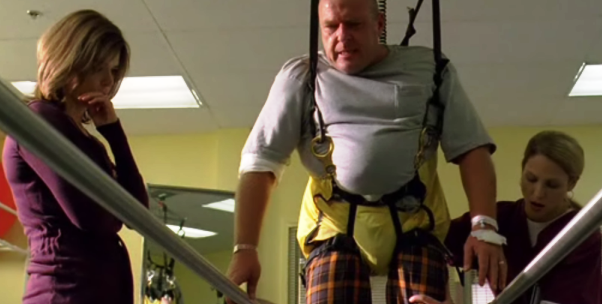
So much more to say. Who knows when I will get them posted? As I posted on Facebook, odds are this is psychosomatic or coincidental, but my M.S. symptoms have spread to parts of my body they had avoided before since Breaking Bad ended. Perhaps sheer force of will held them at bay until I saw the series until its conclusion. I haven't written all I planned to yet, but this makes for a good stopping point for Part II.
Tweet
Labels: Breaking Bad, Curb Your Enthusiasm, David Chase, Larry David, South Park, The Simpsons, The Sopranos, TV Tribute
TO READ ON, CLICK HERE


Monday, September 30, 2013
What a ride: Bye bye 'Bad' Part I
that STILL has yet to watch Breaking Bad in its entirety, close this story now.

By Edward Copeland
Kept you waiting there too long my love.
All that time without a word
Didn't know you'd think that I'd forget
Or I'd regret the special love I have for you —
My Baby Blue.
Perfection. I don’t intend (and never planned) to spend much of this farewell to Breaking Bad discussing its finale, but it happens too seldom that a movie or a final episode wraps with the absolute spot-on song. The Crying Game did it with Lyle Lovett singing “Stand By Your Man.” The Sopranos often accomplished it with specific episodes such as using The Eurythmics’ “I Saved the World Today” at the end of the second season’s “Knight in White Satin Armor” episode. Breaking Bad killed last night with some Badfinger — and how often do you read words along those lines?
We first met Walter Hartwell White, his family and associates (or, if you prefer, eventual victims/collateral damage) on Jan. 20, 2008. Viewers anyway. As for the time period of the show, the first scene or that first episode, I’d be a fool to venture a definitive guess. I start this piece with that date because it places the series damn close to the beginning of the 2008 calendar year. In the years since Vince Gilligan’s brilliant creation graced our TV screens, five full years of movies opened in the U.S. and ⅔ of a sixth. In that time, some great films crossed my path. Many I anticipate being favorites for the rest of my days: WALL-E, (500) Days of Summer and The Social Network, to name but three. As much as I love those movies and many others released in that time, I say without hyperbole that none equaled the quality or satisfied me as much as the five seasons of Breaking Bad.
For me to make such a declaration might come off as one more person jumping on the "what an amazing time we live in for quality TV" bandwagon. As someone who from a young age loved movies to such a degree that I sometimes attended new ones just to see something, admitting this amazes even me. On some level, early on in this sea change, it felt as if I not only had cheated on my wife but become a serial adulterer as well. In my childhood days of movie love, I also watched way too much TV, but I admittedly held the medium in disdain as a whole, an attitude that, despite the shows I loved and recognized as great, didn’t change until Hill Street Blues arrived. However, I can’t deny the transfer of my affection as to which medium satisfies, engages and gives me that natural high once exclusive to the best of cinema or, in those all-too-brief years I could attend, superb New York theater productions, most consistently now. It’s not that top-notch movies no longer get made, but experiencing sublime new films occurs far less frequently than in years past. (Perhaps a mere coincidence, but the most recent year that I’d cite as overflowing with works reaching higher heights happens to be 1999 — the same year The Sopranos premiered, marking the unofficial start of this era.) Granted, television and other outlets such as Netflix expanded the number of places available for programming exponentially, television as a whole still produces plenty of time-wasting crap. However, on a percentage basis, the total of fictional TV series produced that rank among the greatest in TV history probably hits a higher number than great films reach out of each year's crop of new movies.
Close readers of my movie posts know that when I compile lists of all-time favorite films, as I did last year, I require that a movie be at least 10 years old before it reaches eligibility for inclusion. With that requirement for film, it probably appears inconsistent on my part to declare Breaking Bad the greatest drama to air on television when it just concluded last night. However, I don’t feel like a hypocrite making this proclamation. When I saw any of the 62 episodes of Breaking Bad for the first time, never once did I feel afterward as if it had just been an “OK” episode. Obviously, some soared higher than others, but none ranked as so-so. I can’t say that about any other series. As much as I love The Sopranos, David Chase’s baby churned out some clunkers. The Wire almost matched Breaking Bad's achievement, but HBO prevented this by giving it a truncated fifth season that forced David Simon and gang to rush the ending in a way that made the final year unsatisfying following its brilliant fourth. Deadwood gets an incomplete, once again thanks to HBO, for not allowing David Milch to complete his five season vision. I recently re-read the one time I wrote about Breaking Bad, sometime in the middle of its third season, and though I didn't hail it to the extent I do now, the impending signs show in my protective nature toward the series since this came
 when it had a smaller, loyal cadre of fans such as myself who almost wanted to keep it our little secret. As the series moved forward, what amazed me — something that amazes me anytime it happens — was Breaking Bad’s ability to get better and better from season to season. That rarely occurs on any show, no matter how good. Programs might achieve a level of quality and maintain it, but rarely do any continue to top themselves. The Wire did that for its first four seasons but, as I wrote above, that stopped when HBO shorted them by three episodes in its final season. Breaking Bad not only grew better, it continued to experiment with its storytelling techniques right up to its final episodes. In this last batch of eight alone, we had “Rabid Dog” (written and directed by Sam Catlin) that begins with Walt, gun in hand, searching his gasoline-soaked house for an angry Jesse, whose car remains in the driveway while he can't be found. Then, well into the episode, we pick up where the previous episode ended with Jesse dousing the White residence with the flammable liquid and learn that Hank had tailed him and stopped Pinkman in the act and convinced the angry young man that the enemy of his enemy might be his friend. Then, in the episode “Ozymandias” (written by Moira Walley-Beckett, directed by Rian Johnson), the amazing first scene (following the pre-title card teaser scene) at To’hajiilee following the lopsided shootout between Uncle Jack, Todd and their Neo-Nazi gang versus Hank and Gomez, lasts an amazing 13½ riveting minutes. The credits don’t run until after the second commercial break, more than 20 minutes into the episode. Throughout the series, despite being on a commercial network, Breaking Bad never shied away from long scenes (and kudos to AMC for allowing them to do so) such as Skyler and Walt’s rehearsal in season 4’s “Bullet Points” (written by Walley-Beckett, directed by Colin Bucksey) for telling Hank and Marie about Walt’s “gambling problem” and how that gave them the money to buy the car wash. The dramas on pay cable that lack commercials seldom provide scenes of that notable length. Fear of the short attention span. With as many channels as exist, I say fuck those fidgety fools. Cater to those who appreciate these scenes when done as well as Breaking Bad did them. That writing surpassed most everything else on TV most of the time and as usual at the Emmys, where I consider it a fluke if someone or something deserving wins, Breaking Bad received no nominations for writing until the two it earned this year (and lost). On Talking Bad following the finale, Anna Gunn compared each new script’s arrival to Christmas morning — and she also worked on Deadwood with a master wordsmith like David Milch.
 Looking again at the initial moments of Breaking Bad, now viewed with the knowledge of everything to come, it establishes much about Walter White even though it occurred before Heisenberg made any official appearance. Watch this clip of our introduction to both Walt and Breaking Bad and see what I mean.

From the beginning, all the elements of Walt’s delusions had planted their roots in his head: the denial of criminality, his conviction that his family justified all his actions (which, compared to what events transpire later, seem rather minor moral transgressions now). One thing I wondered: Did Hank hang on to that gas mask somewhere in DEA evidence? It had Walt's fingerprints on it since he flung it away bare-handed. If Jesse told Schrader where they began cooking, hard evidence for a case existed and things might have turned out differently. Oh, well. No use crying over spilled brother-in-laws at this point. Dipping in and out of the AMC marathon preceding the finale and watching and re-watching episodes over the years (because, among the other outstanding attributes of Breaking Bad, the show belongs on the list of the most compulsively re-watchable television series in history), I always look for the exact moment when Heisenberg truly dominated Walter White’s personality because while I’m not in any way excusing Walt’s actions the way the deranged Team Walt types do, obviously this man suffers from a split personality disorder. You spot it in the season 2 episode where they hold the celebration party over Walt's cancer news and he keeps pouring tequila into Walt Jr.'s cup until Hank tries to put a stop to it, prompting a confrontation that mirrors in many ways Hank and Walt's after Hank deduced his alter ego. It also contains dialogue where Walt apologizes in the morning, saying, "I don't know who that was yesterday. It wasn't me." What caused that split, we don’t really know. We know that Walt’s dad died of Huntington’s disease when White was young and Skyler alluded to the way “he was raised” when he resisted accepting the Schwartzes’ help paying for his cancer treatments in the early days and he has no apparent relationship with his mother. Frankly, I praise creator Vince Gilligan for not taking that easy way out and trying to explain the cause of Walter White’s madness. I find it more interesting when creators don’t try to explain what made their monsters. I didn’t need to know that young Hannibal Lecter saw his parents killed by particularly ghoulish Nazis in World War II who ate his parents. Hannibal's character remains more interesting without some traumatic back story to explain what turned him into the serial killer he became. Since I brought up
 those Team Walt members, while I can't conceive how anyone still defends him, I understand how people sympathized with Walter White at first and it took different actions and moments in the series for individual viewers to accept the fact that no classification fit Walter White other than that of a monster. In the beginning, the series made it easy to feel for Walt and cheer him on. When he took action on the asshole teens mocking Walt Jr. for his cerebral palsy, who didn't think those punks deserved it? While an excessive act, when he fried the car battery of the asshole who stole his parking space, who hasn't fantasized about getting even on someone like that? Even when Walt's acts got more serious, you sided with him, such as when he bawled, sobbing "I'm sorry" repeatedly as he killed Krazy-8. Even the moment most cite as the breaking point as Walt watches Jane die plays as open to interpretation. He looks like a deer in the headlights, uncertain of what to do as much as someone who sees the advantage of letting this woman in the process of extorting him expire. The credit for that ambiguity belongs to the brilliance of Bryan Cranston's performance. However, once you get to that final season 4 reveal of the Lily of the Valley plant, I don't see how anyone defended Walt after that, if they hadn't stopped already. As Hank said at the end, Walt was the smartest guy he ever met, so why couldn't he devise a way to either save himself or kill Gus that didn't involve poisoning a child?
With all that said, Walt, while not redeemed, did rightfully regain some sympathy in the home stretch — surrendering his precious ill-gotten gains in a fruitless plea for Hank’s life, trying to clear Skyler of culpability, ultimately freeing Jesse and, most importantly, admitting that all his evil deeds had nothing to do with providing for his family but were because he enjoyed them, they made him feel alive. Heisenberg probably left that drink unfinished at the New Hampshire bar, but I think the old Walter White returned. The people he harmed deserved it and the scare he put in Elliot and Gretchen Schwartz merely a fake-out to ensure they did what he wanted with the money. He didn’t break good at the end, but he tied up loose ends and then allowed himself to die side by side with his true love — the blue meth he created that rocked the drug-addicted world.
Alas, my physical limitations prevent me from giving the series the farewell I envisioned in a single tribute, so I must break this into parts as much remains to be discussed — I’ve yet to touch upon the magnificent array of acting talent, brilliant direction and tons of other issues so, while Breaking Bad’s story has ended, this one has not. So, regretfully, as I collapse, I must say…
Tweet
Labels: Breaking Bad, Cranston, David Chase, David Simon, Deadwood, Hannibal Lecter, HBO, Milch, Netflix, The Sopranos, The Wire, Theater, TV Tribute
TO READ ON, CLICK HERE
Wednesday, June 19, 2013
James Gandolfini (1961-2013)

Sometimes, when the greatest of our artists mark the upper reaches of their golden years or they've announced an ominous health prognosis, I plan in advance what type of appreciation to write. However, when an unexpected death such as James Gandolfini's occurs at the age of 51, the task proves harder — I expected a lot more to come from this gifted actor, not this sudden, cruel punctuation mark of finality stamped on a career that promised us so much more.


Some of the films Gandolfini made during his time on the show weren't always the best, but he seldom failed to deliver whether it was his military prison warden in The Last Castle, his philandering husband in the Coens' The Man Who Wasn't There or, most especially, his gay hit man in The Mexican. Perhaps his finest screen work came in In the Loop, the satire about an attempt by D.C. insiders to stop hawks from starting a war. He also did a fine turn in the HBO movie Cinema Verite about the making of the landmark TV documentary on the Loud family in the 1970s that could be called the first reality show. His voice also proved perfect in Spike Jonze's film of Where the Wild Things Are. Among recent films, he and David Chase reunited in Chase's feature directing debut Not Fade Away, and he appeared in Zero Dark Thirty.
I wish I could have seen Gandolfini's Tony-nominated performance in Yasmina Reza's play God of Carnage. Gandolfini also didn't limit himself to acting, serving as producer and interviewer for two great HBO documentaries related to war: Alive Day Memories and Wartorn: 1861-2010.
Several works lay in various stages of production, so I expect we have some more James Gandolfini performances to anticipate, but not remotely as many as we should. RIP Mr. Gandolfini.
Tweet
Labels: Alec Baldwin, Coens, David Chase, Gandolfini, Geena Davis, HBO, J. Lange, Obituary, T. Scott, Television, The Sopranos, Travolta
TO READ ON, CLICK HERE
Monday, October 25, 2010
Boardwalk Empire No. 6: Family Limitation
BLOGGER'S NOTE: This recap contains spoilers, so if you haven't seen the episode yet, move along. Hopefully, next week's recap will be timely, but HBO is cutting it close with sending out the next batch of screeners and I have two doctor's appointments this week, one of which sometimes leads to infection, and the usual M.S. fatigue issues to deal with, so it will be a struggle to watch the Oct. 31 episode and write the recap and have it ready to post as I have the others which I got far in advance of the series' premiere.

By Edward Copeland
With "Family Limitation," we've reached the sixth episode of Boardwalk Empire's premiere season, precisely the halfway point. Additionaly, director Tim Van Patten has taken the job behind the camera for the third time in the show's short history and he's produced what may be the most memorable opening sequences since Martin Scorsese's pilot and his own second episode depiction of Big Jim Colisomo's Chicago funeral. A crane shot on high gives the viewer a wide
 view of the series' incredible Boardwalk set before moving downward and closing in on a corner where the Cafe Beaux Arts stands. Ward Boss O'Neill exits the establishment and crosses off a name in a long list of names in a notebook while adding a substantial amount of cash to an already bulging pile. As he stands there, one of the D'Alessio brothers, I believe Pius (I have as hard a time keeping them straight as Mickey Doyle does) addresses him as fatchops and asks if he has the time. O'Neill asks him what he says and Pius says something else disparaging and spits in the alderman's face before taking off running. Despite the ward boss's age and girth, he chases the young man at a good pace, captured n slow motion offering even more of a view of the fabulous set until he reaches a section the separates the Boardwalk from another part of Atlantic City and another D'Alessio brother appears and knocks O'Neill down with a blow to the head and takes his collections. You almost want to rerun the sequence again on slow play, just so you can examine the details on that fabulous set and admire Van Patten's setup once again.
Lucy Danziger may not be the apolitical Christine O'Donnell of 1920, but she has good instincts and she's been smelling Nucky's attraction to Margaret Schroeder probably long before he did. So, during one of their usual raucous romps in bed, Lucy literally assumes the role of jungle cat and marks her territory: scratching Nucky's chest so violently that she draws blood. She wants to make damn sure the other woman remember there's someone else and that she hold proprietary interest.

If Boardwalk Empire has a theme, in the way that David Chase said The Sopranos' point was to show that people don't change, then Boardwalk Empire seems to be week after week showing that there is more to people than meets than eye or, to use another cliche, don't judge a book by its cover. All of its characters seem criss-crossed by contradictions, none more than Margaret as we've discovered in the last few episodes. Margaret though hardly is the only case of someone who defies appearances. Last week, we saw Mrs. McGarry, the temperance crusader, excuse the drinking of those in Nucky Thompson's class, and she surprises us again when Margaret visits her for advice. Margaret tells her that a man has made her an offer. Mrs. McGarry asks if it is of a financial or sexual nature and Margaret responds yes. McGarry says there are words for that kind of woman,
 none of them flattering, leading you to expect what she will say, but the she turns (and does so wonderfully in the hands of the great Dana Ivey). Margaret tells her it will help provide for her children. Mrs. McGarry tells Margaret that the reason she lives in Atlantic City is that a man from Standard Oil paid her husband a large sum of money for oil on their Pennsylvania property. Her husband took the money and built a large, oceanfront mansion in AC. Six weeks later, he was dead of influenza and she sold the estate, moved into a smaller home and uses the money for causes she's passionate about, such as women's suffrage, which is just one state away from ratification. "The ballot box will free us," she says. Mrs. McGarry then recommends that she read a book she has and hands her Family Limitation by Margaret Sanger, dealing with birth control methods of that time. "Do as you see fit," Mrs. McGarry tells Margaret. "You owe no one an explanation."
Nucky and Lucy aren't the only couple in Atlantic City having a vigorous round in the sack. Lucky Luciano and Gillian are giving a bed quite a workout. As they take a break, Luciano expresses his gratitude to Gillian,
 telling her that no woman has been able to give him as much pleasure as she has in quite some time. Gillian thinks he's just trying to flatter her and brushes off his compliment but Luciano tells her he's serious. He confesses that a couple of years ago he had an "affliction" down there and ever since, he's had a difficult time getting any woman to hold his "wood." Given the evidence she's been experiencing, Gillian still finds his words doubtful. Honestly, Lucky insists, she's the first woman to keep the lead in his pencil in a long time. Their reverie is interrupted by the phone. Luciano answers to find Rothstein on the other end. Luciano wants to know how he knew where to find him. "I have a crystal ball Charlie, I see everything," Rothstein tells him. "For example, I see you aren't wearing any trousers." Lucky laughs and asks if he can call him back later. Rothstein wants to know what the progress is on the James Darmody situation. Luciano tells him he can't really discuss that at the moment. He's with his wife right now. "No you're not Charlie," Rothstein tells him. "You're with his mother." Luciano's jaw drops as Rothstein ends the call.
O'Neill, sporting a helluva shiner, is discussing his mugging with Nucky and Eli in Nucky's office. They agree it has to have been someone who knew his routine. O'Neill mentions that the kid had a "dago" look to him. Eli
 chimes in that the Italians don't respect the rules. O'Neill is steaming to get some guys and take care of the thugs himself, but Nucky insists that he let Eli handle it and tells him to go put a steak on the eye and dismisses him. Once he's gone, Nucky laments to Eli that he can't believe this could happen on the Boardwalk, just a few steps from his own office. He then asks if Luciano still is hanging around. Eli doesn't know who he is talking about. "Rothstein's greaseball. Have you seen him?" "He comes and goes," Eli responds. "I've had other fish to fry." Nucky suspects that Luciano either was behind it or knows who was and tells Eli to bring Lucky to him. Then there is a weak knocking at the door that Nucky can barely hear. Finally he says come in and Eddie enters. He chides him for not knocking like a man, but Eddie says he didn't want to disturb him. He brings a message from Jersey City Mayor Hague. Hague says he's been waiting at a hotel for a meeting for three nights and if he doesn't see Nucky tonight, he's leaving and Nucky should be reminded that, "There are many roads to Rome but there will only be one through New Jersey." Nucky tells Eddie to set up a dinner with Hague for that night.
Jimmy's showing off for a crowd in the club at Torrio's place with a large knife playing what I've always known as mumblypeg where he stabs the knife into the table between each gap of his fingers of one hand at ever-increasing speeds. When Capone sees what he's doing, he expresses concern for an accident. "Didn't you ever play five-finger fillet over there?" Jimmy asks. "No, we were too busy winning the war." Al tells him that Torrio is coming. Johnny joins them, complaining about a cracked molar. He tells the two that he's going to sit down with Sheridan and get out of Greektown. Capone gets livid. Torrio says he wants to get him into a war, but he doesn't need the money or the aggravation and tells Al to go clean the car. He then turns to Jimmy, and asks him if he's smart at all. Jimmy says he understands him not wanting a war, but if he retreats, what kind of message does that send?

Supervisor Elliott pays a surprise visit to Agent Van Alden's makeshift offices at the Post Office. Van Alden apologizes for the disarray of the office, saying he'd have tidied up if he'd known he was coming. That would defeat the purpose of a surprise inspection, wouldn't it? Elliott tells his underling before asking him what he has for him. Van Alden mentions the report on Nucky Thompson he was preparing to send. One of Elliott's men jokingly comments that it looks as if they have plenty of stamps for it. He says he's linked Thompson to much of the illegal alcohol business, but Elliott wants numbers. Elliott needs bottles brokens by the thousands, seized stills and boats. Van Alden mentions capital crimes. Elliott asks what capital crimes and Van Alden brings up the five murders in the woods and the death of Hans Schroeder. "What is your obsession with this Schroeder?" Elliott demands to know, mentioning that Van Alden had requested the immigration file on Mrs. Schroeder. "I'm just being thorough sir." Elliott hands the file back to the agent. "I need numbers, stills. You are a Prohibition agent, not Bulldog Drummond."

As Nucky and Margaret lounge in bed after an early afternoon encounter, Nucky takes her to task for trying to sound "American." He wants an "Irish lass," Margaret suggests. "Perhaps I do," he replies. Margaret wonders what her neighbors are going to think and Nucky tells her they won't be her neighbors much longer. She notices the marks left by Lucy on his chest and ask how he got those. Thompson claims they were from a hunting accident. "Who was hunting whom?" she asks. She then leaps out of bed at a speed that makes Nucky question where she was going, but she says she'd be back. Margaret heads to her bathroom and takes the copy of Family Limitation off the shelf and turns to the page showing how the disinfectant Lysol when mixed with water could be used as a post-coital contraceptive. Who knew? Life in the Roaring Twenties.
Jimmy accepts an invitation for dinner at the Capone household and the cramped apartment seems even more claustrophobic with the family tension between Al's Italian-speaking mother, his Irish wife and his sadly quiet boy who sits in the middle of the kitchen floor playing with a toy as his father routinely calls him a dumbbell. Al's wife Mae (Marcella Lentz-Pope) expresses sympathy to Jimmy over Pearl's death, saying how awful it is
 that she was run down by a streetcar like that. Capone says that he's gonna talk to that streetcar driver to be more careful and gives Jimmy a wink and a smile. He asks his mom to make some coffee and she says in Italian, referring to Mae, that she supposes that stupid cow doesn't have arms. "I may not speak Italian, but I know what stupido means," Mae says. Al asks Jimmy how many sausage links he wants. Jimmy asks for one; Capone says he'll give him three. Mae says he's a grown man, he knows what he wants. Al pushes his son with his foot, startling him and tells him it's time to eat before Mae picks him up and puts him in his chair. Jimmy says he has a kid about his age. Mae asks if he looks like him but Jimmy says no, he has dark eyes like his mother, but he definitely has a mind of his own. Al says, "I bet he answers when you call him" and then demonstrates and repeats his assertion that he's a dumbbell. Capone's mom trips over the toy, causing a huge noise and a mess and Al and Mae get up to check on her and clean. Jimmy notes that the boy doesn't notice a thing. He starts snapping his fingers next to the boy's ear and gets no response. Al notices what he's doing.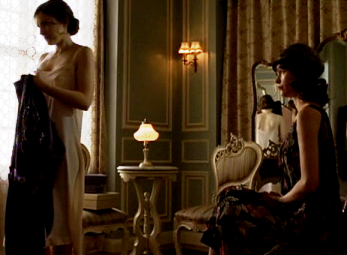
At Madame Jeunet's shop, Lucy pays a visit under the pretense of shopping, but much as her fingernails did to Nucky's chest, she's there to face Margaret and further mark her territory. She describes in great detail the type of sheer undergarment she's looking for to Madame Jeunet and then says she wants to see how it looks — pointing an accusatory finger at Margaret. Reluctantly, Margaret, Lucy and the underwear disappear to the dressing room where Margaret slowly disrobes. Lucy asks Margaret if she wears a bra. Margaret says she has tried them, but finds them uncomfortable. Lucy advises she try again. She says Margaret is saggy and you can tell she's had children. "You look like the kitchen help," Lucy spits. "A quickie bent over the table." "He doesn't seem to mind," Margaret shoots back. Lucy finally gets around directly to Nucky, telling her that the thing you have to realize about him is that he was raised a good Catholic
 boy and every once in a while, he becomes convinced that he is going to go to Hell. However, Lucy continues, all I have to do is this — as Lucy spreads her legs and shows her private parts — and he's "not so Catholic anymore." Margaret proceeds to tell her a tale about when she was a girl in Ireland as she puts her dress back on. "When I was a girl in Ireland, a raggedy man would come around every spring with a little Bantam rooster. He'd trained it to peck out 'The Mountains of Mourne' on a toy piano hung off his chest. Well, the first year he came, we, all of us, the girls in that place, we thought it magical. The second year, we laughed behind our hands at the odd man and his tatters, and the third year we didn't even go, because 'The Mountains of Mourne' was all that little rooster could ever do," Margaret tells an increasingly bored Lucy who asks if her story has a point. Margaret says it does: "Maybe your cunny isn't quite the draw you think it is." Margaret then storms out of the dressing room, curtly telling a confused Madame Jeunet that she quits as she leaves the store. The next thing we see, Margaret and her children are being helped out of Nucky's Rolls by Eddie as they move into their new three-bedroom home, where each child has their own room, there is a master bedroom, a fully-stocked kitchen and a telephone so Nucky can call. Margaret asks Eddie if Nucky treats him well. He answers in the affirmative, that Mr. Thompson is a very nice man.
Eli hauls Luciano into Nucky's office and gets grilled about stealing in Nucky's city. Luciano denies any knowledge of what he's talking about. He tries to get cute and Nucky purposely provokes him but before
 Luciano can leap over the desk and strangle Thompson, Eli has his nightstick around Lucky's throat. After a few brief moments of struggle, Luciano relaxes. He again stands by his story that he had nothing to do with the mugging. He's been too busy with a woman, he grins. Nucky says that if he's referring to Gillian Darmody, that is her business, but that Luciano should be warned that in his relations with her, he should treat her with the utmost regard. The meeting gets loudly interrupted by the sound of vigorous hammering on the door. Eddie comes in and Nucky asks what the hell he was doing. Eddie says that he told him he need to knock more manly. "You don't have to take the door off its hinges," an impatient Nucky says, wanting to know why Eddie is there. Eddie relays the news that Mrs. Schroeder is quite pleased with her new accommodations. Nucky dismisses him and then returns his attention to Luciano to make sure he understands how things work in Atlantic City. Luciano says he does, straightens his jacket and leaves.
Aside from his dinner out, Jimmy has been keeping to himself mostly since Pearl's suicide. He's sitting at a desk sending some cash back to Angela when one of the other girls drops by, trying to get him to join the party. Jimmy says maybe later. The girl does say Pearl left something in her room and returns his copy of Sinclair Lewis' Free Air.

Supervisor Elliott's talk about Van Alden's obsession with the Schroeders must have fallen on deaf ears because Van Alden returns to Margaret's old house but gets no answer when he knocks on the door. The agent can't see anything either when he tries peering in the windows. Margaret's former neighbor and baby sitter Edith, even bitchier than we've ever seen her before, steps out on her porch with a cigarette and tells the agent that she's gone. He asks if she knows where. She says she's probably off somewhere drinking champagne, given the hours she keeps and as much as Edith had to look after her brats. Edith also adds that the late Hans was a "saint" who always brought day-old baked goods to her. She asks if Margaret has done something wrong. Van Alden stays mostly quiet, just listening and asking. Edith tells him that all she knows is that a little while ago a blue limousine came and picked up her, her kids and all their stuff and drove them away. The agent inquires as to whether the limo happened to be a Rolls-Royce and Edith confirms that it was. He asks if there is anything else she can add. "Yes. She's a whore."

Torrio, accompanied by Capone and Jimmy, venture into Sheridan's territory to discuss the Greektown situation. As soon as the three walk in the door, Sheridan's men search them. Al gets his feather ruffled, complaining that that wasn't part of the deal. Sheridan says he wasn't the one who asked for the meeting and if he wanted to kill them, they would have been dead before they walked in the door and in case they are concerned, Sheridan is packing. Torrio succeeds in keeping Capone on his leash and the three men go to leave their coats with the pretty blonde hatcheck girl. Sheridan says to tip her good. Jimmy leaves a gratuity and thanks her politely. She genuinely smiles and the men adjourn to an adjoining room with tables and a bar. In
 the room, Sheridan makes a wisecrack about the violence, but then agrees to give Torrio a three-block section of Greektown. He also apologizes about Pearl. Jimmy, who seems to be in a world of his own, says that she was only 18. "What we gonna get sentimental now?" Sheridan says. Torrio tries to keep everything on an even keel and Sheridan apologizes for Pearl, though Jimmy thinks Liam, the man who sliced her, should apologize as well. Sheridan says he just told Liam to pick out a whore to make a point. It wasn't personal. Torrio says that everyone should agree that things got out of hand on both sides and they should just have a drink to settle things. Then one of Sheridan's men spots Jimmy's knife sticking out of his boot and the guns come out. "I thought you searched him!" Sheridan shouts. Jimmy apologizes, claiming he forgot he had it on him. Sheridan puts it to his throat. "Maybe I'll leave a mark and next time you won't forget." The handle intrigues him and he asks what it's for. Jimmy explains it's called a bonecrusher and it's for cracking walnuts. Everything settles down again and the meeting ends. As the men descend the stairs, Torrio mentions that he has to go to the head. Sheridan goes to get his coat. He asks what happened to the hatcheck girl, who has been replaced by a brunette. She says she's on a coffee break. Capone gets his coat, then Jimmy. Jimmy winks at the girl, pulls out his piece and opens fire. Al whisks out a shotgun and joins in the bloodbath. Torrio reappears and tells them to finish up. Jimmy goes up to a wounded Sheridan and tells him, "I guess you agree Greektown is ours now" before blowing his head off at point blank range and retrieving his knife. The three men hop into Torrio's car and get away.
Nucky and Margaret have their first tete-a-tete in her new house. The ringing of the phone startles her. She says she doesn't know if she'll ever get used to that. Nucky asks Margaret if she'd like to go see Hardeen with him. He's Houdini's brother, but he's just as good, Nucky insists, and show people can be fun. Margaret asks if he does tricks like his brother. Nucky says watch how he escapes from the dinner check.
In Chicago, Torrio's gang throw a private party celebrating their victory and Johnny compliments Jimmy's strategy saying that this "mick may be worth keeping around." Capone obviously doesn't enjoy someone else being Torrio's golden boy, even for a day, so he starts ribbing him about the morning wakeup call the other day as well as his service and injury in the war. It doesn't seem to bother Jimmy, but Al certainly is someone who can dish it out but can't take it. Jimmy teases him about his "hand-to-hand combat with the Kaiser" and
 being part of the Lost Squadron. "They were so lost, they thought Brooklyn was in France." The room laughs. Al does not. Still, Jimmy wonders if Capone should be someone to fear so it's not unreasonable when he's in his room later and hears two knocks on the door with no reply when he asks who it is to answer the door slowly with gun drawn. When it is indeed Al, Jimmy demands that he show what he has in both hands. Capone resists, asking if they aren't friends. Jimmy responds that they are accomplices. Finally, Al shows that his hands are bearing steaks wrapped in salt. Jimmy lowers the gun and lets Capone in. Capone, after explaining the best way to care for and cook the meat, tells Jimmy that it wasn't right the way he treated him in front of the guys. It made him look bad. As he's preparing to leave, he softens a bit and admits his son's deafness, telling about how he plays the mandolin and sings, but the boy can't hear. He'll place his little fingers on his throat and he can feel it, but he doesn't understand. Jimmy tells Al to take him to a doctor but Capone says it is in the blood and there's nothing that can be done. Jimmy says new things get discovered every day and he just has to keep hoping and trying. The entire episode really gives Stephen Graham his best showcase yet and presents the most well-rounded portrait of Al Capone.
Mayor Hague finally gets his dinner with Nucky, who asks him how much of a headache the Democrat is going to give him over the road money. Hague just smiles and continues to enjoy the meal. He asks what they are doing later. Nucky, knowing he's planning to take Margaret to Hardeen, asks if Hague wants to see Hardeen with him and his lady. Hague doesn't want to be a third wheel. "I can find you a girl," Nucky promises. "Only one?" Hague asks. At Margaret's, where a woman already has arrived to watch the children, Margaret receives a phone call from Eddie. She asks if she had the time wrong but learns that business came up and Nucky has to cancel. Apparently, Hague wasn't joking about just one woman. We later see him, sandwiched between two women. There's also a naked woman singing and
 playing the ukelele. Another woman kneels at Nucky's feet, about to please the Atlantic City powerbroker. As if he'd been eavesdropping on what Lucy told Margaret earlier at the shop, Nucky tells the girl, "I try to be good." When the sexplay has subsided and Hague and Nucky sit alone drinking, Hague tells Nucky he'd be wise not to put all his money on Senator Edge because he's a secret partner in a bathing company based in Jersey City. Thompson asks why Hague is telling him this. Hague says it's because guys like Edge come and go, bosses like him and Nucky, they are here to stay. Margaret, depressed that her evening has been called off, gets a surprise visit from a neighbor named Annabelle (Megan Reinking) and her daughter. She saw she had a sitter and her man had a last-minute opening, so she was wondering if she could leave her kid as well. All the "concubines," as she refers to the mistresses, stick together and help each other out. She asks if this is the three bedroom. Margaret confirms it. "Some fella must be sweet on you." Margaret isn't very talkative. The last time we see her. She's sitting in a mostly dark living room, just staring.
As Boardwalk Empire has developed, it's become clearer and clearer that Agent Nelson Van Alden does not fit the mold of your standard, straight-arrow lawman. He's no Eliot Ness and Michael Shannon's performance has been layered wonderfully, only letting the viewer see a little more of the inner Van Alden a little at a time. In the pilot, he appeared to be merely a pious Prohibition officer, telling Jimmy Darmody that it's "a godly
 pursuit" when he tries to recruit him as a federal officer. In the second episode, "The Ivory Tower," when he meets with Nucky, he echoes the Atlantic City powerbroker when he says that he supposes he marches "to the beat of a different drummer himself." After that, we saw him kidnap a dying man and when the man insulted him in Yiddish, shove his hand into his gutshot belly to get the answers he want. With the past two episodes, through his actions and his boss's own words, we're starting to see he might have as an unidentifiable an obsession with Margaret
 Schroeder as Nucky did before Nucky actually started sleeping with her. At the end of this episode, we see the equivalent of a married, tortured Catholic masturbating to his image of the once virgin(?) Margaret. At his apartment, Van Alden examines Margaret's immigration file, the one Supervisor Elliott wanted to know why he even needed. As he does it, he cracks his knuckles even louder than Eddie hammered on Nucky's office door the last time. The agent becomes fascinated with a photo of Margaret when she was 16. Van Alden turns the photo of his own wife face down, takes off his shirt and moves over to his bed where he methodicaly lays down a towel, removes a belt from a suitcase and turns it into a lash, places the photo of young Margaret where he can see it and proceeds to self-flagellate. Given the look of the marks on his back, this is not a new procedure for Van Alden. The guttural sounds Shannon emits almost echo like gunfire.
Tweet
Labels: Boardwalk Empire, David Chase, HBO, Michael Shannon, Scorsese, The Sopranos, TV Recap
TO READ ON, CLICK HERE
Friday, October 01, 2010
Stephen J. Cannell (1941-2010)

Even if you aren't familiar with Stephen J. Cannell's name, it would be impossible not to have seen or heard of an example of his prolific television work as a writer or creator. I really wanted to find a still of his company logo that ended most of his series: The bearded man sitting at his desk pecking away furiously at his typewriter then pulling out a sheet of finished paper and letting it fly as it floated into a C for his name and his company's logo. Now, his work was not all of the highest quality, that of which he'd earn him a place in an imagined hall of great artists, but he definitely holds a high perch in the stadium of pop culture now that he has succumbed to cancer at the age of 69.
According to Cannell's official biography on his own Web site, Cannell overcame dyslexia to become the prolific writer that he did. The site also indicated that he created or co-created more than 40 television series and wrote more than 450 episodes himself while producing more than 1,500 episodes. Here is just a handful of the TV that he had a hand in developing, creating or writing:
That doesn't include many series that didn't last or have been forgotten to the mists of times or work on television movies and series that he merely worked for as a hired writer such as the great Columbo episode "Double Exposure" featuring Robert Culp as the killer, a motivational expert.
He was nominated for an Emmy six times: three times in his role as executive producer of The Rockford Files, one of which won him an Emmy and whose producers included David Chase who would go on to create The Sopranos. He also was nominated for producing Wiseguy and for writing episodes of The Greatest American Hero and Tenspeed & Brown Shoe.
Cannell didn't just concentrate on television. He also wrote 16 novels, mostly thrillers and mysteries.
RIP Mr. Cannell.
Tweet
Labels: Awards, Books, David Chase, Fiction, Obituary, Television, The Sopranos
TO READ ON, CLICK HERE
Monday, July 12, 2010
The Benign Universe of Northern Exposure

By M.A. Peel
“Fleischman”
“Yeah, O’Connell”
It’s been 20 years since we first heard that call and answer. Northern Exposure debuted in the summer of 1990, against reruns of L.A. Law, which it beat out.
It was indeed a surprising summer sizzler, and so CBS asked creators Joshua Brand and John Falsey for a full season. Negotiations took quite a while, so it didn’t come back until April 1991. But the wait was worth it to the team, because they were given the coveted Monday night, 10 p.m. slot, following the well-established hits of Murphy Brown and Designing Women.
And that says a lot. Northern Exposure entered the TV landscape of the acerbic, Washington insider, just-out-of Betty Ford, uber magazine anchor, and the Atlanta, Ga., collective of feminine charm and smarts that was Sugarbaker Designs, with its signature monologue of indignation delivered by Julia. Both series brought issues into prime-time entertainment: racism, homosexuality, single parenting, AIDS, breast cancer, and medical marijuana, among others.
Northern Exposure dealt with issues too, but with no soap box in sight.
And it wasn’t about “women,” it wasn’t from a female pov (not that there’s anything wrong with that). Instead, it was about community and how the social organism relates to our emotional and inner lives. Heart and emotions: that was the magic of its appeal.
There was one TV community that cast a large shadow over the Alaskans — that crazy lot over in Snoqualmie County, Washington.
From Jeanine Kasindorf’s much-quoted April 1991 article for NY Magazine, “The New Frontier, How ‘Northern Exposure’ Because the Spring’s Hottest TV Show”:
“The show seems to have caught the imagination of an audience still hungry for the eccentric characters of Twin Peaks but no longer hungry for that show’s obscurity and rootlessness.”
Funny she should say that. Ron Powers in TV Guide, July 1991:
“Some strange spell falls over reviewers when they tackle the wonderfully woolly Northern Exposure on CBS: They always make a reference to Twin Peaks. Oops. Look at that: I've gone and done it too, keeping the record perfect. The lockstep wisdom seems to be that Exposure is Peaks' younger, smarter, nicer brother. Or that if David Lynch hadn't invented earflap-chic, viewers might not be able to make sense out of the more recent Joshua Brand-John Falsey creation without an interpreter's guide.”
Ron then goes on to say that NoEx goes much deeper into American mythology than being the sweeter Twin Peaks.
That avenue of explicating seems to have been misguided, if the creators get to decide intention (with due respect to Wimsatt’s Intentional Fallacy): “For what it’s worth, “ Falsey says, “we hadn’t even heard of Twin Peaks when we wrote the pilot, and it wasn’t going on the air for another three months.”

Morty the beloved Moose walking through the opening title sequence was an important visual that declared an important idea: that there are stories in this big country worth telling outside of spitting distance of US 1. (Interesting to note that the Bloodworth-Thomason’s Evening Shade, set in Arkansas and starring Burt Reynolds, ran from 1990 to 1994.)
Dr. Joel Fleischman, the Jewish New Yorker from the Upper West Side, is the bridge to this strange new world for the audience that isn’t comfortable away from the Northeast corridor. He’s the fish out of water, the doctor who has to pay off his college loans by working in Anchorage, a good-size city. In the pilot, he learns that Anchorage doesn’t need him and they have sold his debt to Cicely, Alaska, a very small, genuinely rural town.
The pilot starts with a very conscious Joel-as-Woody-Allen voiceover telling his backstory to the guy sitting next to him on the plane, who is none other than Dr. Anspaugh! When Ed Chigliak drives Fleischman to Maurice’s house and starts spouting medical jargon, Ed says “St. Elsewhere, I love that show” (created by the very same Brand & Falsey).
So while we may not know much about Alaska, we are instantly swaddled in unifying elements of pop culture. This is a place we will enjoy visiting.
Kasindorf wrote that Brand & Falsey often called their creation the “benign universe” — a nonjudgmental place where individuals can flourish while serving the greater good of the community. Where Joel and Maggie can pas a deux to their heart’s content and a 62-year-old man marrying a 19-year-old girl isn’t creepy because Holling and Shelly Tambo make sense; a place where a Native American medical secretary exerts steely control over her boss and Chris in the morning (John Corbett in his pre-Carrie Bradshaw days) can wax poetic from Voltaire to Einstein to Kerouac as a welcomed Greek chorus of one (although some did find him cloying).

The memorable episodes are many: “Aurora Borealis,” when Chris discovers Bernard is his black half brother drawn to Cicely by the midnight sun, and Joel runs in to Adam, the wild gourmet cook in the wild; “Jules et Joel,” when Joel’s slick twin brother comes to town; “The Big Kiss,” when Chris loses his voice to a beautiful woman, and can only get it back by sleeping with another beautiful women, that being Maggie; TV’s second gay wedding (but the first most people saw); the story of the lesbians Cicely and Rosalyn who founded the town; Chris flinging the piano (in lieu of the cow); and “The Quest,” the last episode for Rob Morrow/Joel, when he and Maggie go searching for the Jeweled City of the North. When they come to a crossroads, Joel sees his future and goes through the woods and comes out of the fog on the Staten Island Ferry. The view of the Twin Towers was surprising to me — I still flinch when I see them in a TV show that I’ve forgotten that they might be present in.
It was the emotional side to these stories that viewers found very satisfying, and that dynamic was heightened by the exquisite use of music. Miami Vice was the first series where the weekly soundtrack was as important as the dialogue. Its sounds were classic rock and ‘80s mélange. NoEx brought the American songbook into prime time, with Louis Armstrong, Mancini, Bacharach, kd lang, Peggy Lee, Patsy Cline, Etta James, Van Morrison, and so many others.
Ned/Ed from the Cicely episode:
“One person can have a profound effect on another. And two people...well, two people can work miracles. They can change a whole town. They can change the world.”
Brand & Falsey didn’t change the world, but they did bring a unique sense of love and well being to the airwaves. And they employed David Chase as an executive producer for 47 episodes from 1993 to 1995. Who knows, without that we might not have had The Sopranos.
Tweet
Labels: Burt Reynolds, David Chase, Lynch, The Sopranos, TV Tribute, Twin Peaks
TO READ ON, CLICK HERE
Monday, June 28, 2010
The Golden Age of TV drama?

By Edward Copeland
When The West Wing premiered, my mother expressed how glad she was that there finally was a show that wasn't about cops, lawyers or doctors. (She watched that show until the end, I gave up after the first two seasons once I started to realize you could put any character's lines into another's mouth and it wouldn't make a difference: They all sounded exactly the same.) Still, I understood her complaint and in the years since, it truly has been a bountiful time, thanks to the expansion of the cable universe, for TV dramas to explore new and different type of subjects. Most of the network fare still sticks to the docs and crime procedurals, but what glorious ideas have been springing forth elsewhere on the dial.
Even though I don't watch all the series that have driven the drama into new and exciting directions (or in some cases, I've started them and then gave up), it really is an exciting time for television. Though I've been a
 movie lover far and above anything else for all my life, I've had to acknowledge that in recent years, it's television that's been far more willing to take chances than the film industry, which seems obsessed with sequels and remakes of movies that aren't that old to begin with. While great movies still turn up, I really can't recall the last time a new film excited me the same way a series such as AMC's Breaking Bad does. There really isn't a television antecedent for the story of a man who is dying of cancer who becomes a meth-making master to leave a nest egg for his family. The story has the makings for a great movie, but it's even better on television because there's more room for layering and character development over time. Also, it builds anticipation week to week, season to season as to what happens next. It's difficult to remember back to when films could do that for me on a regular basis.
Now the interesting programs are spread across the dial but though it's their slogan (and by now a cliche), for a lengthy time it really did seem like it was true when an announcer would say, "It's not TV. It's HBO." The pay cable behemoth seems as if it single-handedly sparked this new take on what makes a quality drama series. Of
 course, the whiny commercial networks said they could be that good if they had the freedom of language, violence and nudity, but we all know the truth is that would just mean more lawyers would cuss, murders would be bloodier and doctors would take more clothes off when they have sex. Look at NYPD Blue, where the language was marginally more daring but the nudity was nothing but gimmicky shots of butts and the series itself was just an excuse to see how many friends and relatives of Andy Sipowicz they could kill off. It really never expanded to any other network programming and at its base, it was still a cop show with a gimmick. It wasn't the freedom of how things could be presented, but the ideas for series HBO was willing to pursue. Granted, not every drama HBO touched turned to gold (see Carnivale and John From Cincinnati) or were too short lived (like Rome), but they were willing to take chances others wouldn't including one little show you might have heard of that all the commercial networks took a pass on called The Sopranos. It was one of the worst moves in the history of the networks and the greatest for fans of quality television. That's what started the network bellyaching as they rushed to imitate it, but without David Chase and that brilliant cast, there hardly was a point. Not everyone remembers this but The Sopranos debuted in the season before The West Wing did. I can almost justify the first season of West Wing beating The Sopranos second season for the Emmy, but The Practice beating The Sopranos' first season and Nancy Marchand's loss still sticks in my craw. Then again, Emmy voters lack the same imagination that network executives do.
HBO just completed the run of its latest hard-to-describe drama, Treme, a type of series you would never find on a commercial network. Some of HBO's other successful dramas, past and present, might have had unusual
 settings such as Six Feet Under which revolved around a family that ran a funeral home and Big Love with its polygamists but at their base, both shows are really glorified soap operas. Other cable networks have joined the unusual drama game. In addition to AMC's Breaking Bad, the network scored first with Mad Men (ironically rejected by HBO) about ad men in the 1960s incorporating real products, events and characters almost like an E.L. Doctorow novel. What's really encouraging is that there are so many new and interesting dramas out there, you can't possibly watch them all. I've never seen Showtime's The Tudors or HBO's In Treatment, and have only seen the first two seasons of Showtime's Dexter. Would the commercial networks have dared try to make a continuing series with a sympathetic serial killer as its lead? I've also missed FX's Sons of Anarchy and Justified. While most of TNT's offerings fall into pretty predictable lines, they are marking new territory with Men of a Certain Age, but I'll follow Andre Braugher just about anywhere since his days on one of the rare network quality dramas, Homicide: Life on the Street, until that show got ruined by network meddling and pointless cast additions and subtractions that marred what was a marvelous show for three seasons or show. (Of course, Homicide was based on a book by the brilliant writer David Simon who created The Wire and co-created Treme.)
What's interesting is when networks put new spins on old genres. There have been plenty of Westerns on television, though you can never look at any the same way after the three marvelous seasons of HBO's Deadwood, though it was deprived of the two more seasons both it and its fans rightly deserved. The Wire might have been mistaken as just another cop show when it debuted, but it developed into so much more than that, presenting a portrait of a city and keeping more plates spinning in the air with each passing season while looking at the drug trade, port workers, the school system, politics and journalism as well as police work. With its approach that was more novel-like than TV-like, there is a reason that it is routinely hailed as the greatest TV drama ever. FX also shook up the deck of the police drama with The Shield by making its lead a corrupt cop who killed another officer to cover his tracks.
The networks have been sticking their toes in with shows like Lost, which I never watched, but it never could have shown up without the ground work laid by Twin Peaks back when ABC didn't have patience for that sort of adventure. Back when the networks did have their quality phase (and by networks I mean NBC) they gave life to Hill Street Blues and St. Elsewhere because their ratings were so awful, they could afford to take the chance and they stuck by them to let audiences develop. Of course, it's not as if the Emmys can save shows as they did with Hill Street. Look how they ignored the brilliant fusion of teen drama and horror on Buffy, the Vampire Slayer. At least Fox (and WB) stood by it for seven seasons, but again they were still up-starts that could afford to ride out the ratings in return for buzz and demographics. The commercial networks need to realize the days of their monopoly is over and they might as well take chances. What do they have to lose?

Tweet
Labels: Awards, Braugher, Breaking Bad, David Chase, David Simon, Deadwood, HBO, Homicide, Lost, Mad Men, Television, The Sopranos, The Wire, Treme, Twin Peaks
TO READ ON, CLICK HERE


