Monday, July 22, 2013
Dennis Farina (1944-2013)

Dennis Farina tended to be typecast as a cop or a crook — and having served 18 years on Chicago's police force before turning to acting had a lot to do with that, but like so many who come to performing from other lines of work, you'd hardly notice the difference. By the premature end of his 31-year acting career, just seeing his name brought a smile to my face because I knew that he'd provide some good moments in the movie or TV show I was about to watch, even if the production itself didn't turn out to be that great. He garnered two acting nominations in his film career, both for Get Shorty. The American Comedy Awards nominated him as Funniest Supporting Actor in Motion Picture and he joined the other members of the ensemble up for the 1995 Screen Actors Guild Cast Award, including James Gandolfini.

Farina made his film debut in 1981 in Michael Mann's often overlooked gem Thief. He did many guest shots and small roles in movies until he teamed with Mann again as the original screen incarnation of the FBI's Jack Crawford in Manhunter, based on Thomas Harris' novel Red Dragon, which introduced the world to Hannibal Lecter. That same year, Mann gave Farina the short-lived starring role in the 43-episode run of the period TV series Crime Story as Lt. Mike Torello. Atmospheric, vibrant and wonderfully scored — Crime Story couldn't last back then, but imagine if it had premiered a decade or so later on cable. The year Crime Story ended its run, Farina played memorable comic bad guy Jimmy Serrano in the great buddy movie Midnight Run, which just marked its 25th anniversary. Other comic bad guys would follow such as Ray Barboni in the film adaptation of Elmore Leonard's Get Shorty and the hit man Henry De Salvo in the underrated Big Trouble, based on the novel by Dave Barry.
On the good guy side of things he played Marshal Sisco, father of Jennifer Lopez's Karen Sisco in Steven Soderbergh's adaptation of Leonard's Out of Sight. He turned up briefly as one of the recognizable faces fighting World War II, in this case as Lt. Col. Anderson, in Steven Spielberg's Saving Private Ryan. He also
 put in two seasons as Detective Joe Fontana on Law & Order following Jerry Orbach's departure. His other television work includes the short-lived, quirky detective series Buddy Faro created by Mark Frost, which I enjoyed but ended quickly. Farina also put in a nice turn as an annoying fitness center owner in HBO's adaptation of Richard Russo's novel Empire Falls. Finally, in another case of a series that ended prematurely (and unnecessarily) he landed the great role of Gus Demetriou, right-hand man and aging strong arm for horse racing-obsessed prison parolee Chester "Ace" Bernstein (Dustin Hoffman) in HBO's Luck, an ill-conceived partnership between Mann and David Milch whose cancellation got blamed on the unfortunate deaths of three racing horses in the same sort of incidents that happen at real race tracks across the U.S. daily. It's a shame, because the nine episodes of Luck that aired were excellent. HBO should have had the guts to buy either Mann or Milch out and let the series proceed. (My vote would have been to keep Milch).
RIP Mr. Farina. Another gone too soon.
Tweet
Labels: Dustin Hoffman, Farina, Gandolfini, Hannibal Lecter, HBO, Michael Mann, Milch, Obituary, Soderbergh, Spielberg, Television
TO READ ON, CLICK HERE


Sunday, January 29, 2012
Luck Episode No. 1: Pilot Part I

By Edward Copeland
So begins the recapping of another series at ECOF. As you can imagine, even though the pilot only runs an hour, I had to split this recap into two because of all the exposition. As I wrote in the preview Friday, the Luck recaps will evolve as I
 write them. Be patient. Each show finds its own style of recap. Reminder: My comments are in italics and parentheses. Luck opens with the release of the series' main character, Chester "Ace" Bernstein (Dustin Hoffman), from FCI Victorville Medium II in Adelanto, Calif., which lies a bit away from the fictionalized version of Santa Anita Park where most of the series' action will take place. We won't learn exactly why Bernstein was incarcerated for three years in the first episode, but that information will be parceled out as the show develops. Once Ace exits the prison, he finds his faithful bodyguard/driver Gus "The Greek" Demitriou (Dennis Farina) behind the wheel of his car, ready to take him home. "How you doin', Ace?" Gus asks his boss as Bernstein climbs into the back seat and sighs. "We should get me a tape recorder," Bernstein says. "Meaning what?" Gus inquires. "Meaning what? Meaning we should get me a recorder," Ace replies. Two of the series' best-known executive producers, Michael Mann and David Milch, take hands-on roles in the premiere, with Mann directing and the cast speaking that unmistakable sound of Milchian dialogue. "Your trees. How are your trees in the back yard?" Ace asks. "Good. Good. Thanks for asking. You know, just this morning I was thinkin' that it's probably time to take the wraps off the figs," Gus replies. Much like Gus' figs, many things that have been concealed will be unwrapped during the course of Luck's inaugural season.
"Alright, let me see your horse owner's license," Ace requests of Gus, who hands the card back to his boss. "I'm surprised the camera guy didn't ask me who I thought I was kiddin'," Gus laughs. Bernstein leans over the seat to address his driver. "Hey — hey — no ifs, ands or buts — you're that horse's owner," Bernstein emphasizes. "Yes. I got it. I understand. Understood," Gus replies. "You think you're the first front in history?" Ace asks rhetorically with a slight grin as the car continues to speed down the two-lane mountain highway. Farina is great from the start of Luck, but it takes Hoffman some time to get into Bernstein's skin, especially in the pilot, which apparently was filmed long in advance of the rest of the episodes. He starts out, as in the scene in the car, as if he's supposed to be some kind of tough guy, a role he's never been that convincing at such as when he played Dutch Schultz in the film Billy Bathgate. As the show develops, he gets better as both Hoffman and the viewer get a better sense of who Chester "Ace" Bernstein is. One thing that's unmistakable from the beginning is the language could only spring from the mind of Milch. His unique rhythms, while not 19th century period prosaic, still stand out in a modern idiom from other writers' work.

Recurring throughout Luck, especially in the premiere, shots focus on horses' eyes. Those beautiful creatures' orbs captivate you, even more than the majesty the animals project when seen standing in full glory. (Of course, part of me thinks that if horses's brains were slightly larger, they'd hate our fucking guts.) That thoroughbred leads us to the horse barns and shedrow of Santa Anita Park itself. A rooster crows, a groom washes one horse, an exercise girl leads another on a walk while still others perform morning workouts on the track. Gamblers begin filling in Pick Six cards for the day as a large monitor in the median the track surrounds announces that today's Pick Six winners pays "at least $2,250,540." Our view shifts to a different pair of equine eyes: Pint of Plain, the Irish thoroughbred "owned" by Gus Demitriou. The track's head veterinarian, Jo Carter (Jill Hennessy), currently checks Pint of Plain over. "His gut sounds a little slow," she informs his trainer, a semi-legend at the track, Turo Escalante (John Ortiz). "So see what's what," Escalante, who emigrated from Peru, responds. Jo puts on a glove and adds some lube. "Don't you wish this was you?" she asks him jokingly before she goes exploring. "Loquita. A mental case," Turo replies before being distracted. He walks over to Leon Micheaux (Tom
 Payne), an apprentice jockey from Louisiana referred to as "Bug Boy" as most apprentice jockeys are. Escalante grabs Leon's crop. "You don't need no stick," Escalante tells him. "Yes sir, Mr. Escalante," Leon says politely. Escalante instructs Bug Boy to jog the horse once the wrong way around the track to loosen him up for the afternoon's race. "I was telling Joey before how psyched I am getting to ride for you," Leon declares enthusiastically, referring to his agent as Escalante helps him mount Mon Gateau. "We'll run big with this horse today." Bug Boy's statement puts Escalante in a foul mood. "Is this morning today or this afternoon?" Escalante asks him. The question puzzles Leon. "Pinhead — is today this morning so far?" Escalante rephrases. "I guess, sir," Leon answers. "Then jog him once the wrong way around and shut up on what you don't know before I call Porky Pig on you," Escalante threatens, using his derogatory nickname for Leon's agent Joey. "Yes sir, Mr. Escalante," Leon replies as he's led out of the shedrow. Escalante returns to the stable where Jo is removing her glove. "I can't believe you got that one in a race," Jo says of Mon Gateau. "I can't believe where you put your hands," Escalante replies. "No displacement, no obstructions or entrapments. Pretty sure it's just a gas colic," Jo reports. "Leche (Spanish slang for Milk of Magnesia) I can give him?" he asks. "Yeah. Give him some
 Milk of Mag. Once he's alert, just get him walking," she replies before switching subjects. "You met the limo driver yet? The one who broke the bank in Vegas?" Escalante seems skeptical about who really owns Pint of Plain. "And bought this horse for two million? Probably, too. Think they really landed on the moon," Escalante answers. "What? Monkey business?" Jo inquires. "For three years, he's a limo driver. Who he work for before that these three years is in jail?" he queries. Jo guesses Michael Vick, but Turo informs her it was Chester Bernstein. "Gorilla business," Jo says. "A long trip from Ireland. The quarantine — this guy's entitled to a touch of colic, Turo," she declares. He requests she check the horse again that afternoon. As Jo gathers her equipment, she asks Escalante if he's been to Ireland. "No," the Peruvian replies. "You have a heavy brogue," Jo tells him as she exits shedrow. As Escalante speaks Spanish with another worker, we hear Etta James singing, "I'd Rather Go Blind." "Whoo, I would rather, I would rather go blind, boy/Than to see you walk away from me, child, no/Whoo, so you see, I love you so much/That I don't wanna watch you leave me, baby" Escalante gingerly pats the sides of Pint of Plain's head. "For two million dollars, you got some plain head on you," he tells the horse.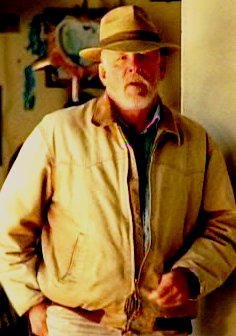
At another set of stables on the park grounds, an older man (Nick Nolte) dressed in beige from his pants to his hat steps up on the deck with his dog and doughnuts for his night watchman (Mario Roccuzzo) who sits outside one of the stables. "That's frosted. They said the chocolate covereds weren't fresh. How'd it go?" he asks the man. "The Big Horse got down. He slept all night, Mr. Walter. Even licked his tub clean," the night watchman replies before asking if "Mr. Walter" plans to bet that Pick Six that afternoon. He may refer to him as Mr. Walter as an old-fashioned courtesy, but his boss's name actually is Walter Smith, a longtime horse trainer
 who came to California by way of Kentucky. Smith not only trains but owns the animals as well now. The "Big Horse" the man referenced is Walter's prized colt Gettn'up Morning. There's a backstory involving both Smith and Gettn'up Morning's history that we'll learn about as the season unfolds. Smith's mind isn't focused on the Pick Six question, so his reply is less than definitive. His life focuses almost exclusively on Gettn'up Morning, to the exclusion of such extraneous matters. "I was wondering if in the last quarter the girl should loosen up and let him stretch the hell out," Smith says as his night watchman continues to talk about possible Pick Six payouts. "Yeah, let the big man show his stuff today," the man concurs with Smith. "Did I tell you that's frosted?" Smith, also known as "The Old Man," asks. "You did," his night guy replies. Smith gives him a pat and tells him to get some sleep. With a whistle and a click of his tongue, Walter gets the Big Horse's attention. "How ya doin' bub? Yeah, you know what I got," Smith says to the horse and we get another close look at one of those marvelous eyes. "What do you think? Do ya feel like stretchin' out?" Walter asks the colt. "Hey bruiser," Rosie Shanahan, the Irish exercise girl (Kerry Condon), says as she blows a kiss at Gettn'up Morning and puts down her gear. "About like last time?" Rosie asks Smith. "About like last time, but maybe you let him stretch out a bit in the lane," Walter tells her. "Great. 'Cause he's been pullin' my arms off," she responds. "He wants to run," The Old Man declares as he helps Rosie take her mount. Smith takes a seat in the bleachers with binoculars. "You're just hobby-horsing him," he comments.
Back in the shedrow, Escalante makes good on his promise and phones jockey's agent Joey Rathburn (Richard Kind) to complain about Bug Boy. "Why are you giving me a jockey who's running his lips about my business?" Escalante demands to know. "You're kidding, Turo," Joey says, expressing surprise from his spot by the track's rail. "I don't kid, you Porky Pig son of a bitch. He's chirping how he's gonna run him big when I told you that horse had no chance," the trainer responds. "A trainer like you throws us a bone, gives this kid a chance to ride for you and then — and then he's — he's gonna run his mouth on you?" an agitated Rathburn gets out, showing how he got his nickname. "Just tell him to shut the fuck up and loose lips sink boats," Turo tells Joey. "I'm gonna take him to the woodshed. Believe me," Rathburn promises as he stands beneath the entrance to Clockers' Corner. Meanwhile, Walter watches from the stands through his binoculars as Rosie begins getting Gettn'up Morning up to a good gallop.

Every track has them and Santa Anita is no exception: The serious gambler. Marcus Becker (Kevin Dunn) sits at one of the tables on the outside patio of Clockers' Corner, lots of forms and tip sheets spread about as he contemplates the day's betting plans. Marcus has to use a wheelchair and, periodically, take in
 oxygen from the mask that's attached to a tank on his wheelchair. Marcus currently eyes the day's 4th race when a member of his betting syndicate (not a crime syndicate as usually associated with the term, but a group of people who pool their money to make larger bets that cover more possibilities), Jerry Boyle (Jason Gedrick), joins him at the table. "I'm tapped," Jerry says as he sits. "You're what?" Marcus asks, removing the oxygen mask. "I'm tapped out. I'm tapioca," Jerry replies. "Yesterday you left the grounds a 390 dollar winner," Marcus declares. "Yeah, then I hit the Commerce Casino for a little poker fun after dark," Jerry explains. "With three days' worth of Pick Six carryovers worth several million dollars and you hand your bankroll to the ricers?" Marcus says, anger and disdain welling up in his voice. "Here's my picks," Jerry responds, sliding a napkin across the small table selecting horse Nos. 1,4,7 for the 3rd race; 5 for the 4th; 1,3,6,7 for the 5th; 2,3,5,7,8 for the 6th; 1,4,7 for the 7th and ALL for the 8th. "Fuck your picks, you degenerate prick — where's your money?" an openly pissed off Marcus demands to know. "Don't wind yourself up. Your face is going all different colors," Jerry says in his tranquil tone. "Fuck my face," Marcus responds, only to be interrupted by a coughing fit and the need to return the oxygen mask to his mouth.
In the stands, Walter continues to watch Rosie ride Gettn'up Morning around the track through his binoculars. "Oh, you're runnin' him around," Smith mutters as Rosie takes the colt to greater strides. Another member of the syndicate, Renzo Calagari (Ritchie Coster),
 shuffles on to the patio for the group's morning meeting. "Oh good. Now here comes the brain surgeon," a still pissy Marcus comments. Renzo holds up some cash. "Got my disability. Two hundred and fifty-five simoleons," Renzo announces as he hands the money over to Marcus. "Meaning against the Social Security he's gonna get, which is the mumbo jumbo these joints use to get around the usury laws," Marcus teaches his class. Gettn'up Morning's workout has captured the attention of eyes other than Walter Smith's. Joey Rathburn, pacing along the rail, and Jerry, still sitting with Marcus and Renzo, have noticed Rosie's ride on the Big Horse. Marcus pushes the napkin to Renzo. "That napkin's Jerry's whole contribution. Sick degenerate," Marcus tells Renzo.
 he took out a payday advance Walter puts his binoculars down and brings out a stopwatch. Rosie's ride continues to captivate Jerry. As she brings Gettn'up Morning to the theoretical finish line, Smith stops the clock and looks pleased. "Guess I still know a peach when I see one," Walter mumbles to himself. "You single the Fourth," Renzo says to Jerry, referring to his selection of only horse No. 5 in the 4th Race for the group's Pick Six plan. "I've got the Fourth semi-spread." Marcus examines Jerry's choice more closely. "A triple-bug apprentice hasn't won ten races in his life. He's gonna single a horse that's been — that hasn't run in two years," Marcus notes. From the racing form, we see that apprentice jockey's name is L. Micheaux and the horse that hasn't run in two years happens to be Mon Gateau, whose morning-line odds are 12-1. No wonder Escalante wanted Bug Boy to keep his mouth shut, but that's the reason behind the bet. "Yeah, but Escalante's the trainer," Renzo tells Marcus, who emits a sarcastic, "Oooh."
Leon slow rides Mon Gateau back and spots Joey. "I met Mr. Escalante in his barn," he tells his agent. "Oh yeah. How — How'd that go?" Rathburn asks as if he doesn't know. "Good. You know he's foreign. He's a little hard to understand," Leon replies, his Louisiana accent clear. One problem that will crop up throughout the series is that Tom Payne, the actor who plays Leon, hails from England and often that accent creeps out and he speaks in an unidentifiable dialect. Joey walks along the rail as the slow ride continues. "Well, you — you did some job," Joey tells his jockey. "I did?" Bug Boy responds with surprise. "P—Pissing him off with your wise-ass chirping about how good you thought this horse was gonna run today," Joey informs him. "I was just sayin' somethin' to say somethin'," Leon offers in defense. "That's what — that's what 'How's the weather?' is for," Rathburn suggests. "With a great trainer, I
 wanted to have somethin' to say," Leon insists. "Suppose he is making a bet, you — you think he wants some big mouth riding his horse?" Joey theorizes. Bug Boy asks if Escalante could be placing a bet, but the question only aggravates Joey more. "I—I—I don't know and if you want to know, I don't want to represent you. You're a bug. You ride everything hard and you don't chirp about what ain't your business," Joey instructs his client. "He could be on go, Joey," Leon whispers to his agent about Mon Gateau. "Moves like shine on a Saturday night." Rathburn makes another appeal, asking Leon to keep his mind right. As Leon rides on, Joey looks down the track as Walter greets the return of Rosie and Gettn'up Morning. Out of Joey's earshot, Walter says to Rosie, "11 and 2. He pulled up (stopped) at 23 and change." (23 and change is the time in seconds that it took the horse to breeze, or lightly run, the distance. Typically, horses are timed at intervals, in races or workouts — generally in ⅛ or ¼ mile increments. “11 and 2” would be the distance the horse ran, the 11 referring to furlongs. ⅛ mile equals one furlong. In the U.S., the classic distance is 1¼ miles. In Europe, it’s 1½ miles. Santa Anita's main dirt track is 1 mile long. Thanks to horse trainer Samantha Harvey of Alternative Horsekeeping With Samantha Harvey at The Equestrian Center in Yuma, Ariz., for helping explain that bit of dialogue for me.) As both the colt and Rosie pant, Rosie tells Smith, "Walter, listen, this guy's got nine more gears." Joey gets on his cell phone. "Ronnie, whereever it is you've flopped, find your coat, find your keys, find your car, get to the gym," Joey says into his phone. We don't see the person he's calling, but we do see his place, which has walls adorned with images of a victorious jockey, though we see Ronnie's wireless phone standing upright on a charger, its screen showing "12 new messages." Joey goes on, "Because if I didn't just see a Derby horse work, I'm a Chinese dentist. Plus the mount is open for you, Ronnie. An exercise girl was up. Yeah — yeah, call me back. Remember me — I'm y—your fucking agent, y—you drunken prick." I haven't spoken much about Mann's direction of this episode. It's been fine, but has been heavy on quick cuts after the initial Ace and Gus scene. However, I thought this sequence involving the various players noticing Gettn'up Morning that leads in to the great Joey-Leon talk that's filmed in a single walking/riding take shows Mann's most exceptional touch so far.
Jerry turns his attention back to his partners now that Gettn'up Morning has left the track. A hefty track security guard (Peter Appel) comes out of Top-O-The-Stretch (Top-O-The-Stretch is the name given to the betting area, either at self-service terminals that open even before the gates, and some manned ones later after the track opens for admissions) at a good gait. "Anyone seeking admission, please clear the grounds before the gates open at 10:30 unless you're a credentialed track employee," the guard announces as Marcus spins his wheelchair around to face the man. "Anyone morbidly fat? Anyone order a heart attack?" Marcus ridicules the guard (as if he has room to talk). "Yeah well, I wouldn't hold my breath. Oh, I forgot — you can't," the guard retorts. "When's the last time you saw your prick without a mirror?" Marcus shoots back. Jerry focuses the day's races instead of the insults. "Got the Pick Six in your crosshairs, Kagle?" Jerry asks the guard. "Yeah, I hold a few opinions," Kagle replies before getting a call on his walkie-talkie. Before Kagle leaves, he asks Jerry if he's going to "step up," but Boyle stays mum though Marcus looks suspiciously on the glances traded between Jerry and the guard. Renzo grabs Marcus' attention, telling him, "There may be more development at the coffee shop." Marcus seeks further explanation of said development, but Renzo prefers not to say. "A development of what type?" Marcus rephrases. "No. So if it doesn't happen," Renzo responds. "You're a moron," Marcus tells him, but he starts his chair moving when he sees Jerry leaving the table. "Hey — do not reach out to that three percent-a-week-charging bloodsucker," he warns Jerry about Kagle.
The drive from Ace's temporary Victorville residence ends as Gus pulls the car up in front of The Beverly Hilton, where Ace uses a suite as his home. When Chester exits the vehicle, he looks up and stares for a moment at his former stomping grounds. The hotel's executive manager (Spencer Garrett) greets Ace and shakes his hand. "Welcome home, Mr. Bernstein," he says. "If you've been partying up at my place, Maurice, they better all be out," Ace responds good-naturedly. "Oh if I missed one or two, you just send them down the fire escape," Maurice replies, adding that they've been preparing Bernstein's suite all week. "How about this guy?" Bernstein comments, indicating Gus. Maurice calls him "The Man With the Golden Arm," though he's referring to neither heroin addiction nor the Frank Sinatra movie. "I leave town. He hits a slot for five million dollars," Ace says. "I only do this for fun now," Gus offers since it would be unusual for millionaires to continue to serve as chauffeur/bodyguards. "I graduated, Mr. Bernstein," the young doorman tells Ace. "Good for you, kid," Bernstein says to the young man, patting him on the shoulder as he and Gus go inside. "So did I." (In a smoothly edited and executed segue, the glass doors of Ace's building turn into the glass doors where you enter the interior of the track's Clockers' Corner where they serve breakfast, seemingly without a cut.)

"There he is," Renzo exclaims as he, Marcus and Jerry enter the inside dining area. "Why do you sound so surprised?" asks a man in a yellow shirt and a light brown hat with his back to the camera. "I'm not. Because I never guaranteed you'd be here," Renzo replies as the man (Ian Hart) stands to greet the group. Jerry slides into a booth. "You gonna sit at the counter, you mind if I get by?" Marcus asks the guy obstructing his path. "That's Lonnie, Marcus. You met him once before," Renzo informs him as he moves into the booth. "And you're Jerry. We've met also, but I don't expect you to remember," Lonnie McHinery tells Boyle as he climbs in next to Renzo who suggests they all sit together there. Marcus wheels to the table's end. "You know what I still call you when I ask them how you are doing?" Lonnie asks Marcus. "Asshole?" he guesses. "The brains housing department," Lonnie answers. "Is it handicapped accessible?" Marcus inquires. Lonnie reminds Marcus where they met — a race day at Hollywood Park with Renzo. "You gave me a triple which I had to leave before I could play it," Lonnie recalls. "Does this story end sad?" Marcus asks in a tone indicating he could care less as he writes in a notebook. "No. No. No. I played it on TVG. 117 bucks it paid," Lonnie tells him. Lonnie's reminiscing gets halted temporarily by a waitress seeking breakfast orders. Once she finishes her business, the men resume theirs. "Now what would I always say to you?" Lonnie asks Renzo. "Let me once make half a score, I'll bankroll that genius gimp," Renzo replies. "Define — I'm afraid to ask — define 'half a score,'" Marcus seems slightly intrigued. "Off two women insurance agents paying me to fuck them senseless," Lonnie answers, a stack of bills in his hand wrapped by a rubberband.
Ace fiddles with a necktie in the bathroom of his suite before abandoning the effort. Gus calls from another room, asking if he's ready. "How'd you leave it with Escalante?" Bernstein asks. "That I'd call him from a few minutes out," Gus replies. "Your attitude with him — business. One hundred percent," Ace instructs Gus. Demitriou admits to being nervous about his planned meeting with Pint of Plain's trainer. Bernstein notices of pile of envelopes on a dresser that Gus explains are three years' worth of letters and notes wishing Ace well. "I wrote or called all of them back," Gus tells him. "You're friendly with Escalante, but you've got all the friends you need," Ace says, holding up his new microcassette recorder. "Spare me the hat dance," Gus pleads. "Just train my horse," Ace orders as they exit the suite.


Jerry dashes through the growing crowd at the betting windows until he finally spots Kagle and starts shouting the guard's name to get his attention. "Hey, would you loan you a thousand dollars?" Kagle asks Jerry. "What are you talking about? I'm not asking for a thousand," Jerry says. "Well. One policy fits all and from now on it's a thousand dollars minimum," the guard/loan shark informs him. "Why one policy? You're your own boss," Jerry points out. "Do I look self-employed in this uniform?" Kagle asks him. "As a shylock, you're self-employed. Does one pant size fit all?" Jerry says, sounding as if spending time with Marcus has rubbed off on him. "Yeah. Yeah. Good. Insult my weight," Kagle bristles. "Hat size, I said," Jerry insists, trying to erase his slur from the air. "It's a thousand minimum. Three points a week on the balance and I ain't chasin' you anymore for vig on a lousy three hundred dollars," Kagle makes clear. "Look, just let me take the fucking thousand then," Jerry says. "You do not qualify," Kagle declares. "Fuck you then and the Goodyear Blimp," Jerry spits as he storms off, but Kagle calls him back, holding cash in his right hand. "Mark my Pick Six," Kagle requests. A disgusted Jerry takes the money and starts filling in Kagle's betting card. Kagle thanks Jerry when he slaps the picks back at him, Playing in the background during the last part of the scene is part of Gil Scott-Heron's cover of Robert Johnson's "Me and the Devil Blues." "Early this morning/he knocked on my door/I said "Hello, Satan,/I believe it's time to go" Of course, if Jerry gave Kagle the same Pick Six selections that the syndicate has and they should pull off the win, the jackpot would be split — and you could count on Marcus being pissed. (Many thanks to Tony Dayoub for uncovering which artist was performing the cover for me. Check out his blog Cinema Viewfinder.)
The other three members of Jerry's group take spots behind the grandstand's last row since Marcus' wheelchair limits options. "I'll illustrate this degenerate's mind — why his vote's for singling the Fourth," Marcus says, referring to Jerry's picks. "Jerry, he's saying," Renzo tells Lonnie, in case he wasn't clear as to whom Marcus referred. Becker
 brings out the napkin as a visual aid. "Off form, it's completely open. He should really use every horse, but he ain't handicapping the horses, he's handicapping Escalante," Marcus elaborates. "Jerry's thinking, Marcus feels," Renzo conveys to Lonnie, as if he has to translate every word Marcus utters. "Escalante enters a horse away two years, all slow workouts, and he gives the mount to a triple-bug apprentice. The horse jumps up, who does that make the hero?" Marcus asks rhetorically. "Escalante, Jerry's thinking," Renzo answers, addressing Marcus this time. "We bet four deep in the Fifth and we're five deep in the Sixth. But you single Escalante. You bet only Escalante's horse and he wins, we just knocked out three-quarters of everybody else's bets. We're perfectly protected in the three races subsequent. And if we make it to the last, the Eighth race in which we bet every horse, we're in to a two million dollar jackpot," Marcus concludes, so excited by the strategy that his cough returns and it's oxygen time again. "Brains housing," Lonnie comments. "So where is Jerry? He feels bad because he tapped out in poker. He's probably got that fat fuck's fangs in his neck," Marcus guesses correctly about Kagle. Can't you hear Milch in that dialogue? "perfectly protected in the three races subsequent" "fat fuck's fangs" I love it. I miss being able to go to the track, not that I knew anything about horse betting. If I ever won, it was pure luck.
Ace enters the glass doors of another building and a woman steps out behind a desk in front of a case displaying wine bottles. She asks Bernstein how he is and if he's there to meet Mr. DiRossi. Ace confirms that he is and Nick DiRossi (Alan Rosenberg) spins on his seat at the lobby bar. "Oh. There he is. We're back to full strength," DiRossi says as he gets up to greet Ace and take him to his office, "So how you doin', Ace?" Nick asks, keeping his arms around Bernstein to guide him. "Great. You're doing real well," Ace comments, surveying the surroundings. This sequence is short, but Mann directs it in an interesting fashion. Though Nick and Ace walk and talk at a normal pace, the camera whizzes by unusually fast, giving the viewer blurry glimpses of the many bottles stacked in the display case. As I said earlier that Dustin Hoffman doesn't really get a handle on who Ace is right away, one thing he does do well is establish the physical side of Ace. Note at the beginning of this scene, if you re-watch it, the way Bernstein adjusts his cuffs and collar before he enters DiRossi's building. "The club is still strong. Last year we opened Atlantic City and Miami but the jewel in the crown is a club in Macau. That club is a real draw, Ace," DiRossi tells him.
Tweet
Labels: Deadwood, Dustin Hoffman, Farina, HBO, Luck, Michael Mann, Milch, Nolte, Sinatra, TV Recap
TO READ ON, CLICK HERE
Friday, January 27, 2012
I'd rather be lucky than smart

By Edward Copeland
More than two years after it was announced that Michael Mann would direct the pilot for a possible new HBO series written by Deadwood mastermind David Milch and starring two-time Oscar winner Dustin Hoffman (Kramer Vs. Kramer, Rain Man) and three-time Oscar
 nominee Nick Nolte (The Prince of Tides, Affliction, Warrior), that series — Luck — makes its official debut Sunday on HBO at 9 p.m. EST/PST, 8 p.m. CST. The premiere episode of Luck's nine-episode inaugural season actually debuted in December following the second season finale of Boardwalk Empire. Mann and Milch both serve as two of the series’ executive producers and Hoffman bears the title of producer as well. Thanks to my good friends of HBO, I've seen all nine episodes of Luck and will be able to post full-fledged recaps the moment each episode has finished airing. For now, I offer this brief, spoiler-free preview of the series that I've found to be a nice addition to the HBO family of dramas. Having that unmistakable rhythm of Milchian language resonating in my ears again certainly pleases me. On top of that, Luck captures the excitement of horse racing, particularly in a Mann-directed/Milch-written sequence in the premiere, like nothing I've seen before. As someone who enjoyed going to the track (even being clueless as far as handicapping horses goes), watching Luck made me miss being able to go. With only its brief run of nine episodes as a barometer, the show's forecast looks good with its future chance at greatness hovering around 75%. Luck isn't there yet. It's no Deadwood — but few things are. More importantly, it's no John From Cincinnati either. As I write this, the first two episodes are the only installments I've watched more than once but, unless I missed others, viewers will get through all nine episodes with only two utterances of cocksucker.
What makes that racing sequence in the Luck premiere mimic the experience of a real race parallels the premise of this new drama. The race gets shown from the various perspectives of those involved in horse racing and Luck tells those sides outside of race scenes as well. Its large cast encompasses owners, trainers, jockeys at different points in their careers, jockeys' agents, track veterinarians and the serious gamblers — and those just include regulars. The world David Milch has created also will cross paths with other track officials and employees. In their own ways, the horses develop distinct personalities as well. While scenes occur away from the fictionalized Santa Anita Park that serves as the focal point of the series, all stories lead back there in some way. As for that race sequence, much of the credit for it has to fall to Michael Mann's direction and the editing team of Michael Brown, Hank Corwin and Kelley Dixon. The cutting of that race should earn the pilot next year's Emmy in that category now.
Mann steered two of the '80s most influential crime dramas to the airwaves — Miami Vice and Crime Story — though he hasn't produced for television since the short-lived Robbery Homicide Division in the 2002-2003 season and he last directed for TV when he helmed the 1989 telefilm L.A. Takedown. It's not that Mann has been loafing — he's directed and/or produced several feature films including Heat, The Insider, Ali, The Aviator and Hancock. The Insider brought Mann three Oscar nominations for producing, directing and co-writing the film. He also was nominated for producing The Aviator.
Milch created Luck, which marks his first new work to air since John From Cincinnati. He wrote a pilot for a series called Last of the Ninth in 2009, but no one picked it up. Milch forever holds a place in the hearts of quality television fans as the maestro behind the prematurely ended Deadwood, whose two two-hour wrap-up movies never came to be. Milch has received an astounding 24 Emmy nominations for writing or producing for Deadwood, Hill Street Blues, Murder One and NYPD Blue. He won four Emmys, two for writing NYPD Blue episodes and one as a producer of that series when it won outstanding drama. He earned his fourth Emmy (actually his first) for writing a Hill Street Blues episode.
In addition to Mann and Milch serving as executive producers and Hoffman as producer, Luck's behind-the-scenes producing team also includes Carolyn Strauss (Game of Thrones, Treme) as executive producer; Henry J. Brochtein (The Sopranos, where he also directed) as co-executive producer; and Eric Roth (Oscar-winning screenwriter of Forrest Gump and Oscar-nominated writer of The Insider, Munich and The Curious Case of Benjamin Button) as co-executive producer.

Hoffman is the series' ostensible lead, though Luck boasts 13 regulars in its opening credits who all get screen time as well as many recurring characters. In fact, in the premiere, some of the other character get more scenes than Hoffman's character, Chester "Ace" Bernstein. We meet Bernstein first as he leaves federal prison after serving three years. The audience won't learn why Ace, a wealthy man who has spent his life operating around gambling enterprises and organized crime, ended up incarcerated in the first episode other
 than the fact he took the fall for other people. While imprisoned, he spent $2 million to buy an Irish race horse, using his faithful driver/bodyguard Gus "The Greek" Demitriou (Dennis Farina, star of Mann's Crime Story) as a front, acting as the thoroughbred's owner. One of Luck's strongest assets proves to be that chemistry between Hoffman and Farina, especially in the duo's late-night bull sessions in the hotel suite that Bernstein calls home. They board the horse, named Pint of Plain, at Santa Anita, the race track located in Arcadia, Calif., about 14 miles northeast of downtown L.A. Bernstein's motivation for picking Santa Anita turns out to have two purposes. The first figures in with long-term plans he's had to purchase the track and add casino gambling while getting even with some of his shady business associates, played by guest star Alan Rosenberg in the premiere who's joined in later episodes by Ted Levine and Sir Michael Gambon, returning to a character closer to his Thief in The Cook, the Thief, His Wife & Her Lover than Dumbledore in the Harry Potter films. The second reason resides closer to Ace's heart. Santa Anita serves as the home track for a talented and temperamental Peruvian-born trainer, Turo Escalante (John Ortiz).
In my eyes, Escalante — and Ortiz — could prove to be the breakout character and actor on Luck. Ortiz's name may not be as recognizable as Hoffman, Nolte or even Farina, but he's worked with some big name American directors since making his film debut in Brian De Palma's Carlito's Way in 1993. He also appeared in Ron Howard's Ransom, Steven Spielberg's Amistad and Ridley Scott's American Gangster. Luck's
 premiere doesn't mark Ortiz's first time being directed by Mann either — he acted in the 2006 film adaptation of Miami Vice as well as Public Enemies. Ortiz also executive produced and repeated his stage role in Philip Seymour Hoffman's directing debut, Jack Goes Boating. The play originated as an off-Broadway production by the theater troupe LAByrinth, where Ortiz served as co-artistic director. It's impressive, but if Luck succeeds,
 Turo Escalante will be the vehicle that launches Ortiz's career to the next level. Not only does Ortiz give a phenomenal performance, but Escalante, by far, shows himself to be the most fascinating part of the series as well as the character that interacts with more of the other players than anyone else, including the track's head veterinarian Jo Carter (Jill Hennessy), who turns out to be Turo's secret girlfriend. As with everything created and written by David Milch, he implies key things as much as he verbalizes them. Viewers will get the distinct impression that Escalante may be covered in infinite layers that could be peeled and examined in future seasons. In the meantime, Turo will be there, lashing out at jockeys for not following his instructions on how to run a horse during a race — even if the horse won anyway or acting as if he's a polite servant to a new horse's owner. Ortiz, as the best performers on a Milch show must know how to do, is as adept at making Escalante funny as frightening and even touching when needed.
Nick Nolte, whose stardom took flight on television in the 1976 miniseries Rich Man, Poor Man, returns to the medium for the first time since for Luck — just days after receiving his third Oscar nomination (his first as a supporting actor) in Warrior. As Walter Smith, the
 grizzled veteran horse trainer-turned-owner from Kentucky, Nolte's role on Luck plays as a supporting one as well. In fact, he's absent from one of the nine episodes. Called "The Old Man" by many at the track, Smith shares something in common with Ace
 Bernstein: the first episode plants seeds of a mystery surrounding his story. In Walter's case, it has nothing to do with a prison sentence, but questions concerning the origin of his "big horse," Gettn'up Morning, that will be resolved rather quickly though the issue will hover over Smith and Gettn'up Morning through the show's short season. Walter also has an important decision to make about the horse — picking the jockey who will ride Gettn'up Morning once he's ready. The two main contenders are his exercise girl, Irish lass Rosie Shanahan (Kerry Condon), who longs to be a jockey, and Ronnie Jenkins (real-life National Museum of Racing and Hall of Fame jockey Gary Stevens), who used to be a great but has moved into a universe of drink and drugs. Condon should be familiar to longtime viewers of HBO dramas from her role as Octavia on Rome or to moviegoers as Tolstoy's daughter in The Last Station. While acting isn't Stevens' first career, Luck isn't his first role. He played the famous 1930s and '40s jockey George Woolf (who happened to be based out of Santa Anita) in Seabiscuit.
Trying to keep Ronnie Jenkins sober and secure him the mount on Gettn'up Morning is his stuttering agent Joey Rathburn (Richard Kind) who also represents an apprentice jockey at the track, Leon Micheaux (Tom Payne), also
 known as Bug, the name given to most beginning jockeys because the asterisk by their names in racing forms resembles an insect. Joey's career as an agent isn't going well and we get hints that his personal life has crumbled into disarray as well. Leon hails from Louisiana and has problems maintaining the weight he needs to qualify for races. He also doesn't know when to keep his mouth shut — so he manages to keep pissing off Escalante, much to Joey's annoyance. Leon also has a mutual attraction with a certain red-haired girl — who may become a professional competitor down the road. Kind's a familiar face from film and television including his regular role on Spin City, his recurring role as Larry's cousin Andy on Curb Your Enthusiasm and as troubled Uncle Arthur in the Coens' great A Serious Man. Leon may be from Louisiana but Payne hails from England and most of his credits so far come from British TV. Payne's best-known work in the U.S. may be the film Miss Pettigrew Lives for a Day.
The final quartet of regulars belongs to a syndicate, but it's not the kind of syndicate that's crossing your mind. It's just the name given to a group of serious gamblers who
 pool their money so they can make bigger bets that cover more options and, hopefully, reap big benefits such as the more than $2 million payout that would go to someone lucky enough to correctly handicap the races involved in the Pick Six contest in Luck's premiere. The four men make for a colorful group, to say the least. The unofficial ringleader, Marcus Becker (Kevin Dunn), suffers from a variety of health conditions that force him to use a wheelchair and take frequent hits of oxygen from the tank attached to it. He's rude to everyone and seems as if he were born in a cranky mood. The true brain of the group belongs to Jerry Boyle (Jason Gedrick), who possesses a true gift for picking the right horses. Unfortunately, he likes to gamble all
 the time so anything he wins at the track he's liable to lose that night playing poker at a casino — and when Jerry gets tapped out, he becomes easy prey for a track security guard (Peter Appel), who works as a loan shark on the side. Marcus calls Jerry a degenerate, but the two of them have a special relationship that's almost
 like a father and son or two close brothers. The other two members of the group truly are misfits and you have to wonder how Marcus has let them hang around. The first is Renzo Calagari (Ritchie Coster), who lives on disability checks that he takes straight to the track. The newest member that Renzo has recruited is Lonnie McHinery (Ian Hart), a man who never gets the point of what's going on and has stumbled upon a bankroll supposedly from two women who are paying him to be their personal gigolo. Dunn has been a familiar face in lots of movies and TV shows since the mid-1980s. Even though he didn't have any scenes with Nolte, he also appeared in Warrior. Gedrick has appeared in a lot of television series either as a guest or in shows that didn't last long. He was the murder defendant in the first season of Murder One and one of the police officers in Boomtown, the NBC series that started out great until they mucked with its premise and destroyed it. Coster and Hart, like Payne, are Englishmen playing Americans. Name any crime procedural on TV and Coster has more than likely played a role on it. On the big screen, his films include Let Me In, The Dark Knight and American Gangster. Early in his career, Hart took on the role of John Lennon in two films in a row: The Hours and the Times and Backbeat. He's also made four films with director Neil Jordan including The End of the Affair, where Hart was especially good as a private detective with problems of his own.
Even with such a short season, Luck — already full of award winners and nominees in front of and behind the camera — attracted even more for recurring guest roles including Oscar nominees Joan Allen and Bruce Davison and Oscar winner Mercedes Ruehl. There's also guest appearances by Barry Shabaka Henley, Jurgen Prochnow and W. Earl Brown (Deadwood's Dan Dority).
When the credits roll for the first time on Luck, in case you don't recognize the song playing beneath the images and artists' names, it's a trimmed version of "Splitting the Atom" by Massive Attack. Below are the lyrics, the show uses. Click here and you can see the video on YouTube for the complete song. Every listing of the lyrics (including the captions) insists that the band sings "eternited leave." I find no evidence of such a word as "eternited" and almost changed it automatically to eternal, assuming it was a misprint but apparently songwriters Robert Del Naja and Damon Albarn invented a word for their song.
The evening it chokes, the candle, it burns
This disguise covers bitter lies
Repeating the joke, the meaning it dies
It's easy, don't let it go
Don't lose it
The bankers have bailed, the mighty retreat
The pleasure it fails at the end of the week
You take it or leave or what you receive
To what you receive is eternited leave
It's easy, don't let it go
It's easy, don't let it go
It's easy, don't let it go
Don't lose it
As readers who have followed any of my previous series recaps know, my format has evolved. The first show I covered was the great fourth season of The Wire, but I basically just regurgitated what happened with a little criticism tossed in. I didn't go crazy and learn all I could about Baltimore.
My recaps for the first seasons of Treme and Boardwalk Empire pretty much followed the same pattern until I noted historical moments on Boardwalk Empire I suspected casual viewers wouldn't get, so I added explanatory links. For the second season of Treme, I started seeking explanations to references that I didn't get and each recap became like a puzzle, adding the context of real New Orleans events, info on the music — I even began to learn the geography of that city without ever having been there. When the second season of Boardwalk Empire premiered, I beefed up those recaps as well, not only on historical points and characters but even the origins of words and phrases.
Now, I start the nine-episode run of Luck. The recaps will evolve as I write them, but I suspect that if you didn't know the ins and outs of horse racing and betting before the show premiered and parts of the series leave you in the dark, I'll do my best to help fill in those gaps as I learn as well. The first recap ended up in two parts, but that had to do with exposition I believe. I do have to say it's probably a good thing that AMC didn't think me worthy enough to receive Breaking Bad screeners or I probably would know how to make crystal meth.
Luck premieres on HBO Sunday at 9 p.m. EST/PST, 8 p.m. CST with each of the subsequent eight episodes in the nine-episode first season airing at the same time.
Tweet
Labels: Boardwalk Empire, Breaking Bad, Coens, Curb Your Enthusiasm, De Palma, Deadwood, Dustin Hoffman, Farina, Gambon, HBO, Luck, Michael Mann, Milch, Nolte, P.S. Hoffman, R. Scott, Spielberg, The Sopranos, The Wire, Treme
TO READ ON, CLICK HERE
Sunday, September 18, 2011
Tears are fallin' and I feel the pain/ Wishin' you were here by me,/To end this misery

By J.D.
Fresh from the success of Miami Vice in the mid-1980s, Michael Mann parlayed his powerful clout to produce a new television show entitled, Crime Story. It was a pet project that he developed with good friend, Chuck Adamson, and Gustave Reininger. Like Vice, Crime Story was a cop show but set in the early 1960s and with a grittier, darker edge as opposed to the stylish, brightly lit pastel look of its predecessor. To this end, Mann not only cast Hollywood outsider Dennis Farina (whose unconventional looks must've terrified NBC executives), but had exploitation filmmaker Abel Ferrara direct the pilot episode. The result is a lean, mean drama that features politically incorrect police officers battling it out with nasty criminals.
The pilot episode for Crime Story begins with a daring restaurant robbery gone bad. Del Shannon sings "Runaway" (re-recorded especially for the show) as the hold-up turns into a hostage situation. Three police detectives led by Mike Torello (Dennis Farina) race to the scene (blink and you'll miss a young Michael Rooker as a beat cop). No words are spoken between the men as they calmly check their guns and get ready. As the criminals are about to take off with their hostages, Torello leans in menacingly and says to one goon, "you hurt anybody else, when this is all over I'm gonna find what you love the most and I'm gonna kill it. Your mother, your father, your dog. Don't matter what it is — it's dead." Welcome to the world of Crime Story.

It turns out that the criminals are working for local wise guy, Ray Luca (Anthony Denison), a vicious thug with a short fuse and an awesome pompadour that defies gravity. This guy isn't afraid to smash bottles and furniture over hapless underlings to get his point across. Luca plans to steal some valuable European royalty jewels from the Lakeshore Museum but Torello intends to link the restaurant robbery to the thug and stop the heist from going down. Mann has said that he was influenced by working on the Police Story TV series (1973-1977), which was run by playwright Liam O'Brien and included famous crime writer Joseph Wambaugh (who wrote The Onion Field) as a contributor. Each episode was based on a real event, working with the policeman whose story it was based on. Mann "learned a lot about writing and about working with real guys." Crime Story was based on the experiences of Chuck Adamson, a former Chicago police detective for 17 years. He claimed that the stories featured on the show were composites rather than actual events, “but they’ll be accurate.” According to Mann, the project's genesis was to follow a group of police officers in a 1963 major crimes unit and how they change over 20 hours of television.
He asked Reininger and Adamson to write the series pilot and a "Bible." Reininger was a former Wall Street international investment banker who had come to Mann's attention based on a screenplay he had written about arson investigators, and a French film that he had written and produced. Reininger researched Crime Story by winning the confidence of Detective William Hanhardt, who put him in touch with undercover officers in Chicago. They sent him on meetings with organized crime figures. Reininger risked wearing a body microphone and recorder. After visiting the crime scene of the gruesome gangland slaying of bookmaker Al Brown, Reininger backed off his mob interviews.
Mann said that the first season of the show would go from Chicago in 1963 to Las Vegas in 1980 where the characters would have "very different occupations, in a different city and in a different time." He said, "It's a serial in the sense that we have continuing stories, and in that sense the show is one big novel." Mann and Reininger's inspiration for the 1963-1980 arc came from their mutual admiration of the epic 15+ hour film Berlin Alexanderplatz (1980), by German director Rainer Werner Fassbinder. Mann said, "The pace of our story is like the speed of light compared to that, but that's the idea — if you put it all together at the end you've got one hell of a 22-hour movie."
NBC President Brandon Tartikoff gave an order for a two-hour movie, which had a theatrical release in a handful of U.S. theaters to invited guests. Tartikoff also ordered 22 episodes which allowed Reininger and Adamson to develop character arcs, and tell continuing stories (instead of episodic, self standing shows). Mann predicted a five-year network run for the show. However, due to budgetary constraints (the need for four sets of cars proved to be too expensive). Tartikoff eventually allowed their series to move to Las Vegas for the last quarter of the 22 episodes. By the second season, an average episode cost between $1.3 and 1.4 million because it was shot on location, set during the 1960s and featured a large cast.
However, Universal Pictures decided not to make Crime Story because they deemed it too expensive to go through several different period changes in one season and a small studio called New World Pictures Ltd., stepped up to finance it. It allowed them to work in the big leagues with a major TV network such as NBC and a chance to sell the show overseas while Universal would retain the domestic syndication rights. The production schedule was a grueling two episodes every three weeks, shooting 12 hours a day or more every day of the week.
One of the most distinctive aspects of Crime Story is the look, the attention to period detail. Hilda Stark worked as an art director on the pilot and was asked back by Mann after seven episodes to be the production designer. To achieve the show’s period look, Stark and her team would go to second-hand and antique stores, run ads in the in newspapers seeking articles from the period, and sometimes build furniture if they could not find it. According to Stark, the overall design or look of the show featured “a lot of exaggerated lines. We go for high style — sleek lines and high style…We go for the exaggerated shapes that recall the era.” Stark and her team also came up with a color scheme for the show that featured “saturated color, and certain combinations — black, fuchsias — reminiscent of the ‘50s.” She finds inspiration from a library of old books and magazines, in particular Life. For the vintage cars in the show, they buy or rent from private owners.
It's a testimony to Mann's reputation at the time that Crime Story was even greenlighted. NBC would have never gone for the casting of Dennis Farina, with his pockmarked face and lack of acting experience, had Mann been a neophyte producer with no proven track record. The choice of cult film director Abel Ferrara also must have freaked out network execs. His previous films included The Driller Killer (1979), where a deranged psycho gruesomely kills people with a power tool, and Ms. 45 (1981), where a rape survivor viciously kills the men who attacked her with a .45 pistol.

Still, the final product proves that Mann's instincts were right on the money. Farina delivers the hard-boiled dialogue with the perfect amount of intensity. (Farina orders a loose cannon cop, "Why don't you get unconscious for awhile?") You can see it in his eyes and the way he barks out orders that this a no-nonsense guy who isn't going to let anything get in the way of his job. In many respects, he is the prototype for Al Pacino's equally driven cop in Mann's Heat (1995). Farina's Torello is the prototypical Mann protagonist: a professional and a perfectionist, at the expense of everything else.
Ferrara directs with the same proficient skill of crime auteur, Don Siegel. Like Siegel's two best crime films, Charley Varrick (1973) and The Killers (1964), Crime Story depicts a harsh world where life is cheap and characters will do anything — even if it means bending or breaking the law — to achieve their goals. Crime Story would provide the blueprint for Ferrara's later forays into urban crime films such as The King of New York (1990) and Bad Lieutenant (1992).
When the show debuted Sept. 18, 1986, following Miami Vice, the two-hour pilot had a 20.1 national Nielsen rating and a 32 percent audience share. The ratings dipped when it was counter-programmed against ABC's Moonlighting. By October, the show dropped below a 22 Nielsen share, where a series is deemed a "failure.” Despite low ratings, Crime Story was picked up by NBC to finish the 1986-87 season. This prompted the network to move the show to Friday nights after Miami Vice on Dec. 5, 1986, where its ratings improved but it still lost to Falcon Crest. NBC temporarily pulled Crime Story off the schedule on March 13, 1987. In order to get more people to watch, Farina and other cast members promoted the show in five U.S. cities.
One of the most striking aspects about Crime Story is that it feels like it was ripped right from the pages of a James Ellroy novel. It is even more surprising that this show was done before Ellroy had written his famous L.A. Quartet of books that featured L.A. Confidential, which Crime Story most closely resembles. The author claims that he hadn't seen the show until after he wrote these novels but he does admit to being a fan since then. In an interview with Paul Duncan, Ellroy said, "I think Dennis Farina as Lieutenant Mike Torello is a force of nature. When the hatred between him and Anthony Denison fuels the plot, it's great, it's epic. but after a while it just goes to hell."
Tweet
Labels: 80s, Don Siegel, Farina, Michael Mann, Pacino, TV Tribute
TO READ ON, CLICK HERE
Monday, August 15, 2011
When Hannibal First Crossed the Screen

By J.D.
Before Jonathan Demme's Academy Award-winning The Silence of the Lambs (1991) graced the screen with Anthony Hopkins in all of his visceral glory, Michael Mann's little-remembered (and seen) thriller, Manhunter (1986), which was released 25 years ago today, presented a very different kind of Hannibal Lecter. While Demme's film opted for over-the-top performances and needlessly gory scenes of violence, Mann's film took a subtler, creepier approach to its material. Manhunter is less interested in depicting the actual killings (the main attraction of this genre when it became popular) than in the cerebral and actual legwork required to enter the killer's frame of mind and track him down.
Thomas Harris' novel, Red Dragon, was published in 1981. It explores one man's eerie trip into the mind of a serial killer. Profiler Will Graham (William Petersen) reluctantly comes out of retirement to track down Francis Dollarhyde (Tom Noonan), a man who slaughters whole families to fulfill his own power fantasies. Graham is able to pursue the killer by thinking and dreaming as he imagines the killer does. However, the last time he tried this technique it pushed him to sanity’s edge. The case involved a cunning psychiatrist named Hannibal Lecktor (spelling changed from the novel) who viciously killed his patients, scarring Graham both physically and emotionally. Now Graham must make the dangerous journey back into the mind of a killer to catch him before he kills again.
Richard Roth (who produced director Fred Zinnemann's penultimate film, the much-lauded Julia, starring Jane Fonda, in 1977) bought the film rights to Harris' novel for Dino De Laurentiis with David Lynch attached to direct. Lynch already had made the critical and commercial disaster Dune (1984) for the Italian movie mogul and was looking for a chance to redeem himself. "I was involved in that a little bit, until I got sick of it. I was going into a world that was going to be, for me, real, real violent. And completely degenerate. One of those things: No Redeeming Qualities." Lynch went on to make Blue Velvet (1986) and so Roth offered the project to Mann. Although, one wonders what Lynch’s take on the material would have been like.
After the failure of The Keep (1983), Mann went back to television and produced the very popular Miami Vice television series for NBC. The 1980s was a time when Ronald Reagan was president of the United States. The country was a consumer culture, a carnivorous, materialistic society that is reflected in the show with its stylish fashion and architecture. Manhunter also is a product of its time as it reflected that era's currency of popular culture in terms of fashion, style and music. Mann read Red Dragon not long after it was published and "thought it was the best thriller I'd ever read, bar none." Mann was intrigued by Harris' exploration into the nature of evil. As Mann wrote the screenplay, he decided not to graphically depict the murders as in the book. This is why Mann's film stands apart from the other Lecter movies and serial killer films in general.
The first Mann theme that Manhunter explores is the conflict of the individual versus the desire to preserve their family. Will Graham is a consummate professional and the best at what he does — profiling serial killers. His friend, Jack Crawford (Dennis Farina), seeks him out. Two families have been brutally murdered by the same killer: the Jacobis in Birmingham, Ala., and the Leeds in Atlanta. They talk on the beach in front of Graham's house. Crawford shows Will not pictures of grisly murders as we almost expect, judging from the way they're talking, but snapshots of two families frolicking in a recreational setting. This is quite shrewd on Crawford's part. He is obviously appealing to Graham's protective nature toward his own family. He knows Graham will feel empathy for the dead families and future ones and therefore offer his services.
This opening conversation between Graham and Crawford also is a teaser of sorts. Nothing is alluded to concretely — especially Graham's ability to get into the mindset of a killer. The closest we get to what happened to him before he quit is when Crawford says, "You look alright." Graham responds, "I am…alright."
 That hesitation makes one wonder — is he really OK? How damaged is Graham? What is so fascinating about this scene is that so much is implied. The scene begins mid-conversation and alludes to Graham’s mysterious past, one that has caused an obvious rift between him and Crawford. The audience can only imagine what the source of this tension was and will only learn bits and pieces of what happened to him later on in the film. While Graham keeps in the tradition of Mann’s intensely professional protagonists who are the best at what they do, he is also one of his most layered characters. There is much more to Graham than a driven investigator. He also is an extremely sensitive person who is compelled to do what he does out of a need to save others from being brutally murdered. The process that Graham undergoes to catch these killers is what intrigued Mann in the first place.
The visual motif of imprisoning bars features prominently in the scene between Graham and Lecktor (Brian Cox) where the investigator goes to visit the killer in order to get the criminal mindset back. The first shot has Graham framed with bars in front of him. The film cuts to a shot of the imprisoned psychiatrist lying on his bed, his back to Graham with bars in front of him as well. In a way, both men are imprisoned. Lecktor literally and Graham metaphorically, trapped in the nightmare of trying to solve these murders. Graham almost is trapped in his nemesis' presence. Graham does not want to talk too long to Lecktor and risk exposing his mind to the psychiatrist's horrible thoughts.
As Hannibal gets up and faces Will, the camera slowly zooms in ever so slightly on him which creates a great dramatic effect. Lecktor resides in an antiseptic white prison cell and he wears white so that he almost blends into his surroundings except for his black hair and the skin color of his face and hands. It is a miniature disturbance in this immaculate and pristine place that effectively conveys how dangerous Lecktor is: those tiny bits of him are already disruptive to the immaculate white of the scene. It also throws everything off just ever so slightly as the focus is directly on Hannibal's face, forcing the audience to pay attention to what he is saying and how he is saying it. Even though imprisoned, he seems very clearly in control.
The two men engage in a verbal dogfight as Lecktor tries to push Graham over the edge, while Graham fights being exposed to the madness. The speed of this little exchange is like some kind of perverse screwball comedy. Cox is so effective by the way he underplays it: completely calm, yet always just a tad menacing — be it the affectations of his accent or the quiet and ruthless way he gives his lines an off-center spin.
Lecktor does not go for the easy insult and counters, "You're very tan, Will," and proceeds to analyze him, demonstrating how easily he can pick him apart. Then, Hannibal goes in for the kill when he says, "Dream
 much, Will?" At this point, Graham has had it and gets up to leave. He cannot let Lecktor invade his thoughts or his dreams. In Mann's world,j this would be fatal. Finally, it gets to be too much for Graham as Lecktor presses his advantage: “You know how you caught me, Will? You know how you caught me? The reason you caught me, Will, is because we're just alike. You want the scent? (quieter, menacing) Smell yourself.” Lecktor starts off speaking quietly yet insistently. Graham can no longer stand it and begins pounding on the door, demanding to get out. Lecktor continues, increasing the volume of his voice until Graham, frantic at this point, runs out of the building. As Lecktor says this last line his voice dips to a threatening whisper. Graham runs down the many corridors of the psychiatric hospital, almost as if he is symbolically escaping Lecktor's brain, his cell being the vortex or center of it.
The scenes that take place at the Chesapeake State Hospital for the Criminally Insane were shot at the High Museum of Art in Atlanta while the scenes in Lecktor’s cell were shot on a soundstage in Wilmington, N.C. According to Cox, he and Petersen rehearsed this scene for 10 days and shot it during a period of four days. Not surprisingly, Mann shot the scene many different ways. "At one point," Cox remembers, "I screamed the line 'Smell yourself.' At another, I did it very quietly. I did it every way imaginable." Cox plays Lecktor as a polite man, but you can sense the menace seething underneath the cheery facade. He delights in probing Graham's mind, threatening to invade his thoughts and his dreams.
Another of Mann's preoccupations is showing the process of professionals hard at work, doing what they do best. This is showcased prominently in the scene where Graham and Crawford analyze Dollarhyde’s note to Lecktor. While cleaning Hannibal’s cell one day, a janitor finds the note addressed to the psychiatrist. Lecktor is taken out of his cell, giving the investigators just a few hours to decipher the note before Lecktor gets suspicious. First, the hair fibers are analyzed; second, the note is analyzed for fingerprints; third, they try to figure out what the missing section of the note says; and finally, they try to decipher Hannibal's reply in the National Tattler personal ads. Mann is meticulous in how he shows the hard work that these professionals do as they analyze physical evidence with state-of-the-art science and technology at their disposal. Everybody works and communicates together as a team racing against time. As a result, there is a believable tension between the haste of beating the clock and the patience Crawford and Graham exert as they supervise their expert forensic team.
Another stand-out scene is one where Graham decides to deal with the rift that has been created between him and his family by talking with his son. The scene between them features some of Mann's best writing. Fascinating insight into Graham's past and his special ability are discussed in detail. It also is a nice scene between a father and his son. It takes place in an everyday setting — a grocery store — but they are talking about extraordinary things. Kevin tries to understand what his father does and Graham explains how he caught Lecktor: "I tried to build feelings in my imagination the killer had so that I would know why he did what he did." They also talk about how catching Lecktor affected him. This scene beautifully underlines the danger that Graham faces. He runs the risk of hurting himself physically and mentally again. It also shows that he is able to compartmentalize his thoughts and his feelings. He recognizes that the thoughts of killing and hurting people are wrong where Lecktor and Dollarhyde do not and that is what separates Graham from them. This exchange is fascinating because we learn more about the internal struggle that exists within Graham and how much of a threat it is to his well-being. Graham and his son have a heartfelt talk about madness which is contrasted by their banal surroundings: brand name consumer goods. This nicely foreshadows what eventually happened to the serial killer genre: in the 1990s: It became riddled with cliches and stereotypes (i.e. the "normality" of the serial killer who is a symptom of our consumer culture). At the time that Manhunter was made, the genre was still quite fresh and new. Terms such as "profiler" and "serial killer" were not as commonplace. The scene ends with a final shot of Graham and Kevin, his arm draped protectively around his son's shoulder, heading to the checkout. Most importantly, this scene demonstrates that Lecktor was not successful in splitting up Graham and his family because they were able to communicate and talk to each other about their feelings.
Mann also provides insight into Francis Dollarhyde's day-to-day existence. This is an attempt to humanize the killer. He is not just some faceless, inhuman maniac or an obvious caricature a la Buffalo Bill in The Silence of the Lambs. Dollarhyde works at a photo developing lab. We see him walk into a room and look intensely at a photo of what will be the next family that he will kill. As he stands up, he rubs the sides of his head and looks up. We can see a shift in his facial expression — he has gone from being Dollarhyde to the Red Dragon, his murderous persona. The way Tom Noonan plays this scene is excellent and understated. He effectively conveys the sudden shift of personalities in Dollarhyde.
Mann goes to great lengths to make Dollarhyde more humane in the sequence where he and Reba (Joan Allen), a woman from work with whom he becomes romantically linked, lie in bed together after making love. He rests his head on her chest almost as a child would and much in the same way she did in an earlier scene with a tiger. She rolls over and puts her hand on his chest but he places it on his mouth. The camera zooms in and his expression transforms into one of sadness as he starts to cry. There is this realization that buried beneath those frightening eyes is a scared, abused child. The Red Dragon persona has not completely taken over. All that Dollarhyde really wants is what most people want: to be loved and needed. He has found this with Reba. Noonan's performance in this sequence is a revelation. He uses his big, awkward-looking body to menacing effect but is as sad as he is deadly in a child-like, almost uncomprehending way. With his very expressive face, Noonan conveys the tortured soul buried deep within and this brings a sense of humanity to his character.
Mann's theory on why a killer such as Dollarhyde does what he does is revealed in a great phone conversation between Lecktor and Graham. The first shot of Hannibal shows him lounging in his cell, his feet up like he is talking to an old friend. It is amusing because here is this very dangerous psychopath being completely casual. Lecktor unwittingly provides Graham with the key to understanding Dollarhyde, thereby allowing the investigator to find him. Lecktor explains why killing feels so good. "God has power. And if one does what God does enough times, one will become as God is." As Lecktor rambles on about what "a champ" God is, Graham is not even listening to him anymore. He has found the key to understanding Dollarhyde and he does not need Lecktor anymore. At this point it becomes readily apparent what Graham meant early on in the film when he said that Lecktor had "disadvantages." This is what allows Graham to finally surpass him.
Throughout the film, William Petersen portrays Graham as a low-key, brooding, tortured individual. He also maintains an incredible amount of intensity and this is no more apparent than in the scene between Graham and
 Crawford where they talk about what motivates and creates monsters like Dollarhyde. Petersen takes the intensity of this scene up another notch when he delivers a disturbing monologue about the duality that exists within Dollarhyde with scary vigor. This scene is the heart of darkness in the film. Serial killers do not materialize suddenly, they are made, gradually, over many years, until they explode, expressing themselves the only way they know how: through violence. In a baffling move, Mann subsequently cut Petersen's monologue from the recent DVD versions of Manhunter that were produced by Anchor Bay. Perhaps Mann felt that it spelled things out too much but it also diminishes one of the most powerful scenes in the film. (Note: this footage has been restored in a bare-bones DVD by MGM)
Not everyone appreciated Mann's approach to filmmaking. Many crew members were stressed out from a grueling and intense shooting schedule. This was only exacerbated by De Laurentiis having financial trouble at the time and as a result the production was running out of money. They were forced to shorten their shooting schedule, which meant that the film’s exciting showdown between Dollarhyde and Graham would have to be shot in only one or two days. The special effects team quit prior to the filming of the scene. The gunshot effects, as Dollarhyde is killed by Graham, were done by Mann himself. The entire confrontation was shot in one day over three-and-a-half hours. Mann remembers that they were shooting so fast it felt as if they filmed the scene in real time.
Harris' novel was named after poet/artist William Blake's famous painting, "The Great Red Dragon and the Woman Clothed with the Rays of the Sun." Mann kept the name “Red Dragon” for the film right up to its release. The title was changed to Manhunter so that, according to Mann, the audience would not mistake it for a kung fu film. The "Manhunter" moniker came from a headline on the Tattler newspaper in the film. The cruel irony is that this change in name did nothing to help the film at the box office. Manhunter grossed $2.2 million on its opening weekend. It went on to make $8.62 million in North America.
In retrospect, Mann feels that "the project was probably doomed commercially from the outset." At the time, Harris had only written Black Sunday and was not the big name he is now. The movie's title still is a sore point for the director. "The film's backers all said, 'Red Dragon? It sounds like a Chinese movie. Who cares about kung fu movies?'…Manhunter was a compromise title and a bit too much in the mode of generic police thrillers." Mann’s film was dumped into cinematic limbo after the De Laurentiis Entertainment Group declared bankruptcy. However, Manhunter survived on video and cable television. With the film’s commercial failure, Mann returned to television and continued to executive produce Miami Vice and a new television series, Crime Story. In a few short years, Crime Story was canceled after only two seasons and Miami Vice ended its lengthy run soon afterward. He would not make another feature film until six years later.
Tweet
Labels: 80s, Demme, Farina, Fiction, Hannibal Lecter, Hopkins, J. Fonda, Lynch, Michael Mann, Movie Tributes, Television, Zinnemann
TO READ ON, CLICK HERE


