Monday, May 21, 2012
Centennial Tributes: Richard Brooks Part III

By Edward Copeland
It isn't often that a masterpiece of literature begets a masterpiece of cinema yet both retain distinct identities all their own, but that's the case with In Cold Blood, Truman Capote's "nonfiction novel" and Richard Brooks' stunning film adaptation of his book. Capote often gets credit for inventing the genre of adapting the techniques of a novelist to that of straight reporting, but earlier attempts existed — Capote's stood out because In Cold Blood 's excellence made everyone forget any other examples (at least until more than a decade later when Norman Mailer added his own brilliant take on the genre with The Executioner's Song). Brooks, with his job as a crime reporter in his past, on the surface appears to follow Capote's approach, but the director, forever the activist, skips the objectivity that Capote tried to evoke in his book. Brooks didn't want to minimize the horror of the crime that occurred at the Clutter farm in Holcomb, Kans., but he also wanted to humanize the killers, Perry Smith and Dick Hickock. In a way, Brooks' film inspired the path for the two films made decades later telling the story of Capote's writing of the book and his getting to know the killers first-hand as they waited on Death Row. Even today, Brooks' 1967 film remains more powerful and better made than the two more recent tales. Undoubtedly, In Cold Blood remains Brooks' greatest film. If you got here before reading either Part I or Part II of this tribute, click on the respective links.
The village of Holcomb stands on the high wheat plains of western Kansas, a lonesome area that other Kansans call "out there." Some seventy miles east of the Colorado border, the countryside, with its hard blue skies and desert-clear air, has an atmosphere that is rather more Far West than Middle West. The local accent is barbed with a prairie twang, a ranch-hand nasalness, and the men, many of them, wear narrow frontier trousers, Stetsons, and high-heeled boots with pointed toes. The land is flat, and the views are awesomely extensive; horses, herds of cattle, a white cluster of grain elevators rising as gracefully as Greek temples are visible long before a traveler reaches them.

Capote begins his book with that paragraph in the first chapter titled The Last to See Them Alive. Brooks begins the film of In Cold Blood introducing us to The Last to See Them Alive in the forms of Robert Blake as newly paroled inmate Perry Smith and Scott Wilson as an acquaintance he met in prison who had been freed earlier, Dick Hickok. Brooks gives Blake — and the movie — a memorable entrance, especially thanks to his decision to go against the grain of the time and film in black-and-white Panavision. We see a bus driving down a two-lane highway, passing signs showing the distance to different Kansas towns, including the horrific Olathe. On the bus, a young female stumbles down the aisle to get a closer look at the pair of pointed-toe cowboy boots with buckles on its heels before creeping back. The shadowy man who wears the boots also has a guitar strung around his neck. A flame suddenly illuminates Robert Blake's face as he lights a cigarette and Quincy Jones' ominous yet jazzy score kicks in to start the credits. The sequence not only sets the tone for the film that follows, it also introduces us to the movie's most important participant — cinematographer Conrad L. Hall (though he didn't need to use the L. yet since his son, Conrad W. Hall, wasn't old enough to follow his dad into the business).

The movie spends its opening minutes introducing us to the soft-spoken Perry and getting him hooked up with Dick. Whereas Blake's Perry comes off as a puppy repeatedly kicked by his owner, Scott Wilson portrays Hickok as a cocky, livewire and a chatterbox — and Brooks gives him great lines, especially in the scenes where he and Blake drive around. "Ever seen a millionaire fry in the electric chair? Hell, no. There's two kinds of laws, one for the rich and one for the poor," Dick imparts as wisdom to Perry. When the two buy supplies for the planned robbery of the Clutter farm, Dick shoplifts some razorblades for no good reason, leading Perry to chastise him for taking such a risk for something so small. "That was stupid — stealin' a lousy pack of razor blades! To prove what?" Perry asks. Smiling, Dick replies, "It's the national pastime, baby, stealin' and cheatin'. If they ever count every cheatin' wife and tax chiseler, the whole country would be behind prison walls." Though in the two recent biographical films about Truman Capote's research into the case, it's strongly implied that Capote at least developed a crush on Smith and that Perry may have been gay. In Cold Blood never explicltly claims that Perry Smith was gay, but throughout the film Dick taunts him by
 calling him "honey," "baby" or something along those lines. Hickock on the other hand chases every skirt he gets near and during the robbery/murder, Perry intervenes to stop Dick from raping the Clutters' 16-year-old daughter Nancy (Brenda Currin). Wilson made his first two feature films in 1967 and he landed roles in two of the biggest — this one and the eventual Oscar winner for best picture, Norman Jewison's In the Heat of the Night. The jaws of younger readers should hit the floor when they see Wilson's great work here and it slowly dawns on them that playing Dick Hickok is a younger incarnation of Herschel on AMC's The Walking Dead. When Perry and Dick do get together, they meet at Dick's father's house where Dick tries to aid his old man, who's slowly losing his battle with terminal cancer. (Veteran character actor Jeff Corey, who co-starred in the Brooks-scripted 1947 classic Brute Force, plays the elder Hickock.) Contrasting Capote's take with Brooks' version fascinates in the ways the works reflect each other yet, like a mirror, many things appear on the opposite side. The book introduces its readers to the Clutter family first before Perry and Dick enter the story (by name anyway). Brooks' screenplay reverses the order, beginning with the killers then letting us meet the Kansas family. However, both aim to draw parallels between the victims and their eventual murderers. "That morning an apple and a glass of milk were enough for him; because
 he touched neither coffee or tea, he was accustomed to begin the day on a cold stomach. The truth was he opposed all stimulants, however gentle. He did not smoke, and of course he did not drink; indeed, he had never tasted spirits, and was inclined to avoid people who had — a circumstance that did not shrink his social circle as much as might be supposed, for the center of that circle was supplied by the members of Garden City's First Methodist Church, a congregation totaling seventeen hundred, most of whom were as abstemious as Mr. Clutter could desire," Capote described the Clutter patriarch. A few pages later in the first chapter, Perry Smith makes his entrance into Capote's book. "Like Mr. Clutter, the young man breakfasting in a cafe called the Little Jewel never drank coffee. He preferred root beer. Three aspirin, cold root beer, and a chain of Pall Mall cigarettes — that was his notion of a proper "chow-down." Sipping and smoking, he studied a map spread on the counter before him — a Phillips 66 map of Mexico — but it was difficult to concentrate, for he was expecting a friend, and the friend was late. He looked out a window at the silent small-town street, a street he had never seen until yesterday. Still no sign of Dick," Capote wrote. Brooks uses a visual link to draw victim and killer together, showing Herbert Clutter (John McLiam) performing his morning shave. As Clutter leans into the sink to rinse the remaining shaving cream from his face, the face that rises up and looks in the mirror sees Perry Smith, excising his excess whiskers as well.
The biggest difference between the book and the movie came with Brooks' introduction of a Truman Capote surrogate, a magazine reporter named Jensen, who travels to Holcomb to cover the case. Jensen isn't played in a way similar to the extremely distinctive Capote — such as the way that won Philip Seymour Hoffman an Oscar for Capote, that Toby Jones played even better in Infamous or that Tru himself played best of all as Lionel Twain in Neil Simon's 1976 mystery spoof Murder By Death. Brooks wrote the Jensen character straight (no pun intended) and conventionally, even giving him a narrator's function at times. He doesn't precisely follow how Capote researched the story though because Capote didn't arrive in Kansas until after Smith and Hickok had been apprehended. In the movie, Jensen arrives almost from the beginning of the investigation. For the role of Jensen, Brooks cast another veteran character actor — Paul Stewart, whose first credited screen role was the butler Raymond in Citizen Kane. His 42-year film and television career ended in 1983 with an episode of Remington Steele and he died three years later, a month shy of his 88th birthday. After starting with Kane, a few of Stewart's eclectic highlights included Champion, Brooks' Deadline-U.S.A., The Bad and the Beautiful, Kiss Me Deadly, Hell on Frisco Bay, King Creole, Opening Night, Revenge of the Pink Panther,
 S.O.B. and appearances on nearly every episodic police or detective show between the 1950s and the 1970s, including The Mod Squad. The Jensen character arrives around the same time that the Kansas Bureau of Investigation joins the case led by John Forsythe as Alvin Dewey, what may be Forsythe's best performance. Brooks gives him a lot of speeches — and some come off as less pristine than others, but Forsythe succeeds at selling most of them. Forsythe gets so identified with Dynasty or as a voice on Charlie's Angels that I think people forget that he really act when the material was there for him as it was here or in the short-lived and underrated Norman Lear sitcom The Powers That Be and having fun with Hitchcock in The Trouble With Harry (though no one could help Topaz much). He also was a replacement performer of one of the major roles in Arthur Miller's All My Sons on Broadway. Granted, didn't see him, but he had to show some chops to land that one. Of his filmed work though, I think In Cold Blood stands as the best. Sure, this speech reads as overwrought, but he pulled it off as he delivered it to Jensen. "Someday, someone will have to explain the motive of a newspaper to me. First, you scream, 'Find the bastards.' Till we do find 'em, you want to get us fired. When we find 'em, you accuse us of brutality. Before we go
 into court, you give them a trial in the newspaper, When we finally get a conviction, you want to save 'em by proving they were really crazy in the first place. All of which adds up to one thing — you've got the killers," Dewey tells Jensen as he's taking down to the basement of the Clutter house. Dewey also serves as Mr. Exposition, explaining why these two numbskulls just out of prison would decide to go to this one particular farmhouse and rob this family, making sure to "leave no witnesses," even though Dick and Perry only gain $40 from the crime. A fellow investigator asks Dewey if Clutter might have been rich and Alvin sort of laughs knowingly. "Ahh — the old Kansas myth. Every farmer with a big spread is supposed to have a secret black box with lots of money in it." It isn't until the ending that you realize the Brooks gave Dewey some of that dialogue because he's supposed to symbolize the parts of the system that disgust him. Brooks ardently opposed capital punishment and he made no secret that he wanted the ending to make clear that it was murder. At Smith's hanging, another reporter asks Dewey about how much the executioner makes. "Three hundred dollars a man," Dewey answers. "Who does he work for? Does he have a name?" the reporter follows up and then poor John Forsythe has to deliver the clunkiest line of dialogue in the entire film. "Yes. We the people." Earlier, it had been the topic of discussion between Jensen and an imprisoned Hickock.
DICK: Perry's the only one talking against capital punishment.
JENSEN: Don't tell me you're for it.
DICK: Hell, hangin' only getting revenge. What's wrong with revenge? I've been revenging myself all my life.

Part of the film's brilliance stems from the way Brooks structures the scenes detailing the crime itself. Toward the beginning of the movie, he presents what probably remains the greatest sequence of his directing career without actually showing the murder. Then, as the film winds down, he shows us what we didn't see and it's horrifying. Through a window of the farmhouse, we can see Nancy kneeling beside her bed saying her prayers. At that moment, it isn't made clear who could be seeing that — are Dick and Perry outside her window or are we simply the voyeurs right then? A split second later we spot Dick and Perry still sitting in the car beneath the cover of night. I guess it was us. The discordant sound of a doorbell suddenly fills the soundtrack and the viewer realizes he or she has moved inside the Clutter house — and sunlight shines through the windows. The camera tracks slowly around the furniture of the living room as it makes its way toward the front door. A woman and some other people open the door calling out for the Clutters. We faintly hear church bells tolling and the visitors wear their Sunday best. The woman continues to call out the Clutters by their first names as she ascends the stairs to the second floor. The film cuts quickly to the house's
 exterior just as we hear the woman let out a horrified scream. Coming on the heels of The Professionals, it's as if somehow Brooks transformed himself from a competent director and damn good writer into a master of both. I don't know if the fact he had Conrad Hall working as his d.p. on both films made any sort of difference or if that proved to be just fortuitous, but that one-two punch sealed Brooks' artistic reputation forever beyond what respect he'd earned before. I've never been fortunate enough to see In Cold Blood on the big screen and allow Hall's haunting and beautiful mix of light and shadow to bathe me in its glow, but I did get the next best thing when in 1993 at the Inwood Theater in Dallas I saw Arnold Glassman, Todd McCarthy and Stuart Samuels' documentary Visions of Light, a film devoted to the art of cinematography and highlighting some of its greatest practitioners and their best moments. One of the highlighted scenes comes from In Cold Blood when Robert Blake as Perry gives an emotional monologue about his father in his prison cell while he looks out the window at the rain coming down. The reflection of the raindrops cast shadows on Blake's face that make it appear as if he's crying. The moment stuns in its beauty — even when you learn that as so many say, accidents ends up producing some of the best parts of film. Hall admitted it hadn't been planned but the humidity in the prison set had pumped up the window's perspiration so much (as well as everyone else's) that's how the magic happened. Thankfully, YouTube had that clip.
It must be said how good a performance Blake gives while at the same time acknowledging that it can't be viewed the way many of us assessed it originally. When a Naked Gun movie pops up and you see O.J. Simpson play an idiot and constantly take a beating, somehow that's OK. When you watch In Cold Blood again and see Blake give such a convincing and chilling performance as a mass murderer (especially when Forsythe's Alvin Dewey engages him in conversation during the ride to jail and Perry tells him, "I thought Mr. Clutter was a very nice gentleman. I thought it right till the moment I cut his throat."), you can't help but recall that a few decades later, the actor stood trial and received an acquittal for killing his wife. It doesn't stand out as groundbreaking now, when last night's Mad Men said shit twice, but in 1967, In Cold Blood became the first major release to utter the word bullshit. For the second year in a row, Brooks received Oscar nominations for directing and adapted screenplay and Hall got one for cinematography. Quincy Jones also picked up a nomination for original score, though Jones didn't receive one for his music for In the Heat of the Night. I don't understand how the nimrods at the Academy left it out of the top five for best picture. They nominated two films that deserved to be there: Bonnie and Clyde and The Graduate. The film that won, a fine film but certainly expendable: In the Heat of the Night. A perceived prestige project of social significance that's overrated as hell: Guess Who's Coming to Dinner. The fifth nominee that would make no sense in any year: Doctor Dofuckinglittle. Basically, three out of the five films could have been tossed to make room for In Cold Blood. A few other more deserving 1967 titles: Cool Hand Luke, The Dirty Dozen, How to Succeed in Business Without Really Trying, Accident, Wait Until Dark, Point Blank, The Jungle Book. The National Board of Review did honor Brooks' direction. Brooks also received his sixth Directors Guild nomination and his sixth Writers Guild nomination. With the exception of the WGA, Brooks would never be named for any of the top awards again. In Cold Blood marked his best, but from there things went downhill fast.
One of the most difficult films to find (I've never seen it) for that recent a film with a best actress nomination. Brooks wrote his first original screenplay since Deadline-U.S.A. as a vehicle for wife Jean Simmons. From descriptions I've read, Simmons plays Mary Wilson, who was raised on romantic notions of marriage from the movies, finds herself in a funk on her anniversary and flies to the Bahamas on a whim, running into a free spirit (Shirley Jones) while there.
I missed this one as well. From TCM's web site; "In Hamburg, Germany, American Joe Collins (Warren Beatty) is considered by bank manager Kessel (Gert Fröbe) to be the most honest, hard-working bank security expert in the world. Unknown to Kessel, Joe has been devising a plan with his girlfriend, American expatriate prostitute Dawn Divine (Goldie Hawn), to take the contents from bank safe-deposit boxes owned by several criminals and place them into one owned by Dawn. Roger Ebert gave it three stars in his original review.

I wanted to see this one, but just ran out of time. Here's what qualifies as TCM's full synopsis: A former roughrider (Gene Hackman) matches wits with a lovely but shady lady-in-distress (Candice Bergen), as a drifting ex-cowboy (James Coburn) and a young, reckless cowboy (Jan-Michael Vincent) join in on a 700 mile journey. Ebert gave it three and a half stars in his original review.
I've actually seen this one. In fact, as we near the end of Brooks' career, I've watched two of the last three movies. As an unrelated sidenote, this year also marked the end of Brooks' 17-year marriage to Jean Simmons. If by chance you aren't familiar with this movie, think of it as sort of the Shame of the 1970s — and I don't mean the Ingmar Bergman movie. Diane Keaton stars as a teacher of deaf students whose affair with her college professor ends badly. She reacts as anyone would to a breakup — she starts cruising New York bars and picking up strangers for one-night stands while also developing a taste for drugs. The film definitely didn't belong in the genre of liberated women films of the 1970s as Keaton's character will pay. I saw this when I was a young man and I found it distasteful then, though it did have more sensible plotting than last year's Shame. Brooks directed his last performer to an Oscar nomination with Tuesday Weld getting a supporting actress nod. Keaton won the best actress Oscar for 1977 — but for Annie Hall. Brooks adapted a novel by Judith Rossen that was loosely based on a real incident, but most reviews by people who had read the novel seemed to indicate that Brooks changed key elements. Then, that matches the speech Brooks gave the movie's cast and crew on the first day of shooting, according to Douglass K. Daniel's Tough as Nails: The Life and Films of Richard Brooks. "I'm sure that all of you have your own ideas about what kind of contributions you can make to this film, what you can do to improve it or make it better. Keep it to yourself. It's my fucking movie and I'm going to make it my way!" Daniel wrote. Goodbar also featured Richard Gere in one of his earliest roles. This clip plays off the tension of whether fun and games are at hands or something more dangerous.
Brooks referred to this film as "the biggest disaster" of his career. Later, he amended it slightly, blaming TV for purposely not coverage the film because the movie criticized "checkbook journalism." Having watched Wrong Is Right for the first time recently, this compels me to ask, "It did?" Sean Connery stars as a globetrotting reporting for what appears to be a CNN-like news station. The opening sequence contains some amusing moments, (including a young Jennifer Jason Leigh, nearly 30 years after her dad Vic Morrow played the worst punk in Brooks; Blackboard Jungle) but what could be cutting-edge satire of a media form just being born transforms into a scattershot satire involving fictional oil-rich African countries, the CIA, a presidential race and arms dealers trading suitcase nukes, Based on a novel, I hope that it had a plot, but Wrong Is Right just ends up being one of those strange satires like The Men Who Stared at Goats where once it ends you still don't know what the hell happened. This clip shows the opening sequence. Nothing after it deserves your attention.
I've got good news and bad news when it comes to Richard Brooks' final film. The good news: it brought him awards consideration again. The bad news: It was at the Razzies where it earned nominations for worst picture, worst director, worst screenplay and worst musical score. I'm not sure whether or not it relieved him that the film lost in all four categories, with Rambo: First Blood Part II taking worst picture, director and screenplay and Rocky IV winning worst score dishonors. I have not seen Fever Pitch which TCM hasn't even given a synopsis, but I know enough to tell you that Ryan O'Neal plays an investigator reporter doing a story on compulsive gambling who discovers he suffers from the problem. The subject of the movie came up on my Facebook page and Richard Brody, critic at The New Yorker, commented, "I saw Fever Pitch when it came out and loved every overheated second. Haven't seen it since then. Seeing The Connection has brought it back: no detached observer but a participant almost instantly in over his head." At the time of its release, it became one of the rare films that Ebert gave zero stars.
Following Fever Pitch, Brooks toyed with the idea of writing a screenplay about the blacklist, basing it around an incident in 1950 when fights broke out at the Directors Guild over the loyalty oath, but he didn't get around to it. The man who could be quite a bully on the set, had quite a bit of bitterness toward the industry by now as he showed in the second half of that 1985 interview.
Richard Brooks died of congestive heart failure on March 11, 1992, at 79. He did have close friends, but most of them had died themselves by then. The stepdaughter he basically raised as his own when he married Jean Simmons, Tracy Granger, made certain, his tombstone bore the only appropriate epitaph for the man.

Tweet
Labels: Arthur Miller, blacklist, Books, Capote, Connery, Diane Keaton, Ebert, Hackman, Hitchcock, J.J. Leigh, James Coburn, Jean Simmons, Jewison, Mailer, N. Lear, Neil Simon, P.S. Hoffman, W. Beatty
TO READ ON, CLICK HERE


Wednesday, May 09, 2012
Such a little word, but oh, the difference it makes!

As people who pay attention to these sorts of things know, for quite some time the Broadway season, and by that I mean in terms of Tony Award eligibility, usually ends toward the end of April with the awards given in June. However, that hasn't always been the case. For example, though A Funny Thing Happened on the Way to the Forum opened May 8, 1962, when it received its Tony nominations they belonged to the crop of 1963 Tony nominations with winners handed out nearly a year later on April 28, 1963. Furthermore, Forum's May 8 opening came a mere nine days after the previous Tony Awards held April 29, 1962 for 1961's Broadway season. On the musical side,
 Frank Loesser's How to Succeed in Business Without Really Trying, which had just opened Oct. 14, 1961, hauled away the most awards. It won best musical, best actor (Robert Morse), best featured actor (Charles Nelson Reilly), best director of a musical (Abe Burrows), best authors of a musical (Burrows, Jack Weinstock and Willie Gilbert), best producers of a musical (Cy Feuer and Ernest Martin) and best conductor and musical director (Elliot Lawrence). In fact, the only nomination that How to Succeed lost was Loesser's as best composer. Richard Rodgers won for No Strings, his first solo effort since Oscar Hammerstein's death. Loesser did receive the consolation of a Pulitzer Prize for his work — one of several parallels between his career and Stephen Sondheim's, one of which we'll be coming upon shortly. As far as when the Tonys switched their eligibility dates and started holding the awards in June, as near as I can determine (cross your fingers, I'm forced to use Wikipedia as a source), the first time that happened was 1977, the year before CBS began carrying the broadcast which it has ever since, heaven help theater fans (at least as far as the past decade or so has gone). I must note, as I return to the subject at hand, that the photo at the top as well as the one inset in this lead both came from the camera of Tony Walton, the scenic and costume designer of the 1962 production. The inset photo shows his model of what the set should look like when complete. Both come courtesy of Walton via an interview he did with examiner.com.
 When those 1963 Tony nominations did come out, A Funny Thing Happened on the Way to the Forum, despite having opened so long ago, did very well. It received a nomination for best musical, competing against Little Me, Oliver!, and Stop the World — I Want to Get Off. Sondheim might have felt guilty about lying to David Merrick but he produced the latter two musicals that would be competing against Forum. Merrick also garnered a nomination as best producer of a musical with Donald Albery for their work on Oliver! where the duo faced off against Hal Prince for Forum as well as last year's winners, Cy Feuer and Ernest Martin, for Little Me. Larry Gelbart and Burt Shevelove picked up a nomination as best authors of a musical for Forum and one of the competition happened to be another veteran from the days of writing for Sid Caesar on television like Gelbart once did — Neil Simon for Little Me. which Simon happened to
 write specifically for Caesar, who would face off against Zero Mostel's Pseudolus in Forum, Anthony Newley in Stop the World — I Want to Get Off and Clive Revill in Oliver! for lead actor in a musical. Lionel Bart (Oliver!) and Leslie Bricusse and Newley (Stop the World — I Want to Get Off) rounded out the author of a musical category. The venerable George Abbott's work on Forum earned him a best director of a musical nomination and he also landed a nomination as best director of a play for Never Too Late, a comedy that actually ran longer than Forum. In the musical direction category, others receiving recognition were Peter Coe (Oliver!), John Fearnley (Brigadoon) and Feuer and Bob Fosse (Little Me). (At right, we see Abbott at the 1994 Tony Awards at the age of 106 braced by Gwen Verdon and Jean Stapleton. He died in January 1995 at 107.) David Burns as the leering, patrician Senex and Jack Gilford as the nervous slave Hysterium took half the nominations in featured actor in a musical for Forum. Filling out the category were a young David Jones as the Artful Dodger in Oliver! The recently passed Jones became better known when he changed his first name to Davy and became part of The Monkees. Sven Svenson in Little Me took the fourth slot. The final nomination that A Funny Thing Happened on the Way to the Forum garnered was for Ruth Kobart, who played Senex's suspicious wife Domina, as featured actress in a musical alongside Virginia Martin (Little Me), Anna Quayle (Stop the World — I Want to Get Off) and Louise Troy (Tovarich). Sondheim's score got snubbed and wasn't nominated in the category for best composer and lyricist. The composers of the other three nominated best musicals made the cut but the fourth slot went to Milton Schafer and Ronny Graham for Bravo Giovanni, a musical that ran only 76 performances and received only two other nominations for choreography and conductor and musical director. Sondheim, who didn't get nominations for his lyrics for West Side Story or Gypsy either, remained in the ranks of those never nominated for Broadway's top honor. Boy, would he make up for that later.
When Tony night 1963 arrived, A Funny Thing Happened on the Way to the Forum won almost every award for which it was nominated. Mostel defeated Gelbart's former boss. Gilford lost — but he lost to co-star Burns. Abbott won for director of a musical, though he didn't take the prize in the play category. Gelbart and Shevelove took the prize for their book, so Gelbart beat his former co-worker as well. Prince won as producer. The American Theatre Wing crowned the show best musical meaning David Merrick went 0 for 2 in that category. Other than Gilford, the only Forum nominee that didn't score was Ruth Kobart, who lost to Anna Quayle for Stop the World — I Want to Get Off. (Shown in the photo at left are the 1963 winners in the lead acting categories. From left, Mostel, Vivien Leigh, lead actress in a musical for Tovarich; Uta Hagen, lead actress in a play and Arthur Hill, lead actor in a play, both for Who's Afraid of Virginia Woolf?) In Meryle Secrest's biography, Stephen Sondheim: A Life, the composer described watching the ceremony from home. Secrest writes, "Prince…thanked Abbott, Gelbart and Shevelove. Gelbart and Shevelove, who won book, thanked each other, Abbott and Prince. 'Nobody mentioned me on the program at all. As far as they were all concerned, my friends, my colleagues, I did not exist. That's what really hurt,' Sondheim said. 'Hal was the only one — Hal called me the next day and apologized. He said, 'I'm sorry, kid. I should have mentioned you and I didn't.'" The lack of acknowledgment did lead to some rifts such as when the hurt Sondheim confronted Shevelove and Shevelove lashed out at him, saying his songs almost killed the show before it ever got to New York. In an anecdote that appears in Secrest's book and Sondheim's Finishing the Hat, Sondheim shares the tale of a special letter he received that lifted his spirits, though it's unclear when Sondheim got the correspondence. Secrest's book says he received the letter shortly after Forum opened, but places the story right after the Tony story. Sondheim doesn't date it at all, though he adds the detail that Frank Loesser told him in the letter that he commiserated with him because he remembered the reception for his first Broadway musical, Where's Charley?, and wanted to let Sondheim know how good he thought the score of Forum was. Specifically quoted in both books, Loesser wrote, "Sometimes even a composer's working partners, to say nothing of the critics, fail to dig every level and facet of what he is doing. But I know, and I wanted you to know that I know."
Before I discuss the revivals, I've been looking for a place to work in talk of the song "Love, I Hear" somewhere and failed to accomplish my mission. Now, I adore "Comedy Tonight" and "Everybody Ought to Have a Maid" but I can't believe that no one mentions "Love, I Hear" anywhere. Hell, "Bring Me My Bride" found its way into a review. While Sondheim criticizes himself for being clever instead of funny, I love his wordplay (and he can't hide his pride in Finishing the Hat about the alliterative string of double consonants that he pulled off in one line of the song, "Today I woke too weak to walk." Links: First "Love, I Hear" from 1962 original cast recording; Second "Love, I Hear" and "Bring Me My Bride" both from 1996 revival original cast recording.

Like most Sondheim shows, Forum tends to add and subtract songs in later versions. After missing out on the original production because they wouldn't let him wear his glasses, that didn't seem to be a problem anymore and Phil Silvers took the role of Pseudolus in the show's first major revival, directed by Burt Shevelove himself. It actually started in October 1971 for a 47 performance run at the Ahmanson Theater in Los Angeles. I mentioned in the last part that Reginald Owen played Erronius. The cast also included Larry Blyden as Hysterium, veteran comic actor Carl Ballantine as Marcus Lycus and, the second biggest name in the show after Silvers, Nancy Walker in the role of Domina. In fact, she felt she needed another solo so Sondheim wrote "Farewell" for her. One of the courtesans happened to be Ann Jillian. The only song dropped was Philia's "That'll Show Him" and "Echo Song" put in its place. When they made the move to Broadway and opened March 30, 1972, Walker and Jillian didn't travel with them and another song got the axe. This time, they excised "Pretty Little Picture." Whatever the Tony eligibility dates were for the 1972 awards were, Forum must have cut it close since the awards were given April 23. Shevelove received a nomination for directing but, ironically, lost to Prince and Michael Bennett for their work on Follies. Silvers won lead actor in a musical and Blyden won featured actor as Hysterium. The revival won two of its three nominations. (They hadn't added a revival category yet.) The show seemed to be doing well until Silvers got sick, reportedly because of "food poisoning." An understudy filled in as they hurried to rehearse Tom Poston as a replacement, but ticket sales fell fast. The show only ran 156 performances and it turned out that Silvers had suffered a stroke. Links: "Farewell" info beneath video; "That'll Show Him" and "Pretty Little Picture" from 1962 cast recording.

When the next Broadway revival arrived in 1996, it did so during the era when the Broadway bug had bitten me badly so I actually got to see it soon after its April 18 opening. I had pretty good orchestra seats — I swear at one point it appeared as if Nathan Lane addressed me personally and we locked eyes at one point. Quite different from the couple of times I bumped into Lane accidentally in Manhattan when he always seemed to be the most annoyed, pissed-off man in the universe. Sure, he hammed it up like crazy as Pseudolus but that's a role that doesn't require nuance and it still won him his first Tony Award. Mark Linn-Baker did fine as Hysterium and, as I mentioned earlier, I got to see the late William Duell as Erronius. Ernie Sabella took on the role of Marcus Lycus and the long-cut song of "The House of Marcus Lycus" finally made the show. Lewis J. Stadlen received a Tony nomination for his portrayal of Senex, but he was out the night I was there so I saw Macintyre Dixon in the role. Mary Testa played Domina. The songs followed the 1962 set with the exception of the addition I mention and continuing to keep "Pretty Little Picture" out of the show, though Lane recorded it for the cast album. Jerry Zaks received a nomination for directing the musical, but lost to George C. Wolfe for Bring in 'da Noise, Bring in 'da Funk. By now, the Tonys did have revival categories but Forum lost to The King & I. The revival made a bit of history when it recast Pseudolus
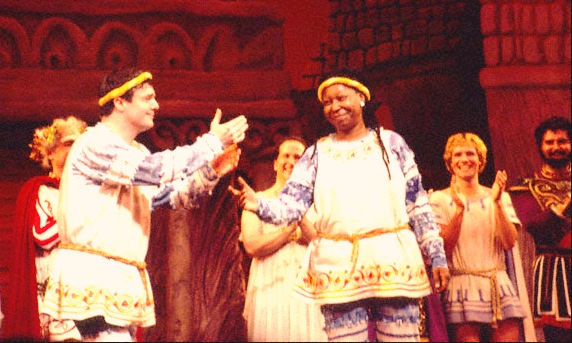 as Lane exited the show by installing Whoopi Goldberg in his place. Casting a woman, let alone an African-American one with Goldberg's reputation, made people wonder what she'd do. Ben Brantley wrote in The New York Times, "The work's authors, Burt Shevelove and Larry Gelbart, and its composer and lyricist, Stephen Sondheim, have always said they made a point of constructing a show true to its ancient sources and free of distracting anachronisms. But the leading role of Pseudolus, the wily slave in pursuit of freedom and a part that demands a manic comic spirit, has inevitably gone to wild-card performers unlikely to resist opportunities for their own shtick. As Mr. Gelbart said, in a recent interview with The Sondheim Review, 'after seeing Zero Mostel recite baseball scores in front of the House of Senex, there's not too much that would surprise me.' So there is Ms. Goldberg, queen of the devilish aside, firmly reminding you of just who she is in the production's opening moments. She finds comic fodder not only in her present personal life, but in her professional life in Hollywood as well.…That this occurs early raises delighted expectations that many audience members have brought with them: Just how bad, as in naughty, is their Whoopi going to be? Of course, others — that nasty breed of theatergoers who find Schadenfreude in seeing big stars blow it — are asking the same question with a different emphasis: Can this movie star-comedian possibly carry a musical? Sorry, guys, she can." Following Goldberg, David Alan Grier took on the role. The second revival ran for 715 performances.
The wreckage in that photo in 1993 represents the remains at the time of the outdoor amphitheater of Butler University in Indianapolis
 that for decades hosted Starlight Musicals every summer. Other cities around the Midwest also received visits from the touring program that would bring concerts, plays and musicals featuring celebrities. From
 the time I was a young child, each summer when we visited my grandma we would take in some shows. Many of the early things we saw tended to be concerts by people such as Mitzi Gaynor, Liberace and the tag team of Jim Nabors and Florence Henderson. In 1979 when I was 10, I got to see my first actual musical. I wish I could locate the program so I'd remember what songs were in that production of A Funny Thing Happened on the Way to the Forum. As a youngster, I tended to be an autograph hound so if we got there early, I'd either stake out the entrance to the backstage or I'd assault the performers after the show. For me, Forum boasted an all-star cast. Playing Pseudolus was none other than Arte Johnson from Rowan and Martin's
 Laugh-In. I'd see him again when I grew up and he appeared in the Broadway revival of Candide. Avery Schreiber portrayed Hysterium, but to me — unfamiliar with his comedy work with Jack Burns — he was the Doritos guy. When I got his autograph after the show, I even brought Doritos with me so when he
 stepped out I had one ready to take a big crunchy bite out of for him. Schreiber raised his hands and said to me, "You got me" then signed my autograph. John Carradine played the role he originated on Broadway, Marcus Lycus. I didn't know that at the time nor did I realize the breadth of his career, but at 73, he looked frail to me, though he'd live another eight years. The final big name belonged to Hans Conried who was cast as Senex. I didn't know at the time that he supplied the voice of Captain Hook in Disney's Peter Pan and I hadn't heard of The 5,000 Fingers of Dr. T. I knew Conried as Wrongway Feldman from an episode of Gilligan's Island. He died less than three years later. Johnson alone remains alive. Schreiber passed away in 2002. That same summer, I saw Rodgers and Hammerstein's Carousel starring a drunk-as-a-skunk Robert Goulet, who exited his limi when he arrived bellowing, "Nobody owns me!" However, that's another story. Tragedy tomorrow, comedy tonight.
Tweet
Labels: Awards, Books, Disney, Fosse, Frank Loesser, Gelbart, Hammerstein, J. Carradine, Music, Musicals, Neil Simon, Phil Silvers, Rodgers, Sid Caesar, Sondheim, Television, Theater Tribute, V. Leigh
TO READ ON, CLICK HERE
Wednesday, November 16, 2011
It started out like a song… (An appreciation in two acts)

By Edward Copeland
…when Merrily We Roll Along opened on Broadway 30 years ago tonight at The Alvin Theatre — or at least it should have. Unfortunately, despite having one of Stephen Sondheim's most gorgeous scores, the musical closed 16 performances later on Nov. 28. The musical tallied 52 previews beginning Oct. 1, 1981, before its official opening at The Alvin (which would lose the name the theater had held since 1927 two years later when rechristened The Neil Simon Theatre). Merrily wasn't the shortest Broadway run of any Sondheim show (that title belongs to 1964's Anyone Can Whistle, which closed after 12 previews and nine performances) but Merrily marked the last collaboration
 on a new musical between the legendary composer with the revered director/producer Harold Prince serving as director, a teaming that began with 1970's Company and continued through Follies, A Little Night Music, Pacific Overtures and Sweeney Todd. The union won Prince five of his Tony Awards, gave Tonys to Sondheim for four of those scores (including an amazing three wins in a four-year span) and three best musical winners. However, Merrily contained too great a score to let it go gentle into that good night and the show (and its composer) raged against the dying of that musical's light and its label as a disaster. As soon as four years later, a key revision of Merrily, directed by James Lapine at The La Jolla Playhouse in La Jolla, Calif., began the show's rehabilitation and it has had frequent tinkering, revisions and revivals in the decades since (and I'm relying on reports and reviews), fixing many of its underlying structural problems and raising its stature in the Sondheim canon. Encores! at City Center in New York will present a two-week concert performance of Merrily in February (again directed by Lapine), but the musical remains one of only three Sondheim shows yet to receive a Broadway revival — the other two being his last original Broadway work, 1994's Passion (but it won best musical, so that'll happen eventually), and Anyone Can Whistle (but no one has spent much time trying to salvage that one). If you aren't familiar with the story in Merrily We Roll Along, it is told backwards, which tends to get a big chunk of the blame for its problem. All I know is that every work I've seen that tells its tale in reverse — be it Harold Pinter's Betrayal, Christopher Nolan's Memento or even the backward episode of Seinfeld (titled "The Betrayal") — turns out well. I've never been fortunate enough to see a production of Merrily live to judge for myself, but damn I love that score so while this day marks the anniversary of a short Broadway run, I'm still taking the opportunity to use it to celebrate Merrily We Roll Along anyway, its initial reception be damned. (Pictured at top, the original Charley Kringas, Mary Flynn and Franklin Shepherd. From left, Lonny Price, Ann Morrison and Jim Walton)
 In Sondheim's great book Finishing the Hat (which is essential reading for both Sondheim fans and writers in general. I've never written a song in my life, but people who practice prose could learn just as much from Finishing the Hat as songwriters), the composer describes the "notion" of Merrily We Roll Along as follows:
Franklin Shepard, a successful songwriter and movie producer in his 40s, reviews his life, both professional and personal, especially his relationships with his best friends, Mary Flynn and Charley Kringas (his songwriting collaborator), and his two wives, Beth and Gussie. The action moves backward in time from 1981 to 1957.
Actually, for me to accurately tell the beginnings of Merrily We Roll Along, I have to go backward in time as well. Merrily's writing took place in 1980 when Sondheim and Prince conceived the idea of making a musical (with actor-writer
 George Furth, who died in 2006, writing the book as he had done for the team's Company, for which he won a Tony) out of the 1934 play Merrily We Roll Along by George S. Kaufman (seen at typewriter in photo below) and Moss Hart (at right in same photo). It was the second effort from the famous playwriting team who had scored with their first collaboration, Once in a Lifetime, and would go on to write such classics as the Pulitzer Prize-winning You Can't Take It With You and The Man Who Came to Dinner. Kaufman and Hart's version of Merrily, while not considered a flop on the level of the musical version, was deemed a disappointment when compared to Once in a Lifetime, which ran at The Music Box Theatre for
 two years and 406 performances. Merrily followed it into The Music Box, but lasted only 155 performances, which would be labeled neither a flop nor a disaster except for how expensive the production was to stage: It had a cast of 55 actors. Among that ensemble were eventual recognizable movie and TV character performers such as Walter Abel, Kenneth MacKenna, Mary Philips and Jessie Royce Landis as well as Doris Eaton, who was the last surviving Ziegfeld girl until her death in May 2010 at 106. The main story differences in the play (other than character names) is that their lead character (MacKenna, at right in photo below) is a successful playwright of popular comedies instead of a composer and film producer and his friend is a painter (Abel in photo below) instead of a lyricist. His platonic female friend remains a writer, though she's patterned after Dorothy Parker here. Obviously, the time span, while still running backward, covers different years, starting in 1934 and ending in 1916. Reviews were mixed and sometimes funny, as the words of Herman J. Mankiewicz, who would go on to co-write Citizen Kane, wrote, "Here's this playwright who writes a play and it's a big success. Then he writes another play and it's a big hit too. All his plays are big successes. All the actresses in them are in love with him, and he has a yacht and a beautiful home in the country. He has a beautiful wife and two beautiful children and he makes a million dollars. Now the problem the play propounds is this: How did the poor son-of-a-bitch get in this jam?"
Obviously, neither Hal Prince nor Stephen Sondheim saw a production of the Kaufman/Hart play, let alone the original. Unlike the playwriting duo's other works, Merrily never received a Broadway revival and wasn't that well known. Prince and Sondheim were considering projects after the astounding success of their last production, Sweeney Todd. According to the biography Sondheim: A Life by Meryle Secrest, Prince's wife Judy suggested that their next show be about young people. Her husband tried to think of appropriate
 works such as Thornton Wilder's Our Town, but rejected them. "Then one morning as he was shaving," Secrest wrote, "he recalled Merrily, in which his former producing partner Robert Griffith, had once played a small part. It seemed like the perfect solution. Prince immediately called Sondheim. Prince said, 'It was the first time he ever said yes on the phone.'" Stephen Citron elaborates further on the appeal to Prince in his book Sondheim & Lloyd-Webber: The New Musical, repeating the story Secrest tells that he recalled the play while shaving particularly "that the play had ended with Polonius' advice to his son, 'This above all, to thine own self be true,' which was one of the messages he wanted the musical to deliver. He knew at once the framework of this play could be bent to serve his purpose — to cast young people in the major roles — and give him a platform to say what he wanted about the disillusioning events of the last 25 years." The Kaufman/Hart play had the similar idea except the defining event of their time was the Great Depression. "Kaufman and Hart had wanted to write about the deterioration of idealism and the rise of American greed in what they called the "heedless years" which followed World War I until the Depression," Sondheim wrote in Finishing the Hat. "In fact, their original title for the play was Wind Up an Era. In our transposition, we were writing about a generation's idealistic expectations for the future, symbolized by the launch of Sputnik, and their deterioration into compromise and deceit, exemplified by Nixon and Watergate, and culminating in The Me Decade, as the 1970s came to be called." Perhaps given that basic crux
 of an idea, Merrily arrived 30 years too soon. Granted, I was a youngster during Watergate through Reagan's election (albeit an odd one who actually knew and paid attention to these events in grade school), but I'd pick the past decade as a time that truly captures disillusionment, the death of idealism and a rise in avarice that would make those labeled greedy in Kaufman and Hart's era drop their collective jaws at Wall Street's audacity and avarice as well as the partisan clashes for control that prioritize political power above the nation's economic welfare. As I write this, the evening news reports on more standoffs between the Occupy protests that have spread across the land and the police, including the suicide of a demonstrator. Merrily, we do not roll along. Sondheim also notes in his book that in the rehearsal script for Merrily We Roll Along, the "Transitions" included references to events that occurred in the years being covered, but those lyrics were cut prior to the opening. "As the show took shape, it became clear that the 'Transitions' should reflect Frank's history, not the country's," Sondheim wrote. The composer also found the reverse chronology intriguing, writing in the same book: "If the songs were conventional, telling the story backwards suggested something unconventional: the possibility of reversing the usual presentation of them.…The structure of Merrily We Roll Along suggested to me that the reprises could come first: the songs that were important to the characters when they were younger would have different resonances as they aged; thus, for example, "Not a Day Goes By," a love song sung by a hopeful young couple getting married, becomes a bitter tirade from the wife when they get a divorce, but the bitter version is sung first in the musical's topsy-turvy chronology." To illustrate what Sondheim means, the first link is to "Not a Day Goes By (Part I)" from the 1994 York Theatre Company production of the show. The character of Beth, Frank's first wife, (played by Anne Bobby) sings in Act I. The second link is "Not a Day Goes By (Part II)" from Act II of the same production. It's also sung by Bobby as Beth joined by Malcolm Gets as Frank and Amy Ryder as Mary.
As I mentioned earlier, the writing of Merrily We Roll Along was mostly complete in 1980 — or so they thought. Things had moved along enough that the casting process took place and, keeping with Prince's idea, they cast talented newcomers with little experience. One of those lucky newcomers who made her Broadway debut in Merrily We Roll Along was Liz Callaway (seen at left in photo below at 2002 reunion of original cast with Tonya Pinkins, middle, and Donna Marie Elio). "It was incredible making my debut in a Sondheim/Prince show because the first Broadway show I ever saw was Company. I think I was 9 or 10 years old," she told me. In fact, of the 27 performers listed in the opening night cast on the Internet Broadway Database, all but seven were making Broadway debuts and
 12 of those 27 never appeared on Broadway again. However, it was a long journey from casting to opening night. Callaway would later receive a Tony nomination for featured actress in a musical for Baby and appear in the original cast of Miss Saigon. In Merrily, she was cast as a nightclub waitress and was the understudy for Ann Morrison's role of Mary Flynn. "After we were cast, they announced we were postponing rehearsals for nine months," Callaway told me. Meryle Secrest wrote in her Sondheim biography that the delay in rehearsals were because Sondheim hadn't finished the score and that's what pushed them to September 1981. Also weighing on his composing, according to Secrest's book, was Hal Prince's insistence that Sondheim needed to write a popular score again. Secrest wrote: "Obviously, 'Send in the Clowns' was a very successful song, but the score was not that type of score. In this show, we've got the Sinatra record and the Carly Simon record, and my mother can sing the songs first time out, so that makes her happy." Prince was referring to the fact that, although the show had not yet opened, Sinatra had recorded one of its songs, "Good Thing Going," and Simon had recorded another, "Not a Day Goes By." Sondheim wrote in Finishing the Hat, "Of all the shows I worked on Merrily We Roll Along was, with the possible exception of A Funny Thing Happened on the Way to the Forum (and for similar reasons), the most difficult score to write. With Forum, however, I didn't have to worry about holding the score together — the piece didn't require cohesion, only variety." When rehearsals did start and they eventually got to the lengthy month of previews, even more changes ensued. "Yes, there were tons of changes, including replacing the leading man and choreographer. We postponed the show several times," Callaway said. Another original cast member, Tonya Pinkins, described the
 constant changes during the rehearsal and preview process as a "trial by fire." Pinkins would next appear on Broadway in 1992 in Jelly's Last Jam with Gregory Hines and win the Tony for best featured actress in a musical. She also received Tony nominations for lead actress in a musical for Play On! and Caroline, or Change? In Merrily, she played Gwen Wilson, who Pinkins characterized as "a Hedda Hopper type" and was one of many characters that were changed or revised in later incarnations of the show. Of those seven actors with previous Broadway experience, one had been in four previous Broadway musicals dating back to 1968 — when he was 10. He hadn't been on Broadway since 1973 when he co-starred in the musical Seesaw with a score by Cy Coleman and Dorothy Fields. It was directed, choreographed and written by Michael Bennett and earned seven Tony nominations, and won two, one for Bennett's choreography and another for Tommy Tune's featured performance. After that show, Giancarlo Esposito didn't return to Broadway until Merrily We Roll Along at the ripe old age of 23 in the role of the valedictorian, another character that would vanish in revisions since the original Merrily started with Franklin Shepherd giving the commencement address at his former high school, prompting the look back at his life. Since Merrily had a short run, Callaway didn't get
 to go on for Morrison in the role of Mary after it opened, something she remains grateful didn't occur. "No, thank God. I wouldn't have been good. I did get to sing for Annie Morrison at some of the rehearsals during previews when she got sick. I think in some ways that was my audition for future work I would do with Sondheim," Callaway told me. In Finishing the Hat, Sondheim wrote that the month of previews "was a painful month spent under the gimlet eyes of theatrical vultures…a month that saw George (Furth, seen at left) and I busily rewriting, Hal busily restaging, the leading actor and choreographer being replaced — in short, all the showbiz chaos I had seen and thought I'd envied in movies. Worse, we fell victim to the age-old illusion that blinds all rewriters: by the time opening night arrived, we thought we'd fixed the show. What we'd done was bettered it, not fixed it." By stroke of luck, a future lyricist and musical book-writer happened to be working at Studio Duplicating at the time and got to type the original Merrily script, once they settled on one. Bill Russell, who received Tony nominations for his book and lyrics for the 1998 musical Side Show, recalls, "I called my boyfriend and said, 'This is going to be such a hit.' Then we saw the show in previews. What had jumped off the page did not jump off the stage. Reading that someone is 'pushed into the swimming pool' was much more exciting in my imagination than the sad effect of someone falling through paper 'water.' Still, the score really stood out." That was before the theater critics weighed in — and, more importantly, its resurrection began.
The reviews tended not to be favorable. Some were downright harsh. Arguably the most powerful theater critic at the time, Frank Rich of The New York Times, had the perception of being an unabashed Sondheim admirer, but the lead of his review read, "As we all should probably have learned by now, to be a Stephen Sondheim fan is to have one's heart broken at regular intervals. Usually the heartbreak
 comes from Mr. Sondheim's songs — for his music can tear through us with an emotional force as moving as Gershwin's. And sometimes the pain is compounded by another factor — for some of Mr. Sondheim's most powerful work turns up in shows (Anyone Can Whistle, Pacific Overtures) that fail. Suffice it to say that both kinds of pain are abundant in Merrily We Roll Along, the new Sondheim-Harold Prince-George Furth musical that opened at the Alvin last night. Mr. Sondheim has given this evening a half-dozen songs that are crushing and beautiful — that soar and linger and hurt. But the show that contains them is a shambles." He also picked up on what he saw as the major problem that many saw — asking younger performers to play older, though his take was its contrast to Follies. Rich wrote, (Follies) also used the effective trick of assigning each major character to two actors, one middle-aged and one young, so that past and present could interweave at will to potent effect. With one passing exception, the roles in Merrily are always played by young actors, no matter what the characters' ages or how high the toll in cuteness." However, Rich would re-examine the show himself as its road to redemption took place. Unbelievably, Douglas Watt reviewing at New York Daily News actually bashed the score. He wrote, "…it would be unthinkable for Sondheim not to come up with at least one sound ballad, as in 'Good Thing Going (Going Gone),' but the score is for the most part pallid…" Watt couldn't even get the song title correct. Later, he disappeared and reportedly changed his name to Frank Wildhorn. (Just kidding.) Many of the reviews beat up on Kaufman and Hart almost as much as Furth, Prince and Sondheim. One notable exception among theater critics was the late Clive Barnes at The New York Post. "Whatever you may have heard about it — go and see it for yourselves. It is far too good a musical to be
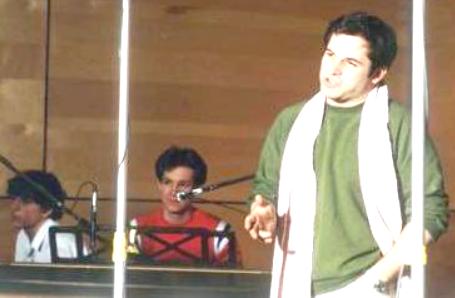 judged by those twin kangaroo courts of word of mouth and critical consensus. It is the story of success, the complexities of compromise, and life lived amid quicksands. It also has that surging Sondheim sound that is New York set to music," Barnes wrote. Even within Barnes' praise though, he saw casting inexperienced newcomers as a flaw. "One difficulty the production did not solve to my entire satisfaction was that of the cast and its aging. From beginning to end, through this entire backward gauntlet race of a Silver Jubilee, the age of the cast scarcely varied," Barnes wrote. In Finishing the Hat, even Sondheim admits that their concept of casting young performers — which included Prince's 16-year-old daughter Daisy as Meg, Shepherd's impending third wife — and expecting them to be able to play the characters' older selves was the biggest flaw. "Whatever the flaws the show may have had to begin with, the original production compounded the felonies. Hal and I had conceived our treatment of the Kaufman-Hart play as a vehicle for young performers. In 1934, the play had been cast with actors in their 20s and 30s who played slightly older than themselves at the start and slightly younger at the finish," Sondheim wrote. "What we envisioned was a cautionary tale in which actors in their late teens and early 20s would begin disguised as middle-age sophisticates and gradually become their innocent young selves as the evening progressed. Unfortunately, we got caught in a paradox we should have foreseen: actors that young, no matter how talented, rarely have the experience or skills to play anyone but themselves, and in this case even that caused them difficulties. (The singular exception was a remarkable performer named Jason Alexander, who at 21 seemed like an old pro: It was as if he'd been born middle-aged.)" Alexander, who played a George Abbott-like producer named Joe Josephson received positive mention in almost every review, no matter how negative overall.
So after the nine-month delay before starting rehearsals, the 52 previews with all those changes and 16 performances, Merrily We Roll Along closed. "It was very depressing to have the show close after we had worked so hard and waited so long to do the show," Liz Callaway
 told me. Callaway and Tonya Pinkins both agreed that while working so hard on a show that closed so quickly was disappointing, it was the perfect introduction to their chosen profession. "I will say I think it some ways it was the ideal first Broadway show experience," Callaway said. "To work with the best and have it not be successful prepared me for what a career in the theater would be." Pinkins said, "It was an amazing experience…to work with the gods of theater." Callaway added that the morning after the show closed, "we recorded the cast album. You can imagine how bittersweet that was." The curtain didn't just fall for good on the first production of Merrily in November 1981: The partnership of Stephen Sondheim and Harold Prince came to an end as well, though neither has ever discussed particulars. However, the story of the musical doesn't end here. It has many stops to make and new passengers to pick up during the next three decades. I've never written a play, but I've seen enough to know you should end Act I with the audience wanting to come back to see how it wraps up. I'll spoil some of my own piece — its ending could be called a happy (or at least hopeful) one and there will be more notable cameos from people associated with the show. Remember — don't take your drinks back to your seat.
Tweet
Labels: 80s, Awards, Books, Christopher Nolan, H. Prince, Harold Pinter, Music, Musicals, Neil Simon, Seinfeld, Shakespeare, Sinatra, Sondheim, Theater Tribute
TO READ ON, CLICK HERE
Tuesday, October 18, 2011
Let's talk about the black bird


By Edward Copeland
In 1941, one man's directing debut wowed the world — and with good reason — but Orson Welles' Citizen Kane wasn't the only impressive directing debut that year. Granted, John Huston grew up around movie sets as the son of actor Walter Huston and had a decade of screenwriting experience before he helmed his first feature, but it certainly could be argued that while The Maltese Falcon isn't as groundbreaking as Kane, it did launch a far more consistent directing career for Huston than Kane did for Welles. More importantly, Falcon served as the key film that transitioned Humphrey Bogart from the criminals and thugs that stereotyped his acting career into everybody's favorite antihero and a more multifaceted range of roles. Anyone who has read much of my writing or seen my comments in various venues know my typical disdain for remakes and my simple rule: Only remake movies that were flawed in the first place. Until recently, Huston's Maltese Falcon, marking its 70th anniversary today, happened to be the only film version of Dashiell Hammett's story that I'd seen. To be fair, I felt that I needed to watch director Roy Del Ruth's 1931 film of The Maltese Falcon. Boy, did my adage hold up. So much so that I'm running a separate review tomorrow of the 1931 film adaptation of Hammett's tale, which began as a five-part serial between September 1929 and January 1930 in the magazine Black Mask before being published as a hardback novel in February 1930.
to Charles V of Spain, by sending him a golden falcon
encrusted from beak to claw with the rarest jewels -----
but pirates seized the galley carrying the priceless token
and the fate of the Maltese Falcon
remains a mystery to this day ---
After this brief written prologue crawls up the screen following the opening credits, we get a panoramic shot of where our story takes place along with the superimposed words SAN FRANCISCO. Soon, we are inside the offices of SPADE AND ARCHER. Private detective Sam
 Spade (Bogart) sits behind his desk fiddling with a tea bag and trying to roll his own cigarette when his faithful secretary Effie (Lee Patrick) comes in and tells him that there's a girl who wants to see him. "Her name's Wonderly," Effie adds. "A customer?" Spade asks. "I guess so. You'll want to see her anyway. She's a knockout," Effie tells him. Sam says to send her in. Miss Wonderly (Mary Astor) shares with Spade her concerns about her sister Corinne, who has hooked up with a no-good guy named Floyd Thursby. She wants to take her sister back home to New York. She has spoken with Thursby, but he won't tell her with Corinne is and
  claims her sister doesn't want to speak with her. This Thursby frightens Miss Wonderly, the woman admits. As she spins her tale, Spade's partner, Miles Archer (Jerome Cowan), enters, practically salivating over their new client. He and Sam both agree that they should be able to handle Thursby and Miss Wonderly lays down two $100 bills for their services. When she leaves, Miles tells Sam, "Oh, she's sweet. Maybe you saw her first, Sam, but I spoke first." Never mind that Miles is married, especially since Sam and Miles' wife Iva (Gladys George) have been having an affair, which Spade very much has tried to sever. In a very interesting and foreshadowing shot, after Miles stakes his claim in the lustful pursuit of Miss Wonderly, the sun through the windows form a shadow of the SPADE AND ARCHER sign on the carpet of their office so that it resembles a tombstone. The very next scene happens to be the only one in the entire film in which Sam Spade isn't present. In a dark setting, a smiling Miles approaches someone who pulls a gun and shoots the private eye who then tumbles down the side of a cliff.

So begins the film's mystery and its first corpse, but as of yet there has been no mention of the fabled Maltese Falcon. I've never read Hammett's story to see how closely Huston's film, which he wrote as well as directed, follows it, though some reports I've read say it follows Hammett's work nearly scene for scene and line for line except for a couple of notable changes. In discussing the The Maltese Falcon, worrying about spelling out the plot or spilling its secrets hardly seems to matter because neither the story nor its resolution strengthens the spine of what makes this movie — pardon my French, but no more accurate way exists to describe it — what makes this movie so fucking great 70 years after its release. Since I've now seen the terrible 1931 film version which shares some of the same dialogue as Huston's film, I'm guessing those lines originated with Hammett, though in some cases it's clear how Huston took some words out of either the 1931 script or the Hammett story and rewrote them to make them better. The dialogue practically sparkles when you only read it. When it's placed in the mouths of the talented cast that was assembled for Huston's movie, it sings. In addition to the five performers that I would name as the principals — Bogart, Astor, Peter Lorre, Elisha Cook Jr. and, in his Oscar-nominated performance and, believe it or not, his film debut, the 61-year-old Sydney Greenstreet — The Maltese Falcon's ensemble boasted the aforementioned Lee Patrick, Gladys George and Jerome Cowan, Ward Bond, Barton McClane and, in a wordless cameo as the dying Captain Jacoby dumping the falcon at Sam's office before expiring, none other than John Huston's father Walter himself.

All that time on sets paid off for John Huston, who managed to include a lot of interesting touches the first time he got his chance to sit in the director's chair. I love the way he films Sam in his seedy apartment receiving the news of Miles' death. He goes directly from the darkness of Archer's tumble to a dark room where you can only see the outline of a phone on a bedside table because of a little light coming through the open window. The telephone rings and we simply see an arm extend into the shot to pick up the receiver and take it back out of the frame again. That's followed by Bogart's familiar voice saying, "Miles Archer — dead." After telling the cop on the other end of the line he'll be there soon, then Spade sits up and turns on the bedside lamp so he can call Effie to give her the news and assign her the task of informing
 the widow Archer so he doesn't have to face Iva. Another visual moment I love comes late in the film when Gutman's henchman Wilmer (Cook) comes to after being knocked out by the principals when they've sequestered themselves in a hotel room all night to keep an eye on one another. Wilmer's head still spins so he awakes to distorted close-ups of Spade, Gutman (Greenstreet) and Cairo (Lorre). Huston gave great thought to how the entire film would go. After he wrote the screenplay, Huston storyboarded the entire film to prepare for the composition of scenes and the movement of the camera. He also rehearsed for two days. As I wrote earlier, so many of the lines were nearly the same as the 1931 version but turned out better here, either Huston improved on Hammett or the 1931 screenplay by Maude Hulton (who wrote the titles on John Barrymore's silent Don Juan) & Brown Holmes (who would go on to co-write I Was a Fugitive From a Chain Gang as well as the other pre-Huston Maltese Falcon adaptation, 1936's Satan Met a Lady with Bette Davis) with uncredited help by Lucien Hubbard (whose most famous film work also went uncredited — editing and production work on Wings).
Now I don't know if Huston proved to be particularly gifted when it came to working with actors or he just lucked out in the casting or how big a part he played in the casting, but the film got stellar performances out of almost all of the players, even though some such as Lorre had given career-best performances elsewhere (in Fritz Lang's M). Though Elisha Cook Jr. had been acting on stage since he was 14 and full-time in movies since 1936, Wilmer in The Maltese Falcon truly proved to be the
 breakthrough role for the man who had a career in film and television that lasted until the late 1980s. Ward Bond and Barton McClane, who played the two police detectives always questioning Spade about his possible role in the murders of Archer and Thursby, both had careers that put them in ruts of sorts. Despite his police work here, Bond mainly would be recognized for his work in Westerns such as My Darling Clementine, Fort Apache, Johnny Guitar, The Searchers, Rio Bravo and the TV series Wagon Train, though he did go back on the beat as Bert the cop in It's a Wonderful Life. McClane did his share of Westerns, but he got to go to war a lot as well such as in The Glenn Miller Story. He worked with Bogart, director Huston and his dad again in Treasure of the Sierra Madre and thanks to reruns may be best known these days for his recurring role as General Peterson on I Dream of Jeannie. Lee Patrick worked steadily in roles such as Bert Pierce's mistress Maggie Biederhof in Mildred Pierce and did lots of TV work, most notably as Henrietta Topper in the 1950s sitcom version of Topper. Patrick and Cook also were the only original Falcon cast members to appear in the 1975 spoof The Black Bird starring George Segal as Sam Spade Jr.

Speaking of spoofs, though Gladys George's part as Iva Archer, widow of Miles and scorned lover of Sam Spade, isn't that large in Huston's version, if you've ever seen The Cheap Detective, it's hard not to envision
 Marsha Mason's Georgia Merkle, especially when Gladys George's Iva wears her full mourning gear. It doesn't help that Sam doesn't take Iva seriously in the Falcon when she enters in that outfit either. The scene, where Iva comes in and basically asks Sam if he killed Miles so they could be together and he lashes out because she acts as if she hopes he did, is a joy because of the way Bogart plays it. Bogie claps his hands and says to her, "You killed my husband. Be kind to me." For those unfamiliar with The Cheap Detective, it was the second parody that Neil Simon wrote directly for the screen that featured Peter Falk playing Bogart. The more famous (and better) film, Murder By Death, had him as Sam Diamond and he was part of an ensemble of "the world's greatest detectives." Falk's performance was so hysterical they built The Cheap Detective around him doing Bogart again, only as a spoof of all Bogie movies with Falk's character named Lou Peckinpaugh. Gladys George's career dated back to the silent era and she made some other notable films including The Hard Way with Ida Lupino, The Best Years of Our Lives and Detective Story. She also earned an Oscar nomination for supporting actress in 1936 for Valiant Is the Word for Carrie.
Though now (and with good reason), Bogart would be considered the biggest name in The Maltese Falcon (and he did receive top billing), at the time Mary Astor probably had the most star wattage in the cast. Astor begin working as an actress in silent films in 1921 and was one of the fortunate ones who had a voice and talent that allowed her to make the transfer to sound pictures easily. Astor also wrote the
 often used line (just change the name) that there are five stages in the career of an actor: "Who's Mary Astor? Get me Mary Astor. Get me a Mary Astor type. Get me a young Mary Astor. Who's Mary Astor?" One of her silent vehicles included that John Barrymore Don Juan whose title writer co-wrote the 1931 Maltese Falcon. In the sound era, she went a little crazy on a rubber plantation with Gable and Harlow in Red Dust; joined Walter Huston in the underrated classic Dodsworth; and showed her penchant for comedy as well in the Billy Wilder/Charles Bracket scripted Midnight. Her career would continue in film and television for another 23 years after The Maltese Falcon and include reteaming with Bogart, Greenstreet and Huston as director the following year in Across the Pacific; Preston Sturges' The Palm Beach Story; Meet Me in St. Louis; Act of Violence; and her final film, Robert Aldrich's Hush…Hush, Sweet Charlotte in 1964. She actually won the Oscar for supporting actress for 1941, but not for The Maltese Falcon but for the melodrama The Great Lie starring Bette Davis. The award was very much deserved, but that in no way diminishes her work as Miss Wonderly alias Brigid O'Shaughnessy. Astor proves superb at balancing the seductive side of Brigid with the admittedly deadly side. Yes, she's a killer and it isn't a sister she's after, it's the black bird. Some of the conversations between her and Spade just mesmerize.
(When Sam first learns of some of her lies and she tries to keep him on her side.)
BRIGID: I've got nobody to help me if you won't help me. Be generous, Mr. Spade. You're brave, you're strong. You can share some of that courage and strength. Help me, Mr. Spade. I need help so badly. I have no right to ask you, I know I haven't…
SAM: You won't need much of anybody's help. You're good. It's chiefly your eyes I think, and that throb you get in your voice. When you say things like, 'Be generous, Mr. Spade.'
BRIGID: I deserved that, but the lie was in the way I said it, not in the words. It's my own fault you can't trust me now.
SAM: Now you are dangerous.

Once Spade deduces that it was Brigid who killed his partner Miles in a botched plan where she thought that either he or Miles would kill Thursby or Thursby would kill one of them and she could send him to jail to get rid of him. Unfortunately, Thursby ended up being murdered by Wilmer before she could set him up. When Sam lets her know that he plans to turn her in for Miles' murder, Brigid can't believe her feminine wiles didn't win him over and Sam responds, quite cruelly at times.
SAM: I hope they don't hang you, precious, by that sweet neck. Yes, angel, I'm gonna send you over. The chances are you'll get off with life. That means if you're a good girl, you'll be out in 20 years. I'll be waiting for you. If they hang you, I'll always remember you.
BRIGID: (trying to laugh) Don't, Sam. Don't say it even in fun. Ha, ha, ha. Oh, I was frightened for a minute. I really thought … You do such wild and unpredictable things.
SAM: Don't be silly. You're taking the fall.
BRIGID: You've been playing with me. Just pretending you care to trap me like this. You didn't care at all. You don't love me!
SAM: I won't play the sap for you!
…
BRIGID: You know down deep in your heart and in spite of anything I've done I love you…How can you do this to me, Sam? Surely, Mr. Archer wasn't so much to you as…(crying)
SAM: When a man's partner is killed, he's supposed to do something about it. It doesn't make any difference what you thought of him. He was your partner and you're supposed to do something about it. And it happens we're in the detective business. Well, when one of your organization gets killed, it's — it's bad business to let the killer get away with it, bad all around, bad for every detective everywhere.

Outside of Spade, Sydney Greenstreet's Kaspar Gutman grabs the lion's share of memorable dialogue, often while conversing with Sam. As I mentioned earlier, the movie amazingly was Greenstreet's film debut at 61. He's spent considerable time in the theater, mostly on the English stage, but it's miraculous that he found his way to Hollywood. At one point, Gutman says of Spade, "By gad, sir, you are a character. There's never any telling what you'll say or do next, except that it's bound to be something astonishing." That applies to Greenstreet as well. He shows up in U.S. movies at 61-years-old, weighing around 300 pounds, earns an Oscar nomination for supporting actor for his film debut, makes 22 more films in the next eight years and dies 1ess than 13 years later. When his health prevented him from acting in film or television, he spent two years starring as Rex Stout's famous sleuth in "The New Adventures of Nero Wolfe" on NBC Radio. In his 23 movies, he made three that Huston directed, six that starred Bogart and nine that co-starred Lorre.
"I do like a man who tells you right out he's looking for himself. I do not trust a man who tells you he's not."
"I distrust a closed-mouthed man. He generally picks the wrong time to talk and says the wrong kind of things. I'll tell youright now I'm a man who likes talking to a man who likes to talk."
"There are other means of persuasion other than killing or threats of killing."
"I couldn't be fonder of you if you were my own son. But, well, if you lose a son, it's possible to get another. There's only one Maltese Falcon."
"I distrust a man who says 'when.' If he's got to be careful not to drink too much, it's because he's not to be trusted when he does."
"Seventeen years I've wanted that little item and I've been trying to get it. If we must spend another year on the quest…well, sir, it will be an additional expenditure in time of only…five and fifteen seventeenths percent."
"That's an attitude, sir, that calls for the most delicate judgment on both sides. 'Cause as you know, sir, in the heat of action men are likely to forget where their best interests lie and let their emotions carry them away."

Before discussing the most important ingredient in The Maltese Falcon, a few more quick general points about the movie. One aspect that slips my mind between viewings of the film concerns its structure. Now, as I wrote at the outset, the puzzle and the plot hardly
 matters but what's so unique for a detective story, especially one that many like to claim as the start date for film noir, it sets up its denouement almost like an Agatha Christie novel with all the central characters gathered in one room. What separates The Maltese Falcon from that type of mystery resolution is that Sam Spade in no way functions like a Hercule Poirot or a Miss Marple. What makes it daring in terms of filmmaking is that Falcon runs about one hour and 40 minutes long and nearly the last 30 minutes consists of Spade, Brigid, Gutman, Cairo and Wilmer all in the same room, explaining what happened and keeping an eye on each other until the bird gets delivered by Effie the next morning. It never loses the viewer during that time as it switches tones several times such as when Spade tries to convince the crooks that they need a fall guy to pin the murders on to an angry Wilmer who Sam teases that his associates plan to sell out and Gutman playing games, trying to make it look as if Brigid stole some cash. There's humor, suspense and, of course, the payoff — when the long-sought Maltese Falcon arrives and turns out to be a lead-based fake.
The most important element of The Maltese Falcon though has to be its impact on Humphrey Bogart's career. Brought to Hollywood to re-create his bad guy role in the film version of The Petrified Forest, Bogart had long been frustrated when his Warner Bros. contract stuck him in the rut of second-string hoods, often getting the roles George Raft refused. He knew he could do more and he wanted to do more. Through some chicanery on his part (and some help from John Huston who wrote the screenplay and may well be the person who wrote best for Bogart), Bogie started his transition earlier in 1941 by playing Roy "Mad Dog" Earle in Raoul Walsh's High Sierra. Earle may have been a lifetime crook just out of prison, but he planned a final job so he could go straight but finds his heart broken by a handicapped young woman who chooses to help. For the first time, he got to play a killer that was undeniably human, whose heart could break. Later that year, when Huston got his chance to direct, Bogart got to play Sam Spade (though Huston first sough Raft) and a world-class antihero was born. Bogart enjoys the chance to break the shackles of his stereotype so much, he literally leaps off the screen in The Maltese Falcon. It may have been Huston's directing debut and Greenstreet's film debut, but it might as well have been Bogart's introduction to the public as well because watching him as Sam Spade, he looks as if he is someone that has just been discovered. Bogart made fortysomething films prior to The Maltese Falcon, but Falcon may as well have been his start. I despise the phrase, since in its proper use it means something has gone terribly wrong with your computer, but the movie gave Bogart's film acting career one helluva reboot.

Bogart's Sam Spade lives and breathes cool and witty — or at least that's the image he projects. It's great to watch as he blows up at his first meeting with Gutman because he's not getting the answers he wants and storms out of his hotel room in a rage. Once he's in the hall though, he breaks into an immediate grin and claps his hands, practically skipping to the elevator. However, the meeting did get to him because when he reaches out to push the button, he sees that his hand has the shakes — yet he laughs at that. I've mentioned his sarcastic retorts to Iva and Brigid, but he gives it to everyone. When he's hauled in by the district attorney, hia assistant and a stenographer to answer questions, he unleashes a long and fast spiel, ranting, "Now, both you and the police have as much as accused me of being mixed up in the other night's murders. Well, I've had trouble with both of you before. And as far as I can see my best chance of clearing myself of the trouble you're trying to make for me, is by bringing in the murderers all tied up. And the only chance I've got of catching them, and tying them up, and bringing them in, is by staying as far away as possible from you and the police, because you'd only gum up the works." He then pauses and turns to the stenographer. "You getting this all right, son, or am I goin' too fast for ya?" he asks the stenographer. "No, sir, I'm getting it all right," the man answers. "Good work," Sam replies.

Of course, many of the funniest moments lie in Sam's run-ins with Wilmer, the tiniest, weakest tough guy in movie history. Spade always disarms him, knocks him around or belittles him. It's no wonder that Gutman is willing to sell him out at the end even though he thinks of him as a "son" and it's implied that he may be Gutman's gay lover. When Sam shows up for a meeting and Wilmer is waiting, he needles him as usual. "Keep on riding me and they're gonna be picking iron out of your liver," Wilmer threatens. "The cheaper the crook, the gaudier the patter, huh?" Sam responds. That's one change Huston made from Hammett's story: Wilmer still sneaks out but in the story, he kills Gutman out on the street. Another change concerns the film's famous closing line. When the cops ask Sam what the black bird is, he says, "The stuff that dreams are made of." Neither Hammett nor Huston wrote that, but Bogart improvised that reference to Shakespeare's The Tempest. In his book The Films in My Life, Francois Truffaut best summed up how big an impact this film had on Bogie's career. "Now the outlaw became private eye, with a police ID in his pocket just in case. He made the switch and added up the balance: in just under 40 films, he had died a dozen times in the electric chair, and had totaled more than 800 years at hard labor. Before, the only thing that spoke was his gun. Now, he spoke." Now look what we had to look forward to from Bogart: Casablanca, Sahara, To Have and Have Not, The Big Sleep, The Treasure of the Sierra Madre, Key Largo, In a Lonely Place, The African Queen, Beat the Devil, The Caine Mutiny and Sabrina, to name but a few.
John Huston's career went on even longer (and included some overlap) and acted as well as directed. The asterisks indicate films in which he acted only. Some examples: Across the Pacific, The Treasure of the Sierra Madre, Key Largo, The Asphalt Jungle, The African Queen, Moulin Rouge, Beat the Devil, The Misfits, Freud, The List of Adrian Messenger, The Cardinal*, The Night of the Iguana, Myra Breckenridge*, Fat City, The Life and Times of Judge Roy Bean, Chinatown*, Breakout*, The Man Who Would Be King, The Wind and the Lion*, Wise Blood, Winter Kills*, Lovesick*, Under the Volcano, Prizzi's Honor and The Dead.

At 70, The Maltese Falcon remains as great as ever and it created one of the great acting-directing teams in John Huston and Humphrey Bogart. Most of their films truly were the stuff that dreams are made of.
Tweet
Labels: 40s, Aldrich, Bette, Bogart, Falk, Harlow, Huston, Lorre, Lupino, Mary Astor, Movie Tributes, Neil Simon, P. Sturges, Raft, Remakes, Shakespeare, Truffaut, W. Huston, Walsh, Welles
TO READ ON, CLICK HERE


