Tuesday, October 11, 2011
Conversation Piece

"Entirely devoid of clichés…There is nothing else like it. It should be unwatchable, and yet those who love it return time and again, enchanted." — Roger Ebert
By John Cochrane
Today marks the 30th anniversary of the release of Louis Malle’s My Dinner With Andre (1981), not only one of the best films of recent decade, but a unique viewing experience that redefines what great filmmaking can be. Essentially an unbroken 100-minute conversation between two men in a restaurant, it has no right to work at all cinematically. It succeeds marvelously however — not only as a philosophical discussion — but as a portrait of two friends who often disagree yet are bound by mutual respect and the search for significance in their own lives.
The idea for the film came from its stars — experimental playwright and character actor Wallace Shawn and New York theater director Andre Gregory — who in 1975 became disillusioned and left his career to travel the world, in a soul-searching quest for creative inspiration. After hearing about some of these experiences upon Gregory’s return, Shawn suggested they write a screenplay revolving around their talks — with the two of them playing characters loosely based on their own personalities.

As the film opens, Wally walks across a dirty New York street to meet Andre for dinner. As he boards a graffiti-strewn subway, Shawn tells us in a voiceover that he is stressed about the scarcity of work and money, and the last thing he wants is to meet an old friend he hasn’t seen for years, and who — according to colleagues — appears to have suffered some sort of mental breakdown. Shawn is the more conventional character who most people will identify with — inquisitive, pragmatic and a little skeptical. Gregory is idealistic, easily excited, open to unconventional ideas and quick to give his honest opinion. Their differences are immediately apparent when greeting one another inside the restaurant. (Shawn: “You look terrific!” Gregory responding enthusiastically: “Well, I feel terrible!”) After some initial small talk, Shawn presses Gregory to tell him about what he’s been up to. It’s here where the film really takes off — with Gregory spinning fascinating stories for 45 minutes about working with theater groups in the Polish forest, traveling through the Sahara desert with a Buddhist monk and stepping off the societal grid in order to rediscover his self-identity.

In a typical movie, most filmmakers would create visual set pieces to dramatize what Gregory talks about — but director Louis Malle never does. He keeps his camera focused on the two men talking. (Malle received the script from a mutual friend of Gregory’s and enthusiastically offered his services as director unsolicited — while also strongly advising that there be no cutaways from the conversation in the restaurant.) Because of this stylistic choice and the director’s steady rhythm of two-shots, close ups and reactions, not only do we focus on the events and concepts that Andre describes, but we actually can see Wally and Andre's friendship evolve. This creates a wonderful instance of "theater of the mind." Instead of being shown Gregory’s stories of “beehives” and a simulated “death and burial” that others created for him, the viewer imagines and experiences them himself. In a recent interview, Gregory correctly states that the film has a canvas just as big as an epic such as Lawrence of Arabia (1962) — the difference being that it all takes place in the audience’s imagination.
Though the film begins with stories and ideas about theater and dramatic techniques, the last half of the movie morphs into an ideological debate about what it means to be human — whether you’re really alive or just doing things out of habit and avoiding real expressions of
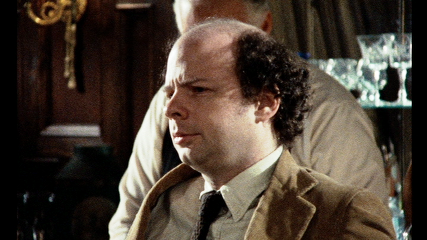 feeling and connection. Shawn begins to speak more in this part — passionately defending the scientific method and suggesting that some of Andre’s experiences (which Gregory interprets as fated signs or supernatural messages directed at him) are mere coincidences. He also argues that while many people may live their lives on autopilot, why should they have to go to Mount Everest — which is expensive, impractical and difficult — in order to have a life-changing experience when they could just as likely have an epiphany in their own home? Upon repeated viewings, it becomes even more evident that the film is as much about friendship and fear as it is about ideas. Shawn himself stated in an interview that in the beginning of the film, Wally is hiding behind silence, and Andre is hiding behind words. Sometimes Wally interjects an awkward tangent — like mentioning a submarine drama Violets Are Blue when Andre talks about a hallucination he had during a Christmas church service. By the movie’s conclusion though, both men have opened up — as they actively listen to and passionately question each other’s points of view.
 My Dinner With Andre may seem more conventional by today’s standards, but it was a revelation back in 1981. The film defied easy categorization, and although seemingly improvised, was crafted painstakingly by its creators. Shawn and Gregory taped their conversations for months, and Shawn then took an additional year to fine-tune the script. Likewise, Louie Malle shot the film not in an actual restaurant, but at the then abandoned Jefferson Hotel in Richmond, Va., over several weeks — carefully finalizing the script, editing takes and framing shots down to the inch to maintain the illusion of a busy public establishment. The movie almost died a quick death upon its initial release, but thanks to critics and word of mouth became a sleeper hit that rose to the forefront of independent American cinema. The picture played in some cities for more than a year and attained a beloved cult status among film buffs that remains to this day.
Since his death from lymphoma at the age of 63, it only has become more obvious that Louis Malle (1932-1995) was one of the great underappreciated masters of world cinema. A Palme d’Or winner at the age of 24 as a co-director and cameraman on Jacques Cousteau’s The Silent World (1956), Malle went on to be a founding member of the French New Wave, along with the likes of François Truffaut, Jean-Luc Godard and Eric Rohmer. Malle then quickly went his own way, avoiding repetition and often creating films that were vastly different from one another — other than a unifying technical virtuosity and a fierce intelligence and curiosity about people.
Because he worked in both France and America, making both fictional features and documentaries, Louis Malle never was accepted completely by either country. But his filmography of more than 30 movies speaks for itself. In addition to the one-of-a-kind Andre, some additional highlights include The Lovers (1958) — an adult fairy-tale, in which a bored aristocratic woman abandons her family and privileged existence when she falls in love with a stranger. In the controversial Lacombe, Lucien (1974) a teenage outcast joins the Gestapo, after being rejected by the French Resistance, only to later to have everything jeopardized when he develops feelings toward a Jewish girl. Revisiting this theme from a different angle toward the end of his career, the very personal Au Revoir Les Enfants (1987) is a semi-autobiographical account of a young boy during World War II, who discovers that his best friend at Catholic boarding school is one of several Jews that the priests are hiding. A possible companion piece to My Dinner With Andre is The Fire Within (1963), which tells the story of an alcoholic writer who decides to commit suicide after he finds he can no longer meaningfully connect with another person, or accept the life compromises that his friends and family have made. While that earlier character gives up his struggle, Andre and Wally continue to search for personal happiness and fulfillment.
Louis Malle’s last motion picture, Vanya on 42nd Street (1994), reunited him with Wallace Shawn and Andre Gregory in a filmed rehearsal-performance of Gregory’s long gestating workshop of Anton Chekhov’s Uncle Vanya (1899) — translated by David Mamet, and starring Shawn in the title role. Performed in a decaying Manhattan theater and featuring actors in street clothes with a minimal set of paper cups and card tables, Malle once again showcased his ability to make an engrossing film utilizing only great dialogue, ideas and performances. (Louis Malle was fascinated with sound, and was said to be able to tell if a take was good, just by listening to it with his eyes closed. “I like the talkies”, he once responded when questioned by Andre during Vanya’s production on why he made unconventional films like their two collaborations together.)
My Dinner With Andre ends ambiguously with an epilogue that’s just about perfect. As Wally takes a quiet taxi ride home, with Erik Satie’s beautifully pensive piano piece “Gymnopedie No. 1” playing on the soundtrack, the reflective mood is in stark contrast to the garbage cluttered landscape that Shawn travels through at the beginning of the movie. What the film seems to say is that it doesn’t matter whether you go to Mount Everest, or what answers you come up with on the meaning of life. It’s that you ask the necessary questions for continual growth, that you take the time to appreciate everyday things, and make the essential connections to others that make us all human beings — which includes the very important act of listening. As Andre so aptly puts it, “If you’re operating by habit, you’re not really living.” In today’s fast-paced world of technological advances, polarizing opinions, increased narcissism and decreasing communication, My Dinner With Andre remains a beacon of hope — and just as riveting and relevant as ever.
Tweet
Labels: 80s, Awards, Ebert, Godard, Malle, Mamet, Movie Tributes, Rohmer, Theater, Truffaut
TO READ ON, CLICK HERE


Sunday, April 03, 2011
“You should have seen the Atlantic Ocean back then…”

By Ivan G. Shreve, Jr.
Thirty years ago on this date, Atlantic City was released to U.S. theaters, a combination crime drama-love story set against the backdrop of the famed New Jersey burg that at the time of the movie’s production had seen the luster of its resort town status give way to a far seedier milieu dominated by casinos and legalized gambling. The oddest aspect of City is that it was directed by a Frenchman, Louis Malle, and with the exception of stars Burt Lancaster and Susan Sarandon, had its cast populated with French and Canadian actors…and still, the movie’s setting and characters possess such a strong American vibe that it’s likely to escape the notice of a first-time viewer.
I had been fortunate enough to see Atlantic City in its original theatrical release and as such I vociferously argued with some film buff friends of mine that it would win the 1981 best picture Oscar — with my fellow cinephiles countering that that popcorn paean to Saturday morning serials, Raiders of the Lost Ark, would take home the grand prize. As it turns out, none of us made the correct call because the sleeper Chariots of Fire nabbed the best-in-show trophy that evening…but 30 years later, I still remain stubbornly convinced that I was right.
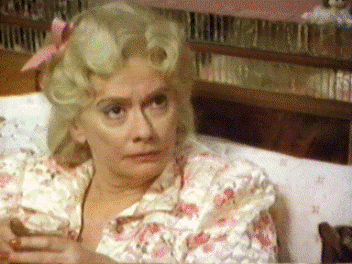
Proving that nostalgia isn’t what it used to be, nickel-and-dime numbers man Lou Pascal (Lancaster) laments how his beloved Atlantic City, N.J. (“It used to be beautiful…what with the rackets, whoring, guns…”) has fallen into a state of decay brought on by the decision by the local government to legalize gambling in a last-ditch attempt to revitalize the city’s sagging fortunes. Pascal himself is looking for redemption; he spends his days as a “kept man” tending to the needs of Grace Pinza (Kate Reid), the verbally abusive widow of his old boss…and an individual whose glory days also have come and gone (she came to Atlantic City as an entrant in a Betty Grable look-a-like contest). Lou’s only avenue of pleasure is spying on his neighbor Sally Matthews (Sarandon) through her window as he intently enjoys her nightly ritual of rubbing her upper body with lemon juice.
The reason for this ritual is that Sally works in an oyster bar and her dedication to removing the stink of fish lies in her ambition to become a blackjack dealer, even to the point of taking instruction from an autocratic martinet (Michel Piccoli) who acts as if he were teaching ballet and not dealing cards. Sally’s dreams of a better life are about to undergo a detour, however, when her drug-dealing ex-husband Dave (Robert Joy) shows up at her doorstep with his pregnant girlfriend Chrissie (Hollis McLaren) in tow. Chrissie, as it turns out, is also Sally’s sister…and Sally’s act of kindness in letting them stay for the night gets her bounced out of the casino because of her association with the two.
Deadbeat Dave managed to heist a brick of cocaine from a connection in Philadelphia and it is while attempting to sell the dope that he makes Lou’s acquaintance, who agrees to be the “mule” and deliver the dope to a local mobster (Al Waxman). But the Philly thugs catch up with Dave and dispatch him posthaste, leaving Lou with nearly a kilo of cocaine that presents him the opportunity to sell it off on a piecemeal basis. Lou uses his windfall to purchase a new suit and to wine and dine Sally, who is in danger when the men who killed her ex suspect their cocaine is in her possession.
Throughout Atlantic City the sounds of constant construction can be heard, which serves as a metaphor for both the refurbishment of the city and the movie’s characters, each of whom is searching for that one chance at betterment and deliverance. Sally hooks up with Lou briefly and while their romance (a mixing of both the old and new of Atlantic City) doesn’t turn out as one would hope she comes away from the experience a better person, richer and filled with self-respect. Lou also finds his mettle tested and passes with flying colors as his former timidity melts when he confronts the individuals who threatened him and Sally earlier in the picture. His salvation is illustrated by the film’s ending where he and Grace promenade proudly along the city boardwalk bruised but unbowed; the lady on his arm also finding a purpose in life when she agrees to overlook her own neuroses and care for the pregnant Chrissie.
Frenchman Malle demonstrated a real flair for Americana mixed with a continental style in several of his motion pictures beginning with 1978’s Pretty Baby, a film set in 1917 against the backdrop of New Orleans’ famed Storyville prostitution district, and continuing with Alamo Bay (1985), a tale of Vietnamese fishermen working off the coast of Texas. While the merits of Baby and Bay are best left to discussion between the films’ defenders and detractors, one aspect that cannot be disputed in all these movies is Malle’s incredible eye for authentic detail and his amazing use of locations. What elevates Atlantic City to a slightly higher plateau than some of Malle’s other films is the contribution by screenwriter John Guare, a playwright best known for works such as House of Blue Leaves and Six Degrees of Separation; Guare’s screenplay for City is a textbook example on how to create characters for the screen that are inescapably living, breathing flesh-and-blood people and not just cardboard caricatures; there are no car chases or explosions in this movie but because we identify so strongly with the people to whom we’ve been introduced their mundane, everyday existence nevertheless satisfies our minimum daily requirement of drama and suspense.
Guare was a friend of actress Sarandon, who in turn was Malle’s girlfriend at the time of the pre-production of the film. Susan had worked with Louis on Pretty Baby, and when the success of that movie nudged several film companies in France and Canada into allocating the director money to make another feature, it was Sarandon who suggested Malle collaborate with Guare when a good script was proving difficult to find…and the deadline to make the movie was drawing near (Malle’s agreement with the production companies stipulated he had to complete the film before the end of 1979). Guare came up with the idea of setting the story in “the lungs of Philadelphia”; the city made famous in song (“On the Boardwalk in Atlantic City”) and the Monopoly board game had just OK'd legalized gambling in effort to stave off the urban deterioration plaguing many municipalities across the nation…and Malle, Guare and cinematographer Richard Ciupka were fortunate to be able to capture a moment in time when many of the old buildings and landmarks were still in place (albeit in disrepair) awaiting their fate by the wrecking ball. Malle and company beat the deadline and completed filming on Dec. 31; the finished project was released in France and Germany in 1980 and to the U.S. the year after that.
With his performance as a gangster-gone-to-seed who undergoes a redemptive rebirth, actor Lancaster also revitalized his acting career in the same stroke. A handsome silver screen idol better known for athleticism and a certain flamboyance in his choice of movie roles, Burt had received the attention of his peers (an Oscar and a Golden Globe) in 1960 for his showy turn as the titular rogue in Elmer Gantry, based on the 1927 novel by Sinclair Lewis. But I’ve always believed that this is the role for which Lancaster should have taken home the Oscar, and in fact his later performances in such films as Local Hero (1983), Rocket Gibraltar (1988) and Field of Dreams (1989) demonstrate that like fine wine, his craft improved with age. I’m pleased to be able to reveal that I’m not the only one who thought Burt was tremendous in City; he was recognized not only by the National Society of Film Critics for his turn but the film critics organizations in Boston, Kansas City, Los Angeles and New York as well.
Lancaster’s co-star Sarandon also received an Academy Award nomination for her work in Atlantic City…and like Burt, went home empty-handed (the two lost to another screen couple, Katharine Hepburn and Henry Fonda in On Golden Pond…and believe you me, you do not want to get me started down that road) — but no one nominated for the movie (it received nods in the five major categories) received any statuettes, either; Malle lost best director to Warren Beatty for Reds and Guare saw his deserved trophy handed off to Colin Welland for best picture winner Chariots of Fire. It did, however, receive recognition at the Venice Film Festival the year before its Oscar nominations (1980); it shared the Golden Lion award with John Cassavetes’ Gloria) and won further vindication in 2003 when it was admitted to the National Film Registry honor roll of the Library of Congress. Since its release, it continues to add to its coterie of fans who are mesmerized by its story, character and images of what John Cougar Mellencamp might describe as “ain’t that America” filtered through the continental European sensibility of a great filmmaker. Louis Malle’s amazing achievement of transforming an ugly, decaying city into a thing of beauty is just one of the many reasons why I remain passionate about film.
Tweet
Labels: 80s, Cassavetes, H. Fonda, K. Hepburn, Lancaster, Malle, Movie Tributes, Oscars, Susan Sarandon, W. Beatty
TO READ ON, CLICK HERE
Monday, June 01, 2009
2008-2009 Broadway Plays, Part 1

By Josh R
May is not a time of year that holds pleasant associations for anyone who’s ever survived a college education. Cramming for exams, grinding out term papers, fighting off the urge to procrastinate…to say that it can be overwhelming is the height of understatement (I would describe my mood at the tail end of my final semester as falling somewhere between immoderately frazzled and thoroughly deranged). It was never my intention to revisit this dreaded state of emotional dystopia, and yet, with a whole season’s worth of plays to discuss, and the Tony Awards looming on the not-too-distant horizon, I find myself in more or less the same spot as when I had to pull 30-odd pages on Dalton Trumbo and The Blacklist out of thin air in about 48 hours in order to graduate. The best approach — really, the only realistic approach at this point — is address everything as briefly as possible, with apologies to the shows I omit due to considerations of time, space and exhaustion.
The straight play reigned supreme on Broadway this year, with more than 20 revivals and a smattering of new works. Theatres that have traditionally housed musicals played host to tried-and-true favorites by Coward and O’Neill, as producers tried to adjust to a less friendly economy. Musicals cost money; with smaller casts and lower overheads, plays are here to stay — at least for the immediate future.
First up — the early-season entries that premiered in the fall, as well as the current crop of “new” plays (note the use of quotation marks) in contention for Tony Awards.
The most surprising production of the 2009-2010 season may well have been Ian Rickson’s glorious staging of The Seagull, in a production that transferred from London. Chekhov can be a rather dry affair, and The Seagull, while indisputably a classic, can seem pretty parched in the absence of a fresh directorial perspective. This was very much the case with the last Seagull I’d seen — a star-studded debacle in Central Park helmed by Mike Nichols featuring Meryl Streep, Kevin Kline, Philip Seymour Hoffman, Natalie Portman and a phalanx of other big-name talents. The fact that Nichols
 seemed more interested in throwing an A-list party than in interpreting the text was the least of that show’s problems — everyone seemed to be acting in a different play (and frankly, all but a few seemed mismatched with their roles). This was most assuredly not the case in Rickson’s masterful staging, which, while remaining entirely true to the spirit of the piece and the intentions of its author, didn’t treat the play like the kind of lofty classical opus to be treated with kid gloves and kept under glass like a priceless museum artifact. In much the same manner as Louis Malle’s Vanya on 42nd Street, this was The Seagull brought down to earth and demythologized — a naturalistic staging which captured the emotional truth behind the words without getting wrapped up in the profundity of them, or aiming for the formal gloss of a Masterpiece Theatre production. With his complex portrayal of a woman who can be both passionate and aloof, engaging and off-putting, breathtakingly assured and wildly insecure, Chekhov seemed to have imagined the actress Arkadina as a Molotov cocktail blended from equal parts fire and ice — and that’s exactly the way Kristin Scott Thomas played her, embodying the myriad contradictions of the character with wit, verve, and a laser-like emotional acuity. Since the production ended its limited engagement way back in December — and since Tony nominators have notoriously short memories — The Seagull and its star were conspicuously absent from the list of contenders for the big prizes.
Also lost in the shuffle was Thea Sharrock’s hugely successful revival of Peter Shaffer’s Equus — although whether that success owed itself more to
 the merits of the production than to Daniel Radcliffe’s highly publicized nude scene can remain a subject of debate (or not — something tells me all those teenage girls in attendance the day that I saw it were not hardcore Shaffer mavens). No matter how many times I see it, I’m never quite sure what to think of Equus as a play; while frequently fascinating and unfailingly provocative, it never quite seems to come together in the way that it should. Its central conflict is built around the contention that true liberation can be achieved only through madness — a conceit that the narrative doesn’t really seem to support, given that the lunatic in question seems less a free spirit than a desperately unhappy prisoner of his own warped mind. That notwithstanding, Sharrock’s highly polished staging kept the action moving even though the play’s overly cerebral passages, and Richard Griffiths delivered a performance admirable for its understatement (resisting the urge to mine so many flashy monologues for the stuff of actorly tour-de-force is no small thing). Inevitably, it was Radcliffe — in clothes and out of them — who attracted the lion’s share of the attention, although the performance lacked something in terms of shading and nuance. I’m not averse to an element of theatricality — but portraying a character who functions in a state of angry delirium doesn't necessitate shouting all of one’s lines.
The shouting was appropriate in Neil Pepe’s fall revival of David Mamet’s Speed-the-Plow, a marvelously cynical look at Hollywood power players and the ambitious hangers-on who love them (or, at least, want to ride to glory on their coattails). As a play, Speed-the-Plow isn’t quite as rich in scope as some of Mamet’s more celebrated works — nevertheless, it is a smartly calibrated, vastly entertaining example of the playwright’s craft. The action is streamlined and concise, while the dialogue, consisting mainly of sentence fragments, manages to be blunt yet elliptical at the same time. In some of his plays — particularly, it must be said, in the ones where female characters are placed front and center — Mamet’s fragmented style seems to be at odds with characterization. It feels perfectly right in Speed-the-Plow, which centers around the interactions of two jittery, over-caffeinated studio execs whose motors run so fast they can only pause long enough to communicate in sound bites. When I saw the production, these two titans of industry were played by Jeremy Piven and Raul Esparza, while the role of the seemingly demure office temp who gets caught in the crossfire was performed by Elisabeth Moss. Piven left the production mid-run amidst some controversy — something about mercury poisoning after having eaten too much salmon — and was subsequently replaced by Norbert Leo Butz and Mamet stalwart William H. Macy. Better Piven had departed under fishy circumstances than Mr. Esparza, who, I suppose, may be capable of giving a performance that is less than brilliant — I only say “may” because his most recent performances haven’t provided any evidence to that effect. On the heels of his triumphs in Company and The Homecoming, the protean star of plays and musicals delivered yet another galvanizing star turn — one which went for the jugular, and hit its target like a guided missile.

As for new plays, the story remained much as it always has on Broadway — which is to say, ‘twas slim pickins. The season’s best and most interesting new works could be found in non-for-profit off-Broadway houses — venues where the risk factor is considerably less from a financial standpoint, and greater risks can be taken on the artistic front as a result. Female playwrights made a particularly strong showing this year. Lynn Nottage’s Ruined, a modern-day version of Mother Courage set in war-torn Congo, deservedly won the Pulitzer Prize for Drama, while Gina Gionfriddo’s Becky Shaw was a sharply observed comedy of manners with a sleek contemporary twist. Sarah Kane’s Blasted — an audacious compendium of unspeakable behaviors — was perversely fascinating, while Annie Baker’s clever, inquisitive Body Awareness marked a particularly auspicious debut for an emerging playwright. If the women commanded the spotlight, the men were not entirely lacking in action; Lorenzo Pisoni’s Humor Abuse, an autobiographical account of growing up in the circus, and Chris Durang’s absurdist trifle Why Torture is Wrong and The People who Love Them were particular standouts in a off-Broadway season that offered more than its share of high points (the lows were there too…but that’s a discussion for another day).
To say that no new works to be seen on Broadway quite matched that standard is a bit misleading, since all but a few could be accurately termed “new.” The late Horton Foote’s Dividing the Estate, written and first performed in the late 1980s, made its belated Broadway bow in a limited engagement at The Booth Theatre last fall. A kindler, gentler cousin to August: Osage County, featuring a gaggle of contentious Texan siblings squabbling over their inheritance, it was warmly received by critics — if generating little in the way of excitement beyond that. Foote’s homespun, elegiac style can work to beguiling effect when plied in service of gentle stories about gentle subjects — Trip to Bountiful and Tender Mercies are the two that immediately spring to mind. It doesn’t seem entirely appropriate, though, when the subject is something as thorny as a family feud. As with many of Foote’s later works, Dividing the Estate seemed to consist mainly of rose-tinged anecdotes strung together to create a sort of careworn, dog-eared scrapbook — while the fire-and-brimstone antics of Osage County would have seemed completely out-of-place, the proceedings could have used a bit more in the way of tension and urgency. Still, the play did furnish the occasion for pitch-perfect ensemble work by cast led by Elizabeth Ashley and Gerald McRaney; deserving of special praise (and receiving the show’s lone acting nomination) was Hallie Foote, the playwright’s daughter and frequent collaborator, making a memorable impression as the passive-aggressive sister determined to grab off the biggest piece of the pie. Another “new” play — at least according to Tony eligibility rulings — was Richard Greenberg’s The American Plan, originally performed off-Broadway in the early '90s. The Manhattan Theatre Club revival, directed by David Grindley, featured expert performances by Lily Rabe, Keiran Campion and particularly the acerbic, husky-voiced Mercedes Ruehl as an imposing, fatalistic Teutonic mama who alternately coddles and smothers her hapless offspring. Fine acting aside, you could see The American Plan’s surprise twist coming from a mile away, and the pretensions of the dialogue weighed the proceedings down to a certain degree — it didn’t quite make sense for Jews on vacation in The Catskills to spend quite as much time waxing philosophical.

Something called Impressionism quickly established itself as the biggest belly-flop of the year — not even the marquee value of Jeremy Irons and Joan Allen, making their first Broadway appearances since The Real Thing and The Heidi Chronicles respectively, could keep it from closing two months ahead of schedule. Not all the news was bad, however, and other instances of starry casting paid big dividends. There was no reason to assume that Jane Fonda, who hadn’t set foot on a Broadway stage in some 40-odd years, would deliver one of the breakout performances of the season. She did just that in 33 Variations, a strange, diffuse work by I Am My Own Wife scribe Moises Kaufman, rising above the limitations of the script and showing that she’s still got the goods to take on multi-faceted roles of the non-monster-in-law variety. Fonda’s most exciting quality as a performer has always been her bracing, prickly intelligence — the performances that stand as her career high-water marks always examined the manner in which intellect can exist at odds with naked emotionalism. It’s a formula that still retains its potency; as a dying scholar trying to unravel the mysteries of Beethoven’s life and work, she was never less than compelling, even when the play itself seemed unfocused and inconsistent in its ambitions. A cutesy subplot involving a burgeoning romance between Colin Hanks and Samantha Mathis — appealing performers who work a bit too hard to be ingratiating — could have excised altogether without altering the narrative framework considerably.
If 33 Variations was, at least, a work of considerable ambition, the season’s one true non-musical smash was blissfully unencumbered by anything of the kind. I didn’t see Art, Yasmina Reza’s previous Broadway hit, or Life x 3, which did very well abroad but was less kindly received in its 2004 New York debut. Based on everything I’ve gleaned about the prolific French playwright and her oeuvre, God of Carnage doesn’t represent much of a departure for her. It’s simplistic in its aims, which is to say it has about as much depth to it as pan of water; if that statement smacks of reproach, bear in mind that, in certain instances, shallowness can be a virtue. Reza has a remarkably assured grasp of the mechanics of playwriting — one can’t fault her sense of structure, and God of Carnage is, above all things, a shrewdly constructed work of theater. It knows exactly where it’s going and exactly how to get there, moving along smoothly from start to finish without hitting any speed bumps or permitting itself to stall for a fraction of a second. If it is, essentially, a glorified sitcom given the illusion of sophistication by virtue of an upscale milieu and highbrow cultural references (a pigeon dressed up as a peacock), that doesn’t prevent it from qualifying as the most entertaining new work of the season. Two couples meet to discuss an altercation their children have had on the school playground — what begins as an informal meeting for dessert and cocktails, largely characterized by strained civility and forced politeness, quickly degenerates into a drunken, screaming free-for-all, with the type of juvenile antics that might embarrass Albee’s George and Martha (in case you were wondering, it is a comedy). It’s a foolproof recipe for success — everyone loves seeing grown-up people behaving like children, especially when those cell-phone-stealing, flower-throwing, projectile-vomiting heathens in Armani are played by actors as resourceful as the four person cast assembled by director Matthew Warchus. His rollicking, immaculately executed production gives each performer his or her moment to shine in turn — James Gandolfini and Jeff Daniels are perfectly matched as wildly contrasting combatants in what turns out to be the silliest of pissing contests, Hope Davis’ drippy passivity mutates into a kind of maniacal glee all the more hysterical for its unexpectedness, while the indispensable Marcia Gay Harden all but steals the show as the kind of self-important, highly strung culture vulture who couldn’t let any imagined slight pass if her life — or her sanity — depended upon it. You can insult her husband, but don’t dare to insult her taste.

If God of Carnage was the best production of a new work to be seen on a Broadway in 2009, honors for the best new play can be conferred upon Neil LaBute’s reasons to be pretty, currently playing at The Belasco Theatre. That may sound like a ringing endorsement, but honestly, when you look at the season’s new plays as plays — meaning what’s on the page, as opposed to what shows up on the stage — 2009 didn’t produce any classics. There were some good, solid efforts, but very little in the way of risk. Reasons to be pretty is about the gap in communication and between men and women, and specifically how that lack of understanding is fueled by male competition and insensitivity (a friend of mine remarked that all LaBute’s plays and screenplays revolve around the notion that men are pigs - she may be on to something there.) It’s a worthy effort, with sharply drawn characterization and a dramatic intensity most of the year’s other new entries lacked — and yet, it feels a bit like the writer is spinning his wheels. If you’ve seen LaBute’s other works — in addition to being a prolific playwright, he’s had success as an independent filmmaker (In the Company of Men, Your Friends and Neighbors) — you know that he’s traversed this terrain before, and isn’t breaking any new ground at this point. There’s a sense of déjà vu that comes with seeing so many different variations on a single theme; LaBute is too talented a writer to get stuck in place, striking the same notes over and over again in slightly different arrangements. While his latest effort a lot to recommend it, it can’t avoid seeming remedial.
To avoid seeming remedial myself, I’m going to leave things there for now….the portion of our program where Josh is generally underwhelmed by everything and impossible to please has reached its conclusion. Next up, I’ll tackle the flurry of revivals that arrived in the spring — which is when the wow factor really kicked in, with some marvelous productions I fully expect to bore everyone to tears going gaga over. Stay tuned…
Tweet
Labels: Albee, blacklist, E. Ashley, Gandolfini, J. Fonda, Jeff Daniels, Jeremy Irons, Kevin Kline, Kristin Scott Thomas, Malle, Mamet, Natalie Portman, Nichols, P.S. Hoffman, Streep, Theater Tribute
TO READ ON, CLICK HERE
Tuesday, October 16, 2007
A Parisian in America

By Josh R
For the past several years at The Primetime Emmy Awards, it has been an annual custom for the winners in the guest acting categories — which are announced during
 a prior ceremony primarily devoted to the technical arts — to present the writing and directing awards. In discussing the highs and lows of last month’s ceremony, some smartass AOL television blogger was given to wonder why The Academy would allow Leslie Caron, a winner for her guest turn on Law & Order: Special Victims Unit, to present an award during the network telecast when, in his words, “nobody had the faintest idea of who she was or what she was doing there.” In the warped mind of this sad and twisted soul, who shall remain nameless mainly to save undue embarrassment (because it isn’t nice to pick on the mentally deranged), Ms. Caron’s presence on the telecast qualified as a “low” point of the evening. It wasn’t that the actress had difficulty reading off the prompter, went off book with some shambling impromptu remarks (paging Elaine Stritch), or wore some outlandishly garish frock so blinding as to cause television sets to go on the fritz. Blogger X, whom I only assume is one of those nutjobs who believes that all black and white movies categorically “suck” and that elderly people who can no longer contribute to society should be kept in detention centers fenced in by chicken wire, simply felt that presentation duties should be reserved for the likes of “real” stars, like Eva Longoria, Adrian Grenier or Hayden Patinierre.
 Forgetting for a moment that people will still be watching films like An American in Paris long after most of today’s top-rated shows have become obscure footnotes in pop cultural history, with names of the actors who starred in them long forgotten, indulge me while I review the credentials of the lady in question — and, hopefully, give Blogger X a lesson in respect. These kids today — you gotta learn `em.
To be fair, it would be difficult to make a case for Leslie Caron as a major star — at least when juxtaposing her career accomplishments with those of her contemporaries. Her rise to prominence in the 1950s, and her years of greatest productivity, coincided with those of Elizabeth Taylor, Audrey Hepburn, Grace Kelly, Marilyn Monroe and Sophia Loren. While a marquee attraction in the prime of her career, Caron never quite achieved — nor ever really earned — the same degree of importance or acclaim as the aforementioned women, either as a performer or as a figure of public fascination. Nevertheless, Blogger X dismisses her too lightly, for her resume is impressive by any standard. Consider these facts:
She is a two-time Academy Award nominee for best actress, and one of only two women to have played leading roles in multiple Best Picture winners. She is perhaps the only French-born actress whose stardom owes itself to work in English-language films, and really the only one who can be said to qualify as a mainstream American movie star; one could rightly argue that Jeanne Moreau and Catherine Deneuve have had more significant careers in the world of global cinema, but neither ever found success in Hollywood to the extent that Caron did (for a bit of perspective, Deneuve’s most prominent American film credits would be Hustle and The Hunger — a far cry from Gigi and An American in Paris). She is one of the few MGM contract players hired as a novelty performer for Arthur Freed’s musical unit to have successfully navigated the transition to dramatic roles, and one of only three “star” dancers, after Cyd Charisse and Vera-Ellen, whose field of specialty was ballet — she is more closely associated with the genre than either of the other two. She is among an elite group of women to have danced opposite both Gene Kelly and Fred Astaire, and quite a few of her films have endured as major and minor classics beyond the period of their initial success. From the group of actresses mentioned in the previous paragraph, she is the only one who is still active as a performer — while the legendary status of Taylor and Loren may eclipse that of the little French ballerina, Caron is the one who’s still working.
The delicate-featured, purse-lipped gamine, often employed as the centerpiece of MGM’s frequent attempts at Gallic pastiche, was born in Boulogne-Bilaincort, France in 1931, the daughter of a chemist. Her mother had been a dancer; Caron was introduced to ballet at an early age. As a teenager, she was performing with a company in Paris when spotted by a vacationing Gene Kelly, who was in town doing preliminary research for An American in Paris. Cyd Charisse, the original choice for the female lead, had become unavailable due to pregnancy, and Kelly and director Vincente Minnelli were in the process of searching for a replacement — no small feat, considering Kelly’s concept required a classically trained ballerina who could meet the rigorous demands of the film’s ambitious choreography. Caron was quickly signed to a contract by MGM, transplanted from Paris to Culver City, given a crash course in English, and cast as Lisa, the Parisian love interest of Kelly’s struggling artist. If the novice made little impression beyond affecting a modest, self-effacing charm in her acting scenes, she more than compensated for it with her exquisite performance in the climatic 20-minute dance sequence. Her look was unusual — as Pauline Kael observed in her discussion of the film, it didn’t appear that MGM had quite yet gotten her makeup exactly right for the purposes of her debut. Her pleasantly quotidian appearance, distinguished by a broad, toothy grin, made her a bit of a challenge from a casting perspective; the 1950s was already shaping up as the decade of goddesses, glamour queens and sex symbols.
She bided her time in a few dull costume pictures — she cited the consummate professionalism of Barbara Stanwyck, with whom she appeared in 1951’s The Man
 with the Cloak, as being of particular inspiration to her — before signing on for her next musical project, Lili, directed by Charles Walters. The sentimental story of an orphaned waif who finds a home with a traveling carnival, it was property that MGM had no particular enthusiasm for. The studio brass underestimated the film’s canny fusion of sweetness and pathos; made on a low budget and with limited expectations, it went on to become one of MGM’s top grossing films of 1953, netting a surprise best actress nomination for its leading lady in the process. Although that accolade seems generous in retrospect, the film did allow Caron to demonstrate an ability to project an appealing vulnerability without resorting to preciousness. She lost the Oscar to Roman Holiday's Audrey Hepburn, with whom she was often compared and occasionally confused; although bearing little facial resemblance, they were a similar physical type — together they popularized the gamine look, making slim-hipped, flat-chested girls with boyish haircuts seem like the height of European sophistication.
 Daddy Long Legs, which found her being romanced by Astaire, and The Glass Slipper, a musical retelling of the Cinderella story, were pleasant diversions; the latter’s ballet-heavy choreography provided her with best opportunity since An American in Paris to demonstrate her prodigious skill as a dancer. Gaby, an unhappy foray into straight drama, was a sodden remake of the 1940 Vivien Leigh weepie Waterloo Bridge concerning an out-of-work dancer who resorts to prostitution as a means of support; the actress was unhappy while making the film, and considered the finished product an embarrassment. While she had been an appealing presence in her musical roles, it was clear that she hadn’t yet experienced her breakthrough as an actress — her unaffected charm, while never less than ingratiating, didn’t communicate an abundance of personality; she didn’t always seem that sure of her bearings in front of the camera, and slightly embarrassed as a result. Her next project — and the film for which she was to become most identified — marked tremendous strides toward that end.
Gigi, Vincente Minnelli’s lavish musical adaptation of Collette’s mildly risqué novella concerning the antics of a sprightly Parisian schoolgirl being groomed for the life of
 a courtesan, has sometimes been unfavorably compared to My Fair Lady — certainly, they were cut from the same cloth. The composer-lyricist team of Alan Jay Lerner and Frederic Loewe adhered very closely to the template set by their previous success; as in their smash musical treatment of Shaw’s Pygmalion, Gigi chronicled the transformation of a rambunctious, unprepossessing girl into an elegant, sophisticated woman — much to the consternation of the male protagonist, who finds himself surprisingly, if somewhat unwillingly, drawn to the altered incarnation. Moreover, in terms of both the structural function and thematic content of the musical numbers, Gigi mirrored its predecessor to an uncanny degree: “The Night They Invented Champagne,” in which the hero, the heroine and her grandmother dance around their apartment in jubilant celebration, is essentially a refurbishment of “The Rain in Spain”; “I Don’t Understand the Parisians” expresses female frustration in the tradition of “Just You Wait, Henry Higgins”; “It’s a Bore,” which outlines the male protagonist’s blithely anti-social outlook, echoes “Let a Woman in Your Life”; the Oscar-winning title song, in which Louis Jourdan’s disaffected playboy (a man who puts limited stock in the notion of romance) begins by disparaging the heroine, only to come to the realization that he has fallen in love, builds in much the same way as “I’ve Grown Accustomed to Her Face” — in both cases, the internal conflict, which progresses from angry denial to stunned epiphany, is made musically and verbally explicit.
 If an inevitable sense of déjà vu accompanied the proceedings, it didn’t prevent Gigi from qualifying as a resounding success on its own terms; in truth, it was a better film than An American in Paris, and Minnelli’s best since Meet Me in St. Louis. The melodic score, coupled with a witty script by Lerner which captured the essence of Collette’s prose while tempering its racier aspects, only accounted for part of the film’s considerable charm — with gorgeous location photography and French actors in the principal roles (including the redoubtable Maurice Chevalier as a septuagenarian bon vivant), the film felt like an authentic reflection of the culture it was attempting to recreate — something of a rarity for MGM, whose version of continental flavor usually wound up seeming more Euro-Disney than European. Moreover, Minnelli’s elegant visual composition brilliantly showcased the sumptuous production design; the director received an Academy Award for his efforts. All around, it was a sparkling entertainment, and the best film in which Caron appeared during her tenure at the studio.
For her part, the actress seemed notably more animated and engaged than she had been in her previous efforts. Too often, there had seemed to be a dark cloud hovering overhead when she took on ingénue roles — her lack of formal training as an actress may have left her feeling somewhat insecure, making the halting, abashed quality that had characterized her other star turns more pronounced than it would have been otherwise. It was nowhere in evidence with her work in Gigi, which revealed a lightness of touch worthy of a polished boulevard comedienne; working with Minnelli, perhaps her greatest champion, brought out her confidence, as well as a previously unsuspected streak of mischief. In the early scenes, she successfully conveyed the exuberance of youth and handled the comic aspects of the role with surprising dexterity; as the transformation took root, she became self-possessed, forthright, and for the first time, genuinely beautiful. As Lili, Gaby and Ella of the Cinders, she had had a tendency to seem pathetic and childlike when the material took a turn for the dramatic — finally, it was possible to see her as a mature actress of genuine spirit, capable of holding the screen without seeming apologetic or ill at ease.
Her last project at MGM was Fanny, another expensively mounted exercise in Gallic frivolity, only one in which the fun seemed forced. The film was successful, earning a best picture nomination and a Golden Globe nomination for its star, but couldn’t help seeming like a step backward — if Gigi had liberated her sense of humor, Fanny seemed determined to reign it back in. But The L-Shaped Room was a genuine triumph; as the ostracized émigré trying to rebuild her life in a seedy London boarding house, she offered an instinctive, insightful account of a stranger in a strange land, struggling to regain her sense of equilibrium. Clearly, the bleak predicament of a foreigner negotiating the uncertainties of survival in a hostile, unfamiliar environment struck a deeply personal chord; plucked out of the corps de ballet at a young age to embark on an acting career she had neither pursued nor conceived of, Caron had spent much of her early years in Hollywood feeling like a fish out of water.
The L-Shaped Room represented a risk for Caron, as it marked a dramatic departure from the kind of films on which she’d made her name. A product of the new vogue
 in British filmmaking which favored the kitchen-sink style of realism, Bryan Forbes’ perceptive character study considers the position of social outcasts, trying to carve out a place for themselves in a world that regards them with suspicion and disapproval. The character of Jane Fosset, in addition to being an immigrant, also has the stigma of being pregnant and unwed — the first friend she makes is an immigrant and a man of color, who feels betrayed when she shows a romantic interest in someone else, and betrays her in turn. The characters are isolated by their outsider status, and ultimately, from each other — their attempts to connect often result in misunderstanding, disappointment and hurt. When an elderly eccentric reveals herself to be a lesbian, you can see in her face the fear of reprisal that such an admission might bring. Staring at the photograph of the woman’s dead companion, whom she had assumed to be a man, Caron’s wordless response is one of sad recognition and empathy — she can relate to what it means to be on the margins, yearning for acceptance but feeling shut out in the cold. It’s an unusual film, and probably ahead of its time in many respects, even though from a modern standpoint its content seems relatively tame.
 Her excellent, moving performance netted Caron a second, well-deserved best actress nomination; in contrast to her first nominated performance, audiences were seeing the insecurities of the character, as opposed to those of the actress. Her naturalistic style, which occasionally seemed out of place in the glossy Hollywood product which had been her stock in trade, meshed well with the new wave sensibility — it’s tempting to wonder what Truffaut, Malle and Godard might have made of her if she’d remained in her native France.

The fruits of success were somewhat less than she might have hoped for. In Father Goose, she played second fiddle to Cary Grant and a gaggle of schoolgirls — as if Gigi were getting her comeuppance. The lame-brained sex comedy Promise Her Anything cast her opposite Warren Beatty, with whom she embarked on an ill-fated affair; the young actor, who had already acquired the reputation of a lothario, was named as a correspondent in Caron’s divorce from British stage director Peter Hall. Later, the actress offered this infamous put-down: “Warren has an interesting pathology; he always goes after women who have either just won or been nominated for an Academy Award”…while not on the level of Carly Simon’s “You’re So Vain,” a withering assessment nonetheless.
She worked out the '60s in a succession of increasingly less interesting roles; in the seventies she devoted more of her energies to rearing her two children by Hall, breaking occasionally for the odd bit of film or television work (in some instances, quite odd indeed). If her work attracted less attention in the years to follow, she did — finally — get to work with Truffaut in The Man Who Loved Women, and with Malle in Damage. Chocolat was a high-profile film, even if she was criminally underutilized in what amounted to a cameo — she might have done wonders with the more prominent role of the village curmudgeon, which in Dame Judi Dench’s hands amounted to a fussy piece of caricature. Her fine, restrained work in Law & Order: SVU, in which she played a victim of sexual assault whose attacker is brought to justice 30 years after the fact, demonstrated that she is still willing and able to take on challenging acting assignments when the opportunity presents itself.
Contrary to what Blogger X and many others may have felt, this year’s Emmy telecast was a depressingly prurient affair — one in which the “high” points were often indistinguishable from the low. Poor taste has been the hallmark of many an awards show, and Emmy `07 didn’t stint in that regard: viewers were treated to Brad Garrett making crude remarks about Joely Fisher’s tits to the approbation of the crowd, the obligatory round of off-color jokes about Charlie Sheen, and an unusually high rate of bleeping (Fox’s censors might want to ease up on the trigger finger — a boob is a boob, but how much hand-wringing is merited by the term “screwing?”). Even Sally Field let a cuss word slip while voicing the tired old Lysistrata line, spoken verbatim at podiums around the world by women who want to make a political statement without saying anything remotely controversial, about how “if all the mothers of the world got together, there would be no goddamn wars” — a sentiment as quixotically naïve as it is stupidly sexist (at this point, I think women have demonstrated that they can be just as self-serving and obtuse when it comes to the politics of violence as men are — just ask Mr. Copeland for his views on Mrs. Clinton). It turns out, after all, that Blogger X has a point: Ms. Caron did seem out-of-place at this year’s Emmy Awards. Her presence provided the one glimpse of class in an evening otherwise distinguished by a lack of it. Perhaps her Emmy victory will bring more opportunities worthy of her talents — time can neither diminish the memory of her triumphs, nor, with luck, prevent her from achieving still more.
Tweet
Labels: A. Hepburn, Astaire, Awards, C. Sheen, Cary, Cyd Charisse, Dench, Gene Kelly, Kael, Lang, Law and Order, Malle, Marilyn, Musicals, Oscars, Stanwyck, Television, Truffaut, W. Beatty
TO READ ON, CLICK HERE
Thursday, September 21, 2006
Sven Nykvist (1922-2006)
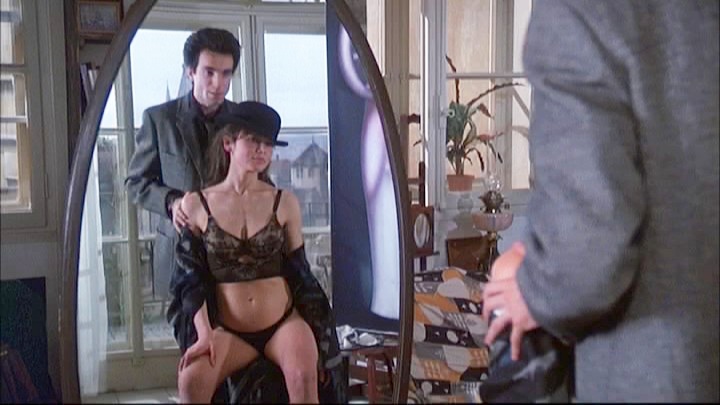

One of the true cinematographic masters has passed away. Sven Nykvist, who collaborated with Ingmar Bergman an astounding 22 times and won two Oscars as a result, was 83.
His body of work is truly astounding. Amazingly, he only had one other Oscar nomination beside his two wins, for his exquisite work in Philip Kaufman's The Unbearable Lightness of Being.
He was a true working artist, contributing his talents not only to the exceptional films, but to lightweight (and sometimes just plain awful) movies as well such as Sleepless in Seattle, With Honors, Only You, Something to Talk About and the truly dreadful Mixed Nuts, which I hope few of you have ever had the misfortune of sitting through, despite Nykvist's contribution.
He also filmed What's Eating Gilbert Grape, Starting Over, Chaplin and Pretty Baby, a film where his contribution much outweighed the Louis Malle film which gave us Brooke Shields as jailbait.


Nykvist's name always will be remembered in conjunction with the great Ingmar Bergman. Their collaboration began in 1953 on The Naked Night and stretched for more than 30 years through After the Rehearsal. Along the way, he filmed such Bergman classics as The Virgin Spring, Through a Glass Darkly, The Silence, Persona, Shame and Face to Face. He won the first of his two Oscars for filming Bergman's (in my eyes) deadly dull but beautiful to look at Cries and Whispers. I found that film to be a depressing bore, but Nykvist's use of light and color, especially reds, made it at least watchable.

He won his second Oscar for Bergman's masterpiece Fanny and Alexander, a film unlike Cries and Whispers where the film itself equaled the wondrous cinematography Nykvist provided to Bergman's epic tale of two children raised in a theatrical family and at the mercy of a sadistic minister of a stepfather.
Woody Allen, a self-proclaimed Bergman worshipper, also got the chance to employ Nykvist's services four times, the best being on Crimes and Misdemeanors but also including Another Woman, the "Oedipus Wrecks" segment of New York Stories and the truly abysmal Celebrity, where Nykvist's black-and-white cinematography was the only thing worth recommending in what I consider Allen's worst film.
Tweet
Labels: Ingmar Bergman, Malle, Obituary, Woody
TO READ ON, CLICK HERE


