Wednesday, August 18, 2010
Three strikes and you're out

By Edward Copeland
Think how much money could be saved the next time Noah Baumbach seeks financing for a film if instead of someone ponying up for a full-scale production, they simplify the process by simply giving him a cameraman and filming his sessions with his psychiatrist. Better yet: Don't actually film them and spare viewers from having to endure Baumbach working through his issues.
Many artists have worked through their neuroses in their art and done so in astoundingly great works of film, literature, theater and television. While Baumbach has been at it a while and I admit I haven't seen his earlier directing efforts, his last three films do so in such an overt way with such annoying and downright unlikable characters that you wish you could enter the film and slap the whole fucking lot of them.
With The Squid and the Whale, the ensemble of Jeff Daniels, Laura Linney, Jesse Eisenberg and even young Owen Kline were so good that their performances managed to overcome the script's deficiencies and make the experience of watching the film less painful than it might otherwise have been.
Then came Margot at the Wedding, which I would call insufferable if I weren't afraid it could come off as high praise for such a miserable waste of film.
While the screenplay for Greenberg is credited to Baumbach, surprisingly story credit is shared between him and his real-life wife, the gifted actress Jennifer Jason Leigh, who has a small role in this film. I hate to blame her for part of this mess as well, especially considering that she co-wrote and co-directed, with Alan Cumming, the underrated 2001 gem The Anniversary Party.
Ben Stiller stars as Roger Greenberg, recently released from a mental hospital in New York, who travels to Los Angeles to housesit for his brother while he and his wife take a trip to Vietnam. This brings Roger in contact with his brother's assistant Florence (Greta Gerwig), the only character in the film that doesn't come off at some point as an asshole.
I do have praise for one scene. When Roger decides to throw a party that somehow attracts throngs of twentysomethings, he launches into a coke-fueled speech about their generation that I do have to admit was quite funny. It was Stiller's best moment as well as the movie's. Also, I'll give Greenberg this much: It's not as painful as Margot at the Wedding was, where I dreamed of a Dynasty-style terrorist massacre to take out the entire wedding party.
I could delve further into the machinations of the story of Greenberg, but it's honestly not worth the effort. Once I finished the torture of watching the film, I would have ejected the DVD, but out of habit I checked to see what bonus features were offered. One was titled "Greenberg: A Novel Approach." In it, Baumbach, obviously suffering from delusions of grandeur, said he hoped to make a movie similar to a novel that would have been written by a Philip Roth or John Updike or Saul Bellow.
Of course, the only thing Greenberg has in common with those writing greats is that their books and Baumbach's screenplay were printed in English. To make the extra more ridiculous (before I shut it off) others involved in the film tried to compare it to classic films of the 1970s, such as something Hal Ashby might have made.
So, it's going to take a lot of convincing to get me to watch the next Noah Baumbach-directed project. I'll be nice and go easy on movies he only participates in the writing of, even though I've only liked one of those, Fantastic Mr. Fox. Next time Noah, maybe you should let your wife do the heavy lifting.
Tweet
Labels: 10s, Ashby, J.J. Leigh, Jeff Daniels, Laura Linney, Roth, Updike
TO READ ON, CLICK HERE


Wednesday, May 12, 2010
Oh, The Plays You Can See

By Hannah W
Now that Tony nominations are out, we might be kicking ourselves for not seeing this play or that play, especially the ones that earned four, five or maybe even six of these honors. How can you predict the Tony winners if you haven’t seen the productions? Luckily, many of the nominated plays are still up and running on Broadway, and you have until June 13 to make your predictions.
Amazingly, every play that opened this season (and therefore is eligible for a Tony) and is still running has been noticed in at least one category. No matter what you decide to see, you’ll see a show that has earned a Tony nod.
As expected, Fences, the August Wilson revival that opened at the Cort Theatre on April 26, is the leader in Tony nominations. With a total of 10 recognitions, including Best Revival of a Play, Best Direction, Best Leading Actor and Actress, one has to assume that there is something to this production.
Though the commercial power of the show stems from its Tony nominated leading stars, Denzel Washington and Viola Davis, the show has also been hailed for its scenic design, costume design, lighting design, sound
 design and original score. Yes, score. Though Fences Branford Marsalis wrote jazz music for the scene breaks that can have you dancing in your seat. This music is seamlessly incorporated into the production so well that you almost forget you’re really waiting for the actors to return.
 Fences is the story of Troy Maxson (Washington), a trash collector in 1975 Pittsburgh. Troy is dreamer with dashed dreams. He constantly tells stories to his wife, Rose (Davis), and his best friend, Bono (played by Best Featured Actor nominee Stephen McKinley Henderson) of amazing things in his life, past and present. However, he is terrified his son, played by Chris Chalk, will go farther and become something more than Troy ever could.
Another leading contender that comes as somewhat of a surprise is Red, John Logan’s play about famed expressionist painter Mark Rothko. As with Fences, Red is up for Leading Actor, Featured Actor, Best Direction, Scenic Design, Lighting Design and Sound Design, but this play’s seven acknowledgements are rounded out by a Best New Play nomination.
Red is about Art. Through the years, we’ve seen a number of Broadway plays and musicals question Art, what it means to create Art and why Art exists. Perhaps the most well known is Stephen Sondheim’s Sunday in the Park with George, last seen on Broadway in 2008.

Though both shows deal with artists struggling with what they want from their art, the Mark Rothko of Red has already achieved his fame. Red takes place during the two years he spent creating a series of murals for the Four Seasons Restaurant in New York City. The discussions that take place between Rothko, played by Alfred Molina, and his fictional assistant, Ken, played by Eddie Redmayne, unveil the two men’s opinions on Art, what Art means and the kinds of people who are able to see Art, versus the ones who should have that privilege.
The play is completely staged in Rothko’s art studio, with red paint on the floor and large expressionist paintings line the walls. During each scene break, a new painting is displayed to the audience, giving an idea for how Rothko wanted these murals to exist. The deep reds, crimsons and blacks of these paintings reflect the growing despair Rothko feels in sharing these murals with diners who can never appreciate them as he does.

Most of the time it seems that the only plays nominators take notice of are heavy dramas. Not this year. Ken Ludwig’s 1986 farce Lend Me a Tenor is up for Best Revival of a Play, among others. Though the cast consists of well known comedians such as Tony Shalhoub (TV’s Monk) and Justin Bartha (The Hangover), the standout performance is giving by Jan Maxwell, for which she has received a Best Featured Actress nod. Maxwell plays Maria, the jealous wife of a famed Italian tenor, who travels with her husband to Cleveland. A comedy of errors ensues in a Cleveland hotel between the opera manager, his assistant, his daughter, the chairwoman of the board, the opera diva and the bellhop. And we cannot forget the costumes in this production. If you remember Roger De Bris’s Anastasia (or Chrysler Building) dress from The Producers, be aware that it makes an encore appearance.

Making its Broadway debut is another comedy, this one dark, starring the Tony nominated Christopher Walken. Martin McDonagh’s new play, A Behanding in Spokane, might be a disappointment to those who loved his earlier work. True McDonagh fans might leave upset over the relatively blood-free stage (though this is not true of body parts). The true genius of Walken, plying a man who has spent half a century looking for his dismembered hand, is evident by his comic timing and dry humor, so that you might not miss the gore.
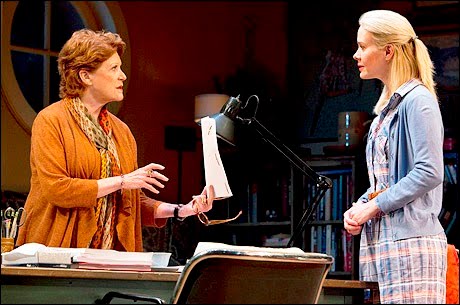
Two of the recognized plays, Collected Stories and Race, are structured to make you deconstruct both sides of an argument that doesn’t have a clear right or wrong answer. While that might sound like it can’t possibly result in entertaining theater, the performances give life to these very wordy plays. Collected Stories, the second Donald Margulies play produced by Manhattan Theatre Club this season, is essentially a series of discussions between two women, a celebrated author and her up-and-coming student. Linda Lavin, who plays the author, is up for Best Leading Actress for this strong performance. Race, the second David Mamet play to be seen on Broadway this season, uses the backdrop of a law firm defending a white man charged with raping a black woman to discuss the difficult topic of race relations. Noticed for Scenic Design, Race also received a Featured Actor nomination for David Alan Grier, playing the black lawyer on the case.

Much more plot-based than either Race or Collected Stories, Geoffrey Nauffts’s Next Fall is extremely
 thought-provoking in a different way. Next Fall presents two different ideas of Christianity and religion in general, seen from both an agnostic and Christian standpoint. The play centers around a gay couple, Adam (agnostic) and Luke (religious), as they try to overcome this major disparity in their relationship. At times funny (Jesse McCartney music makes an appearance) and at times heartbreaking, the struggle of these two men is shown without judgment. The audience members are the judges, most of whom picked a side before entering the theater. Next Fall is recognized for Best Play and Best Direction, due to Geoffrey Nauffts' ability to present different views on religion and write a compelling love story at the same time.
Originally a limited run at Manhattan Theatre Club, Time Stands Still closed March 27, but if you missed this Best New Play contender with Laura Linney, a Best Leading Actress nominee, you’re in luck. The first Donald Margulies play of the season is coming back to Broadway in the fall as a commercial production. Time Stands Still tells the story of photojournalist Sarah (Linney) and what happened to her life after she is injured while on assignment in Iraq. Sarah is so devoted to her job of observing the world that she finds it hard to participate and connect without her camera. We can’t escape the news reports of the war our country is currently engaged in, but rarely do we stop and think about those people who bring us our information. Time Stands Still places them firmly in our consciousness.
Of the eight plays currently running on Broadway, seven are Tony nominees for the 2009/2010 season, and God of Carnage, the only other play, is last year’s Tony winner for Best New Play, though it will close June 27. You have your pick of comedy or drama, new play or revival. The season has been kind to the playgoing theatergoer, as every play has something to offer. Which plays are you going to see?
Tweet
Labels: Awards, Denzel, Laura Linney, Mamet, Sondheim, Theater, Viola Davis, Walken
TO READ ON, CLICK HERE
Monday, February 25, 2008
It's meant to be funny?
By Edward Copeland
At one point in Margot at the Wedding, a frustrated Malcolm (Jack Black) tells his fiancee Pauline (Jennifer Jason Leigh) that both she and her sister Margot (Nicole Kidman) are "fucking morons." When Jack Black is the voice of reason, you know you are probably in trouble and Noah Baumbach's film is the most excruciatingly bad moviegoing experience I've had among 2007 releases.
I can't imagine how much time Baumbach has spent in therapy in his life, but the bills must be astronomical. (If he hasn't been in therapy at all, The Squid and the Whale and this piece of shit are strong evidence that perhaps he should be sent forcibly to a mental health facility.)
While Squid worked to some extent thanks to the solid acting by Laura Linney, Jeff Daniels, Jesse Eisenberg and Owen Kline, there is no such luck with Margot at the Wedding. Baumbach even manages to drag down the talent of his wife, Leigh, whom we don't see that often anymore.
Kidman is flat-out bad and Black seems as if he dropped in from another film, a film I certainly would have rather been watching.
Ciaran Hinds shows up as Kidman's lover and as much as I disliked There Will Be Blood, I hoped that somehow Hinds could teleport the cast of Margot back to Daniel Plainview's bowling alley.
Few films I can recall have created such an array of repulsive, hateful and boring characters such as those Baumbach assembles here. The motivations for what they do don't seem to spring from their characters' inner wounds but solely from a desire on Baumbach's part to drag audiences into his own dysfunctional misery.
I have to ask Baumbach, "What did we ever do to you to deserve this?" I didn't think that anything could top Colour Me Kubrick as the worst 2007 film I saw, but Baumbach managed to pull that off with Margot at the Wedding. It's really the only superlative this film deserves.
Tweet
TO READ ON, CLICK HERE
At one point in Margot at the Wedding, a frustrated Malcolm (Jack Black) tells his fiancee Pauline (Jennifer Jason Leigh) that both she and her sister Margot (Nicole Kidman) are "fucking morons." When Jack Black is the voice of reason, you know you are probably in trouble and Noah Baumbach's film is the most excruciatingly bad moviegoing experience I've had among 2007 releases.
I can't imagine how much time Baumbach has spent in therapy in his life, but the bills must be astronomical. (If he hasn't been in therapy at all, The Squid and the Whale and this piece of shit are strong evidence that perhaps he should be sent forcibly to a mental health facility.)
While Squid worked to some extent thanks to the solid acting by Laura Linney, Jeff Daniels, Jesse Eisenberg and Owen Kline, there is no such luck with Margot at the Wedding. Baumbach even manages to drag down the talent of his wife, Leigh, whom we don't see that often anymore.
Kidman is flat-out bad and Black seems as if he dropped in from another film, a film I certainly would have rather been watching.
Ciaran Hinds shows up as Kidman's lover and as much as I disliked There Will Be Blood, I hoped that somehow Hinds could teleport the cast of Margot back to Daniel Plainview's bowling alley.
Few films I can recall have created such an array of repulsive, hateful and boring characters such as those Baumbach assembles here. The motivations for what they do don't seem to spring from their characters' inner wounds but solely from a desire on Baumbach's part to drag audiences into his own dysfunctional misery.
I have to ask Baumbach, "What did we ever do to you to deserve this?" I didn't think that anything could top Colour Me Kubrick as the worst 2007 film I saw, but Baumbach managed to pull that off with Margot at the Wedding. It's really the only superlative this film deserves.
Tweet
Labels: 00s, J.J. Leigh, Jeff Daniels, Laura Linney, Nicole Kidman
TO READ ON, CLICK HERE
Tuesday, December 11, 2007
Going Gently (if not very Happily) into That Good Night
By Josh R
When it comes to aging parents and the grown children who have to care for them, whose position is the less enviable? When failing health enters into the equation, there are no easy choices — and even fewer prospects for a happy ending. This would be the case in even the most loving, well-adjusted of families. When the people in question are of the dysfunctional variety — both individually and collectively — it’s not exactly conducive to heroics. Even if the brother-and-sister pair memorably delineated by Philip Seymour Hoffman and Laura Linney in The Savages weren’t faced with the challenges of dealing with a dying father, they wouldn’t be rolling in clover; since misery loves company, Dad’s infirmities only add to the weight of their already troubled existences. Entering the home stretch is no picnic — and as Tamara Jenkins’ darkly comic film suggests, groping one’s way through middle age isn’t that much better.
The family is, in fact, called the Savages. Even though its junior members belong to the rarefied world of academia and high culture — conversations are peppered with references to Bertholt Brecht and Josef von Sternberg — they’re living up to their name in other ways. The trouble begins — or rather, intensifies — when Wendy, a self-professed playwright who supports herself by doing temp work, gets the distressing news that her estranged father (Philip Bosco) has been acting out by smearing his feces on the walls of his Arizona home. Although her brother John — a sad sack college professor who cries when his girlfriend, a Polish scholar who will be leaving him as soon as her visa expires, fixes him eggs — dryly advises his distraught sibling that they’re “not in a Sam Shepard play,” matters quickly progress from bad to worse; they’re not exactly bound for Shepard country, but for someplace just as difficult to negotiate. Figuring out what to do with Dad — an ornery old cuss rapidly sinking into dementia due to the onslaught of Parkinson’s disease — is a tricky proposition, offering no comfortable solutions. It doesn’t help that as a father, Lenny Savage was neglectful at best and abusive at worst; in addition to the guilt his children feel about being unable and unwilling to care for him properly, neither is insensible to the bitter irony of taking on responsibility for someone who never really took care of them.
If the film sounds lugubrious to an extreme, writer-director Jenkins provides enough flashes of sharp gallows humor to keep the proceedings from becoming unrelentingly bleak. Not that the approach is always entirely successful. There are times when The Savages’ systemic morbidity makes for a rather plodding affair — even though Jenkins is able to bring out the humor in pathos in unexpected ways (and vice versa), the film as a whole could have used more in the way of variety. It also smacks of some of the pretensions that are particular to the world of independent filmmaking; while a fine example of the genre, there is a sense of ennui that comes with witnessing the trials and tribulations of yet another batch of quirky dysfunctionals muddling their way through life in dysfunctionally quirky fashion. The plonkety-plonking score, which suggests both a sad brand of whimsy and a crestfallen synthesizer comparing notes with a clinically depressed xylophone, seems to have been a feature of every indie-family-drama of the past ten years; it’s practically a prerequisite. Those reservations aside, the film is well-written and ultimately very moving — it grows on one as the action progresses, handling its sensitive subject matter in a way that is never less than believable. Whatever minor flaws the film has are compensated for by the performances of the principals, who are uniformly excellent. With his rumpled, hangdog look and bone-dry delivery, Hoffman subtly suggests the deep-seated anger and inability to forgive that informs his character’s seeming passivity; while I sometimes find his whiny monotone and consistent underplaying a bit too method-actorish for my taste, in this, as in Owning Mahowny, the approach pays off. Laura Linney’s triumphs usually come in twos — in 2004 she scored twin knockouts with Kinsey and P.S., and in 2007, she repeats the feat. Jindabyne, a little-seen film which can (and should) be seen in its recent DVD release, cast her in a more darkly dramatic mode, while The Savages allows her to display a brittle, defensive humor that makes her character’s neuroticism all the more compelling. In both films, the bracing intelligence which has distinguished her best work is present and accounted for (and when you factor in her well-received supporting turns in Breach and The Nanny Diaries, she’s probably broken some record of Julianne Moore’s). Bosco, a veteran stage actor, is pitch-perfect as the regressed tyrant who, through the fog of his hazy confusion, can glean just enough of his offspring’s unspoken recrimination to understand just how friendless his predicament is. When Dylan Thomas famously urged his ailing father “Do not go gentle into that good night; Rage, rage against the dying of the light,” he wasn’t speaking of a parent who was made acutely aware of the extent to which he’d failed in respect to those duties. Sometimes, the light provides the only comfort that there is — in The Savages, the departure from the world of the living is ultimately a gentle one, if inescapably colored by bitter shades of regret.
Tweet
TO READ ON, CLICK HERE
When it comes to aging parents and the grown children who have to care for them, whose position is the less enviable? When failing health enters into the equation, there are no easy choices — and even fewer prospects for a happy ending. This would be the case in even the most loving, well-adjusted of families. When the people in question are of the dysfunctional variety — both individually and collectively — it’s not exactly conducive to heroics. Even if the brother-and-sister pair memorably delineated by Philip Seymour Hoffman and Laura Linney in The Savages weren’t faced with the challenges of dealing with a dying father, they wouldn’t be rolling in clover; since misery loves company, Dad’s infirmities only add to the weight of their already troubled existences. Entering the home stretch is no picnic — and as Tamara Jenkins’ darkly comic film suggests, groping one’s way through middle age isn’t that much better.
The family is, in fact, called the Savages. Even though its junior members belong to the rarefied world of academia and high culture — conversations are peppered with references to Bertholt Brecht and Josef von Sternberg — they’re living up to their name in other ways. The trouble begins — or rather, intensifies — when Wendy, a self-professed playwright who supports herself by doing temp work, gets the distressing news that her estranged father (Philip Bosco) has been acting out by smearing his feces on the walls of his Arizona home. Although her brother John — a sad sack college professor who cries when his girlfriend, a Polish scholar who will be leaving him as soon as her visa expires, fixes him eggs — dryly advises his distraught sibling that they’re “not in a Sam Shepard play,” matters quickly progress from bad to worse; they’re not exactly bound for Shepard country, but for someplace just as difficult to negotiate. Figuring out what to do with Dad — an ornery old cuss rapidly sinking into dementia due to the onslaught of Parkinson’s disease — is a tricky proposition, offering no comfortable solutions. It doesn’t help that as a father, Lenny Savage was neglectful at best and abusive at worst; in addition to the guilt his children feel about being unable and unwilling to care for him properly, neither is insensible to the bitter irony of taking on responsibility for someone who never really took care of them.
If the film sounds lugubrious to an extreme, writer-director Jenkins provides enough flashes of sharp gallows humor to keep the proceedings from becoming unrelentingly bleak. Not that the approach is always entirely successful. There are times when The Savages’ systemic morbidity makes for a rather plodding affair — even though Jenkins is able to bring out the humor in pathos in unexpected ways (and vice versa), the film as a whole could have used more in the way of variety. It also smacks of some of the pretensions that are particular to the world of independent filmmaking; while a fine example of the genre, there is a sense of ennui that comes with witnessing the trials and tribulations of yet another batch of quirky dysfunctionals muddling their way through life in dysfunctionally quirky fashion. The plonkety-plonking score, which suggests both a sad brand of whimsy and a crestfallen synthesizer comparing notes with a clinically depressed xylophone, seems to have been a feature of every indie-family-drama of the past ten years; it’s practically a prerequisite. Those reservations aside, the film is well-written and ultimately very moving — it grows on one as the action progresses, handling its sensitive subject matter in a way that is never less than believable. Whatever minor flaws the film has are compensated for by the performances of the principals, who are uniformly excellent. With his rumpled, hangdog look and bone-dry delivery, Hoffman subtly suggests the deep-seated anger and inability to forgive that informs his character’s seeming passivity; while I sometimes find his whiny monotone and consistent underplaying a bit too method-actorish for my taste, in this, as in Owning Mahowny, the approach pays off. Laura Linney’s triumphs usually come in twos — in 2004 she scored twin knockouts with Kinsey and P.S., and in 2007, she repeats the feat. Jindabyne, a little-seen film which can (and should) be seen in its recent DVD release, cast her in a more darkly dramatic mode, while The Savages allows her to display a brittle, defensive humor that makes her character’s neuroticism all the more compelling. In both films, the bracing intelligence which has distinguished her best work is present and accounted for (and when you factor in her well-received supporting turns in Breach and The Nanny Diaries, she’s probably broken some record of Julianne Moore’s). Bosco, a veteran stage actor, is pitch-perfect as the regressed tyrant who, through the fog of his hazy confusion, can glean just enough of his offspring’s unspoken recrimination to understand just how friendless his predicament is. When Dylan Thomas famously urged his ailing father “Do not go gentle into that good night; Rage, rage against the dying of the light,” he wasn’t speaking of a parent who was made acutely aware of the extent to which he’d failed in respect to those duties. Sometimes, the light provides the only comfort that there is — in The Savages, the departure from the world of the living is ultimately a gentle one, if inescapably colored by bitter shades of regret.
Tweet
Labels: 00s, Julianne Moore, Laura Linney, P.S. Hoffman, Shepard, von Sternberg
TO READ ON, CLICK HERE
Monday, June 18, 2007
The why doesn't matter
By Edward Copeland
For his second film as a director, Billy Ray again tells the story of convincing liars, only in Breach the lies surrounding FBI Agent Robert Hanssen certainly have more serious consequences than the flamboyant fibs of Stephen Glass in Shattered Glass. The end result is a film nearly as great as Ray's directing debut.
For a story with a denouement most viewers will know, Ray manages to build a lot of genuine suspense as he spins the tale of the FBI operative Eric O'Neill (Ryan Phillippe) who helped bring Hanssen down.
What makes Breach such an exceptional film is Chris Cooper who, in a career already full of memorable performances, delivers one of his very best as Hanssen. The easy path would have been to play Hanssen as a sneering villain, but the screenplay by Ray, Adam Mazer and William Rotko and Cooper's performance instead creates a layered portrait of a man full of contradictions.
Robert Hanssen betrayed his country and cost people their lives and who knows what else by selling secrets to the Soviets and the Russians, but Breach makes the viewer develop empathy for the man without ever excusing the inexcusable things he did.
On the DVD commentary, Ray comments that at one point he told Phillippe that he was very good and says that the actor replied, "I can be better" and I'm inclined to side with Phillippe. At times, he does stand up well in scenes opposite Cooper and a great supporting turn by Laura Linney as his superior, but Phillippe also is burdened with the film's weakest elements: domestic scenes between O'Neill and his East German-born wife (Caroline Dhavernas).
I understand the parallel that is trying to be set up between the O'Neills' marriage (he has been reared Catholic; she's a lapsed Protestant) and the Hanssens' marriage (both Robert and his wife (Kathleen Quinlan) are superdevout Opus Dei followers), but every time we get to the scenes between Phillippi and Dharvernas, the film screeches to a halt.
Thankfully, there aren't enough of those scenes to truly harm what is otherwise a suspenseful, watchable and fascinating film. The DVD commentary is worth listening to as well, not only for Ray's insights but because it also includes the real Eric O'Neill discussing how the case actually went down.
Tweet
TO READ ON, CLICK HERE
For his second film as a director, Billy Ray again tells the story of convincing liars, only in Breach the lies surrounding FBI Agent Robert Hanssen certainly have more serious consequences than the flamboyant fibs of Stephen Glass in Shattered Glass. The end result is a film nearly as great as Ray's directing debut.
For a story with a denouement most viewers will know, Ray manages to build a lot of genuine suspense as he spins the tale of the FBI operative Eric O'Neill (Ryan Phillippe) who helped bring Hanssen down.
What makes Breach such an exceptional film is Chris Cooper who, in a career already full of memorable performances, delivers one of his very best as Hanssen. The easy path would have been to play Hanssen as a sneering villain, but the screenplay by Ray, Adam Mazer and William Rotko and Cooper's performance instead creates a layered portrait of a man full of contradictions.
Robert Hanssen betrayed his country and cost people their lives and who knows what else by selling secrets to the Soviets and the Russians, but Breach makes the viewer develop empathy for the man without ever excusing the inexcusable things he did.
On the DVD commentary, Ray comments that at one point he told Phillippe that he was very good and says that the actor replied, "I can be better" and I'm inclined to side with Phillippe. At times, he does stand up well in scenes opposite Cooper and a great supporting turn by Laura Linney as his superior, but Phillippe also is burdened with the film's weakest elements: domestic scenes between O'Neill and his East German-born wife (Caroline Dhavernas).
I understand the parallel that is trying to be set up between the O'Neills' marriage (he has been reared Catholic; she's a lapsed Protestant) and the Hanssens' marriage (both Robert and his wife (Kathleen Quinlan) are superdevout Opus Dei followers), but every time we get to the scenes between Phillippi and Dharvernas, the film screeches to a halt.
Thankfully, there aren't enough of those scenes to truly harm what is otherwise a suspenseful, watchable and fascinating film. The DVD commentary is worth listening to as well, not only for Ray's insights but because it also includes the real Eric O'Neill discussing how the case actually went down.
Tweet
Labels: 00s, Chris Cooper, Laura Linney
TO READ ON, CLICK HERE
Saturday, December 30, 2006
Soul Food...from a Can

By Josh R
The history of African-American recording artists in this country is one with a turning point. In the late 1950s, upstart producer Berry Gordy founded Motown Records, the specific mission of which was to bring Rhythm & Blues out of the realm of ethnic specialty and into the mainstream of American culture. From the get-go, it was an uphill battle. While there had been African-American R&B artists with some crossover appeal, notably Fats Domino and Little Richard, white audiences were, at best, wary of the rumblings coming out of Detroit. Rude, rough, racy and unapologetically confrontational, R&B was a tough sell for that segment of the population that wasn’t quite ready to accept any show, overt or otherwise, of African-American power, strength and defiance. Well-heeled suburbanites who happened into Harlem’s Apollo Theater, that inner-city musical cathedral where blues and gospel merged with the insistent beat of rock n’ roll, might well find themselves scuttling towards the exit doors in fits of apoplexy ... and it’s not hard to imagine them double-bolting their own front doors after staggering home to New Rochelle.
When Domino’s first crossover hit, “Ain’t That a Shame,” was infamously covered by squeaky-clean Pat Boone — whose easy-listening style made The Beach Boys look like a metal band — the cover version hit No. 1 on the pop charts, eclipsing the success of the Domino original. Since the Boone track received much wider radio airplay in segregated areas, Gordy understood that a change was needed if black artists had any hope of getting their sound into the mainstream — without seeing it plundered and cannibalized by the Pat Boones of the world, who would ultimately reap the rewards of other people’s labors. A canny appraiser of what white audiences were ready to accept, Gordy deliberately steered R&B away from its boisterous origins, cultivating a milder, softer sound that was more patently listener-friendly. Thus, the raucous, hair-raising vocal stylings of Little Richard were jettisoned in favor of the smooth, silky falsetto of Smokey Robinson, Gordy’s first top attraction in what would soon prove to be an unprecedented stable of talents. It was the most nonthreatening approach he could have taken, and it proved to be a lucrative one — while white audiences of the early 1960s weren’t necessarily prepared for electric firebrands in the James Brown and Tina Turner mold, they were more than happy for the spectacle of smiling black men sweetly harmonizing about having “sunshine on a cloudy day.” Whatever you happen to think of the Motown sound as refined and perfected by Berry Gordy — and I, for one, happen to love it — it must be acknowledged that it was a sanitized, smoothed-over (if not de-fanged) version of how R&B was originally conceived.
This is essentially true of the new film Dreamgirls, based on the wildly successful Broadway musical of the 1980s and brought to the screen by writer-director Bill Condon. Not-so-loosely based on the saga of The Supremes, the trio of singers molded by Gordy into the most influential girl group of all time, the film looks and sounds like a reasonably fair approximation of the Motown style. But looking and sounding the part is only half the battle, and Condon’s effort ultimately feels less like a genuine reflection of the hardscrabble African-American experience in America (and the personalities who served as its artistic spokesmen) than a nice, safe little film pitched directly at a suburban white audience. The result feels cautious, and somewhat on the bland side — the cinematic equivalent of the kind of mass-marketed soul food that comes out of a can. To be fair, this is R&B filtered through the more conciliatory sensibility of Broadway ... nobody expected Hustle & Flow, but we weren’t expecting Mahogany either.
Dreamgirls follows the story of The Supremes closely in many respects. For anyone unfamiliar with the history, Gordy replaced the group’s original lead singer, the soulful Florence Ballard, with Diana Ross, the light-skinned beauty with the tiny little voice. While a consummate performer with star quality to spare, Ross — and I’m sure I’ll get tons of flack for saying this — was never much of a vocal powerhouse. Or really even much of a singer. If not for the science of electronic amplification, it’s doubtful she might ever have found herself on The Supremes roster, let alone serving as its lead vocalist. She was, however, a personality that could be packaged and marketed to the target audience, unencumbered by the kind of virtuosic skill that might overpower the mellow vibe Gordy was trying to create. It was about as far from Aretha Franklin as one could get — it was Nancy Sinatra and Brenda Lee. To be blunt — and go ahead, start firing off those outraged comments accusing me of stereotyping — she sang like a white girl. She also was romantically involved with Gordy at the time, which hardly hurt her cause. Ballard sank into obscurity and poverty, and died at the age of 32, a victim of depression and alcohol abuse.
The film provides its own thinly veiled version of The Supremes in The Dreamettes, a trio comprised of brass-lunged Effie White (Jennifer Hudson), demure Deena Jones (Beyonce Knowles) and pert Lorrell Robinson (Anika Noni Rose). Ambitious would-be producer Curtis Taylor Jr. (Jamie Foxx) lands them a gig singing backup for established star James Thunder Early (Eddie Murphy), a soul singer in the James Brown-Little Richard mold whose popularity doesn’t extend much beyond the R&B circuit. While romancing the dynamic Effie, whose unabashed confidence makes her full-bodied sensuality only that much more pronounced, Curtis doesn’t permit sentiment to distract him from the goal of using the Dreamettes as a vehicle for crossover success. He installs conventionally pretty, honey-voiced Deena as the new lead vocalist of the re-christened Dreams, demoting Effie to the role of backup vocalist. Her pride and vanity wounded by Curtis’ rejection of her talent, Effie’s inability to accept her diminished role leads to her eventual dismissal from the group. Unlike her real-life counterpart, Florence Ballard, she eventually rises up from the subsequent indignities of poverty to achieve success in her own right as a solo artist. Meanwhile, Deena (now Mrs. Curtis Taylor Jr.) has grown increasingly dissatisfied with the extent to which she has had to sublimate her own personality — conforming to the confining mold Curtis has pushed upon her — and tries to recover her own voice as both an artist and a woman.
It’s basically your standard rags-to-riches formula, enacted in predictably soapy fashion. The cast is undoubtedly talented, but with two notable exceptions, they fail to imbue their roles with much in the way of personality. Foxx comes across as neither dynamic nor ruthless enough to convince as the kind of upstart who could build an empire from scratch — his failure in the role is surprising given what a natural choice he would have seemed to be for the assignment (for a character who, in his own words, "step(s) up to the dark side," he seems pretty harmless). Beyonce looks and sounds like a dream, bringing a creamy luster to her vocals in what would also seem to be a tailor-made role — but she is similarly hamstrung by the soft-focus approach favored by Condon. Her character is supposed to be dewy-eyed and pliant, but without a sense of genuine drive behind the come-hither stage smile, her character arch isn’t particularly compelling. Her performance of the song “Listen,” written specifically for the film, shows off her vocal chops to great effect, and is the only moment in the film where her undeniable star quality is fully utilized. The talented Anika Noni Rose, who won a Tony for her buoyant performance in Caroline or Change?, by necessity comes across as a bit of a third wheel.
That leaves two performers — and they are, for all intensive purposes, the only thing which lends the film any measure of distinction. I watched Jennifer Hudson as a contestant on American Idol — while she impressed with her powerful vocals, there was nothing in her presence to indicate the potential for stardom. As Effie White, however, she commands full attention, at times offering enticing glimpses of what Dreamgirls could have been if brought to life with more conviction. I didn’t see the legendary stage version, but anyone with any familiarity with the show knows that its centerpiece has always been Effie’s raging anthem of defiance and denial, “And I Am Telling You I’m Not Going.” Jennifer Holliday, the original Effie, sang the song with such force that it drew ovations the likes of which hadn’t been heard on Broadway since the age of Ethel Merman. Hudson puts the number over with a voracious theatricality and a shattering sense of urgency, all but blowing the lid off of a film which would otherwise seem to settle for tepid complacency when it should be going for the jugular. It’s the highlight of a performance that, while strong from start to finish, may not quite deserve the overweening praise that’s been heaped upon it by critics — truth be told, it’s only when she unleashes her spectacular voice upon the Henry Krieger-Tom Eyen score that the effect is truly riveting. If I remain unconvinced as to whether or not Hudson is, in fact, much of actress, let it be said that she is ideally suited to the demands of the role, and demonstrates a thorough understanding of the bruised feelings and fractious fits of temperament which make Effie a cyclone of a diva. Condon, who has been instrumental in drawing career-best performances from the likes of Ian McKellen, Liam Neeson and Laura Linney, doubtless deserve some of the credit.
It is Eddie Murphy, however, who provides Dreamgirls with its most effective acting performance. As the rough-living soul singer who can’t temper his electric style to suit the demands of the industry, he creates a touching study of a tortured soul struggling to bridge the gap between his natural assurance as a performer and his lack of wherewithal when the curtain comes down. Once the former has been cruelly taken away from (Curtis tries to shoe-horn him into the mold of an Al Green-style crooner), it isn’t long before his self-destructive impulses fully take hold. The advance word was that Murphy, along with everyone else in the film, would be swept away by the tidal wave of Hudson’s tour-de-force, but that proves not to be the case. Again, this is the sort of film that can only furnish good performances, as opposed to great ones, since there isn't much complexity of characterization — but Murphy certainly acquits himself well, and he and Hudson come closer than anyone else to suggesting the turbulence of the artistic temperament, and the restless, audacious spirit of a generation of musical pioneers.
The re-emergence of the movie musical has been a heartening development in recent years, even if the films themselves haven’t always provided much cause for cheer. Dreamgirls is far from a debacle on the level of The Phantom of the Opera, which was as overwrought as it was overproduced, or as disappointing as The Producers, which managed to be singularly uncinematic in Susan Stroman’s insistence on treating her original Broadway staging as if it were the Holy Grail. Hell, next to something like Babel, it could be called a masterpiece (will I ever stop razzing Babel? Not in this lifetime, kids). But Dreamgirls, while not a bad film, is sorely lacking in the one crucial ingredient by which a musical succeeds or fails — a sense of vitality. Bland and safe when it needed to be vibrant, it keeps its soul hidden under a bushel.
Tweet
Labels: 00s, Awards, Eddie Murphy, Laura Linney, Liam Neeson, Merman, Music, Musicals, Television, Theater
TO READ ON, CLICK HERE
Friday, February 10, 2006
It's not the size of the role...
By Edward Copeland
With William Hurt's much-deserved (in my opinion) nomination for A History of Violence this year, my thoughts have turned to some of the great single-scene or particularly small roles that were able to grab the viewer's attention in unprecedented ways.
Hurt's brief bit is by no means the Oscar's only instance of short scene-stealers — Beatrice Straight won for basically one monologue in Network and Judi Dench won with very limited screen time in Shakespeare in Love.
Geraldine Page also snagged a nomination for essentially one scene in The Pope of Greenwich Village. Network also produced a great monologue for Ned Beatty that earned him an Oscar nomination. All those nominees were fine by me except for Dench, who was really just getting makeup Oscar love for losing for Mrs. Brown the year before to the wandering accent of Helen Hunt in As Good As It Gets. Then there were also some brief nominations that were a complete puzzlement like Ethel Barrymore's nomination for The Paradine Case, one of Alfred Hitchcock's worst films.
So, as they come to me, some of my favorite brief roles.
Alfred Molina in Boogie Nights. When you get right down to it, the scene is completely extraneous to the movie — the climax of a film about the evolution of the porn industry well into the 1980s should have involved AIDS, not a standard drug deal. Still, Molina is masterful with his drug-addled dialogue set to the tune of Night Ranger's "Sister Christian."
One of my favorite single sequence tour-de-forces is Bill Murray in Little Shop of Horrors. His masochist wouldn't come off as great without Steve Martin's sadistic dentist to play off, but he's great.
Christopher Walken is a master of the monologue, but his one scene telling a child-size version of Bruce Willis about the journey of a gold watch in Pulp Fiction is priceless.
Another role that is essentially a single monologue, Jack Lemmon in Short Cuts. A brief but great role that few besides me remember is Swoosie Kurtz in Against All Odds where she is delightfully flaky as the secretary of a crooked lawyer who decides to help Jeff Bridges.
The year Frances McDormand won lead actress (for what in my opinion was a supporting role, but that's an argument for another time) for Fargo, she also gave a great single scene performance in Lone Star. Throughout the film, Chris Cooper's character's unstable ex-wife is referred to and when the situation requires Cooper to visit her late in the film, McDormand nails the character in a way that brings earlier references to vivid life.
Michael Mann's Collateral offered two great one scene performances: Barry Shabaka Henley as a jazz musician targeted for elimination and Javier Bardem as a crime lord. In another Tom Cruise vehicle, Lois Smith had a memorable one-scene turn in a greenhouse in Minority Report.
For a while last year, there was buzz that Lynn Redgrave might get nominated for her great single-scene at the climax of Kinsey as a woman whose life was profoundly affected by the sex researcher, but when that film folded, only Laura Linney was left standing.
It's more than one scene, but Tony Shalhoub's cab driver of indeterminate origin in Quick Change is a riot. Another short one that cracked me up was Maximilian Schell in The Freshman. "Carmine said one boy, here are two."
The original version of Love Affair and its remake by Warren Beatty produced two great short turns by Maria Ouspenskaya and Katharine Hepburn, respectively. Ouspenskaya even managed an Oscar nomination for her performance. Another one scene wonder that earned an Oscar nomination was Sylvia Miles in Midnight Cowboy, though it's been a long time since I've seen that one.
Most of the ones that are springing to my mind right now are more recent ones, but I'm sure brief turns in older films will come to my mind once the conversation gets going. The ones that immediately occur to me are Leslie Howard, Anton Walbrook and Raymond Massey's brief bits in the Powell/Pressburger masterpiece 49th Parallel aka The Invaders.
I'll leave you with this one: while certainly not a nomination-worthy performance, Garry Marshall's turn as the manager of the Desert Inn in Lost in America always cracks me up. "We're through talking now."
He may be through, but I hope you aren't.
Tweet
TO READ ON, CLICK HERE
With William Hurt's much-deserved (in my opinion) nomination for A History of Violence this year, my thoughts have turned to some of the great single-scene or particularly small roles that were able to grab the viewer's attention in unprecedented ways.
Hurt's brief bit is by no means the Oscar's only instance of short scene-stealers — Beatrice Straight won for basically one monologue in Network and Judi Dench won with very limited screen time in Shakespeare in Love.
Geraldine Page also snagged a nomination for essentially one scene in The Pope of Greenwich Village. Network also produced a great monologue for Ned Beatty that earned him an Oscar nomination. All those nominees were fine by me except for Dench, who was really just getting makeup Oscar love for losing for Mrs. Brown the year before to the wandering accent of Helen Hunt in As Good As It Gets. Then there were also some brief nominations that were a complete puzzlement like Ethel Barrymore's nomination for The Paradine Case, one of Alfred Hitchcock's worst films.
So, as they come to me, some of my favorite brief roles.
Alfred Molina in Boogie Nights. When you get right down to it, the scene is completely extraneous to the movie — the climax of a film about the evolution of the porn industry well into the 1980s should have involved AIDS, not a standard drug deal. Still, Molina is masterful with his drug-addled dialogue set to the tune of Night Ranger's "Sister Christian."
One of my favorite single sequence tour-de-forces is Bill Murray in Little Shop of Horrors. His masochist wouldn't come off as great without Steve Martin's sadistic dentist to play off, but he's great.
Christopher Walken is a master of the monologue, but his one scene telling a child-size version of Bruce Willis about the journey of a gold watch in Pulp Fiction is priceless.
Another role that is essentially a single monologue, Jack Lemmon in Short Cuts. A brief but great role that few besides me remember is Swoosie Kurtz in Against All Odds where she is delightfully flaky as the secretary of a crooked lawyer who decides to help Jeff Bridges.
The year Frances McDormand won lead actress (for what in my opinion was a supporting role, but that's an argument for another time) for Fargo, she also gave a great single scene performance in Lone Star. Throughout the film, Chris Cooper's character's unstable ex-wife is referred to and when the situation requires Cooper to visit her late in the film, McDormand nails the character in a way that brings earlier references to vivid life.
Michael Mann's Collateral offered two great one scene performances: Barry Shabaka Henley as a jazz musician targeted for elimination and Javier Bardem as a crime lord. In another Tom Cruise vehicle, Lois Smith had a memorable one-scene turn in a greenhouse in Minority Report.
For a while last year, there was buzz that Lynn Redgrave might get nominated for her great single-scene at the climax of Kinsey as a woman whose life was profoundly affected by the sex researcher, but when that film folded, only Laura Linney was left standing.
It's more than one scene, but Tony Shalhoub's cab driver of indeterminate origin in Quick Change is a riot. Another short one that cracked me up was Maximilian Schell in The Freshman. "Carmine said one boy, here are two."
The original version of Love Affair and its remake by Warren Beatty produced two great short turns by Maria Ouspenskaya and Katharine Hepburn, respectively. Ouspenskaya even managed an Oscar nomination for her performance. Another one scene wonder that earned an Oscar nomination was Sylvia Miles in Midnight Cowboy, though it's been a long time since I've seen that one.
Most of the ones that are springing to my mind right now are more recent ones, but I'm sure brief turns in older films will come to my mind once the conversation gets going. The ones that immediately occur to me are Leslie Howard, Anton Walbrook and Raymond Massey's brief bits in the Powell/Pressburger masterpiece 49th Parallel aka The Invaders.
I'll leave you with this one: while certainly not a nomination-worthy performance, Garry Marshall's turn as the manager of the Desert Inn in Lost in America always cracks me up. "We're through talking now."
He may be through, but I hope you aren't.
Tweet
Labels: Archers, Bardem, Chris Cooper, Cruise, Dench, Geraldine Page, Hitchcock, Jeff Bridges, K. Hepburn, Laura Linney, Lemmon, McDormand, Michael Mann, Murray, N. Beatty, Steve Martin, W. Beatty, Walken, William Hurt, Willis
TO READ ON, CLICK HERE


