Saturday, February 01, 2014
Maximilian Schell (1930-2014)

Schell received two other Oscar nominations in his film career as best actor: in 1975's The Man in the Glass Booth and as supporting actor in 1977's Julia. He also received two Emmy nominations for the TV films Stalin and Miss Rose White in the early '90s. He appeared on Broadway three times, the first time in 1958 in Interlock, the same year his first English-language film, The Young Lions, came out. His third appearance came in 2001 in a stage production of Judgment at Nuremberg, this time playing the role of Dr. Ernst Janning whom Burt Lancaster played in the 1961 film.
Shortly after his Oscar win, he joined the cast of thieves in Jules Dassin's 1964 Topkapi. The first exposure to Schell's work for many in my generation probably came from silly 1979 sci-fi flick The Black Hole. He also played the erstwhile villain opposite James Coburn in one of the lesser Sam Peckinpah effort, 1977's Cross of Iron. He appeared in many films and roles for television both in the U.S. and abroad, including a six-episode stint on Wiseguy.
He also directed, most notably the remarkable 1984 documentary Marlene, where Marlene Dietrich reflected on her life without ever letting herself be seen in her current state.
Of all Schell's roles though, I always maintain a soft spot in my heart for his role as eccentric chef Larry London in Andrew Bergman's great comedy The Freshman with Marlon Brando doing a pitch-perfect parody of his own Vito Corleone.
RIP Mr. Schell.
Tweet
Labels: Awards, Brando, Dassin, Documentary, James Coburn, Lancaster, Marlene, Obituary, Oscars, Peckinpah, Television, Theater
TO READ ON, CLICK HERE


Monday, May 21, 2012
Centennial Tributes: Richard Brooks Part III

By Edward Copeland
It isn't often that a masterpiece of literature begets a masterpiece of cinema yet both retain distinct identities all their own, but that's the case with In Cold Blood, Truman Capote's "nonfiction novel" and Richard Brooks' stunning film adaptation of his book. Capote often gets credit for inventing the genre of adapting the techniques of a novelist to that of straight reporting, but earlier attempts existed — Capote's stood out because In Cold Blood 's excellence made everyone forget any other examples (at least until more than a decade later when Norman Mailer added his own brilliant take on the genre with The Executioner's Song). Brooks, with his job as a crime reporter in his past, on the surface appears to follow Capote's approach, but the director, forever the activist, skips the objectivity that Capote tried to evoke in his book. Brooks didn't want to minimize the horror of the crime that occurred at the Clutter farm in Holcomb, Kans., but he also wanted to humanize the killers, Perry Smith and Dick Hickock. In a way, Brooks' film inspired the path for the two films made decades later telling the story of Capote's writing of the book and his getting to know the killers first-hand as they waited on Death Row. Even today, Brooks' 1967 film remains more powerful and better made than the two more recent tales. Undoubtedly, In Cold Blood remains Brooks' greatest film. If you got here before reading either Part I or Part II of this tribute, click on the respective links.
The village of Holcomb stands on the high wheat plains of western Kansas, a lonesome area that other Kansans call "out there." Some seventy miles east of the Colorado border, the countryside, with its hard blue skies and desert-clear air, has an atmosphere that is rather more Far West than Middle West. The local accent is barbed with a prairie twang, a ranch-hand nasalness, and the men, many of them, wear narrow frontier trousers, Stetsons, and high-heeled boots with pointed toes. The land is flat, and the views are awesomely extensive; horses, herds of cattle, a white cluster of grain elevators rising as gracefully as Greek temples are visible long before a traveler reaches them.

Capote begins his book with that paragraph in the first chapter titled The Last to See Them Alive. Brooks begins the film of In Cold Blood introducing us to The Last to See Them Alive in the forms of Robert Blake as newly paroled inmate Perry Smith and Scott Wilson as an acquaintance he met in prison who had been freed earlier, Dick Hickok. Brooks gives Blake — and the movie — a memorable entrance, especially thanks to his decision to go against the grain of the time and film in black-and-white Panavision. We see a bus driving down a two-lane highway, passing signs showing the distance to different Kansas towns, including the horrific Olathe. On the bus, a young female stumbles down the aisle to get a closer look at the pair of pointed-toe cowboy boots with buckles on its heels before creeping back. The shadowy man who wears the boots also has a guitar strung around his neck. A flame suddenly illuminates Robert Blake's face as he lights a cigarette and Quincy Jones' ominous yet jazzy score kicks in to start the credits. The sequence not only sets the tone for the film that follows, it also introduces us to the movie's most important participant — cinematographer Conrad L. Hall (though he didn't need to use the L. yet since his son, Conrad W. Hall, wasn't old enough to follow his dad into the business).

The movie spends its opening minutes introducing us to the soft-spoken Perry and getting him hooked up with Dick. Whereas Blake's Perry comes off as a puppy repeatedly kicked by his owner, Scott Wilson portrays Hickok as a cocky, livewire and a chatterbox — and Brooks gives him great lines, especially in the scenes where he and Blake drive around. "Ever seen a millionaire fry in the electric chair? Hell, no. There's two kinds of laws, one for the rich and one for the poor," Dick imparts as wisdom to Perry. When the two buy supplies for the planned robbery of the Clutter farm, Dick shoplifts some razorblades for no good reason, leading Perry to chastise him for taking such a risk for something so small. "That was stupid — stealin' a lousy pack of razor blades! To prove what?" Perry asks. Smiling, Dick replies, "It's the national pastime, baby, stealin' and cheatin'. If they ever count every cheatin' wife and tax chiseler, the whole country would be behind prison walls." Though in the two recent biographical films about Truman Capote's research into the case, it's strongly implied that Capote at least developed a crush on Smith and that Perry may have been gay. In Cold Blood never explicltly claims that Perry Smith was gay, but throughout the film Dick taunts him by
 calling him "honey," "baby" or something along those lines. Hickock on the other hand chases every skirt he gets near and during the robbery/murder, Perry intervenes to stop Dick from raping the Clutters' 16-year-old daughter Nancy (Brenda Currin). Wilson made his first two feature films in 1967 and he landed roles in two of the biggest — this one and the eventual Oscar winner for best picture, Norman Jewison's In the Heat of the Night. The jaws of younger readers should hit the floor when they see Wilson's great work here and it slowly dawns on them that playing Dick Hickok is a younger incarnation of Herschel on AMC's The Walking Dead. When Perry and Dick do get together, they meet at Dick's father's house where Dick tries to aid his old man, who's slowly losing his battle with terminal cancer. (Veteran character actor Jeff Corey, who co-starred in the Brooks-scripted 1947 classic Brute Force, plays the elder Hickock.) Contrasting Capote's take with Brooks' version fascinates in the ways the works reflect each other yet, like a mirror, many things appear on the opposite side. The book introduces its readers to the Clutter family first before Perry and Dick enter the story (by name anyway). Brooks' screenplay reverses the order, beginning with the killers then letting us meet the Kansas family. However, both aim to draw parallels between the victims and their eventual murderers. "That morning an apple and a glass of milk were enough for him; because
 he touched neither coffee or tea, he was accustomed to begin the day on a cold stomach. The truth was he opposed all stimulants, however gentle. He did not smoke, and of course he did not drink; indeed, he had never tasted spirits, and was inclined to avoid people who had — a circumstance that did not shrink his social circle as much as might be supposed, for the center of that circle was supplied by the members of Garden City's First Methodist Church, a congregation totaling seventeen hundred, most of whom were as abstemious as Mr. Clutter could desire," Capote described the Clutter patriarch. A few pages later in the first chapter, Perry Smith makes his entrance into Capote's book. "Like Mr. Clutter, the young man breakfasting in a cafe called the Little Jewel never drank coffee. He preferred root beer. Three aspirin, cold root beer, and a chain of Pall Mall cigarettes — that was his notion of a proper "chow-down." Sipping and smoking, he studied a map spread on the counter before him — a Phillips 66 map of Mexico — but it was difficult to concentrate, for he was expecting a friend, and the friend was late. He looked out a window at the silent small-town street, a street he had never seen until yesterday. Still no sign of Dick," Capote wrote. Brooks uses a visual link to draw victim and killer together, showing Herbert Clutter (John McLiam) performing his morning shave. As Clutter leans into the sink to rinse the remaining shaving cream from his face, the face that rises up and looks in the mirror sees Perry Smith, excising his excess whiskers as well.
The biggest difference between the book and the movie came with Brooks' introduction of a Truman Capote surrogate, a magazine reporter named Jensen, who travels to Holcomb to cover the case. Jensen isn't played in a way similar to the extremely distinctive Capote — such as the way that won Philip Seymour Hoffman an Oscar for Capote, that Toby Jones played even better in Infamous or that Tru himself played best of all as Lionel Twain in Neil Simon's 1976 mystery spoof Murder By Death. Brooks wrote the Jensen character straight (no pun intended) and conventionally, even giving him a narrator's function at times. He doesn't precisely follow how Capote researched the story though because Capote didn't arrive in Kansas until after Smith and Hickok had been apprehended. In the movie, Jensen arrives almost from the beginning of the investigation. For the role of Jensen, Brooks cast another veteran character actor — Paul Stewart, whose first credited screen role was the butler Raymond in Citizen Kane. His 42-year film and television career ended in 1983 with an episode of Remington Steele and he died three years later, a month shy of his 88th birthday. After starting with Kane, a few of Stewart's eclectic highlights included Champion, Brooks' Deadline-U.S.A., The Bad and the Beautiful, Kiss Me Deadly, Hell on Frisco Bay, King Creole, Opening Night, Revenge of the Pink Panther,
 S.O.B. and appearances on nearly every episodic police or detective show between the 1950s and the 1970s, including The Mod Squad. The Jensen character arrives around the same time that the Kansas Bureau of Investigation joins the case led by John Forsythe as Alvin Dewey, what may be Forsythe's best performance. Brooks gives him a lot of speeches — and some come off as less pristine than others, but Forsythe succeeds at selling most of them. Forsythe gets so identified with Dynasty or as a voice on Charlie's Angels that I think people forget that he really act when the material was there for him as it was here or in the short-lived and underrated Norman Lear sitcom The Powers That Be and having fun with Hitchcock in The Trouble With Harry (though no one could help Topaz much). He also was a replacement performer of one of the major roles in Arthur Miller's All My Sons on Broadway. Granted, didn't see him, but he had to show some chops to land that one. Of his filmed work though, I think In Cold Blood stands as the best. Sure, this speech reads as overwrought, but he pulled it off as he delivered it to Jensen. "Someday, someone will have to explain the motive of a newspaper to me. First, you scream, 'Find the bastards.' Till we do find 'em, you want to get us fired. When we find 'em, you accuse us of brutality. Before we go
 into court, you give them a trial in the newspaper, When we finally get a conviction, you want to save 'em by proving they were really crazy in the first place. All of which adds up to one thing — you've got the killers," Dewey tells Jensen as he's taking down to the basement of the Clutter house. Dewey also serves as Mr. Exposition, explaining why these two numbskulls just out of prison would decide to go to this one particular farmhouse and rob this family, making sure to "leave no witnesses," even though Dick and Perry only gain $40 from the crime. A fellow investigator asks Dewey if Clutter might have been rich and Alvin sort of laughs knowingly. "Ahh — the old Kansas myth. Every farmer with a big spread is supposed to have a secret black box with lots of money in it." It isn't until the ending that you realize the Brooks gave Dewey some of that dialogue because he's supposed to symbolize the parts of the system that disgust him. Brooks ardently opposed capital punishment and he made no secret that he wanted the ending to make clear that it was murder. At Smith's hanging, another reporter asks Dewey about how much the executioner makes. "Three hundred dollars a man," Dewey answers. "Who does he work for? Does he have a name?" the reporter follows up and then poor John Forsythe has to deliver the clunkiest line of dialogue in the entire film. "Yes. We the people." Earlier, it had been the topic of discussion between Jensen and an imprisoned Hickock.
DICK: Perry's the only one talking against capital punishment.
JENSEN: Don't tell me you're for it.
DICK: Hell, hangin' only getting revenge. What's wrong with revenge? I've been revenging myself all my life.

Part of the film's brilliance stems from the way Brooks structures the scenes detailing the crime itself. Toward the beginning of the movie, he presents what probably remains the greatest sequence of his directing career without actually showing the murder. Then, as the film winds down, he shows us what we didn't see and it's horrifying. Through a window of the farmhouse, we can see Nancy kneeling beside her bed saying her prayers. At that moment, it isn't made clear who could be seeing that — are Dick and Perry outside her window or are we simply the voyeurs right then? A split second later we spot Dick and Perry still sitting in the car beneath the cover of night. I guess it was us. The discordant sound of a doorbell suddenly fills the soundtrack and the viewer realizes he or she has moved inside the Clutter house — and sunlight shines through the windows. The camera tracks slowly around the furniture of the living room as it makes its way toward the front door. A woman and some other people open the door calling out for the Clutters. We faintly hear church bells tolling and the visitors wear their Sunday best. The woman continues to call out the Clutters by their first names as she ascends the stairs to the second floor. The film cuts quickly to the house's
 exterior just as we hear the woman let out a horrified scream. Coming on the heels of The Professionals, it's as if somehow Brooks transformed himself from a competent director and damn good writer into a master of both. I don't know if the fact he had Conrad Hall working as his d.p. on both films made any sort of difference or if that proved to be just fortuitous, but that one-two punch sealed Brooks' artistic reputation forever beyond what respect he'd earned before. I've never been fortunate enough to see In Cold Blood on the big screen and allow Hall's haunting and beautiful mix of light and shadow to bathe me in its glow, but I did get the next best thing when in 1993 at the Inwood Theater in Dallas I saw Arnold Glassman, Todd McCarthy and Stuart Samuels' documentary Visions of Light, a film devoted to the art of cinematography and highlighting some of its greatest practitioners and their best moments. One of the highlighted scenes comes from In Cold Blood when Robert Blake as Perry gives an emotional monologue about his father in his prison cell while he looks out the window at the rain coming down. The reflection of the raindrops cast shadows on Blake's face that make it appear as if he's crying. The moment stuns in its beauty — even when you learn that as so many say, accidents ends up producing some of the best parts of film. Hall admitted it hadn't been planned but the humidity in the prison set had pumped up the window's perspiration so much (as well as everyone else's) that's how the magic happened. Thankfully, YouTube had that clip.
It must be said how good a performance Blake gives while at the same time acknowledging that it can't be viewed the way many of us assessed it originally. When a Naked Gun movie pops up and you see O.J. Simpson play an idiot and constantly take a beating, somehow that's OK. When you watch In Cold Blood again and see Blake give such a convincing and chilling performance as a mass murderer (especially when Forsythe's Alvin Dewey engages him in conversation during the ride to jail and Perry tells him, "I thought Mr. Clutter was a very nice gentleman. I thought it right till the moment I cut his throat."), you can't help but recall that a few decades later, the actor stood trial and received an acquittal for killing his wife. It doesn't stand out as groundbreaking now, when last night's Mad Men said shit twice, but in 1967, In Cold Blood became the first major release to utter the word bullshit. For the second year in a row, Brooks received Oscar nominations for directing and adapted screenplay and Hall got one for cinematography. Quincy Jones also picked up a nomination for original score, though Jones didn't receive one for his music for In the Heat of the Night. I don't understand how the nimrods at the Academy left it out of the top five for best picture. They nominated two films that deserved to be there: Bonnie and Clyde and The Graduate. The film that won, a fine film but certainly expendable: In the Heat of the Night. A perceived prestige project of social significance that's overrated as hell: Guess Who's Coming to Dinner. The fifth nominee that would make no sense in any year: Doctor Dofuckinglittle. Basically, three out of the five films could have been tossed to make room for In Cold Blood. A few other more deserving 1967 titles: Cool Hand Luke, The Dirty Dozen, How to Succeed in Business Without Really Trying, Accident, Wait Until Dark, Point Blank, The Jungle Book. The National Board of Review did honor Brooks' direction. Brooks also received his sixth Directors Guild nomination and his sixth Writers Guild nomination. With the exception of the WGA, Brooks would never be named for any of the top awards again. In Cold Blood marked his best, but from there things went downhill fast.
One of the most difficult films to find (I've never seen it) for that recent a film with a best actress nomination. Brooks wrote his first original screenplay since Deadline-U.S.A. as a vehicle for wife Jean Simmons. From descriptions I've read, Simmons plays Mary Wilson, who was raised on romantic notions of marriage from the movies, finds herself in a funk on her anniversary and flies to the Bahamas on a whim, running into a free spirit (Shirley Jones) while there.
I missed this one as well. From TCM's web site; "In Hamburg, Germany, American Joe Collins (Warren Beatty) is considered by bank manager Kessel (Gert Fröbe) to be the most honest, hard-working bank security expert in the world. Unknown to Kessel, Joe has been devising a plan with his girlfriend, American expatriate prostitute Dawn Divine (Goldie Hawn), to take the contents from bank safe-deposit boxes owned by several criminals and place them into one owned by Dawn. Roger Ebert gave it three stars in his original review.

I wanted to see this one, but just ran out of time. Here's what qualifies as TCM's full synopsis: A former roughrider (Gene Hackman) matches wits with a lovely but shady lady-in-distress (Candice Bergen), as a drifting ex-cowboy (James Coburn) and a young, reckless cowboy (Jan-Michael Vincent) join in on a 700 mile journey. Ebert gave it three and a half stars in his original review.
I've actually seen this one. In fact, as we near the end of Brooks' career, I've watched two of the last three movies. As an unrelated sidenote, this year also marked the end of Brooks' 17-year marriage to Jean Simmons. If by chance you aren't familiar with this movie, think of it as sort of the Shame of the 1970s — and I don't mean the Ingmar Bergman movie. Diane Keaton stars as a teacher of deaf students whose affair with her college professor ends badly. She reacts as anyone would to a breakup — she starts cruising New York bars and picking up strangers for one-night stands while also developing a taste for drugs. The film definitely didn't belong in the genre of liberated women films of the 1970s as Keaton's character will pay. I saw this when I was a young man and I found it distasteful then, though it did have more sensible plotting than last year's Shame. Brooks directed his last performer to an Oscar nomination with Tuesday Weld getting a supporting actress nod. Keaton won the best actress Oscar for 1977 — but for Annie Hall. Brooks adapted a novel by Judith Rossen that was loosely based on a real incident, but most reviews by people who had read the novel seemed to indicate that Brooks changed key elements. Then, that matches the speech Brooks gave the movie's cast and crew on the first day of shooting, according to Douglass K. Daniel's Tough as Nails: The Life and Films of Richard Brooks. "I'm sure that all of you have your own ideas about what kind of contributions you can make to this film, what you can do to improve it or make it better. Keep it to yourself. It's my fucking movie and I'm going to make it my way!" Daniel wrote. Goodbar also featured Richard Gere in one of his earliest roles. This clip plays off the tension of whether fun and games are at hands or something more dangerous.
Brooks referred to this film as "the biggest disaster" of his career. Later, he amended it slightly, blaming TV for purposely not coverage the film because the movie criticized "checkbook journalism." Having watched Wrong Is Right for the first time recently, this compels me to ask, "It did?" Sean Connery stars as a globetrotting reporting for what appears to be a CNN-like news station. The opening sequence contains some amusing moments, (including a young Jennifer Jason Leigh, nearly 30 years after her dad Vic Morrow played the worst punk in Brooks; Blackboard Jungle) but what could be cutting-edge satire of a media form just being born transforms into a scattershot satire involving fictional oil-rich African countries, the CIA, a presidential race and arms dealers trading suitcase nukes, Based on a novel, I hope that it had a plot, but Wrong Is Right just ends up being one of those strange satires like The Men Who Stared at Goats where once it ends you still don't know what the hell happened. This clip shows the opening sequence. Nothing after it deserves your attention.
I've got good news and bad news when it comes to Richard Brooks' final film. The good news: it brought him awards consideration again. The bad news: It was at the Razzies where it earned nominations for worst picture, worst director, worst screenplay and worst musical score. I'm not sure whether or not it relieved him that the film lost in all four categories, with Rambo: First Blood Part II taking worst picture, director and screenplay and Rocky IV winning worst score dishonors. I have not seen Fever Pitch which TCM hasn't even given a synopsis, but I know enough to tell you that Ryan O'Neal plays an investigator reporter doing a story on compulsive gambling who discovers he suffers from the problem. The subject of the movie came up on my Facebook page and Richard Brody, critic at The New Yorker, commented, "I saw Fever Pitch when it came out and loved every overheated second. Haven't seen it since then. Seeing The Connection has brought it back: no detached observer but a participant almost instantly in over his head." At the time of its release, it became one of the rare films that Ebert gave zero stars.
Following Fever Pitch, Brooks toyed with the idea of writing a screenplay about the blacklist, basing it around an incident in 1950 when fights broke out at the Directors Guild over the loyalty oath, but he didn't get around to it. The man who could be quite a bully on the set, had quite a bit of bitterness toward the industry by now as he showed in the second half of that 1985 interview.
Richard Brooks died of congestive heart failure on March 11, 1992, at 79. He did have close friends, but most of them had died themselves by then. The stepdaughter he basically raised as his own when he married Jean Simmons, Tracy Granger, made certain, his tombstone bore the only appropriate epitaph for the man.

Tweet
Labels: Arthur Miller, blacklist, Books, Capote, Connery, Diane Keaton, Ebert, Hackman, Hitchcock, J.J. Leigh, James Coburn, Jean Simmons, Jewison, Mailer, N. Lear, Neil Simon, P.S. Hoffman, W. Beatty
TO READ ON, CLICK HERE
Tuesday, May 24, 2011
When a Star Went Swingin' and Landed With a Thud

By Damian Arlyn
Once in a blue moon, Hollywood releases a movie which, in spite of its huge expectations, fails on such a massive scale that its name becomes indelibly associated with the word “flop” forever after. Films such as Ishtar, Heaven’s Gate, 1941, Howard the Duck, North, Battlefield Earth and Gigli are all notoriously remembered for how embarrassingly they tanked at the box office, how universally they angered critics and how completely they alienated audiences that they have achieved a level of immortality no less enduring than their more acclaimed counterparts (such as Casablanca, Gone With the Wind, Citizen Kane, Star Wars and The Godfather). Well, on this day in the summer of 1991, while Ridley Scott was unveiling Thelma & Louise to critical and financial success, Tri-Star Pictures was releasing another film by the name of Hudson Hawk to theaters and it quickly joined the very exclusive club of infamous box office bombs. For those who have neither seen nor heard of this film, here is a brief description of what it is, how it came to be and why we are still talking about it 20 years later.
Hudson Hawk was the brainchild of Bruce Willis, who in 1991 was at the peak of his popularity. The recently cancelled television show Moonlighting had turned him into a star but the 1988 blockbuster Die Hard (and its equally profitable 1990 sequel) firmly established him as a major box office draw and gave him the kind of clout he needed to produce his own vanity project. As it turns out, for years Willis had been developing a story involving a cat burglar in which he would play the title role. With his action flick-producing buddy Joel Silver footing the bill, Heathers director Michael Lehmann on board to give the film a subversive sensibility, and a hand-picked cast (including Danny Aiello, James Coburn, Andie MacDowell and many more) what could possibly go wrong? Well, as it turned out, everything. The film was plagued with all sorts of problems (many of which are chronicled in Richard E. Grant’s book With Nails) including cost overruns, cast replacements, location difficulties and creative tensions. Although these things were well covered in the press and no doubt helped contribute to the perception that the film was in trouble long before its release, it seems no amount of bad backstage buzz could’ve prepared anyone for what Hawk was actually trying to sell audiences.
I vividly remember looking forward to the movie myself. It was the summer before my sophomore year in high school. I was (and, quite honestly, still am) a big Bruce Willis fan, I was (and, once again, still am) a lover of action/caper movies and the trailers made this one look fun and exciting. My father was planning to take me one afternoon to see it but through a series of mishaps it just didn’t happen. As a fluke, he ended up going
 with a friend of his soon thereafter and he, to put it bluntly, hated it. Absolutely hated it. He hated it so much that he, knowing how much I wanted to see it, actually felt bad for me and tried to inform me with the utmost delicacy how truly awful it was. I had never, up to that point, seen my dad have such a visceral hostile reaction to a film (though I’ve seen it since). Naturally, I was heartbroken and didn’t end up viewing it until much later when it came to video. I admit I was certainly disappointed by it, but did not think it was quite as bad as I’d heard. It’s actually taken two decades and dozens more viewings for me to formulate a coherent final opinion on it. First of all, while I can admit to having some affection for it and actually enjoying watching it once in a while (Hudson Hawk is one of the few films I consider a genuine “guilty pleasure”), I can simultaneously admit to what a colossal miscalculation it is. The film is indeed bad, but it's bad in such a uniquely strange and jaw-droppingly surreal way that it’s actually hard to put into words what makes it so (although if you're looking for a very extensive analysis of what's wrong with the film, try this scene-by-scene critique at the Agony Booth).
Bruce Willis plays Eddie Hawkins (aka the "Hudson Hawk"), a smarmy, self-satisfied thief — presumably the best in the world — who, after being released from a 10-year stint in prison, tries to go straight but ends up getting blackmailed (though he really doesn’t put up much of a fight) into stealing again. Who precisely is blackmailing him can be confusing as there are far too many villains in the film. These include a psychotic billionaire married couple (the incessantly annoying Richard E. Grant and Sandra Bernhard) and their lethal British butler, four rogue CIA agents named after candy bars (yes, you read that right) and their arrogant leader (gamely played by James Coburn), two Italian mobsters called (sigh) the Mario brothers, a corrupt parole officer, a pair of silent twins and a deadly little dog named Bunny. Furthermore, what Hawk is stealing and why he's stealing it also is somewhat confusing as the plot for Hudson Hawk is so convoluted it's virtually incomprehensible. Suffice it to say, it involves some art treasures of Leonardo DaVinci, a giant machine that can turn lead into gold and a top-secret Vatican organization.
The plot is ultimately unimportant because Hudson Hawk was clearly conceived as a series of comic-action set pieces. Some of them are admittedly unique and memorable (such as an ambulance and hospital gurney chase across the Brooklyn Bridge), but many of them, unfortunately, are outlandishly bizarre and embarrassingly grotesque. It has the feel of a movie where every single idea was considered clever and thrown into the pot
 while nobody bothered to ask "Hey, are we going too far here? I mean, does any of this make any sense?" For example, one particularly absurd, yet admittedly amusing, conceit is that Hawk and his partner Tommy (the always charismatic Danny Aiello) time their heists by singing songs to which they each know the exact running length. The end result is an honest-to-God musical number wherein two burglars are crooning Bing Crosby's "Swingin' On a Star" while cracking safes and dodging guards. Besides being an utterly ridiculous concept for a variety of reasons (it's an imperfect way to time something given that songs can be sung at different tempos or it can actually be rather noisy when silence might be the best approach to performing a robbery, etc), it's just another example of the wildly inconsistent tone that the film has. One second the characters are belting out showtunes, the next second they're in a thrilling action sequence. In one scene they're involved in a wacky bit of physical comedy, the next they're witnessing a rather ugly act of brutal violence.
Alas, much of the blame has to be directed at Willis himself as many of its flaws clearly originate in the conception stage and Hudson Hawk was his baby from beginning to end. Willis seemed to want the film to be a very specific thing and his ego just got the better of him. This is just speculation on my part, but I suspect Willis was probably spoiled by his experience on Moonlighting, a show that successfully played with the conventions of television (constantly breaking the fourth wall, throwing gags at the audience at lightning speed, etc.) while still telling stories that engaged viewers emotionally. Willis probably thought he could bring the same zany, anarchic spirit to the big screen with a satirical take on action movies that still retained the thrill that great stunt sequences can provide (Joel Silver, John McTiernan and Arnold Schwarzenegger would attempt a similar feat two summers later with Last Action Hero with about the same level of success) and the end result is a rather schizophrenic picture that just can't seem to decide what kind of movie it truly is ("Is it an action-thriller? Is it a comedy-spoof? Is it a musical?") or who it's intended audience would be. ("Who's this for? It's too silly and cartoonish for adults yet too violent and vulgar for kids.")

Willis' career managed to recover from the debacle of Hudson Hawk, but he continues to defend the film to this day (as do the members of its small cult following). It's always interesting to hear filmmakers attribute a film's poor reception to audiences not "getting" their film. On the Hudson Hawk DVD commentary, for example, director Michael Lehmann talks about how the film was not well-received because people, based on the film's advertising, were not expecting a comedy. While this is certainly true, it never seems to occur to Lehmann or Willis that perhaps they also just made a bad movie. Speaking for myself, I think I "get" what they were trying to do. I'm just not sure that what they were trying to do was such a good idea. Yes, I know they were poking fun at the cliches of action movies and deliberately twisting the conventions of the cinematic language (such as changing the time from day to night in the middle of a scene), but those conventions exist for a reason and if you knowingly violate them then you run the risk of confounding your audience who need such conventions to orient themselves to what they're seeing. If, for example, you have a character fall from an enormous height and simply walk away unharmed (or, as in the case of this film, survive an explosion in the back of a car because a sprinkler system was installed), then you remove any element of the threat of danger from your equation. Thus, with nothing at stake there's no suspense and with no suspense there's no emotional investment on the part of the audience. They had to know this was at least a possibility when they decided to break these rules. Either they didn't know or they just didn't care and it's that kind of blatant disregard for logic and sense that got their film trashed. A lot of Hollywood movies require us to suspend disbelief. A lot even ask us to accept nonsense as if it were sense, but very few expect us to accept nonsense simply because it is nonsense. They must have either been giving audiences too much credit or not nearly enough.
So, what's my verdict on Hudson Hawk? Well, despite the fact that the film does possess some stellar elements (such as the gorgeous production design by Jackson DeGovia, the striking cinematography by Dante Spinotti and the wonderful music score by the late great Michael Kamen) and a few truly funny moments that can't help but make me laugh (I get a kick out of the gag where the Italian night watchman pours spaghetti out of his thermos instead of coffee), I mostly enjoy Hudson Hawk precisely for its sheer brazenness in flaunting the well-known and well-established rules of visual storytelling. On those rare occasions when I do watch it, I always wear a big goofy grin on my face as I simultaneously shake my head in disbelief. Twenty years later, Hudson Hawk is perhaps the best "worst movie" I've ever seen and one of the most perfect examples Hollywood has ever produced of how NOT to make a film.
Tweet
Labels: 90s, James Coburn, Movie Tributes, Nonfiction, R. Scott, Schwarzenegger, Star Wars, Television, Willis
TO READ ON, CLICK HERE
Thursday, May 13, 2010
Peckinpah's wistful look at the dying of the West

By John Dacapias
When one thinks of famed director Sam Peckinpah, the mind immediately leaps to bodies flaying to and fro in slow motion, as bullets cut through their dying corpses, not the comically elegiac Ballad of Cable Hogue.
Released 40 years ago today, one year after the masterful The Wild Bunch, Cable Hogue centers on the soulful performance of Jason Robards in the title role. Robards plays a grizzled prospector left to die in the middle of a nondescript Arizona desert c. 1908 by his equally grungy and loquacious former partners, Bowen and Taggart (played respectively by Strother Martin and L.Q. Jones).
In what amounts to a more than four minute monologue, we hear Hogue cursing God in a seemingly empty universe. Out of nowhere, God grants Hogue his wish by directing him to a muddied waterhole, which he fashions into Cable Springs, a rest stop for stagecoaches.
In all due candor, I have to admit that when I first saw Cable Hogue as a skinny 14-year-old, I had images of hard bitten men living up to an unwritten macho code, then dying violently but gallantly because of said code. Yes, it was 1980, I had fallen in love with the Western, and I have just finished watching The Wild Bunch. Next stop on my journey through Peckinpah-land: Cable Springs!
Little did I know that Peckinpah loved to play against expectations. Those expecting a brutal glimpse into the disappearing West, look elsewhere. In fact, the only violent moment I can remember in Cable Hogue occurs in the pre-credit scene where a lizard is blasted apart by Hogue’s erstwhile partners.
Each subsidiary character is introduced in an appropriately unflattering light. When we think of Westerns, we usually think of characters like Clint Eastwood’s Man with No Name, striding into the foreground with an Ennio Morricone score literally backing up his mythic stature. In Cable Hogue though, we see grizzled drivers pissing off of stagecoaches and characters moving in fast motion, like a slapstick comedy. We even have “Butterfly Mornings,” a sensuous but peaceful musical duet, surprisingly well sung by both Stella Stevens and Robards.
This droll fashion of introducing each character is shown to its fullest with Hildy, a luscious Stevens playing the proverbial hooker with a heart of gold, the self-described “ladiest damn'd lady of them all.” Peckinpah, along with the fabled cinematographer Lucien Ballard, takes every opportunity to exploit Hildy’s rear end and ample chest. However, Stevens is able to fashion a three dimensional performance, both sexy yet humane, despite the leering camerawork.
Thinking back on my teenage years and raging hormones, I first fell in lust with Ms. Stevens when she graced the Playboy centerfold in 1960. Watching the actress craft and transcend a sexist stereotype into an earthy Women’s Libber from the Old West made my second viewing of Cable Hogue much more rewarding.
We can sense what James Coburn once said to be true, that Peckinpah “...was Cable.” Indeed, Sam Peckinpah often refers to The Ballad of Cable Hogue as being his personal favorite film. The wayward desert fox we see during the closing credits becomes a true symbol of Hogue, a grungy old coot clawing his way clear to his own corner of the world.

One also thinks of the journey of Cable Hogue from initial bitterness over his dire fate to finally finding forgiveness in his heart and soul to his lot in life. Instead of killing Joshua, like Hogue’s first “customer,” the wayward, womanizing preacher as played by David Warner (Straw Dogs and Time After Time) becomes Hogue’s ostensible right-hand man, helping him in constructing Cable Springs. Even Bowen, who left Hogue to die in the desert at the beginning of the film, becomes the new owner of Cable Springs at the end of the film.
Overall, we should enjoy The Ballad of Cable Hogue for what it is, not for what we expect it to be in light of its placement in the director’s chronology. It is a dirty but sweet look into the end of the West, slowly but surely encroached by the coming of technology. It is telling that Cable Hogue is run down by the new-fangled horseless carriage that bring Hildy back to Hogue, a symbolic death, if ever there were one.
If you stop and think about it, isn’t that all we ask of ourselves, to find acceptance for who we are in this world? Don’t we all want to be cast off with an appropriate sermon? This is what Joshua ultimately did for the ill-tempered but lovable Cable Hogue. He returned his body to a deep dark hole in the desert earth from whence it came: “He wasn’t strictly a good man, but Lord — he was a man.”
Tweet
Labels: 70s, David Warner, Eastwood, James Coburn, Movie Tributes, Peckinpah, Robards
TO READ ON, CLICK HERE
Monday, June 22, 2009
All of Us Under Its Spell

By Jonathan Pacheco
It’s tempting to believe that nostalgia fuels most of the lasting appeal of The Muppet Movie as so many people literally grew up with these characters. I, however, watched the movie for the first time a few years ago as a nearly blank slate, enabling me to objectively see that, after 30 years, the film still captivates. Gushing with more puns than your grandpa, the film's intoxicating charm bursts from its anchor, Kermit D. Frog, and the virtuoso behind the Muppet, the late Jim Henson.
Meant as a “fictionalized account” of how the Muppets came to be, the film chronicles Kermit’s journey from an unassuming swamp to the glamorous streets of Hollywood, picking up Muppets along the way at clubs, fairs, churches, and used car dealerships.
The movie’s humor lives and dies by the pun, so from beginning to end, the jokes, idioms, and wordplays require enough sharpness to keep things fresh for the entire film. The Muppet Movie unabashedly dives into the silly and absurd, but it never feels lazy. The slapstick never overwhelms and the characters mix things up with self-aware humor that breaks the barrier between the film and the audience; Kermit points out running gags and characters literally pull out the screenplay for the film to find out what to do next.
The writing and delivery of these jokes and banter evoke the same vaudevillian sensibility that powered The Muppet Show (at the height of its popularity when the film came out in 1979), and three decades later, it seems to be a nearly lost comedy form. This film isn’t funny simply because the characters act silly, look funny, and yell a lot; this isn’t Spongebob. No, The Muppet Movie has actual jokes — with punchlines. When Kermit asks Fozzie to make a left at a fork in the road, he obliges, pointing out a 7-foot utensil jammed in the concrete. Kermit voices our thoughts: “I don’t believe that.” There’s something comforting and homey about the distinct “setup/payoff” rhythm to the exchanges between Fozzie and Kermit.
While Fozzie and the other Muppets serve their purposes in the film, everything hinges on Kermit’s character. Jim Henson’s performance as the frog not only carries the weight of the film, but it completely takes off with it. As played in The Muppet Movie, Kermit exhibits the sincerity and straight-forwardness of Jimmy Stewart, the articulation of Steve Martin, the stature and female prowess of Woody Allen, and the timing and charm of Billy Crystal before Billy Crystal even had them. Henson gives us a surprisingly emotive character, considering every facial expression must stem only from the frog’s flapping mouth. You can see this in the amazing mileage he gets out of pursed lips, in the way he rolls his fingers when Kermit enunciates “al-ee-gay-tors,” or in the slight tilt of the wrist and pressing of the fingers to let you know that the frog is nervous. Best of all, Henson’s Kermit has presence. When the frog walks into the room, even in his seeming meekness, he commands attention. He’s the definite leader of the group, and adoration comes his way both from the characters on the screen and the viewers in the audience.

Now, the average kid isn’t clever enough to get the majority of the puns or punchlines in this movie. I doubt they appreciate Henson’s masterful handwork behind the Muppet, and they probably don’t care too much for the cameos from Steve Martin, Mel Brooks, James Coburn, Richard Pryor or Orson Welles. This means that despite the nature of its characters, The Muppet Movie needs to connect on an adult level more than anything, otherwise the film is a failure. However, beyond the jokes and cameos that only the older crowd would understand, Kermit continues to shine as a protagonist who, despite being made of fabric, has a soul. As a bittersweet establishment of the character’s yearning for adventure and exploration, Kermit’s opening song, “The Rainbow Connection,” reaches further than the superfluous singing bogging down nearly every musical we see today. As the most dense bit of development in the entire film, “The Rainbow Connection” forms Kermit’s character completely and immediately. Paul Williams, co-songwriter on the film, had this to say about writing “The Rainbow Connection”:
"Kenny Ascher and I sat down to write these songs, and we thought ... Kermit is … he’s like "every frog." He’s the Jimmy Stewart of frogs. So how do we show that he’s a thinking frog, and that he has an introspective soul, and all that good stuff? We ... also wanted to show that he would be on this spiritual path, examining life, and the meaning of life.
The thing I love best about the lyric, I think, is that in the first two lines, you know that he’s been to the movies. “Why are there so many songs about rainbows? And what’s on the other side?” It tells you that he’s been exposed to culture. I think the song works because it’s more about questions than answers."
As this film’s equivalent to “Over the Rainbow,” “The Rainbow Connection” is a paramount example of how a song can explore a film’s character — silly or serious, Muppet or human — so thoroughly.
The weak point of the film lies in one half of its plot as Doc Hopper, creator of Hopper’s French Fried Frog Legs, sees Kermit’s talent and charisma and decides he must have the Muppet as the face of his franchise. The plot line gives the film a villain but he never feels like a relevant one. Kermit’s goals involve going to Hollywood so he can potentially make millions of people happy with his talents, and Hopper is trying to stop him every step of the way because...he wants to sell frog legs? The connection between Kermit’s altruistic motivations and Hopper’s exploitative intentions lacks the kind of effectiveness that would warrant such a prominent placement in the story. But as only a portion of the plot, it annoys more than it derails.
The Muppet Movie’s positives simply steamroll minor plot flaws with momentum generated by Jim Henson’s soaring performance as Kermit. Truly the heart of the film, Kermit, with all his sincerity and genuineness, appeals as much today as he did 30 years ago. Attributing the film’s charm to nostalgia ignores the fact that the bright, fast, clever humor and overall energy of the film will always appeal equally to the Muppet faithful and the newcomers.
Tweet
Labels: 70s, J. Stewart, James Coburn, Jim Henson, Mel Brooks, Movie Tributes, Musicals, Steve Martin, Welles
TO READ ON, CLICK HERE
Friday, May 15, 2009
Centennial Tributes: James Mason

By Edward Copeland
When an artist is called prolific, it is usually an adjective being attached to a writer or if it's in the film medium, perhaps a director, but there probably is no better word to describe the amount of film and television work churned out by James Mason as an actor. Check out his filmography at IMDb. Even if all his work were available on DVD, I doubt anyone would have time to watch it all. Hell, I doubt Mason himself, who was born 100 years ago today, could have even been able to view everything he was in. He was too damn busy. His first
 credited film role dates to 1935 in a mystery titled Late Extra and it seems as if he never stopped working after that in films originating in all parts of the world. Mason turned in one of his best performances for director Carol Reed in 1947's Odd Man Out, which tragically is not available on Region 1 DVD. Mason turns in a superb outing as an Irish nationalist who tries to evade police after a robbery, despite the fact that he's been seriously wounded. As I mentioned, Mason's filmography is so extensive, there is no way I could be comprehensive, even if I wanted to be, so I'm sticking to the films I've seen or that I recognize as being notable. There were several more I'd hoped to catch, but an unexpected hospitalization interferred with my plans. In 1949, Mason co-starred with Barbara Stanwyck, Van Heflin, Ava Gardner and Cyd Charisse in Mervyn LeRoy's odd but watchable hybrid of soap opera melodrama, romance and noir in East Side, West Side. Mason plays Stanwyck's husband, who truly loves his wife but can't bring an end to his caddish playboy ways. 1951 brought two distinctive roles for Mason. He played Nazi Field Marshal Erwin Rommel in The Desert Fox, making the man a sympathetic soldier who had no use for Hitler's lunacy and politics. He even reprised the role in a cameo in 1953's The Desert Rats, which focused on Richard Burton as a Scottish army officer. His other 1951 offering had the look of a Powell-Pressburger production thanks to the great color cinematography of Jack Cardiff, but Albert Lewin directed Pandora and the Flying Dutchman which reunited Mason and Gardner in a modern interpretation of the mythical tale. 1952 brought another of Mason's greatest roles and yet another film frustratingly not found on Region 1 DVD: Joseph L. Mankiewicz's 5
 Fingers. Mason excels as the valet for the British ambassador to Turkey during World War II who envisions a cushy existence for himself, one he intends to finance by becoming a spy for Germany. It's another example of what Mason brought to all his greatest roles: a certain gravity that tethered him to the ground and made almost all his roles seem real even in the most questionable of films. In 1953, he teamed with Mankiewicz again and while Marlon Brando garnered most of the attention as Antony in Julius Caesar, Mason was no slouch as Brutus either. The following year brought two of Mason's most recognizable roles: His first Oscar nomination as Norman Maine in the remake of A Star is Born opposite Judy Garland and as the legendary Captain Nemo in the adaptation of Jules Verne's 20,000 Leagues Under the Sea opposite Kirk Douglas. Mason made an odd choice in 1956 when he appeared opposite Lucille Ball and Desi Arnaz in Forever, Darling. In their second feature film during the run of I Love Lucy, Desi and Lucy played a couple with a struggling marriage and Lucy starts being visited by her guardian angel who wants to help her save her marriage, the main joke of the film being that her angel is a dead ringer for James Mason, her favorite movie star, which does lead to a funny sequence where they go to see a positively awful looking James Mason movie. Three years later, he starred in one of his time capsule candidates: playing the suave bad guy mistakenly chasing Cary Grant in Alfred Hitchcock's North By Northwest. That same year, he returned to Jules Verne as a professor who becomes obsessed with the idea of finding his way to the earth's core in Journey to the Center of the Earth. I can only assume his descent into partial madness was sped along by having to endure Pat Boone's attempt at a Scottish accent and frequent slips into lip-synching pop songs. Throughout the late 1950s period, the ever-busy Mason started being seen with more frequency on the various theater anthology series on television, work on the small
 screen he continued in the 1960s while still appearing on the big screen. When 1962 arrived, Mason took on the character of Humbert Humbert in Stanley Kubrick's adaptation of Vladimir Nabokov's controversial novel Lolita. Once again, while he was surrounded by some silliness around him (provided mainly by Peter Sellers), Mason kept Humbert grounded in the real world even as he obsessed about the young teen (Sue Lyons). Throughout the 1960s, Mason continued to appear in film productions around the world as well as on television, including a four-episode run on TV's medical drama Ben Casey. In 1966, he scored his second Oscar nomination, this time in supporting, as the older London businessman obsessed with making a carefree, somewhat homely teacher his mistress (Lynn Redgrave) in
 Georgy Girl. Be careful what you wish for. Mason continued to balance classics with potboilers and paychecks, such as a film of The Sea Gull or exploitation classics such as Mandingo. Sometimes, the stars aligned and a little gem sprang force such as The Last of Sheila. Written by Stephen Sondheim and Anthony Perkins, it's a mystery disguised as Hollywood satire featuring Mason, Raquel Welch, Dyan Cannon, James Coburn, Richard Benjamin, Joan Hackett and none other than young Ian McShane long before we ever met Al Swearengen. He returned to the Nazi military for Sam Peckinpah for Cross of Iron and returned to a heavenly guise, this time trying to guide Warren Beatty in an afterlife screwup in Heaven Can Wait, the 1978 remake of Here Comes Mr. Jordan. The story requires more than just a little suspension of belief but like most of Mason's roles, he manages to sell it somehow even if others in a production descend to camp. The next year he got to spar lovingly as Dr. Watson to Christopher Plummer's Sherlock Holmes in Murder By Decree, making the most out of a night at the theater or a meal's last pea. He worked for another monster, a vampire, (see comments) when TV adapted Stephen King's Salem's Lot in 1979 and he earned a final Oscar nomination as supporting actor as the wily defense attorney of a crooked hospital in The Verdict in 1982. Mason never managed to nab the golden guy, but he sure knew how to put on a good show.
Tweet
Labels: Brando, Carol Reed, Cary, Cyd Charisse, Garland, Hitchcock, James Coburn, K. Douglas, Kubrick, L. Ball, Mankiewicz, Mason, Peckinpah, Plummer, Sellers, Sondheim, Stanwyck, Van Hefiin, W. Beatty
TO READ ON, CLICK HERE
Friday, June 22, 2007
Fading in the last leg
BLOGGER'S NOTE: This post is part of the Ambitious Failure Blog-a-Thon being coordinated by William Speruzzi at This Savage Art.

By Wagstaff
Unlike Edward Copeland’s experience with The Cotton Club — liking it as a youngster and then lowering his estimation on a more mature viewing — my encounter with Major Dundee was quite the opposite. The early pan-and-scan VHS version of Dundee, with its grainy print and washed-out colors was almost unwatchable. It was well known that Sam Peckinpah’s vision was butchered beyond repair by producer Jerry Bresler and Columbia Pictures. I had almost written the film off when news of a restored DVD version with additional footage and a new score got me excited again. By this time I was familiar with Peckinpah’s other work and I waited with baited breath for it to arrive from my Netflix queue. I wanted to call Major Dundee a major done deal.
Alas, while it wasn’t the forgotten masterpiece I had hoped for, it still had enough to keep any Peckinpah fan glued to the screen.

Major Dundee was Sam’s first feature after Ride the High Country, and it’s arguably his most ambitious; if not dramatically, then in terms of sheer scale and the logistics of production. I daresay it has more men and horses than any other Peckinpah film. Sure, he got to use a train and blow up a bridge in The Wild Bunch, but Major Dundee makes that film look like a chamber piece. Major Dundee was a grandly imposing yet necessary stumbling block on the road to The Wild Bunch’s greatness.

The story concerns a group of U.S. Cavalry in the Territory of New Mexico led by Maj. Amos Charles Dundee. They set out to destroy the Apache warrior Sierra Charriba, who has raided, sacked, and looted an area three
 times the size of Texas. It is during the waning days of the Civil War, and Maj. Dundee is short of men and supplies. He supplements his small group of scouts and army regulars by enlisting the aid of Confederate prisoners jailed under his command at Fort Benlin. He tells potential volunteers, “I need horse soldiers — men who can ride, men who can shoot. In return, I promise you nothing … saddle sores, short rations, maybe a bullet in your belly … and free air to breathe, fair share of tobacco, quarter pay … and my good will and best offices for pardons and paroles when I get back.” He also promises to shoot out of hand any deserters once they’ve signed up.
Maj. Dundee plans to avenge an entire company of men that were sent out of Fort Benlin only to be ambushed and massacred at the Rostes ranch. “I am Sierra Charriba! Who you send against me now?” boasts the fiercely cunning warrior. That man would be the equally fierce, but deeply flawed avenging angel, Maj. Dundee. The Apache practice after a raid is to keep the male children and train them to become part of the fighting tribe. Dundee also intends to get these children back. It is the winter of ’64, and Charriba and his gang of 47 warriors are wintering in French controlled Mexico. Maj. Dundee and company travel south to rescue the children and to pursue vengeance.
All this works wonderfully for the first hour or so. We sense Peckinpah doing some heavy lifting, moving large blocks of character and plot into place for something truly special. The acting is fantastic, the dialogue top-notch and rich with the kind
 of Western slang you’d expect from Peckinpah. It is replete with lines such as “You are a $70, red-wool, pure-quill military genius, or the biggest damn fool in northern Mexico” and “I want everyone under my command to be drunker than a fiddler’s bitch by nightfall.” (Where did Sam get this stuff?) The film is plenty atmospheric, the sense of time and place expert. Costumes and faces look authentic. The plot’s architectural design is complex and resonates with subtext. The deep divisions of Civil War America feel contentious and real. The racism of both North and South is convincing and honest. A brilliant tapestry of characterizations is woven into something ironic and satisfying. Then … it all falls apart. To borrow a quote from Dundee that could be about the film itself, “You were a rock once, now you’re crumbling like old chalk.” I’ll talk more about the “failure” part of “ambitious failure” in a moment, but first, the cast.
Richard Harris is outstanding as Capt. Benjamin Tyreen, leader of the Confederate prisoners — a man who, in Dundee’s words, is “a would-be cavalier, an Irish potato farmer with a plumed hat fighting for a white-columned plantation house you never had and never will.” Tyreen and Dundee know each other well; they have a history that goes way back. Dundee uses Tyreen’s outdated code of Southern chivalry — the honor of his word — to keep him and his men in line. Capt. Tyreen promises to kill the major, once the Apache are taken or destroyed. James Coburn is excellent as the one-armed scout Samuel Potts. He is knowledgeable and has a natural affinity for the Indians and Mexicans; but he will go with Dundee only so far. I’d wager that his viewpoint is the closest to Peckinpah’s; they even share the same first name. “They all look alike to you, don’t they?” he asks the major.

There is other stellar work from Jim Hutton as the green artillery man, Lt. Graham, who provides several doses of humor, and a slew of Peckinpah regulars such as Slim Pickens, L.Q. Jones, Ben Johnson and Warren Oates, who’s given a monologue and a chance to shine as a Southern deserter who gets executed. There also is sound work from Michael Anderson Jr. as Tim Ryan, the bugler whose journal narrates the movie, and whose loss of virginity gives the boys some sexist laughs.

At the heart of the movie is the mystery of Dundee himself. It is Charlton Heston’s most complex role. He is presented simply at first. “I have only three commands. When I signal you to come, you come. When I signal you to charge, you charge. When I signal you to run – you follow me and run like hell.” Then things get murkier. “Are you pursuing the Apache, Major, or a promotion?” The question is asked more than once, and we never find out the answer. Dundee has been demoted to jailer, something that rankles him no end, after “he tried to fight his own war at Gettysburg.” He secures the safe return of the captured children, but then still presses on deeper into the quagmire of Mexico, his men swamped on all sides by Confederates, Apaches, Mexicans, and the French. He is a man driven, but by what? After he “liberates” a Mexican village that has been previously “liberated” by the French, the peasants throw a fiesta, but Dundee doesn’t seem to enjoy it much. “You don’t have the temperament to be a liberator, Amos,” Tyreen tells him. When Amos and his band leave the village, the sequence becomes a harsher and more arid precursor to the similar sequence in The Wild Bunch where Pike and his gang leave the plush, Eden-like village in a drawn out celebration.
The problems in Major Dundee begin in hour two, just about the time the implausibly beautiful Teresa Santiago (Senta Berger) shows up. A faltering midsection is then followed by a weak to nonexistent third act. I don’t care how much butchering Jerry Bresler did, nothing could have saved a script that was basically unfinished. It’s a damn shame too, because what’s left is sporadically interesting. You get the feeling that Sam Peckinpah’s logistical problems (he scouted locations in Mexico that were too far apart) the problems with the script, and Dundee’s arrow wound and subsequent drinking and moral disintegration, all mirror each other. By the end, even though they have killed Charriba, the best they can hope for is to fight their way across the Rio Grande and return safely to the U.S. The meandering folly of this ambitious failure is, if anything, even more pertinent today than it was in 1965. American idealism, foreign adventurism and a divided country are still with us. In spite of, or maybe even because of its failures, Major Dundee has weighty if deeply ambiguous things to say on these subjects.
Tweet
Labels: 60s, B. Johnson, Blog-a-thons, Heston, James Coburn, Netflix, Oates, Peckinpah
TO READ ON, CLICK HERE
Wednesday, December 27, 2006
Peckinpah goes to war
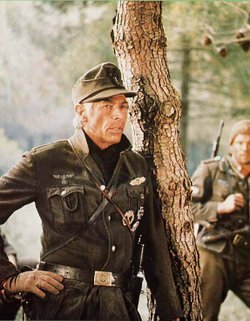
By Edward Copeland
With the strides — if that's the correct word — that Sam Peckinpah made in the depiction of cinematic violence, you would think that he would have found his way to World War II long before 1977's Cross of Iron. (Of course, he had filmed a war movie before in 1965's Major Dundee, but not one set in WWII). While too long and again overusing slow motion, the film is an interesting piece despite its flaws, namely for telling the story from the point of view of German officers. Of course, Cross of Iron does cop out a bit in this regard.
Unlike Clint Eastwood's Letters From Iwo Jima this year which gives a genuinely sympathetic view of Japanese soldiers without going to the extent of showing the soldiers as opposed to their country's efforts, Cross of Iron goes to great pains to separate its German characters from the Nazis and their goals.
The maverick sergeant (James Coburn) who plays the lead role, frequently expresses his disdain for the war, tries to save an adolescent Russian soldier and prevents the rape of some women.
Even the ostensible villain of the piece, an ambitious Prussian aristocrat (Maximilian Schell), makes a point of emphasizing that he does not belong to the Nazi Party. After awhile, all the qualifying remarks started to remind me of the "I hate this case" aside that Mary Steenburgen's defense attorney makes in Philadelphia as she's representing the law firm that fired Tom Hanks.
Despite those moments, much of the movie does prove compelling with Peckinpah providing the horrifying images of war you'd expect him to come up with, such as scenes of tanks rolling over corpses and particularly brutal deaths.
The most puzzling part of Cross of Iron is its lack of forward direction and a particularly odd series of comical freeze frames to wrap up the movie.
It's not one of Peckinpah's best works, but it certainly was a step up from The Killer Elite.
Tweet
Labels: 70s, Eastwood, Hanks, James Coburn, Peckinpah
TO READ ON, CLICK HERE
Wednesday, May 24, 2006
Knockin' on Cinema's Door
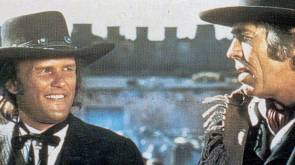
By Edward Copeland
This post shall be brief, but I wanted to scribble a few thoughts on Sam Peckinpah's Pat Garrett & Billy the Kid while I have them. I can't really assess the film, since I still don't have the emotional attention span to really judge a feature-length film yet. It literally took me two weeks of stopping and starting to get through the movie, which in this case is the reworked 2005 version of the movie. Having never seen it before and having even less patience to try to get through a commentary track, I can't compare the two. It certainly didn't seem to be up to Peckinpah's best, but I'm not much of a judge right now.
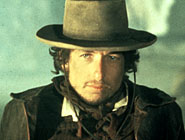
Hopefully, I'm going to be back in the swing of things soon, but I don't know. Green Cine just sent me part 2 of The Best of Youth, months after I saw part 1. I hope I can remember what happened in the first half. As for Pat Garrett, two things did stand out for me. Of course, there is Bob Dylan (and until I glanced over at Liverputty, I had no idea today was his 65th birthday) and his music. Not sure how good his performance really is, but he did have a face made for Westerns. The other is the vast cast of Western regulars who pop up in a variety of roles both large and small, especially James Coburn as Garrett. Two of them provide what to me was the most vivid image of the entire movie. I may not recall much about the movie, but I doubt I'll forget the looks between Katy Jurado and the wounded Slim Pickens. It may be the most touching images I've ever seen in a Peckinpah film.
Tweet
Labels: 70s, Dylan, James Coburn, Peckinpah
TO READ ON, CLICK HERE


