Saturday, May 19, 2012
Centennial Tributes: Richard Brooks Part II

By Edward Copeland
We pick up our tribute to Richard Brooks in 1956. If you missed Part I, click here. Of Brooks' two 1956 releases, I've only seen one of them. The Last Hunt stars Stewart Granger as a rancher who loses all his cattle to a stampeding herd of buffalo. Robert Taylor plays a buffalo hunter who asks him to join in an expedition to slaughter the animals, but the rancher, an ex-buffalo hunter himself, had quit because he'd grown weary of the killing. Brooks may be the auteur of antiviolence. Filmed in Technicolor Cinemascope, I imagine it looked great on the big screen. Bosley Crowther wrote in his New York Times review, "Even so, the killing of the great bulls—the cold-blooded shooting down of them as they stand in all their majesty and grandeur around a water hole—is startling and slightly nauseating. When the bullets crash into their heads and they plunge to the ground in grotesque heaps it is not very pleasant to observe. Of course, that is as it was intended, for The Last Hunt is aimed to display the low and demoralizing influence of a lust for slaughter upon the nature of man." The second 1956 film I did see and given the talents involved and the paths it would take, it's a fairly odd tale. The Catered Affair was the third and last film in Richard Brooks' entire directing career that he also didn't write or co-write.

It began life as a teleplay by the great Paddy Chayefsky in 1955 called A Catered Affair starring Thelma Ritter, J. Pat O'Malley and Pat Henning before its adaptation for the big screen the following year, the same journey Chayefsky's Marty took that ended up in Oscar glory. This time, Chayefsky didn't adapt his work for the movies — Gore Vidal did. Articles of speech changed in its title as well as the teleplay A Catered Affair became The Catered Affair for Brooks' film. (Chayefsky apparently wasn't a particular fan of this work of his — it never was published or appeared in a collection of his scripts.) We're at the point where the project just got screwy. The simple story concerns an overbearing Irish mom in the Bronx determined to give her daughter a ritzy wedding because of the bragging she hears her future in-laws go on about describing the nuptials thrown for their girls. Despite the fact that the Hurley family lacks the funds for it, Mrs. Hurley stays determined while her husband Tom sighs — he's been saving to buy his own cab. On TV, the casting of Ritter and O'Malley for certain sounded appropriate. For the film, which added characters since it had to expand the length, the cast appeared to have been picked out of a hat because they certainly didn't seem related, most didn't register as Irish and as for being from the Bronx — fuhgeddaboudit. Meet Mr. and Mrs. Tom Hurley, better known to you as Ernest Borgnine and
 Bette Davis. Unlikely match though they be, somehow their genes combined and out popped the most Bronx-like of Irish girls — Debbie Reynolds. The new character of Uncle Jack does add a bit of real Irish flavor by tossing in Barry Fitzgerald for no apparent reason. Unbelievably, it made the list of the top 10 films of the year from the National Board of Review who also named Reynolds best supporting actress (nothing against Reynolds in general — just miscast here). You would think that this Affair would fade into oblivion, but you'd be wrong. In 2008, it changed articles again and re-emerged on the Broadway stage as the musical A Catered Affair. Faith
 Prince and Tom Wopat(Yes — that Tom Wopat of Luke Duke fame) earned Tony nominations as the parents, Harvey Fierstein wrote the book and played the uncle (named Winston) and John Bucchino wrote the score. Why did Brooks make this one? Easy. He was under contract. MGM told him to make it, so he had no choice. From Tough as Nails: The Life and Films of Richard Brooks, some of the cast talked on record about how Brooks could be a bit of a prick as a director. "I didn't know it at the time, but Brooks ate and digested actors for breakfast," Borgnine said later. "If things weren't working, he let you know it, and not gently." When a particular scene was not working to his satisfaction, (Brooks) ordered Borgnine and Davis to figure out the problem. Borgnine suggested a different pacing and Davis agreed the scene was better for it — as did (Brooks), though he offered Borgnine not praise but a putdown. 'Goddamn thinking actor.'" Reynolds also tells the author Douglass K. Daniel that from the first day she met Brooks he told her that he didn't want her in the part, but it wasn't his decision. "'He said he was stuck with me and he'd do the best he could with me,' Reynolds recalled. 'He hoped I could come through all right with him, because everybody else was so great, but he wasn't certain I could keep up with the others. He actually said he was stuck with me. And he said so in front of everybody, too. He was so cruel.'" Davis and Borgnine coached Reynolds on the side and Bette, not known to be a shrinking violet, told Reynolds once, according to the book, "'Don't pay any attention to him, the son of a bitch,' Davis told her. 'The only important thing is to work with the greats.'" Davis did get help from Brooks in her fight against the studio that a Bronx housewife shouldn't be wearing movie star costumes they wanted, so he supported her decision to buy clothes at a store like Mrs. Hurley would shop at in real life. Years later, Davis referred to Brooks as one of the greats. This wasn't the first time Brooks had treated a young actress oddly on a set, Anne Francis told Douglass Daniel for his book that he practically ignored her during the filming of Blackboard Jungle and she received no direction at all. Daniel suggests and, given the way Brooks ordered Borgnine and Davis to come up with an idea to fix a scene, that writing had been his greatest gift, he grew into a solid visual storyteller, but Brooks proved limited when it came to directing actors. Daniel wrote, "…(the accounts of Francis and Reynolds) suggested he had a limited ability to communicate what he wanted. He either paid them little attention…or tried to bully a performance from them." Despite that problem, 10 actors in Brooks-directed films earned Oscar nominations and three took home the statuette.
The following year, Brooks made another film that revolved around the hunt of an animal, though that just leads to much bigger issues in Something of Value, sometimes known as Africa Ablaze. Starring Rock Hudson and filmed in Kenya, the film, which I haven't seen, concerns tensions that erupt between formerly friendly colonial white settlers and the Kenyan tribesmen. It also began a run of films that Brooks adapted from serious literary sources. Something of Value had been written by Robert C. Ruark, a former journalist like Brooks, who fictionalized his experiences being present in Kenya during the Mau Mau rebellion. In 1958, the two authors he adapted carried names more prestigious and recognizable. The first movie released derived from a particularly literary source and Brooks didn't do all that heavy lifting alone. Julius and Philip Epstein did the original adaptation, working from the English translation of the novel by Constance Garnett before Brooks began his work writing a worthwhile screenplay that didn't run more than two-and-a-half hours out of Fyodor Dostoyevsky's The Brothers Karamazov. It wasn't easy. Brooks told Daniel that he "wrestled with the book for four months." What surprised me to learn, also according to what Brooks told Daniels, MGM assigned Karamazov to him. Brooks also said that he never initiated any of his films while under contract at MGM. I love Dostoyevsky. Hell, even a master such as Kurosawa couldn't pull off a screen adaptation of The Idiot. The only aspect of this film that holds your attention — actually it would be more accurate to say grabs you by your throat and keeps you awake for his moments — ends up being any scene with Lee J. Cobb playing the Father Karamazov. I don't know if Cobb realized that somebody needed to step up or what, but the brothers, with only Yul Brynner showing much charisma, also include William Shatner. It's almost embarrassing except for Cobb who got a deserved supporting actor Oscar nomination, the first of the 10 from Brooks-directed films.
The actor who Cobb lost that Oscar to that year had a major part in Brooks' other 1958 feature — the film adaptation of Tennessee Williams' Pulitzer Prize-winning play Cat on a Hot Tin Roof. However, Burl Ives didn't win the prize for his great turn as Big Daddy, but for his role as a ruthless cattle baron fighting with another rancher over land and water in The Big Country. As with nearly all of Williams' works, movie versions castrated his plays' subtext (and sometimes just plain text) and this proved true with Cat as well, though the cast and its overriding theme of greed kept it involving enough. The film scored at the box office for MGM, taking in a (big for 1958) haul of $8.8 million — Leo the Lion's biggest hit of the year and third-biggest of the 1950s. It scored six Oscar nominations: best picture, best actress for Elizabeth Taylor as Maggie the Cat, best director for Brooks, best adapted screenplay for Brooks and James Poe best color cinematography for William Daniels and best actor for Paul Newman as Brick, Newman's first nomination and the film that truly cemented him as a star.
After the success of Cat on a Hot Tin Roof, Brooks decided to take an ocean voyage to Europe as a vacation. The writer-director packed the essentials for a lengthy trip: some articles on evangelism, a Gideon Bible a copy of Sinclair Lewis' novel Elmer Gantry and Angie Dickinson. By the time the ship docked in Europe, a first draft of a screenplay, based on the novel by one of the men who stood ready to
 defend Brooks during The Brick Foxhole brouhaha with the Marines, lay finished. Dickinson, on the other hand, departed the cruise quite a while back, having grown annoyed by Brooks ignoring her for Elmer. For many lives, 1960 would prove quite eventful either professionally, personally or both. Brooks filmed the highly entertaining movie version of Elmer Gantry early in the year, directing one of his best friends, Burt Lancaster, for the first time in the title role, which is good since the film got made under the auspices of an independent Burt Lancaster/Richard Brooks Production. Lancaster gives one of his best performances and won his first Oscar. The film co-starred Jean Simmons, giving one of her greatest, most mesmerizing turns as Sister Sharon Falconer, the traveling tent show evangelist who gets Elmer into the biz. She fell for Brooks on the set. Within the calendar year, she ended her unhappy marriage to Stewart Granger and became Brooks' wife. Unfortunately, when the Oscar nominations came out the next year, Simmons got left out of the nominations for Elmer Gantry. It received five total. In addition to Lancaster's nomination and win for best actor, it received nominations for best picture; Shirley Jones as supporting actress, which she won; Andre Previn for best score for a drama or comedy; and Brooks for best adapted screenplay. That cruise paid off. Brooks won an Oscar and found a wife. Below, a bit of Lancaster at work — and singing too.
With his next film, Brooks finally received the key that unlocked the leg shackles that bound him to MGM. The studio once again assigned him to a Tennessee Williams play. Though Sweet Bird of Youth did moderately well on Broadway, it wasn't one of The Glorious Bird's triumphs and took a long time to get to New York, starting as a one-act, premiering as a full-length play with a reviled ending in Florida in 1956 and, finally, the revised version's
 opening in NY in 1959. (The play has yet to be revived on Broadway whereas, in contrast, Cat on a Hot Tin Roof has been revived four times, including twice in this young century, and A Streetcar Named Desire 's eighth Broadway revival currently runs.) Originally, its plot concerned a retired actress and a gigolo with dreams of Hollywood who brings her to his old Southern hometown to get away and runs into trouble with the town's corrupt political boss (Ed Begley) when he woos his daughter (Shirley Knight). Williams said he'd hoped for Brando and Magnani to play the parts on stage. Eventually, she became merely an aging actress and Geraldine Page and Paul Newman played the leads on Broadway. When it came time for the movie, according to legend, MGM desperately wanted Elvis for Newman's part, but the Colonel nixed that because he didn't like the character's morals. Instead, the great Page and Newman repeated their stage roles as did Rip Torn as the son of the political boss. Once again, Hollywood castrated a Williams play or, in this instance, literally didn't castrate it (people who know both the play and movie get that joke. Page and Knight received Oscar nominations in the lead and supporting actress categories, respectively, and Begley won as best supporting actor. In this clip, you can see Newman's Chance try to get a handle on Page's wasted Alexandra in their hotel room.
Now a free agent, Brooks decided to stay that way — in essence becoming an independent filmmaker toward the end of his career instead of the beginning, as the path usually goes. He also defied that typical indie move of starting small — this wasn't John Cassavetes — but beginning this stage of his career more like the final films (and current ones for 1965) of David Lean. He went BIG. He even nabbed Lean's Lawrence to star in his adaptation of Joseph Conrad's Lord Jim, a longtime obsession of Brooks that he bought the rights to in 1958 for a mere $6,500. The filming took place in Hong Kong, Singapore and, dangerously in Cambodia as things grew tense. The movie crew's interpreter happened to be Dith Pran, the man the late Haing S. Ngor won an Oscar for playing in Roland Joffe's 1984 film The Killing Fields. O'Toole hated his time there, complaining about the living conditions — he isn't a fan of mosquitoes and snakes. Later, he also admitted he thought he'd been wrong for the part itself. Portions of the film ended up shot in London's Shepperton Studios as Cambodia became full of anti-American rage. When the film opened, it bombed and badly. Sony put it on DVD briefly, but it's currently out of print so, alas, I've never seen this one. Brooks did make an impression on O'Toole though, who told Variety when he died that Brooks was "the man who lived at the top of his voice."

Having a flop on the scale of Lord Jim the first time you produce your own film could really discourage a guy. However, it sure didn't show in what he produced next because The Professionals turned out to be the most well-made, entertaining film he'd directed up until this point in his career. (His next film swipes the most well-made title, but The Professionals continues to hold the prize for being one hell of a ride.) Based on a novel by Frank O'Rourke, the movie teamed Brooks with his pal Lancaster again. Set soon after the 1917 Mexican Revolution, early in the 20th century when the Old West and modern movement intermingle near the U.S.-Mexican border, it almost plays like a rough draft for Sam Peckinpah's admittedly superior Wild Bunch. Ralph Bellamy plays a rich tycoon who hires a team of soldiers of fortune to go in to Mexico and rescue his daughter who has been kidnapped by a guerrilla bandit (Jack Palance, hysterically funny and good despite making no attempt to appear Mexican). The team consists of Lancaster as a dynamite expert, Lee Marvin as a professional soldier, Robert Ryan as a wrangler and packmaster and Woody Strode as the team's scout and tracker. The film turned out to be a huge hit with audiences and critics alike and earned Brooks Oscar nominations for directing and adapted screenplay. The Academy also cited the cinematography of its director of photography, the master Conrad L. Hall, who would do some of the finest work of his career in Brooks' next film. Below, one of The Professionals' action sequences.
I hoped to complete this in two parts and considered breaking out the next film as a separate review because In Cold Blood stands firmly as Richard Brooks' masterpiece (and then there remain some other films to mention after that). So, another temporary pause.
Tweet
Labels: Angie Dickinson, Bellamy, Bette, Borgnine, Chayefsky, Debbie Reynolds, Geraldine Page, Jean Simmons, Lancaster, Lee J. Cobb, Liz, Marvin, Newman, O'Toole, Peckinpah, Rip Torn, Shatner, Tennessee Williams, Vidal
TO READ ON, CLICK HERE


Friday, December 09, 2011
Centennial Tributes: Broderick Crawford

By Ivan G. Shreve, Jr.
In 1949, Columbia Pictures brought Robert Penn Warren’s classic novel All the King’s Men to the big screen in an adaptation that deviated a great deal from the source material (as most films are wont to do) but nevertheless made for a compelling movie about idealism and political corruption in telling the tragic story of the rise and fall of a populist demagogue named Willie Stark. In casting the film, director Robert Rossen first offered the role of Stark to John Wayne who — not surprisingly — turned down the part, thinking the script unpatriotic. Rossen then decided upon Broderick Crawford, a burly character actor whose prolific if undistinguished cinematic career was comprised of playing tough guys and Runyonesque hoods in vehicles such as Tight Shoes (1941) and Butch Minds the Baby (1942). The role of Willie Stark fit Crawford like a glove, however; he won an Oscar for his performance in King’s Men beating out the Duke, who also had been nominated that same year for his starring turn in Sands of Iwo Jima.
Crawford’s triumph for All the King’s Men has often acted as a litmus test where Academy Awards are concerned; many film historians and critics argue that the Best Actor Oscar should not have gone to someone whose movie career, with the exception of King’s Men and Born Yesterday (1950), was marked by admittedly one-note performances in B-pictures, alternately playing heroes and villains. Is the purpose of Academy Awards to single out meritorious individual performances, or are they largely recognition for an entire distinguished body of work? I suppose it matters very little in the final analysis, because there are no mulligans when it comes to Oscars: Crawford won his, and in all honesty I think it was most deserved. The actor, who would become one of Hollywood’s most cantankerous character thespians, was born 100 years ago today, and now is good as time as any to see if his stage, screen and television legacy holds up.
Broderick Crawford was born in Philadelphia in 1911 to a second generation of performers, vaudevillians Lester Crawford and Helen Broderick. The latter name is familiar to many classic film buffs that’ve seen the comedienne in such Fred Astaire-Ginger Rogers vehicles as Top Hat (1935) and Swing Time (1936). Before her movie career, she and her husband were a successful comedy duo in vaudeville, with an act that occasionally featured their young son in small roles. Brod graduated from the Dean Academy in Franklin, Mass., (where he was a well-regarded athlete) and was accepted at Harvard but his further academic pursuits came to a halt when he dropped out after three months to find work in New York. He became a jack-of-all-trades (longshoreman, seaman, etc.) though eventually the show business bug consumed him and he landed a number of radio jobs in the 1930s; reportedly appearing from time to time on Flywheel, Shyster and Flywheel — the 1932-33 half-hour comedy series starring Groucho and Chico Marx.
With performing in his blood, Broderick made his Broadway debut in 1934 as a football player in She Loves Me Not (he had made his stage debut in the same production in 1932 in London, where his talents attracted the notice of Alfred Lunt and Lynn Fontanne, who in turn introduced him to Noel Coward) and later appeared in such productions as Coward’s Point Verlaine, Sweet Mystery of Life and Of Mice and Men. It was for the latter play that Crawford earned exceptional critical acclaim, though when it came time for Hollywood to do its adaptation Brod was overlooked for the part in favor of Lon Chaney, Jr. By that point in his show business career, Crawford had set stage work aside in favor of the movies; his film debut was in the Samuel Goldwyn-produced Woman Chases Man (1937; with Miriam Hopkins and Joel McCrea) and he continued to appear in such B-flicks as Submarine D-1, Undercover Doctor and Eternally Yours. On occasion, Broderick would land roles in “A” productions such as Beau Geste, The Real Glory, Seven Sinners and Slightly Honorable but his rough-hewn manner and less-than-matinee-idol looks (in later years he remarked that his cinematic countenance resembled that of “a retired pugilist”) usually relegated him to character parts in scores of shoot-‘em-up Westerns like The Texas Rangers Ride Again and When the Daltons Rode. He did, however, prove versatile and adept at humorous turns in films like The Black Cat (Brod’s actually one of the “heroes” in this horror comedy, teamed with cinematic toothache Hugh Herbert) and Larceny, Inc.; he supported Edward G. Robinson in this last one as the lunkheaded Jug Martin, who assists Eddie and Ed Brophy in their attempts to rob a bank by purchasing and operating a luggage store next to it. (A decade later, Crawford paid homage to Robinson by re-creating a role that Eddie G. had played in the 1938 crime comedy A Slight Case of Murder but unfortunately, Stop, You’re Killing Me can’t quite measure up to the original.)
Crawford’s film career was interrupted briefly by World War II; he enlisted in the U.S. Army Air Corps and while in Europe saw action in the Battle of the Bulge. He later was assigned to the Armed Forces Radio Network in 1944, where as Sergeant Crawford he fell back on his previous radio experience to serve as an announcer for Glenn Miller’s band. Back in Hollywood by 1946, Brod returned to the B-picture grind with occasional bright spots such as Black Angel, The Time of Your Life (as a melancholy policeman) and Night unto Night. His gig in All the King’s Men transformed him into a box-office draw and made him the most unlikely leading man since Wallace Beery; signing a contract with Columbia that same year, he also nabbed the plum role of tyrannical junk tycoon Harry Brock opposite Judy Holliday in Born Yesterday — a part that actor Paul Douglas had played to great acclaim on stage.
Crawford’s brilliant comic turn in Yesterday had an unfortunate side effect in that it earned him enmity from critics who have argued that, for the most part, he played variations of Harry Brock in practically every film in its wake. The success of both King’s Men and Yesterday nevertheless earned him considerable cache to appear in “A” productions such as Night People (1954) and Not as a Stranger (1955) —the latter film once described by one critic as “the worst film with the best cast.” His turn as Capt. “Waco” Grimes in Between Heaven and Hell (1956) features some of his best work, and his approach to the character may remind you of Col. Kurtz in Joseph Conrad’s Heart of Darkness. That same year, he surprised critics again by scoring as a petty thief seeking redemption in Federico Fellini’s Il Bidone.
Truth be told, Crawford worked his magic best as a screen heavy; he appeared as a formidable villain against Clark Gable in 1952’s Lone Star, and particularly shone in film noirs such as Big House, U.S.A. and New York Confidential (both 1955). One of his best showcases in that style was in 1952’s Scandal Sheet, a film directed by Phil Karlson (based on a novel by Sam Fuller) in which he plays a tyrannical tabloid editor who assigns his star reporter (John Derek, who had played son Tom Stark in King’s Men) to investigate a sensationalistic murder knowing full well that he is the guilty party. Scandal Sheet bears a strong resemblance to the earlier The Big Clock (1948) — in which powerful magazine magnate Charles Laughton tries to frame editor Ray Milland for a murder Charlie committed — but while Crawford was certainly not in Laughton’s league watching him sweat bullets as the noose tightens around his neck during Derek and girlfriend Donna Reed’s relentless investigation is certainly worth the price of admission.
Crawford also headlined another underrated noir entitled The Mob (1951); as undercover cop Johnny Damico, Crawford sets out to find a hit man while exposing corruption in the waterfront rackets — Mob has some memorably snappy dialogue in addition to its first-rate supporting cast (Richard Kiley, Ernest Borgnine, Neville Brand) though I will admit Brod seems more like the guy who’d be running the waterfront in the first place. Other standout noirs with Crawford include Down Three Dark Streets (1954), in which he plays a stalwart FBI agent, and Human Desire (also 1954), a Fritz Lang-directed remake of Jean Renoir's La Bête Humaine that cast him as the cuckolded husband in a torrid love affair between wife Gloria Grahame and co-worker Glenn Ford. (Crawford’s husband in Desire is a truly pitiful soul who earns the audience’s sympathy because Gloria, not to put too fine a point on it, is a real bitch.)
Ford and Crawford squared off again two years later in an underrated Western that’s been a longtime favorite of mine, The Fastest Gun Alive. Brod is the loathsome Vinnie Harold, a gun-toting bully compelled to challenge any individual who’s acquired a reputation as a fast gun. When he arrives in a town where shopkeeper Ford’s prowess with a firearm is being kept under wraps by the populace (they’re afraid that Glenn’s rep will draw every gunslinger in for miles around…and they were pretty much right), he and his men (John Dehner, Noah Beery, Jr.) threaten to set the burg ablaze unless they identify Ford. A great psychological oater, Fastest Gun stands out among the many Westerns Crawford appeared in at that time, which included such films as Last of the Comanches and The Last Posse (both 1953).
Toward the latter part of the 1950s, Crawford’s film appearances became sporadic (The Decks Ran Red, Goliath and the Dragon) due to his conquering another medium: television. Syndicated TV king Frederic Ziv tabbed Brod to play the lead role in a half-hour crime drama series entitled Highway Patrol, in which the actor played Dan Matthews, head of a state police patrol (the state was never specified). Ziv, who was responsible for such boob tube hits as Sea Hunt and Bat Masterson, scored a bona fide success in Patrol, which ran for four seasons (a total of 156 episodes) and made Crawford a TV icon, brandishing a trademark fedora and barking mile-a-minute orders into a microphone (“10-4, 10-4”). Crawford by this point in his career had finely honed the belligerence (and drinking habits) that made many producers reluctant to work with the volatile star, but Ziv got along well with Brod, though he later admitted: “To be honest, Broderick could be a handful.” Ziv wanted Crawford to do a fifth season of Patrol but Broderick took a pass, later explaining “We ran out of crimes.” However, he did go to work again for the company in 1961, starring as insurance investigator (whose specialty was precious gems) John King in King of Diamonds. The series lasted but a single season, as did a later show entitled The Interns (1970-71).
Throughout the 1960s and 1970s, Crawford found himself in demand as a frequent guest star in most of the hit dramatic TV shows from that era: The Virginian, Rawhide, Burke’s Law, The Name of the Game, etc. His movie work largely was relegated to foreign films though he turned up in the likes of Convicts 4, A House is Not a Home, The Oscar and Terror in the Wax Museum. His last notable film role was the titular protagonist of Larry Cohen’s 1977 cult curiosity The Private Files of J. Edgar Hoover — a part he also had played in a sketch hosting Saturday Night Live in 1977, in which he also appeared in a send-up of Highway Patrol. Crawford also landed a tongue-in-cheek cameo on the first season of the TV series CHiPs, a watered-down version of the show that made him a household name (and he said as much, remarking to star Larry Wilcox: “You know, I was making those Highway Patrol shows long before you guys were born”).
Broderick Crawford rarely had any pretensions about being a great actor (he was famous for remarking “Don’t applaud, just send me the check”) — he took what work he wanted, and wasn’t what one would consider a leading man type in the style of a Cary Grant or James Stewart. Aside from his starring turns in All the King’s Men and Born Yesterday, his greatest legacy in show business was an unassuming little half-hour television cop show that is still around for us to enjoy today (Highway Patrol is frequently rerun on affiliates that carry ThisTV programming, and the first season of the series has been released on manufactured-on-demand DVD). But his performances were never boring, and when given the right material (King’s Men, Yesterday, The Mob, Scandal Sheet), he could be a most mesmerizing presence…and if you don’t believe me, check out Turner Classic Movies for a three-film festival beginning at 8 p.m. EST this evening in honor of his 100th birthday.
I’m serious, you need to sit down and watch.
“Do what I’m tellin’ ya!!!”
Tweet
Labels: Astaire, B. Crawford, Borgnine, Cary, Edward G., Fellini, Fuller, Gable, Ginger Rogers, Glenn Ford, J. Stewart, Joel McCrea, Lang, Laughton, Lon Chaney Jr., Marx Brothers, Oscars, Renoir, Wayne
TO READ ON, CLICK HERE
Sunday, July 10, 2011
The Next 60 Seconds Are All That Matter

By J.D.
John Carpenter is one of those rare filmmakers that entertains while also trying to say something about the society in which we live in. It is a tough balancing act that few can maintain but Carpenter's films make it look easy. From the special effects opus/remake drenched in paranoia of The Thing (1982) to the two-fisted diatribe against Reaganomics of They Live (1988), he hasn't been afraid to sandwich a thought-provoking message in between action sequences. In this respect, his films are much more than genre pictures; rather they critique the problems of contemporary society. And for its time, Escape From New York(1981) was no different. Carpenter's film examined the validity of the presidency and the increase of crime and disguised it as a slick, futuristic race against time that was very prescient, going on to influence similarly minded and looking films for years, including a fascinating subgenre of Italian rip-offs.
Escape From New York is set in 1997 (?!) and crime in the United States has grown so bad that Manhattan Island in New York has become a maximum security prison with one simple rule: "Once you go in, you don't come out." One night, the president's plane is taken over by terrorists who crash it into the prison. The president (Donald Pleasence) escapes but quickly becomes a prisoner of the inmates led by the Duke (Isaac Hayes). It seems that the president is carrying a vital piece of information that is to be delivered to a historical summit in Hartford. Enter Snake Plissken (Kurt Russell), an ex-soldier, now legendary fugitive who has been captured by the government and is scheduled to be transferred into the prison. Instead, Police Commissioner Bob Hauk (Lee Van Cleef) offers him a deal: go into the prison, find the president, and bring him and the information back in exchange for a full pardon. Sounds easy, right? There's a catch: Snake only has 22 hours to do all this because by then the conference will be over and the world will be thrown into chaos. As an incentive he has two explosive charges lodged in his neck to keep him focused on the task at hand. With this enticing opening, the film kicks into high gear as Snake enters the world's most dangerous prison to find the president and save the world.
Carpenter had just made Dark Star (1974) and no one wanted to hire him as a director so he shifted his focus to screenwriting. Inspired by the Charles Bronson film Death Wish (1974), Carpenter originally wrote the screenplay in 1974. He didn’t agree with the film’s philosophy but liked how it conveyed “the sense of New York as a kind of jungle, and I wanted to make an SF film along these lines. He was also influenced by the Watergate scandal. "The whole feeling of the nation was one of real cynicism about the president. I wrote the screenplay and no studio wanted to make it" because the general feeling was that “It was too violent, too scary, too weird.” And so the director went on to do other films with the intention of making Escape later. After the successes of Halloween (1978) and The Fog (1980), Carpenter was in a position to make a motion picture with a big budget. He decided to revive his Escape script, but something seemed to be missing. "This was basically a straight action film. And at one point I realized it really doesn't have this kind of crazy humor that people from New York would expect to see." So, he brought in Nick Castle, a friend from his film school days at University of Southern California. Castle invented the Cabbie (Ernest Borgnine) character and came up with the film's humorous conclusion that offset the bleak tone of the film with a skewed sense of satire.
The film's setting proved to be another potential problem for Carpenter. It is apocalyptic in tone: a decaying, semi-destroyed version of New York. How could Carpenter create this world on only a budget of $6 million (his biggest at the time)? As fate would have it, in 1977 there was a big fire in St. Louis that burned out several blocks of the downtown area. Carpenter and his crew convinced the city to shut off the electricity to these blocks at night and then proceeded to transform the remains into a New York of the future. They even found an exact replica of Grand Central Station that was deserted and unused. It was a tough, demanding shoot that Carpenter had never experienced before. "We'd finish shooting at about 6 a.m. and I'd just be going to sleep at 7 when the sun would be coming up. I'd wake up around 5 or 6 p.m., depending on whether or not we had dailies, and by the time I got going the sun would be setting. So for about two and a half months I never saw daylight, which was really strange." This approach paid off, creating a dark, foreboding atmosphere of a futuristic film noir.
In addition, Carpenter shot parts of the film in Los Angeles and New York. He and his film company were the first ones ever to be allowed to shoot on Liberty Island, at the Statue of Liberty at night. They let Carpenter have free run of the entire island. He remembers, “We were lucky. It wasn’t easy to get that initial permission. They’d had a bombing three months earlier, and were worried about trouble.” With Escape, the director created two distinct looks: “one is the police state, high tech, lots of neon, a United States dominated by underground computers. That was easy to shoot compared to the Manhattan Island prison sequences, which had few lights, mainly torch lights, like feudal England.”
The heart of Escape From New York lies in its main character: Snake Plissken. His cynical, world-weary attitude flies in the face of the earnest authorities who send him off to the save the world. Snake could care less. All that matters to him is "the next 60 seconds," as Kurt Russell commented in an interview. "Living for exactly that next minute is all there is." It is this kind of intensity that makes Snake such an interesting
 character. He is the ideal antihero — intent on getting the job done and content on being left alone. Snake doesn't need anyone. Russell's performance clearly echoes Clint Eastwood's style of acting — the strong, silent type. Snake is a clever hybrid of The Man With No Name and Dirty Harry. It is an amusing riff on Eastwood's two most famous characters, which is only reinforced by the appearance of Lee Van Cleef (who appeared in a few films opposite Eastwood). It is to Russell's credit that he makes Snake a character you want to root for, that you want to see win at the end. There is something charismatic about Snake that makes you automatically want to like him. What is so great about the character is that Carpenter and co-screenwriter Nick Castle remain true to him throughout. They don’t saddle him with a love interest or dilute his intensity by having him crack the occasional joke. Snake remains an unrepentant badass, the proverbial fly in the ointment with a surly disregard for authority right up to the last shot of the film.
And to think that the studio did not want Carpenter to cast Russell in the role. Up until then the actor had done a string of Disney films as a youth and worked with Carpenter on a TV movie about Elvis Presley. The studio did not see Russell as a tough action hero. In fact, Charles Bronson expressed an interest in playing Snake (Tommy Lee Jones also was considered). However, by Carpenter’s own admission, “I was afraid of working with him. He was a big star and I was this little-shit nobody.” Fortunately, the filmmaker had faith in Russell and Escape From New York continued a long-standing relationship between the two men — both personal and professional — that continues to this day.

Escape From New York also features a strong supporting cast of character actors such as veteran thespian Harry Dean Stanton as Brain, the smartest man in the prison, and Ernest Borgnine as Cabbie, a hack who stayed in New York even after it changed into a prison. Let’s not forget Adrienne Barbeau as the Brain’s girlfriend Maggie and yet she is anything but that, as the talented actress plays her character as the tough-minded female equivalent of Snake. The film contains an eccentric assortment of characters each of who get their moment to shine and this only enhances the enjoyment of watching Escape. One of the best things about it is how these characters interact with Snake and how he views them. The supporting cast also fleshes out more of this fascinating world. They continually offer all sorts of tantalizing tidbits that allude to Snake's colorful past, to conditions in the prison and how the inmates have created their own world.
Escape from New York received mostly positive reviews when it was released. Newsweek magazine felt that Carpenter had a “deeply ingrained B-movie sensibility — which is both his strength and limitation. He does clean work, but settles for too little. He uses Russell well, however.” Time magazine’s Richard Corliss wrote, “John Carpenter is offering this summer's moviegoers a rare opportunity: to escape from the air-conditioned torpor of ordinary entertainment into the hothouse humidity of their own paranoia. It's a trip worth taking.” In his review for The New York Times, Vincent Canby wrote, "[The film] is not to be analyzed too solemnly, though. It's a toughly told, very tall tale, one of the best escape (and escapist) movies of the season." However, the Chicago Reader’s Dave Kehr felt that the film, “fails to satisfy — it gives us too little of too much.”
First and foremost Escape From New York is a fast-paced action film that is never dull to watch. However, the film also contains a dark, satirical edge that never falters, even right up to the film's conclusion. One the most frustrating problems of most films is how they end. No one seems to know how to end a film without relying on tried and true clichés. Carpenter's film does not fall into this trap. Escape may be an action film but it also makes some very interesting comments about crime in the United States that are still relevant even today. One could argue that Carpenter's film is almost intended to be a warning. That if things get any worse, the world that is depicted in this film isn't that far off. It is these sobering thoughts that make Escape From New York as powerful and entertaining today as it was when it first hit the screens in 1981.
Tweet
Labels: 80s, Borgnine, Eastwood, Elvis, John Carpenter, Kurt Russell, Movie Tributes, Pleasence, Tommy Lee Jones
TO READ ON, CLICK HERE
Tuesday, February 01, 2011
Retired and Extremely Dangerous

By VenetianBlond
Willis, Freeman, Malkovich, Mirren, Cox. Throw in a Borgnine and a bit of Dreyfuss, and you've got a cast worth watching. RED (Retired and Extremely Dangerous) marketed its lineup heavily, and for good reason. These international treasures hopefully will not abandon making high art, but it's grand to watch them having a great time.
The implication, of course, is that RED is not high art, but neither does it attempt to be. It's an action comedy with the above heavyweights as ex-CIA, MI-6, and KGB agents forced to come out of retirement and fight for their lives as they try to unravel why they need to fight for their lives. Mary-Louise Parker is dragged unwillingly (at first) on the grand adventure and Karl Urban is the current CIA agent charged with bringing the senior team down.
Urban and his boss, played by Rebecca Pidgeon, are directed in a completely different manner than our heroes. They play it entirely straight, as if they were in a Bourne movie. It makes the contrast with the bonhomie of the others, who have already seen everything that can be seen and have made it out the other side, that much funnier.
RED plays as if it's self aware. It namechecks the action tropes — thousands and thousands of rounds fired with casings littering the ground, characters appearing miraculously in the right place at the right time, the Russian is named Ivan (although I briefly flashed back to the line in The Wire, "Boris. Why always Boris?"), and the revelation early in the film of a terminal disease leading to a later noble act of sacrifice. But there's another layer there as well, including a visual Sergio Leone reference, and a musical James Bond one. Malkovich says at one point, "I remember the Secret Service being tougher," a possible shoutout to In the Line of Fire and a contemporary of the retirees, Clint Eastwood.
Other than noticing that the French Quarter of New Orleans was completely abandoned in broad daylight (spring for some extras, will you) I was more than willing to go along on this ride. Willis and Urban get to dust it up, and I utterly loved that the giant guns were in the lovely hands of Helen Mirren. Malkovich is mostly nuts or partially lucid, depending upon how hard you squint.
Practically the entire plot is a MacGuffin, but when you've got John Malkovich running screaming down the street with explosives and a Flava Flav clock around his neck, as well as one of the most perfectly applied and exquisitely timed FUs in film, who needs it?
Tweet
Labels: 10s, Borgnine, Eastwood, Leone, Malkovich, Mirren, Morgan Freeman, The Wire, Willis
TO READ ON, CLICK HERE
Thursday, June 18, 2009
Your word isn't what counts, it's who you give it to

By Edward Copeland
You know a film is powerful when it's controversial when it opens and when a restored version is planned for re-release 25 years later, an MPAA ratings dispute over its violent images delays the re-release until it was 26 years old. Now 40 years old, Sam Peckinpah's The Wild Bunch not only retains its power, the film grows in magnificence. If re-watching it evokes anything negative, it's the sadness that great films such as this hardly ever get re-releases anymore, affording movie fans the chance to see movies made before their time in a theater. As theaters move toward digital, it's probably sadly passed. Still, DVD and a good home setup keep The Wild Bunch vibrantly alive, if not ideally viewed.
You can't begin any conversation about The Wild Bunch (or Sam Peckinpah) without inevitably hitting the topic of violence and whether or not the film glorifies it or not but watching it again, it's beyond me how
 anyone can see it that way. In fact, this time it seemed to me that Peckinpah builds the violence in the film to the crescendo of its finale. There is some use of slow-motion in the film's earlier gunbattles, the killings are quicker, more typical of what audiences are used to seeing in normal Westerns, without lingering on the wounds or carnage. Each subsequent encounter ups the ante leading to the famous finale, where the bloodshed contains the most meaning because the fight has the most meaning. When the bunch goes out in their blaze of glory, they aren't involved in a theft or running from a heist or a quick act of revenge, they are doing it because morally it's the correct thing for them to do, no matter that it is a suicide mission. That final melee is where you see the agony, the anguish and the pain. It's the way Peckinpah has set it up and the way it had to go because it needs to unfold this way for the characters to become flesh-and-blood people the audience cares about instead of just outlaws of a dying breed trying to hang on to a dying lifestyle in a fast-changing era.
As The Wild Bunch opens, the viewer can't really be certain what time period they are in. The military uniforms that the bunch are wearing seem to
 be early 20th century Army issue, but everything else seems to be from any Old West time period. It isn't until nearly an hour into the film when the would-be Mexican despot arrives in a fancy automobile and the bunch reacts with amazement and speak of reports of vehicles like birds that might be used in the next war that you realize we are several years into the 20th century and the Western lifestyle the bunch has enjoyed is passing the aging men by. Pike Bishop (William Holden), the group's leader admits that they aren't getting any younger and it's time they start "thinking beyond their guns." The impetus for this reappraisal of their lifework comes after the gang's latest assault on their favorite archenemy, the railroad. Peckinpah's opening setpiece really gets the movie galloping as we are introduced to the ruthlessness of the gang, taking the railroad's office as well as the equal ruthlessness of the railroad, who have staged a setup involving a team of bounty hunters in place to take out the bunch once and for all. There is no easy route taken of making the violent gang likable protagonists from the beginning. They are willing to leave an accomplice behind to almost certain death and kill another one with emotionless efficiency. This is their job and fun times come later. The fly in the ointment turns out to be the unexpected temperance union parade by a local church. When the siege is over, there are far more dead civilians than there are crooks or bounty
 hunters and the clergyman (Dub Taylor) lets the railroadman know it, but he's indifferent as big businessmen continue to be to this day as his interests and bottom line supersede the public's. This "do it on the cheap" mentality extends to the bounty hunters that the railroad hires. The leaders is a former member of the bunch, Deke Thornton (Robert Ryan), who has been promised an end to his prison sentence if he brings them back dead. Unfortunately, as help he's been given a motley group of misfits led by Strother Martin, who aren't above pillaging the corpses of the accidentally slain. Martin proves to be comic relief extraordinaire, especially with his large crucifix hanging around his neck. Ryan's performance as Thornton, the bounty hunter whose heart lies with his prey, grows deeper and better with each viewing.
 The actors who comprise the bunch are a strong ensemble. Three had won Oscars by the time The Wild
 Bunch was made and a fourth would win one two years later. In nearly every case, it's one of the actors' strongest performances and, in one case, I consider it his best. Holden is great as Pike and of course the list of great roles he played are legendary spanning from Sunset Blvd. to Network and many in between. Pike Bishop belongs in that hallowed company as Holden gives him a taciturn strength but isn't afraid to show his vulnerabilities and the toll time has taken on the robber. Often forgotten, since he's not as active in the gang's criminal exploits, is the great Edmond O'Brien as Sykes, who used to ride and kill with the best of them but now basically holds down the fort while the bunch is away. O'Brien is a riot, even if at times he borders on cliche and seems to be channelling Walter Huston in Treasure of the Sierra Madre. More comedy is provided by Warren Oates and
 Ben Johnson as the drinkin', whorin' Gorch brothers. (In the DVD commentary, one of the Peckinpah experts mentions that Johnson's wife never let him return to the sites of their Mexican scenes because of the scenes of his character's lechery depicted there. TV's Buffy the Vampire Slayer even saluted Oates' character with a vampire bounty hunter with cowboy sensibility named Lyle Gorch on a couple of episodes. The youngest and newest member of the gang, the one who gets them in trouble and helps them find their moral compass, is Angel (Jaime Sanchez), a Mexican who wants to help his people get out from under the thumb of the minidictators who ruled Mexico at the time. Politics is anathema to the others but when they witness the mistreatment that goes on of the poor, eventually even the aging crooks discover there are some fights worth joining. Of course, the
 second most important member of the bunch is Dutch (Ernest Borgnine). Though Borgnine has given many good performances, including his Oscar-winning one in Marty, it's clear to me after watching The Wild Bunch again that this is easily his greatest performance. He's always the one who seems to have the smartest take, the most regrets, and Dutch gets the others to realize their obligations when the final battle comes about. The grin that Borgnine lets loose before the gunfire is a sight to behold as are his quieter moments, turning his back when he's afraid to admit something tender to Pike or he's just sitting on a stoop whittling waiting for the others to finish their debauchery.
As all conversations about The Wild Bunch inevitably focus on the violence, I think we should end this anniversary discussing those aspects that are too often overlooked. In addition to the performances, not
 enough is made of the comic relief (the last images of the bunch are of them laughing at better times) as when the Mexican generale lets a machine gun go wild despite his German visitor's plea that he must place it upon a tripod. There's also the imagery. The kids torturing the scorpions gets cited often, but there also are nice touches such as a shot of a mother breastfeeding her baby while a belt of ammunition hangs across her torso. Finally, there is the suspense. Like all great suspense scenes, no matter how many times you see them, you still wonder what will happen, as when that wagon gets stuck on the bridge that's already set to detonate. I'd also be remiss if I didn't shower some praise on some of the film's other collaborators such as Peckinpah's co-writer Walon Green, the vivid photography of Lucien Ballard, the fine score by Jerry Fielding and the absolutely irreplaceable editing of Lou Lombardo.
Tweet
Labels: 60s, B. Johnson, Borgnine, Dub Taylor, Holden, Movie Tributes, Oates, Peckinpah, Robert Ryan, W. Huston
TO READ ON, CLICK HERE
Wednesday, January 16, 2008
Centennial Tributes: Ethel Merman

By Josh R
Stephen Sondheim tells a great story about Ethel Merman — it draws laughs when he repeats it at speaking engagements, although it must have been hard to find much humor in the event in question when it originally occurred. For those whose knowledge of the musical theater doesn’t extend much beyond the recent film adaptations of Hairspray and Dreamgirls, a bit of background information may be required:
Along with composer Jule Styne and bookwriter Arthur Laurents, Sondheim had created a musical based on the memoirs of Gypsy Rose Lee, the celebrity stripper who had been pushed, prodded and essentially bullied into show business by her domineering mother, Rose Hovick — the kind of stage parent who could vaporize her children's rivals with as little as a withering stare. The show was conceived as a vehicle for its star; it
 was Merman, in fact, who had put the kibosh on the idea of Sondheim penning the score for Gypsy in addition to its lyrics (nervous about the prospect of putting her fate in the hands of an untested composer, she insisted on the involvement of someone more experienced). Since the idea of Ethel playing a stripper was appealing to absolutely no one — she was built rather like a defensive linebacker — the part of the mother was built up into the star role. As conceived by Laurents and Sondheim, it amounted to a complex, multifaceted character study with enough psychological wrinkles built into it to keep a team of Freudian scholars intrigued for years. The real Rose had been something of a monster, with behavior ranging from moderately abusive to downright sadistic. While Lee had soft-pedaled the more repellent aspects of her mother’s character in her autobiography, the peculiar forces that drove Mama — a relentless, monolithic ambition to make her daughters into stars, the need to experience vicarious fulfillment through their success, and the barely suppressed rage of someone all too achingly aware of her own lost opportunities — were still present and accounted for.
 Sondheim had conceived of a pivotal moment during the show-closing number “Rose’s Turn,” a climatic soliloquy in which the character’s roiling emotions came bubbling to the surface in what amounted to a mental meltdown set to music. Toward the end of the song, Rose — who is exorcising the accumulated grief, anger and disappointment of 50-odd years — gets to the point where she is reduced to stammering. Sondheim was inspired by seeing Jessica Tandy in Elia Kazan’s legendary production of A Streetcar Named Desire; as Blanche DuBois, Tandy began tripping over her words in helpless, babbling hysteria once the character’s sanity had irrevocably deteriorated. In Gypsy, Merman was to struggle with the word “Mama”. In the script, it appeared as “M-m-m-mama, M-m-m-mama.”
When it came time to rehearse the scene, Merman had one question. “Here, where it says M-m-m-mama, with the stutterin’….d’ya want that on a upbeat or a downbeat?”
Sondheim and Laurents stared at her incredulously. It was carefully explained to Merman that “the stutterin’” represented a moment of extreme emotional distress, during which the character was literally fighting to get her words out. Not only was she confronting the harsh realities of an entire existence spent observing from the sidelines, but her daughter’s ultimate rejection of her awakens dormant memories of Rose’s abandonment by her own mother.
Merman listened stone-faced, her blank expression unchanging, while her director and the lyricist patiently outlined the character’s fragile emotional state and the significance of the peculiar speech pattern. When their detailed presentation had reached its conclusion, she offered this in response:
“So didja want that on an upbeat or a downbeat?”
At that moment, Sondheim realized that while he had fought the good fight, there was little point in persevering — “Do it on an upbeat, Ethel,” he responded in weary resignation. Great entertainers are not necessarily great actors, just as the reverse is often frequently the case. For better or worse, Merman was Merman, and tutoring her on the basics of character development had about as much practical utility as there would have been in stationing Jessica Tandy downstage center to belt out “Everything’s Coming Up Roses.”
Unlike film, the stage is not a permanent record; instances of performers attaining legendary status solely for their work in the theater are few and far between. It takes
 a big talent — and an even bigger personality — to make an impression so forceful that their accomplishments not only stand the test of time, but define a style of performance so completely that it becomes their legacy. It is doubtful that Merman made any kind of study of the tenets of “method” acting; if the name Stanislavski had come up in conversation, she might be forgiven for mistaking it for that of the maitre'd at The Russian Tea Room. She was not an intellectual — nor, by all accounts, was she naturally curious. Really, there is nothing to suggest that she was even remotely interested in the complexities of human behavior, at least as far as her work was concerned (she infamously made a bargain with Jerry Orbach, with whom she worked in the 1966 revival of Annie Get Your Gun, that if he wouldn’t react to her performance, she wouldn’t react to his.) What she had was a clarion voice, as pure and as powerful as an entire brass section, a killer sense of comic timing, and an intuitive understanding of what it took to hold an entire audience in the palm of her hand. People flocked to her performances with the expectation of seeing a force of nature in action; for her part, Merman saw no reason to do anything other than plant her two little feet on the edge of that stage, and let 'em have it.
 The woman destined to become known, both affectionately and otherwise, as “The Merm,” was born Ethel Agnes Zimmerman in Astoria, Queens on Jan. 16, 1908. She worked as a secretary for the B-K-Booster Vacuum Cleaner Company before embarking on a career in vaudeville. Her Broadway debut came with a featured role in Gershwin’s 1930 Girl Crazy — while a 19-year-old named Ginger Rogers was the alleged star of the production, it was Merman who set Broadway on its ear. The high point of her performance came during her rendition of “I Got Rhythm,” in which she held a C-note for 16 earth-shattering bars. The audience went berserk, demanding multiple encores — as the proverb goes, a star was born.
Cole Porter was to become her greatest champion over the course of the next decade; all together, they collaborated on six productions, mostly hits. If it seemed like an unlikely union — the urbane sophisticate and the brass-lunged belter — Merman’s earthy forcefulness brought an element of substance to the material, which was often whimsical if not wispy in nature. Anything Goes was her first leading role, and a roaring success; audiences responded to her vocal virtuosity and her take-no-prisoners approach to putting over a number. Subsequent hits included Red, Hot and Blue and Something for the Boys, both opposite Jimmy Durante, and two genuine smashes — DuBarry Was a Lady, in which she and Bert Lahr routinely stopped the show with the comic duet “Friendship,” and Panama Hattie. In the late 1940s, she began her association with Irving Berlin, who provided the star with her two best vehicles to date. Annie Get Your Gun, a highly fictionalized account of the life and loves of legendary sharp-shooter Annie Oakley, was about as close to perfection as a musical can get; a big, jubilant glorification of a mythological Wild West that never was, and with nary a bad song in it, it fashioned Merman with what was to become her signature song, “There’s No Business Like Show Business.” Call Me Madam, which cast her in a tailor-made role as a brassy society hostess appointed ambassador to a fictional European nation, was almost as good, and won her the Tony Award. After announcing her intention to retire after Gypsy, she reprised her role in the 1966 Broadway revival of Annie Get Your Gun — referred to by theater insiders as “Granny Get Your Gun”. It didn’t matter that she was nearly 60 years old at the time; her voice remained as strong and clear as it always had, and audiences happily bought into the illusion. She closed out the storied run of Hello, Dolly!, winning a special Drama Desk Award for a role she had originally taken a pass on.

For all the success that Merman had on the stage — and not even her chief rival, Mary Martin, really came close to matching her track record — her film career never really got off the ground. It went beyond the fact that Merman was not, to put it delicately, attractive in the conventional sense or particularly photogenic. The camera doesn’t lie, and what works on a stage doesn’t necessarily translate onto the screen — film is fundamentally an actor’s medium, not an entertainer’s. In close-up, it was apparent how limited Merman’s dramatic skills were, and the extent to which she was dependent on a live audience to work her special brand of magic. Call Me Madam and a radically reworked version of Anything Goes (which had Ethel playing second banana to Bing Crosby) were the only two of her Broadway triumphs which she repeated on film. Panama Hattie and DuBarry were assigned by MGM to two non-singers, Ann Sothern and Lucille Ball, while Judy Garland was replaced on Annie Get Your Gun by Betty Hutton. In a way, this last piece of casting must have been more galling to Merman than the others. Hutton had played a secondary role in the original 1939 production of Panama Hattie — the fact that she was cited as a scene-stealer by many critics did not sit particularly well with the show’s leading lady.

The loss of her lead role in the film adaptation of Gypsy, undoubtedly the greatest triumph of her career, to Rosalind Russell was particularly painful, if arguably justified. On stage, the role may have required a great singer more than it needed a great actress, but on film, the opposite may have well proved the case (it has been suggested that the reason she lost the Tony to Mary Martin, who won for The Sound of Music, was that she didn’t quite do the role justice from an acting standpoint). What remained of Merman’s film career was eclectic, to say the least. She was stranded on a desert island with Crosby, Carole Lombard, George Burns and Gracie Allen in We’re Not Dressing, a bizarre curio of the early '30s, and had a small role in Alexander’s Ragtime Band. 1954’s There’s No Business Like Show Business was a splashy, trashy 20th Century Fox musical which seemed more interested in Marilyn Monroe than it was with Merman. Her best film performance came, rather predictably, with a one-note role in the raucous ensemble comedy It’s a Mad, Mad, Mad, Mad World; she played the shrill archetype of the monstrous mother-in-law for what it was worth, and was the only woman in the film to make any kind of impression. Fans of the 1980 cult classic Airplane! would have my head if I didn’t make some mention of her brief cameo as the soldier suffering from head injuries who believes himself to be Ethel Merman. Her Lieutenant Hurwitz has to be strapped down and sedated to be stopped from belting out “Everything's Coming Up Roses” — a fitting metaphor for the irrepressible energy and drive of a woman who believed, above all other things, that the show must go on.
Behind the talent, the triumphs, and the legend lies the story of a woman whose personality was just as forceful offstage as it was on. She was, by common consensus, a vulgar, overbearing figure whose consummate professionalism didn’t necessarily allow
 for a spirit of generosity, or camaraderie with others. It's possible that she made more enemies than friends during her four decades as a star; her co-workers frequently described her in less than flattering terms. Sondheim referred to her as “The Talking Dog” — possibly in reference to her acting ability, but certainly a reflection of the mutual animosity that existed between them. Fernando Lamas, her leading man in the 1955 Broadway musical Happy Hunting, likened kissing her to “kissing a truck driver,” and made a point of ostentatiously wiping his mouth with the back of his hand during one performance to drive the point across; Merman filed a complaint with Actors Equity over the incident, and her co-star was forced to issue a formal apology and pay a fine. Her personal life was no less without its share of unpleasantness and intrigue. A chapter of her autobiography entitled “Ernest Borgnine,” in reference to her marriage to the Oscar-winning actor (which ended in a hasty annulment after 32 days), consisted of one blank page. As a mother, she may or may not have been a more nurturing presence than Rose Hovick; her only daughter died of a drug overdose, which the star firmly stipulated was not a suicide. There was no end to speculation surrounding her sexual orientation, although this seemed to be more a product of rumor than a reflection of genuine fact. It is known that her friendship with pulp novelist Jacqueline Susann ended with an acrimonious falling-out, although there is little hard evidence to support the claim that they were ever romantically involved. There was an element of malice involved with these rumors — while many of her detractors charged her with being “unfeminine,” she made some enemies in the gay community with what were ocassionally perceived as homophobic attitudes.
Whatever people felt about her, either as an actress or an individual, there was no denying the power and the impact of what she accomplished onstage. Her performance on the original cast recording of Gypsy represents something that will never be duplicated or equaled — it is, quite simply, the greatest vocal interpretation of a role ever captured in sound. You can hear Merman’s influence to this very day — on Broadway, community and high school stages in this country and around the world. When Idina Menzel belted out “Defying Gravity” on the 2004 Tony Awards — transforming a power ballad into a vocal tour-de-force through shear physical stamina, practically muscling the song into submission — you could all but see the ghost of Ethel Merman hovering overhead, nodding in motherly approval. The truth was that Merman didn’t need to be a great actress; she was less concerned with complexity of characterization than with the act of giving a performance. That meant giving something to the audience who came for the purpose of witnessing a once-in-a-lifetime event. Merman felt the obligation to deliver such an experience very keenly, and she always gave it her all. As the song says, who could ask for anything more?
Tweet
Labels: Awards, Borgnine, Cole Porter, Garland, Ginger Rogers, Kazan, L. Ball, Lombard, Marilyn, Merman, Musicals, Orbach, Roz Russell, Sondheim, Tandy, Theater
TO READ ON, CLICK HERE
Sunday, April 29, 2007
Centennial Tributes: Fred Zinnemann

By Edward Copeland
If someone asks, "What is a Fred Zinnemann film like?" How would you respond? It's not that Zinnemann, who would turn 100 years old today, didn't make quite a few good and great films and at least one bona fide classic, but is there something you can point to as a Zinnemannesque film the way you might say Hitchcockian or Hawksian? Not really. This isn't to disparage Zinnemann at all. He simply was a solid, workman-like director who ended up making movies worth watching far more often than he made clunkers. He earned seven Oscar nominations as director between 1948 and 1977 and won twice. He also won an Oscar for producing A Man for All Seasons and for the documentary short Benjy in 1951. Some might call him colorless, but his body of work certainly deserves reflection today on the anniversary of his birth.

Zinnemann has directing credits stretching all the way back to 1929, but this is the earliest one I've been able to see and what a pleasant surprise it turned out to be. A simple B programmer about a blind detective (the great Edward Arnold), the mystery may be more complicated than necessary (and easy to guess what's going on in general, if not in specific), but it's a lot of fun. Arnold is great and Donna Reed gives a performance unlike any I've seen from her as a bitter, manipulative young woman at odds with her stepmother. There are some slightly racist scenes involving Arnold's butler that made me uncomfortable, but they are so few that I was able to look aside. Besides, that dog! Friday may well be the most talented dog in the history of film, being a true partner to his blind owner. In fact, in one scene where Friday ends up with the gun of a bad guy in his mouth, I was surprised the canine didn't actually know how to fire it.
Zinnemann scored his first Oscar nomination as director for this moving drama set in post-World War II Berlin where an Army private (Montgomery Clift) tries to help a lost Czech boy find his mother while she similarly searches refugee camps for him. It's a simple, stark tale, but quite compelling, painting a vivid portrait of the desolation of the German city after the war and the timeless tale of people separated by events trying to find their way back together again.
The Search brought Zinnemann his Oscar nomination for 1948, but this taut thriller may be the better film. The always-great Robert Ryan plays a wounded WWII veteran on a mission to kill his former CO (Van Heflin), whom he holds responsible for his misfortune. The film holds the details close to its vest for awhile, and to good effect. Eventually, the stench of vengeance and violence contaminates most of the characters in the film so you're really not certain who will be on the receiving end of the film's title. Unfortunately, the payoff wimps out slightly, but until then the film is riveting, led by Ryan, Heflin and able supporting work, including Mary Astor as a hooker with a heart of stone.
More than anything else, this melodramatic portrait of recovering war veterans remains best known for marking the feature film debut of Marlon Brando. Brando plays an embittered soldier paralyzed from his war injuries. Much of the dramatics do go over the top, but The Men also contains surprising frankness, given when it was made, in terms of sexuality and balancing an antiwar message with a supportive one for fighting men, something that really rings true today, both in terms of the Iraq mess our troops find themselves embroiled in as well as the recent revelations of the piss-poor medical treatment they've received when they've returned home.
In the 2003 documentary All the Presidents' Movies, it was amazing how many occupants of the Oval Office
 picked Zinnemann's Western classic as one of the films they watched in the White House screening room multiple times. (In fact, since Eisenhower, it's been the film requested most often by all presidents.) Regardless of your political persuasion, it's easy to see why this tale of one man standing alone against a cadre of villains while all his supposed allies turn tail and run would appeal to commanders-in-chief. Of all Zinnemann's movies, this one remains my favorite. Really, it's the perfect role for the stoic Gary Cooper and having its action play out in real time works better than just about any other attempt to imitate that pattern. (Come on 24 fans, you can't get anywhere in Los Angeles in an hour let alone have all the things that happen on the show in 60 minutes occur.) High Noon works as well even if you don't know or notice its allegorical background of the blacklist. It's a classic that should never be forsaken.
While The Member of the Wedding still entertains after all these years, its stage origins remain painfully apparent. Julie Harris is quite good in her Oscar-nominated turn as the tomboy Frankie Addams unhappy with her lot in life and dreaming of something more. (You almost believe that Harris, in her late 20s at the time, is a 12-year-old.) However, the performance that stands out for me is Ethel Waters, the sensible maid who becomes Frankie's confidant. She grounds the film in a realism that some of its more theatrical flairs threaten to unravel. Waters should have been the one up for an Oscar that year.
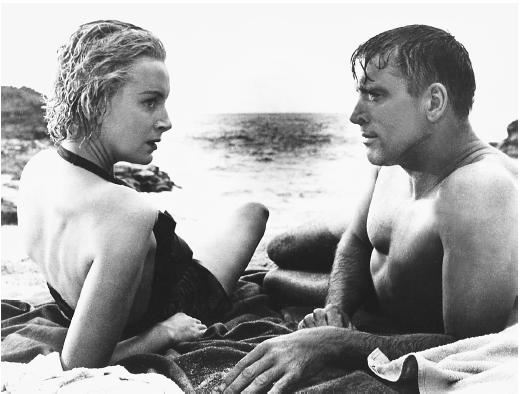
It's interesting to note that with all the people questioning whether it was too soon for films such as United 93 and World Trade Center to tackle the events of 9/11 that From Here to Eternity re-created the attack on Pearl Harbor a mere 12 years after it occurred, albeit as a glorified soap opera. (Actually, movies began referring to the attack on Pearl Harbor within months of December 1941, but I believe this is the first to actually depict the attack.) Thankfully though, Zinnemann was no Michael Bay and the film still has some teeth (and earned Zinnemann his first directing Oscar). Most importantly though, it has great performances from Burt Lancaster, Montgomery Clift, Deborah Kerr, Ernest Borgnine and Frank Sinatra's Oscar-winning turn as the doomed Pvt. Maggio. How Donna Reed won her Oscar I'm not certain. (As Josh R is fond of pointing out, she plays what must be the most virginal prostitute ever put on film.) However, enough remains to make it stand the test of time.
Zinnemann ventured into musicals and he went BIG, i.e. in full-blooded Technicolor, Todd-AO glory transferring this landmark Rodgers and Hammerstein musical to the truly big screen. In a way, Oklahoma! really is
 a stage show that should be opened up since a stage is too limiting for this tale of early settlers. Zinnemann takes true advantage of this with some nice shots, particularly the opening which moves the camera through the stalks of a corn field before coming upon Gordon MacRae singing "Oh, What a Beautiful Mornin.'" While the film is good enough, the importance of its stage version doesn't exactly transfer since Hollywood already had produced its own much better musical originals for the screen (such as Singin' in the Rain three years earlier). Despite that, there is much to admire in the songs and some of the performances, specifically Gloria Grahame's fun turn as Ado Annie. This is the performance that should have earned her an Oscar nomination and/or win, not her blink-or-you'll-miss-it work in The Bad and the Beautiful. Rod Steiger is good as the dark Jud, but his performance (and really the character himself) always has seemed somewhat out of place in what is essentially a musical comedy. Eddie Albert does what he can as Persian peddler Ali Hakim, but he's about as much a Persian as Mickey Rooney was Chinese in Breakfast at Tiffany's. (Well, Albert isn't offensive at least).
You can probably count on one hand the number of films about Catholic priests or nuns that still have them in their religious vocation by the time the film ends, and this bloated work isn't one of them. Audrey Hepburn does her best as the conflicted nun-in-training, but it's really Peter Finch who steals the show as a feisty doctor that Hepburn works with during some missionary work. It's not only an obscenely long film, it's also an eminently forgettable one.

Also too long, but immensely more fun was Zinnemann's next film, with Robert Mitchum and Deborah Kerr struggling to make ends meet in the outback as sheep drovers, with Kerr trying to be the sensible one and Mitchum's gambling spirit always getting the best of him (and their nest egg). She's tired of their wandering ways and wants to settle down, but his rambunctioness always gets in the way. There also are fine supporting performances by Peter Ustinov and Glynis Johns. Still, the cinematography by Jack Hildyard is stunning and there are some great set pieces, particularly a sheep-shearing competition. To say that its Oscar nomination for best picture was more than generous is no understatement.

Zinnemann truly created an odd one with this film that has Gregory Peck (?) playing an exiled Spanish revolutionary and Anthony Quinn as the Spanish official hoping to lure him back to the country to kill him with the news that his mother (Mildred Dunnock) is dying 20 years after the end of the Spanish civil war. Things get complicated further by a young boy named Paco (Marietto Angeleletti) who wants Peck to go back to kill Quinn to avenge his own father's death, but Peck also is torn by a possible traitor within his ranks. Despite the fact that Peck is even a less-convincing Spaniard than Eddie Albert was a Persian, the movie's overriding problem is that it's a world-class bore. It drags on and on to a truly anticlimactic ending. The most interesting thing about it is that it was based on a novel by Emeric Pressburger.
It had been a long time since I'd seen this best picture winner that earned Zinnemann his final two Oscars, one for directing and one for producing, and it plays even better than I remembered. While Robert Bolt's
 screenplay does show its stage origins, Zinnemann has turned this story of Sir Thomas More's stance on principle against the will of King Henry VIII into a sleek, compelling enterprise with the look and feel of an epic but a running time of a mere two hours. Central to the film's success of course is Paul Scofield's Oscar-winning turn as More, but Zinnemann does add a lot of nice touches as well, particularly in the great opening sequence showing the travel of a message from Cardinal Wolsey to More. There's also stunning cinematography by Ted Moore and a top-notch supporting cast that includes Wendy Hiller, Leo McKern, a young John Hurt and Robert Shaw in his Oscar-nominated turn as Henry VIII, which is a much smaller role than I recall. My 1966 Oscar preferences still lean to Who's Afraid of Virginia Woolf? but this film's win is not an embarrassment.
As Fred Zinnemann began his sixth decade as a filmmaker, he turned to yet another genre with this taut thriller starring the cool Edward Fox as a hired gun whose services are employed by embittered former members of the French Foreign Legion to assassinate French President Charles De Gaulle. The story moves on two tracks as Fox, code name The Jackal, pursues his plot and the French authorities, led by Col. Rolland (Michel Auclair) try to determine the killer's identity and to stop him before he is able to act. The film is a bit overlong, but Zinnemann does build quite a bit of suspense, even though we know De Gaulle won't be killed, and Fox is superb as the cold and calculating mercenary.
I saw Julia when it was originally released and I was in grade school, hardly the ideal audience. All I remembered really was that I was bored silly and the scene where a frustrated Lillian Hellman (Jane Fonda)
 tosses her typewriter out a window (I miss typewriters). So, in fairness, I decided I needed to take a new look, hoping that age would make me have a new view on the film the way I did a turnaround on Reds recently. Alas, 30 years later, I find Julia as boring as I did as an elementary school student. Its awards puzzle me more now than they did when I only had vague memories. Fonda at times is pretty bad. Jason Robards in his second consecutive Oscar-winning supporting turn is fine, but really doesn't have anything to do to deserve the prize. Maximilian Schell's presence is so fleeting that his nomination is a headscratcher. What shocked me the most was Vanessa Redgrave. While she is one of our finest actresses, there was more drama and suspense surrounding her nomination and her winning speech than she gets to create in the film itself. This was Zinnemann's final Oscar nomination as director (though he did direct one more film, which I haven't seen), but Julia is a bore. Pure and simple. Despite his less successful works, Zinnemann produced a lot of good and great movies in his time and I still salute him on his centennial.
Tweet
Labels: A. Hepburn, blacklist, Borgnine, Brando, Clift, Cooper, Deborah Kerr, Gregory Peck, Hammerstein, Lancaster, Mary Astor, Mitchum, Robards, Robert Ryan, Rodgers, Sinatra, Van Hefiin, Vanessa Redgrave, W. Hiller
TO READ ON, CLICK HERE


