Saturday, November 30, 2013
Harder to survive on the margins
BLOGGER'S NOTE: This preview of the fourth and final season of Treme contains mild spoilers for the last five episodes, but nothing too serious. If you fear knowing ANYTHING ahead of time, move along. Also, health problems and other interruptions have put timely recaps in jeopardy. At least part of the first episode will be up in time Sunday, but I can't make promises about timeliness going forward.

The headline that I used for this preview of the truncated fourth and final season of HBO's Treme paraphrases something Marvin Frey (Michael Cerveris), manager of Annie Tee aka Talarico (Lucia Micarelli), says to his client in the Sunday season premiere after she finishes a set with her band. Frey advises Annie that her album has peaked and, if she wishes to continue her ascent to stardom, her act requires big changes. While Frey's statement specifically
 pertains to Annie, it also applies to the unforgivable final season HBO allowed for this great series created by David Simon and Eric Overmyer. Yes, even in the commercial-free universe of pay cable, where subscribers should matter more than ratings, the various TV ratings systems (which grow more imperfect and outmoded by the day as the methods by which viewers watch TV evolve in ways A.C. Nielsen never could have envisioned) still capture the attention of channels such as HBO and Treme never drew an audience comparable to shows such as The Sopranos, Game of Thrones or even Boardwalk Empire. I suppose I should commend them for sticking with Treme as long as they did, but that doesn't excuse HBO for the scraps that it threw the series' way for a final season. Despite the burdens of a season half the size of a traditional one (and they received an 11-episode order for season 2) and steep cuts to staff and crew, the people remaining at Treme manage to go out well with few signs on the screen of the behind-the-scenes austerity measures imposed upon them in order to complete the story they never intended to run past four seasons. When I first learned of what HBO gave Treme for Season 3.5, my thoughts went to the citizens of New Orleans and the city itself, whose economy benefited from the series' filming there each year. Hasn't that city suffered enough? I digress. Five episodes remain to spend with the great characters we've met over the previous 31 episodes. We'll join the second line after the last episode airs Dec. 29.
 As the card shown above from Sunday's premiere indicates, the final season of Treme picks up 38 months after Hurricane Katrina and the federal flood that followed and devastated New Orleans and neighboring regions. More specifically, the day on which season 3.5 chooses to begin happens to be Nov. 4, 2008 — that historic day that saw Barack Obama elected the first African-American president of the United States. While the U.S. started the process of transition from one president to another, we learn of changes to most of the characters in the Treme universe in the premiere, “Yes We Can Can” (written by Simon, Overmyer & George Pelecanos, directed by Anthony
 Hemingway), in terms of relationships started and ended, both personal and professional. For those forgetting where we left our friends more than a year ago, LaDonna Batiste-Williams (Khandi Alexander) struggled after her bar GiGi’s got torched in a suspicious, presumed revenge fire; Delmond Lambreaux (Rob Brown) found himself more torn than ever between his New York jazz career and his New Orleans roots, especially after his father Albert (Clarke Peters) began treatment for cancer; Janette Desautel (Kim Dickens) continued to butt heads with Tim Feeny (Sam Robards), the moneyman behind her new restaurant, Desautel’s on the Avenue; Sofia Bernette (India Ennenga) headed east for college as her mom Toni (Melissa Leo) continued to fight the good fight and began a relationship with Lt. Terry Colson (David Morse), who attempted to do the same within his police department; Sonny Schilder* (Michiel Huisman) wore down Tran (Lee Nguyen), the father of Linh (Hong Chau), and made her his bride; Nelson Hidalgo (Jon Seda), back in the good graces of C.J. Liguori (Dan Ziskie) and friends after exile for association with Oliver Thomas, worked on various projects, including a New Orleans city jazz center, a project that Del and Albert already decided not to take part in despite a possible lucrative end; Annie’s burgeoning career led to her breakup with Davis McAlary (Steve Zahn), who gave a “final” performance announcing he was quitting the music industry; and Antoine Batiste (Wendell Pierce) found himself getting into the groove in his job as the assistant band instructor at Theophile Jones Elie Elementary.
 My return to recapping Treme episodes comes after sitting out Season 3 (and post-episode summaries/reviews of Boardwalk Empire as well) due to worsening aspects of the physical limitations associated with my primary progressive multiple sclerosis. A major impediment to me continuing the recaps stemmed from the fact that my recaps of both series grew so insanely ambitious with research and links supplementing the general summary and assessment of each individual episode. In fact, I got so detailed when referring to neighborhoods and sections of New Orleans that some readers assumed that I either hailed from there or had lived in the city for a sizable portion of my life when I never got the chance to visit the Crescent City back when I was mobile. Thankfully, no one thought I was old enough that I acquired my knowledge of 1920s Atlantic City from first-hand experience. My recaps
 for the final five episodes of Treme won't approach the detail or ambition of my season 2 efforts. (Look at my recap of Treme's season two episode "Carnival Time" or my recap of Boardwalk Empire's season 2 episode "To the Lost" to see how overboard I went.) I regret not being able to recap season 3 of Treme because I felt it turned out to be its best season, especially following season two, which contained individual episodes that proved great and contained truly memorable moments, but had too many episodes undermined by an editing style that seemed geared for children with ADD. In season three, the series largely corrected its flow problems and managed even to find use for some of its characters who had been annoying and pointless such as Sonny. It also introduced a new character in young enterprising reporter L.P. Everett (Chris Coy), a writer for ProPublica, who arrived in New Orleans to investigate the possible murder of a man by police following Hurricane Katrina. Everett's work brought him into contact with a natural ally in Toni and paralleled the internal frustration of Terry trying to delve into the culture of cover-up and corruption throughout the city's police department. While the entire ensemble managed to get their moments in season three, in my eyes, the season really belonged to Morse's stellar work as Colson. As a point of personal pride, when in season two Janette toured the kitchens of various New York restaurants, she began at the marvelous fictional creation Brulard’s, named for its owner and chef Enrico Brulard (a magnificent invention of a character by actor Victor Slezak — I still dream of spin-off where Brulard and Dr. John decide to open a restaurant and club together). Janette bonded best in Brulard's kitchen with actor Paul Fitzgerald's character, who never received a name, referred in credit lists simply by job title as Le poissonnier. In my recap of one of season two's best episodes, "Santa Claus, Do You Ever Get the Blues?" (written by Lolis Eric Elie, directed by Alex Zakrzewski), I decided to christen Fitzgerald's character as Paul. To my delight, when he turned up in New Orleans at Janette's new restaurant, he had a name and it happened to be Paul. I'd love to think I had a hand in that, but I'm not deluded enough to assume such a thing. It pleased me nonetheless and I wish I'd been able to note it when it occurred.
What makes this final stretch of Treme particularly interesting are how some episodes seem to have an overlying theme in a way that previous installments didn't. While episodes might revolve around a common event or day such as Mardi Gras or Thanksgiving, a couple of these final five delve specifically, though subtly, into overarching topics. As I referred to earlier, few signs on-screen indicate the steep cuts made for the final season. You spot them when some regulars' names only appear in episodes in which they appear and in the relative absence of bigger names such as Elizabeth Ashley's wonderful Aunt Mimi, who appears but once and briefly.
Whenever I try to describe Treme to nonviewers, a pat description defies me. No television antecedent that's not really dependent on plot springs to mind as a comparison. Treme proves to be neither about the journey nor the destination while telling its tale of a community and its culture in the aftermath of a disaster, but, in the end, Katrina really isn't its point either. Miraculously, Treme works and, this late in the game, I finally realized the closest comparison to its type of storytelling. It came not from television, but a movie: Robert Altman's Nashville. It also focused on a musical community with a large cast of characters, some of whom met, some who didn't, and didn't contain what anyone could call a conventional plot, yet it's one of Altman's masterpieces. Of course, Nashville comes to a climax of sorts and covers a very specific period of time. That thought prompted memories of another essentially plotless, though quite different, great film that by coincidence took place in our bicentennial year: Richard Linklater's Dazed and Confused, only it contained no big finish. As for television, I still can't think of a Treme antecedent and that's probably a good thing. I expect someone to correct me in comments and come up with a similar TV example and I'll be suitably red-faced for that series not occurring to me, but until then I welcome that in my mind Treme stands as one-of-a-kind.
Treme premieres on Sunday night on HBO at 9 p.m. Eastern/8 p.m. Central.
*As far as I recall, Sonny's last name never was mentioned or seen on the show itself, but a book solved that mystery. Treme: Stories and Recipes from the Heart of New Orleans by Lolis Eric Elie, former story editor for the series, presents recipes belonging to various characters from Treme and it reveals Sonny's last name as Schilder when providing his dishes.
Tweet
Labels: Altman, Boardwalk Empire, Clarke Peters, D. Morse, David Simon, E. Ashley, HBO, Kim Dickens, Linklater, M. Cerveris, Melissa Leo, Overmyer, Television, The Sopranos, Treme, TV Recap, Wendell Pierce, Zahn
TO READ ON, CLICK HERE


Tuesday, July 05, 2011
The longest tracking shot ever

By Edward Copeland
OK, technically, Slacker isn't one unbroken shot, but it almost feels that way, even 20 years after it finally completed its long, arduous journey toward a major U.S. release on this date (major for an indie arthouse film anyway). It only took writer-director Richard Linklater two months to film it in the summer of 1989, but the task of getting it released took two years. On the commentary track for the Criterion DVD that Linklater recorded in 2004, he says that he wanted the film to be "one long take" and re-watching it, Slacker still stuns me by how close it comes to evoking that feel, even though it's artifice. In many ways, it's an experimental film, so it's quite remarkable that its appeal became as broad as it did, that it remains so enjoyable on repeat viewings and that it even got made in the first place, especially for that fabled budget of $23,000.
Slacker covers 24 hours in Austin, though as Linklater points out in his commentary, it's actually only a small portion of the Texas city — confined mainly to the west side of the University of Texas campus and a few downtown clubs. The film contains no plot or narrative or central characters (In fact, characters don't get names as much as descriptions.); it just follows one person who then leads to another and another and so on, as if it's a funky sort of relay race with the baton constantly being passed. Miraculously, almost every character we meet and every short scene that plays out turns out to be as entertaining or fascinating as the one that came before. Slacker truly lacks any dead spots because we're watching all forms of humanity on display and though it's fiction, it almost plays like a documentary. "It seems spontaneous, but we always knew what was coming next," Linklater says on the DVD. The writer-director also is the first character to launch the chain, playing what he says is sort of a continuation of his first full-length feature It's Impossible to Learn to Plow By Reading Books, which is on the Criterion DVD and I'd planned to watch but simply ran out of time. Linklater plays Should Have Stayed at Bus Station who gets into a cab and tells Taxi Driver (Rudy Basquez) about a dream he had, which more or less sums up the idea behind Slacker itself.
"Do you ever have those dreams that are just completely real? I mean, they're so vivid it's just like completely real. It's like there's always something bizarre going on in those.…There's always someone getting run over or something really weird.…Anyway, so this dream I just had was just like that except instead of anything bizarre going on, there was nothing going on at all.…I was just traveling around…When I was at home, I was flipping through TV stations endlessly.Reading. I mean, how many dreams do you have where read in a dream?…it was like the premise for this whole book was that every thought you have creates its own reality, you know? It's like every choice or decision you make, the thing you choose not to do, fractions off and becomes its own reality, you know, and just goes on from there, forever. I mean, it's like you know in The Wizard of Oz where Dorothy meets the Scarecrow and they do that little dance at the crossroads and they think about going in all those directions and they end up going in that one direction? All those other directions, just because they thought about them, become separate realities. I mean, they just went on from there and lived the rest of their life…you know, entirely different movies, but we'll never see it because we're kind of trapped in this one reality restriction type of thing."
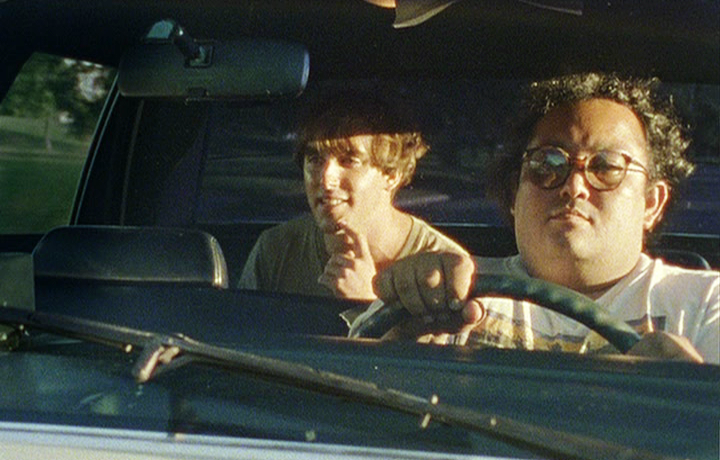
His full monologue runs much longer than that, but I had to cut it down a bit, but you don't know it the first time you see Slacker, but in hindsight and later viewings, he's giving you a lot of foreshadowing. For one thing, he mentions there is "always someone getting run over" and when he exits the cab to start the first handoff, that's the first thing he sees: a mother, Roadkill (Jean Caffeine) plowed down by a car we'll learn was driven by her Hit-and-Run Son (Mark James) as a couple of witnesses gather. Which one will we follow though? The movie of the Jogger (Jan Hockey) or the
 businessman Running Late (Stephen Hockey)? Maybe the third person to appear on the scene, Grocery Grabber of Death's Bounty (Samuel Dietert). Nah. They all were just links waiting for the Hit-and-Run Son's car to reappear so we can see his story which, according to Linklater, may have been based on a true story which had become sort of a neighborhood legend, since the murdering son waited around for the police — reading no less. He also talks about flipping channels endlessly and we will eventually meet Video Backpacker (Kalman Spellitich) who has flooded his room with all types of TVs showing different images — he even has one strapped to his back. Should Have Stayed at Bus Station says the book with the different realities concept he described must have been written by him since it's in his dream and the part is played by Linklater after all, who described the structure of the film as "jumping from movie to movie" and said the content of the film was of less concern to him than the form. When I first saw Slacker, I laughed when Should Have Stayed at Bus Station made the comparison to The Wizard of Oz because ever since I was a kid and saw that movie for the first time, I always wondered what would happen if Dorothy and the gang decided to follow one of those brick roads of another color. They had to lead somewhere, didn't they?
While true that the structure formed the basis for the idea for Slacker, the budding filmmaker, who celebrated his 29th birthday during shooting (It's hard to believe Linklater is 51 now), also selected the premise of a plotless film where one character leads to the next as a matter of convenience. It eliminated the need for continuity concerns. A character once they appeared wouldn't be coming back later in the film, so hairstyle changes or other things weren't a worry. However, because Linklater wanted the movie to appear seamless, every decision on where to make a cut or edit became a "big deal." Since the film aimed to cover a 24-hour period but wasn't going to run 24 hours, at some point the movie had to switch from day to night and he did that with a dissolve that, at least in 2004 when he recorded the commentary, he still felt "was a cheat" 15 years after he'd done it. He employed 16mm, Super 8 and even a Fisher-Price toy "PixelVision" cameras to film the movie which were able to produce a viewable 16mm print but, Linklater admits, did present problems getting all actors in the 1.37:1 aspect ratio frame. Otherwise, Linklater had a relatively easy shoot, even laying down dolly tracks on public streets without permits and not getting in trouble for doing so.
Linklater did have some tryouts for roles in the movie, but many were played by friends, many who seemed to have been former or future roommates. His funniest recurring comment on the DVD is that everyone in the cast is a musician unless otherwise noted. That applied to the person in the movie's most infamous scene, Teresa Taylor, who portrays Pap Smear Pusher and also was the drummer for the band The Butthole Surfers, whose song "Strangers Die Everyday" plays over the end credits. What's forgotten in the memory of someone trying to sell Madonna's pap smear is that before she brings that up, she tells a pretty hilarious story about a man speeding down a highway squawking like a chicken and firing a gun in the air with one bullet ricocheting inside the car for awhile and another lodging in a girl's ponytail and the girl "called the pigs." An interesting note from Linklater's commentary track is that he wanted to avoid references that might date the movie too much and he pondered, since it was filmed in 1989 and Madonna had only been a star for about five years at that point, if her fame would last long enough that audiences well into the future would know who she was.

Because so many in the cast are playing characters that resemble themselves, you're not certain whether to praise someone's acting because you can't be sure that acting is taking place. However, there were some real or beginning actors in the cast, including a person who played a character that made quite an impression and that's Charles Gunning as Hitchhiker. Gunning had started acting not very long before Slacker: Joel and Ethan Coen discovered him and put him in Miller's Crossing. His scenes contain so much power that I believe he's the only character who doesn't just hand off to the next person he encounters: Linklater wisely lets him
 linger a little longer. In fact, Linklater liked him so much that he used him again in his underrated film The Newton Boys and Waking Life. As Hitchhiker, Gunning's off-kilter deadpan delivery truly proves riotous, whether he's telling Nova (Scott Van Horn), the passenger in the convertible he's hitched a ride in, that he's coming from a funeral and Nova says he's sorry, "Fuck it — should have let him rot." As he explains further that the dead man was his stepfather who always got drunk and beat on his mom, him and his siblings. "He was a serious fuckup. I'm glad the son of a bitch is dead. Thought he'd never die.…I couldn't wait for the bastard to die. (pause) I'll probably go back next week and dance on his grave." Once he's left the car, even though he's already bummed a cigarette off the guys in the car, he asks a man at an outdoor cafe if he can have one, palms two and sticks the extra one behind his ear. He then gets stopped by the Video Interviewer (Tammy Ringler) who wants to see if he'll answer some questions, which he agrees to do. She asks if he voted in the last election. "Hell no — I've got less important things to do." She asks what he does to earn a living. "You mean work? To hell with the kind of work you have to do to earn a living. All that does is fill the bellies of the pigs that exploit us. Hey, look at me — I'm making it. I may live badly, but at least I don't have to work to do it." Just reading his lines doesn't do justice to Gunning's delivery. Sadly, Gunning died in December 2002 due to injuries from a car wreck. He was 51.
Members of the cast who aren't actors or musicians do pretty damn well too, though I suppose being a philosophy professor at UT as Louis Mackey was at the time when he played the Old Anarchist requires performing skills as well and Mackey shares them delightfully in another of my favorite scenes. The Old Anarchist and his daughter Delia (Kathy McCarty) enter the movie as they witness the apprehension of the Shoplifter (Shelly Kristaponis) outside a grocery store. Delia tells her father that Shoplifter was in her ethics class and he comments, "Well, I'm always glad to see any young person doing SOMETHING" only he's referring to the shoplifting, not the ethics class. When they arrive home, they happen upon Burglar (Michael Laird), a
 particularly inept criminal who fumbles with his gun and didn't get a chance to try to steal anything because he was reading one of the many books in the house. The Old Anarchist easily takes the gun from Burglar and befriends him immediately, telling him, "No one's going to call the police. I hate the police more than you probably. Never done me any good." Just the idea of some aging, white-haired anarchist who says the things he does was pretty damn daring for a filmmaker trying to get his career off the ground and forming his first major work around a specific city. Old Anarchist would praise Leon Czolgosz as an American hero and lament not being on campus the day Charles Whitman went up into the tower with a sniper's rifle "because my fucking wife — God rest her soul — she had some stupid appointment that day. So during this town's finest hour, where the hell was I? Way the hell out on South Congress." You would think there would still be enough survivors or relatives of Whitman's victims in Austin that the film would have been reviled there, but it was embraced. Linklater says on the DVD that he "really thought Slacker had something in it to alienate everybody on some level or another." In referring to the Whitman lines, he even referenced what I thought of when I saw it — Alan Alda's character's formula in Woody Allen's Crimes and Misdemeanors : "Comedy equals tragedy plus time." Mackey though plays the nutty old kook wonderfully as he tries to impart life lessons on the would-be thief. "It's taken my entire life, but I can now say that I've practically given up on not only my own people but for mankind in its entirety. I can only address myself to singular human beings now."
As far as I can remember, Slacker never played in my city in 1991 as was often the case with many arthouse films back then. So, as would often happen, I would either drive to Dallas by myself or with friends to catch those types of movies, usually at the Inwood on Lovers Lane. That's where I saw Slacker. Austin may have been able to get past the Charles Whitman part, but I wasn't there to know if they laughed. I do know
 however that Dallas moviegoers still carry sensitivity relating to JFK's assassination. The whole scene, involving the character called JFK Buff (John Slate) is pretty funny. Linklater even calls it one of, if not his favorite scene in the film. However, when JFK Buff appeared on screen wearing a T-shirt with a big picture of Ruby shooting Oswald, my visiting friends and I all laughed out loud. I don't think our laughter was particularly noisy — it just stood out from the others in the audience who were from Dallas and in complete silence. I even caught one or two people look our direction. If I weren't a strict proponent of not talking during movies, I might have said, "Relax. Neither you nor your city killed him and that was almost 30 years ago (at that time)." As you would expect, JFK Buff was an authority on all things Kennedy, conspiracy and otherwise and he's advising a young woman called Girlfriend (she's not his, but played by Sarah Harmon) who is browsing through the Kennedy section of a bookstore which are the best books to read. He's also writing his own JFK book which he wanted to call Profiles in Cowardice, but his publisher suggested issuing as Conspiracy-a-Go-Go. He suggests she "snap up" the book Forgive My Grief which has the story of how Oswald and Officer Tippet were supposed to have their "'breakfast of infamy.' Yeah, the waitresses went on the record, in the Warren Report, as saying Oswald didn't like his eggs and used bad language," JFK Buff tells her. Ironically, as recently as 2006, John Slate worked as the city archivist for Dallas so he actually works with Kennedy assassination documents.
 When you have a 100 minute film that's stuffed full of so many unique and interesting characters and memorable moments, you can't possibly highlight them all, no matter how much you might want to pay tribute to them on this anniversary. There's the Dostoyevsky Wannabe (Brecht Andersch) "Who's ever written the great work about the immense effort required NOT to create?"; I'd really love to write at length about the
 scene with Been on Moon (Jerry Deloney) "So they must like children too, because FBI statistics since 1980 say that 350,000 children are just missing — they disappeared. There's not that many perverts around."; Bush Basher (Daniel Dugan) and his ideas on how the nonvoting majority wins ever election; Prodder (Steve Anderson) who makes Jilted Boyfriend (Kevin Whitley) perform ritual sacrifice of items related to his ex-girlfriend with Boyfriend (Robert Pierson) along to watch; Scooby-Doo Philosopher (R. Malice) explaining how the cartoon teaches kids about bribery and how he thinks Smurfs has something to do with Krishna so people will be used to seeing blue people; Having a Breakthrough Day (D. Montgomery) handing out her oblique strategy cards and I could keep going, but I'll stop with Old Man (Joseph Jones), who appears toward the end walking down a road talking into a tape recorder and saying, "When young, we mourn for one woman. As we grow old, for women in general."
When it comes to picking the best part of Slacker, selecting that choice doesn't require any mulling or contemplation because Richard Linklater himself serves as the film's strongest and longest-lasting legacy. Slacker belongs in that same category of film as Citizen Kane (I'm not saying in terms of greatness) where its structure guarantees its freshness because it's so unique no matter how many times you see it, you're never certain what comes next. Not all of Linklater's films have turned out to be gems, but then that's the case with most great filmmakers. Robert Altman and Billy Wilder had their duds too. In fact, with the exception of School of Rock (which I love) and The Bad News Bears remake (which I still refuse to see), he reminds me of Altman in the way he avoids commercial prospects when picking projects. He's also been very prolific, to the point that I think some of his movies escaped people's notice altogether.
Look at the body of work he's compiled since Slacker: the great Dazed and Confused; the exquisite yet complete change-of-pace that was Before Sunrise, which I got to interview him about on the phone; the very good adaptation of Eric Bogosian's off-Broadway play SubUrbia; The Newton Boys, long overdue for reappraisal; Waking Life, which admittedly works better as an experiment in style than as a film; the underseen and very strong Tape featuring searing work by Robert Sean Leonard, Uma Thurman and Ethan Hawke; the aforementioned blast that is The School of Rock; Before Sunset, the unlikeliest sequel ever made; turning a nonfiction best seller into a fiction film with the same message in Fast Food Nation; A Scanner Darkly, his venture into Philip K. Dick and sci-fi using the animation technique from Waking Life; Inning by Inning: A Portrait of a Coach, a documentary about Texas' baseball coach who holds the most wins in NCAA history, a film I didn't even know about until I was going through IMDb; and his most recent film, Me and Orson Welles, which is simply one of the best he's made. Later this year, there should be a new Linklater crime comedy called Bernie that reunites him with Jack Black and Matthew McConaughey and also starring Shirley MacLaine.

Back to Slacker, the film I'm saluting. On that commentary, Linklater says that much of the movie really revolves around deciding whether or not to do something or, as he put it, "To act or not to act." If that is the question Slacker poses, Linklater chose the positive response and film lovers are better off for him doing so.
Tweet
Labels: 90s, Alda, Altman, Coens, Hawke, Linklater, MacLaine, Movie Tributes, Remakes, Sequels, Welles, Wilder, Woody
TO READ ON, CLICK HERE
Tuesday, September 21, 2010
In awe of such a thing as Welles himself

By Edward Copeland
Few filmmakers have as an eclectic resume as Richard Linklater has developed over the years, most often with positive results, so it's great to see him try another period piece with Me and Orson Welles, particularly after the unfair flailing The Newton Boys received. This 2009 release seemed to escape much notice aside for a brief Oscar push for supporting actor for Christian McKay as Welles and that's a shame, because it's a very good film that deserved more attention.
Zac Efron, acquitting himself quite nicely, stars as high school student Richard Samuels who, while playing drums outside the infamous Mercury Theatre in 1937, meets the famed wunderkind himself and charms Welles enough that he offers Richard a small role in the troupe's currently rehearsing production of Shakespeare's Julius Caesar. The daydreaming Richard, whose drawn to all artistic bents, especially acting, is awestruck and anxiously accepts despite the limited time until the opening date and the lack of pay. If his school suffers, he feels that's a small price to pay for working alongside Welles.
Richard also find himself falling for something besides the theater: Welles' assistant who practically runs the theater, Sonja (Claire Danes), an ambitious young woman who is hoping that her nonstop devotion to Orson will lead to an introduction to David O. Selznick, prepping a film version of Gone With the Wind at the time. All the horny young men in the theater company lust for Sonja, but consider her a bit of a cold fish and strike out in their attempts to land her, but the minor Richard actually finds a bit of luck in that area.
The period details truly make the film breathe and the backstage drama energizes the story, especially thanks to McKay's pitch-perfect performance as Welles, giving him the right mix of genius, ego and asshole. It's truly impressive that Efron holds his own so well.
The large ensemble also does well. It took until the end credits, which I recommend that everyone stay for because they are fun, that it is Eddie Marsan from Mike Leigh's Happy-Go-Lucky playing John Houseman. With an actor who was as distinctive as Houseman, Marsan goes in the opposite direction than McKay and doesn't attempt imitation. He just plays the role. There also is fine work from Ben Chaplin, Zoe Kazan, James Tupper and Leo Bill. (In case you don't catch it in the film, the latter two are playing Joseph Cotten and Norman Lloyd.)
Though I have liked almost every film Linklater has made (I refuse to see The Bad News Bears remake), Me and Orson Welles works so well on every conceivable level that I believe it's his best film since Dazed and Confused and he's made some very good films since then. It not only tells a wonderful story with the script by Holly Gent Palmo & Vincent Palmo based on the novel by Robert Kaplow, its atmospherics and general sense of the importance of all arts to life really delivers an important message at a vital time.
The production design by Laurence Doman, cinematography by Dick Pope and costumes by Nic Ede all lend credibility to the film's gorgeous depiction of 1937 New York. Simply put, it is by far the most beautiful film Linklater has yet made.
Still, if you only watch Me and Orson Welles for one reason, that should be for Christian McKay's brilliant turn as Welles. He resembles the actor-writer-director at a young age and gives a resonating performance that goes beyond mere impersonation.
Tweet
Labels: 00s, Linklater, Selznick, Shakespeare, Welles
TO READ ON, CLICK HERE
Saturday, June 19, 2010
From the Vault: Before Sunrise

In an interview last month, director Robert Altman said it's always better seeing a movie a second time. Knowing what's going to happen, he proposed, relaxes filmgoers so they can concentrate on details.
Unfortunately, constraints more often than not prevent a critic from having a second viewing before the review is due. Thankfully, this was not the case with Before Sunrise, writer-director Richard Linklater's latest film, which offers great support for Altman's statement.
Linklater, with his naturalistic style and the ensemble casts of his first two films, Slacker and Dazed and Confused, could be superficially compared to Altman, but the most important trait they share is the rarest of things in movies today - the willingness to cross the cinematic tightrope without a net.
This is what Linklater has done with Before Sunrise, a distinct departure from the free-wheeling fun of his first two efforts. While it's hardly a complete success, it does provide ample rewards for the discerning viewer and further secures the 33-year-old Linklater's place as one of the major talents of the new generation of filmmakers.
Ethan Hawke and Julie Delpy star in Before Sunrise and, unlike the vast casts of Linklater's previous work, they are the only characters the viewer has to focus on, playing twentysomethings from the United States and France, who meet each other aboard an Austrian train and decide to spend Hawke's remaining hours in Europe strolling around Vienna.
Linklater co-wrote the film with Kim Krizan and together they take An Affair to Remember, drop the hokey melodrama and crossbreed it with My Dinner With Andre. On one level, it's a brief romance between strangers, but deeper down Before Sunrise tackles the love of conversations and ideas.
Given its talky nature, audiences with short attention spans will likely grow fidgety waiting for a plot engine that doesn't arrive.
Though I admired Before Sunrise the first time, I didn't freely enjoy it until that second viewing.
The first time, Hawke seemed too frantic in the early stages of the movie, coming off like a grunge Woody Allen. In retrospect though, his exuberance stems purely from his character's desire to captivate Delpy and not from a conceit.
Delpy, on the other hand, is charming from the very first, and the fact that she is as much a newcomer to Vienna as Hawke adds to the accurate depiction of visitors to foreign countries.
Aside from a slow start, the only real problem is the abrupt ending. It leaves you wanting more and even a tentative resolution would be more satisfying.
However, that's a quibble, because Linklater is sticking his artistic neck out so far, you want to couch criticism of it in the softest terms so as not to discourage him from striking out in daring directions.
Since Linklater is so talented, that probably shouldn't be a concern. Before Sunrise will not please everyone, but only the grumpiest of moviegoers should fail to be seduced by its charm.
Tweet
Labels: 90s, Altman, Hawke, Linklater, Woody
TO READ ON, CLICK HERE
From the Vault: Richard Linklater

ORIGINALLY PUBLISHED JAN. 27, 1995
Few things can stir as much excitement as finding a promising young artist and watching him grow. Austin, Texas-based writer-director Richard Linklater, 33, currently promoting his third theatrical release, has shown much willingness to grow. His latest movie, Before Sunrise, demonstrates he is never content to play it safe.
Before Sunrise stars Ethan Hawke and Julie Delpy. The film shows a brief romance between a young American man and a young French woman who meet on an Austrian train and decide to spend several hours walking the streets of Vienna together.
The pared-down cast is quite a switch for Linklater, whose two previous efforts were two different types of ensembles: a collage of characters in Slacker and many students populating Dazed and Confused.
"The making of (Before Sunrise) was very intimate. I worked very closely, very intensely with two people, but I was up for that. I was looking forward to that. I felt I needed to do that next."
Linklater was speaking by telephone from Austin last week where Before Sunrise premiered one day prior to kicking off the Sundance Film Festival in Park City, Utah.
Before Sunrise was made in 25 days for $3 million, a low budget for most film releases but a staggering increase considering Slacker cost a mere $23,000. Sunrise cost about half what Dazed and Confused cost to make.
"It's really not the budget, but how much each film needs to be made the right way. I felt I got everything I wanted."
Part of what he wanted became the city of Vienna itself, where the movie was made, though Linklater returned to his home base of Austin for post-production work.
"The Austrian government was very accommodating. They were open to us filming there, unlike a lot of cities. I liked the city. I wouldn't have used it otherwise. I just thought it was an interesting, kind of classical backdrop. It could have been other cities, but once it was Vienna I really wanted to make ... a movie that couldn't have been anywhere else."
The romance in Before Sunrise achieves a kind of universal appeal, even if the exact details of the film haven't happened to each individual viewer.
"I think everyone's had an experience like this, in some way or another."
In some respects, Linklater has been surprised by how well received his somewhat idiosyncratic movies have been.
"When I first set out to make films, I didn't know if they would be funny or if people would relate to them. You never really know. I guess it was surprising to see my sensibilities hooked up with more people than I thought they would have. We all imagine ourselves way off in the corner, doing something really weird, but I have to admit that there's something kind of common about me. I kind of tap into a common experience."
Unlike many talented filmmakers of Linklater's generation or the two generations that preceded them, Linklater wasn't weaned on movies in childhood. His interest came rather late.
"It wasn't until later that I got interested in films. I guess the most fascinating film of my childhood was ... watching 2001. I think I was in first grade. I thought, 'My God.' It really intrigued me, and it still does. It's really amazing, the power of the medium to appeal to a 7-year-old or an older person, same film. I think films communicate on a deeper level that way. It was in college I really started watching films more seriously, or thinking of them as an art form. I was just coming in contact with great films, not just the entertainments that opened that week, but the classics."
Ideally, Linklater would like to make a film a year, though he admits that can be tough to do. Once the promotion cycle for Before Sunrise winds down, he hopes to get back to work on his next script, a more epic-type film involving Texas history set in the 1920s.
"It'll be yet another big change, but I think it will still be very character driven."
He hopes to film in summer or fall of this year with a possible 1996 release. For the foreseeable future, Linklater plans to stick to scripts that he's been involved in writing. Filming someone else's screenplay is "quite a ways down the road, I think. I have a lot of stories of my own I really want to do. Whatever feels right next, you know, that sort of thing."
Tweet
Labels: Hawke, Interview, Linklater
TO READ ON, CLICK HERE
Thursday, January 28, 2010
Describing the indescribable
"Be pleased then, you living one
in your delightfully warmed bed
before Lethe's ice-cold wave
will lick your escaping feet."
Goethe

By Edward Copeland
When you've been a lifelong film fan as I've been, you end up seeing a multitude of movies, from the sublime to the ridiculous. After awhile, even when watching a great film, it's seldom something you can't compare to another work or, in the worst cases, doesn't turn out to be something trying so hard to be experimental or bizarre that it leaves a rotten residue. Sometimes though, lightning strikes and you see a film that truly defies comparisons and just turns out to be a truly delightful viewing experience. This is the case with Swedish director Roy Andersson's You, the Living.
You, the Living can best be described as a collection of vignettes, yet that doesn't quite do justice in depicting the film in easy-to-categorize terms. The scenes are not short films; some characters recur, but most don't; there is only the vaguest of overriding themes serving as connective tissue for all that transpires. What can be said with authority is that what Andersson has assembled transfixes, frequently causes bursts of inexplicable laughter and is unlike just about any film I've ever watched.
Believe me — I racked my brain for comparisons, but every movie that came to mind was just another example of one that elicited the same excited reaction of newness or the bored fatigue of a failed folly in me. I thought of Richard Linklater's Slacker, with its unbroken take of following one character to the next for the entire film, but that's really not the right mold. On the negative side, I recalled my recent viewing of Werner Herzog's Even Dwarfs Started Small, but that did have recognizable characters and situations even if the ultimate result was dull and pointless. The closest I came was Francois Girard's Thirty-Two Short Films About Glenn Gould and that's only because that was the last time I got a similar feeling of something remarkably fresh in filmmaking after I saw it, not that You, the Living resembled it.
No, You, the Living plays, at least for me, as an original, a unique piece of filmmaking and, more importantly, a unique piece of filmmaking that remarkably succeeds. I could describe many of the vignettes from the film, but I fear that if I did that would dilute the film's magic. The Goethe quote at the top of this post is what opens the film and it really gives a sense of what underlies the various people whose paths we cross. Most feel misunderstood or unwanted and seek a sense of belonging, though even when they have mates, they treat them inhumanely, but in a way that usually comes off comically, not cruelly.
In the film's first scene, a man wakes up suddenly from his bed declaring, "The bombers are coming." The next thing we know, we are in a park where a distraught woman is telling a man to just take her dog and leave her alone because no one understands her and everyone would be better off if she didn't exist. The man protests, but he finally slinks off and the woman suddenly bursts into a song while a man in a raincoat suddenly reveals himself from behind a tree. Then the credits roll and you are hypnotized into the universe Roy Andersson has created, or at least I was.
Later in the film, we meet a doctor who speaks directly to the audience, informing us that he's been a psychiatrist for 27 years and he's basically burned out listening to people demand that he help them find the fun in their life, when his own life lost his fun long ago. He talks to the camera and says:
"People demand so much...They demand to be happy at the same time they are egocentric, selfish and ungenerous. Well, I would like to be honest. I would like to say that they are quite simply mean, most of them. Spending hour after hour in therapy trying to make mean people happy. There's no point. You can't do it. These days, I just give them pills."
In the DVD commentary for You, the Living, which was released in 2007 but only arrived on U.S. shores in 2009, the interviewer asks Andersson if things have grown worse in the world since his last film, 2000's Songs From the Second Floor. Andersson concedes yes with constant wars and economic turmoil and a world economy he labels a "chain-letter economy."
Between the psychiatrist's quote and what Andersson says, you'd expect a fairly pessimistic film, but You, the Living is anything but. It embraces the humanity of its put-upon characters, but does it with joyous humor and a musicality that leaves a smile on your face. Often in the film, someone will say, "Tomorrow is another day," but it's not a Scarlett O'Hara declaration of hope for a new start, it's just the recognition that life will go on and the next day likely won't be better or worse, but just more of the same. You certainly can't say that You, the Living is more of the same.
Tweet
Labels: 00s, Foreign, Herzog, Linklater
TO READ ON, CLICK HERE
Wednesday, August 26, 2009
From the Vault: Dazed and Confused

With his second feature, Richard Linklater cements his place as the preeminent chronicler of the 13th generation. The 13th generation refers to those born since 1961, so named by authors Neil Howe and Bill Strauss because they are the 13th generation to know the American flag.
As with his great film Slacker, Linklater's Dazed and Confused veers off the obvious route of angst-ridden twentysomethings trying to cope in the 1990s.
In Slacker, Linklater evoked that generation without focusing exclusively on that demographic. Instead, he created characters of all ages who embodied that spirit. In Dazed and Confused, he takes an almost anthropological approach by vividly recreating the year 1976 as a pivotal point in the evolution of both 13ers and baby boomers.
The story starts on May 26, 1976, as the school year is coming to a close. In the small, unnamed town, the annual ritual begins of incoming seniors (class of '77) celebrating their new rank by initiating the newly minted freshmen (class of '80) with various hazing rituals.
Though Dazed offers a skeletal plot, it's not aiming for story. Rather, it's focused on flawlessly re-creating a time and place. With the use of vintage music, it could be labeled as Linklater's American Graffiti, only he doesn't bother to tell you where the characters go once the film ends.
The performers, few of whom are recognizable from other work, all play their parts naturally and effortlessly. No star turns pop out because the bulk of the characters are equal in the film's context.
When Linklater first worked on Dazed and Confused, he was quoted as saying that its subject was the transformation of 1960s values into the Me Generation and that change dwells beneath the surface of Dazed and Confused, but Linklater doesn't allow the theme to overpower the fun.
The class of '80 were among the first 13ers to finish high school and the class of '77 marked the tail end of the boomers. Though the differences are subtle, Linklater delineates them as the freshmen see the shallowness in the seniors' traditions. At the same time, the seniors' idealism has been whittled down to refusing to take no-drug pledges and in admitting that aiding the less fortunate isn't as lucrative as going for the gold.
Ultimately, the subtext doesn't distract from the enjoyment of the film, which depicts high school life that any generation can relate to, with the chronic need to belong and the fear and anticipation of what lies ahead. It also happens to be incredibly funny. No one can truly say what will happen down the road. With Dazed and Confused, Linklater does hold out the promise that the 13th generation will produce artists whose talents grow with them.
Tweet
TO READ ON, CLICK HERE
Monday, April 20, 2009
NY theater flashbacks: 1994
By Edward Copeland
I'd thought of doing something like this for a long time and since I have long-term projects and other complications preventing me from seeing new things to write about, it seemed as good as time a time as any. Of course, I'm relying on memory, so forgive any mistakes I may make along the way. My theater obsession was primarily New York and primarily Broadway. I had been to the city before on movie junkets, but never had enough free time to see a show. So, in March 1994, I planned my first trip to the Big Apple to specifically see a show. In this case, it actually was two shows or one show in two parts. In other words, it was both halves of Tony Kushner's Angels in America on consecutive nights.
Since this was the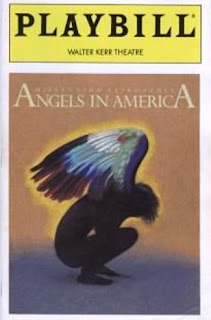 second season in which Kushner's play had run, though the first for the second half, two members of the original cast already had left. F. Murray Abraham had succeeded Ron Leibman in Leibman's Tony-winning role of Roy Cohn (in addition to some other roles). I'd seen bits of Leibman, but I felt Abraham was more than a worthy substitution. Marcia Gay Harden had departed from her Tony-nominated role as Harper Pitt (among others). Cynthia Nixon had yet to assume the role, so I got to see Harden's understudy, Susan Bruce, who was fine. One other interesting casting note that few get to experience is the chance to see both the understudy for a role and the actor who was cast in the part. When I saw Millennium Approaches on Friday night, Jeffrey Wright was off, so his understudy played Belize and his other roles. The actor was Darnell Williams, known to All My Children fans as Jesse Hubbard. He was quite good. Saturday, Wright returned for Perestroika. As good as I thought Williams was, Wright was a revelation. I wanted to leap to the stage and give him a Tony right then and, sure enough, months later Wright would win the Tony for featured actor in a play for Angels in America: Perestroika. Seeing this two-part play was a wonder; it makes perfect sense why I developed an addiction to New York theater, specifically Broadway. An expensive habit. I should have taken up heroin. The power and magic of Angels in America still resonates. What a work of imagination, blending fantasy, history, current events, real people, fictional characters and churning them all into a glorious theatrical fest. Now, 15 years and more than 100 productions later, Angels in America remains the best show I ever saw on Broadway. I was such a theater neophyte when I ordered the tickets for the show over the phone, I didn't know the difference between orchestra and mezzanine, so first row mezzanine center sounded better than ninth row orchestra center. Actually though, I think my lack of knowledge served me well. When Ellen McLaughlin's angel came crashing through the ceiling of the bedroom of Prior Walter (the magnificent Stephen Spinella who won Tonys for both halves), I was more or less even with her. Since the play was split into two
 halves, it won the Tony for best play in two consecutive seasons but it only won the Pulitzer Prize for part 1, Millennium Approaches. I really don't know how you can separate it like that because for me both parts make a whole and you can't have one without the other without it seeming incomplete. I fell in love with the play so much (and I'm a straight man) that I bought book copies of both halves of the play and performed them in the living room of my friend Wagstaff, playing all the parts, so he could get a sense of the play that I thought just reading the play wouldn't do. (The only other time I did this was to perform The Seagull, which I was reading for the first time when I performed it.) As Angels in America became a cultural phenomenon, there was immediate talk of a film version. I still would love to have seen what Robert Altman would have done if his plan to make it as two films had come to fruition. As much as I loved Altman, Angels in America seemed to be a uniquely theatrical experience to me and a lot of its magic and spectacle would be lost on the big screen. Now though, most people probably know Angels in America based on Mike Nichols' HBO miniseries version of it. It is very good but I was right: While it's a good thing that it doesn't seem like a filmed play, a lot of the spirit is lost. You also inevitably get into the performance comparison game since Jeffrey Wright was the only member of the Broadway cast to reprise his role in the TV version (and he got an Emmy to go with his Tony). Al Pacino put a handle on some of his worst late-career traits and was great as Roy Cohn. I can't compare him to Leibman and, of course, it's difficult sizing up performances trying to reach the balcony with the toned-down ones of film or television. Most of the miniseries and stage counterparts seem fairly evenly matched, though I actually preferred the underrated Kathleen Chalfant in all her many roles to Meryl Streep. While Justin Kirk was fine as Prior on TV, he had a helluva act to follow in Spinella (Kirk would shone for me in a later theater season on stage). Ben Shenkman's Louis on TV actually was better than Joe Mantello's on stage. (Mantello turned primarily to directing after Angels, winning several Tonys and having mixed results, in my opinion.) The biggest mistake of the miniseries though was the casting of the ultrabland Patrick Wilson as Joe Pitt. Sure, the character was supposed to be a closeted, Mormon Republican, but David Marshall Grant had no problem bringing him to life on stage. On the whole, the TV miniseries was good, but I'll probably never watch it again because my memories of the Broadway incarnation are too precious to me.

PASSION
Before I ever saw a show on Broadway, I was a fan of Broadway musicals and I had a collection of original cast recordings that might seem suspiciously too large for a heterosexual, especially since the collection was dominated by my adoration of Stephen Sondheim. A planned junket for a couple of movies (I can't even remember which ones) happened to coincide with the opening of a new Sondheim musical on Broadway. Hallelujah. I booked my flight for a day early and spent the night with a friend so I could see the 2 p.m. Saturday matinee (7th row, right orchestra) of Passion before having to show up at the junket hotel for my job. The show was still in previews, which had been extended, so I wasn't seeing the finished project but I didn't care. It's evolution was interesting. It began life as an idea of two one-act musicals, the other half being something called Muscle about bodybuilders. That would have been strange. Instead, Passion grew to a 2-hour, intermission-free show based on an Italian film from the 1970s I actually had seen accidentally late one night on Showtime or Cinemax when I was in junior high. So I had a vague idea of the plot, but I didn't care: I was going to hear a Sondheim score I'd never heard before. Passion divided its audiences in half. Many hated it, others loved it, but for me, especially upon many times listening to the score, it's the same case as with many Sondheim shows: The score is better than the show itself and Passion is one of Sondheim lushest, most beautiful scores of love and longing. The critics of the show whom I found ridiculous were the ones who mocked Donna Murphy's performance as Fosca, the sickly soldier's sister whose face and demeanor leaves a lot to be desired but whose obsession with another soldier manipulates him into loving him despite his love for a married woman. Murphy won a well-deserved Tony because she is amazing. She practically overpowers everyone else on stage with her. Some pros such as Tom Aldredge and Gregg Edelman hold their own, but Jere Shea as Giorgio, was the show's weak link and he was supposed to be the lead and every other performer got the better of him, be it Marin Mazzie as the married woman he's having an affair with to the various soldiers to Murphy. Passion is a problematic show with a great score and I'm grateful I saw it because it seems highly unlikely at this point that Sondheim will ever premiere another new score on Broadway, even if he ever solves the problem of Wise Guys/Bounce/Road Show; it's played so many different places and I doubt the entire score would go in the trash can even if it did somehow ever make it to Broadway.

GREASE
This was the point when someone should have staged an intervention, but alas I was in New York for a junket and the only people I knew were fellow entertainment journalists, and none too well. They scheduled interviews extremely late on a Sunday afternoon for some reason, so I scanned the Broadway listings. As usual, most Sunday matinees didn't start until 3 p.m., too late for me. However, one show had a 1 p.m. starting time and to get my fix, I bought tickets to the Grease revival with Rosie O'Donnell. I assure you, Rosie was not the attraction. As a kid, and even today, I love the movie version. I'd only seen one production of the stage version, a summer stock version starring Eddie Mekka of Laverne & Shirley fame and it sucked. Still, I could not be deterred. The pre-show actually got me in a good mood. The guy playing Vince Fontaine already was on stage acting as a disc jockey, bantering with the audience and playing classic 1950s songs. Unfortunately, that eventually stopped and the curtains opened. My seat was on the very front row, so much so that part of the stage extended out past my seat. This proved to be particularly odd seating when they staged Danny and Sandy's trip to the drive-in and his car literally drove over me where I had to crook my head to see some of the number, but mainly I saw a tire and the undercarriage of the fake car. Despite the fact that the show generally sucked, especially because they kept trying to insert Rosie's Rizzo into numbers in which she didn't belong, including a reprise of "Greased Lightning." What the fuck? Though since Rosie was in it, it would have made sense if she'd sang the line, "You know that I ain't braggin'/she's a real pussy wagon." Still, there were some good performances. It was a minor performance, but Megan Mullally got to play Marty. Marcia Lewis, the show's sole Tony nominee for acting, was fun as Miss Lynch, the Rydell teacher. Sam Harris showed real promise as Doody, especially in his big number "Those Magic Changes." Without a doubt though, the performance the brought the house down was the great Billy Porter as the Teen Angel really bringing "Beauty School Dropout." The original Grease at one time was the longest-running show in Broadway history. I never saw it, but it's a bit of a head-scratcher to me since the movie seemed to improve so much. This revival, which opened in May 1994, lasted until January 1998. This was largely due to its producers, the infamous Weisslers, who kept it alive and have kept Chicago alive by inserting one bit of stunt casting after another. A short list of names who went into Grease for a time following Rosie: Linda Blair (Rizzo vomits pea soup! No, but that would have been fun), Debby Boone, Chubby Checker, Mickey Dolenz, Sheena Easton, Joely Fisher, Debbie Gibson, Dody Goodman, Jasmine Guy, Jennifer Holliday, Al Jarreau, Lucy Lawless, Maureen McCormick, Mackenzie Phillips, Joe Piscopo, Jon Secada, Brooke Shields, Sally Struthers, Jody Watley, Jo Anne Worley and Adrian Zmed. Obviously, they didn't all play Rizzo. There were some Dannys, Teen Angels, Miss Lynches and Vince Fontaines thrown in as well. Of course, this revival had nothing on stunt casting compared to the Grease revival that ran from August 1997 through January of this year that picked its leads from a TV reality show.

TWILIGHT: LOS ANGELES, 1992
My job at work had switched to an interesting schedule of 10 hour days where every third week we would have three-day weekends and every third week we'd get four-day weekends. It certainly proved to be a nice schedule, but not so much for my credit card and my Broadway obsession, which you think that Grease would have slowed. So I planned my first three-play trip in June and I lucked out that they were all winners. One thing I found: I was disappointed far fewer times by Broadway plays than by Broadway musicals. The first play of the weekend amazed me and was the closest to casting the spell on me that Angels in America did. Twilight: Los Angeles, 1992 was a one-woman show performed by Anna Deavere Smith. Now, this wasn't the type of one-person show most people think of where an actor assumes one persona for an evening. No, Smith portrays dozens of people, people she interviewed as a journalist would to get their take on what happened to them during and after the Los Angeles riots. Very few of the people are well known, but it doesn't make Smith's performance any less riveting as she assumes every gender, ethnicity, etc., to paint a portrait of a staggering event in this nation's history as well as an intimate look at a major city that still has characteristics of a small town. It's brilliant. I only saw two of the four nominated lead actresses in a play (the other was the winner that same weekend), but I still believe that Smith deserved the prize, especially since there was no way Twilight: Los Angeles, 1992 was going to (or should have) beat Perestroika for play.
AN INSPECTOR CALLS

You don't often come out of a play feeling cool and wet, but if you were close enough to the awesome set by Ian MacNeil working in tandem with Rick Fisher's lighting and Gregory Meeh's special effects, you were likely to exit the theater with tangible evidence of a night's entertainment with Stephen Daldry's revival of J.B. Priestley's An Inspector Calls. Now, if you go to the theater as often as I did, you are going to run into celebrities eventually. This show marked my first experience as the late Madeline Kahn and her husband sat in the row behind me. They seemed to enjoy the play as well, an old-style mystery as a mysterious inspector (Kenneth Cranham) upends family secrets while investigating a death. The family, a rich industrial clan led by Philip Bosco and Rosemary Harris, has many members and are far from functional. The entire cast excelled, the pros such as Bosco, Cranham and Harris, as well as newer finds such as Marcus D'Amico and especially Jane Adams as the clan's daughter and she won a Tony for the role, one of 5 Tonys it won, though it amazingly lost scenic design which still boggles my mind. Granted, I didn't see the show that won (Carousel), but it had to be stunning to top McNiece's set.

MEDEA
Emma Peel, meet Euripides. Diana Rigg brought her London stage triumph to the states for a limited engagement in a new translation by Alistair Elliott that seemed to draw Tonys to actresses like a magnet and it did so with Rigg in director Jonathan Kent's production. This time, I was back in the mezzanine, not by choice, but because the play was a limited engagement, it was the best I could get. Medea was the third and final play in my three-play weekend and since it was a quick 90 minutes, I had my carryon duffle bag (I travel light) under my seat so when the show ended I could grab a cab to the airport and catch my plane home. That is one advantage of going from the Eastern time zone back to the Central: Time is on your side. Back to the play. Don't get me wrong. Rigg was superb, even though Anna Deavere Smith's achievement impressed me more. Medea has to be placed in the hands of a really lousy actress to fail and Rigg doesn't fit that definition. This is a wronged woman whose idea of revenge on her husband is to kill her own children, yet somehow you still manage not to hate her or view her as a complete monster. Rigg pulls this off magnificently, making her Medea a woman of intelligence as well as sadness. She hates what she is doing yet she's certain it's the course she must follow. The play itself was set on a very sparse set of loud, clanging metal doors, ringing through the audience with appropriately echoing dins that must have driven theatergoers with assisted listening devices crazy at times. Peter J. Davidson's set along with the revival itself were the only Tony nominations besides Rigg the show received and I think that was what sort of made the production feel lopsided. Except for some occasional nice moments from the women of Corinth who serve as a chorus, everything is designed as a showcase for Medea/Rigg. Any other characters or actors seem to be an afterthought. As a result, I think that's why Rigg's performance loomed so large. Everyone else was designed to be minimized.
DAMN YANKEES
The shows I saw in 1994 (with the exception of Millennium Approaches, which was really a holdover from the 1992-93 season) were really all from the 1993-94 season in terms of the Tony Awards. The final Broadway show that I saw from that season was the revival of Damn Yankees. Bebe Neuwirth took on Gwen Verdon's famous role of Lola, the Devil's temptress trying to keep a man's soul for the Devil's collection. Victor Garber played the Devil who offered a middle-age man (Dennis Kelly) a chance for a sprint at youth and baseball glory in the form of a gifted player (Tony winner Jarrod Emick, by far the show's highlight). The cast also had some other soon-to-be familiar faces in Vicki Lewis (of NewsRadio fame), Dick LaTessa (who would win a Tony as the dad in Hairspray) and Gregory Jbara (currently playing Billy's father in the musical version of Billy Elliott.) As I said earlier, I was disappointed much more often by musicals than by plays and that was the case here. The cast certainly had talent to spare, but the production never seemed to come together for me. Emick truly shone, but Neuwirth seemed as if she were in a different show and Garber projected himself as too much of a pushover to be much of a formidable devil. It also launched what I called the "Marquis curse." The Marquis Theatre is located within the Marriott Marquis hotel and I didn't have much of a good track record with the shows I saw there. The theater itself was odd. It didn't feel like a Broadway house in the way every other theater I'd go to did. It look and felt more like a high school auditorium, more suitable for a commencement ceremony than a multimillion musical production. Now, I didn't go on this trip to New York for one show, but the other two shows I saw were my first ventures to that state of mind known as "off-Broadway," where better things often play but they are forbidden from Tony recognition because their theaters fail to have enough seats or fall between certain streets.
THREE TALL WOMEN
Edward Albee received the third of his three Pulitzer Prizes for Three Tall Women (and who knows if he's done. He turned 80 last year, but he's still working). Two of his plays have won Tonys for best plays (surprisingly, neither one was one of the Pulitzer winners) and last year he got a special Tony for lifetime achievement. Three Tall Women was my first off-Broadway visit, venturing further up the upper west side of Manhattan to see the play at the Promenade Theatre. Usually, I'm a big Albee fan, but what I think hurt this production was that it revolved around three actresses, two of whom were magnificent and one who was fairly bad. The actresses play characters named simply A, B and C. Carter was quite wonderful as the nonagenarian A, in faltering health and fuzzier memory and Seldes is nearly as good as B, her caretaker. Baker, however, fumbles as C, a young lawyer sent to try to get A's estate in order. Part of the problem could be attributed to her role, but to me it seemed to emanate from Baker. In the second act, the three actresses, all become A at different ages while a mannequin in a bed beneath an oxygen mask comes to represent the real woman. The problem with the play is that, unlike the very best Albee plays, Three Tall Women is too on the nose, missing Albee's famous obliqueness with an unfortunate tendency to spell everything out. Still, Carter and Seldes and long stretches of the dialogue made the trek worthwhile.
SUBURBIA
I began my 1994 theater journey with the greatest theatrical experiences I've ever had and I ended that season with another of the best theatrical experiences, only this one took place in Lincoln Center's off-Broadway house, the Mitzi E. Newhouse, located below its Broadway showcase, the Vivian Beaumont. No curtain hid the set from the audience before the show began. My seat was on the front row of the pseudo-in-the-round theater. The play was Eric Bogosian's Suburbia, which Richard Linklater made a fairly good film version of later. The only member of the stage cast to repeat in the movie was the hysterical Steve Zahn as the stoned, skateboarding, Buff. The play cross-breeds your usual look at aimless youth in a small town with Waiting for Godot as several of the young adult await a reunion with a former member of their pack who has found that first taste of fame and fortune as a rock musician outside of their world. Sitting so close to the action, at times it felt as if the actors were in my lap and it was a great cast that included, in addition to Zahn, Josh Hamilton, Martha Plimpton, Tim Guinee and Zak Orth. Most of the action takes place in the parking lot of a 7-Eleven and that miniature 7-Eleven was a wonder to behold. Large enough for the actors to walk through its aisles, it was fully stocked with the products you'd expect to find in a convenience store. Before the play started, it was tempting to hop the bar and walk on in and buy a cold Coke from the fridge (if they were really cold) and have a nice refreshment. Bogosian's style, as seen in his one-man shows, is often an in-your-face, electric sort of dialogue that brings its truths in stings and that was the case with Suburbia as well but, like most Bogosian works, it's also very funny. There is something about great works of art, be they plays, musicals or movies, when they are really good, afterward, you feel energized, as if you should be dancing a dance of joy as you exit, no matter what the subject matter was. That's what I discovered in the best of New York theater, a love affair that was no longer unrequited beginning in 1994.
Tweet
TO READ ON, CLICK HERE
I'd thought of doing something like this for a long time and since I have long-term projects and other complications preventing me from seeing new things to write about, it seemed as good as time a time as any. Of course, I'm relying on memory, so forgive any mistakes I may make along the way. My theater obsession was primarily New York and primarily Broadway. I had been to the city before on movie junkets, but never had enough free time to see a show. So, in March 1994, I planned my first trip to the Big Apple to specifically see a show. In this case, it actually was two shows or one show in two parts. In other words, it was both halves of Tony Kushner's Angels in America on consecutive nights.
Since this was the
 second season in which Kushner's play had run, though the first for the second half, two members of the original cast already had left. F. Murray Abraham had succeeded Ron Leibman in Leibman's Tony-winning role of Roy Cohn (in addition to some other roles). I'd seen bits of Leibman, but I felt Abraham was more than a worthy substitution. Marcia Gay Harden had departed from her Tony-nominated role as Harper Pitt (among others). Cynthia Nixon had yet to assume the role, so I got to see Harden's understudy, Susan Bruce, who was fine. One other interesting casting note that few get to experience is the chance to see both the understudy for a role and the actor who was cast in the part. When I saw Millennium Approaches on Friday night, Jeffrey Wright was off, so his understudy played Belize and his other roles. The actor was Darnell Williams, known to All My Children fans as Jesse Hubbard. He was quite good. Saturday, Wright returned for Perestroika. As good as I thought Williams was, Wright was a revelation. I wanted to leap to the stage and give him a Tony right then and, sure enough, months later Wright would win the Tony for featured actor in a play for Angels in America: Perestroika. Seeing this two-part play was a wonder; it makes perfect sense why I developed an addiction to New York theater, specifically Broadway. An expensive habit. I should have taken up heroin. The power and magic of Angels in America still resonates. What a work of imagination, blending fantasy, history, current events, real people, fictional characters and churning them all into a glorious theatrical fest. Now, 15 years and more than 100 productions later, Angels in America remains the best show I ever saw on Broadway. I was such a theater neophyte when I ordered the tickets for the show over the phone, I didn't know the difference between orchestra and mezzanine, so first row mezzanine center sounded better than ninth row orchestra center. Actually though, I think my lack of knowledge served me well. When Ellen McLaughlin's angel came crashing through the ceiling of the bedroom of Prior Walter (the magnificent Stephen Spinella who won Tonys for both halves), I was more or less even with her. Since the play was split into two
 halves, it won the Tony for best play in two consecutive seasons but it only won the Pulitzer Prize for part 1, Millennium Approaches. I really don't know how you can separate it like that because for me both parts make a whole and you can't have one without the other without it seeming incomplete. I fell in love with the play so much (and I'm a straight man) that I bought book copies of both halves of the play and performed them in the living room of my friend Wagstaff, playing all the parts, so he could get a sense of the play that I thought just reading the play wouldn't do. (The only other time I did this was to perform The Seagull, which I was reading for the first time when I performed it.) As Angels in America became a cultural phenomenon, there was immediate talk of a film version. I still would love to have seen what Robert Altman would have done if his plan to make it as two films had come to fruition. As much as I loved Altman, Angels in America seemed to be a uniquely theatrical experience to me and a lot of its magic and spectacle would be lost on the big screen. Now though, most people probably know Angels in America based on Mike Nichols' HBO miniseries version of it. It is very good but I was right: While it's a good thing that it doesn't seem like a filmed play, a lot of the spirit is lost. You also inevitably get into the performance comparison game since Jeffrey Wright was the only member of the Broadway cast to reprise his role in the TV version (and he got an Emmy to go with his Tony). Al Pacino put a handle on some of his worst late-career traits and was great as Roy Cohn. I can't compare him to Leibman and, of course, it's difficult sizing up performances trying to reach the balcony with the toned-down ones of film or television. Most of the miniseries and stage counterparts seem fairly evenly matched, though I actually preferred the underrated Kathleen Chalfant in all her many roles to Meryl Streep. While Justin Kirk was fine as Prior on TV, he had a helluva act to follow in Spinella (Kirk would shone for me in a later theater season on stage). Ben Shenkman's Louis on TV actually was better than Joe Mantello's on stage. (Mantello turned primarily to directing after Angels, winning several Tonys and having mixed results, in my opinion.) The biggest mistake of the miniseries though was the casting of the ultrabland Patrick Wilson as Joe Pitt. Sure, the character was supposed to be a closeted, Mormon Republican, but David Marshall Grant had no problem bringing him to life on stage. On the whole, the TV miniseries was good, but I'll probably never watch it again because my memories of the Broadway incarnation are too precious to me.
Before I ever saw a show on Broadway, I was a fan of Broadway musicals and I had a collection of original cast recordings that might seem suspiciously too large for a heterosexual, especially since the collection was dominated by my adoration of Stephen Sondheim. A planned junket for a couple of movies (I can't even remember which ones) happened to coincide with the opening of a new Sondheim musical on Broadway. Hallelujah. I booked my flight for a day early and spent the night with a friend so I could see the 2 p.m. Saturday matinee (7th row, right orchestra) of Passion before having to show up at the junket hotel for my job. The show was still in previews, which had been extended, so I wasn't seeing the finished project but I didn't care. It's evolution was interesting. It began life as an idea of two one-act musicals, the other half being something called Muscle about bodybuilders. That would have been strange. Instead, Passion grew to a 2-hour, intermission-free show
 based on an Italian film from the 1970s I actually had seen accidentally late one night on Showtime or Cinemax when I was in junior high. So I had a vague idea of the plot, but I didn't care: I was going to hear a Sondheim score I'd never heard before. Passion divided its audiences in half. Many hated it, others loved it, but for me, especially upon many times listening to the score, it's the same case as with many Sondheim shows: The score is better than the show itself and Passion is one of Sondheim lushest, most beautiful scores of love and longing. The critics of the show whom I found ridiculous were the ones who mocked Donna Murphy's performance as Fosca, the sickly soldier's sister whose face and demeanor leaves a lot to be desired but whose obsession with another soldier manipulates him into loving him despite his love for a married woman. Murphy won a well-deserved Tony because she is amazing. She practically overpowers everyone else on stage with her. Some pros such as Tom Aldredge and Gregg Edelman hold their own, but Jere Shea as Giorgio, was the show's weak link and he was supposed to be the lead and every other performer got the better of him, be it Marin Mazzie as the married woman he's having an affair with to the various soldiers to Murphy. Passion is a problematic show with a great score and I'm grateful I saw it because it seems highly unlikely at this point that Sondheim will ever premiere another new score on Broadway, even if he ever solves the problem of Wise Guys/Bounce/Road Show; it's played so many different places and I doubt the entire score would go in the trash can even if it did somehow ever make it to Broadway.
This was the point when someone should have staged an intervention, but alas I was in New York for a junket and the only people I knew were fellow entertainment journalists, and none too well. They scheduled interviews extremely late on a Sunday afternoon for some reason, so I scanned the Broadway listings. As usual, most Sunday matinees didn't start until 3 p.m., too late for me. However, one show had a 1 p.m. starting time and to get my fix, I bought tickets to the Grease revival with Rosie O'Donnell. I assure you, Rosie was not the attraction. As a kid, and even today, I love the movie version. I'd only seen one production of the stage version, a summer stock version starring Eddie Mekka of Laverne & Shirley fame and it sucked.
 Still, I could not be deterred. The pre-show actually got me in a good mood. The guy playing Vince Fontaine already was on stage acting as a disc jockey, bantering with the audience and playing classic 1950s songs. Unfortunately, that eventually stopped and the curtains opened. My seat was on the very front row, so much so that part of the stage extended out past my seat. This proved to be particularly odd seating when they staged Danny and Sandy's trip to the drive-in and his car literally drove over me where I had to crook my head to see some of the number, but mainly I saw a tire and the undercarriage of the fake car. Despite the fact that the show generally sucked, especially because they kept trying to insert Rosie's Rizzo into numbers in which she didn't belong, including a reprise of "Greased Lightning." What the fuck? Though since Rosie was in it, it would have made sense if she'd sang the line, "You know that I ain't braggin'/she's a real pussy wagon." Still, there were some good performances. It was a minor performance, but Megan Mullally got to play Marty. Marcia Lewis, the show's sole Tony nominee for acting, was fun as Miss Lynch, the Rydell teacher. Sam Harris showed real promise as Doody, especially in his big number "Those Magic Changes." Without a doubt though, the performance the brought the house down was the great Billy Porter as the Teen Angel really bringing "Beauty School Dropout." The original Grease at one time was the longest-running show in Broadway history. I never saw it, but it's a bit of a head-scratcher to me since the movie seemed to improve so much. This revival, which opened in May 1994, lasted until January 1998. This was largely due to its producers, the infamous Weisslers, who kept it alive and have kept Chicago alive by inserting one bit of stunt casting after another. A short list of names who went into Grease for a time following Rosie: Linda Blair (Rizzo vomits pea soup! No, but that would have been fun), Debby Boone, Chubby Checker, Mickey Dolenz, Sheena Easton, Joely Fisher, Debbie Gibson, Dody Goodman, Jasmine Guy, Jennifer Holliday, Al Jarreau, Lucy Lawless, Maureen McCormick, Mackenzie Phillips, Joe Piscopo, Jon Secada, Brooke Shields, Sally Struthers, Jody Watley, Jo Anne Worley and Adrian Zmed. Obviously, they didn't all play Rizzo. There were some Dannys, Teen Angels, Miss Lynches and Vince Fontaines thrown in as well. Of course, this revival had nothing on stunt casting compared to the Grease revival that ran from August 1997 through January of this year that picked its leads from a TV reality show.
My job at work had switched to an interesting schedule of 10 hour days where every third week we would have three-day weekends and every third week we'd get four-day weekends. It certainly proved
 to be a nice schedule, but not so much for my credit card and my Broadway obsession, which you think that Grease would have slowed. So I planned my first three-play trip in June and I lucked out that they were all winners. One thing I found: I was disappointed far fewer times by Broadway plays than by Broadway musicals. The first play of the weekend amazed me and was the closest to casting the spell on me that Angels in America did. Twilight: Los Angeles, 1992 was a one-woman show performed by Anna Deavere Smith. Now, this wasn't the type of one-person show most people think of where an actor assumes one persona for an evening. No, Smith portrays dozens of people, people she interviewed as a journalist would to get their take on what happened to them during and after the Los Angeles riots. Very few of the people are well known, but it doesn't make Smith's performance any less riveting as she assumes every gender, ethnicity, etc., to paint a portrait of a staggering event in this nation's history as well as an intimate look at a major city that still has characteristics of a small town. It's brilliant. I only saw two of the four nominated lead actresses in a play (the other was the winner that same weekend), but I still believe that Smith deserved the prize, especially since there was no way Twilight: Los Angeles, 1992 was going to (or should have) beat Perestroika for play.
You don't often come out of a play feeling cool and wet, but if you were close enough to the awesome set by Ian MacNeil working in tandem with Rick Fisher's lighting and Gregory Meeh's special effects, you were likely to exit the theater with tangible evidence of a night's entertainment with Stephen Daldry's revival of J.B. Priestley's An Inspector Calls. Now, if you go to the theater as often as I did, you are going to run into celebrities eventually. This show marked my first experience as the late Madeline Kahn and her husband sat in the row behind me. They seemed to enjoy the play as well, an old-style mystery as a mysterious inspector (Kenneth Cranham) upends family secrets while investigating a death. The family, a rich industrial clan led by Philip Bosco and Rosemary Harris, has many members and are far from functional. The entire cast excelled, the pros such as Bosco, Cranham and Harris, as well as newer finds such as Marcus D'Amico and especially Jane Adams as the clan's daughter and she won a Tony for the role, one of 5 Tonys it won, though it amazingly lost scenic design which still boggles my mind. Granted, I didn't see the show that won (Carousel), but it had to be stunning to top McNiece's set.

Emma Peel, meet Euripides. Diana Rigg brought her London stage triumph to the states for a limited engagement in a new translation by Alistair Elliott that seemed to draw Tonys to actresses like a magnet and
 it did so with Rigg in director Jonathan Kent's production. This time, I was back in the mezzanine, not by choice, but because the play was a limited engagement, it was the best I could get. Medea was the third and final play in my three-play weekend and since it was a quick 90 minutes, I had my carryon duffle bag (I travel light) under my seat so when the show ended I could grab a cab to the airport and catch my plane home. That is one advantage of going from the Eastern time zone back to the Central: Time is on your side. Back to the play. Don't get me wrong. Rigg was superb, even though Anna Deavere Smith's achievement impressed me more. Medea has to be placed in the hands of a really lousy actress to fail and Rigg doesn't fit that definition. This is a wronged woman whose idea of revenge on her husband is to kill her own children, yet somehow you still manage not to hate her or view her as a complete monster. Rigg pulls this off magnificently, making her Medea a woman of intelligence as well as sadness. She hates what she is doing yet she's certain it's the course she must follow. The play itself was set on a very sparse set of loud, clanging metal doors, ringing through the audience with appropriately echoing dins that must have driven theatergoers with assisted listening devices crazy at times. Peter J. Davidson's set along with the revival itself were the only Tony nominations besides Rigg the show received and I think that was what sort of made the production feel lopsided. Except for some occasional nice moments from the women of Corinth who serve as a chorus, everything is designed as a showcase for Medea/Rigg. Any other characters or actors seem to be an afterthought. As a result, I think that's why Rigg's performance loomed so large. Everyone else was designed to be minimized.
The shows I saw in 1994 (with the exception of Millennium Approaches, which was really a holdover from the 1992-93 season) were really all from the 1993-94 season in terms of the Tony Awards. The final Broadway
 show that I saw from that season was the revival of Damn Yankees. Bebe Neuwirth took on Gwen Verdon's famous role of Lola, the Devil's temptress trying to keep a man's soul for the Devil's collection. Victor Garber played the Devil who offered a middle-age man (Dennis Kelly) a chance for a sprint at youth and baseball glory in the form of a gifted player (Tony winner Jarrod Emick, by far the show's highlight). The cast also had some other soon-to-be familiar faces in Vicki Lewis (of NewsRadio fame), Dick LaTessa (who would win a Tony as the dad in Hairspray) and Gregory Jbara (currently playing Billy's father in the musical version of Billy Elliott.) As I said earlier, I was disappointed much more often by musicals than by plays and that was the case here. The cast certainly had talent to spare, but the production never seemed to come together for me. Emick truly shone, but Neuwirth seemed as if she were in a different show and Garber projected himself as too much of a pushover to be much of a formidable devil. It also launched what I called the "Marquis curse." The Marquis Theatre is located within the Marriott Marquis hotel and I didn't have much of a good track record with the shows I saw there. The theater itself was odd. It didn't feel like a Broadway house in the way every other theater I'd go to did. It look and felt more like a high school auditorium, more suitable for a commencement ceremony than a multimillion musical production. Now, I didn't go on this trip to New York for one show, but the other two shows I saw were my first ventures to that state of mind known as "off-Broadway," where better things often play but they are forbidden from Tony recognition because their theaters fail to have enough seats or fall between certain streets.
Edward Albee received the third of his three Pulitzer Prizes for Three Tall Women (and who knows if he's done. He turned 80 last year, but he's still working). Two of his plays have won Tonys for best plays (surprisingly, neither one was one of the Pulitzer winners) and last year he got a special Tony for lifetime
 achievement. Three Tall Women was my first off-Broadway visit, venturing further up the upper west side of Manhattan to see the play at the Promenade Theatre. Usually, I'm a big Albee fan, but what I think hurt this production was that it revolved around three actresses, two of whom were magnificent and one who was fairly bad. The actresses play characters named simply A, B and C. Carter was quite wonderful as the nonagenarian A, in faltering health and fuzzier memory and Seldes is nearly as good as B, her caretaker. Baker, however, fumbles as C, a young lawyer sent to try to get A's estate in order. Part of the problem could be attributed to her role, but to me it seemed to emanate from Baker. In the second act, the three actresses, all become A at different ages while a mannequin in a bed beneath an oxygen mask comes to represent the real woman. The problem with the play is that, unlike the very best Albee plays, Three Tall Women is too on the nose, missing Albee's famous obliqueness with an unfortunate tendency to spell everything out. Still, Carter and Seldes and long stretches of the dialogue made the trek worthwhile.
I began my 1994 theater journey with the greatest theatrical experiences I've ever had and I ended that season with another of the best theatrical experiences, only this one took place in Lincoln Center's off-Broadway house, the Mitzi E. Newhouse, located below its Broadway showcase, the Vivian Beaumont. No
 curtain hid the set from the audience before the show began. My seat was on the front row of the pseudo-in-the-round theater. The play was Eric Bogosian's Suburbia, which Richard Linklater made a fairly good film version of later. The only member of the stage cast to repeat in the movie was the hysterical Steve Zahn as the stoned, skateboarding, Buff. The play cross-breeds your usual look at aimless youth in a small town with Waiting for Godot as several of the young adult await a reunion with a former member of their pack who has found that first taste of fame and fortune as a rock musician outside of their world. Sitting so close to the action, at times it felt as if the actors were in my lap and it was a great cast that included, in addition to Zahn, Josh Hamilton, Martha Plimpton, Tim Guinee and Zak Orth. Most of the action takes place in the parking lot of a 7-Eleven and that miniature 7-Eleven was a wonder to behold. Large enough for the actors to walk through its aisles, it was fully stocked with the products you'd expect to find in a convenience store. Before the play started, it was tempting to hop the bar and walk on in and buy a cold Coke from the fridge (if they were really cold) and have a nice refreshment. Bogosian's style, as seen in his one-man shows, is often an in-your-face, electric sort of dialogue that brings its truths in stings and that was the case with Suburbia as well but, like most Bogosian works, it's also very funny. There is something about great works of art, be they plays, musicals or movies, when they are really good, afterward, you feel energized, as if you should be dancing a dance of joy as you exit, no matter what the subject matter was. That's what I discovered in the best of New York theater, a love affair that was no longer unrequited beginning in 1994.
Tweet
Labels: Albee, Altman, Awards, Cynthia Nixon, Linklater, Musicals, Nichols, Pacino, Sondheim, Streep, Theater, Zahn
TO READ ON, CLICK HERE
Tuesday, February 21, 2006
Anthologize This
By Edward Copeland
Last night, I finally watched Nine Lives and my reaction was about what I expected, namely the same that happens when I watch any film that is an anthology of scenes. To me, by their very nature, they can't help but be unsatisfactory. I liked segments in Nine Lives and there were certainly a lot of strong performances, but for me films made up of what are essentially short films are doomed to disappoint.
You start and stop nine different times in this movie and it's inevitable that you are going to like some segments more than others and unless they hit a lucky streak where there are more segments you like than segments you don't, the film itself will leave you underwhelmed.
This has been the case with nearly every film anthology I can think of. Take Woody Allen's Everything You Always Wanted to Know About Sex (But Were Afraid to Ask). I could watch the segments inside the male body, with Gene Wilder and the sheep, the "What's My Line?" takeoff and even with Woody's court jester numerous times, but I doubt there is enough money in the world to make me endure the segment with Lou Jacobi as a cross-dresser again. Fortunately, I think there is more good than bad in Allen's film, but not enough to compete with his truly great works.
Another example involving Allen was New York Stories. I think the first segment, "Life Lessons," by Martin Scorsese is brilliant. So good in fact that anything that follows it is almost certain to disappoint and, in the case of Francis Ford Coppola's "Life Without Zoe," do more than disappoint. It's such a lifeless, pointless mess that all the goodwill that Scorsese built up in the viewer evaporates. When Allen's "Oedipus Wrecks" shows up, it skews your reaction. It's funny and a welcome respite from Coppola's train wreck, but is your reaction truly because you find it funny or just because you are relieved. Would it have played differently as the middle film of the trilogy or the first?
One of the greatest anthology misfires I've ever endured was Aria, where 10 directors take their shot at making short films out of classic opera passages — and all but one fail. This list included Robert Altman, Bruce Beresford, Jean-Luc Godard, Derek Jarman, Nicolas Roeg, Ken Russell and Julien Temple. The only segment I liked was Franc Roddam's "Liebestod," set in Las Vegas and starring a young Bridget Fonda — and I wasn't familiar with any of Roddam's previous works.
By their nature, anthology films start to remind me of old episodes of TV's Love American Style. You almost expect each segment to end with some cutesy freeze frame and explosion of fireworks. Honestly, I don't even see what the appeal is for filmmakers. Look at the disaster that was Four Rooms, connected only by the character of Tim Roth's bellhop. Only Robert Rodriguez's segment entertains and the other three segments are ponderous misfires.
The one example I can think of where all the segments of an anthology are about on par is the film adaptation of Neil Simon's Plaza Suite — each segment is funnier than the one that precedes it. It's not a great film, but it works for what it is.
On the other end of the scale, there are things like Creepshow and Twilight Zone: the Movie where you are lucky that you get one segment worth watching. Hell, in Twilight Zone, the prologue and epilogue with Dan Aykroyd and Albert Brooks are better than three of the segments of the film itself.
There is something to be said for having a movie that moves from beginning to end in whatever way it chooses. The films that choose to merge and intercut stories and characters (such as Pulp Fiction or Nashville or Short Cuts) end up infinitely more satisfying than the ones that start and stop and start again. Nine Lives does have some characters who recur in subsequent segments, but really it's to no point and no avail.
Perhaps the only anthology that I would call great is Richard Linklater's Slacker and that's because it doesn't play like an anthology. It flows from one segment to the next on a nonstop trip from beginning to end.
Come to think of it, my resistance to movies as anthology is probably why I've always been lukewarm to Fantasia.
Tweet
TO READ ON, CLICK HERE
Last night, I finally watched Nine Lives and my reaction was about what I expected, namely the same that happens when I watch any film that is an anthology of scenes. To me, by their very nature, they can't help but be unsatisfactory. I liked segments in Nine Lives and there were certainly a lot of strong performances, but for me films made up of what are essentially short films are doomed to disappoint.
You start and stop nine different times in this movie and it's inevitable that you are going to like some segments more than others and unless they hit a lucky streak where there are more segments you like than segments you don't, the film itself will leave you underwhelmed.
This has been the case with nearly every film anthology I can think of. Take Woody Allen's Everything You Always Wanted to Know About Sex (But Were Afraid to Ask). I could watch the segments inside the male body, with Gene Wilder and the sheep, the "What's My Line?" takeoff and even with Woody's court jester numerous times, but I doubt there is enough money in the world to make me endure the segment with Lou Jacobi as a cross-dresser again. Fortunately, I think there is more good than bad in Allen's film, but not enough to compete with his truly great works.
Another example involving Allen was New York Stories. I think the first segment, "Life Lessons," by Martin Scorsese is brilliant. So good in fact that anything that follows it is almost certain to disappoint and, in the case of Francis Ford Coppola's "Life Without Zoe," do more than disappoint. It's such a lifeless, pointless mess that all the goodwill that Scorsese built up in the viewer evaporates. When Allen's "Oedipus Wrecks" shows up, it skews your reaction. It's funny and a welcome respite from Coppola's train wreck, but is your reaction truly because you find it funny or just because you are relieved. Would it have played differently as the middle film of the trilogy or the first?
One of the greatest anthology misfires I've ever endured was Aria, where 10 directors take their shot at making short films out of classic opera passages — and all but one fail. This list included Robert Altman, Bruce Beresford, Jean-Luc Godard, Derek Jarman, Nicolas Roeg, Ken Russell and Julien Temple. The only segment I liked was Franc Roddam's "Liebestod," set in Las Vegas and starring a young Bridget Fonda — and I wasn't familiar with any of Roddam's previous works.
By their nature, anthology films start to remind me of old episodes of TV's Love American Style. You almost expect each segment to end with some cutesy freeze frame and explosion of fireworks. Honestly, I don't even see what the appeal is for filmmakers. Look at the disaster that was Four Rooms, connected only by the character of Tim Roth's bellhop. Only Robert Rodriguez's segment entertains and the other three segments are ponderous misfires.
The one example I can think of where all the segments of an anthology are about on par is the film adaptation of Neil Simon's Plaza Suite — each segment is funnier than the one that precedes it. It's not a great film, but it works for what it is.
On the other end of the scale, there are things like Creepshow and Twilight Zone: the Movie where you are lucky that you get one segment worth watching. Hell, in Twilight Zone, the prologue and epilogue with Dan Aykroyd and Albert Brooks are better than three of the segments of the film itself.
There is something to be said for having a movie that moves from beginning to end in whatever way it chooses. The films that choose to merge and intercut stories and characters (such as Pulp Fiction or Nashville or Short Cuts) end up infinitely more satisfying than the ones that start and stop and start again. Nine Lives does have some characters who recur in subsequent segments, but really it's to no point and no avail.
Perhaps the only anthology that I would call great is Richard Linklater's Slacker and that's because it doesn't play like an anthology. It flows from one segment to the next on a nonstop trip from beginning to end.
Come to think of it, my resistance to movies as anthology is probably why I've always been lukewarm to Fantasia.
Tweet
Labels: 00s, Albert Brooks, Altman, Animation, Aykroyd, Coppola, Godard, Linklater, Neil Simon, Rodriguez, Scorsese, Woody
TO READ ON, CLICK HERE


