Wednesday, December 28, 2011
An antidote for the emptiness of existence — at least for 90 minutes

By Edward Copeland
Seventeen years later…
Woody Allen makes another good movie. That's not entirely true. Since Bullets Over Broadway's release in 1994, I have liked two of his films — Match Point in 2005 and Whatever Works in 2009. However, Midnight in Paris definitely deserves the label as the first great Woody Allen film since Bullets. As Donald Rumsfeld said of the Iraq war, it's been a long, hard slog for Woody fans who used to anxiously anticipate each new Allen offering before his films turned into retreads of previous works and tasted like a fifth night of leftovers. With Midnight in Paris, his muse returns and blesses us with a fully formed, funny, thoughtful piece of cinematic inspiration.
Most people heard the news that Midnight in Paris stood tall in the Allen canon months ago when the film opened, earning raves and becoming his highest-grossing film ever. I had to wait for DVD and retain a healthy skepticism until I saw it. I simply had no other choice. During the nearly two decades that Woody toiled in the artistic wilderness, people burned me far too often by insisting Allen's latest belonged in his win column only to discover the opposite when I viewed the film. After I finished watching Midnight in Paris, it seemed as if those 17 years had been erased magically. I actually had to check IMDb because my brain couldn't conjure the titles of some of the forgettable films he churned out in those years — Small Time Crooks, Melinda and Melinda, Scoop, Cassandra's Dream, You Will Meet a Tall Dark Stranger. That doesn't even take into account the ones so bad I couldn't bleach the stain they left on my cerebrum such as Celebrity, Curse of the Jade Scorpion and Hollywood Ending. Midnight in Paris washes away those transgressions, clears the slate and renews my hope that inside the 76-year-old filmmaker there still exists things worth saying and movies worth making.
As many of Allen's films that he doesn't star in do, Midnight in Paris features a Woody surrogate and, in what might appear to be an unlikely casting choice, Owen Wilson gets to be his stand-in here. Selecting Wilson as the Woody Allen substitute turns out to be the first of many grand decisions the writer-director makes. In fact, I'll go further and declare that Owen Wilson makes the best faux screen Woody yet (and let's hope we never endure one worse than Kenneth Branagh's in Celebrity). Wilson plays Gil Pender, a successful Hollywood screenwriter with an attractive fiancée named Inez (Rachel McAdams). The couple tag along with Inez's ultra-conservative parents (Kurt
 Fuller, Mimi Kennedy) on a trip to Paris where Inez plans to be lazy and sight-see while Gil hopes the City of Lights ignites his first attempt at writing a novel. Paris casts a spell on Pender almost immediately, even though it's raining at the time, something that annoys Inez. "Why does every city have to be in the rain? What's so wonderful about being wet?" asks Inez, a woman Gil unconvincingly describes to strangers as charming but who looks to outsiders as a high-maintenance, judgmental snob. It doesn't take long in France for Gil to suggest that they should move there, but Inez doesn't understand what's so terrible about living in Malibu and being a rich screenwriter, especially with as much trouble as Gil tells her he's having with his novel. "I'm having trouble because I'm a Hollywood hack who never gave literature a real chance until now," he replies. Pender hates his job because he doesn't write anything of value and before we even get to Allen's major themes in Midnight in Paris, he appears to be submitting himself for some self-criticism over his output in recent years. When he made the atrocious Hollywood Ending, the movie was a one-joke notion that the industry had devolved to the point that a director no one realized had gone blind could make a movie and still deliver a box-office smash. In Midnight in Paris, (at least I hope this is the case) he's taken the same complaint and aimed it inward and disposed of it in pieces of dialogue as appetizers to a bigger and better cinematic dinner. (Besides, as far as Hollywood Ending goes, I'd submit Kurosawa and Ran as a counterargument for what blind directors can accomplish.) Gil's novel's plot teases us as to what the main course will be as it tells the story of a man who owns a nostalgia shop, selling memorabilia relating to bygone days.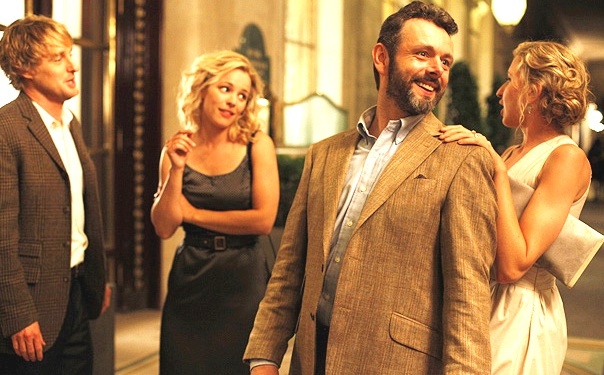
While Gil and Inez wander the city with her parents, they bump into Inez's old friends Paul and Carol (Michael Sheen, Nina Arianda) and soon the two couples visit all the sites together where Paul, an unctuous know-it-all on all subjects makes it a point to show off his expertise to anyone and everyone, even telling the tour guide at the Rodin museum (played by French first lady Carla Bruni) that she has her facts wrongs). Paul embodies a 21st century representation of the man pontificating in a movie line in Annie Hall that Alvy fantasizes about bringing Marshall McLuhan out to chastise. Watching the laid-back Wilson do the annoyed Woody dance at this character type not only proves hilarious but a refreshing twist on the familiar routine. Every word Paul utters, of course, enthralls Inez, who believes he's as brilliant as he thinks he is. It's also a nice change of pace for Sheen to play a fictional creation for a change instead of impersonating famous British people. Paul probes Gil about the subject of his novel and at first, Gil resists discussing it, but Inez spills the beans and the movie's argument gets rolling — namely, is the grass really greener in the other era? Gil romanticizes the Paris of the 1920s, when so many great artists from America and elsewhere flocked there. Paul pooh-poohs the notion immediately. "Nostalgia is denial. Denial of the painful present," Paul declares. Inez, the woman who allegedly loves Gil and wants to spend the rest of her life with him, takes Paul's side in the browbeating. "Gil is a complete romantic. I mean he would be more than happy living in a complete state of denial," she says of her fiancé. Paul isn't able to discuss any topic unless he does it at length and in long-winded lectures, so he has to show everyone what he knows of this "syndrome." "The name for this fantasy is Golden Age thinking. The erroneous notion that a different time period is better than the one one's living in now," he pronounces.

Having had enough of being a foursome one night as Paul suggests they all go dancing, Gil begs off, choosing to return to the hotel and perhaps work on his novel. Instead, he walks the streets. As he sits on some steps, a clock strikes midnight and an old yellow Peugeot pulls up as if it's the pumpkin that turned into Cinderella's carriage. The antique automobile bears '20s-era Frenchmen and Frenchwomen (who may have been mice once — who can say?) drinking champagne and beckoning Gil to climb in for a ride. That's when the real sparkle of Midnight in Paris begins and it involves another Woody Allen venture into a magical realm. Gil doesn't speak French, so he's clueless as to what his fellow passengers might be saying as they take him to a party where everyone dresses decidedly retro. Fortunately, most of the other guests appear to be American or at least speak English, so communication isn't a problem. A young man (Yves Heck) sits at a piano, playing and singing, "Let's Do It, Let's Fall in Love." He mentions to one guest that he's a writer and they introduce him to Scott (Tom Hiddleston) and his wife Zelda (Alison Pill) — the Fitzgeralds. Gil finally realizes that
 somehow, that mysterious Peugeot took him on a very long drive — one that traveled nearly 100 years in reverse to his ideal Golden Age where he could mix and mingle with his long-dead artistic inspirations. In the past, when Allen employed these fantastical devices it began to feel as if, to paraphrase one of his oldest jokes, he'd resorted to cheating by looking into the soul of the guy sitting next to him, only in these instances, he wasn't seeing another person but staring at himself in a mirror. Magic tricks which first played a key role in the "Oedipus Wrecks" short of New York Stories would return in Curse of the Jade Scorpion and Scoop or, to a lesser extent, assume the form of magical herbs in Alice. Actual Greek choruses would arrive to comment on the action in Mighty Aphrodite or see-through characters would pop up in the form of Robin Williams in Deconstructing Harry. This is a well that Woody drinks from often except that it works best when he employs it in service of larger ideas such as in Zelig, The Purple Rose of Cairo (which I still consider his best film), and, now added to that list, Midnight in Paris. As Midnight in Paris enthralled me, a small detail leaped out early on. In both Purple Rose and Midnight, he names one of the leads Gil. In the case of Purple Rose, most tellingly, the actor that Jeff Daniels plays who creates the role of Tom Baxter, the movie character who steps off the screen and into 1930s New Jersey, bears the name Gil Shepherd, only that Gil embraces his burgeoning stardom and hopes a B-picture such as "The Purple Rose of Cairo" raises his stature high enough to nab the lead in a Charles Lindbergh biopic — as long as his doppelganger in the pith helmet doesn't wreck his career. Gil Pender in Midnight in Paris may work in the same industry, but he fears he's sold his soul to it and he wants out.
The first night that Gil takes his trip back to the 1920s he also encounters Ernest Hemingway (played by Corey Stoll in the film's most entertaining performance). Fitzgerald introduces them and Gil gets the envious position of talking writing with Papa in the movie's best exchange on writing that'll appeal to anyone who has ever put pen to paper. It begins with Gil being self-deprecating about the subject of his novel (of course, no one in the 1920s has the faintest idea what a nostalgia shop is), calling it a terrible idea. "No subject is terrible if the story is true and if the prose is clean and honest, and if it affirms grace under pressure," Hemingway tells him. Gil then works up the nerve to ask if the author would look at what he's written and offer suggestionss.
HEMINGWAY: My opinion is I hate it.
GIL: But you haven't read it yet.
HEMINGWAY: If it's bad, I'll hate it because it's bad writing. If it's good, I'll be envious and hate it all the more. You don't want the opinion of another writer.
Hemingway does offer to give Gil's manuscript to Gertrude Stein (Kathy Bates) to read, because he's always trusted her opinion. They agree to meet the following night and Gil leaves but suddenly remembers he forgot to ask Hemingway where to meet him, but when he turns back the coffeehouse has turned into a laundromat and Gil finds himself in 2010 again.
In the morning at his hotel, he attempts to explain his adventure to Inez, asking her what she'd think if he told her he met Zelda Fitzgerald and she's exactly like they had read and Scott really loves her and worries endlessly, but she hates Hemingway because he's right that she's standing in the way of his writing. When Gil completes his enthusiastic rambling, Inez replies, "I'd think you had a brain tumor." Gil manages to convince Inez to go back with him the next night to wait for the Peugeot, but she grows impatient and takes off before the clock strikes midnight. After Inez has left, the Peugeot arrives and takes him to Gertrude Stein's apartment where Hemingway awaits and Pablo Picasso (Marcial Di Fonzo Bo) paints his current mistress Adriana (Marion Cotillard), who catches the eye of both Gil and Hemingway. Despite the many larger-than-life figures than circle Adriana's world, she finds herself just as drawn to Gil — until she learns of his engagement. She also shares Gil's Golden Age thinking, While he thinks that she lives in the greatest time period, she thinks it's awful and wishes she could have been in Paris during the Belle Epoque of the late 19th century. Meanwhile Gil's behavior in the 21st century becomes so bizarre that his father-in-law-to-be hires a private eye to tail him on his midnight walks to see what Gil does on them, since he doesn't trust anyone who says such nasty things about the Tea Party.

Even when Allen had fallen into his long slump, he still had the ability to attract some pretty solid ensembles, not that they were given much to do. In Midnight in Paris, the casting shines with a mix of lesser-known performers and bigger names, all bring their A game to Allen's greatest screenplay in 17 years. In addition to Wilson and Stoll who I've mentioned, the cast's standouts include a zany single scene by Adrien Brody as Salvador Dali, Kathy Bates, Michael Sheen, Rachel McAdams, Marion Cotillard in the first performance she's given that I've enjoyed and, most worth noting, Alison Pill as Zelda Fitzgerald. Pill to me proves again she's an actress just waiting to break out. She's funny and touching here after giving a good dramatic turn in Milk and being part of the fun ensemble in Scott Pilgrim vs. the World. Given how many great lines Woody's script for Midnight in Paris delivers, it's tempting to rattle them all off, but I'm resisting the urge for those who have yet to see this charmer, but I have to mention one of my favorite gags when Gil runs into a young Luis Buñuel (Adrien de Van) and gives him an idea for a movie — basically the plot of his film
If there has been any debate about Midnight in Paris, it's been where Allen comes down in the end on the question of nostalgia and Golden Age thinking. It seems pretty obvious to me based on what Gil's last line to Adriana is, even though he sends mixed signals by having Paul, the film's most pompous character, ridicule the idea of Golden Age thinking first. Also, as others have pointed out, throughout most of Allen's career his choices in music and references have screamed nostalgia, but Midnight in Paris plays as one of the most entertaining self-critical works any artist has ever made. At the same time, Allen does acknowledge the natural reflex to long for an earlier, better time — if not in another era, at least in one's own life.
Tweet
Labels: 10s, Branagh, Buñuel, Cotillard, Fitzgerald, Hemingway, Jeff Daniels, K. Bates, Kurosawa, O. Wilson, Robin, Woody
TO READ ON, CLICK HERE


Monday, November 07, 2011
Walk on the Wild Side

By Phil
My, how times change. In 1986, Jonathan Demme’s Something Wild crackled with hip edginess. It was smart, sexy and subversive, a playful jab to family values in the Reagan era. But the passage of years hasn’t been particularly kind to the film, which saw its theatrical release 25 years ago today. While the picture still has its charms, enough to warrant the Criterion treatment earlier this year, nowadays Something Wild comes off as a bit more mild.
For Demme, the experience must have been a blast after the debacle of Swing Shift, a 1984 Goldie Hawn dramedy in which the director had lost control to the studio. Something Wild was an opportunity for the filmmaker — whose impressive oeuvre up to that point included Handle with Care and Melvin and Howard — to get back on track.
The story follows Charlie Driggs, played by Jeff Daniels, a mild-mannered banker in New York whose life is thrown for a loop after a chance encounter with a sexy free spirit named Lulu (Melanie Griffith). She catches him walking out on a bill at a corner restaurant, pegs him as a closet rebel and proceeds to pick him up in near-record time. The uptight Charlie goes along, albeit reluctantly (“I can’t just take the afternoon off! Are you nuts), but Lulu turns out to be more than he bargained for. She swipes money from a liquor store cash register, handcuffs him to a motel room bed for some raucous sex and makes a habit of testing Charlie’s ability to ditch restaurant tabs.
Eventually, she whisks Charlie away to Pennsylvania and she tells her homespun mom (Dana Preu) that they’ve been married for several months. It is there that Lulu dispenses with a brunette wig, takes off the gaudy jewelry and reveals to Charlie that her real name as Audrey Hankel.
Things quickly turn dangerous when the pair goes to Audrey’s 10th high school reunion. They run into the woman’s old flame, a disarmingly charismatic jailbird named Ray Sinclair (Ray Liotta). Audrey clearly is terrified of the guy, but Charlie doesn’t clue in until it’s too late. Ray brutally robs a convenience store, clocks Charlie and all hell breaks loose.
The jarring tonal shift of Something Wild remains its most interesting aspect. Still, Demme’s breezy direction and E. Max Frye’s quirky screenplay do provide considerable charm. The periphery is especially appealing, from a knockout soundtrack — veering from reggae to post-punk — to the film’s comforting conceit that life on the road is populated with open-hearted folks eager to lend a helping hand. Small kindnesses abound here; the picture’s most emotionally resonant moments stem from the random cashier or motel guest who Charlie and Audrey happen across on their journey.
The casting, however, is otherwise a mixed bag. Daniels certainly is likable in the Jack Lemmon Everyman role, and he displays strong comic timing as he unravels amid the force of nature that is Lulu/Audrey. But the audience is asked to suspend a staggering amount of disbelief with Melanie Griffith as that force of nature. She is a shockingly bland seductress here, making it tough to swallow that Charlie would so fully fall under her reckless spell. It almost feels as if Griffith is a placeholder for an actual performance that never quite materialized.
That void is all the more apparent when Liotta blasts onscreen. In his first major film appearance, he lends Ray Sinclair with generous doses of menace of charm — so much so that the movie winds up sagging when he isn’t around.
As a romantic comedy, Something Wild is a pleasant trifle but little more.
Tweet
Labels: 80s, Demme, Jeff Daniels, Lemmon, Liotta
TO READ ON, CLICK HERE
Monday, January 10, 2011
Peter Yates (1929-2011)

As a director, the Hampshire, England-born Peter Yates embraced a wide range of genres in the stories he brought to the silver screen, running the gamut from police thrillers to science fiction tales, from relationships dramas to beautifully rendered American slices of life, earning four Oscar nominations along the way, two for directing and two for producing. Yates has died at 81.
Though he began his career as an actor, Yates found his greatest fame behind the camera. He started doing second unit and assistant directing work on such notable films as Sons and Lovers, The Entertainer with Laurence Olivier, The Guns of Navarone and The Roman Spring of Mrs. Stone. He made his feature directing debut in 1963 with Summer Holiday, a musical romance starring pop star Cliff Richard. The following year, he turned to comedy with a film called One Way Pendulum.
For much of the mid-1960s, he worked in television, directing episodes of The Saint starring Roger Moore and Secret Agent starring Patrick McGoohan.
He returned to features in 1967 with a dramatization of the Great Train Robbery called Robbery, but it was the film he made in 1968 that made his name: Bullitt. Starring Steve McQueen as a San Francisco cop, Bullitt still contains one of the famous chase scenes in movie history, thanks largely to the hilly environs of its setting.
His next film couldn't have been more of a departure. In John and Mary, Dustin Hoffman and Mia Farrow play two people who meet at a bar, have a one night stand and then spend the next day getting to know one another.
In 1971, he helmed Murphy's War where Peter O'Toole played the title character, the sole survivor of a ship attacked by a German U-boat during World War II who washes up on an island and plots how to take out the U-boat all by himself.
With Robert Redford as his lead, 1972's The Hot Rock took Yates into the heist genre. With a script by William Goldman adapted from a Donald Westlake novel, Redford gathers his crew to steal a big diamond from a museum at the behest of an African doctor who wants it returned to his homeland. The problem: Every time they get it, they keep losing the damn thing and having to steal it again.
Yates filmed a crime classic the following year when Robert Mitchum starred in The Friends of Eddie Coyle. The next year, Yates went in a completely different direction again with the Barbra Streisand comedy For Pete's Sake.
Comedy was still on his plate in 1976 with Mother, Jugs and Speed about the competition between private ambulance companies which brought together the unusual trio of Bill Cosby, Raquel Welch and Harvey Keitel. The next year, he submerged himself with the adaptation of Peter Benchley's thriller The Deep.
His next film though, at least as far as I'm concerned, will be his legacy and remains his best. It brought him those first two Oscar nominations as he filmed Steve Tesich's brilliant script Breaking Away, a film that is as great today as it was the first time I saw it, if not better. He even served as executive producer for the short-lived television series of the movie.
Even though Tesich wrote the screenplay for his next film, Eyewitness, and it starred William Hurt and Sigourney Weaver, the film was a better idea than a movie and bit of a letdown. However, nothing could prepare for his next release, the monumentally silly sci-fi monstrosity Krull in 1983.
Fortunately, he had another 1983 offering to get the taste of Krull out of one's mouth and it earned him those final two Oscar nominations. The Dresser really was an actor's movie (literally) more than anything else as it told the story of an aging and dotty Shakespearean actor (Albert Finney) and his dresser (Tom Courtenay) who more or less serves as his protector. Both Finney and Courtenay were nominated as well.
Following The Dresser, Yates made several films, but nothing to equal those from the early portions of his career. There was Eleni with Kate Nelligan, Suspect with Cher, The House on Carroll Street with Kelly McGillis and Jeff Daniels, the wretched An Innocent Man with Tom Selleck, Year of the Comet, Roommates with Peter Falk and D.B. Sweeney, The Run of the Country with Finney and Curtain Call with James Spader.
His final two projects were made-for-television adaptations of Don Quixote and A Separate Peace.
Even with some dogs on that resume, Yates produced a helluva body of work and an eclectic one at that with several titles that will last for generations.
RIP Mr. Yates.
Tweet
Labels: Dustin Hoffman, Falk, Finney, Jeff Daniels, Keitel, Mia Farrow, Mitchum, Musicals, O'Toole, Obituary, Olivier, Redford, Sigourney Weaver, Streisand, Television, William Hurt
TO READ ON, CLICK HERE
Wednesday, August 18, 2010
Three strikes and you're out

By Edward Copeland
Think how much money could be saved the next time Noah Baumbach seeks financing for a film if instead of someone ponying up for a full-scale production, they simplify the process by simply giving him a cameraman and filming his sessions with his psychiatrist. Better yet: Don't actually film them and spare viewers from having to endure Baumbach working through his issues.
Many artists have worked through their neuroses in their art and done so in astoundingly great works of film, literature, theater and television. While Baumbach has been at it a while and I admit I haven't seen his earlier directing efforts, his last three films do so in such an overt way with such annoying and downright unlikable characters that you wish you could enter the film and slap the whole fucking lot of them.
With The Squid and the Whale, the ensemble of Jeff Daniels, Laura Linney, Jesse Eisenberg and even young Owen Kline were so good that their performances managed to overcome the script's deficiencies and make the experience of watching the film less painful than it might otherwise have been.
Then came Margot at the Wedding, which I would call insufferable if I weren't afraid it could come off as high praise for such a miserable waste of film.
While the screenplay for Greenberg is credited to Baumbach, surprisingly story credit is shared between him and his real-life wife, the gifted actress Jennifer Jason Leigh, who has a small role in this film. I hate to blame her for part of this mess as well, especially considering that she co-wrote and co-directed, with Alan Cumming, the underrated 2001 gem The Anniversary Party.
Ben Stiller stars as Roger Greenberg, recently released from a mental hospital in New York, who travels to Los Angeles to housesit for his brother while he and his wife take a trip to Vietnam. This brings Roger in contact with his brother's assistant Florence (Greta Gerwig), the only character in the film that doesn't come off at some point as an asshole.
I do have praise for one scene. When Roger decides to throw a party that somehow attracts throngs of twentysomethings, he launches into a coke-fueled speech about their generation that I do have to admit was quite funny. It was Stiller's best moment as well as the movie's. Also, I'll give Greenberg this much: It's not as painful as Margot at the Wedding was, where I dreamed of a Dynasty-style terrorist massacre to take out the entire wedding party.
I could delve further into the machinations of the story of Greenberg, but it's honestly not worth the effort. Once I finished the torture of watching the film, I would have ejected the DVD, but out of habit I checked to see what bonus features were offered. One was titled "Greenberg: A Novel Approach." In it, Baumbach, obviously suffering from delusions of grandeur, said he hoped to make a movie similar to a novel that would have been written by a Philip Roth or John Updike or Saul Bellow.
Of course, the only thing Greenberg has in common with those writing greats is that their books and Baumbach's screenplay were printed in English. To make the extra more ridiculous (before I shut it off) others involved in the film tried to compare it to classic films of the 1970s, such as something Hal Ashby might have made.
So, it's going to take a lot of convincing to get me to watch the next Noah Baumbach-directed project. I'll be nice and go easy on movies he only participates in the writing of, even though I've only liked one of those, Fantastic Mr. Fox. Next time Noah, maybe you should let your wife do the heavy lifting.
Tweet
Labels: 10s, Ashby, J.J. Leigh, Jeff Daniels, Laura Linney, Roth, Updike
TO READ ON, CLICK HERE
Monday, April 12, 2010
A Ghost Story Without a Ghost

By Ali Arikan
In Noah Baumbach’s The Squid and The Whale, Jeff Daniels’ character glibly — and, dare I say, wrongly — dismisses A Tale of Two Cities as minor Dickens. Similarly, Rebecca, Alfred Hitchcock’s Academy Award-winning 1940 film of the Daphne Du Maurier novel, has a reputation amongst informed acolytes of the director as not being emblematic of his best work. Without fully disowning it, Hitchcock also eventually came to regard the film with slight unease. Talking to François Truffaut in 1967, he famously remarked,
“It's not a Hitchcock picture; it's a novelette, really. The story is old-fashioned; there was a whole school of feminine literature at the period; and though I’m not against it, the fact is that the story is lacking in humour.”
While it’s certainly true that Rebecca is not vintage Hitchcock (Robin Wood flat out dismissed it in his 1989 classic Hitchcock’s Films Revisited), it’s impossible not to be drawn into the spectral presence of the past in the movie’s subtext, as well as the romantic melodrama. On the surface, the film is a ghost story without a ghost. The Elizabethan façade of Manderley, the centerpiece of the de Winter country estate, harbours within it a gothic interior, where the triumphs and tragedies of the past linger behind every nook and cranny as characters find themselves haunted by menacing memories. The interiors, photographed in a wonderful black and white chiaroscuro by George Barnes (for which he won an Oscar), take a life of their own, and Hitchcock hints — with his first Hollywood budget — at the sort of technical wizardry that would come to define him in the zenith of his career.

Released 70 years ago today, Rebecca’s story is familiar to most. After a particularly bizarre whirlwind romance in Monte Carlo, a young lower-middle class girl (Joan Fontaine) marries Maxim de Winter (Laurence Olivier), a recently widowed English aristocrat, and goes back with him to his magnificent Cornish mansion, managed by the domineering Mrs. Danvers (Judith Anderson), a taciturn authoritarian of a housekeeper, who revels in tormenting the new lady of the house. The young bride soon starts to suspect that something, as they say, is rotten in the estate of Manderley, as she gets enveloped in the mystery of the house, and of what happened to the former Mrs. de Winter.
Seeing it for the first time in 15 years, and aware of just what it was that happened to Rebecca that fateful night, I noticed a few personal touches that Hitchcock weaved through the narrative. The obsession with a dead woman (and her “doppelganger”), for example, would be a motif that Hitchcock would revisit in his masterwork, Vertigo (1958). Similarly, the psycho-sexual tension between the characters would be a running theme in many of the directors’ best films (though never quite as overtly sapphic or pedophilic as here). In his 1986 book, The Films of Alfred Hitchcock, Neil Sinyard compares the relationship between the unnamed heroine and the sinister housekeeper Mrs. Danvers to that of the heroine and the housekeeper in Under Capricorn (1949), the tennis-star and the psychopath in Strangers on a Train (1951), or the thief and the traffic cop in Psycho (1960). In fact, the way Hitchcock fashions a character from Manderley itself anticipates the similar approach he would employ for the Bates Motel 20 years later (both buildings are “haunted” by the presence of a woman long gone).
Hitchcock had apparently read the original novel when it was still in galleys, and tried to buy the rights, which proved too costly for the director. They were eventually purchased by David O. Selznick, who saw in the story yet another opportunity to turn an international best seller into a major hit (in fact, the film’s release was delayed by a year to clear the way for Gone With the Wind at the 1939 Oscars — or, rather, vice versa). Soon after, Hitchcock moved to the United States, and signed a seven year contract with Selznick, under which he made three films, including Rebecca (1946's Notorious began as a Selznick project, but he sold it midway through production, and was never involved in the film creatively).
Like the marriage of the central couple in the film, the relationship between the star-producer and hot-shot director was no bed of roses. Selznick wanted to stick as closely to the novel as he possibly could (there are entire paragraphs directly lifted from the novel), interfered when flourishes of Hitchcock’s style became too overt, and eventually edited the film himself. While the eventual film does contain a few nice allusions to the director’s pre-war work (the skewed close-ups of Olivier and his interrogator during the inquest are particularly delightful), it is, nonetheless, a tightly controlled Selznick picture.
Still, though, there was one thing that neither David Selznick nor Maxim de Winter could get away with in the film: murder. In the novel, Maxim admits to his bride to having murdered Rebecca, but the inquest brings a verdict of suicide, reinforced, as in the film, by the later revelation that Rebecca was suffering from cancer and would have been dead in a few months. Hollywood Production Code at the time stipulated that a murderer must be punished at the end of a film, which caused Selznick and his writers, Joan Harrison and Robert E. Sherwood, to turn Rebecca’s death into an accident. A necessity of the time, this change, nonetheless, makes the final 20 of the film following Maxim’s confession in the cottage rather anticlimactic and undramatic.

The actors also did not get along. Olivier thought Fontaine was inexperienced and wrong for the part, a feeling Hitchcock refused to alleviate. In fact, Fontaine once said that Hitchcock deliberately created strife on the set, not least to keep the novice ill at ease:
“To be honest, Hitchcock was divisive with us. He wanted total control over me, and he seemed to relish the cast not liking one another, actor for actor, by the end of the film. Now of course this helped my performance, since I was supposed to be terrified of everyone and it gave a lot of tension to my scenes. It kept him in command and it was upheaval he wanted.”
However questionable his methods were, Hitchcock, nonetheless, managed to get the best out of his actors. Fontaine is the true revelation of the film, playing with precocious gusto a flibbertigibbet with daddy issues. Olivier is a delight to watch throughout the couple’s coquetry in Monaco, especially during the breakfast scene at the hotel where Maxim is more paternal and patronising than flirtatious, which adds to the general creepiness of the couple’s relationship. I also love that particularly symbolic earlier scene at the hotel lobby with Maxim, the embonpoint Mrs. Van Hopper (Florence Bates), and Maxim’s future wife — old money, new money, and no money. If Maxim seems uncharacteristically distant and boorish during the later scenes in Manderley, surely that’s a conscious decision on Olivier’s part. Most memorable of all, though, is Judith Anderson, who, through her stern presence and economical movements, dominates every scene she is in.

Also gripping are the weird psycho-sexual themes Hitchcock hints at, to which the censors at the time seem to have turned a blind eye. Hitchcock strongly implies a lesbian relationship between Mrs. Danvers and Rebecca: look at the way Mrs. Danvers recounts how Rebecca used to undress for bed, as she shows off the draw with her knickers, and caresses Rebecca’s diaphanous silk negligee. Later, she rubs Rebecca’s fur coat on the new Mrs. de Winter’s face, a not-so-subtle allusion to cunnilingus. As we find out more about Rebecca’s penchant for playing the field, we even sympathise with Mrs. Danvers, who seems to have been nothing but a sexual plaything for Rebecca.
In fact, as in many of Hitchcock’s later works, the women in Rebecca are treated as either gauche simpletons or manipulative harpies. The men don’t come off any better; the three male leads are a distant boor, a lackey and a blackmailer. Rebecca began production just as the Second World War broke out, and maybe this unsympathetic look at the human race was a conscious creative choice by Hitchcock. We’ll never know.
Equally captivating, if bloody weird, is the relationship between Maxim and his new wife. The former proposes to her in the shower of his hotel room; “I’m asking you to marry me you little fool,” he says, charmingly. He treats her like a child, asking her to promise him never to be 36. She takes this in her stride, with Maxim as a proxy replacement for her father. As Germaine Greer observed in a 2006 article to coincide with the film’s re-release, “She has nothing else going for her. Maxim wants to marry her - not despite the fact that she is, in his phrase, a "little fool", but because of it. When she snivels, which is often, he provides the handkerchief. He orders her about unmercifully. When she knocks over a glass of port and fusses to clean it up, he orders her to leave it, as if she were a dog sniffing excrement. Every now and then, he kisses her on the top of the head, just as she does Jasper the dog. By way of endearment, he calls her ‘you sweet child’ or ‘my good child’.” This is not a relationship between two equal partners — this is two people projecting their freakish fantasies at each other (asking his wife to wear a wrap because it’s chilly, Maxim intones, “you can’t be too careful with children”). Now I am the last person on earth to talk about relationships and such, but I’ll go out on a limb and characterise this as being really rather unhealthy.
But there is one theme that Hitchcock visits in Rebecca that he would generally shy away from in his Hollywood career (except, perhaps, in 1964's Marnie), and that is, of course, issues of class. Opening Rebecca’s monogrammed address book, the new bride is terrified to see a list of honorifics. She is suppressed both by the memory of the titular ex-Mrs. de Winter and what she considers to be her social ineptitude: her fear of inadequacy, of being unable to live up to the standards set by Rebecca the person, and Rebecca the institution. The film is as much about class struggle as it is about being haunted by the past, and the ambiguous ending makes this even more blatant. And if Rebecca is, finally, not quite the perfect marriage of form and technique, it’s most certainly not for any lack of trying.
Tweet
Labels: 40s, Dickens, Fontaine, Hitchcock, Jeff Daniels, Movie Tributes, Olivier, Oscars, Selznick, Truffaut
TO READ ON, CLICK HERE
Monday, March 01, 2010
He's Fictional, But You Can't Have Everything

By Jonathan Pacheco
It's no tall order to write a tragedy set during the Great Depression, but I imagine it takes some restraint to write one where the era's circumstances aren't the immediate sources of distress. The Purple Rose of Cairo, turning 25 today, tells a heartbreaking story that's sadness comes not from the Depression's difficult times, but from one person's antidote to these hardships. This gives the relatively simple tale much more depth, for the filmmaking occupies itself not with plot and historical accuracy, but with understanding its themes — namely, reality versus fantasy, cinematic escapism, and perhaps a slight warning against this defense mechanism. And it's because of this that, though I often cite Annie Hall as my favorite Woody Allen film, I have to side with Edward: The Purple Rose of Cairo is the director at his most masterful, focused, and wise.
I would argue that it's not Cecilia's (Mia Farrow) abusive marriage to Monk (Danny Aiello) that saddens the viewer as much as her fear of doing anything about it. She'll pack a suitcase and walk out on her husband, only to return later that night. She's a naive, submissive, meek mouse of a woman, fragile physically as well as emotionally and psychologically. Her only escape from the disheartening New Jersey world around her is the local cinema. Many people turn to movies to distract them from personal troubles, but Cecilia carries it further, captivated by the film world for days at a time. She can barely function at work without breaking plates or forgetting orders due to her enraptured state.
Imagine her excitement when, after an emotionally damaging day, she watches three straight showings of the newest film in the theater, "The Purple Rose of Cairo," only to have one of the minor characters on screen take notice of her in the audience. Tom Baxter (Jeff Daniels) literally leaps off the screen and runs out of the theater with Cecilia, hopelessly in love.
Every time I watch the film, I'm impressed by Jeff Daniels' performance as Tom, straightly playing the pitch-perfect innocence the adventurer-poet is meant to embody. I'm even more amazed when Daniels shows up again as the actor who played Tom, Gil Shepherd (in town trying to convince his character to jump back into the limboed film on screen). Gil's a man desperately reaching for Hollywood stardom, making him susceptible to anyone willing to flatter him. Watch the scene where he meets Cecilia at her house to inquire about Tom's whereabouts. Gil starts the conversation with one purpose, and the next thing you know, he's taking Cecilia out for a meal, completely smitten with her; the turnaround is nothing short of astonishing, and Daniels plays it brilliantly. Every compliment Gil receives turns his character's attitude a few more degrees, and oh, how fluidly Daniels performs this transition.
Daniels' dual roles and Tom's self-aware existence aren't new to anyone who knows their Woody Allen (more recently, think of Melinda and Melinda and the literally out-of-focus Robin Williams character in Deconstructing Harry), but it's in this film that the director simply nails all of it. It's been widely quoted that this is one of the few films Allen feels turned out closest to his original vision, and I believe it. The Purple Rose of Cairo is a taut 82 minutes — always focused, even while on tangents, like when Tom unknowingly wanders into a bordello, nearly roped into an orgy. In this seemingly unrelated scene, Tom turns down sexual offers because he's completely in love with and loyal to Cecilia, and the sequence becomes an emphasis on Allen's idea that women, even working girls, desperately want to believe in the romanticism that Tom personifies. In this film, everything falls in line with the greater narrative.
Allen has often toyed with the idea of shooting films through the mind of the protagonist. Annie Hall's original cut was heavier on this concept, but the final film still supports this idea, from Alvy's words to the audience to his literal trips down memory lane. After the dead rabbit moment in the kitchen, the rest of Stardust Memories is intended to be filmed from the mind of Sandy. And everything in Deconstructing Harry, from the events to the editing, represent Harry's state of mind, not necessarily his reality. Although I never considered this during my initial viewing, I now see the events of The Purple Rose of Cairo as taking place almost exclusively in Cecilia's mind. This viewpoint takes a sad love story and turns it into a depressing tale of what this poor woman resorts to to deal with her terrible life.
Think of the film's title: "The Purple Rose of Cairo," described in the film-within-the-film as an Egyptian rose painted purple. It takes something commonly associated with romance, and perverts it to make it even more exotic. In the same way, Cecilia takes the romantic notion of escaping through movies, and one-ups it: what about escaping from a movie, or escaping into a movie? Tom relays a legend that claims the purple rose of Cairo now grows naturally within the Egyptian tomb, and so Cecilia wishes that her altered, unlikely, and unrealistic romance (first with Tom, then with Gil) can blossom into something true and natural.
When she chooses between the character of Tom and Gil the actor, she's choosing between fantasy and reality. But try to imagine her heartbreak when she realizes that her "reality," in this state of mind, is still a fantasy, as Gil jets for Hollywood the moment Tom hops back onto the screen. Cecilia's become so far removed from true reality — the reality of her trapping marriage, the reality of the depression that surrounds her — that it takes the loss of two lovers to bring her crashing back. But Allen still doesn't let us off the hook, because instead of fully accepting her true reality, Cecilia once more chooses to escape through the movies, "the true love of her life" as Edward puts it. Yes, it's sort of a beautiful tragedy when you think of it that way, but by not dealing with or fully accepting her reality, by alleviating the pain from her fantasy letdown by trying to escape into fantasy once again, Cecilia refuses to heal. She perpetuates the cycle that caused her mental breakdown to begin with. As the film fades to black, Cecilia has the same look on her face that she had shortly before Tom Baxter stepped off the screen and indulged her fantasies, and it's only a matter of time until it happens again.
While the film boasts countless laughs and even a bit of Hollywood satire, Allen firmly holds onto this one, never letting it fly apart in a wild mess. Instead, a tragic air permeates even the laughter of nearly every scene as the director crafts a balanced, cohesive film with such an emotionally important message.
Tweet
Labels: 80s, Jeff Daniels, Mia Farrow, Movie Tributes, Robin, Woody
TO READ ON, CLICK HERE
Monday, October 12, 2009
On the road to nowhere

By Edward Copeland
When a film is structured as a road trip, basically a series of vignettes, you're going to run into trouble when the characters your main protagonists meet along the way are infinitely more interesting than the film's stars are. Each time you run into a new set of potentially fascinating people, Away We Go jerks the characters away and sticks you back into the company of the two bores you began the journey with and from whom you were seeking respite.
John Krasinksi and Maya Rudolph star as Burt and Verona, a couple expecting their first child in Sam Mendes' film of Dave Eggers and Vendela Vida's screenplay. The pair are uncertain where and how to make a life. Burt would like to wed, but Verona sees no need and two take off across North America seeing friends, acquaintances and relatives to get ideas of what to do and what not to do in their future. While Krasinksi and Rudolph each have their moments, especially Krasinski, the stars are overshadowed by the characters they meet on their journey,
First, there is an all-to-brief but fun appearance by Jeff Daniels and Catherine O'Hara as Burt's parents. They are followed by hysterical turns by Allison Janney and Jim Gaffigan as a long married couple and later by Maggie Gyllenhaal and Josh Hamilton as a New Agey pair who believe they have all the answers and finally set Burt off.
The problem with Away We Go, as with most films of this sort of episodic nature, is that the structure comes prebuilt with its own inevitable series of ups and downs and some parts work better than others and the whole suffers as a result.
This is doubly the case here since we never get a good hook on who Burt and Verona are and why we should care enough to follow these two around to begin with. Away We Go isn't a bad film, it's just one that was flawed from its conception and the movie that ended up being born as a result just doesn't work.
Tweet
Labels: 00s, Jeff Daniels, M. Gyllenhaal
TO READ ON, CLICK HERE
Monday, June 01, 2009
2008-2009 Broadway Plays, Part 1

By Josh R
May is not a time of year that holds pleasant associations for anyone who’s ever survived a college education. Cramming for exams, grinding out term papers, fighting off the urge to procrastinate…to say that it can be overwhelming is the height of understatement (I would describe my mood at the tail end of my final semester as falling somewhere between immoderately frazzled and thoroughly deranged). It was never my intention to revisit this dreaded state of emotional dystopia, and yet, with a whole season’s worth of plays to discuss, and the Tony Awards looming on the not-too-distant horizon, I find myself in more or less the same spot as when I had to pull 30-odd pages on Dalton Trumbo and The Blacklist out of thin air in about 48 hours in order to graduate. The best approach — really, the only realistic approach at this point — is address everything as briefly as possible, with apologies to the shows I omit due to considerations of time, space and exhaustion.
The straight play reigned supreme on Broadway this year, with more than 20 revivals and a smattering of new works. Theatres that have traditionally housed musicals played host to tried-and-true favorites by Coward and O’Neill, as producers tried to adjust to a less friendly economy. Musicals cost money; with smaller casts and lower overheads, plays are here to stay — at least for the immediate future.
First up — the early-season entries that premiered in the fall, as well as the current crop of “new” plays (note the use of quotation marks) in contention for Tony Awards.
The most surprising production of the 2009-2010 season may well have been Ian Rickson’s glorious staging of The Seagull, in a production that transferred from London. Chekhov can be a rather dry affair, and The Seagull, while indisputably a classic, can seem pretty parched in the absence of a fresh directorial perspective. This was very much the case with the last Seagull I’d seen — a star-studded debacle in Central Park helmed by Mike Nichols featuring Meryl Streep, Kevin Kline, Philip Seymour Hoffman, Natalie Portman and a phalanx of other big-name talents. The fact that Nichols
 seemed more interested in throwing an A-list party than in interpreting the text was the least of that show’s problems — everyone seemed to be acting in a different play (and frankly, all but a few seemed mismatched with their roles). This was most assuredly not the case in Rickson’s masterful staging, which, while remaining entirely true to the spirit of the piece and the intentions of its author, didn’t treat the play like the kind of lofty classical opus to be treated with kid gloves and kept under glass like a priceless museum artifact. In much the same manner as Louis Malle’s Vanya on 42nd Street, this was The Seagull brought down to earth and demythologized — a naturalistic staging which captured the emotional truth behind the words without getting wrapped up in the profundity of them, or aiming for the formal gloss of a Masterpiece Theatre production. With his complex portrayal of a woman who can be both passionate and aloof, engaging and off-putting, breathtakingly assured and wildly insecure, Chekhov seemed to have imagined the actress Arkadina as a Molotov cocktail blended from equal parts fire and ice — and that’s exactly the way Kristin Scott Thomas played her, embodying the myriad contradictions of the character with wit, verve, and a laser-like emotional acuity. Since the production ended its limited engagement way back in December — and since Tony nominators have notoriously short memories — The Seagull and its star were conspicuously absent from the list of contenders for the big prizes.
Also lost in the shuffle was Thea Sharrock’s hugely successful revival of Peter Shaffer’s Equus — although whether that success owed itself more to
 the merits of the production than to Daniel Radcliffe’s highly publicized nude scene can remain a subject of debate (or not — something tells me all those teenage girls in attendance the day that I saw it were not hardcore Shaffer mavens). No matter how many times I see it, I’m never quite sure what to think of Equus as a play; while frequently fascinating and unfailingly provocative, it never quite seems to come together in the way that it should. Its central conflict is built around the contention that true liberation can be achieved only through madness — a conceit that the narrative doesn’t really seem to support, given that the lunatic in question seems less a free spirit than a desperately unhappy prisoner of his own warped mind. That notwithstanding, Sharrock’s highly polished staging kept the action moving even though the play’s overly cerebral passages, and Richard Griffiths delivered a performance admirable for its understatement (resisting the urge to mine so many flashy monologues for the stuff of actorly tour-de-force is no small thing). Inevitably, it was Radcliffe — in clothes and out of them — who attracted the lion’s share of the attention, although the performance lacked something in terms of shading and nuance. I’m not averse to an element of theatricality — but portraying a character who functions in a state of angry delirium doesn't necessitate shouting all of one’s lines.
The shouting was appropriate in Neil Pepe’s fall revival of David Mamet’s Speed-the-Plow, a marvelously cynical look at Hollywood power players and the ambitious hangers-on who love them (or, at least, want to ride to glory on their coattails). As a play, Speed-the-Plow isn’t quite as rich in scope as some of Mamet’s more celebrated works — nevertheless, it is a smartly calibrated, vastly entertaining example of the playwright’s craft. The action is streamlined and concise, while the dialogue, consisting mainly of sentence fragments, manages to be blunt yet elliptical at the same time. In some of his plays — particularly, it must be said, in the ones where female characters are placed front and center — Mamet’s fragmented style seems to be at odds with characterization. It feels perfectly right in Speed-the-Plow, which centers around the interactions of two jittery, over-caffeinated studio execs whose motors run so fast they can only pause long enough to communicate in sound bites. When I saw the production, these two titans of industry were played by Jeremy Piven and Raul Esparza, while the role of the seemingly demure office temp who gets caught in the crossfire was performed by Elisabeth Moss. Piven left the production mid-run amidst some controversy — something about mercury poisoning after having eaten too much salmon — and was subsequently replaced by Norbert Leo Butz and Mamet stalwart William H. Macy. Better Piven had departed under fishy circumstances than Mr. Esparza, who, I suppose, may be capable of giving a performance that is less than brilliant — I only say “may” because his most recent performances haven’t provided any evidence to that effect. On the heels of his triumphs in Company and The Homecoming, the protean star of plays and musicals delivered yet another galvanizing star turn — one which went for the jugular, and hit its target like a guided missile.

As for new plays, the story remained much as it always has on Broadway — which is to say, ‘twas slim pickins. The season’s best and most interesting new works could be found in non-for-profit off-Broadway houses — venues where the risk factor is considerably less from a financial standpoint, and greater risks can be taken on the artistic front as a result. Female playwrights made a particularly strong showing this year. Lynn Nottage’s Ruined, a modern-day version of Mother Courage set in war-torn Congo, deservedly won the Pulitzer Prize for Drama, while Gina Gionfriddo’s Becky Shaw was a sharply observed comedy of manners with a sleek contemporary twist. Sarah Kane’s Blasted — an audacious compendium of unspeakable behaviors — was perversely fascinating, while Annie Baker’s clever, inquisitive Body Awareness marked a particularly auspicious debut for an emerging playwright. If the women commanded the spotlight, the men were not entirely lacking in action; Lorenzo Pisoni’s Humor Abuse, an autobiographical account of growing up in the circus, and Chris Durang’s absurdist trifle Why Torture is Wrong and The People who Love Them were particular standouts in a off-Broadway season that offered more than its share of high points (the lows were there too…but that’s a discussion for another day).
To say that no new works to be seen on Broadway quite matched that standard is a bit misleading, since all but a few could be accurately termed “new.” The late Horton Foote’s Dividing the Estate, written and first performed in the late 1980s, made its belated Broadway bow in a limited engagement at The Booth Theatre last fall. A kindler, gentler cousin to August: Osage County, featuring a gaggle of contentious Texan siblings squabbling over their inheritance, it was warmly received by critics — if generating little in the way of excitement beyond that. Foote’s homespun, elegiac style can work to beguiling effect when plied in service of gentle stories about gentle subjects — Trip to Bountiful and Tender Mercies are the two that immediately spring to mind. It doesn’t seem entirely appropriate, though, when the subject is something as thorny as a family feud. As with many of Foote’s later works, Dividing the Estate seemed to consist mainly of rose-tinged anecdotes strung together to create a sort of careworn, dog-eared scrapbook — while the fire-and-brimstone antics of Osage County would have seemed completely out-of-place, the proceedings could have used a bit more in the way of tension and urgency. Still, the play did furnish the occasion for pitch-perfect ensemble work by cast led by Elizabeth Ashley and Gerald McRaney; deserving of special praise (and receiving the show’s lone acting nomination) was Hallie Foote, the playwright’s daughter and frequent collaborator, making a memorable impression as the passive-aggressive sister determined to grab off the biggest piece of the pie. Another “new” play — at least according to Tony eligibility rulings — was Richard Greenberg’s The American Plan, originally performed off-Broadway in the early '90s. The Manhattan Theatre Club revival, directed by David Grindley, featured expert performances by Lily Rabe, Keiran Campion and particularly the acerbic, husky-voiced Mercedes Ruehl as an imposing, fatalistic Teutonic mama who alternately coddles and smothers her hapless offspring. Fine acting aside, you could see The American Plan’s surprise twist coming from a mile away, and the pretensions of the dialogue weighed the proceedings down to a certain degree — it didn’t quite make sense for Jews on vacation in The Catskills to spend quite as much time waxing philosophical.

Something called Impressionism quickly established itself as the biggest belly-flop of the year — not even the marquee value of Jeremy Irons and Joan Allen, making their first Broadway appearances since The Real Thing and The Heidi Chronicles respectively, could keep it from closing two months ahead of schedule. Not all the news was bad, however, and other instances of starry casting paid big dividends. There was no reason to assume that Jane Fonda, who hadn’t set foot on a Broadway stage in some 40-odd years, would deliver one of the breakout performances of the season. She did just that in 33 Variations, a strange, diffuse work by I Am My Own Wife scribe Moises Kaufman, rising above the limitations of the script and showing that she’s still got the goods to take on multi-faceted roles of the non-monster-in-law variety. Fonda’s most exciting quality as a performer has always been her bracing, prickly intelligence — the performances that stand as her career high-water marks always examined the manner in which intellect can exist at odds with naked emotionalism. It’s a formula that still retains its potency; as a dying scholar trying to unravel the mysteries of Beethoven’s life and work, she was never less than compelling, even when the play itself seemed unfocused and inconsistent in its ambitions. A cutesy subplot involving a burgeoning romance between Colin Hanks and Samantha Mathis — appealing performers who work a bit too hard to be ingratiating — could have excised altogether without altering the narrative framework considerably.
If 33 Variations was, at least, a work of considerable ambition, the season’s one true non-musical smash was blissfully unencumbered by anything of the kind. I didn’t see Art, Yasmina Reza’s previous Broadway hit, or Life x 3, which did very well abroad but was less kindly received in its 2004 New York debut. Based on everything I’ve gleaned about the prolific French playwright and her oeuvre, God of Carnage doesn’t represent much of a departure for her. It’s simplistic in its aims, which is to say it has about as much depth to it as pan of water; if that statement smacks of reproach, bear in mind that, in certain instances, shallowness can be a virtue. Reza has a remarkably assured grasp of the mechanics of playwriting — one can’t fault her sense of structure, and God of Carnage is, above all things, a shrewdly constructed work of theater. It knows exactly where it’s going and exactly how to get there, moving along smoothly from start to finish without hitting any speed bumps or permitting itself to stall for a fraction of a second. If it is, essentially, a glorified sitcom given the illusion of sophistication by virtue of an upscale milieu and highbrow cultural references (a pigeon dressed up as a peacock), that doesn’t prevent it from qualifying as the most entertaining new work of the season. Two couples meet to discuss an altercation their children have had on the school playground — what begins as an informal meeting for dessert and cocktails, largely characterized by strained civility and forced politeness, quickly degenerates into a drunken, screaming free-for-all, with the type of juvenile antics that might embarrass Albee’s George and Martha (in case you were wondering, it is a comedy). It’s a foolproof recipe for success — everyone loves seeing grown-up people behaving like children, especially when those cell-phone-stealing, flower-throwing, projectile-vomiting heathens in Armani are played by actors as resourceful as the four person cast assembled by director Matthew Warchus. His rollicking, immaculately executed production gives each performer his or her moment to shine in turn — James Gandolfini and Jeff Daniels are perfectly matched as wildly contrasting combatants in what turns out to be the silliest of pissing contests, Hope Davis’ drippy passivity mutates into a kind of maniacal glee all the more hysterical for its unexpectedness, while the indispensable Marcia Gay Harden all but steals the show as the kind of self-important, highly strung culture vulture who couldn’t let any imagined slight pass if her life — or her sanity — depended upon it. You can insult her husband, but don’t dare to insult her taste.

If God of Carnage was the best production of a new work to be seen on a Broadway in 2009, honors for the best new play can be conferred upon Neil LaBute’s reasons to be pretty, currently playing at The Belasco Theatre. That may sound like a ringing endorsement, but honestly, when you look at the season’s new plays as plays — meaning what’s on the page, as opposed to what shows up on the stage — 2009 didn’t produce any classics. There were some good, solid efforts, but very little in the way of risk. Reasons to be pretty is about the gap in communication and between men and women, and specifically how that lack of understanding is fueled by male competition and insensitivity (a friend of mine remarked that all LaBute’s plays and screenplays revolve around the notion that men are pigs - she may be on to something there.) It’s a worthy effort, with sharply drawn characterization and a dramatic intensity most of the year’s other new entries lacked — and yet, it feels a bit like the writer is spinning his wheels. If you’ve seen LaBute’s other works — in addition to being a prolific playwright, he’s had success as an independent filmmaker (In the Company of Men, Your Friends and Neighbors) — you know that he’s traversed this terrain before, and isn’t breaking any new ground at this point. There’s a sense of déjà vu that comes with seeing so many different variations on a single theme; LaBute is too talented a writer to get stuck in place, striking the same notes over and over again in slightly different arrangements. While his latest effort a lot to recommend it, it can’t avoid seeming remedial.
To avoid seeming remedial myself, I’m going to leave things there for now….the portion of our program where Josh is generally underwhelmed by everything and impossible to please has reached its conclusion. Next up, I’ll tackle the flurry of revivals that arrived in the spring — which is when the wow factor really kicked in, with some marvelous productions I fully expect to bore everyone to tears going gaga over. Stay tuned…
Tweet
Labels: Albee, blacklist, E. Ashley, Gandolfini, J. Fonda, Jeff Daniels, Jeremy Irons, Kevin Kline, Kristin Scott Thomas, Malle, Mamet, Natalie Portman, Nichols, P.S. Hoffman, Streep, Theater Tribute
TO READ ON, CLICK HERE
Sunday, November 23, 2008
It's not a chick flick, but it is a damn good movie

By Edward Copeland
Before I begin expounding in earnest about why I love Terms of Endearment (which turns 25 today) so much, I'd like to talk about an old bugaboo of mine that I haven't spoken of at length on these virtual pages: There is no such thing as a chick flick. There are merely good movies, bad movies and those in between and Terms of Endearment is a very good movie and if you disagree as astronaut Garrett Breedlove so memorably says, "You need a lot of drinks." Not to break the ice, but to kill the bug you have up your ass.
Let's get this chick flick nonsense out of the way quickly so we can get on to the movie. I've enumerated my points against the phrase.
It's insulting to say something that has subject matter about women (which nine times out of 10 are written by men) will not be understood or appreciated by men if the movie is a good one. The corollary also is true as there is no such thing as a "guy movie." I've known plenty of women who have loved Die Hard as much as men.
If a male critic reviews a movie (let's say Beaches) and says it's bad, some will try to dismiss the criticism because "it's a chick flick" as if that makes it some sort of special needs child that needs its own grading scale. No. Terms of Endearment succeeds as a great movie. Beaches just sucks in a supremely mediocre way (and I'm being kind in only calling it that).
In much the same way, it assumes a "chick flick" won't appeal to any man, it assumes that all women have the same tastes. All movie opinions are subjective. I'm sure there are women who don't like Terms or Beaches or countless others saddled with that label. There's nothing wrong with them but there is something wrong with people who want to pigeonhole every member of an entire gender into one way of thinking on a subject.

Meanwhile, on to more important matters, namely the film writing and directing debut of James L. Brooks. His mark on television itself was fairly impressive: producing and writing on The Mary Tyler Moore Show and Taxi among others and later going on to executive produce The Simpsons. Very few people win three Oscars for the same movie, so Brooks' achievement with his adaptation of Larry McMurtry's novel Terms of Endearment proves quite an impressive film directing debut. His second writing-directing effort, Broadcast News, would turn out even better though Oscar failed to smile on it. Brooks' big-screen efforts since have ranged from middling (As Good As It Gets) to downright awful (Spanglish). Though
 Terms has a reputation as one of the great tearjerkers — and don't get me wrong, unless you are made of stone, tears will be shed — its essence is more that of a comedy. Brooks builds to the tonal shift quite stealthily, adding the elements of dysfunction in the marriage of Emma and Flap Horton (the too-seldom-seen Debra Winger and the underappreciated Jeff Daniels) but using the comic courtship of Aurora (Shirley MacLaine) and Garrett Breedlove (Jack Nicholson) as a counterbalance to keep it light. Brooks admits in the DVD commentary that in many ways he felt he had to do it that way so he could use the word cancer to cause a spit take late in the film. He does and it works. Perhaps Brooks' greatest feat was his invention of Breedlove, who didn't exist in McMurtry's novel, where Aurora was pursued by a vast array of suitors, a little bit of which remains in the film, but Nicholson's Oscar-winning astronaut is one of the many ingredients that lifts the movie into the stratosphere. (It's interesting that two of the best films of 1983 involved astronauts, the fictional one here and the real ones in The Right Stuff.)
In fact, Brooks' achievement would have been impossible without the cast he assembled. Some find MacLaine's Oscar-winning turn too shrill and over-the-top, but Aurora Greenway is shrill and over-the-top and, to me at least, it was the performance of MacLaine's career. Her only serious competition that year was in the very same movie and in an ideal world, she and Debra Winger would have tied because every time I watch Terms of Endearment, Winger's performance impresses me more than the last time. Watching her again, parts of Emma reminded me of a friend I loved dearly and still miss and whose birthday would have been tomorrow. Whether it's expressing pure joy or pure anger, she never strikes a false note. Bob Newhart has a reputation for doing the greatest comic telephone call routines ever. I'd make the case that Winger is the greatest telephone scene actress ever, making every one of the numerous calls between Aurora and Emma seem real and punctuating them with wit and pathos. While those three principals snagged Oscar nominations (and two won), John Lithgow also grabbed a nomination for his small but sweet role as an Iowa banker who has an affair with Emma. Jeff Daniels as Emma's disappointing husband Flap didn't earn as much attention as he should have, something that seems to have plagued Daniels to this day. Will he ever earn an Oscar nomination for anything?
The smaller roles largely were cast with local Houston-area actors and wise selections were made such as Lisa Hart Carroll as Patsy and Betty R. King as Rosie. They didn't reprise their roles in the sequel, The Evening Star, which holds the distinction of being the worst sequel ever made to an Oscar-winning best picture. Actually, I've never seen The Sting II, where Jackie Gleason and Mac Davis took over the Newman and Redford roles, but I'll give it the benefit of the doubt that it can't be worse than The Evening Star. I'd rather stick needles in my eyes than sit through The Evening Star again. Terms of Endearment, however, always will hold a place in my heart.
Tweet
Labels: 80s, Books, Debra Winger, Fiction, Jeff Daniels, Lithgow, MacLaine, Movie Tributes, Newman, Nicholson, Redford, Sequels, Television, The Simpsons
TO READ ON, CLICK HERE
Monday, February 25, 2008
It's meant to be funny?
At one point in Margot at the Wedding, a frustrated Malcolm (Jack Black) tells his fiancee Pauline (Jennifer Jason Leigh) that both she and her sister Margot (Nicole Kidman) are "fucking morons." When Jack Black is the voice of reason, you know you are probably in trouble and Noah Baumbach's film is the most excruciatingly bad moviegoing experience I've had among 2007 releases.
I can't imagine how much time Baumbach has spent in therapy in his life, but the bills must be astronomical. (If he hasn't been in therapy at all, The Squid and the Whale and this piece of shit are strong evidence that perhaps he should be sent forcibly to a mental health facility.)
While Squid worked to some extent thanks to the solid acting by Laura Linney, Jeff Daniels, Jesse Eisenberg and Owen Kline, there is no such luck with Margot at the Wedding. Baumbach even manages to drag down the talent of his wife, Leigh, whom we don't see that often anymore.
Kidman is flat-out bad and Black seems as if he dropped in from another film, a film I certainly would have rather been watching.
Ciaran Hinds shows up as Kidman's lover and as much as I disliked There Will Be Blood, I hoped that somehow Hinds could teleport the cast of Margot back to Daniel Plainview's bowling alley.
Few films I can recall have created such an array of repulsive, hateful and boring characters such as those Baumbach assembles here. The motivations for what they do don't seem to spring from their characters' inner wounds but solely from a desire on Baumbach's part to drag audiences into his own dysfunctional misery.
I have to ask Baumbach, "What did we ever do to you to deserve this?" I didn't think that anything could top Colour Me Kubrick as the worst 2007 film I saw, but Baumbach managed to pull that off with Margot at the Wedding. It's really the only superlative this film deserves.
Tweet
Labels: 00s, J.J. Leigh, Jeff Daniels, Laura Linney, Nicole Kidman
TO READ ON, CLICK HERE
Monday, September 03, 2007
First forgive yourself
By Edward Copeland
Acting truly is a wondrous talent, a gift that can raise an otherwise marginal film to a higher level as is the case with The Lookout.
Screenwriter Scott Frank (Get Shorty, Out of Sight, Minority Report) makes his directing debut with The Lookout from his own original script and while both his writing and directing bring positive elements to the film, much of the credit for the film's success really belongs to its cast, particularly Joseph Gordon-Levitt in the lead role of Chris Pratt.
Chris is a young man struggling with the after-effects of a horrifying car crash that left him with a traumatic brain injury and a large dose of guilt. Gordon-Levitt could have easily overplayed the role of a man forced to use notes to keep his mind on track but instead the actor goes the other direction and embraces stillness and quiet in the role. Eschewing histrionics helps prevent The Lookout from turning into a gimmick picture and allows the viewer to more fully invest in Chris' plight.
Unfortunately, that plight includes becoming involved in a plot to rob the bank where he does custodial work. The crime angle threatens to derail what until then is simply a compelling character study, but the strength of Gordon-Levitt and his co-stars manage to navigate the film past this potential plot bump. In particular, the two actors whose support proves incalculable are Jeff Daniels and Matthew Goode.
Daniels plays the blind burnout with whom Chris lives and who seems to have a far-better ability to see through people and things than the sighted Chris does.
Goode is a revelation. Watching the film, I had no idea who he was, playing the shady Gary who lures Chris into the bank plot. It wasn't until I watched some of the DVD's extras that I realized Goode was not only British but was the same actor who played Jonathan Rhys Meyers' brother-in-law and Scarlett Johansson's original boyfriend in Match Point. He didn't make much of an impression on me in Woody Allen's film, but Goode truly announces himself as someone to watch in The Lookout.
Still, this is Gordon-Levitt's film. He sure has come a long way from his work as a child actor and on TV's silly comedy 3rd Rock From the Sun, but The Lookout definitely proves that he is one of our finest young actors.
Tweet
Labels: 00s, Gordon-Levitt, Jeff Daniels, Johansson, Television, Woody
TO READ ON, CLICK HERE


