Wednesday, December 28, 2011
An antidote for the emptiness of existence — at least for 90 minutes

By Edward Copeland
Seventeen years later…
Woody Allen makes another good movie. That's not entirely true. Since Bullets Over Broadway's release in 1994, I have liked two of his films — Match Point in 2005 and Whatever Works in 2009. However, Midnight in Paris definitely deserves the label as the first great Woody Allen film since Bullets. As Donald Rumsfeld said of the Iraq war, it's been a long, hard slog for Woody fans who used to anxiously anticipate each new Allen offering before his films turned into retreads of previous works and tasted like a fifth night of leftovers. With Midnight in Paris, his muse returns and blesses us with a fully formed, funny, thoughtful piece of cinematic inspiration.
Most people heard the news that Midnight in Paris stood tall in the Allen canon months ago when the film opened, earning raves and becoming his highest-grossing film ever. I had to wait for DVD and retain a healthy skepticism until I saw it. I simply had no other choice. During the nearly two decades that Woody toiled in the artistic wilderness, people burned me far too often by insisting Allen's latest belonged in his win column only to discover the opposite when I viewed the film. After I finished watching Midnight in Paris, it seemed as if those 17 years had been erased magically. I actually had to check IMDb because my brain couldn't conjure the titles of some of the forgettable films he churned out in those years — Small Time Crooks, Melinda and Melinda, Scoop, Cassandra's Dream, You Will Meet a Tall Dark Stranger. That doesn't even take into account the ones so bad I couldn't bleach the stain they left on my cerebrum such as Celebrity, Curse of the Jade Scorpion and Hollywood Ending. Midnight in Paris washes away those transgressions, clears the slate and renews my hope that inside the 76-year-old filmmaker there still exists things worth saying and movies worth making.
As many of Allen's films that he doesn't star in do, Midnight in Paris features a Woody surrogate and, in what might appear to be an unlikely casting choice, Owen Wilson gets to be his stand-in here. Selecting Wilson as the Woody Allen substitute turns out to be the first of many grand decisions the writer-director makes. In fact, I'll go further and declare that Owen Wilson makes the best faux screen Woody yet (and let's hope we never endure one worse than Kenneth Branagh's in Celebrity). Wilson plays Gil Pender, a successful Hollywood screenwriter with an attractive fiancée named Inez (Rachel McAdams). The couple tag along with Inez's ultra-conservative parents (Kurt
 Fuller, Mimi Kennedy) on a trip to Paris where Inez plans to be lazy and sight-see while Gil hopes the City of Lights ignites his first attempt at writing a novel. Paris casts a spell on Pender almost immediately, even though it's raining at the time, something that annoys Inez. "Why does every city have to be in the rain? What's so wonderful about being wet?" asks Inez, a woman Gil unconvincingly describes to strangers as charming but who looks to outsiders as a high-maintenance, judgmental snob. It doesn't take long in France for Gil to suggest that they should move there, but Inez doesn't understand what's so terrible about living in Malibu and being a rich screenwriter, especially with as much trouble as Gil tells her he's having with his novel. "I'm having trouble because I'm a Hollywood hack who never gave literature a real chance until now," he replies. Pender hates his job because he doesn't write anything of value and before we even get to Allen's major themes in Midnight in Paris, he appears to be submitting himself for some self-criticism over his output in recent years. When he made the atrocious Hollywood Ending, the movie was a one-joke notion that the industry had devolved to the point that a director no one realized had gone blind could make a movie and still deliver a box-office smash. In Midnight in Paris, (at least I hope this is the case) he's taken the same complaint and aimed it inward and disposed of it in pieces of dialogue as appetizers to a bigger and better cinematic dinner. (Besides, as far as Hollywood Ending goes, I'd submit Kurosawa and Ran as a counterargument for what blind directors can accomplish.) Gil's novel's plot teases us as to what the main course will be as it tells the story of a man who owns a nostalgia shop, selling memorabilia relating to bygone days.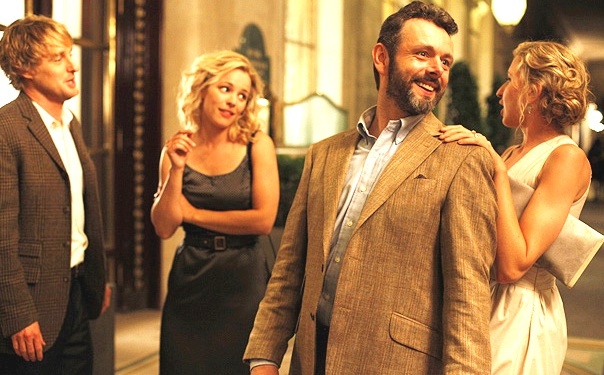
While Gil and Inez wander the city with her parents, they bump into Inez's old friends Paul and Carol (Michael Sheen, Nina Arianda) and soon the two couples visit all the sites together where Paul, an unctuous know-it-all on all subjects makes it a point to show off his expertise to anyone and everyone, even telling the tour guide at the Rodin museum (played by French first lady Carla Bruni) that she has her facts wrongs). Paul embodies a 21st century representation of the man pontificating in a movie line in Annie Hall that Alvy fantasizes about bringing Marshall McLuhan out to chastise. Watching the laid-back Wilson do the annoyed Woody dance at this character type not only proves hilarious but a refreshing twist on the familiar routine. Every word Paul utters, of course, enthralls Inez, who believes he's as brilliant as he thinks he is. It's also a nice change of pace for Sheen to play a fictional creation for a change instead of impersonating famous British people. Paul probes Gil about the subject of his novel and at first, Gil resists discussing it, but Inez spills the beans and the movie's argument gets rolling — namely, is the grass really greener in the other era? Gil romanticizes the Paris of the 1920s, when so many great artists from America and elsewhere flocked there. Paul pooh-poohs the notion immediately. "Nostalgia is denial. Denial of the painful present," Paul declares. Inez, the woman who allegedly loves Gil and wants to spend the rest of her life with him, takes Paul's side in the browbeating. "Gil is a complete romantic. I mean he would be more than happy living in a complete state of denial," she says of her fiancé. Paul isn't able to discuss any topic unless he does it at length and in long-winded lectures, so he has to show everyone what he knows of this "syndrome." "The name for this fantasy is Golden Age thinking. The erroneous notion that a different time period is better than the one one's living in now," he pronounces.

Having had enough of being a foursome one night as Paul suggests they all go dancing, Gil begs off, choosing to return to the hotel and perhaps work on his novel. Instead, he walks the streets. As he sits on some steps, a clock strikes midnight and an old yellow Peugeot pulls up as if it's the pumpkin that turned into Cinderella's carriage. The antique automobile bears '20s-era Frenchmen and Frenchwomen (who may have been mice once — who can say?) drinking champagne and beckoning Gil to climb in for a ride. That's when the real sparkle of Midnight in Paris begins and it involves another Woody Allen venture into a magical realm. Gil doesn't speak French, so he's clueless as to what his fellow passengers might be saying as they take him to a party where everyone dresses decidedly retro. Fortunately, most of the other guests appear to be American or at least speak English, so communication isn't a problem. A young man (Yves Heck) sits at a piano, playing and singing, "Let's Do It, Let's Fall in Love." He mentions to one guest that he's a writer and they introduce him to Scott (Tom Hiddleston) and his wife Zelda (Alison Pill) — the Fitzgeralds. Gil finally realizes that
 somehow, that mysterious Peugeot took him on a very long drive — one that traveled nearly 100 years in reverse to his ideal Golden Age where he could mix and mingle with his long-dead artistic inspirations. In the past, when Allen employed these fantastical devices it began to feel as if, to paraphrase one of his oldest jokes, he'd resorted to cheating by looking into the soul of the guy sitting next to him, only in these instances, he wasn't seeing another person but staring at himself in a mirror. Magic tricks which first played a key role in the "Oedipus Wrecks" short of New York Stories would return in Curse of the Jade Scorpion and Scoop or, to a lesser extent, assume the form of magical herbs in Alice. Actual Greek choruses would arrive to comment on the action in Mighty Aphrodite or see-through characters would pop up in the form of Robin Williams in Deconstructing Harry. This is a well that Woody drinks from often except that it works best when he employs it in service of larger ideas such as in Zelig, The Purple Rose of Cairo (which I still consider his best film), and, now added to that list, Midnight in Paris. As Midnight in Paris enthralled me, a small detail leaped out early on. In both Purple Rose and Midnight, he names one of the leads Gil. In the case of Purple Rose, most tellingly, the actor that Jeff Daniels plays who creates the role of Tom Baxter, the movie character who steps off the screen and into 1930s New Jersey, bears the name Gil Shepherd, only that Gil embraces his burgeoning stardom and hopes a B-picture such as "The Purple Rose of Cairo" raises his stature high enough to nab the lead in a Charles Lindbergh biopic — as long as his doppelganger in the pith helmet doesn't wreck his career. Gil Pender in Midnight in Paris may work in the same industry, but he fears he's sold his soul to it and he wants out.
The first night that Gil takes his trip back to the 1920s he also encounters Ernest Hemingway (played by Corey Stoll in the film's most entertaining performance). Fitzgerald introduces them and Gil gets the envious position of talking writing with Papa in the movie's best exchange on writing that'll appeal to anyone who has ever put pen to paper. It begins with Gil being self-deprecating about the subject of his novel (of course, no one in the 1920s has the faintest idea what a nostalgia shop is), calling it a terrible idea. "No subject is terrible if the story is true and if the prose is clean and honest, and if it affirms grace under pressure," Hemingway tells him. Gil then works up the nerve to ask if the author would look at what he's written and offer suggestionss.
HEMINGWAY: My opinion is I hate it.
GIL: But you haven't read it yet.
HEMINGWAY: If it's bad, I'll hate it because it's bad writing. If it's good, I'll be envious and hate it all the more. You don't want the opinion of another writer.
Hemingway does offer to give Gil's manuscript to Gertrude Stein (Kathy Bates) to read, because he's always trusted her opinion. They agree to meet the following night and Gil leaves but suddenly remembers he forgot to ask Hemingway where to meet him, but when he turns back the coffeehouse has turned into a laundromat and Gil finds himself in 2010 again.
In the morning at his hotel, he attempts to explain his adventure to Inez, asking her what she'd think if he told her he met Zelda Fitzgerald and she's exactly like they had read and Scott really loves her and worries endlessly, but she hates Hemingway because he's right that she's standing in the way of his writing. When Gil completes his enthusiastic rambling, Inez replies, "I'd think you had a brain tumor." Gil manages to convince Inez to go back with him the next night to wait for the Peugeot, but she grows impatient and takes off before the clock strikes midnight. After Inez has left, the Peugeot arrives and takes him to Gertrude Stein's apartment where Hemingway awaits and Pablo Picasso (Marcial Di Fonzo Bo) paints his current mistress Adriana (Marion Cotillard), who catches the eye of both Gil and Hemingway. Despite the many larger-than-life figures than circle Adriana's world, she finds herself just as drawn to Gil — until she learns of his engagement. She also shares Gil's Golden Age thinking, While he thinks that she lives in the greatest time period, she thinks it's awful and wishes she could have been in Paris during the Belle Epoque of the late 19th century. Meanwhile Gil's behavior in the 21st century becomes so bizarre that his father-in-law-to-be hires a private eye to tail him on his midnight walks to see what Gil does on them, since he doesn't trust anyone who says such nasty things about the Tea Party.

Even when Allen had fallen into his long slump, he still had the ability to attract some pretty solid ensembles, not that they were given much to do. In Midnight in Paris, the casting shines with a mix of lesser-known performers and bigger names, all bring their A game to Allen's greatest screenplay in 17 years. In addition to Wilson and Stoll who I've mentioned, the cast's standouts include a zany single scene by Adrien Brody as Salvador Dali, Kathy Bates, Michael Sheen, Rachel McAdams, Marion Cotillard in the first performance she's given that I've enjoyed and, most worth noting, Alison Pill as Zelda Fitzgerald. Pill to me proves again she's an actress just waiting to break out. She's funny and touching here after giving a good dramatic turn in Milk and being part of the fun ensemble in Scott Pilgrim vs. the World. Given how many great lines Woody's script for Midnight in Paris delivers, it's tempting to rattle them all off, but I'm resisting the urge for those who have yet to see this charmer, but I have to mention one of my favorite gags when Gil runs into a young Luis Buñuel (Adrien de Van) and gives him an idea for a movie — basically the plot of his film
If there has been any debate about Midnight in Paris, it's been where Allen comes down in the end on the question of nostalgia and Golden Age thinking. It seems pretty obvious to me based on what Gil's last line to Adriana is, even though he sends mixed signals by having Paul, the film's most pompous character, ridicule the idea of Golden Age thinking first. Also, as others have pointed out, throughout most of Allen's career his choices in music and references have screamed nostalgia, but Midnight in Paris plays as one of the most entertaining self-critical works any artist has ever made. At the same time, Allen does acknowledge the natural reflex to long for an earlier, better time — if not in another era, at least in one's own life.
Tweet
Labels: 10s, Branagh, Buñuel, Cotillard, Fitzgerald, Hemingway, Jeff Daniels, K. Bates, Kurosawa, O. Wilson, Robin, Woody
TO READ ON, CLICK HERE


Friday, May 06, 2011
As good as he seems to get anymore

By Edward Copeland
Last year's How Do You Know is the first feature James L. Brooks has written and directed in 23 years that almost works. Actually, I'm just being kind because I still have affection for the man. What the hell happened to him that I have to rate his work now on how much more or less painful than Spanglish it is?
Brooks wrote and directed two of my favorite films, Terms of Endearment and the even better Broadcast News. He also produced films such as Say Anything, The War of the Roses and Bottle Rocket. On television, he co-created The Mary Tyler Moore Show, Taxi and The Simpsons.
So went wrong? It's not that the movies he's made since 1987 were without charms. I enjoyed many parts of the de-musicalized I'll Do Anything starring Nick Nolte, but it was a miss (even though I'd still love to see those cut musical numbers. DVDs were invented for extras like that.)
As Good As It Gets had very good performances by Jack Nicholson and Greg Kinnear, but the storyline was very unfocused and the film as a whole was sunk when it hit the iceberg known as Helen Hunt's Oscar-winning performance, with its Bronx accent that would appear, then disappear, then reappear, then turn into some other sort of accent altogether. Supposedly, the point was that her character makes Nicholson's a better man. Honestly, I imagine she would add to his mental problems.
Then came Spanglish. Adam Sandler is unbearable enough in his comedies that give lowbrow a bad name, but somehow he becomes even worse when he tries to play it straight and serious as he does in Spanglish. What makes this mess of a movie even more of an amazing achievement (in a negative way) is that Sandler isn't its most annoying character. That title goes to Tea Leoni as Sandler's messed-up wife Deborah who fluctuates between shrew, politically concerned citizen, manic depressive and so many other troublesome traits I'm surprised her character wasn't named Sybil.
Coming from Brooks, who created or brought to the big and small screen so many great female characters such as Holly Hunter's Jane Craig in Broadcast News, Shirley MacLaine and Debra Winger's Aurora and Emma in Terms of Endearment and Mary Tyler Moore and Valerie Harper's Mary Richards and Rhoda Morgenstern on The Mary Tyler Moore Show and Rhoda, to name a few. As A.O. Scott wrote in his review of Spanglish, describing Leoni's Deborah:
...Deborah, a creature whose flailing awfulness goes beyond the requirements of comic villainy and exposes an ugly, punitive strain of misogyny at the heart of a movie that basks in its own sense of decency. Coming from Mr. Brooks, this is more than a little shocking, since strong, interesting, complicated women have been something of a specialty for him.
The longer you get away from your viewing of How Do You Know, the more it dissipates in your mind, but while you watch it, it's pleasant and entertaining enough not to cause the viewer anguish. Much of the credit for this shouldn't go to Brooks' screenplay, but to the charming presences of stars Reese Witherspoon, Owen Wilson and, most particularly, Paul Rudd.
Rudd and Witherspoon really have the lead roles of How Do You Know in parts that run on parallel tracks for much of the film while Wilson serves a mostly supporting function.
Witherspoon stars as Lisa, a legendary member of the U.S. Olympic softball team, but she's aging (all of 31!) and though she's worshipped by her younger teammates, the new coach (Dean Norris, Hank on "I can't wait until July" Breaking Bad) decides it's time to cut her loose. On the rebound. she throws herself into dating Matty (Wilson), a hugely successful Major League Baseball player who always offers a fun time but who doesn't seem to have an idea about the concept of monogamy.
Rudd plays George, who has the top job at his father Charles' financial firm, though one gets the impression that George functions largely as a figurehead while those below him and his father (Jack Nicholson) above do the heavy lifting. This changes when he's hit with a federal subpoena indicating that George may be the target of a criminal investigation. The screenplay keeps the details very sketchy but it's obvious early on who is really responsible for wrongdoing, especially by the constant hints his very pregnant assistant Annie (Kathryn Hahn) keeps trying to make.
The unraveling of George's life does serve as a catalyst for him to start doing things differently, especially after his girlfriend (Shelley Conn), who never had any interest in his life anyway, dumps him when his legal problems start, promising to return when they are over.
What starts as a strange call where George apologizes to Lisa for not calling to ask her out because a mutual friend gave him her number later turns into the predictable platonic path between the two as Lisa tries hard to make it work with Matty. The steps of the film aren't surprising in the least and Brooks really doesn't come up with any lines close to the classics he produced in his first two films as a director, but Rudd, Witherspoon and Wilson make it watchable. (Hahn deserves kudos as well.)
Nicholson, who remains one of my all-time favorites and has been served well by Brooks, who directed him to two Oscar wins and a fun extended cameo in Broadcast News, seems adrift in How Do You Know. Except for his speech that was played to overkill in ads and trailers about how he can't trust himself not to manipulate his son and that he could be doing it right then.
Rudd, who finally broke out once he pretty much devoted himself as a comic actor, keeps How Do You Know going. He can get laughs just from facial expressions, as if his face were made of rubber. Witherspoon and Wilson also have moments, but Rudd helps you forget while you watch that you know everything that is going to happen and the film lacks inspiration.
I've already forgotten most of How Do You Know and it's highly unlikely that I'll ever see it again, but at least it's no Spanglish.
Tweet
Labels: 10s, Breaking Bad, Debra Winger, Holly Hunter, MacLaine, Nicholson, Nolte, O. Wilson, Oscars, Paul Rudd
TO READ ON, CLICK HERE
Wednesday, February 03, 2010
Crazy like a director

By Edward Copeland
My first exposure to Wes Anderson were the great Rushmore and The Royal Tenenbaums, films original and entertaining enough to make me think I had a new young filmmaker to look forward to. Then came the misfire The Life Aquatic With Steve Zissou followed by the dreadful Darjeeling Limited and it began to look as if Anderson was repeating himself to very diminishing returns. With Fantastic Mr. Fox, Anderson goes in a completely unexpected direction and this delight may be the palate cleanser he and I both needed.
Based on a Roald Dahl book that I've never read, Fantastic Mr. Fox is an animated film, but not like the animation we've been conditioned to see of late. Not the multi-dimension, computer-designed Pixar magic, not the old-fashioned two-dimensional type pioneered by Disney or even the popular Japanese anime. Anderson has went back to an older style and chosen stop-motion animation and enlisted a class of top-notch voice talent and breakneck pacing to create something more than just a family film.
George Clooney voices the title role. Imagine Ocean's 11 retold where Danny Ocean is a fox, his crew is made up of woodland creatures and the objects of the heist isn't the loot of a casino but chickens and cider, and you get a general idea of the story of Fantastic Mr. Fox.
As the film opens, Mr. Fox and his bride (Meryl Streep) get caught as they try to steal some chickens. As they hang in a cage, Mrs. Fox reveals that she's with child. Fast forward to 12 years later where the Foxes are living the woodsy version of a suburban life with their insecure son Ash (Jason Schwartzman), jealous of an athletic visiting cousin (Eric Anderson). Unfortunately, Mr. Fox has that old itch. He tries to satisfy it by purchasing a larger tree home in a shady neighborhood that his friend Badger (Bill Murray) warns him against.
What's really eating at Mr. Fox is not where he lives, but how he lives. He misses the game. Stealing chickens from farmers is in his nature and he convinces his dense possum pal Kylie (Wally Wolodarsky) to help him do, in the best of thieves' cliches, "one last job." It's actually three jobs and one thing Fox didn't count on was that one of the victimized farmers, a ruthless man named Franklin Bean (Michael Gambon), will do every thing short of nuclear war to get revenge.
In addition to the wonderful sets and characters with their meticulous detail, there also is a very nice instrumental score by Alexandre Desplat.
Stop-motion may be a pain-staking process, but at the pace Anderson moves the film along, it sure doesn't show. Fantastic Mr. Fox also proves to be the first time Anderson co-wrote a script with someone other than Owen Wilson (this time it's Noah Baumbach) that actually turns out to be a success. Fantastic Mr. Fox is just plain fun.
Tweet
Labels: 00s, Animation, Disney, Gambon, George Clooney, Murray, O. Wilson, Pixar, Streep, Wes Anderson
TO READ ON, CLICK HERE
Monday, October 29, 2007
A rut of not-so-many colors
By Edward Copeland
At the very beginning of The Darjeeling Limited (not counting the Hotel Chevalier prologue), we see Bill Murray in a cab speeding through Indian streets, rushing to meet a train that he just misses catching. Once Wes Anderson's latest cinematic ride is over, I wished I'd stayed with Murray at the train station where it's possible I could have found a better and more interesting movie.
Watching The Darjeeling Limited after Wes Anderson's last disappointment, The Life Aquatic With Steve Zissou, I can't help but wonder if what's gone off course in Anderson's films is not having Owen Wilson as his writing collaborator.
I loved Rushmore and The Royal Tenenbaums and I liked Bottle Rocket, but Anderson's work with other writers (Roman Coppola and co-star Jason Schwartzman here, Noah Baumbach in Life Aquatic) seems to lack the essential fun and magic the Anderson-Wilson screenplays were able to conjure.
What's left in both cases seem to be sets, shots and even color schemes out of a Wes Anderson movie, but with nothing of interest to bring the productions alive. The Darjeeling Limited seems even more aimless than Life Aquatic did, with Anderson calling on most of the same stable of actors (Wilson, Schwartzman, Anjelica Huston) to sound pretty much the same notes they have in his other films.
The one thing that sets Darjeeling Limited slightly apart is the addition of Adrien Brody, who manages to shake up the usual formula a bit by bringing his own strange chemistry to the mix and most of the best moments of the movie are thanks to him.
I got to see the latest prints of the movie which include the short film Hotel Chevalier in front of it, a short that has received more praise than The Darjeeling Limited itself. Even that wasn't that interesting to me, though I think it earned kudos just because it ends more quickly than the main feature.
It's easy to see why they added it though, to explain what otherwise would look like a wordless cameo by Natalie Portman late in the film. On the other hand, it also undercuts some of the movie's closing lines about Owen Wilson's character not knowing the whole story when the audience does.
With Wilson's personal problems of late, I wish him only the best, but I do wish he'd step back behind the keyboard, with or without Anderson. Anderson is a very idiosyncratic filmmaker, but that runs risks after awhile.
Think of all the duds another filmmaker, Woody Allen, had in the '90s when his best offering, Bullets Over Broadway, happened to have a collaborator on the screenplay.
Anderson hasn't been flying solo on his scripts, but he hasn't found anyone who meshes with him as well as Wilson did. With The Darjeeling Limited, Anderson has come up with his second film in a row that plays as the dullest form of deja vu you can imagine, right down to the similar slow-motion shots of actors walking to background music.
The Darjeeling Limited is an even bigger disappointment than Life Aquatic was, but I still hold out hope that Anderson can right his ship.
Tweet
TO READ ON, CLICK HERE
At the very beginning of The Darjeeling Limited (not counting the Hotel Chevalier prologue), we see Bill Murray in a cab speeding through Indian streets, rushing to meet a train that he just misses catching. Once Wes Anderson's latest cinematic ride is over, I wished I'd stayed with Murray at the train station where it's possible I could have found a better and more interesting movie.
Watching The Darjeeling Limited after Wes Anderson's last disappointment, The Life Aquatic With Steve Zissou, I can't help but wonder if what's gone off course in Anderson's films is not having Owen Wilson as his writing collaborator.
I loved Rushmore and The Royal Tenenbaums and I liked Bottle Rocket, but Anderson's work with other writers (Roman Coppola and co-star Jason Schwartzman here, Noah Baumbach in Life Aquatic) seems to lack the essential fun and magic the Anderson-Wilson screenplays were able to conjure.
What's left in both cases seem to be sets, shots and even color schemes out of a Wes Anderson movie, but with nothing of interest to bring the productions alive. The Darjeeling Limited seems even more aimless than Life Aquatic did, with Anderson calling on most of the same stable of actors (Wilson, Schwartzman, Anjelica Huston) to sound pretty much the same notes they have in his other films.
The one thing that sets Darjeeling Limited slightly apart is the addition of Adrien Brody, who manages to shake up the usual formula a bit by bringing his own strange chemistry to the mix and most of the best moments of the movie are thanks to him.
I got to see the latest prints of the movie which include the short film Hotel Chevalier in front of it, a short that has received more praise than The Darjeeling Limited itself. Even that wasn't that interesting to me, though I think it earned kudos just because it ends more quickly than the main feature.
It's easy to see why they added it though, to explain what otherwise would look like a wordless cameo by Natalie Portman late in the film. On the other hand, it also undercuts some of the movie's closing lines about Owen Wilson's character not knowing the whole story when the audience does.
With Wilson's personal problems of late, I wish him only the best, but I do wish he'd step back behind the keyboard, with or without Anderson. Anderson is a very idiosyncratic filmmaker, but that runs risks after awhile.
Think of all the duds another filmmaker, Woody Allen, had in the '90s when his best offering, Bullets Over Broadway, happened to have a collaborator on the screenplay.
Anderson hasn't been flying solo on his scripts, but he hasn't found anyone who meshes with him as well as Wilson did. With The Darjeeling Limited, Anderson has come up with his second film in a row that plays as the dullest form of deja vu you can imagine, right down to the similar slow-motion shots of actors walking to background music.
The Darjeeling Limited is an even bigger disappointment than Life Aquatic was, but I still hold out hope that Anderson can right his ship.
Tweet
Labels: 00s, A. Huston, Murray, Natalie Portman, O. Wilson, Wes Anderson, Woody
TO READ ON, CLICK HERE
Wednesday, April 11, 2007
Running on fumes
By Edward Copeland
Perhaps it was too much to expect Pixar to hit every film out of the park. Granted, I've liked some more than others, but now that I've finally seen Cars I can truly say this is the first Pixar effort I flat out didn't like. Combined with the 20 minutes of Happy Feet I could stomach, this now makes Monster House not winning the Oscar seem like an even bigger outrage.
For one thing, Cars is entirely too long, coming close to running a full two hours. I thought The Incredibles was too long, but at least it was entertaining enough to make up for it. Cars is the first Pixar movie that seemed so formulaic to me to be a true disappointment.
Lightning McQueen (Owen Wilson), the protagonist of Cars, is a shallow, egotistical character who thinks only of himself and says he doesn't need anyone else. Nothing wrong with that in a character, but was there ever any doubt that by the film's end, the racing car would see the errors of his/its ways?
As a result, Cars doesn't move at the pace you'd expect from a high-speed vehicle but instead plods along as we await Lightning's inevitable transformation. Even the moments of ingenuity that I've come to expect from Pixar were few and far between. (For me, the best moment in that regard was turning cow tipping into tractor tipping.)
Cars produced a reaction in me I didn't think I'd have to a Pixar movie: boredom. Granted, their track record has been so good so far (they couldn't have kept up that pace forever), but it doesn't change the fact that Cars is the worst movie I've seen from the folks at Pixar. Monster House was robbed.
Tweet
TO READ ON, CLICK HERE
Perhaps it was too much to expect Pixar to hit every film out of the park. Granted, I've liked some more than others, but now that I've finally seen Cars I can truly say this is the first Pixar effort I flat out didn't like. Combined with the 20 minutes of Happy Feet I could stomach, this now makes Monster House not winning the Oscar seem like an even bigger outrage.
For one thing, Cars is entirely too long, coming close to running a full two hours. I thought The Incredibles was too long, but at least it was entertaining enough to make up for it. Cars is the first Pixar movie that seemed so formulaic to me to be a true disappointment.
Lightning McQueen (Owen Wilson), the protagonist of Cars, is a shallow, egotistical character who thinks only of himself and says he doesn't need anyone else. Nothing wrong with that in a character, but was there ever any doubt that by the film's end, the racing car would see the errors of his/its ways?
As a result, Cars doesn't move at the pace you'd expect from a high-speed vehicle but instead plods along as we await Lightning's inevitable transformation. Even the moments of ingenuity that I've come to expect from Pixar were few and far between. (For me, the best moment in that regard was turning cow tipping into tractor tipping.)
Cars produced a reaction in me I didn't think I'd have to a Pixar movie: boredom. Granted, their track record has been so good so far (they couldn't have kept up that pace forever), but it doesn't change the fact that Cars is the worst movie I've seen from the folks at Pixar. Monster House was robbed.
Tweet
Labels: 00s, Animation, O. Wilson, Pixar
TO READ ON, CLICK HERE


