Wednesday, June 26, 2013
Different ways of playing 'Cards'

BLOGGER'S NOTE: This post contains spoilers for the three segment British miniseries House of Cards from the 1990s starring Ian Richardson and this year's 13-episode U.S. version made for Netflix, produced by David Fincher and starring Kevin Spacey. If you plan to watch either version and haven't yet, read no further.
By Edward Copeland
After giving people time to watch the American version of House of Cards and with its availability on DVD and Blu-ray for those without access to Netflix Instant, I thought enough time had transpired to discuss both the new version as well as the original BBC miniseries, whose first part premiered in 1990. Prior to watching the David Fincher-produced D.C.-set House of Cards with Kevin Spacey playing the wily lead, I felt I needed to see the British version to see how well the differences translated. (Obviously, Britain's parliamentary system of government works quite differently from our legislative branch — which, in its current state, doesn't work at all, but House of Cards exists in the land of make-believe. I lacked either the time or the energy given personal matters to attempt to read the novel by Michael Dobbs that spawned the BBC miniseries.)

Though the new version pads out its story to 13 roughly one-hour episodes while the first of the three British House of Cards miniseries told mostly the same story in four episodes of approximately the same length, the U.S. take does hit many of the same plot points except when it comes to the ending, but the makers of the U.S. House of Cards envision it as a continuing series. (I needn't have watched the second and third BBC miniseries, To Play the King and The Final Cut, since the stories in those sequels aren't covered in the first season of the U.S. House of Cards.) Both versions of the political chicanery, whether set here or across the pond, offer solid entertainment and mostly solid performances, though the U.S. House of Cards wins out in terms of production values. Unfortunately, when it comes to the battle of FUs (Francis Urquhart in the U.K., Francis Underwood in the U.S.), the late Ian Richardson wins hands down. Spacey proves capable as usual for the most part, but he burdens himself with an off-and-on Southern drawl that's wholly unnecessary and, at times, a major distraction. When Richardson's Urquhart speaks to the viewer in his well-mannered, upper-crust tone, it always works. When Spacey's Underwood attempts to pull it off while simultaneously putting on a generic son of the South voice for his South Carolina representative, at times it comes off as too cutesy by half.
Despite the differences in forms of government, both House of Cards begin with essentially the same kernel of a motivation for our two Francises. In the 1990 BBC version, Urquhart has served faithfully as an MP of the Conservative Party, functioning as their Chief Whip under Margaret Thatcher's reign as prime minister. In its fictionalized view of history, Thatcher's loss of support has led to her resignation and while the Conservatives look bound to keep a weakened majority hold of the British government, Urquhart expects
 the new prime minister, Hal Collinridge (David Lyon, whose death at 72 was announced today), to appoint him to a long-sought Cabinet position and remove him from his duties as whip. Instead, with the slimmer majority, Collinridge decides not to shake up the Cabinet and an angry Urquhart starts maneuvering many people to get his revenge and build his own rise to power. In the 2013 U.S. take on the tale, Underwood long has held the title of Democratic Whip in the House, now the Majority Whip as a new Democratic president (not Barack Obama), Garrett Walker (Michael Gill), takes office. but Walker reneges on a promise to pick Underwood as his secretary of state. This begins Underwood's convoluted maneuvering. One problem that separates the two versions comes down to logic. You see why Urquhart longs to become the prime minister himself, but if you know U.S. history, it seems downright silly for Underwood to leap through all the hoops and commit all the deeds he does just to end up as vice president. When George H.W. Bush won the presidency, he was the first sitting vice president to manage the victory in his own right since Martin Van Buren. Unless Underwood plans to kill off Walker in a subsequent season of the U.S. House of Cards, why does he see that as a plausible path to the Oval Office?
What delineates our two Francises (the U.S. version only uses the FU joke once as its expected, vulgar stand-in by some of Underwood's opponents while the BBC call Urquhart FU frequently and affectionately by both friends and foes to his face without a hit of a double meaning) most distinctly comes from the difference in the way Spacey acts the words by Beau Willmon and his writing staff and Richardson's delivery of Andrew Davies' dialogue. Almost everyone appears to be on to what Frank Underwood conspires to do at all times, even if his machinations win in the end since Spacey doesn't take much of an effort to hide his moves from those he attempts to manipulate. In contrast, it takes some time for people to catch on to the lengths that Francis Urquhart will go to to accomplish his means thanks to Richardson's performance, which he keeps close to his vest. Both versions rely on the conceit that the Francises speak in asides to the television viewer about what they think and plan, only Spacey talks to audiences in the same basic tone as most of the other characters. Richardson confides to us, letting us in on secrets that others aren't aware of and it makes his performance much richer and, given the late actor's training, provides Francis Urquhart with an almost Shakespearean air. Urquhart picks off opponents with a variety of means and accomplishes most of this without leaving any fingerprints. The game plan in the U.S. House of Cards differs slightly as no list of vice presidential contenders stand in Underwood's way, but they do match in terms of subject matter. Urquhart must sink health and education ministers while those two issues become legislative hurdles that play a part in Underwood's climb.

Both House of Cards include two main women in the lives of their protagonists: their wives and young reporters who become the pols' lovers as well as their tool to help advance their plots. The idea of the female journalist follows fairly closely in both versions (except where they end up in the first installment and the level of their naïveté). In the BBC, the young reporter Mattie Storin (Susannah Harker) takes a long time (too long for her sake) to catch on to Urquhart's true nature and their illicit romance takes on a somewhat twisted father figure complex where the young Mattie tends to call the much older Francis "Daddy" during their dalliances. In the U.S. version, the young woman journalist Zoe Barnes (Kate Mara) contains a much more ambitious nature and she uses Underwood as much as he uses her. Both Mattie and Zoe do make colleagues jealous with their scoops and end up booted from their newspapers, only the U.S. version updates for technological changes and makes Zoe's success come via instant blog posts and finds her gaining new employment with an online political publication. Probably due to the way Mattie is written, Harker comes off as a weaker actress than Mara, who has a more fully developed character. The bigger difference presents itself in the portrayal
 of the political wives. Elizabeth Urquhart (Diane Fletcher) truly serves as her husband's partner-in-crime. She knows of his affair with Mattie (and other women in the later installments) but approves wholeheartedly because she knows that letting him have his extracurricular activity with Mattie only serves the couple's ultimate goal and doesn't pose a threat to her position. Claire Underwood (Robin Wright) begins that way early in the U.S. House of Cards, but as the series develops she exhibits jealousy. showing up at Zoe's apartment, interfering with part of Underwood's legislative agenda and even leaving D.C. to renew an affair with a former lover, a famous photographer (Ben Daniels). Presumably, the part required beefing up in order to get someone of Wright's caliber to agree to accept it in the first place. Claire also gets her own sideline with story strands involving the charitable foundation that she runs whereas Elizabeth Urquhart basically serves as Francis' adornment at party and sounding board at home but little else.
Both versions equip our FUs with henchmen named Stamper to help him carry out the more unseemly parts of his schemes, though the portrayals as well as the job titles come off quite differently in each country. In England, Urquhart's underling, Tim Stamper, comes across as quite a weasel in the hands of actor Colin
 Jeavons. Tim Stamper functions as the Assistant Whip for the Conservatives in the House of Commons until Urquhart succeeds at ascending to the position of prime minister and Stamper moves up to Chief Whip. Later, unhappily, Urquhart moves him to the post party chairman. The British Stamper not only gets his hands dirty with delight, he also overflows with ambition himself and it costs him in the end (part of which may have been necessitated by Jeavons' decision to retire from acting after completing the second installment, To Play the King). The American Stamper gets a new first name — Doug — and does show signs of conscience even while he performs Underwood's errands. Doug Stamper serves as the House Majority Whip's chief of staff and holds no elected position. Michael Kelly, who most people will recognize him from many roles on television and in film, doesn't get down and dirty with the same glee that Jeavons does, but Kelly creates a different persona and plays him well. Odds are, depending how many seasons House of Cards continues, Doug Stamper either will turn on his boss or become a liability to him.
The one area besides production design where the U.S. House of Cards bests the British original comes from the actor who portrays Underwood's actual victim and how the U.S. version fleshes out his character in the first place. Before I began this piece, I issued a spoiler warning, but the U.S. House of Cards doesn't make it a secret that Underwood's deviousness takes a lethal turn, thanks to some of its promotional posters, and the very first sequence of the series gives viewers that impression by showing Underwood putting an injured dog out of its misery with his bare hands but making it clear that he isn't doing it to be merciful. In the British take, even though the first installment only consists of four 1-hour installments, it doesn't
 let the audience know that Urquhart's manipulations include murder. In the BBC version, the first life that Urquhart literally takes with his own hand belongs to Roger O'Neill (Miles Anderson), the P.R. consultant for the Conservative Party whom Urquhart gets to use his girlfriend, Penny Guy (Alphonsia Emmanuel), to seduce Foreign Secretary Patrick Woolton (Malcolm Tierney), one of Urquhart's competitors for the prime minister post. Unfortunately, O'Neill loves Penny as much as he loves cocaine and when she dumps him when she realizes O'Neill used her, O'Neill becomes a wild card that Urquhart can't trust. To make sure nothing comes out that damages FU's plan and reveals his role in the Woolton revelation, Urquhart spikes O'Neill's coke supply with rat poison, assuring Mattie who figures out he did it that he was just putting O'Neill out of his misery.
Overall, the American ensemble beats the British one. Granted, the U.S. version provides nine extra hours to fill with juicy parts for actors to the BBC's mere four, so the original lacks the room to develop many characters in depth so it's easy to see how Ian Richardson steals the show. Kevin Spacey, in addition to his aforementioned accent problem, shares time with a lot of great performers in parts large and small. On top of those mentioned already, Sebastian Arcelus, Reg E. Cathey, Kathleen Chalfant, Nathan Darrow, Sandrine Holt, Boris McGiver, Larry Pine, Al Sapienza, Constance Zimmer and Gerald McRaney all put in appearances. We also get three actors familiar to Treme fans in parts of various scope: Mahershala Ali, Lance E. Nichols and Dan Ziskie. The M.V.P. of the entire cast though turns out to be Corey Stoll, so great as Hemingway in
 Woody Allen's Midnight in Paris, as the U.S. equivalent of Roger O'Neill. Instead of a P.R. guy, Stoll plays Pennsylvania Rep. Peter Russo, a divorced father of two with a penchant for drugs, booze and sex, despite his deep feelings for and relationship with his chief of staff Christina Gallagher (Kristen Connolly). For those who only know Stoll from Midnight in Paris, he'll be unrecognizable. In the short number of episodes though, he takes Russo through the largest journey of any character in the series, battling to sobriety and attempting to believe in himself, unaware of his status as a pawn in Underwood's game (both Underwoods, actually), until it's too late. Stoll makes Russo the only character that the audience develops any sympathy for at all. Though Russo behaves badly, his mistakes all flow from his personal weaknesses. He doesn't do things maliciously the way that Underwood and other characters do. When he commits wrongs, it's because he can't control himself. Underwood always stays in control, even if unexpected events force him to improvise. You feel bad for Russo when he can't
 stand up for himself and acts against his own interests and those of his constituents, just to be Underwood's toady and pay him back for covering up an incident when he got caught drunk with a prostitute. You get a sense of where this comes from a in a couple of brief scenes involving Russo and his hospitalized mother (a great Phyllis Somerville) that gives you insight into Russo and makes you feel sorry for the man at the same time it provides some wickedly dark humor. When he begins to turn himself around, you develop a rooting interest for him to succeed (even though having seen the U.K. version first, I figured what fate awaited Russo, though the U.S. changes the manner of his inevitable death at Underwood's hands slightly differently). Though the U.S. House of Cards contains a lot of great acting, no one comes close to turning in a performance as wonderful as Stoll's and no character gets as much development and detail as Rep. Peter Russo.
Since the British House of Cards only ran four hours, it had a sole director, Paul Seed, and writer, Andrew Davies. Davies and Seed returned to the same roles on the second installment, To Play the King, but Seed's directing work consists almost entirely of British television. Davies wrote the third and final part, The Final Cut, but Mike Vardy took over helming duties. Similarly, his directing work stayed restricted to British TV. Davies' writing extends to film including the screenplays for Circle of Friends, Emma, The Tailor of Panama, Bridget Jones's Diary, the 2008 feature of Brideshead Revisited and the 2011 version of The Three Musketeers directed by Paul W.S. Anderson.
While Beau Willmon had a hand in writing most of the U.S. episodes, he also had a staff of writers who either contributed or turned in their own episodes. On the directing side, Fincher started the series off by directing the first two episodes while James Foley directed the most at 4 episodes and Allen Coulter, Carl Franklin, Charles McDougall and Joel Schumacher helmed two each.
In the final assessment, the U.S. House of Cards moves fairly well except at times when it feels as if it stuffed itself with too many character and plot strands and an episode set at Underwood's reunion at The Citadel that, while OK, feels and plays like filler. The U.K. House of Cards comes off as far more efficient, even if most of the characters aside from Richardson's Urquhart prove far less compelling. In the second and third parts, they do at least give him actual adversaries, which make things slightly more interesting, but in the end all the British House of Cards episodes always belong to the great Richardson and his rich and delicious
 performance. One really bizarre viewing experience for me came from the miniseries — which aired in 1990, 1995 and 1996 — incorporating Margaret Thatcher's fictional death. She died in the miniseries as I watched it before she died in real life earlier this year. Part of the subtext is that Francis Urquhart wants to break Thatcher's record for serving as prime minister longer in the post-WW2 era. One other thing that makes the British version slightly better than the American take is that the first installment ends with a great cliffhanger mystery that plays out over the course of the next two parts. The new House of Cards leaves us with reporters hot on Underwood's trail about Russo's "suicide," but it doesn't come off nearly as intriguing as the British version. I'm also curious where the U.S. version goes next. It obviously can't follow the storyline of the British To Play the King since we don't have a constitutional monarch and a newly sworn in Vice President Underwood wouldn't run into conflict with a recently crowned king. Presumably, that tension will present itself with his new boss, President Walker. It's a shame that Ian Richardson isn't with us anymore and that the third British House of Cards installment resolved the Francis Urquhart character. It might have been fun to see U.S. President Francis Underwood face off against British Prime Minister Francis Urquhart. I'd probably root for Urquhart, if only because he doesn't have that corny and awful Southern accent.
Tweet
Labels: 10s, 90s, Books, Fiction, Fincher, Hemingway, Netflix, Robin Wright, Shakespeare, Spacey, Television, Treme, Woody
TO READ ON, CLICK HERE


Friday, May 18, 2012
Centennial Tributes: Richard Brooks Part I

By Edward Copeland
"First comes the word, then comes the rest" might be the most famous quote attributed to Richard Brooks, who began his life 100 years ago today in Philadelphia as Ruben Sax, son of Jewish immigrants Hyman and Esther Sax. He wrote a lot of words too — sometimes using only images. In fact, too many to tell the story in a single post. so it will be three. His parents came from Crimea in 1908 when it belonged to the Russian Empire. Like the parents of a great director of a much later generation and an Italian Catholic heritage, Hyman and Esther Sax also worked in the textile and clothing industry. Sax's entire adult working life revolved around the written word — even while he busied himself with other tasks. “I write in toilets, on planes, when I’m
 walking, when I stop the car. I make notes. If I am working at a studio, I work at the studio in the morning, then come home. I am really writing two days instead of one. After the studio, I have my second day (at home). I write whenever I can,” Brooks said in an interview with Patrick McGilligan for his book Backstory 2: Interviews with Screenwriters of the 1940s and 1950s. After high school, he entered Temple University where he majored in journalism, though he left early when he realized the financial hardship that his tuition put on his parents. After drifting around the eastern half of the U.S. for a while by train, Sax returned to Philadelphia and got a job as s sports reporter at The Philadelphia Record where he first adopted the name of Richard Brooks. When he later got hired by The Atlantic City Press-Union, he met another reporter with an independent streak who would eventually make his way to Hollywood by the name of Samuel Fuller. Shortly after moving to New York for a job with that city's World Telegram newspaper, only leaving the sports beat behind for crime reporting. Brooks discovered that radio jobs provided bigger paychecks so he took a job at the 24-hour radio station WNEW, first as a disc jockey. "Played records 23 of those hours," McGilligan described in the introduction to his interview. Later, the station promoted him to news where he edited four news broadcasts a day newspaper jobs and wrote one. His work there led to a news job at NBC Radio's Blue Network where he also got to do commentary. At the same time, in 1938, Brooks tried his hand at playwriting, which led in 1940 to co-founding The Mill Pond Theater in Roslyn, N.Y., with David Loew. It's on that stage that Brooks made his debut as a director, taking turns with Loew helming productions at the summer theater. A falling out with other members of the theater sent Brooks to California where he worked for NBC Radio from the other coast. Among his duties was writing and directing the broadcast Richard Sands. Brooks also began writing a short story every day and reading it on air. “I’d written some short stories before, but none was published. Anyway, every day, another short story. Everything became grist for a short story. It began to drive me crazy…a different plotline every day. My ambition: write one story a week instead of a different story every day. In about 11 months, I wrote over 250 stories. I even devised a system whereby on Fridays I wouldn't have to write a short story. I called that day 'Heels of History.' I would take a fable and convert it. As a matter of fact, I used one afterwards in The Blackboard Jungle,” Brooks told McGilligan. Brooks gave the example of how he took the story of "Jack and the Beanstalk," citing how while he's portrayed as a hero, Jack's actually a dumb, bad kid who ignores his mother's order, shows little concern for an ailing fire and steal, even if it's from a giant. Granted, it doesn't appear to have been broadcast nationally but I wonder if Stephen Sondheim and James Lapine came across this when
 conceiving Into the Woods?. Witches can be right, giants can be good… Brooks, like what happened when he learned radio paid more than newspapers, discovered in California that screenwriters earned bigger paychecks than broadcasters. He set up a meeting with George Waggner at Universal, where Waggner — who later would direct The Wolf Man and much episodic TV including many installments of The Man from U.N.C.L.E. and Batman — was the assistant producer of White Savage, a Maria Montez film directed by Arthur Lubin. Waggner asked if Brooks wrote because they desperately needed a rewrite. It was his first movie job and Brooks made "$100 (weekly) plus a day or two prorated, and they put my name on (the screen) as 'additional dialogue,'" Brooks told McGilligan. White Savage wasn't the first film Brooks worked on to be released though — two others and a serial came first. He also hung on to the NBC gig and got the chance to write for Orson Welles' Mercury Theatre. Brooks produced countless sentences and paragraphs and but still lacked a "written by" credit on a screenplay credit. Once he did and, later, when he directed, he'd impact filmmaking both during and beyond his life, often with social themes few would touch (though occasionally in a heavy-handed way). He also managed to write some novels on the side — while with the Marines during World War II, where he'd also crank out a couple of screenplays (including his first credited one on Cobra Woman, directed by Robert Siodmak and again starring Montez) and report for Stars & Stripes as well while learning about filmmaking from Frank Capra's motion picture unit and eventually on his own editing combat footage into documentaries while attached to the 2nd Marines, Photographic Unit. If the Allies only needed a typewriter to defeat the Axis, Brooks might have been a good option for the weapon. First comes the word…
Though Brooks' legend derives predominantly from his film legacy, he experienced his first rush of acclaim with the publication of his debut novel, written while stationed at Quantico at night in the bathroom, according to the account in Tough as Nails: The Life and Films of Richard Brooks by Douglass K. Daniel. Several publishers rejected it until Edward Aswell at Harper & Brothers, who also edited Thomas Wolfe, agreed to take it — and he shocked Brooks further by telling him (after a few suggestions) they planned to publish in May 1945. This news flabbergasted Brooks who obtained a weekend pass to go to New York because Aswell insisted on informing him in person. Now Brooks had to return to Quantico where the top officers of the Corps about shit bricks when The New York Times published a big review of The Brick Foxhole soon after it hit shelves. (Orville Prescott's take was mixed, assessing it as compulsively readable but weak on characterization.) Its story of hate and intolerance within the Marines brought threats of court-martialing Brooks, since he'd ignored procedure and never submitted the novel to Marine officials for approval ahead of time. They wanted to avoid bad publicity, especially with all the good feelings as the war wound down. "There was nothing in that book that violated security, but their rules and regulations were not for that purpose alone," Brooks told Daniel. Aswell prepared to launch a P.R. counteroffensive with literary giants such as Sinclair Lewis and Richard Wright ready to stand by Brooks. In case you don't know the story of the novel, it concerns a Marine unit in its barracks and on leave in Washington. Through their wartime experiences, some of the men truly turned ugly, suspecting cheating wives and tossing hate against any non-white Christian. It turns out, though the real Marines let the matter drop, what bothered them
 about the book wasn't the anti-Semitism or racist tendencies of the characters but the murder of a Marine some of the other Marines learn is gay. The U.S. Marines didn't want to promote the idea there might be homosexuals serving in the military. Ironically, they got their wish when The Brick Foxhole transferred to the big screen in 1947 as Crossfire. Brooks wasn't involved in the film version, but they made the murdered Army (The Marines even got to toss it off to another military branch entirely) soldier Jewish in the film. The film actually happens to be very good and was nominated for best picture and earned Robert Ryan his only Oscar nomination ever as supporting actor. What's even sadder is that Crossfire ends up being a much more powerful film against anti-Semitism than the creaky Gentleman's Agreement that took on the same subject that year and won best picture. If there weren't already enough ironic twinges in that story for you, Gentleman's Agreement, probably the grandfather of that tried-and-true staple "let a white guy be the hero of a story about another ethnic group" with Gregory Peck playing a Christian going undercover as a Jew to learn about anti-Semitism, won Elia Kazan his first directing Oscar. Edward Dmytryk, one of The Hollywood Ten, directed Crossfire, which dealt straight on with anti-Semitism and the effects of warfare on men. Then again, once Dmytryk served his jail time, he became the only one of the 10 to name names to HUAC because he wanted to work again.
While he didn't want to make a movie of The Brick Foxhole himself, another former newspaperman turned socially conscious film artist met with Brooks about working with his independent production company. At first, Mark Hellinger tried to lure Brooks away from Universal with the promise of doubling his salary if he'd adapt a play he liked into a movie, but before Brooks could consider that offer, Hellinger called with a more pressing matter. He was producing an adaptation of Ernest Hemingway's famous short story The Killers. The problem: someone had to dream up what happened after the brief tale ends because it certainly wouldn't last 90 minutes otherwise. Hellinger flew Brooks out to meet Papa himself, but he didn't get much out of him but he did come up with an idea for what would happen after the story ends. Hellinger liked it and sent it to John Huston, who wrote the screenplay as a favor. Since both Brooks and Huston had contracts at other studios, neither got screen credits, so Ernest Hemingway's The Killers' official screenplay credit goes to Anthony Veiller, who received an Oscar nomination for best screenplay. He'd previously shared a nomination in the same category for Stage Door. The film also made a star out of Burt Lancaster, who would work with Brooks several times and be his lifelong friend. In fact, Lancaster would star in the next screenplay that Brooks wrote, a Mark Hellinger production directed by one of those people Edward Dmytryk eventually would name before the House Un-American Activities Committee. The film, of course, would be the still-powerful Brute Force, the director, Jules Dassin.


John Huston wasn't happy. Producer Jerry Wald called him, excitement in his voice, to tell him he'd secured the rights to Maxwell Anderson's Broadway play Key Largo for Huston to direct. This didn't thrill Huston, who thought the play gave new meaning to the word awful. Written in blank verse, Anderson's play concerned a deserter from the Spanish-American War. People at a hotel do get taken hostage, but by Mexican hostages. Essentially, Huston tossed the play in the trash bin. Huston hired Brooks to co-write an in-title only version and, still pissed at Wald, barred him from the set. Part of Huston's anger stemmed from the HUAC nonsense, (His outrage would drive him to move to Ireland for a large part of the 1950s.) so he couldn't stomach adapting a play by Anderson whom he considered a reactionary because of his hate of FDR. Despite Huston's distaste for the project, he
 turned it into a classic film with a little help from Humphrey Bogart, Lauren Bacall, Lionel Barrymore, Claire Trevor in her Oscar-winning role and, last but certainly not least, Edward G. Robinson as exiled mobster Johnny Rocco, who likes to brag about the power he used to wield. "I made 'em — like a tailor makes a suit of clothes," he tells a former associate. Knowing the story of what happened prior to filming makes you chuckle when you see the credit that reads, "As Produced on the Spoken Stage." It's great to watch Robinson and Bogart go toe-to-toe. Rocco makes a particularly memorable first appearance, lounging upstairs in a hotel bathtub, looking in a way like a prediction of that famous photo of Dalton Trumbo that would be taken decades later. Bogart, updated to a returning WWII veteran, perfectly plays his role of Frank McCloud so that you never know if he's being savvy or scared of the crimnals terrorizing them. "You don't like it, do you Rocco, the storm? Show it your gun, why don't you? If it doesn't stop, shoot it," Frank says at one point, but when he gets a chance to grab a gun and take him out (though Rocco's men would certainly finish Frank afterward), he nonchalantly declares, "One Rocco more or less isn't worth dying for." The script's dialogue crackles and for additional fun touches we get a great Max Steiner score and the multitalented German émigré Karl Freund as cinematographer. The most remarkable thing that Huston did though was to invite Brooks to stay on the set during the film's shooting, something he'd never done as a writer and that he talked about in this YouTube video in 1985.
While I would have liked to have viewed more of Brooks' work that I've never seen (and to re-visit some which I have), time and availability, combined with his prolific nature and the industry's increasingly cavalier willingness to let both old and recent films fade into oblivion, proved to be a problem. After Huston's generosity, Brooks' directing debut would arrive two years later. Four films where Brooks worked
 solely as a writer remained — the Paris-set spy thriller To the Victor; Any Number Can Play with Clark Gable as an underground casino owner advised by his doctor to get out of the business because of his heart disease; Mystery Street with detectives Ricardo Montalban and Wally Maher consult a Harvard forensics expert (Bruce Bennett) to solve a mystery when a decomposed body washes ashore; and Storm Warning, where model Ginger Rogers goes to visit her sister in a particularly unfriendly town and secretly witnesses a mob lynch a man that her sister (Doris Day) tells her was a reporter who denounced the KKK. Rogers' character gets a bigger shock when she realizes baby sis' husband participated in the lynching. After 1951, every film Brooks worked on he at least held the title of director, beginning with 1950's Crisis with Cary Grant as a doctor vacation with his wife in a small country when the dictator (José Ferrer) kidnaps them to force the doctor to treat his life-threatening condition. The doctor's ethics get tested by his oath and the idea that if he lets the man die, life for the country's people will improve. For a writing-directing debut, Brooks makes a pretty good start even if it doesn't come close to some of the films he wrote. His next four films as director and writer or co-writer I haven't seen, though I tried to watch the last one. The next film, The Light Touch (1952). starred George Sanders and Stewart Granger a collector of stolen art and an art thief, respectively, trying to get their hands on the masterpiece Granger stole and that his wife Pier Angeli stays busy counterfeiting
 enters their lives. At the time, Granger was married in real life to Jean Simmons, who would become Brooks' second wife about 10 years later. The next two films both starred Bogart. First came Deadline-U.S.A. with Bogie playing an investigative reporter trying to expose a gangster as his paper faces imminent closing followed by Battle Circus co-starring June Allyson where they played medical personnel at a MASH unit during the Korean War. The final film, which I almost watched, was The Last Time I Saw Paris, based on a story by F. Scott Fitzgerald and co-written by Brooks and the Epstein brothers, Van Johnson plays a former soldier returning to the city he liberated in the war, now despondent over his attempts to be a writer. He gets invited to parties with the city's beautiful people and finds one (Elizabeth Taylor) who enchants him. Unfortunately, the DVD transfer on Netflix’s rental copy proved abysmal. The Technicolor has faded beyond belief and it was filmed in an odd 1:75:1 spherical ratio, so every image looked distorted because they just flattened it full screen. After a few minutes, I had to shut it off. Apparently, it's a Warners Archive title now, but of course, they don't offer those for rental so the shitty DVDs will remain for people who don't believe in buying blind. I haven't caught his next two directing efforts either, but they stand out because they marked the first two times (and it only occurred three times) that Brooks directed screenplays written by someone else. In 1953, he directed Richard Widmark as a Korean War vet now serving as a tough drill instructor for new GIs bound for Korea while he's bitter that his request to return to Korea keeps being denied in Take the High Ground! In 1954, Brooks helmed Flame and the Flesh with Lana Turner as unlucky woman trying to get what she can for nothing visiting Europe who finds herself wooed by a gigolo.
With 1955, Brooks wrote and directed the first film that truly garnered him an identity as more than a writer who directs but as a director with Blackboard Jungle, a film that admittedly manages to look both dated and timely simultanouesly, First, as so many old films did, it had to start with a long scroll explaining that American schools maintain high standards, but we need to worry about these juvenile
 deliquents before this gets out of hand. It gets off to a rockin' start — literally — with opening credits that can't help but make you think of the original beginning to TV's Happy Days as Bill Haley and the Comets get everything moving to "Rock Around the Clock" as new English teacher Richard Dadier (Glenn Ford) arrives to work at all-boys high school North Manual Street. Most of the school overflows with miscreants, especially his class who start calling him "Daddy-O" to avoid pronouncing his name. (Though it's never been confirmed, many assume that the movie inspired Leiber & Stoller's lyric "Who called the English teacher Daddy-O?" in The Coasters' huge late '50s hit "Charlie Brown.") The ensemble Brooks assembled, including some of the "teens" who would make their names much later included Anne Francis as Dadier's pregnant (and, quite frankly, neurotic) wife; Louis Calhern as a veteran teacher left with nothing but cynicism and a
 desire to beat the crap out of the punks; Richard Kiley as a nerdy math teacher with a love for jazz; Margaret Hayes as another new teacher who doesn't think about how she's dressing and nearly pays for it; Sidney Poitier as a student who appears to be one of the delinquents yet practices playing the piano and singing hymns; and Vic Morrow as the worst kid in the school, a downright criminal. Also, look for appearances by future writer-director Paul Mazursky as a student, Richard Deacon as a teacher and Jamie Farr as another student when he acted using the name Jameel Farah. While Blackboard Jungle offers much to praise, at times it comes off as too simplistic. It did dare to tackle bigotry and use the epithets. Sometimes, it feels eerily like the awful 1984 film Teachers. I kept expecting Calhern to turn out to be like the Royal Dano character and drop dead at his desk. I wonder what Brooks would have thought if he'd seen The Wire's fourth season. Blackboard Jungle earned Brooks his first Oscar nomination for best screenplay. Brooks' competition consisted of Millard Kaufman (who wrote Take the High Ground!) for Bad Day at Black Rock, Paul Osborn for East of Eden, Daniel Fuchs and Isobel Lennart for Love Me or Leave Me and Paddy Chayefsky, who wrote the teleplay that would be the basis for one of Brooks' 1956 films, for Marty. Chayefsky won his first Oscar. Nearly the entire cast excels in spite of some of the weaker parts of Blackboard Jungle (except Francis, burdened with a thankless role) but Morrow stands out in the ensemble as the worst punk.
 Tweet
Labels: blacklist, Bogart, Capra, Cary, Dassin, Doris Day, Edward G., Fiction, Fitzgerald, Fuller, Ginger Rogers, Glenn Ford, Hemingway, Huston, Lancaster, Liz, Mazursky, Poitier, Robert Ryan, Widmark
TO READ ON, CLICK HERE
Wednesday, December 28, 2011
An antidote for the emptiness of existence — at least for 90 minutes

By Edward Copeland
Seventeen years later…
Woody Allen makes another good movie. That's not entirely true. Since Bullets Over Broadway's release in 1994, I have liked two of his films — Match Point in 2005 and Whatever Works in 2009. However, Midnight in Paris definitely deserves the label as the first great Woody Allen film since Bullets. As Donald Rumsfeld said of the Iraq war, it's been a long, hard slog for Woody fans who used to anxiously anticipate each new Allen offering before his films turned into retreads of previous works and tasted like a fifth night of leftovers. With Midnight in Paris, his muse returns and blesses us with a fully formed, funny, thoughtful piece of cinematic inspiration.
Most people heard the news that Midnight in Paris stood tall in the Allen canon months ago when the film opened, earning raves and becoming his highest-grossing film ever. I had to wait for DVD and retain a healthy skepticism until I saw it. I simply had no other choice. During the nearly two decades that Woody toiled in the artistic wilderness, people burned me far too often by insisting Allen's latest belonged in his win column only to discover the opposite when I viewed the film. After I finished watching Midnight in Paris, it seemed as if those 17 years had been erased magically. I actually had to check IMDb because my brain couldn't conjure the titles of some of the forgettable films he churned out in those years — Small Time Crooks, Melinda and Melinda, Scoop, Cassandra's Dream, You Will Meet a Tall Dark Stranger. That doesn't even take into account the ones so bad I couldn't bleach the stain they left on my cerebrum such as Celebrity, Curse of the Jade Scorpion and Hollywood Ending. Midnight in Paris washes away those transgressions, clears the slate and renews my hope that inside the 76-year-old filmmaker there still exists things worth saying and movies worth making.
As many of Allen's films that he doesn't star in do, Midnight in Paris features a Woody surrogate and, in what might appear to be an unlikely casting choice, Owen Wilson gets to be his stand-in here. Selecting Wilson as the Woody Allen substitute turns out to be the first of many grand decisions the writer-director makes. In fact, I'll go further and declare that Owen Wilson makes the best faux screen Woody yet (and let's hope we never endure one worse than Kenneth Branagh's in Celebrity). Wilson plays Gil Pender, a successful Hollywood screenwriter with an attractive fiancée named Inez (Rachel McAdams). The couple tag along with Inez's ultra-conservative parents (Kurt
 Fuller, Mimi Kennedy) on a trip to Paris where Inez plans to be lazy and sight-see while Gil hopes the City of Lights ignites his first attempt at writing a novel. Paris casts a spell on Pender almost immediately, even though it's raining at the time, something that annoys Inez. "Why does every city have to be in the rain? What's so wonderful about being wet?" asks Inez, a woman Gil unconvincingly describes to strangers as charming but who looks to outsiders as a high-maintenance, judgmental snob. It doesn't take long in France for Gil to suggest that they should move there, but Inez doesn't understand what's so terrible about living in Malibu and being a rich screenwriter, especially with as much trouble as Gil tells her he's having with his novel. "I'm having trouble because I'm a Hollywood hack who never gave literature a real chance until now," he replies. Pender hates his job because he doesn't write anything of value and before we even get to Allen's major themes in Midnight in Paris, he appears to be submitting himself for some self-criticism over his output in recent years. When he made the atrocious Hollywood Ending, the movie was a one-joke notion that the industry had devolved to the point that a director no one realized had gone blind could make a movie and still deliver a box-office smash. In Midnight in Paris, (at least I hope this is the case) he's taken the same complaint and aimed it inward and disposed of it in pieces of dialogue as appetizers to a bigger and better cinematic dinner. (Besides, as far as Hollywood Ending goes, I'd submit Kurosawa and Ran as a counterargument for what blind directors can accomplish.) Gil's novel's plot teases us as to what the main course will be as it tells the story of a man who owns a nostalgia shop, selling memorabilia relating to bygone days.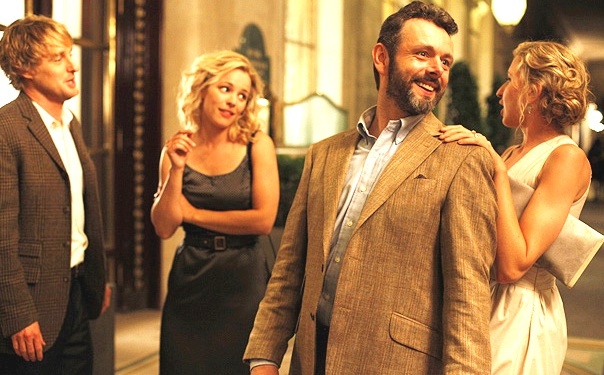
While Gil and Inez wander the city with her parents, they bump into Inez's old friends Paul and Carol (Michael Sheen, Nina Arianda) and soon the two couples visit all the sites together where Paul, an unctuous know-it-all on all subjects makes it a point to show off his expertise to anyone and everyone, even telling the tour guide at the Rodin museum (played by French first lady Carla Bruni) that she has her facts wrongs). Paul embodies a 21st century representation of the man pontificating in a movie line in Annie Hall that Alvy fantasizes about bringing Marshall McLuhan out to chastise. Watching the laid-back Wilson do the annoyed Woody dance at this character type not only proves hilarious but a refreshing twist on the familiar routine. Every word Paul utters, of course, enthralls Inez, who believes he's as brilliant as he thinks he is. It's also a nice change of pace for Sheen to play a fictional creation for a change instead of impersonating famous British people. Paul probes Gil about the subject of his novel and at first, Gil resists discussing it, but Inez spills the beans and the movie's argument gets rolling — namely, is the grass really greener in the other era? Gil romanticizes the Paris of the 1920s, when so many great artists from America and elsewhere flocked there. Paul pooh-poohs the notion immediately. "Nostalgia is denial. Denial of the painful present," Paul declares. Inez, the woman who allegedly loves Gil and wants to spend the rest of her life with him, takes Paul's side in the browbeating. "Gil is a complete romantic. I mean he would be more than happy living in a complete state of denial," she says of her fiancé. Paul isn't able to discuss any topic unless he does it at length and in long-winded lectures, so he has to show everyone what he knows of this "syndrome." "The name for this fantasy is Golden Age thinking. The erroneous notion that a different time period is better than the one one's living in now," he pronounces.

Having had enough of being a foursome one night as Paul suggests they all go dancing, Gil begs off, choosing to return to the hotel and perhaps work on his novel. Instead, he walks the streets. As he sits on some steps, a clock strikes midnight and an old yellow Peugeot pulls up as if it's the pumpkin that turned into Cinderella's carriage. The antique automobile bears '20s-era Frenchmen and Frenchwomen (who may have been mice once — who can say?) drinking champagne and beckoning Gil to climb in for a ride. That's when the real sparkle of Midnight in Paris begins and it involves another Woody Allen venture into a magical realm. Gil doesn't speak French, so he's clueless as to what his fellow passengers might be saying as they take him to a party where everyone dresses decidedly retro. Fortunately, most of the other guests appear to be American or at least speak English, so communication isn't a problem. A young man (Yves Heck) sits at a piano, playing and singing, "Let's Do It, Let's Fall in Love." He mentions to one guest that he's a writer and they introduce him to Scott (Tom Hiddleston) and his wife Zelda (Alison Pill) — the Fitzgeralds. Gil finally realizes that
 somehow, that mysterious Peugeot took him on a very long drive — one that traveled nearly 100 years in reverse to his ideal Golden Age where he could mix and mingle with his long-dead artistic inspirations. In the past, when Allen employed these fantastical devices it began to feel as if, to paraphrase one of his oldest jokes, he'd resorted to cheating by looking into the soul of the guy sitting next to him, only in these instances, he wasn't seeing another person but staring at himself in a mirror. Magic tricks which first played a key role in the "Oedipus Wrecks" short of New York Stories would return in Curse of the Jade Scorpion and Scoop or, to a lesser extent, assume the form of magical herbs in Alice. Actual Greek choruses would arrive to comment on the action in Mighty Aphrodite or see-through characters would pop up in the form of Robin Williams in Deconstructing Harry. This is a well that Woody drinks from often except that it works best when he employs it in service of larger ideas such as in Zelig, The Purple Rose of Cairo (which I still consider his best film), and, now added to that list, Midnight in Paris. As Midnight in Paris enthralled me, a small detail leaped out early on. In both Purple Rose and Midnight, he names one of the leads Gil. In the case of Purple Rose, most tellingly, the actor that Jeff Daniels plays who creates the role of Tom Baxter, the movie character who steps off the screen and into 1930s New Jersey, bears the name Gil Shepherd, only that Gil embraces his burgeoning stardom and hopes a B-picture such as "The Purple Rose of Cairo" raises his stature high enough to nab the lead in a Charles Lindbergh biopic — as long as his doppelganger in the pith helmet doesn't wreck his career. Gil Pender in Midnight in Paris may work in the same industry, but he fears he's sold his soul to it and he wants out.
The first night that Gil takes his trip back to the 1920s he also encounters Ernest Hemingway (played by Corey Stoll in the film's most entertaining performance). Fitzgerald introduces them and Gil gets the envious position of talking writing with Papa in the movie's best exchange on writing that'll appeal to anyone who has ever put pen to paper. It begins with Gil being self-deprecating about the subject of his novel (of course, no one in the 1920s has the faintest idea what a nostalgia shop is), calling it a terrible idea. "No subject is terrible if the story is true and if the prose is clean and honest, and if it affirms grace under pressure," Hemingway tells him. Gil then works up the nerve to ask if the author would look at what he's written and offer suggestionss.
HEMINGWAY: My opinion is I hate it.
GIL: But you haven't read it yet.
HEMINGWAY: If it's bad, I'll hate it because it's bad writing. If it's good, I'll be envious and hate it all the more. You don't want the opinion of another writer.
Hemingway does offer to give Gil's manuscript to Gertrude Stein (Kathy Bates) to read, because he's always trusted her opinion. They agree to meet the following night and Gil leaves but suddenly remembers he forgot to ask Hemingway where to meet him, but when he turns back the coffeehouse has turned into a laundromat and Gil finds himself in 2010 again.
In the morning at his hotel, he attempts to explain his adventure to Inez, asking her what she'd think if he told her he met Zelda Fitzgerald and she's exactly like they had read and Scott really loves her and worries endlessly, but she hates Hemingway because he's right that she's standing in the way of his writing. When Gil completes his enthusiastic rambling, Inez replies, "I'd think you had a brain tumor." Gil manages to convince Inez to go back with him the next night to wait for the Peugeot, but she grows impatient and takes off before the clock strikes midnight. After Inez has left, the Peugeot arrives and takes him to Gertrude Stein's apartment where Hemingway awaits and Pablo Picasso (Marcial Di Fonzo Bo) paints his current mistress Adriana (Marion Cotillard), who catches the eye of both Gil and Hemingway. Despite the many larger-than-life figures than circle Adriana's world, she finds herself just as drawn to Gil — until she learns of his engagement. She also shares Gil's Golden Age thinking, While he thinks that she lives in the greatest time period, she thinks it's awful and wishes she could have been in Paris during the Belle Epoque of the late 19th century. Meanwhile Gil's behavior in the 21st century becomes so bizarre that his father-in-law-to-be hires a private eye to tail him on his midnight walks to see what Gil does on them, since he doesn't trust anyone who says such nasty things about the Tea Party.

Even when Allen had fallen into his long slump, he still had the ability to attract some pretty solid ensembles, not that they were given much to do. In Midnight in Paris, the casting shines with a mix of lesser-known performers and bigger names, all bring their A game to Allen's greatest screenplay in 17 years. In addition to Wilson and Stoll who I've mentioned, the cast's standouts include a zany single scene by Adrien Brody as Salvador Dali, Kathy Bates, Michael Sheen, Rachel McAdams, Marion Cotillard in the first performance she's given that I've enjoyed and, most worth noting, Alison Pill as Zelda Fitzgerald. Pill to me proves again she's an actress just waiting to break out. She's funny and touching here after giving a good dramatic turn in Milk and being part of the fun ensemble in Scott Pilgrim vs. the World. Given how many great lines Woody's script for Midnight in Paris delivers, it's tempting to rattle them all off, but I'm resisting the urge for those who have yet to see this charmer, but I have to mention one of my favorite gags when Gil runs into a young Luis Buñuel (Adrien de Van) and gives him an idea for a movie — basically the plot of his film
If there has been any debate about Midnight in Paris, it's been where Allen comes down in the end on the question of nostalgia and Golden Age thinking. It seems pretty obvious to me based on what Gil's last line to Adriana is, even though he sends mixed signals by having Paul, the film's most pompous character, ridicule the idea of Golden Age thinking first. Also, as others have pointed out, throughout most of Allen's career his choices in music and references have screamed nostalgia, but Midnight in Paris plays as one of the most entertaining self-critical works any artist has ever made. At the same time, Allen does acknowledge the natural reflex to long for an earlier, better time — if not in another era, at least in one's own life.
Tweet
Labels: 10s, Branagh, Buñuel, Cotillard, Fitzgerald, Hemingway, Jeff Daniels, K. Bates, Kurosawa, O. Wilson, Robin, Woody
TO READ ON, CLICK HERE
Friday, June 18, 2010
The devaluation of history and culture

By Edward Copeland
There's a funny anecdote that I tell frequently about when a friend and I were perusing Blockbuster late one night a long time ago, trying to find some classic we hadn't seen, to rent. This was so long ago, there were no such things as DVDs and I even held my nose and didn't worry about the lack of proper aspect ratio (for a good read on the topic, check out this piece by Glenn Kenny). As we searched, a group of young teens also searched for a rental, dissatisfied with the remnants in the new releases, when one of the young men suggested "the older movie" Apocalypse Now. One of the young women in the group, in complete seriousness, asked, "Is that in color?"
I don't know if the answer had been yes if that would have ruled out Coppola's film right then, but there always has been a tendency among every generation to act as if anything that happened outside of their lifespan didn't really count, but it appears to me to have grown worse, egged on by magazines such as Entertainment Weekly which compiles lists that do their best to avoid including anything that occurred prior to the publication's existence, justifying it by saying they rely on a "new canon" instead of confirming what I suspect is the real reason for the unforgivable omissions: young writers who lack a suitable cultural education to draw from when they compile such lists.
In my freshman year of college, I had an intro to journalism class where the professor on the first day, gave us a quiz with a list of titles and wanted us to fill in the authors. It covered all mediums and wasn't for a grade, he just wanted a sense of what we knew. I tend to write the first thing that comes to my mind so when I got to the title The Stranger, I naturally wrote Orson Welles instead of the Albert Camus he was seeking, though I'd argue that Billy Joel might have been an acceptable response as well.
The U.S. educational system has degenerated enough when it comes to teaching proper knowledge of history, but cultural education isn't even taken seriously as something that needs to be taught, let alone is. It's high time that we not only turn out students who know the basics (and we're not that great at that either) but we have to emphasize cultural literacy as well and it's high time that we recognize that great films should be required learning alongside the classic works of written literature.
Forgive me if this rambles at times and seems to lack cohesion or a sense of direction. I had the idea for a certain piece early in the week, it soon morphed into something else and I had intended to work on it awhile before I posted it, but I lacked any other copy to publish today, so I put it in the best shape I could in a short amount of time. If I'd given myself more time, I probably would be happier with it, but I always tend to be my harshest critic.
It's easy to dismiss the idea of requiring a basic film education, given that it is a popular medium and produces a lot of junk, but the fact that many best sellers aren't worth the paper they are printed on (or the digital reader they scroll on)doesn't diminish the written word as a whole, especially the many centuries of great works that had nothing to do with the Twilight series. I'm still shocked and appalled when I run into people my age or older who haven't seen films such as Casablanca. What have they been doing for their first four decades or more?
Recently, Jim Emerson wrote at his Scanners blog in an entry titled "Who Killed the Movies?" of a certain existential fatigue he was experiencing, one that is not uncommon to movie lovers and especially those who make their living as critics and often have no say in what films they have to take in, from the sublime to the
 ridiculous. I've felt that way before at many points in my life, especially when I was younger and for some reason felt it was my duty to try to see EVERYTHING, spurned on by a numbers contest with a high school friend over who could see more movies in one year. It got out of hand when he got a job at a movie theater and started using the perk of being able to get in to free movies even at other theaters and would skip school to attend morning critic screenings. It made me mad because of his unfair advantage, but also because I realized I was sitting through such unbelievable garbage just to boost numbers. The real depressions would come later when I was writing reviews for publications and I wasn't necessarily picking the films I had to review and, being the low man on the totem pole, ended up with a lot of the turkeys. Sure, they were free and I got my revenge in print, but it's a high price to pay for lowering the collective value of a medium I love. Still, once I stumbled upon a good one, it would lift my spirits enough to keep going and would never seriously harm my belief that film is a great artistic medium, even when wasted.
It's been decades since I was in high school, but they did make a point of introducing us to a lot of the important works of Western Literature (yes, anything outside of Europe got short shrift, but considering where things have degenerated now, I feel fortunate we got what we did). Three out of four years of high
 school we were taught a Shakespeare play (Romeo & Juliet, Julius Caesar and either MacBeth or Hamlet, depending whether or not you were in the honors English class). We went over the top poems and poets (as well as The Bard's sonnets), Chaucer and we did get some of the top novels such as Twain's Tom Sawyer, Fitzgerald's The Great Gatsby Hawthorne's The Scarlet Letter and Harper Lee's To Kill a Mockingbird. We even got to read Ray Bradbury's Fahrenheit 451. Unfortunately, we also got some real clunkers such as Alas, Babylon by Pat Frank, A Separate Peace by John Knowles and the torturous I Heard the Owl Call My Name by Margaret Craven, the only book I've ever fallen asleep reading while sitting up in a classroom desk. We also struggled through James Fenimore Cooper's The Unvanquished. I wonder what they teach now. I do know that in the case of myself and many of my friends, unless you took courses in college and, even then, if that wasn't your course of study, it was up to you to seek out the classics. It's always been the case that you have to truly educate yourself in film, but sadly that's also true with much of literature because our society places so little value on it.
Of course, even history is up for grabs now, when you have politically biased boards of education such as the one in Texas seeking to rewrite history to match their own ideology instead of just teaching children what
 really happened. Who was that Thomas Jefferson guy again? What slave trade? Those people abducted from Africa were just part of a trade program involving rum and molasses. Joe McCarthy was vindicated and a hero! The Texas outrage, treating history as something that is subjective instead of objective, reminds me of the quote by the late Daniel Patrick Moynihan: "You are entitled to your own opinion, but not your own facts." It also had me thinking back to my pre-college days and the silliness of standardized tests such as the ACT divided into math, science, English and reading. Nowhere is there a section that finds it important that incoming college students have even a rudimentary knowledge of history or literature of any kind. The SAT even blows off science, just concentrating on math, critical reading and writing. To show you how silly the multiple choice ACT was, I scored highest in the science section, which really was my weakest school subject. Of course, if education standards start going the way of Texas, I guess science and facts won't matter much anymore anyway, unless a burst of rationality breaks out somewhere.
Now, I won't even pretend to hold the answers as to how to improve this country's piss-poor knowledge of history. It's hard to get them interested or educated about current events when the so-called cable news networks will drop all coverage of other, important news because Michael Jackson inevitably drops dead about 15 years after most people expected to hear that news at any time. News priorities have gone completely haywire. The newspaper I used to work for actually had a larger Page One spread on the "been waiting for that shoe to drop" death of Anna Nicole Smith than it did on Gerald Ford. When I was in elementary school, we actually had a current events contest provided by a local TV station and most students knew what was going on. In high school, my American history teacher had her students read the local paper and then gave current event quizzes once a month for extra credit. One of the questions would always be the current unemployment rate. Does that happen anywhere now? As newspapers die, could it?
However, as far as trying to seriously create a mass curriculum on the history of the film, on that I do have some ideas. Obviously, all opinions on a movie's worth are subjective, but that applies to literature as well and there is no reason that some titles can't be agreed to and rise above petty critical fights. Besides, encouraging students to think for themselves can never be a bad thing, no matter what Texans and many home-school advocates think. A good place to start might be the Library of
 Congress' National Film Registry. Since its authorization in 1988, it has added 525 titles worth preservation by the library to ensure that future generations will have access to important films. There are some unusual choices contained in there, but there also are a lot of movies that most would agree everyone should have some familiarity with: All About Eve, All Quiet on the Western Front, American Graffiti, Annie Hall, The Apartment, Back to the Future, The Bank Dick, The Best Years of Our Lives, The Birth of a Nation, Bonnie and Clyde, Casablanca, Chinatown, Citizen Kane, City Lights, The Crowd, Do the Right Thing, Dog Day Afternoon, Dr. Strangelove, Duck Soup and many, many more with a list that grows longer each year. It also includes important animated works and newsreel footage and other moving images such as the Zapruder film and the Why We Fight series from World War II (I knew I could sneak some history in there). What it does lack is anything that isn't American and that is something that would have to be corrected in any serious curriculum, unless universities get exclusive reign over studies of foreign films.
Of course, no curriculum could cover all the films anyway and since they include more recent films as well, you have to assume that the close-minded, busybody parents among us would object to many titles. Hell, if titles such as The Adventures of Huckleberry Finn, 1984, Call of the Wild, To Kill a Mockingbird and most works of Ernest Hemingway still are routinely challenged as unsuitable reading material for students, you can just imagine the shitstorm some of the titles on the National Film Registry would raise. I mean, some have R ratings. I remember in ninth grade after we read Romeo & Juliet, we watched Franco Zeffirelli's film version and at the crucial point, my teacher had to stand in front of the TV set to spare us the traumatizing sight of Olivia Hussey's bare bosom.

There would be plenty of possibilities for subject synergy: read Edith Wharton's The Age of Innocence and then watch Martin Scorsese's extremely faithful film version and discuss the two mediums. When studying Coleridge's poem Kubla Khan, see how it relates to Welles' Citizen Kane. On the historical side, you could use Kane's fictional take on William Randolph Hearst to lead into a discussion of how the real Hearst and Joseph Pulitzer used their papers to pump up the Spanish-American War. Also for history, use newsreel footage of parts of the Why We Fight series to accompany teaching of World War II. With a kindly "fuck you" to Texas, use real footage of the McCarthy hearings and Edward R. Murrow's dismantling of the disgraced demagogue on the airwaves. Imagine the positive press corporate sponsors could receive by helping to subsidize the material. Believe it or not, television has worthy culture as well.
Now, I do not want to leave the impression that I'm just a cranky middle-age man raging against those young vulgarians who dismiss things that don't relate to them. In many ways, it isn't their fault, because the people
 with the money who market to them design it to be that way and the youth certainly can't be blamed for the failures of the education system. Why should new generations seek out films that are 20 or 25 years old when Hollywood produces unnecessary remakes of so many of them that soon after the original? A Nightmare on Elm Street came out all the way in 1984 — did they have color then? (OK, neither film should be part of public education, but you see my point.) Besides, I've run into many a person older than myself who are ignorant of history and culture and have no excuse. Years ago, at a newspaper I used to work for, we were going over the stories at the news meeting and one that was mentioned was that we would be covering a speech that night by Kurt Vonnegut. A senior editor who is about 15 years older than me literally had no idea who Vonnegut was. This was a man who came of age and went to college in the 1960s and the 1970s, yet a literary icon such as Vonnegut drew a blank. I wish I could say that man and that story were isolated incidents, but I've encountered many older than me that didn't know things that they should — and many of these were supposed journalists in the news business who had an appalling lack of information about recent historical events. One thing that drew me to journalism is that I'm a news junkie, but I was amazed how few news junkies existed in the various newsrooms in which I worked. Why did they even choose the career? No wonder news is dying.
The biggest problem to the idea of teaching film as literature to public school students really extends beyond the rabblerousing of cranks and the resistance of educators is the state of our nation's economy. Teachers are losing their jobs across the country and school districts are being forced to make budget cuts and, inevitably, among the first things to go are arts programs and there's no doubt in my mind that even if film education was considered part of English education, the requisite costs would doom the idea. Doesn't that make it an excellent opportunity for the movie industry to give something back? If they helped with the study materials and films themselves, what a lucrative marketing tool they could have. Imagine if a teacher assigned a weekend homework assignment of seeing a certain film at a theater and a studio provided vouchers for the students so they didn't have to pay. Granted, one would hope it would be a worthy film and not the latest Transformers, but you get the idea. How about encouraging the industry to do more mass re-releases like they used to do? Remember when Disney used to bring back their classics every seven years or so. Certainly, a plethora of serious writings exist on most important films to help teachers along.

The idea I'm suggesting is not a full-blown film study course of the type you would take in college, but just of integrating the medium into the studies of other literary works you learn (or damn well should be learning) before you graduate high school. The value that seems to have been placed in this country of late on ignorance, spurned on by our political leaders, is truly frightening. It's truly outrageous how freely misinformation is allowed to be spread because it's to the gain of both parties and the news media either is too lazy or ignorant to call them on it. How many times do you hear it repeated that the IRS will fine you if you do not purchase health insurance under the new health care reform when the legislation specifically prohibits any punitive measures. The GOP continues to spread the lie to get people angry and the Democrats let them because they fear if the truth was widely known, the plan falls apart because people won't purchase the insurance. Both parties should be ashamed, but do politicians know what shame is anymore? As columnist Mark Shields once said, "Stupidity is not a victimless crime."
Children need to be taught more than just how to score well on a test on the basics, they need to know where we came from and I'm not talking about evolution. You know the saying: Those who do not learn from history...
While Hollywood certainly churns out a lot of crap, the worldwide film industry throughout its history has produced some exquisite works of art that deserve to stand alongside the greatest works of written literature. A better educated populace, even in areas of culture, can be the first serious step in dealing with the politicians who treat us like morons and the ignorant masses who fear that their children and others might form their own ideas and the ability for critical thought.
Tweet
Labels: Books, Coppola, Criticism, Disney, Hemingway, Misc., Scorsese, Shakespeare, Television, Twain, Vonnegut, Welles
TO READ ON, CLICK HERE


