Monday, November 14, 2011
"It's all true — every word he isn't saying"

By Eddie Selover
Is he or isn't he?
That was the question about Cary Grant throughout his life: gay or straight? This was based, it would seem, on little more than his having shared a house with Randolph Scott in the '30s and having posed for some goofy pictures of the two of them in aprons and frolicking in the pool. Grant was married five times, had some well-publicized affairs, yet the rumors never stopped, and everyone knew about them. Even my parents. In the early 1960s, they had a live album by Allan Sherman, the singing comedian of "Camp Granada" fame. One of the songs was a riff on a mover and shaker having his secretary call various celebrities, and the big ending went: "And then when you reach Cary Grant, tell him I'd love to, but I just…can't." The audience on the album roared; so did my parents.
Around the same time, Tony Curtis did his famous parody of Grant in Some Like It Hot, the humor of which comes not from the accuracy of the impersonation but from the portrait of Grant as a nearsighted, girl-shy millionaire in a silly nautical outfit. Curtis' very next movie co-starred Grant, so evidently there were no hard feelings. A decade later, when Chevy Chase jokingly used a homosexual slur to refer to Grant on a talk show, Grant sued him for slander and won a settlement; later, he was studiously casual about the whole thing. And it continues: just a few weeks ago, Grant's fifth wife Dyan Cannon shot down the rumors yet again in interviews promoting her book about him. But neither Cannon's testimony, or that of his daughter, his other wives, his former lovers and friends, or anybody else, seems to be enough to put the suspicion to rest.*
Because there's something about Cary Grant. Whatever he projects at any given moment, he somehow manages to suggest something else at the same time. He's remembered as the epitome of class and style, but with his strange, not-quite-Cockney accent and thick features, he's clearly no aristocrat. In his screwball comedies, he projects anger and a kind of general threat to the other actors. His spills and pratfalls are clearly the result of enormous physical mastery and athleticism. Playing heroes in adventure films, he's a joker and a clown. In love scenes, he's quizzical, wary, amused — anything but ardent. Often his eyes, his smile, the tilt of his head seem to convey something quite different, and usually more intelligent, than the dialogue coming out of his mouth.
Which is why Johnnie Aysgarth in Alfred Hitchcock's Suspicion is in many ways the ultimate Cary Grant role. Johnnie is married to Lina, a wealthy spinster from a small English village. He puts the moves on her and they marry quickly, but soon his evasions and subterfuges cause her to have doubts about him. He may have married her for her money (her father thinks so) and be planning to murder her for it too. Or he may be a misguided, misunderstood underdog who's uncomfortably adjusting to life with a woman who has more money than he does. Is he or isn't he guilty, that's what the entire movie is asking. It's not spoiling anything to tell you the ending (he isn't), because it satisfied neither the cast, writers, director, original audiences, or virtually anybody else who has seen the movie since its premiere 70 years ago. Everybody struggled with it during the writing and filming — nobody could come up with the right ending. Because there's no way to resolve this particular story. Suspicion is about something inexplicable: Cary Grant's personal ambiguity, his elisions, his ultimate mystery.
Joan Fontaine won the Oscar for playing Lina, an award generally assumed to be a consolation prize for her losing the previous year for Rebecca. She basically repeats the performance here, but with more flattering makeup, hair and clothes, and with a veneer of movie-star graciousness that probably drove Hitchcock a little crazy. Making Rebecca, he had used a variety of psychological tricks on set to undermine her confidence. Here, he improvised a nickname for Grant to call her throughout the film: "Monkeyface." It's like a slap every time he says it; he might as well be calling her "shithead" in that musical voice of his. Let it be said for the record that Joan Fontaine is beautiful and looks nothing like a monkey, but her role gives her little to do other than suffer and look elegantly worried while keeping a stiff upper. (Lina was a little more masochistically interesting in the original novel, "Before the Fact," in which she's correct about her husband's motivations but so in love with him that she knowingly drinks the glass of poisoned milk he brings her.)
Grant's real romance in Suspicion isn't with Fontaine anyway — it's with Nigel Bruce as his old friend Gordon Thwaite. Considering his snub nose, he has an inappropriate nickname too: "Beaky." In the 20 years Bruce mumbled and bumbled around Hollywood, he was never more appealing than in this part. Beaky always says the wrong thing and reveals Johnnie's tricks and lies, and then hangs his head as both the angry husband and the offended wife slap him around. Bruce and Grant get a real performance rapport going — they play their relationship as if Beaky was a big overgrown dog and Johnnie his affectionate but exasperated master. When Beaky has a brandy-induced choking fit and Johnnie stops Lina from coming to his aid, Grant is expertly unreadable. Is he frozen with concern, or callous indifference?
70 years later, it's not easy to appreciate what a daring performance this was in 1941. Grant had just come off the greatest string of movies any actor ever had — Topper, The Awful Truth, Bringing Up Baby, Holiday, Gunga Din, Only Angels Have Wings, The Philadelphia Story, His Girl Friday — and was now one of the biggest stars in Hollywood. What was bold of Grant was to take the charm that had brought him to the top and suggest that it might in fact be a cover for any number of repellent qualities. Johnnie is handsome, smooth, and commanding, but he's also a chronic fibber, con man and embezzler... a spider, as the photo at the top suggests. Essentially it's the darkest role Grant ever played. And though the director claimed (probably falsely) that the studio forced it on him, Hitchcock's "happy" ending (as with many of his happy endings) is anything but. Lina blames herself for everything, but she's still married to a man who lies at the drop of the hat and steals money every chance he gets. Johnnie has explained everything away, but he's still married to a woman who knows what he's capable of and shrinks from his touch. Contemplating the future of their relationship is actually the scariest thing about Suspicion.
*P.S.: What I've never understood is the need to have Grant to pick a team. Haven't people ever heard of bisexuality?
Tweet
Labels: 40s, Cary, Fontaine, Hitchcock, Movie Tributes, Tony Curtis
TO READ ON, CLICK HERE


Sunday, July 03, 2011
He certainly admires people who do things

By Edward Copeland
Saying that Alfred Hitchcock created great sequences certainly isn't a particularly profound or original statement for someone who writes about film to make, but each time you re-visit one of his classics, it's hard not to repeat that kind of statement because it washes over you, especially when you look again at
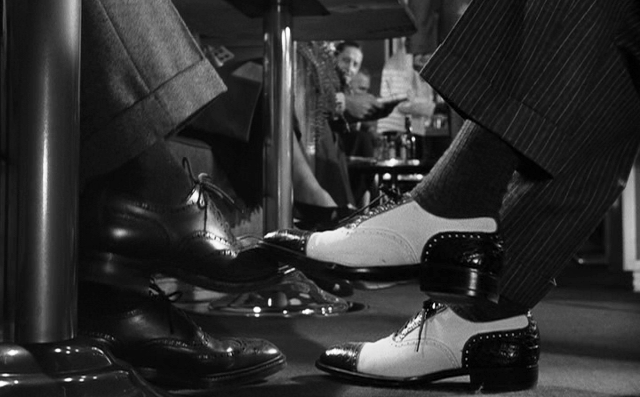 Strangers on a Train, which was released 60 years ago today in New York, though some sources have its U.S. premiere elsewhere on June 30, 1951. The great director's masterful set pieces especially took hold of my thoughts when I watched it this time because of its marvelous opening. We see a man get out of a cab with luggage, but only from below the waist, concentrating on his shoes as he heads to catch a train. Then, we see a second man get out of another cab, identical company, and we only notice the difference because of the style of his shoes as he hurries to catch his train. We follow the shoes as they go through the turnstiles and board the train, even get a shot of the train pulling away and switching tracks. The one pair of shoes keeps moving within the train car finally taking a seat by a table in a lounge car when those two pairs of shoes brush one another, giving us our first meeting between tennis pro Guy Haines (Farley Granger) and Bruno Anthony (Robert Walker). YouTube has the clip, but you can't embed it, so click here to see one of the best starts to one of Hitchcock's greatest films.
 The novel Strangers of a Train was the first thriller published by Patricia Highsmith, who would go on to write the successful series of books on serial killer Tom Ripley that have been adapted into films starring actors as diverse as Alain Delon, Dennis Hopper, Matt Damon, John Malkovich and Barry Pepper by directors as disparate in style as Rene Clement, Wim Wenders, Anthony Minghella and Roger Spottiswoode. As good as some of those films are and as fascinating as Ripley is as a character, for my money, none match Walker's creation of the sociopathic, psychopathic and just plain crazy Bruno in Strangers on a Train,
 especially under Hitchcock's direction and working from a screenplay whose co-writers included none other than Raymond Chandler. Walker's performance as Bruno functions as the key to Strangers on a Train really unlike an actor in any other Hitchcock film. For a director who liked to joke that actors should be treated like cattle, Strangers wouldn't be the classic that it is without the brilliance of Walker's performance. Walker's work borders on genius and, to me, may well be the best ever given in any Hitchcock film. His Bruno can evoke chills and a general feeling of creepiness, but Walker doesn't play him as an over-the-top villain, working overtime to scare the audience at every turn. He creates a three-dimensional, troubled individual that at times you might even feel a twinge of sympathy for — until he commits his next horrifying act. When I planned to write this tribute, I found myself less interested in recounting a lot of the plot or describing the highlights as I did honoring Walker's work. It gets boring after awhile to whine about the performances that Oscar didn't nominate, but how they missed Walker is an outrage. It's even sadder considering that about a month and a half after the film's release, the actor died because of a bad reaction to prescription drugs. All things considered, performers in Hitchcock films didn't get as many nominations through the years as they probably deserved. The only ones who did get nominated were Laurence Olivier, Joan Fontaine and Judith Anderson in Rebecca; Albert Basserman in Foreign Correspondent; Joan Fontaine in Suspicion; Claude Rains in Notorious; Ethel Barrymore in The Paradine Case; and Janet Leigh in Psycho. Only Fontaine's performance in Suspicion took home the prize. No Anthony Perkins. No Jimmy Stewart for Vertigo or Rear Window. No Joseph Cotten for Shadow of a Doubt. All those nominated and unnominated pale though next to the omission of Robert Walker's Bruno. If for some inexcusable reason you've never seen Strangers on a Train, what the hell have you been doing with your life?
Some plot synopsis and I'll try to be brief. Once their footwear bump, Bruno recognizes Guy Haines immediately and slides over to make conversation. The men may be strangers, but Bruno knows a lot about Guy from newspapers. Not just about his
 tennis career, but from the society and gossip pages as well, so Bruno brings up Guy's marriage to Anne Morton (Ruth Roman), daughter of Sen. Morton (Hitchcock favorite Leo G. Carroll), when he spots Guy's cigarette lighter engraved A to G. "Perhaps you read too much," Guy tells Bruno as he grows
 annoyed. Besides, Guy adds, he hasn't married Anne, unless they've changed the laws against bigamy and he hadn't heard about it. Haines remains legally married to Miriam Joyce Haines (Laura Elliott), who has delayed their divorce even though she's openly playing around. Bruno starts to suggest something, but holds back instead just saying, "Right now, I suppose divorce is the simplest option." Bruno invites Guy to dine with him in his compartment, but Haines wants no part of that, hoping to rid himself of the pest. He asks the train's waiter if there are any empty seats in the dining car, but the waiter says no and there probably wouldn't be for another 30 minutes at least. Bruno takes that as his cue and a sign. Guy simply must dine with him now and Haines reluctantly agrees. Walker perfectly blends the charming side of Bruno with the annoying without giving away hints of the darkness inside.
When the two are alone and Guy gets some liquor in him, he's a bit too open about his life, admitting how Miriam played him for a fool. Bruno admits he has someone he hates too — his father. Bruno's father is a rich man, but he expects Bruno to earn a living and won't just let him have what's "rightfully his." Bruno says that some people just deserve to die, doesn't Guy agree? "I may be old-fashioned, but I thought murder was against the law," Guy says. "Some people may be better off dead, like my father or your wife for instance," Bruno suggests
 before he tells Guy of his plan for the perfect murder. Two strangers — much like Guy and himself — with no connection to one another meet and agree to swap murders. For instance, while Guy has an airtight alibi, Bruno would kill Miriam. Then, Guy would do the same for Bruno and murder his father. "Criss-cross," Bruno says. The train nears Guy's stop where he's going to try to talk to Miriam again. In the meantime, realizing he's trapped in a compartment with a loon, Guy just tries to humor Bruno. As he's leaving, Bruno tries to confirm that they've made a deal and Guy sort of laughs him off, just eager to get out of there. Guy also fails to notice that Bruno managed to swipe his engraved lighter from him. To Bruno's ears though, it sounds as if Guy has agreed to swap murders with him. For those always on the lookout for where Hitchcock might appear, when Guy exits the train in his hometown, Alfred can be seen climbing aboard carrying a bass.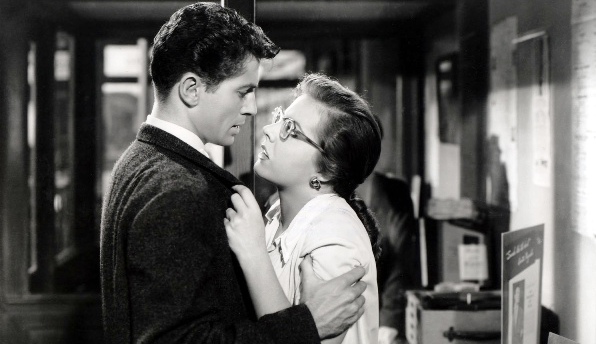
Things do not go well when Guy meets with Miriam at the music store where she works about the divorce. His wife turns out to be a real shrew. She tells him that she was prepared to give him a divorce but thought he was dragging his feet. She demands he cough up money for her lawyer which Guy does, though he grumbles about her carrying another man's child. Then Miriam springs it on him — she has no plans to give him a divorce. She tells him that she wouldn't have started playing around if he hadn't been gone playing tennis all the time. Guy practically throttles her in the store, until the manager breaks it up. A steamed Guy calls Anne from a phone booth and relays the latest development. "I wanted to strangle her," he tells Anne.

Later that night, Miriam decides to head to the amusement park with not one, but two men. Unbeknownst to her, a third man will be tagging along. From this point on, Strangers on a Train exists
 almost entirely of Hitchcock set pieces and creepy moments provided by Walker. The actor and director work together on the very first as Bruno stalks Miriam through the amusement park, always seeming to appear beside her from out of nowhere, impressing her with the ability to hit the bell when he strikes the game with the hammer, keeping a constant devilish grin on his face. Has a smile ever looked more malevolent to the moviegoer while a passer-by wouldn't notice that anything's amiss. When Miriam and her boy toys get a boat to sail through the Tunnel of Love, Bruno gets one as well, munching on popcorn as he drives. In the cave, ambiguous shadows appear on the wall followed soon by Miriam's scream. That turns out to be a fakeout. Miriam comes out the other side just fine. When the boats dock at a little island, her men head off somewhere, but Bruno stops her to light her cigarette. She flirts with the madman who goes from gentleman to killer, knocking off her glasses as he begins to strangle her, her murder viewed as a reflection in the eyewear.


As they say, the best laid plans…Nothing goes the way Bruno planned and since Guy didn't take him seriously in the first place, events don't go his way either. When Guy arrives at Sen. Norton's home, they inform him of Miriam's murder, but Guy has already been told — Bruno met him at the gate and showed him Miriam's smashed glasses and wanted to make plans for when Guy will kill Bruno's father. Unfortunately, Guy hadn't planned an alibi. He has one: He was on a train back to Washington and spoke with a professor. Unfortunately, the professor had imbibed a bit too much and when the police bring him to meet Guy, he doesn't remember him. The senator asks if everything's fine now that his alibi has been verified. "When an alibi is full of bourbon, sir,
 it can't stand up," Guy tells him. Because Guy had a motive, the police are even keeping him under surveillance, keeping detectives tailing him at all times. It doesn't help that an impatient Bruno keeps spying on Guy in a variety of settings creating some really spooky moments as when he's the sole figure on the steps of the Jefferson Memorial or the true masterpiece: When he attends one of Guy's tennis matches and all the spectators' head move side-to-side, following the serves but Bruno sits perfectly still among keeping his focus on Guy. He gets more daring, insinuating himself among Guy and the Mortons' circle of friends. "You're spoiling everything. You made me come out in the open," Bruno tells Guy at one point. Guy explains that the police are watching him, so he can't easily slip away and kill his father from him. I love Strangers on a Train and Robert Walker as Bruno so much that I could probably write endlessly about it, detailing every plot point, sharing all the great lines of dialogue, describing all of Hitchcock's magnificent touches, but part of me thinks if you have seen Strangers on a Train, you already know all this and if you haven't, you shouldn't be reading what I'm writing about it, you should be watching it — as soon as possible.
Therefore, I'm resisting the urge to expound on all I wanted to such as mentioning Marion Lorne (Aunt Clara on Bewitched) and her two scenes as Bruno's mother and quoting some of her lines. It means not going into detail about Patricia Hitchcock as Anne's sister Barbara or Bruno's party game when he crashes the senator's party. He has so many lines that I'm tempted to repeat but if you haven't heard them, you need to hear them from Walker first, not me. I do have to briefly refer to the amazing suspense Hitchcock builds with activities happening in two different spots: Guy trying to hurry and win a tennis match so he can get back to the amusement park to prevent Bruno from planting his lighter and framing him while in the town where that park is, Bruno tries to retrieve the lighter he accidentally dropped down a storm drain. The throwaway line of the rich old woman when police commandeer her car, telling her they are in pursuit of a criminal. "Really? How exciting."

Finally, there's the climax on the merry-go-round, one of the most exciting Hitchcock filmed, but there's a moment many might miss. There's a little boy still on the ride and even though it's spinning wildly out of control, he's having a blast. When the fighting Bruno and Guy come near him, the tyke stars hitting on Bruno — and Bruno hits the kid back. Strangers on a Train, simply put, is just a great fucking movie with Robert Walker giving one of the best portrayals of an on-screen psycho in film history. As Guy says about Bruno toward the end, "He was a very clever man" and Walker was just as clever an actor to deliver this brilliant a performance.
Tweet
Labels: 50s, Fiction, Fontaine, Hitchcock, Hopper, J. Stewart, Joseph Cotten, Malkovich, Matt Damon, Movie Tributes, Olivier, Oscars, Rains
TO READ ON, CLICK HERE
Monday, April 12, 2010
A Ghost Story Without a Ghost

By Ali Arikan
In Noah Baumbach’s The Squid and The Whale, Jeff Daniels’ character glibly — and, dare I say, wrongly — dismisses A Tale of Two Cities as minor Dickens. Similarly, Rebecca, Alfred Hitchcock’s Academy Award-winning 1940 film of the Daphne Du Maurier novel, has a reputation amongst informed acolytes of the director as not being emblematic of his best work. Without fully disowning it, Hitchcock also eventually came to regard the film with slight unease. Talking to François Truffaut in 1967, he famously remarked,
“It's not a Hitchcock picture; it's a novelette, really. The story is old-fashioned; there was a whole school of feminine literature at the period; and though I’m not against it, the fact is that the story is lacking in humour.”
While it’s certainly true that Rebecca is not vintage Hitchcock (Robin Wood flat out dismissed it in his 1989 classic Hitchcock’s Films Revisited), it’s impossible not to be drawn into the spectral presence of the past in the movie’s subtext, as well as the romantic melodrama. On the surface, the film is a ghost story without a ghost. The Elizabethan façade of Manderley, the centerpiece of the de Winter country estate, harbours within it a gothic interior, where the triumphs and tragedies of the past linger behind every nook and cranny as characters find themselves haunted by menacing memories. The interiors, photographed in a wonderful black and white chiaroscuro by George Barnes (for which he won an Oscar), take a life of their own, and Hitchcock hints — with his first Hollywood budget — at the sort of technical wizardry that would come to define him in the zenith of his career.

Released 70 years ago today, Rebecca’s story is familiar to most. After a particularly bizarre whirlwind romance in Monte Carlo, a young lower-middle class girl (Joan Fontaine) marries Maxim de Winter (Laurence Olivier), a recently widowed English aristocrat, and goes back with him to his magnificent Cornish mansion, managed by the domineering Mrs. Danvers (Judith Anderson), a taciturn authoritarian of a housekeeper, who revels in tormenting the new lady of the house. The young bride soon starts to suspect that something, as they say, is rotten in the estate of Manderley, as she gets enveloped in the mystery of the house, and of what happened to the former Mrs. de Winter.
Seeing it for the first time in 15 years, and aware of just what it was that happened to Rebecca that fateful night, I noticed a few personal touches that Hitchcock weaved through the narrative. The obsession with a dead woman (and her “doppelganger”), for example, would be a motif that Hitchcock would revisit in his masterwork, Vertigo (1958). Similarly, the psycho-sexual tension between the characters would be a running theme in many of the directors’ best films (though never quite as overtly sapphic or pedophilic as here). In his 1986 book, The Films of Alfred Hitchcock, Neil Sinyard compares the relationship between the unnamed heroine and the sinister housekeeper Mrs. Danvers to that of the heroine and the housekeeper in Under Capricorn (1949), the tennis-star and the psychopath in Strangers on a Train (1951), or the thief and the traffic cop in Psycho (1960). In fact, the way Hitchcock fashions a character from Manderley itself anticipates the similar approach he would employ for the Bates Motel 20 years later (both buildings are “haunted” by the presence of a woman long gone).
Hitchcock had apparently read the original novel when it was still in galleys, and tried to buy the rights, which proved too costly for the director. They were eventually purchased by David O. Selznick, who saw in the story yet another opportunity to turn an international best seller into a major hit (in fact, the film’s release was delayed by a year to clear the way for Gone With the Wind at the 1939 Oscars — or, rather, vice versa). Soon after, Hitchcock moved to the United States, and signed a seven year contract with Selznick, under which he made three films, including Rebecca (1946's Notorious began as a Selznick project, but he sold it midway through production, and was never involved in the film creatively).
Like the marriage of the central couple in the film, the relationship between the star-producer and hot-shot director was no bed of roses. Selznick wanted to stick as closely to the novel as he possibly could (there are entire paragraphs directly lifted from the novel), interfered when flourishes of Hitchcock’s style became too overt, and eventually edited the film himself. While the eventual film does contain a few nice allusions to the director’s pre-war work (the skewed close-ups of Olivier and his interrogator during the inquest are particularly delightful), it is, nonetheless, a tightly controlled Selznick picture.
Still, though, there was one thing that neither David Selznick nor Maxim de Winter could get away with in the film: murder. In the novel, Maxim admits to his bride to having murdered Rebecca, but the inquest brings a verdict of suicide, reinforced, as in the film, by the later revelation that Rebecca was suffering from cancer and would have been dead in a few months. Hollywood Production Code at the time stipulated that a murderer must be punished at the end of a film, which caused Selznick and his writers, Joan Harrison and Robert E. Sherwood, to turn Rebecca’s death into an accident. A necessity of the time, this change, nonetheless, makes the final 20 of the film following Maxim’s confession in the cottage rather anticlimactic and undramatic.

The actors also did not get along. Olivier thought Fontaine was inexperienced and wrong for the part, a feeling Hitchcock refused to alleviate. In fact, Fontaine once said that Hitchcock deliberately created strife on the set, not least to keep the novice ill at ease:
“To be honest, Hitchcock was divisive with us. He wanted total control over me, and he seemed to relish the cast not liking one another, actor for actor, by the end of the film. Now of course this helped my performance, since I was supposed to be terrified of everyone and it gave a lot of tension to my scenes. It kept him in command and it was upheaval he wanted.”
However questionable his methods were, Hitchcock, nonetheless, managed to get the best out of his actors. Fontaine is the true revelation of the film, playing with precocious gusto a flibbertigibbet with daddy issues. Olivier is a delight to watch throughout the couple’s coquetry in Monaco, especially during the breakfast scene at the hotel where Maxim is more paternal and patronising than flirtatious, which adds to the general creepiness of the couple’s relationship. I also love that particularly symbolic earlier scene at the hotel lobby with Maxim, the embonpoint Mrs. Van Hopper (Florence Bates), and Maxim’s future wife — old money, new money, and no money. If Maxim seems uncharacteristically distant and boorish during the later scenes in Manderley, surely that’s a conscious decision on Olivier’s part. Most memorable of all, though, is Judith Anderson, who, through her stern presence and economical movements, dominates every scene she is in.

Also gripping are the weird psycho-sexual themes Hitchcock hints at, to which the censors at the time seem to have turned a blind eye. Hitchcock strongly implies a lesbian relationship between Mrs. Danvers and Rebecca: look at the way Mrs. Danvers recounts how Rebecca used to undress for bed, as she shows off the draw with her knickers, and caresses Rebecca’s diaphanous silk negligee. Later, she rubs Rebecca’s fur coat on the new Mrs. de Winter’s face, a not-so-subtle allusion to cunnilingus. As we find out more about Rebecca’s penchant for playing the field, we even sympathise with Mrs. Danvers, who seems to have been nothing but a sexual plaything for Rebecca.
In fact, as in many of Hitchcock’s later works, the women in Rebecca are treated as either gauche simpletons or manipulative harpies. The men don’t come off any better; the three male leads are a distant boor, a lackey and a blackmailer. Rebecca began production just as the Second World War broke out, and maybe this unsympathetic look at the human race was a conscious creative choice by Hitchcock. We’ll never know.
Equally captivating, if bloody weird, is the relationship between Maxim and his new wife. The former proposes to her in the shower of his hotel room; “I’m asking you to marry me you little fool,” he says, charmingly. He treats her like a child, asking her to promise him never to be 36. She takes this in her stride, with Maxim as a proxy replacement for her father. As Germaine Greer observed in a 2006 article to coincide with the film’s re-release, “She has nothing else going for her. Maxim wants to marry her - not despite the fact that she is, in his phrase, a "little fool", but because of it. When she snivels, which is often, he provides the handkerchief. He orders her about unmercifully. When she knocks over a glass of port and fusses to clean it up, he orders her to leave it, as if she were a dog sniffing excrement. Every now and then, he kisses her on the top of the head, just as she does Jasper the dog. By way of endearment, he calls her ‘you sweet child’ or ‘my good child’.” This is not a relationship between two equal partners — this is two people projecting their freakish fantasies at each other (asking his wife to wear a wrap because it’s chilly, Maxim intones, “you can’t be too careful with children”). Now I am the last person on earth to talk about relationships and such, but I’ll go out on a limb and characterise this as being really rather unhealthy.
But there is one theme that Hitchcock visits in Rebecca that he would generally shy away from in his Hollywood career (except, perhaps, in 1964's Marnie), and that is, of course, issues of class. Opening Rebecca’s monogrammed address book, the new bride is terrified to see a list of honorifics. She is suppressed both by the memory of the titular ex-Mrs. de Winter and what she considers to be her social ineptitude: her fear of inadequacy, of being unable to live up to the standards set by Rebecca the person, and Rebecca the institution. The film is as much about class struggle as it is about being haunted by the past, and the ambiguous ending makes this even more blatant. And if Rebecca is, finally, not quite the perfect marriage of form and technique, it’s most certainly not for any lack of trying.
Tweet
Labels: 40s, Dickens, Fontaine, Hitchcock, Jeff Daniels, Movie Tributes, Olivier, Oscars, Selznick, Truffaut
TO READ ON, CLICK HERE
Tuesday, May 22, 2007
Centennial Tributes: Laurence Olivier
"I take a simple view of living. It is keep your eyes open and get on with it."
Lord Laurence Olivier

By Edward Copeland
Lord Laurence Olivier was often referred to as one of the all-time greats on stage and I wish I could have seen him perform in that capacity. He co-founded with Sir Ralph Richardson a new Old Vic Theatre Company in 1944. Later, he was one of the founders of the Royal National Theatre in 1963. He retired from the stage in 1974. He also was the fifth actor to be given the honor of burial in Westminster Abbey. Despite his legendary status as a stage actor and appearing frequently on Broadway between 1929 and 1961 and directing two productions after that, he only received a single Tony nomination for acting (for The Entertainer in 1958) and he lost. As it is, myself and many others have had to make do with his admittedly massive body of screen and television work, work which the actor often expressed embarrassment about, understandable when you consider some of the roles he took, presumably just for the paycheck.
Really, Olivier is the one who inspired me to use my running gag "All British actors are whores." That's not to say he wasn't great, but it did often exemplify itself in his seeming willingness to appear in just about anything that passed his way. At the same time, he did manage for a long time to hold the record for acting Oscar nominations among men with 10 nominations until Jack Nicholson tied him with his nomination for A Few Good Men and passed him with his nomination for As Good As It Gets. Instead of just going chronologically through his works that I've seen, I've decided to divide this tribute into four acts.
"My stage successes have provided me with the greatest moments outside myself; my film successes the best moments, professionally, within myself."

Olivier's first Oscar nomination came in 1939 for the film which really put him on the map as far as movies were concerned, Wuthering Heights. Really it is one of the few times he played an almost purely romantic role on film, seeming to slip into more character-type parts almost immediately afterward. Still, his Heathcliff can make hearts flutter to this very day. in 1940, he scored his second consecutive nomination as best actor and worked with the legendary Alfred Hitchcock on Rebecca, the only Hitchcock film to win best picture, even though Hitch failed to pick up director. Olivier's Max de Winter perfectly blended mystery as to what his character may or may not have done to his previous wife with enough appeal to understand why Joan Fontaine's unnamed second wife would fall for the rich and eccentric man living in the wondrous estate of Manderley with the housekeeper from hell, even if his marriage proposal was vague enough that he had to add, "I'm asking you to marry me, you little fool." As World War II preoccupied most of England, Olivier originally joined the actual
 war effort until given a pass to lend more support through the arts and so his next Oscar nomination came in 1946 with Henry V, which also marked Olivier's first outing as a film director. Shakespeare's tale of the English king and his battles was transformed into a rousing morale boost for British moviegoers when it debuted there in 1944, though it didn't land in the states until two years later. He didn't win as actor, but the Academy bestowed an honorary Oscar to him for his work as actor, director and producer in bringing Henry V to the screen. Two years later, Olivier returned to the best actor ranks in another Shakespeare adaptation, Hamlet, and this time he earned a directing nomination as well. Perhaps
 Shakespeare's most famous play and certainly the most famous role for any actor interested in the Bard, Hamlet earned Olivier the prize for best actor and won best picture as well, though Olivier lost director to John Huston for Treasure of the Sierra Madre. His Hamlet, as was his Henry V, is very good, but for me he approaches the roles as if the words might break, a tendency I see too often in Shakespearean turns. I wonder if his Shakespearean performances would play differently for me if I saw them on the stage. It was five years until Olivier's next best actor nomination and once again it came from Shakespeare and in a film he directed. This time, Olivier sank his teeth into the great villain that is Richard III and to me, it plays as his first truly great Shakespearean role on film, though I still prefer Ian McKellen's Richard III both in terms of performance and as a film. In 1960, Olivier made it into the best actor finals again, this time for repeating his stage triumph as Archie Rice
 in Tony Richardson's film of The Entertainer, also notable for his first film teaming with his third and final wife, Joan Plowright. For me, of all the Olivier film performances I've seen, Archie Rice remains the best. His next nomination returned him to Shakespeare again, this time for a film he didn't direct. His Othello is jarring at first, when he enters the film in blackface using a gait that's reminiscent of Antonio Fargas as Huggy Bear on Starsky & Hutch. Once you get past that though (and the makeup is good), it turns out to be his best Shakespearean performance on film yet. It's fascinating, because you see that the older Olivier got and the longer he worked with the Bard's words, the better he got at it. His movie Hamlet
 was better than his Henry V and his Richard III bested Hamlet, but Othello beats them all (and wait until we get to his King Lear on TV). The supporting cast is a mixed bag. I didn't care much for Frank Finlay's Iago and after decades of enjoying the steel and wit of many a Maggie Smith performance, it seems weird to see her as frail Desdemona, but then again it beats Julia Stiles any day. His next nomination in 1972 came for his acting duel with Michael Caine in Sleuth, but imagine for a moment how the movie world would have been different if Olivier's health had been better in the 1970s. In his DVD commentary on The Godfather, Francis Ford Coppola admits that he had two choices for Don Vito: Brando and Olivier, but Olivier's health forced him to decline, though the studio would have preferred him. Four years later, his next nomination came for the
 first time in the supporting category for his superb turn as the Nazi-in-hiding Christian Szell in Marathon Man, a chilling portrayal that heightened fear of the dentist as much as Jaws did for swimming in the ocean. Two years later, he went from the hunted to the hunter with his final Oscar-nominated performance as the Nazi hunter seeking to stop Josef Mengele (Gregory Peck) and his plot to clone little Hitlers in The Boys From Brazil. Though, as if they wanted to make sure he got a little something, the Academy gave him an honorary Oscar the same night.
"I believe in the theater. I believe in it as the first glamorizer of thoughts. It restores dramatic dynamics and their relations to life size."


Olivier won five Emmys for his acting work on television and two of those wins were for performances that probably come closest to approximating what it would have been like to see him on the stage. I was unable to see his first win for a 1960 special of The Moon and Sixpence or his 1975 win for Love Among the Ruins, which paired him with Katharine Hepburn. I did see his 1973 win for a production of Eugene O'Neill's Long Day's Journey Into Night, and I must say he was great as the elder Tyrone, the tired actor not nearly as great as he wanted to be nor that he thought he was. The production itself is as flawed as the 1962 film version starring Katharine Hepburn and none of the other cast members really soar the way Olivier did. I also saw his winning performance in the 1982 British miniseries Brideshead Revisited, whose reputation far exceeds the production's actual worth. Olivier only appeared in two of the 11 laborious chapters and I was sort of surprised as it unfolded that he beat the far-more interesting work by John Gielgud — until I saw the episode Olivier won for, which happened to be the final installment. His performance overpowers the entire episode (thank goodness something did) as a family's dying patriarch. The finest television work I saw him give
 (and the best Shakespeare I've seen him perform) was his final win for a 1984 production of King Lear. Watching Olivier as the troubled monarch who can't tell his good children from his bad was a joy to behold, despite Gordon Crosse's overbearing musical score, and he truly does the mad scene justice. I once saw a stage production of King Lear and during an intermission, an audience member commented that what Lear really needed was a good estate planner, but what the play really needs is a great Lear and Olivier provided that.
"I don't know what is better than the work that is given to the actor, to teach the human heart the knowledge of itself."


Olivier also appeared in many other notable films, some of which attracted award attention, even if not for him. The same year he made Rebecca, he also played Mr. Darcy in the great 1940 version of Pride and Prejudice, even if Greer Garson was too old for her part. The next year, he appeared in the great Powell-Pressburger film 49th Parallel aka The Invaders, as well as perhaps his best collaboration with second wife Vivien Leigh in That Hamilton Woman. You know, it's always odd to hear Leigh act with her own British accent. Another film worth checking out is William Wyler's 1952 film Carrie, one of Jennifer Jones' best efforts as a girl looking for success in the big city of Chicago but running into a spate of bad luck and falling for a married restaurant manager (Olivier). Also, it goes without saying that anyone would be remiss if they missed Olivier's campy turn as Crassus in Stanley Kubrick's Spartacus. Kubrick basically disowned the film, but it's still worth seeing, if only for the ridiculous amount of innuendo in the scenes between Olivier and Tony Curtis.
"Without acting, I cannot breathe."

For most of the 1970s until the end of his life, Olivier battled many illnesses and I have to hope that they explain some of the motivation. Sometimes, the roles worked out in spite of themselves (I can't imagine that he expected that his fine turn in A Little Romance or the movie itself would turn out as well they did.) Other times, they turned out to be a campy treat in spite of themselves such as his role as Zeus in Clash of the Titans, which also contained a fun turn by fellow Brit Maggie Smith as the devious Thetis. However, other times things didn't turn out nearly so well and Olivier's work turned out campy and over-the-top in movies that ranged from the dull 1979 Dracula where he hammed it up as Van Helsing to the disaster that was Neil Diamond's version of The Jazz Singer where Lord Olivier took the role of the singer's cantor father intoning, "I haf no son." Then there is something that goes beyond the pale in putridness, his role as an American auto magnate (with an awful American accent in the soapy adaptation of Harold Robbins' potboiler The Betsy. The Betsy also proved that it's not just Brits that need paychecks, because I can see no other explanation for the presence of great American actors such as Robert Duvall, Jane Alexander, Tommy Lee Jones and Edward Herrmann in this 1978 lemon. Fortunately, I never saw Olivier take on the role of Douglas MacArthur in the fabled big-budget monstrosity Inchon, most notable for being financed by the Rev. Sun Myung Moon, founder of the Unification Church (better known as "Moonies") and owner of The Washington Times newspaper. Hell, death hasn't even stopped Olivier who, through the creepy magic of CGI, turned up as the villain in 2004's Sky Captain and the World of Tomorrow, released 15 years after his death.
Tweet
Labels: Archers, Caine, Coppola, Duvall, Fontaine, Garson, Gielgud, Gregory Peck, Hitchcock, Huston, K. Hepburn, Kubrick, Maggie Smith, O'Neill, Olivier, Shakespeare, Tony Curtis, V. Leigh, Wyler
TO READ ON, CLICK HERE
Friday, May 19, 2006
Tarzan's Lament
By Josh R
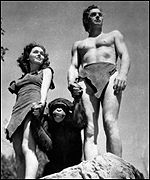
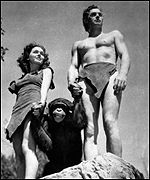
My name is Josh R, and I am a cineholic. My drug of choice is classic films of the 1930s and 1940s. I’ve made several unsuccessful attempts to kick the habit...I do manage to limit myself to contemporary films while Oscar season is in full swing. But as soon as those little golden goodies are handed out, I inevitably fall off the wagon. Don’t judge me.

During my formative years, my parents were too naïve to recognize the telltale signs of addiction — or perhaps they made the deliberate decision to turn a blind eye to something they couldn’t bring themselves to acknowledge. By the time I was 5, I would spend every Sunday morning watching the kiddie matinee on a local cable channel — usually a Shirley Temple or Tarzan film — in the case of the latter, it was more often the cheapo B-movie sequels featuring a paunchy, middle-age Johnny Weismuller made long after Maureen O’Sullivan had jumped ship (sometimes it wasn't even Weismuller, but Lex Barker or Gordon Scott). These films generally sported titles like Tarzan and the Cobra Woman, Tarzan and the Amazons, and Tarzan and the Mermaids. I grew up believing that the darkest jungles of Africa were populated almost entirely by secret tribes of pretty white women with ample cleavage who existed solely for the purpose of getting nailed by Tarzan (apparently Jane rivaled even Hillary Clinton in the forbearance department).
Even at the tender of age of 5, I probably instinctively recognized that these films were crap — even so, I loved them. I occasionally wonder what it would be like to revisit them today. Sadly, they almost never air on television, all but a scant few are available on DVD, and most have never even received a video release. Perhaps this is excusable given the nature of the material — these are, after all, films with little discernible artistic merit beyond what pleasures can be derived by watching scantily clad contract players in loincloths and bikinis delivering risible dialogue in the service of a ludicrous storyline. More troubling is the fact that many good or great films from this era, including those helmed by acclaimed filmmakers and featuring major stars of the period, are similarly missing in action. Several have a certain degree of standing within the annals of film history, even if they remain relatively unknown to anyone beyond the most ardent cinema enthusiast.

Why some of these films have languished in the land of lost movies remains anyone’s guess. Some of it may be cold, hard economics — the studios simply don’t feel that’s worth their while to shell out for the DVD release of a film for which there’s a limited market. Several critics, in recapping the career of the great Billy Wilder after his death in 2002, lamented the fact that his cynical masterpiece, Ace in the Hole, remained unavailable for viewing in any form to the general public. Featuring Kirk Douglas as an unscrupulous reporter who turns a tragic mine cave-in into a three-ring media circus, the film has become something of a Holy Grail for film buffs. Presumably, prints still exist in archives or private collections, although it’s never been released on video and is nowhere in evidence on the TV schedule. I bought a copy on eBay — junkies like me can spend hours trolling eBay searching for rare and out-of-print films, usually with a certain degree of success.
Unfortunately, the items themselves are usually homemade videotapes of inferior quality auctioned off at ridiculously exorbitant prices. Such was also the case with another purchase I made, a video copy of The Constant Nymph, a romantic weepie for which Joan Fontaine received an Oscar nomination in 1943. I cried, alright — the picture was so grainy and distorted I could barely make out facial features (I’m reasonably sure the leading man was either Charles Boyer or Robert Montgomery, but you can’t tell from looking at it). This particular film will never be available on video, or be allowed television airings, because of an ongoing legal dispute over who owns the rights. For Oscar buffs such as Mr. Copeland and myself, who consider it a matter of principle to see as many nominated performances as we can get our grubby little hands on, it’s been particularly rough going — you’d be surprised how many films with major nominations are missing in action. For me, 1951 is the most frustrating year — Death of a Salesman and The Blue Veil, which received a total of five acting nominations between them, are both hard commodities to come by. Five nominations — that’s a whole freakin’ category. I need my fix, man.
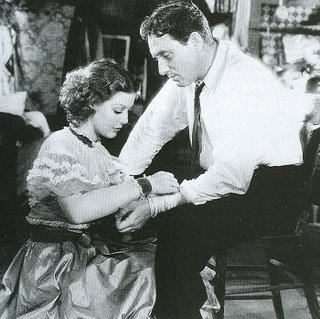
In spite of the obvious problems with picture quality, which can be variable, eBay has proved an invaluable resource in terms of locating and obtaining rare films. My wallet’s a little lighter, but there are several wonderful films I never would have been able to see otherwise. My favorite to date is Frank Borzage’s 1933 tragic drama Man’s Castle, with Spencer Tracy and Loretta Young giving sensitive performances as vagrants who fall in love in a depression-era shantytown; the film is as striking visually and thematically in its own right as Sunrise, the director’s most celebrated film.
The best recent acquisition I’ve made is The Macomber Affair, a fascinating Zoltan Korda film from 1947. The picture quality is actually pretty good — it looks as though it was taped sometime in the '80s (the logo for KETA 13 in Oklahoma City is emblazoned across the bottom of the screen during the opening credits — shout-out to the Okies!), but it doesn’t show too much evidence of decay. I wanna talk about it a bit, because it’s fresh in memory and I want to provide y’all with an idea of what kinds of treasures are out there that you’re not being allowed to see.
Based on “The Short and Happy Life of Francis Macomber,” a short story by Ernest Hemingway, the film concerns a typically Hemingway-esque great white hunter/rugged individualist who is hired to lead a Kenyan safari by a wealthy American couple — whose relationship isn’t what it initially appears to be. In the isolation of the African wild, the guide finds himself drawn into an elaborate game of recrimination and cruelty worthy of an Albee play — and one with deadly consequences. An unsettling examination of passion and betrayal, Korda’s film noir benefits from gorgeous location photography and some unconventional casting choices which pay great dividends. Gregory Peck is surprisingly effective in the kind of hard-bitten, rough-hewn man’s man kind of role one would usually associate with Clark Gable. It’s an unusual triumph for him, considering how lackluster I find most of the performances from this early stage of his career. Not that Peck himself was entirely to blame for this — no one in Hollywood seemed to know exactly what to do with this lean, handsome actor in the 1940s, before he’d attained the kind of gravitas one associates with his most famous performances. The contrast of delicate, almost feminine features and a gruff, preternaturally deep voice undoubtedly made him a bit of a casting paradox — he usually got stuck playing the dull embodiment of decency (his Oscar-nominated turns in Keys to the Kingdom, The Yearling and Gentlemen’s Agreement) or as eye-candy opposite a female superstar (squiring Greer Garson in Valley of Decision and Ingrid Bergman in Spellbound). When he tried to play badass, as in the lurid Duel in the Sun (a debacle that’s really kind of fascinating in its awfulness), the results could be embarrassing — although considering that this is the same film that cast little Jennifer Jones as an oversexed halfbreed temptress, he does his best to rise above the sheer lunacy of it all. But with the right part, good material and the guidance of a skilled director working together in happy complicity, he had the ability to shine — his undeniable star quality is evident in every film that he made during this period, but The Macomber Affair is probably the only film he made in the 1940s, other than 12 O’Clock High, where his talent was put to full use.
Every great film noir needs a femme fatale, and The Macomber Affair features a specialist in the field — in fact, one of the best who ever vamped her way across the screen. Joan Bennett began her career as an innocuous, rather circumspect blonde, raising her naturally husky voice several octaves to a strained helium-induced squeak so as not to seem abrasive, and was more or less overshadowed by her sister Constance (who was briefly a top female box office attraction in the early 1930s). It wasn’t till the '40s that little sister got wise, dispensed with the peroxide, let her whisky-soaked alto rip, and bared her fangs for Fritz Lang in a succession of deliciously nasty roles (anyone who hasn’t seen her lolling about in slovenly splendor as ‘Lazy Legs’ in Scarlet Street, get ye to a rental store). The Macomber Affair makes generous use of her peculiar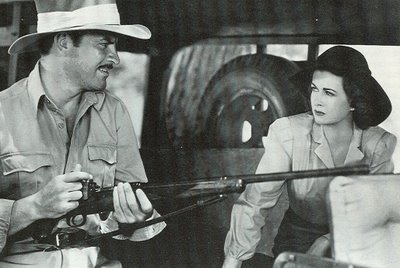 gifts, but allows the actress more emotional complexity than the Lang films did — she’s a cool, patrician beauty in a white hat and gloves whose prim exterior masks deep-seated resentments and an aching awareness what living a lie has cost her. Bennett allows the audience to feel sympathy for her character, who doesn’t fully understand how she allowed herself to be trapped in a dysfunctional marriage based in accommodation and denial, and whose efforts to avoid being poisoned by the contempt she feels for both and her husband and herself have ended in futility. Even as the film moves to its inevitable conclusion, her motives remain ambiguous — we’re never really sure how many of her actions are intentional, and to what extent she’s simply at the mercy of her own subconscious. Bennett convinces us that she doesn’t know either. The third member of the triangle is Robert Preston (yes, that Robert Preston), who has the trickiest role, and delivers the film’s most stunningly executed performance. For those who know him only from his galvanizing, personality-driven turns in The Music Man and Victor/Victoria, this early performance reveals a wrinkle to his talent heretofore completely unsuspected. At first glance, and for much of the film, Preston seems little more than an ingratiating, slightly dull-witted milquetoast. His bland affability catches you completely off guard, as the actor gradually reveals the dark undercurrents of depravity and despair that lurk beneath the surface geniality. Cowardice isn’t a benign attribute when coupled with self-knowledge; shame and self-loathing create an emotional disturbance which, in turn, manifests itself as physical violence. It’s pretty obvious that Preston’s "problems" are meant to be symbolic of male impotency — it’s his own blistering awareness of his shortcomings as a man which drive his need to victimize the weak.
So this is basically an example of a movie that has not been deemed worthy of any kind of release for home viewing, because apparently none of you could possibly be interested in seeing a film which is in black and white and doesn't have any explosions (United Artists, welcome to my shit list). Of course, if there’s a specific crappy, mindless action flop from the '80s or '90s — let’s call it, oh, Daylight — you can go to amazon.com and find listings for a widescreen DVD, a fullscreen DVD, a collector’s edition with special features, a two-disc special deluxe commemorative issue with special features on the special features (The Making of the Making of Daylight, anyone?), and so on and so on until we arrive at a limited-edition, five-disc, velvet-lined, jewel-encrusted box set of platinum discs with complimentary t-shirt and tote bag that no one with a modicum of taste would ever f**king want. Studios, shape up. There will always be an audience for great classic films, so stop underestimating your clientele. Thus ends my tirade.
Tweet
TO READ ON, CLICK HERE
My name is Josh R, and I am a cineholic. My drug of choice is classic films of the 1930s and 1940s. I’ve made several unsuccessful attempts to kick the habit...I do manage to limit myself to contemporary films while Oscar season is in full swing. But as soon as those little golden goodies are handed out, I inevitably fall off the wagon. Don’t judge me.

During my formative years, my parents were too naïve to recognize the telltale signs of addiction — or perhaps they made the deliberate decision to turn a blind eye to something they couldn’t bring themselves to acknowledge. By the time I was 5, I would spend every Sunday morning watching the kiddie matinee on a local cable channel — usually a Shirley Temple or Tarzan film — in the case of the latter, it was more often the cheapo B-movie sequels featuring a paunchy, middle-age Johnny Weismuller made long after Maureen O’Sullivan had jumped ship (sometimes it wasn't even Weismuller, but Lex Barker or Gordon Scott). These films generally sported titles like Tarzan and the Cobra Woman, Tarzan and the Amazons, and Tarzan and the Mermaids. I grew up believing that the darkest jungles of Africa were populated almost entirely by secret tribes of pretty white women with ample cleavage who existed solely for the purpose of getting nailed by Tarzan (apparently Jane rivaled even Hillary Clinton in the forbearance department).
Even at the tender of age of 5, I probably instinctively recognized that these films were crap — even so, I loved them. I occasionally wonder what it would be like to revisit them today. Sadly, they almost never air on television, all but a scant few are available on DVD, and most have never even received a video release. Perhaps this is excusable given the nature of the material — these are, after all, films with little discernible artistic merit beyond what pleasures can be derived by watching scantily clad contract players in loincloths and bikinis delivering risible dialogue in the service of a ludicrous storyline. More troubling is the fact that many good or great films from this era, including those helmed by acclaimed filmmakers and featuring major stars of the period, are similarly missing in action. Several have a certain degree of standing within the annals of film history, even if they remain relatively unknown to anyone beyond the most ardent cinema enthusiast.

Why some of these films have languished in the land of lost movies remains anyone’s guess. Some of it may be cold, hard economics — the studios simply don’t feel that’s worth their while to shell out for the DVD release of a film for which there’s a limited market. Several critics, in recapping the career of the great Billy Wilder after his death in 2002, lamented the fact that his cynical masterpiece, Ace in the Hole, remained unavailable for viewing in any form to the general public. Featuring Kirk Douglas as an unscrupulous reporter who turns a tragic mine cave-in into a three-ring media circus, the film has become something of a Holy Grail for film buffs. Presumably, prints still exist in archives or private collections, although it’s never been released on video and is nowhere in evidence on the TV schedule. I bought a copy on eBay — junkies like me can spend hours trolling eBay searching for rare and out-of-print films, usually with a certain degree of success.
Unfortunately, the items themselves are usually homemade videotapes of inferior quality auctioned off at ridiculously exorbitant prices. Such was also the case with another purchase I made, a video copy of The
 Constant Nymph, a romantic weepie for which Joan Fontaine received an Oscar nomination in 1943. I cried, alright — the picture was so grainy and distorted I could barely make out facial features (I’m reasonably sure the leading man was either Charles Boyer or Robert Montgomery, but you can’t tell from looking at it). This particular film will never be available on video, or be allowed television airings, because of an ongoing legal dispute over who owns the rights. For Oscar buffs such as Mr. Copeland and myself, who consider it a matter of principle to see as many nominated performances as we can get our grubby little hands on, it’s been particularly rough going — you’d be surprised how many films with major nominations are missing in action. For me, 1951 is the most frustrating year — Death of a Salesman and The Blue Veil, which received a total of five acting nominations between them, are both hard commodities to come by. Five nominations — that’s a whole freakin’ category. I need my fix, man.
In spite of the obvious problems with picture quality, which can be variable, eBay has proved an invaluable resource in terms of locating and obtaining rare films. My wallet’s a little lighter, but there are several wonderful films I never would have been able to see otherwise. My favorite to date is Frank Borzage’s 1933 tragic drama Man’s Castle, with Spencer Tracy and Loretta Young giving sensitive performances as vagrants who fall in love in a depression-era shantytown; the film is as striking visually and thematically in its own right as Sunrise, the director’s most celebrated film.
The best recent acquisition I’ve made is The Macomber Affair, a fascinating Zoltan Korda film from 1947. The picture quality is actually pretty good — it looks as though it was taped sometime in the '80s (the logo for KETA 13 in Oklahoma City is emblazoned across the bottom of the screen during the opening credits — shout-out to the Okies!), but it doesn’t show too much evidence of decay. I wanna talk about it a bit, because it’s fresh in memory and I want to provide y’all with an idea of what kinds of treasures are out there that you’re not being allowed to see.
Based on “The Short and Happy Life of Francis Macomber,” a short story by Ernest Hemingway, the film concerns a typically Hemingway-esque great white hunter/rugged individualist who is hired to lead a Kenyan safari by a wealthy American couple — whose relationship isn’t what it initially appears to be. In the isolation of the African wild, the guide finds himself drawn into an elaborate game of recrimination and cruelty worthy of an Albee play — and one with deadly consequences. An unsettling examination of passion and betrayal, Korda’s film noir benefits from gorgeous location photography and some unconventional casting choices which pay great dividends.
 Gregory Peck is surprisingly effective in the kind of hard-bitten, rough-hewn man’s man kind of role one would usually associate with Clark Gable. It’s an unusual triumph for him, considering how lackluster I find most of the performances from this early stage of his career. Not that Peck himself was entirely to blame for this — no one in Hollywood seemed to know exactly what to do with this lean, handsome actor in the 1940s, before he’d attained the kind of gravitas one associates with his most famous performances. The contrast of delicate, almost feminine features and a gruff, preternaturally deep voice undoubtedly made him a bit of a casting paradox — he usually got stuck playing the dull embodiment of decency (his Oscar-nominated turns in Keys to the Kingdom, The Yearling and Gentlemen’s Agreement) or as eye-candy opposite a female superstar (squiring Greer Garson in Valley of Decision and Ingrid Bergman in Spellbound). When he tried to play badass, as in the lurid Duel in the Sun (a debacle that’s really kind of fascinating in its awfulness), the results could be embarrassing — although considering that this is the same film that cast little Jennifer Jones as an oversexed halfbreed temptress, he does his best to rise above the sheer lunacy of it all. But with the right part, good material and the guidance of a skilled director working together in happy complicity, he had the ability to shine — his undeniable star quality is evident in every film that he made during this period, but The Macomber Affair is probably the only film he made in the 1940s, other than 12 O’Clock High, where his talent was put to full use.
Every great film noir needs a femme fatale, and The Macomber Affair features a specialist in the field — in fact, one of the best who ever vamped her way across the screen. Joan Bennett began her career as an innocuous, rather circumspect blonde, raising her naturally husky voice several octaves to a strained helium-induced squeak so as not to seem abrasive, and was more or less overshadowed by her sister Constance (who was briefly a top female box office attraction in the early 1930s). It wasn’t till the '40s that little sister got wise, dispensed with the peroxide, let her whisky-soaked alto rip, and bared her fangs for Fritz Lang in a succession of deliciously nasty roles (anyone who hasn’t seen her lolling about in slovenly splendor as ‘Lazy Legs’ in Scarlet Street, get ye to a rental store). The Macomber Affair makes generous use of her peculiar
 gifts, but allows the actress more emotional complexity than the Lang films did — she’s a cool, patrician beauty in a white hat and gloves whose prim exterior masks deep-seated resentments and an aching awareness what living a lie has cost her. Bennett allows the audience to feel sympathy for her character, who doesn’t fully understand how she allowed herself to be trapped in a dysfunctional marriage based in accommodation and denial, and whose efforts to avoid being poisoned by the contempt she feels for both and her husband and herself have ended in futility. Even as the film moves to its inevitable conclusion, her motives remain ambiguous — we’re never really sure how many of her actions are intentional, and to what extent she’s simply at the mercy of her own subconscious. Bennett convinces us that she doesn’t know either. The third member of the triangle is Robert Preston (yes, that Robert Preston), who has the trickiest role, and delivers the film’s most stunningly executed performance. For those who know him only from his galvanizing, personality-driven turns in The Music Man and Victor/Victoria, this early performance reveals a wrinkle to his talent heretofore completely unsuspected. At first glance, and for much of the film, Preston seems little more than an ingratiating, slightly dull-witted milquetoast. His bland affability catches you completely off guard, as the actor gradually reveals the dark undercurrents of depravity and despair that lurk beneath the surface geniality. Cowardice isn’t a benign attribute when coupled with self-knowledge; shame and self-loathing create an emotional disturbance which, in turn, manifests itself as physical violence. It’s pretty obvious that Preston’s "problems" are meant to be symbolic of male impotency — it’s his own blistering awareness of his shortcomings as a man which drive his need to victimize the weak.
So this is basically an example of a movie that has not been deemed worthy of any kind of release for home viewing, because apparently none of you could possibly be interested in seeing a film which is in black and white and doesn't have any explosions (United Artists, welcome to my shit list). Of course, if there’s a specific crappy, mindless action flop from the '80s or '90s — let’s call it, oh, Daylight — you can go to amazon.com and find listings for a widescreen DVD, a fullscreen DVD, a collector’s edition with special features, a two-disc special deluxe commemorative issue with special features on the special features (The Making of the Making of Daylight, anyone?), and so on and so on until we arrive at a limited-edition, five-disc, velvet-lined, jewel-encrusted box set of platinum discs with complimentary t-shirt and tote bag that no one with a modicum of taste would ever f**king want. Studios, shape up. There will always be an audience for great classic films, so stop underestimating your clientele. Thus ends my tirade.
Tweet
Labels: Albee, Fontaine, Gable, Garson, Gregory Peck, Ingrid Bergman, Joan Bennett, K. Douglas, Lang, R. Preston, Tracy
TO READ ON, CLICK HERE