Wednesday, February 01, 2012
It's a Late Night World of Love
By Edward Copeland
The moment when I knew Late Night with David Letterman wasn't like other talk shows might have been the first time Dave did one of his smallest touches and flung either a blue index card or a pencil through the mock window behind his desk and we heard the sound of breaking glass. Before we begin reminiscing about that magical night 30 years ago when a gap-toothed former weatherman from Indianapolis changed the face of late night television. (If he'd stayed a local TV weatherman, perhaps across the country, more hail would be described on TV as
 "the size of canned hams.") To commemorate the debut of this standup comic's breakthrough off-the-wall, wacky talk show that took NBC's airwaves hostage following the end of The Tonight Show Starring Johnny Carson, I feel that it's only appropriate that we recognize this anniversary with the proper reverence. You might have already played the YouTube clip above, but that's OK. Play the official anthem of Late Night With David Letterman again, only sing along this time, using the lyrics I've provided below. I'd have an animated bouncing ball if I were capable of creating one that was timed with the music but, alas, that falls beyond my capabilities. After you've paid due homage by singing the Late Night anthem, rejoin me after the jump so we can talk in more detail about Dave's impact on the talk show format, the culture and many impressionable viewers of a certain age. If you don't believe me, you should poll them — and we all know how painful that can be.
You can feel it across the land.
It's clear blue skies,
It's grandma's eyes,
A place where you can stand.
Late Night is the reason
Our forefathers fought with pride.
It's surfin' fun,
it's dad and son,
A feelin' that's deep inside.
(CHORUS)
It's a Late Night world,
It's a world that we can share.
So turn on your TV
And watch it with me.
It's a Late Night world of love.
(END CHORUS)
There's a whole new generation
who are willing to say yes.
Soups and stews,
A wall of shoes,
A thing called happiness.
So change the channel,
Change your life,
Doesn't cost a thing.
We're talking loud,
standing proud,
now join us as we sing
(REPEAT CHORUS TWICE)
I wanted to make this tribute more thorough, but unfortunately I was hit with a long Internet outage last evening that made finishing this piece a bit of a rush job. In a way, that's more appropriate. Late Night With David Letterman always resembled a fly-by-the-seat-of-your-pants operation, that the tribute follow suit just seems right.

Letterman and I are both Aries born in Indianapolis, Ind. I lived there when he was a weatherman, but I was too young to remember him in that role though my parents do. When Letterman were merely a standup comic, I didn't care for his comedy much, so I don't know when or why I started tuning in to Late Night, which premiered in the second half of my seventh-grade year of school. I never saw an installment of his short-lived morning show. I do, however, remember what changed my opinion on him. Letterman had an HBO special, but not a standup special of the type comedians usually had, called Looking for Fun. Its premise had Dave trolling around Los Angeles trying to find fun things to do and displayed the type of absurd humor that would be perfected on Late Night. I couldn't remember the year of the special — my memory spoke to me and said I watched it in the house we lived in through my sixth-grade year, so I was guessing 1980 or 1981. I checked the "not as reliable as you wish it was" Internet Movie Database and it doesn't even list such a special in Letterman's credits. I did a Google search and found a comic's Web site making the same complaint about IMDb and dating it as 1981. He actually at one point had the special on the site in three video clips until Time Warner asserted its rights and forced him to remove it, so there's a lost gem of Letterman comedy out there somewhere. During my junior high years, I turned Late Night on and got hooked. It was a relationship that lasted through high school and college and even a little bit beyond. Somehow it lost part of that go-for-broke edge it had when it was on at a later hour on NBC when it went on earlier on the Tiffany Network. I'm sure people younger than I am probably feel toward Conan the way my age group did toward Dave. I don't know if there's a new generation that's embraced Fallon or Kimmel. One thing is clear across all age groups: Nobody likes Leno.
The montage the folks at Late Night put together to accompany "The Late Night Anthem" (official title) contains so many moments dear to my heart and the hearts of many friends I know who recall seeing those moments live or remember the individuals, some who have shuffle off this mortal coil. Now, it includes plentiful shots of Late Night regulars such as band leader Paul Schaffer, utility player Chris Elliott and "Where'd-they-dig-up=that-guy?" guy Larry "Bud" Melman. (In fact, Chris and Larry "Bud" played such integral roles in what made this talk show unique, I've written separate posts on each on them. Follow the links on their names.) Elsewhere in the video, we see the
 great Bill Murray, who was Dave's very first guest on the inaugural show. Sandra Bernhard makes an appearance — her appearances always proved entertaining just by how uncomfortable she could make Dave. Who can forget Stupid Human Tricks or Stupid Pet Tricks? My college roommate and I cracked up for months over that monkey in a dress's expression after she paws at Letterman and then looks shocked. The other band members would get a moment in the sun, such as drummer Anton Zipp or was that Figg? I didn't see the nutty Crispin Glover appearance the night it happened, but I saw the clip plenty of times later — and this took place before YouTube or the Web. After all that fake gunplay, we see the great Penn and Teller. There's Pee-wee Herman taking Dave for a ride in a fake car that in retrospect looks quite similar to when Conan O'Brien drives around in his desk. Comic Jeff Altman gets an appearance (which seems strange in retrospect) followed by the band's guitarist Will Lee and then the great longtime movie star Van Johnson, who just left us in 2008 at the age of 92. Underground comic writer Harvey Pekar (who left us in 2010 and was the subject of the movie American Splendor) made the most of every appearance, usually making NBC's corporate owners extremely uneasy. Then it's a medley of wacky comics: Gilbert Gottfried, Bobcat Goldthwait and the one-of-a-kind stand-up philosopher Brother Theodore, who most of us never would have heard of in the first place if it hadn't been for Late Night With David Letterman. Ironically, it ends with a parting word from guest Jay Leno. How could they know how that would end? What surprised me at the time was the glaring omission from the "Late Night Anthem" montage, Where in the world was Teri Garr? She was one of Letterman's most frequent guests on his NBC shows and the two had such comic chemistry that no one could stop the rumors that the two were secretly married. Hell, Teri even took a shower on the show once. I can't remember the premise, but for some reason they had to do the show out of Dave's office. As a bonus, the clip below includes Dave's Dancing Waters.
The incredible magic of Late Night With David Letterman can be found in how its appeal cut across the usual clique and class divides of your typical suburban high school. In my sophomore year, Late Night had achieved such a level of popularity that the student planners of the school talent show lifted the talk show as the framing device for that year's talent show with a student pretending to be Letterman introducing the acts. I'm not ashamed to say that their material was quite lame and the only two jokes that got riotous laughter were written by yours truly: one being a Top 10 list, the other concerning who paid for promotional considerations that referenced a mini-scandal after a school dance. I'd share them but they were so site and date specific that if you didn't attend that school 27 years ago, the humor would be lost. Weren't we lucky that NBC didn't hear we were stealing their "intellectual property?" This was before General Electric purchased NBC. Boy, they welcomed Dave, didn't they?
In addition to all the memorable guests such as Cher who doesn't mince words as to why she avoided his show. Later, when she and Sonny reunited. The countless appearances of Tony Randall. The features: Supermarket Finds, Viewer Mail, Small Town News, Dropping Stuff Off a 5-Story Tower, Crushing Things With Steamrollers or 80-Ton Hydraulic Presses. Thrill-Cams. Monkey Cams. The NBC Bookmobile. Inventing a catchphrase ("They pelted us with rocks and garbage.") One clip I wish I could have found was a bit they used to do about editing mistakes, talking about the rare times they had to edit the show before it aired. They showed a segment where a guest was keeled over in his chair with an arrow in his back and Letter was pointing at the audience and yelling, "You. Yes, you. You know damn well what I'm talking about." Then there were the suits.
I was so tempted to run every clip YouTube had of Brother Theodore just so those unfamiliar with him could see his act. He had to be seen to be believed, but I narrowed it down to one.
They did plenty of special shows: A mock Christmas special that gave Dave a family, the 360 degree rotation show, the reverse image show, the rerun shows, but perhaps my favorite were the Custom-Made Shows and I thought I would end with a clip from one of those because when Jane Pauley finally gets coaxed into speaking, I think she sums up the feelings of Late Night with David Letterman fans everywhere about the show they loved.
Please remember: This tribute has only been an exhibition. It's not a competition. Please. No wagering.
Tweet
Labels: 80s, Carson, HBO, Letterman, Murray, Tony Randall, TV Tribute
TO READ ON, CLICK HERE


Sunday, January 08, 2012
Centennial Tributes: José Ferrer

By Edward Copeland
CYRANO: You may go. Or tell me, why are you staring at my nose?
THE MEDDLER: No!
CYRANO: It disgusts you, then? Does its color appear to you unwholesome? Or its form obscene?
THE MEDDLER: But I've been careful not to look!
CYRANO: And why not if you please? Possibly you find it just a trifle large!

José Ferrer played many roles throughout his lengthy career on stage, screen, television and even radio, but none loomed larger than Cyrano de Bergerac, who actually was a 17th century dramatist and swordsman but gained famed only in other authors' works loosely based on his life, most notably the 1897 play by Edmond Rostand. Without a doubt, Cyrano became Ferrer's signature role from the moment he placed the fake proboscis on his face and stepped onto the stage of The Alvin Theatre on Oct. 8, 1946 (Though on Nov. 18 of that year, the production moved to the Ethel Barrymore Theatre). His Roxane happened to be the late Frances Reid, best known for her 44-year-run as Alice Horton on the soap Days of Our Lives. I'll get back to Ferrer and Cyrano later in this tribute to the Oscar- and Tony-winning actor, Emmy and Directors Guild nominee and first actor to receive the U.S. National Medal of Arts, who was born 100 years ago today as José Vicente Ferrer de Otero y Cintrón in the Santurce district of San Juan, Puerto Rico.
Ferrer's father was a respected attorney and writer in San Juan. His parents sent José to the prestigious Swiss boarding school Institut Le Rosey, which was founded in 1880 and has educated children of royalty from all parts of the world. After his attendance there, Ferrer went to Princeton University, where he graduated either in 1933 or 1934 (depends which source you read at the time). While at Princeton, he was a member of its famous Princeton Triangle Club, the oldest collegiate musical-comedy theater troupe in the U.S. which was founded in 1891. Since its creation, the club has counted as members Booth Tarkington, F. Scott Fitzgerald, Joshua Logan, James Stewart, Wayne Rogers, David E. Kelley and Brooke Shields. Regardless of whether he graduated in '33 or '34, it didn't take Ferrer long to make his Broadway debut, even if it were merely the role of Second Policeman in the comedy A Slight Case of Murder. Written by Damon Runyon and Howard Lindsay, the play opened Sept. 11, 1935, and played for 69 performances at The 48th Street Theatre, a theater that
 hasn't been renamed but was destroyed when a water tower collapsed on Aug. 24, 1955. When A Slight Case of Murder closed, Ferrer moved almost directly into another comedy, Stick-in-the-Mud by Frederick Hazlitt Brennan which starred Thomas Mitchell, who also directed. Ferrer was cast as the chauffeur. The play's run was a brief one — it lasted only nine performances at the same 48th Street Theatre. It would be eight months before Ferrer would appear on The Great White Way again. When Ferrer tread the Broadway boards again in August 1936 in the Philip Barry comedy Spring Dance, another quick closer, lasting only 24 performances at The Empire Theatre, which was demolished in 1953 so an office tower could be built. His next Broadway role changed everything. The play was a huge hit and Ferrer got his largest part yet. The production was the comedy Brother Rat by John Monks Jr. and Fred F. Finklehoffe and was produced and directed by the legendary George Abbott, who was a spry 49 years old then (He was 107 when he died in 1995, outliving Ferrer by three years). The plot revolved around three senior cadets at the Virginia Military Institute where one is secretly married and about to be a father. Ferrer played Dan Crawford, one of the three, opposite Eddie Albert as Bing Edwards, the dad-to-be, and Frank Albertson as Billy Randolph. The show ran 577 performances at The Biltmore Theatre (now The Samuel J. Friedman Theatre) through May 1938. By October 1938, a movie version of Brother Rat had hit movie theaters, though only Albert re-created his stage role. Ferrer's part in the film went to Ronald Reagan, who met Jane Wyman on the film's production. It's unclear when
 Ferrer exited the Broadway production, but he appeared in two other Broadway plays while Brother Rat still was running. A very significant event occurred in Ferrer's life in 1938, the year Brother Rat did close though — he wed Uta Hagen, who would go on to become an esteemed actress herself and an even more legendary acting teacher. The next notable Broadway production in which Ferrer appeared was the debut of Maxwell Anderson's Key Largo on Nov. 27, 1939. Based on the Brooks Atkinson review of the play in The New York Times archives and the fact that none of the characters has the same names as the characters in John Huston's famous 1948 film version, it's difficult to tell who played what part. Paul Muni was the star of the Broadway production in what would seem to be the equivalent of the Humphrey Bogart role, though Ferrer plays a character named Frank (and received Atkinson's praise) as Bogie did in the film, though with a different last name. Hagen played Ferrer's Victor's sister. I can't be positive who plays the Johnny Rocco equivalent, but the play also featured Karl Malden as Hunk and James Gregory in his Broadway debut as Jerry. In October 1940, Ferrer received his first undisputed lead role in a smash as he starred in a revival of the drag farce Charley's Aunt under Joshua Logan's direction. The revival ran for 233 performances at The Cort Theatre, which still bears that name today.
Two days before Charley's Aunt opened on Oct. 17, 1940, Ferrer and Hagen premiered another collaboration: daughter Leticia Thyra. Ferrer stayed with Charley's Aunt through May 3, 1941. On Sept. 22, 1942, S.M. Herzig's Vickie debuted on Broadway, marking Ferrer's Broadway directing debut. He also played the husband of the title character, whose role was filled by Hagen. Also in the cast were Red Buttons and Mildred Dunnock. The comedy only played at The Plymouth Theatre (now The Gerald Schoenfeld Theatre) for 48 performances. Sometime in February 1943, Ferrer replaced Danny Kaye for the final month of performances of the hit musical Let's Face It! with songs by Cole Porter and a book by Herbert and Dorothy Fields.
 Ferrer's next Broadway engagement turned out to be a landmark in the history of that strip of Manhattan theater. Ferrer played Iago and Hagen played Desdemona opposite Paul Robeson in the title role as Shakespeare's Othello. The revival of the famous tragedy opened at The Shubert Theatre on Oct. 19, 1943 and ran 296 performances before taking a break to take the play on tour. The trio returned in May 22, 1945 for 24 more performances, this time at The City Center. To this date, it is the longest running Shakespeare production in Broadway history. While Ferrer was playing Iago, Billy Wilder pursued him because he wanted the actor to play the lead in The Lost Weekend, however Paramount refused to let Wilder hire him, insisting he cast a name. They pursued Cary Grant, who passed but finally got Ray Milland who won an Oscar for the role, despite his initial reluctance to take the part. On a personal level, Othello would leave to an unhappy side effect for Ferrer. Robeson and Hagen had an affair, leading the Ferrers to divorce in 1948. Before their split, Ferrer kept himself busy. On radio, he had a successful series playing detective Philo Vance in 1945. On Nov. 29, 1945, Lillian Smith's play Strange Fruit opened at The Royale Theatre (now the Bernard B. Jacobs Theatre). Ferrer produced and directed the production which starred a different though unrelated Ferrer — actor Mel Ferrer, still going by his full first name Melchor. Also in the cast were Murray Hamilton and Ralph Meeker. It ran 60 performances. The two Ferrers would swap roles in José's next Broadway production, though José would produce it while Melchor directed and José starred in the Oct. 8, 1946, premiere of Cyrano de Bergerac. Meeker also was part of the cast as was the actress Phyllis Hill, who would become Ferrer's second wife in 1948 soon after his divorce from Uta Hagen.
"José Ferrer has administered a lively draft of tonic to this season by staging Cyrano de Bergerac as though he meant it. Acting the part of the braggart romantic, he is appearing at the Alvin in a pulsating performance that makes full use of the modern theatre. Although Cyrano is no longer a modern play, it is still one of the most dashing ever written, particularly in the Brian Hooker version that preserves the bravura of the Rostand text in light verse of a modern idiom." That's how Brooks Atkinson began his review in The New York Times on Oct. 9, 1946. Atkinson heaped praise upon practically all aspects of the production — even giving a shout-out to the stage hands for moving the scenery, The critic closes by writing, "Mr. Ferrer has done Cyrano in the grand manner,
 like a man who gets fun as well as a living out of the theatre." Another notable name composed the incidental music for the production: the renaissance man Paul Bowles. Ferrer's revival ran 193 performances through March 22, 1947 and its run coincided with the inaugural year of the Antoinette Perry Awards, better known by its shorthand name, the Tony, presented by The American Theatre Wing. The Tonys were presented for the first time on April 6, 1947 at the Waldorf Astoria. The American Theatre Wing handed out 11 Tonys in seven categories that first evening. Ferrer's performance in Cyrano was honored for dramatic actor alongside Fredric March in Years Ago. Four others won for acting that first year, including Ingrid Bergman in Maxwell Anderson's Joan of Lorraine and Helen Hayes in Happy Birthday, both for dramatic actress. Shortly before Cyrano ended its run, Ferrer produced and directed a five-performance run of As We Forgive Our Debtors for the American National Theatre and Academy after originally being staged by The Experimental Theatre Inc. When the play closed, Ferrer finally prepared to leave New York, ironically in the film version of the play that won Ingrid Bergman her Tony. Retitled Joan of Arc, the Victor Fleming film premiered in 1948 with Ferrer portraying the Dauphin. He earned a supporting actor Oscar nomination for his film debut. It's been a long time since I've seen the film, but I remember him being the best thing in it other than the vibrant Technicolor cinematography.
Once Ferrer returned from California and making his first feature film, he started bouncing between the media of stage, screen and television. Between January 1948 and May 1949, Ferrer either starred, directed, produced, co-adapted or some combination of those in five Broadway shows. In January 1949, he appeared on The Philco Television Playhouse and reprised his role in a televised version of Cyrano de Bergerac. He returned to the same showcase in April to play Sammy Glick in Paddy Chayefsky's adaptation of Budd Schulberg's novel What Makes Sammy Run? In November 1949, he appeared in his second feature role, playing the manipulative hypnotist in Otto Preminger's thriller Whirlpool. Another fabled story has it that Ferrer was the first choice to play Addison De Witt in All About Eve, but the role went to George Sanders, who of course won the 1950 best supporting actor Oscar for the part. This time period wasn't an easy one for artists and like so many in his field, Ferrer found himself caught up in the Communist witchhunts of the time. Former co-star and friend Paul Robeson had his own problems above and beyond the run-of-the mill ones associated with others who ended up on HUAC-inspired blacklists when in March 1950, at the last minute, NBC canceled his planned appearance on Eleanor Roosevelt's program and banned him from its network while the U.S. State Department lifted his passport, effectively confining the Soviet-friendly artist from leaving the country. Red Channels, an anti-Communist pamphlet by the right-wing magazine Counterattack published on June 22, 1950, a list of 151 artists it claimed had Communist ties — including Ferrer and his ex-wife, Uta Hagen. It affected Hagen immediately and she never did much outside theater, but Ferrer held off repercussions for a bit as he had two films coming out in 1950.
A couple of weeks after his name appeared on the Red Channels list, the movie Crisis opened. Written and directed by Richard Brooks, Crisis starred Cary Grant as a brain surgeon on vacation with his wife in an unnamed Spanish-speaking country where Ferrer played its dictator, who happens to have a life-threatening tumor. Grant's doctor must decide whether he should keep his oath to save lives or let the tyrant die and give the country a chance at freedom. Later in 1950, Ferrer put on the big nose again in Michael Gordon's film version
 of Cyrano de Bergerac. Ferrer would win the best actor Oscar (so he and Sanders won in the same year) becoming the first Hispanic actor and first Puerto Rican actor to win an Academy Award. Ferrer is one of only nine performers to win both Oscars and Tonys for playing the same role, sharing that distinction with Jack Albertson (The Subject Was Roses). Anne Bancroft (The Miracle Worker), Shirley Booth (Come Back, Little Sheba), Yul Brynner (The King and I), Joel Grey (Cabaret), Rex Harrison (My Fair Lady). Lila Kedrova (Zorba the Greek/Zorba) and Paul Scofield (A Man for All Seasons). To honor his Puerto Rican roots, Ferrer donated his Oscar to the University of Puerto Rico. Ferrer played Cyrano in a television production again on Oct. 17, 1955, on Producers' Showcase and received an Emmy nomination for best actor — single performance. Because the Emmys always have been screwed up, Ferrer also was nominated as best actor in 1951, though even their official database doesn't know for what and the only TV credits IMDb shows prior to 1951 were those two appearances mentioned earlier. At any rate, Ferrer remains the only actor in history to be nominated for an Emmy, an Oscar and a Tony for playing the same role. He also returned to the Cyrano role in a 1953 production he directed at City Center in New York (the year his marriage to Phyllis Hill ended). In a March 1956 episode of the Burns and Allen show, he played Cyrano again, but only as a voice. Abel Gance directed him as Cyrano in French in the 1964 film Cyrano et d'Artagnan. He did Cyrano's voice again in a March 1974 ABC Afterschool Special. On a 1980s Tony telecast, Ferrer recited from the play a final time and then hung up the nose for good.
When Cyrano de Bergerac opened and throughout the time of his nomination and Oscar win, Ferrer had returned to New York where he produced, directed and starred in a revival of the comedy Twentieth Century opposite another 1950 Oscar nominee — Sunset Blvd.'s Norma Desmond herself, Gloria Swanson. In the 1951-52 Broadway season, Ferrer directed three big plays. In addition to directing, he produced the premiere of Stalag 17, staged the key Hume Cronyn-Jessica Tandy teaming in The Fourposter and directed, produced and starred in The Shrike. When the 1952 Tonys came out, Ferrer won best actor in a play for The Shrike as well as best director for all three plays. In Hollywood, he had two films come out. The first was the comedy Anything Can Happen. The second and far more important film was John Huston's
 Moulin Rouge where Ferrer played the famed painter Henri de Toulouse-Lautrec as well as The Comte de Toulouse-Lautrec, the painter's father. When Ferrer received an Oscar nomination, it was the first instance of a performer being nominated for portraying two distinct characters in the same film. Before that happened though, that Red Channels list controversy finally hit. As William O'Neill wrote in his chapter on The Blacklist in his book A Better World: Stalin and the American Intellectuals:
 On Dec. 27, 1952, the American Legion announced that it disapproved of…Moulin Rouge, starring José Ferrer, who used to be no more progressive than hundreds of other actors and had already been grilled by HUAC.…Nine members of the Legion had picketed it anyway, giving rise to the controversy. By this time, people were not taking any chances. Ferrer immediately wired the Legion's national commander that he would be glad to join the veterans in their "fight against communism." A few days later, Ferrer denounced Paul Robeson for accepting the Stalin Peace Prize. On Jan. 2, Leonard Lyons a columnist, wrote that the Legion opposed any further picketing of Moulin Rouge. Victor Lasky, another red-baiting columnist, was said to have withdrawn an article on Ferrer he had written for the Legion's magazine. On the 16th, Lyons reported the Ferrer had ironed out all his problems with Legion officials over lunch.

As I mentioned earlier, 1953 was the year when Ferrer and Phyllis Hill ended their marriage. It also was the year that Ferrer married his third wife, singer and actress Rosemary Clooney. The couple had three sons and two daughters. Their marriage ended eight years later in 1961, though they tried again and remarried in 1964 only
 to divorce again in 1967. Their first child, born in 1955, was son Miguel, who would become an actor in his own right, always will be treasured by Twin Peaks fans for his role as FBI Agent Albert Rosenfeld. The resemblance between father and son shows through clearly when you compare the b&w photo of José from Whirlpool three paragraphs above to the photo of Miguel as Albert in this paragraph. The marriage of José and Rosemary connected to branches of many entertainment families. It made José the uncle of George Clooney. Their son Gabriel married Debby Boone, who sang the 1977 pop hit "You Light Up My Life," which made Ferrer and Clooney the in-laws of Pat and Shirley Boone. While Ferrer only made one feature film with Rosemary Clooney (1954's Deep in My Heart), the spouses appeared on many entertainment TV shows together as well as The Ed Sullivan Show and an appearance on Person to Person with Edward R. Murrow. In 1964, competed against each other on an episode of the game show Password All-Stars. Even before he married Clooney though, Ferrer was somewhat of a regular fixture on all sorts of TV shows as himself as early as 1949 including The Milton Berle Show, Penthouse Party hosted by Betty Furness and three appearances on Your Show of Shows. Without his new bride, he appeared on shows including Tonight! when Steve Allen was host, two episodes of The Tennessee Ernie Ford Show and the game shows What's My Line? and I've Got a Secret.
For the most part, though Ferrer kept working nearly continuously until his death, the decade of the 1950s marked his heyday across all media. "The truth is I made a few good movies in the '50s, then went into freefall," Ferrer was quoted as saying, but his stage and television work didn't bring the acclaim they once did either. The Oscar nomination he received for Moulin Rouge was his third and final one, though I believe he should have been a contender for supporting actor for his role as Lt. Barney Greenwald, lawyer for the accused
 mutineers in 1954's The Caine Mutiny. The British Academy of Film nominated Ferrer as best foreign actor for his part, mainly for his superb drunken dressing down of his clients after he has cleared them and exposed Humphrey Bogart's Captain Queeg as a nutcase on the stand. Edward Dmytryk, the sole member of The Hollywood Ten who turned friendly HUAC witness after serving jail time, directed the film. The Oscars deservingly nominated Bogart as lead but from a supporting cast that also included fine work from Van Johnson and Fred MacMurray, instead nominated the milquetoast Tom Tully. In 1955, he made his film directing debut as he re-created his Tony-winning role The Shrike. He directed six feature films in total: The Cockleshell Heroes (1956); The Great Man (1957), which earned him a Directors Guild of America nomination alongside 16 other contenders though the prize went to David Lean for The Bridge on the River Kwai; I Accuse! (1958) where Ferrer played Capt. Dreyfuss in a screenplay by Gore Vidal; and The High Cost of Living (1958). The final two films Ferrer helmed didn't star him: 1961's Return to Peyton Place and the 1962 remake of State Fair starring future in-law Pat Boone. Other notable films in which Ferrer would appear throughout his life included Lawrence of Arabia, The Greatest Story Ever Told, Ship of Fools, the hilarious 1976 disaster spoof The Big Bus where Ferrer plays the villain who spends the film in an iron lung, Voyage of the Damned, finally got to work with Billy WIlder on Wilder's penultimate film, Fedora, made a disaster movie that meant to be serious — The Swarm, Woody Allen's A Midsummer Night's Sex Comedy, the remake of To Be or Not to Be and David Lynch's Dune.
Ferrer's theater career in New York for the remainder of the 1950s resembled reruns. Three days after Ferrer finished the 1953 revival of Cyrano he directed himself in at City Center, Ferrer did the same at City Center with The Shrike. Three days after The Shrike closed at the location, Ferrer acted there in the title role of Shakespeare's Richard III for The New York City Theatre Company with a cast that included Vincent Price and Maureen Stapleton. Two days after The Bard's work ended its run, Ferrer reached into his past again, starring and directing a revival of Charley's Aunt at City Center. One year and a day after the curtain fell on that revival, Ferrer directed Hume Cronyn and Jessica Tandy at City Center in a revival of The Fourposter. It took three years for Ferrer to return to work on something in New York theater. The project was the original musical comedy Oh Captain!, based on the 1953 comedy The Captain's Paradise starring Alec Guinness. Ferrer directed the musical and co-wrote the book with Al Morgan. Music and lyrics were by Jay Livingston and Ray Evans and Tony Randall played the Guinness
 role in the musical. The show received six Tony nominations, including the last Ferrer would ever receive for co-writing the book. Ferrer would direct three more shows in the 1950s, only one of which he would act in (Edwin Booth), the second which was the third director to work on a troubled musical (Juno) and the last was the play The Andersonville Trial where he butted heads with star George C. Scott. When he returned to Broadway in December 1963, it was in the original Noel Coward musical The Girl Who Came to Supper co-starring Florence Henderson. Ferrer briefly replaced Richard Kiley in the lead role of the gigantic hit Man of La Mancha in May 1966 and did well enough to lead the first national touring company of the musical. He wouldn't do any Broadway work again for 13 years, though he did some off-Broadway productions. In 1972, he directed The Web and the Rock. He succeeded Ellis Rabb in the role of Robert in the Gerald Gutierrez-directed production of David Mamet's A Life in the Theatre at some point in its run from Oct. 20, 1977-July 9, 1978. Finally, he produced and starred in White Pelicans, written and directed by Jay Broad, which ran for 14 performances beginning Oct. 19, 1978, at Theatre de Lys (now the Lucille Lortel Theatre). Ferrer's last work on Broadway was his direction of the new musical Carmelina with lyrics by Alan Jay Lerner (My Fair Lady, Camelot, On a Clear Day You Can See Forever, Brigadoon), music by Burton Lane (Finian's Rainbow, On a Clear Day You Can See Forever) and book by Lerner and Joseph Stein (Fiddler on the Roof, Zorba). It only ran 17 performances and received a single Tony nomination best original score. Ferrer was inducted into the Theater Hall of Fame in 1981. The hall's inductees' names get inscribed in gold lettering on the walls of the upper levels of the Gershwin Theatre, one of Broadway's largest houses.
From the 1960s on, the bulk of Ferrer's work came on television. In 1964, he was the uncredited narrator of the first three episodes of Bewitched, explaining the story of Samantha admitting to
 Darrin that she's a witch before they wed. Rumor has it that the producers of the TV series Batman pursued Ferrer first to play The Joker. He also provided the voice of Ben Haramed, the man who kidnaps Aaron to put in his act in the Rankin/Bass animated version of The Little Drummer Boy in 1968. His presence became a common one on episodic television such as The Name of the Game, The Marcus-Nelson Murders, the movie that served as the pilot for Kojak, the "Mind Over Mayhem" episode of Columbo, Banyon, Starsky and Hutch, Magnum, P.I., Quincy, M.E., Murder, She Wrote, Hotel, Matlock and the requisite appearances on The Love Boat and Fantasy Island. Ferrer took roles in many television movies
 and miniseries including A Case of Libel, The Rhinemann Exchange, Gideon's Trumpet, Evita Peron, Peter and Paul, Blood Feud, Samson and Delilah, George Washington, Hitler's S.S.: Portrait in Evil, Strange Interlude for PBS' American Playhouse. He also appeared on Sesame Street in 1988 as Tio Jose' to attend the wedding of Luis and Maria. Between 1985-87, he guest-starred eight times on Newhart as Arthur Vanderkellen, the father of spoiled maid/heiress Stephanie (Julia Duffy). Between 1989-91, he appeared on the soap opera Another World four times as Reuben Marino, an attorney involved in a custody suit. Ferrer's final work on film came out posthumously and only opened in Hong Kong. It's an action film called Lam Gong juen ji fan fei jo fung wan or Attack the Restless and starred Leslie Cheung.
 Ferrer was married for the fifth and final time to Stella Daphne Magee in 1977, a marriage that lasted until his death. In 1985, he was the first actor to receive the National Medal of Arts alongside the other honorees for that year composer Elliott Carter Jr., arts patron Dorothy Chandler, writer Ralph Ellison, dancer/choreographer Martha Graham, corporate arts patron Hallmark Cards, arts patron Lincoln Kirstein, arts patron Paul Mellon, sculptor Louise Nevelson, painter, Georgia O'Keeffe, soprano Leonytne Pryce and arts patron Alice Tully.
Ferrer passed away on Jan. 26, 1992, in Coral Gables, Fla., following a brief battle with colon cancer at 82. He is interred in Santa Maria Magdalena de Pazzis Cemetery in Old San Juan in his native Puerto Rico.
Tweet
Labels: blacklist, Chayefsky, Cole Porter, Cronyn, Fitzgerald, George C. Scott, Gloria Swanson, Huston, Ingrid Bergman, Lynch, Mamet, Morgan Freeman, Preminger, R. Brooks, T. Mitchell, Tandy, Tony Randall, Vidal, Wilder, Woody
TO READ ON, CLICK HERE
Saturday, July 23, 2011
Tom Aldredge (1928-2011)

When I was just beginning my years of obsessive New York theatergoing, the second Broadway show I took in was the last new Stephen Sondheim musical to premiere on Broadway, Passion, in 1994. I was still an amateur as far as theatergoing went so I got to the Longacre Theatre for the 2 p.m. Saturday matinee very early. Seated on the sidewalk by the stage door in a T-shirt and jeans wearing a baseball cap creased to the point it resembled a duck bill, was the actor Tom Aldredge. Throughout my theatergoing years, which basically ran from 1994 until 1999 with a handful later before ending permanently in 2002, I saw Aldredge, not by design, in more shows than any other actor. Readers who haven't attended New York theater regularly since Aldredge made his Broadway debut in 1959 probably know him best from his television work, be it as Carmela's father Hugh DeAngelis on The Sopranos, Patty Hewes' Uncle Pete on Damages or Nucky Thompson's bitter father Ethan on Boardwalk Empire. Aldredge died Friday after a long battle with cancer. He was 83.
As I said, I saw him more on stage than any other actor (not that it took much) seeing him in four shows between 1994-97. In addition to Passion, I saw Aldredge as Rev. Jeremiah Brown in the revival of Inherit the Wind with George C. Scott and Charles Durning. I got to see him perform Solyony (the Captain) in Chekhov's The Three Sisters, replacing Jerry Stiller in the role. Finally, I saw him play Stephen Hopkins in the revival of the musical 1776 with Brent Spiner and the late Pat Hingle.
Aldredge was born Feb. 28, 1928, in Dayton, Ohio. He attended the Goodman School of Drama at DePaul University. He married his wife Theoni V. Aldredge in 1953, a union that lasted until her death in January of this year. Theoni was an acclaimed costume designer for theater and movies who won three Tonys for her work (Annie, Barnum and La Cage Aux Folles ) out of a total 14 nominations and won an Oscar for her costumes for 1974's The Great Gatsby.

The first time I recall seeing Tom Aldredge actually combined theater and television. It was when PBS aired a filmed version of Sondheim's great Broadway musical Into the Woods in 1991. Aldredge played the dual role of the narrator and the Mysterious Man. Given Aldredge's prolific output in television and movies, I'm certain I ran across him before that, but it certainly was the first time he left an impression on me. The second time came courtesy of HBO, but not on the more celebrated series he's probably most recognizable from, but from what may be the first really good made-for-HBO movie: 1993's Barbarians at the Gate. Aldredge's part wasn't huge, but I remembered him in that great Larry Gelbart-scripted account of the takeover battle for RJR Nabisco starring James Garner and Jonathan Pryce. After that, most of my Aldredge performances were seen on stage.
Tom Aldredge's New York stage career began in 1957 and he landed his first Broadway show in 1959 in the musical comedy The Nervous Set which also featured Larry Hagman in its cast. It took seven years to land another Broadway role but when he did, what a cast he got to work alongside. The original comedy UTBU was directed by Nancy Walker and had an ensemble featuring Cathryn Damon (Mary Campbell on Soap), Margaret Hamilton, Tony Randall and Thelma Ritter. Alas, it only lasted 15 previews and seven performances. Fortunately, Aldredge was back on Broadway the next month in Slapstick Tragedy, which was an evening of two new Tennessee Williams' one-act plays. Aldredge appeared in the first, The Mutilated. The second one-act was The Gnadiges Fraulein.
In the seven year interim between his Broadway debut in 1959 and his return in 1966, Aldredge was by no means idle. He made his television debut in 1961 as part of The Premise Players on a Paul Anka special called The Seasons of Youth where Anka discusses a long-lost crush and the actors perform skits about young love. In 1963, Aldredge made his film debut in The Mouse on the Moon, the sequel to The Mouse That Roared. In 1964, many of the same members of The Premise Players, which now included Buck Henry who co-wrote the script, made The Troublemaker about a New Jersey chicken farmer who moves to Greenwich Village to open a coffee shop. Aldredge had a role in 1965's Who Killed Teddy Bear?, whose plot, as described by IMDb, is "A busboy at a disco has sexual problems related to events in his childhood. He becomes obsessed with a disc jockey at the club, leading to obscene phone calls, voyeurism, trips to the porn shop and adult movie palace, and more!" The unusual cast includes Sal Mineo, Juliet Prowse, Jan Murray, Elaine Stritch and Daniel J. Travanti. Aired on TV in 1966 after Aldredge had returned to New York was a movie adaptation of Tennessee Williams' Ten Blocks on the Camino Real which Williams wrote and which starred Martin Sheen.
Back in New York, before he returned to Broadway, Aldredge took part in two of Joseph Papp's Shakespeare in the Park productions in the summer of 1965. First, he played Boyet in Love's Labors Lost. Then he played Nestor in Troilus and Cressida, whose cast included James Earl Jones, Michael Moriarty and John Vernon. Throughout his career he would return to the Delacorte and Shakespeare. He played Tybalt in Romeo and Juliet in 1968, Sir Andrew Aguecheek in Twelfth Night in 1969, the title role in Cymbeline in 1971, the 2nd Gravedigger in Hamlet in 1972, Lear's Fool in King Lear in 1973 and John of Gaunt in Richard II in 1987. Ironically, the only time Aldredge received an Emmy nomination, it was a Daytime Emmy nomination (which he won) for playing Shakespeare in a 1973 episode of The CBS Festival of Lively Arts for Young People titled "Henry Winkler Meets William Shakespeare." Aldredge appeared in many off-Broadway productions but two to take note of are his role of Emory in the original production of the landmark play The Boys in the Band and the Joseph Papp production of David Rabe's Sticks and Bones, which transferred to Broadway and earned Aldredge the first of his five Tony nominations.
His 1972 nomination for lead actor in a play for Sticks and Bones, which won best play, was Aldredge's only in the lead category. His other nominations came for the revival of the musical Where's Charley? in 1975, the revival of The Little Foxes opposite Elizabeth Taylor in 1981, in the original musical Passion in 1994 and in the revival of the play Twentieth Century in 2004.
Throughout his Broadway career, he performed the works of O'Neill (The Iceman Cometh, Strange Interlude), George Bernard Shaw (Saint Joan) and Arthur Miller (The Crucible) and created the role of Norman Thayer Jr. in the original production of On Golden Pond. His final Broadway show was a revival of Twelve Angry Men that closed in May 2005.
His many film credits include Coppola's The Rain People, a 1973 film version of his stage success Sticks and Bones directed by Robert Downey Sr., Lawn Dogs, Rounders, Intolerable Cruelty, Cold Mountain, the remake of All the King's Men, What About Bob? and The Assassination of Jesse James by the Coward Robert Ford.
He appeared in lots of episodic television and some notable TV movies including the miniseries The Adams Chronicles, Great Performances' Heartbreak House, playing Justice Hugo Black in Separate But Equal and O Pioneers!
Aldredge was a talented and prolific actor who needs to be remembered for more than playing Carmela Soprano's dad, but for Sopranos trivia buffs I'll toss in that Hugh and Carmela's mother Mary (Suzanne Shepherd) didn't appear until Livia was banned from the Soprano home. Who can forget him ripping into Livia at her wake? I wish YouTube had the actual clip of "Ever After" that Aldredge starts the cast singing at the end of Act I of Into the Woods, for I feel it's a fitting close. Click here and listen anyway,
RIP Mr. Aldredge.
Tweet
Labels: Arthur Miller, Boardwalk Empire, Buck Henry, Coppola, Durning, Gelbart, George C. Scott, HBO, J.E. Jones, Liz, M. Sheen, O'Neill, Obituary, Shakespeare, Sondheim, Tennessee Williams, The Sopranos, Theater, Thelma Ritter, Tony Randall
TO READ ON, CLICK HERE
Wednesday, October 27, 2010
NY Theater Flashbacks: 95-96 Season
By Edward Copeland
As I mentioned in the second installment of this series, while the previous installments covered years, the future ones would cover seasons as my obsession grew and I saw more shows. While my last installment wrapped up in the summer of 1995, this one picks up in October of the same year but in a few months, I'd move from Oklahoma to Florida, making travel to New York easier and more frequent. On the plus side, while what I'd seen in 1995 so far had been a disappointment, the rest of the season turned out to have some of the best productions I would ever see on Broadway, though some dogs remained as well. One unusual thing though: The further ahead in time I go, the harder I'm finding it to locate art or clips to go with my words.
COMPANY
As I wrote in my piece earlier this year marking the 40th anniversary of Stephen Sondheim's landmark show, as with many of his works, the score always proves stronger than the book.
Still, the talented cast of Roundabout Theatre's revival of the show (the first since its original production) gave it their all. Led by Boyd Gaines in the lead role of Bobby, the cast included Debra Monk, La Chanze, Jane Krakowski and, exciting for a Soap fanatic such as myself, Diana Canova — Corinne Tate Flotsky herself.
Veanne Cox got the assignment of doing the frenzied mouthful of "Getting Married Today" and earned a Tony nomination for it, one of the few the revival received. Even as much of a Sondheim worshipper as I am, I found that understandable. Something seemed stillborn about the show. For every great moment — as when La Chanze belted "Another Hundred People" — the musical seemed to stop in its tracks in the silly skits, even when songs surrounded them. Still, it's hard to call it a loss of an afternoon when you get well-sung renditions of "Being Alive," "The Ladies Who Lunch," "The Little Things You Do" and "You Could Drive a Person Crazy."
MASTER CLASS


Much as Sondheim's score propped up the weak book beneath Company, the performances, particularly the powerhouse lead, saved Terrence's McNally's lackluster Master Class. Zoe Caldwell won a well-deserved fourth Tony for her starring role as Maria Callas in McNally's play which showed the grand dame of opera running roughshod over three students who had earned the chance to be taught by the great one, one of whom was played by an equally good Audra McDonald who picked up her second Tony on her way to four total (so far). Interspersed with the class sequences are Callas' recollections of various events and loves throughout her life which might play as nothing more than filler in the rather short play if they were placed in hands less capable than Caldwell's, but she makes them work and helped McNally win his 2nd consecutive Tony for best play following the previous season's Love! Valour! Compassion!, even though Master Class was far from the best in its category but we'll get to my choice later.
VICTOR/VICTORIA
After enduring what had been done when Andrew Lloyd Webber musicalized one of my favorite films of all time, Sunset Blvd., I started to question whether it was a good idea to turn any movies into musicals since more times than not the results turn out badly. You would think though that taking Victor/Victoria to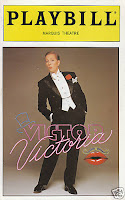 the stage, which was essentially a movie musical to begin with, with the same star, albeit 14 years older than when she originally played the part, and the film's director guiding the production, despite the fact he'd never directed a musical for the stage before, what could possibly go wrong? As it turns out, pretty much everything. First of all, the film's composer, Henry Mancini, died early in the process, so the new songs needed to flesh out the show were composed by theatrical wunderhack Frank Wildhorn, a man I'm thoroughly convinced was invented for the sole purpose of improving Lloyd Webber's own reputation. The YouTube clip above of "Louie Says" is an example of one of Wildhorn's contributions with terrible reaches for rhymes by Leslie Bricusse to the show. I won't feel bad if you don't make it through the whole clip. On top of that, those 14 years did make a bit of a difference for Julie Andrews, who tried her best. The comic timing was terrible. As luck would have it during the show, a man came out of the side exit near my seat in the Marquis Theatre. It was Blake Edwards. It was all I could do to keep myself from getting out of my chair and taking Edwards aside and trying to advise him on some ways to improve the show. The cast tried their best but I didn't even get to see the performer who got the best reviews, Rachel York: She was out the day I went. It remains the worst musical I ever sat through on Broadway.
A FUNNY THING HAPPENED ON THE WAY TO THE FORUM
Now, a much better revival of a classic Sondheim, his first (staged on Broadway anyway) for which he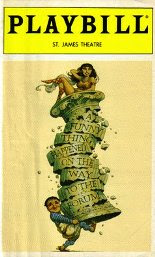 composed both the music and the lyrics. Furthermore, it was a great comic farce with a book by Larry Gelbart and Burt Shevelove. Inspired by the farces of the ancient Roman playwright Plautus, it has proved a Tony success for every actor who took on its lead role as the scheming slave Pseudolus, first for Zero Mostel in the original, then for Phil Silvers in a revival in the 1972 and this time out for Nathan Lane.
Directed by the old pro Jerry Zaks, it's a joy from start to finish with a cast of top-notch musical comedy talents such as Mark Linn-Baker, Mary Testa, Ernie Sabella, Lewis J. Stadlen, William Duell and Cris Groenedall. Unfortunately, the night I saw it, Stadlen, who received a Tony nomination as Senex, wss out but MacIntyre Dixon did a more than adequate job. When I was in grade school, we often visited my grandma during summer and would attend Starlight Musicals in Indianapolis, an outdoor summer stock, and it was there that I first saw Forum and fell in love with it. Being a young autograph hound, I got autographs of the entire cast afterward which included Arte Johnson, Avery Schreiber, Hans Conried and John Carradine. Sadly, Johnson is the only one of the four who still is with us. One word of warning: The clip of "Comedy Tonight" above was filmed very poorly, but the infectious spirit of the song and the production remains.
INHERIT THE WIND

As I mentioned when I marked the 50th anniversary of Stanley Kramer's film version of Inherit the Wind earlier this year, I'm just a sucker for this play in whatever form it takes. So, when Tony Randall's Nationalh!3w~~_12.jpg) Actors Theatre announced it would be staging a revival of Jerome Lawrence and Robert E. Lee's fictionalized take on the Scopes monkey trial with George C. Scott as Henry Drummond and Charles Durning as Matthew Brady, I was as good as there. Needless to say, I was not disappointed as its lines and messages got to me as they always do. If it had a problem, it was Scott. Not because his acting was weak: He was phenomenal. This was toward the end of his life and his ailing nature showed. In fact, he had to leave the play in the middle of one performance because he felt faint. As my dear and much missed friend Jennifer said at the time, Brady is supposed to be the one who seems to be in frail health.
Actors Theatre announced it would be staging a revival of Jerome Lawrence and Robert E. Lee's fictionalized take on the Scopes monkey trial with George C. Scott as Henry Drummond and Charles Durning as Matthew Brady, I was as good as there. Needless to say, I was not disappointed as its lines and messages got to me as they always do. If it had a problem, it was Scott. Not because his acting was weak: He was phenomenal. This was toward the end of his life and his ailing nature showed. In fact, he had to leave the play in the middle of one performance because he felt faint. As my dear and much missed friend Jennifer said at the time, Brady is supposed to be the one who seems to be in frail health.
As I mentioned in the introduction to this installment, I had great difficulty find photos of any of the productions from this season, but I did luck out on this one and by this one I realized for the first time that I had seen Garret Dillahunt on Broadway playing Bertram Cates. Dillahunt was fine, but he didn't make much of an impression on me, but it's funny how much of one he would make many years down the road in not just one but two roles on Deadwood and he now pops up quite frequently in movies such as No Country for Old Men, The Assassination of Jesse James by the Coward Robert Ford and The Road as well as on many TV series. He currently is a regular on the new TV comedy Raising Hope.
A DELICATE BALANCE
Under normal circumstances, you wouldn't hear me expressing relief that a new Sondheim show for which I held a ticket closed before I could see it, but boy am I glad that is what happened to Getting Away With Murder. You see Getting Away With Murder wasn't a Sondheim musical, it was a mystery play that went along with the composer's obsession with puzzles, along the lines of the 1973 screenplay he co-wrote with Anthony Perkins, The Last of Sheila. Anyway, having come all the way to New York with a ticket to a show now closed, I had to exchange and I made one of the greatest decisions of my life by choosing to cash it in for the revival of Edward Albee's Pulitzer Prize-winning A Delicate Balance starring George Grizzard, Rosemary Harris and the incomparable Elaine Stritch. I got to see one of the best afternoons of Broadway theater I ever have. As much as I love Who's Afraid of Virginia Woolf, this may have become my favorite Albee that day with its tale of would-be empty nesters facing suburban angst and a fuller nest than ever with an alcoholic sister, a grown daughter returning home after the breakup of a fourth marriage and a similarly married couple who just suddenly found themselves "scared." The entire cast was brilliant, with Grizzard winning a much deserved Tony. Harris and Stritch unfortunately not only had to compete against each other, they also had to contend with Zoe Caldwell in Master Class, so they couldn't make it to the podium. I didn't even mention the great work of the other three cast members: Mary Beth Hurt, Elizabeth Wilson and John Carter. The show won best revival of the play and its director, the late great Gerald Gutierrez, won director of a play for the second consecutive year after giving The Heiress new life the year before. If not for Angels in America, A Delicate Balance would be the best thing I ever saw on Broadway.
SEVEN GUITARS
Here's one of the plays that was more deserving of the best play Tony than Master Class: Seven Guitars, another of the plays in August Wilson's Pittsburgh cycle which depicts the African-American experience in the U.S. in the 20th century in each decade. This play, set in 1948, takes its title from its seven characters, the six we see and the seventh whose funeral begins and ends the action of the play. Keith David starred as a blues guitarist who squandered an advance from a record label while juggling women and making his way to his mother's funeral.
The excellent cast received Tony nominations for four members of its six-member ensemble: Viola Davis, Michele Shay, Roger Robinson and Ruben Santiago-Hudson, with Santiago-Hudson winning the prize. While Seven Guitars wasn't as solid as other works in Wilson's cycle such as The Piano Lesson and Fences, it still was quite good and provided a great mix of harrowing drama and boisterous comedy.
Its atmospheric scenic design by Scott Bradley also earned a nomination, though it lost to the colorful spectacle of The King and I since this was back in the days before there were separate technical categories for plays and musicals.
A MIDSUMMER NIGHT'S DREAM
I love Shakespeare and while it's a pleasure to read The Bard's plays, I've found it's always much better to see his works performed, either on stage or film. Given that, you would think that no one would prove better at interpreting and staging Shakespeare's plays that a company such as The Royal Shakespeare Company. Then why on earth did their production of one of his most delightful works, A Midsummer Night's Dream, almost bore me to tears?
I seldom laughed as the natural comedy came off to me as the clumsiest of slapstick and many of the performers treated the language the way I hate: so carefully that it seemed as if they feared the iambic pentameter might break if they weren't careful. Looking back at my Playbill to see if any of the company included anyone I came to know better but the only name that leaped out at me was Lindsay Duncan who played Titania and Hippolyta here but would go on to give a wonderful turn as the vengeful Servilia on HBO's Rome.
Apparently, I wasn't alone in having lukewarm memories of this production. While, as I have mentioned, art of these various productions were difficult if not impossible to come by, I could usually guarantee I could find art of the corresponding Playbill. In the case of A Midsummer Night's Dream, even that could not be found. Thankfully, my wireless printer I was given a while back also scans and I used it for the first time to scan my own Playbill because that's the only way I could get art of it.
BIG
If Sunset Boulevard didn't make it a concrete decision and Victor/Victoria didn't cinch it as a rule, the musical version of Big made it a personal principle of mine not to go see a Broadway musical based on a movie. Now I know this means I would have missed, if I'd still been able to go to New York at the time, well- reviewed examples of movies-to-musicals such as The Producers, Billy Elliot, Hairspray and The Full Monty (another acclaimed musical, Grey Gardens, even came from a documentary), but look at some of what I would have avoided: Urban Cowboy, Footloose, Chitty Chitty Bang Bang, High Fidelity, High Society, Saturday Night Fever, Tarzan, The Little Mermaid, 9 to 5, Mary Poppins, Young Frankenstein, Shrek, The Addams Family (I know, based on the cartoons, not the TV show or movie. Uh-huh). Thoroughly Modern Millie, Sweet Smell of Success, Dirty Rotten Scoundrels, The Color Purple, The Wedding Singer and Cry-Baby to name a few too many. I gave a break to a few others that got some passable reviews such as Legally Blonde, Xanadu and A Catered Affair. Before my obsession ended and my ability to go to New York went away I would still see a couple, with qualifications, but enough was becoming enough.
The saddest part about Big is that I saw it on its very first night of previews and I heard it improved slightly later but it was a sign of my mental illness that I went in the first place because I wasn't that crazy about the movie in the first place. I always thought Tom Hanks played the character as far too young for what age Josh was when he grew and the musical didn't fix that. Even worse, they took the sweet simplicity of the moment from the movie when the big Josh and his boss at the toy company played "Chopsticks" on the giant keyboards at F.A.O. Schwarz and transformed it into an overblown production number, sapping it of all its charm.
RENT
What luck did I have getting to see Rent when I did. First, I ordered my ticket the day before it received the Pulitzer Prize for drama, a rare feat for a musical. Secondly, on the day I was to see it, flying in from Florida, I thought I had plenty of time. I'd get to New York, check into the hotel and get to the theater. Unfortunately, flight delays started to push it and when we got to New York, for some reason we were sittingr9sUw5qBMhS0-StQQ~~_3.jpg) on the tarmac, not allowed to get to the gate, for an interminable amount of time. The clock ticked. It got past 7 p.m. Finally, a flight attendant got on the intercom and asked the passengers to sit down and we could finally go to the gate. Some idiot businessman was still rifling through his overhead. I shouted, "Sit the hell down! We have places to be." Thankfully, I only had a carryon. I grabbed the first cab I could and told the driver I would make it worth his while if he got me to the Nederlander Theatre before 8 p.m. I love N.Y. cabbies: I got there at 7:45 p.m. I had to sit through the show with my carryon bag at my feet, but the show, which also happened to have recently received all its Tony nominations, was well worth it. Quite simply, I was enthralled. It's still the best new musical I saw on Broadway and the only one I paid to see twice. It still was as great the second time. I did see a few problems: I knew it would be almost immediately dated, but it was a show I couldn't stop talking about, wanting to spread the word and share it to everyone I knew. Of course, it became a phenomenon and I can always say I saw it with the original cast. It was magical. It also played to my age at the time: It seemed to speak to it and my generation. Who knows? While I still love the music, today as I become an old fogey, I might relate more to Benny the landlord than the squatters. For the record, I never saw the movie version and I never will because it was obvious how they were ruining it. Usually I support using the original cast members, but they were all more than a decade too old for their parts by then. Having Chris Columbus direct? Ugh. Again, with the clip above, the filming isn't the best, but the song, "What You Own," one of my favorites, still comes through fairly well.
on the tarmac, not allowed to get to the gate, for an interminable amount of time. The clock ticked. It got past 7 p.m. Finally, a flight attendant got on the intercom and asked the passengers to sit down and we could finally go to the gate. Some idiot businessman was still rifling through his overhead. I shouted, "Sit the hell down! We have places to be." Thankfully, I only had a carryon. I grabbed the first cab I could and told the driver I would make it worth his while if he got me to the Nederlander Theatre before 8 p.m. I love N.Y. cabbies: I got there at 7:45 p.m. I had to sit through the show with my carryon bag at my feet, but the show, which also happened to have recently received all its Tony nominations, was well worth it. Quite simply, I was enthralled. It's still the best new musical I saw on Broadway and the only one I paid to see twice. It still was as great the second time. I did see a few problems: I knew it would be almost immediately dated, but it was a show I couldn't stop talking about, wanting to spread the word and share it to everyone I knew. Of course, it became a phenomenon and I can always say I saw it with the original cast. It was magical. It also played to my age at the time: It seemed to speak to it and my generation. Who knows? While I still love the music, today as I become an old fogey, I might relate more to Benny the landlord than the squatters. For the record, I never saw the movie version and I never will because it was obvious how they were ruining it. Usually I support using the original cast members, but they were all more than a decade too old for their parts by then. Having Chris Columbus direct? Ugh. Again, with the clip above, the filming isn't the best, but the song, "What You Own," one of my favorites, still comes through fairly well.
THE KING AND I

The above clip is not from the actual revival of The King and I that starred Lou Diamond Phillips and won Donna Murphy her second Tony but of a brief rendition of "Shall We Dance?" the pair performed on the 1996 Tony Awards broadcast. I thought I'd begin with it because the thing I took away most prominently from seeing this show which I'd never noticed before but which I wanted everyone to listen to is how closely the refrain of "Be Our Guest" from Beauty and the Beast resembles "Shall We Dance?" Now, I don't want to accuse Alan Menken of plagiarism, but let your ears decide. As for the production of The King and I itself, it was fine. Murphy was great and Phillips put any skepticism I might have had about his casting to rest. It was a gorgeous production. It also finally made clear to me the lyric about "Eliza on the ice" in "Getting Married Today" in Company. It's a reference to Uncle Tom's Cabin, but I bet Sondheim would have never referenced it if they didn't enact the scene in The King and I by his mentor Oscar Hammerstein II first.
BURIED CHILD
May 22, 1996 marks the date of the best night in terms of entertainment I ever had in Manhattan. On my way to the Brooks Atkinson Theatre to see the Broadway premiere (even though it was really a New York revival) of the Steppenwolf Theatre production of Sam Shepard's Buried Child, I passed The Supper Club and noticed that at the same time, Elvis Costello and Steve Nieve would be performing. I went on in and saw Buried Child, which was absolutely superb. Directed by Gary Sinise, it starred Terry Kinney, Jim True (of Wire fame, before he added the Frost to his last name), and, in their Tony-nominated roles, the great Lois Smith and the late James Gammon. Darkly funny and just as disturbing, Shepard's play remained riveting. Thanks to the ever-changing Tony rules, since it had never played Broadway before, it was eligible and was nominated for best play. It would have been my choice. Both it and Seven Guitars were leaps and bounds better than Master Class. I did not see the fourth nominee, David Hare's Racing Demon. Floating on air after such a stupendous night of theater, I exited the Brooks Atkinson and began the walk back toward my hotel. There were still lines outside The Supper Club. It seems Costello and Nieve were giving two performances that night and someone was selling tickets outside the club:
 at the ticket price no less. I bought one immediately and went straight from Buried Child to Elvis Costello, who gave a great performance, including many songs off his most recent album at the time that I still adore, All This Useless Beauty such as "The Other End of the Telescope": Shall we agree that just this once/I'm gonna change my life/Until it's just as tiny or important as you like?/And in time we won't even recall that we spoke/Words that turned out to be as big as smoke/As smoke that disappears in the air/There's always something that's smoldering somewhere/I know it don't make a difference to you/But oh! It sure made a difference to me/You'll see me off in the distance, I hope/At the other end/At the other end of the telescope. The next morning, I boarded a plane and went back to Florida after my greatest two-day N.Y. jaunt ever: Rent, The King and I, Buried Child and Elvis Costello — all in two days time. Those were the days.
Tweet
TO READ ON, CLICK HERE
As I mentioned in the second installment of this series, while the previous installments covered years, the future ones would cover seasons as my obsession grew and I saw more shows. While my last installment wrapped up in the summer of 1995, this one picks up in October of the same year but in a few months, I'd move from Oklahoma to Florida, making travel to New York easier and more frequent. On the plus side, while what I'd seen in 1995 so far had been a disappointment, the rest of the season turned out to have some of the best productions I would ever see on Broadway, though some dogs remained as well. One unusual thing though: The further ahead in time I go, the harder I'm finding it to locate art or clips to go with my words.
As I wrote in my piece earlier this year marking the 40th anniversary of Stephen Sondheim's landmark show,
 as with many of his works, the score always proves stronger than the book.
Still, the talented cast of Roundabout Theatre's revival of the show (the first since its original production) gave it their all. Led by Boyd Gaines in the lead role of Bobby, the cast included Debra Monk, La Chanze, Jane Krakowski and, exciting for a Soap fanatic such as myself, Diana Canova — Corinne Tate Flotsky herself.
Veanne Cox got the assignment of doing the frenzied mouthful of "Getting Married Today" and earned a Tony nomination for it, one of the few the revival received. Even as much of a Sondheim worshipper as I am, I found that understandable. Something seemed stillborn about the show. For every great moment — as when La Chanze belted "Another Hundred People" — the musical seemed to stop in its tracks in the silly skits, even when songs surrounded them. Still, it's hard to call it a loss of an afternoon when you get well-sung renditions of "Being Alive," "The Ladies Who Lunch," "The Little Things You Do" and "You Could Drive a Person Crazy."


Much as Sondheim's score propped up the weak book beneath Company, the performances, particularly the powerhouse lead, saved Terrence's McNally's lackluster Master Class. Zoe Caldwell won a well-deserved fourth Tony for her starring role as Maria Callas in McNally's play which showed the grand dame of opera running roughshod over three students who had earned the chance to be taught by the great one, one of whom was played by an equally good Audra McDonald who picked up her second Tony on her way to four total (so far). Interspersed with the class sequences are Callas' recollections of various events and loves throughout her life which might play as nothing more than filler in the rather short play if they were placed in hands less capable than Caldwell's, but she makes them work and helped McNally win his 2nd consecutive Tony for best play following the previous season's Love! Valour! Compassion!, even though Master Class was far from the best in its category but we'll get to my choice later.
After enduring what had been done when Andrew Lloyd Webber musicalized one of my favorite films of all time, Sunset Blvd., I started to question whether it was a good idea to turn any movies into musicals since more times than not the results turn out badly. You would think though that taking Victor/Victoria to
 the stage, which was essentially a movie musical to begin with, with the same star, albeit 14 years older than when she originally played the part, and the film's director guiding the production, despite the fact he'd never directed a musical for the stage before, what could possibly go wrong? As it turns out, pretty much everything. First of all, the film's composer, Henry Mancini, died early in the process, so the new songs needed to flesh out the show were composed by theatrical wunderhack Frank Wildhorn, a man I'm thoroughly convinced was invented for the sole purpose of improving Lloyd Webber's own reputation. The YouTube clip above of "Louie Says" is an example of one of Wildhorn's contributions with terrible reaches for rhymes by Leslie Bricusse to the show. I won't feel bad if you don't make it through the whole clip. On top of that, those 14 years did make a bit of a difference for Julie Andrews, who tried her best. The comic timing was terrible. As luck would have it during the show, a man came out of the side exit near my seat in the Marquis Theatre. It was Blake Edwards. It was all I could do to keep myself from getting out of my chair and taking Edwards aside and trying to advise him on some ways to improve the show. The cast tried their best but I didn't even get to see the performer who got the best reviews, Rachel York: She was out the day I went. It remains the worst musical I ever sat through on Broadway.
Now, a much better revival of a classic Sondheim, his first (staged on Broadway anyway) for which he
 composed both the music and the lyrics. Furthermore, it was a great comic farce with a book by Larry Gelbart and Burt Shevelove. Inspired by the farces of the ancient Roman playwright Plautus, it has proved a Tony success for every actor who took on its lead role as the scheming slave Pseudolus, first for Zero Mostel in the original, then for Phil Silvers in a revival in the 1972 and this time out for Nathan Lane.
Directed by the old pro Jerry Zaks, it's a joy from start to finish with a cast of top-notch musical comedy talents such as Mark Linn-Baker, Mary Testa, Ernie Sabella, Lewis J. Stadlen, William Duell and Cris Groenedall. Unfortunately, the night I saw it, Stadlen, who received a Tony nomination as Senex, wss out but MacIntyre Dixon did a more than adequate job. When I was in grade school, we often visited my grandma during summer and would attend Starlight Musicals in Indianapolis, an outdoor summer stock, and it was there that I first saw Forum and fell in love with it. Being a young autograph hound, I got autographs of the entire cast afterward which included Arte Johnson, Avery Schreiber, Hans Conried and John Carradine. Sadly, Johnson is the only one of the four who still is with us. One word of warning: The clip of "Comedy Tonight" above was filmed very poorly, but the infectious spirit of the song and the production remains.

As I mentioned when I marked the 50th anniversary of Stanley Kramer's film version of Inherit the Wind earlier this year, I'm just a sucker for this play in whatever form it takes. So, when Tony Randall's National
h!3w~~_12.jpg) Actors Theatre announced it would be staging a revival of Jerome Lawrence and Robert E. Lee's fictionalized take on the Scopes monkey trial with George C. Scott as Henry Drummond and Charles Durning as Matthew Brady, I was as good as there. Needless to say, I was not disappointed as its lines and messages got to me as they always do. If it had a problem, it was Scott. Not because his acting was weak: He was phenomenal. This was toward the end of his life and his ailing nature showed. In fact, he had to leave the play in the middle of one performance because he felt faint. As my dear and much missed friend Jennifer said at the time, Brady is supposed to be the one who seems to be in frail health.
Actors Theatre announced it would be staging a revival of Jerome Lawrence and Robert E. Lee's fictionalized take on the Scopes monkey trial with George C. Scott as Henry Drummond and Charles Durning as Matthew Brady, I was as good as there. Needless to say, I was not disappointed as its lines and messages got to me as they always do. If it had a problem, it was Scott. Not because his acting was weak: He was phenomenal. This was toward the end of his life and his ailing nature showed. In fact, he had to leave the play in the middle of one performance because he felt faint. As my dear and much missed friend Jennifer said at the time, Brady is supposed to be the one who seems to be in frail health. As I mentioned in the introduction to this installment, I had great difficulty find photos of any of the productions from this season, but I did luck out on this one and by this one I realized for the first time that I had seen Garret Dillahunt on Broadway playing Bertram Cates. Dillahunt was fine, but he didn't make much of an impression on me, but it's funny how much of one he would make many years down the road in not just one but two roles on Deadwood and he now pops up quite frequently in movies such as No Country for Old Men, The Assassination of Jesse James by the Coward Robert Ford and The Road as well as on many TV series. He currently is a regular on the new TV comedy Raising Hope.
Under normal circumstances, you wouldn't hear me expressing relief that a new Sondheim show for which I held a ticket closed before I could see it, but boy am I glad that is what happened to Getting Away With Murder. You see Getting Away With Murder wasn't a Sondheim musical, it was a mystery play that went along with the composer's obsession with puzzles, along the lines of the 1973 screenplay he co-wrote with
 Anthony Perkins, The Last of Sheila. Anyway, having come all the way to New York with a ticket to a show now closed, I had to exchange and I made one of the greatest decisions of my life by choosing to cash it in for the revival of Edward Albee's Pulitzer Prize-winning A Delicate Balance starring George Grizzard, Rosemary Harris and the incomparable Elaine Stritch. I got to see one of the best afternoons of Broadway theater I ever have. As much as I love Who's Afraid of Virginia Woolf, this may have become my favorite Albee that day with its tale of would-be empty nesters facing suburban angst and a fuller nest than ever with an alcoholic sister, a grown daughter returning home after the breakup of a fourth marriage and a similarly married couple who just suddenly found themselves "scared." The entire cast was brilliant, with Grizzard winning a much deserved Tony. Harris and Stritch unfortunately not only had to compete against each other, they also had to contend with Zoe Caldwell in Master Class, so they couldn't make it to the podium. I didn't even mention the great work of the other three cast members: Mary Beth Hurt, Elizabeth Wilson and John Carter. The show won best revival of the play and its director, the late great Gerald Gutierrez, won director of a play for the second consecutive year after giving The Heiress new life the year before. If not for Angels in America, A Delicate Balance would be the best thing I ever saw on Broadway.
Here's one of the plays that was more deserving of the best play Tony than Master Class: Seven Guitars,
 another of the plays in August Wilson's Pittsburgh cycle which depicts the African-American experience in the U.S. in the 20th century in each decade. This play, set in 1948, takes its title from its seven characters, the six we see and the seventh whose funeral begins and ends the action of the play. Keith David starred as a blues guitarist who squandered an advance from a record label while juggling women and making his way to his mother's funeral.
The excellent cast received Tony nominations for four members of its six-member ensemble: Viola Davis, Michele Shay, Roger Robinson and Ruben Santiago-Hudson, with Santiago-Hudson winning the prize. While Seven Guitars wasn't as solid as other works in Wilson's cycle such as The Piano Lesson and Fences, it still was quite good and provided a great mix of harrowing drama and boisterous comedy.
Its atmospheric scenic design by Scott Bradley also earned a nomination, though it lost to the colorful spectacle of The King and I since this was back in the days before there were separate technical categories for plays and musicals.
I love Shakespeare and while it's a pleasure to read The Bard's plays, I've found it's always much better to see his works performed, either on stage or film. Given that, you would think that no one would prove better at interpreting and staging Shakespeare's plays that a company such as The Royal Shakespeare Company. Then
 why on earth did their production of one of his most delightful works, A Midsummer Night's Dream, almost bore me to tears?
I seldom laughed as the natural comedy came off to me as the clumsiest of slapstick and many of the performers treated the language the way I hate: so carefully that it seemed as if they feared the iambic pentameter might break if they weren't careful. Looking back at my Playbill to see if any of the company included anyone I came to know better but the only name that leaped out at me was Lindsay Duncan who played Titania and Hippolyta here but would go on to give a wonderful turn as the vengeful Servilia on HBO's Rome.
Apparently, I wasn't alone in having lukewarm memories of this production. While, as I have mentioned, art of these various productions were difficult if not impossible to come by, I could usually guarantee I could find art of the corresponding Playbill. In the case of A Midsummer Night's Dream, even that could not be found. Thankfully, my wireless printer I was given a while back also scans and I used it for the first time to scan my own Playbill because that's the only way I could get art of it.
If Sunset Boulevard didn't make it a concrete decision and Victor/Victoria didn't cinch it as a rule, the musical version of Big made it a personal principle of mine not to go see a Broadway musical based on a movie. Now I know this means I would have missed, if I'd still been able to go to New York at the time, well-
 reviewed examples of movies-to-musicals such as The Producers, Billy Elliot, Hairspray and The Full Monty (another acclaimed musical, Grey Gardens, even came from a documentary), but look at some of what I would have avoided: Urban Cowboy, Footloose, Chitty Chitty Bang Bang, High Fidelity, High Society, Saturday Night Fever, Tarzan, The Little Mermaid, 9 to 5, Mary Poppins, Young Frankenstein, Shrek, The Addams Family (I know, based on the cartoons, not the TV show or movie. Uh-huh). Thoroughly Modern Millie, Sweet Smell of Success, Dirty Rotten Scoundrels, The Color Purple, The Wedding Singer and Cry-Baby to name a few too many. I gave a break to a few others that got some passable reviews such as Legally Blonde, Xanadu and A Catered Affair. Before my obsession ended and my ability to go to New York went away I would still see a couple, with qualifications, but enough was becoming enough.
 The saddest part about Big is that I saw it on its very first night of previews and I heard it improved slightly later but it was a sign of my mental illness that I went in the first place because I wasn't that crazy about the movie in the first place. I always thought Tom Hanks played the character as far too young for what age Josh was when he grew and the musical didn't fix that. Even worse, they took the sweet simplicity of the moment from the movie when the big Josh and his boss at the toy company played "Chopsticks" on the giant keyboards at F.A.O. Schwarz and transformed it into an overblown production number, sapping it of all its charm.
What luck did I have getting to see Rent when I did. First, I ordered my ticket the day before it received the Pulitzer Prize for drama, a rare feat for a musical. Secondly, on the day I was to see it, flying in from Florida, I thought I had plenty of time. I'd get to New York, check into the hotel and get to the theater. Unfortunately, flight delays started to push it and when we got to New York, for some reason we were sitting
r9sUw5qBMhS0-StQQ~~_3.jpg) on the tarmac, not allowed to get to the gate, for an interminable amount of time. The clock ticked. It got past 7 p.m. Finally, a flight attendant got on the intercom and asked the passengers to sit down and we could finally go to the gate. Some idiot businessman was still rifling through his overhead. I shouted, "Sit the hell down! We have places to be." Thankfully, I only had a carryon. I grabbed the first cab I could and told the driver I would make it worth his while if he got me to the Nederlander Theatre before 8 p.m. I love N.Y. cabbies: I got there at 7:45 p.m. I had to sit through the show with my carryon bag at my feet, but the show, which also happened to have recently received all its Tony nominations, was well worth it. Quite simply, I was enthralled. It's still the best new musical I saw on Broadway and the only one I paid to see twice. It still was as great the second time. I did see a few problems: I knew it would be almost immediately dated, but it was a show I couldn't stop talking about, wanting to spread the word and share it to everyone I knew. Of course, it became a phenomenon and I can always say I saw it with the original cast. It was magical. It also played to my age at the time: It seemed to speak to it and my generation. Who knows? While I still love the music, today as I become an old fogey, I might relate more to Benny the landlord than the squatters. For the record, I never saw the movie version and I never will because it was obvious how they were ruining it. Usually I support using the original cast members, but they were all more than a decade too old for their parts by then. Having Chris Columbus direct? Ugh. Again, with the clip above, the filming isn't the best, but the song, "What You Own," one of my favorites, still comes through fairly well.
on the tarmac, not allowed to get to the gate, for an interminable amount of time. The clock ticked. It got past 7 p.m. Finally, a flight attendant got on the intercom and asked the passengers to sit down and we could finally go to the gate. Some idiot businessman was still rifling through his overhead. I shouted, "Sit the hell down! We have places to be." Thankfully, I only had a carryon. I grabbed the first cab I could and told the driver I would make it worth his while if he got me to the Nederlander Theatre before 8 p.m. I love N.Y. cabbies: I got there at 7:45 p.m. I had to sit through the show with my carryon bag at my feet, but the show, which also happened to have recently received all its Tony nominations, was well worth it. Quite simply, I was enthralled. It's still the best new musical I saw on Broadway and the only one I paid to see twice. It still was as great the second time. I did see a few problems: I knew it would be almost immediately dated, but it was a show I couldn't stop talking about, wanting to spread the word and share it to everyone I knew. Of course, it became a phenomenon and I can always say I saw it with the original cast. It was magical. It also played to my age at the time: It seemed to speak to it and my generation. Who knows? While I still love the music, today as I become an old fogey, I might relate more to Benny the landlord than the squatters. For the record, I never saw the movie version and I never will because it was obvious how they were ruining it. Usually I support using the original cast members, but they were all more than a decade too old for their parts by then. Having Chris Columbus direct? Ugh. Again, with the clip above, the filming isn't the best, but the song, "What You Own," one of my favorites, still comes through fairly well.
The above clip is not from the actual revival of The King and I that starred Lou Diamond Phillips and won Donna Murphy her second Tony but of a brief rendition of "Shall We Dance?" the pair performed on the 1996 Tony Awards broadcast. I thought I'd begin with it because the thing I took away most prominently from seeing this show which I'd never noticed before but which I wanted everyone to listen to is how closely the refrain of "Be Our Guest" from Beauty and the Beast resembles "Shall We Dance?" Now, I don't want to accuse Alan Menken of plagiarism, but let your ears decide. As for the production of The King and I itself, it was fine. Murphy was great and Phillips put any skepticism I might have had about his casting to rest. It was a gorgeous production. It also finally made clear to me the lyric about "Eliza on the ice" in "Getting Married Today" in Company. It's a reference to Uncle Tom's Cabin, but I bet Sondheim would have never referenced it if they didn't enact the scene in The King and I by his mentor Oscar Hammerstein II first.
May 22, 1996 marks the date of the best night in terms of entertainment I ever had in Manhattan. On my
 way to the Brooks Atkinson Theatre to see the Broadway premiere (even though it was really a New York revival) of the Steppenwolf Theatre production of Sam Shepard's Buried Child, I passed The Supper Club and noticed that at the same time, Elvis Costello and Steve Nieve would be performing. I went on in and saw Buried Child, which was absolutely superb. Directed by Gary Sinise, it starred Terry Kinney, Jim True (of Wire fame, before he added the Frost to his last name), and, in their Tony-nominated roles, the great Lois Smith and the late James Gammon. Darkly funny and just as disturbing, Shepard's play remained riveting. Thanks to the ever-changing Tony rules, since it had never played Broadway before, it was eligible and was nominated for best play. It would have been my choice. Both it and Seven Guitars were leaps and bounds better than Master Class. I did not see the fourth nominee, David Hare's Racing Demon. Floating on air after such a stupendous night of theater, I exited the Brooks Atkinson and began the walk back toward my hotel. There were still lines outside The Supper Club. It seems Costello and Nieve were giving two performances that night and someone was selling tickets outside the club:
 at the ticket price no less. I bought one immediately and went straight from Buried Child to Elvis Costello, who gave a great performance, including many songs off his most recent album at the time that I still adore, All This Useless Beauty such as "The Other End of the Telescope": Shall we agree that just this once/I'm gonna change my life/Until it's just as tiny or important as you like?/And in time we won't even recall that we spoke/Words that turned out to be as big as smoke/As smoke that disappears in the air/There's always something that's smoldering somewhere/I know it don't make a difference to you/But oh! It sure made a difference to me/You'll see me off in the distance, I hope/At the other end/At the other end of the telescope. The next morning, I boarded a plane and went back to Florida after my greatest two-day N.Y. jaunt ever: Rent, The King and I, Buried Child and Elvis Costello — all in two days time. Those were the days.
 Tweet
Labels: Albee, Blake Edwards, Deadwood, Durning, Gelbart, George C. Scott, Hammerstein, Hanks, J. Carradine, Julie Andrews, Phil Silvers, Shakespeare, Shepard, Sondheim, The Wire, Tony Randall, Viola Davis
TO READ ON, CLICK HERE


