Sunday, February 13, 2011
Betty Garrett (1919-2011)

With a talent that spanned generations, decades and the mediums of stage, screen and television and who kept working almost to the very end, we have lost the great Betty Garrett, who has passed away at the age of 91.
Born May 23, 1919, in St. Joseph, Mo., Garrett debuted on Broadway in 1942 in the musical revue Of V We Sing, one of many musical revues in which she took part in the beginning of her stage career that were intended as rousing support for our troops serving in World War II.
Her third Broadway production certainly sounded like more of the same with the title Something for the Boys, but it was an original musical comedy produced by Michael Todd with songs by Cole Porter, a book by Herbert and Dorothy Fields and starring Ethel Merman. Garrett not only had a part in the show, she also served as Merman's understudy, but as her reputation goes, Merman never missed a performance.
She followed that with another musical comedy called Jackpot where her co-stars included Nanette Fabray and Mary Wickes. Her final Broadway appearance of the 1940s would be the musical revue Call Me Mister where one of her co-stars was Jules Munshin, who would appear in one of her biggest successes where she was heading: Hollywood.
She made her film debut in 1948's Big City about an abandoned baby raised by three men who grows up to be Margaret O'Brien and, though the film wasn't really a musical, gets to have her young singing voice dubbed by Marni Nixon. That same year, she did co-star in a musical, Words and Music, a fictionalized version of the story of Rodgers and Hart that dragged out practically every MGM star available such as Judy Garland, Gene Kelly, Mickey Rooney, Cyd Charisse, etc., to play either themselves or characters. Both of Garrett's first two films were directed by Norman Taurog.
1949 brought three big movie musicals for Garrett, including one of the best of all time. Busby Berkeley directed her in Take Me Out to the Ball Game, which for the first time put her in the same film with Kelly, Jules Munshin and Frank Sinatra, tossing in Esther Williams for good measure.
She worked with Williams again as well as Ricardo Montalban and Red Skelton in the musical comedy Neptune's Daughter, which featured Frank Loesser's Oscar-winning song "Baby, It's Cold Outside."
Garrett's final 1949 musical though is the one that has stood the test of time. Pairing Stanley Donen and Gene Kelly as co-directors for the first time and starring Kelly, Sinatra and Munshin as three sailors on leave in New York, On the Town really raised Garrett's profile with her role as Hildy (short for Brunhilde), the man-hungry cab driver. With its screenplay and lyrics by Comden and Green and music by Leonard Bernstein, it's still a blast.
Unfortunately, the communist witchhunt brought Garrett's career at that point to a screeching halt. She was married to actor Larry Parks, who admitted membership in the communist party, but refused to name names before the House Un-American Activities Committee. This also coincided with Garrett being very pregnant with their child. The two survived in nightclubs, but Garrett didn't resurface on Broadway or movie screens until 1955 when she landed a role in the movie My Sister Eileen with Janet Leigh and Jack Lemmon. That same year she began making TV appearances on some episodes of The Ford Television Theatre.
In November 1956, she returned to the Broadway stage, replacing Judy Holliday in Bells Are Ringing during Holliday's vacation. She returned to the Great White Way again in 1960 in the original musical Beg, Borrow or Steal and did two other appearances on Broadway as well as various episodic TV spots throughout the 1960s.
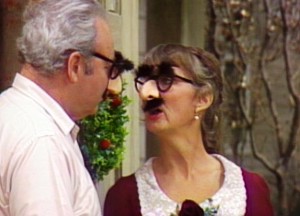
The next role that really brought Garrett back into national prominence didn't come until 1973 when she was cast in the recurring role of Irene Lorenzo, a new neighbor and foil for Carroll O'Connor's Archie Bunker on All in the Family. The role earned her a Golden Globe in 1975 for best supporting actress on television. Vincent Gardenia also was cast to play Irene's husband Frank. Garrett played Irene for 24 episodes from 1973 until 1975 when she joined the cast of another hit comedy, Laverne & Shirley. There, she played the girls' landlady Edna Babish before eventually becoming Laverne's stepmom when she wed her widowed father Frank DeFazio (Phil Foster). She stayed with the show until 1981. She never had another role as a series regular but did appear frequently as a guest, most recently on Grey's Anatomy in 2006. In 2003, she was nominated for an Emmy as guest actress in a comedy for an appearance on Becker.
She appeared on Broadway three more times: in a play, The Supporting Cast, in 1981, in a stage version of Meet Me in St. Louis in 1989 and in the revival of Stephen Sondheim's Follies in 2001, where she got to perform "Broadway Baby" as Hattie Walker.
Her final credit on IMDb is for a 2009 mystery comedy called Dark and Stormy Night starring Jim Beaver, the noble Ellsworth on Deadwood, and currently on Supernatural.
R.I.P. Ms. Garrett.
Tweet
Labels: Awards, blacklist, Cole Porter, Comden and Green, Cyd Charisse, Donen, Frank Loesser, Garland, Gene Kelly, Mary Wickes, Merman, Musicals, Obituary, Rodgers, Sinatra, Sondheim, Television, Theater
TO READ ON, CLICK HERE


Sunday, June 13, 2010
Centennial Tributes: Mary Wickes


By Edward Copeland
Where would entertainment be without the character actor or, in this case, actress? Mary Wickes, who was born 100 years ago today, spent nearly 60 years supporting the stars on the stage, big and small screens, usually with a crusty exterior and almost always leaving the audience laughing. Her Broadway debut came in 1936 in a play called Spring Dance written by Philip Barry of The Philadelphia Story fame and starring José Ferrer and her film debut came two years later in a comedy short titled Too Much Johnson that starred Joseph Cotten and was directed by none other than Orson Welles. Her name may never have reached household status, but at 5 feet 10 inches tall with a usual wisecracking demeanor, once someone showed you a photo or clip of her, you knew who Mary Wickes was.
Wickes was born Mary Isabelle Wickenhauser on June 13, 1910, in St. Louis, Mo., the daughter of well-off banker. While the vast majority of her roles came from the working class, Wickenhauser was a debutante who graduated from Washington University in St. Louis with a degree in political science with plans to pursue a law degree until the acting bug bit.

Her career began on the stage (to which she returned frequently) and she became part of Welles' Mercury players. She appeared in the original Broadway production of Stage Door. She originated the role of Miss Preen in the Kaufman/Hart hit The Man Who Came to Dinner opposite Monty Woolley. When Hollywood decided to adapt the play to film, they kept Wickes and Woolley in their roles, though they did add Bette Davis and Ann Sheridan to the cast. Though Wickes did frequently return to Broadway throughout the 1940s, her career remained firmly anchored on the West Coast after that, except for a return to the Great White Way in 1979 to play Aunt Eller in a revival of Oklahoma!

The movie of The Man Who Came to Dinner was released in 1942, a particularly busy year for Wickes who also co-starred with Bette Davis in Now, Voyager. She appeared in the short Keeping Fit which also featured Robert Stack, Broderick Crawford and Andy Devine as Wickes' husband. Wickes also landed in the cast of two musicals: Private Buckaroo with The Andrews Sisters and The Mayor of 44th Street starring George Murphy that was part musical, part gangster story. She aided Penny Singleton in her popular series with the installment Blondie's Blessed Event and she teamed with Bud Abbott and Lou Costello in their comic mystery Who Done It? All of those released in what was essentially her first year in movies. The following year brought fewer roles as she headed back East for more stage work. A couple of film roles went uncredited, but she did appear in three more musicals: another with Andrews Sisters (How's About It?), another that featured Andy Devine (Rhythm of the Islands) and a third that featured a young singer named Frank Sinatra (Higher and Higher). Wickes didn't make another film until 1948.
When she did return to the West Coast, her first feature in 1948 was June Bride, once again with Bette Davis (whom she'd work again with in 1952's The Actress), but she really began to make her mark in the fledgling medium of television, beginning with two appearances on The Actor's Studio. She appeared on many of the live theater shows, including re-creating her role of Miss Preen in a production of The Man Who Came to Dinner (and she reprised it again in a 1972 TV movie). A friendship with Lucille Ball led to her guest appearance on an infamous episode of I Love Lucy as the ballet instructor Madame Le Mond. Ball and Wickes' friendship led to frequent guest appearances on every TV series in which Ball ever starred.
On the feature side of things, she appeared with Doris Day in On Moonlight Bay, whom she teamed again with in I'll See You in My Dreams, By the Light of the Silvery Moon and two episodes of Day's TV show. Once someone met her, they seemed to develop a loyalty to Wickes, working with her again and again. She worked with Glenn Ford in five films, the most notable being 1957's Don't Go Near the Water and the 1960 remake of Cimarron.
Aside from guest shots, Wickes had many recurring and regular roles on television series throughout her long career including Make Room for Daddy, Dennis the Menace, Sigmund and the Sea Monsters, Doc, The Father Dowling Mysteries and, though some episodes appeared after her death, her voice was heard on the animated series Life with Louie featuring comic Louie Anderson. Two of her most memorable guest shots appeared on Sanford & Son as a housekeeper Fred and Lamont hire but can't bring themselves to fire, even though she's terrible and as Hot Lips' visiting supervising colonel on M*A*S*H who tries to seduce Frank.
Throughout her many decades an actress, there were still other notable feature films. She was housekeeper to Dean Jagger's general as Bing Crosby and Danny Kaye plotted to cheer the old man up in White Christmas. Her
 voice graced Disney's original animated 101 Dalmatians. She helped populate River City in The Music Man. She put on a nun's habit alongside Rosalind Russell in The Trouble With Angels directed by Ida Lupino and its sequel (though Lupino sat that one out). She played Meryl Streep's grandmother and Shirley MacLaine's mom in 1990's Postcards From the Edge. She strapped on a nun's habit again as Sister Mary Lazarus opposite Whoopi Goldberg in Sister Act and its sequel. In the 1994 Little Women with Winona Ryder, she played Aunt March. Her final film, released after her death, again featured only that remarkable voice as she gave life to the gargoyle Laverne in Disney's Hunchback of Notre Dame.
Tweet
Labels: Abbott and Costello, Animation, B. Crawford, Bette, Disney, Doris Day, Ferrer, Glenn Ford, Joseph Cotten, L. Ball, Lupino, MacLaine, Mary Wickes, Musicals, Roz Russell, Sinatra, Streep, Welles, Winona
TO READ ON, CLICK HERE
Wednesday, March 28, 2007
Swear to tell the truth

By Edward Copeland
Everyone has them. Call them guilty pleasures or whatever else you want, but everyone has them: Movies you really like but that you feel you'd be ostracized or ridiculed for if your affection became common knowledge. Not today. We are all under oath, myself included, and it's time to give these films our due. It's not a time for mocking others. This is a time to come clean. Besides, if you are like me and insist on broadcasting your opinions to the entire world, you shouldn't hold some back for fear that you stand alone. That also goes for you, politicians. Opinions are subjective, so no opinion of something like a movie can be wrong. (Opinions on political issues can be wrong, but you should still stand by your opinions if you enter the political arena.) Still, I'm withholding the names of the handful of movies I've selected to mention until after the jump, just to be safe.
What prompted this little column was the habit of TNT of showing the same movie multiple times in a short period of time. Catching pieces frequently and remembering how much I love My Best Friend's Wedding. Then I anticipated what would happen if I wrote of my affection for the film and the fusillade of anti-Julia Roberts missiles that would start flying in my direction. I'm not ashamed to admit it: I'm a sucker for My Best Friend's Wedding. It gets me every time. Put aside your Julia prejudices out there for a moment: Can't just about all of you identify with a friendship that you wished could be more and been saddened when you realize that opportunity is about to be lost forever? Granted, most of us don't engage in some of the downright despicable things the unstable Julianne Potter (Roberts) does to try to sever Michael and Kimberly (Dermot Mulroney, Cameron Diaz) ahead of their wedding, but still you can identify with her.
On top of that, the film also is damn entertaining, thanks in no small part to Rupert Everett as Julianne's best gay friend George. He's not only there to provide plenty of laughs but to act as the voice of reason. In the film's climax as Michael chases an upset Kimberly and Julianne chases Michael, it's George who asks Julianne the crucial question, "Who's chasing you? Nobody. There's your answer." Then he's still there in time to shore up her lagging spirits post-wedding. As he tells her, "Maybe there won't be marriage, maybe there won't be sex, but by God there'll be dancing" and My Best Friend's Wedding is a film I never tire of taking a turn on the dance floor with.
Myra: Is it really that good?
Sidney: I'll tell you how good it is. Even a gifted director couldn't hurt it.
When I decided to expand this post beyond My Best Friend's Wedding, I thought I'd try to limit myself to one film per decade, but I'm skipping the aughts, the 1930s and the 1940s. My pick for the 1980s couldn't be more different from My Best Friend's Wedding. There isn't an ounce of sentiment in Deathtrap, but damn if it isn't fun.
I'll admit it, though it's probably not nice to say so, Christopher Reeve isn't very good in this movie, but Michael Caine, Dyan Cannon and Irene Worth more than make up for it. I can see how the twists upon twists upon twists might grow tiresome after awhile, but I think Sidney Lumet's version of Ira Levin's play proves infinitely more fun than Sleuth.
As we turn the clock back to the 1970s, my hidden joy returns to the land of schmaltz in the form of Same Time, Next Year. Even from my grade school years, this adaptation of the stage comedy was nearly a yearly ritual. Ellen Burstyn is great, even if the sudden shifts her character takes defy reason and she pretty much wipes the screen with Alan Alda. Still, the romance, the passage of time and the low-rent Neil Simon-esque comedy get me every time. Though, what I think really is the key to the spell this film casts on me is that damn sappy song: Johnny Mathis and Jane Olivor singing "The Last Time I Felt Like This" over montages of crucial events in each time period always gets to me. Plus, it was easy to win an elementary age kid over in the late 1970s when the last pivotal historical photo is one of C-3PO and R2-D2.
"And then they decide I'm supposed to get a smaller share, like I'm someone extra special stupid. Even if it is a democracy, in a democracy it don't matter how stupid you are, you still get an equal share."
Contributor Jeffrey has written at his blog Liverputty about The 90-Minute Rule, which essentially says that no comedy really should go past the hour-and-a-half mark, or it's pressing its luck. By and large, I agree, though there certainly are exceptions. The 40-Year-Old Virgin neared two hours and still managed to maintain itself. Still, though I know the length of It's a Mad, Mad, Mad, Mad World is comedic overkill, I'm still a softie when it comes to this movie. It's another film that I formed a bond with at an impressionable age that is difficult to break. That cast! It's absurd, it's too long and I still love it, especially for the priceless Ethel Merman, Jonathan Winters and Dick Shawn and for that insane ending with the fire engine's ladder. I used to recreate that in my younger days with Tonka trucks and Fisher-Price Adventure People, flinging them to various spots around my room. Just about any criticism that can be made about this film I know is right, but I still can't help it.
My final confession concerns another film that hooked me at an impressionable age and that's White Christmas. For years, I always heard people say that it wasn't as good as Holiday Inn, which introduced the classic yuletide tune first. Once I finally saw Holiday Inn, I couldn't believe anyone could ever say such a ludicrous thing. For one thing, the earlier film didn't have the tag-team comedy/matchmaking pairing of Danny Kaye and Vera-Ellen or the sardonic touch of Mary Wickes. Even more importantly, White Christmas doesn't contain a salute to Lincoln's birthday with Bing Crosby in blackface which would be appalling if you weren't so shocked by what you're seeing in the first place. White Christmas is just plain fun. I still laugh when Bing and Danny lip-sync to "Sisters."
Tweet
Labels: Alda, Burstyn, Caine, Julia Roberts, Lumet, Mary Wickes, Merman, Neil Simon
TO READ ON, CLICK HERE


