Wednesday, July 17, 2013
What he really wanted to do was be an actor
BLOGGER'S NOTE: This post is part of The Sydney Pollack Blogathon occurring through July 22 at Seetimaar — Diary of a Movie Lover

By Edward Copeland
For 40 years, from 1965 to 2005, Sydney Pollack directed 19 feature films. His last directing effort appeared as an installment of PBS' American Masters series on the architect Frank Gehry. Prior to that, he directed lots of episodic television. As Pollack reached the end of his life (and beyond it) he produced projects more than he directed and toward the end he also resumed the artistic endeavor where he started, acting more
 and more often. When he ventured into show business, he aimed toward acting. His father hoped that Pollack would pursue a career in dentistry, but after catching the theater bug in high school in South Bend, Ind., he left for New York following graduation and studied with legendary acting teacher Sanford Meisner at Meisner's Neighborhood Playhouse (The same year he directed the American Masters special on Frank Gehry, he executive produce another episode of the series on Meisner). Eventually, he became an assistant to Meisner and even taught acting to others, though in a 2006 interview with Venice Magazine, Pollack resisted calling the technique he learned and passed on "The Method." "People call a lot of things 'The Method,' but there really isn’t one Method," Pollack said, "but it’s all derived from Stanislavsky. It’s all derived from Stanislavsky, but Stella Adler taught it different than Sandy Meisner and Strasberg taught it differently from both of them, and Harold Clurman taught it differently than the three of them, and Bobby Lewis took it in his own direction, as well. They each took The Moscow Art Theater of Stanislavsky and basic principles, and then developed their own approach. The goal was always the same: to find a way to analyze the construction of truthful behavior within imaginary circumstances."
As he acted a lot in television of the 1950s, Pollack's interest turned to directing. While Pollack directed and produced some great and good films (my favorite being 1982's Tootsie, where he took his first substantial acting role since an episodic television appearance on a 1964 episode of the crime drama Brenner starring Edward Binns and James Broderick), after Tootsie, he acted or did voicework in more films and TV shows than his entire filmography. In many ways, I found Pollack more interesting at times as an actor than as a filmmaker, and that's where his career in the arts began, with his single Broadway role in 1955's The Dark Is Light Enough by Christopher Fry and starring Katharine Cornell, Tyrone Power and featuring Christopher Plummer.

Pollack began directing episodic television in 1961 and had ceased television acting in 1964 with that appearance on Brenner. As he jettisoned acting to concentrate on directing, he made a single movie: the 1962 Korean War drama War Hunt. The film starred John Saxon and Charles Aidman, but in addition to Pollack's supporting role, the movie offered appearances by Gavin MacLeod, Tom Skerritt and uncredited work by another future director, Francis Ford Coppola, as an Army truck driver. The biggest name among the ranks (at least he would be eventually) turned out to be a young Robert Redford. Pollack would direct Redford in seven films: This Property Is Condemned, Jeremiah Johnson, The Way We Were, Three Days of the Condor, The Electric Horseman, Out of Africa and Havana. Redford served as one of the producers of A Civil Action which featured Pollack in an acting role.
The headline at the top of this piece isn't quite true. Pollack return to acting in 1982's Tootsie (aside from a brief cameo in 1979's The Electric Horseman) proved to be quite a reluctant one. He already had cast Dabney Coleman to play George Fields, agent to prima donna/unemployed actor Michael Dorsey (Dustin Hoffman) but Hoffman pushed Pollack into taking the role himself, seeing the dynamic they had in their disagreements over the script. Pollack didn't want to leave Coleman in the cold so he cast him in the role of movie's fictional soap opera's director instead. Hoffman's instincts didn't fail him or the film as his scenes with Pollack provide many of the movie's comic highlights. You get that in the scene above, in the scene in the Russian Tea Room where Michael surprises George by showing up as his new alter ego Dorothy Michaels and, in perhaps my favorite scene between the two of them, when Michael shows up at George's home late one night to try to explain the romantic complications, including the fact that the father (Charles Durning) of the woman he loves (Jessica Lange) bought Dorothy an engagement ring. Forgetting for a moment what this all means, Pollack's reaction to news of the proposal comes off as priceless.
Following Tootsie, Pollack returned to the directing-producing track for a decade. During this decade he won his two Oscars for Out of Africa, but looking at the projects in that decade on which he worked solely as a producer or executive producer actually look more interesting than most of the movies he directed in that time. Some examples of his producing output from 1982 to 1991: Songwriter, The Fabulous Baker Boys, Presumed Innocent, White Palace, (surprisingly) King Ralph and Dead Again. With Tootsie, Pollack displayed a grounded, realistic comic side, but when 1992 arrived and he began to act up a storm, his range
 widened, even if for the most part Pollack got pigeonholed as either a lawyer or a doctor, he played distinct members of each profession. Ten years after Tootsie, he managed roles in three films (and found time to executive produce two movies as well: HBO's A Private Matter and Leaving Normal, which had the misfortune of being too similar to Thelma & Louise and coming out a few months after the other film). The photo at the top of this post shows Pollack in his first 1992 role, Dick Mellon, business lawyer to besieged studio exec Griffin Mill (Tim Robbins) in Robert Altman's The Player. As Mellon, Pollack plays a no-nonsense Hollywood figure who has seen it all and never changes his vocal tone, no matter how serious the situation becomes, and doles out truisms such as in this exchange with Mill. "Rumors are always true. You know that," Mellon tells Mill. "I'm always the last to hear about them," Griffin sighs. "No, you're always the last one to believe them," Dick corrects his client. Pollack, as in the case of his casting in Tootsie, hadn't been the first choice of the director. Of course, Pollack had helmed Tootsie and opposed casting himself as George Fields. With The Player, Altman tried to cast as many of the character parts with lesser-known faces because his film contained so many star cameos and he wanted to avoid as much audience
 confusion as possible. Initially, Altman sought writer-director Blake Edwards, who also started his career as an actor, though he hadn't appeared on screen since 1948, for the part of Mellon, but it didn't work out and he went with Pollack, who only had that one role in Tootsie in 30 years. While The Player offers darker, satirical laughs than Tootsie did and Pollack doesn't get the laughs out of Dick Mellon that he did out of George Fields, he garnered more laughs in his most dramatic, deepest film role yet as Jack, the divorcing best friend of Gabe Roth (Woody Allen) in Husbands and Wives. I wasn't as crazy about the film as others, but Pollack delivered one of his greatest acting jobs, ranging from the at-ease midlife divorced man finding renewed vigor with a twentysomething aerobics instructor (Lysette Anthony) and then turning downright nasty on her at a party when she doesn't meet his standards for intellectual heft. He literally drags her from the soiree and tosses her toward his car, accusing her of being an "infant." It's a scary side of Pollack that we'll see more of in other roles. His third on-screen role of 1992 didn't receive a credit, but the cameo in Death Becomes Her provides what could be Pollack's funniest moments as an ER doctor examining Meryl Streep. The clip below leaves out his character's final punch line.
Until his death from cancer in May 2008, seeing Pollack act became a much more common sight than spotting his directing credit. He turned up in legal entanglements again in films such as A Civil Action, Michael Clayton and Changing Lanes. He guided Tom Cruise into the sexual netherworld of the rich and powerful in Stanley Kubrick's final film, Eyes Wide Shut. He took roles in the last two films he directed, Random Hearts and The Interpreter. Pollack even provided the voice for the studio executive in The Majestic and the French film Avenue Montaigne. His final film role was in the romantic comedy Made of Honor where he played the father of the male maid of honor (Patrick Dempsey). On television, he did more voice work on comedies such as Frasier and King of the Hill. He also played a doctor on an episode of Mad About You and had a recurring role as Will's father on Will & Grace. He even played himself on an episode of Entourage, his last TV or movie appearance. Of all his late appearances though, the one that stands out to me also came in 2007 and put him in the role of another doctor. In the batch of the last nine episodes of The Sopranos, Pollack played jailed oncologist Warren Feldman, incarcerated with the dying Johnny Sac (Vincent Curatola) in the great episode "Stage 5." This scene I believe gives a great example of how talented Pollack truly could be as an actor.
Tweet
Labels: Altman, Blake Edwards, Coppola, Cruise, Dabney Coleman, Durning, Dustin Hoffman, J. Lange, Kubrick, Plummer, Redford, Streep, Sydney Pollack, The Sopranos, Tim Robbins, Woody
TO READ ON, CLICK HERE


Tuesday, April 10, 2012
Untold Stories of Robert Altman's The Player or Who the Hell is Thereza Ellis?

"When you really get down to who made the difference, who made this thing better instead of just ordinary, I don't think we'll ever find out." — Robert Altman on collaboration in making The Player on its DVD commentary
By Edward Copeland
Not everyone does great commentary tracks for DVDs (or laserdiscs or Blu-rays), but one man you could depend on to provide candid and informative listening experiences was the late great and much-missed Robert Altman. When it came to The Player, Altman either did the exercise twice or the version on the DVD of The Player was edited down to allow room for the comments of producer/screenwriter Michael Tolkin, who also wrote the novel upon which the film was based. I know I recall things from the long-gone Criterion laserdisc edition, I just can't be certain if the DVD commentary contains Altman anecdotes that weren't there before. Damn these ever-changing formats. Ironically, The Player DVD, now a New Line Platinum Series edition, recalls those Paleozoic days of laserdisc players: You have to flip the disc to access the special features. I knew going into the tribute to the 20th anniversary of The Player, that one post wouldn't do, that's why I set aside this one for those extra details about the film.
One instance that I know for certain Altman mentioned on the Criterion laserdisc that can't be found anywhere on the New Line DVD concerns the screenwriter that stalks studio executive Griffin Mill (Tim Robbins) — even after Mill unintentionally kills the wrong writer, David Kahane (Vincent D'Onofrio), that he believes to be responsible. I remember at the time when I heard it on the laserdisc, it provided another laugh because unless you happened to be a voice recognition expert with a tremendous memory, you likely wouldn't have gleaned
 this from the movie itself. Kahane's failed screenwriter buddy Phil (Brian Brophy) eulogizes his dead friend at a graveside service and turns it into a tirade about Hollywood, which he pronounces guilty of "assault with intent to kill" though he blames society for Kahane's actual murder. "And the next time we sell a million dollar script and nail some shitbag producer, we'll say that's another one for David Kahane." At the end of the film, as Griffin drives home, fellow exec Larry Levy (Peter Gallagher) tells him he just has to hear this movie pitch. Another voice gets on the speakerphone and reminds Griffin that he used to be in the postcard business. He then pitches the events in Griffin's life (and the movie you've just watched to him) and it's Brian Brophy's voice again as Phil, though the name Phil never comes up. Without Altman mentioning it on that Criterion laserdisc, I wouldn't know that. Since it's not on New Line's version, fewer people will. During Tolkin's portion of the commentary on the New Line DVD, he regrets that "Altman lost the sense of the writer and the police stalking Griffin. You really lost the sense of the writer stalking Griffin. I tried to maintain that in the script, but Altman lost it completely. I think that's a loss because it takes away something that was right about the book." While I agree in the sense that you'd never get that connection on your own, Altman never drops either strand completely. Griffin still gets postcards while attending the benefit dinner and the Lyle Lovett character literally stalks him and you don't know immediately that he's a police detective and the investigation keeps coming back right until the final scene where the witness bungles the lineup and clears him.
While The Player remains as good as it ever was, perhaps deeper even than I remember, watching the non-Criterion DVD of it made me mournful for the laserdisc collection I once owned. Sure, it could be a pain to have to get up a turn a disc over every half-hour or hour in the middle of a movie and purchase prices ran obscenely high, but when DVD came around, studios didn't let Criterion keep all the titles it had on laserdisc. Laserdisc players also had a function that DVD players don't (not having a Blu-ray, I can't speak for that device). Criterion has been able to release another Altman film, Short Cuts on DVD, but it lacks a feature that the laserdisc had that made for interesting viewing experiments. Since you could program the chapters you wanted to play on the laserdisc player, the Criterion Short Cuts laserdisc listed which chapter numbers went with which Raymond Carver story so you could set the machine up to watch a single one straight through. It also included a section of reviews of the film that you could read, including one by a young critic out of Dallas named Matt Zoller Seitz. This didn't just apply to Altman's films either. The Criterion laserdiscs for Martin Scorsese's Taxi Driver and Raging Bull both contained superior extras and full Scorsese commentaries. I don't think any of the zillion DVD and Blu-ray versions of Casablanca have yet included the fun Criterion laserdisc treasure of the story treatment for Brazzaville, the proposed sequel.

The major weakness of the New Line DVD of The Player versus the Criterion laserdisc (RIP) resides with their guides to the film's numerous cameo appearances. First, the New Line DVD omits some names listed on the Criterion laserdisc while it includes names that could have been on Criterion's but I have no clue concerning their identities now so they might have been on the laserdisc and I didn't know them almost two decades ago either. Of course, if you attempt to find the answer online, ha! The Inaccurate Movie Database contains a list of people playing themselves that matches neither list, including Patrick Swayze who filmed a cameo but was cut and appears in deleted scenes on both the DVD and the laserdisc alongside David Brown, Seymour Cassel, John Considine, Tim Curry, Joe Dallesandro, Jeff Daniels, Richard Edson, Franco Nero, Martha Plimpton and Lori Singer. Wikipedia provides a list as well, but it doesn't correspond with any of the three lists we have going so far. I decided that the only fair way to count the cameos is to go by the credits on the film itself — those listed as playing themselves. However, the movie actually sort of screws us on that one too because it counts Annie Ross (who plays the boozy torch singer in Short Cuts) as a cameo though when she appears in the opening unbroken shot, she's clearly playing the part of a studio executive discussing the studio's situation with fictional exec Frank Murphy, played by Frank Barhydt, co-screenwriter of Altman's Quintet, HealtH, Short Cuts and Kansas City and an actor in Tanner '88. Altman even says on the commentary that Ross plays an executive, yet the movie's credits call her a cameo. Using that logic,
 every single person in the film makes a cameo. Admittedly, my memory could be fuzzy on the mechanics of the cameo guide on the laserdisc, but it seemed to me that if you clicked on a name, it took you directly to the scene and pointed them out somehow, since some of the cameos can be particularly difficult to find. On the New Line version, good luck. You click on the name and it takes you to the scene, but just lets the sequence run. Trying to locate the late Brad Davis would become the DVD equivalent of Where's Waldo? — if New Line had remembered to include him as Criterion and the credits did. Lord help you when you get to the Habeas Corpus climax (the film-within-a-film) trying to sort out the guards. Don't blink or you'll miss Dennis Franz's mustache. In the spirit of helping, I'm going to try to guide readers to the film's officially sanctioned cameos where I can. I've taken care of Annie Ross (though I don't think she should count) so let's try to take care of the other 64 guest appearances. Before I delve into the cameo genealogy, I thought I'd share other details from the DVD commentary.
One piece of information I don't remember hearing or reading about Robert Altman and The Player (unless my steel-trap memory finally shows signs of metal fatigue following decades of overloading it) concerns how Altman became involved in the first place. Altman and co-writer Frank Barhydt had completed the screenplay for Short Cuts, Altman's planned movie that would interweave several tales based on short stories by the great Raymond Carver, but financing for the film remained elusive. In a video interview on the reverse side of the
 New Line DVD, Altman admits that some of the pointed barbs aimed at anxious writers and directors in The Player applied to him. "You can't do a satire unless it's mostly about yourself, unless you recognize all those things that you hate in yourself," Altman says. "When I was trying to sell Short Cuts, I sounded very much like one of those guys pitching. 'This is very much like Nashville but you've got to think it's more like blah blah blah.'" As Altman waited for money to come his way, someone showed him Tolkin's screenplay for The Player and offered Altman the chance to direct the movie — and Altman grabbed the job. The director's casting for Short Cuts largely had been completed so that explains why so many of that film's performers also appear in The Player. He'd hired Robbins for the other movie first before the character of Griffin Mill entered both of their lives. He'd locked in Annie Ross as well. Altman also had settled on singer-songwriter Lyle Lovett, an acting novice, to play the baker in Short Cuts' take on Carver's story "A Small, Good Thing." In order to give Lovett some on-the-job-training ahead of that film's shoot, Altman created the character of Detective DeLongpre for him. Altman also claims on the commentary track that Vincent D'Onofrio already had secured a part in Short Cuts before selecting him to be doomed writer David Kahane in The Player, but I find no evidence to back that up though I know Altman cut at least one story from Short Cuts.
In a film such as The Player filled with so many memorable scenes, one of its standouts exemplifies the brilliance that could result when Robert Altman's preferred way of working came together and flourished. It involved chance, luck, casting and the director's willingness to let his actors collaborate. Altman received a phone call from Whoopi Goldberg, begging to be in the movie. At the time, Altman didn't see any roles for her and told her she could appear as herself but Goldberg thought differently, She wanted to play Susan Avery, the Pasadena police detective who suspects Griffin of murder. Altman originally sought Joan Cusack for the role, but the actress was unavailable so Goldberg got the part. The film ran into a problem when everyone realized it lacked a scene where a completely paranoid Griffin had to travel to the Pasadena police station where the detectives toy with him. They had a set, but not a scene. Goldberg, Robbins and the other actors spent a day bouncing ideas off each other and then came up with this gem involving a fly swatter, off-color personal jokes, cracks about Rodney King, the infamous tampon talk and use as a prop and discussion of the horror classic Freaks. On the DVD commentary, Altman says that in reality, you could say that Goldberg wrote and directed this scene, showed in the YouTube clip below.
We're almost ready to leap into the cameo appearance search, but first I thought we'd stop for a good chuckle. A really good chuckle. I realize that the YouTube clip of the Pasadena police station scene provided quite a few, but this starts with the film and then gets its big
 laugh from the real world, which once again proves how truly clueless it can be. As you know, since we're celebrating The Player today, the movie got its release on April 10, 1992. The main character works at a fictional yet unnamed Hollywood movie studio. During filming, director Robert Altman asked his son Stephen, who served as the film's production designer, to try to come up with a slogan for the studio, preferably something as dumb and banal as he could. Stephen Altman came through, branding Griffin Mill's studio with the meaningless phrase "Movies — now more than ever!" Needless to say, he pleased his father, who admits on the DVD that The Player "has more contrivance in it than probably any film I've ever made." Now comes the funny part. Leap forward four years in the future to 1996. It's a presidential election year. NBC News, looking to rebrand itself and apparently having never seen The Player, chooses the slogan — yes, you guessed it — NBC News Now More Than Ever. We're not done. This slogan isn't new either. Click here to see who used that same slogan for a political campaign in 1972. I wouldn't put it past Altman for having known the connection and liking the link, but what the hell was NBC News' excuse, especially in a presidential campaign year?
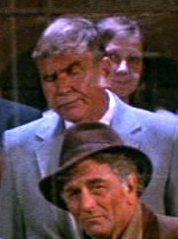
First, some sympathy for poor Guy Remsen. "Who is Guy Remsen?" you might ask. His late older brother was the Altman regular repertory player Bert Remsen (I know — Bert Remsen probably isn't ringing bells for many of you either. How about Jack Riley? If the name doesn't cut, his face would or perhaps the name of his most famous character — Mr. Carlin on The Bob Newhart Show. When they get to end and show the climax of the movie within The Player, Habeas Corpus, all three actors make cameo appearances. If you read closely (here's one helpful item the DVD players have that laserdisc players didn't: zooms), you see that in Habeas Corpus, Riley plays "Hap" Harlow, one of the reporters covering the execution; Bert Remsen's name gets listed as executioner, since he's the guard who starts the gas pellets dropping into the chamber; and Guy Remsen portrays The Attorney General. On both the Criterion laserdisc version and the New Line DVD version, they managed to misidentify Guy Remsen in their respective cameo guides. In the Criterion, they just got the Remsen brothers confused. Bad, but I guess we could call that an understandable mistake. In the New Line edition, somehow they swapped Guy Remsen and Jack Riley. So I've included photos of all three to avoid confusion. Bert Remsen throws open the blinds, Guy Remsen stands behind Peter Falk (who has the role of Harry Levin in
 Habeas Corpus) and Jack Riley takes notes at the very edge of the chamber window (if the full picture were there, you would see Susan Sarandon to Riley's left in the part of another reporter, Ellen Walsh. I suppose this serves as good as a place as any to point out the three credited cameos I couldn't locate (for certain). The first actor I know very well. He's Richard Anderson, a character since the 1940s whose best-known role probably would be Oscar Goldman on both The Six-Million Dollar Man and The Bionic Woman. Where Anderson has hidden in The Player remains a mystery to me. He's not on the New Line DVD and I don't recall him on the Criterion laserdisc either. The mystery actress, whom I couldn't even find a photo for to try to search out her location, is named Maxine John-James. The Inaccurate Movie Database lists three features and one episode of the television series Acapulco H.E.A.T. Personally, I must track down her dual role in the 1997 film Pterodactyl Woman from Beverly Hills. The third incognito cameo belongs to an actress named Jennifer Nash. Unlike Ms. John-James, she cites an extensive list of credits, mostly on television, and photographic proof of her existence can be obtained. In The Player, I couldn't find her unless that's her holding a dog and accompanying Malcolm McDowell in the lobby of The St. James Club. However, no matter how I tried to play with her image, I never succeeded in making it discernible enough to match against other photos of Nash.
Since they count Ross and she appears in the opening eight-minute shot, I'm going to attempt to get through the remainder of the cameos in the order that they appear in the film. Writer-director Adam Simon steps up first, pitching to Griffin as soon as Mill gets out of his Range Rover at the unnamed studio. Griffin pushes Simon off on his D-Girl (and girlfriend) Bonnie Sherow (Cynthia Stevenson) while he has his secretary Jan (Angela Hall) call security to figure out who let Simon on the lot. His first official pitch comes from Buck Henry who tries to sell him the idea of a sequel to The Graduate. Henry reappears later at a benefit dinner for the Los Angeles County Museum of Art's film program. Griffin meets next with two women screenwriters: Patricia Resnick and Joan Tewksbury. Resnick co-wrote Altman's A Wedding and Quintet. Tewksbury wrote Altman's Nashville and co-wrote Thieves Like Us. Alan Rudolph throws out the final pitch of the unbroken shot (after first being mistaken as Martin Scorsese by Jimmy the bike messenger, played by Paul Hewitt) and serves as the segment's final cameo. The writer-director's long relationship Altman includes Altman producing five of the feature films that Rudolph directed. On the DVD, Altman says, "I'm as interested in getting Alan Rudolph's new films going as I am my own."

Most of the film's cameos occur in group situations. I hadn't thought of this before but, in its own way, it mirrors the various settings that keep uniting all the characters in Altman's Nashville, which I still consider his greatest work. Only in The Player, the same characters do not cross paths but instead enter a location stocked with a new group of celebrities. This scene even gets a nice aural to visual segue. Griffin hovers over Claire (Dina Merrill), the studio president's powerful all-knowing executive secretary, trying to learn what she knows about rival movie executive Larry Levy. Claire ducks his queries long enough until the phone rings and she tells whoever is on the line, "No, we
 couldn't sign Anjelica Huston for that. She's booked for two years." Her utterance cuts immediately to Huston's face eating lunch on the patio of an outside restaurant with John Cusack and Levy. Soon, we see Griffin walking up the path to the restaurant where he bumps into Joel Grey on the steps. Mill introduces himself and says he knows his daughter Jennifer and is a big fan. Grey notes that the two have similar ties and moves on. Griffin joins the large table across Levy, Cusack and Huston where Bonnie and others who work at the studio await (including Jeremy Piven, who has a small role in the film). At a table for two next to the studio contingent's large round table sits Martin Mull. The remaining cameo in this scene happens to be the hardest to spot as well as the saddest. Actor Brad Davis, best known for the lead role in Midnight Express, eats at a table on the patio on the other side of the eatery's entryway. You don't get a good look at him, but what you can see gives an indication of his illness. Davis was dying of AIDS and succumbed on Sept. 8, 1991, seven months before the movie's release. I've cropped a larger frame so you can see where he sat and then enlarged Davis from that screenshot to give you an idea.
The mixture of celebrities mingling at the pool party of Griffin's attorney, noted entertainment lawyer Dick Mellon (Sydney Pollack), proves quite eclectic, to say the least. When Griffin and Bonnie arrive at Dick's place, they first encounter Marlee Matlin and Bonnie — through Matlin's interpreter — discusses a script that she read and thinks would be great for Matlin. Dick spots Griffin's arrival and excuses himself
 from a conversation with Harry Belafonte and his daughter Shari concerning network news figures. Griffin and Mellon's conversation offered more evidence that Pollack might be a better actor than director, this time playing it straight. Griffin starts to tell Mellon about the threatening postcards when his white whale — Larry Levy — crashes the party, arriving as a guest of Jeff Goldblum. Mill complains to Dick that Levy keeps getting in his face. "He's a comer. That's what comers do — they get in
 your face. You're a comer, too. You can handle it," Mellon reassures him. "So, the rumors are true," Griffin replies. "Rumors are always true. You know that," Mellon tells him. "I'm always the last to hear about them," Griffin sighs. "No, you're always the last one to believe them," Dick corrects his client. Today, seeing Sydney Pollack play a character in a scene surrounded by celebrity cameos throws you off-kilter, the way some actors do when they appear on Curb Your Enthusiasm and it takes a few minutes to realize that they aren't playing themselves, but Pollack's role in The Player was the director's first acting job since 1982's Tootsie. Later in 1992, he took another part, this time in Woody Allen's Husbands and Wives, but Pollack didn't start acting regularly until 1998. In fact, in that final decade of his life (he died in 2008), Pollack only directed two films and mostly acted and produced. Pollack's relative anonymity to audiences in 1992 prompted Altman to cast him in the first place, though Altman originally pursued director Blake Edwards for the part of Dick Mellon. In addition to those named so far and the two couples and Sally Kellerman (who appears again later at a gala benefit) pictured in the photograph above, the remaining attendees included Kathy Ireland, Jill St. John and Robert Wagner and last, but certainly not least, Rod Steiger, saying not a word as he holds a plate of food and stares at what appears to be a vertical fish tank, though it might just be bubbling water as I see no fish.
Our next stop on the virtual bus tour of Player cameos takes us another patio restaurant, this time for breakfast the next morning. Larry Levy just completed his meeting with studio head Joel Levison (Brion James), who can be spotted eating alone near the railing between the foreground figures of Burt Reynolds and entertainment columnist and critic Charles Champlin. Altman says he cast James as the studio head specifically because he'd been typecast as a villain in so many films such as Blade Runner, Tango & Cash and Another 48 Hrs. While looking over Brion James' filmography, I may have solved part of the Maxine John-James cameo mystery. Brion James also appeared in
 Pterodactyl Woman from Beverly Hills and served as an associate producer of this Troma release. Looking further, Brion and Maxine John-James were married at the time of The Player. I still can't find a photo of her, but there you go. Levy makes a point of apologizing to Reynolds on the way out, hoping there are no hard feelings over some incident that Reynolds apparently doesn't recall since he has to ask Champlin who Levy was. Reynolds' cameo turns out to be one of the funniest once Griffin drops by. He remembers him. After Mill exits, Reynolds mutters to Champlin, "Asshole." The columnist responds, "One of a breed" which launches Reynolds into a monologue that we only hear the start of before they cut away. "No, actually they are a breed, In fact, they're breeding them" Reynolds begins but the sound fades out as we move to Levison's table. Reynolds' bit scored because, like all who appeared for Altman (accepting scale payment or no payment at all), they had no scripted dialogue. In Altman's way of thinking, if the celebrities show up to play themselves, he couldn't very well tell them what they would do in real life. As a result, every line or use of prop by a cameo artist came from that person. They also could choose to say nothing at all, but Altman and his editor Geraldine Peroni got to pick the best ones to use. (Peroni received the film's third Oscar nomination along with Altman's direction and Tolkin's adapted screenplay.) When Griffin threatens to quit over Levy coming to the studio, Levison tells him that he's under contract and he'd sue. Then, the third cameo becomes easier to see as Cathy Lee Crosby sits right behind him. In the wide picture above, Crosby appears as the blonde across from Levison.

That night, Griffin had his fatal encounter with David Kahane in Pasadena, but first the two went to a Japanese karaoke bar where actor Brian Tochi, perhaps best known as Takashi in Revenge of the Nerds or as the voice of Leonardo in the live-action Teenage Mutant Ninja Turtles movies, performed. The next day at work, Griffin and others watched the dailies from a noirish detective film called The Lonely Room starring Scott Glenn and Lily Tomlin. The purposeful flubs induce enough laughs, but the deleted scenes comes off as being even funnier as Tomlin complains about having to smoke so much when she doesn't and expresses concern about the message being sent. Then, in another cut take, Glenn asks that someone make sure that he gets his per diem when the day's shooting ends. Tomlin whines that she gets penalized because she lives in Los Angeles while Glenn lives in another state, flies in and stays at the Chateau Marmont and receives extra pay for it.

Now comes the moment we've been waiting for since the headline of this post: Who the hell is Thereza Ellis? Thanks to the New Line cameo guide, I know what she looks like and where she appears, but that answers no questions whatsoever. It's later that night when Griffin's stalker,
 who has surprised Griffin by not being dead, had told him to meet him alone at The St. James Club. In the hotel lobby, Griffin first encounters Malcolm McDowell (who is accompanied by a young blonde woman with a dog that might be that Jennifer Nash. Who knows?) McDowell smiles as he shakes Mill's hand and then tells the studio executive, "The next time you want to badmouth me, have the courage to do it to my face. You guys are all the same." Griffin looks stunned as the actor leaves (though he'll pop up again at that gala benefit). In a lounge area, Andie MacDowell has been cornered by the film's two most over-the-top characters: screenwriter Tom Oakley (Richard E. Grant) and Andy Civella (Dean Stockwell). Geena Davis originally was going to do this cameo, but some emergency happened so MacDowell flew in from her home in Montana at the last minute to pitch hit. That makes the conversation all the funnier since Oakley and Civella are trying to convince the actress the Montana always ends up being bad luck for people in the movie business, citing as their only evidence Michael Cimino's Heaven's Gate. When the hyper pair spot Griffin, they start trying to pitch a movie idea at him and MacDowell takes the opportunity to escape, being led off by *(drumroll please)* THEREZA ELLIS. My search for information on Ellis has taken me to the far corners of the World Wide Web but the only sign that seems to point to the existence of a Thereza Ellis comes from universal agreement that she played herself in The Player. I could find no other credits, no other photographs, no other lines of work. Someone must track down Andie MacDowell. She could be the only person who knows the truth!
 When the studio holds a black-and-white gala benefit for the Los Angeles County Museum of Art, the scene overflows with cameos both famous and curious. Buck Henry, Sally Kellerman and Malcolm McDowell put in repeat appearances, though the first cameo exists only as a voice as Leeza Gibbons narrates the arrivals at the event for Entertainment Tonight. Griffin uses the occasion to take the late David Kahane's girlfriend June Gudmundsdottir (Greta Scacchi) out on their first public date after having sent Bonnie to New York to check out the new Tom Wolfe novel. Mostly, it's a sea of face in quick glances with the exception of Cher, who comes wearing red at Altman's behest. Later, he learned that Cher never wears red. The remaining attendees in alphabetical order: Karen Black, Gary Busey, James Coburn, Kasia Figura (who apparently has a huge career in Europe), Teri Garr, Elliott Gould, Sally Kirkland, Nick Nolte, Alexandra Powers (who appears to have been stuck sitting next to Fred Ward's Walter Stuckle), Mimi Rogers and Marvin Young, known better by his recording name Young MC of "Bust a Move" fame. Finally, we come to cameo payoff — the star-studded cast of the movie-within-the-movie Habeas Corpus. I already named some earlier, but I'll point them out again as art alone places these actors in order.


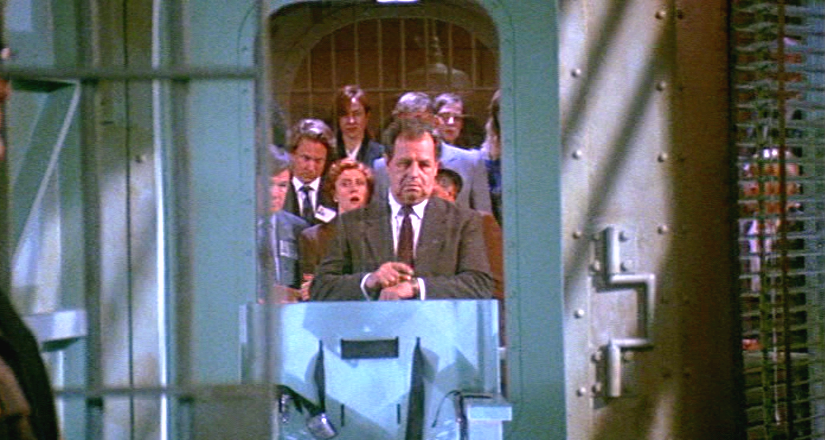
ABOVE LEFT: Guard No. 6 (Michael Bowen) stands in the hallway leading to the gas chamber in Habeas Corpus. ABOVE RIGHT: Reporters and other witnesses await the execution in the viewing room outside the gas chamber. (Front row, left to right) Reporters "Hap" Harlow (Jack Riley), Ellen Walsh (Susan Sarandon) and Harry Levin (Peter Falk) take notes for their stories. Standing directly behind Levin wearing a gray suit is The Attorney General (Guy Remsen). BELOW LEFT: Warden Lowe (Paul Dooley) appears at the witness window and taps his watch, indicating the execution should proceed. BELOW RIGHT: Following the warden's orders, Guard No. 3 (Robert Carradine, left) and Guard No. 4 (Steve James) head toward the cell to retrieve the condemned prisoner.


ABOVE LEFT: Condemned murderer Marsha Kent (Julia Roberts) sits on her cot listening to Father Pratt (Ray Walston) read from The Bible. Matron Cole (Louise Fletcher) stands speaking with Dr. Besh (Rene Auberjonois) by the cell door. Marsha gets removed and taken to the gas chamber where they strap her in the chair and drop the gas pellets. (not pictured) ABOVE RIGHT: Assistant D.A. Dave Williams (Bruce Willis) bursts into the unit preparing to execute Marsha, the woman he convicted for murdering her husband and whom he loves, upon learning that Marsha's husband faked his death. Williams passes Guard No. 4 (David Alan Grier) on his way. BELOW LEFT: Williams (Bruce Willis) grabs a shotgun from Guard No. 1 (Dennis Franz). Williams blasts the glass of the gas chamber, releasing fumes everywhere.(not pictured) BELOW RIGHT: Williams (Bruce Willis) carries Marsha (Julia Roberts) to safety while inside the gas chamber (from left to right) Guard No. 4 (Steve James), the Executioner (Bert Remsen) and Guard No. 3 (Robert Carradine) shield their faces from the fumes.


Tweet
Labels: A. Huston, Altman, Blake Edwards, Burt Reynolds, Curb Your Enthusiasm, Dean Stockwell, Fiction, Geena Davis, Lily Tomlin, Malcolm McDowell, Oscars, Scorsese, Sydney Pollack, Tim Robbins, Woody
TO READ ON, CLICK HERE
Wednesday, October 05, 2011
A Real Phony

By Damian Arlyn
What was it about Audrey Hepburn? She was beautiful. There's no doubt about that. She made being natural and vulnerable in front of the camera seem so effortless. She had grace, charm, poise, charisma, and could seem both earnestly innocent and incredibly sexy at the same time. Yet these qualities have all belonged to countless other actresses both before and after her, so what made her different? Having re-watched two of her movies recently, I was reminded of what a truly unique screen presence she was. The impression she managed to leave on audiences was far more than merely the sum of these parts. Regardless of the genre she was working in there was something strangely elusive and sparklingly radiant about her. As the cliché goes, one can't take one's eyes off her. She commanded attention not by doing a lot (as other actors tend to do) but by doing very little. It's easy to see how a whole industry has sprung up around her, and yet somehow (almost 20 years after her death) she even manages to rise above that. I mention all this because one of her most iconic films, Breakfast at Tiffany's, celebrates its 50th anniversary today and although it is one of my all-time favorite films, I can admit that whatever greatness it does possess comes mostly because of her immeasurable contribution, which is far more than purely an aesthetic one. Her presence alters the whole approach the filmmakers took to the material and her absence no doubt would've affected the film's now classic status. Without Audrey, Tiffany's still would've been a good movie, but with her, it's a terrific one.
The role Audrey played (famously known as Holly Golightly but, as the film elucidates, that's not her real name) first began as a character in a Truman Capote novella. While I have not personally read the book, my understanding is that it's much darker and more provocative than the Paramount's movie adaptation (the character of "Fred" is homosexual, there is no happy ending, etc). As it is, the film still deals with very adult subject matter but it handles it in a very restrained and accessible manner. Because of that approach, the casting of Audrey Hepburn as the naive but worldly "call girl" (called by Capote as an "American geisha") works. Capote apparently wanted the sluttier Marilyn Monroe for the part and although it might've made it closer in spirit to its gritty source material, that choice would've severely altered the alchemy of the finished film.

From the film's opening sequence where a gorgeous Audrey stands on a deserted street eating breakfast while gazing longingly at a Tiffany's store window to the emotionally wrenching climactic kiss in the rain, it is clear that Breakfast at Tiffany's is pure Hollywood fantasy. Only in a fantasy could such a scared, lonely and tragic character seem so elegant, so glamorous and so engaging. It surprises me (and my wife) how many women fantasize about being Audrey's Golightly character (wearing her outfits and so forth) presumably not realizing that within the context of the film, it's a facade. She is not stylish, she's pathetic. She's not strong, she's sad. As Martin Balsam states in the film: "She's a phony," but because she actually believes in the illusion "she's a real phony."
Surrounding Audrey is a very capable cast. A young, handsome George Peppard plays Paul Varjak, the down-on-his-luck writer currently being supported by his "decorator," with ease and confidence. The always reliable Patricia Neal was the classy (and deliciously frosty) Emily Failenson, Paul's married companion/benefactor. Buddy Ebsen turns in a brief, but heartbreaking, performance as Holly's former husband, Marty Balsam plays Holly's long-suffering agent and, in one of my all-time favorite "bit" parts of any movie, a memorable John McGiver shows up as a very understanding Tiffany's salesman who, in spite of his cold professionalism, pontificates wistfully about how the knowledge that Cracker Jack boxes still contain prizes "gives one a feeling of solidarity with the past."

The film's solitary sour note performance-wise comes from Mickey Rooney's buck-toothed, yellow-faced Japanese landlord, Mr. Yunioshi. Originally intended to provide hilarious "comic relief", the clumsy, bad-tempered character is the textbook example of a racist stereotype. Made all the more embarrassing by its sheer gratuitousness, many of the filmmakers have since apologized for the insensitive portrayal, though his scenes did make for a compelling sequence in the 1993 biopic Dragon: The Bruce Lee Story starring Jason Scott Lee. There are, however, other moments of comedy in the film that do work very well. When Holly throws a party in her apartment, for example, we are treated to some very funny vignettes (my favorite of which is the woman who's laughing at her own reflection in the mirror at one point and then when glimpsed later she's crying at it, mascara smearing down her face). Some have commented that these scenes are actually the best in the movie. I don't know that I'd go that far but they do demonstrate Blake Edwards' knack for staging comic set pieces, a talent that would be on full display two years later in his most famous film, The Pink Panther.
Despite Edwards' natural affinity for comedy, he was a competent director of drama as well. Breakfast at Tiffany's and Days of Wine and Roses prove this I think. Furthermore, there is a lightness of touch that Edwards brings to the whole proceedings. Not a subtlety necessarily because Edwards is admittedly not the most subtle of directors (he often paints in very broad strokes whatever genre he chooses to work in), but a nimbleness. Edwards may deal with heavy material, but he doesn't handle it heavily and that characteristic, combined with Audrey's effervescent influence, is what makes Breakfast at Tiffany's so airy and delightful (in contrast, consider that the film originally was going to be directed by John Frankenheimer and imagine what kind of finished product it would've ended up becoming). This is helped in no small way by Henry Mancini's lovely score (another plus of having Edwards as the director since he and Mancini always worked together). In addition to some bouncy jazz pieces and some appropriately emotional cues for the film's more dramatic moments, Mancini created one of the most unforgettable theme songs in the history of cinema in "Moon River." A simple little melody with somewhat corny lyrics and yet, like Audrey herself, somehow the tune manages to transcend its ingredients. The scene where Audrey sits in her window playing the guitar and singing helps to establish its immortality. By now it is almost common knowledge that the studio did not want to keep the song but Audrey forbade them from cutting it ("Over my dead body" were ostensibly her exact words).
When it was released in 1961, Breakfast at Tiffany's was very successful at the box office and relatively well received by critics. Whatever criticisms were aimed at the film, Audrey herself was highly praised for her performance. Nobody could've anticipated, however, the lasting effect the film and its protagonist could have on pop culture. Holly Golightly would become Audrey's most iconic character and the quintessential example of her onscreen appeal. I must confess that the film was my first introduction to Ms. Hepburn and, just as George Peppard did, I fell in love with her almost immediately. She was a true original and I doubt there will ever be another one like her. Her character might've been a "real phony," but she herself was the genuine article.

Tweet
Labels: 60s, A. Hepburn, Blake Edwards, Capote, Fiction, Marilyn, Movie Tributes, Patricia Neal
TO READ ON, CLICK HERE
Sunday, July 17, 2011
He did more than just think funny things

By Edward Copeland
Thirty years ago, we were visiting my aunt and uncle when one night my older cousin came home raving about a hysterical movie that he and his date had seen called Arthur and how good this Dudley Moore was in the title role. Why he didn't know who Moore was before that, I can't rationally explain. I certainly knew who he was. Not only from two years earlier in Blake Edwards' sex farce 10 but for his amusing supporting turn in 1978's Foul Play with Goldie Hawn and Chevy Chase. Admittedly, I was unaware of his decades of British work with the satirical troupe Beyond the Fringe or his frequent comic pairings with Peter Cook. However, when Arthur opened on this date 30 years ago, it launched Moore into the stratosphere in the U.S. thanks to his brilliant comic turn, a great supporting cast led first and foremost by the incomparable Sir John Gielgud and a Grade A script by writer and first-time director Steve Gordon. Despite the best efforts to suppress the original gem for this year's remake which thankfully bombed, the real Arthur survives and perhaps finally will get the proper DVD release the movie always has been denied.
Arthur Bach (Moore) may look like an adult, but he's really a child trapped in a man's body and having one helluva time with it. He's a wealthy playboy devoted to fun and leisure and leaving many an empty bottle in his wake across Manhattan. In the film's very first scene, his chauffeur Bitterman stops the Rolls by two streetwalkers for his drunken boss who asks if "the more
 attractive" of the two would please step forward. Realizing that's not the best approach, even when you are paying, Arthur amends his query to ask the one who finds him more attractive to step forward. Dressed in red spandex pants, the hooker Gloria (very recognizable character actress Anne De Salvo) steps up to the car and asks Arthur what he wants. "VD. I'm really into penicillin," he laughs. She gets in any way as the inebriated heir continues to crack jokes and laugh. When she asks him what he does for a living, Arthur tells her, "I race cars, play tennis and fondle women, but I have weekends off and I AM my own boss." At one point, he just starts laughing for no apparent reason. Gloria asks what's so funny. "Sometimes I just think funny things," he responds. Arthur will say a lot of funny things as will the other members of the cast and we'll learn we're not just laughing at someone doing a drunk act — if it's been a while since you've seen the 1981 film, you might be surprised to see how relatively little time Arthur spends soused in the movie and when he's on a bender, something has usually set him off or he's inoculating himself ahead of time for an event he's dreading. There's a serious reason behind it that actually makes Arthur slightly deeper than your average comedy. I'll get to all that later, first I have to take a break to vent about unnecessary remakes and how they actually can be dangerous in this era.
I must get this rant off my chest about the Arthur remake that came out earlier this year with Russell Brand taking Moore's role and John Gielgud's Oscar-winning valet Hobson getting a sex change and becoming Arthur's nanny Hobson in the form of Oscar winner Helen Mirren. I did not see the remake. I live by the principle that if the original movie was really good or great, I will not see a remake of it. There's no point other than filmmakers
 bereft of original ideas looking to steal what worked in the past and, inevitably, doing a piss-poor job of it. When I first heard that they were remaking Arthur, I thought it sounded like a bad idea. Once commercials started appearing, it looked much worse than even I imagined. It didn't help that they had Brand going around semi-criticizing the original in a way that only proved he couldn't have seen it (or wasn't sober at that time if he did). Since the character of Arthur does drink to excess and Brand is a recovering addict in real life, he made a big point about changes in the remake as if the original were pro-alcoholism. “It was very important that we established a context where the alcohol was humbling,” Brand said in an interview. “In 2011, you also need to see a resolution to his vice. I was happy to see how it was rendered.” The only times Dudley Moore's Arthur Bach gets drunk is when he's miserable or frightened. Once he meets Linda (Liza Minnelli) and falls in love or when he worries about Hobson's health and becomes his caretaker for a change, his drinking ceases. His drinking wasn't a vice: It was an anesthetic to ease his pain about being forced into marriage with a woman he not only didn't love but didn't like much either with the cost of refusing to wed her being the loss of his fortune.
What's most despicable in this case is that it sort of proves my fears of why remakes are dangerous. With the constant development of new technologies, Hollywood won't keep transferring every film ever made to the latest format. They will stick to the most recent versions with the most recognizable stars. When I started plotting out tributes to do this year at the end of 2010, I knew that the 30th anniversary of Arthur would be one of them. Upon investigation, I was shocked to find that it was NEVER released on DVD in its proper aspect ratio. All versions were cropped instead of the 1.85:1 in which it was shot. (At the time of the remake's release, the original along with its horrid 1988 sequel Arthur 2: On the Rocks were released together on a single Blu-ray disc in widescreen without any special features which even the cropped DVDs had.) I also try to collect screenshots from the web ahead of time, so I know if there is anything I'll have to grab from the DVD. Surprisingly, very few shots from the actual 1981 movie are out there. Mostly, there are poster or publicity stills. Even more frightening, if you try to do an advanced search where you specifically omit the name "Russell Brand," you still end up getting more art related to the remake than the original anyway. Now someone tell me I have nothing to fear from Johnny Depp's ego thinking it needs to play Nick Charles in a remake of The Thin Man. If they start trying to pretend that a 1981 film doesn't exist, what do you think they'll do with one made in 1934? Think they released that no-frills Blu-ray where they handcuffed it to its terrible sequel by accident or so they can say, "Nobody bought it" and then let it die? It's more ridiculous when you realize what a gigantic hit the original Arthur was and what a colossal flop the remake turned out to be.
Back to the real Arthur. We'll pick up where we left off with Arthur on his "date" with Gloria. Part of the genius of Steve Gordon's screenplay was how deftly it intertwined plentiful laughs and exposition at the same time. Arthur takes Gloria to dinner at The Plaza. Needless to say, when she walks in first, the maitre'd (Dillon Evans) is ready to throw the hooker out — until he sees she's with "Mr. Bach" and then he's all manners. The other haughty patrons express shock, but few of them stand to inherit $750 million someday so the maitre'd isn't
 too concerned. On their way to Arthur's regular table, Arthur spots his Uncle Peter (Maurice Copeland, no relation) and Aunt Pearl (Justine Johnston). He goes on to introduce the hooker as "Princess Gloria," telling them she hails from a tiny country. "It's terribly small, tiny little country," he breathes on Aunt Pearl to her disgust. "Rhode Island could beat the crap out of it in a war. That's how small it is." Uncle Peter finally steps in saying what he does know is that Arthur is terribly drunk and perhaps they should see him when he's sober. "Grow up Arthur, you'll make a fine adult," his uncle tells him. "That's easy for you to say. You don't have 50 pair of short pants hanging in your closet," Arthur responds as Gloria leadx him to their table. Without being aware of what he just asked, Arthur prods Gloria to tell him about herself. "You mean why I'm a hooker?" she replies. She goes on to reveal that her mother died when she was 6 and her father raped her when she was 12. "So you had six relatively good years," Arthur slurs. "Sorry. My father screwed me too." That's how he introduces the film's main plot point and why Arthur drinks. His father and grandmother keep pressuring him to marry a young heiress named Susan Johnson, but Arthur wants no part of it. He holds on to the silly notion that he'll get married for love.
The next morning, when Gloria wakes up with Arthur in his bedroom that looks more suited for a child, complete with an elaborate train set behind his bed, we meet the most important person in Arthur's life: his butler/manservant/valet Hobson (Gielgud, who most deservedly took home the Oscar for best supporting actor). We first see him as elevators door open to reveal him bearing a tray of breakfast sustenance. Having just awakened, Arthur's embracing Gloria and we hear Hobson intone, "Please stop that." He steps further into the room and informs Arthur, "I've taken the liberty of anticipating your condition. I have brought you orange juice, coffee, and aspirins. Or do you need to throw up?" Gloria registers surprise at the sudden appearance of this British gentleman who hands her a robe and asks her to put it on, adding that she has breakfast waiting for her on the patio. "Say goodbye to Gloria, Arthur," Hobson instructs him and Arthur does as he says. Later, Arthur sits in a chair reading part of the newspaper while Hobson stands next to him reading another. It's a scene that contains several classic moments and, thankfully, YouTube had the clip.
Now Arthur's bathtub is much like his bedroom: Elaborate with an intercom system and a stereo (From the photo of the remake the bigger budget seems to have bought a smaller tub with fewer frills). Hobson reminds him that he must meet with his father in his office, so he gets prepped. Once they arrive and wait in the outer lobby, Arthur's jitters are on full display. He tells Hobson how he hates it there. "Of course you hate it. People work here," Hobson replies, before ordering Arthur to lean back in his chair and sit up straight. The receptionist announces that Arthur's father will see him now. He wants to take Hobson, but the receptionist says that his father said for Arthur to come in alone. After Arthur has left, an
 exec in the lobby (Paul Gleason) picks up the courtesy phone and says to Hobson, "He gets all that money. Pays his family back by being a stinkin' drunk. It's enough to make ya sick." Hobson smiles. "I really wouldn't know, sir. I'm just a servant. On the other hand, go screw yourself." In his father's office, Arthur makes a beeline for the bar. His father, Stanford Bach (Thomas Barbour), flips through newspaper clips, noting how his drunken playboy status has made great fodder for the tabloids. He calls his son weak. "I despise your weakness," his father tells him. Arthur reiterates what he says he's told his father "a thousand times." He's not going to marry Susan Johnson. His father tries to sell him on it, insisting that he wants it, his grandmother wants it and Burt Johnson wants it. "Burt Johnson — he's a criminal!" Arthur exclaims in reference to Susan's father. Stanford Bach says they all are criminals in their own way and he admires Arthur, in a way, for sticking to his principles, but from this moment on — he's cut off. "From you? From grandmother? The rest of the family?" Arthur gulps. His father shakes his head. "You mean from —" Arthur can't even say the word. "The money Arthur," his father says. Suddenly, Arthur has a change of heart about Susan, finding positive qualities about her. Stanford shakes his son's hand. "Congratulations Arthur. You're gonna be a very wealthy man for the rest of your life," he tells him. "It's all I've ever wanted to be."
Most of the pieces for Gordon's simple yet great screenplay are in place but the final part comes into play after Arthur's meeting with his father when he and Hobson go shopping at Bergdorf Goodman. Arthur goes on a spiteful spending spree, ordering three dozen of a particular shirt then telling Hobson, "I hate my father." "Buy four dozen," Hobson advises and Arthur increases the order. Then Arthur spots her (Liza
 Minnelli). She's wearing a red hat and bright yellow slicker with a bag draped over her shoulder — and she steals a necktie and stuffs it in the bag. Arthur asks Hobson if he saw that. "It's the perfect crime — women don't wear ties. Some women do so it's not the perfect crime, but it's a good crime," Arthur comments. He then sees that the store's security guard has begun to follow her. Despite Hobson questioning why they should care, Arthur follows her out to the street where the guard confronts her, accusing her of stealing a tie. She gets confrontational, wanting to know the guard's name and asking the people in the crowd to get her a cop. Arthur steps in and says he thinks he can straighten this out. The guard of course knows who he is. He tells the guard he told her to pick out a tie and he'd put on his bill at the cashier. Arthur even asks to see it which the woman shows to him. Arthur says it's lovely and plants a big kiss on her lips. He tells the guard to have the cashier add the tie to his bill and he just keeps following the woman, whose name he learns is Linda. She can't figure out who the tall British gentleman stalking them is. When Arthur tells her he's not married, she gives him her phone number. "Thank you for a memorable afternoon," Hobson tells her. "Usually one must go to a bowling alley to meet a woman of your stature." Arthur lets Bitterman drive her home while he and Hobson continue shopping.
 Now the romance, albeit thwarted, at the center of Arthur may be between Arthur and Linda, but when you get right down to it, the film's most important relationship exists between Arthur and Hobson. The reason Arthur drinks has little to do with him being an overgrown kid out to have a good time but much to do with
 the lousy childhood he had. The movie never even alludes to what happened to Arthur's mother, but in one of the film's quieter and sweeter scenes, when he's showing Linda his favorite horse, she comments how great it must have been to be around the horses and the rest of the estate when he was growing up. Arthur admits he wasn't home a lot because he always was at a boarding school — and he got kicked out of 10 prep schools because he was a bad kid. "You weren't bad. You just wanted to come home," Linda tells him. She's right — and the main reason for that was Hobson, who treated Arthur more like a son than Stanford Bach did. Sure, Hobson and Arthur have a teasing relationship, but Hobson always has been Arthur's protector. While the rapport between Moore and Gielgud provides many of the movie's biggest laughs, it also supplies the film with much of its emotional underpinnings and heart. You can tell from looks that Gielgud gives early in the film (or the TV ads showing Mirren's Hobson in the remake) that Hobson isn't well and he's trying to prepare Arthur for life when he's no longer there.
At first, Hobson isn't the wise oracle you might take him for, at least when it comes to Arthur's feelings toward Linda. When Arthur asks Bitterman where Hobson is and the driver says he's tired, Arthur notes that he's been tired a lot lately. Arthur goes to Hobson's room out of concern for his surrogate father and also to vent because he's feeling crappy, having just told Linda about his engagement to Susan. First, Hobson tries to
 allay Arthur's fears about his health by doing his usual hammy fake dying scene, but Arthur isn't in the mood. He tells Hobson about his admission to Linda and the old valet, assuming they still are playing their usual verbal games responds, "I don't know why. A little tart like that could save you a fortune in prostitutes." Arthur gets livid, yelling at Hobson never to speak about Linda in that way again and asking why he has to be such a snob before storming out. It actually causes Hobson to sit up in bed when Arthur returns to the room, saying that's the first time he's yelled at him in his life. "Perhaps you're growing up," Hobson suggests. Despite Arthur standing up for Linda as he did, it still isn't enough to convince Hobson yet that Arthur's feelings really represent love for Linda and not just resistance to marrying Susan. Arthur's mood does not change though. Hobson accompanies him to one of his favorite getaways — some high-speed spins around the racetrack — but Bach remains as morose as ever when he climbs out of his car, complaining to Hobson that, "I could love somebody. I never got to love anybody. I'm a failure in everything I do." Hobson asks Arthur to remove his racing helmet, then his goggles, and holds them both under one arm as he repeatedly slaps him on both cheeks with one hand.
And incidentally, I love you. (Hobson puts his arm around Arthur and they walk off together.) Marry Susan, Arthur. Poor drunks do not find love, Arthur. Poor drunks have very few teeth, they urinate outdoors,
they freeze to death in summer. I can't bear to think of you that way."
Hobson may have advised Arthur to marry Susan, but he has plans of his own. He soon shows up at Linda's apartment with a dress and the time and address for Arthur and Susan's engagement party. Linda can see that the old man is sick, but she realizes he's doing this because he cares for Arthur. He tells her he still recognizes when "a gentleman is in love." She does have to ask though if Arthur sent him. "Arthur would never be involved in something as devious as this," Hobson insists. Linda tells Hobson that Arthur has a really good friend in him. "You really look out for him, don't you?" she says. "It's a job I highly recommend," Hobson
 responds. He has another bad coughing spell as he's leaving and she asks if he's seen a doctor. "Yes — and he has seen me." Soon, Hobson does end up hospitalized and his role and Arthur's are reversed as Arthur sees to his care, completely re-doing his hospital room, bringing him catered meals against doctor's orders ("I'm not going to let his last meal be jello.") and moving in himself. He also brings him a plethora of gifts from basketballs and toy trains to a cowboy hat, which Hobson insists he remove if he should die suddenly. After Arthur stays up most of the night when Hobson has a bad one, Hobson tells him in the morning that he looks awful. "That's because you've never seen me sober," Arthur tells him. At one point as he grows weaker, Hobson confides to Arthur that he can do anything he wants. Arthur asks what he means. "Figure it out." The pairing of Gielgud and Moore was brilliant casting on someone's part and, as I wrote before, Gielgud deserved that Oscar win. Moore also deserved his nomination for best actor, but he faced a tougher field that consisted of Warren Beatty in Reds, sentimental favorite and winner Henry Fonda in On Golden Pond, Burt Lancaster in Atlantic City and Paul Newman in Absence of Malice.
Watching it again, you have to commend whoever took a chance on Steve Gordon and let him make his directing debut on Arthur when it was only the second screenplay he'd written. The first, The One and Only starring Henry Winkler and directed by Carl Reiner, wasn't bad, but couldn't prepare anyone for how good Arthur would be. The remainder of Gordon's resume consisted of limited sitcom writing on shows such as Barney Miller and Chico and the Man and as creator/head writer of a short-lived 1976 comedy called The Practice starring Danny Thomas. Sadly, after the success of Arthur, including an Oscar nomination and a Writers Guild award for original screenplay, Gordon died in 1982 of heart failure at the age of 44.
Arthur wouldn't feel that out of place if it had been made decades earlier than 1981 except for some language and sexual innuendo. Classic comic scene follows classic comic scene, great actors both of stature and solid character work fill most every role and it
 follows the tried-and-true rule of the best comedies by running around 90 minutes. (The remake and the original's own awful sequel both end up 10 minutes shy of the two hour mark.) The infectious, bouncy score by Burt Bacharach blends perfectly with the laughs and tugs on the heart when needed, though the instrumental music was overshadowed by the film's popular and award-winning theme song. The cinematography by Fred Schuler (who also filmed The King of Comedy) makes Manhattan look beautiful and glistening, something you didn't see too often in films of the late '70s and early '80s. I've praised the exquisite work of Moore and Gielgud, but some of the others deserve their due. Admittedly, I've always felt that Liza Minnelli was the weak link as Linda, but seeing it again, I enjoyed her performance more than I have in the past and it's probably the most likable she's been on screen. Of course, this was before her body was made mostly of plastic, rivets and wax. Even better is the late Barney Martin (probably best known now as Morty Seinfeld on Seinfeld) as Linda's unemployed father who gets more upset than she does at times when it looks as if she's lost her chance at love with a multimillionaire. Martin's far from the only familiar face that shows up.
Jill Eikenberry, long before L.A. Law, gets the somewhat thankless task of playing Susan, Arthur's unwanted fiancée, who always denies the evidence of what's in front of her — namely that Arthur isn't attracted to her in the least. She's blind to the clue of his drunken playboy antics that perhaps she shouldn't be anxious for this marriage. She does come from her own fortune after all. The restaurant scene where Arthur forces himself to propose turns out to be another hilarious keeper as he shows up blotto — he couldn't go through with it otherwise — and tosses out a seemingly endless line of nonsequiturs. (My personal favorite: "Do you have any objection to naming a child Vladimir? Even a girl?") Susan never runs out of patience, insisting to Arthur that "a real woman could stop you from drinking" to which he replies, "It'd have to be a real BIG woman." While Susan may be a forgiving sort, the same cannot be said for her father Bert Johnson, a tough self-made millionaire who likes to intimidate and, though he wants Arthur to marry his daughter, he doesn't trust him or like his drinking. Played
 by another great character actor, Stephen Elliott, veteran of countless TV appearances as well as films such as The Hospital and Beverly Hills Cop as the police chief. Bert sets up a meeting with Arthur to make it clear that he won't put up with his nonsense. Arthur offers him a drink, though he's in Bert's house, but Bert informs him that no one in his family drinks. "I don't drink because drinking affects your decision-making," Bert tells Arthur. "You may be right. I can't decide," Arthur replies. On a feature on the DVD, which must have been made before anyone even dreamed of a laserdisc let alone a DVD, the late Gordon talks about how during the sequence, which takes place in Bert's study in front of the head of a moose he killed while hunting, Dudley Moore kept improvising so many funny things that he ended up with 12 takes where each one was just as funny as the last and he wished someday he could run all of them in a row. Bert makes a point of telling Arthur — with a smile no less — how he killed a man when he was 11 who was trying to steal food from his family. "Well, when you're 11 you probably don't even know there's a law against that," a drunken and nervous Arthur replies.
Sir John Gielgud wasn't the only actor with "prestige" in Arthur. Also a delight is Geraldine Fitzgerald, the Irish-born actress whose film career dated back to the 1930s (She earned a supporting actress Oscar nomination for 1939's Wuthering Heights), though she moved to the U.S. early and became an American citizen during World War II to be in solidarity with her adopted country, and earned the title of a British Lady when she wed Sir Edward Lindsay-Hogg 4th Bt., which means he held an inherited title of baronetcy from one of the U.K.'s isles. Fitzgerald turns in a doozy of a performance as Arthur's grandmother, who he calls Martha, and who is keeper of the Bach family fortune. She can be naughty, as when she tells Arthur, "Every time you get an erection it makes the papers" or asks him, "Is it wonderful to be promiscuous?" However, she might seem old and dotty, but that doesn't mean she isn't ruthless as she insists that Arthur marry Susan, reminding him that he's too old to be poor. "You're a scary old broad, Martha," he tells his grandmother. She's also one of the few with the guts to stand up to Bert Johnson in the film's climax, slapping him and threatening him with the words, "Don't screw with me."

I wanted to make sure to include a good shot of Ted Ross as the chauffeur Bitterman. He didn't get a lot to do, giving a performance that was mostly reacting to what was going on around him. He wasn't close to Arthur the way Hobson was, but he had a similar dynamic where he could be exasperated by his boss, but he wouldn't want to work for anyone else. Ross deserves some recognition not just for his performance because
 he also belongs to the sadly long list of people associated with Arthur who have died in the 30 years since it was released. I already discussed the early and untimely death of writer-director Steve Gordon, but of the performers in major roles in the film we have lost Dudley Moore, John Gielgud, Geraldine Fitzgerald, Stephen Elliott, Ted Ross, Barney Martin and Thomas Barbour. Even though they only had single brief scenes, even Paul Gleason, Lou Jacobi who plays a florist, Richard Hamilton who plays a drunk in a bar who listens to Arthur's story and Lawrence Tierney who plays a diner customer sitting next to Arthur when he proposes to Linda. Of the major characters and notable appearances, only Liza Minnelli, Jill Eikenberry and Anne De Salvo remain. Even Executive Producer Charles H. Joffe and Peter Allen, one of the four people who took home an Oscar for contributing to the song "Arthur's Theme (The Best That You Can Do") have passed on. (Allen only got any credit because on a completely separate occasion, he'd coined the phrase "caught between the moon and New York City" when his airplane was circling awaiting approval to land.)
Three decades after it first seemed to spring out of nowhere, Arthur remains a well-crafted, well-acted piece of film entertainment. After the disastrous remake's huge flop and the original's years of neglect (probably partially due to its origination as an Orion release, making it another unfortunate orphan of that defunct studio), the movie deserves proper preservation and presentation for those who wish to see it again at home, either as a rental or as part of their home library. If they need another reason, do it as a record of what may be Dudley Moore's finest work. Sadly, he never made another film that came close to equaling Arthur in terms of quality or using his talent to great effect.

Tweet
Labels: 80s, Blake Edwards, C. Reiner, Depp, Gielgud, H. Fonda, Lancaster, Liza, Mirren, Movie Tributes, Newman, Oscars, Remakes, Seinfeld, Sequels, Television, W. Beatty
TO READ ON, CLICK HERE


