Monday, March 26, 2012
Merging art and commerce

— Pauline Kael, The New Yorker, March 18, 1972
By Edward Copeland
Picture this: The war Michael Corleone returns from at the beginning of The Godfather isn't World War II, but Vietnam. Perhaps Kay Adams looks more like a flower child (Diane Keaton had been a Member of the Tribe in the original Broadway production of Hair after all). Try to fathom what poor Fredo would be experimenting with once they sent him off to Las Vegas. If Paramount Pictures steamrolled over
 Francis Ford Coppola from the minute he agreed to direct the film, these things might not be theoretical flights of fancy. On the commentary track of The Godfather DVD, Coppola tells how when he climbed aboard the project, Paramount handed him a completed screenplay that the studio had developed, much as they financed the writing of the novel, with Mario Puzo. Only for some bizarre reason, while setting the story's beginnings in 1945 satisfied Paramount for
 the 1969 novel (which, remember, wasn't the blockbuster best seller yet as production plans began), it didn't work for a studio looking to make a quick feature on the cheap. The screenplay given to Coppola moved the events to the 1970s, added hippies and, according to Coppola, this quintessentially New York story would be filmed in Kansas City (though later in the commentary, Coppola refers to a plan to shoot it in St. Louis). "There was none of that post-war ambiance," Coppola said, which was one of the major attractions for him to the project in the first place since he didn't like the novel with its graphic sex and general tawdriness until he discovered the story of the family buried underneath the trash. I imagine that few people out there now have endured the actual reading of Mario Puzo's novel, which, awful as it is, spent 67 weeks on The New York Times best-seller list. Coppola's commentary, recorded in 2004, tries to be as nice as possible about the book because Puzo became a close friend right until his death in 1999. Pauline Kael's review of the movie goes into a lot of detail about the novel before she even starts writing about how good she thinks the movie turned out to be, but a few of her words give you who haven't read it a much better idea than my fuzzy memory of it could conjure.
"The movie starts from a trash novel that is generally considered gripping and readable, though (maybe because movies more than satisfy my appetite for trash) I found it unreadable.…Mario Puzo has a reputation as a good writer, so his potboiler was treated as if it were special, and not in the Irving Wallace-Harold Robbins class which, by its itch and hype and juicy roman-à-clef treatment, it plainly belongs.…The novel…features a Sinatra stereotype, and sex and slaughter, and little gobbets of trouble and heartbreak.…Francis Ford Coppola…has stayed very close to the book's greased-lightning sensationalism and yet has made a movie with the spaciousness and the strength that popular novels such as Dickens' used to have.…Puzo provided what Coppola needed: a storyteller's output of incidents and details to choose from, the folklore behind the headlines, heat and immediacy, the richly familiar. And Puzo's shameless turn-on probably left Coppola looser than if he had been dealing with a better book…"

Of course, Coppola had a long way to go and many battles to wage before that finished film could win Pauline's seal of approval.
Before we delve deeper into some of the behind-the-scenes brouhahas, I do want to pause for a moment to mention the one detail of the novel still trapped in my brain that convinced me the book stunk. Admittedly, this stretch of Puzo's work thoroughly amused friends of mine around the same age (junior high), who found the entire sequence hysterical. On the commentary, Coppola raises this, though he can't bring himself to talk about it in clinical detail, other than to say the lengthy plot point stood as a key factor in his thinking long and
 hard about whether or not he wanted to make a film version of this book. Now, the movie does show that James Caan's Sonny Corleone gets laid a lot, but that's nothing compared to Puzo's description of Santino. In the novel, covered over many pages, readers learn that Sonny isn't just a lothario, he happens to be a well-endowed lothario. Apparently, when standing at full attention, Sonny proves to be so mammoth in size that his mistress (who eventually will give birth to Andy Garcia for The Godfather Part III) requires corrective gynecological surgery because just having sex with him disfigures her vagina. (She needed the surgery or Baby Andy Garcia might have just slid out like a bowling ball through the return, dangling between her legs by the umbilical cord.) I know what you are thinking — did the Farrelly brothers help Puzo write The Godfather? I have no evidence to support such a rumor, though Peter was 15 and Bobby was 13 when the novel came out, so the two had hit the correct age for that kind of humor — and with The Godfather turning into such a huge hit, who could blame them for never wanting to abandon that mentality? Anyway, Coppola wisely decided that the film could leave out that part of the story, but what he did do borders on genius. He alludes to it by a simple, visual gag by unnamed female wedding guests after they spot Sonny sneaking off with his mistress for an assignation.
In Kael's review, she writes that Puzo claims that he wrote the novel "below my gifts" because he needed the money (other stories report that Puzo was drowning in gambling debts at the time). Coppola, Kael similarly said, told everyone he took the film for the money.
 Though he never makes that case on the DVD commentary, most stories sound different depending on the storyteller and evidence exists that Kael had the story correct when she penned that Coppola sought the cash so he could make the movies that he wanted to make. In Kael's opinion, Puzo taking the dough turned out a much worse result than Coppola doing it for the money did. "(Coppola) has salvaged Puzo's energy and lent the narrative dignity," Kael opined. First, he had to land that job. Mark Seal wrote a fascinating look of the events surrounding the making of the film in the March 2009 edition of Vanity Fair titled "The Godfather Wars." In it, he chronicled Coppola's initial reluctance to take the job as well as Paramount, which back then had the oil company Gulf & Western as its parent, considering selling the property instead of ponying up the money to make it. According to Seal's article, Coppola's chief cheerleader for the job at Paramount was Peter Bart, then vice president in charge of creative affairs at the studio. Bart later would run Variety before leaving as the once powerful trade paper went into its death throes, with its probable mercy killing appearing imminent any day now.
"Bart felt that Coppola would not be expensive and would work with a small budget. Coppola passed on the project, confessing that he had tried to read Puzo’s book but, repulsed by its graphic sex scenes, had stopped at page 50. He had a problem, however: he was broke. His San Francisco–based independent film company, American Zoetrope, owed $600,000 to Warner Bros., and his partners, especially George Lucas, urged him to accept. “Go ahead, Francis,” Lucas said. “We really need the money. What have you got to lose?” Coppola went to the San Francisco library, checked out books on the Mafia, and found a deeper theme for the material. He decided it should be not a film about organized crime but a family chronicle, a metaphor for capitalism in America."

When Robert Evans, then-head of production at Paramount, heard what Coppola thought the story should be, Evans thought the young director had lost it. More importantly, he feared that Paramount execs above him such as studio president Stanley Jaffe would sell the
 rights. Burt Lancaster had offered $1 million for them because he lusted after the role of Don Corleone for himself. The top studio brass weren't as hot as Evans on making the film anyway. Seal's account says "the studio bosses didn’t want to make the movie. Mob films didn’t play, they felt, as evidenced by their 1969 flop The Brotherhood, starring Kirk Douglas as a Sicilian gangster." Evans employed a last-ditch maneuver in hopes of keeping The Godfather, Seal recounts further. "(H)e dispatched Coppola to New York to meet with (Gulf & Western Chairman Charlie) Bluhdorn. Coppola’s presentation persuaded Bluhdorn to hire him. Immediately, he began re-writing the script with Mario Puzo, and the two Italian-Americans grew to love each other.'Puzo was an absolutely wonderful man,' says Coppola. 'To sum him up, when I put a line in the script describing how to make sauce and wrote, ‘First you brown some garlic,’ he scratched that out and wrote, ‘First you fry some garlic. Gangsters don’t brown.’'" Crisis averted. Now Coppola and Paramount just had each other to fight, especially about casting.
Since they thwarted Burt Lancaster's dream of playing Vito, Coppola and crew would need an actor to play the don. During discussions, according to Coppola's commentary track, they determined that the Don needed to be played by one of the world's greatest actors and
 Coppola narrowed that list to two men — Brando, who being in his 40s at the time was younger than the sixtysomething Corleone, and Laurence Olivier, who was in the right age range, seen in the photo at the left as he looked in 1973 in a television production of The Merchant of Venice playing the original Shylock. When casting The Godfather though, representatives described Olivier's health to them as precarious, almost implying the bell would soon toll for the actor. Of course, this wasn't the case and Olivier recovered soon enough that when Brando won the best actor Oscar for 1972 for playing Vito, Olivier held one of the other four nominations for Sleuth and didn't die until 1989. While Brando did get the part, the studio fought like hell to prevent it. His
 reputation as difficult and eccentric superseded his reputation as brilliant in their collective minds and it took a screen test, makeup tests and many promises that he'd be on his best behavior before Paramount agreed to let him play the part. Aside from his usual pranks on the set (such as in the scene when two men carry Vito upstairs on a gurney and he secretly added hundreds of pounds of weights beneath the sheet to watch them struggle), Brando actually stayed on his best behavior. Brando saved his only stunt for Oscar night when the world met a Native American woman who called herself Sacheen Littlefeather. (Digression: Coppola won Oscars for adapted screenplay three times: for the first two Godfathers and for Patton. Twice, the films also won best actor and both times, the actors refused to accept the Oscar — though George C. Scott announced in advance he wouldn't if he won and had said the same when nominated for The Hustler.) Imagine another scenario, one Paramount considered before Coppola's hiring. At one point, they seriously planned to cast Danny Thomas as the senior Corleone. I don't know if the film's title would have changed to Make Room for Godfather.
Casting Vito turned out to be a breeze compared to many names floated to play Michael before Coppola was involved and the director and Paramount displaying equal intransigence about who should play Michael. From the beginning, Coppola visualized the actors as certain
 characters in his head, going so far as to bring them down to American Zoetrope's San Francisco offices before any discussions with the studio. In his mind, Sonny always looked like James Caan and no one but Al Pacino played Michael. Back when it looked as if Danny Thomas would be playing the Don, the Gulf & Western CEO approached Warren Beatty not only to take the part of Michael but to produce and direct the film as well, Beatty told Mark Seal. This was 1970, not even a full three years since Bonnie and Clyde. Beatty said to Bluhdorn, "Charlie, not another gangster movie!" Film lovers reaped the rewards of Beatty refusing that offer, not only because ultimately it would lead to Coppola and Pacino in The Godfather but because instead Beatty teamed with Robert Altman on McCabe & Mrs. Miller. Other actors considered for
 Michael, some who actually received offers and turned them down included Robert Redford, Martin Sheen, Ryan O’Neal, David Carradine and Jack Nicholson. One thing became clear: Once Paramount determined that it would make the film, it fought about everything. They hated the idea of Pacino as Michael. Evans told Coppola that Pacino was too short for the part and that "a runt" couldn't play Michael. Caan called up Coppola before the film started and informed him that the studio and just offered him the part of Michael. Not only had Coppola always envisioned Caan as Sonny, he viewed the character as the Americanized one and that Michael should look more traditionally Italian which Pacino did and Caan did not, especially since Caan's ancestry was Jewish not Italian. The studio relented long enough to get production started, though Coppola just knew he'd be fired at any time so, as an insurance policy, he scheduled Michael's killing of Sollozzo and police Capt. McCluskey (Al Lettieri, Sterling Hayden) for the first week of filming. Coppola credits this memorable sequence, seen in the clip below, for selling the studio on Pacino and saving his job — temporarily, but the director continued to feel at risk as the studio tried to undermine his ideas at nearly every turn.
Robert Evans didn't like Nino Rota's score. Coppola decided to start playing rough with the studio. His certainty that he could be fired any moment freed him in a way so he began telling them to fire him each time the studio wanted to change something important to him. That music qualified as one of those for Coppola. Evans wouldn't budge, so they agreed to let a screening decide. The audience loved the
 movie so much, no one even noticed the score, if you can believe that. Another time, the studio complained that the film didn't have enough "action" in it and told Coppola that they planned to send an action director to the set to see how to pick it up. To beat them to the punch, so to speak, he came up with the scene where Connie (Talia Shire) gets into a huge fight with Carlo (Gianni Russo) when she intercepts a phone call from a woman and assumes he's cheating on her. She starts throwing every dish in the apartment at him. Coppola's young son even got in on the fun — handing objects to his aunt from offscreen for her to let fly. If the studio
 wasn't bitching about scenes they didn't see, they'd whine about ones that they told him should be coming out. On the commentary track, Coppola refers specifically about a studio hack that he doesn't name since the man has died who constantly appeared on the set saying, "We don't need that scene" or "That scene has been cut." Fortunately, on some sequences, Coppola covered the sequences with two cameras so when this man showed up to try to stop the famous scene of the Don's death in the garden while playing with his grandson, Coppola was able to shut off one to appease him while the second camera continued to work. The studio particularly hated that scene because of the costs associated with flying in the tomatoes and the hack's belief that just
 cutting from the previous scene to Vito's funeral would make the point just as well. The other incident when Coppola believed his firing was imminent concerned the scene where Brando as the Don met with Sollozzo. The studio only would tell Coppola that something dissatisfied them about the scene. Coppola offered to reshoot it, but he was informed that wouldn't be necessary so he knew what that meant. Then, on the commentary, he offers one of his many pieces of advice that he directs specifically for young filmmakers. They'll never fire you on a Wednesday. They'll always wait until Friday, wanting to use the weekend for a smoother transition. Coppola realized he wasn't just making a movie. If he famously described the making of Apocalypse Now as Vietnam, then shooting The Godfather paralleled mob warfare so Coppola hit them before the studio could whack him. Coppola fired four people that day — assistant directors and others that he suspected as being the traitors, and threw Paramount into disarray. With those four gone, he reshot the scene, Paramount didn't object any longer and Coppola didn't get the axe. The final battle over the film came down to the editing process itself. Coppola wanted to cut the film in his San Francisco studios, Paramount wanted to cut it in L.A. Evans relented, but warned Coppola that if he turned in a movie with a running time longer than 2 hours and 15 minutes, they'd move editing to Los Angeles. The first cut ran 2 hours and 45 minutes. Coppola got brutal, removing anything that added color or could be considered extraneous. When done, he had trimmed it to 2 hours and 20 minutes. He took his chances and delivered that to Paramount in L.A. Evans complained that he cut all the color and best stuff and they were moving the editing to L.A.. Coppola realized they would have done that no matter what, but they basically put back everything he cut and then some ending up with the cut we know that's just five minutes short of three hours.
Once the film had finished and it became abundantly clear that Coppola had made a hit for Paramount, they loved him. Its very limited opening weekend in merely six theaters took in $302,393 (an average of $50,398 per screen). That calculates today to $1,646,978.41 on six screens for a $274,491.86 per screen average. As The Godfather became a bigger hit, Coppola didn't get to enjoy its early success because now that Paramount valued him so much, Robert Evans begged him to come help re-write Jack Clayton's troubled adaptation of The Great Gatsby starring Robert Redford. For three weeks, Coppola says he was "pulling his hair out" trying to fix that. In the end, Coppola doesn't think that Clayton used any of his revisions in the dreadful Gatsby adaptation, which might end up looking better once Baz "Short Attention Span" Luhrmann releases his 3D version of Fitzgerald's masterpiece.
"I felt so embarrassed…I was very unhappy during The Godfather. I had been told by everyone that my ideas for it were so bad and I didn't have a helluva lot confidence in myself — I was only 30 years old or so — and I was just hangin' on by my wits…I had no idea that this nightmare was going to turn into a successful film much less a film that would become a classic."
Well, maybe directing a movie isn't always fun, at least that's Coppola's recollection of his time on The Godfather. He shot the film for $6.5 million in 52 days, but he admits he felt like an outsider on his own set. (Since it did become a huge blockbuster, Part II received a
 budget bump to $11 million and they actually got to go on location for shooting.) He speaks honestly about how the great cinematographer Gordon Willis and other crewmembers wondered why Coppola got the job. They didn't quite understand things that he tried but by the sequel, that had all changed. That took some time to happen though. Willis, the man who deserves much of the credit for the film's great look, often shook his head at Coppola's ideas. He particularly disdained high shots, though Coppola made him do some anyway, specifically when they try to kill Vito so you can see the oranges roll into the street and during the Sollozzo killing. Coppola recounts one incident when nature called and as he sat in the bathroom stall, two crewmembers walked in, unaware of Coppola's presence. "What do you think of this director?" one asked the other. "Boy, he doesn't know anything. What an asshole he is!" the other replied. It didn't help Coppola's confidence. Listening to his commentary, it doesn't just illuminate the history of the film's production, you also hear Coppola react to things that still bother him because of the cheap production such as obvious stock footage of cars driving in New York in the 1940s or cheap second unit shots of signs in Las Vegas. The low budget did force some ingenuity on him as well. When it came time to
 film the sequence where Michael goes to the hospital to see his recovering father and notices the lack of security, they didn't realize until editing that not enough suspense had been built up because where they filmed had such limited space. George Lucas searched through discarded strips of films for shots made of the hospital corridor and they strung them together to give the illusion that it was longer and to increase the suspense. Late in production, there turned out to be several scenes that Coppola realized they needed, the most important being that he'd failed to write a one-on-one scene between Pacino and Brando. Since he was in a frenzy as it was, he called up his friend Robert Towne and he quickly cranked out that memorable scene where Vito tells Michael what to watch out for and expresses regrets that he has assumed his role as don since he never wanted that life for him. He dreamed of a "Senator Corleone" or "Governor Corleone." Finally, Vito sighs, "There just wasn't enough time." "We'll get there, pop. We'll get there," Michael replies. One of the best-written scenes in the entire film came from a screenwriter who received no credit for it. Forget it Robert, it's Hollywood.
The Godfather comes stocked with so many memorable sequences, it's damn near impossible to list them all, but perhaps the most famous one of all, one which Coppola conceived for the movie, remains the most imitated of them all. Coppola himself tried to do variations in both of the Godfather sequels but, as with most things, it's hard to top the original. The ending killing spree montage surrounding the baptism of Carlo and Connie's newborn son with Michael standing by to be the child's godfather came about as a matter of practicality. In the novel, the revenge taken on the heads of the five families and Bugsy Siegel-stand-in Moe Green out in Vegas (played briefly but memorably by the great Alex Rocco) covered about 30 pages or so in the book. In the script, Coppola needed to condense that to two pages. As coincidence would have it, around the same time of the contemplation about how to accomplish this, Coppola's wife gave birth to future Oscar-winning screenwriter Sofia Coppola. Baby Sofia wasted no time joining the family business, even though she took on the acting challenge of portraying a baby boy. Her birth inspired Coppola to unify the killings around the baptism ceremony, something that seemed even more appropriate once he reminded himself of the specific baptism text. "Do you renounce Satan?" Still, Coppola said that the ingredient that makes the sequence truly work came courtesy of co-editor Peter Zinner who added the organ tract. Play the clip and try to imagine the sequence without that organ. I think Coppola has that exactly right.
Now, one final time I'm going to plug the Vanity Fair article from 2009 by Mark Seal called "The Godfather Wars". It's online and free and I was tempted to use a lot of material from it, but I had to cut somewhere so I didn't get into the really juicy stuff involving the real Frank Sinatra, the real mobsters and the interaction between the Mafia and the studios. Hell, I didn't even go into the story of who the real Johnny Fontane might have been. It's all in there, so it's worth reading. However, I'm not done. The Godfather was a trilogy after all, so I have one more post coming, which mostly will just me talking about what I think about the film itself with a little bit of other gangster-related entertainment thrown it. I give you my word: I'll do my damnedest to make certain that my third part turns out better than Coppola's did. I end with one last bit from Seal's piece, relating to something from the novel and what Mario Puzo said once.
"One of the most quoted lines from Puzo’s novel never made it to the screen: 'A lawyer with his briefcase can steal more than a hundred men with guns.' Before his death, in 1999, Puzo said in a symposium, 'I think the movie business is far more crooked than Vegas, and, I was going to say, than the Mafia.'”
Tweet
Labels: 70s, Altman, Brando, Caan, Coppola, Diane Keaton, Fitzgerald, George C. Scott, Hayden, Kael, Lancaster, Lucas, M. Sheen, Nicholson, Olivier, Pacino, Redford, Sinatra, Towne, W. Beatty
TO READ ON, CLICK HERE


Tuesday, January 17, 2012
"Life's a mess, dude — but we're all just doing the best we can"

By Edward Copeland
When perusing year-end award nominations for films that escaped my notice, often the result can prove disappointing (as in the case of Sundance Grand Prize winner Like Crazy). Other times, they turn out to be gems such as Terri, which lost that Sundance prize to Like Crazy, but whose script by Patrick de Witt from a story by Azazel Jacobs and de Witt has been nominated for best first screenplay by the Independent Spirit Awards — and deservedly so.
In a way, Terri resembles a superior, off-kilter version of the largely forgotten (and flawed) 1995 film Angus about an overweight teen's struggles in life and school. While Angus tended to be more conventional in its approach as the title character dreamed of the class beauty, had a gawky friend and lived with his single mom (Kathy Bates) and colorful grandfather (George C. Scott), Terri's approach couldn't be more different. Terri Thompson (Jacob Wysocki) is 15 and lives with his Uncle James (Creed Bratton of The Office) since his parents abandoned him and attends school wearing pajamas.
Life at home isn't easy. Uncle James' health tends to rise and fall, so Terri cares for him as often as the other way around. At school, his attire targets him for even more razzing than usual but it also catches the attention of the high school's unusual principal, Mr. Fitzgerald (another great John C. Reilly turn), who schedules Terri to have regular Monday meetings with him. Soon, Terri realizes that Fitzgerald sets these conferences with many of the school's outcasts, yelling at them sometimes — though he admits to Terri he just does that for the benefit of his secretary, Mrs. Harnish (Mary Anne McGarry).
The odd relationship that develops between Terri and Mr. Fitzgerald drives Terri, thanks to de Witt's great screenplay and Wysocki's performance. He and Reilly create a great rhythm between them, one that takes on a third measure when another of the school's outcasts, Chad Markson (Bridger Zadina), latches on to Terri.
Also giving a fine performance and becoming part of this unusual circle is Olivia Croicchia (Denis Leary's daughter Katy on Rescue Me) as Heather Miles, a precocious girl caught in a sex act during home ec and then ridiculed throughout school.
Describing Terri in details that come off too vivid would be doing a disservice to work as delicately wonderful as this. It isn't a matter of ruining twists by revealing spoilers — simply, I wish people to experience Terri for themselves, knowing as little as possible, the way I did.
Jacobs shows himself to be quite deft as a director by never hitting the wrong tone in this dramedy or trying to force laughs or pathos onto a scene. His cast helps him accomplish most of this, particularly Wysocki in his breakout role and the always reliable Reilly.
Terri belongs to that group of films that's likely to disappear eventually. It shouldn't — movies this special shouldn't vanish once the glare of awards season has passed, especially when only the smaller prize-givers noticed it in the first place.
Tweet
Labels: 10s, George C. Scott, John C. Reilly, K. Bates
TO READ ON, CLICK HERE
Sunday, January 08, 2012
Centennial Tributes: José Ferrer

By Edward Copeland
CYRANO: You may go. Or tell me, why are you staring at my nose?
THE MEDDLER: No!
CYRANO: It disgusts you, then? Does its color appear to you unwholesome? Or its form obscene?
THE MEDDLER: But I've been careful not to look!
CYRANO: And why not if you please? Possibly you find it just a trifle large!

José Ferrer played many roles throughout his lengthy career on stage, screen, television and even radio, but none loomed larger than Cyrano de Bergerac, who actually was a 17th century dramatist and swordsman but gained famed only in other authors' works loosely based on his life, most notably the 1897 play by Edmond Rostand. Without a doubt, Cyrano became Ferrer's signature role from the moment he placed the fake proboscis on his face and stepped onto the stage of The Alvin Theatre on Oct. 8, 1946 (Though on Nov. 18 of that year, the production moved to the Ethel Barrymore Theatre). His Roxane happened to be the late Frances Reid, best known for her 44-year-run as Alice Horton on the soap Days of Our Lives. I'll get back to Ferrer and Cyrano later in this tribute to the Oscar- and Tony-winning actor, Emmy and Directors Guild nominee and first actor to receive the U.S. National Medal of Arts, who was born 100 years ago today as José Vicente Ferrer de Otero y Cintrón in the Santurce district of San Juan, Puerto Rico.
Ferrer's father was a respected attorney and writer in San Juan. His parents sent José to the prestigious Swiss boarding school Institut Le Rosey, which was founded in 1880 and has educated children of royalty from all parts of the world. After his attendance there, Ferrer went to Princeton University, where he graduated either in 1933 or 1934 (depends which source you read at the time). While at Princeton, he was a member of its famous Princeton Triangle Club, the oldest collegiate musical-comedy theater troupe in the U.S. which was founded in 1891. Since its creation, the club has counted as members Booth Tarkington, F. Scott Fitzgerald, Joshua Logan, James Stewart, Wayne Rogers, David E. Kelley and Brooke Shields. Regardless of whether he graduated in '33 or '34, it didn't take Ferrer long to make his Broadway debut, even if it were merely the role of Second Policeman in the comedy A Slight Case of Murder. Written by Damon Runyon and Howard Lindsay, the play opened Sept. 11, 1935, and played for 69 performances at The 48th Street Theatre, a theater that
 hasn't been renamed but was destroyed when a water tower collapsed on Aug. 24, 1955. When A Slight Case of Murder closed, Ferrer moved almost directly into another comedy, Stick-in-the-Mud by Frederick Hazlitt Brennan which starred Thomas Mitchell, who also directed. Ferrer was cast as the chauffeur. The play's run was a brief one — it lasted only nine performances at the same 48th Street Theatre. It would be eight months before Ferrer would appear on The Great White Way again. When Ferrer tread the Broadway boards again in August 1936 in the Philip Barry comedy Spring Dance, another quick closer, lasting only 24 performances at The Empire Theatre, which was demolished in 1953 so an office tower could be built. His next Broadway role changed everything. The play was a huge hit and Ferrer got his largest part yet. The production was the comedy Brother Rat by John Monks Jr. and Fred F. Finklehoffe and was produced and directed by the legendary George Abbott, who was a spry 49 years old then (He was 107 when he died in 1995, outliving Ferrer by three years). The plot revolved around three senior cadets at the Virginia Military Institute where one is secretly married and about to be a father. Ferrer played Dan Crawford, one of the three, opposite Eddie Albert as Bing Edwards, the dad-to-be, and Frank Albertson as Billy Randolph. The show ran 577 performances at The Biltmore Theatre (now The Samuel J. Friedman Theatre) through May 1938. By October 1938, a movie version of Brother Rat had hit movie theaters, though only Albert re-created his stage role. Ferrer's part in the film went to Ronald Reagan, who met Jane Wyman on the film's production. It's unclear when
 Ferrer exited the Broadway production, but he appeared in two other Broadway plays while Brother Rat still was running. A very significant event occurred in Ferrer's life in 1938, the year Brother Rat did close though — he wed Uta Hagen, who would go on to become an esteemed actress herself and an even more legendary acting teacher. The next notable Broadway production in which Ferrer appeared was the debut of Maxwell Anderson's Key Largo on Nov. 27, 1939. Based on the Brooks Atkinson review of the play in The New York Times archives and the fact that none of the characters has the same names as the characters in John Huston's famous 1948 film version, it's difficult to tell who played what part. Paul Muni was the star of the Broadway production in what would seem to be the equivalent of the Humphrey Bogart role, though Ferrer plays a character named Frank (and received Atkinson's praise) as Bogie did in the film, though with a different last name. Hagen played Ferrer's Victor's sister. I can't be positive who plays the Johnny Rocco equivalent, but the play also featured Karl Malden as Hunk and James Gregory in his Broadway debut as Jerry. In October 1940, Ferrer received his first undisputed lead role in a smash as he starred in a revival of the drag farce Charley's Aunt under Joshua Logan's direction. The revival ran for 233 performances at The Cort Theatre, which still bears that name today.
Two days before Charley's Aunt opened on Oct. 17, 1940, Ferrer and Hagen premiered another collaboration: daughter Leticia Thyra. Ferrer stayed with Charley's Aunt through May 3, 1941. On Sept. 22, 1942, S.M. Herzig's Vickie debuted on Broadway, marking Ferrer's Broadway directing debut. He also played the husband of the title character, whose role was filled by Hagen. Also in the cast were Red Buttons and Mildred Dunnock. The comedy only played at The Plymouth Theatre (now The Gerald Schoenfeld Theatre) for 48 performances. Sometime in February 1943, Ferrer replaced Danny Kaye for the final month of performances of the hit musical Let's Face It! with songs by Cole Porter and a book by Herbert and Dorothy Fields.
 Ferrer's next Broadway engagement turned out to be a landmark in the history of that strip of Manhattan theater. Ferrer played Iago and Hagen played Desdemona opposite Paul Robeson in the title role as Shakespeare's Othello. The revival of the famous tragedy opened at The Shubert Theatre on Oct. 19, 1943 and ran 296 performances before taking a break to take the play on tour. The trio returned in May 22, 1945 for 24 more performances, this time at The City Center. To this date, it is the longest running Shakespeare production in Broadway history. While Ferrer was playing Iago, Billy Wilder pursued him because he wanted the actor to play the lead in The Lost Weekend, however Paramount refused to let Wilder hire him, insisting he cast a name. They pursued Cary Grant, who passed but finally got Ray Milland who won an Oscar for the role, despite his initial reluctance to take the part. On a personal level, Othello would leave to an unhappy side effect for Ferrer. Robeson and Hagen had an affair, leading the Ferrers to divorce in 1948. Before their split, Ferrer kept himself busy. On radio, he had a successful series playing detective Philo Vance in 1945. On Nov. 29, 1945, Lillian Smith's play Strange Fruit opened at The Royale Theatre (now the Bernard B. Jacobs Theatre). Ferrer produced and directed the production which starred a different though unrelated Ferrer — actor Mel Ferrer, still going by his full first name Melchor. Also in the cast were Murray Hamilton and Ralph Meeker. It ran 60 performances. The two Ferrers would swap roles in José's next Broadway production, though José would produce it while Melchor directed and José starred in the Oct. 8, 1946, premiere of Cyrano de Bergerac. Meeker also was part of the cast as was the actress Phyllis Hill, who would become Ferrer's second wife in 1948 soon after his divorce from Uta Hagen.
"José Ferrer has administered a lively draft of tonic to this season by staging Cyrano de Bergerac as though he meant it. Acting the part of the braggart romantic, he is appearing at the Alvin in a pulsating performance that makes full use of the modern theatre. Although Cyrano is no longer a modern play, it is still one of the most dashing ever written, particularly in the Brian Hooker version that preserves the bravura of the Rostand text in light verse of a modern idiom." That's how Brooks Atkinson began his review in The New York Times on Oct. 9, 1946. Atkinson heaped praise upon practically all aspects of the production — even giving a shout-out to the stage hands for moving the scenery, The critic closes by writing, "Mr. Ferrer has done Cyrano in the grand manner,
 like a man who gets fun as well as a living out of the theatre." Another notable name composed the incidental music for the production: the renaissance man Paul Bowles. Ferrer's revival ran 193 performances through March 22, 1947 and its run coincided with the inaugural year of the Antoinette Perry Awards, better known by its shorthand name, the Tony, presented by The American Theatre Wing. The Tonys were presented for the first time on April 6, 1947 at the Waldorf Astoria. The American Theatre Wing handed out 11 Tonys in seven categories that first evening. Ferrer's performance in Cyrano was honored for dramatic actor alongside Fredric March in Years Ago. Four others won for acting that first year, including Ingrid Bergman in Maxwell Anderson's Joan of Lorraine and Helen Hayes in Happy Birthday, both for dramatic actress. Shortly before Cyrano ended its run, Ferrer produced and directed a five-performance run of As We Forgive Our Debtors for the American National Theatre and Academy after originally being staged by The Experimental Theatre Inc. When the play closed, Ferrer finally prepared to leave New York, ironically in the film version of the play that won Ingrid Bergman her Tony. Retitled Joan of Arc, the Victor Fleming film premiered in 1948 with Ferrer portraying the Dauphin. He earned a supporting actor Oscar nomination for his film debut. It's been a long time since I've seen the film, but I remember him being the best thing in it other than the vibrant Technicolor cinematography.
Once Ferrer returned from California and making his first feature film, he started bouncing between the media of stage, screen and television. Between January 1948 and May 1949, Ferrer either starred, directed, produced, co-adapted or some combination of those in five Broadway shows. In January 1949, he appeared on The Philco Television Playhouse and reprised his role in a televised version of Cyrano de Bergerac. He returned to the same showcase in April to play Sammy Glick in Paddy Chayefsky's adaptation of Budd Schulberg's novel What Makes Sammy Run? In November 1949, he appeared in his second feature role, playing the manipulative hypnotist in Otto Preminger's thriller Whirlpool. Another fabled story has it that Ferrer was the first choice to play Addison De Witt in All About Eve, but the role went to George Sanders, who of course won the 1950 best supporting actor Oscar for the part. This time period wasn't an easy one for artists and like so many in his field, Ferrer found himself caught up in the Communist witchhunts of the time. Former co-star and friend Paul Robeson had his own problems above and beyond the run-of-the mill ones associated with others who ended up on HUAC-inspired blacklists when in March 1950, at the last minute, NBC canceled his planned appearance on Eleanor Roosevelt's program and banned him from its network while the U.S. State Department lifted his passport, effectively confining the Soviet-friendly artist from leaving the country. Red Channels, an anti-Communist pamphlet by the right-wing magazine Counterattack published on June 22, 1950, a list of 151 artists it claimed had Communist ties — including Ferrer and his ex-wife, Uta Hagen. It affected Hagen immediately and she never did much outside theater, but Ferrer held off repercussions for a bit as he had two films coming out in 1950.
A couple of weeks after his name appeared on the Red Channels list, the movie Crisis opened. Written and directed by Richard Brooks, Crisis starred Cary Grant as a brain surgeon on vacation with his wife in an unnamed Spanish-speaking country where Ferrer played its dictator, who happens to have a life-threatening tumor. Grant's doctor must decide whether he should keep his oath to save lives or let the tyrant die and give the country a chance at freedom. Later in 1950, Ferrer put on the big nose again in Michael Gordon's film version
 of Cyrano de Bergerac. Ferrer would win the best actor Oscar (so he and Sanders won in the same year) becoming the first Hispanic actor and first Puerto Rican actor to win an Academy Award. Ferrer is one of only nine performers to win both Oscars and Tonys for playing the same role, sharing that distinction with Jack Albertson (The Subject Was Roses). Anne Bancroft (The Miracle Worker), Shirley Booth (Come Back, Little Sheba), Yul Brynner (The King and I), Joel Grey (Cabaret), Rex Harrison (My Fair Lady). Lila Kedrova (Zorba the Greek/Zorba) and Paul Scofield (A Man for All Seasons). To honor his Puerto Rican roots, Ferrer donated his Oscar to the University of Puerto Rico. Ferrer played Cyrano in a television production again on Oct. 17, 1955, on Producers' Showcase and received an Emmy nomination for best actor — single performance. Because the Emmys always have been screwed up, Ferrer also was nominated as best actor in 1951, though even their official database doesn't know for what and the only TV credits IMDb shows prior to 1951 were those two appearances mentioned earlier. At any rate, Ferrer remains the only actor in history to be nominated for an Emmy, an Oscar and a Tony for playing the same role. He also returned to the Cyrano role in a 1953 production he directed at City Center in New York (the year his marriage to Phyllis Hill ended). In a March 1956 episode of the Burns and Allen show, he played Cyrano again, but only as a voice. Abel Gance directed him as Cyrano in French in the 1964 film Cyrano et d'Artagnan. He did Cyrano's voice again in a March 1974 ABC Afterschool Special. On a 1980s Tony telecast, Ferrer recited from the play a final time and then hung up the nose for good.
When Cyrano de Bergerac opened and throughout the time of his nomination and Oscar win, Ferrer had returned to New York where he produced, directed and starred in a revival of the comedy Twentieth Century opposite another 1950 Oscar nominee — Sunset Blvd.'s Norma Desmond herself, Gloria Swanson. In the 1951-52 Broadway season, Ferrer directed three big plays. In addition to directing, he produced the premiere of Stalag 17, staged the key Hume Cronyn-Jessica Tandy teaming in The Fourposter and directed, produced and starred in The Shrike. When the 1952 Tonys came out, Ferrer won best actor in a play for The Shrike as well as best director for all three plays. In Hollywood, he had two films come out. The first was the comedy Anything Can Happen. The second and far more important film was John Huston's
 Moulin Rouge where Ferrer played the famed painter Henri de Toulouse-Lautrec as well as The Comte de Toulouse-Lautrec, the painter's father. When Ferrer received an Oscar nomination, it was the first instance of a performer being nominated for portraying two distinct characters in the same film. Before that happened though, that Red Channels list controversy finally hit. As William O'Neill wrote in his chapter on The Blacklist in his book A Better World: Stalin and the American Intellectuals:
 On Dec. 27, 1952, the American Legion announced that it disapproved of…Moulin Rouge, starring José Ferrer, who used to be no more progressive than hundreds of other actors and had already been grilled by HUAC.…Nine members of the Legion had picketed it anyway, giving rise to the controversy. By this time, people were not taking any chances. Ferrer immediately wired the Legion's national commander that he would be glad to join the veterans in their "fight against communism." A few days later, Ferrer denounced Paul Robeson for accepting the Stalin Peace Prize. On Jan. 2, Leonard Lyons a columnist, wrote that the Legion opposed any further picketing of Moulin Rouge. Victor Lasky, another red-baiting columnist, was said to have withdrawn an article on Ferrer he had written for the Legion's magazine. On the 16th, Lyons reported the Ferrer had ironed out all his problems with Legion officials over lunch.

As I mentioned earlier, 1953 was the year when Ferrer and Phyllis Hill ended their marriage. It also was the year that Ferrer married his third wife, singer and actress Rosemary Clooney. The couple had three sons and two daughters. Their marriage ended eight years later in 1961, though they tried again and remarried in 1964 only
 to divorce again in 1967. Their first child, born in 1955, was son Miguel, who would become an actor in his own right, always will be treasured by Twin Peaks fans for his role as FBI Agent Albert Rosenfeld. The resemblance between father and son shows through clearly when you compare the b&w photo of José from Whirlpool three paragraphs above to the photo of Miguel as Albert in this paragraph. The marriage of José and Rosemary connected to branches of many entertainment families. It made José the uncle of George Clooney. Their son Gabriel married Debby Boone, who sang the 1977 pop hit "You Light Up My Life," which made Ferrer and Clooney the in-laws of Pat and Shirley Boone. While Ferrer only made one feature film with Rosemary Clooney (1954's Deep in My Heart), the spouses appeared on many entertainment TV shows together as well as The Ed Sullivan Show and an appearance on Person to Person with Edward R. Murrow. In 1964, competed against each other on an episode of the game show Password All-Stars. Even before he married Clooney though, Ferrer was somewhat of a regular fixture on all sorts of TV shows as himself as early as 1949 including The Milton Berle Show, Penthouse Party hosted by Betty Furness and three appearances on Your Show of Shows. Without his new bride, he appeared on shows including Tonight! when Steve Allen was host, two episodes of The Tennessee Ernie Ford Show and the game shows What's My Line? and I've Got a Secret.
For the most part, though Ferrer kept working nearly continuously until his death, the decade of the 1950s marked his heyday across all media. "The truth is I made a few good movies in the '50s, then went into freefall," Ferrer was quoted as saying, but his stage and television work didn't bring the acclaim they once did either. The Oscar nomination he received for Moulin Rouge was his third and final one, though I believe he should have been a contender for supporting actor for his role as Lt. Barney Greenwald, lawyer for the accused
 mutineers in 1954's The Caine Mutiny. The British Academy of Film nominated Ferrer as best foreign actor for his part, mainly for his superb drunken dressing down of his clients after he has cleared them and exposed Humphrey Bogart's Captain Queeg as a nutcase on the stand. Edward Dmytryk, the sole member of The Hollywood Ten who turned friendly HUAC witness after serving jail time, directed the film. The Oscars deservingly nominated Bogart as lead but from a supporting cast that also included fine work from Van Johnson and Fred MacMurray, instead nominated the milquetoast Tom Tully. In 1955, he made his film directing debut as he re-created his Tony-winning role The Shrike. He directed six feature films in total: The Cockleshell Heroes (1956); The Great Man (1957), which earned him a Directors Guild of America nomination alongside 16 other contenders though the prize went to David Lean for The Bridge on the River Kwai; I Accuse! (1958) where Ferrer played Capt. Dreyfuss in a screenplay by Gore Vidal; and The High Cost of Living (1958). The final two films Ferrer helmed didn't star him: 1961's Return to Peyton Place and the 1962 remake of State Fair starring future in-law Pat Boone. Other notable films in which Ferrer would appear throughout his life included Lawrence of Arabia, The Greatest Story Ever Told, Ship of Fools, the hilarious 1976 disaster spoof The Big Bus where Ferrer plays the villain who spends the film in an iron lung, Voyage of the Damned, finally got to work with Billy WIlder on Wilder's penultimate film, Fedora, made a disaster movie that meant to be serious — The Swarm, Woody Allen's A Midsummer Night's Sex Comedy, the remake of To Be or Not to Be and David Lynch's Dune.
Ferrer's theater career in New York for the remainder of the 1950s resembled reruns. Three days after Ferrer finished the 1953 revival of Cyrano he directed himself in at City Center, Ferrer did the same at City Center with The Shrike. Three days after The Shrike closed at the location, Ferrer acted there in the title role of Shakespeare's Richard III for The New York City Theatre Company with a cast that included Vincent Price and Maureen Stapleton. Two days after The Bard's work ended its run, Ferrer reached into his past again, starring and directing a revival of Charley's Aunt at City Center. One year and a day after the curtain fell on that revival, Ferrer directed Hume Cronyn and Jessica Tandy at City Center in a revival of The Fourposter. It took three years for Ferrer to return to work on something in New York theater. The project was the original musical comedy Oh Captain!, based on the 1953 comedy The Captain's Paradise starring Alec Guinness. Ferrer directed the musical and co-wrote the book with Al Morgan. Music and lyrics were by Jay Livingston and Ray Evans and Tony Randall played the Guinness
 role in the musical. The show received six Tony nominations, including the last Ferrer would ever receive for co-writing the book. Ferrer would direct three more shows in the 1950s, only one of which he would act in (Edwin Booth), the second which was the third director to work on a troubled musical (Juno) and the last was the play The Andersonville Trial where he butted heads with star George C. Scott. When he returned to Broadway in December 1963, it was in the original Noel Coward musical The Girl Who Came to Supper co-starring Florence Henderson. Ferrer briefly replaced Richard Kiley in the lead role of the gigantic hit Man of La Mancha in May 1966 and did well enough to lead the first national touring company of the musical. He wouldn't do any Broadway work again for 13 years, though he did some off-Broadway productions. In 1972, he directed The Web and the Rock. He succeeded Ellis Rabb in the role of Robert in the Gerald Gutierrez-directed production of David Mamet's A Life in the Theatre at some point in its run from Oct. 20, 1977-July 9, 1978. Finally, he produced and starred in White Pelicans, written and directed by Jay Broad, which ran for 14 performances beginning Oct. 19, 1978, at Theatre de Lys (now the Lucille Lortel Theatre). Ferrer's last work on Broadway was his direction of the new musical Carmelina with lyrics by Alan Jay Lerner (My Fair Lady, Camelot, On a Clear Day You Can See Forever, Brigadoon), music by Burton Lane (Finian's Rainbow, On a Clear Day You Can See Forever) and book by Lerner and Joseph Stein (Fiddler on the Roof, Zorba). It only ran 17 performances and received a single Tony nomination best original score. Ferrer was inducted into the Theater Hall of Fame in 1981. The hall's inductees' names get inscribed in gold lettering on the walls of the upper levels of the Gershwin Theatre, one of Broadway's largest houses.
From the 1960s on, the bulk of Ferrer's work came on television. In 1964, he was the uncredited narrator of the first three episodes of Bewitched, explaining the story of Samantha admitting to
 Darrin that she's a witch before they wed. Rumor has it that the producers of the TV series Batman pursued Ferrer first to play The Joker. He also provided the voice of Ben Haramed, the man who kidnaps Aaron to put in his act in the Rankin/Bass animated version of The Little Drummer Boy in 1968. His presence became a common one on episodic television such as The Name of the Game, The Marcus-Nelson Murders, the movie that served as the pilot for Kojak, the "Mind Over Mayhem" episode of Columbo, Banyon, Starsky and Hutch, Magnum, P.I., Quincy, M.E., Murder, She Wrote, Hotel, Matlock and the requisite appearances on The Love Boat and Fantasy Island. Ferrer took roles in many television movies
 and miniseries including A Case of Libel, The Rhinemann Exchange, Gideon's Trumpet, Evita Peron, Peter and Paul, Blood Feud, Samson and Delilah, George Washington, Hitler's S.S.: Portrait in Evil, Strange Interlude for PBS' American Playhouse. He also appeared on Sesame Street in 1988 as Tio Jose' to attend the wedding of Luis and Maria. Between 1985-87, he guest-starred eight times on Newhart as Arthur Vanderkellen, the father of spoiled maid/heiress Stephanie (Julia Duffy). Between 1989-91, he appeared on the soap opera Another World four times as Reuben Marino, an attorney involved in a custody suit. Ferrer's final work on film came out posthumously and only opened in Hong Kong. It's an action film called Lam Gong juen ji fan fei jo fung wan or Attack the Restless and starred Leslie Cheung.
 Ferrer was married for the fifth and final time to Stella Daphne Magee in 1977, a marriage that lasted until his death. In 1985, he was the first actor to receive the National Medal of Arts alongside the other honorees for that year composer Elliott Carter Jr., arts patron Dorothy Chandler, writer Ralph Ellison, dancer/choreographer Martha Graham, corporate arts patron Hallmark Cards, arts patron Lincoln Kirstein, arts patron Paul Mellon, sculptor Louise Nevelson, painter, Georgia O'Keeffe, soprano Leonytne Pryce and arts patron Alice Tully.
Ferrer passed away on Jan. 26, 1992, in Coral Gables, Fla., following a brief battle with colon cancer at 82. He is interred in Santa Maria Magdalena de Pazzis Cemetery in Old San Juan in his native Puerto Rico.
Tweet
Labels: blacklist, Chayefsky, Cole Porter, Cronyn, Fitzgerald, George C. Scott, Gloria Swanson, Huston, Ingrid Bergman, Lynch, Mamet, Morgan Freeman, Preminger, R. Brooks, T. Mitchell, Tandy, Tony Randall, Vidal, Wilder, Woody
TO READ ON, CLICK HERE
Saturday, October 22, 2011
"A person can't sneeze in this town without someone offering them a handkerchief"

How come you treat me like a worn-out shoe?
My hair's still curly and my eyes are still blue
Why don't you love me like you used to do?
•••
Well, why don't you be just like you used to be?
How come you find so many faults with me?
Somebody's changed so let me give you a clue
Why don't you love me like you used to do?
By Edward Copeland
Even if Hank Williams Sr. weren't well represented with songs that play throughout Peter Bogdanovich's film adaptation of Larry McMurtry's novel The Last Picture Show, somehow I think the movie would play as if it were a cinematic evocation of the music legend. Despite the fact that today marks the 40th anniversary of the film's release and The Last Picture Show took as its setting a small, depressed Texas town in 1951 and 1952 (even going so far as to have cinematographer Robert Surtees shoot it in glorious black & white), it contains a universality that resonates today both in human and economic terms. Williams' hit "Why Don't You Love Me (Like You Used to Do)?" that I quote partially above are the first words we hear, before any character speaks a line. In the movie's context, the lyrics could be describing the first person we see — high school senior Sonny Crawford (Timothy Bottoms). With the way the U.S. has been going of late, I know very few people who don't feel like a "worn-out shoe" and wish fondly for past, better days and these feelings stretch from one end of the ideological spectrum to the other. Fortunately, The Last Picture Show itself hasn't changed. Age has served the film well, helped in no small part by its amazing cast.
McMurtry, who based the town in the novel on his own small north Texas hometown of Archer City, co-wrote the screenplay with Bogdanovich, the former film critic who was directing his second credited feature film after the fun and tawdry thriller Targets that gave Boris Karloff a great, late career role. (Under the name Derek Thomas, he had filmed a sci-fi feature called Voyage to the Planet of Prehistoric Women in 1968 starring Mamie Van Doren.) In the novel, McMurtry renamed the town Thalia, but the film gave it another moniker — Anarene.
The movie opens on Anarene's main stretch of road and passes the Royal movie theater. The wind howls ferociously, blowing dust, leaves, trash and anything that isn't tied down through the air and down the street. The flying debris leads us to Sonny and that Hank Williams song, which comes from the radio of his old pickup that he's having a helluva time getting started. Actually, the pickup only half belongs to
 Sonny — he shares it with his best friend Duane Moore (Jeff Bridges), who always seems to get it first on date nights so he can neck with his girlfriend, Jacy Farrow (Cybill Shepherd in her film debut), widely considered the best-looking teen in town. Once Sonny gets that old pickup running, he spots young Billy (the late Sam Bottoms, Timothy's real-life younger brother) standing in the middle of the street with his broom, trying to sweep up the dust. Sonny honks at him and Billy smiles and climbs in the pickup with him. As he usually does, Sonny affectionately turns the mentally challenged boy's cap around backward and the two head to the pool hall owned by Sam the Lion (Ben Johnson). Sonny pays for what looks like a sticky bun and a bottle of pop, prompting Sam to shake his head. "You ain't ever gonna amount to nothing. Already spent a dime this morning, ain't even had a decent breakfast," Sam tells Sonny, but not in a mean-spirited way. "Why don't you comb you hair, Sonny? It sticks up…I'm surprised you had the nerve to show up this morning after that stomping y'all took last night." Sam's referring to Anarene High School's final football game of the year, where the team took a real beating. "It could've been worse," Sonny replies. "You could say that just about everything," Sam says.
 "It could've been worse" applies to most of the situations in The Last Picture Show, which can be described accurately by the overused phrase "slice of life." Plot doesn't drive the story — character, not only of the people but of the town itself, does. While you watch the movie, you aren't concerned with what happens next or how the film ends because you realize that life will go on for most of these fictional folks you've come to know even after the lights come up in the theater and the projector shuts off. Wherever the movie finishes will resemble a chapter stop more than a finale. (As if to prove the point, McMurtry returned to Thalia in four more novels, though Duane becomes the main character in the followups as opposed to Sonny, who decidedly takes the lead here. Bogdanovich even filmed the first sequel, Texasville, in 1990 with mixed results.)

Sam's reference to the previous night's football debacle displays an excellent example of what captivates the citizens in a so-called "one-stoplight" town such as Amarene, as the team's players (mainly Sonny and Duane, since they are the teammates we know best) get repeatedly berated by their elders the day after the loss. A common refrain becomes variations of the question, "Have you ever heard of tackling?" That even continues when Abilene (Clu Gulager), one of the many oil-field workers who live in Amarene, when he comes straight from work to Sam's pool hall, changes clothes and takes billiards so seriously that he has his own cue stick that he keeps in a case and assembles. While he's there, he collects on a bet he had with Sam on the game. Abilene isn't faithful in most areas of his life and that's telegraphed right away when we see that he'd bet against the hometown high school football team. "You see? This is what I get for bettin' on my own hometown ballteam. I ought'a have better sense," Sam says as he forks over the cash. "Wouldn't hurt to have a better hometown," the emotionless Abilene declares. Soon enough, football will fade from the town's collective memory as they move into basketball season. While sports may be important in holding this dying town
 together, we never see an actual game of any kind. The closest we come is one instance of basketball practice in the school gym. That's because high school sporting events aren't what The Last Picture Show wants to show us. It's telling a coming-of-age story — several in fact — and not all concern the teen characters in the tale. It's also about love and loss, not always in the present tense. Of course, at its core, The Last Picture Show also deals with community and by community, I mean gossip. In this small a town, very few secrets can be kept, yet at the same time its citizens seem fairly discreet about what they know and staying out of other people's business. I've never read the novel, but I can see how easily it would work in book form. There's a story that Bogdanovich, who was then married to multi-hyphenate Polly Platt, who died earlier this year, read the jacket cover of the book and didn't see a way it could work as a film until Platt outlined it for him in chronological form. She must have done a brilliant job since she not only changed Bogdanovich's mind but led him to the road where he ended up directing and co-writing one of the best films of all time. the balancing act needed to transfer The Last Picture Show to the screen would have been very tricky for anyone to pull off, but I think the reason it worked boiled down to two key elements: its look and its cast.
Platt, in addition to being the person who gave Bogdanovich the vision to turn McMurtry's novel into a feature film also served as the film's production designer and its uncredited costume designer, seamlessly taking the actors and Archer City, Texas, back in time nearly 20 years. Her work was helped in no small part by the legendary director of photography Robert Surtees' exquisite black & white images, which earned one of The Last Picture Show's eight Oscar nominations. Surtees received a total of 15 Oscar nominations for
 cinematography in his career and won three: for King Solomon's Mines, The Bad and the Beautiful and Ben-Hur. He actually lost twice in 1971 — he was nominated for Summer of '42 as well as The Last Picture Show. He earned four consecutive nominations from 1975-78, when he made his last film before he retired. Other nominations included The Sting, The Graduate and Oklahoma! He showed a strong gift for using both color and black & white and his stark look in The Last Picture Show perfectly captured the time and place of the setting without letting any nostalgia sneak into the proceedings, which it really shouldn't. No one is looking back at the events from the future, so that element shouldn't be there. In a way, it's interesting to compare it to George Lucas' American Graffiti two years later. Both films look at high school seniors and eschew musical scores in favor of soundtracks full of the pop hits of the era. The difference is that Graffiti, while good, revels in a "good old days" spirit with barely a mention of sexual curiosity let alone activity while The Last Picture Show depicts an entirely different economic class that's having very few good times, but certainly getting drunk and laid. Of course, adults didn't exist in Graffiti whereas their roles prove integral in The Last Picture Show. Admittedly, I haven't seen American Graffiti in some time — Lucas hasn't re-edited it to make the drag race CGI and digitally replaced all the cars out cruising with hybrids, has he?
Despite the film's ensemble nature, Sonny truly serves as the center of this movie's universe. Timothy Bottoms wears such deep, soulful eyes that it made him a natural to play a role that required deadpan humor as well heartbreaking drama. While the other younger cast members mostly continue to flourish in the industry if we can still count Randy Quaid, who made his film debut as Lester Marlow, a rich kid from Wichita Falls who lures Shepherd's Jacy to a nude swimming party, but has now transformed himself from a talented character actor into a fugitive from justice on the run with his wife and being pursued by Dog the Bounty Hunter), Bottoms' star never seemed to take off after such a promising start. The Last Picture Show was his second feature following Dalton Trumbo's Johnny Got His Gun and in 1973 he starred in The Paper Chase, but it has been mostly TV. low budget movies and downhill since then. (I suppose his most recent highlight was playing the title character in Trey Parker and Matt Stone's short-lived Comedy Central sitcom That's My Bush!) It's a shame because he's the key to so much of The Last Picture Show. Of those eight Oscar nominations that I mentioned it received, four went to acting and two won. All were much deserved, but Bottoms deserved a slot as well. I didn't add it up, but I imagine he appears in a great majority of the movie's scenes and a case could have easily been made for pushing him for lead — not that he stood a chance to win against Gene Hackman in The French Connection, but I would have nominated him before Walter Matthau in Kotch, George C. Scott in The Hospital or Topol in Fiddler on the Roof. However, I don't know if I could have evicted Peter Finch in Sunday Bloody Sunday for him.

Bottoms' Sonny though really serves as the line upon which so much of the movie's clothing hangs to dry. He's the first character we meet, introducing us to Billy, whose origin never gets explained, and more importantly Johnson's Oscar-winning Sam the Lion, who not only owns the pool hall but the diner and the Royal movie theater as well. Sonny takes us to the Royal for the first time, arriving late because of his delivery job. Miss Mosey (Jessie Lee Fulton), the kindly manager of the place who never has popcorn since she long ago forgot how the machine worked, tells Sonny that he already missed the newsreel and the comedy and the feature has started, so she only charges him 30 cents for admission. Imagine being able to see a movie for that cheap — and I imagine it wasn't that much more to get two movies and a newsreel, Now, the prices go up and up and up while, in general, the quality goes down further and
 further. Once inside, he hooks up with his girlfriend Charlene Duggs (Sharon Taggart), who gets annoyed that he doesn't realize what an important day it is. It seems it's their one-year anniversary of going steady. With that perfect deadpan aplomb I mentioned earlier, Bottoms as Sonny simply says, "Seems longer." The main feature playing that night is Father of the Bride starring Spencer Tracy and Elizabeth Taylor. Though Sonny and Charlene have relocated to the back row so they can make out, it's clear that Sonny finds the giant image of Liz Taylor more alluring than the girl who is kissing him, While we met Duane earlier when he got off work from the oil field and went to the diner with Sonny, he and Jacy show up and take the seats in front of them and it's clear that Duane finds it very satisfying to be kissing Jacy because they don't seem to be watching the movie at all. When the movie is over and all the kids exit, they tell Miss Mosey they enjoyed it, but I bet they wouldn't want to take a quiz on it. However, that wind still howls giving the older woman trouble putting up the poster for the next attraction so Sam gives her a hand teasing the return of Sands of Iwo Jima starring John Wayne. The town can boast having a movie theater, but it certainly isn't first run. After the show, Duane lets Sonny have the pickup, so he drives Charlene out by the lake and they begin to make out. You can tell this is a choreographed routine for the teens because Charlene immediately unhooks her bra and hangs it from the rearview mirror, which is followed immediately by Sonny's hands going to her bare breasts as if they were magnets and her chest was built out of metal. Charlene complains that something's wrong
 with Sonny — that he's acting as if he's bored or would rather be somewhere else. However, when Sonny does venture to place his hand somewhere else, Charlene goes nuts. "You cheapskate — you didn't even get me an anniversary present. Now, you want to get me pregnant," she barks as she starts to put her top back on. Sonny argues that it was only his hand, but she says she knows how one thing leads to another and she's waiting until she gets married. Sonny, a hangdog expression on his face, tells her that they should break up then. This shocks Charlene, but she gets mad, not upset. "Now don't go tellin' all the boys how hot I was," she warns him. "You wasn't that hot," Sonny sighs sadly in a monotone. He can't decide if he's depressed or relieved to be rid of Charlene when he shows up at the diner and tells the ever faithful manager/waitress Genevieve (the great Eileen Brennan) about it. "Jacy's the only pretty girl in town and Duane's got her," Sonny tells her. "Jacy will bring you more misery than she'll ever be worth," Genevieve declares. What a font of wisdom her character will turn out to be. Sonny remembers hearing the news that Genevieve's husband Dan finally is able to return to work, so he figures that means she won't be working much longer. In another moment from a 1971 film set in 1951 that could be taking place in 2011, she responds, "We've got four thousand dollars in doctor bills to pay. I'll probably be making cheeseburgers for your grandkids." If the bills are that high in 1951, calculate them now.
You will have to forgive me for saying so much — I have an unfortunate tendency to ramble about films I love — but I also needed to get you to this point so we could talk about the most important part of film dealing with Sonny, something that begins with doing a simple favor for Coach Popper (Bill Thurman). The coach asks Sonny if he will drive his wife Ruth (Cloris Leachman in her Oscar-winning performance) to her doctor's appointment. In exchange, he'll get Sonny out of physics lab. Sonny will take any excuse to get out of that class so he agrees. Mrs. Popper is surprised when Sonny shows up at her door — her husband didn't tell her that he wasn't taking her. It's all quiet and above board on that trip. However, when Sonny sees her again at the town's sad Christmas dance, she asks him if he could help her take out the trash from the refreshment stand. He does and the two share their first kiss. Ruth asks the teen if he'd be able to drive
 her to the clinic again next week. "You bet!" Sonny replies. Many movies and works of fiction have told stories of affairs between older married women and younger men of high school or college age, but none have done so with as much meaning or affection as The Last Picture Show does in its depiction of Sonny and Ruth, which tosses most of those clichés out. Ruth isn't some oversexed seductress — she's a lonely, needy woman of 40 trapped in a miserable marriage. The movie doesn't spell it out directly, but in the commentary on the DVD, Bogdanovich says that Coach Popper is supposed to be gay. To me what's so stunning about Leachman's performance is that I can't think of her in any other dramatic roles. She's a comic actress extraordinaire. but she's so frighteningly good as Ruth I wonder why we never saw her explore really juicy drama. When Ruth and Sonny make love for the first time, it's such a mixture of elements when you have the overanxious boy rushing to lose his virginity while the 40-year-old married woman cries because she feared she never know that feeling again. As their affair continues, she actually seems to grow younger. Sonny also finds himself surprised to learn how many people are aware of what's going on between the two of them.
As great as Leachman is, she didn't win that Oscar in a walk. Her toughest competition came from the same film. Ellen Burstyn scored her first Oscar nomination in the same category, supporting actress, for playing Lois Farrow, Jacy's mother. Burstyn always is brilliant, but she
 manages to make us have sympathy for Lois at the same time we realize that her somewhat crazy ways have rubbed off on her daughter and turned her into the superficial cocktease that she is. Jacy claims she loves Duane, but her parents won't ever permit her to marry a boy like him without a future. The Farrows are one of the few well-off families in town, thanks to her husband striking oil. Not that it has saved the marriage any because Lois has been having an on again-off again affair with Abilene for quite some time. Jacy tries to convince her mother that she married her father when he wasn't rich. "I scared your daddy into getting rich, beautiful," Lois tells her daughter. Jacy insists that if Daddy could do it, so could Duane. "Not married to you. You're not scary enough," her mother replies. Later, when Lois informs Jacy about Sonny and Ruth's affair, Jacy's shocked, "She is 40 years old." Her mother quickly says, "So am I, honey. It's an itchy age." The big scenes for Burstyn (and Leachman) don't come until after other developments.
The fourth performer to earn an acting nod from the film was the great Jeff Bridges as Duane. It was his very first. He's good, but Duane actually isn't that large a part despite the fact he becomes the central figure in the book sequels. Duane's love for Jacy goes beyond reason. When she ditches him at the dance to go to the nude swim party in Wichita Falls, he takes it. When she finally agrees to put out,
 he can't perform (though Bridges' facial expression when she exposes her breasts to him is priceless). They try again and he comes out all smiles and she cuts him down, telling him, "Oh, quit prissing. I don't think you done it right, anyway." Finally, as she ducks him more often, he leaves town to take another job elsewhere, but gives Sonny explicit orders to watch if anyone starts seeing her. One night, Abilene stops by the Farrow house to tell her dad that a well came in, but he isn't home. He ends up taking Jacy to the pool hall and having sex with her on a pool table, her hands grabbing hold of the corner pockets. After awhile, when the boy she'd been dating from Wichita Falls runs off and gets married, she pursues Sonny, who is powerless to resist, no matter how it hurts Ruth. When Duane returns and finds out that Sonny and Jacy are dating, he breaks a beer bottle against his face, injuring his eye. "Jacy's just the kind of girl that brings out the meanness in men," Genevieve tells Sonny when she sees him with the patch on his eye. Soon after, he and Jacy drive to Oklahoma to elope, only Jacy left a long detailed note so the Oklahoma state troopers detain them until her parents arrive and get the marriage annulled. Sonny rides back with Lois who tells him he's lucky they saved him from her.
In a way, I have saved the best for last, except it isn't really the last. If Timothy Bottoms' Sonny provides the line from which all the characters and stories dangle, Ben Johnson's Sam the Lion provides the posts that anchors his line. The story goes that Johnson didn't want to take the part because he thought it was too wordy and Bogdanovich, who had just completed a documentary on John Ford asked Ford to talk him into it. Ford reportedly asked Johnson if he wanted to be the Duke's sidekick all his life and told him that if he played the part,
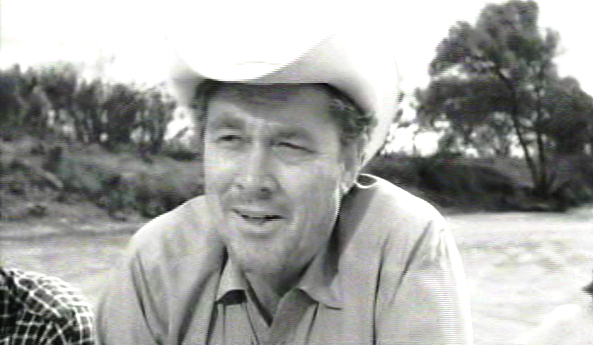 he'd win the Oscar for supporting actor and that's just what happened. There are so many moments in Johnson's performance that I'd love to pick, but so I don't go on forever, I'm concentrating on one, which also happens to be my favorite part of the film. Sam takes Sonny and Billy fishing at this reservoir on land he once owned and it opens him up about the past. He talks about this crazy girl he was involved with about 20 years ago after his wife had lost her mind and his sons had died and how they always came out there. She challenged him to ride horses across the water. He didn't think they'd make it, but somehow she did it. Sonny asks why he never married her, but Sam tells him she already was married — one of those young marriages people get into that makes them miserable. He figured some day it would end, but it never did. "If she was here I'd probably be just as crazy now as I was then in about five minutes. Ain't that ridiculous? Naw, it ain't really. 'Cause being crazy about a woman like her is always the right thing to do. Being an old decrepit bag of bones, that's what's ridiculous. Gettin' old," Sam declares. What makes the whole sequence and monologue even better is the way Bogdanovich films it. He starts out in a medium shot where you can see all three characters, but as the tale grows more romantic he slowly moves the camera in on Johnson's face. As he starts to tell how they never ended up together, the camera pulls back out again.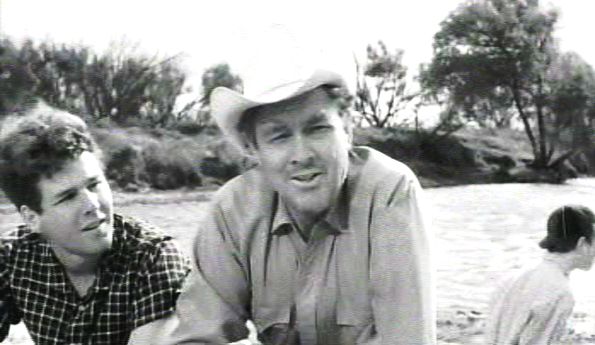

The Last Picture Show has so many great moments, big and small, that I want to talk about them all but I do have to mention one final Sam moment before wrapping up Lois and Ruth. Earlier in the film, before Duane beats him up (they reconcile anyway) Duane and Sonny drown separate sorrows in sundaes at the diner when Duane decides that he just wants to get out of town — that night — at least for the weekend. He suggests to
 Sonny that they go to Mexico. The two friends check their cash reserves and decide they can do it and get up and leave. Genevieve asks where they are going. "Mexico," they tell her. "Mexico?" As they drive the pickup down the street, they notice Sam sitting on the curb outside the theater. They tell him of their plans. He gives them some money, telling them that Mexico has a way of swallowing your money. Wistfully, he even says that if he were younger, he might go with them. There's something odd in the town — as if he has something else to say, but he just tells them he'll see them around and gives them a wave. Somehow though, even when you're watching The Last Picture Show for the first time, you know that will be the last time in the movie you'll see Sam. When Sonny and Duane come back, they go to the pool room and find it locked. They find that odd. They ask a man what's going on. He remembers that they've been gone so they don't know. Sam died. "Keeled over one of the snooker tables. Had a stroke," the man says. He adds the Sam left the diner to Genevieve, the theater to Miss Mosey and the pool hall to Sonny.
Back to that ride home from Oklahoma between Lois and Sonny. Before they get in the car, Lois tells him that he should have stayed with Ruth Popper. "Does everyone know about that?" he asks annoyed. She says yes. "I guess I treated her badly," Sonny admits. "Guess you did," Lois concurs. As she drives, Sonny says, "Nothin's really been right since Sam the Lion died." No, they really haven't, Lois agrees. Sonny guesses that she must have liked him a lot, but Lois says no, she loved him. Sonny mentions the story Sam told him about the girl and she's surprised. "He told you that? You know, I'm the one who started calling him Sam the Lion," Lois confesses as Sonny realizes that she was the girl that Sam talked about. She apologizes for getting slightly teary. "It's terrible to meet only one man in your life who knows what you're worth," Lois admits. "I guess if it wasn't for Sam, I'd have missed it, whatever it is. I'd have been one of them amity types that thinks that playin' bridge is about the best thing that life has to offer."
When Sonny gets back to town, he learns Duane, who has enlisted in the Army, is in town for a short visit. He asks if he wants to go with him to the Royal. Miss Mosey has to close the picture show. Duane agrees. The final movie is Howard Hawks' Red River. "No one wants to come to shows no more. Kid baseball in the summer, television all the time," Miss Mosey tells them. Imagine now. Out-of-sight prices, out-of-control crowds, declining quality of product, more at-home convenience, everything digital so there is in essence no difference between theaters and home. The next day, Duane boards a bus to his base to ship off for Korea. "I'll see you in a year or two if I don't get shot," he tells Sonny.
As Sonny works the pool hall, the scene mirrors the opening with the howling wind and blowing dust, only this time he hears a commotion. He runs outside and sees that a truck hauling cattle struck and killed Billy who, as usual was sweeping the middle of the street. A bunch of gawkers try to console the driver, explaining that the kid was "simple" and continuously asking why he had that broom. Sonny snaps. "He was sweeping you sons of bitches, he was sweeping!" he yells as he picks Billy's broken body up and lays it on the sidewalk.

Eventually, he works up the nerve to knock on Ruth's door and asks if he can have a cup of coffee with her. She apologizes for still being in her bathrobe this late in the day. Then, as she's starting to pour coffee, it's her turn to explode and she throws the cup and the coffee pot against the wall.
"What am I doing apologizing to you? Why am I always apologizing to you, you little bastard? Three months I've spent apologizing to you without you even being here. I haven't done anything wrong. Why can't I quit apologizing? You're the one ought to be sorry. I wouldn't still be in my bathrobe. I would've had my clothes on hours ago. It's because of you I quit caring if I got dressed or not. I guess because your friend got killed you want me to forget what you did and make it alright. I'm not sorry for you. You'd have left Billy too just like you left me. I bet you left him plenty of nights, whenever Jacy whistled. I wouldn't treat a dog that way. I guess I was so old and ugly it didn't matter how you treated me — you didn't love me."
Ruth sits down at the kitchen table across from Sonny. "You shouldn't have come here. I'm around that corner now. You've ruined it and it's lost completely. Just your needing me won't make it come back," Ruth tells him. He reaches out and takes her hand. She takes it and puts it to her face. He never says a word. The two of them just sit holding hands across the table.


Lots of people can quote the last lines of movies, but when you think about it, there aren't as many famous final ones as you would think. The Last Picture Show belongs in that exclusive company.
Tweet
Labels: 70s, B. Johnson, Bogdanovich, Burstyn, Cybill Shepherd, George C. Scott, Hackman, Hawks, Jeff Bridges, John Ford, Karloff, Liz, Lucas, Matthau, Movie Tributes, Oscars, R. Quaid, Sequels, Tracy, Wayne
TO READ ON, CLICK HERE


