Friday, October 21, 2011
I'm in Fourth Grade, Going on Fifth Grade...

By Josh R
In the fourth grade, we were required to write book reports — we’d have to read a book, summarize it and say what we liked or didn’t like about it. Not being a particularly literary type of child, I always used to wish that we could write book reports for movies; I was completely ignorant to the existence of film criticism, and consequently thought I had come up with an original idea (when you're 9, you tend to think everything is an original idea.)
I was thinking back on this as I watched a movie I’d seen many times before. I know how I’d review it now, as my more evolved, rapidly aging self — but how, I wondered, would I, as a 9 year old, have written a “movie report” on what I was seeing? To that end, I’ve attempted a simulation, trying to channel my fourth-grade self (which isn’t difficult, since emotionally I, like Guido Contini, am still 9 years old) to see what kinds of things I might have to say. It’s not an entirely successful experiment — I suspect my adult self has intruded to some degree — but I think the results actually are quite intriguing.
By Josh R
Ms. Folderman's fourth-grade class
P.S. #16
The Sound of Music is about a nun-in-training named Maria, who is British and can’t stop singing. She sings a song on a mountain about how much she loves music. A church bell lets Maria know that she is late for mass. She runs down the mountain. Meanwhile, back at the Abbey, The Mother Abbess talks to some other nuns about the fact that Maria is a problem. The nuns can’t decide whether Maria is adorable or the antichrist and they sing a song about it. When Maria returns, she explains to the Mother Abbess that her need to be constantly singing is a form of obsessive compulsive disorder which she is unable to control and begs to remain at the Abbey. The Mother Abbess is sympathetic, but explains that she is kicking Maria out anyway, whether she likes it or not. She is sending Maria to work for Captain Von Trapp, a widower who hates Nazis. Since Captain Von Trapp is also a Catholic, he does not believe in birth control, and has seven children. It is explained that the Captain’s wife has died of an overtaxed uterus and that Maria will be the children’s governess.
Maria sings about being nervous and then about not being nervous, because she is plucky and has a sunny disposition. She sings for hours and hours as she makes her way to the Von Trapp house. She is thrown off of a bus because she will not stop singing and has to walk the rest of the way. Once she gets there, she meets the Captain, who is handsome but mean. She meets the children, most of whom do not resemble each other at all, and exhibit signs of sociopathic behavior. The children are bent on destroying Maria. They give her bad advice, put a frog in her pocket to make her scared and later a pine cone on her chair in an attempt to cripple her. Maria uses Catholic guilt to make the children feel bad about themselves, and makes them all cry. Meanwhile, the oldest Von Trapp daughter, Leisl, is in love with a Nazi named Rolf, with whom she dances and makes out with in a gazebo.
Even though some of them are teenagers, all of the Von Trapp children are pathologically afraid of thunderstorms and run to Maria for comfort even though they mostly don’t like her yet. Maria invites all of the children, including an adolescent and prepubescent boy, to get into bed with her. She then sings about her favorite things and they all have a pillow fight. The Captain is not amused, and scolds Maria. Maria is upset and, as a form of revenge, resolves to embarrass the Captain by forcing his children to wear upholstery fabric in public. The Captain leaves for Vienna to see his girlfriend, and Maria makes the children clothes out of drapes. They have a field trip to Salzberg and ride in a horse drawn carriage, and then in a choo-choo train. The children grow to love Maria, and under her care, quickly acquire advanced musical theatre skills. Only the youngest is tone deaf.
The Captain returns to Salzberg with his friend Max, who is a music producer, and his girlfriend, Baroness Schrader, who has false eyelashes and is a bitch. When they arrive at the house, they cannot find Maria or the children, until they see them in a rowboat. Maria gets hyper at seeing the captain and the rowboat capsizes, but none of the children drown. The Captain is angry and scolds Maria for not obeying his instructions. Maria tells the Captain that he is a terrible father. The Captain fires Maria, but then hears his children singing and decides that he likes her after all and that he wants to be a good father. Maria and the children put on a puppet show called The Lonely Goatherd, in which peasants consume alcohol and people and farm animals copulate. Everyone considers it charming. Max thinks he can make recording stars out of the children, or possibly get them a sitcom, replacing Maria with Shirley Jones, but the deal falls through because he and the Captain cannot agree on a profit-sharing arrangement, or so it is implied. The Captain sings Edelweiss.
The Captain has a party because he wants his friends and neighbors to meet his new girlfriend. He and Maria dance to a classic Austrian folk dance, which is actually The Lonely Goatherd played at a slower tempo. Maria and The Captain stare longingly at each other. The children do a cuckoo clock routine for the party guests, in which the boys reveal themselves to be effeminate, and the youngest girl reveals herself still to be tone deaf. The Baroness tracks down Maria in her underwear, and tells her that she knows that Maria is in love with the Captain and that the Captain thinks he’s in love with her, but that he will get over it. Maria is ashamed, because she thinks that she is cheating on God. She sneaks out of the house to go back to the Abbey, and there is an intermission.
After the intermission, the children are depressed because the Baroness doesn’t sing and makes them play dodgeball instead of arranging and choreographing musical routines for them to do. They decide to visit Maria at the Abbey, but can’t get in to see her. The Mother Abbess asks Maria to confide in her. Maria reveals that she has feelings for The Captain, but thinks that they are wrong and wants to be made a full-on nun right away to try and deny her urges, just as if she were a priest. The Mother Abbess sings an inspirational song, in which she encourages Maria not to be afraid of sex. She tells Maria that if it’s a choice between being a bride of Christ and hooking up with the handsome rich guy, God will understand if she goes with the handsome rich guy. Maria decides to go secular.
The children are happy that Maria is back and Maria is happy too, until she learns that The Captain is engaged to The Baroness. She tells The Captain she will stay until arrangements can be made for a new governess. The Captain decides he would rather be with Maria, who is a younger than the Baroness, has her own eyelashes, and is not a bitch. Also, he is in love with her. He and Maria confess their love for each other and they make out in a gazebo, which is the main function of the gazebo for all members of the Von Trapp family. He asks Maria if there is anyone he should ask for her hand in marriage. Maria responds that they should ask the children. We never learn whether or not all of the children said yes, or if consent was obtained by majority rule with some dissenting votes cast.
Maria and the Captain get married and go on their honeymoon. While they are away, Hitler takes over Austria. The Captain doesn’t want to be a Nazi, so he and Maria decide to move to Switzerland, which is neutral and has good chocolate. The Nazis don’t want The Captain to leave and try to stop him. Fortunately, Max has arranged for the family to perform in an outdoor concert. The Von Trapps distract the Nazis with their singing and cuteness and escape to the Abbey. While hiding in an outdoor graveyard, they are discovered by Rolf, who hesitates to turn them in because he feels conflicted. The Captain invites Rolf to become a part of their family and go to Switzerland with them. Faced with the prospect of being integrated into the cuckoo clock routine, Rolf decides he would rather remain a Nazi. He blows his whistle to alert the stormtroopers to their presence, and the Von Trapps run away. Because their cars have been vandalized by nuns, the Nazis are unable to pursue the Von Trapps, who have to cross the Alps on foot in order to get to Switzerland. It is described as a long and perilous journey and since the family has brought no visible provisions with them, it is implied that Maria and The Captain may have to eat one or more of the children in order to survive.
I liked The Sound of Music because it has good story and good songs and everything about it was really entertaining. I liked it when Maria taught the children how to sing Do Re Mi, and also the part where she and the Captain danced, and then the puppets were really cool as well. It reminded me of another show I saw called Next to Normal, which also is about a family, and in which people sing too. But it’s not just because of the families and the singing that these two shows are alike. As in Next to Normal, The Sound of Music also examines the manner in which the mental imbalance and compulsive behaviors of one family member (in both cases, the maternal figure) can upset routine, distort a family’s perception of reality, and infect all its members, drawing them into her dysfunction to a point where “normality” ceases to exist within the structure of a family’s daily life. The Von Trapp children are well-adjusted when we first meet them, leading an existence characterized by discipline and order. Once Maria has exerted her influence over them, the children, and eventually even the father, come to share in her disorder, and assume her compulsive tendencies — they just can’t stop singing and they actually come to think that their singing-and-dancing cuckoo clock routine is endearing and fun as opposed to just creepy and wrong. It is the harrowing disconnect between perception and reality which reveals the dark undercurrents of depravity and despair lurking just beneath the surface of what is purportedly intended as wholesome family entertainment about a chipper nun working in child care, examining how easily interdependence and enabling can breed dysfunction and madness. So I liked it because of its psychological underpinnings, and also because the music was really good, and the puppets were cool. Maria is played by Julie Andrews, who has a really good voice and looks kind of like Mary Poppins. I would recommend this movie to people who like singing and musicals and also to those who have a family member who suffers from an extreme form of mental illness.
Tweet
Labels: 60s, Julie Andrews, Musicals, Theater
TO READ ON, CLICK HERE


Friday, July 01, 2011
We gave them virtue, they want vice

there lived a very successful motion picture producer named Felix Farmer.
He owned three beautiful houses, he had two lovely children and he was married to a gorgeous movie star. The people who ran the studio where he worked loved and admired him because he had never made
a movie that had lost money. Then one day he produced the biggest most expensive motion picture
of his career…and it flopped. The people who ran the studio were very angry at Felix
because they lost millions of dollars…
and Felix lost his mind.
By Edward Copeland
We see that title crawl after brief credits run while Julie Andrews as actress Sally Miles plays Gillian West in her producer husband Felix Farmer's multimillion extravaganza Night Wind. That photo above doesn't do justice to how garish that set is as Sally as Gillian cavorts with life-size toys dancing and singing "Polly Wolly Doodle" (There are even singing balloons and a Jack in the Box). It has to be seen. Click here. You can believe from that scene alone that Night Wind truly stinks as much as they say it does, though how they could calculate on its opening weekend that it's "the lowest-grossing film of all time," seems a bit suspect. I would imagine films that never open would have lower grosses. Maybe the biggest money loser in relation to cost? Oh, who cares? We're not here to be serious or particularly realistic. We're here to pay tribute to the 30th anniversary of writer-director Blake Edwards' mad spoof of the movie business. Blessed with an unbelievably large and talented cast, S.O.B. isn't as sophisticated as Robert Altman's The Player would be a little more than a decade later and its satire isn't as sharp as Sidney Lumet's film of Paddy Chayefsky's take on the television industry was in Network a mere five years earlier, but it was and remains damn funny.

That crawl scrolls against the blue sky over Malibu beach where a man (Stiffe Tanney) jogs with his dog (Troubles). He suddenly suffers a heart attack and though he manages to crawl toward the deck of a large beachhouse and the dog barks up a storm, no one notices his emergency and he collapses. It sets the tone for an underlying theme that afflicts most of the film's characters: obliviousness, mostly stemming from self-absorption. As a result, a man drops dead on a beach with his dog barking loudly even though people keep coming and going on the deck a few feet above where a catatonic Felix Farmer (Richard Mulligan) sits among the trades reporting Night Wind's failure.
 (A smaller headline in Variety reads N.Y. Critics Break 'Wind' — Edwards' humor doesn't always aim for the highbrow. Though from the descriptive crawl, you'd think that Felix is the film's main character. While S.O.B., which does not stand for what you think it does, revolves around him and his movie, the film truly stands as an ensemble piece. No character really serves as lead even though Andrews and William Holden as the film's director Tim Culley get top billing, all the other significant characters are listed alphabetically. In fact, Felix remains in his non-speaking state of depressed madness for a long time. When he does snap out of it and taks 44 minutes into the film, Mulligan at first does it in a way very reminiscent of reactions his character of Burt Campbell on television's Soap sometimes did.
While S.O.B. retains its power to make me laugh decades after I first saw the movie, I have to admit that re-watching it for the first time in a long time, I found more problems than before, but not as an entertainment rather in how it chooses to take its shots at the always worthy target of movie studios. I first saw S.O.B. on cable when I was a teenager but as I've grown up, not only have my tastes grown more refined, so has my knowledge of how the film industry works. S.O.B. works on many comic levels, but this time the ludicrous nature of its story took me out of the movie at times. The crawl set up the basic premise, but it's more complicated than that. Even though Night Wind has opened to terrible reviews and
 worse box office, Capitol Studios President David Blackman (Robert Vaughn) desperately tries to get his top executive Dick Benson (Larry Hagman, taking the relatively minor role when he was white hot as J.R. on Dallas, having just finished the season that resolved "Who Shot J.R.?") to talk to Felix so they can jerk the film out of theaters and do a major editing job on it which they can't do because of Farmer's ironclad contract that only allows him to make changes. Sure, there was a re-edited version of Leone's Once Upon a Time in America a few years later, but that wasn't a wide release. Blackman himself has been getting pressure from the chairman of the corporation that owns Capitol Studios, Harry Sandler, played by longtime dependable Hollywood character actor Paul Stewart whose first credited film role was the butler Raymond in Citizen Kane. Now, the studio and everyone involved in Night Wind had to know it was a turkey before it opened, so why didn't they try to get him to re-edit it before it opened? You can't tell me they didn't hold test screenings. He might have had a contract that stopped anyone else from making changes, but I doubt it required Capitol Studios to give it a wide release.
While that part of the movie doesn't pass the credibility test, even for a farce, other aspects do. Sally and her team worry about damage to her career and Sally would like to exit the marriage. She gets conflicting advice from her attorney Herb (Robert Loggia), her press agent Ben Coogan (Robert Webber) and her agent Eva Brown (Shelley
 Winters). While Loggia wants to help extricate her from the marriage, the agents advise against it. Eva in particular reminds her client that her image couldn't withstand a divorce or even a separation, especially now. "You know this town, sweetie. You can smoke dope and end up going steady with your Afghan and you're one of the gang, but you — you're Peter Pan," Eva tells her. Winters is a riot as is just about everyone in this sparkling cast and the cast makes the film overcome its weaknesses. There also are many hints of autobiography and inside jokes sprinkled throughout. Andrews never really played Peter Pan, but she did have that Mary Poppins/Maria von Trapp image. In real life, Edwards did cope with serious depression and supposedly studio interference on Darling Lili inspired S.O.B. Ironically, Hagman's mother Mary Martin originated the roles of both Peter Pan and Maria von Trapp when the characters made their stage musical debuts.
The studio finally dispatches his good friend and the film's director Culley (Holden) to the beachhouse to keep watch on him and see if he can pull Farmer back to the real world. Culley is a hard-drinking womanizer. Culley, always on the lookout for young women to decorate his surroundings, picks up
 two hitchhikers on the way, Lila and Babs (Jennifer Edwards, Blake's daughter; and Rosanna Arquette in a very early role). At Farmer's house, the servants and the man who mows the yard are so oblivious to what goes on around them that they don't notice when Felix heads to the garage, starts the Cadillac and closes the garage door again. The gardener (Bert Rosario) doesn't get an inkling until he finds a dead rat. When the gardener puts the mower up, he smells the carbon monoxide and sees Felix's red eyes staring at him through the car's rear window. "Not such a good idea to sit in here with the motor running," he tells Felix as he reaches inside to try to cut the engine. Instead, he shifts it into drive and the Caddy crashes through the back of the garage, down the beach and into the ocean, just in time for Culley, Lila and Babs to stare in disbelief.
Felix's attempt at suicide introduces us to the greatest asset that S.O.B. has — Robert Preston as physician to the stars, Dr. Irving Finegarten. Blake Edwards wrote Preston the part of Toddy for his next film, Victor/Victoria, and earned Preston his only Oscar nomination, but as great as he is there, I think his Irving Finegarten is even better. Once he joins the film, he enlivens every scene he's in. When Robert Webber's character Ben, though he works for Sally, starts feeling guilty and spends most of his time hanging out with Irving and Culley, a comic troika for the ages forms. Irving mildly sedates Felix and they sit around the bar. Ben has turned into a wreck. Irving suggests giving Ben a vitamin shot. As he removes bottle after bottle from his medical bag, Dr. Finegarten has second thoughts. "Come to think of it, why should I give you a vitamin shot? I'm the one with the hangover," Irving declares.
Before I forget, when Felix's car ended up in the ocean, it did attract police interest and they did discover the poor dead man and, after subduing the dog, retrieved the corpse who was identified as veteran character actor Burgess Webster. The dog escaped and continued to hang out on the beach. Irving didn't give Felix that strong a dose apparently because he wanders downstairs and that obliviousness theme continues as Ben follows him, trying to talk, not noticing as Felix sticks his head in the oven or scrounges successfully for rope and returns upstairs. Ben soon panics with the arrival of gossip columnist Polly Reed (Loretta Swit) at the front door. Everyone tries to ignore her, but then they can hear she's sneaking in the back. Irving whispers, "This reminds me of a scene in The Thing when a terrible monster is just on the other side of a door" which only sets Ben off more. Polly comes in cooing for Felix while he's upstairs trying to hang himself. The beam doen't hold and he crashes through the floor, landing on Polly below. She ends up in the hospital in traction with multiple injuries. Irving gives him a stronger dose this time and Culley sits beside him and gives him a speech that seems especially prophetic, knowing what fate awaits Holden so soon after the film's release. It's spooky, since we know that a little more than four months later, Holden would get drunk alone at home, fall, hit his head on the corner of a nightstand and bleed to death. This was his last film.
"Felix, for the last 40 years I've lived a life of dedicated debauchery. I've consumed enough booze to destroy a dozen healthy livers. I've filled my lungs with enough nicotine to poison the entire population of Orange County. I've engaged in sexual excesses that make Caligula look like a celibate monk. I have, in fact, conscientiously, day in and day out, for more years than you've been in this best of all possible worlds, tried to kill myself and I've never felt better in my life. So, if you're really going to end it all, I can show you at least a half-dozen better ways to do it."
This being Hollywood, everyone is sleeping with everyone else and cheating as one might expect. David Blackman's girlfriend Mavis (Marisa Berenson) also is seeing an up-and-coming young actor Sam Marshall (David Young) on the side. When Culley takes Lila to the store, they run into Sam who invites Culley to a party he's having in Malibu that night. Culley regretfully declines, but hits upon the idea that perhaps a party will lift Felix's spirits so Sam agrees to move the party there. It's really the key scene in the movie with most of the film's character's there. It reminds me of Blake Edwards' 1968 film The Party with Peter Sellers, which I never was that big a fan of, but it has that sort of feel with the wacky orgiastic vibe that occurs — only he could do a lot more in a R-rated 1981 film than a pre-rating system 1968 one. Lots of sex, drugs and punchlines a-plenty. Even the cops who came earlier when Felix's car ended up in the ocean, come back for the party (and one of them is Joe Penny, whom some might remember from TV's Riptide).
Also showing up at the party are studio exec Dick Benson (Hagman), Polly Reed's henpecked husband Willard (Craig Stevens), who is supposed to do the spying for his wife, and loads of hot young men and women eager to engage in scenes that would seem more at home in the "free love" era than the
 beginning of the 1980s. Felix eventually awakens from Dr. Finegarten's magic medicine and as he walks, he's too out of it to remember that there's a hole in the bedroom floor that has been covered with a rug and he steps on it and glides rather easily to the party below. He does notice that one of the partying cops took off his holster and left his gun on the bar. Felix takes the gun and returns to the refuge beneath the rug, trying to point feel the barrel so while he's covered and he can shoot himself through the rug. Before he can, a topless young woman crawls under the rug and presumably
 a different gun goes off because soon Felix has fired the gun in the air a couple of times until he appears, pants down in that Burt-esque moment I alluded to earlier shouting, "Woohoo. I've got it!" The next thing we know, Felix, who hasn't said a word and who we've only seen as slow-moving, glum and silent has transformed into a ball of energy. He bursts into a bedroom where Culley is enjoying the company of a young lady and bellows, "Sex, Culley! That's the answer. We'll give 'em a $40 million pornographic epic." Having been preoccupied at the time and not accustomed to seeing Felix up and around lately, Culley expresses a bit of understandable confusion. Felix explains that the times have passed them by. People don't want the goody-goody stuff they've fed them for years, so they'll re-shoot it. Gillian West's dream will no longer be of childhood good times but of repressed fantasies. The world wants sex.
 David Blackman, Dick Benson (wearing a cast from an injury he sustained at the party; it's a recurring gag that almost everyone ends up in a cast — Polly's husband Willard got hurt as well and ends up in the same hospital room), and two other execs (John Pleshette, John Lawlor) wait impatiently for Farmer. They begin to
 think it's a put-on until they begin to hear his voice over the speakers singing "Polly Wolly Doodle" and describing the Night Wind that they know — "But we blew it!" Felix shouts through a megaphone as he appears from behind the Jack in the Box. "Because dying fathers and lying mothers are a dime a dozen these days. Home and family have become civilization's antiques along with the flag, Sunday school, Girl Scout cookies, C.B. de Mille and virginity," Felix tells them. "We gave them virtue, they want vice. We sold them schmaltz, they prefer sadomasochism. Instead of the American dream, it should have been the American wet dream." What's funny is that, to some extent, the situation has reversed in 30 years. Movies made for adults — and I don't mean porn, but subject matter — almost have become an endangered species. Films that earn an R because they aren't for the younger set seem to be a rare breed. Live Free or Die Hard mumbled Bruce
 Willis' signature line as John McClane so it could get that all-important PG-13. The King's Speech never deserved an R for its single scene where Colin Firth unleashes a string of fucks, but when it started winning awards Harvey Weinstein cut that scene just to get a PG-13 so it would earn more money. Excuse me. Back to S.O.B. Felix explains his plan to re-shoot parts of Night Wind to change it from a woman's dream of childhood to her Freudian nightmare. Turn Gillian West into a nymphomaniac businesswoman. He just needs a few million for a re-shoot. Blackman doesn't seem to be listening, but he does pull out his pages for suggestions they have for cuts that can be made to the current version. "Cutting won't help," Felix teases. Blackman yells about how much he went overbudget and Farmer rightfully goes back at him saying he didn't go to his office and hold a gun to his head and demand more money. They approved the script and the budget. Blackman is firm and is ready to walk out — until Felix offers to buy Night Wind back. The execs whisper and then they agree to sell the movie back to Farmer.
 Apparently, Felix has been very good with his money, though he still has to do some asset shuffling to get the funds ready to shoot. Felix must fend off someone who isn't very happy with him right now: His wife. Several million dollars of that money that Felix put together to fund the Night Wind re-shoot rightfully belongs to Sally. Felix tries to explain his plan to her, including having her do a nude scene. "Peter Pan is dead. Long live Gillian West, nymphomaniac executive," he tells her. Sally seeks the advice of her attorney Herb and her agent Eva. Herb agrees that she has plenty of grounds to sue to try to get her money back but Eva, who admits she's always there to protect Sally's image, has to ask, "What if Felix is right?" Maybe it's not a bad idea for Sally to take the chance and go against her image and possibly get a lot of money out of the deal. If it doesn't work, she always can sue him for everything later. Sally reluctantly agrees that she'll film the revised Night Wind.
Of course, getting Sally to that point is easier said than done, even if she has agreed to do it. She's too nervous. Everyone wants to be there on the set to see what happens that day. Polly Reed makes them take her by ambulance but a guard that Felix has hired named Harold Harrigan (Ken Swofford) refuses to let her in. Blackman and his toadies show up in a golf cart and Harrigan tells them to shove off as well. Blackman tells
 Harrigan he won't work in Hollywood again. Felix may have control of the set, but it does reside on Capitol Studio's lot, so Blackman does succeed in having Harrigan tossed off. When Ben hears that Polly lurks, he lets her in and the two ambulance attendants are forced to hold her upright to watch. In her dressing room, nothing Felix, Culley or anyone can say can convince her to do the scene. Thankfully, Dr. Irving and his bag of tricks are on the scene (play clip above) to help and an artificially high Sally is ready to film the scene. Culley escorts her back to the set. "You know you are sexually notorious," Sally tells Culley. "A semi-fraudulent reputation which I do everything I can to encourage," Culley admits. Sally asks why he does that. "Because it's the best way for an old man to compete in a young man's world," Cully replies. Polly waves at Sally, trying to get her attention. Sally finally recognizes her, then asks, "Did you come to see my boobies?"
When S.O.B. opened, reviews varied, but it was hard to hear them above the noise about Julie Andrews baring her breasts in a film for the first time. That trumped everything else about the movie. It doesn't help that the way it happens in the movie-within-the-movie makes it all about Sally Miles baring her breasts. It's not as if it comes in a Gillian West love scene, nymphomaniac or not, but it just comes at the end of a new dark dream sequence (Jack in the Box is now Jock in the Box and a stalker). As Jock chases Gillian through a maze and she enters the devil's mouth, the music builds to a crescendo, she holds out her hand for Jock to stop and simply pulls down the front of her dress and unveils her breasts. (To see something completely bizarre, here is a YouTube clip where you can see a great deal of the sequence except it has been set to the Chris de Burgh song "Lady in Red." I recommend hitting mute and just looking at the images.) Everyone present applauds, including the ambulance attendants who drop Polly as a result. Sally smiles gratefully and covers herself, before collapsing. However, this is Hollywood and scheming usually is going on. Sally's personal secretary Gary (Stuart Margolin) never has been trustworthy but he's been talking to Eva behind Sally's back in hopes of getting a career of his own. Now that Capitol Studios has no part of Night Wind, all the buzz that has been building has made the corporate boss bug Blackman about why they don't have a piece of it in case it turns into a hit. As a result, the studio has been using Eva who has been dangling a job in front of Gary in exchange for him putting the idea in Sally's head that since she technically owns half the film, she should sell distribution rights to Capitol since Felix can't very well distribute it himself. Sally agrees to do it and a judge backs up her right to do it. Felix, however, doesn't learn of it until after he screens a final cut of it with Cully and the lights come up in the screening room to reveal Blackman and his toadies. Blackman shows him the legal documents which basically means Night Wind has been stolen from him. Since his original contract was voided, they can do what they want. Blackman asks what the running time is. When he's told 164 minutes, he says they'll have to cut that.

Felix drives like a maniac, first going to his other house looking for Sally, but she's gone somewhere in the Far East to visit some kind of swami. He does see his kids briefly who want to play with daddy and squirt him with a squirt gun, which he takes. He even plows a car through the kitchen of the Malibu home. Because he's been speeding and driving recklessly, police have been pursuing him, but somehow he's able to switch cars and escape. He drives to the office where the original negative is stored in a vault. When he gets in the building, a friendly voice surprises him: It's Harrigan. He's working security there now. Felix is too preoccupied for small talk. He goes to the office of a Mr. Lipschitz (Hamilton Camp) and makes him take him to the film at "gunpoint." As Felix leads Lipschitz and the reels to the lobby, the squirt gun aimed at Lipschitz's head, Harrigan tries to calm him since by then a lot of armed police have arrived. Some distraction makes Felix aim the gun toward the cops and he gets hit by a fusillade of bullets. Harrigan leans over the dying producer. "I'm sorry, Mr. Farmer," Harrigan says. "It's alright, Harrigan. It'll mean another $10 million at the box office," Farmer tells him before he dies.

At this point, the film divides half into Hollywood hypocrisy, half into the funniest part of the film as the three characters most disgusted by Felix's treatment band together on a bender: Culley, Irving and Ben. It begins at a bar where Sinatra's "All the Way" begins playing and Culley informs them that he just put $6 of Sinatra into the jukebox. Ben, having worked for Sally, who they feel stabbed Felix in the back, feels the worst and tries to convince Culley to beat the shit out of him in the hope it will make him feel better. It's in this scene that we learn that the S.O.B. of the title stands for Standard Operational Bullshit, according to Ben. Culley agrees, lamenting that there are "so few people in this town with a conscience." Meanwhile, the rest of the industry plans a huge memorial service where Sally plans to sing and they all will pretend they treated him decently. The drunken trio, who christen themselves The Three Muscatels at one point, all agree they won't take part in the sham, which will be presided over by the guru Sally met in the Far East (Larry Storch). Sall also will sing. The triumvirate decides that they are going to give Felix the memorial he deserves and set out to steal Felix's body from the funeral home. Apparently, this is based on a Hollywood legend that director Raoul Walsh stole John Barrymore's corpse after he died and propped him up to scare Errol Flynn, but what the fictional characters do with Felix is a bit more elaborate.
When they get to the funeral home, the first coffin they check is no one they know. The next contains the late character actor Burgess Webster. The third time turns out to be the charm and they find Felix. Feeling that Webster's death hasn't received the attention it deserved, when they remove Felix, they put Webster in
 his coffin and the other guy in Webster's. Upstairs, the couple (Byron Kane, Virginia Gregg) that owns the funeral parlor salivate over how much business the Farmer funeral will bring them when they hear a noise downstairs. They find the empty coffin but locate the body in Webster's place and Webster in Farmer's. The husband is beside himself: Their cash cow is gone. His wife slams the lid on Farmer's coffin, now holding Webster. "Who's to know?" On the streets, after initial difficulty bending Felix into the car, they make Ben sit in the back with him because he's been having a bad night of bodily functions and as Irving points out Felix is the only one who won't mind. They stick some sunglasses on Felix and proceed to drive him back to Culley's where they drink and play cards with Felix as guest. It was funny for a time when I'd see the movie because from the years 1989-2000, the only actor in these scenes who was still alive was Richard Mulligan, who was playing the corpse. As they wonder what they should do with Felix, Culley fetches something from another room and places it on Felix's head. It's a Viking helmet for a Viking funeral.
The next morning, the men take Felix out to sea on his boat to prepare for their salute. At the same time, the rest of the industry begins gathering on a soundstage at the Capitol Studio lot for Felix's funeral. The
 occasion doesn't stop anyone from continuing their deals or their affairs. Blackman congratulates Sam Harris on his new role and whispers to Mavis that he better be worth it, not noticing that Sam's hand is up Mavis' skirt. Gary and Eva finalize their deal. All the people with various injuries wheel in. Sally tells Gary that she doesn't know if she'll be able to sing. "You have to — it's the only reason everybody came," Gary says. Her guru sits up on the stage looking as if he can barely stay awake. Finally, he's roused and stands to give his eulogy. Is it full of Eastern philosophy? Not hardly. It's as show bizzy as it can be. This is where some of the unreality takes over again. Felix was shot and killed before the film was released and still in the funeral home, yet the guru gives new box office reports on the revised Night Wind. Farmer also was supposed to have had a record of nothing but hits prior to the first version of Night Wind, but when the guru reads off the list of his film titles they all sound ridiculous. Here is a clip of the eulogy so you can see what I mean.

As Culley drives the boat, Irving and Ben sit on deck with Felix in the fisherman's seat, complete with rod and reel in hand. Ben wonders what happens if he should catch something. Back at the other memorial, Sally finally rises and sings "Oh Promise Me." Irving reads the inscription on the Viking helmet which reads "From the cast and crew of The Pagan Plunder." "I don't think I saw that one," Irving says. "Terrible reviews," Ben tells him. "Grossed a fortune." Once Culley feels they've gone far enough out, they load Felix into a little wooden craft, cover him in blankets, soak it with gasoline and then Irving lights a match and drops it and Culley pulls the boat away as it starts burning. "So long pal," Culley says as they watch Felix and the little boat burn. Back on the beach, Burgess Webster's dog can see the smoke and wags his tail. Then a final crawl scrolls across the screen.


in motion picture history and Sally won another Academy Award and the people who ran the studio made
a ton of money and they all lived happily ever after…
until the next movie!
S.O.B. isn't the finest Hollywood satire ever made, but it's likely to put a smile on your face thanks to its great cast, most especially Robert Preston who I really can't say enough about here.
Tweet
Labels: 80s, Altman, Blake Edwards, Chayefsky, Colin Firth, Erroll Flynn, H. Weinstein, Holden, Julie Andrews, K. Douglas, Leone, Lumet, Movie Tributes, R. Preston, Richard Mulligan, Shelley Winters, Sinatra, Walsh, Willis
TO READ ON, CLICK HERE
Thursday, December 16, 2010
Blake Edwards (1922-2010)

Blake Edwards' reputation as a film director seems locked by some in the realm of lowbrow slapstick comedy and, in many cases, not particularly good ones, but Edwards' work as a director and a writer was more multifaceted than that. Born in Tulsa, Okla., in 1922, Edwards died this morning at 88.
True, at his heart he was a clown. A few years ago when the Academy of Motion Pictures Arts and Sciences finally saw fit to bestow an honorary Oscar upon Edwards, he used his acceptance speech as an occasion for a gag, abetted by presenter Jim Carrey, showing up in a wheelchair with a broken leg and making it appear as if it went out of control and crashed through the wall of part of the awards show set. Like many recent honorary Oscar presentations, it was a highlight until the youth hungry, ratings-obsessed execs in charge segregated honorary awards to a nontelevised dinner where movie buffs couldn't celebrate significant players in film history such as Edwards anymore.
His work in the film industry began as a screenwriter in the late '40s with his most notable work probably being the screenplay for 1955's My Sister Eileen starring Janet Leigh and Jack Lemmon. In this same period he also did a lot of television work, including creating several shows in the late 1950s, the most famous being Peter Gunn starring Craig Stevens and Richard Diamond, Private Detective starring David Janssen and the legs of one Mary Tyler Moore.
His feature directing debut came in 1955 on the musical Bring Your Smile Along. He directed a few more films but the one that was his first standout was 1959's Operation Petticoat starring Cary Grant and Tony Curtis.
In 1961, he helmed the adaptation of Truman Capote's Breakfast at Tiffany's starring Audrey Hepburn. The following year, he made two films that no one could accuse of being slapstick: Experiment in Terror with Glenn Ford and Days of Wine and Roses with Jack Lemmon and Lee Remick battling alcoholism.
Though it opened in 1963 elsewhere, the film that would launch his most famous film series didn't open in the U.S. until 1964: Peter Sellers as Inspector Clouseau in The Pink Panther. The first followup, A Shot in the Dark, came out the very same year. Edwards became so attached to the series that he kept it going for decades, even after Sellers had died.
Other notable films of the 1960s included The Great Race, What Did You Do in the War, Daddy? and The Party.
In 1970, he directed the woman he wed in 1969, Julie Andrews, for the first time in Darling Lili. He tried a Western in 1971 with William Holden in Wild Rovers. He directed the adaptation of the Michael Crichton thriller The Carey Treatment in 1972. In 1974, he directed Omar Sharif and his wife in a romantic drama called The Tamarind Seed.
It wasn't until 1979 that he got out of a Pink Panther rut and introduced the world to Bo Derek in the Dudley Moore comedy 10, which also managed to make composer Ravel's piece "Bolero" popular again.
He followed that up with the wicked Hollywood satire S.O.B. with an all-star cast led by William Holden and including Julie Andrews' first topless scene.
In 1982, he made his last really big hit with Victor/Victoria, earning Andrews an Oscar nomination as best actress. More than a decade later, he tried his hand at turning it into a Broadway musical with terrible results.
Most of his films after that were not worth mentioning, though Micki & Maude with Dudley Moore as a bigamist had its moments and you have to mention Skin Deep since it is the only film with a glow-in-the-dark condom chase scene.
Still, Edwards' resume was far more eclectic than you'd think and he did produce some classics. His only competitive Oscar nomination came for writing the adapted screenplay for Victor/Victoria. He received two Emmy nominations for Peter Gunn, for writing and directing the same episode. He also earned a Directors Guild nomination for Breakfast at Tiffany's.
RIP Mr. Edwards.
Tweet
Labels: A. Hepburn, Blake Edwards, Capote, Cary, Glenn Ford, Holden, Julie Andrews, Lemmon, Musicals, Obituary, Oscars, Sellers, Television, Theater, Tony Curtis
TO READ ON, CLICK HERE
Wednesday, October 27, 2010
NY Theater Flashbacks: 95-96 Season
By Edward Copeland
As I mentioned in the second installment of this series, while the previous installments covered years, the future ones would cover seasons as my obsession grew and I saw more shows. While my last installment wrapped up in the summer of 1995, this one picks up in October of the same year but in a few months, I'd move from Oklahoma to Florida, making travel to New York easier and more frequent. On the plus side, while what I'd seen in 1995 so far had been a disappointment, the rest of the season turned out to have some of the best productions I would ever see on Broadway, though some dogs remained as well. One unusual thing though: The further ahead in time I go, the harder I'm finding it to locate art or clips to go with my words.
COMPANY
As I wrote in my piece earlier this year marking the 40th anniversary of Stephen Sondheim's landmark show, as with many of his works, the score always proves stronger than the book.
Still, the talented cast of Roundabout Theatre's revival of the show (the first since its original production) gave it their all. Led by Boyd Gaines in the lead role of Bobby, the cast included Debra Monk, La Chanze, Jane Krakowski and, exciting for a Soap fanatic such as myself, Diana Canova — Corinne Tate Flotsky herself.
Veanne Cox got the assignment of doing the frenzied mouthful of "Getting Married Today" and earned a Tony nomination for it, one of the few the revival received. Even as much of a Sondheim worshipper as I am, I found that understandable. Something seemed stillborn about the show. For every great moment — as when La Chanze belted "Another Hundred People" — the musical seemed to stop in its tracks in the silly skits, even when songs surrounded them. Still, it's hard to call it a loss of an afternoon when you get well-sung renditions of "Being Alive," "The Ladies Who Lunch," "The Little Things You Do" and "You Could Drive a Person Crazy."
MASTER CLASS


Much as Sondheim's score propped up the weak book beneath Company, the performances, particularly the powerhouse lead, saved Terrence's McNally's lackluster Master Class. Zoe Caldwell won a well-deserved fourth Tony for her starring role as Maria Callas in McNally's play which showed the grand dame of opera running roughshod over three students who had earned the chance to be taught by the great one, one of whom was played by an equally good Audra McDonald who picked up her second Tony on her way to four total (so far). Interspersed with the class sequences are Callas' recollections of various events and loves throughout her life which might play as nothing more than filler in the rather short play if they were placed in hands less capable than Caldwell's, but she makes them work and helped McNally win his 2nd consecutive Tony for best play following the previous season's Love! Valour! Compassion!, even though Master Class was far from the best in its category but we'll get to my choice later.
VICTOR/VICTORIA
After enduring what had been done when Andrew Lloyd Webber musicalized one of my favorite films of all time, Sunset Blvd., I started to question whether it was a good idea to turn any movies into musicals since more times than not the results turn out badly. You would think though that taking Victor/Victoria to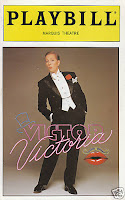 the stage, which was essentially a movie musical to begin with, with the same star, albeit 14 years older than when she originally played the part, and the film's director guiding the production, despite the fact he'd never directed a musical for the stage before, what could possibly go wrong? As it turns out, pretty much everything. First of all, the film's composer, Henry Mancini, died early in the process, so the new songs needed to flesh out the show were composed by theatrical wunderhack Frank Wildhorn, a man I'm thoroughly convinced was invented for the sole purpose of improving Lloyd Webber's own reputation. The YouTube clip above of "Louie Says" is an example of one of Wildhorn's contributions with terrible reaches for rhymes by Leslie Bricusse to the show. I won't feel bad if you don't make it through the whole clip. On top of that, those 14 years did make a bit of a difference for Julie Andrews, who tried her best. The comic timing was terrible. As luck would have it during the show, a man came out of the side exit near my seat in the Marquis Theatre. It was Blake Edwards. It was all I could do to keep myself from getting out of my chair and taking Edwards aside and trying to advise him on some ways to improve the show. The cast tried their best but I didn't even get to see the performer who got the best reviews, Rachel York: She was out the day I went. It remains the worst musical I ever sat through on Broadway.
A FUNNY THING HAPPENED ON THE WAY TO THE FORUM
Now, a much better revival of a classic Sondheim, his first (staged on Broadway anyway) for which he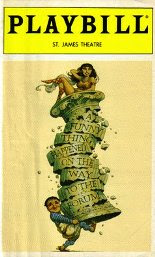 composed both the music and the lyrics. Furthermore, it was a great comic farce with a book by Larry Gelbart and Burt Shevelove. Inspired by the farces of the ancient Roman playwright Plautus, it has proved a Tony success for every actor who took on its lead role as the scheming slave Pseudolus, first for Zero Mostel in the original, then for Phil Silvers in a revival in the 1972 and this time out for Nathan Lane.
Directed by the old pro Jerry Zaks, it's a joy from start to finish with a cast of top-notch musical comedy talents such as Mark Linn-Baker, Mary Testa, Ernie Sabella, Lewis J. Stadlen, William Duell and Cris Groenedall. Unfortunately, the night I saw it, Stadlen, who received a Tony nomination as Senex, wss out but MacIntyre Dixon did a more than adequate job. When I was in grade school, we often visited my grandma during summer and would attend Starlight Musicals in Indianapolis, an outdoor summer stock, and it was there that I first saw Forum and fell in love with it. Being a young autograph hound, I got autographs of the entire cast afterward which included Arte Johnson, Avery Schreiber, Hans Conried and John Carradine. Sadly, Johnson is the only one of the four who still is with us. One word of warning: The clip of "Comedy Tonight" above was filmed very poorly, but the infectious spirit of the song and the production remains.
INHERIT THE WIND

As I mentioned when I marked the 50th anniversary of Stanley Kramer's film version of Inherit the Wind earlier this year, I'm just a sucker for this play in whatever form it takes. So, when Tony Randall's Nationalh!3w~~_12.jpg) Actors Theatre announced it would be staging a revival of Jerome Lawrence and Robert E. Lee's fictionalized take on the Scopes monkey trial with George C. Scott as Henry Drummond and Charles Durning as Matthew Brady, I was as good as there. Needless to say, I was not disappointed as its lines and messages got to me as they always do. If it had a problem, it was Scott. Not because his acting was weak: He was phenomenal. This was toward the end of his life and his ailing nature showed. In fact, he had to leave the play in the middle of one performance because he felt faint. As my dear and much missed friend Jennifer said at the time, Brady is supposed to be the one who seems to be in frail health.
Actors Theatre announced it would be staging a revival of Jerome Lawrence and Robert E. Lee's fictionalized take on the Scopes monkey trial with George C. Scott as Henry Drummond and Charles Durning as Matthew Brady, I was as good as there. Needless to say, I was not disappointed as its lines and messages got to me as they always do. If it had a problem, it was Scott. Not because his acting was weak: He was phenomenal. This was toward the end of his life and his ailing nature showed. In fact, he had to leave the play in the middle of one performance because he felt faint. As my dear and much missed friend Jennifer said at the time, Brady is supposed to be the one who seems to be in frail health.
As I mentioned in the introduction to this installment, I had great difficulty find photos of any of the productions from this season, but I did luck out on this one and by this one I realized for the first time that I had seen Garret Dillahunt on Broadway playing Bertram Cates. Dillahunt was fine, but he didn't make much of an impression on me, but it's funny how much of one he would make many years down the road in not just one but two roles on Deadwood and he now pops up quite frequently in movies such as No Country for Old Men, The Assassination of Jesse James by the Coward Robert Ford and The Road as well as on many TV series. He currently is a regular on the new TV comedy Raising Hope.
A DELICATE BALANCE
Under normal circumstances, you wouldn't hear me expressing relief that a new Sondheim show for which I held a ticket closed before I could see it, but boy am I glad that is what happened to Getting Away With Murder. You see Getting Away With Murder wasn't a Sondheim musical, it was a mystery play that went along with the composer's obsession with puzzles, along the lines of the 1973 screenplay he co-wrote with Anthony Perkins, The Last of Sheila. Anyway, having come all the way to New York with a ticket to a show now closed, I had to exchange and I made one of the greatest decisions of my life by choosing to cash it in for the revival of Edward Albee's Pulitzer Prize-winning A Delicate Balance starring George Grizzard, Rosemary Harris and the incomparable Elaine Stritch. I got to see one of the best afternoons of Broadway theater I ever have. As much as I love Who's Afraid of Virginia Woolf, this may have become my favorite Albee that day with its tale of would-be empty nesters facing suburban angst and a fuller nest than ever with an alcoholic sister, a grown daughter returning home after the breakup of a fourth marriage and a similarly married couple who just suddenly found themselves "scared." The entire cast was brilliant, with Grizzard winning a much deserved Tony. Harris and Stritch unfortunately not only had to compete against each other, they also had to contend with Zoe Caldwell in Master Class, so they couldn't make it to the podium. I didn't even mention the great work of the other three cast members: Mary Beth Hurt, Elizabeth Wilson and John Carter. The show won best revival of the play and its director, the late great Gerald Gutierrez, won director of a play for the second consecutive year after giving The Heiress new life the year before. If not for Angels in America, A Delicate Balance would be the best thing I ever saw on Broadway.
SEVEN GUITARS
Here's one of the plays that was more deserving of the best play Tony than Master Class: Seven Guitars, another of the plays in August Wilson's Pittsburgh cycle which depicts the African-American experience in the U.S. in the 20th century in each decade. This play, set in 1948, takes its title from its seven characters, the six we see and the seventh whose funeral begins and ends the action of the play. Keith David starred as a blues guitarist who squandered an advance from a record label while juggling women and making his way to his mother's funeral.
The excellent cast received Tony nominations for four members of its six-member ensemble: Viola Davis, Michele Shay, Roger Robinson and Ruben Santiago-Hudson, with Santiago-Hudson winning the prize. While Seven Guitars wasn't as solid as other works in Wilson's cycle such as The Piano Lesson and Fences, it still was quite good and provided a great mix of harrowing drama and boisterous comedy.
Its atmospheric scenic design by Scott Bradley also earned a nomination, though it lost to the colorful spectacle of The King and I since this was back in the days before there were separate technical categories for plays and musicals.
A MIDSUMMER NIGHT'S DREAM
I love Shakespeare and while it's a pleasure to read The Bard's plays, I've found it's always much better to see his works performed, either on stage or film. Given that, you would think that no one would prove better at interpreting and staging Shakespeare's plays that a company such as The Royal Shakespeare Company. Then why on earth did their production of one of his most delightful works, A Midsummer Night's Dream, almost bore me to tears?
I seldom laughed as the natural comedy came off to me as the clumsiest of slapstick and many of the performers treated the language the way I hate: so carefully that it seemed as if they feared the iambic pentameter might break if they weren't careful. Looking back at my Playbill to see if any of the company included anyone I came to know better but the only name that leaped out at me was Lindsay Duncan who played Titania and Hippolyta here but would go on to give a wonderful turn as the vengeful Servilia on HBO's Rome.
Apparently, I wasn't alone in having lukewarm memories of this production. While, as I have mentioned, art of these various productions were difficult if not impossible to come by, I could usually guarantee I could find art of the corresponding Playbill. In the case of A Midsummer Night's Dream, even that could not be found. Thankfully, my wireless printer I was given a while back also scans and I used it for the first time to scan my own Playbill because that's the only way I could get art of it.
BIG
If Sunset Boulevard didn't make it a concrete decision and Victor/Victoria didn't cinch it as a rule, the musical version of Big made it a personal principle of mine not to go see a Broadway musical based on a movie. Now I know this means I would have missed, if I'd still been able to go to New York at the time, well- reviewed examples of movies-to-musicals such as The Producers, Billy Elliot, Hairspray and The Full Monty (another acclaimed musical, Grey Gardens, even came from a documentary), but look at some of what I would have avoided: Urban Cowboy, Footloose, Chitty Chitty Bang Bang, High Fidelity, High Society, Saturday Night Fever, Tarzan, The Little Mermaid, 9 to 5, Mary Poppins, Young Frankenstein, Shrek, The Addams Family (I know, based on the cartoons, not the TV show or movie. Uh-huh). Thoroughly Modern Millie, Sweet Smell of Success, Dirty Rotten Scoundrels, The Color Purple, The Wedding Singer and Cry-Baby to name a few too many. I gave a break to a few others that got some passable reviews such as Legally Blonde, Xanadu and A Catered Affair. Before my obsession ended and my ability to go to New York went away I would still see a couple, with qualifications, but enough was becoming enough.
The saddest part about Big is that I saw it on its very first night of previews and I heard it improved slightly later but it was a sign of my mental illness that I went in the first place because I wasn't that crazy about the movie in the first place. I always thought Tom Hanks played the character as far too young for what age Josh was when he grew and the musical didn't fix that. Even worse, they took the sweet simplicity of the moment from the movie when the big Josh and his boss at the toy company played "Chopsticks" on the giant keyboards at F.A.O. Schwarz and transformed it into an overblown production number, sapping it of all its charm.
RENT
What luck did I have getting to see Rent when I did. First, I ordered my ticket the day before it received the Pulitzer Prize for drama, a rare feat for a musical. Secondly, on the day I was to see it, flying in from Florida, I thought I had plenty of time. I'd get to New York, check into the hotel and get to the theater. Unfortunately, flight delays started to push it and when we got to New York, for some reason we were sittingr9sUw5qBMhS0-StQQ~~_3.jpg) on the tarmac, not allowed to get to the gate, for an interminable amount of time. The clock ticked. It got past 7 p.m. Finally, a flight attendant got on the intercom and asked the passengers to sit down and we could finally go to the gate. Some idiot businessman was still rifling through his overhead. I shouted, "Sit the hell down! We have places to be." Thankfully, I only had a carryon. I grabbed the first cab I could and told the driver I would make it worth his while if he got me to the Nederlander Theatre before 8 p.m. I love N.Y. cabbies: I got there at 7:45 p.m. I had to sit through the show with my carryon bag at my feet, but the show, which also happened to have recently received all its Tony nominations, was well worth it. Quite simply, I was enthralled. It's still the best new musical I saw on Broadway and the only one I paid to see twice. It still was as great the second time. I did see a few problems: I knew it would be almost immediately dated, but it was a show I couldn't stop talking about, wanting to spread the word and share it to everyone I knew. Of course, it became a phenomenon and I can always say I saw it with the original cast. It was magical. It also played to my age at the time: It seemed to speak to it and my generation. Who knows? While I still love the music, today as I become an old fogey, I might relate more to Benny the landlord than the squatters. For the record, I never saw the movie version and I never will because it was obvious how they were ruining it. Usually I support using the original cast members, but they were all more than a decade too old for their parts by then. Having Chris Columbus direct? Ugh. Again, with the clip above, the filming isn't the best, but the song, "What You Own," one of my favorites, still comes through fairly well.
on the tarmac, not allowed to get to the gate, for an interminable amount of time. The clock ticked. It got past 7 p.m. Finally, a flight attendant got on the intercom and asked the passengers to sit down and we could finally go to the gate. Some idiot businessman was still rifling through his overhead. I shouted, "Sit the hell down! We have places to be." Thankfully, I only had a carryon. I grabbed the first cab I could and told the driver I would make it worth his while if he got me to the Nederlander Theatre before 8 p.m. I love N.Y. cabbies: I got there at 7:45 p.m. I had to sit through the show with my carryon bag at my feet, but the show, which also happened to have recently received all its Tony nominations, was well worth it. Quite simply, I was enthralled. It's still the best new musical I saw on Broadway and the only one I paid to see twice. It still was as great the second time. I did see a few problems: I knew it would be almost immediately dated, but it was a show I couldn't stop talking about, wanting to spread the word and share it to everyone I knew. Of course, it became a phenomenon and I can always say I saw it with the original cast. It was magical. It also played to my age at the time: It seemed to speak to it and my generation. Who knows? While I still love the music, today as I become an old fogey, I might relate more to Benny the landlord than the squatters. For the record, I never saw the movie version and I never will because it was obvious how they were ruining it. Usually I support using the original cast members, but they were all more than a decade too old for their parts by then. Having Chris Columbus direct? Ugh. Again, with the clip above, the filming isn't the best, but the song, "What You Own," one of my favorites, still comes through fairly well.
THE KING AND I

The above clip is not from the actual revival of The King and I that starred Lou Diamond Phillips and won Donna Murphy her second Tony but of a brief rendition of "Shall We Dance?" the pair performed on the 1996 Tony Awards broadcast. I thought I'd begin with it because the thing I took away most prominently from seeing this show which I'd never noticed before but which I wanted everyone to listen to is how closely the refrain of "Be Our Guest" from Beauty and the Beast resembles "Shall We Dance?" Now, I don't want to accuse Alan Menken of plagiarism, but let your ears decide. As for the production of The King and I itself, it was fine. Murphy was great and Phillips put any skepticism I might have had about his casting to rest. It was a gorgeous production. It also finally made clear to me the lyric about "Eliza on the ice" in "Getting Married Today" in Company. It's a reference to Uncle Tom's Cabin, but I bet Sondheim would have never referenced it if they didn't enact the scene in The King and I by his mentor Oscar Hammerstein II first.
BURIED CHILD
May 22, 1996 marks the date of the best night in terms of entertainment I ever had in Manhattan. On my way to the Brooks Atkinson Theatre to see the Broadway premiere (even though it was really a New York revival) of the Steppenwolf Theatre production of Sam Shepard's Buried Child, I passed The Supper Club and noticed that at the same time, Elvis Costello and Steve Nieve would be performing. I went on in and saw Buried Child, which was absolutely superb. Directed by Gary Sinise, it starred Terry Kinney, Jim True (of Wire fame, before he added the Frost to his last name), and, in their Tony-nominated roles, the great Lois Smith and the late James Gammon. Darkly funny and just as disturbing, Shepard's play remained riveting. Thanks to the ever-changing Tony rules, since it had never played Broadway before, it was eligible and was nominated for best play. It would have been my choice. Both it and Seven Guitars were leaps and bounds better than Master Class. I did not see the fourth nominee, David Hare's Racing Demon. Floating on air after such a stupendous night of theater, I exited the Brooks Atkinson and began the walk back toward my hotel. There were still lines outside The Supper Club. It seems Costello and Nieve were giving two performances that night and someone was selling tickets outside the club:
 at the ticket price no less. I bought one immediately and went straight from Buried Child to Elvis Costello, who gave a great performance, including many songs off his most recent album at the time that I still adore, All This Useless Beauty such as "The Other End of the Telescope": Shall we agree that just this once/I'm gonna change my life/Until it's just as tiny or important as you like?/And in time we won't even recall that we spoke/Words that turned out to be as big as smoke/As smoke that disappears in the air/There's always something that's smoldering somewhere/I know it don't make a difference to you/But oh! It sure made a difference to me/You'll see me off in the distance, I hope/At the other end/At the other end of the telescope. The next morning, I boarded a plane and went back to Florida after my greatest two-day N.Y. jaunt ever: Rent, The King and I, Buried Child and Elvis Costello — all in two days time. Those were the days.
Tweet
TO READ ON, CLICK HERE
As I mentioned in the second installment of this series, while the previous installments covered years, the future ones would cover seasons as my obsession grew and I saw more shows. While my last installment wrapped up in the summer of 1995, this one picks up in October of the same year but in a few months, I'd move from Oklahoma to Florida, making travel to New York easier and more frequent. On the plus side, while what I'd seen in 1995 so far had been a disappointment, the rest of the season turned out to have some of the best productions I would ever see on Broadway, though some dogs remained as well. One unusual thing though: The further ahead in time I go, the harder I'm finding it to locate art or clips to go with my words.
As I wrote in my piece earlier this year marking the 40th anniversary of Stephen Sondheim's landmark show,
 as with many of his works, the score always proves stronger than the book.
Still, the talented cast of Roundabout Theatre's revival of the show (the first since its original production) gave it their all. Led by Boyd Gaines in the lead role of Bobby, the cast included Debra Monk, La Chanze, Jane Krakowski and, exciting for a Soap fanatic such as myself, Diana Canova — Corinne Tate Flotsky herself.
Veanne Cox got the assignment of doing the frenzied mouthful of "Getting Married Today" and earned a Tony nomination for it, one of the few the revival received. Even as much of a Sondheim worshipper as I am, I found that understandable. Something seemed stillborn about the show. For every great moment — as when La Chanze belted "Another Hundred People" — the musical seemed to stop in its tracks in the silly skits, even when songs surrounded them. Still, it's hard to call it a loss of an afternoon when you get well-sung renditions of "Being Alive," "The Ladies Who Lunch," "The Little Things You Do" and "You Could Drive a Person Crazy."


Much as Sondheim's score propped up the weak book beneath Company, the performances, particularly the powerhouse lead, saved Terrence's McNally's lackluster Master Class. Zoe Caldwell won a well-deserved fourth Tony for her starring role as Maria Callas in McNally's play which showed the grand dame of opera running roughshod over three students who had earned the chance to be taught by the great one, one of whom was played by an equally good Audra McDonald who picked up her second Tony on her way to four total (so far). Interspersed with the class sequences are Callas' recollections of various events and loves throughout her life which might play as nothing more than filler in the rather short play if they were placed in hands less capable than Caldwell's, but she makes them work and helped McNally win his 2nd consecutive Tony for best play following the previous season's Love! Valour! Compassion!, even though Master Class was far from the best in its category but we'll get to my choice later.
After enduring what had been done when Andrew Lloyd Webber musicalized one of my favorite films of all time, Sunset Blvd., I started to question whether it was a good idea to turn any movies into musicals since more times than not the results turn out badly. You would think though that taking Victor/Victoria to
 the stage, which was essentially a movie musical to begin with, with the same star, albeit 14 years older than when she originally played the part, and the film's director guiding the production, despite the fact he'd never directed a musical for the stage before, what could possibly go wrong? As it turns out, pretty much everything. First of all, the film's composer, Henry Mancini, died early in the process, so the new songs needed to flesh out the show were composed by theatrical wunderhack Frank Wildhorn, a man I'm thoroughly convinced was invented for the sole purpose of improving Lloyd Webber's own reputation. The YouTube clip above of "Louie Says" is an example of one of Wildhorn's contributions with terrible reaches for rhymes by Leslie Bricusse to the show. I won't feel bad if you don't make it through the whole clip. On top of that, those 14 years did make a bit of a difference for Julie Andrews, who tried her best. The comic timing was terrible. As luck would have it during the show, a man came out of the side exit near my seat in the Marquis Theatre. It was Blake Edwards. It was all I could do to keep myself from getting out of my chair and taking Edwards aside and trying to advise him on some ways to improve the show. The cast tried their best but I didn't even get to see the performer who got the best reviews, Rachel York: She was out the day I went. It remains the worst musical I ever sat through on Broadway.
Now, a much better revival of a classic Sondheim, his first (staged on Broadway anyway) for which he
 composed both the music and the lyrics. Furthermore, it was a great comic farce with a book by Larry Gelbart and Burt Shevelove. Inspired by the farces of the ancient Roman playwright Plautus, it has proved a Tony success for every actor who took on its lead role as the scheming slave Pseudolus, first for Zero Mostel in the original, then for Phil Silvers in a revival in the 1972 and this time out for Nathan Lane.
Directed by the old pro Jerry Zaks, it's a joy from start to finish with a cast of top-notch musical comedy talents such as Mark Linn-Baker, Mary Testa, Ernie Sabella, Lewis J. Stadlen, William Duell and Cris Groenedall. Unfortunately, the night I saw it, Stadlen, who received a Tony nomination as Senex, wss out but MacIntyre Dixon did a more than adequate job. When I was in grade school, we often visited my grandma during summer and would attend Starlight Musicals in Indianapolis, an outdoor summer stock, and it was there that I first saw Forum and fell in love with it. Being a young autograph hound, I got autographs of the entire cast afterward which included Arte Johnson, Avery Schreiber, Hans Conried and John Carradine. Sadly, Johnson is the only one of the four who still is with us. One word of warning: The clip of "Comedy Tonight" above was filmed very poorly, but the infectious spirit of the song and the production remains.

As I mentioned when I marked the 50th anniversary of Stanley Kramer's film version of Inherit the Wind earlier this year, I'm just a sucker for this play in whatever form it takes. So, when Tony Randall's National
h!3w~~_12.jpg) Actors Theatre announced it would be staging a revival of Jerome Lawrence and Robert E. Lee's fictionalized take on the Scopes monkey trial with George C. Scott as Henry Drummond and Charles Durning as Matthew Brady, I was as good as there. Needless to say, I was not disappointed as its lines and messages got to me as they always do. If it had a problem, it was Scott. Not because his acting was weak: He was phenomenal. This was toward the end of his life and his ailing nature showed. In fact, he had to leave the play in the middle of one performance because he felt faint. As my dear and much missed friend Jennifer said at the time, Brady is supposed to be the one who seems to be in frail health.
Actors Theatre announced it would be staging a revival of Jerome Lawrence and Robert E. Lee's fictionalized take on the Scopes monkey trial with George C. Scott as Henry Drummond and Charles Durning as Matthew Brady, I was as good as there. Needless to say, I was not disappointed as its lines and messages got to me as they always do. If it had a problem, it was Scott. Not because his acting was weak: He was phenomenal. This was toward the end of his life and his ailing nature showed. In fact, he had to leave the play in the middle of one performance because he felt faint. As my dear and much missed friend Jennifer said at the time, Brady is supposed to be the one who seems to be in frail health. As I mentioned in the introduction to this installment, I had great difficulty find photos of any of the productions from this season, but I did luck out on this one and by this one I realized for the first time that I had seen Garret Dillahunt on Broadway playing Bertram Cates. Dillahunt was fine, but he didn't make much of an impression on me, but it's funny how much of one he would make many years down the road in not just one but two roles on Deadwood and he now pops up quite frequently in movies such as No Country for Old Men, The Assassination of Jesse James by the Coward Robert Ford and The Road as well as on many TV series. He currently is a regular on the new TV comedy Raising Hope.
Under normal circumstances, you wouldn't hear me expressing relief that a new Sondheim show for which I held a ticket closed before I could see it, but boy am I glad that is what happened to Getting Away With Murder. You see Getting Away With Murder wasn't a Sondheim musical, it was a mystery play that went along with the composer's obsession with puzzles, along the lines of the 1973 screenplay he co-wrote with
 Anthony Perkins, The Last of Sheila. Anyway, having come all the way to New York with a ticket to a show now closed, I had to exchange and I made one of the greatest decisions of my life by choosing to cash it in for the revival of Edward Albee's Pulitzer Prize-winning A Delicate Balance starring George Grizzard, Rosemary Harris and the incomparable Elaine Stritch. I got to see one of the best afternoons of Broadway theater I ever have. As much as I love Who's Afraid of Virginia Woolf, this may have become my favorite Albee that day with its tale of would-be empty nesters facing suburban angst and a fuller nest than ever with an alcoholic sister, a grown daughter returning home after the breakup of a fourth marriage and a similarly married couple who just suddenly found themselves "scared." The entire cast was brilliant, with Grizzard winning a much deserved Tony. Harris and Stritch unfortunately not only had to compete against each other, they also had to contend with Zoe Caldwell in Master Class, so they couldn't make it to the podium. I didn't even mention the great work of the other three cast members: Mary Beth Hurt, Elizabeth Wilson and John Carter. The show won best revival of the play and its director, the late great Gerald Gutierrez, won director of a play for the second consecutive year after giving The Heiress new life the year before. If not for Angels in America, A Delicate Balance would be the best thing I ever saw on Broadway.
Here's one of the plays that was more deserving of the best play Tony than Master Class: Seven Guitars,
 another of the plays in August Wilson's Pittsburgh cycle which depicts the African-American experience in the U.S. in the 20th century in each decade. This play, set in 1948, takes its title from its seven characters, the six we see and the seventh whose funeral begins and ends the action of the play. Keith David starred as a blues guitarist who squandered an advance from a record label while juggling women and making his way to his mother's funeral.
The excellent cast received Tony nominations for four members of its six-member ensemble: Viola Davis, Michele Shay, Roger Robinson and Ruben Santiago-Hudson, with Santiago-Hudson winning the prize. While Seven Guitars wasn't as solid as other works in Wilson's cycle such as The Piano Lesson and Fences, it still was quite good and provided a great mix of harrowing drama and boisterous comedy.
Its atmospheric scenic design by Scott Bradley also earned a nomination, though it lost to the colorful spectacle of The King and I since this was back in the days before there were separate technical categories for plays and musicals.
I love Shakespeare and while it's a pleasure to read The Bard's plays, I've found it's always much better to see his works performed, either on stage or film. Given that, you would think that no one would prove better at interpreting and staging Shakespeare's plays that a company such as The Royal Shakespeare Company. Then
 why on earth did their production of one of his most delightful works, A Midsummer Night's Dream, almost bore me to tears?
I seldom laughed as the natural comedy came off to me as the clumsiest of slapstick and many of the performers treated the language the way I hate: so carefully that it seemed as if they feared the iambic pentameter might break if they weren't careful. Looking back at my Playbill to see if any of the company included anyone I came to know better but the only name that leaped out at me was Lindsay Duncan who played Titania and Hippolyta here but would go on to give a wonderful turn as the vengeful Servilia on HBO's Rome.
Apparently, I wasn't alone in having lukewarm memories of this production. While, as I have mentioned, art of these various productions were difficult if not impossible to come by, I could usually guarantee I could find art of the corresponding Playbill. In the case of A Midsummer Night's Dream, even that could not be found. Thankfully, my wireless printer I was given a while back also scans and I used it for the first time to scan my own Playbill because that's the only way I could get art of it.
If Sunset Boulevard didn't make it a concrete decision and Victor/Victoria didn't cinch it as a rule, the musical version of Big made it a personal principle of mine not to go see a Broadway musical based on a movie. Now I know this means I would have missed, if I'd still been able to go to New York at the time, well-
 reviewed examples of movies-to-musicals such as The Producers, Billy Elliot, Hairspray and The Full Monty (another acclaimed musical, Grey Gardens, even came from a documentary), but look at some of what I would have avoided: Urban Cowboy, Footloose, Chitty Chitty Bang Bang, High Fidelity, High Society, Saturday Night Fever, Tarzan, The Little Mermaid, 9 to 5, Mary Poppins, Young Frankenstein, Shrek, The Addams Family (I know, based on the cartoons, not the TV show or movie. Uh-huh). Thoroughly Modern Millie, Sweet Smell of Success, Dirty Rotten Scoundrels, The Color Purple, The Wedding Singer and Cry-Baby to name a few too many. I gave a break to a few others that got some passable reviews such as Legally Blonde, Xanadu and A Catered Affair. Before my obsession ended and my ability to go to New York went away I would still see a couple, with qualifications, but enough was becoming enough.
 The saddest part about Big is that I saw it on its very first night of previews and I heard it improved slightly later but it was a sign of my mental illness that I went in the first place because I wasn't that crazy about the movie in the first place. I always thought Tom Hanks played the character as far too young for what age Josh was when he grew and the musical didn't fix that. Even worse, they took the sweet simplicity of the moment from the movie when the big Josh and his boss at the toy company played "Chopsticks" on the giant keyboards at F.A.O. Schwarz and transformed it into an overblown production number, sapping it of all its charm.
What luck did I have getting to see Rent when I did. First, I ordered my ticket the day before it received the Pulitzer Prize for drama, a rare feat for a musical. Secondly, on the day I was to see it, flying in from Florida, I thought I had plenty of time. I'd get to New York, check into the hotel and get to the theater. Unfortunately, flight delays started to push it and when we got to New York, for some reason we were sitting
r9sUw5qBMhS0-StQQ~~_3.jpg) on the tarmac, not allowed to get to the gate, for an interminable amount of time. The clock ticked. It got past 7 p.m. Finally, a flight attendant got on the intercom and asked the passengers to sit down and we could finally go to the gate. Some idiot businessman was still rifling through his overhead. I shouted, "Sit the hell down! We have places to be." Thankfully, I only had a carryon. I grabbed the first cab I could and told the driver I would make it worth his while if he got me to the Nederlander Theatre before 8 p.m. I love N.Y. cabbies: I got there at 7:45 p.m. I had to sit through the show with my carryon bag at my feet, but the show, which also happened to have recently received all its Tony nominations, was well worth it. Quite simply, I was enthralled. It's still the best new musical I saw on Broadway and the only one I paid to see twice. It still was as great the second time. I did see a few problems: I knew it would be almost immediately dated, but it was a show I couldn't stop talking about, wanting to spread the word and share it to everyone I knew. Of course, it became a phenomenon and I can always say I saw it with the original cast. It was magical. It also played to my age at the time: It seemed to speak to it and my generation. Who knows? While I still love the music, today as I become an old fogey, I might relate more to Benny the landlord than the squatters. For the record, I never saw the movie version and I never will because it was obvious how they were ruining it. Usually I support using the original cast members, but they were all more than a decade too old for their parts by then. Having Chris Columbus direct? Ugh. Again, with the clip above, the filming isn't the best, but the song, "What You Own," one of my favorites, still comes through fairly well.
on the tarmac, not allowed to get to the gate, for an interminable amount of time. The clock ticked. It got past 7 p.m. Finally, a flight attendant got on the intercom and asked the passengers to sit down and we could finally go to the gate. Some idiot businessman was still rifling through his overhead. I shouted, "Sit the hell down! We have places to be." Thankfully, I only had a carryon. I grabbed the first cab I could and told the driver I would make it worth his while if he got me to the Nederlander Theatre before 8 p.m. I love N.Y. cabbies: I got there at 7:45 p.m. I had to sit through the show with my carryon bag at my feet, but the show, which also happened to have recently received all its Tony nominations, was well worth it. Quite simply, I was enthralled. It's still the best new musical I saw on Broadway and the only one I paid to see twice. It still was as great the second time. I did see a few problems: I knew it would be almost immediately dated, but it was a show I couldn't stop talking about, wanting to spread the word and share it to everyone I knew. Of course, it became a phenomenon and I can always say I saw it with the original cast. It was magical. It also played to my age at the time: It seemed to speak to it and my generation. Who knows? While I still love the music, today as I become an old fogey, I might relate more to Benny the landlord than the squatters. For the record, I never saw the movie version and I never will because it was obvious how they were ruining it. Usually I support using the original cast members, but they were all more than a decade too old for their parts by then. Having Chris Columbus direct? Ugh. Again, with the clip above, the filming isn't the best, but the song, "What You Own," one of my favorites, still comes through fairly well.
The above clip is not from the actual revival of The King and I that starred Lou Diamond Phillips and won Donna Murphy her second Tony but of a brief rendition of "Shall We Dance?" the pair performed on the 1996 Tony Awards broadcast. I thought I'd begin with it because the thing I took away most prominently from seeing this show which I'd never noticed before but which I wanted everyone to listen to is how closely the refrain of "Be Our Guest" from Beauty and the Beast resembles "Shall We Dance?" Now, I don't want to accuse Alan Menken of plagiarism, but let your ears decide. As for the production of The King and I itself, it was fine. Murphy was great and Phillips put any skepticism I might have had about his casting to rest. It was a gorgeous production. It also finally made clear to me the lyric about "Eliza on the ice" in "Getting Married Today" in Company. It's a reference to Uncle Tom's Cabin, but I bet Sondheim would have never referenced it if they didn't enact the scene in The King and I by his mentor Oscar Hammerstein II first.
May 22, 1996 marks the date of the best night in terms of entertainment I ever had in Manhattan. On my
 way to the Brooks Atkinson Theatre to see the Broadway premiere (even though it was really a New York revival) of the Steppenwolf Theatre production of Sam Shepard's Buried Child, I passed The Supper Club and noticed that at the same time, Elvis Costello and Steve Nieve would be performing. I went on in and saw Buried Child, which was absolutely superb. Directed by Gary Sinise, it starred Terry Kinney, Jim True (of Wire fame, before he added the Frost to his last name), and, in their Tony-nominated roles, the great Lois Smith and the late James Gammon. Darkly funny and just as disturbing, Shepard's play remained riveting. Thanks to the ever-changing Tony rules, since it had never played Broadway before, it was eligible and was nominated for best play. It would have been my choice. Both it and Seven Guitars were leaps and bounds better than Master Class. I did not see the fourth nominee, David Hare's Racing Demon. Floating on air after such a stupendous night of theater, I exited the Brooks Atkinson and began the walk back toward my hotel. There were still lines outside The Supper Club. It seems Costello and Nieve were giving two performances that night and someone was selling tickets outside the club:
 at the ticket price no less. I bought one immediately and went straight from Buried Child to Elvis Costello, who gave a great performance, including many songs off his most recent album at the time that I still adore, All This Useless Beauty such as "The Other End of the Telescope": Shall we agree that just this once/I'm gonna change my life/Until it's just as tiny or important as you like?/And in time we won't even recall that we spoke/Words that turned out to be as big as smoke/As smoke that disappears in the air/There's always something that's smoldering somewhere/I know it don't make a difference to you/But oh! It sure made a difference to me/You'll see me off in the distance, I hope/At the other end/At the other end of the telescope. The next morning, I boarded a plane and went back to Florida after my greatest two-day N.Y. jaunt ever: Rent, The King and I, Buried Child and Elvis Costello — all in two days time. Those were the days.
 Tweet
Labels: Albee, Blake Edwards, Deadwood, Durning, Gelbart, George C. Scott, Hammerstein, Hanks, J. Carradine, Julie Andrews, Phil Silvers, Shakespeare, Shepard, Sondheim, The Wire, Tony Randall, Viola Davis
TO READ ON, CLICK HERE


