Monday, September 23, 2013
More than any of us can bear
BLOGGER'S NOTE: This review originally ran on this blog on Aug. 9, 2006. I'm re-posting it for The Oliver Stone Blogathon occurring through Oct. 6 at Seetimaar — Diary of a Movie Lover

By Edward Copeland
I finally caught up with Oliver Stone's World Trade Center and, as indicated by many reviews, it certainly qualifies as the least Oliver Stone-like film Stone has made (though Oliver can't resist tossing in a couple of ghostly images of Jesus in a light but hey, at least it wasn't a mystical Indian). World Trade Center does end up being Stone's best work in quite some time.
Like most Stone movies, it contains fat that could be lost easily and in the battle of 9/11 movies, I still prefer United 93, even though Stone's film contains good performances. Cage gives his best straight performance in ages. Yes, I loved him in Adaptation, but I can't remember the last time he played a dramatic role in a movie that wasn't a time-waster.
He's also ably supported by Michael Pena as the fellow Port Authority officer trapped with him beneath the rubble, and Maria Bello as Cage's wife and Maggie Gyllenhaal as Pena's wife, awaiting word on their husbands' fates. If I prefer United 93 to World Trade Center, it's for one main reason: the emotional wounds of 9/11 remain so fresh, that it seems almost unnecessary to tell personal, albeit true, stories to wring emotion from a viewer. The relative anonymity of the passengers depicted in United 93 touched me more deeply than the fleshed-out stories in World Trade Center did, especially when they tack on a lapsed paramedic (Frank Whaley) and a former Marine (Michael Shannon) who abandons his office job, throws on his old uniform and marches into Ground Zero to help.
World Trade Center depicts well the confusion and communications breakdowns on 9/11, where the first responders themselves don't realize that a second plane has hit the second tower until well after they've arrived on the scene of the first tower.
As you expect from a Stone production, his production team delivers top-notch technical aspects. While World Trade Center as a film comes off as Stone's finest in ages, it's difficult to compete with the real images we saw that day. Paul Greengrass found a way to accomplish that in United 93. While Stone's film offers good performances, somehow the personal touch ends up being less emotionally satisfying.
Tweet
Labels: 00s, M. Gyllenhaal, Maria Bello, Michael Shannon, Nicolas Cage, Oliver Stone
TO READ ON, CLICK HERE


Saturday, March 17, 2012
Round is funny
This post originally ran as part of The Slapstick Blog-a-Thon held at Film of the Year in September 2007. I've revised the piece slightly to mark the 25th anniversary of the release of the Coen brothers' second feature on March 13, 1987.

They say he's a decent man, so maybe his advisers are confused." — H.I. McDunnough
By Edward Copeland
The frenetic slapstick nature of Raising Arizona doesn't kick in immediately. As it begins, the movie restricts most of its wackiness to wordplay. The first (and I still think the best) instance of the Coen brothers milking laughs by creating dimwitted characters that spout purple prose in thickly painted-on accents, churning out phrases that people such as these never would utter if they existed in the real world. The Coens would recycle that formula many times in films such as Fargo, O Brother, Where Art Thou? and the ill-advised remake of The Ealing Studios classic The Ladykillers, having Tom Hanks assume Alec Guinness' memorable turn by impersonating Colonel Sanders. However, the Coens never would go that route with as much hilarious and charming success as they did in Raising Arizona, which holds up strongly 25 years later.

What impressed me first when I saw Raising Arizona a quarter-century ago was its opening prologue, which lasts a full 11 minutes before the title even appears. It's an amazingly efficient 11 minutes as well, setting up nearly all the main characters and situations. We meet habitual convenience store robber H.I. McDunnough (Nicolas Cage), whose parole board he frequently visits (and which frequently frees him) warns that he's only hurting himself with this "rambunctious behavior." We also meet his prison friends Gale and Evelle Snoats (John Goodman, William Forsythe). Most importantly, we meet the police officer who takes H.I.'s mugshot and prints each time he returns to prison. The
 officer goes by the name Ed, short for Edwina (Holly Hunter). We get to see the attraction grow between her and H.I., especially after Ed's fiancé dumps her and, during one of his releases, H.I. finally works up the courage to ask Ed to be his bride, even though he'd previously said, referring to his chosen profession of armed robbery, that "sometimes your career comes before family." Unfortunately, family doesn't seem to be in the offing for the McDunnoughs as they learn from doctors that Ed's "insides were a rocky place where my seed could find no purchase." That bit of narration from H.I. perfectly illustrates what I mean about the contrast between the characters' character and their speech. In Raising Arizona, the Coens excel at crafting this type of incongruous dialogue. The brothers followed up with two completely different films — Miller's Crossing and Barton Fink. After that, they tended to keep returning to a formula of dumb characters speaking flowery language in plots usually involving kidnapping and/or murder.

All that comes later. Today, we're praising when it worked in what was just their second feature. At the same time that the childless McDunnoughs are beginning married life, furniture kingpin Nathan Arizona (the late Trey Wilson) and his wife, thanks to fertility drugs, end up having quintuplets which prompts Nathan to remark is
 "more than they can handle." It gives Ed the idea that perhaps it would be OK if she and H.I. just took one of the five off the Arizonas' hands so she and H.I. would have a little one to raise as their own while they eased the Arizonas' burden at the same time. That's where the madness truly begins. What's remarkable about the Coens' work in Raising Arizona is that it's not just pure slapstick, but a brilliant blending of slapstick and suspense, beginning with the first outright slapstick sequence as H.I. climbs through the window of the Arizona household to try to snatch one of the infants, setting off a tense comic scene of toddlers gone wild. Set to Carter Burwell's musical score, which has more than a passing resemblance in this scene to John Williams' theme from Jaws, the babies roam, one perilously approaching the steps leading downstairs. You can't decide whether to laugh uproariously or in fright. Once the stolen baby rests comfortably in the McDunnoughs' trailer, things get really complicated.
H.I.'s prison buddies Gale and Evelle literally burst through the mud outside the prison and escape, or as Evelle puts it, they released themselves "on their own recognizance." After briefly cleaning themselves up in a gas station rest room (Dr. Strangelove fans, check the
 acronym that's been spray-painted on the bathroom stall's door), the brothers arrive at H.I.'s trailer, looking for a place to stay and insisting to Ed that they "don't always smell this way." The police officer in Ed doesn't like fugitives in her family's home,
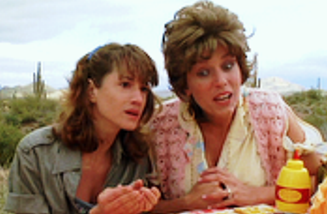 even though she herself is a felon now, albeit a good-intentioned one. Another complication arises with a visit from H.I.'s boss at work, Glen (Sam McMurray), his wife Dot (Frances McDormand) and their seemingly endless stream of diabolical children. "Mind you don't cut yourself, Mordecai" and "Take that diaper off your head and put it back on your sister" are just two of the many things Glen yells as his brood goes wild. While Dot rapidly lectures Ed on the need for insurance, avoiding orthodontic work and making sure the baby stays up to date on his "dip-tet boosters," Glen confides to H.I. that Dot wants another one, because these have grown too big to cuddle, but something has gone wrong with his semen. H.I. tries to lie about how he and Ed got to "adopt" a child so fast, but more trouble arises when Glen suggests to H.I. that they swap wives because he and Dot like to swing. H.I. punches Glen, who takes off like a madman and runs smack into a tree. Glen flees H.I., telling him not to bother coming into work anymore and promising to sue.

From that moment on, Raising Arizona essentially becomes an extended free-for-all chase. Since H.I. figures that Glen will make good on his word and fire him, he finds himself passing by convenience stores again "that weren't on the way home." Ed puts her foot down and wants Gale and Evelle gone. "I'd rather light a candle than curse your darkness," Gale tells H.I., while trying to convince him to help with a bank robbery. H.I. declines, but with Ed and the baby in the car, he does proceed to rob a convenience store for money and Huggies, setting off a loopy, more than five-minute long pursuit sequence. A pissed off Ed drives off with the baby, leaving H.I. to escape on foot. The Coens' hyperkinetic camera doesn't stop for a second as it rolls through groceries, streets and houses while clerks and dogs join the H.I. hunt.

Of course, the deadliest pursuit has yet to occur. H.I. already has had visions of a strange biker who takes no mercy on anyone or anything, and the vision turns out to be Leonard Smalls (Randall "Tex" Cobb), a self-described tracker, "some say hound dog." He meets with Nathan Arizona and offers to find his boy, but for a higher price than the reward the furniture magnate has offered. Arizona refuses, but Smalls insists he'll find the baby anyway and take whatever price "the market will bear." Back at the trailer, the chaos escalates as Glen figures out where H.I. and Ed got the baby and demands they turn the tot over to him and Dot. Before H.I. can even contemplate what to do, Gale and Evelle, who
 overheard the conversation, decide to steal the infant for themselves. Gale and H.I. tear the trailer apart in a residence-wrecking fight that takes place while Evelle shields Nathan Jr. The fugitives prevail and take off with Nathan Jr. with plans to hold him for ransom (and use him as a third man on the bank holdup). When Ed returns home to find H.I. tied up, she frees him and the couple leave to rescue the child, though Ed makes it clear that they aren't good for each other and should split once the baby is safe. The raucous slapstick melees run nearly nonstop after that as the convicts grow too fond of Nathan Jr. to part with him and Smalls arrives to whisk the baby away for his own nefarious purposes, leading to a final showdown with H.I. and Ed. Despite the frenzied pace and over-the-top nonsense, Raising Arizona even manages to conjure some warmth as the film winds down, though perhaps what touched me the most re-watching the film this time is remembering how much I loved the Coen brothers back then, until I felt their career went off the rails beginning with The Hudsucker Proxy. At least their upcoming film, No Country for Old Men, shows some promise as the vehicle marking their return to filmmaking I love instead of just doing variations on the same gags and gimmicks that I still love in their first four films, but has grown old by now.

From top to bottom, all the actors hit exactly the right notes for the movie. Forsythe and Goodman make for a hysterical pair of not-so-swift criminals. Cobb displays just the right amount of menace to remain a cartoon without pushing the film off its comic tone and into a terror mode. The late Parker gets some great material as Nathan Arizona as well as when he yells at the multitude of cops loitering at his house. "Dammit, are you boys gonna chase down your leads or are you gonna sit drinkin' coffee in the one house in the state where I know my boy ain't at?" Even the small roles of bank customers and store owners get priceless moments, especially Charles "Lew" Smith who plays the store owner who utters the response that gives this post its title when Evelle asks a question about some balloons. Cage still was in the early years of his career and Arizona marked the middle film of a three-film run of great Cage performances that started the year before with Peggy Sue Got Married and would concluded later in 1987 with Moonstruck. The breakout actor though was undoubtedly Holly Hunter as Ed. Hunter had appeared in a handful of films and TV movies, but Raising Arizona gave Hunter her biggest exposure so far, but it was just an appetizer for the gourmet meal Hunter would serve fans of great movies and acting in December 1987: Broadcast News.
UPDATE March 17, 2012: As we now know, my hopes for No Country for Old Men ended up being more than fulfilled. That same year, the brothers wrote and directed "Tuileries," one of the best shorts in the great compilation film, Paris, je t'aime . The Coens took a minor step backward with the so-so Burn After Reading that came next. However, the next movie they made ranked as one of their all-time greatest. A Serious Man also introduced me to the great actor Michael Stuhlbarg, who had mostly toiled upon the stage but would go on to impress me in a completely different type of role than his Larry Gopnik in A Serious Man when he became 1920s gangster Arnold Rothstein on HBO's Boardwalk Empire. Most recently, the Coens accomplished that rare feat of remaking a film and producing a greater version. Granted, the original True Grit wasn't a masterpiece, but it did contain John Wayne's Oscar-winning role as Rooster Cogburn which Jeff Bridges took on, easily besting the Duke. What really made the Coens' True Grit exceed the 1969 film version was young Hailee Steinfeld playing Mattie Ross. Yes, the Coens I loved early in their career have matured and returned better than ever. It's good that they can produce great works again and we continue to have their older classics such as Raising Arizona holding up after 25 years.

Tweet
Labels: 80s, Blog-a-thons, Boardwalk Empire, Coens, Guinness, Hanks, Holly Hunter, Jeff Bridges, John Goodman, John Williams, McDormand, Movie Tributes, Nicolas Cage, Oscars, Remakes, Wayne
TO READ ON, CLICK HERE
Monday, January 02, 2012
Boldly going where man's ancestors went before

By Edward Copeland
Werner Herzog's voice has embedded itself inside my brain. Each time I watch a documentary he directed and inevitably narrated, it takes longer to shake his German-accented English voiceover from my mind. A similar thing happened when I once listened to John Updike read one of his books on tape. After that, every time I read something by the great writer, I heard the prose in his voice. It's not an exact parallel with Herzog, since I only heard Updike when I read Updike. Once Cave of Forgotten Dreams finished, though Herzog's narration ceased to emanate from my TV, for some time afterward and as I write this, his voice continues to echo in my head.
Cave of Forgotten Dreams shares a thematic similarity with Herzog's Encounters at the End of the World except instead of looking at our least-explored continent, Herzog gains access to an ancient cave in southern France, sealed for thousands of years, that gives fascinating insight into what man's ancestors saw and could do in terms of paintings and sculptures believed to be the oldest ever found. The Chauvet Cave, named for Jean-Marie Chauvet, one of three cave explorers who followed an air current during an expedition in 1994 and found the cave apparently sealed to humans for more than 20,000 years.
France seized custody of the prehistoric site to prevent degradation, installing a locked steel door to bar access. The government allowed Herzog access under strict conditions, letting him film no more than four hours a day and if anyone had to leave during that time, the shoot stopped for the day. Making it more challenging, Herzog, who generally dismisses the need for 3D, felt it would make the experience more exciting for the viewer here (alas, Hugo remains the only 3D film I've seen since the gimmick's comeback). However, the narrow passages of the Chauvet Cave made the equipment necessary for 3D filming impossible so a special 3D camera had to be designed.
While some dispute the dating of what's been found in the cave, (Who wants to quibble between 20,000 and 32,000 years ago when either figure will set creationists' hair on fire?) even in two-dimensions the paintings astound. Depictions of animals extinct or evolved, some drawn in a succession that with the dim light almost make them appear to be the precursor of cinema. Handprints indicating an ancestor with a deformed finger is used as a map to trace the journey of the artist and the cave. The two sculptures found even indicate early depictions of a human-like form.
Herzog, always a jokester at heart, throws in an epilogue that questions both what our next step in the history of the world might be as well as whether France might see the tourist potential in this great find.
Herzog used to make some of the most interesting foreign language features around, especially when his stormy acting muse, Klaus Kinski, still lived to produce films ranging from the idiosyncratic (Woyzeck) to the astounding (Fitzcarraldo), from the one-of-a-kind (Aguirre, the Wrath of God) to a remake of a classic that became that rare classic remake itself (Nosferatu: Phantom Der Nacht).
Following Kinski's death in November 1991, Herzog turned almost exclusively to documentary filmmaking. Nonfiction works always held a place in Herzog's repertoire — both before and during his days with Kinski — but most were shorts made for television with theatrical features dominating his directing career. From the start of Herzog's feature career with Signs of Life in 1968 through his final film with Kinski (Cobra Verde) in 1987, Herzog directed 14 documentaries, all shorts except for three feature-length, only two of which were made for theatrical release.
Since 1987, Herzog only has directed five feature films (one of which was a fictionalized version of one of the documentaries he made in that time). With the exception of directing episodes of three separate German TV series, all his work in that time period has been on nonfiction filmmaking — shorts and feature-length, for television and theaters. What's even more fascinating is that his documentaries such as Cave of Forgotten Dreams prove far more interesting than the handful of fictional features that barely get released and, when they do, turn out to be flat-out disasters such as The Bad Lieutenant: Port of Call — New Orleans starring Nicolas Cage.
If he can keep finding topics such as Cave of Forgotten Dreams, the loss of Herzog the fiction filmmaker with Herzog the documentarian might make for a worthy swap.
Tweet
Labels: 10s, Documentary, Herzog, Nicolas Cage, Remakes, Updike
TO READ ON, CLICK HERE
Monday, September 13, 2010
Different rules apply when it gets this late at night


By Edward Copeland
In 1983, Martin Scorsese was down. While he was a critical darling, already revered for making some great films before his 40th birthday, the lifelong movie fanatic had earned the right to bigger projects with larger budgets and longer shooting schedules but the audiences didn't come along with the acclaim and the films weren't tearing up the box office. As a result, his longtime dream project, The Last Temptation of Christ, got scuttled by the studio. His passion for filmmaking had reached a breaking point, but then he received a screenplay from producers Griffin Dunne and Amy Robinson by a writer named Joseph Minion called Lies, which Minion wrote as his thesis at Columbia. The title eventually became After Hours, and it opened 25 years ago today and may well be the tensest comedy ever made. More importantly, it renewed Scorsese's love of filmmaking.

Actually, my lead fudges the chronology slightly. Robinson and Dunne, both actors who had turned to producing having already made Chilly Scenes of Winter and John Sayles' Baby, It's You (Later, they would produce Once Around and Running on Empty), sent the Lies screenplay to Scorsese before Last Temptation fell apart. Robinson had been given the script by director Dusan Makavejev (The Coca-Cola Kid) while she attended an early year of The Sundance Institute. Makavejev felt the very New York-centric script might be up her alley. Robinson loved it as did Dunne. The two both had past relationships with Scorsese, though Robinson's was more substantial: She played Teresa, Harvey Keitel's secret epileptic girlfriend in Mean Streets. Dunne's link was a bit more tenuous, if not comical: He auditioned for the role of Ellen Burstyn's son in Alice
 Doesn't Live Here Anymore, even though Dunne was 18 at the time. Scorsese told him he was too old, but was kind enough to give him a reading and talk to him for awhile anyway. The two sent the screenplay to Scorsese but because of Last Temptation, he declined. The producing pair learned of an up-and-coming filmmaker named Tim Burton and offered the movie to him and he accepted. Then Last Temptation fell apart and Scorsese found Minion's script again and called Dunne and Robinson back saying he'd like to make it. This put the producers in a quandary. They didn't want to dump Burton for no good reason, yet how do you say no to Martin Scorsese? They called Burton and told him the truth, that they had offered it to Scorsese first. Burton withdrew gracefully, saying he'd never stand in the way of something that Martin Scorsese wanted to do. The disappointment over the cancellation of his longtime dream project had inspired Scorsese to return to his indie roots — smaller budget, smaller cast, shorter shoot and renewed energy. In the DVD commentary, the director describes it as if he were going back to school. With After Hours, he would earn an A+ and revitalize himself. He'd even take home the directing prize at the Cannes Film Festival.
Paul Hackett (Dunne) works as a word processor. When we meet him, he's helping a co-worker (Bronson Pinchot) who can't get the hang of a certain skill. (Before he got stereotyped by his role on TV's Perfect Strangers, Pinchot had small but visible roles in notable films each year from 1983 to 1985: Risky Business, Beverly Hills Cop and here in After Hours.) Paul's tedium isn't restricted to work. At his apartment, he lies in
 the dark absent-mindedly flipping through channels before deciding to go to a nearby coffee shop, taking the copy of Henry Miller's Tropic of Cancer that he is re-reading with him. As he's lost in the novel, a female customer (Rosanna Arquette) says how much she loves that book. It takes a moment for Paul to realize she's speaking to him. A conversation starts and the woman, whose name is Marcy, joins his table and whispers her thoughts about the cashier's odd behavior. For the first time, Paul notices that he appears to be dancing with an invisible partner. Paul asks if she lives nearby, but Marcy says no, she lives in Soho with her sculptress friend Kiki, adding that Kiki makes plaster of paris bagel with cream cheese paperweights that he really should look at. Paul takes her number and the two part ways. Later in his apartment, Paul notices the number and gives Marcy a call. She encourages him to come on by. Hackett glances at his clock and it reads 11:32 p.m. So begins his journey into a bizarre vision of hell, only he doesn't know it yet. He just thinks he might get lucky, but the luck he'll be experiencing is not the good kind.

What attracted Scorsese to Minion's screenplay wasn't just the chance to return to his indie roots with a quintessential New York story, but because its portrait of being trapped in Lower Manhattan as some twisted vision of Hades reminded him of his own personal experiences living in Tribeca. While that area's image of a Bohemian, artistic paradise appeals to many, by the time Scorsese found himself living there, he was a bit older and spoiled by the comforts of life. He didn't feel like climbing five flights of stairs to get to his apartment anymore. He wanted the convenience of an elevator where he could push a button and get to his floor without so much strenuous effort. So, as he admits on the commentary, when late in the film, Paul shares his story with a stranger and says with exasperation, "I just wanted to leave my apartment, maybe meet a nice girl and now I have to die for it!" and Scorsese's giggling response is, "Yes, you have to die for it." Not that Paul does literally.
Paul's journey down the Manhattan version of the River Styx begins with a wild cab ride, zooming through practically empty streets. In the first (and perhaps the stupidest) bad decision of the night, Hackett places the $20 bill he plans to pay the driver with in the cradle on the back of the front seat, even though the window is open and the ride already has reached a ferocious speed that has jerked Paul himself side to side, so he shouldn't be surprised when the wind sweeps into the cab, grabs the currency like the hands of a ghost and whisks it out the window before Paul can catch it. He tries in vain to get the driver to stop, as if he could get out and find the bill even if he did. They reach their destination and Hackett tries to explain what happened to the disbelieving cabbie, but the driver just speeds off pissed, leaving Paul standing in Soho with an empty wallet and some pocket change.
He finds Marcy's building and searches for the correct button to buzz, settling on one with the name Bridges with Franklin below it, remembering that Bridges was the last name of her sculptress roommate. After he buzzes it, a woman sticks her head out of a window above, asking if he's Paul. He answers in the affirmative and she tosses him down her keys.

After Hours marked the first collaboration between Scorsese and cinematographer Michael Ballhaus and the manic cab ride that brings Paul to Soho was shot using only available light, upon Scorsese's insistence. Dunne and Robinson recommended him having worked with the d.p. on Baby, It's You and showing it to Scorsese, who, of course, also was familiar with his incredible string of nearly 20 films in eight years working for Rainer Werner Fassbinder in his native West Germany. Admiring the look of the Ballhaus films he'd seen and his obvious ability to be able to work fast and well, Scorsese decided he'd be the perfect d.p. for the quick shoot of After Hours. Their work together went so well that Ballhaus would later work on six more Scorsese films. One of the earliest shots of After Hours was his most difficult but was, according to Scorsese, the pivotal moment of the entire film: Kiki (Linda Fiorentino) dropping her keys from the window to Paul on the street below.

After Paul ascends all the flights of stairs to the loft apartment that Kiki and Marcy share, he finds only Kiki there, working on a papier-mache sculpture of a man that Paul thinks resembles Edvard Munch's The Scream (though he mistakenly calls it The Shriek). Marcy, it seems, had to run to the pharmacy. Kiki says she's been giving herself a real workout and asks Paul to takeover, assuring him it's easy. He complies, despite being in a dress shirt and tie which soon get messed up. Kiki offers to toss the shirt in the washer so he'll look good for "his big date" and he continues his work on her sculpture. Kiki continues to complain about her shoulder and Paul offers a massage and before he knows it, she's fallen asleep in his lap on the couch when Marcy finally makes
 her appearance. Paul and Marcy leave the sleeping Kiki and go off to Marcy's bedroom. Marcy first accusingly asks Paul what he did to Kiki, then changes tone and tells him that she feels like something incredible is going to happen. This will prove to be an understatement for Paul and not in a good way. Before they can even get to know each other, Marcy asks if she can excuse herself to take a quick shower. Paul says sure, but Marcy makes him promise to stay on the bed. Of course, his curiosity gets the better of him: He has to see what she got at the pharmacy and it's some sort of ointment to treat second-degree burns. He also finds a book depicting horrible, disfiguring burns and is horrified as he peruses them before quickly returning to his spot on the bed. Marcy scolds him for not following her orders to stay right where he was, but she forgives him and they decide to go to a diner.
On the DVD commentary, Scorsese praises actors for their bravery, specifically Griffin Dunne for his willingness to stand below for the dangerous and tricky keys point-of-view shot that Scorsese felt was key to the whole film. The clip above picks up from the end of the cab ride and includes the amazing shot of the keys drop and goes on much beyond that. The key drop was a challenge for Ballhaus to put together. Though the sequence only takes a few seconds of
 screentime, it exists of nearly a dozen shots and involved a complicated setup that included placing the camera on bungee cords, a piece of wood with a hole cut in it and the keys themselves, which were really like a projectile hurtling at Dunne's head. Scorsese saw Paul's acceptance of the keys as the moment he sells his soul to Soho, so to speak. For spectators, such as Amy Robinson, filming the scene was frightening enough, but Dunne was willing to do it again, just to get it right. The entire shoot required energy and perseverance from all involved. Scorsese insisted that the entire shooting schedule be done at night, from sunset to sunrise. They could have shot interiors during the daytime, but he would have none of that. When they'd break for "lunch" around midnight, they'd sometime wonder why restaurants would be closed. In any other city, there wouldn't have been as many available options as they did find in New York. As Ballhaus explained in the commentary, longer shoots can present their own problems with more money and bigger cast and crews and they'd be lucky to finish five or six shots a day on a 100-day shoot. For After Hours, they completed 16 shots a day in a 40-day shoot — all at night.
For the uninitiated, to spoil much more of the plot developments would ruin the twisted fun of a truly unpredictable comedy, a comedy that will tie your stomach in knots as you wonder whether or not Paul Hackett can survive this evening or not. At the same time, After Hours contains so many kooky characters
 played by such a talented ensemble and delivers so many classic moments and memorable lines, in its own way for those who have shared in its madness, it's as quotable as Airplane! There's the story Marcy tells about the movie her husband obsesses with and what it leads him to shout every time he climaxes during sex; when Paul, eager to escape uptown, learns the subway fare has risen at midnight to $1.50 and all he has left is change and tries to convince the subway clerk to give him a break because no one is around to find out and the clerk responds, "I could go to a party, get drunk, talk to somebody. Who knows?"; there's the entire sequence with Teri Garr playing the cocktail waitress, seemingly transported out of the late 1960s, obsessed with The Monkees and with a bed encircled with mouse traps. She also gets a great line when she quits (or was she fired) her waitressing job and mutters under her breath about how figuring 8% sales tax is a bitch. There's also great work from Verna Bloom, Catherine O'Hara, John Heard, Cheech & Chong and many fine character actors you'd recognize but may not know by name.

Dunne, who essentially has the dual role as the film's straight man and victim, delivers many of the film's best lines with panache. When he finally gets frustrated with Marcy's eccentricities and is just ready to go home, he indignantly demands to know where those damn bagel and cream cheese paperweights are. That's why he came down. "At this very moment, important papers are flying rampant around my apartment and I don't have anything to hold them down," he shouts. Later, as he trying to hide from a vigilante mob who mistakenly believes he's behind a series of burglaries, Scorsese uses the film's only crane shot as Hackett falls to his knees in the street and cries out, "I'm just a word processor for Christ's sake." Of course, the entire film is another example of how different the situation would be today in the universe of cell phones, though I imagine in a modern day After Hours, Paul's phone's battery would run out and no charger would be available.

As you would expect from Scorsese, his camera almost never slows down, often aided by a great Howard Shore score that almost plays more like a sound effect than music. Scorsese's first cut of the film came in at 2 hours and 40 minutes and though it meant cutting some scenes he did like, he knew it was too much for the film to work as a comedy. Joseph Minion's screenplay originally ended with Paul imprisoned in papier mache and being driven off in a van by Cheech and Chong to an uncertain fate, but the ending didn't satisfy test audiences or the many friends Scorsese showed it too (including Steven Spielberg). (By the way, what happened to Joseph Minion? He wrote Vampire's Kiss with Nicolas Cage in 1988 that I didn't care for and has a handful of other credits, but none that I've heard of or seem to have had much of a release, if any.) This is one case where changing the original ending actually was for the best and the idea came from the great Michael Powell (husband to Scorsese's longtime editor Thelma Schoonmaker), who suggested his worst fate would be to end up back at his dead-end job again after the night he's just endured. When filming was completed, Scorsese gathered the cast and crew and said, "Thank you for giving me back my love of making movies." I think all movie lovers should be grateful to them for that and for After Hours itself. Wouldn't it be great to see Scorsese (or many other great filmmakers) try something like this again?


Tweet
Labels: 80s, Awards, Burstyn, Griffin Dunne, Keitel, Michael Powell, Movie Tributes, Nicolas Cage, Sayles, Scorsese, Spielberg, Tim Burton
TO READ ON, CLICK HERE
Tuesday, August 17, 2010
From the Vault: Wild at Heart
BLOGGER'S NOTE: Twenty years ago today, Wild at Heart opened. Here is the review I wrote at my college newspaper upon its opening.

When the 1990 entertainment yearbook is written, it should say that David Lynch single-handedly saved the year from being completely drowned in mediocrity. He and Mark Frost helped raised the quality of television with Twin Peaks and Lynch himself has given a boost to the movie year with Wild at Heart.
Wild at Heart tells the road story of Sailor Ripley (Nicolas Cage) and Lula Pace Fortune (Laura Dern), two young lovers trying to overcome the many obstacles to their love, most of which have been placed there by Lula's evil mother Marietta Fortune (Diane Ladd).
Other than that, characterizing this wickedly funny film by its story becomes a fool's errand other than to say it resembles a dark, demented version of the type of films the minds behind Airplane! make. Lynch throws in every strange and silly thing he can think of, achieving the film equivalent of a nonsequitur.
Lusciously filmed and edited, Angelo Badalamenti's score builds suspense and adds a humorous edge to some of its toughest scenes. Wild at Heart isn't designed for everyone, but it is Lynch's most successful screen venture to date. Blue Velvet grows on you, but it's overrated and never balances its abrupt shifts in tone.
With the exception of a few horrifying scenes, Wild at Heart pulls it off since it's clear that it's not meant to be taken too seriously. Cage — who seems to alternate good performances with annoying ones — submits a completely original characterization.
Ladd gets her best role in years as the malevolent mother worried more about her own fate than her daughter's happiness.
Willem Dafoe delivers an Oscar-caliber supporting turn as a frightening man named Bobby Peru. Decked in black, Dafoe perfectly balances his character's evil nature with humor.
Dern, Ladd's daughter in real life, also shines, unlike in Blue Velvet where she was one of that film's weakest elements.
Lynch's direction moves at a brisk pace, never letting the audience stop to breathe long enough to realize they are watching a 2 hour, 17 minute movie. The Elvis-like Sailor wears a snakeskin jacket which he calls "a statement on his individuality and of his belief in personal freedom." Wild at Heart serves as Lynch's cinematic snakeskin jacket.
Lynch's vision on both big and small screen is unlike anyone working today, testing the limits of what can be accepted and what is acceptable. The movie, while very violent and sexual, often borders on excess, but Lynch pulls it off because he knows exactly where he's aiming. A major motif turns out to be The Wizard of Oz, with characters constantly comparing themselves to Dorothy and the gang. If forced to place a meaning on this film, I guess it is the difficulty in finding your way home to happiness.
Looking for meaning in Wild at Heart isn't the attitude one should take into the theater. Instead, audiences should allow themselves to venture into the bizarre and disgusting world that Lynch has conjured.
Tweet
Labels: 90s, Dafoe, Elvis, L. Dern, Lynch, Nicolas Cage, Television, Twin Peaks
TO READ ON, CLICK HERE
Saturday, August 07, 2010
All Science and No Philosophy Makes Nerds Have Dull Lives

By J.D.
In the 1980s, Martha Coolidge’s films were a welcome antidote to the dominance of John Hughes’ output. On the surface, her films appear to be quite similar but whereas Hughes’ films ultimately play it safe and are conservative in nature (i.e. the status quo is preserved), Coolidge’s films champion the outsider in society — for example, Nicolas Cage’s punk rocker hooks up with Deborah Foreman’s Valley girl despite societal pressure in Valley Girl (1983). When it premiered 25 years ago today, Real Genius appeared to be just another mindless college comedy like Revenge of the Nerds (1984) but whereas that film had its outsiders ultimately become part of accepted mainstream society, the nerds in Real Genius rebelled against it and were proud to be different.
Mitch Taylor (Gabe Jarret) is a brilliant high school student recruited by Professor Jerry Hathaway (William Atherton) to become a student at Pacific Tech and join a special team working on an experimental laser. Hathaway tells Mitch and his parents in person at a science fair. The exchange between them is priceless. His parents obviously have no idea just how smart their son is and only want him to get the best education. At one point, Mitch’s mother asks Hathaway, “I saw your show the other night on radioactive isotopes and I’ve got a question for you. Is that your real hair?” He cheerfully replies, “Is Mitch by any chance adopted?” They are oblivious to the implied insult and Hathaway pulls Mitch aside and tells him, “We’re different than most people. Better.” Hathaway’s elitist attitude is established early on, setting him up as an arrogant snob that must be taught a lesson in humility by our heroes.
Hathaway rooms Mitch with Chris Knight (Val Kilmer), the top brain on campus — at least he used to be until Mitch showed up. We first meet Chris as he’s being taken on a guided tour of a top science laboratory. He has a t-shirt on that reads, “I love toxic waste,” and a set of alien antennae on his head that demonstrate he is the antithesis of Hathaway. He may be super smart but he’s not a stuffed shirt. At one point, his tour guide asks him, “You’re Chris Knight, aren’t you?” Without missing a beat, he replies, “I hope so, I’m wearing his underwear.” Val Kilmer’s deadpan delivery is right on the money and he demonstrates an uncanny knack for comic timing. The film could have so easily set up a rivalry between Chris and Mitch but instead they become friends and team up against a common foe: Kent (Robert Prescott), an arrogant senior student who also is working on the laser.
Chris is super smart but something of a loose cannon, always cracking jokes and never taking anything too seriously, much to Mitch’s consternation because he doesn’t know how to loosen up and have fun. Mitch also has trouble adjusting to campus life and this isn’t helped by Kent who enjoys tormenting Mitch when the senior student isn’t busy sucking up to Hathaway. Coolidge replaces the class warfare in Valley Girl with in-fighting amongst academics in Real Genius. The setting may be different but the tactics are no less mean-spirited as Kent delights in publicly humiliating Mitch. Meanwhile, Hathaway puts pressure on Chris to produce a working laser before the school year ends. Failure to do so will result in Hathaway making sure that Chris doesn’t graduate or work in his field of expertise. Unbeknownst to the ace student, his professor is getting pressured by a flunky and his superior from the CIA who want to use the laser for their own covert actions (assassinations from outer space?).
Every so often, Mitch catches a glimpse of a mysterious long-haired man who goes into his closet at random times during the day. His name is Lazlo (Jon Gries) and he lives deep in the bowels of the school. He used to be the smartest student on campus back in the 1970s but cracked under the pressure and now spends all of his time generating entries for the Frito Lay sweepstakes (enter as often as you like) so as to get as many of the prizes as possible. Jon Gries plays Lazlo as a shy genius, smarter than Chris and Mitch combined. He’s a gentle soul and a far cry from the arrogant blowhard he would go on to play in Napoleon Dynamite (2004)

Over the course of the film, Mitch finds himself attracted to Jordan (Michelle Meyrink), a hyperactive student who never seems to sleep. She sports an adorable Louise Brooks-style bob haircut and a nervous energy that is oddly attractive. I had a huge crush on her when I first saw this film back in the day, quite possibly one of my earliest cinematic crushes. She was the ultimate nerd sex symbol in the ‘80s with her undeniable beauty and brains. Sadly, after a few films she grew disenchanted with the movie making business and retired to Canada to become a Zen Buddhist.
Remember when Val Kilmer was funny? Between this film and Top Secret! (1984), he displays some impressive comedic chops. Kilmer excels at delivering smartass quips and jokes but also is capable of delivering an inspirational speech that convinces Mitch to stick it out at school and get revenge on Kent. There are two scenes where he dispenses with the jokes and has a relatively serious conversation with Mitch about life. They are refreshingly heartfelt and elevate Real Genius above the usual ‘80s teen comedy.
Gabe Jarret is perfectly cast as the helplessly square Mitch with his dorky haircut and his J.C. Penney wardrobe. We aren’t meant to laugh at him and Coolidge shows that he’s a good kid thrust into a new and strange environment. He’s smart but lacks the emotional maturity which he will acquire over the course of the film. Jarret does a nice job of conveying his character’s arc. He doesn’t totally transform into Chris but instead absorbs some of his traits while remaining true to himself.
In the ‘80s, William Atherton seemed to be the go-to guy for playing douchebag authority figures, with memorable turns as the unscrupulous journalist in Die Hard (1988), the “dickless” EPA guy in Ghostbusters (1984), and, of course, his turn in Real Genius. Atherton’s job, and man, does he do it oh so well, is to provide a source of conflict for our protagonists. He portrays Hathaway as the ultimate arrogant prick and we can’t wait to see him get his well-deserved comeuppance at the hands of Chris and Mitch.
Real Genius does plug in the usual tropes of ‘80s teen comedies with the now dated soundtrack of New Wave songs, most of them forgotten except for “Everybody Wants to the Rule the World” by Tears for Fears, which plays over the blissfully carefree ending of the film. There is the wacky comedic set pieces involving pranks. There’s also the T&A factor when Chris takes Mitch to an indoor pool party populated by sexy beauticians. Not to mention, the dorm that Chris and his classmates live in which vaguely resembles the chaotic frat house in Animal House (1978), only inhabited by really smart people.

However, it is how the film presents these generic elements that sets it apart from the typical ‘80s teen comedy. For example, the pranks are quite inventive, such as when Chris and Mitch manage to place Kent’s car in his dorm room. There are several and they all lead up to the mack daddy of them all which occurs at the climax of the film. While there is the requisite T&A factor in Real Genius, the PG rating assures that we don’t see much, just some girls in bikinis. Instead, we get the understated romance that develops between Mitch and Jordan, which is rather sweet in its own unassuming way. The dorm is certainly not the debauched chaos of Delta House, but it clearly is a place of fun, led by Chris and his various antics.
Real Genius argues that nerds can have fun too but there needs to be a balance. You can love solving problems but it can’t be all science and no philosophy as Chris tells Mitch. People like Kent and Hathaway have no sense of humor and are self-obsessed egotists. They are ambitious to a fault, not caring who they step on along the way, while Chris and Mitch are aware of the consequences of their actions. There is sweetness to this film that is endearing and rather strange considering that Neal Israel and Pat Proft wrote the screenplay (authors of such paeans to sweetness, such as Police Academy and Bachelor Party), but Coolidge is firmly in charge and wisely doesn’t let Real Genius get too sappy. She also doesn’t let the funny stuff devolve into mindless frat humor, instead maintaining a proper mix that doesn’t insult our intelligence. The end result is a film that the characters in the film might enjoy, if they weren’t already in it. Achieving just the right alchemy may explain why the film continues to enjoy a modest cult following and is one of the few teen comedies from the ‘80s that stands the test of time.
Tweet
Labels: 80s, John Hughes, Meg Ryan, Movie Tributes, Nicolas Cage, Val Kilmer
TO READ ON, CLICK HERE
Monday, April 26, 2010
Mr. Monk and the Hilarious Hooey

By M.A. Peel
I saw the revival of Ken Ludwig’s Lend Me a Tenor this weekend with Mater. The New York Times didn’t like it either in 1989 (Frank Rich) nor today (Charles Isherwood). I’m not usually a fan of farce (high or low) or slapstick, or endless double entendres or playing broad, but this show is a delight.
I got excellent orchestra seats nine rows from the stage thanks to a 50% discount code that appeared on the Monk Facebook page just as after the series ended. Thanks very much, Mr. Monk. It’s a thrill to sit close to a Broadway stage because you really feel the live energy. If you sit in the back, it’s like watching TV.
Isherwood and Rich quibble about the plot of Tenor. Kind of makes them look silly. They are SO missing the point. Let me explain it to them and you with a perfect, appropriated description from Gary Giddins (via James Wolcott): it’s “absolute hooey, but it is a hooey of master craftspeople, working together like apprentice in a Renaissance studio, each one a specialist in light or fabric or hands or eyes, held in balance by their master’s supervision. In this instance, the master was director Stanley Tucci.” (OK, Giddins was actually talking about Joan Crawford’s film Sadie McKee directed by Clarence Brown.)
Sparkling hooey isn’t about plot. It’s about ridiculous set-ups that play out in inane ways, with just a soupcon of wit. It’s actually the ensemble of pros that make for the laughter. For me, Tony Shalhoub is the master of the subtle look within the over-the-top lunacy going on around him.

Shalhoub’s impresario is a man used to giving orders and getting what he wants. It’s the control of his performance that I loved. He is a very elegant man, and you can feel the intelligence below the reaction shots. I find that very rich and appealing.
Anthony LaPaglia had the harder role, Il Stupendo. He looked less at ease in his roll than Shalhoub, although his confusion in the second act was very, very funny.
The discovery for me was the young Justin Bartha who plays Max, the nerd factotum who blossoms before our eyes. He’s in The Hangover, which I now must see, and the National Treasure series with Nicolas Cage where he plays Riley Poole. Don’t think too many of his under 30 film friends have the chops for the stage that he has.
And so I found myself laughing and laughing at stupid lines and silly moments in my own willing suspension of disbelief.
It was a beautiful day in Gotham, and this hilarious hooey shared with Mater felt like such a gift. I don’t laugh enough (with a notable exception on my recent trip to China): I’m an Ox, and so I got a of cosmic dose seriousness (with a little artistry thrown in from the Libra side). Performing art of any kind that makes people laugh is extremely important to the human condition. It literally helps to lighten our load, to counterbalance the veil of tears that is so much of our human equation.
Preston Sturges knew this. That scene at the end of Sullivan’s Travels when the convicts and churchgoers start laughing while watching the 1934 Walt Disney cartoon Playful Pluto with Mickey Mouse and Pluto is one of the great moments in cinema.
The dedication at the film’s beginning:
"To the memory of those who made us laugh: the motley mountebanks, the clowns, the buffoons, in all times and in all nations, whose efforts have lightened our burden a little, this picture is affectionately dedicated."
The film’s last line, spoken by John L. Sullivan
"There's a lot to be said for making people laugh! Did you know that's all some people have? It isn't much but it's better than nothing in this cockeyed caravan! Boy!"
Labels: Crawford, Disney, Nicolas Cage, P. Sturges, Television, Theater, Tucci
TO READ ON, CLICK HERE
Tuesday, April 13, 2010
He has his bad days
By Edward Copeland
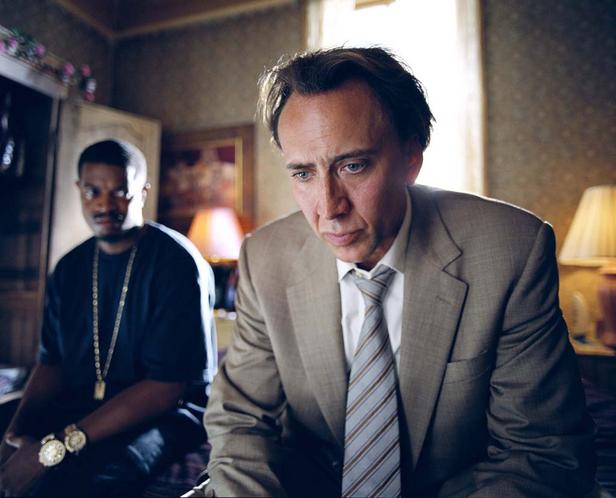
When I heard that Werner Herzog was doing a "reimagining" of Abel Ferrara's over-the-top 1992 Harvey Keitel vehicle Bad Lieutenant starring Nicolas Cage, the last adjective I thought would enter my mind when watching it would be the one that did: conventional.
Actually, that adjective only applies to the first hour or so of The Bad Lieutenant: Port of Call — New Orleans, but even with a glorious cinematic madman such as Herzog at the helm and an actor with a penchant for extremes such as Cage in the lead, this take doesn't come close to touching the 1992 version, which I was never that big a fan of to begin with.
This version is set "in the aftermath of Hurricane Katrina," though it's hard to see why since aside from the opening scene where Cage's Terence McDonagh saves an inmate from a flooding jail cell and severely injures his back, it never comes up as an issue again and very little of the places the film takes place in shows signs of the disaster. It seemed particularly odd to me coming so soon after I had just watched the first three episodes of the great new HBO series Treme, which begins in New Orleans three months after Katrina.
McDonagh's heroism not only leaves him with a lifetime of back pain but earns him a promotion to lieutenant and the cravings for any sort of drug that might make the pain go away, though it seems more likely that he prefers the crack, cocaine, heroin, pot and pills just so he can act crazy as the film requires and up the ante on his gambling addiction.
While I wasn't a huge fan of Ferrara's earlier film, what made that film more worthwhile, other than Keitel's fearlessness in his go-for-broke performance, is that Keitel's bad cop started out corrupt, drug addicted and a gambling fiend. However, that film's central case, the brutal rape of young nun in a church sparks Keitel's character on a journey not only to solve her case but to seek his own redemption.
In The Bad Lieutenant: Port of Call — New Orleans, the central case of the drug-related slayings of an immigrant family plays almost as an afterthought, an excuse just so McDonagh can run wild through various encounters with lowlifes and power brokers while trying to protect his prostitute girlfriend (Eva Mendes). The ridiculous ending, where somehow he bungles into solving all his problems, makes it all the more ridiculous. Cage certainly can be entertaining in the film at times, but it all adds up to a big case of "What's the point?"
The film also manages to wastes the talents of Brad Dourif as a bookie, Jennifer Coolidge as Cage's stepmom and Val Kilmer in a truly thankless role that does little more than present more evidence that his reputation of being such a pariah to work with has made him have to settle for thankless roles such as this.
Not only did this film need not be made, it is a true disappointment coming from a director of the caliber of Werner Herzog. As I sat through this, all I could picture in my head was a vulnerable, nude Harvey Keitel, arms outstretched, walking toward the camera in tears. Its not an image I particularly wanted to have, but I could relate to why he was crying.
Tweet
Labels: 00s, Herzog, Keitel, Meg Ryan, Nicolas Cage, Remakes, Treme, Val Kilmer
TO READ ON, CLICK HERE
Tuesday, October 13, 2009
Another season, another reason

By Edward Copeland
It's a cliche to say, "They don't make 'em like they used to." It's downright depressing when that trite saying is being employed to refer to a film such as The Fabulous Baker Boys that is just marking its 20th anniversary. Has Hollywood really degenerated this much this fast? In 1989, this was a big studio release. Now, we'd be lucky if someone would pick it up as an independent feature. Maybe if the Baker Boys were built out of Legos or transformed into robots.
When I first saw Steve Kloves' film in 1989, while I liked it, I didn't know quite what to think of it because it really was unlike any major studio release I was used to at the time. Here it was though: a film more like a tone poem than a heavily plotted release with Warner Bros. behind it and marquee names such as Sydney Pollack and Paula Weinstein backing a first-time writer-director on a film whose commercial prospects must
 have seemed limited. Before Kloves made The Fabulous Baker Boys, his main credit was as the screenwriter of the good but largely forgotten coming-of-age film Racing With the Moon starring Sean Penn, Nicolas Cage and Elizabeth McGovern. Michelle Pfeiffer's star was just beginning to rise, but she couldn't be counted on to lure in audiences. Jeff Bridges was a much respected actor but hardly box office gold and that was even more the case with his co-star, brother Beau. They even dared to allow a film with an open-ended, ambiguous ending. Still, they took the chance and allowed this film to be made and it is one that grows better and better with each viewing, even though I know deep down that if all the planets hadn't been in alignment at the right moment in the late 1980s, this film gem would never have been made. That makes me sad. It also makes me sadder to think of Kloves' career direction. He made another film as writer-director, Flesh and Bone, a mixed bag of a movie most notable for first gaining notice for Gwyneth Paltrow. Since then, he's been purely a screenwriter, albeit a great one, doing a faithful and solid job at adapting Michael Chabon's Wonder Boys and adapting every single Harry Potter book with the exception of The Order of the Phoenix. He got the job because The Fabulous Baker Boys is one of J.K. Rowlings' favorite films. Still, I wish Kloves had the chance to write and direct his own original work again.
Still, even if Kloves never directs again, he's left us a great one in The Fabulous Baker Boys where seemingly
 every aspect is top notch, from Dave Grusin's moody, jazz-like score which seems in perfect harmony with Michael Ballhaus' cinematography, full of smoke and shadows, almost creating a color noir look to this tale of two piano-playing brothers. You're never quite certain where this film is heading because plot is almost irrelevant, yet Kloves creates a fictional universe with such complete confidence that it's never a concern. Having real-life brothers Jeff and Beau Bridges play Jack and Frank Baker was a brilliant stroke. Not only do the true siblings have a short-hand that only a lifetime of knowing each other could have brought, Baker Boys also gives each of the actors what may well be their finest feature film roles. Most of Beau's best work came on TV after this, but his Frank is memorable as the passive-aggressive control freak, who fancies himself the business brains behind the act and who works to support his wife and kids, even though he knows that his brother is the one with the greater talent. Jack though is the center of the film and Jeff
 Bridges is superb as the chain-smoking, borderline alcoholic who hates the redundancy of his life and would rather be playing what he wants instead of the same set for the umpteenth time. He can be cruel and as one character describes him, cold as razorblades, yet he still takes time to be a pseudo-surrogate dad for the young girl who lives upstairs from him and frequently is abandoned by her mother for her frequent boyfriends. Bridges has been great so often in so many films sometimes it's easy to forget about him, but I've never forgotten his Jack Baker. Of course, the third member of this acting team is Pfeiffer as Susie Diamond, the singer the brothers hire when Frank decides that perhaps they need a vocalist to jump-start the act. Pfeiffer's work is both sultry and superb and there's a wisp of sadness when you remember when Pfeiffer was on the rise before she began turning down great roles and appeared to commit career suicide in crap such as I Am Sam. Susie not only revitalizes the act, she creates friction about other changes. When one of Frank's kids get sick and he has to let Jack and Susie perform alone, the two relish the chance to change the playlist. When Frank learns later they skipped "Feelings," an argument ensues over whether the song is filet mignon or parsley. In terms of movies, The Fabulous Baker Boys is most definitely filet. In fact, 1989 may be the most recent year to serve up so many delectable entrees and desserts in the form of movies. From the masterpieces to the solid good times, it truly was an amazing year and The Fabulous Baker Boys is another example of what cinematic magic that movie year managed to bestow as gifts to us who worship films.
Tweet
Labels: 80s, Beau Bridges, Chabon, Gwyneth Paltrow, Jeff Bridges, Movie Tributes, Nicolas Cage, Pfeiffer, Sean Penn, Sydney Pollack
TO READ ON, CLICK HERE
Wednesday, June 20, 2007
Ill wind blows Coppola no good
BLOGGER'S NOTE: This post is part of the Ambitious Failure Blog-a-Thon being coordinated by William Speruzzi at This Savage Art.

By Edward Copeland
Having not seen The Cotton Club in more than 20 years (and remembering it fondly), I suspected that it might fit the bill for an "ambitious failure." Boy, was I right. It's hard now to see how I gave this film a pass in the first place except that I was young and naive and may have been giving Francis Ford Coppola (who for some reason dropped the Ford for this film) way too much credit.

In a way, I can excuse my initial exuberance: The Cotton Club had a helluva pedigree: The Godfather team of Coppola and Mario Puzo and produced by Robert Evans, who was Paramount Pictures' production head at the time of The Godfather. It also was co-written by William Kennedy, fresh off his Pulitzer Prize for the novel Ironweed. Music, mobsters, what could go wrong? Looking at it again now, just about everything. Perhaps if it had been a novel, it might have made some sense with its multitude of characters and storylines but in a barely over two-hour running time, the film sadly lacks focus. It also hurts that while there are some good performances, the cast doesn't come close to the talent assembled for The Godfather films. The movie overflows with atmosphere and great technical details but sorely lacks momentum. It starts out well with a great looking credit sequence (which notes something I forgot, that Richard Gere did his own cornet solos) before convincingly placing the viewer in 1928 Harlem, where Gere's musician gets more than he bargained for when he saves the life of Jewish gangster kingpin Dutch Schultz (James Remar, still menacing but a few miles removed from his bad guy in 48 Hrs.).

Rewatching it, it's interesting to compare the portrayals of Schultz and his numbers man Abbadaba Berman in this film and Billy Bathgate, the botched adaptation of E.L. Doctorow's good novel. I actually think Remar proves more interesting that Dustin Hoffman did in the later film but Allen Garfield's Berman here doesn't even seem like he's the same guy played so memorably by Steven Hill in the later movie. I digress: We're here to discuss the failures of The Cotton Club and there is no way around blaming it on its ambitions.

Here is a short laundry list that the film tries to encompass: racial discrimination where African Americans could perform in The Cotton Club, but not attend the shows; the waning influence of Jewish and Irish mobsters; tensions between Dutch's Jewish hoods trying to hone in on the action of African American crooks in Harlem; the approach of Lucky Luciano and Italian mobsters; light-skinned African Americans trying to pass for white; and the transition of silent films to sound. That's not even counting the tacked on plot strands of thwarted romance and brotherly conflict, among both Gere and Nicolas Cage as his aspiring hood brother and Gregory and Maurice Hines as a dancing team with different goals. That's a bit much for any movie to bear, especially without clocking in around four hours in length.

At times, Coppola does handle the transitions between his characters and story deftly, as in an early scene where we pass from Hines' storyline to Gere's simply by having the characters pass each other on the street. It doesn't help that the most interesting characters are the smallest ones while the leads come off as stiffs. There's a nice small role by Laurence Fishburne when he was still known as Larry who describes himself as a pimp, thief and gambler who only has two things to do: "One is to stay black and the other is to die." There's also interesting moments provided by Lisa Jane Persky as Dutch's angry wife, Gwen Verdon as Gere's former showgirl mom and Tom Waits as a manager at The Cotton Club. There's also the wonderfully droll performance of Julian Beck as Dutch's aging strongarm Sol, who is given to saying odd things such as when asked about his parents, saying he had no parents, "they found me in a garbage pail" and tossing nonsequiturs such as "I used to race rats as a kid."

Still, two actors alone probably deserve the credit for me liking The Cotton Club as much as I did then and providing what I like best about it today: Bob Hoskins as Owney Madden, the Irish gangster who owns the Cotton Club, and Fred Gwynne as Frenchie, his right-hand man. As he usually was in those days, Hoskins is a real spark plug as Madden. When Dutch bursts out in an act of violence, he declares that someone "needs to cut out your brain and pickle it." When he acts as a mediator between Dutch and a rival gangster, he forces them to seal the deal by shoving their hands together and declaring "Shake fucking hands." Ultimately, it's his comic, touching relationship with Gwynne that remains the best thing about the movie. Frenchie advises Owney never to trust anyone with a nickname. When Owney points out that Frenchie is a nickname, Frenchie replies, "That's different — I'm trustworthy." When Cage, desperate for cash abducts Frenchie, Gere is forced to deliver the ransom and tries to convince Frenchie he's not involved with his brother's scheme. "I see what I see, I hear what I hear, then I make up my mind," Frenchie replies. When Frenchie mistakenly believes that Owney only offered $500 for his release when Madden really coughed up $50,000, their reunion ends up with Frenchie smashing Madden's pocket watch to smithereens, then pulling out a wrapped box containing a platinum replacement. Truly, Frenchie and Owney are the only love story in The Cotton Club that works.

Coppola does provide many nice set pieces, especially among the musical numbers such as Lonette McKee's rendition of "Ill Wind," the climax of all the stories in the train station and the nice followup to a scene of violence as blood drips onto Diane Lane's cheek before she realizes it's coming from the chandelier. However, he's also capable of creating some ridiculous scenes as well, such as when Gere and Lane start slapping each other as they dance and the people around them start aping the move, assuming it's a new dance. That worked well and with laughs years later, when Twin Peaks did a similar scene with a crazed Leland, but it seems completely out of place here. Also, some of his connections don't quite work. Gregory Hines' conflict with The Cotton Club's backstage enforcer (Ron Karabatsos) leads him to tell Fishburne that he's going to "kill him with his tap shoes" but when the sequence come that contrasts Hines' tap number with a death, it's not Karabatsos on the receiving end, but Remar, so it doesn't make sense. Overall, The Cotton Club had so much going for it, it's a shame that it didn't work out better. Hell, the making of the movie itself inspired a real-life murder among would-be movie producers. Even in real life, The Cotton Club proved to inspire failed ambitions.
Tweet
Labels: 80s, Blog-a-thons, Coppola, Dustin Hoffman, Fishburne, Nicolas Cage, Twin Peaks
TO READ ON, CLICK HERE


