Sunday, September 15, 2013
From the Vault: The Doors
BLOGGER'S NOTE: I'm re-posting this review, originally written when The Doors opened in 1991, as part of The Oliver Stone Blogathon occurring today through Oct. 6 at Seetimaar — Diary of a Movie Lover

Then lack of character development proves to be the major problem with this film. Near the beginning of the film, a 5-year-old Morrison vacations with his family in 1949 when they see the aftermath of a car wreck involving Navajos. The movie refers to the incident time and time again, apparently to explain why Morrison sets out on a path to self-destruction.
Alex Cox produced a much-better illustration of drugs sucking the life out of a talented individual in his 1986 film Sid & Nancy. Stone makes no secret of his admiration of Morrison, which makes me wonder how The Doors would have turned out if made by someone who didn't like Morrison since the resulting film comes off as spending 2 hours and 15 minutes with a truly repellent individual.
Val Kilmer does look and, in the live performance scenes, sound like Morrison, and his performance can't be faulted. Morrison comes off as a zonked-out prick and, since Stone worships him, you have to think that's an accurate portrayal. Then again, who's to say? The film creates a Morrison without any depth. It doesn't play him as a tortured artist or, in many ways, even a human being. He's just a doomed curiosity trapped in an extremely long music video — film as a hallucinogen, if you will.
The other members of The Doors may as well be cardboard cutouts for as much time and energy the film spends exploring them as individuals. Poor Kyle MacLachlan, trapped in a blond wig as Ray Manzarek, gets little more to do that sit at the keyboards, look concerned and occasionally defend Morrison in a DeForest Kelley-as-Dr. McCoy tone with lines such as, "Dammit, Jim's an artist."
The result comes off as even more despairing for the characters of Robby Krieger and John Densmore (Frank Whaley, Kevin Dillon), the other two members of the band. I don't know where Morrison and Manzarek met them. One scene, Ray suggests to Jim that they form a band. In the next, suddenly Krieger and Densmore complete the foursome.
Stone again finds himself trapped in the era of his obsession, namely the mid-1960s to the early 1970s, and, while the look rings true thanks to brilliant and stunning cinematography by Robert Richardson, the stilted dialogue borders on laughable, making me wonder if secret giggles lurk beneath the lines. On the plus side, Stone makes no assertions connecting the band to U.S. presence in Vietnam.
In many ways, the film reminds me of Tron, Disney's 1982 film about life inside a video game. That film looked great, but at its core offered nothing more than good graphics. The Doors stimulates visually, but doesn't engage the mind at all. In the end, it becomes nothing more than a meaningless assault on the senses about people who made good rock and roll between the sex and the drugs.

Stone, usually reliably opinionated, seems to lack a point of view here. He's neither defending Morrison nor chastising him. More importantly, the film lacks what much of Stone's work lacks — structure. When you go back and look at much of his body of work, Platoon, Wall Street and Born on the Fourth of July all fail to hold up on subsequent viewings, usually because of a lack of structure. Talk Radio remains the Stone film that holds up best because of its built-in structure of the radio broadcast. In The Doors, except for occasional reminders of the year, structure does not exist, just a drifting, mind-altering montage of events leading up to the inevitable discovery of Morrison in the bathtub. The most glaring example comes in a scene with Meg Ryan as Pamela, Morrison's "ornament." Jim finds Pam shooting heroin with another man and. in a rage, frightens her into a closet where he locks her in before setting the door ablaze. That's it. We hear no more about it. Twenty minutes later, Pam shows up at a recording studio. In the film's context, it's unclear that it's even the same time period as when he lit the fire and nothing explains her escape.
There are moments of fun, such as Crispin Glover's cameo as Andy Warhol and Stone's own brief ironic appearance as Morrison's UCLA film professor accusing Jim of being pretentious.
The Doors produced great music, but this film doesn't attempt to look behind the talent. Instead, it just shows an unpleasant man marching to his own beat on the way to his doom.
Tweet
Labels: 90s, Blog-a-thons, Kyle MacLachlan, Meg Ryan, Oliver Stone, Val Kilmer
TO READ ON, CLICK HERE


Tuesday, March 20, 2012
You’re written in her book…

By Kevin J. Olson
Basic Instinct is one of those movies that deserve to be rediscovered. That may sound strange for a film that made more than $300 million worldwide upon its release, but there’s a lot more to the film than just the sex, the violence and the controversy that surrounded the film upon its initial release. Like all of Verhoeven’s films — with the exception of maybe Hollow Man — there’s something deeper, something more worthy of deconstruction lurking beneath the film’s familiar template. Verhoeven likes working within genre films so that he can distract one set of viewers with the sex and the ultra-violence that has become synonymous with his name, yet he also likes to use that familiar structure so that he can explicate deeper themes and tropes through his unique lens. Make no mistake: Verhoeven — despite his Dutch masterpiece The 4th Man — does not make art films. Sure, his films have a depth to them that may sneak up on people, but he flaunts his mainstream styling, and, for all intents and purposes, the man is an action filmmaker. However, in 1992, Verhoeven wanted to do something different with Basic Instinct and mine the familiar territory of the Hitchcockian thriller and the character type of the femme fatale.
Joe Eszterhas’ sleazy neo-noir script is perfectly suited for the subversively wry Dutch director. Eszterhas was famous for his ‘80s scripts Flashdance and Jagged Edge (which I really like), and wrote Basic Instinct prompting a bidding war at the time. It was around the late ‘80s when the film’s producers were hoping to get it made with a mainstream actress in the lead. When major stars such as Michelle Pfeiffer, Kathleen Turner, Kim Basinger and Meg Ryan turned down the role, Verhoeven and the producers gave the role to the relatively unknown Sharon Stone (who had a small role in Verhoeven’s own Total Recall). Her performance as Catherine Tramell would go on to define her career and be one of the most iconic and memorable female performances of the ‘90s.
The film’s basic plot structure comes right out of Hitchcock with its twisting narrative and male protagonist who always seems to be in the wrong place at the wrong time and who just can’t seem to avoid trouble. Michael Douglas was perfectly cast as the barely-hanging-on detective Nick Curran. Curran investigates the murder of a rock star who died via multiple stab wounds from an ice pick. One of the suspects is the women who matches a description of the suspect and was the last person to see the rock star alive. Crime author Catherine Tramell (Sharon Stone) wrote a novel titled Basic Instinct in which a character dies in the exact same way (white scarf stuffed in their mouth and killed by ice pick). Curran learns that she’s writing a new book about a cop and soon finds that she uses him, and others, for her material as dangerous real-life situations play out.
Curran serves as the prototypical noir protagonist who enjoys getting a little dirty and gets a little too drawn into the seedy underworld he’s investigating. I love the way that the film sets up the viewer with Nick’s past about being a little trigger happy and a little coked-up while accidentally shooting some tourists while undercover; it’s a nice bit of foreshadowing for the film’s ending which some feel unnecessarily removed the ambiguity surrounding the identity of the icepick killer; however, I like the little bit of punctuation at the end because it makes that final decision Nick makes have more impact. It leaves the viewer with a little bit of a sour taste in their mouth just like those old, hard-boiled noirs used to do. Also, you can’t tell me that Hitch didn’t have a wry smile on his face when he filmed some of his endings in similar vein that left the viewer in a state of, “what the hell was that?”
One thing that makes the film so memorable — and one of my top five choices whenever I get in a Verhoeven-y mood — is the energy the auteur brings to the film. Verhoeven and his d.p. Jan de Bont (who would later go on to make a name for himself in ‘90s action films with the tremendous Speed), are more than up to the task in making Basic Instinct a beautiful and efficient neo-noir that has the right look
 and sound; it’s part polished Hitchcock (the style and the music) and part hard-boiled noir (the character types and the language/content). Sure, kinky sex and graphic violence fill the narrative, but many movies like Basic Instinct consist solely of overkill with no sense of vitality or variety (Eszterhas’ own Jade, for example). Quite honestly, there isn’t even that much action in the film, but that energy and style that Verhoeven brings to the dialogue and the characters — driven by Stone’s performance — makes the film feel like wall-to-wall action. Just as he did with the science-fiction subgenre in RoboCop, the Middle Ages action film in Flesh + Blood, the exploitation subgenre in Showgirls, the pro-war propaganda film in Starship Troopers and the WWII drama in Black Book Verhoeven brings unmitigated verve and élan to these overly familiar premises. Even though Basic Instinct doesn't approach the best of Verhoeven’s films, just look at the way he frames Stone in that interrogation scene, the way he shoots bird’s eye as his characters run toward crashing waves on the beach with the overdramatic music in the background, or the fun he wrings from the obligatory car chase.
 And maybe that’s the word I’m looking for, “fun.” Verhoeven’s zeal often translates into a fun movie experience where you often find yourself laughing unexpectedly because you know the filmmakers aren’t taking themselves too seriously (RoboCop exemplifies this in its purposeful absurdity and seems Dada-esque in its satirical take on a violent dystopian future). Starship Troopers may be one of the most misunderstood of all of Verhoeven’s works because of its subtle satire — something definitely lacking in Basic Instinct. While I don’t see signs of satirism in Basic Instinct as Verhoeven approaches many of his other genre films, I do think that he’s using the overblown and melodramatic (much like he did to great effect in 2006’s Black Book) to sneak in the things he really wants to say underneath that all-too-familiar veneer of sex and violence. One only needs to look to Eszterhas’ other psychosexual thriller of the ‘90s, the aforementioned Jade, to see that these kinds of films aren’t always filmed with the kind of intensity Verhoeven brings to this script. William Friedkin helmed that Eszterhas script, and produced a complete and utter mess; an ugly film that wasted the talents of its leading actress and lacked any of the drama or Hitchcockian qualities found in Basic Instinct. That’s the impact of Verhoeven.
I think now that people can see Basic Instinct in a light removed from its controversy surrounding its portrayal of homosexual relationships (the film was protested so passionately that the filmmakers had to have extra security on hand during filming) and it being just “that movie where Sharon Stone shows Michael Douglas and Newman from Seinfeld her crotch,” they’ll see one of the best modern examples of the femme fatale archetype. Catherine is a character type that Verhoeven has studied before (Christine from The 4th Man kind of acts as a precursor to Basic Instinct), and it’s one of the most memorable characters of any of his films. Stone plays Catherine with such an icy confidence — she’s the perfect femme fatale: she’s confident sexually and ambiguously dangerous throughout the film’s mystery so that you know with certainty she’s the killer…but then again, you’re not really sure. It’s a fine balancing act by Stone who, after this film, wouldn’t really have another performance this juicy (although I thought she was pretty good in Scorsese’s Casino). I love the way in which she completely manipulates Douglas’ character throughout the entire film. Those who think that Stone’s performance, and her character, functions solely as a sex-crazed character couldn’t be more wrong. Sex may indeed be the most valuable weapon in Catherine’s arsenal, and she knows that she must use it in order to maneuver Nick, but it’s not because she’s extremely beautiful, it’s because Verhoeven understands that for the traditional male, there’s nothing scarier than a blatantly promiscuous woman, confident about sex and her sexual prowess. The femme fatale archetype hinges on flipping the preconceived notions about power and sex, and, often, how those two usually connect. No better modern femme fatale has been put on celluloid than Sharon Stone’s portrayal of Catherine Tramell (Kathleen Turner’s Matty Walker from Body Heat ranks up there, too).
Just look at the film’s most famous (or infamous) scene. Catherine being interrogated by a group of male police officers and people from the office of the district attorney — a kind of verbal gangbang as Verhoeven’s camera goes in and out of focus on the men throwing their
 rapid-fire questions at her. Catherine maintains total control of the situation, despite the bravado and machismo of the cops tuned up for full effect. Of course, the scene lives in infamy for Stone flashing her panty-less crotch at the officers as she crosses her legs. The scene's importance though stems from Catherine letting these people understand that not only does she feel comfortable showing them that she doesn’t wear underwear, but also that she can wield her control over the room by messing with their minds as well by flipping roles and interrogating Nick about his attempt to quit smoking (which, just like all of his other attempts to stunt his vices, go by the wayside by film’s end). This brings those in the room to wonder if the two know each other from a previous encounter, and it shows that Catherine, on the surface, can manipulate men with her sexuality, but she’s just as keen to mess with their heads. In other words: she’ll fuck you, but she’ll fuck your mind, too, and each will be equally as fun for her. The way Stone plays that scene proves crucial to its success — she doesn’t allow Catherine to be an object, rare in movies such as this and Hollywood in general, yet she allows Catherine’s sexuality to take control of the room as she flippantly disregards the no smoking rule — she performs it masterfully, and it’s a shame that more remember the scene for her uncrossing her legs than her acting and Verhoeven's underlying commentary that follows.
 It’s interesting to compare Basic Instinct and the character of Catherine with another Michael Douglas film of the ‘90s, Disclosure. In that film, Demi Moore attempts to seduce Michael Douglas and then wrongfully accuse him of sexual harassment in order to ruin his life. It’s all very tame and banal because you don't believe Moore as a femme fatale. She lacks the assurance as an actress that Stone gives Catherine, and because of that, we don’t buy Douglas’ plight; the whole thing just feels lifeless, as if it’s going through the motions. Basic Instinct, on the other hand, is the opposite. Not because Douglas’ character has more definition than in Disclosure, but because we buy why Nick would follow Catherine down into that world of rough sex and violence. Moore brings the sex and tries to play scary…attempts to equal what a male would do in that performance. Stone’s performance, though, does the opposite. As I mentioned earlier, sex happens to be the best weapon in Catherine’s arsenal, and that makes her scary because she cannot be contained, controlled or manipulated like most women in thrillers such as these. Disclosure tries to invert this trope as Basic Instinct does but it comes off so artificially because the movie takes itself too seriously.

What I love about Catherine is that she lacks anything subversive about her character; she’s as blatant an archetype for a femme fatale as you’ll get. From the minute Douglas and his partner meet her, they understand they’re dealing with a woman who controls everything. The film's script makes her sexy and smart, sure, but that’s not the scariest thing about Catherine as a femme fatale — that would be her awareness of her ability to control others. She knows she can control Nick with her sexuality, and more importantly, she knows she can manipulate Nick because he’s willing to let her. Nick can't help himself around her, yet he feels as if he always controls his faculties. When he has a bit of rough sex with his on-again-off-again girlfriend (Jeanne Tripplehorn), it’s eerie and offsetting because it seems as if Catherine’s influence already has penetrated Nick’s daily life; he has succumbed to her power. It isn’t long after this scene that Nick begins his obsession with Catherine. The power games between the male and female leads — those kinds of gender war-type films popular in ‘90s dramas — lacked teeth in Disclosure; however, with Basic Instinct, thanks to Verhoeven’s direction and Stone’s performance, there’s an electricity to it that keeps the film’s over-the-top and headlong momentum rolling.
Paul Verhoeven could be as misunderstood an auteur in mainstream Hollywood system as exists. I admire the fact that Verhoeven goes all-in regarding his films; he just lays it all out there — realism be damned. He reminds me of my favorite Italian horror filmmakers that prove that style can be substance. I mean, sure, the film contains awkward moments of haughty aesthetic, but I like that about Verhoeven. He reminds me of Ken Russell a little bit in that regard: here’s a filmmaker who, if you’re willing to go along for the ride, does have something to say in his films; it’s there lurking beneath the surface of all of that ultra-violence and gratuitous sex and nudity. Twenty years later, people can take a fresh look at Basic Instinct as a film without all the outside distractions. Here’s a film where Verhoeven inverts the experience of the typical theatergoing male. The sex can't be labeled pornographic by any means (a male-dominated exercise, no doubt), but it’s explicit in its portrayal of sex, which I think scares some people more (and probably explains why the idiots in the MPAA initially gave the film an NC-17) in the audience it’s a film where the sex is primarily controlled, orchestrated and because the female lead dominates it. I think that’s Verhoeven being deliciously subversive, and I really admire that about Basic Instinct.
In Roger Ebert’s 1992 review, he wrote, "The film is like a crossword puzzle. It keeps your interest until you solve it, by the ending. Then it's just a worthless scrap with the spaces filled in." Narratively speaking, the same could be said for a number of Hitchcock films; It’s the style that keeps us coming back to those, and it’s the style, as well as the subtext, that keeps me coming back to Verhoeven’s film. I
 think it’s incredibly shortsighted of Ebert to see the film in this light considering it’s so heavily indebted to Hitchcock, whose films, for the most part, played exactly as he describes above. Verhoeven always has had an uncanny knack for capturing the particular milieu of whatever genre he’s tackling. Even though he’s over-the-top, he never comes right out and admits his purpose. Perhaps that’s why so many people have trouble with him: he’s so good at it that you think what you’re getting is just another genre film competently crafted and nothing more. I think maybe that’s why people have a hard time looking beyond the general silliness of something such as Starship Troopers or the sex and violence in Basic Instinct as films that are saying something beyond their gruff narratives and ultra-violent surfaces. I also think that the knock on Basic Instinct — and Verhoeven in general — derives from over-the-top tendencies that allow the film to get lost by the end. It results in a well-made, but not great, experience. For me, I love the way Verhoeven goes storming into his narratives, and Basic Instinct (even though it’s “lesser” Verhoeven), 20 years later, still stands as one of his most loopy, over-the-top and slyly fun rides.
 Tweet
Labels: 90s, Demi, Ebert, Hitchcock, K. Turner, M. Douglas, Meg Ryan, Movie Tributes, Pfeiffer, Scorsese, Seinfeld, Sharon Stone
TO READ ON, CLICK HERE
Monday, May 16, 2011
Twenty-Five Years and Still Climbing

On March 3, 1969 the United States Navy established an elite school for the top one percent of its pilots. Its purpose was to teach the lost art of aerial combat and to ensure that the handful of men who graduated were the best fighter pilots in the world.
They succeeded.
Today, the Navy calls it Fighter Weapons School.
The flyers call it:
TOP GUN
By le0pard13
If you were born during the 1980s (and a good number of you reading this were), congratulations. You entered this world when action movies really came into their own in Hollywood — I also have ties older than many of you, but that's besides the point. Apparently, actor Tom Cruise began his meteoric rise on screen at the same time. And pretty much both coalesced in one breakthrough film, for better or for worse. 1986's Top Gun, released 25 years ago today, was that development, and we've been living with its effects ever since.
If the 1970s offered up the rise of the antihero in cinema (The French Connection, Get Carter, Taxi Driver, etc.), then the '80s were the reflexive kickback. The Me Decade presented us with the last of the Vietnam War, Watergate and more than one oil crisis for good measure. A dim aftermath in people's lives was to be expected. Of course, film folk seized upon the lethargy and the economic repercussions with an unmatched creative gusto in that same period (still and all, let's just agree here and now to not discuss disco). Whatever doldrums and cynicism the '70s decade left behind, however, films of that subsequent period seemed to relish in jolting that out of moviegoers.
(web definition)
Action film is a film genre where one or more heroes is thrust into a series of challenges that require physical feats, extended fights and frenetic chases. Story and character development are generally secondary to explosions, fist fights, gunplay and car chases.
Top Gun is likely the slickest exercise in both '80s reverie and taking the action movie up a big notch. Who cares if they were empty calories? I mean, Reagan was president, tax cuts and military spending went way up and all was well in the world (even if we became more of a debtor nation during this time and the threat of the Cold War going hot still hung in a precarious balance). We were back, baby! Nothing was going to dispel that notion with this film, at least for two years until John Carpenter let the cat of the bag with They Live, but I digress. And the All-American producer tandem of Don Simpson and Jerry Bruckheimer assembled a mighty force to deliver a film worthy of that unique period of time.
MAVERICK: I feel the need...
MAVERICK, GOOSE: ...the need for speed!
You may think the conglomeration of Tom Cruise, a young Tony Scott serving as director and a cast of the best groomed man flesh in Hollywood at the time achieved box office greatness by their mere presence on the set. I mean was there ever a handsomer lot than Tom, Val Kilmer, Anthony Edwards (with hair no less), Rick Rossovich (who offered the best beach pose ever in a movie), and young faced Adrian Pasdar, Tim Robbins and other magazine model wannabes sprinkled among the cast of movie aviators? You'd think all of that made it auspicious, but you'd be wrong. The single most important thing Don and Jerry ever did to make this film a success (and it was the top-grossing movie for 1986) was bringing the Department of Defense into the gig.
Without the DoD's involvement, none of the best parts in the film would have ever made it to celluloid. Period. Want to nest your camera operators on a aircraft carrier or have real Top Gun instructors execute wicked dog fights around Miramar Naval Air Station or perform split-S maneuvers with abandon in real aircraft before your cinematographer's lenses? Just ain't happening without the Pentagon's OK. I give credit to director Scott's commercial television experience in framing it slickly though (along with the film's wonderfully iconic '80s soundtrack matched across its scenes) but none of the following would be half as good without access to the real Naval hardware:
The story of Maverick (Cruise) and Goose (Edwards) making their way to Fighter Weapons School is not the best example of story or Hollywood screenwriting [*cough* stupid... my wife's mutter), but then again, audiences don't come to summer action movies for character development, yet there has to be some dialogue with a little snap ("You live your life between your legs, Mav."). Still, there were enough crowd-pleasing and predictable moments to keep scenes moving along till we got to the next F-14 aerial sequence. Though it should be noted, even with the beautiful Kelly McGillis and the cute-as-a-button Meg Ryan in the cast, the spotlight here is on the men throughout this film. The macho vibe in evidence is at a Spinal Tap eleven.
"The plaque for the alternates is down in the ladies room."
Additionally, Tony Scott imbued Top Gun with a MTV-like flash which naturally drew a younger audience into the mix. That, along with his penchant for saturated colors and neon lighting (but before his more frenetic camera style and editing extremes manifested themselves), countered the grim and grit of the previous decade's film fare. It was dazzling by comparison. Plus, he had at his disposal a young Tom Cruise cresting in popularity. Although, I can't say his on-screen chemistry with McGillis matched anything close to that of his chumming around with his Radar Intercept Officer Goose or sparking up against his nemesis aviator Ice Man (Kilmer).
For better or worse, Top Gun set a standard 25 years ago in the '80s for star power, action formula, and box office results, especially for those not named George Lucas or Steven Spielberg. Blockbuster thrillers such as Jaws and sci-fi fantasies (Star Wars) from the previous era would have another genre vying for summer movie glory from here on out (though it could be argued the debut of Raiders of the Lost Ark really heralded it all five years earlier). Yet Top Gun 's heavy-duty use of real military apparatus brought another distinct aspect all of those films lacked. From this point forward, because of Top Gun 's success, studios and the military got even more buddy-buddy. Each had something the other wanted.
Our armed forces didn't begin a liaison with Hollywood with this film (that goes back to World War I), but it did reach a new level. From this point, filmmakers who wanted greater access to the same toys Paramount got to use, and could boast of an authenticity they were selling to the movie public (who now had more of an appetite for such things since Vietnam was so "last decade"), did so. And in exchange for more influence in film production, the Pentagon (who received more favorable light during the Decade of Excess) got an indirect boost to recruiting efforts whenever they became more involved. According to the Navy, aviator recruitment went up 500% after Top Gun was released. You still see all of this in play today, in fact (the latest being Battle: Los Angeles).
Top Gun arrived at a perfect time and place that guaranteed success. It fed into the public's need to rebound from a decade most of that generation wanted to forget ever happened. And it did so in an escapist style that studios continue to emulate (hint: combat accuracy needn't apply, if you've got the hardware to back you up). It could be just me, but did I spot a Pete "Maverick" Mitchell-like swagger to Chris Pine's James T. Kirk (right down to the bike he rides) from the recent Star Trek reboot? Hmm... The film's jet wash is still making waves two and a half decades later. Of course, all of this context is mute, if you happen to believe Quentin Tarantino and Roger Avary's subversive take of Top Gun in the film Sleep With Me. Makes that last shot of those two F-14s flying off toward the sunset together something else entirely.
Tweet
Labels: 80s, Cruise, John Carpenter, Lucas, Meg Ryan, Movie Tributes, Spielberg, Star Wars, T. Scott, Tarantino, Tim Robbins, Val Kilmer
TO READ ON, CLICK HERE
Saturday, October 30, 2010
From the Vault: Heat

Sometimes more is less, as in Heat, where more judicious cutting could have turned a good film into a great one.
Even though its length weighs down Heat, most of what's there rivets the viewer enough to make the point moot.
Michael Mann wrote and directed Heat, an epic cops-and-robbers story that places screen legends Al Pacino and Robert De Niro within the same movie scenes for the first time.
Pacino plays Vincent Hanna, a workaholic L.A. detective on his third marriage who becomes consumed with tracking down a band of exceptional thieves. The crooks follow Neil McCauley (De Niro), a cool, professional loner who advises his partners never to make attachments they can't drop at a moment's notice if the police get too close.
As one might expect, Pacino and De Niro bring out the best in each other, especially in their main scene together where the adversaries share coffee and conversation in a diner. The verbal volleys make for mesmerizing acting tennis.
The rest of the cast excels as well, including Val Kilmer and Jon Voight as De Niro associates, Ashley Judd as Kilmer's wife and Ted Levine, Wes Studi and Mykelti Williamson as members of Pacino's team.
The story Heat tells proves so complex that it isn't easy to absorb it all in one viewing. It may sound unseemly to criticize the movie for ambition, but many scenes could have excised without losing any of the scope. For example, a plot strand involving a bad apple on De Niro's team widens to include the fact that the robber also serially kills prostitutes, a completely unnecessary development.
Many of the romantic elements, including Pacino's troubled marriage and his distraught stepdaughter, also add little to the movie. The focus should remain on the two professionals on the opposite sides of the law and their symbiotic relationship. Without each other, they have no purpose.
As in Mann's Last of the Mohicans, the technical credits are impeccable, with great sound and cinematography that contribute greatly to the film's success as in a conversation on a balcony overlooking the lights of Los Angeles.
Heat also finds itself blessed with one of the year's most subtle and best musical scores by Elliot Goldenthal, a pulsating piece that underscores the action without drowning out the movie itself. For fans of action melodrama, Heat is one of the best recent efforts in the genre, despite its flaws.
Tweet
Labels: 90s, De Niro, Meg Ryan, Michael Mann, Pacino, Val Kilmer
TO READ ON, CLICK HERE
Saturday, August 07, 2010
All Science and No Philosophy Makes Nerds Have Dull Lives

By J.D.
In the 1980s, Martha Coolidge’s films were a welcome antidote to the dominance of John Hughes’ output. On the surface, her films appear to be quite similar but whereas Hughes’ films ultimately play it safe and are conservative in nature (i.e. the status quo is preserved), Coolidge’s films champion the outsider in society — for example, Nicolas Cage’s punk rocker hooks up with Deborah Foreman’s Valley girl despite societal pressure in Valley Girl (1983). When it premiered 25 years ago today, Real Genius appeared to be just another mindless college comedy like Revenge of the Nerds (1984) but whereas that film had its outsiders ultimately become part of accepted mainstream society, the nerds in Real Genius rebelled against it and were proud to be different.
Mitch Taylor (Gabe Jarret) is a brilliant high school student recruited by Professor Jerry Hathaway (William Atherton) to become a student at Pacific Tech and join a special team working on an experimental laser. Hathaway tells Mitch and his parents in person at a science fair. The exchange between them is priceless. His parents obviously have no idea just how smart their son is and only want him to get the best education. At one point, Mitch’s mother asks Hathaway, “I saw your show the other night on radioactive isotopes and I’ve got a question for you. Is that your real hair?” He cheerfully replies, “Is Mitch by any chance adopted?” They are oblivious to the implied insult and Hathaway pulls Mitch aside and tells him, “We’re different than most people. Better.” Hathaway’s elitist attitude is established early on, setting him up as an arrogant snob that must be taught a lesson in humility by our heroes.
Hathaway rooms Mitch with Chris Knight (Val Kilmer), the top brain on campus — at least he used to be until Mitch showed up. We first meet Chris as he’s being taken on a guided tour of a top science laboratory. He has a t-shirt on that reads, “I love toxic waste,” and a set of alien antennae on his head that demonstrate he is the antithesis of Hathaway. He may be super smart but he’s not a stuffed shirt. At one point, his tour guide asks him, “You’re Chris Knight, aren’t you?” Without missing a beat, he replies, “I hope so, I’m wearing his underwear.” Val Kilmer’s deadpan delivery is right on the money and he demonstrates an uncanny knack for comic timing. The film could have so easily set up a rivalry between Chris and Mitch but instead they become friends and team up against a common foe: Kent (Robert Prescott), an arrogant senior student who also is working on the laser.
Chris is super smart but something of a loose cannon, always cracking jokes and never taking anything too seriously, much to Mitch’s consternation because he doesn’t know how to loosen up and have fun. Mitch also has trouble adjusting to campus life and this isn’t helped by Kent who enjoys tormenting Mitch when the senior student isn’t busy sucking up to Hathaway. Coolidge replaces the class warfare in Valley Girl with in-fighting amongst academics in Real Genius. The setting may be different but the tactics are no less mean-spirited as Kent delights in publicly humiliating Mitch. Meanwhile, Hathaway puts pressure on Chris to produce a working laser before the school year ends. Failure to do so will result in Hathaway making sure that Chris doesn’t graduate or work in his field of expertise. Unbeknownst to the ace student, his professor is getting pressured by a flunky and his superior from the CIA who want to use the laser for their own covert actions (assassinations from outer space?).
Every so often, Mitch catches a glimpse of a mysterious long-haired man who goes into his closet at random times during the day. His name is Lazlo (Jon Gries) and he lives deep in the bowels of the school. He used to be the smartest student on campus back in the 1970s but cracked under the pressure and now spends all of his time generating entries for the Frito Lay sweepstakes (enter as often as you like) so as to get as many of the prizes as possible. Jon Gries plays Lazlo as a shy genius, smarter than Chris and Mitch combined. He’s a gentle soul and a far cry from the arrogant blowhard he would go on to play in Napoleon Dynamite (2004)

Over the course of the film, Mitch finds himself attracted to Jordan (Michelle Meyrink), a hyperactive student who never seems to sleep. She sports an adorable Louise Brooks-style bob haircut and a nervous energy that is oddly attractive. I had a huge crush on her when I first saw this film back in the day, quite possibly one of my earliest cinematic crushes. She was the ultimate nerd sex symbol in the ‘80s with her undeniable beauty and brains. Sadly, after a few films she grew disenchanted with the movie making business and retired to Canada to become a Zen Buddhist.
Remember when Val Kilmer was funny? Between this film and Top Secret! (1984), he displays some impressive comedic chops. Kilmer excels at delivering smartass quips and jokes but also is capable of delivering an inspirational speech that convinces Mitch to stick it out at school and get revenge on Kent. There are two scenes where he dispenses with the jokes and has a relatively serious conversation with Mitch about life. They are refreshingly heartfelt and elevate Real Genius above the usual ‘80s teen comedy.
Gabe Jarret is perfectly cast as the helplessly square Mitch with his dorky haircut and his J.C. Penney wardrobe. We aren’t meant to laugh at him and Coolidge shows that he’s a good kid thrust into a new and strange environment. He’s smart but lacks the emotional maturity which he will acquire over the course of the film. Jarret does a nice job of conveying his character’s arc. He doesn’t totally transform into Chris but instead absorbs some of his traits while remaining true to himself.
In the ‘80s, William Atherton seemed to be the go-to guy for playing douchebag authority figures, with memorable turns as the unscrupulous journalist in Die Hard (1988), the “dickless” EPA guy in Ghostbusters (1984), and, of course, his turn in Real Genius. Atherton’s job, and man, does he do it oh so well, is to provide a source of conflict for our protagonists. He portrays Hathaway as the ultimate arrogant prick and we can’t wait to see him get his well-deserved comeuppance at the hands of Chris and Mitch.
Real Genius does plug in the usual tropes of ‘80s teen comedies with the now dated soundtrack of New Wave songs, most of them forgotten except for “Everybody Wants to the Rule the World” by Tears for Fears, which plays over the blissfully carefree ending of the film. There is the wacky comedic set pieces involving pranks. There’s also the T&A factor when Chris takes Mitch to an indoor pool party populated by sexy beauticians. Not to mention, the dorm that Chris and his classmates live in which vaguely resembles the chaotic frat house in Animal House (1978), only inhabited by really smart people.

However, it is how the film presents these generic elements that sets it apart from the typical ‘80s teen comedy. For example, the pranks are quite inventive, such as when Chris and Mitch manage to place Kent’s car in his dorm room. There are several and they all lead up to the mack daddy of them all which occurs at the climax of the film. While there is the requisite T&A factor in Real Genius, the PG rating assures that we don’t see much, just some girls in bikinis. Instead, we get the understated romance that develops between Mitch and Jordan, which is rather sweet in its own unassuming way. The dorm is certainly not the debauched chaos of Delta House, but it clearly is a place of fun, led by Chris and his various antics.
Real Genius argues that nerds can have fun too but there needs to be a balance. You can love solving problems but it can’t be all science and no philosophy as Chris tells Mitch. People like Kent and Hathaway have no sense of humor and are self-obsessed egotists. They are ambitious to a fault, not caring who they step on along the way, while Chris and Mitch are aware of the consequences of their actions. There is sweetness to this film that is endearing and rather strange considering that Neal Israel and Pat Proft wrote the screenplay (authors of such paeans to sweetness, such as Police Academy and Bachelor Party), but Coolidge is firmly in charge and wisely doesn’t let Real Genius get too sappy. She also doesn’t let the funny stuff devolve into mindless frat humor, instead maintaining a proper mix that doesn’t insult our intelligence. The end result is a film that the characters in the film might enjoy, if they weren’t already in it. Achieving just the right alchemy may explain why the film continues to enjoy a modest cult following and is one of the few teen comedies from the ‘80s that stands the test of time.
Tweet
Labels: 80s, John Hughes, Meg Ryan, Movie Tributes, Nicolas Cage, Val Kilmer
TO READ ON, CLICK HERE
Friday, April 23, 2010
Solid Laughs Serve as Strong 'Back-up' to Formula

By Liz Hunt
How times have changed.
Until the Summer of Love, a single woman having a baby was something kept a family secret. From that time, single moms went from being divorced with children to the current situation where any woman who wants a child can pretty well have one and no one cares.
The Back-up Plan takes advantage of the great number of woman, who, if they aren't married or have a steady guy, can plan to have a baby by using a sample from any sperm bank.
Zoe (Jennifer Lopez) is a woman who has reached that point. She owns a pet store and has just been inseminated by donated sperm from a bank. As she leaves the doctor's office in the pouring rain, she grabs a cab and slides into the back seat at the same time a soaked guy enters from the other side. After a crabby conversation, both get out and lose the cab.
Stan (Alex O'Loughlin) likes what he sees, Zoe is more hesitant since she already has what she wants. Days later, they meet again at a farmer's market, where Zoe learns Stan works at his family cheese farm and is selling goat cheeses. Another misfire between the two, but Stan has learned more about Zoe and finally catches her at her pet shop.
Zoe gives Stan a chance, still not mentioning her pending pregnancy. Their first date starts well but goes bad quickly in a really funny way. The rest of Zoe and Stan's story is pretty predictable with some insanely funny moments.
Stan falls for Zoe and her unborn baby and together they experience the time when her regular sexy clothes don't fit any more, her membership is a diverse and hilarious group of single mothers in a support group, shopping for baby clothes and a big surprise during an ultrasound.
Yes, The Back-up Plan is a totally formulaic romantic comedy, but its comedic set pieces are simply hilarious, making this an OK date movie, but a truly great chick flick, especially for mothers. While the first date is lovely, then funny, as the pregnancy progresses, a few scenes set new standards with what's funny to a woman.
Meg Ryan's pivotal scene in When Harry Met Sally... is topped in a make-out scene between Zoe and Stan. A scene with a woman having a water birth in a New York apartment living room in a kiddie pool sets a new standard in how hard a woman can laugh and cry at the same time. Men will laugh as well, because the woman in the tub does an amazing array of funny faces and sounds. Lopez and O'Loughlin's faces play into the scene with their varying amounts of horror and disbelief.
For the most part, The Back-up Plan succeeds on Lopez's acting. She does humor well and has picked a film that will give her movie career a boost, and perhaps launch O'Loughlin's career as a leading man.
There is a slight twist at the end, and try to stay through the credits for the outtakes. It's worth it.
Tweet
TO READ ON, CLICK HERE
Wednesday, April 21, 2010
From the Vault: True Romance

When Reservoir Dogs came out last year, some critics suggested writer-director Quentin Tarantino had spent too much time working in a video store. While I still admire Reservoir Dogs, those critics may have had a point based on Tarantino's screenplay for Tony Scott's film True Romance.
A strange puree of various genres and memorable plot devices, True Romance frequently is a likable though ultimately unsatisfying romp.
Christian Slater stars as Clarence, a young Detroit man who spends his life working in a comic book store until an apparent chance encounter with a woman named Alabama (Patricia Arquette) begins a strange chain reaction of events.
As the plot unfolds, so much deja vu washes over the audience that the viewer risks drowning in nostalgia. The script snatches bits from Easy Rider, bits from countless on-the-run films and a final result that plays like a poor man's Wild at Heart, including a dream Elvis (Val Kilmer) who offers Slater advice.
Scott downplays his usual glitzy style for this low-end road picture but as is usually the case, the Top Gun director fails to deliver anything substantial.
True Romance does have some merit. It contains some strong acting, especially a small role by Bronson Pinchot, James Gandolfini as a ruthless gangster named Virgil, and, in the film's most memorable scene, a memorable duet between Dennis Hopper and Christopher Walken.
On the whole, True Romance ends up being a quirky film whose positive factors can't overcome its negative attributes.
Tweet
Labels: 90s, Elvis, Gandolfini, Hopper, Meg Ryan, T. Scott, Tarantino, Val Kilmer, Walken
TO READ ON, CLICK HERE
Tuesday, April 13, 2010
He has his bad days
By Edward Copeland
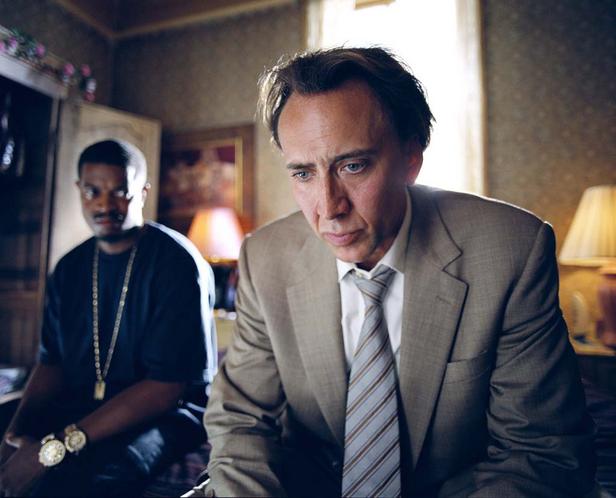
When I heard that Werner Herzog was doing a "reimagining" of Abel Ferrara's over-the-top 1992 Harvey Keitel vehicle Bad Lieutenant starring Nicolas Cage, the last adjective I thought would enter my mind when watching it would be the one that did: conventional.
Actually, that adjective only applies to the first hour or so of The Bad Lieutenant: Port of Call — New Orleans, but even with a glorious cinematic madman such as Herzog at the helm and an actor with a penchant for extremes such as Cage in the lead, this take doesn't come close to touching the 1992 version, which I was never that big a fan of to begin with.
This version is set "in the aftermath of Hurricane Katrina," though it's hard to see why since aside from the opening scene where Cage's Terence McDonagh saves an inmate from a flooding jail cell and severely injures his back, it never comes up as an issue again and very little of the places the film takes place in shows signs of the disaster. It seemed particularly odd to me coming so soon after I had just watched the first three episodes of the great new HBO series Treme, which begins in New Orleans three months after Katrina.
McDonagh's heroism not only leaves him with a lifetime of back pain but earns him a promotion to lieutenant and the cravings for any sort of drug that might make the pain go away, though it seems more likely that he prefers the crack, cocaine, heroin, pot and pills just so he can act crazy as the film requires and up the ante on his gambling addiction.
While I wasn't a huge fan of Ferrara's earlier film, what made that film more worthwhile, other than Keitel's fearlessness in his go-for-broke performance, is that Keitel's bad cop started out corrupt, drug addicted and a gambling fiend. However, that film's central case, the brutal rape of young nun in a church sparks Keitel's character on a journey not only to solve her case but to seek his own redemption.
In The Bad Lieutenant: Port of Call — New Orleans, the central case of the drug-related slayings of an immigrant family plays almost as an afterthought, an excuse just so McDonagh can run wild through various encounters with lowlifes and power brokers while trying to protect his prostitute girlfriend (Eva Mendes). The ridiculous ending, where somehow he bungles into solving all his problems, makes it all the more ridiculous. Cage certainly can be entertaining in the film at times, but it all adds up to a big case of "What's the point?"
The film also manages to wastes the talents of Brad Dourif as a bookie, Jennifer Coolidge as Cage's stepmom and Val Kilmer in a truly thankless role that does little more than present more evidence that his reputation of being such a pariah to work with has made him have to settle for thankless roles such as this.
Not only did this film need not be made, it is a true disappointment coming from a director of the caliber of Werner Herzog. As I sat through this, all I could picture in my head was a vulnerable, nude Harvey Keitel, arms outstretched, walking toward the camera in tears. Its not an image I particularly wanted to have, but I could relate to why he was crying.
Tweet
Labels: 00s, Herzog, Keitel, Meg Ryan, Nicolas Cage, Remakes, Treme, Val Kilmer
TO READ ON, CLICK HERE
Thursday, October 18, 2007
The Close-Up as Revelation: The Moral Imperative
BLOGGER'S NOTE: This post is part of the Close-Up Blog-a-thon being coordinated by Matt Zoller Seitz at The House Next Door.

By Odienator
Why is this man smiling?
Chris Knight (Val Kilmer), the wisecracking hero of Martha Coolidge's Real Genius has just suffered the biggest disaster of his academic career. The laser he and his best buddy Mitch have staked their grades on has just disintegrated, courtesy of their archenemy Kent's shenanigans. The cocky protagonist is devastated by the loss, for he knows his future is gone with the wind.
In fact, mere seconds before this moment was captured, Chris looked like this —

— and had a more natural reaction to watching his college degree burn up with that laser: He kicked and punched the walls in the common area of the dormitory, knocking open the freezer door and freeing the means to his salvation. As he stares down at the cylinder of frozen nitrogen rolling across the floor, his dour expression transforms from misery to exaltation. Coolidge keeps her camera on Chris' face as it registers the epiphany that will allow him to graduate AND ensure that his former laser did not die in vain. It plays out in real time, and Kilmer's eyes reflect his hallelujah moment. You can see his lost confidence returning — this is how Chris Knight Got His Groove Back. He starts to giggle, then launches into a dance of pure joy. He runs into Lazlo, the guy who lives in his dorm room closet (don't ask) and says "I'm going to graduate!" He's also going after Kent, because as he explains to Mitch, "It's a moral imperative to get revenge on Kent."
For more on Real Genius, go here.
Tweet
Labels: 80s, Blog-a-thons, Meg Ryan, Val Kilmer
TO READ ON, CLICK HERE
Friday, August 17, 2007
A Girl's Got To Have Her Standards

By Odienator
When first released, Real Genius was marketed as a teenage sex comedy "from the writers of Police
 Academy and Bachelor Party." This was to draw teenagers familiar with those R-rated comedies to the theater. However, most teenagers looked in the lower left hand corner of the poster and realized Tri-Star pictures was trying to pull a fast one: This was rated PG. With the fresh paint still drying on the new PG-13 rating, teens knew PG was the kiss of death. You might see some kissing, and you might see some death. What you weren't going to see was what happened after the kissing, or the gory details of the death. After all, raunchy begins with R. So does Revenge of the Nerds.
 Tri-Star next marketed the film as the revenge of one nerd. "When he gets mad, he doesn't get even...he gets creative" says the tag line on this poster. The he in question is Val Kilmer, and though many may have found him cute or even amusing with his bunny slippers and the alien headgear that was ubiquitous back in 1985, he still was smiling on a poster for a PG-rated teenage sex comedy. Teenagers stayed away in droves, opting instead to see The Breakfast Club, an R-rated John Hughes movie.
I'll bet they were surprised to discover there's more sex in Real Genius; Hughes' R was for language.
Despite the perverted pedigree of its writers Neal Israel, Pat Proft and Peter Torokvei, Real Genius is closer to WarGames than Porky's. It is somewhat a revisionist teenage comedy. Most flicks of this ilk pit the geeks/nerds against the jocks/popular kids, with the latter doing everything it can to make life miserable for the former. Real Genius presents us with a universe where everyone's a nerd, then proceeds to fracture it down the same middle as every other '80s teen comedy. The heroes are "nerds" and the villains also are nerds. I didn't find this hard to believe; in 1985 I was a senior at a gifted and talented high school, i.e., one full of nerds. We had the nerd nerds and the jock/popular nerds. Our world was bizarro in that it followed the same dichotomy of a regular high school despite having only one side of it.
Real Genius' other difference is that it takes place on a college campus like Cal Tech, where the teenagers are more concerned with getting a good grade than getting laid. Everything else follows the genre convention: there's a victimized hero, a cool kid who takes him under his wing to help him achieve his goal, and a mean villain whose comeuppance the audience greatly desires.

The primary villain of the piece is a senior named Kent Torokvei (Robert Prescott). In addition to sharing the last name of one of Real Genius' writers, Kent has 2-liter Coke bottle glasses, little fashion sense and a mouthful of braces. He has a group of yes-men who follow him around, laughing at all his jokes and his cruel putdowns of other students. His favorite color is yellow and he looks like a younger version of the character Philip Seymour Hoffman played in Todd Solondz's Happiness. He is a chronic masturbator and a rather sadistic piece of work. He is in service to a much older character who is the more dangerous villain of the piece. He's the lead guy on the school project that will guarantee him the job he wants after graduation — at least until our hero shows up.

Mitch (Gabe Jarrett) is a 15-year-old wunderkind recruited by the college as one of the few high school students ever to attend the school. He isn't the youngest, however. "We had one 12-year-old, but he cracked under the pressure," reveals Dr. Jerry Hathaway (William Atherton), the aforementioned older, more dangerous villain. Our hero will be an asset to Hathaway's team, as his science project deals with the properties of lasers. It's a lot less fun than some of the other science projects at the fair, but Jerry is under pressure to build a specific type of laser.
Jerry puts Mitch over Kent in the project pipeline, and it's enough to jump-start Kent's vendetta against Mitch. Kent fears for his future — he doesn't want all the brown-nosing he's doing to go to waste. He picks up Jerry's dry cleaning, teaches his classes and even helps with the construction duties on Jerry's new house, a house Jerry is affording by being in business with some shady dealers.

Mitch is going to need all the help he can get. Enter Chris Knight (Kilmer). Chris is the top student in the school, handpicked by Jerry himself back when he was a freshman. Chris and his pals also are the only people in school who realize that grades aren't the only important thing in college life. He has a sense of humor, a thing against authority, a mischievous streak and active hormones. Jerry puts Mitch into Chris' room so that Chris can get him up to speed on the project and help him acclimate to dorm life. Mitch is somewhat in awe of Chris, whose reputation precedes him. Chris' goal is to get the stick out of Mitch's butt and convince him to bend the rules and have a little fun. Chris and his cronies do science-oriented mischief such as turning the entire dorm hallway into an ice skating rink and using laser splitters to invite their sex-deprived fellow students to a tanning invitational filled with bikini-clad beauticians-in-training. Said invitational occurs in a lecture hall that has been turned into a swimming pool complete with water slides.
It's at the tanning invitational that Mitch has a second run-in with Jordan (Michelle Meyrink), Real Genius' love interest. Jordan has the hairstyle Meryl Streep robbed for that "dingo-ate-the-bay-bee" movie,
 talks a mile a minute, is so hyper she knits sweaters and sands the floor in her room, and is so preoccupied she fails to realize on their first meeting that she followed Mitch into the men's room. "Are you peeing?" she asks while Mitch tries to cover his indecent exposure. At the invitational, Mitch isn't holding his exposed penis, so he is more comfortable and confident talking to Jordan. The two connect while testing out her underwater breathing apparatus. Everything is going swimmingly until, of course, Kent shows up to ruin things. Mitch and Chris are supposed to be in the lab, so Kent interrupts Jerry's public access science show (on the wonders of the human colon!!) to tattle on them. Jerry finds Mitch in Jordan's company and chews him out, telling him he's too immature to be in college. Mitch panics and calls his parents, unaware that Kent is recording the conversation. This leads to the single most painful sequence in Real Genius, where Mitch is publicly humiliated by Kent. Kent plays Mitch's embarrassing call to the entire student body, and the pain on Mitch's face feels palpably real.
However, Kent's plan to get Mitch to leave backfires; Mitch and Chris bond over their desire to avenge Mitch's honor. Chris tells Mitch his story of coming to the college and realizing that, after three years of keeping his face in the books, he realized that he had missed out on all the fun things that make college great. This pep talk makes Mitch smile, especially the part that goes "we have to get revenge on Kent. It's a moral imperative." This isn't the revenge alluded to on the poster however — that comes later.

Mitch then asks Chris about the mystery man whom he has seen several times. The bearded man enters the room, acknowledges Mitch's presence, then says nothing before entering their closet. When Mitch opens the closet door, the man is gone and the closet looks untouched. There are no secret doors or compartments. The guy just vanishes. Mitch's attempts to catch him or interact with him all fail. "Oh, that's Laslo," Chris says matter-of-factly. "He used to be the No. 1 guy here." Where Laslo goes when he enters the closet, I'll leave for you to discover, but it might explain how R. Kelly came up with his "Trapped in the Closet" series. Since there are no extraneous characters in Real Genius, expect Laslo to assist in the aforementioned poster-predicted revenge.

Meanwhile, Jerry cracks under the pressure of his shady benefactors. They are from the government and they want the laser his student team is trying to create so they can use it to fry enemies from space (this is depicted in the hilarious minimovie that opens the film). When Chris is summoned to Jerry's, he encounters the government guys and a very hot looking young woman who turns out to be the daughter of one of the agents. "If there is anything I can do for you," Chris begins, "or more importantly, TO you, let me know." "Can you hammer a six-inch spike into a board with your penis?" she asks. When Chris answers that he cannot, she says "a girl's got to have her standards."

Dr. Jerry Hathaway also has standards, and when Chris can't commit to the accelerated time frame for the laser, Jerry tells him he'll never graduate from the school. Now it's Mitch's turn to give his mentor and best bud a pep talk. He finds Chris outside their window meditating on the words of the great Socrates, who said...I drank what?!" Mitch gets Chris to meditate on the words of Chris Knight: "We have to get revenge on Dr. Hathaway. It's a moral imperative." He and Mitch bust their asses to get the laser working, and when they do, all seems right with the world. This being an '80s teenage comedy, we know this is a short lived nirvana. Kent shows up to sabotage things once again, and though Chris has a last minute epiphany to save the laser Kent destroys, he still vows more revenge on Kent.
So far, there has been so much revenge-vowing in Real Genius that one expects Charles Bronson to show up. Instead, Laslo does, interrupting the team's celebration to ask "why would they need a laser this powerful?" The guys ponder it a moment, then realize they've been used to create a weapon of mass destruction. More revenge vowing ensues!

When the gang finds out the laser has been taken from their lab, they execute revenge plan No. 1 on Kent, who tells them where Jerry has taken it. Revenge plan No. 2 has Chris and Mitch sneaking into the military base while Jordan and Laslo stay behind to hack into the computer to help them. Posing as older military scientists, Mitch wears aging makeup he got from Jake Gyllenhaal's makeup artist on Brokeback Mountain. Somehow it works, and the guys leave a nasty little surprise for Jerry and his benefactors. The bad are punished, the good get avenged, the right people hook up with each other, nobody dies, and everyone who deserves it lives happily ever after. Just like every other teenage sex comedy in the '80s.

Real Genius is a smart movie. Unlike most films of the time, it demands that you pay attention. There are multiple things going on in the plot, and a throwaway line by Jerry early in the film pays off wonderfully in the end for those who have paid attention. Martha Coolidge directs and manages to keep tone despite the film being a pastiche of paranoid government plot movies, science fiction movies, buddy movies and comedy of the high and low variety. It's telling that women directed the best teenager-oriented movies of the '80s, and I'd like to think this is the reason women play a bigger part in this film (and Fast Times at Ridgemont High) than they normally do in this genre.

For example, Jordan plays a major role in the film, and though she is not exactly Phoebe Cates, she is allowed to be not only brilliant but also the object of a young man's desires. Late in the film, Mitch finds the very sexy Patti D'Arbanville in his room. She offers him what Patti D'Arbanville offers you in movies. It appears that Mitch is going to lose his virginity to her, but shortly after the scene ends (remember, this is PG), Mitch appears in Jordan's room. He explains "there was a woman in my room!" Jordan asks, "Did you make it with her?" Mitch says "I wanted to, but I wanted to with you." Jordan pauses, and you can see her hyperactive brain wrapping around this concept. "Oh," she says. It is a perfectly calibrated moment, filmed in closeup by Coolidge so you can see Meyrink thinking. I doubt a male director would have done it this way.

Of course, I could be wrong; three men wrote this film and their screenplay is full of hilarious lines that are almost underplayed by the actors. The one-liners have an almost Steven Wright air about them (the Socrates line had me stumped at first, then I laughed out loud 10 seconds later when I got it) and Kilmer delivers them with impeccable comic timing. Israel, Proft and Torokvei also allow their characters to be more than just genre types. Each has a story and is filled in with three-dimensional detail. Chris runs through a myriad of emotions despite being the resident comedian in the picture; Kilmer invests his scenes of anger and elation with a scary intensity — Chris is allowed to be real to us. Each character, even Kent and Jerry, act in ways we can understand and identify based on the story and their character arc.

The acting also is first rate. Gabe Jarrett gives Mitch an uncertainty about himself that makes you want to be his mentor and pal. Atherton gives us a villain whose motivation, no matter how wrong-headed, seems plausible (and he apparently can hammer a six inch spike through a board with his penis). Jonathan Gries adds mystery to Laslo at first, and then a bit of real pain when he realizes that the vicious cycle of the college making things that kill people is happening again. He gets the biggest reward in the picture, even if his calculations are off. Everyone is very good, but this film belongs to Val Kilmer.
This was Kilmer's second movie, coming after 1984's ZAZ-comedy Top Secret! In that film, Kilmer was loose and hilarious as Nick Rivers, a singer not unlike Elvis who winds up in a World War II movie. Kilmer sings and dances and tosses off every joke without a hint of the glum self-seriousness that marred some of his later work. In Real Genius, he knows how to play every note and every line. There is a lot of scientific mumbo-jumbo in the script and Kilmer actually sounds convincing spouting it. He is even funnier here than in Top Secret! and I wish he'd do more comedy. Sparks of the comedic side of Kilmer show up occasionally in movies such as Kiss Kiss Bang Bang, but I don't think he's ever been looser or better than in Real Genius.
At the end of the film, Chris' pal asks, "Do you think it's getting too weird around here?" "Absolutely," Chris says as Tears for Fears' "Everybody Wants to Rule The World" plays on the soundtrack. The last scene of this film drives that statement home, and looks like so much fun I wish I could have been there to partake in it. They must have used tons of this stuff.

There's a twist on the adage that goes "the geek shall inherit the earth." I doubt that, but they do inhabit one of my favorite movies of my coming-of-age years.
Tweet
Labels: 80s, Elvis, J. Gyllenhaal, John Hughes, Meg Ryan, Movie Tributes, P.S. Hoffman, Streep, Val Kilmer
TO READ ON, CLICK HERE
Tuesday, January 24, 2006
I like to watch — and watch — and watch — and watch
I summoned the ghost of Chauncey Gardiner from Being There for the title of this post, because I want to look at a specific type of movie. Not the greatest or even necessarily your favorites, though they can often overlap, but movies that just seem infinitely watchable. If you stumble upon them on TV and you are bored, you may stick around until the end just because they are so damn mesmerizing.
Several films on my 10 best of all time list fit this criteria: I never seem to tire of Casablanca, Dr. Strangelove, Goodfellas, Network or Rear Window.
However, look at some of the other great works by the directors there: I can't say I could watch Kubrick's 2001: A Space Odyssey over and over again and A Clockwork Orange actually weakens on repeat viewings. While I love Goodfellas and can watch it repeatedly, there is a limit to how many times you can sit through Scorsese's Raging Bull or Taxi Driver. A lot of Hitchcock's works could fall into this category (I'm thinking especially of North by Northwest), but who really wants to watch Vertigo or Psycho on a daily basis?
There are many great films not on my all-time list that are ones whose greatness you can recognize but that you aren't inclined to revisit frequently. Steven Spielberg's Schindler's List is a great example. There's only so much of it you can take, but I never tire of Jaws, which when push comes to shove I still think is Spielberg's best movie.
While Sidney Lumet's Network is on my all-time list, he has another title that in many ways is even more watchable. If I ever stumble across Dog Day Afternoon, I inevitably have to stick it out to the end. The fascinating thing is that you can't always quite put your finger on why these films affect you like this.
So, in no particular order other than the one in which they cross my mind, I'd like to toss out some movies, some great, some merely good, that I think have a special magnetism that draw me back for more looks.
Duck Soup and Horse Feathers: A lot of the early Marx Brothers fit this category, but these two are my favorites and I think show them at their zenith of zaniness.
His Girl Friday: In my opinion, one of the greatest comedies of all times by Howard Hawks, one of the most underappreciated directors of all time. Cary Grant and Rosalind Russell sparkle in the rare example of a remake of a good movie that's actually better than the original. Remember — keep the rooster story, that's human interest.
It's a Wonderful Life: Part of this may be because of the pure repetition in which it was shown back in the days it was in the public domain, but if I stumble upon its less-frequent showings now, I still have to watch. I think part of the reason is that it's not really the Capra-corn it gets credit for being. There is a darkness here too, a darkness I think Hitchcock may have picked up on when he started using Jimmy Stewart soon after. At its heart, while it's inspirational, it's really about a man who gets screwed over time and time again —
and that's why it works. George Bailey is a 1940s Job.
Singin' in the Rain: Arguably the greatest movie musical ever, it never grows old.
The Manchurian Candidate: Of course, I refer only to John Frankenheimer's original classic, not Jonathan Demme's modern travesty.
The Godfather: For me, this only applies to the original. Part 2 is good, but doesn't cast the same spell and as for Part 3, let's not talk about that one.
The Sting: Seeing this is one of my earliest memories of seeing an "adult" movie in a theater. While I'm sure I didn't quite comprehend it at the time, I think Marvin Hamlisch's reworking of Scott Joplin helped it work its magic on me forever after.
Smokey and the Bandit: Somewhere deep in my movie critic's mind, I know this isn't that good a movie, but I can't help it. It cracks me up, especially an uncut Jackie Gleason. If they didn't stop the film for the romantic rendezvous between Burt Reynolds and Sally Field, it never would have slowed down and that would have suited me fine.
Tootsie: There was a time in my youth, when I used to think that E.T.: the Extra-Terrestrial was the best film of 1982, but when you return to these two now, it's hard not to laugh (in a bad way) at some of E.T. while Tootsie just gets better and better
Terms of Endearment: I'm sure many would argue with me, but I love this movie and never grow tired of it — and odds are I'll bawl every time too. As a sidenote, I'd like to present my longtime argument against the term known as "chick flick." There is no such thing. There are good movies, bad movies and those in between. By trying to label something a chick flick (or a guy flick), it implies that all members of one gender will like something because of the genitalia they were born with. It's also too often used as an excuse to try to explain away criticism of lesser films. Terms of Endearment is a great film, Beaches sucks and gender has nothing to do with my assessment of either.
Real Genius: Here's the movie that might be the perfect example of what I'm talking about. If I hadn't rejected the future use of a 4-star rating scale, I couldn't give this anything higher than ***. When it shows up on TV, I have to watch, thanks mainly to Val Kilmer's fun performance. Besides, who can argue with a film whose climax involves a house being destroyed by popcorn?
Broadcast News: James L. Brooks is back again — yet he's never equaled his first two film efforts as writer-director. Of course in the case of this film, part of its appeal to me is because it relates to the business I'm in and I find way too much in common between myself and Albert Brooks' Aaron Altman.
Raising Arizona: Another Holly Hunter offering from 1987. This Coen brothers farce still grabs you and never lets go, all accompanied by that yodeling score. Granted, I think Miller's Crossing is still the Coens' best film and though I eventually grew tired of them (I haven't liked anything after Barton Fink, Raising Arizona is still pure entertainment.
Die Hard: With each viewing, I love this action ride more and more. Sometimes, jokingly, I say it is the greatest film ever made (though I mean it about as much as Pauline Kael probably did whenever she chose Million Dollar Legs). It's got one of the all-time great movie villains in Alan Rickman and a supporting cast seemingly plucked straight out of Asshole Central Casting (Paul Gleason, Robert Davi, William Atherton, Hart Bochner). The amazing thing about this movie to me is that no matter how many times I've seen it, it can still hold me in suspense.
Back to the Future Part II: Granted, the original Back to the Future is by far the better film and certainly is just as watchable as Part II, but for some reason I find this one more fun. Perhaps it's the mind-bending time-bending storyline, where action from the first film is playing in the background while the sequel's story moves along in the foreground. Can't really explain it, but I love it.
Pulp Fiction: I know that this film wears on some viewers, but having just rewatched it recently, Quentin Tarantino's masterpiece still holds me in its clutches just as it did the first time I saw it in 1994.
South Park: Bigger, Longer & Uncut: This is probably the most recent title I would allow on this list. The songs are great, the satire is sharp and it's just damn funny.
Those are all I'm coming up with right now, but please feel free to add your own.
Tweet
Labels: Albert Brooks, Burt Reynolds, Capra, Cary, Coens, Demme, Hawks, Hitchcock, Holly Hunter, J. Stewart, Kael, Lumet, Marx Brothers, Meg Ryan, Rickman, Roz Russell, Scorsese, Spielberg, Tarantino, Val Kilmer
TO READ ON, CLICK HERE


