Saturday, March 17, 2012
Round is funny
This post originally ran as part of The Slapstick Blog-a-Thon held at Film of the Year in September 2007. I've revised the piece slightly to mark the 25th anniversary of the release of the Coen brothers' second feature on March 13, 1987.

They say he's a decent man, so maybe his advisers are confused." — H.I. McDunnough
By Edward Copeland
The frenetic slapstick nature of Raising Arizona doesn't kick in immediately. As it begins, the movie restricts most of its wackiness to wordplay. The first (and I still think the best) instance of the Coen brothers milking laughs by creating dimwitted characters that spout purple prose in thickly painted-on accents, churning out phrases that people such as these never would utter if they existed in the real world. The Coens would recycle that formula many times in films such as Fargo, O Brother, Where Art Thou? and the ill-advised remake of The Ealing Studios classic The Ladykillers, having Tom Hanks assume Alec Guinness' memorable turn by impersonating Colonel Sanders. However, the Coens never would go that route with as much hilarious and charming success as they did in Raising Arizona, which holds up strongly 25 years later.

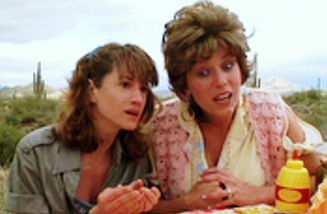
What impressed me first when I saw Raising Arizona a quarter-century ago was its opening prologue, which lasts a full 11 minutes before the title even appears. It's an amazingly efficient 11 minutes as well, setting up nearly all the main characters and situations. We meet habitual convenience store robber H.I. McDunnough (Nicolas Cage), whose parole board he frequently visits (and which frequently frees him) warns that he's only hurting himself with this "rambunctious behavior." We also meet his prison friends Gale and Evelle Snoats (John Goodman, William Forsythe). Most importantly, we meet the police officer who takes H.I.'s mugshot and prints each time he returns to prison. The
 officer goes by the name Ed, short for Edwina (Holly Hunter). We get to see the attraction grow between her and H.I., especially after Ed's fiancé dumps her and, during one of his releases, H.I. finally works up the courage to ask Ed to be his bride, even though he'd previously said, referring to his chosen profession of armed robbery, that "sometimes your career comes before family." Unfortunately, family doesn't seem to be in the offing for the McDunnoughs as they learn from doctors that Ed's "insides were a rocky place where my seed could find no purchase." That bit of narration from H.I. perfectly illustrates what I mean about the contrast between the characters' character and their speech. In Raising Arizona, the Coens excel at crafting this type of incongruous dialogue. The brothers followed up with two completely different films — Miller's Crossing and Barton Fink. After that, they tended to keep returning to a formula of dumb characters speaking flowery language in plots usually involving kidnapping and/or murder.
All that comes later. Today, we're praising when it worked in what was just their second feature. At the same time that the childless McDunnoughs are beginning married life, furniture kingpin Nathan Arizona (the late Trey Wilson) and his wife, thanks to fertility drugs, end up having quintuplets which prompts Nathan to remark is
 "more than they can handle." It gives Ed the idea that perhaps it would be OK if she and H.I. just took one of the five off the Arizonas' hands so she and H.I. would have a little one to raise as their own while they eased the Arizonas' burden at the same time. That's where the madness truly begins. What's remarkable about the Coens' work in Raising Arizona is that it's not just pure slapstick, but a brilliant blending of slapstick and suspense, beginning with the first outright slapstick sequence as H.I. climbs through the window of the Arizona household to try to snatch one of the infants, setting off a tense comic scene of toddlers gone wild. Set to Carter Burwell's musical score, which has more than a passing resemblance in this scene to John Williams' theme from Jaws, the babies roam, one perilously approaching the steps leading downstairs. You can't decide whether to laugh uproariously or in fright. Once the stolen baby rests comfortably in the McDunnoughs' trailer, things get really complicated.
 H.I.'s prison buddies Gale and Evelle literally burst through the mud outside the prison and escape, or as Evelle puts it, they released themselves "on their own recognizance." After briefly cleaning themselves up in a gas station rest room (Dr. Strangelove fans, check the
 acronym that's been spray-painted on the bathroom stall's door), the brothers arrive at H.I.'s trailer, looking for a place to stay and insisting to Ed that they "don't always smell this way." The police officer in Ed doesn't like fugitives in her family's home,
 even though she herself is a felon now, albeit a good-intentioned one. Another complication arises with a visit from H.I.'s boss at work, Glen (Sam McMurray), his wife Dot (Frances McDormand) and their seemingly endless stream of diabolical children. "Mind you don't cut yourself, Mordecai" and "Take that diaper off your head and put it back on your sister" are just two of the many things Glen yells as his brood goes wild. While Dot rapidly lectures Ed on the need for insurance, avoiding orthodontic work and making sure the baby stays up to date on his "dip-tet boosters," Glen confides to H.I. that Dot wants another one, because these have grown too big to cuddle, but something has gone wrong with his semen. H.I. tries to lie about how he and Ed got to "adopt" a child so fast, but more trouble arises when Glen suggests to H.I. that they swap wives because he and Dot like to swing. H.I. punches Glen, who takes off like a madman and runs smack into a tree. Glen flees H.I., telling him not to bother coming into work anymore and promising to sue.
From that moment on, Raising Arizona essentially becomes an extended free-for-all chase. Since H.I. figures that Glen will make good on his word and fire him, he finds himself passing by convenience stores again "that weren't on the way home." Ed puts her foot down and wants Gale and Evelle gone. "I'd rather light a candle than curse your darkness," Gale tells H.I., while trying to convince him to help with a bank robbery. H.I. declines, but with Ed and the baby in the car, he does proceed to rob a convenience store for money and Huggies, setting off a loopy, more than five-minute long pursuit sequence. A pissed off Ed drives off with the baby, leaving H.I. to escape on foot. The Coens' hyperkinetic camera doesn't stop for a second as it rolls through groceries, streets and houses while clerks and dogs join the H.I. hunt.

Of course, the deadliest pursuit has yet to occur. H.I. already has had visions of a strange biker who takes no mercy on anyone or anything, and the vision turns out to be Leonard Smalls (Randall "Tex" Cobb), a self-described tracker, "some say hound dog." He meets with Nathan Arizona and offers to find his boy, but for a higher price than the reward the furniture magnate has offered. Arizona refuses, but Smalls insists he'll find the baby anyway and take whatever price "the market will bear." Back at the trailer, the chaos escalates as Glen figures out where H.I. and Ed got the baby and demands they turn the tot over to him and Dot. Before H.I. can even contemplate what to do, Gale and Evelle, who
 overheard the conversation, decide to steal the infant for themselves. Gale and H.I. tear the trailer apart in a residence-wrecking fight that takes place while Evelle shields Nathan Jr. The fugitives prevail and take off with Nathan Jr. with plans to hold him for ransom (and use him as a third man on the bank holdup). When Ed returns home to find H.I. tied up, she frees him and the couple leave to rescue the child, though Ed makes it clear that they aren't good for each other and should split once the baby is safe. The raucous slapstick melees run nearly nonstop after that as the convicts grow too fond of Nathan Jr. to part with him and Smalls arrives to whisk the baby away for his own nefarious purposes, leading to a final showdown with H.I. and Ed. Despite the frenzied pace and over-the-top nonsense, Raising Arizona even manages to conjure some warmth as the film winds down, though perhaps what touched me the most re-watching the film this time is remembering how much I loved the Coen brothers back then, until I felt their career went off the rails beginning with The Hudsucker Proxy. At least their upcoming film, No Country for Old Men, shows some promise as the vehicle marking their return to filmmaking I love instead of just doing variations on the same gags and gimmicks that I still love in their first four films, but has grown old by now.
From top to bottom, all the actors hit exactly the right notes for the movie. Forsythe and Goodman make for a hysterical pair of not-so-swift criminals. Cobb displays just the right amount of menace to remain a cartoon without pushing the film off its comic tone and into a terror mode. The late Parker gets some great material as Nathan Arizona as well as when he yells at the multitude of cops loitering at his house. "Dammit, are you boys gonna chase down your leads or are you gonna sit drinkin' coffee in the one house in the state where I know my boy ain't at?" Even the small roles of bank customers and store owners get priceless moments, especially Charles "Lew" Smith who plays the store owner who utters the response that gives this post its title when Evelle asks a question about some balloons. Cage still was in the early years of his career and Arizona marked the middle film of a three-film run of great Cage performances that started the year before with Peggy Sue Got Married and would concluded later in 1987 with Moonstruck. The breakout actor though was undoubtedly Holly Hunter as Ed. Hunter had appeared in a handful of films and TV movies, but Raising Arizona gave Hunter her biggest exposure so far, but it was just an appetizer for the gourmet meal Hunter would serve fans of great movies and acting in December 1987: Broadcast News.
UPDATE March 17, 2012: As we now know, my hopes for No Country for Old Men ended up being more than fulfilled. That same year, the brothers wrote and directed "Tuileries," one of the best shorts in the great compilation film, Paris, je t'aime . The Coens took a minor step backward with the so-so Burn After Reading that came next. However, the next movie they made ranked as one of their all-time greatest. A Serious Man also introduced me to the great actor Michael Stuhlbarg, who had mostly toiled upon the stage but would go on to impress me in a completely different type of role than his Larry Gopnik in A Serious Man when he became 1920s gangster Arnold Rothstein on HBO's Boardwalk Empire. Most recently, the Coens accomplished that rare feat of remaking a film and producing a greater version. Granted, the original True Grit wasn't a masterpiece, but it did contain John Wayne's Oscar-winning role as Rooster Cogburn which Jeff Bridges took on, easily besting the Duke. What really made the Coens' True Grit exceed the 1969 film version was young Hailee Steinfeld playing Mattie Ross. Yes, the Coens I loved early in their career have matured and returned better than ever. It's good that they can produce great works again and we continue to have their older classics such as Raising Arizona holding up after 25 years.

Tweet
Labels: 80s, Blog-a-thons, Boardwalk Empire, Coens, Guinness, Hanks, Holly Hunter, Jeff Bridges, John Goodman, John Williams, McDormand, Movie Tributes, Nicolas Cage, Oscars, Remakes, Wayne
TO READ ON, CLICK HERE


Friday, May 06, 2011
As good as he seems to get anymore

By Edward Copeland
Last year's How Do You Know is the first feature James L. Brooks has written and directed in 23 years that almost works. Actually, I'm just being kind because I still have affection for the man. What the hell happened to him that I have to rate his work now on how much more or less painful than Spanglish it is?
Brooks wrote and directed two of my favorite films, Terms of Endearment and the even better Broadcast News. He also produced films such as Say Anything, The War of the Roses and Bottle Rocket. On television, he co-created The Mary Tyler Moore Show, Taxi and The Simpsons.
So went wrong? It's not that the movies he's made since 1987 were without charms. I enjoyed many parts of the de-musicalized I'll Do Anything starring Nick Nolte, but it was a miss (even though I'd still love to see those cut musical numbers. DVDs were invented for extras like that.)
As Good As It Gets had very good performances by Jack Nicholson and Greg Kinnear, but the storyline was very unfocused and the film as a whole was sunk when it hit the iceberg known as Helen Hunt's Oscar-winning performance, with its Bronx accent that would appear, then disappear, then reappear, then turn into some other sort of accent altogether. Supposedly, the point was that her character makes Nicholson's a better man. Honestly, I imagine she would add to his mental problems.
Then came Spanglish. Adam Sandler is unbearable enough in his comedies that give lowbrow a bad name, but somehow he becomes even worse when he tries to play it straight and serious as he does in Spanglish. What makes this mess of a movie even more of an amazing achievement (in a negative way) is that Sandler isn't its most annoying character. That title goes to Tea Leoni as Sandler's messed-up wife Deborah who fluctuates between shrew, politically concerned citizen, manic depressive and so many other troublesome traits I'm surprised her character wasn't named Sybil.
Coming from Brooks, who created or brought to the big and small screen so many great female characters such as Holly Hunter's Jane Craig in Broadcast News, Shirley MacLaine and Debra Winger's Aurora and Emma in Terms of Endearment and Mary Tyler Moore and Valerie Harper's Mary Richards and Rhoda Morgenstern on The Mary Tyler Moore Show and Rhoda, to name a few. As A.O. Scott wrote in his review of Spanglish, describing Leoni's Deborah:
...Deborah, a creature whose flailing awfulness goes beyond the requirements of comic villainy and exposes an ugly, punitive strain of misogyny at the heart of a movie that basks in its own sense of decency. Coming from Mr. Brooks, this is more than a little shocking, since strong, interesting, complicated women have been something of a specialty for him.
The longer you get away from your viewing of How Do You Know, the more it dissipates in your mind, but while you watch it, it's pleasant and entertaining enough not to cause the viewer anguish. Much of the credit for this shouldn't go to Brooks' screenplay, but to the charming presences of stars Reese Witherspoon, Owen Wilson and, most particularly, Paul Rudd.
Rudd and Witherspoon really have the lead roles of How Do You Know in parts that run on parallel tracks for much of the film while Wilson serves a mostly supporting function.
Witherspoon stars as Lisa, a legendary member of the U.S. Olympic softball team, but she's aging (all of 31!) and though she's worshipped by her younger teammates, the new coach (Dean Norris, Hank on "I can't wait until July" Breaking Bad) decides it's time to cut her loose. On the rebound. she throws herself into dating Matty (Wilson), a hugely successful Major League Baseball player who always offers a fun time but who doesn't seem to have an idea about the concept of monogamy.
Rudd plays George, who has the top job at his father Charles' financial firm, though one gets the impression that George functions largely as a figurehead while those below him and his father (Jack Nicholson) above do the heavy lifting. This changes when he's hit with a federal subpoena indicating that George may be the target of a criminal investigation. The screenplay keeps the details very sketchy but it's obvious early on who is really responsible for wrongdoing, especially by the constant hints his very pregnant assistant Annie (Kathryn Hahn) keeps trying to make.
The unraveling of George's life does serve as a catalyst for him to start doing things differently, especially after his girlfriend (Shelley Conn), who never had any interest in his life anyway, dumps him when his legal problems start, promising to return when they are over.
What starts as a strange call where George apologizes to Lisa for not calling to ask her out because a mutual friend gave him her number later turns into the predictable platonic path between the two as Lisa tries hard to make it work with Matty. The steps of the film aren't surprising in the least and Brooks really doesn't come up with any lines close to the classics he produced in his first two films as a director, but Rudd, Witherspoon and Wilson make it watchable. (Hahn deserves kudos as well.)
Nicholson, who remains one of my all-time favorites and has been served well by Brooks, who directed him to two Oscar wins and a fun extended cameo in Broadcast News, seems adrift in How Do You Know. Except for his speech that was played to overkill in ads and trailers about how he can't trust himself not to manipulate his son and that he could be doing it right then.
Rudd, who finally broke out once he pretty much devoted himself as a comic actor, keeps How Do You Know going. He can get laughs just from facial expressions, as if his face were made of rubber. Witherspoon and Wilson also have moments, but Rudd helps you forget while you watch that you know everything that is going to happen and the film lacks inspiration.
I've already forgotten most of How Do You Know and it's highly unlikely that I'll ever see it again, but at least it's no Spanglish.
Tweet
Labels: 10s, Breaking Bad, Debra Winger, Holly Hunter, MacLaine, Nicholson, Nolte, O. Wilson, Oscars, Paul Rudd
TO READ ON, CLICK HERE
Thursday, April 07, 2011
The Larry Sanders Show Season 3, Part 1

By Edward Copeland
In a way, the beginning of the third season of The Larry Sanders Show reminds me of the beginning of the second season of The Sopranos. With the cliffhanger devised for the second season ender, with Larry abruptly quitting the show and moving to Montana, it left all the various characters scattered (in theory at least). The Sopranos faced a similar dilemma in that it had pretty much resolved its central conflict with Uncle Junior, then in jail, Livia incapacitated and Tony and Dr. Melfi's relationship severed for security reasons. As a result, they had to spend time getting all the players back together again. Larry Sanders had a much easier time pulling this off (one episode) and with the departure of ex-wife Francine, the show now focused exclusively on the workplace and got even better, giving each member of the ensemble more chances to shine. The series still had a 17-episode load to carry, one less than the year before, and it took a few episodes for it to hit its stride again, but once it did... Because so many other projects and health factors kept eating into my chances to get back to the Larry Sanders project and left days without copy, I decided to split this season into two parts, since I've had the first nine episodes done for so long.

The first episode finds Larry still cloistered in that Montana lakeside cabin where he is watching tapes of old episodes of the talk show. He hears the approach of a car and quickly hides the cassette inside a cabinet full of tapes as if he's trying to keep a secret stash of porn. The arrival is Artie and he asks Larry if he's got any vodka, but Larry says all he has is Snapple, but the resourceful producer has brought his own ingredients for his beloved salty dogs. Larry heads to the kitchen for glasses and it doesn't take long for Artie to find the stored cassettes.
At first, Larry tries to keep up the illusion that moving to Montana is the best decision he's ever made but once Artie tells him he saw the tapes, Larry caves and says he's miserable and there must be a way to get the show back. "I knew you wouldn't be happy here," Artie tells him. "You are a talk show host. You are like one of those goddamn creatures out of Greek mythology — half man/half desk."
Artie's first suggestion is that they come up with the story that Larry had to leave so abruptly because he had a drug addiction and he's spent the last three months in rehab, but Sanders wisely suggests that they should save that for when he has a real drug problem. Artie has another ace up his sleeve though: It seems the network is suing him for breach of contract, so they can make it look as if they forced him to go back on the air and he can save face. Larry is eager to go back immediately, but Artie suggests keeping it low profile, so he doesn't seem desperate. Artie will fly back alone first. Of course, Larry can't wait to leave Montana so he actually takes the same flight as Artie, hiding in coach. Once back in L.A., the big discussion is the book The Late Shift by Bill Carter about the behind-the-scenes gameplaying around the time of Johnny Carson's retirement. Sanders can't believe Jay Leno hid in a closet to hear what NBC execs were saying about him. He wonders who could be that desperate to know what's being said about them, stopping to ask if anyone's talking about how little he's mentioned in the book. "Everybody's talking about it," Artie tells him.
For the most part, the staff has been doing very little for the past three months. Hank has been making do by drawing the lottery numbers for the state and adding "Say now" since "Hey now" is considered the intellectual property of The Larry Sanders Show. As Larry goes to gather the rest of the staff (something Artie specifically told him not to do), he finds that he never fired Beverly so his business manager has still been paying her the past three months. Paula, now a blonde (dammit, my Janeane should be a brunette!), is entertaining an offer to be an assistant producer at Late Night With Conan O'Brien. When Larry asks Phil what he's been doing, he says, "Jerking off. See you Monday." Darlene tells Sanders that working for Hank was the most rewarding experience of her life, but when Larry tells her that Hank has expressed reluctance about returning, Darlene seems fine about coming back as long as there is some kind of sidekick.
It may all be for naught though because the network's new owner Richard Germain (David Warner) basically sued only to save face himself. They've been doing fine filling his time slot with Cheers reruns, beating Leno even, and he really doesn't want to put the show back on. His attitude forces Artie to take him into his office and resort to Plan B. He tells Germain that he has a confession. Before Artie can spin his web of bullshit, Germain guesses that he and Larry are lovers. Artie is taken aback momentarily and asks why he would think that. "I don't know. Something about the dynamic." He then tells Germain that Larry left so abruptly because he'd developed an addiction to pills and had spent the past three months in rehab to spare the network embarrassment. Germaine says that explains the weight gain and asks if he's clean now. "As clean as Louie Anderson's dinner plate."
Germain makes a few demands, but he ultimately agrees and The Larry Sanders Show returns to the air, though Artie does have to slip Larry some pills to calm him down over all the turmoil.

Paula, Darlene and Phil are gathered around the break room reading a report that Larry may have survived Round I of the late night wars and drug rehab, but rumors are circulating that a Montana woman is about to file papers claiming he is the father of her unborn child. Beverly chides her fellow employees for believing such tabloid garbage until Paula informs her that it's not in a tabloid, it's in Howard Rosenberg's column in The Los Angeles Times.
Larry comes in and asks the staff if there was anything good in the paper this morning and they all say no except Darlene who tosses out that Baywatch was renewed. Larry says, "So no one saw that story about the woman in Montana claiming she's having my baby?" They keep to their denial and he thanks them all for lying through their teeth for him, though he adds that he hopes that part about Baywatch is true.
Artie quizzes Larry about the veracity of the item, but Larry says he hasn't even met someone he's liked in six months, that's why he's so excited about Mimi Rogers being a guest on that night's show. "I get some on a nightly basis," Artie interjects, "and I'm excited about Mimi Rogers." Before the show Hank asks how Larry wants to handle it on the air and he says the same way they did the drunk driving incident in '89. Of course, Hank doesn't remember that that means saying nothing and brings it up, calling the LA Times garbage, referring to the woman as "a loony out there in Montana" and bringing up his own stalker by name. On the commercial break, Artie lays into him and tells him he had to bleep out the name to avoid a lawsuit as great as the big outdoors.
When Mimi Rogers comes on, they resume their flirtation from season one and Larry asks her out, but she's hesitant because of the rumors about the possible paternity suit.
After the show, Hank brings a woman to Larry's office who introduced herself as a long-lost cousin, but it's really Mary Beth Nagler (Tracy Ellis), the woman claiming to be having his baby and she's spacey as all get out. She mentions that Hard Copy is offering her $5,000 to talk to them. Artie accuses her of blackmailing Larry and she bursts out laughing and says she just wanted to let Larry know in case he wanted to do something. "If you move another inch toward Larry, I'll take you down hard," Artie warns her and she laughs giddily again.

Then Twin Peaks fans, Ray Wise pops up to play Larry's lawyer Lloyd Simon. At first, Lloyd advises Larry not to settle, but later when witnesses pop up and Mary Beth provides a detailed description of Larry's penis, he changes his tune. After Lloyd leaves, Artie is shocked that she knows about "little Mickey" and Larry confesses that he never slept with Mary Beth, but he's ashamed of the truth — she gave him a hand job in the parking lot of a Denny's. Hank keeps calling Howard Rosenberg at the Times trying to make up stories about himself to take attention away from Larry, but ends up a subject of ridicule himself in the newspaper. Meanwhile, Mary Beth shows up at Larry's house, ruining his date with Mimi Rogers. Lloyd returns with the good news that they've found the real father and Mary Beth has tried to pull this sort of stunt before and now she's changed her story that she only gave Larry a hand job in a restaurant parking lot. Artie and Larry laugh and Larry says, "Like I'd go to a Denny's." Lloyd says he never said it was a Denny's.
While the third season will eventually turn in to a magnificent one, like the season premiere, this episode is one of the series' weaker efforts, but it does give us Wise playing a lawyer again, even if he isn't Leland Palmer.

"And now because he needs you more than you need him" is the throwaway phrase Hank uses before introducing Larry at the start of the show and damn if it's not the most truthful one ever spoken before the monologue. Showing again the only aspects that date the still-brilliant comedy usually pop up in the monologue, he references the recent breakup of Roseanne and Tom Arnold (though wait until we see how Roseanne plays a role in Sanders' world later in the season). More importantly, this episode really gives Penny Johnson an episode to give her all as Beverly.
Larry expresses concern to Artie that someone has been stealing money from his ATM. Artie asks who has access to his ATM and Larry says his business manager, his assistant, his gardener, his housekeeper..."So technically your account is a slush fund for the entire Pacific Rim," Artie says. Beverly comes in with possible ties for the Friars Roast, but she seems really distracted. She also informs him that Larry's father called and Larry asks her to handle it because he's trying to avoid him, even going so far as to hide in Hank's office to avoid a phone call.
Artie notices that Beverly is playing bloodhound to get Larry to talk to his father and accuses her of badgering Larry, reminding her that he's a grown man. A curt Beverly says that when she took this job, she came under the assumption that she was to do his schedules and return his phone calls, not play family therapist, do his tie shopping and pick the tomatoes out of his salad. Artie tells her that the job is to "keep their little host happy, whatever that takes." "Sometimes I think it takes too much," Beverly replies, "and do you think it would kill him to say 'Thank you' just once?" Artie thanks Beverly from the bottom of his heart.
Beverly finally brings the phone to him in Hank's office and he talks to his dad who tells him he's coming to visit the next day, much to Larry's displeasure.
Jason Alexander guests on the show and Hank apologizes for constantly calling him Kramer, saying he loves Seinfeld so much he kept confusing him with his character. Waiting backstage for Larry after the taping is his father, Jerry Sanders, and for the second episode in a row we get treated to an alumnus of Twin Peaks (and Seinfeld for that matter) as he is played by Warren Frost aka Doc Hayward on Twin Peaks and Susan's father on Seinfeld. (Of course, frequent Larry Sanders director Todd Holland did direct two episodes of Twin Peaks, so perhaps that explains it.)

As Larry strands his dad in his office, Hank goes in and shows him an album of Larry's work, to give him an idea of what his "son does so well" and getting misty eyed that his own father never even saw his first big boat show. Jerry Sanders identifies Hank as a sidekick "like Ed McMahon." He says that it must be a pretty sweet deal. "Take home a big paycheck just for holding down a couch and selling crap," the elder Sanders says. Tambor's reaction is priceless. Hank goes into where Larry is trying on costumes for a sketch behind a screen and tells Artie to get Larry's father the hell out of his office, not realizing Larry is there. Larry says that it's OK and Hank says that Jerry is a big pain in the ass. Larry says there is nothing more frustrating than doing everything for someone and not getting them to say thank you even once. Neither Artie nor Beverly say a word. When Artie and Larry are alone, Artie tells Larry he knows who has been taking his money.
Larry asks Beverly if she knows of any extra expenses this month because $1,500 is missing from his ATM account. She says she took it and if he wanted to know why all he had to do was ask. He says he would never have asked because he never would have thought she would steal from him. Beverly goes on a tirade, saying she didn't steal. She charged him for spending three hours in traffic on a Sunday going to Encino looking for a paint chip for his decorator. She charged him for shopping for his ties. She charged him for getting up at 7 every morning to make sure he got the first batch of frozen yogurt out of the machine. "I'm tired Larry. I'm tired of cleaning your ointment applicators. I'm tired of begging your father to come see your show so you can feel good about yourself," she sighs. Larry, never too far from self-involved, immediately wants to know what his father said when she asked. She leaves and he follows her, asking her if she wants a raise and telling her if there's something she doesn't want to do, have the weird intern do it. She tells him that it's not about money, it's about people who take others for granted and aren't appreciated or thanked. Larry assumes his father has done something else again.
During the next taping, his father actually comes to see the show. The weird intern (French Stewart) also brings him his butt cream during a commercial break. Larry points his dad out on the show and thanks him and then thanks Beverly on the show as well. Though it certainly has laughs, it's of the painful variety, but it's the best episode of the third season so far.

During a meeting discussing scheduling, Artie, Larry and Paula get hit with two big decisions: 1) An earthquake has caused significant structural damage to the ceiling of the studio and engineers recommend moving to another stage for safety; and 2) Danny DeVito backs out of that night's show at the last minute, citing illness and Larry implies guests have been doing this more frequently, making Paula fear for her job if she doesn't get DeVito back.
In private, Larry tells Artie that he doesn't think Paula has the right personality that she's — and it takes Artie several tries at adjectives to get the one Larry is going for — "incapable of putting the performer at ease because she has a basic contempt for the business," Artie finally says to Larry's agreement. Meanwhile, Paula busily works the phone trying to get a hold of DeVito anyway she can. Larry compliments Paula again and she lies and says she has DeVito back. Artie tries to get Larry to make a decision on the stage but he's become obsessed about the gifts they give guests, which appear to be the crappiest of all talk shows.
Larry spends the day trying on potential new gifts in his office when Hank and Darlene come in asking about the stage. Darlene says she has the same bad feeling she had before the earthquake. She says she's like a dog that way.
Paula gets a hold of De Vito and starts harassing him about doing the show but DeVito is just getting more annoyed, saying he doesn't feel well and he has to film a spot for juvenile diabetes. Artie whines to Beverly that Larry won't listen to him anymore since he's still ignoring him about the stage issue. "Oh Arthur, that's not true. Larry thinks of you as a close friend and a trusted adviser," Beverly tells him. "Cut the crap. Don't talk to me the way I would be talking to me," Artie responds. Artie asks if Larry is on something, but Beverly says just the same two things, but she thinks she took them at the same time.
Paula interrupts the shooting of De Vito's charity spot and begs him to come over, telling him that their studio is only 200 feet away, he could promote his movie and prevent Larry from firing her. As the show begins taping, Larry asks Paula what the deal is with DeVito and she says he is just running late, but Jimmie Walker is prepared to go on early.
Artie goes off about how bad the questions for the Potato Lady are, not realizing Beverly wrote them for Paula. Darlene says she's never had the feeling that bad before. DeVito shows up and asks Larry where he wants him. Larry wants to know why he's late and he tells him he just decided to do the show five minutes ago because he didn't want Paula's firing on his conscience. Larry tells Paula he'll talk to her after the show — then an aftershock hits, knocking a light down and causing Hank to flee the set.
DeVito is ready to bolt again but then Larry offers the new jogging suit but it's no sale until Artie says it's just wrapping a silver Tiffany's clock.
Boy, does this episode fly. It's not only the funniest third season episode so far, but Todd Holland's direction never lets up and it's a great Janeane Garofalo showcase that perfectly integrates the entire ensemble.

Artie informs Larry that during their next hiatus week, he'll be producing The People's Choice Awards and just wants to make sure there aren't any problems. Larry says he's fine with it, since he'll be in Maui, but once he's alone he starts making calls, asking why he wasn't considered as host over Paul Reiser.
Hank is taping a commercial spoof about shaving cream and asks Phil and Artie to let him do the line he came up with about the shaving cream tasting a little like coconut as opposed to the real joke about it tasting like chicken. Larry hears it and criticizes it, saying some shaving creams are scented to smell like coconut and Hank drops the props and walks off in a silent hissy fit. Phil tells him they only filmed that once to make Hank happy. They never planned to use it. Larry wonders if he should go talk to him, but Artie says no.
Hank starts sucking up to Artie about being the announcer for The People's Choice Awards. During the taping of the show, Larry lets Hank's coconut line go on.
Later, Reiser drops out at the last minute and Artie asks Larry to pinch-hit, so he says yes. When Larry's unctuous agent Stevie Grant hears about it, he goes nuts that Larry didn't consult him first because Larry isn't hosting solo — he's co-hosting with Rita Moreno and Dean Cain. Stevie says it detracts from his specialness as a performer and he had been getting close to grabbing the Oscars for him and Artie was screwing him.
Hank calls Dean Cain and gets nowhere trying to get him to help get him the announcing gig. Before the show goes to satellite, Larry has Phil change Hank's ad spoof back to the original line. He then bumps into executive Melanie Parrish in the elevator and learns that the network wanted a single host but that Artie had the final call and it was his idea to have three. Soon after, Larry and Artie are fighting at his house, with Artie saying Stevie had called him within an hour of Larry learning he was producing the show whining as to why Larry wasn't doing it and Artie sticking to his guns about the host triumvirate. Continuing to set up the season's theme about what seems to be Larry developing a real drug problem, Artie asks him what he is on now as he exits and Larry says he is quitting the awards show.
Hank interrogates Phil about why the line was changed back and Phil admits he did the deed, but only because Larry told him to do it. "And you just automatically do anything Larry asks you to do?" Hank asks angrily. "Yes. Don't you?" Phil responds. "Yes," Hank replies before ordering Phil out of his office.
Paula, in another strand that's been running through the show, has been trying to stop the staff from bringing in things for guest Elvis Costello to autograph, feeling it would make them look unprofessional. When Costello shows up, everyone purposely ignores him. Paula introduces him to Larry who starts to talk to him until he sees Artie coming and leaves. Artie does the same, except he ducks out as he sees Hank approaching. Paula
 introduces Costello to Hank saying, "Hank, this is Elvis" to which the always-clueless Kingsley responds, "I don't think so." Of course, I love Elvis Costello, so it's a treat beyond the show's usual comedy to hear him and the Attractions perform "Thirteen Steps Lead Down" from the then-new album Brutal Youth. Unfortunately, Artie, Hank and Larry all are too preoccupied during Costello's performance to pay any attention to the music, so much so that a pacing Hank's shadow can be seen behind the backdrop of The Attractions. After the show, Paula takes Larry and Artie to see Elvis because he's very upset. He tells them that not to give him any more of that "big fan shit," lashing out at them for jabbering away while he was performing and how no one on the staff will even look at him. Usually they want autographs, ask questions about songs, etc. Artie asks if there is anything they can do. Costello says that he already took care of that and says, "Bye bye" leaving them to discover a decimated dressing room. Larry says, "This reminds me of the time Angela Lansbury was on."
Artie sits down with Larry in his office and admits it was a mistake to take on the awards show. He said he should be using the hiatus to focus on their show like Larry is doing. Larry asks him if this means he quit. Artie says no. "Never quit. Always make them fire you. That way they have to pay you." He says he'll be on the plane to Maui with Larry. Unfortunately, Larry also felt so bad, he called them back and agreed to co-host the show again. It ends with him in rehearsals for one of the dance numbers he dreaded with Rita Moreno. Larry tries to back out unless they get Artie back, but Melanie assures him it will work and then he hears the announcer — it's Hank.
The third season is definitely on an uphill swing after a slow start with this fun episode, which was directed by Michael Lehmann, who directed the great movie Heathers.

With the sixth episode of the third season, we have the season's first undisputed classic and the first episode this year to let the awesome power that is Jeffrey Tambor as Hank Kingsley shine. Peter Tolan's script and Todd Holland's direction both earned well-deserved Emmy nominations, though they both unfortunately lost again to writing and directing on the middlebrow and unchallenging Frasier. Even more outrageous, Tambor, after being nominated for outstanding supporting actor in a comedy alongside Rip Torn as Artie in season one, was snubbed once again. At least Torn still made it, but to think after seeing Tambor's work in this episode alone that he didn't make the cut but they had room for David Schwimmer on Friends makes me want to choke on my own vomit. I believe Tambor deserved the prize over winner David Hyde Pierce on Frasier and Seinfeld's Jason Alexander and Michael Richards, but they at least are deserving nominees. To omit Tambor for Schwimmer borders on being a crime against humanity.
Anyway, back to the episode itself. Paula comes rushing to Artie in a panic with the news that Beverly was driving Larry to the frozen yogurt place and on the way back, he puked all over her car and then on Ventura Boulevard. Artie finds relief in the word that there were no witnesses. "Thank God. I've seen Larry vomit. It's not something you want to see over and over again on Hard Copy." Paula suggests canceling the show, but the guests are Angela Lansbury (a personal friend of Artie's) and George Wendt, who the network wants to promote a TV movie airing the next night so Paula has the uneviable task of finding a guest host 45 minutes before taping. Artie tells her to call in this order: Jerry Seinfeld, Richard Lewis, Bob Saget, John Ritter, Howie Mandel, Louie Anderson. "Howie Mandel?" Paula says quizzically. Artie agrees and tells her to flop Louie and Howie and to bump Saget from third to fourth and to make sure that Seinfeld knows he's their first choice. If he can't do it, make sure Richard Lewis thinks he was their first choice and so on down the list. "Oh your mind amazes me!" Paula declares. "I'm just now comfortable with it myself."
Paula goes through the list (trying her best to avoid Mandel) finding that most are out of town and have conflicts, coming closest with Richard Lewis who can do it the next night if needed, but can't then. Artie then has to make a grim move as he says, "Paula, are you aware that I'm about to open the lid of a box far nastier than Pandora's?" The next thing we see is Hank making a mess while eating in his office when Artie comes in and tells him he has to host the show that night. Hank's expression is giddy, but then fear sets in and he says he can't move his legs and Artie and Darlene have to physically help Hank out of his office.
As they drag him down the hall, Darlene tells Hank she's doing a visualization and sees the audience "screaming with laughter." Artie says he's seeing the same thing and thanks Darlene for explaining the screaming. Phil tries to coach him through the monologue and it looks ugly. Larry calls and asks Artie how far down the list they had to go for a host and Artie informs him they went off the list to Hank and Larry starts barfing again.
Five minutes before taping, Artie tries to pep Hank up as he goes on a crying jag, concerned that he's going to finally get his big chance and learn that he sucks. Before Artie's ready to open the curtain for Hank, he tells him that he has been in the business 40 years and he knows things and one of the things he knows is that Hank "does not suck." Hank tells him it's one of the kindest things anyone has ever said to him.

Larry watches the show from his sickbed and Beverly comes in and asks how Hank is doing. Larry says he just got his first big laugh. "Good for Hank," Beverly says. Larry tells her this will go straight to his head and he's going to become a huge pain in the ass. "You know Jimmy Woods? That's nothing." Yes, the bumbling, clueless, always incompetent Hank Kingsley scores, not just with the monologue, but interviewing George Wendt as well. His hosting proves an unqualified success — and Larry's prediction is absolutely right. The next morning, Artie asks Beverly for a report on Larry and she says he's over the food poisoning, but he slipped and hit his head and got a minor concussion so he finally got his hands on those pain pills he'd been after and would be out again. Hank enters the office like a triumphant hero, if that hero were a gigantic asshole I mean. When Artie asks if he's still buzzed from his success, Hank cuttingly says Artie sounds like he wouldn't be able to pull it off. Paula gives Hank a rather monotone "Good job" which he says doesn't sound very excited and then asks her to get him a cup of coffee. She tells him no, because that's not her job, she books talent. "Then could you book David Copperfield on the show and when he gets here, have him pull a cup of coffee out of his ass?" he replies to her.
Beverly finds Hank sitting in Larry's office and asks what he's doing there. He says it's customary for the guest host to use Larry's office. Beverly says that is right, but he's not the guest host and he should go back to his own office. He then tells her to switch desks with Darlene because he wants her closer to him. Beverly warns Hank not to get her angry and Hank repeats the same threat back. "Hank, would you like it if I called Larry about this? Because you know that if I do he'll give me the go-ahead to kick your balls right through the top of your head." Artie wanders into this ugly scene and Hank learns that Richard Lewis is guest hosting that night. Hank explodes. He saved their asses last night, he tells Artie, "and this is the fucking gratitude I get." Rip Torn's glare as Artie truly is frightening. You believe Artie killed men in Korea in hand-to-hand combat.
Hank goes back to his office and calls Richard Lewis and gets him to drop out by telling him that Larry and Artie were talking behind his back about his "neurotic Jewish shtick" being predictable and old.
Artie calls Larry to fill him in on the new developments, but Larry wanders out of the room during the call and then returns as if he didn't know he'd been talking to him, obviously having taken some pills in the interim. What Artie didn't get to tell him is that the only way to kill the monster he created was to let Hank host again and go down in flames, which he does in spectacular fashion.
Before the taping, Darlene tells Hank that there's a darkness around him and he admits that he actually got on his knees and prayed that Larry would stay sick for a long time. "I wish this man unwell, do you understand that?" Darlene begs Hank to stop. "You don't get it, do you? It's not Larry who is sick, it's me," Hank says in a rare moment of self-awareness.
The after-show silent walk to Larry's office between Artie and Hank is just one of the many great directing touches Holland brings to this episode. The frenetic pacing at the beginning is a wonder. In the DVD commentary on this episode by Holland and Garry Shandling, they talk about the show being so low budget that they didn't have tracks for what looked like tracking shots but they accomplished the same look by having their camerman film on rollerblades.
It's a brilliant episode on all levels and the third season's best episode so far.

Larry is leaving the office late and is surprised to find that Darlene still is there as well, even though it's nearly 9 p.m. Seems her car broke down and she's waiting on a cab. She asks Larry if he's going on this year's staff retreat, but he says he avoids those. He starts to leave, but then comes back and offers her a ride. First, she has to stop by Hank's restaurant to give him his reading glasses. Larry says he'll drop her off around the corner from there, so Hank doesn't see him.
Larry ends up going into the restaurant anyway, shocking the hell out of Hank, who's embarrassed that the floor isn't rotating (a couple of rats got caught in the mechanism) but he insists that Larry stay for supper on him. Larry keeps saying no until Darlene asks him to stay, then he agrees that he will. Darlene leaves to change and Hank asks Larry if this is the first time he's given Darlene a ride but before Larry can answer the floor starts moving again.
The next morning, Artie tells Larry plans for the retreat have changed. It's going to be held at the Calico Ranch in San Diego. Larry says it doesn't matter because he's not going. Artie, obviously hurt, says, "If you really mean it this time, I'll cancel the ranch and the rest of us will sit in a sensory deprivation tank and see who takes a shit first." Larry then tells Artie that he drove Darlene home which causes Artie to sit down with a grim look on his face. Larry sees his expression and says, "What?" Artie replies, "I drove Phil home once. It meant nothing." Artie bets Larry $1,000 that this is going to mean big trouble and screw up office dynamics into the next century. Larry adds that Darlene believes in tantric sex and Artie raises the bet to $1,500, though Larry says they didn't do anything, though he has to explain to Artie what tantric sex is. The bet goes to an even $2,000. Of course, the subtext of the episode is interesting since in real life Garry Shandling and Linda Doucett were involved at the time.
The ride quickly becomes office gossip as Beverly brings up the time she and Larry slept together and suggests that Paula better watch out. Hank then corners him in the kitchenette, ostensibly for Hank to heat a muffin, and asks how Larry would feel if he started dating Beverly. Larry says that it would be their business, not his. Hank says that he wouldn't because interracial dating never works, adding that the sex is good, but then the cultural differences rear their ugly head. "I believe the cultural differences would happen with you and any woman," Larry responds. Hank tells Larry to back off from Darlene, even though Larry assures him that nothing is going on. They leave the kitchenette and Larry asks Hank why he's not heating his muffin. "Oh, you'd like that, wouldn't you?" Kingsley growls before dumping the muffin in the garbage.
Larry ends up on the elevator with Darlene where he tells her that he's learned the hard way that office relationships are inappropriate. The quartet of Beverly, Hank, Phil and Paula (whose hair is getting darker again — hooray!) wait for the elevator and when the doors open they see Larry and Darlene making out. Larry tries to cover by acting as if he's congratulating her for something and wishes her good luck.
As Darlene cleans Hank's office, Hank tries to tell her that he thinks Larry is a wonderful guy — he'd date him if he could. Darlene lets Hank know that what she does in the elevator is her business. Hank swears he's just looking out for Darlene. Darlene says that it's sweet that he's looking out for her but then Hank immediately turns it into a surveillance mission, pumping her for any information about things Larry might have said about Hank.
Things get more complicated when Phil pulls Darlene into the makeup room to demand to know what's going on. Darlene tells him they never said they had an agreement to which Phil counters that she never said she was going to start dating the boss. Phil calls her an opportunist asking who's next — the Clintons? Darlene slaps Phil just as Hank walks in a costume for a skit. Phil tries to say it was for a sketch and say when you hit for a skit, it needs to be bigger, so Darlene punches him. Hank agrees — that is funnier.
The spurned Phil then starts trying to get Paula to go out with him and she agrees, admitting she'd been thinking of asking him out. Then she learns about him dating Darlene and just wanting to get back at her by dating Paula.
Finally, Larry tells Darlene they can't go any further and she gets upset. Paula tells Larry that they should have kept Jerry and fired Phil. Phil says that Paula has threatened him with physical violence and if he gets injured, he'll sue the show. Larry asks Artie if he wants to be paid in cash, but Artie says he'll be getting a bill for this new Browning rifle he's purchased which he shows him. Larry tells him to load it.
With everyone at each other's throats, they gather to head off for the staff retreat. Artie and Beverly are laughing about everyone as they walk down the hall toward the elevator, though Beverly adds that she got her and Artie adjoining cabins. He tells her that he thought they agreed that their evening of bliss was an event best not repeated. Beverly storms off, mad about the timing, and says it was three evenings. Larry wants his money back.
All in all, a pretty funny episode, but anything that comes after "Hank's Night in the Sun" will be at least a slight letdown.

With this episode, we've reached the second instant classic of the third season and the other episode that received an Emmy nomination for outstanding writing in a comedy series for Peter Tolan and Shandling.

Larry gets an invitation to a Clinton White House dinner (table 20) and Beverly says they want to know if he'll be bringing a guest. Larry isn't sure yet but somehow he and Artie start talking and using the phrase "pussy," offending Beverly. It gets worse when Hank comes in with the news that the People is reporting that Sharon Stone's engagement is off and she's a guest that night and then he says "pussy" as well. Beverly asks them how they would feel if she suddenly went around saying "Pussy pussy pussy" and Larry admits that takes the shine off it. Later, Larry lurks backstage where he meets Diane, Sharon Stone's assistant (played by none other than Lisa Edelstein, better known now as Cuddy on House) who says she's surprised to see him because she'd heard he doesn't usually see guests before the shows, but Larry denies that just as Phil comes running down the hall to see what's wrong. Larry tells Phil he's just saying hi to the guests. "If you are going to try something new, you should tell somebody," Phil tells him. "You scared the shit out of me."
Diane knocks on the door and says Larry is there and the dressing room door opens and we meet Sharon Stone. Sharon tells Larry she's glad that the show is back on the air. He tells her he had to go to Montana for awhile to straighten things out, adding that he was in a really unhealthy relationship with his ex-wife. "We're like locusts. We get together every seven years, destroy everything for miles around and then split apart again." He makes sure to add that he's in L.A. alone and Francine is in New York, but Stone sees through it and guesses he read the People article. Larry tries to play dumb and asks, "What article?" Before he can stick to the story though, Hank shows up and ruins the ruse by saying they both read it.
Once they are taping, Stone jokingly says she won't come back. Larry escorts her backstage during the commercial and asks what someone like her does on a night like this. She says she's going to have dinner with Oliver Stone. Paula (who is blonde again for some reason) comes running up wondering why he's there during the show. He tells her that he was just escorting Ms. Stone out out of common courtesy. Paula says, "Of course. There's a lot of gang activity in this part of the hallway." Larry says he'd love to meet Oliver Stone sometime because he's convinced his mother was involved in the Kennedy assassination. It's clear that chemistry is developing between the two and Sharon asks him to come along to the dinner. Larry says he doesn't want to act like he's weaseling in on her dinner and she says she knows he is, but she thinks it would be fine. Then Larry races back to the set to finish the show.
The next morning, a reporter from TV Guide is waiting for Sanders in his office. Larry is ready for questions about Leno, Letterman and the late night wars, but he's shocked when the first thing the guy brings up is his dinner with Sharon Stone and asking how the food at Morton's was. Larry buzzes Beverly and asks her if they've heard from the Cadillac dealer yet, which apparently is a code because she comes running in saying there is an emergency that something fell on a stagehand's head so Larry bolts from his office and the interview.

Diane calls and says Sharon wants to know where to meet Larry for dinner that night and Hank and Artie hear and both start acting giddy as can be. It also brings back David Paymer as network PR man Norman Litkey who wants to promote the relationship. Larry says it's his private life, but Litkey says, "This is SHARON STONE. I'm wetting myself." Larry tells him that that is a pre-existing condition. Litkey tells Larry that he needs to get in photos with her that all the shots of them last night have her but little of him. He then goes on to explain the Second Law of Thermodynamics: Heat always passes from a hotter body to a cooler body and never the other way around. In other words, Larry is getting Sharon Stone's heat, which means the show is getting heat, which means Litkey's kids will eat. "You have kids?" Larry says with surprise. "There are some kids in my neighborhood. Who gives a shit?" Norman says before departing.
 Artie, muffling his words, tries to explain to Larry when Larry says he knows what it's like to be watched all the time and be a celebrity that Sharon Stone is a bigger star than he is. Larry says it's all relative, but Artie warns that his ego is going to get the shit kicked out of it. After the taping of the next night's show, Larry has to wait around backstage as Sharon gets cornered by a phalanx of cameras and reporters asking her questions about her upcoming movie project with Sylvester Stallone. Finally, Larry and Sharon make it back to his place and he asks her if she'd like to go with him to the Clinton dinner and tells her he's at table 20. She tells him that she was going to ask him the same thing, only her tickets are for table 1. As you would expect, realizing that her table puts her with the Clintons, Larry's erection goes bye-bye until he turns the TV on and watches his own talk show.
When Larry tries to call Sharon the next day, he can't get past her assistant Diane who suddenly remembers that Stone was going to Canyon Ranch for two weeks. Larry recognizes it as the female equivalent of Big Bear, which he's used to blow women off. He has Beverly check and Diane admits that Sharon really likes Larry, but she needs someone outside show business who can nurture her. The relationship is over. Hank seems to take the news harder than Larry does.
Larry tells Artie he needs to find someone normal like a nurse, then he spots someone by an elevator and asks who it is. Artie identifies her as Julianne Phillips. "She's not more famous than I am, is she?" Artie assures him that she isn't. He hits her up about the Clinton dinner, saying he has extra tickets and she tells him she's already going. He asks where she's sitting and she responds, "Table 2."
The whole episode is another keeper and Sharon Stone really plays herself well and funny. It takes a lot to be that good a sport about yourself and she pulled it off with aplomb.

As I mentioned in the beginning, with no mate for Larry as a regular, this season really gives all the members of the workplace ensemble a chance to shine and this episode belongs to Wallace Langham as Phil. As the episode opens, Phil and Artie are flipping through resumes trying to find a headwriter. It seems the show has been unable to keep one ever since Jerry got fired. Mentioning one candidate, Phil says that his 3-year-old niece writes funnier stuff than these guys. Artie asks if she's available, but Phil says he doesn't want her because she cries a lot and walks around with a full diaper. "If she had a fondness for malt liquor, she could be my father-in-law," Artie responds.
As they are walking through the hall, Phil tosses his name into the hat, asking why he couldn't be the headwriter. Paula (still blonde) interrupts to announce that she's secured Steve Martin for a guest and Phil suggests that she offered to blow him to get the booking. He then returns to asking Artie why he thinks it's a bad idea for him to be headwriter, but Artie sas he doesn't think he has the temperament. Phil asks what that means and Artie says it means, "That you're a snide little prick, not that we don't love that about you." Phil really tries to make his case, though Artie still has his doubts that Phil has the diplomatic skills needed for the job. Phil tells Artie that he thinks it's a great show, but he knows he can make it better and he wants to do more sketches which Larry always has wanted to do. Phil says he'd also like to meet with Larry at 4 each day to go over that night's show and go over future projects. Artie says that all sounds good and agrees to run it by Larry. Phil thanks him and tells him he just wants him to know that whatever they decide, he'll go along with it. "No shit," Artie says.
A police detective comes to see Hank about a problem with drug dealing out of the Look-Around Cafe. Hank keeps obsessing about it and talking about it as he and Larry are shooting promotional photos, which gets Larry complaining that it will look like they are talking in all the pictures. In the middle of the shoot, Artie tosses out that Phil wants to be headwriter and Larry says, "Sure. Why not?" Artie goes to the writer's room where Phil sits with Mike (John Riggi), who we haven't seen so far this season, and another writer we've never seen named Greg (Jim Patterson) and gives him the news of his promotion. Phil brings out a sketch he's written for Steve Martin that Artie tells him to have Paula fax to Steve Martin. He also informs him that there is a network meeting at 3 the next day and to try to find a razor and dress appropriately as opposed to his usual attire. "You look like part of the Peanuts gang. Linus with a goatee." The other two writers immediately start grilling him about any salary increase and whether the decision was based purely on seniority.
Phil gives Paula the sketch to fax to Steve Martin and tells her to tell him to call him if he has any questions. "Whoa whoa whoa little big man," Paula barks. "Steve Martin isn't doing a sketch. He's just paneling." She says Martin won't do it and asks if Larry has even approved it. Phil says that it has been approved — by him, the headwriter. Paula asks if that's true and Phil confirms his new title. "Oh goodie. That means you'll be gone in a month."
The next morning, Phil shows up in a suit and tie, prompting Beverly to laugh hysterically. He prepares his notes for the big network meeting. The exec comes in says a few words as does Artie and the meeting lasts barely two minutes with Phil saying nothing, but he stops them because he wants to take part so they come back. He discusses his idea for more sketches by the executive, Dennis (Doug Ballard). Dennis says he doesn't like sketches and that research shows that the audience doesn't like it when Larry tries to act, with 38% feeling embarrassed for him.
Phil learns from Paula that Steve Martin didn't like the sketch and won't wear a loin cloth. He then goes to Larry's office for his 4 p.m. meeting only to learn that at that time every day, Larry goes for a drive in the canyon to clear his head where he can't be reached and that Artie is who he meets with. Artie likes the skit, but as he leaves he also lets him know that Mike's contract is up in two weeks and they are letting him go.
He takes the revised sketch to Paula to fax to Steve Martin and tells her he left the loin cloth in only to learn that Martin has already said he won't do it and has dropped out of the show entirely. "I wrote a great fucking script because you told us we had a great piece of talent booked on the show," Phil lays into Paula. "Now I come to find out that you don't know what you're talking about. Do your job, Paula." Paula shoots right back. "Do my job? You do it asswipe. You find a last-minute replacement for Steve Martin, someone willing to do a hack sketch about The Piano which, by the way, is about six months too late. Nice topical meter dipshit." Phil tells Paula to go fuck herself and she throws coffee on her shirt.
The sketch does go on, with Dave Thomas filling in for Martin as a Harvey Keitel surrogate, Hank playing the Holly Hunter part and Larry playing a marriage counselor, though the skit does go over well. Afterward, both Thomas and Sanders admit they've never seen The Piano.
Phil takes another meeting with Artie with a list of demands: complete control over the comedy pieces, his prop budget doubled, he wants Paula fired and he wants to watch. "If I'm to provide the level of service expected of me here, I need an environment that's supportive, do you hear what I'm saying?" Phil asks. Artie says yes — "You don't want to be headwriter anymore." Phil says exactly, citing the last four days as the worst of his life. He has no more friends there and he's the only one who does any of the work and at the end of the day all he can think about is how he has to come back and do it over again the next day. Artie laughs. "A lot more fun being the snotty little dork, wasn't it?" Artie won't let him quit though. "You're talented. You care about your work. You fight for what you want. That's the qualities that make you a good headwriter and give you ulcers and colitis for the rest of your professional life." Artie tries to soften it with the news of the huge raise, unfortunately later Larry puts the kibosh on that, at least for a trial period.
Tweet
Labels: 90s, Carson, David Warner, DeVito, Holly Hunter, Keitel, Lansbury, Larry Sanders, Letterman, Ray Wise, Rip Torn, Seinfeld, Shandling, Sharon Stone, Stallone, Steve Martin, Tambor, The Sopranos, TV Recap, Twin Peaks
TO READ ON, CLICK HERE
Tuesday, January 18, 2011
From the Vault: Once Around
BLOGGER'S NOTE: Today marks the 20th anniversary of the release of Once Around. This is my original review of the film from 1991.

Dogs can't fulfill their dreams so humans have to do it for them. So goes a Lithuanian proverb that Sam Sharpe likes to recite in Once Around, the American film debut of Swedish director Lasse Hallstrom (My Life as a Dog).
Richard Dreyfuss stars as Sam and everyone knows someone like him. He'd do anything for you, but perhaps with ulterior motives. He's as lovable as he is obnoxious and he always has to be "on." He is his own caricature and feels compelled to be the center of attention.
In Hallstrom's film, Sam captures the attention of Renata Belle (Holly Hunter) and tries to woo her family as he has her. Renata meets Sam at a real estate seminar, a new business she's pursuing in hopes of healing from her breakup with her boyfriend Rob (Griffin Dunne in an amusing cameo).
Sam masterminded the condominium ploy, demonstrated in a dead-on parody of those half-hour infomercials that inundate the TV airwaves in the wee hours of the morning.
Don't be confused into thinking that Once Around exists solely as comedy, because it's much more than that. It takes moviegoers on a life-affirming journey through the lives of a family that teeters between reality and fantasy.
Some critics complain that Once Around has an inconsistent tone, that characters — particularly Sam — seem realistic one moment, a broad caricature the next. This isn't a weakness — it's a plus. These dynamic characters, like most real people, seldom stay in the same mood for years. Once Around dares to show these characters in different modes and it deserves applause for that.
The performances make the film work on that level. In addition to Dreyfuss and Hunter's work (despite her iffy Boston accent), strong performances come from Danny Aiello, Laura San Giacomo and Gena Rowlands as Renata's family. Aiello gives his usual strong performance as Joe Bella, Renata's concerned father who lives for family and distrusts outsiders. San Giacomo shines as Renata's younger, newlywed sister.
Perhaps the strongest kudos deserve to go to Gena Rowlands' underplayed elegance as Marilyn, Joe's wife. A no-nonsense woman, she usually spots a problem quickly and keeps it in perspective. However, she babies Renata, her oldest daughter and at times seems too intent on being seen as perfect.
Malia Scotch Marmo's script consistently rings true with surprises that feel right without being manipulative. It equally balances humor and tension, chaos with calm. Hallstrom keeps the shifting tones of the film moving within the circular motif he follows. Rings and circles and round objects constantly pop up in the visual field and finally it hits home what Once Around aims at being about.
This movie is about change and the life cycle itself. In the end, Once Around presents one of the most moving depictions of this classic subject in a long time.
Tweet
Labels: 90s, Griffin Dunne, Holly Hunter
TO READ ON, CLICK HERE
What's lost in translation and what remains

By Edward Copeland
While I generally frown on remakes of good movies, I give adaptations of films made in another country more slack. Often, the results still don't turn out well, but Let Me In does a fairly good job at Americanizing the great Swedish vampire film Let the Right One In.
The foreign-to-American translation can have decidedly mixed results, even in cases where the same filmmaker does both versions and it seems especially true for thrillers or films with suspense elements. George Sluizer directed the truly haunting film The Vanishing in The Netherlands with one of the all-time great endings, but then had his own remake ruined by Hollywood meddling that wouldn't allow for that bleak finish and made an American version whose only positive element was a wonderfully eccentric performance by Jeff Bridges.
The case proved stranger with Michael Haneke's Funny Games, which I liked in its original German version. When Haneke basically did almost a shot-for-shot, line-for-line remake of Funny Games in English, suddenly everything seemed forced and absurd and it even caused me to reassess my views of the original.
Then other times both turn out nearly equal in quality (and I know I'll get grief for this) as in the case of Andrew Lau and Alan Mak's Infernal Affairs which was remade by Martin Scorsese as The Departed. Even though I'd seen Infernal Affairs not long before The Departed, when Scorsese's film used the same twists I was surprised despite the fact they weren't new to me.
Matt Reeves' Let Me In sticks very closely to Tomas Alfredson's 2008 film. I still prefer the original for its higher level of creepiness and more success at building the odd friendship between the bullied boy and the vampire girl who lives next door. However, Reeves' version does have a lot going for it.
In particular, I thought Let Me In displays a marvelous look courtesy of cinematographer Greig Fraser, who keeps much of the film bathed in a cool bluish hue. Reeves also creates some nice sequences, particularly when the man (the always good Richard Jenkins) who finds victims for Abby (Chloe Grace Moretz) to feed on has a particular sloppy kill.
I thought the choice to set Let Me In in the 1980s for no apparent reason was odd, but I liked that they were subtle how they introduce that by merely having a small TV showing Ronald Reagan giving a speech. I suspect they picked that period mainly for the use of many of its pop hits, especially Blue Oyster Cult's "Burnin' for You" in the scene I referred to above.
While the use of the songs add to the film the same cannot be said for Michael Giacchino's score, which at times seems to be trying to overpower the movie in much the same way Abby tries to overtake victims when forced to do it herself.
One small performance worth noting is Dylan Minnette as the main bully terrorizing Owen (Kodi Smit-McPhee) at school. He's so different from his part as Holly Hunter's nephew on TV's Saving Grace, I'll be curious to see where his career goes next, though he and Owen's other classmates look a lot older than Smit-McPhee to be in his grade.
Moretz, who was so great as Joseph Gordon-Levitt's wise-for-her-years sister in (500) Days of Summer, does a fine job as the vampire torn between her feelings of friendship toward the boy next door and her needs as a creature of the night.
Smit-McPhee, who was the best part of The Road, has some nice moments as the victimized boy ignored by his mom, but he and Moretz lack the chemistry of the young actors in Let the Right One In that made that film so compelling and touching as well as scary.
Overall, Let Me In works, especially I imagine for those unfamiliar with the original.
Tweet
Labels: 10s, Gordon-Levitt, Haneke, Holly Hunter, Jeff Bridges, Remakes, Scorsese, Television
TO READ ON, CLICK HERE


