Monday, March 12, 2012
Is the magic and the meaning in the movies or ourselves?
was meant perhaps to suggest a mixture of horror movie and automated toyshop, but now just provides noisy irritation. Films
have become a lot quieter since then — at least in the music department. And above all the acting seems weirdly dated,
with its deliberately sought-out stiffness and posing.…Now the performance just looks arch, and we know that stylisation in film requires more extreme measures — a real marionette-effect, for instance. It's notable that in this film Resnais succeeds best
with his anti-naturalist note when the actors are either quite still — so still you don't know whether they are in a moving picture
or a photograph — or dancing, rocking slowly, dully, to the sounds of an unearthly waltz.”
— Michael Wood, The Guardian, July 14, 2011
By Edward Copeland
The above quote appeared in a piece Wood wrote on the occasion of a 50th anniversary engagement of Last Year in Marienbad. Despite the way it reads, Wood's overall tone was positive. Putting aside that he must not go to new movies that often if he thinks film scores today have become a lot quieter, his words about the acting in Marienbad struck me as another reason why Resnais' film entrances me in a way other films that could be called "similar" don't. I can't imagine anyone, fan or foe of the film, watching it thinking that acting or
 characterization had occurred in Marienbad or even had been desired. Using the actors as props but attempting to make them "real" in other movies that could be lumped into the same category as Marienbad might be why works by a filmmaker such as Lars von Trier or each successive effort by Terrence Malick don't: They go to the trouble of pretending they care about narrative storytelling and their poor performers, such as a Kirsten Dunst in Melancholia or a Sean Penn in The Tree of Life, try to create characters in universes where that doesn't matter. At least Resnais and Robbe-Grillet made it clear to everyone that the actors' importance equaled that of the ceiling fixtures (probably less) in Marienbad so that doesn't get in my way. It's been a progression for Malick. His film that I tolerated best was Badlands. Then came Days of Heaven, pretty but blah with a voiceover from a poorly educated person with a Southern accent waxing philosophical as if she were in a Coen brothers movie, only not doing it for laughs. It got even worse in The Thin Red Line, so much so that I skipped The New World (with its Clue-like 15 different versions) entirely. So many spoke glowingly about The Tree of Life (I even let my contributior J.D. run a positive review of it before I saw it), even people who didn't care for The Thin Red Line, that I decided I'd give The Tree of Life a chance and went in with an open mind. I should have known better. Malick and I just aren't cut out for each other. I've been saying for a long time he really should be a nature documentarian because narratives aren't his forte. I can feel the anger of his fans exercising their fingers to beging composing their replies. Now, I didn't just write my anti-Malick feelings to get a rise out of them but also to remind people of one of the central objectives of this second, more generalized Marienbad-inspired post: All opinions about movies are subjective. Before we move on, just to calm the Malick fans before I whack on Lars von Trier, check out this interview with my good friend Matt Zoller Seitz, an ordained archbishop in the Church of Terrence Malick, and his five-part video essay series on Malick's films from Badlands through The Tree of Life for The Museum of the Moving Image.


As for Von Trier, we got off on the wrong foot with poor Max von Sydow's voiceover leading the somnambulistic tone of Zentropa. Somehow Emily Watson overcame his traps to give a good performance Breaking the Waves, which I otherwise rejected. I admit that I still would like to see The Kingdom and I liked Dancer in the Dark. Never saw The Idiots. Never wanted to see Dogville. The Five Obstructions sounds interesting as an experiment, not necessarily a movie. Perhaps a reality TV show. Then came Melancholia — ay caramba — though you definitely see the Marienbad influence there: He even had similarly sculpted trees. If you want to see a 2011 film that involves the sudden appearance of a planet in the sky, rent the indie Another Earth. It's shorter, better written and contains actual characters. It will mean sacrificing Udo Kier's appearance as a wedding planner complaining that the bride ruined his work. I'm certain I've said enough in this section to get blood pressures boiling, so now I can move on to what too many people — both moviegoers and critics alike — tend to do: Take what's said about their favorite movies and filmmakers way too seriously. Forgetting that the things I wrote above are my opinion and, more importantly, opinions about movies and filmmakers. This is hardly the equivalent of, let me think of a recent example, Rush Limbaugh calling a law student testifying to Congress about a friend's medical reason for access to contraceptives a slut who must have lots of sex and if health insurers cover female contraceptives, he should be allowed to see tapes of her having sex on his computer. Big difference between that and me saying I don't think Melancholia is a good movie. I'm giving a subjective opinion. Rush is being an asshole.
Thinking about how upset people can get when a favorite film has been attacked takes me back to my days as a working critic. I usually received angry letters or phone calls, since my paper fortunately didn't run movie critics' photos. I preferred anonymity, like a food critic. Ironically, given my physical state now, I once received a letter from an organization for disabled people taking me to task for referring to a character in a movie as being "confined to a wheelchair." They were right and I never used that phrase again even before I learned the hard way why those words are inaccurate. I recall the woman who called the day I gave The Beverly Hillbillies movie the smackdown it so richly deserved. (That's one plus to this nonprofit blog thing — with the exception of my
 obsession of trying to see all the major Oscar nominees each year, I only see what I want. I feel sad for those few remaining paid critics who still have to sit through Adam Sandler movies.) Anyway, this woman called almost as soon as I arrived in the office that morning to harangue me about the bad review — even though she hadn't seen the movie. What cracked me up was her question: "Do you think the people who made that movie appreciate you writing those things about their film?" I didn't have phone numbers for Penelope Spheeris or any of the cast members to get the answer. The absolute funniest phone call came from an older-sounding man horrified because I'd given something a good review. It was the Monday after The Crying Game opened in our city. I already had placed it at No. 1 on my 10 best of 1992 list, but its January 1993 opening gave me the first chance for a full-fledged review. The man couldn't believe I liked that movie. "It made me ill," he told me. "I felt like I needed to take a shower afterward." It took every ounce of restraint I could muster not to respond, "You found Jaye Davidson attractive, eh?" The final one isn't really funny and it took place in person. I was heading to a dreaded radio-promoted screening of something and I stopped by the concession stand to get a drink. The kid working knew who I was and gave me an unmistakably dirty look, so obvious that I had to ask what was wrong. "I used to respect you. Your reviews were the only good ones that paper ever had," he said. I asked him what I did wrong. Turned out that he couldn't believe how I tore apart Oliver Stone's Natural Born Killers. He was working and so was I, so I didn't have time to try to explain subjectivity or how great I thought Pauline Kael was though I probably disagreed with her more than I agreed, but what can you do?

The other issue I wanted to address was whether meaning matters, though the person who responded most specifically to that query answered it more than 45 years ago and died nearly seven years ago. Susan Sontag's "Against Interpretation" struck me like a lightning bolt this week, probably quite annoyingly since I imagine many out there had read it long ago and I'm cheerleading it as if I just found out the world was round and am telling everyone I know. Sontag quotes a famous saying by D.H. Lawrence that I had heard before that might be the most concise warning against reading too much into art, be it literature or film: "Never trust the teller, trust the tale.” Sontag drops his line into Part 6, which I quoted a couple times in my review. She also writes there, "Interpretation, based on the highly dubious theory that a work of art is composed of items of content, violates art. It makes art into an article for use, for arrangement into a mental scheme of categories." Sontag carries it further, questioning (in 1966 remember) what role criticism should take. In Part 8, Sontag wrote:
"What kind of criticism, of commentary on the arts, is desirable today? For I am not saying that works of art are ineffable, that they cannot be described or paraphrased. They can be. The question is how. What would criticism look like that would serve the work of art, not usurp its place?
What is needed, first, is more attention to form in art. If excessive stress on content provokes the arrogance of interpretation, more extended and more thorough descriptions of form would silence. What is needed is a vocabulary — a descriptive, rather than prescriptive, vocabulary — for forms. The best criticism, and it is uncommon, is of this sort that dissolves considerations of content into those of form.…
Equally valuable would be acts of criticism which would supply a really accurate, sharp, loving description of the appearance of a work of art. This seems even harder to do than formal analysis."
Her essay really builds up a head of steam, so by the time she reaches Part 9, Sontag's words ignite a virtual bonfire of ideas, ideas that she had placed on paper decades earlier that I'd said and thought often before without knowing her essay existed. Part 9 added more to contemplate:
"Interpretation takes the sensory experience of the work of art for granted, and proceeds from there. This cannot be taken for granted, now. Think of the sheer multiplication of works of art available to every one of us, superadded to the conflicting tastes and odors and sights of the urban environment that bombard our senses. Ours is a culture based on excess, on overproduction; the result is a steady loss of sharpness in our sensory experience.…
What is important now is to recover our senses. We must learn to see more, to hear more, to feel more.
Our task is not to find the maximum amount of content in a work of art, much less to squeeze more content out of the work than is already there. Our task is to cut back content so that we can see the thing at all.
The aim of all commentary on art now should be to make works of art — and, by analogy, our own experience — more, rather than less, real to us. The function of criticism should be to show how it is what it is, even that it is what it is, rather than to show what it means."
"Against Interpretation" is an essay divided in 10 sections, though Sontag's last section consists of a single sentence calling for "an erotics of art." As I've said, I've never been one who spent much time trying to decipher a film's meaning. As I read Sontag's essay, the words sounded like an echo of my present sent from someone else's past. When Sontag added how overburdened her senses were — in the early to mid-1960s — compared to the overload now, it was as if I'd found a holy text by accident — but I promised you a punchline and I will give it to you, but first I'm going to share all the friends kind enough to contribute to this with thoughts on Last Year at Marienbad, films they love but can explain, style vs. substance, etc. Thanks to all who replied. Here they are, in alphabetical order:
"I would offer Syndromes and a Century as a movie that defies conventional understanding yet totally transported and transformed me: I left the theater in an elated state, but not sure how I got there. Couldn't begin to tell you what it 'means': there's no 'story' in the usual sense, yet I knew I was in the presence of a masterful filmmaker casting a spell I didn't want broken. Apitchapong Weerasethakul's films are both abstract and down to earth, so that they never feel pretentious the way, say, the late (Theo) Angelopoulos often did, where every gorgeous frame asked you to admire his (sometimes ponderous) brilliance. But of course many people find these Thai films baffling and boring. Chacun a son gout."
"Great art fills you with awe and wonder — whether it’s through substance, a particular style (the hallmark of a great artist, who may eventually seem like a friend on the same mental wavelength as you) or usually some combination of both. Being able to explain it eventually helps, but ultimately art is an emotional experience that changes you or takes you to a different place. If you are in the same frame of mind afterward as you were at the beginning, it’s probably not great art."
(1) “Why does Movie X work for me, but not for Critic A or others?” Because something “working” is a two-way street between the text and each member of the audience. We all have movies we love that we know we shouldn’t, and we all have movies we greatly admire
 but dislike. There’s no accounting for taste.
(2) “How can a director…have either fans who think he walks on water or people such as myself who mock him mercilessly but seemingly few who look at him dispassionately from the middle ground?” In the case of Lars von Trier, it’s because he’s an agitator; his work is designed to provoke extreme reactions, and he wants you to either love or hate his movies — and I think he’d actually prefer you hate his work. (I’m actually on the dispassionate middle ground with him.) And remember that critics have agendas, too; some are simply provocateurs. More generally, directors/authors make connections with some people and not with others.
(3) “Does the magic reside in the movies or within ourselves?” Yes! The best critics don’t merely provide summary judgment; they show you how something worked or didn’t work for them. Essentially, they’re articulating and supporting a deeply personal reaction.
"'Substance' is such an abstract term when it comes to any discussion of the movies; I suppose, if you go by the conventional definition, Amistad has substance, whereas Bringing Up Baby does not…but does anyone reading this regard the Spielberg entry as the superior example of the filmmaker's craft? I think you need to accept each and every film on its own terms, and judge them based on how well they succeed in achieving their own objectives; you can't measure them all by the same scale, and it's probably a mistake to use subject matter, or even stylistic aesthetics, as your guide in determining the worth of any particular enterprise. There isn't a particular 'type' of film that I'm more inclined to like more than any other — you take them all on an individual basis (in reference to Marienbad, which I haven't seen, there are some very oblique films — The Tree of Life is a recent example — that have really connected with me…whereas others have left me absolutely cold.) That's the nature of the beast — whether it's gourmet cooking from a Five-Star Chef, or a damn good cheeseburger, a good eat is a good eat."
"I've always been a big believer in the idea that style is substance. I like this quote I found in the comments section of a Jim Emerson blog post: 'Style is supposed to express content, dammit — not disguise a lack of it! The meaning of a film is in what these images on the screen (and don't forget the sounds!) do to you while you experience them. (As you so eloquently put it: a film is about what happens to you when you're watching it.) If you ask me, we should stop seeing style and content as separate entities. In a good film, they're a natural unity.' I understand that this person is using 'content' instead of 'substance,' but I thought it still applied here. In fact, I liked it so much I used it as one of my blog's epigraphs."
"I, too, like Last Year at Marienbad. I like Delphine Seyrig. The formal garden. The chorus line of cypresses. It had the order and mystery of a de Chirico painting. I've often wondered why Pauline Kael and Manny Farber were so tough on it. But I saw it in the '70s, when it was an artifact of another civilization and not an expression of contemporary weltanschauung.

"When Pauline begged to be disinvited to the "Come-Dressed-as-the-Sick-Soul-of-Europe Parties" and Manny described the star of La Notte as 'Monica Unvital,' they were fighting a stealth battle against the New York intellectuals who assumed that film art came from Europe. (Manny and Pauline both grew up in the Bay Area and were somewhat suspicious of East Coast intellectuals. They saw art in American movies. My hunch is part of their irritation at the more Symbolist of the French and Italian new wave was because the intellectual quarterlies didn't respect American movies. Interestingly, Susan Sontag — who was raised in North Hollywood! — was one of those NY intellectuals they railed against.)
"As to the basic question: When we go to films we project ourselves and values on the screen. The beauty is in the eye of the beholder.
"Malick represents pure visual storytelling, which I find exciting as long as there are no lava lamps or dinosaurs."
"Last Year really builds on its predecessor, Hiroshima Mon Amour, which was a collaboration between Resnais and Margeurite Duras, the screenwriter/novelist. It kind of pushes the techniques of Hiroshima to the next level, juxtaposing elliptical or poetic editing and voiceover to create something very close to an experimental or puzzle film. I admire it more than I like it, and I think some of the people who made fun of it at the time as a film that was flattering art house audiences for 'getting' it when there was nothing to get might have had a point. It's mainly a stylistic and atmospheric exercise, I think, ultimately far less effective than Hiroshima because it's not rooted in psychological and historical specifics. It's a bit more aware of itself as a tour-de-force, as an attempt to top what the director had done before. It verges on self-parody rather often, and Resnais is not known for his humor, so I suspect most of this is unintentional."
"It doesn't take much for people to disagree about a movie, and that's partly because there's always so much to like or dislike: the story and the dialogue, the tone of the cinematography, the settings and costumes, the actors and their performances, the director's point of view. The closeness or distance of what's onscreen from your sensibility, and then how you feel about that. And it's complicated — loving a movie and respecting it are two different things. I don't care for Citizen Kane and I love Myra Breckinridge. I can't defend this preference on any sort of critical grounds…I know intellectually that Kane has all the virtues of script, acting, art direction, photography, and theme ('meaning,' in other words) and that Myra is an incoherent mess. But we don't evaluate movies intellectually. More than any other art form, they're an experience, and no two people have the same experience, even of the same event."
"I was once in a play called Slow Love. It was written by an Australian man who had epilepsy. He envisioned his work to come in a series of staged images that would be framed by lights up — some kind of abstract action — blackout. This would repeat maybe a hundred times to make up the content of the play. Of the many referenced works in the play was Last Year at Marienbad, which was quoted throughout. I think in the play it was meant to mirror what the writer was feeling, about the echoing of brief but substantial, memorable images. I suppose that film, therefore, does much of what every other art form does — it can be both abstract and entertaining. I think ultimately there is some kind of deeper meaning people take from even the most abstract works. It probably isn't a shared experience, the way it would be with a more accessible, universal story. In the end, I think it comes down to you, on that
 day, as to whether the film will piss you off or pull you in. I was far more moved and intrigued by what Von Trier did in Melancholia that what Malick did in Tree of Life, perhaps because Tree of Life felt like a singular experience of a certain kind of family — whereas Melancholia (Take Shelter, too) was closer to what I think life is really like in 2011.
But I guess I'd have to say that, ultimately, the magic resides within us — and depending on how much energy we have that particular day to struggle with a meaningless film. This year seemed to offer up many fairly abstract, challenging stories that sort of meant what you wanted them to mean. But too many of those and you tune them out, reaching instead for the ones that tell stories that aren't open to interpretation. Marienbad stands out because it was one of a kind. It's hard to find anything that is one of a kind now.
The great thing about it all, I guess, is that there is room for both — frustratingly opaque art and pleasingly transparent entertainment."
"All I can say is that I do think movies cast a kind of spell when they work for you. I've seen movies under different circumstances and have had totally different reactions, other times my attempt at rediscovering something I thought maybe I was unprepared for only leaves to the depressing realization I was 'right' the first time."
"At the risk of polarizing some people here, I'm one of those biased moviegoers who thinks movies always need to be entertaining and — for the most part — have a plot, in order for me to be invested. At times I'm willing to bend the rules, of course; whenever kids at my college campus tell me they can't finish 2001 because it has no story, I always try to tell them that the film is meant to be an experience, full of ideas, and that a plot doesn't emerge until two-thirds into the movie…but at least it's telling a story. On second
 thought, I guess Killer of Sheep didn't really have a story at all, but you know what? Burnett still drew me into that world. I got a feel for that environment. So, I love that movie too.
Again, though, being — for the most part — a proponent of movies with stories, I do have a bit of problem with movies that are all about exercises in style. This is why I have a more difficult time appreciating Godard than some of my peers in the blogosphere, or why I can't watch Soderbergh's Ocean remakes. The actors are clearly having fun on the screen, but I'm not having any fun watching them.
Again, though, there's always that Killer of Sheep-style of filmmaking: slow, slow case studies of slow characters. Uncle Boonmee and Gus Van Sant's Last Days both come to mind, and I love those movies, too. But those are the films in which all entertainment value derives from exploring those slow, introverted characters through repeated viewings. I had an even easier time appreciating Melancholia and Tree of Life because they have more of a narrative to them, though they're clearly also exercises in style.
I guess what I'm trying to say is: if I were a director, I'd want to be a storyteller, first and foremost. Have a good style, sure, but good substance first. Some of you guys are bringing up Howard Hawks, whom I do like, but the fact that most of his movies *are* mostly just full of talky sequences of camaraderie and bonding without much plot to them is probably the reason why you don't hear me raving about his work as much as others. Maybe that's why I enjoy John Ford's movies a little more.
By now, it certainly will seem anticlimactic, but as I previewed, I also stumbled upon an essay Susan Sontag wrote. Titled "Thirty Years Later," the essay was published in the Summer 1996 edition of The Threepenny Review to mark the reissuing of Against Interpretation on its 30th anniversary. What Sontag had to say as she looked backward began promising enough.
"The great revelation for me had been the cinema: I felt particularly marked by the films of Godard and Bresson. I wrote more about cinema than about literature, not because I loved movies more than novels but because I loved more new movies than new novels. Of course, I took the supremacy of the greatest literature for granted. (And assumed my readers did, too.) But it was clear to me that the film-makers I admired were, quite simply, better and more original artists than nearly all of the most acclaimed novelists; that, indeed, no other art was being so widely practiced at such a high level. One of my happiest achievements in the years that I was doing the writing collected in Against Interpretation is that no day passed without my seeing at least one, sometimes two or three, movies. Most of them were 'old.' My gluttonous absorption in cinema history only reinforced my gratitude for certain new films which (along with my roll-call of favorites from the silent era and the 1930s) I saw again and again, so exalting did they seem to me in their freedom and inventiveness of narrative method, their sensuality and gravity and beauty."
Then the essay turns decidedly toward the pessimistic side, not that you could argue with her much even though that is now almost 16 years old. "The world in which these essays were written no longer exists," Sontag wrote. "Instead of the utopian moment, we live in a time which is experienced as the end — more exactly, just past the end — of every ideal. (And therefore of culture: there is no possibility of true culture without altruism.) An illusion of the end, perhaps — and not more illusory than the conviction of thirty years ago that we were on the threshold of a great positive transformation of culture and society. No, not an illusion, I think." If Sontag felt this way in 1996, imagine what she'd think of our world today where the GOP presidential candidates try to outcrazy each other, little of good, substantive policy can be created in D.C. since both parties in Congress would rather do nothing that let the opposing team take partial credit for a "win" and, though film lovers such as myself hate to admit it, while television played a primary role in the debasing of our culture and still does with the various Real Housewives and Jersey Shores, the best shows that TV produces regularly exceed in quality the best in movies whether the films come from Hollywood studios or are produced independently. What grabbed me the most in "Thirty Years Later" were when Sontag wrote these words:
"So I can’t help viewing the writing collected in Against Interpretation with a certain irony. Still, I urge the reader not to lose sight of — it may take some effort of imagination — the larger context of admirations in which these essays were written. To call for an “erotics of art” did not mean to disparage the role of the critical intellect. To laud work condescended to, then, as 'popular' culture did not mean to conspire in the repudiation of high culture and its burden of seriousness, of depth. I thought I’d seen through certain kinds of facile moralism, and was denouncing them in the name of a more alert, less complacent seriousness. What I didn’t understand (I was surely not the right person to understand this) is that seriousness itself was in the early stages of losing credibility in the culture at large, and that some of the more transgressive art I was enjoying would reinforce frivolous, merely consumerist transgressions. Thirty years later, the undermining of standards of seriousness is almost complete, with the ascendancy of a culture whose most intelligible, persuasive values are drawn from the entertainment industries. Now the very idea of the serious (and the honorable) seems quaint, 'unrealistic,' to most people; and when allowed, as an arbitrary decision of temperament, probably unhealthy, too."
Surely, she can't be serious. I think she was and her name was Susan, not Shirley. It was enough to break my momentary spell. While I certainly agree with much of what Sontag wrote, where would we be without a little levity? (Watching nothing but Terrence Malick films, he said, followed by a rim shot from the drummer.)
I wish that I had had more time to organize these posts more coherently and given the number of comments I've received on the first two parts, I doesn't seemed to have sparked the conversation I'd hoped for either. Oh, well. Do you all think there was a subliminal message in Airplane!?
Tweet
Labels: Books, Coens, Criticism, Dunst, Godard, Hawks, John Ford, Kael, Malick, Oliver Stone, Resnais, Sean Penn, Soderbergh, Spielberg, Van Sant, Von Sydow, von Trier
TO READ ON, CLICK HERE


Thursday, December 01, 2011
The dino ate her baby

By Edward Copeland
Most people who know me and my past opinions on director Terrence Malick won't believe me when I say that I started watching The Tree of Life with an open mind. Given the reviews it received — even from non-Malick devotees — and that it seems likely to figure in this
 year's awards, I thought I'd give it a shot. Besides, the fact that I ended up thinking The Tree of Life was profoundly muddled and silly was no more preordained than all the glowing reviews the film received from those who think the man walks on water. Actually, I bet the odds were better that I'd end up liking The Tree of Life than one of his worshippers would have written a pan. As it turns out, neither his apostles nor I ended up shocking anyone, though some of my criticisms of the movie surprised even me. I have my usual problems with The Tree of Life that I do with his other films: no narrative, no characters, pretty but empty. However, I didn't expect to review a Malick film and use the adjective derivative to describe it (and I don't mean derivative of himself). As a sort of unofficial rule, if one of our writers has reviewed a recent release, I tend not to run another one, but for this I make an exception. However, I don't want anyone to misinterpret this as a rebuttal to J.D.'s positive review of The Tree of Life. In fact, when I decided to watch it, I debated whether I would write about it, no matter how I ended up feeling about the film. I decided that if I ended up liking it, that deserved to be noted and if I had my usual reaction to his work, I was going to stay silent. As I watched the movie though and found more things I wanted to shout to the world, I knew I couldn't keep my naysaying to myself.
Before I dive into my own thoughts, I wanted to mention some amusing things I discovered on the Web that I felt were worth mentioning about the film.

Penn who makes a brief appearance in the film playing Brad Pitt's son, told Le Figaro that he is not sure what his character added to the film.
Penn said: "On screen, I didn't see the emotion of the script, which is the most beautiful I've ever read. In my opinion, a more conventional narrative would have made the film better and clearer without affecting its beauty and impact.
"Frankly, I'm still trying to understand what I was there to do and what I was meant to add in that context. Even Terry himself didn't manage to explain it to me clearly."

While cinephiles delight in deciphering the complexities of Terrence Malick’s new film, The Tree of Life, movie theaters across the country are dealing with something else: a steady stream of walkouts.
I counted 12 to 15 people leaving a showing I attended last weekend at the Cobb Jupiter 18 theater. A colleague at another screening counted 17.
At a Connecticut art-house theater, enough people were asking for refunds, which the theater does not permit, that management posted this notice: "We would like to take this opportunity to remind patrons that The Tree of Life is a uniquely visionary and deeply philosophical film from an auteur director. It does not follow a traditional, linear narrative approach to storytelling."
I remember a movie buff pal of mine in the thrall of having seen the movie predicting that it could be an unexpected box office hit and I told him at the time that even if it were really great, a Malick film would never set the box office on fire. (Current figures courtesy Box Office Mojo. Total domestic gross: $13,303,319. Foreign gross: $41 million. Production budget: $32 million. Perhaps not having English as your native language helps.) Granted, I'm not a Malick fan, but I do think it would be a great thing if we lived in a country where the majority of people had more discerning tastes, but unfortunately that isn't the case. Centuries ago, even the English peasants enjoyed Shakespeare as popular entertainment. Today, while many of us still worship the Bard, most think reading him or watching his plays is comparable to having a root canal. Look at the kind of people that get elected time and time again: People in West Virginia and South Carolina sent men over the age of 90 back to the Senate for six-year-terms and, not surprisingly, they died in office. We're not a country of rocket scientists.
Putting that aside, that doesn't excuse Malick for making the malarkey that is The Tree of Life. Now I'm fully prepared for the backlash I'll get and I don't care because one thing people forget — alas, even critics a lot of the time I'm afraid — is that all opinions are subjective. My opinion is as valid as yours. Too many people are insecure about what they believe so when someone posits the opposite, they take it as a personal attack when it isn't. Those who love The Tree of Life aren't wrong but neither are those who puncture its meandering pretentiousness because there isn't a right answer. It's not an equation such as what 2+2 equals. If only one point of view on a movie or a novel or a work of theater were valid and all others were bunk, that would delegitimize criticism in general.
I'm guilty of wanting to gird myself with backers of my point-of-view, but I decided not to list other critics who went against the wave on The Tree of Life with the exception of one, whose lead I enjoyed so much (and who actually identified himself as someone who had liked Malick's previous films). So, only Michael Atkinson at Sight & Sound gets a review excerpt:
As you may well have already deduced, Terrence Malick’s new hyper-reverie is an entirely unique launch into the present-moment film-culture ether — an ambitious Rorschach blot that is almost exactly as pretentious and unwittingly absurd as it is inspired, evocative and gorgeous. It often seems to have been deliberately calibrated to divide its viewership into warring camps, to intoxicate the Malickians into awestruck swoons just as it produces scoffings from the skeptics and stupefies the average filmgoer. But that presumes Malick considers a viewership at all — which he may not, and if there are many, many ways to look at The Tree of Life, which seems already to be a film that’s more interesting to argue about than to actually watch, then it’s difficult to shake the sense of it as the spectacle of a man gone deep-sea diving in his own navel.
Atkinson later adds, "I, just so we’re clear, have not been a Malick skeptic until now; his 1970s double-hitter ages beautifully, and The Thin Red Line (1998) is an epochal explosion of broken hearts, adrenal fever and genre-movie subversions. The New World (2005), for all its historical pathmarks, played like a sweet chapter elided from the previous film, with much of the same visual and tonal vocabulary." So I guess there were some admirers who felt that The Tree of Life was too much. Though as he gets deeper into the faults he finds within The Tree of Life, Atkinson asks two questions that I, myself found hilarious and wondered what the answer would be. "Does Malick think the universe shines out of his ass? Do you?" he asks.
I think my prologue has gone on long enough, now it's time for me to unload. One of the things that grated on my nerves in Days of Heaven and, most especially, in The Thin Red Line were the pseudo-philosophical voiceover narrations by characters with really bad attempts at backwoods Southern accents. One mark in the favor of The Tree of Life is that the inevitable voiceovers haven't been required to sound like untalented junior high school students trying to put on a production of Greater Tuna. Unfortunately, for the first 40 minutes or so of the movie, all dialogue, be it voiceover or between characters, is conducted in such a whispery tone that's
 overpowered by music and sound effects that you can barely hear what Jessica Chastain as Mrs. O'Brien, Brad Pitt's character's wife and mother of the three boys, is even saying. It may have been a blessing that I couldn't see it until DVD because then I could hit the subtitles to figure out what the hell was being said. As expected, it was the usual Malick attempt at being poetic, discussing the paths you choose in life. Thanks to having to use the subtitles, I can quote Mrs. O'Brien verbatim. "The nuns taught us there were two ways through life — the way of nature and the way of grace. You have to choose which one you'll follow. Grace doesn't try to please itself. Accepts being slighted, forgotten, disliked. Accepts insults and injuries. Nature only wants to please itself. Get others to please it too. Likes to lord it over them. To have its own way. It finds reasons to be unhappy when all the world is shining around it. And love is smiling through all things," Mrs. O'Brien says in a whispered voiceover, perhaps addressing us, perhaps addressing her sons. One thing is certain: I found it a surprising point-of-view from Malick who never met a leaf or a tree he didn't like, but if you delve into what she's saying — basically choosing a life of grace over nature "which only wants to please itself," this may be Malick's way of confessing to compulsive masturbation because Lord knows that's what his films play like and The Tree of Life may be the ultimate culmination of that habit. Call it autoerotic moviemmaking without a plastic bag over his head or noose around his neck (as far as we know).

During this opening section where you can't make out most of what anyone is saying, the O'Briens receive word that one of their sons has died (I honestly can't tell you which one other than it's not the one who grows up to be Sean Penn and it doesn't happen until that son is 19-years-old, not that Pitt or Chastain show any evidence of aging. The DVD labels this chapter "Grief." I will not go to the trouble of naming the infinite number of films that have had better depictions of grieving, mainly because it's one of the few moments of The Tree of Life that didn't look to me as if it was ripping off another (and usually better) movie. That front section though does, in its own odd way, set up the battle for young Jack's soul between Jessica Chastain's mother who is all that is good (she literally levitates around a tree in the yard in one scene without any explanation and ends up dying and placed in a Sleeping Beauty-like glass coffin in the woods; when she gives birth to one of the boys, it's done in a strange room completely draped in white). In contrast, Pitt's Mr. O'Brien, who gets fleshed out more in the film's second half, seems as if he was spawned by a lab experiment that united the genes of Robert De Niro's Dwight Hansen from This Boy's Life and Jack Nicholson's Robert Dupea in Five Easy Pieces. In its 1950s suburban Malick-like way (at one point Mr. O'Brien actually accuses his wife of trying to turn his sons against him), it almost sets the two up as if Chastain's Mrs. O'Brien is Willem DaFoe's Sgt. Elias and Pitt's Mr. O'Brien is Tom Berenger's Sgt. Barnes from Oliver Stone's Platoon, fighting over three young boys instead of Charlie Sheen. Before we can really dive into Mr. Brien's abusive "I wish I'd been a pianist" character more deeply, we interrupt this sketchiness for the creation of the world.
Throughout The Tree of Life, the film will fade to black and something resembling a large pilot light will appear in the middle of the screen, usually accompanied by voiceover, then back to another scene, either of the kids, or Mrs. O'Brien, or maybe the older Jack walking aimlessly in structures of glass and concrete supposedly looking contemplative. At one point, we do get Mrs. O'Brien swinging on a swing which, if I recall correctly, one of the wives or girlfriends back at home during World War II in The Thin Red Line did as well. I wonder if it's the same swring. Anyway, about 30 minutes into the movie, the flame doesn't go to a "normal" scene but to a more than
 15-minute sequence of exploding volcanoes with lots of magma, rushing water and all sorts of imagery evoking the creation of the universe. Eventually, we witness the development of the first sea creatures, which actually are better defined as characters than the human ones have been up to that point. We get to the infamous moment with the dinosaurs (which, much to my disappointment did not speak in voiceover) as one skips over to another lying by a creek and proceeds to step on its head, crushing it until it is dead. What a revelation! Is this the first murder? Dinosaurs predated man, but if man evolved from apes then apes predated man and they used a bone as a weapon to kill another ape for the first murder 43 years ago in Kubrick's 2001. The Tree of Life even tosses in a shot of the planet Jupiter for some reason and in the book and movie sequel, 2010, Jupiter answered the questions from 2001 no one really needed answered as the planet served as the beginning of a second sun for Earth. Then again, The Tree of Life's ending includes many shots of the sun, maybe Malick is endorsing Arthur C. Clarke's tale as science fact. On the other hand, perhaps he's a Star Wars nut and it's an homage to Tatooine. Now, I'm far from the first (nor will I be the last) to note similarities to 2001: A Space Odyssey, especially with Douglas Trumbull coming out of retirement to help Malick with special effects, but The Tree of Life is no 2001 — and I'm not even that film's biggest fan — but there's more character development in HAL 9000 than any of the stick figures of Malick's film.
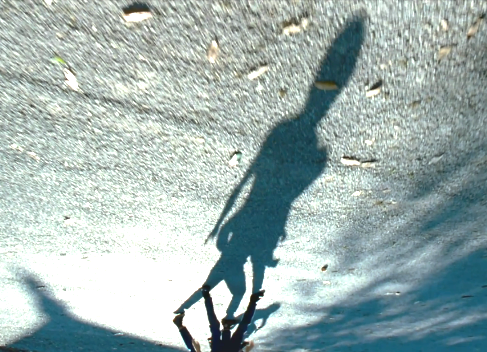
Even pieces on Malick I've read by people who love him and The Tree of Life acknowledge that with each new film, he seems to be less interested not only in conventional narrative structure but dialogue as well. I have no problem with playing around with structure — many of the greatest films of all time have done that, but it takes some special skills to pull off films that eschew dialogue and characterization, that embrace style at the expense of substance. Now, Malick defenders will argue that The Tree of Life actually overflows with substantive ideas, but does it or does Malick just toss some images on the screen and let the viewer do all the work, conjuring substance that may or may not be there. For me, the most telling shot of the entire film occurs early when Malick films the boys playing outside and their shadows on the sidewalk seem to resemble aliens. That seems wholly appropriate because watching Malick films, they don't seem to be made by someone who has any connection to humanity anymore. The one line of dialogue in the film that actually stood out to me is when Mr. O'Brien tells his son, "Toscanini recorded a piece 65 times. When he was done, he said, 'It could have been better.' Think about it." Perhaps that explains how Malick ended up with about a dozen different versions of The New World.
Now, I know I'm treading on dangerous ground with what I'm about to write, so I ask my friends who admire Malick and/or The Tree of Life not to take this part personally, but it's something that struck me as strange before I saw it. Now that I have seen the film, it makes me feel that it's an even odder side effect. The film's fans discuss it in terms of its spirituality and how it raises "the big questions."
 Friends, who in everyday life would willingly categorize themselves as atheists, agnostics or general nonbelievers or would even go so far as to mock those who do profess religious faith, suddenly ask, "What is God's plan for us?" "Why are we here?" and other similar existential questions inspired from the viewing the film. Malick certainly isn't playing the role of evangelist here and the next day, they'll be back to their normal selves, but it's so out of character. Even in an actual great film such as The Rapture which raises these issues, the conversation doesn't change the films' admirers' ways of thinking. (Coincidence or not, when Penn's adult Jack wanders toward the end, the barren landscape resembles both the desert that Mimi Rogers' character Sharon in The Rapture takes her daughter to as she awaits the endtimes and the purgatory she's left in because she refuses to give in to God. (There's a more compelling idea in the last half of that sentence describing The Rapture than in the entire 2 hours and 18 minutes of The Tree of Life.) In some cases, I think it stems from people so devoted to Malick that they'd never dare criticize, in others, they defy reason. As for being unable to criticize favorite directors of yours, I always remember what Roger Ebert says Robert Altman told him once. "If you never gave me a bad review, how could I believe the good ones?" Even masters such as Wilder and Hitchcock don't have perfect records.
In the end, what really struck me about The Tree of Life wasn't all the elements it had that annoyed me in previous Malick films but the amount of images and situations in a film hailed as such a unique and original vision that looked as if they were lifted from other films. When Penn wanders in that desert, it differs from The Rapture in that he finds a door and the thought that crossed my mind was Beetlejuice — not that I expected him to face off against giant worm creatures. I think it was my subconscious thinking of films I'd rather be watching and, honestly, had just as many profound things to say about the life cycle as Malick's film does. Then all the family members at their various ages reunite in the barren land to come to grace. Jack and his dad set aside their rocky relationship (and I awaited Jack to say to his dad with a crack in his voice, "Want to have a catch?"). Even though the living and the dead hadn't reassembled in a church, it also reminded me of the idyllic ending of Places in the Heart.
More than the many films that The Tree of Life reminded me of is the master filmmaker who kept invading my thoughts. If it's true that the O'Brien family represents a pseudo-autobiographical look at Malick's own family life and their story came out as this muddle, think of how many distinct and masterful films (not always directed by him) Ingmar Bergman wrote about his family's life. Aside from that, Bergman also made some of the greatest films of all time that tackled all the issues Malick supposedly flirts with in The Tree of Life — memory, dying, death, loss, faith, etc. — and he made them all with finesse, skill and daring — he even toyed with linear structure to represent memory. Sure, Bergman never thought about including dinosaurs, but he did let a knight play chess with death and I'd rather re-watch The Seventh Seal another hundred times before even considering dipping my toes into Malick's murky waters again.
Tweet
Labels: 10s, Altman, Berenger, Brad Pitt, C. Sheen, Dafoe, De Niro, Ebert, Hitchcock, Ingmar Bergman, Kubrick, Malick, Nicholson, Oliver Stone, Sean Penn, Shakespeare, Star Wars, Wilder
TO READ ON, CLICK HERE
Wednesday, October 26, 2011
“I live in a perpetual state of optimism…”

By Ivan G. Shreve, Jr.
Artist and activist Harry Belafonte turned 84 in March of this year…and has lost none of his expertise for making headlines. On a recent edition of The Joy Behar Show, he was extremely critical of former Godfather’s Pizza CEO and now GOP presidential candidate Herman Cain, labeling him “a bad apple” — and later remarked to Newsweek, “I’m pretty sure African Americans don’t take Cain seriously, but I’m not sure about white people. They believe this black man is the real deal. He isn’t. Anyone who says what he says isn’t.” Cain volleyed back, remarking “He’s been on that banana boat too long” — a reference to the actor-singer’s million-selling record in 1956, “The Banana Boat Song (Day-O).”
At the risk of getting into a political urination contest…Herman Cain can’t carry Harry Belafonte’s jockstrap. While Cain was content to shuck and jive in the back of the bus during the Civil Rights struggle, Belafonte was at the forefront of that movement…as a confidant to Martin Luther King, Jr., and an organizer/supporter of many of the landmark events during that era (the Freedom Rides, the March on Washington, etc.). Long before celebrities such as Sean Penn and Angelina Jolie stretched beyond their chosen professions with defiant political stands and causes, Harry was one of the first to walk the walk and talk the talk…and as a new HBO documentary, Sing Your Song, demonstrates — he is “the real deal.”

The running time of Sing Your Song (1 hour and 45 minutes) can’t scratch the surface in documenting Belafonte’s remarkable career — in fact, the presentation is but one portion of a retrospective look at the actor-singer’s life; a memoir entitled My Song was published recently and allows Belafonte to take a more detailed and anecdotal look into his amazing past. Sing Your Song acts as a primer for those individuals whose only familiarity with the performer-activist boils down to asking the boss man to count his bananas. The documentary offers rich, rewarding archival footage of Harry’s TV appearances and clips from his movies, supplemented with Belafonte’s narration and on-camera interviews with the likes of Diahann Carroll, the late Coretta Scott King, Julian Bond, Rep. John Lewis and Sidney Poitier, to name just a few. Directed by Susanne Rostock and co-produced by his daughter Gina, Song tells the story of Belafonte’s triumph over a life of hardscrabble poverty to become a Emmy, Grammy and Tony Award-winning performer whose dedication to the cause of social justice was prompted by his mother once telling him “that I should never, ever awaken in a day where there wasn’t something in our agenda that would help set the course for the undermining of injustice.”
Harold George Belafonte, Jr. was born in Harlem in 1927 to immigrant parents — and when his father left his mother shortly after his birth, she was forced to compensate in a one-parent household by working as a domestic, sending Harry and his brother to live with their grandparents in Jamaica. His early life (1932-40) in that country would have a profound effect on his future profession. That career direction was decided one night back in New York when he attended a performance of Home is the Hunter at the American Negro Theatre in Harlem (he was working as a janitor’s assistant and received tickets to the play as a gratuity). He joined the theater company (his fellow students included Brock Peters and lifelong friend Poitier), and soon after became a pupil under the tutelage of German director Erwin Piscator at the Dramatic Workshop of the New School of Social Research. (Among Harry’s classmates: Marlon Brando, Tony Curtis, Walter Matthau, Bea Arthur and Rod Steiger.)

To pay for his acting classes, Belafonte worked as a nightclub singer in New York — his first gig found the likes of Charlie Parker, Max Roach and Miles Davis playing as his “back-up band.” Belafonte had started out singing pop tunes in 1949, but he became interested in folk music after seeing a performance by Huddie Ledbetter and studied the history of that music at the archives of the Library of Congress. He soon became a regular at New York’s Village Vanguard, and it was there that the legendary actor-singer-activist Paul Robeson made Harry’s acquaintance, advising him: “Get them to sing your song and they will want to know you are.” (Hence the title of the documentary.) Robeson would become one of the many mentoring influences in Belafonte’s meteoric rise to fame, which all began with a Tony Award for his participation in a Broadway production of John Murray Anderson’s Almanac. With his first single released in 1953 and first LP a year later (Mark Twain and Other Folk Favorites), Belafonte’s breakthrough album came in 1956, entitled Calypso — the first LP certified as a million seller. In clips from variety shows hosted by Ed Sullivan, Dinah Shore and Steve Allen, Sing Your Song features snippets of Harry’s popular hits such as “Jamaica Farewell,” “Mama Look at Bubu” and “Man Smart, Woman Smarter.”
Achieving success with a gold record album was not all peaches and cream for Belafonte, who was also carving out a niche in motion pictures beginning with his first film for MGM, Bright Road (1953), co-starring Dorothy Dandridge. During production on this film, Harry was staying with friends at a house in Beverly Hills when he decided to take a fresh air stroll one night and found himself stopped by the local constabulary, whose interest in him seemed to center around the fact that he was “walking around Beverly Hills while being black.” It wouldn’t be the first time the actor-singer would be on the receiving end of the cold water splash of prejudice; he details in Song how he wasn’t able to stay in the same hotels as co-stars Marge and Gower Champion when they toured with their revue 3 For Tonight (his encounter with a state trooper after attempting to relieve himself in a “whites only” restroom is particularly memorable) and how his protest over similar conditions at a Las Vegas hotel (he was the headliner but wasn't expected to use the main entrance or eat in the hotel’s main dining facilities) earned him a warning “that the only way I would leave Las Vegas if I didn’t fulfill that contract would be in a box.” (Harry gets the last laugh; Fran Scott Attaway, the wife of Belafonte’s bandleader, relates an incident in which Harry summons up the stones to take a dip in the hotel’s lily-white swimming pool.)
Despite motion picture success in films such as Carmen Jones (1954; which re-teamed him with Dandridge), Belafonte encountered similar hostile racial attitudes in the movie industry — controversy arose from his performance in the 1957 film Island in the Sun, which
 intimated that there was a romance going on between his character and that of Joan Fontaine’s — something that was anathema to Southern audiences (his publicist, Mike Merrick, observes that the ticklish situation nevertheless made curious onlookers more determined to see the film). Belafonte’s struggle to find good roles free of negative black stereotypes led him to start his own production company in HarBel — which produced movies such as The World, The Flesh and the Devil (an “end of the world” film whose ending was tampered with by MGM when the touchy issue of a romance between Harry and white Inger Stevens once again caused Southern audiences to revolt) and Odds Against Tomorrow (both 1959). (In an interview with The Daily Beast, Belafonte cited the last movie — a noir that mixes a heist film with a searing examination of racial prejudice — as “the centerpiece of my work in cinema.”) Everywhere Harry seemed to turn he would confront the specter of intolerance; his television specials Tonight with Belafonte and Belafonte, New York 19, despite winning critical and ratings accolades (Tonight won Harry a Emmy for outstanding performance in a variety or musical program or series) earned him enmity from the sponsors for his insistence on using racially integrated casts.
Belafonte recently related to an interviewer: “I was an activist before I was an actor. I was aware of all happening around me that was wrong in the midst of getting into this career. All of us did during those times, and we couldn’t sit back and worry about the consequences of doing something. We had to speak out about what was wrong in this country, and we did.” It is this portion of Harry’s
 life that makes much of Sing Your Song fascinating viewing; the audience learns that his friendships with Robeson and later Martin Luther King, Jr. earned him the unwelcome intrusion of the FBI (who was convinced back then that anyone fighting for the cause of equal rights must be some sort of Commie) — Belafonte’s first marriage to wife Marguerite Byrd suffered the severe strain of J. Edgar’s interest in the activist; Byrd simply couldn’t reconcile that the stories being handed to her about Belafonte by the bureau were complete bullshit. His closeness with Dr. King is even more remarkable and is choc-a-bloc with anecdotes; it was Belafonte who lobbied presidential candidate John F. Kennedy (then a senator) to intervene on King’s behalf when King was sentenced to work on a Georgia chain gang for a minor traffic violation. Later, Harry was needed to put the Kennedy administration’s fears to rest about the unrest that they believed would result from the 1963 March on Washington. Belafonte proudly relates how he persuaded the Kennedy people to eventually side with those in the civil rights movement, and in particular the part he played in educating Robert Kennedy, who may have been his brother’s attorney general but was still quite conservative in his politics (he had worked for Sen. Joseph McCarthy early in his career). (King once said to Belafonte about Bobby Kennedy: “In that mind resides good; go out and find that man’s moral center and win him to our cause.”)
Sing Your Song provides telling details about Belafonte’s humanitarian efforts on behalf of Haiti, South Africa and other nations, particularly as one of the organizers behind USA for Africa and as goodwill ambassador to UNICEF …and comes full circle to the actor-singer’s struggle to make individuals aware of the growing problem with at-risk and incarcerated black/Latino gang youth (his palpable rage at seeing television news footage of a 9-year-old girl being handcuffed because she was “unruly” is not something easily forgotten). If there are any weak areas in Song, it’s that Belafonte’s controversial stance on the Iraq War (with headline-grabbing remarks directed toward its architects U.S. Secretaries of State Colin Powell and Condoleezza Rice, not to mention President George W. Bush) is sort of glossed over, but then much of the material from later in his life (including some of his film work from the '70s up to today) is telescoped to fit the demands of the documentary’s running time.
“How could it be that the world is in the chaos and disorder and the consuming violence that we are all experiencing after so many had invested so much to change that fact?” Harry Belafonte asks the interviewer’s camera close to the end of Sing Your Song. The struggle against injustice is a constant one, and while Harry Belafonte was able to temper the fight on occasion through his music and acting, he would pay a price for his activism; several of his children and second wife Julie Robinson (the two of them later divorced and Belafonte married his third wife, Pamela in April 2008) relate in Song that while Harry wasn’t a bad father it was often a trial serving two families (his own and his activism) making demands on his time. The release of this documentary and his memoir My Song comes at a most opportune time when the U.S. is in a current state of upheaval over the issues of unemployment, health care and poverty. It is one thing to allow individuals to do the heavy lifting addressing the ills of the system in order for you to reap financial benefits (and perhaps run for president), it is another to commit yourself to a mindset that “from the time I go to sleep till the time I get up, I seek out the injustices done to humankind.” Harry Belafonte continues to sing his song…and we are all richer for his having done so.
The original HBO documentary Sing Your Song has an encore performance today at 11:30 a.m. EDT (10:30 a.m. Central) and also can be viewed later at 2:30 p.m. on HBO West. It will continue to air at various time and dates on various HBO channels through Nov. 22. The documentary also is available on HBO On Demand (where applicable) until Nov. 13. It will be accessible to HBO subscribers on HBO GO until Dec. 31, 2012. For more details, check out its entry on HBO’s website here.
Tweet
Labels: 10s, Awards, Belafonte, Brando, Documentary, HBO, Jolie, Matthau, Music, Musicals, Nonfiction, Poitier, Sean Penn, Television, Theater, Tony Curtis, Twain
TO READ ON, CLICK HERE
Tuesday, June 28, 2011
Cinematic Grace

By J.D.
Decades in the making, the gestation period of Terrence Malick’s The Tree of Life (2011) is as epic as the film itself. After Days of Heaven (1978) was released to critical acclaim and nominated for four Academy Awards, Paramount, the studio that backed it, offered the director $1 million dollars for his next project, regardless of its subject matter. Despite being burnt out from making and editing Days, he agreed. Malick had been contemplating his most ambitious film yet: the creation of our galaxy and the Earth as well as the beginnings of life. It was originally called Qasida (a reference to an ancient Arabian form of rhythmic lyric poetry) and eventually shortened to Q. In 1979, Malick and a small crew began shooting footage in exotic locales all over the world. The footage they were getting looked great but Paramount was nervous about the absence of a screenplay (Malick would write 40-page poetic descriptions of the imagery) and a structured shooting schedule. Eventually, the studio lost patience with the director’s methods and he not only quit the project but the movie business for 20 years.
The first signs that Malick was returning to his Q project came during pre-production on The New World (2005) when producer Sarah Green received a revised treatment for what would become The Tree of Life. By July 2007, there was a script that fused the cosmic nature of Q with a semi-autobiographical story that focused on a Texas family in the 1950s as seen through the eyes of the oldest child Jack (Hunter McCracken as a child and Sean Penn as an adult). As early as Days of Heaven, Malick had been moving away from linear narratives to a more philosophical tone poem approach. With The Thin Red Line (1998), he began to explore in greater detail man’s relationship with his environment and with the Earth. This continued with The New World, which embraced a nonlinear narrative more than anything he had done before. The Tree of Life is the culmination of Malick’s body of work so far.
The film begins with the death of one of the O’Brien children. The mother (Jessica Chastain) is understandably devastated while the father (Brad Pitt) is stoic but eventually the cracks begin to show and he also grieves in his own way. Cut to the present day and Jack O’Brien (Sean Penn) is an architect, unhappy and adrift in the world, still haunted by the death of his brother. The film flashes back to his reminisces of his childhood in the ‘50s. In this first section, Malick cuts back and forth between the impersonal concrete and glass jungle of the big city in which Jack works and the idyllic suburban neighborhood of his youth.
Early on in the film, the mother says in a disembodied voiceover, “There are two ways through life: the way of nature, and the way of Grace. You have to choose which one you'll follow. Grace doesn't try to please itself. Accepts being slighted, forgotten, disliked. Accepts insults and injuries. Nature only wants to please itself. Get others to please it too. Likes to lord it over them. To have its own way. It finds reasons to be unhappy when all the world is shining around it. And love is smiling through all things.” I believe that this passage is integral to understanding Malick’s film and it becomes apparent that the mother represents Grace, accepting insults and injuries, while the father represents nature, lording over his family.
Right from the get-go, Malick dispenses with the traditional notion of how a scene is structured and linked to another in favor of an impressionistic approach. This is no more apparent than when the narrative segues to an extraordinary sequence depicting the creation of our galaxy and the Earth with absolutely breathtaking imagery — a stunning mix of unusual practical effects (created by Dan Glass and the legendary Douglas Trumbull) and actual footage courtesy of NASA. With this sequence we are entering Stanley Kubrick territory. Like 2001: A Space Odyssey (1968), Malick mixes science with spirituality, the cosmic and the ethereal, occasionally commented on via existential voiceover musings about God by the mother. He actually shows the Earth forming and early life being created on the most basic cellular level on up to the dinosaurs. This sequence and its placement so early on in the film is just one of the audacious choices Malick makes.
The film then goes back to early stages of the O’Brien family, to the creation of their children, the painful and glorious experience of childbirth, much like that of the Earth itself. Malick presents two approaches to parenting: the mother is a nurturing figure while the father is a stern disciplinarian. She is in tune with nature while he represents structure. It is this part of the film that is the most engaging as we are presented with familiar, relatable imagery: a very young boy gazes in wonderment and then jealousy at his baby sibling; the shadows of tree branches playing across a wall; the family playing with sparklers at night; kids playing in tall grass; and a tree-lined suburb at dusk with the sky the most amazing shade of purple-blue. These are the innocent, carefree days when you had no worries and would spend hours playing with other children until called in by your mother for the night. Malick has come full circle by returning to the same tranquil Texas suburbs first glimpsed at the beginning of Badlands (1973), his debut feature. These scenes will be instantly familiar to anyone who grew up in the suburbs or a rural environment.
As he did with Linda Manz in Days of Heaven, Malick demonstrates an incredible affinity for working with children and pulling naturalistic performances out of them. All of the kids, especially newcomer Hunter McCracken, act very comfortable in front of the camera, almost as if Malick caught them unaware that they were being filmed. McCracken has a very expressive face, which he utilizes well over the course of the film as Jack becomes increasingly rebellious, testing the rules imposed by his father. Malick documents the children’s behavior and all of their idiosyncrasies, like how they interact with each other and how this differs with their interaction with adults, especially in the ‘50s when they were much more respectful. Much of the film is seen from a child’s point-of-view with low angle shots that look up at adults, trees, and so on. It’s only in the scenes with other children that the camera takes a more level position.

At one point, the father tells Jack that his mother is naive and that “It takes fierce will to get ahead in this world.” Brad Pitt doesn’t play the stereotypical strict father figure but one with layers that are gradually revealed through the course of the film. He works in a factory, a labyrinthine maze of metal machinery but we learn that he wanted to originally be a musician but it didn’t work out. He had to become responsible and lead a more traditional life in order to provide for his family. He still plays piano and passes this ability on to his children. Pitt delivers an excellent performance that grounds the film. The actor has aged well and grown into his looks, relying less and less on them as he gets older. There is a nice scene where he accompanies one of his sons playing an acoustic guitar with the piano that is brief but does a lot to humanize his character. The mother, in comparison, is a more elusive character, more of an ethereal figure as played by Jessica Chastain.
You simply cannot engage The Tree of Life in a traditional way. The first section is a little impenetrable at first as one has to leave the concept of traditional narrative behind and get acclimatized to Malick’s approach. One has to let it wash over you and let his poetic imagery work its magic. Like all of his films, this is one that people will either passionately love or hate because of its ambitious, unusual approach. It will be seen as pretentious by some but any film that strives to tackle big themes like life and death and what it means to be human on such an epic (and also intimate) scale runs that risk. What prevents it from collapsing under its own thematic weight is Malick’s sincerity. He really believes in what he is showing us and treats it with the solemnity and weight it deserves. The Tree of Life has the kind of lofty ambitions most films only dream of reaching and it is easy to see why it is being compared to 2001. Like that film, Malick’s will undoubtedly reveal more upon repeated viewings. There is just so much to absorb that one viewing is not enough because you are too busy trying to make sense of what all this breathtaking imagery means. It will take repeated viewings to fully appreciate what Malick is trying to do and say. This is an important film by a master filmmaker.
Tweet
Labels: 00s, Brad Pitt, Malick, Oscars, Sean Penn
TO READ ON, CLICK HERE
Thursday, February 24, 2011
The Last Troops to Withdraw

By J.D.
Casualties of War (1989) came out toward the end of the trend of Vietnam War movies in the 1980s after the likes of Oliver Stone, Stanley Kubrick and others had tried their hand at it. By the time Brian De Palma’s film came out the public had grown tired of this sub-genre and, despite glowing reviews from critics, Casualties did not perform as well as hoped at the box office.
Based on an actual incident that was reported by David Lang in The New Yorker in 1969 and which he later turned into a book, Casualties of War focuses on a group of American soldiers who rape and kill a young Vietnamese woman and how one tries to do something about it. Private Eriksson (Michael J. Fox) has only been in country for three weeks and is the quintessential inexperienced recruit. He looks up to (as do most of the men) Sergeant Meserve (Sean Penn), a battle-hardened veteran whose tour of duty is almost up.
It quickly becomes apparent that Meserve fits in perfectly with the madness of the war and that he enjoys killing because it makes him feel powerful — he gets off on it. If there were any last bits of humanity left in him, they are gone when a sniper kills his fellow long-timer comrade. We actually see the humanity dissipate in Meserve’s sad expression as he watches his friend taken away in a medical helicopter. It’s a beautifully acted moment by Sean Penn.
The man’s death puts Meserve and his men in a mean, vengeful mood. They are subsequently ordered to go on a long-range recon patrol and this provides them with an outlet for their aggression. Meserve makes it clear that they are going on an unplanned detour to a village and find a girl that they can have their way with. In private, Eriksson voices his concerns but goes along with it. Even though he doesn’t actually participate in the act, he is complicit because he doesn’t actually try to stop it.
Michael J. Fox was primarily known as a sitcom actor and for a string of lightweight comedies (Teen Wolf, The Secret of My Success, et al) but the underrated (if not flawed) Bright Lights, Big City (1988) hinted at a capacity for drama that he showcased to greater effect in Casualties of War. Fox does a nice job of conveying the moral dilemma that his character faces. He is the film’s moral center and the one we are meant to identify with. His scenes with Penn have the requisite intensity with Fox wisely underplaying to Sean Penn’s over-the-top sergeant.

Penn plays the obvious villain of the film and is a real monster. You can see it often in the psychotic gleam in his eyes. At times, his performance veers into caricature as he lays on the New York accent a little too thick and his grotesque facial expressions are a little too garish to be believable. That being said, one has to admire his fearlessness as an actor to play such a truly unlikable character. He and Fox are surrounded by an impressive cast of then-up-and-coming character actors, such as John C. Reilly, John Leguizamo, De Palma regular Don Harvey, Ving Rhames and Sam Robards. Harvey, in particular, is impressive as Penn’s amoral right-hand man and it’s a shame this fascinating actor hasn’t gotten more mainstream roles.
Penn (and the rest of the cast) are let down by David Rabe’s screenplay. He has essentially written a morality play but it resorts to broad strokes when shades of gray would have been much more effective (as in Mystic River which showcased Penn’s talents much more effectively). Rabe does a good job with the relationships between the soldiers and how the younger, more inexperienced ones are subservient to the veterans because that is their right — they’ve earned it due to their experience in combat. Casualties of War is a flawed film but a visually interesting one as is customary with De Palma’s body of work. He expertly uses the entire widescreen frame in many scenes showing off his command of composition. It’s a shame that the content of the film wasn’t up to the same quality as the style.
Tweet
Labels: 80s, De Palma, John C. Reilly, Kubrick, Oliver Stone, Sean Penn
TO READ ON, CLICK HERE


