Sunday, December 19, 2010
The thing ain't the ring, it's the play So give him a stage/Where this bull can rage

By Edward Copeland
Whenever I'm involved in a discussion about Martin Scorsese's films and the subject turns to
 Raging Bull, which marks its 30th anniversary today, my standard response tends to be that it's a film that's easier to admire than to love. Each time I re-visit the movie though, that point-of-view becomes a less satisfactory one because, as any great film should, the movie rises higher in my esteem. While it's not a double-barrelled treat like other Scorsese masterpieces such as Goodfellas, After Hours or Taxi Driver, where his filmmaking prowess dazzles and you never tire of watching the films, Raging Bull offers the serious film connoisseur other ample rewards, including Robert De Niro's greatest performance, even if it's now tinged with a sadness as you see a commercial for yet another Meet the Parents sequel and realize how long it's been since he has even tried to scale those acting heights — and the heights he reached as Jake La Motta remain astonishing.
What struck me first when re-watching Raging Bull this time (I can't even recall the last time I saw it) was just how mesmerized I was by De Niro. In the film's opening moments, first when De Niro plays the older, fat
 Jake preparing for his lounge act in 1964 before it cuts to the ripped fighter in 1941, even though I consciously knew both versions of La Motta were played by the same actor and that De Niro was that actor, the performance so entranced me that I actually thought to myself, "Who is this guy and why hasn't he made more movies?" It used to be sort of a joke about how De Niro was so committed to the role that they took time off so he could gain the weight for the older, fat scenes, but to gaze at the way he sculpted his body into the shape of a believable middleweight boxer, sweat glistening in Michael Chapman's gorgeous black-and-white cinematography, truly makes for the more impressive achievement. It really struck me when we get to the post-fight scenes and you watch this man act. No, scratch that. Act isn't the proper word for what De Niro does here. He doesn't act the role of Jake La Motta, he becomes Jake La Motta, or at least the screen version, and leaves all vestiges of Robert De Niro somewhere else. Even when De Niro is good or great in other roles, they never come as close to complete immersion as his La Motta does.

What always amazes me about films such as Raging Bull, other great boxing films or a movie such as Without Limits about track is the ability of talented filmmakers to take a subject with which I have no inherent interest in real life and produce compelling cinema out of it. I'd never watch a boxing match in real life or attend a track meet, but somehow these movie magicians can turn these topics into story gold. It can even happen with documentaries. When We Were Kings, the Oscar-winning account of the bout between Muhammad Ali and George Foreman in 1974 in Zaire, remains one of the best documentaries I've ever seen despite the fact I have no interest in the sport. Of course, though Raging Bull may tell the story of a boxer, there actually are fewer fight scenes than it seems like when you are watching the film. In the DVD commentary, Scorsese says that the film actually contains less than nine minutes of total fight footage.
Then, Scorsese did approach most of his fight material as if they were part of a documentary. La Motta was an adviser on the film for the fights (he left the set when they got to the non-boxing scenes) and Scorsese went over archival footage of the actual bouts to try to make each one as realistic as possible. For the one fight that lacked footage, he used a phalanx of photographers' flashbulbs to re-create the still photos that they were
 going by. This isn't to say that Scorsese and his great film editor Thelma Schoonmaker (who earned her first Oscar for this film) didn't take some artistic license in these scenes, but for the most part he tried to make them follow the fights as they occurred. Still, anyone who has watched Scorsese knows he loves to play and he did include some great tricks to get the effects he wanted. For one fight, to get the perspective he wanted, they actually elongated the boxing ring so that it was longer than a normal ring. The most infamous example, which you might not even notice he did unless you've heard him talk about it, comes in the final fight between La Motta and Sugar Ray Robinson (played by Johnny Barnes who, like all the opponents in the film, were fighters in real life). Scorsese storyboarded the moment when Robinson pummels La Motta against the ropes based on Hitchcock's shot sequence for the shower scene in
 Psycho. At first, Scorsese wasn't sure how to pull it off, but fellow director, the legendary independent filmmaker Samuel Fuller gave him the idea of placing the camera within the boxing glove. Hitchcock chose to shoot Psycho in black and white because he didn't want the blood in the shower scene to be in color. The process that led to Scorsese deciding to film Raging Bull in black and white, against studio objections of course, also came courtesy of another legendary director. Scorsese had become friends with the great Michael Powell, who would wed Schoonmaker in 1984, who mentioned to him that the red boxing gloves could prove distracting. Originally, according to Scorsese's commentary, he considered just desaturating the color but then when he took into account several boxing films that were out around the same period of time such as Rocky II and The Main Event, he committed to black and white to make Raging Bull distinctive from the other films (as if it would be confused with a Ryan O'Neal-Barbra Streisand comedy anyway) and because it just seemed right given the archival tone of the fights.
Since in essence I watched Raging Bull again twice before writing this (once as the movie itself and then once where I was just watching the images while listening to the commentary by Scorsese and Schoonmaker), I found myself examining the camera work even more closely than I had in awhile and what struck me was that
 while Scorsese utilized the many techniques he loves to employ in his films, I never really found an example that could be accused of being there for showy effect. As much as I love Goodfellas, his greatest and most memorable touches do call attention to themselves at times. I can't really say that about Raging Bull. Every time he employs different speeds, reverse pans or even his requisite tracking shot in Raging Bull, Scorsese does it because it's the best way to serve the story at that time. When it came time for the tracking shot, following Jake from his dressing room through the tunnel and hallways, up the stairs, through the spectators and into the ring, I didn't even realize it had happened. After I had finished watching the film, I wondered if I somehow had missed the shot or had dreamt it and it took watching the film again with the commentary for me to notice it. I don't think this was a case of me being an inattentive viewer but that I was being held in the thrall of an exemplary visual storyteller.

Though I've spent a lot of space heaping praise on what every movie buff already knows — that Martin Scorsese belongs on the list of film's greatest artists — the stunning look, electric editing and well-planned
 visuals alone did not make Raging Bull a masterpiece. He also was blessed with a solid screenplay by Mardik Martin and Paul Schrader, which he and De Niro shaped structurally into the final product, and, more importantly, a cast composed of veterans, newcomers and some who'd abandoned acting who meshed together into a perfect blend of realism to tell the life story of Jake La Motta that existed when his gloves were off and he wasn't in the ring. Going mano-a-mano with a referee between him and his opponent and crowds watching were the times when La Motta was in his element. When he was removed from that and forced to live everyday life, that's really when everything would go awry and the cast assembled to tell this story was almost universally brilliant from the phenomenal De Niro down to the smallest role.
It is hard to believe now that Joe Pesci, an Oscar winner so well known that a recurring skit on Saturday Night Live used to be the idea of him (or really his Tommy character from Goodfellas) hosting a talk show with De Niro serving as his Ed McMahon, had basically given up on acting and had to be repeatedly begged by
 Scorsese and De Niro, who had seen him in a small film he'd made called The Death Collector, to play Jake's brother Joey in Raging Bull. Not only were their instincts wise to seek him out for the part, Pesci deservedly received his first Oscar nomination for the performance. Pesci has become so identified with Tommy, his psychotic mobster from Goodfellas that it's almost become a stereotype (not helped by playing a very similar character in Casino), that it always takes you by surprise when you see him as the relatively quiet Joey. He can be funny and he acts as the conduit between Jake and the mobsters involved in the fight game, but he's really nothing like Pesci's later characters (even if he does beat up Frank Vincent in one scene). He's playing against De Niro giving not only his career-best performance but one of the greatest feats of acting ever put on film and Pesci more than holds his own. Almost from the beginning, after
 Jake unfairly loses the fight to Jimmy Reeves and complains about his "small, girlish hands" that prevent him from fighting the best like Joe Louis even though, as Joey reminds him, he and Louis are in different weight classes. It prompts the self-hating Jake to force his brother, using a dishrag as a substitute for a boxing glove, to repeatedly punch him in the face. Joey also serves as a Jake's truth-teller as his paranoid jealousy about his second wife Vickie (Cathy Moriarty) literally drives him cuckoo. He tells his brother that he knows she's doing something, he just wants to catch her once. "Want to do yourself a favor?" Joey tells his brother. "Bust her fuckin' hole and throw her out. Either that or live with her and let her ruin your life because that's what's happening. How much can you take? How much shit can you take?" One interesting side note about Frank Vincent's character: He plays a mob-connected figure who frequents the Copacabana, as the gangsters did in Goodfellas, which took place in a later time. His Goodfellas' character was named Billy Batts; in Raging Bull, he's Salvy Batts. They changed a lot of names in Goodfellas and the book it was based on didn't exist when Raging Bull was being made, but could the two characters be related or is someone just winking at us in Goodfellas because Vincent is playing both characters on the receiving end of Pesci's blows?

Now, Vincent's character Salvy associates frequently in the film with a higher-ranked Mob figure, Tommy Como, based on the real-life Frankie Carbo who had his fingers in most New York bouts in '40s and '50s before eventually being convicted of various crimes and sent to prison by Bobby Kennedy. The actor playng Como must have had a thing for sports, though not all Mob-connected-figures. The late, great Nicholas Colasanto probably will always be best known as the sweet Coach who took too many balls to the head in his baseball career on TV's Cheers. He also appeared in another boxing film, John Huston's Fat City, playing the former manager of Stacy Keach's down-on-his-luck pugilist. Tommy Como doesn't reflect the kindness you see in either of those other two Colasanto roles. He's not frightening and he doesn't make threats because he doesn't have to. Joey is the one who has to deal with him. Jake steers clear. Tommy flat out tells him that Jake will never get a shot at the title unless he takes a dive in another fight first. Jake reluctantly agrees, but it's so obvious that it ends with La Motta's suspension from boxing for two years, the only fighter in history suspended for throwing a fight. You also get to see an emotion that isn't rage after the fight as Jake just sobs uncontrollably in his dressing room.

The third person to garner an acting Oscar nomination for the film was Moriarty as Vickie. It's often said that some kids are wise beyond their years and in truth, that was the case with Moriarty who begins playing Vickie at age 15 when Moriarty wasn't but a couple of years older than that herself. The black-and-white cinematography accentuates her sensuality, even though Vickie as well as Moriarty were both basically jailbait. You can see how the married Jake's libido goes into overdrive as he spots her at the community swimming pool that one day. However, that's not the impressive part of Moriarty's performance. It is feasible for someone to change their body to
 look convincing as a fighter or an older, fatter version of the same man as De Niro did, but it takes some inner acting chops for a teenage girl to be that convincing playing a character from her 15-year-old schoolgirl days to a thirtysomething mother and housewife. She also gets to play all sides of the tempestuous relationship between Vickie and Jake. From their first official meeting separated by the barbed wire fence between the pool and the street that from the very first time I saw the film reminded me of the scene between Brando and Eva Marie Saint in On the Waterfront, an homage Scorsese confirms in the commentary, to the physical abuse she takes from his paranoid jealousy that convinces that since she's so alluring to him, she must be irresistible to everyone and isn't strong enough to say no. That's something else that's unique about Moriarty's performance: She brings out the sex in De Niro. Really, I can't cite another example where De Niro has played a role where he's involved with someone on a sensual, romantic level, but Moriarty pulls that off, even if La Motta has rules against sex for certain time periods before a fight and will stop in the middle to go the bathroom and pour ice water over his erection. It's funny because I remember that part first from the Mad magazine spoof, which I read years before I ever saw the movie.


Still, amid the turmoil, there were happy times for Jake and Vickie La Motta, which in another brilliant touch, Scorsese filmed as Super 8 color home movies, personally scratching the film himself to give it the old look he was seeking.

You can never be certain what will set off that rage that boils inside Jake. If he could have restricted it to the ring, he would have merely been a ferocious fighter, but it stayed wth him at all times. Whether it's when he thinks his first wife is going to overcook a steak (and reacts when she tosses it on his plate by overturning the table) or yelling at a neighbor complaning about his shouting that he's going to have the man's barking dog for dinner. It's that inner Jake La Motta that makes it hard for many (and for myself for a long time) to fully embrace Raging Bull. He's a troubled man, his own worst enemy if you will. Scorsese cites someone on the commentary who said that La Motta took more beatings than he had to because he acted as if he deserved it. As De Niro as Jake says at one point in the movie, he thinks he's done so many bad things, that they come back to haunt him, that he's a jinx. So at its essence,
 Raging Bull isn't a simple biography of a boxer, it's a biopic of a man hellbent on destroying himself and all those around him. It's not because he's just a jerk or an asshole, it's because something deep in his psyche won't allow him to be happy or content for long and his inability to be satisfied infects all those around him like a virus until he's eventually alone. He will interrogate his brother because he gives Vickie a quick kiss on the lips instead of the cheek, somehow interpreting from that that his wife and Joey had oral sex. It's even worse when he learns of Joey beating Salvy in defense of Vickie months after the incident. The twisted logic of La Motta's mind makes the fact that he was never told mean there was something to hide, such as an affair between Joey and Vickie. After taking his actions out on Vickie, he heads over to Joey and beats the hell out of him with two wives trying to stop him and Joey's two young children staring in disbelief, still wearing their dinner bibs. It's a rupture between the brothers that causes Jake great pain, even though it's all his fault. At one point after a bout, he has Vickie dial Joey's number and Jake gets on the phone, but he's too ashamed to speak and Joey, thinking he's someone else, just cusses him out. In fact, La Motta's character proved so hard to take for some that Scorsese felt compelled to put the following Bible verse at the end of the film to explain why he was even telling his story.
"Speak the truth before God.
We know this fellow is a sinner."
"Whether or not he is a sinner, I do not know,"
The man replied.
"All I know is this:
Once I was blind and now I can see."
— John IX, 24-26 (the New English Bible)

The film raises the question that often comes up: Should disreputable people be the subjects of art, be it film, literature or theater. The answer is that of course they should. How boring art would be if everything was purified glorified goop. Richard Attenborough made a good passable film about Mahatma Gandhi, but imagine how much more interesting it would be if it had been a warts and all portrait and not just a step on the road to cinematic sainthood. If some of the more unseemly aspects of Gandhi's life, such as his taste for young girls, had been shown, it wouldn't diminish his greatness anymore than knowing that Martin Luther King played around lessens his monumental role in the civil rights movement and Gandhi's tradition. Should Shakespeare have not written Richard III? Granted, Jake La Motta was not a Gandhi or a King, not by a
 long shot. It's been said that when Jake went to a screening of the film with his then ex-wife Vickie he turned to her and asked, "Was I really that bad?" and she replied, "You were worse." Still, Raging Bull certainly gave us enough of a taste that if he was worse, I'm not sure how explicity we needed to see that to get the point across. Bible quote aside, it's not out to make excuses for him, it's to tell a good story. It's a harsh story, but it's a good one. As much as you can't believe what Jake does, you still manage empathy for him at times, as when he is in a Dade County jail cell on a moral charge beating his head against a wall crying that he's "not an animal." When he needs bail money, having to pry the jewels off
 his long-sought championship belt to get cash only to be told the whole belt might be worth something. Then of course there's that ending, the bookend of the opening, where he's back doing his lounge act in 1964, fat, out of shape, performing the works of Shakespeare, Schulberg, Chayefsky and others and we see him alone in his dressing room, coldly running through Brando's famous "I could'a been a contender" speech from On the Waterfront. You're watching Robert De Niro giving the greatest performance of his career, one of the best screen performances of all time, in character saying the lines of one of the other best screen performances of all time by the greatest screen actor of all time. That's entertainment.
Tweet
Labels: 80s, Brando, Chayefsky, De Niro, Documentary, Hitchcock, Huston, Michael Powell, Movie Tributes, Pesci, Schrader, Scorsese, Shakespeare, Streisand, Zemeckis
TO READ ON, CLICK HERE


Monday, September 13, 2010
Different rules apply when it gets this late at night


By Edward Copeland
In 1983, Martin Scorsese was down. While he was a critical darling, already revered for making some great films before his 40th birthday, the lifelong movie fanatic had earned the right to bigger projects with larger budgets and longer shooting schedules but the audiences didn't come along with the acclaim and the films weren't tearing up the box office. As a result, his longtime dream project, The Last Temptation of Christ, got scuttled by the studio. His passion for filmmaking had reached a breaking point, but then he received a screenplay from producers Griffin Dunne and Amy Robinson by a writer named Joseph Minion called Lies, which Minion wrote as his thesis at Columbia. The title eventually became After Hours, and it opened 25 years ago today and may well be the tensest comedy ever made. More importantly, it renewed Scorsese's love of filmmaking.

Actually, my lead fudges the chronology slightly. Robinson and Dunne, both actors who had turned to producing having already made Chilly Scenes of Winter and John Sayles' Baby, It's You (Later, they would produce Once Around and Running on Empty), sent the Lies screenplay to Scorsese before Last Temptation fell apart. Robinson had been given the script by director Dusan Makavejev (The Coca-Cola Kid) while she attended an early year of The Sundance Institute. Makavejev felt the very New York-centric script might be up her alley. Robinson loved it as did Dunne. The two both had past relationships with Scorsese, though Robinson's was more substantial: She played Teresa, Harvey Keitel's secret epileptic girlfriend in Mean Streets. Dunne's link was a bit more tenuous, if not comical: He auditioned for the role of Ellen Burstyn's son in Alice
 Doesn't Live Here Anymore, even though Dunne was 18 at the time. Scorsese told him he was too old, but was kind enough to give him a reading and talk to him for awhile anyway. The two sent the screenplay to Scorsese but because of Last Temptation, he declined. The producing pair learned of an up-and-coming filmmaker named Tim Burton and offered the movie to him and he accepted. Then Last Temptation fell apart and Scorsese found Minion's script again and called Dunne and Robinson back saying he'd like to make it. This put the producers in a quandary. They didn't want to dump Burton for no good reason, yet how do you say no to Martin Scorsese? They called Burton and told him the truth, that they had offered it to Scorsese first. Burton withdrew gracefully, saying he'd never stand in the way of something that Martin Scorsese wanted to do. The disappointment over the cancellation of his longtime dream project had inspired Scorsese to return to his indie roots — smaller budget, smaller cast, shorter shoot and renewed energy. In the DVD commentary, the director describes it as if he were going back to school. With After Hours, he would earn an A+ and revitalize himself. He'd even take home the directing prize at the Cannes Film Festival.
Paul Hackett (Dunne) works as a word processor. When we meet him, he's helping a co-worker (Bronson Pinchot) who can't get the hang of a certain skill. (Before he got stereotyped by his role on TV's Perfect Strangers, Pinchot had small but visible roles in notable films each year from 1983 to 1985: Risky Business, Beverly Hills Cop and here in After Hours.) Paul's tedium isn't restricted to work. At his apartment, he lies in
 the dark absent-mindedly flipping through channels before deciding to go to a nearby coffee shop, taking the copy of Henry Miller's Tropic of Cancer that he is re-reading with him. As he's lost in the novel, a female customer (Rosanna Arquette) says how much she loves that book. It takes a moment for Paul to realize she's speaking to him. A conversation starts and the woman, whose name is Marcy, joins his table and whispers her thoughts about the cashier's odd behavior. For the first time, Paul notices that he appears to be dancing with an invisible partner. Paul asks if she lives nearby, but Marcy says no, she lives in Soho with her sculptress friend Kiki, adding that Kiki makes plaster of paris bagel with cream cheese paperweights that he really should look at. Paul takes her number and the two part ways. Later in his apartment, Paul notices the number and gives Marcy a call. She encourages him to come on by. Hackett glances at his clock and it reads 11:32 p.m. So begins his journey into a bizarre vision of hell, only he doesn't know it yet. He just thinks he might get lucky, but the luck he'll be experiencing is not the good kind.

What attracted Scorsese to Minion's screenplay wasn't just the chance to return to his indie roots with a quintessential New York story, but because its portrait of being trapped in Lower Manhattan as some twisted vision of Hades reminded him of his own personal experiences living in Tribeca. While that area's image of a Bohemian, artistic paradise appeals to many, by the time Scorsese found himself living there, he was a bit older and spoiled by the comforts of life. He didn't feel like climbing five flights of stairs to get to his apartment anymore. He wanted the convenience of an elevator where he could push a button and get to his floor without so much strenuous effort. So, as he admits on the commentary, when late in the film, Paul shares his story with a stranger and says with exasperation, "I just wanted to leave my apartment, maybe meet a nice girl and now I have to die for it!" and Scorsese's giggling response is, "Yes, you have to die for it." Not that Paul does literally.
Paul's journey down the Manhattan version of the River Styx begins with a wild cab ride, zooming through practically empty streets. In the first (and perhaps the stupidest) bad decision of the night, Hackett places the $20 bill he plans to pay the driver with in the cradle on the back of the front seat, even though the window is open and the ride already has reached a ferocious speed that has jerked Paul himself side to side, so he shouldn't be surprised when the wind sweeps into the cab, grabs the currency like the hands of a ghost and whisks it out the window before Paul can catch it. He tries in vain to get the driver to stop, as if he could get out and find the bill even if he did. They reach their destination and Hackett tries to explain what happened to the disbelieving cabbie, but the driver just speeds off pissed, leaving Paul standing in Soho with an empty wallet and some pocket change.
He finds Marcy's building and searches for the correct button to buzz, settling on one with the name Bridges with Franklin below it, remembering that Bridges was the last name of her sculptress roommate. After he buzzes it, a woman sticks her head out of a window above, asking if he's Paul. He answers in the affirmative and she tosses him down her keys.

After Hours marked the first collaboration between Scorsese and cinematographer Michael Ballhaus and the manic cab ride that brings Paul to Soho was shot using only available light, upon Scorsese's insistence. Dunne and Robinson recommended him having worked with the d.p. on Baby, It's You and showing it to Scorsese, who, of course, also was familiar with his incredible string of nearly 20 films in eight years working for Rainer Werner Fassbinder in his native West Germany. Admiring the look of the Ballhaus films he'd seen and his obvious ability to be able to work fast and well, Scorsese decided he'd be the perfect d.p. for the quick shoot of After Hours. Their work together went so well that Ballhaus would later work on six more Scorsese films. One of the earliest shots of After Hours was his most difficult but was, according to Scorsese, the pivotal moment of the entire film: Kiki (Linda Fiorentino) dropping her keys from the window to Paul on the street below.
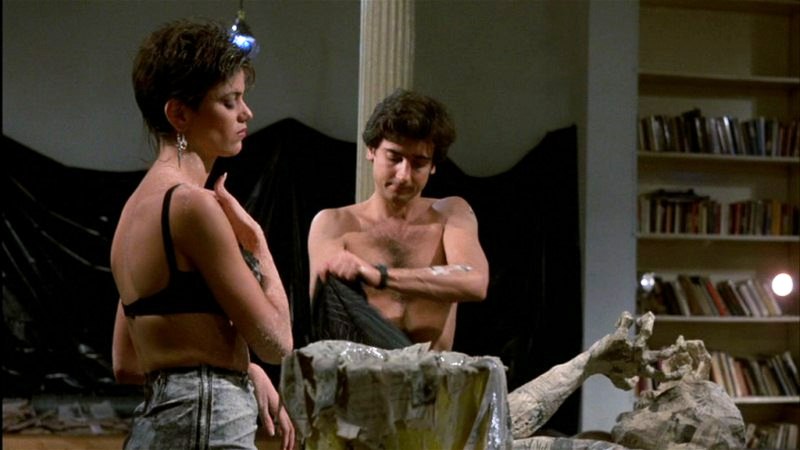
After Paul ascends all the flights of stairs to the loft apartment that Kiki and Marcy share, he finds only Kiki there, working on a papier-mache sculpture of a man that Paul thinks resembles Edvard Munch's The Scream (though he mistakenly calls it The Shriek). Marcy, it seems, had to run to the pharmacy. Kiki says she's been giving herself a real workout and asks Paul to takeover, assuring him it's easy. He complies, despite being in a dress shirt and tie which soon get messed up. Kiki offers to toss the shirt in the washer so he'll look good for "his big date" and he continues his work on her sculpture. Kiki continues to complain about her shoulder and Paul offers a massage and before he knows it, she's fallen asleep in his lap on the couch when Marcy finally makes
 her appearance. Paul and Marcy leave the sleeping Kiki and go off to Marcy's bedroom. Marcy first accusingly asks Paul what he did to Kiki, then changes tone and tells him that she feels like something incredible is going to happen. This will prove to be an understatement for Paul and not in a good way. Before they can even get to know each other, Marcy asks if she can excuse herself to take a quick shower. Paul says sure, but Marcy makes him promise to stay on the bed. Of course, his curiosity gets the better of him: He has to see what she got at the pharmacy and it's some sort of ointment to treat second-degree burns. He also finds a book depicting horrible, disfiguring burns and is horrified as he peruses them before quickly returning to his spot on the bed. Marcy scolds him for not following her orders to stay right where he was, but she forgives him and they decide to go to a diner.
On the DVD commentary, Scorsese praises actors for their bravery, specifically Griffin Dunne for his willingness to stand below for the dangerous and tricky keys point-of-view shot that Scorsese felt was key to the whole film. The clip above picks up from the end of the cab ride and includes the amazing shot of the keys drop and goes on much beyond that. The key drop was a challenge for Ballhaus to put together. Though the sequence only takes a few seconds of
 screentime, it exists of nearly a dozen shots and involved a complicated setup that included placing the camera on bungee cords, a piece of wood with a hole cut in it and the keys themselves, which were really like a projectile hurtling at Dunne's head. Scorsese saw Paul's acceptance of the keys as the moment he sells his soul to Soho, so to speak. For spectators, such as Amy Robinson, filming the scene was frightening enough, but Dunne was willing to do it again, just to get it right. The entire shoot required energy and perseverance from all involved. Scorsese insisted that the entire shooting schedule be done at night, from sunset to sunrise. They could have shot interiors during the daytime, but he would have none of that. When they'd break for "lunch" around midnight, they'd sometime wonder why restaurants would be closed. In any other city, there wouldn't have been as many available options as they did find in New York. As Ballhaus explained in the commentary, longer shoots can present their own problems with more money and bigger cast and crews and they'd be lucky to finish five or six shots a day on a 100-day shoot. For After Hours, they completed 16 shots a day in a 40-day shoot — all at night.
For the uninitiated, to spoil much more of the plot developments would ruin the twisted fun of a truly unpredictable comedy, a comedy that will tie your stomach in knots as you wonder whether or not Paul Hackett can survive this evening or not. At the same time, After Hours contains so many kooky characters
 played by such a talented ensemble and delivers so many classic moments and memorable lines, in its own way for those who have shared in its madness, it's as quotable as Airplane! There's the story Marcy tells about the movie her husband obsesses with and what it leads him to shout every time he climaxes during sex; when Paul, eager to escape uptown, learns the subway fare has risen at midnight to $1.50 and all he has left is change and tries to convince the subway clerk to give him a break because no one is around to find out and the clerk responds, "I could go to a party, get drunk, talk to somebody. Who knows?"; there's the entire sequence with Teri Garr playing the cocktail waitress, seemingly transported out of the late 1960s, obsessed with The Monkees and with a bed encircled with mouse traps. She also gets a great line when she quits (or was she fired) her waitressing job and mutters under her breath about how figuring 8% sales tax is a bitch. There's also great work from Verna Bloom, Catherine O'Hara, John Heard, Cheech & Chong and many fine character actors you'd recognize but may not know by name.

Dunne, who essentially has the dual role as the film's straight man and victim, delivers many of the film's best lines with panache. When he finally gets frustrated with Marcy's eccentricities and is just ready to go home, he indignantly demands to know where those damn bagel and cream cheese paperweights are. That's why he came down. "At this very moment, important papers are flying rampant around my apartment and I don't have anything to hold them down," he shouts. Later, as he trying to hide from a vigilante mob who mistakenly believes he's behind a series of burglaries, Scorsese uses the film's only crane shot as Hackett falls to his knees in the street and cries out, "I'm just a word processor for Christ's sake." Of course, the entire film is another example of how different the situation would be today in the universe of cell phones, though I imagine in a modern day After Hours, Paul's phone's battery would run out and no charger would be available.

As you would expect from Scorsese, his camera almost never slows down, often aided by a great Howard Shore score that almost plays more like a sound effect than music. Scorsese's first cut of the film came in at 2 hours and 40 minutes and though it meant cutting some scenes he did like, he knew it was too much for the film to work as a comedy. Joseph Minion's screenplay originally ended with Paul imprisoned in papier mache and being driven off in a van by Cheech and Chong to an uncertain fate, but the ending didn't satisfy test audiences or the many friends Scorsese showed it too (including Steven Spielberg). (By the way, what happened to Joseph Minion? He wrote Vampire's Kiss with Nicolas Cage in 1988 that I didn't care for and has a handful of other credits, but none that I've heard of or seem to have had much of a release, if any.) This is one case where changing the original ending actually was for the best and the idea came from the great Michael Powell (husband to Scorsese's longtime editor Thelma Schoonmaker), who suggested his worst fate would be to end up back at his dead-end job again after the night he's just endured. When filming was completed, Scorsese gathered the cast and crew and said, "Thank you for giving me back my love of making movies." I think all movie lovers should be grateful to them for that and for After Hours itself. Wouldn't it be great to see Scorsese (or many other great filmmakers) try something like this again?


Tweet
Labels: 80s, Awards, Burstyn, Griffin Dunne, Keitel, Michael Powell, Movie Tributes, Nicolas Cage, Sayles, Scorsese, Spielberg, Tim Burton
TO READ ON, CLICK HERE


