Thursday, August 08, 2013
Karen Black (1939-2013)

Throughout the late 1960s and early 1970s, Karen Black occupied a singular place in movies, hovering in that rarefied atmosphere that placed her somewhere between character actress and star. It landed her roles in many of the decade's classics as well as some of its silliness (such as Airport 1975) As the '80s came along, more of her work came on television and in low-budget horror films, but her early work kept her a recognizable name. Black died today at 74 after a battle with ampullary cancer diagnosed in 2010.

Born Karen Ziegler in Park Ridge, Ill., the actress attended Northwestern University before heading east and attending The Actors Studio with Lee Strasberg. She appeared in several off-Broadway plays and as an understudy in the 1961 comedy Take Her, She's Mine starring Art Carney before making her starring debut in 1965's The Playroom whose cast also included Bonnie Bedelia and Richard Thomas. Her second feature film made a mark for many people when she joined the cast of Francis Ford Coppola's 1966 comedy You're a Big Boy Now starring Elizabeth Hartman, Geraldine Page, Rip Torn and Tony Bill, among others. She made lots of episodic television appearances until she gained noticed in the small role of a hooker named Karen who drops acid in a cemetery with Dennis Hopper and Peter Fonda in 1969's Easy Rider. Her counterculture journey continued the following year when she played the role of Rayette, the country-music loving waitress who becomes crazy in love with the alienated Robert Dupea (Jack Nicholson) in Bob Rafelson's Five Easy Pieces. The part earned Black her sole Oscar nomination as supporting actress.
Black teamed with Nicholson again the following year, only Nicholson sat in the director's chair as she starred opposite Bruce Dern in Drive, He Said. She soon followed that by assuming the part of the Claire Bloom surrogate Mary Jo Reid or The Monkey opposite Richard Benjamin in Ernest Lehman's adaptation of Philip Roth's comic novel Portnoy's Complaint. In 1974, she joined Zero Mostel when he brought his Tony-winning role from Eugene Ionesco's Rhinoceros to the big screen co-starring Gene Wilder. That same year she assumed the role of Tom Buchanan's mistress, Myrtle Wilson, in Jack Clayton's version of The Great Gatsby starring Robert Redford and Mia Farrow and the film won Black a Golden Globe for best supporting actress — and she did it in two dimensions! Finally, she completed 1974 by playing the scrappy stewardess trying to fly a crippled jumbo jet whose flight crew got taken out when a small plane crashed into its side in the funniest of the Airport movies, Airport 1975 (which I'll always love for having Gloria Swanson playing herself dictating her memoirs into a tape recorder as the plane is going down).

Black found herself busy again in 1975, beginning with the cult classic horror film Trilogy of Terror where she starred in three shorts all based on stories by the recent passed Richard Matheson. She also co-starred in John Schlesinger's film of the Nathanael West classic novella Day of the Locust. Her epic piece for that year though involved her first collaboration with Robert Altman in his masterpiece Nashville. Black played country superstar Connie White, filling the bill for another ailing star Barbara Jean (Ronee Blakeley), during events surrounding the political campaign of Replacement Party candidate Hal Philip Walker. In 1976, Black worked again with Nashville co-star Barbara Harris and frequent co-star Bruce Dern as well as William Devane to appear in what would be the final film of the Master of Suspense, Alfred Hitchcock's darkly funny tale of crooks, con men and kidnapping, Family Plot. In 1982, she returned to Broadway under Altman's direction as part of the ensemble of Come Back to the Five & Dime, Jimmy Dean, Jimmy Dean. Altman's impossible-to-see film version featuring Black came out later that same year. Aside from some notable television appearances, most of her post-1982 career has been in horror and science fiction, but Karen Black delivered so much great work when her career was hot, she won't soon be forgotten. RIP Ms. Black.
Tweet
Labels: Altman, Awards, Coppola, Geraldine Page, Gloria Swanson, Hitchcock, Hopper, Mia Farrow, Nicholson, Obituary, Oscars, Redford, Rip Torn, Roth, Television, Theater
TO READ ON, CLICK HERE


Sunday, November 27, 2011
Coppola's Vietnam

"My film is not a movie. My film is not about Vietnam. It is Vietnam. It's what it was really like. It was crazy. We were in the jungle, there were too many of us, we had access to too much money, too much equipment, and little by little we went insane." — Francis Ford Coppola
By Damian Arlyn
Apocalypse Now is one of my all-time favorite movies. In adapting Joseph Conrad's novella Heart of Darkness for the big screen, but setting it in Cambodia during the Vietnam War, director Francis Ford Coppola created one of the most ambitious, absorbing and awe-inspiring examples of what I refer to as "immersive" (and sometimes "meditative") cinema I've ever seen. Some call it the greatest war film ever made but I think, like all masterpieces, it transcends the genre in which it resides and becomes something wholly other: something deeper, more profound. It is about a man surrounded by madness, trying to hold onto his sanity as he goes to kill another man who has lost his. The protagonist's journey into the depths of the jungle actually is a journey into the darker regions of his own soul. Coppola's film was a landmark in motion picture history (winning the Palme d'Or at Cannes and receiving multiple Oscar and Golden Globe nominations) and his achievement is all the more impressive when one learns of what really was involved to make it. Although newspapers reported many of the difficulties encountered in shooting Apocalypse Now in the latter half of the '70s, it wasn't until 1991, when the documentary Hearts of Darkness: A Filmmaker's Apocalypse, was released, that the full story behind Coppola's Vietnam film became known. I actually watched the doc before I ever saw Apocalypse Now and it gave me an appreciation for the film that I doubt I would have had otherwise. To this day no other documentary (besides perhaps Burden of Dreams) more compellingly chronicles the aspirations, obsessions, insecurities and ultimate triumph of a young filmmaker tackling his biggest and most challenging project.
Hearts of Darkness was directed by George Hickenlooper (who died late last year) and Fax Bahr, but the majority of its footage was shot by Coppola's wife Eleanor during the filming of Apocalypse Now. As the director's wife, Eleanor had access to the troubled filmmaker that few other documentarians would. In addition to recording candid interviews with her husband as well as on-set interactions between him and his crew and actors, Eleanor recorded talks that they had alone in which Coppola revealed his fears about the project as well as his own career. After Eleanor turned her footage over to Bahr and Hickenlooper, they shot new interviews with Coppola, Martin Sheen, Laurence Fishburne, Robert Duvall, Dennis Hopper, cinematographer Vittorio Storaro, writer John Milius and even George Lucas. They then enlisted Eleanor to provide the film's narration (except for some passages from Conrad's novella Orson Welles read on an old radio broadcast) and premiered it at Cannes to great critical acclaim. In the U.S., it premiered on Showtime before being released theatrically 20 years ago today.

The film depicts Apocalypse Now's tumultuous shoot in a very honest and forthright manner. It didn't escape Coppola's notice, as he said in the now famous quote shown above this post, how much the story being filmed mirrored his own experience trying to tell it. Originally, Harvey Keitel was cast in the lead role of Capt. Ben Willard, but after seeing the dailies, Coppola was dissatisfied and replaced him with Martin Sheen. During the shooting of the now iconic "Ride of the Valkyries" helicopter scene, several copters suddenly were pulled away by the Philippines government to battle rebels. At one point, Martin Sheen had a heart attack and needed to be flown out of the country in order to have surgery. Marlon Brando, who was being paid the astronomical sum of a million dollars a week, showed up severely overweight and not having read the Conrad novella as Coppola had requested. Dennis Hopper's brain was so fried from drugs that he couldn't remember his lines. Eventually, Coppola was forced to abandon the script and make up a lot of it (including the ending) as he went along. What initially was slated as a five-month shoot lasted more than two years and the budget ballooned from $14 million to more than $30 million. In some very revealing audio tracks, Coppola confesses to his wife that he's certain the film is awful, will fail, that he'll become a laughingstock, etc. It is somewhat ironic that Coppola was correct that his career has fallen way short of its early promise while his contemporaries (Spielberg, Lucas and Scorsese) have, for the most part, continued to create films that are financially and/or critical successes. It did not, however, have anything to do with Apocalypse Now which, in spite of the incredible trials and tribulations faced during its production, was (and still is) considered one of his great accomplishments.
In an era where "making-of" documentaries are common features on DVDs (the best ones usually made by Laurent Bouzerau), it's difficult to appreciate what a rare glimpse behind the curtain Hearts of Darkness provided. Even today, most "behind-the-scenes" specials are puff pieces where the actors all are "thrilled" to be on the project, the director "couldn't be happier" with the work being done and the producer "loves everyone involved." Occasionally you get one like the Dangerous Days doc on the Blade Runner DVD/Blu-ray that has the courage to admit that the director wasn't easy to work with, that the studio was making things much harder than it had to be and the overall shoot was a bitch. Hearts of Darkness: A Filmmaker's Apocalypse put all of that out there. Although the film's place in cinematic history is secure, one almost wouldn't be surprised to see Coppola characterizing his experience working on the film by uttering the immortal last words of Kurtz as he lay dying, in both Coppola's film and Conrad's novella:

Tweet
Labels: 90s, Awards, Brando, Coppola, Documentary, Duvall, Fiction, Fishburne, Hopper, Keitel, Lucas, M. Sheen, Movie Tributes, Scorsese, Spielberg, Welles
TO READ ON, CLICK HERE
Monday, November 14, 2011
"There's more to this game than shooting"

By David Gaffen
Though I didn't get on the floor much, I played for my high school's freshman basketball team. If I were to track down any of the players from that squad today, one of their first recollections of that year would doubtlessly be of our coach, who shall remain nameless to protect the innoc — er, guilty. With his bullet-head, close-cropped haircut and a perpetual expression of annoyance, his sideline tirades, often punctuated with the phrase, “Jesus H. Christ Motherfucker!” were enough to blanch even the most jaded of those familiar with high school athletics. Yes, this was the man charged with dealing with ninth-graders. Needless to say, none of us were upset to see him go the following year, collectively relieved he wasn’t promoted to junior varsity coach.
People talk of coaches that you’d follow into battle. He was not one of them. The traditional idea of the "tough coach" is one that has wended its way through popular literature and film, and, at first glance, it’s hard to distinguish one portrayal of this character from another. They’re generally gruff, foul-mouthed and strict, but with a sense of empathy that naturally doesn’t manifest until key moments in the story. In the hands of the wrong actor, he remains a stock character and nothing more, and while it's always fun to watch a grizzled character actor chew on the scenery while barking orders at athletes, it takes an actor operating on a higher plane to make such a character worth something, and thus, worthy of his team's sweat and energy.
In a sense, Gene Hackman is an actor in the John Wayne mold, albeit a bit more rumpled and lived-in, which suited him through the 1970s, when such actors could be considered leading men. He still nabbed some starring roles in the '80s as well, including a memorable portrayal of one of those coaches you'd follow into Hell in Hoosiers.
Norman Dale is a strong-headed coach so intense he alienates most of a small town where he’s been appointed to lead a basketball squad in Indiana, the most hoops-crazy state in the nation. Looking back 25 years later, it’s easy to remember the booming, anthemic score from Jerry Goldsmith, the rich photography and the famous moment late in Hoosiers where Hackman’s character eases his players’ worried minds by demonstrating that no matter how big the stadium, the basketball court’s dimensions do not change.
For his career, Hackman's tallied a surprisingly low number of Oscar nominations with just five, and just two for leading actor — Mississippi Burning a few years after this film, and The French Connection, for which he won. With an additional win for Unforgiven as supporting actor, he has gone two-for-five, which isn’t a bad percentage. Nevertheless, he was passed over for his work in Hoosiers.
What doesn't immediately come to mind upon recollection of Hoosiers is just what a hard case Hackman's character is. We’re introduced to this man who'd been fired for striking a student. He finds a few supporters who agree with his on-court philosophies — constant passing, moving without the ball and other logical tenets of the game — but puts off most others who find him haughty and a bit condescending. And for good reason: he is haughty and condescending. By keeping everyone at arm’s length, he sets himself up for a public hearing where the residents of Hickory, Ind., vote to dismiss him. That he survives at all is only through the sort of divine intervention that happens only in films. The town’s star, Jimmy Chitwood, who until now had refused to play on the team, decides to join the squad, but only on the condition that Dale stays. Dale had given the young, enigmatic man a talking-to earlier in the film where he again asserts his stubbornness, but makes an impression by refusing to kiss the star player's rear end, concluding a short speech by telling Chitwood, “I don’t care if you play on the team or not.”

Tellingly, Chitwood, who had sunk several shots from long range on a small dirt court outside the high school, clangs one off the back of the rim after Hackman's soliloquy. Hoosiers is filled with moments similar to that: quiet conversations where the director, David Anspaugh, resists the temptation to be cloying by letting people speak without syrupy music cues and dreamy, doe-eyed close-ups. (Then again, Gene Hackman and co-star Dennis Hopper didn’t become famous for their devastating smiles, so perhaps that option was unavailable to begin with. It’s something he would fail to heed with Rudy, one of the more bathetic sports movies, with characters of much less import.) Together, Hackman and Hopper have one of the best moments of the film, taking place in the small hovel in the woods where Hopper's Shooter, a former star and now the town drunk, is asked by Dale to be his assistant coach. Shooter was once a god, and now he's a sad reminder of what it means to have too much too soon in life, never able to live up to expectations set by youthful accomplishments. Dale asks that he wear a suit and come to all practices — easy conditions to meet. But then he asks that Shooter be there sober. Shooter throws him out, obviously wounded after being reminded of this flaw by a person he doesn't know. Hopper did end up with an Oscar nomination for this movie — a surprise to him, as he expected it for his mad performance as Frank Booth in Blue Velvet. But the Academy went with the warmer, more sentimental role, though it's hard to argue he didn't deserve this nod. Hopper's face is as lived-in and craggy as Hackman's, wearing years of pain drowned by drink.
Hoosiers benefits from the fact that, outside of the major actors and a few well-known character types like Chelsie Ross, many of the actors, particularly the players, were recruited directly from Indiana; some were basketball players, some were not. It adds an air of authenticity that would have been overwhelmed had any of the characters been played by young, well-known stars. (For some, this was their only film.) Indeed, an ESPN article published a year ago that caught up with many of the cast members quotes Wade Schenck, who played the half-pint Ollie, saying he wanted to be in the movie because, “If I got a part, I wouldn't have to work the farm for harvest.” He's still a farmer today. Hoosiers has a deserved reputation as one of the best sports movies ever made, and it's largely because the cast grounds the film by not overplaying. (Another smart turn is having Hopper’s alcoholic character end up in a hospital late in the movie rather than fully redeem him.)
Hackman tends to make his characters easy to sympathize with, though perhaps the movie fails in the way it tells more than it shows. Norman Dale is full of bombast, and is at times self-destructive when it comes to his team (keeping just four players on the court at one moment when a healthy player sits on the bench, getting thrown out of multiple games including once to teach Hopper’s character a lesson) but I’d argue we don’t see the kind of character who'd strike a student as we’re told he did. Unfortunately, Barbara Hershey’s character, a surrogate mother to Chitwood and a rival to Dale for most of the film, also acts as sand in the gears. She’s usually naturalistic, but feels forced through most of this movie.
But these are minor points. The movie is based on a true story about a small squad that, in the 1950s, did win the state championship, and the film's portrayal of the team's late run for the title is full of rousing moments, as is the movie’s last line, heard in voiceover while the camera pans to a latter-day photo of the championship squad: “I love you guys.”

Tweet
Labels: 80s, Barbara Hershey, Hackman, Hopper, Movie Tributes, Wayne
TO READ ON, CLICK HERE
Monday, September 19, 2011
A Detective and a Pervert

By Jonathan Pacheco
There are critics out there who have no interest in watching any film more than once, but I’ve always been of the mind that a film worth watching is worth watching twice. So while I borderline-abhorred Blue Velvet when I first watched it back in college, I always knew it was a film I’d re-visit someday. Twenty-five years ago, David Lynch created a challenging, controversial and passionate film — that much I could tell even while I found it uncomfortable and uninteresting. I’m thankful that I did indeed take a second, fresh look at Blue Velvet because now I see the film in the context of Lynch’s entire career, which, for me, helps to illuminate the film’s strengths while it also shines a bright spotlight on its flaws.
College-age Jeffrey (Kyle MacLachlan) returns home to Lumberton, a wholesome “Anytown, U.S.A.” seemingly stuck in the 1950s, to visit his ailing father. While walking through a field on his way back from the hospital, he spots a severed human ear hidden in the grass. With no regard for his own health, he picks the thing up with his bare hands and delivers it in a bag to Detective Williams (George Dickerson), a friend of Jeffrey’s father and himself the father of Sandy (the always-dependable Laura Dern), a cherubic high school beauty and the physical representation of love, goodness and virtue in Lynch’s film. With her help and a bit of inside information, Jeffrey decides to investigate the ear-severing himself, mostly out of thrill-seeking curiosity.
His strange, erotic journey eventually leads him into the arms of Dorothy (Isabella Rossellini), a nightclub singer under the control of Frank Booth (Dennis Hopper), a local criminal with a knack for kidnapping, a gas inhalation addiction, a proclivity for depraved and violent sexual
 abuse and a blue velvet fetish. He’s really something else. At one point, Sandy, speaking of Jeffrey almost in awe, confesses to him, “I don’t know if you’re a detective or a pervert.” By the end of the film, we can gather that Lynch wants us to believe he’s a bit of both, and in that sense he represents the film itself, which is simultaneously a neo-noir mystery and a twisted erotic tale. An intriguing mix, but one that Lynch can’t quite balance. Not to say that Blue Velvet is unsuccessful — seeing it again and having a better grasp of Lynch’s style and what I feel his intentions are, I “get” the director’s brand of zany humor as it comes across when mashed against visually and aurally nightmarish sequences and disturbing subject matter. When Lynch contrasts such polar opposites, when he includes jokes about “morning wood” in a film with scenes of sexual abuse, I know that it’s not to “take the edge off sex and violence” as Roger Ebert claimed in his highly unfavorable review. Instead, as we’ve seen throughout the years, Lynch works like a chemist, mixing elements at different doses, curious to see what reactions he can produce. His blend of ironic clichés with uncomfortable harshness is intentional and in no way cowardly, as Ebert implies.
I feel, however, that the chemist is simply off on his measurements in this experiment. The way he juxtaposes the campy and the disturbing feels unrefined, showing promise, particularly in the opening and closing sequences, but also immaturity; just think back to some of those low-hanging radio gags. (And that’s not even getting into his awfully basic usage of color semiotics.) Compare his attempts here to, say, the two dance sequences of 2006's Inland Empire. Lynch’s intentions with that film and those sequences may not be the same as in Blue Velvet, but his success in creating moments bizarre enough to conjure his desired mix of emotions but not wacky enough to remove you from the film suggests a maturity and mastery of his now-patented approach.
And that’s the thing about watching Blue Velvet in 2011: though it contains its own triumphs — such as he funny, frightening and unreal scene at Ben’s place (a scene that does find just the right mixture of contrasting tones) or the absolutely full-throttle and deservedly iconic performance by Dennis Hopper — we’ve seen Lynch use many of the same techniques and ideas in his other films since this one, sometimes with greater success (Twin Peaks, with its comparable theme of the dark underbelly lurking beneath a wholesome society) and sometimes with similarly mixed results (the should’ve-been-brilliant Lost Highway, with its noir-ish peek into kinky sexuality and its consequential murder). Mulholland Drive, to me, represents a sort of culmination of all these attempts, and in some ways is the film that Blue Velvet perhaps could’ve been. It’s a mystery for both the characters and the viewer. It’s a romance of confusing and conflicting sexual thoughts and identities. It’s sleek, sexy, perplexing, frightening and unnerving in ways that Blue Velvet only showed the potential to be. And it all works in practically perfect harmony. I understand why Blue Velvet is considered a cult and beyond-cult classic, but seen in the context of Lynch’s greater works, it loses so much of its remarkableness, simply serving as an interesting case study in which one can see the development of the David Lynch we now know.
Tweet
Labels: 80s, Ebert, Hopper, Kyle MacLachlan, L. Dern, Lynch, Movie Tributes, Twin Peaks
TO READ ON, CLICK HERE
Monday, August 22, 2011
Like death eatin' a cracker

By Edward Copeland
When you hear people talk about those rare instances when a movie sequel turns out to be better than its predecessor, the usual titles spring up: Aliens, The Godfather Part II, Bride of Frankenstein, the original
 Dawn of the Dead, etc. However, there is one sequel that I feel has been unjustly neglected for its superiority to the original and today I come to praise it. Twenty-five years ago today, Tobe Hooper's Texas Chainsaw Massacre 2 hit theaters to the resounding thud of overwhelmingly negative reviews by people who probably remembered the original a lot more fondly than they should have and didn't recognize the sequel for the hilarious, albeit grotesque, satire that it is. This isn't just your run-of-the-mill followup to a famous slasher film — this is a sharply written parody about the perils of the small businessman, who in this case happens to make his living by turning humans into chili. I never saw the original until shortly before the sequel opened — I didn't want to be hopelessly lost — but I found it terribly disappointing. It didn't seem that suspenseful to me and the sequence that worked best was when they hauled Grandpa out for dinner to kill the girl they captured, a scene echoed in the sequel for even funnier effect than in the first outing.


For solid evidence of the satirical intentions of Hooper and his screenwriter L.M. "Kit" Carson (and Carson has a long satiric history since he "was" David Holzman in David Holzman's Diary), one need look no further than to compare the posters on the left and the right sides of this paragraph. The one on the left side for John Hughes' 1985 film The Breakfast Club, has its five central characters posed with Judd Nelson's rebel pumping his fist into the air. Now, look at the poster on the right. The brilliant poster they came up with for Texas Chainsaw Massacre 2 the following year exquisitely apes the angst-ridden detention students by placing its assortment of misfits involved in the man-as-meat chili business in a nearly identical tableau with, as appropriate, Leatherface assuming the Judd Nelson spot since in the sequel's terms, he is sort of the rebel among the cannibal family. You see, in this slasher sequel, Leatherface, the grunting butcher for the family business finds, of all things, love. Alas, it turns out to be an unrequited one. I'll get back to that later.

A little background on the story is probably necessary at this point for the uninitiated: An opening title crawl informs the viewer that 13 years after the events of the original film (which for the sake of argument — long before The Blair Witch Project — actually happened), strange chainsaw slayings still occur in Texas though the story the sole survivor of the original film told could never be confirmed by authorities and the cannibal family (their actual surname is Sawyer) was never found. As the sequel opens, it is the fabled OU-Texas football weekend (another brilliant satirical touch) and two drunk preppie-looking guys are heading to Dallas for the festivities and taunting a disc jockey with phone calls from their car at the same time.

Unfortunately for the football fans on the road, they piss off the wrong drivers — and they encounter Leatherface and his deadly weapon. The chainsaw gang makes a crucial mistake though — as they are dismembering the two young men, the victims are still on the phone with the DJ, Stretch (Caroline Williams) who records their death throes and the sounds of the chainsaw bringing about their demise. Stretch is suitably horrified. Enter former Texas ranger Lefty Enright played by Dennis Hopper in the same year he brought Frank Booth to life in Blue Velvet and scored an Oscar nomination for Hoosiers. Lefty has been searching for the butchers for years — he is the uncle of some of the victims in the original — and he's been vengeance-minded ever since.
After stumbling upon the dead preppies, Lefty gets a newspaper to print his plea for any information — and Stretch answers his ad at the hotel where Lefty is staying (and which overflows with soused OU and Texas fans
 in Dallas for the big game). In another of the film's funniest sequences, Lefty goes chainsaw shopping to prepare for battle, purchasing a large main one and two smaller pair which he attaches to his belt like a pair of six shooters (though firearms would really be more efficient, but it would deprive us of a chainsaw joust). Part of what makes the scene so laugh-out-loud funny is watching the unabashed joy expressed by the manager (James N. Harrell) of the store (called Cut-Rite) where Lefty buys the equipment as Lefty tests them out on tree stumps in front of his shop. Meanwhile at the radio station, apparently Stretch's station management doesn't pay close attention to what she plays because she heeds Lefty's request to start playing the tape of the slaughter on the air — and the Sawyer family hears it and realizes they've made a mistake.

The news comes soon after oldest brother and family leader Drayton Sawyer (Jim Siedow) has achieved yet another victory at a chili contest for his cannibalistic catering business. (As he tells the judge, the secret's "in the meat.") Chop Top (Bill Moseley), the hippified Vietnam vet of the Sawyer clan, calls to tell Drayton the bad
 news about the radio broadcast and Chop Top and Leatherface (Bill Johnson) are dispatched to the radio station to take care of the evidence — and Stretch. Unfortunately for the Sawyers, Leatherface gets distracted from his mission at the radio station when he encounters Stretch and does something you don't often see in nonspeaking maniacal chainsaw killers — he falls in love. Something about Stretch calms the killer inside Leatherface and he can't bring himself to off her. In fact, during their encounter he almost tries to accomplish the phrase Heather Chandler (Kim Walker) would make infamous in Heathers three years later — he tries to fuck Stretch gently with a chainsaw. He and his brother do get a body though in the form of Stretch's compulsively spitting co-worker L.G. (Lou Perry). When Leatherface and Chop Top depart the station with L.G., Stretch feels compelled to follow them to the roadside attraction that serves as the family's cover: Texas Battle Land. Of course, Lefty is not far behind — he even admits he used Stretch as bait.

When Stretch accidentally falls into the lair, Leatherface discovers her and does his best to protect his "girlfriend," even attempting to dance with her at one point, though Stretch tries to explain to him that their relationship isn't working out. Eventually, his brothers find her and decide it's time to serve her up to Grandpa, a veteran of the
 cattle industry who quit when the slaughtering process got too modern (and whose makeup to me always seemed very reminiscent of the old Salieri in Amadeus). While there are some standard sudden shocks, it's not really suspenseful, which is fine — because it's there to be funny. The comedy is sprinkled throughout, but many of the best bits occur once all the characters are below ground. (One of the best jokes references the original when Lefty finds the remains of his nephew Franklin in his wheelchair and now, 13 years later, that damn flashlight works.)

You don't often hear praise for the acting in films such as Texas Chainsaw Massacre 2 and I wouldn't suggest they were robbed of Oscar nominations, but Siedow and Moseley give absolutely terrific performances, especially Moseley who gets the bulk of the hilarious nonsequiturs sprinkled throughout the movie, including the title of this post and lines that make no sense out of context such as "You ruined my Sonny Bono wig" and his insistence that Texas Battle Land be transformed into Nam Land because, "It's what the people want." Siedow gets assigned the task of underlining the film's satirical content
 with his obsession with the business, worrying about property taxes and decrying that the small businessman "always gets it in the ass." In fact, when he finally encounters Lefty, who has been systematically destroying their lair with his chainsaw, Drayton jumps to the conclusion that he's been sent by a rival caterer and tries to pay him off. He also gets some of the best lines when he discovers Leatherface's affection for Stretch, accusing him of "turning traitor for a piece of tail" and explaining to him that sex is a swindle and only the saw is family. The final confrontation between Lefty and the Sawyers still trots out the laughs instead of the horror and as Drayton senses the end is near, he laments that he "wouldn't wish this life on a one-eyed ferret with mange." I understand that for many, the satirical elements of Texas Chainsaw Massacre 2 have and will be lost, but I stand by my assessment: This is a sharp, hysterically funny film and Texas Chainsaw Massacre 2 — I salute you on your birthday. If most people fail to appreciate you, take heart — I'll always be on your side.
BLOGGER'S NOTE: This piece originally ran five years ago for the film's 20th anniversary. There have been a few minor revisions and art changes. Happy 25th Sawyers.

Tweet
Labels: 80s, Hopper, John Hughes, Movie Tributes, Sequels
TO READ ON, CLICK HERE
Sunday, July 03, 2011
He certainly admires people who do things

By Edward Copeland
Saying that Alfred Hitchcock created great sequences certainly isn't a particularly profound or original statement for someone who writes about film to make, but each time you re-visit one of his classics, it's hard not to repeat that kind of statement because it washes over you, especially when you look again at
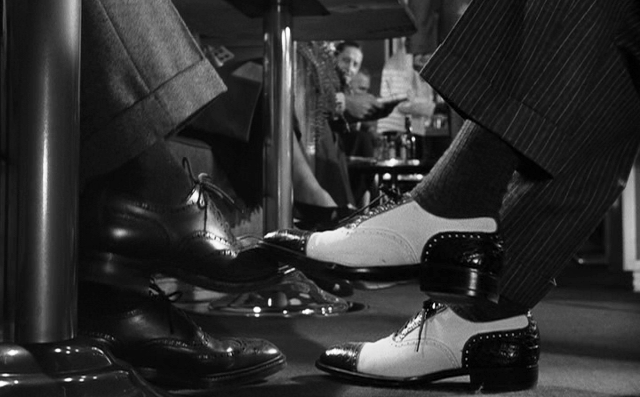 Strangers on a Train, which was released 60 years ago today in New York, though some sources have its U.S. premiere elsewhere on June 30, 1951. The great director's masterful set pieces especially took hold of my thoughts when I watched it this time because of its marvelous opening. We see a man get out of a cab with luggage, but only from below the waist, concentrating on his shoes as he heads to catch a train. Then, we see a second man get out of another cab, identical company, and we only notice the difference because of the style of his shoes as he hurries to catch his train. We follow the shoes as they go through the turnstiles and board the train, even get a shot of the train pulling away and switching tracks. The one pair of shoes keeps moving within the train car finally taking a seat by a table in a lounge car when those two pairs of shoes brush one another, giving us our first meeting between tennis pro Guy Haines (Farley Granger) and Bruno Anthony (Robert Walker). YouTube has the clip, but you can't embed it, so click here to see one of the best starts to one of Hitchcock's greatest films.
The novel Strangers of a Train was the first thriller published by Patricia Highsmith, who would go on to write the successful series of books on serial killer Tom Ripley that have been adapted into films starring actors as diverse as Alain Delon, Dennis Hopper, Matt Damon, John Malkovich and Barry Pepper by directors as disparate in style as Rene Clement, Wim Wenders, Anthony Minghella and Roger Spottiswoode. As good as some of those films are and as fascinating as Ripley is as a character, for my money, none match Walker's creation of the sociopathic, psychopathic and just plain crazy Bruno in Strangers on a Train,
 especially under Hitchcock's direction and working from a screenplay whose co-writers included none other than Raymond Chandler. Walker's performance as Bruno functions as the key to Strangers on a Train really unlike an actor in any other Hitchcock film. For a director who liked to joke that actors should be treated like cattle, Strangers wouldn't be the classic that it is without the brilliance of Walker's performance. Walker's work borders on genius and, to me, may well be the best ever given in any Hitchcock film. His Bruno can evoke chills and a general feeling of creepiness, but Walker doesn't play him as an over-the-top villain, working overtime to scare the audience at every turn. He creates a three-dimensional, troubled individual that at times you might even feel a twinge of sympathy for — until he commits his next horrifying act. When I planned to write this tribute, I found myself less interested in recounting a lot of the plot or describing the highlights as I did honoring Walker's work. It gets boring after awhile to whine about the performances that Oscar didn't nominate, but how they missed Walker is an outrage. It's even sadder considering that about a month and a half after the film's release, the actor died because of a bad reaction to prescription drugs. All things considered, performers in Hitchcock films didn't get as many nominations through the years as they probably deserved. The only ones who did get nominated were Laurence Olivier, Joan Fontaine and Judith Anderson in Rebecca; Albert Basserman in Foreign Correspondent; Joan Fontaine in Suspicion; Claude Rains in Notorious; Ethel Barrymore in The Paradine Case; and Janet Leigh in Psycho. Only Fontaine's performance in Suspicion took home the prize. No Anthony Perkins. No Jimmy Stewart for Vertigo or Rear Window. No Joseph Cotten for Shadow of a Doubt. All those nominated and unnominated pale though next to the omission of Robert Walker's Bruno. If for some inexcusable reason you've never seen Strangers on a Train, what the hell have you been doing with your life?
Some plot synopsis and I'll try to be brief. Once their footwear bump, Bruno recognizes Guy Haines immediately and slides over to make conversation. The men may be strangers, but Bruno knows a lot about Guy from newspapers. Not just about his
 tennis career, but from the society and gossip pages as well, so Bruno brings up Guy's marriage to Anne Morton (Ruth Roman), daughter of Sen. Morton (Hitchcock favorite Leo G. Carroll), when he spots Guy's cigarette lighter engraved A to G. "Perhaps you read too much," Guy tells Bruno as he grows
 annoyed. Besides, Guy adds, he hasn't married Anne, unless they've changed the laws against bigamy and he hadn't heard about it. Haines remains legally married to Miriam Joyce Haines (Laura Elliott), who has delayed their divorce even though she's openly playing around. Bruno starts to suggest something, but holds back instead just saying, "Right now, I suppose divorce is the simplest option." Bruno invites Guy to dine with him in his compartment, but Haines wants no part of that, hoping to rid himself of the pest. He asks the train's waiter if there are any empty seats in the dining car, but the waiter says no and there probably wouldn't be for another 30 minutes at least. Bruno takes that as his cue and a sign. Guy simply must dine with him now and Haines reluctantly agrees. Walker perfectly blends the charming side of Bruno with the annoying without giving away hints of the darkness inside.

When the two are alone and Guy gets some liquor in him, he's a bit too open about his life, admitting how Miriam played him for a fool. Bruno admits he has someone he hates too — his father. Bruno's father is a rich man, but he expects Bruno to earn a living and won't just let him have what's "rightfully his." Bruno says that some people just deserve to die, doesn't Guy agree? "I may be old-fashioned, but I thought murder was against the law," Guy says. "Some people may be better off dead, like my father or your wife for instance," Bruno suggests
 before he tells Guy of his plan for the perfect murder. Two strangers — much like Guy and himself — with no connection to one another meet and agree to swap murders. For instance, while Guy has an airtight alibi, Bruno would kill Miriam. Then, Guy would do the same for Bruno and murder his father. "Criss-cross," Bruno says. The train nears Guy's stop where he's going to try to talk to Miriam again. In the meantime, realizing he's trapped in a compartment with a loon, Guy just tries to humor Bruno. As he's leaving, Bruno tries to confirm that they've made a deal and Guy sort of laughs him off, just eager to get out of there. Guy also fails to notice that Bruno managed to swipe his engraved lighter from him. To Bruno's ears though, it sounds as if Guy has agreed to swap murders with him. For those always on the lookout for where Hitchcock might appear, when Guy exits the train in his hometown, Alfred can be seen climbing aboard carrying a bass.
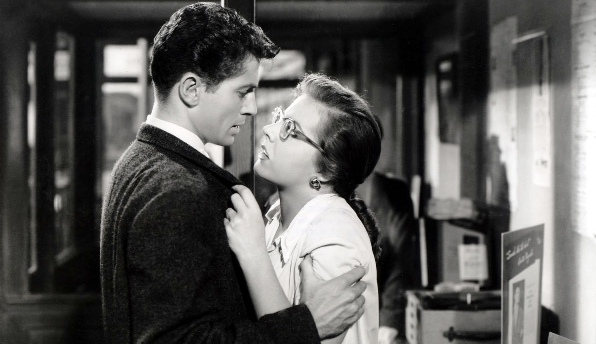
Things do not go well when Guy meets with Miriam at the music store where she works about the divorce. His wife turns out to be a real shrew. She tells him that she was prepared to give him a divorce but thought he was dragging his feet. She demands he cough up money for her lawyer which Guy does, though he grumbles about her carrying another man's child. Then Miriam springs it on him — she has no plans to give him a divorce. She tells him that she wouldn't have started playing around if he hadn't been gone playing tennis all the time. Guy practically throttles her in the store, until the manager breaks it up. A steamed Guy calls Anne from a phone booth and relays the latest development. "I wanted to strangle her," he tells Anne.

Later that night, Miriam decides to head to the amusement park with not one, but two men. Unbeknownst to her, a third man will be tagging along. From this point on, Strangers on a Train exists
 almost entirely of Hitchcock set pieces and creepy moments provided by Walker. The actor and director work together on the very first as Bruno stalks Miriam through the amusement park, always seeming to appear beside her from out of nowhere, impressing her with the ability to hit the bell when he strikes the game with the hammer, keeping a constant devilish grin on his face. Has a smile ever looked more malevolent to the moviegoer while a passer-by wouldn't notice that anything's amiss. When Miriam and her boy toys get a boat to sail through the Tunnel of Love, Bruno gets one as well, munching on popcorn as he drives. In the cave, ambiguous shadows appear on the wall followed soon by Miriam's scream. That turns out to be a fakeout. Miriam comes out the other side just fine. When the boats dock at a little island, her men head off somewhere, but Bruno stops her to light her cigarette. She flirts with the madman who goes from gentleman to killer, knocking off her glasses as he begins to strangle her, her murder viewed as a reflection in the eyewear.


As they say, the best laid plans…Nothing goes the way Bruno planned and since Guy didn't take him seriously in the first place, events don't go his way either. When Guy arrives at Sen. Norton's home, they inform him of Miriam's murder, but Guy has already been told — Bruno met him at the gate and showed him Miriam's smashed glasses and wanted to make plans for when Guy will kill Bruno's father. Unfortunately, Guy hadn't planned an alibi. He has one: He was on a train back to Washington and spoke with a professor. Unfortunately, the professor had imbibed a bit too much and when the police bring him to meet Guy, he doesn't remember him. The senator asks if everything's fine now that his alibi has been verified. "When an alibi is full of bourbon, sir,
 it can't stand up," Guy tells him. Because Guy had a motive, the police are even keeping him under surveillance, keeping detectives tailing him at all times. It doesn't help that an impatient Bruno keeps spying on Guy in a variety of settings creating some really spooky moments as when he's the sole figure on the steps of the Jefferson Memorial or the true masterpiece: When he attends one of Guy's tennis matches and all the spectators' head move side-to-side, following the serves but Bruno sits perfectly still among keeping his focus on Guy. He gets more daring, insinuating himself among Guy and the Mortons' circle of friends. "You're spoiling everything. You made me come out in the open," Bruno tells Guy at one point. Guy explains that the police are watching him, so he can't easily slip away and kill his father from him. I love Strangers on a Train and Robert Walker as Bruno so much that I could probably write endlessly about it, detailing every plot point, sharing all the great lines of dialogue, describing all of Hitchcock's magnificent touches, but part of me thinks if you have seen Strangers on a Train, you already know all this and if you haven't, you shouldn't be reading what I'm writing about it, you should be watching it — as soon as possible.

Therefore, I'm resisting the urge to expound on all I wanted to such as mentioning Marion Lorne (Aunt Clara on Bewitched) and her two scenes as Bruno's mother and quoting some of her lines. It means not going into detail about Patricia Hitchcock as Anne's sister Barbara or Bruno's party game when he crashes the senator's party. He has so many lines that I'm tempted to repeat but if you haven't heard them, you need to hear them from Walker first, not me. I do have to briefly refer to the amazing suspense Hitchcock builds with activities happening in two different spots: Guy trying to hurry and win a tennis match so he can get back to the amusement park to prevent Bruno from planting his lighter and framing him while in the town where that park is, Bruno tries to retrieve the lighter he accidentally dropped down a storm drain. The throwaway line of the rich old woman when police commandeer her car, telling her they are in pursuit of a criminal. "Really? How exciting."

Finally, there's the climax on the merry-go-round, one of the most exciting Hitchcock filmed, but there's a moment many might miss. There's a little boy still on the ride and even though it's spinning wildly out of control, he's having a blast. When the fighting Bruno and Guy come near him, the tyke stars hitting on Bruno — and Bruno hits the kid back. Strangers on a Train, simply put, is just a great fucking movie with Robert Walker giving one of the best portrayals of an on-screen psycho in film history. As Guy says about Bruno toward the end, "He was a very clever man" and Walker was just as clever an actor to deliver this brilliant a performance.
Tweet
Labels: 50s, Fiction, Fontaine, Hitchcock, Hopper, J. Stewart, Joseph Cotten, Malkovich, Matt Damon, Movie Tributes, Olivier, Oscars, Rains
TO READ ON, CLICK HERE
Friday, December 31, 2010
The Year in Appreciations
Now this is hardly a comprehensive list of the artists who left us in the calendar year 2010, but just of those we had the time and energy to do write-ups on. Sometimes the death announcements hit at an inopportune time for me such as when we lost Dino De Laurentiis. I was on the way to a lengthy doctor's appointment and by the time I got home, I was so worn out the news was so old, I didn't have the stamina to type something out. Othertimes, even important artists who deserved mention, I wouldn't have had much to say about, even someone as great (and a Facebook friend) such as George Hickenlooper. I wouldn't have had much to say about Barbara Billingsley or Ronni Chasen, but they deserved notice as did Mitch Miller, Jerry Bock, Sally Menke and many others. It's meant as no slight on those we didn't. There are a lot of names, but I doubt that even this list is comprehensive.




Others who deserve remembering in alphabetical order: Corey Allen, Dede Allen, Sparky Anderson, Louis Auchincloss, Beryl Bainbridge, Roy Ward Baker, Eddie Barth, Martin Baum, Captain Beefheart, Martin Benson, Luis Garcia Berlanga, Lisa Blount, Denise Borino-Quinn, Vance Bourjaily, Robert F. Boyle, David Brown, Solomon Burke, Jackie Burroughs, Christopher Cazenove, Claude Chabrol, Maury Chaykin, Chao Li Chi, Alex Chilton, John Clifford, Art Clokey, Hank Cochran, Clay Cole, Gary Coleman, Paul Conrad, Leo Cullum, Joe Deal, Jimmy Dean, Richard Devon, George DiCenzo, Ronnie James Dio, Nancy Dolman, Bernard-Pierre Donnadieu, Donal Donnelly, Clive Donner, Paul Dunlap, Doris Eaton, Bill Erwin, Doug Fieger, Eddie Fisher, Maureen Forrester, Fred Foy, William A. Fraker, Dick Francis, David Froman, Frank Giering, Jackson Gillis, Greg Giraldo, Mark Gordon, Henryk Gorecki, John Graysmark, Kathryn Grayson, Bud Greenspan, Bob Guccione, Corey Haim, Barry Hannah, Capt. Phil Harris, Peter Haskell, June Havoc, Peter Hofmann, Alan Hume, Gregory Isaacs, Marvin Isley, Peter Jamison, Mitch Jayne, Lionel Jeffries, Lamont Johnson, Elliott Kastner, Larry Keith, Irvin Kershner, Andrew Koenig, Michael Kuchwara, Steve Landesberg, Jack Levine, Marcia Lewis, Abbey Lincoln, Art Linkletter, James MacArthur, Simon MacCorkindale, Tom Mankiewicz, Joe Mantell, Teena Marie, Jim Marshall, Grant McCune, Kate McGarrigle, Vonetta McGee, Malcolm McLaren, Caroline McWilliams, Justin Mentell, Don Meredith, James Mitchell, Willie Mitchell, Mario Monicelli, Elizabeth Moody, Ronald Neame, Edwin Newman, Kazuo Ohno, Merlin Olsen, Nikos Papatakis, Fess Parker, Robert B. Parker, Robert Paynter, Harvey Pekar, Teddy Pendergrass, Charles Pierce, Ingrid Pitt, Belva Plain, Sigmar Polke, Dorothy Provine, Pete Quaife, Irving Ravetch, Corin Redgrave, Frances Reid, Pernell Roberts, Eric Rohmer, Lina Romay, Aaron Ruben, Zelda Rubinstein, Bruno S., Jose Saramago, Furio Scarpelli, Robert Schimmel, Karen Schmeer, Daniel Schorr, Erich Segal, Robert J. Serling, Glenn Shadix, Ted Sorenson, David Soyer, Joseph Stein, George Steinbrenner, Joseph Strick, Gloria Stuart, Joan Sutherland, Hideko Takamine, Billy Taylor, Derek Vanlint, Shirley Verrett, Helen Wagner, Albertina Walker, Earl Wild, Norman Wisdom, David L. Wolper, Ilene Woods, Lorene Yarnell and Howard Zinn.
Tweet
Labels: Arthur Penn, Blake Edwards, Hopper, Jean Simmons, Nielsen, Patricia Neal, Rohmer, Tony Curtis
TO READ ON, CLICK HERE


