Thursday, May 16, 2013
Leave the rooster story alone. That's human interest.
BLOGGER'S NOTE: This post originally appeared Jan. 18, 2010. I'm re-posting it as part of The Howard Hawks Blogathon occurring through May 31 at Seetimaar — Diary of a Movie Lover

By Edward Copeland
The list of remakes that exceed the original is a short one, especially when the original was a good one, but there never has been a better remake than Howard Hawks' His Girl Friday, which took the brilliance of The Front Page and turned it to genius by making its high-energy farce of an editor determined by hook or by crook to hang on to his star reporter by turning the roles of the two men into ex-spouses. Icing this delicious cake, which marks its 70th anniversary today, comes from casting Cary Grant and Rosalind Russell as the leads.
Words open His Girl Friday declaring that it takes place in the dark ages of journalism when getting that story justified anything short of murder, but insists that it bears no resemblance to the press of its day, 1940 in this case. What saddens me today is, despite the ethical lapses and underhandedness and downright lies
 committed by the reporters in this version (and really all versions based on the original play The Front Page by Ben Hecht and Charles MacArthur, themselves once Chicago journalists), their energetic devotion to capturing the story seems downright heroic compared to the herd mentality and lack of intellectual curiosity we see exhibited most of the time today by pack journalists such as the White House press corps. It's really why the first two film versions of the play are the only ones that work. The 1931 Lewis Milestone adaptation starring Adolphe Menjou definitely belonged to its time and Hawks' take with its inspired twist came along close enough to remain relevant. When Billy Wilder tried to remake the original in 1974 as a period piece with Jack Lemmon and Walter Matthau, it fell flat because in the era of Vietnam and Watergate, journalists actually existed in a moment of heroism for their profession. The 1988 disaster Switching Channels returned to the His Girl Friday model with Burt Reynolds and Kathleen Turner and tried to set it in the world of cable news but the only update they came up with was hiding the fugitive in a copy machine instead of a rolltop desk.
Each time I write one of these anniversary tributes, no matter how many times I've seen the film in question (and I can't count that high when we're discussing Friday, I try to watch the movie again, in a quest for fresh thoughts and reminders of lines that may have slipped my mind. In nearly every, case I notice something new (and with the rapid-fire pace of Friday's dialogue, remembering them all borders on impossible). What stood out as I
 started this salute wasn't just the work-a-day newshounds it depicts compared to the state of the industry today but the social subtext emerged more prominently this time. It's not that I've missed or ignored it before, but it's the light-speed comic hijinks that keeps me coming back. The story's main focus may concern Walter Burns (Grant), that sneaky editor of the Morning Post, trying to keep his ex-wife Hildy Johnson (Russell) from leaving the paper and his life to wed insurance agent Bruce Baldwin, who looks like that fellow in the movies, you know, Ralph Bellamy (who fortunately plays Bruce). However, the story Walter uses to keep his hooks into Hildy concerns that of Earl Williams (John Qualen), a man who killed a cop and received a ticket on a bullet train to the gallows by a politically hungry Republican mayor with an eye on unseating the Democratic, anti-death penalty governor, despite the fact the reporters and many others believe Earl's mental
 illness should stop his hanging. Qualen, a solid character actor in many films, and Mollie Malloy (Helen Mack), a woman who befriended Earl prior to the slaying and who the tabloids misrepresent as his lover and a prostitute, stand apart as the only characters in this screwball farce who play it completely straight. (In an all-time bit of miscasting, in the Wilder remake, Carol Burnett got the Mollie Malloy role. Of course, the nearly 50-year-old Jack Lemmon also was engaged to the 28-year-old Susan Sarandon in that film.) His Girl Friday requires neither Qualen nor Mack to garner laughs like every other character. As the courthouse reporters behave particularly cruelly to Mollie at one point, only Hildy comforts her. "They ain't human," Mollie cries. "I know," Hildy sympathizes. "They're newspapermen." Hildy realizes the jobless Earl spent too much time listening to socialist speeches in the park and his fascination with the concept of "production for use" led to his fatal error.
Social message aside, it's the earth-shattering cosmic comic chemistry of Grant and Russell, aided by Bellamy's perfect innocent foil and countless supporting vets. (One of them, Billy Gilbert, plays Mr. Pettibone (Roz holds his tie in the photo above) and I wish I could have found a good closeup photo of him because I think it's hysterical how much 9/11 mastermind/terrorist asshole Khalid Sheikh Mohammed resembles Gilbert in KSM's arrest mugshot.) The lines come fast and furious. While many do come from the original Hecht-MacArthur play, Hawks gets the credit for the film's amazing speed (though screenwriter Charles Lederer deserves more kudos). Still, in the end, Cary and Roz make the dialogue sizzle and Grant's physical touches serve as a master class in comic movement on film. Watch every little bounce he makes as Hildy kicks him beneath the table when he's trying to get things past poor Bruce and you'll crack up every time. Originally, I was writing down all my favorite lines, planning to try to work them all into this tribute, but then I thought: Maybe not everyone has seen His Girl Friday, even after 70 years,
_04.jpg)
Tweet
Labels: 40s, Bellamy, Burt Reynolds, Cary, Hawks, Hecht, K. Turner, Lemmon, Matthau, Menjou, Milestone, Movie Tributes, Remakes, Roz Russell, Susan Sarandon, Wilder
TO READ ON, CLICK HERE


Tuesday, April 10, 2012
Untold Stories of Robert Altman's The Player or Who the Hell is Thereza Ellis?

"When you really get down to who made the difference, who made this thing better instead of just ordinary, I don't think we'll ever find out." — Robert Altman on collaboration in making The Player on its DVD commentary
By Edward Copeland
Not everyone does great commentary tracks for DVDs (or laserdiscs or Blu-rays), but one man you could depend on to provide candid and informative listening experiences was the late great and much-missed Robert Altman. When it came to The Player, Altman either did the exercise twice or the version on the DVD of The Player was edited down to allow room for the comments of producer/screenwriter Michael Tolkin, who also wrote the novel upon which the film was based. I know I recall things from the long-gone Criterion laserdisc edition, I just can't be certain if the DVD commentary contains Altman anecdotes that weren't there before. Damn these ever-changing formats. Ironically, The Player DVD, now a New Line Platinum Series edition, recalls those Paleozoic days of laserdisc players: You have to flip the disc to access the special features. I knew going into the tribute to the 20th anniversary of The Player, that one post wouldn't do, that's why I set aside this one for those extra details about the film.
One instance that I know for certain Altman mentioned on the Criterion laserdisc that can't be found anywhere on the New Line DVD concerns the screenwriter that stalks studio executive Griffin Mill (Tim Robbins) — even after Mill unintentionally kills the wrong writer, David Kahane (Vincent D'Onofrio), that he believes to be responsible. I remember at the time when I heard it on the laserdisc, it provided another laugh because unless you happened to be a voice recognition expert with a tremendous memory, you likely wouldn't have gleaned
 this from the movie itself. Kahane's failed screenwriter buddy Phil (Brian Brophy) eulogizes his dead friend at a graveside service and turns it into a tirade about Hollywood, which he pronounces guilty of "assault with intent to kill" though he blames society for Kahane's actual murder. "And the next time we sell a million dollar script and nail some shitbag producer, we'll say that's another one for David Kahane." At the end of the film, as Griffin drives home, fellow exec Larry Levy (Peter Gallagher) tells him he just has to hear this movie pitch. Another voice gets on the speakerphone and reminds Griffin that he used to be in the postcard business. He then pitches the events in Griffin's life (and the movie you've just watched to him) and it's Brian Brophy's voice again as Phil, though the name Phil never comes up. Without Altman mentioning it on that Criterion laserdisc, I wouldn't know that. Since it's not on New Line's version, fewer people will. During Tolkin's portion of the commentary on the New Line DVD, he regrets that "Altman lost the sense of the writer and the police stalking Griffin. You really lost the sense of the writer stalking Griffin. I tried to maintain that in the script, but Altman lost it completely. I think that's a loss because it takes away something that was right about the book." While I agree in the sense that you'd never get that connection on your own, Altman never drops either strand completely. Griffin still gets postcards while attending the benefit dinner and the Lyle Lovett character literally stalks him and you don't know immediately that he's a police detective and the investigation keeps coming back right until the final scene where the witness bungles the lineup and clears him.
While The Player remains as good as it ever was, perhaps deeper even than I remember, watching the non-Criterion DVD of it made me mournful for the laserdisc collection I once owned. Sure, it could be a pain to have to get up a turn a disc over every half-hour or hour in the middle of a movie and purchase prices ran obscenely high, but when DVD came around, studios didn't let Criterion keep all the titles it had on laserdisc. Laserdisc players also had a function that DVD players don't (not having a Blu-ray, I can't speak for that device). Criterion has been able to release another Altman film, Short Cuts on DVD, but it lacks a feature that the laserdisc had that made for interesting viewing experiments. Since you could program the chapters you wanted to play on the laserdisc player, the Criterion Short Cuts laserdisc listed which chapter numbers went with which Raymond Carver story so you could set the machine up to watch a single one straight through. It also included a section of reviews of the film that you could read, including one by a young critic out of Dallas named Matt Zoller Seitz. This didn't just apply to Altman's films either. The Criterion laserdiscs for Martin Scorsese's Taxi Driver and Raging Bull both contained superior extras and full Scorsese commentaries. I don't think any of the zillion DVD and Blu-ray versions of Casablanca have yet included the fun Criterion laserdisc treasure of the story treatment for Brazzaville, the proposed sequel.

The major weakness of the New Line DVD of The Player versus the Criterion laserdisc (RIP) resides with their guides to the film's numerous cameo appearances. First, the New Line DVD omits some names listed on the Criterion laserdisc while it includes names that could have been on Criterion's but I have no clue concerning their identities now so they might have been on the laserdisc and I didn't know them almost two decades ago either. Of course, if you attempt to find the answer online, ha! The Inaccurate Movie Database contains a list of people playing themselves that matches neither list, including Patrick Swayze who filmed a cameo but was cut and appears in deleted scenes on both the DVD and the laserdisc alongside David Brown, Seymour Cassel, John Considine, Tim Curry, Joe Dallesandro, Jeff Daniels, Richard Edson, Franco Nero, Martha Plimpton and Lori Singer. Wikipedia provides a list as well, but it doesn't correspond with any of the three lists we have going so far. I decided that the only fair way to count the cameos is to go by the credits on the film itself — those listed as playing themselves. However, the movie actually sort of screws us on that one too because it counts Annie Ross (who plays the boozy torch singer in Short Cuts) as a cameo though when she appears in the opening unbroken shot, she's clearly playing the part of a studio executive discussing the studio's situation with fictional exec Frank Murphy, played by Frank Barhydt, co-screenwriter of Altman's Quintet, HealtH, Short Cuts and Kansas City and an actor in Tanner '88. Altman even says on the commentary that Ross plays an executive, yet the movie's credits call her a cameo. Using that logic,
 every single person in the film makes a cameo. Admittedly, my memory could be fuzzy on the mechanics of the cameo guide on the laserdisc, but it seemed to me that if you clicked on a name, it took you directly to the scene and pointed them out somehow, since some of the cameos can be particularly difficult to find. On the New Line version, good luck. You click on the name and it takes you to the scene, but just lets the sequence run. Trying to locate the late Brad Davis would become the DVD equivalent of Where's Waldo? — if New Line had remembered to include him as Criterion and the credits did. Lord help you when you get to the Habeas Corpus climax (the film-within-a-film) trying to sort out the guards. Don't blink or you'll miss Dennis Franz's mustache. In the spirit of helping, I'm going to try to guide readers to the film's officially sanctioned cameos where I can. I've taken care of Annie Ross (though I don't think she should count) so let's try to take care of the other 64 guest appearances. Before I delve into the cameo genealogy, I thought I'd share other details from the DVD commentary.
One piece of information I don't remember hearing or reading about Robert Altman and The Player (unless my steel-trap memory finally shows signs of metal fatigue following decades of overloading it) concerns how Altman became involved in the first place. Altman and co-writer Frank Barhydt had completed the screenplay for Short Cuts, Altman's planned movie that would interweave several tales based on short stories by the great Raymond Carver, but financing for the film remained elusive. In a video interview on the reverse side of the
 New Line DVD, Altman admits that some of the pointed barbs aimed at anxious writers and directors in The Player applied to him. "You can't do a satire unless it's mostly about yourself, unless you recognize all those things that you hate in yourself," Altman says. "When I was trying to sell Short Cuts, I sounded very much like one of those guys pitching. 'This is very much like Nashville but you've got to think it's more like blah blah blah.'" As Altman waited for money to come his way, someone showed him Tolkin's screenplay for The Player and offered Altman the chance to direct the movie — and Altman grabbed the job. The director's casting for Short Cuts largely had been completed so that explains why so many of that film's performers also appear in The Player. He'd hired Robbins for the other movie first before the character of Griffin Mill entered both of their lives. He'd locked in Annie Ross as well. Altman also had settled on singer-songwriter Lyle Lovett, an acting novice, to play the baker in Short Cuts' take on Carver's story "A Small, Good Thing." In order to give Lovett some on-the-job-training ahead of that film's shoot, Altman created the character of Detective DeLongpre for him. Altman also claims on the commentary track that Vincent D'Onofrio already had secured a part in Short Cuts before selecting him to be doomed writer David Kahane in The Player, but I find no evidence to back that up though I know Altman cut at least one story from Short Cuts.
In a film such as The Player filled with so many memorable scenes, one of its standouts exemplifies the brilliance that could result when Robert Altman's preferred way of working came together and flourished. It involved chance, luck, casting and the director's willingness to let his actors collaborate. Altman received a phone call from Whoopi Goldberg, begging to be in the movie. At the time, Altman didn't see any roles for her and told her she could appear as herself but Goldberg thought differently, She wanted to play Susan Avery, the Pasadena police detective who suspects Griffin of murder. Altman originally sought Joan Cusack for the role, but the actress was unavailable so Goldberg got the part. The film ran into a problem when everyone realized it lacked a scene where a completely paranoid Griffin had to travel to the Pasadena police station where the detectives toy with him. They had a set, but not a scene. Goldberg, Robbins and the other actors spent a day bouncing ideas off each other and then came up with this gem involving a fly swatter, off-color personal jokes, cracks about Rodney King, the infamous tampon talk and use as a prop and discussion of the horror classic Freaks. On the DVD commentary, Altman says that in reality, you could say that Goldberg wrote and directed this scene, showed in the YouTube clip below.
We're almost ready to leap into the cameo appearance search, but first I thought we'd stop for a good chuckle. A really good chuckle. I realize that the YouTube clip of the Pasadena police station scene provided quite a few, but this starts with the film and then gets its big
 laugh from the real world, which once again proves how truly clueless it can be. As you know, since we're celebrating The Player today, the movie got its release on April 10, 1992. The main character works at a fictional yet unnamed Hollywood movie studio. During filming, director Robert Altman asked his son Stephen, who served as the film's production designer, to try to come up with a slogan for the studio, preferably something as dumb and banal as he could. Stephen Altman came through, branding Griffin Mill's studio with the meaningless phrase "Movies — now more than ever!" Needless to say, he pleased his father, who admits on the DVD that The Player "has more contrivance in it than probably any film I've ever made." Now comes the funny part. Leap forward four years in the future to 1996. It's a presidential election year. NBC News, looking to rebrand itself and apparently having never seen The Player, chooses the slogan — yes, you guessed it — NBC News Now More Than Ever. We're not done. This slogan isn't new either. Click here to see who used that same slogan for a political campaign in 1972. I wouldn't put it past Altman for having known the connection and liking the link, but what the hell was NBC News' excuse, especially in a presidential campaign year?
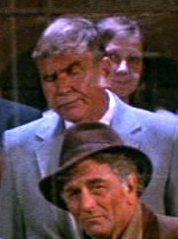
First, some sympathy for poor Guy Remsen. "Who is Guy Remsen?" you might ask. His late older brother was the Altman regular repertory player Bert Remsen (I know — Bert Remsen probably isn't ringing bells for many of you either. How about Jack Riley? If the name doesn't cut, his face would or perhaps the name of his most famous character — Mr. Carlin on The Bob Newhart Show. When they get to end and show the climax of the movie within The Player, Habeas Corpus, all three actors make cameo appearances. If you read closely (here's one helpful item the DVD players have that laserdisc players didn't: zooms), you see that in Habeas Corpus, Riley plays "Hap" Harlow, one of the reporters covering the execution; Bert Remsen's name gets listed as executioner, since he's the guard who starts the gas pellets dropping into the chamber; and Guy Remsen portrays The Attorney General. On both the Criterion laserdisc version and the New Line DVD version, they managed to misidentify Guy Remsen in their respective cameo guides. In the Criterion, they just got the Remsen brothers confused. Bad, but I guess we could call that an understandable mistake. In the New Line edition, somehow they swapped Guy Remsen and Jack Riley. So I've included photos of all three to avoid confusion. Bert Remsen throws open the blinds, Guy Remsen stands behind Peter Falk (who has the role of Harry Levin in
 Habeas Corpus) and Jack Riley takes notes at the very edge of the chamber window (if the full picture were there, you would see Susan Sarandon to Riley's left in the part of another reporter, Ellen Walsh. I suppose this serves as good as a place as any to point out the three credited cameos I couldn't locate (for certain). The first actor I know very well. He's Richard Anderson, a character since the 1940s whose best-known role probably would be Oscar Goldman on both The Six-Million Dollar Man and The Bionic Woman. Where Anderson has hidden in The Player remains a mystery to me. He's not on the New Line DVD and I don't recall him on the Criterion laserdisc either. The mystery actress, whom I couldn't even find a photo for to try to search out her location, is named Maxine John-James. The Inaccurate Movie Database lists three features and one episode of the television series Acapulco H.E.A.T. Personally, I must track down her dual role in the 1997 film Pterodactyl Woman from Beverly Hills. The third incognito cameo belongs to an actress named Jennifer Nash. Unlike Ms. John-James, she cites an extensive list of credits, mostly on television, and photographic proof of her existence can be obtained. In The Player, I couldn't find her unless that's her holding a dog and accompanying Malcolm McDowell in the lobby of The St. James Club. However, no matter how I tried to play with her image, I never succeeded in making it discernible enough to match against other photos of Nash.
Since they count Ross and she appears in the opening eight-minute shot, I'm going to attempt to get through the remainder of the cameos in the order that they appear in the film. Writer-director Adam Simon steps up first, pitching to Griffin as soon as Mill gets out of his Range Rover at the unnamed studio. Griffin pushes Simon off on his D-Girl (and girlfriend) Bonnie Sherow (Cynthia Stevenson) while he has his secretary Jan (Angela Hall) call security to figure out who let Simon on the lot. His first official pitch comes from Buck Henry who tries to sell him the idea of a sequel to The Graduate. Henry reappears later at a benefit dinner for the Los Angeles County Museum of Art's film program. Griffin meets next with two women screenwriters: Patricia Resnick and Joan Tewksbury. Resnick co-wrote Altman's A Wedding and Quintet. Tewksbury wrote Altman's Nashville and co-wrote Thieves Like Us. Alan Rudolph throws out the final pitch of the unbroken shot (after first being mistaken as Martin Scorsese by Jimmy the bike messenger, played by Paul Hewitt) and serves as the segment's final cameo. The writer-director's long relationship Altman includes Altman producing five of the feature films that Rudolph directed. On the DVD, Altman says, "I'm as interested in getting Alan Rudolph's new films going as I am my own."

Most of the film's cameos occur in group situations. I hadn't thought of this before but, in its own way, it mirrors the various settings that keep uniting all the characters in Altman's Nashville, which I still consider his greatest work. Only in The Player, the same characters do not cross paths but instead enter a location stocked with a new group of celebrities. This scene even gets a nice aural to visual segue. Griffin hovers over Claire (Dina Merrill), the studio president's powerful all-knowing executive secretary, trying to learn what she knows about rival movie executive Larry Levy. Claire ducks his queries long enough until the phone rings and she tells whoever is on the line, "No, we
 couldn't sign Anjelica Huston for that. She's booked for two years." Her utterance cuts immediately to Huston's face eating lunch on the patio of an outside restaurant with John Cusack and Levy. Soon, we see Griffin walking up the path to the restaurant where he bumps into Joel Grey on the steps. Mill introduces himself and says he knows his daughter Jennifer and is a big fan. Grey notes that the two have similar ties and moves on. Griffin joins the large table across Levy, Cusack and Huston where Bonnie and others who work at the studio await (including Jeremy Piven, who has a small role in the film). At a table for two next to the studio contingent's large round table sits Martin Mull. The remaining cameo in this scene happens to be the hardest to spot as well as the saddest. Actor Brad Davis, best known for the lead role in Midnight Express, eats at a table on the patio on the other side of the eatery's entryway. You don't get a good look at him, but what you can see gives an indication of his illness. Davis was dying of AIDS and succumbed on Sept. 8, 1991, seven months before the movie's release. I've cropped a larger frame so you can see where he sat and then enlarged Davis from that screenshot to give you an idea.
The mixture of celebrities mingling at the pool party of Griffin's attorney, noted entertainment lawyer Dick Mellon (Sydney Pollack), proves quite eclectic, to say the least. When Griffin and Bonnie arrive at Dick's place, they first encounter Marlee Matlin and Bonnie — through Matlin's interpreter — discusses a script that she read and thinks would be great for Matlin. Dick spots Griffin's arrival and excuses himself
 from a conversation with Harry Belafonte and his daughter Shari concerning network news figures. Griffin and Mellon's conversation offered more evidence that Pollack might be a better actor than director, this time playing it straight. Griffin starts to tell Mellon about the threatening postcards when his white whale — Larry Levy — crashes the party, arriving as a guest of Jeff Goldblum. Mill complains to Dick that Levy keeps getting in his face. "He's a comer. That's what comers do — they get in
 your face. You're a comer, too. You can handle it," Mellon reassures him. "So, the rumors are true," Griffin replies. "Rumors are always true. You know that," Mellon tells him. "I'm always the last to hear about them," Griffin sighs. "No, you're always the last one to believe them," Dick corrects his client. Today, seeing Sydney Pollack play a character in a scene surrounded by celebrity cameos throws you off-kilter, the way some actors do when they appear on Curb Your Enthusiasm and it takes a few minutes to realize that they aren't playing themselves, but Pollack's role in The Player was the director's first acting job since 1982's Tootsie. Later in 1992, he took another part, this time in Woody Allen's Husbands and Wives, but Pollack didn't start acting regularly until 1998. In fact, in that final decade of his life (he died in 2008), Pollack only directed two films and mostly acted and produced. Pollack's relative anonymity to audiences in 1992 prompted Altman to cast him in the first place, though Altman originally pursued director Blake Edwards for the part of Dick Mellon. In addition to those named so far and the two couples and Sally Kellerman (who appears again later at a gala benefit) pictured in the photograph above, the remaining attendees included Kathy Ireland, Jill St. John and Robert Wagner and last, but certainly not least, Rod Steiger, saying not a word as he holds a plate of food and stares at what appears to be a vertical fish tank, though it might just be bubbling water as I see no fish.
Our next stop on the virtual bus tour of Player cameos takes us another patio restaurant, this time for breakfast the next morning. Larry Levy just completed his meeting with studio head Joel Levison (Brion James), who can be spotted eating alone near the railing between the foreground figures of Burt Reynolds and entertainment columnist and critic Charles Champlin. Altman says he cast James as the studio head specifically because he'd been typecast as a villain in so many films such as Blade Runner, Tango & Cash and Another 48 Hrs. While looking over Brion James' filmography, I may have solved part of the Maxine John-James cameo mystery. Brion James also appeared in
 Pterodactyl Woman from Beverly Hills and served as an associate producer of this Troma release. Looking further, Brion and Maxine John-James were married at the time of The Player. I still can't find a photo of her, but there you go. Levy makes a point of apologizing to Reynolds on the way out, hoping there are no hard feelings over some incident that Reynolds apparently doesn't recall since he has to ask Champlin who Levy was. Reynolds' cameo turns out to be one of the funniest once Griffin drops by. He remembers him. After Mill exits, Reynolds mutters to Champlin, "Asshole." The columnist responds, "One of a breed" which launches Reynolds into a monologue that we only hear the start of before they cut away. "No, actually they are a breed, In fact, they're breeding them" Reynolds begins but the sound fades out as we move to Levison's table. Reynolds' bit scored because, like all who appeared for Altman (accepting scale payment or no payment at all), they had no scripted dialogue. In Altman's way of thinking, if the celebrities show up to play themselves, he couldn't very well tell them what they would do in real life. As a result, every line or use of prop by a cameo artist came from that person. They also could choose to say nothing at all, but Altman and his editor Geraldine Peroni got to pick the best ones to use. (Peroni received the film's third Oscar nomination along with Altman's direction and Tolkin's adapted screenplay.) When Griffin threatens to quit over Levy coming to the studio, Levison tells him that he's under contract and he'd sue. Then, the third cameo becomes easier to see as Cathy Lee Crosby sits right behind him. In the wide picture above, Crosby appears as the blonde across from Levison.

That night, Griffin had his fatal encounter with David Kahane in Pasadena, but first the two went to a Japanese karaoke bar where actor Brian Tochi, perhaps best known as Takashi in Revenge of the Nerds or as the voice of Leonardo in the live-action Teenage Mutant Ninja Turtles movies, performed. The next day at work, Griffin and others watched the dailies from a noirish detective film called The Lonely Room starring Scott Glenn and Lily Tomlin. The purposeful flubs induce enough laughs, but the deleted scenes comes off as being even funnier as Tomlin complains about having to smoke so much when she doesn't and expresses concern about the message being sent. Then, in another cut take, Glenn asks that someone make sure that he gets his per diem when the day's shooting ends. Tomlin whines that she gets penalized because she lives in Los Angeles while Glenn lives in another state, flies in and stays at the Chateau Marmont and receives extra pay for it.

Now comes the moment we've been waiting for since the headline of this post: Who the hell is Thereza Ellis? Thanks to the New Line cameo guide, I know what she looks like and where she appears, but that answers no questions whatsoever. It's later that night when Griffin's stalker,
 who has surprised Griffin by not being dead, had told him to meet him alone at The St. James Club. In the hotel lobby, Griffin first encounters Malcolm McDowell (who is accompanied by a young blonde woman with a dog that might be that Jennifer Nash. Who knows?) McDowell smiles as he shakes Mill's hand and then tells the studio executive, "The next time you want to badmouth me, have the courage to do it to my face. You guys are all the same." Griffin looks stunned as the actor leaves (though he'll pop up again at that gala benefit). In a lounge area, Andie MacDowell has been cornered by the film's two most over-the-top characters: screenwriter Tom Oakley (Richard E. Grant) and Andy Civella (Dean Stockwell). Geena Davis originally was going to do this cameo, but some emergency happened so MacDowell flew in from her home in Montana at the last minute to pitch hit. That makes the conversation all the funnier since Oakley and Civella are trying to convince the actress the Montana always ends up being bad luck for people in the movie business, citing as their only evidence Michael Cimino's Heaven's Gate. When the hyper pair spot Griffin, they start trying to pitch a movie idea at him and MacDowell takes the opportunity to escape, being led off by *(drumroll please)* THEREZA ELLIS. My search for information on Ellis has taken me to the far corners of the World Wide Web but the only sign that seems to point to the existence of a Thereza Ellis comes from universal agreement that she played herself in The Player. I could find no other credits, no other photographs, no other lines of work. Someone must track down Andie MacDowell. She could be the only person who knows the truth!
 When the studio holds a black-and-white gala benefit for the Los Angeles County Museum of Art, the scene overflows with cameos both famous and curious. Buck Henry, Sally Kellerman and Malcolm McDowell put in repeat appearances, though the first cameo exists only as a voice as Leeza Gibbons narrates the arrivals at the event for Entertainment Tonight. Griffin uses the occasion to take the late David Kahane's girlfriend June Gudmundsdottir (Greta Scacchi) out on their first public date after having sent Bonnie to New York to check out the new Tom Wolfe novel. Mostly, it's a sea of face in quick glances with the exception of Cher, who comes wearing red at Altman's behest. Later, he learned that Cher never wears red. The remaining attendees in alphabetical order: Karen Black, Gary Busey, James Coburn, Kasia Figura (who apparently has a huge career in Europe), Teri Garr, Elliott Gould, Sally Kirkland, Nick Nolte, Alexandra Powers (who appears to have been stuck sitting next to Fred Ward's Walter Stuckle), Mimi Rogers and Marvin Young, known better by his recording name Young MC of "Bust a Move" fame. Finally, we come to cameo payoff — the star-studded cast of the movie-within-the-movie Habeas Corpus. I already named some earlier, but I'll point them out again as art alone places these actors in order.


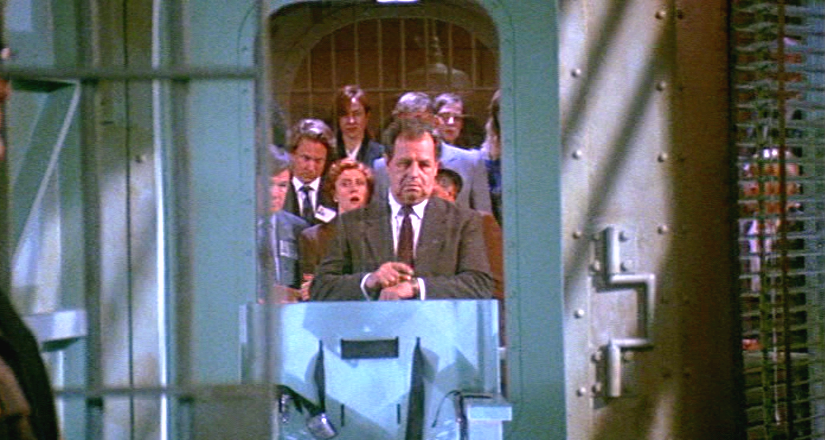
ABOVE LEFT: Guard No. 6 (Michael Bowen) stands in the hallway leading to the gas chamber in Habeas Corpus. ABOVE RIGHT: Reporters and other witnesses await the execution in the viewing room outside the gas chamber. (Front row, left to right) Reporters "Hap" Harlow (Jack Riley), Ellen Walsh (Susan Sarandon) and Harry Levin (Peter Falk) take notes for their stories. Standing directly behind Levin wearing a gray suit is The Attorney General (Guy Remsen). BELOW LEFT: Warden Lowe (Paul Dooley) appears at the witness window and taps his watch, indicating the execution should proceed. BELOW RIGHT: Following the warden's orders, Guard No. 3 (Robert Carradine, left) and Guard No. 4 (Steve James) head toward the cell to retrieve the condemned prisoner.


ABOVE LEFT: Condemned murderer Marsha Kent (Julia Roberts) sits on her cot listening to Father Pratt (Ray Walston) read from The Bible. Matron Cole (Louise Fletcher) stands speaking with Dr. Besh (Rene Auberjonois) by the cell door. Marsha gets removed and taken to the gas chamber where they strap her in the chair and drop the gas pellets. (not pictured) ABOVE RIGHT: Assistant D.A. Dave Williams (Bruce Willis) bursts into the unit preparing to execute Marsha, the woman he convicted for murdering her husband and whom he loves, upon learning that Marsha's husband faked his death. Williams passes Guard No. 4 (David Alan Grier) on his way. BELOW LEFT: Williams (Bruce Willis) grabs a shotgun from Guard No. 1 (Dennis Franz). Williams blasts the glass of the gas chamber, releasing fumes everywhere.(not pictured) BELOW RIGHT: Williams (Bruce Willis) carries Marsha (Julia Roberts) to safety while inside the gas chamber (from left to right) Guard No. 4 (Steve James), the Executioner (Bert Remsen) and Guard No. 3 (Robert Carradine) shield their faces from the fumes.


Tweet
Labels: A. Huston, Altman, Blake Edwards, Burt Reynolds, Curb Your Enthusiasm, Dean Stockwell, Fiction, Geena Davis, Lily Tomlin, Malcolm McDowell, Oscars, Scorsese, Sydney Pollack, Tim Robbins, Woody
TO READ ON, CLICK HERE
Monday, September 05, 2011
Burning a path of destruction — through relationships

By Edward Copeland
If moviegoers met Cliff Stern, the documentary filmmaker Woody Allen plays in Crimes and Misdemeanors, when he were younger, he'd been from the South instead of New York and his girlfriend left him for an old boyfriend just as he received a grant to make a movie about Civil War Gen. William Tecumseh Sherman, the film that resulted might have turned out similar to how real documentarian Ross McElwee's Sherman's March did. Released 25 years ago today, McElwee's one-of-a-kind nonfiction film retains its almost inexplicable hypnotic hold (on me anyway) and proves once again, just as recent films such as Exit Through the Gift Shop and Waltz With Bashir have, how elastic the definition of what qualifies as a documentary can be.
At the film's outset, we hear the stern and serious narration of cinéma vérité pioneer Richard Leacock, who died in March, telling the overall details of Sherman's infamous march to the sea, complete with archival photos and a colorful map that traces the general's route as Leacock's voice informs us that the Union military leader's contingent of 60,000 troops cut a path 60 miles wide and 700 miles long. The documentary looks and sounds as if it's truly going to reflect its title of Sherman's March and though Leacock doesn't appear and isn't identified, if you know that it's his presence launching the film, you're liable
 to believe the entire movie will concern the Civil War. After all, Leacock's work in documentaries dates back to the 1930s and includes being the cinematographer on the influential 1948 documentary Louisiana Story by Robert J. Flaherty which won the BAFTA for best documentary and somehow earned an Oscar nomination for best original motion picture story. (Flaherty was the man behind the even better-known 1922 silent documentary Nanook of the North.) Leacock's work as a cinematographer on documentaries proved quite eclectic ranging from 1960's Primary, which observed John F. Kennedy and Hubert Humphrey in the hunt for the Democratic delegates in Wisconsin; D.A. Pennebaker's 1968 concert documentary Monterey Pop where Jimi Hendrix set that guitar on fire; Pennebaker's 1970 Company: Original Cast Recording detailing the work that went into putting Stephen Sondheim's Broadway classic on wax; and even a 1999 film John Huston War Stories containing interviews with the late director about footage he shot during World War II. Leacock also directed many documentaries as well and though he's not identified and won't return to Sherman's March beyond those opening moments, the eclecticism of his long career supports what I said at the beginning about the flexibility of what constitutes a documentary. Leacock also happened to head the MS program in filmmaking at M.I.T. with Ed Pincus (who co-wrote The Filmmaker's Handbook: A Comprehensive Guide for the Digital Age with Steven Ascher) where McElwee received his master's degree.
McElwee picks up the narration after Leacock begins it, effectively beginning the film's transition. He describes how Sherman destroyed Atlanta, Columbia, S.C. and thousands of smaller towns, burning homes, plundering cattle and leaving an unprecedented path of destruction before bringing about a Confederate surrender in North Carolina. As McElwee notes, Sherman's march marked the first time in
 modern warfare where a campaign had been waged primarily against a civilian population. The director informs us that he first conceived the idea for the documentary about a decade before he actually filmed it, thinking it would be interesting to look at Sherman's lingering influence in the South and on Southerners. He shares the tale of an aunt who keeps in her attic an ancestor's couch which still bears the puncture holes from the swords of Sherman's troops who were searching for hidden loot. When McElwee finally received a grant that would allow him to fund such a documentary, before he returned to his Boston home to prepare, he stopped first in New York to share the good news with the woman that he'd been seeing. Unfortunately for Ross, when he arrived she informed him that she'd reconciled with her ex-boyfriend, knocking McElwee for a loop. He stayed in New York after they argued for awhile, taking refuge in a friend's vacant loft. Eventually, he decides to head south to see his family and begin his film but William Tecumseh Sherman's starring role has been usurped and the Sherman's March's title card makes its appearance followed by a subtitle added to more accurately reflect the documentary's broader scope in terms of subject matter.
During an Era of Nuclear Weapons Proliferation
When McElwee arrives in North Carolina, his family talks him into joining them on an outing — one that just happens to include many young, single women. As his relatives keep telling the filmmaker, he "needs a nice Southern girl" to help him get over the breakup. McElwee's mind, which can't get focused on his documentary,
 isn't really prepared to leap back into the dating pool, saying in voiceover, "The mere thought of trying to meet someone depresses me." It's the beginning of many memorable sequences as McElwee films some sort of event where "various men compete in demonstrations of strength and virility." It leads to the first classic scene of Sherman's March when his newlywed sister takes him out in a canoe (along with a dog) and rails against his ex, saying she could leave her husband anytime she got bored if she wanted to but she doesn't because that would be "bullshit." She does suggest to her brother that he could "tidy up a bit" in terms of appearance if he really wanted to attract someone and suggests that his movie camera could be used as a natural tool of flirtation. "You have an instant rapport with people because you have a camera," she tells him and McElwee wonders if she could be right, despite his past relationship wreckage.
"For a long time I had this notion that love was possible — I mean romantic love, two people falling madly in love with each other and managing to stay together for more than two weeks. But time after time, it seems a woman would get involved with me and want some sort of commitment and I would decide it wasn't right or vice versa. No matter how passionate things were in the beginning, there never was an equilibrium and nothing ever seemed to last."
The first woman in the movie to capture McElwee's attention and seriously distract him from his doldrums and his documentary is an aspiring actress named Pat he meets at the North Carolina festivities who invites him to film her doing her cellulite crunches, even though McElwee admits he doesn't know what cellulite is. She projects a sunny optimism and openness that keeps McElwee up the first night after he's met her, wondering how he should
 have responded when she told him she doesn't wear underwear. "I mean, it's not like saying you're not wearing any socks," he tells the viewer. When Ross does sleep, he confesses that he's having dreams of thermonuclear war again, dreams that date to his childhood when he was a witness to a far-off test of an atomic bomb. When he sees Pat again, she shares with him her idea for a bizarre screenplay that I won't even attempt to summarize. You have to hear it to believe it, but when McElwee tells her that he's worried he'll run out of film if she doesn't sum it up, he isn't joking. Though he's interested in Pat, she does have a boyfriend, albeit one who is out of the picture since he's in a mental institution at the moment. Though he has been abusive her in the past, Pat's convinced that he will find the path to inner peace and they'll reunite some day. At the moment, she's concentrating on acting, specifically getting a part in a Burt Reynolds film since she's heard he's filming in the area. (Reynolds almost gets mentioned in Sherman's March more than General Sherman.) McElwee knows he has a Civil War documentary to make, but instead he hops in the car with Pat and her friend to head to Atlanta because he just can't stop filming her.
With his slow, almost monotone way of speaking, describing Sherman's March to people makes it sound as if it would be a long, excruciating bore. Hell, if McElwee actually had made a 2½-hour documentary about the Civil War general, many would undoubtedly yawn at the prospect of sitting through it. When you tell them Sherman's March concerns a filmmaker not making that movie but instead spending his time chasing new women, being set up on dates or looking up old female friends and trying to force them to love him, potential viewers might be even more resistant to give the film a try. McElwee defies those odds though and while
 Sherman's March may be a nonfiction film, the same rule applies to it that applies to fictional features: Sometimes cinematic magic happens in the most unlikely of places and the most unusual forms. As McElwee hangs out with Pat as she tries to land bit parts and awaits word from her agent about the possibility of jobs in a Reynolds film or even a Stanley Kubrick project, it's very difficult not to laugh in a sympathetic way as Ross tries to convince Pat that she'd be better off not flying to Hollywood but staying and letting him continue to film her, especially as he describes himself as being in a competition with Kubrick and Reynolds. Pat does pursue her career and McElwee, who has no car of his own, finds himself stranded for a bit. As McElwee lies in his darkened motel room watching reruns of The Love Boat and The Beverly Hillbillies, he comments to the viewer that he finds "being in a crummy motel with two large empty beds even more depressing than in a hotel with one." Fortunately, he talks to his brother who offers him his old sports car if he can get it running (adding that he thinks the car would improve Ross' image). Soon, McElwee has arrived back near his family awaiting the car's repair (though the film doesn't explain exactly how he returned).
Part of the joy of Sherman's March (and I'm not referring to Joy, the singer McElwee briefly becomes a groupie for before she decides to head to New York to really pursue a music career) is that this truly is a film, albeit a documentary film, that a viewer can't predict where it's going or where it will end. McElwee really lucked out that so many entertaining and insightful anecdotes crossed his path during filming. After making Sherman's March, it changed the course of McElwee's career to where all the documentaries that he has made since have been autobiographical ones such as Time Indefinite and Bright Leaves. In an interview on the DVD, McElwee says he started making these types of films "because I decided I didn't have the ability to be the invisible man behind the camera." A quote on McElwee's website credited to The Museum of Modern Art sums him up very well:
"For the past 25 years, Ross McElwee has given new meaning and flair to first-person nonfiction cinema. Always wise and irreverent, ever the unreliable narrator, McElwee makes the grandest themes of human comedy his artistic province: love and death, chance and fate, memory and denial, the marvelous and the appalling."
What's ironic about Sherman's March as a documentary is that McElwee's original germ of an idea — painting a portrait of the South and Southerners today (or the early 1980s since that's when it was filmed) — does get
 accomplished, albeit William Tecumseh Sherman has next to nothing to do with it. There are exceptions. Occasionally, he's warned not to bring up the general's name and when his family tries to hook him up with a single mom named Claudia, they do go to a costume party where most wear Confederate garb and her friend Lydia makes one of the most mind-boggling statements you're ever likely to hear. Telling Ross that she still "gets turned on" by the Civil War, Lydia declares, "I know it's been a hundred years, and I still don't think we were wrong. Only in that slavery should not be enforced. It should be a right. If you want to be a slave, be a slave. If you don't, fine." Yes, I imagine there would be a long line of African Americans lining up to become slaves if the opportunity presented itself because their slave ancestors all were volunteers. It reminds me of the series in the late lamented Spy magazine called "Admit It! It Sucks!" Part III: The Civil War by Joe Queenan which had the punchline that the only good thing to come out of the Civil War was the joke "Other than that Mrs. Lincoln, how was the play?" No wonder so many people and politicians today are criminally uninformed about history. I wonder if Lydia and Michelle Bachmann are related.
His time with Claudia also introduces him to a group of survivalists who only agree to appear as long as the location of their settlement and their names are kept secret and their words sound eerily similar to rhetoric
 you hear now where in one breath they'll expound how the U.S. is the "greatest country in the world" and in the next, after loading his mouth up with a big chunk of chewing tobacco, one will declare that the U.S. government is his "mortal enemy" and it better watch out if it tries to mess with their group. As for what they're building out in the woods, one of the men explains, "What we are basically involved in is isolationism, survival, and going back, if you will, to the movie Little House on the Prairie, where the family is the dominant factor in our lives." Yes, they can't distinguish a TV show from a movie. The men regret that they do have to make their own liquor and women are scarce. Dating the time period of Sherman's March, they also are fervently "anti-Commie" and believe the U.S. doesn't have enough nuclear weapons — and this is after Reagan took office. (Judging from some markers in the movie even though it didn't come out until 1986, I'm guessing filming was around 1981 or 1982.)

Writing an adequate tribute to Sherman's March vexes me because I'm not sure where to draw the line between giving away too many of the film's numerous great moments and risk making the experience of watching the film less enjoyable should this convince anyone to seek McElwee's movie out. On the other hand, I fear that if I don't include enough of the highlights, I won't be successful at selling Sherman's March to potential new viewers either. It's easy to pick out the women that I don't have to go into detail about such as Jackie, Karen or Joy. I think what little I've mentioned about Burt Reynolds leaves enough of an implication that the actor almost becomes a recurring character. It's worth mentioning the odd little incidents such as when McElwee's car breaks down in a small town in the middle of the night and there's no other lodging available so he has to spend it in a jail cell. Of course, I won't give away the film's ending which works as a punchline of sorts, but there are two women who must be discussed, one who becomes a possible romantic interest, the other an old friend and former teacher who really is the film's breakout character.
He meets Winnie when he gets permission to visit Ossabaw Island, a barrier island off the coast of Savannah, Ga., which at the time was closed to the public and inhabited by very few people who were doing some sort of research. He only meets two: Michael, a geologist, and Winnie, a linguist working on her doctorate. Ross assumes they are a couple until he learns that they live on opposite ends of the estuary. A relationship
 develops between Ross and Winnie, who doesn't mind talking about things while he films her nude sunbathing. McElwee tries to convince her of parallels between himself and Sherman saying they both have red beards and both are failures of a sort: Sherman in businesses such as real estate, Ross in real estate. "There's no analogy between the real estate business and love affairs," Winnie tells him. She's completely self-sufficient on the island which you can only travel back and forth from on a ferry. Winnie gets her milk from a cow. While she milks the animal one time, she utters one of the film's most memorable lines, "The only important things in life are linguistics and sex." She does admit having a fondness for the cow as well though. In a way, whatever relationship exists between Winnie and Ross does recall that statement from The Museum of Modern Art about McElwee being an unreliable narrator: We never hear or see anything that indicates romance or affection between the linguist and the filmmaker. Unfortunately, McElwee has run out of cash so he has to fly back to Boston to take a film editing job. He tells Winnie that he'll only be gone two months and promises to return.
Ross and Winnie write to each other during his absence but the job ends up lasting longer than he expected. When McElwee finally sends her a letter that says he has finished and will be back soon, he receives a reply
 from Winnie telling him that things will have to be different once he's back. He can guess that this doesn't foreshadow something positive. Upon his arrival on the island, Winnie informs him that she and Michael now live together. McElwee asks what happened. "Michael was here, Ross, and you'd moved on, filming," Winnie admits. For awhile, Ross tries to stay on the island anyway but eventually it gets to be too much and he knows he can't handle being the third wheel in a buggy atmosphere when he has a long-delayed film to make. What brought him to the island in the first place was that it had served as a staging area for Sherman's troops at one point. "I didn't handle things very well with Winnie," McElwee confesses in voiceover. "By leaving her for so long, I sabotaged myself. If I really wanted things to work out, I would have found some way to come back sooner." Once he's off the island, he also acknowledges "a creeping psychosexual despair" had entered his mind.

Then comes Charleen. A longtime friend and former teacher of McElwee's, we first meet her playing a scratch-off lottery ticket in a Charleston, S.C., McDonald's, haranguing Ross about the state of his love life. "It is boring for you to be middle-aged and lonely," she tells him. She wants to set him up with a woman she knows named Dede who is a singer and a musician. Charleen also advises him on the best way to land a mate. "Now the only way to get you coupled…and it can be a permanent thing…is to find you a woman who thinks that you're God. It's gonna take a special kind of woman to think you're God," she advises. Charleen even visits some Civil War sites with McElwee, though she finds it boring and depressing. "You see how foolish it all is. You see what the Army comes to. The bunkers, the island, the burned-out house. Hell, it's all a tragedy. It's just a matter of how you get through it." Unlike McElwee's sister who views the camera as a plus
 to get women to talk to him, Charleen always advises him to put it down or turn it off. "Forget the fucking film," she tells him at one point. At another, she adds, "This is not art, this is life." Charleen even offers to send Ross to dental school if he'd give up this filmmaking thing. With a character as flamboyant and scene-stealing as Charleen, any woman she sets Ross up with is sure to be a letdown, but the scene where Dede sings "Just the Way You Are" to a group of very young, bored and dumbfounded students at an all-girls school does prove priceless and the payoff of the Ross-Dede date and Charleen's reaction turns out hysterical as well. After this encounter, McElwee wisely decides to get out of Charleston before Charleen can inflict any more damage, but you'll have to see the movie to find out what that means.
As McElwee visits a Confederate gravesite, his thoughts turn very inward. "It seems like I'm filming my life to have a life to film, like some sort of primitive organism that nourishes itself by somehow devouring itself, growing as it diminishes," his narration says as he looks at the markers. "I ponder the possibility that Charleen
 is right that filming has become the only way I can relate to women," McElwee continues. "I'm beginning to lose touch with where I really am in all of this. It's a little like looking into a mirror to see what you look like when you're not really looking at your own reflection." In a way, by accident, when Ross McElwee's girlfriend dumped him, changing the direction of both Sherman's March and McElwee's filmmaking career, McElwee evolved into the real David Holzman, the made-up filmmaker in Jim McBride's landmark 1967 mockumentary David Holzman's Diary except that McElwee isn't a parody and his sincerity ultimately powers the film's humor and success. If you like documentaries or, more importantly, unique, one-of-a-kind films, see Sherman's March which, after 25 years and multiple viewings, continues to fill me with awe, amusement and wonder every time I see it. Each time I ask myself, "How can this film possibly captivate me for 2½ hours?" I'm never certain I've settled on the correct answer to that question. I just know that Sherman's March does.
Tweet
Labels: 80s, Burt Reynolds, Documentary, Huston, Kubrick, Movie Tributes, Sondheim, Television, Woody
TO READ ON, CLICK HERE


