Tuesday, May 08, 2012
Puttering all around the house

It occurs to me that I haven't bothered to even attempt to summarize the plot of A Funny Thing Happened on the Way to the Forum, Partly, that's because Stephen Sondheim's song "Comedy Tonight" spells out most of the characters pretty well, but mainly it's because the shenanigans that Larry Gelbart and Burt Shevelove cooked up out of surviving Plautus works contain so many complications that it would
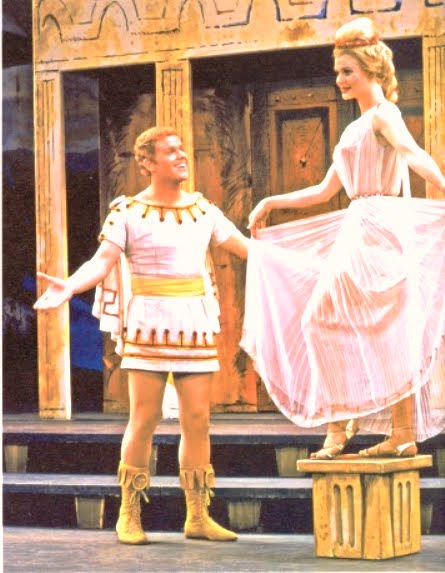
 prove damn difficult to synopsize. However, I do feel that one character in particular — Erronius — deserves separate mention since he didn't get a song of his own. In Finishing the Hat, Sondheim provides the lyrics for a cut song that had been intended for the character called "A Gaggle of Geese," which referred to his family's crest that appears on rings worn by his long-lost children, kidnapped decades earlier by pirates. He, however, persists in searching for his son and daughter. In the original Broadway production, Raymond Walburn, who made his Broadway debut in 1914 and his film debut in 1916, played the role. He played the butler Walter in Frank Capra's Mr. Deeds Goes to Town. In the 1972 revival, the part went to Reginald Owen, who first appeared on Broadway in 1925, though he started making movies in 1911 where his most famous role probably remains Scrooge in the 1938 version of A Christmas Carol. In the 1966 film version, the Erronius role found a masterful custodian in the great Buster Keaton, making his final film appearance. The reason I chose the photo above from the 1996 revival wasn't based solely on availability but because it shows its Erronius, William Duell, who just passed away in December. A very recognizable character actor of stage and screen, Duell appeared in both the original production, revival and film of 1776 as well as one of the patients in One Flew Over the Cuckoo's Nest. For many though, he'll always remain Johnny the shoeshine boy from TV's Police Squad!
 After all the excised songs and subplots, the restoration of said subplots, tensions causing everyone to blame each other for the problems (such as when Shevelove yelled at Sondheim, pointing to his songs as the main reason for the show's failings) and strained relations leftover from the blacklist, the audiences loved it and most reviews praised it. Looking back at those 1962 New York reviews, thanks to a friend with access to them since The New York Times alone provides easy
 online access to its archives, not only do the critics provide interesting insight into the show's reception but it's amazing to see how many newspapers that city supported in 1962. Few of the critics, while acknowledging A Funny Thing Happened on the Way to the Forum entertained them immensely, wrote much — if anything — about Sondheim's score. The morning after it premiered, Howard Taubman, chief drama critic for The Times since Brooks Atkinson's retirement in 1960, wrote, "Know what they found on the way to the forum? Burlesque, vaudeville and a cornucopia of mad, comic hokum. The phrase for the title of the new musical comedy that arrived at the Alvin last night might be, caveat emptor. A Funny Thing Happened on the Way to the Forum indeed! No one gets to the forum; no one even starts for it. And nothing really happens that isn't older than the forum, more ancient than the agora in Athens. But somehow, you keep laughing as if the old sight and sound gags were as good as new. As for the score, Taubman said, "Mr. Sondheim's songs are accessories to the pre-meditated offense. With the Messrs. Mostel, Gilford, Burns and Carradine as a coy foursome, 'Everybody Ought to Have a Maid' recalls the days when delirious farceurs like the Marx Brothers could devastate a number. When Mr. Mostel, the slave with a nimble mind and a desire to be free, persuades Mr. Gilford, the nervous straw boss of the slaves, to don virgin's white, the two convert the show's romantic and pretty 'Lovely' into irresistible nonsense." Taubman penned one of the kinder notices to Sondheim's songs though he appears to have missed the point that even the first version of "Lovely" sung by the story's virginal courtesan Philia comes steeped in satire as the beauty sings an ode to superficiality and her own bubbleheadedness. (The first link takes you to Preshy Marker's version from 1962, the second to Jessica Boevers' from the 1996 revival; since I used the 1962 recording of "Everybody Ought to Have a Maid" at the beginning of the first half, this link goes to the BBC Proms rendition by Daniel Evans, Julian Ovendon, Simon Russell Beale and Bryn Terfel.) The score's assessment changes over the years and as of today, Sondheim may remain the toughest critic. In his book, he again wrote, "I made the subtle, though thankfully not fatal, error of being witty instead of funny." Below, watch a quite different take on "Lovely" from Putting It Together as performed by Carol Burnett and Ruthie Henshall.
Let's skip quickly through some excerpts from the other opening night reviews. Remember: Each of these came from New York newspapers and many no longer exist. Still, today, when some major cities fail to support one daily newspaper to think that this many could thrive in a single city, albeit one as large as New York, makes an old ex-journalist such as myself fill with both wonder and sadness. Walter Kerr for The New York Herald Tribune: "The funny thing about A Funny Thing Happened on the Way to the Forum is that it's
 funny. I'm not going to tell you it's anything more than that, but maybe I don't have to. For all I know, you like funny musicals. You may even like classical funny musicals, and this one is very classic.…Composer Stephen Sondheim begins by giving his lightfooted fools some rather odd recitative as substitute for melody and same vaguely Oriental wood-block effects as substitute for lively accompaniment. You wonder. Then, with a foursome in which Mr. Mostel, Mr. Burns, Mr. Gilford and a borrowed scarecrow named John Carradine, take off to a tune called 'Everybody Ought to Have a Maid,' the odd figurations Mr. Sondheim is attracted to begin to pay off. There's a faint edge of musical sarcasm to be dealt with here, and it crops up again — most effectively — in 'I'm Calm,' 'Impossible,' 'That Dirty Old Man,' and in Mr, Mostel's swooning reprise of a number that was mocking in the first place, "Lovely." The score is in and out, but wins out. The lyrics are fine. Is it me or does it seem as if Kerr keeps changing his mind as he's writing? Though a Broadway theater remains named after the critic today, I've always been leery of Kerr since he actively participated in the industry as a writer, director and lyricist at the same time he worked regularly as a critic. At least he recognized the humor in the first version of "Lovely" though, I'll give him that. (Isn't it fascinating to imagine that Broadway theater owners sometimes honor critics this way? A theater bears Brooks Atkinson's name as well and they even awarded him a special Tony after he retired. When will we see The Frank Rich Theater? Can you imagine and honorary Oscar to a film critic?) The links: "Everybody Ought to Have a Maid" from 1966 film; "Impossible" from the 1996 revival recording; "I'm Calm" and "That Dirty Old Man" both from the 1962 original cast recording. Below we have the clip from the poorly shot bootleg of the "Lovely" (reprise) from the 1996 revival performed by Nathan Lane and Mark Linn-Baker.
Others who opined about opening night. Unless they took contrarian views on the show itself, I'm limiting the comments to the score.: Except for calling Forum a musical comedy in his lead, the only other reference to the score Richard Watts Jr. made in The New York Post comes as part of the review's penultimate sentence. "…and Stephen Sondheim’s score is modest but pleasant." John McClain wrote in The Journal American, "Zero Mostel, a very animated blimp, will personally defy you not to like A Funny Thing Happened on the Way to the Forum…The clients laughed and seemed to enjoy themselves, but there was always the suggestion that had they not, Mr. Mostel would have passed among them and belabored them with a baseball bat. He is quite largely the whole show… The book by Burt Shevelove and Larry Gelbart (claiming some debt to Plautus) is a wispy affair, and Stephen Sondheim's score is less than inspired,
 but under George Abbott's slick direction the show moves and the audience roars. I should think it would succeed." At The New York Daily News, John Chapman chimed in, "(The performers) are grand muggers, leerers and slapstickers, and any old vaudeville fan will be happy to see them in operation.…The songwriter, Stephen Sondheim, comes up with an occasional bright and funny number, such as the four burlesquers song 'Everybody Ought to Have a Maid,' and Miss Kobart’s venomous hymn to Burns, 'That Dirty Old Man of Mine.'" Did he not look at his Playbill? How did he get the song title wrong? Links: "Everybody Ought to Have a Maid" performed by Carol Burnett and Bronson Pinchot in Putting It Together; "That Dirty Old Man" from 1996 revival cast recording. Another critic who didn't find it important to check song titles was Norman Nadel in The New York World Telegram, who delivered the harshest review I read. "But too high a price must be paid for entertaining moments in A Funny Thing… Much of the comedy repeats itself. Some of the players work so hard to exploit their thin materials that they generate more sympathy than laughter. The show is slow starting and sometimes heavy-footed. Stephen Sondheim’s music would have been a second-rate score even in 1940, but he has come up with some catchy lyrics. One is “All I Know is Lovely,” sung by Ms. Marker and Mr. Davies. Another is 'Bring Me My Bride,' in which Miles proclaims his own glory; this is done resonantly by baritone Holgate.…There are indications at the Alvin that A Funny Thing might have been an earthy, boisterous delight. From time to time, it is. For the most part, however, it strains too hard to achieve too little." Link: "Bring Me My Bride" from original 1962 cast recording; I've run out of versions of "Lovely." Finally, we get to Robert Colman reviewing at The New York Mirror with the nicest words for Sondheim's score. "Stephen Sondheim has supplied a score that falls pleasantly on the ears. Jack Cole has choreographed dances that would have delighted Billy Minsky’s. We suspect that A Funny Thing will prove the most controversial song-and-dancer of the season. You’ll either love it or loathe it. In our book, it looms as a hot ticket. A riotous and rowdy hit." The retired Brooks Atkinson filed a "critic at large" piece for The New York Times in July where he barely mentions that Forum contains music and Sondheim's name never appears, though the "low comedy" delights him to no end. Since "Everybody Ought to Have a Maid" comes up so often, I've reserved two video clips for you to watch. The first comes from the 1996 revival.
Before I get to the final clip of "Everybody Ought to Have a Maid," I thought it would be interesting to point out how quickly critics began to re-evaluate Sondheim's score for Forum. Granted, in these reviews I was limited to The New York Times and most come after the one-two punch of Company and Follies supersized his reputation, but the reconsideration started as early as the 1966 film version. Vincent Canby wrote in his review of the film, "Stephen Sondheim's music and lyrics hold up well, especially 'Comedy Tonight,' by which Mr. Mostel introduces the characters at the start, and the slightly bawdy 'Everybody Should Have A Maid' ('sweeping out, sleeping in')." When Clive Barnes assessed the 1972 revival for The Times, he said, "Mr. Sondheim's music is original and charming, with considerable musical subtlety but a regard for down-to-earth show-biz vigor that is precisely what is needed. And, as always, his lyrics are a joy to listen for. The American theater has not had a lyricist like this since Hart or Porter." By the time the 1996 revival arrived, Canby's beat had switched from film to theater. "This brazenly retro Broadway musical, inspired by Plautus, is almost as timeless as comedy itself. Here's a glorious, old-fashioned farce that, with its vintage Stephen Sondheim score and its breathless book by Burt Shevelove and Larry Gelbart, celebrates everything that man holds least dear but can't deny himself: lust, greed, vanity, ambition; in short, all of those little failings that make man human. Yet for all of its disguises, mistaken identities, pratfalls and leering jokes, A Funny Thing is as sophisticated as anything now on Broadway. In its own lunatic way, it's both wise and rigorously disciplined. Easy sentimentality is nowhere to be found here; in its place: the kind of organized chaos that leads to sheer, extremely contagious high spirits," Canby wrote. Now, that other clip of "Everybody Ought to Have a Maid" features original 1962 cast member Jack Gilford performing with two (well, at least one) other surprising performers in a television appearance.
I'd hoped to avoid this situation, but I got so caught up with the behind-the-scenes history that what I intended as a short tribute grew to be massive. I still need to write about the original production's performance at the Tony Awards and some tidbits concerning the two revivals, the second of which I saw, not to mention that version I saw in 1979 when I was 10. That won't be coming today I'm afraid. So, I'll leave you with the sequence for "Bring Me My Bride" from Richard Lester's film version.
Labels: blacklist, Books, Capra, Criticism, Gelbart, J. Carradine, J. Robbins, Keaton, Marx Brothers, Music, Musicals, Sondheim, Television, Theater Tribute, Welles
TO READ ON, CLICK HERE


Monday, May 07, 2012
Love Story

— Orson Welles on Make Way for Tomorrow
By John Cochrane
No one film dominated the 1937 Academy Awards, but with the country still in the grips of the Great Depression and slowly realizing Europe’s inevitable march back into war, the subtle theme of the evening in early 1938 seemed to be distant escapism — anything to help people forget the troubled times at home. The Life of Emile Zola, a period biopic set in France, won best picture. Spencer Tracy received his first best actor Oscar, playing a Portuguese sailor in Captains Courageous, and Luise Rainer was named best actress for a second year in a row, playing the wife of a struggling Chinese farmer in the morality tale The Good Earth.
Best director that year went to Hollywood veteran Leo McCarey for The Awful Truth. McCarey’s resume was impressive. He paired Stan Laurel and Oliver Hardy together as a team, and he had directed, supervised or helped write much of their best silent work. He had collaborated with W.C. Fields, Charley Chase, Eddie Cantor, Mae West, Harold Lloyd, George Burns and Gracie Allen — almost an early Hollywood Comedy Hall of Fame. He had also directed the Marx Brothers in the freewheeling political satire Duck Soup (1933) — generally now considered their best film. The Awful Truth was a screwball comedy about an affluent couple whose romantic chemistry constantly sabotages their impending divorce that starred Irene Dunne, Ralph Bellamy — and a breakout performance by a handsome leading man named Cary Grant — who supposedly had based a lot of his on-screen persona on the personality of his witty and elegant director. Addressing the Academy, the affable McCarey said “Thank you for this wonderful award. But you gave it to me for the wrong picture.”
The picture that McCarey was referring to was his earlier production from 1937, titled Make Way for Tomorrow — an often tough and unsentimental drama about an elderly couple who loses their home to foreclosure and must separate when none of their children are able or willing to take them both in. The film opened to stellar reviews and promptly died at the box office — being unknown to most people for decades. Fortunately, recent events have begun to rectify this oversight as this buried American cinematic gem turns 75 years old.

Based on Josephine Lawrence’s novel The Years Are So Long, the film opens at the cozy home of Barkley and Lucy Cooper (Victor Moore, Beulah Bondi), who have been married for 50 years. Four of their five children have arrived for what they believe will be a joyous family dinner — until Bark breaks the news that he hasn’t been able to keep up with the
 mortgage payments since being out of work and that the bank will repossess the property within days. Bark and Lucy insist that they will stay together, regardless of what happens. With little time to plan, the family decides that, for the time being, Lucy will move to New York to live with their eldest son George’s family in their apartment, while Bark will be 360 miles away — sleeping on the couch at the home of their daughter Cora (Elisabeth Risdon) and her unemployed husband Bill (Ralph Remley). For the film's first hour or so, we see Bark and Lucy trying to adjust to their new surroundings. While George (an excellent Thomas Mitchell) tries to be as pleasant and accommodating to his mother as possible, his wife Anita (Fay Bainter) and daughter Rhoda (Barbara Read) display little patience and dislike the disruption of their routines. Meanwhile, Bark spends his time walking around his new hometown, looking for a job and visiting a new friend, a local shopkeeper named Max Rubens (Maurice Moscowitz).
Many filmmakers develop a visual signature that dominates their work, but McCarey employs a fairly basic and straightforward style, using group and reaction shots as well as perceptive editing that places the emphasis on the actors and the story. Working with screenwriter Vina Delmar, McCarey creates set pieces that blend touches of light comedy and everyday drama that feel so correct and truthful that audiences likely feel a sometimes uncomfortable recognition with them. Often, this stems from McCarey's use of improvisation to sharpen his scenes before filming them. If short on ideas, he would play a nearby piano on the set until he figured out what to do. This practice creates a freshness that, as Peter Bogdanovich points out, gives the impression that what you’re watching wasn't planned but just happened. A large part of the film’s greatness also comes from the cast, headed by Moore and Bondi as Bark and Lucy. Both theatrically trained actors, vaudeville star Moore (age 61) and future Emmy winner Bondi (age 48), through the wonders of make-up and black and white photography prove completely convincing as an elderly couple in their 70s.

Moore performs terrifically as the blunt, but loving Bark. Bondi gives an even better turn as Lucy. In one scene, representative of McCarey’s direction and Bondi’s performance, Lucy inadvertently interrupts a bridge-playing class being taught by her daughter-in-law at the apartment by making small talk and noticing the cards in players’ hands. She’s an intrusion, but by the end of the evening, after being abandoned by her granddaughter at the movies and returning home, she takes a phone call in the living room from her husband. Critic Gary Giddins notes that as the class listens in to her side of the conversation, she becomes highly sympathetic — and the scene now flips with the card students visibly moved and feeling invasive of her space and privacy. Then there’s the crucial scene where Lucy sees the writing on the wall and offers to move out of the apartment and into a nursing home without Bark’s knowledge, before her family can commit her — so as not to be a burden to them anymore. She shares a loving moment with her guilt-ridden son George. (“You were always my favorite child,” she sincerely tells him.) His disappointment in himself in the scene’s coda resonates deeply. Lucy’s character seems meek and easily taken advantage of when we first meet her, but she’s really the strongest person in the story. It’s her love and sacrifice for her husband and family that give the movie much of its emotional weight, and the unforgettable final shot belongs to her.
McCarey and Delmar create totally believable characters and it should be pointed out that while friendly, decent people, Bark and Lucy, by no means, lack flaws. Bark doesn't make a particularly good patient when sick in bed two-thirds of the way through the story, and Lucy stands firm in her ways and beliefs — traits that can annoy, but people can be that way. Even the children aren’t bad — they have reasons that the audience can understand — even if we don’t agree with their often seemingly selfish or preoccupied behavior. This delicate skill of observation was not lost on McCarey’s good friend, the great French director Jean Renoir, who once said, “McCarey understands people better than anyone in Hollywood.”
As memorable a first hour as Make Way for Tomorrow delivers, McCarey saves the best moments for the film’s third act. Bark and Lucy meet one last time in New York, hours before his train departure for California to live with their unseen daughter Addie for health reasons. For the first time since the opening scene, the couple finally reunites. The last 20 minutes of the picture overflows with what Roger Ebert refers to in his Great Movies essay on the film as mono no aware — which roughly translated means “a bittersweet sadness at the passing of all things.” Regrets, but nothing that Bark and Lucy really would change if they had to do everything over again.

Throughout the story, the Coopers often have been humiliated or brushed off by their children. When a car salesman (Dell Henderson) mistakes them for a wealthy couple and takes them for a ride in a fancy car, the audience cringes — expecting another uncomfortable moment — but then something interesting happens. As they arrive at their destination and an embarrassed Bark and Lucy explain that there’s been a misunderstanding, the salesman tactfully assuages their concerns. He allows them to save face, by saying his pride in the car made him want to show it off. Walking into The Vogard Hotel where they honeymooned 50 years ago, the Coopers get treated like friends or VIPs — first by a hat check girl (Louise Seidel) and then by the hotel manager (Paul Stanton), who happily takes his time talking to them and comps their bar tab. Bark and Lucy's children expect their parents at George’s apartment for dinner, but Bark phones them to say that they won't be coming.

At one point, we see the couple from behind as they sit together, sharing a loving moment of intimate conversation. As Lucy leans toward her husband to kiss him, she seems to notice the camera and demurely stops herself from such a public display of affection. It’s an extraordinary sequence that’s followed by another one when Bark and Lucy get up to dance. As they arrive on the dance floor, the orchestra breaks into a rumba and the Coopers seem lost and out of place. The watchful bandleader notices them, without a word, quickly instructs the musicians to switch to the love song “Let Me Call You Sweetheart.” Bark gratefully acknowledges the conductor as he waltzes Lucy around the room. Then the clock strikes 9, and Bark and Lucy rush off to the train station for the film’s closing scene.
Paramount studio head Adolph Zukor reportedly visited the set several times, pleading with his producer-director to change the ending, but McCarey — who saw the movie as a labor of love and a personal tribute to his recently deceased father — wouldn’t budge. The film was released to rave reviews, though at least one reviewer couldn’t recommend it because it would “ruin your day.” Industry friends and colleagues such as John Ford and Frank Capra were deeply impressed. McCarey even received an enthusiastic letter from legendary British playwright George Bernard Shaw, but the Paramount marketing department didn’t know what to do with the picture. Audiences, still facing a tough economy, didn’t want to see a movie about losing your home and being marginalized in old age. They stayed away, while the Motion Picture Academy didn’t seem to notice. McCarey was fired from his contract at Paramount (later rebounding that year at Columbia with the unqualified success of The Awful Truth), and the film seemed to disappear from view for many years.

The movie never was forgotten completely though. Screenwriter Kogo Noda, who wrote frequently with the great Japanese director Yasujiro Ozu, saw the film and used it as an inspiration for Ozu’s masterpiece Tokyo Story (1953), in which an elderly couple journey to the big city to visit their adult children and quietly realize that their offspring don’t have time for them in their busy lives — only temporarily getting their full attention when one of the parents unexpectedly dies during the trip home. Ironically, Ozu’s film also would be unknown to most of the world for decades, until exported in the early 1970s, almost 10 years after the master filmmaker’s death. Tokyo Story, with its sublime simplicity and quiet insight into human nature now is considered by many critics and filmmakers to be one of the greatest movies ever made — placing high in the Sight & Sound polls of 1992 and 2002. In the meantime, Make Way for Tomorrow slowly started getting more attention in its own right, probably sometime in the mid- to late 1960s. Although the movie never was released on VHS, it occasionally was shown enough on television to garner a devoted underground following. More recently, the movie played at the Telluride Film Festival, where audiences at sold out screenings were stunned by its undeniable quality and its powerful, timeless message. Make Way for Tomorrow was finally was released on DVD by The Criterion Collection and was selected for preservation by the Library of Congress on the National Film Registry in 2010.
The funny phenomenon of how audiences in general dislike unhappy endings, and yet somehow our psyches depend on them always proves puzzling. Classics such as Casablanca (1942), Vertigo (1958), The Third Man (1949 U.K.; 1950 U.S.) and even the fictional romance in a more contemporary hit such as Titanic (1997) wouldn't carry the same stature or mystique in popular culture if they somehow had been pleasantly resolved. Life often disappoints and turns out unpredictably, messy and frequently filled with loss. Even though many people claim they don’t like sad stories, it comforts somehow to know that we aren’t alone — that others understand and feel similarly as we do about life’s experiences. It’s what makes us human.
Make Way for Tomorrow serves as many things. It’s a movie about family dynamics and the Fifth Commandment. Gary Giddins points out that it’s also a message film about the need for a safety net such as Social Security — which hadn't been fully implemented when the
 picture was released. It’s a plea for treating each other with more kindness — in a culture that increasingly pushes the old aside to embrace the young and the new, and it’s one of the saddest movies ever made. At its most basic level, it’s a tender love story between two people who have spent most of their lives together — knowing each other so well that words often seem unnecessary. However you choose to look at it, Make Way for Tomorrow remains one of the greatest American films — certainly a strong contender for the best classic Hollywood movie that most people have never heard of. Leo McCarey would create highly successful hits that were more sentimental later on in his career — including the enjoyable romance Love Affair (1939) and its subsequent color remake An Affair to Remember (1957), starring Cary Grant and Deborah Kerr. He also would direct Bing Crosby as a charismatic priest in 1944’s Going My Way (7 Oscars — including picture, director, actor) and its superior sequel, 1945’s The Bells of St. Mary’s (8 nominations, 1 win), co-starring Ingrid Bergman, but he never forgot about Make Way for Tomorrow, which remained a personal favorite until the day he died from emphysema in 1969. Leo McCarey did not live to see his masterpiece fully appreciated, but that wasn't necessary. In 1938, he knew the film’s value.
It’s a marvelous picture. Bring plenty of Kleenex.
Tweet
Labels: 30s, Bellamy, Bogdanovich, Capra, Cary, Deborah Kerr, Ebert, Fields, Ingrid Bergman, Irene Dunne, John Ford, Luise Rainer, Marx Brothers, McCarey, Movie Tributes, Oscars, Renoir, T. Mitchell, Tracy, Welles
TO READ ON, CLICK HERE
Sunday, March 04, 2012
Pearl Tributes: Rex Hamilton

By Edward Copeland
No, Rex Hamilton isn't really 30 years old, but today marks the pearl anniversary of his most famous performance. Sure, many fine actors have taken a shot at playing our 16th president — Ralph Ince, Benjamin Chapin and Francis Ford practically made entire careers out of playing Honest Abe in film after film after film during the silent era. Among the better-known names to don the stovepipe hat on the big screen and TV include Walter Huston, John Carradine, Henry Fonda, Raymond Massey, Hal Holbrook, Gregory Peck, Jason Robards and Sam Waterston. Many of those names would return to the role again and again — and we still haven't even seen Daniel Day-Lewis' take in Steven Spielberg's upcoming film. What none of these greats had that made Hamilton's portrait of Lincoln so much richer than any Lincoln before or since was his supporting cast: Ed Williams as Ted Olson; the great, recently passed William Duell as Johnny; Mission: Impossible veteran Peter Lupus as Officer Norberg; Alan North as Capt. Ed Hocken and, most importantly, Leslie Nielsen as Sgt. Frank Drebin, Detective Lieutenant, Police Squad! — a special division of the police force.
The writing-directing team of brothers David and Jerry Zucker and Jim Abrahams couldn't have been hotter following the surprise hit of their no-holds-barred comedy Airplane! Made for a mere $3.5 million, it tallied a domestic gross of $83,453,539 and became the fourth-biggest moneymaker of 1980. Paramount Pictures, headed then by Michael Eisner, was eager to work with the boys again. ZAZ (shorthand for the trio) had an idea to make a parody of old TV police dramas, but Paramount had offered them such a small window they couldn't figure out a way to turn the idea into a 90-minute script. Someone suggested that if they were spoofing a type of television show, why not make a television show? The idea appealed to them immediately since it meant having to produce a shorter script. According to commentaries on the DVD on two of the episodes by ZAZ and producer Robert Weiss (whose voices all sound terribly alike and hard to distinguish from each other), they sold the Police Squad! idea to ABC based on the opening credits sequence alone. As Airplane! took its premise from the 1957 film Zero Hour! (so much so that the rights to that film had to be acquired), Police Squad! was loosely based on the police drama M Squad that ran from 1957-1960 and starred Lee Marvin. Below are two YouTube clips. First, watch the memorable opening to Police Squad!, and then below it, the credits to M Squad, and see how closely ZAZ aped it, right down to the music.
The opening credits alone leave much to discuss. First, anyone old enough to remember series from the 1960s and 1970s such as Barnaby Jones, Cannon, The Fugitive and The Streets of San Francisco recalls the announcer who would proclaim the series "A Quinn Martin Production" as well as informing the viewer the title of the night's episode. In yet another instance of inaccuracy and inconsistency found on the Incompetent Movie Database, the entry for Police Squad! claims the narrator was Marvin Miller. However, the Quinn Martin announcer was Hank Simms, who IMDb also identifies as the narrator on Police Squad!, a fact verified by multiple sources across the Internet. You don't find Miller's name associated with Police Squad! anywhere else. The other distinctions that need to be pointed out about the credits is that when Simms announces the title, as in the premiere when he says, "Tonight's episode: The Broken Promise," on screen it would read, "tonight's episode: A SUBSTANTIAL GIFT." All six episodes had dual titles like that. Then there were the special guest
 stars. In the clip, from the first episode, you saw it was Lorne Greene who rolled out of a car, a knife in his chest. It's never mentioned again. That happened each week with the special guest stars who always would be killed off and have nothing to do with the rest of that episode's story. In the second episode, they dropped a safe on Georg Stanford Brown, who made his name as an actor on The Rookies and went on to direct, including the third episode of Police Squad! In the third episode, Robert Goulet, the eventual villain in The Naked Gun 2½, bought it in front of a firing squad. The fourth special guest star honors went to William Shatner who dines with a beautiful blonde when a barrage of gunfire opens up on him. Shatner ducks, gets back up and fires back. He then smiles at his date and sips his wine and starts grabbing his throat. He points at her before keeling over. The fifth guest star death had Florence Henderson spoofing her Wesson Oil "Wessonality" commercials of the time. She's on a kitchen set holding a plate of fried chicken singing "Put on a Happy Face" when a hail of gunfire mows her down and she lets out a high note. We see her foot kicking up above the kitchen counter before it ends. The final celebrity death went to none other than an actual Quinn Martin production — William Conrad, Frank Cannon himself, doing a virtual shot-by-shot recreation of the Lorne Greene scene. The public has never seen the most infamous celebrity death scene and no one
 knows if it has been lost or purposely destroyed. ZAZ met with John Belushi, who jokingly suggested they film him lying dead with a needle in his arm. What they did film was him having rocks attached to his feet and then sinking below the water, bubbles coming out of his mouth and a fish swimming by. The eerie part is that during the filming, something went wrong with the air, and when they pulled him out of the water, he started choking. Once he was OK, everyone was joking about mock obits saying, "Belushi was best known for his work on Saturday Night Live…" Two weeks later, Belushi did die of an overdose, so they didn't air his cameo. They thought about putting it on the DVD, but the footage couldn't be found. Of course, Greene, Goulet and Conrad all have passed on now. On the DVD, it includes a two-page memo of proposed celebrity death ideas they had (if the show had gone on) that included a shark attack, getting on the Hindenburg and signing a contract with ABC. The final credit detail worth noting is that, according to the commentary, ABC was uncomfortable with a show that aired at 7 p.m. in some time zones having a man run through the squad room on fire. ZAZ ignored them, but ABC kept complaining, and after three episodes had aired with that footage, ABC made them remove it, which was dumb considering the show was pulled after the fourth episode. Apparently for the DVD, they just used the same credits with the burning man for all six episodes.
Yes, as beloved as many hold Police Squad! and Frank Drebin now, and even though less than two years earlier the comedy style employed by Abrahams and the Zucker brothers — namely having every kind of comedy running simultaneously as a nonstop bombardment of visual gags, puns, wordplay, very literal language, slapstick and more — reaped huge rewards in Airplane!, when ZAZ took that technique to TV, Police Squad! flopped badly. ABC didn't help the matter with where they placed Police Squad! on their schedule: the first show on Thursday nights opposite Magnum, P.I. on CBS and Fame on NBC (Yes Virginia, there once were only three commercial networks), filling in for Mork & Mindy. I'm uncertain what aired there for a couple weeks following its four-episode run, but then another short-lived (and truly bizarre) show, No Soap Radio, occupied the slot until Mork returned in May. While their madness appeared to be a new style of humor, on the commentaries the creators freely credit the influences of the Marx Brothers, Ernie Kovacs and MAD magazine. The trio had the right man for their star in Leslie Nielsen. In an interview on the DVD, he talked about how when he was making Airplane!, he noticed the writing-directing team watching him very closely, especially during the scene where he's trying to lift the spirits of Ted Stryker (Robert Hays) by telling him about George Zipp ("I don't know where I'll be then — but it won't smell too good, that's for sure"). "I thought, 'You know, if they watch too much, they're gonna find out I'm a fraud.' But it never turned out that way because they were watching me because they had detected in me the same wavelength in humor that they had." Indeed, aside from a few exceptions such as an early, hilarious episode of M*A*S*H, Airplane! unleashed the comic actor in Nielsen that always existed and
 Police Squad! sealed it. Rewatching the six episodes, while each episode had its share of funny bits, the premiere episode, the only episode actually written and directed by ZAZ, is a gem from beginning to end. It opens at ACME Finance Credit Union where Sally Decker (Kathryn Leigh Scott) argues with the teller Jim Johnson (Terry Wills) about skimming more money for her because she owes money to her dentist, but Jim won't steal anymore. Then poor Ralph Twice (Russell Shannon) comes in to cash his last paycheck after being laid off from his job at the tire factory, giving Sally an idea as she takes two guns from her desk. Viewers who didn't already realize this wasn't your average TV comedy started to realize it as they watched Sally prepare but still heard Jim ask Ralph the usual check-cashing questions: form of ID, two major credit cards, thumbprint. Then it gets odd as Jim asks Ralph to look into a camera, to turn his head and cough and, finally, to spread his toes. Sally finishes loading her guns and she shoots Ralph with one of them and he dies in horribly fake slow-motion before she shoots Jim with the other, though he's conscientious enough to finish his paperwork before falling dead. Sally makes it look like Ralph shot Jim in an attempted robbery, and then she shot him. This leads to Nielsen's introduction as Drebin as he's driving his car.
 "My name is Sergeant Frank Drebin, Detective Lieutenant, Police Squad, a special detail of the police department. There'd been a recent wave of gorgeous fashion models found naked and unconscious in laundromats on the west side. Unfortunately, I was assigned to investigate holdups at neighborhood credit unions," he says in voiceover. When Drebin pulls up to the crime scene, his car crashes into a garbage can. They didn't end up getting to do it through all six episodes, but in each subsequent episode they would add a trash can for Drebin's car to strike, but for whatever reason the gag only got up to four cans in the fourth episode. The visual gags begin nonstop when he arrives and his boss, Capt. Ed Hocken (Alan North), awaits. One of the corpses is being brought out of the credit union on an insanely long gurney. As they go inside, they walk past the chalk outline of Ralph's body where there also is an Egyptian hieroglyphic on the floor. Someone takes a photo of a man posing on a bench with Ralph's corpse as Drebin and Hocken go to interview Sally, where Frank introduces himself with his third rank, this time captain. What follows is another great ZAZ variation on the classic Abbott & Costello "Who's on First?" routine, which they used in Airplane! among the pilot, co-pilot and navigator. It gives a great example of the absolute straight-faced style of Nielsen and North.
Nielsen and this episode's writing earned Police Squad!'s only Emmy nominations. Nielsen was brilliant, playing Drebin more deadpan than he eventually would in the movies. In an interesting comparison to their inspiration, click here to watch a clip of Lee Marvin in an episode of M Squad alongside a young Leonard Nimoy. In his interview, Nielsen says he broached the idea of a movie when the show died so quickly, but ZAZ still couldn't imagine stretching it out for 90 minutes. At one point, there was talk of trying to edit the six episodes together into a feature. In fact, according to the ZAZ and Weiss commentary, that's what prompted the freeze frames at the end of each episode. It wasn't just to spoof the old TV shows that would do that, but to use them as planned transitions for a feature. Surely, they
 can't be serious. That would mean the Zuckers, Abrahams and Weiss would have had to know before the episodes aired that the series would flame out in the ratings so spectacularly. Nielsen summed up fairly well why the series failed. "(Tony) Thomopolous, who was the head of ABC at that time, said the series didn't work because you had to watch it. Well, it sounds funny and it sounds dumb, but it was true. You had to pay attention. You couldn't look away," Nielsen said. "You had to watch to make sure you caught the humor or where it was coming from. People don't really watch TV…That's why you can have a laugh track. You can read a book, then look up and ask, 'Oh, what are they laughing at? Oh yeah, that's funny.' Then you go back to reading or do anything you want, but you don't really watch TV." ZAZ and Weiss said that ABC tried to get them to use a laugh track, but, by contract, the final decision on that matter rested with them. An episode actually was tested with a laugh track and without one, but the results were negligible so they got to go without one. As one of the Zuckers or Weiss or Abrahams asked, "How do you put a laugh track on a sight gag?" Remember, Drebin and Hocken had told Sally Decker that she needed to go down to the station and make a "formal statement." Several minutes passed between that direction and the payoff. Nielsen also put some of the blame on the size of TV screens at the time, which made some of the sight gags too small to catch whereas in Airplane! they were huge and hard to miss. Man cannot live on sight gags alone and that first episode contained what I think was Nielsen's greatest Frank Drebin moment as he and Hocken go interview Ralph Twice's widow (Barbara Tarbuck) in the Twices' apartment in Little Italy. Something Mrs. Twice says gets Frank a little distracted and nostalgic.
In "A Substantial Gift"/"The Broken Promise," we meet two of the series' priceless recurring characters. First, we meet Mr. Ted Olson (Ed
 Williams), sort of a forerunner of all those forensic specialists on the various CSI shows, only crossed with Mr. Wizard and perhaps someone who belongs on a neighborhood watch list. As Peter Graves' Capt. Clarence Oveur liked to ask young Joey uncomfortable questions such as, "Have you ever seen a grown man naked?" in Airplane!, each week when Frank goes to Olson's lab, he's always visiting with a child (of either sex) trying to explain different scientific things that inevitably draw comparisons to their mothers getting out of showers or something along those lines. Each week, he leaves them with a hysterically odd line. For those six brief weeks, we hear Olson make these promises or requests to various kids:
What might be the biggest gag concerning Williams' great performance as Ted Olson is that it was his first acting role. Prior to auditioning for Police Squad! and winning the part, Williams had retired from a career actually teaching science. He's acted steadily in small roles ever since. Every visit to his lab, even in the lesser of the six episodes, usually proved worth it. In the perfection of the premiere, Olson discovers problems with Sally's story because of the depth and trajectory the bullets would have had to take to make her story true. He demonstrates this for Frank with a state-of-the-art ballistics test where he fires each weapon into videotapes of Barbara Walters interviews. His first firing goes all the way to her interview with Paul Newman where Walters "asks him if he's afraid to love." The bullet from the second gun goes through the entire row of tapes clear through "where she asks Katharine Hepburn what kind of tree she would be." For a first-time actor, one thing that sets Ed Williams apart is that when Police Squad! had its resurrection in the form of The Naked Gun movies, he was the only actor other than Nielsen to reprise his role. The Zuckers, Abraham and Weiss regret on the commentary not being able to bring Alan North back as Hocken, calling him "very good." The studio insisted on a better-known actor so George Kennedy got the role in the films and as (I think it was David Zucker) said, "We folded like a cheap suit."
Another recurring joke that Police Squad! spoofed from the Quinn Martin shows were mid-episode title cards that marked the start of an episode's second act. With that in mind, I will end the first half of the tribute here with my favorite second act joke. You can click here to go to Part II to read about the other recurring characters, the remainder of "A Substantial Gift/The Broken Promise," some of the best bits of the other episodes, other background tidbits and the lasting influence of Police Squad!

Tweet
Labels: 80s, Abbott and Costello, D. Zucker, G. Kennedy, J. Zucker, Jim Abrahams, K. Hepburn, Marvin, Marx Brothers, Newman, Nielsen, Nimoy, Shatner, TV Tribute
TO READ ON, CLICK HERE
Friday, December 09, 2011
Centennial Tributes: Broderick Crawford

By Ivan G. Shreve, Jr.
In 1949, Columbia Pictures brought Robert Penn Warren’s classic novel All the King’s Men to the big screen in an adaptation that deviated a great deal from the source material (as most films are wont to do) but nevertheless made for a compelling movie about idealism and political corruption in telling the tragic story of the rise and fall of a populist demagogue named Willie Stark. In casting the film, director Robert Rossen first offered the role of Stark to John Wayne who — not surprisingly — turned down the part, thinking the script unpatriotic. Rossen then decided upon Broderick Crawford, a burly character actor whose prolific if undistinguished cinematic career was comprised of playing tough guys and Runyonesque hoods in vehicles such as Tight Shoes (1941) and Butch Minds the Baby (1942). The role of Willie Stark fit Crawford like a glove, however; he won an Oscar for his performance in King’s Men beating out the Duke, who also had been nominated that same year for his starring turn in Sands of Iwo Jima.
Crawford’s triumph for All the King’s Men has often acted as a litmus test where Academy Awards are concerned; many film historians and critics argue that the Best Actor Oscar should not have gone to someone whose movie career, with the exception of King’s Men and Born Yesterday (1950), was marked by admittedly one-note performances in B-pictures, alternately playing heroes and villains. Is the purpose of Academy Awards to single out meritorious individual performances, or are they largely recognition for an entire distinguished body of work? I suppose it matters very little in the final analysis, because there are no mulligans when it comes to Oscars: Crawford won his, and in all honesty I think it was most deserved. The actor, who would become one of Hollywood’s most cantankerous character thespians, was born 100 years ago today, and now is good as time as any to see if his stage, screen and television legacy holds up.
Broderick Crawford was born in Philadelphia in 1911 to a second generation of performers, vaudevillians Lester Crawford and Helen Broderick. The latter name is familiar to many classic film buffs that’ve seen the comedienne in such Fred Astaire-Ginger Rogers vehicles as Top Hat (1935) and Swing Time (1936). Before her movie career, she and her husband were a successful comedy duo in vaudeville, with an act that occasionally featured their young son in small roles. Brod graduated from the Dean Academy in Franklin, Mass., (where he was a well-regarded athlete) and was accepted at Harvard but his further academic pursuits came to a halt when he dropped out after three months to find work in New York. He became a jack-of-all-trades (longshoreman, seaman, etc.) though eventually the show business bug consumed him and he landed a number of radio jobs in the 1930s; reportedly appearing from time to time on Flywheel, Shyster and Flywheel — the 1932-33 half-hour comedy series starring Groucho and Chico Marx.
With performing in his blood, Broderick made his Broadway debut in 1934 as a football player in She Loves Me Not (he had made his stage debut in the same production in 1932 in London, where his talents attracted the notice of Alfred Lunt and Lynn Fontanne, who in turn introduced him to Noel Coward) and later appeared in such productions as Coward’s Point Verlaine, Sweet Mystery of Life and Of Mice and Men. It was for the latter play that Crawford earned exceptional critical acclaim, though when it came time for Hollywood to do its adaptation Brod was overlooked for the part in favor of Lon Chaney, Jr. By that point in his show business career, Crawford had set stage work aside in favor of the movies; his film debut was in the Samuel Goldwyn-produced Woman Chases Man (1937; with Miriam Hopkins and Joel McCrea) and he continued to appear in such B-flicks as Submarine D-1, Undercover Doctor and Eternally Yours. On occasion, Broderick would land roles in “A” productions such as Beau Geste, The Real Glory, Seven Sinners and Slightly Honorable but his rough-hewn manner and less-than-matinee-idol looks (in later years he remarked that his cinematic countenance resembled that of “a retired pugilist”) usually relegated him to character parts in scores of shoot-‘em-up Westerns like The Texas Rangers Ride Again and When the Daltons Rode. He did, however, prove versatile and adept at humorous turns in films like The Black Cat (Brod’s actually one of the “heroes” in this horror comedy, teamed with cinematic toothache Hugh Herbert) and Larceny, Inc.; he supported Edward G. Robinson in this last one as the lunkheaded Jug Martin, who assists Eddie and Ed Brophy in their attempts to rob a bank by purchasing and operating a luggage store next to it. (A decade later, Crawford paid homage to Robinson by re-creating a role that Eddie G. had played in the 1938 crime comedy A Slight Case of Murder but unfortunately, Stop, You’re Killing Me can’t quite measure up to the original.)
Crawford’s film career was interrupted briefly by World War II; he enlisted in the U.S. Army Air Corps and while in Europe saw action in the Battle of the Bulge. He later was assigned to the Armed Forces Radio Network in 1944, where as Sergeant Crawford he fell back on his previous radio experience to serve as an announcer for Glenn Miller’s band. Back in Hollywood by 1946, Brod returned to the B-picture grind with occasional bright spots such as Black Angel, The Time of Your Life (as a melancholy policeman) and Night unto Night. His gig in All the King’s Men transformed him into a box-office draw and made him the most unlikely leading man since Wallace Beery; signing a contract with Columbia that same year, he also nabbed the plum role of tyrannical junk tycoon Harry Brock opposite Judy Holliday in Born Yesterday — a part that actor Paul Douglas had played to great acclaim on stage.
Crawford’s brilliant comic turn in Yesterday had an unfortunate side effect in that it earned him enmity from critics who have argued that, for the most part, he played variations of Harry Brock in practically every film in its wake. The success of both King’s Men and Yesterday nevertheless earned him considerable cache to appear in “A” productions such as Night People (1954) and Not as a Stranger (1955) —the latter film once described by one critic as “the worst film with the best cast.” His turn as Capt. “Waco” Grimes in Between Heaven and Hell (1956) features some of his best work, and his approach to the character may remind you of Col. Kurtz in Joseph Conrad’s Heart of Darkness. That same year, he surprised critics again by scoring as a petty thief seeking redemption in Federico Fellini’s Il Bidone.
Truth be told, Crawford worked his magic best as a screen heavy; he appeared as a formidable villain against Clark Gable in 1952’s Lone Star, and particularly shone in film noirs such as Big House, U.S.A. and New York Confidential (both 1955). One of his best showcases in that style was in 1952’s Scandal Sheet, a film directed by Phil Karlson (based on a novel by Sam Fuller) in which he plays a tyrannical tabloid editor who assigns his star reporter (John Derek, who had played son Tom Stark in King’s Men) to investigate a sensationalistic murder knowing full well that he is the guilty party. Scandal Sheet bears a strong resemblance to the earlier The Big Clock (1948) — in which powerful magazine magnate Charles Laughton tries to frame editor Ray Milland for a murder Charlie committed — but while Crawford was certainly not in Laughton’s league watching him sweat bullets as the noose tightens around his neck during Derek and girlfriend Donna Reed’s relentless investigation is certainly worth the price of admission.
Crawford also headlined another underrated noir entitled The Mob (1951); as undercover cop Johnny Damico, Crawford sets out to find a hit man while exposing corruption in the waterfront rackets — Mob has some memorably snappy dialogue in addition to its first-rate supporting cast (Richard Kiley, Ernest Borgnine, Neville Brand) though I will admit Brod seems more like the guy who’d be running the waterfront in the first place. Other standout noirs with Crawford include Down Three Dark Streets (1954), in which he plays a stalwart FBI agent, and Human Desire (also 1954), a Fritz Lang-directed remake of Jean Renoir's La Bête Humaine that cast him as the cuckolded husband in a torrid love affair between wife Gloria Grahame and co-worker Glenn Ford. (Crawford’s husband in Desire is a truly pitiful soul who earns the audience’s sympathy because Gloria, not to put too fine a point on it, is a real bitch.)
Ford and Crawford squared off again two years later in an underrated Western that’s been a longtime favorite of mine, The Fastest Gun Alive. Brod is the loathsome Vinnie Harold, a gun-toting bully compelled to challenge any individual who’s acquired a reputation as a fast gun. When he arrives in a town where shopkeeper Ford’s prowess with a firearm is being kept under wraps by the populace (they’re afraid that Glenn’s rep will draw every gunslinger in for miles around…and they were pretty much right), he and his men (John Dehner, Noah Beery, Jr.) threaten to set the burg ablaze unless they identify Ford. A great psychological oater, Fastest Gun stands out among the many Westerns Crawford appeared in at that time, which included such films as Last of the Comanches and The Last Posse (both 1953).
Toward the latter part of the 1950s, Crawford’s film appearances became sporadic (The Decks Ran Red, Goliath and the Dragon) due to his conquering another medium: television. Syndicated TV king Frederic Ziv tabbed Brod to play the lead role in a half-hour crime drama series entitled Highway Patrol, in which the actor played Dan Matthews, head of a state police patrol (the state was never specified). Ziv, who was responsible for such boob tube hits as Sea Hunt and Bat Masterson, scored a bona fide success in Patrol, which ran for four seasons (a total of 156 episodes) and made Crawford a TV icon, brandishing a trademark fedora and barking mile-a-minute orders into a microphone (“10-4, 10-4”). Crawford by this point in his career had finely honed the belligerence (and drinking habits) that made many producers reluctant to work with the volatile star, but Ziv got along well with Brod, though he later admitted: “To be honest, Broderick could be a handful.” Ziv wanted Crawford to do a fifth season of Patrol but Broderick took a pass, later explaining “We ran out of crimes.” However, he did go to work again for the company in 1961, starring as insurance investigator (whose specialty was precious gems) John King in King of Diamonds. The series lasted but a single season, as did a later show entitled The Interns (1970-71).
Throughout the 1960s and 1970s, Crawford found himself in demand as a frequent guest star in most of the hit dramatic TV shows from that era: The Virginian, Rawhide, Burke’s Law, The Name of the Game, etc. His movie work largely was relegated to foreign films though he turned up in the likes of Convicts 4, A House is Not a Home, The Oscar and Terror in the Wax Museum. His last notable film role was the titular protagonist of Larry Cohen’s 1977 cult curiosity The Private Files of J. Edgar Hoover — a part he also had played in a sketch hosting Saturday Night Live in 1977, in which he also appeared in a send-up of Highway Patrol. Crawford also landed a tongue-in-cheek cameo on the first season of the TV series CHiPs, a watered-down version of the show that made him a household name (and he said as much, remarking to star Larry Wilcox: “You know, I was making those Highway Patrol shows long before you guys were born”).
Broderick Crawford rarely had any pretensions about being a great actor (he was famous for remarking “Don’t applaud, just send me the check”) — he took what work he wanted, and wasn’t what one would consider a leading man type in the style of a Cary Grant or James Stewart. Aside from his starring turns in All the King’s Men and Born Yesterday, his greatest legacy in show business was an unassuming little half-hour television cop show that is still around for us to enjoy today (Highway Patrol is frequently rerun on affiliates that carry ThisTV programming, and the first season of the series has been released on manufactured-on-demand DVD). But his performances were never boring, and when given the right material (King’s Men, Yesterday, The Mob, Scandal Sheet), he could be a most mesmerizing presence…and if you don’t believe me, check out Turner Classic Movies for a three-film festival beginning at 8 p.m. EST this evening in honor of his 100th birthday.
I’m serious, you need to sit down and watch.
“Do what I’m tellin’ ya!!!”
Tweet
Labels: Astaire, B. Crawford, Borgnine, Cary, Edward G., Fellini, Fuller, Gable, Ginger Rogers, Glenn Ford, J. Stewart, Joel McCrea, Lang, Laughton, Lon Chaney Jr., Marx Brothers, Oscars, Renoir, Wayne
TO READ ON, CLICK HERE
Wednesday, October 19, 2011
The first time was not the charm

By Edward Copeland
Though one shouldn't assume, I'm guessing the third time did indeed prove to be the charm as far as screen adaptations of Dashiell Hammett's The Maltese Falcon go, even though time prevented me from sampling 1936's Satan Met a Lady starring Bette Davis. Reports on that incarnation of Hammett's story claim it turned the tale into farce, changed all names to protect the fictional and rechristened the much-sought-after Maltese Falcon as the fabled Horn of Roland. Unfortunately, I did have time to see the first crack movies took at Hammett's detective classic, director Roy Del Ruth's 1931 film The Maltese Falcon. I can see now — with Warner Bros., screwing up the story credited with creating the hard-boiled detective genre twice within seven years of its publication — how it became a matter of pride and urgency to try again as soon as 1941 to right the cinematic wrongs. This time, the studio hired a talented writer (John Huston) and gave him his first shot at directing in the hopes he'd make the definitive film version of The Maltese Falcon, which he did, even though his casting of Humphrey Bogart as Sam Spade looked unorthodox at the time. However, Bogart's Spade ended up being as definitive a take on the private eye as the film itself became on the work of fiction. Now, I realize people exist who enjoy slowing down to gaze upon traffic accidents and part of these misguided souls wants to see how bad the 1931 version really could be. Trying to spare these folks an hour and 20 minutes of their lives prompts me to write about that 1931 Maltese Falcon today.
More than merely a decade separates the two films titled The Maltese Falcon and — with the exception of more sexual innuendo because the camera rolled on the 1931 version in pre-Code era Hollywood — little of what's different plays in the first film's favor. In fact, Huston's Maltese Falcon proved so beloved that when televisions began to spring up in U.S. households and old movies were rerun, the first Maltese Falcon got a new title: Dangerous Female. It's somewhat ironic that the 1931 movie would end up traveling under an alias
 because one of the most mystifying changes the 1931 film made from Hammett's story was making that "dangerous female" be named Ruth Wonderly from beginning to end. She still lies and kills, but she doesn't use any fake names at all. Brigid O'Shaughnessy doesn't exist here. In Hammett's version, she also used other aliases but even Huston edited it down to two. Bebe Daniels plays Miss Wonderly in the 1931 version and she's representative of that film's biggest problem. Even some of the cast who were good in other roles in other films, weren't here. Perhaps it's just seeing them in contrast to the brilliant 1941 ensemble, but with the exception of Una Merkel, who plays Sam Spade's secretary Effie in 1931, nearly the entire cast stinks. Granted, part of the problem stemmed from the time period and the cast was populated with many performers who made their names in silents and didn't make the transition well. The only truly decent sound role that Daniels ever got was as the fading star Dorothy Brock in the 1933 musical 42nd Street. However, when I mentioned it as a pre-Code picture, that was not an exaggeration. The opening scene shows a pair of female legs adjusting her dress and walking out of Sam Spade's office followed by Spade (Ricardo Cortez) adjusting the pillows on the couch with the definite implication that hanky panky had been taking place. His relationship with Miss Wonderly seems to be sexual for sure and there's no question about his affair with partner Miles Archer's wife Iva. As Wonderly, hiding from Iva and trying to make her jealous at the same time, Bebe Daniels takes a bath in a scene that nearly shows her nude.
What ultimately ruins this version of The Maltese Falcon and, I suspect, would be the key to any attempt to tell this story belongs to whoever gets cast to play Sam Spade. In the 1931 case, Ricardo Cortez simply sinks the character and takes the movie down with him. Cortez, like Daniels, came from silents. Looking at his resume, he later did appear in one good film, his final film actually — John Ford's The Last Hurrah in 1958 — not that I recall him in it. Cortez portrays Spade as a grinning ghoul. He never stops smiling, laughing or giggling. Because he only seems to have one emotional note, every piece of dialogue gets the same spin, ruining some great lines.
 When he's meeting with Caspar Gutman (Dudley Digges) — for some reason Gutman's first name starts with a C here but a K in 1941 — and Gutman explains the falcon's origin dating back to the Crusades, Sam says, "Holy wars? I'll bet that was a great racket!" In a talented actor's hands, that could get a laugh. Coming out of Cortez's mouth, it drops like a lead balloon, but it's how he delivers every line whether he's making a threat, toying with cops or trying to seduce a woman. I don't think it's director Roy Del Ruth who is to blame, not that he ever made an exceptional piece of work, but Cortez in the 1931 Maltese Falcon gives us another example of how a bad lead can ruin an entire film. For a modern example, think Danny Huston in John Sayles' Silver City. Other things that make this film's Sam Spade ridiculous don't have anything to do with Cortez. When he gets the call about Miles' murder, his bedroom looks suitably seedy just as Sam's apartment does in 1941. However, when you see his plush living room, egad. The first thing it reminded me of was those ridiculously large Manhattan apartments the characters in the sitcom Friends somehow afforded. How does Sam Spade afford this nice a place in San Francisco even that long ago when Miss Wonderly's $200 payment was way more than they expected?
One thing I searched in vain to find on the Web was how old Miles Archer is supposed to be in Hammett's original story. In the 1941 version, there doesn't seem to be that much of an age discrepancy between Jerome Cowan and Bogart (In real life, Cowan was born in 1897, Bogart in 1899). However, Roy Del Ruth's version shows Miles (Walter Long) looking as if he has quite a few years on Sam (Long was born in 1879, Cortez in 1900). I was curious how Hammett wrote them, but could never find an answer. The closest I found was a character description on something that claimed to be the final version of John Huston's screenplay for the 1941 film where he writes that Miles is "about as many years past 40 as Spade is past 30." Iva's role increases in the 1931 version and in it, Miles knows that she and Sam had an affair, He returns early from a trip while Iva has called to whisper sweet nothings to Sam on the phone. When Effie steps away from her desk, Miles picks up her extension and overhears his wife and Sam's conversation. He never really gets a chance to confront them about it because when he goes into Sam's office, that's when Miss Wonderly has begun telling her story and she'll kill Miles soon enough. One thing doesn't change — both Sam Spades anxiously want the affair with Iva to be over. An interesting note about how Spade and Archer work in 1931: They shared an office in 1941 and were called private investigators. In 1931, each man has his own office and the sign on the outer office door refers to them as "Samuel Spade & Miles Archer: Private Operatives."

In most respects, the broad outlines of the story follows the tale most people know through the 1941 film. Many of the same lines are used, so they probably originated with Hammett, but they just don't get the same spin or aren't rewritten the way Huston did. Mostly, things get left out to make things go more quickly. We don't see Archer shot and killed and he doesn't tumble the way he does in 1941. Spade still receives the news in the dark of his bedroom, though it isn't filmed nearly as well as it was by Huston, and we don't see him call and
 ask Effie to inform Iva. We only learn that she did that deed from the cops who confront Sam with that tidbit. Effie gets to score with some information of her own as well, telling Sam that Iva wasn't there when she got there, even if that is a red herring. For instance, the character of Wilmer doesn't appear until very late in the movie and doesn't get but a handful of lines, though he does kill Gutman offscreen as he does in the story which doesn't happen in the 1941 film. What's shocking about that is what a waste it is of the actor who plays Wilmer here — Dwight Frye, who in 1931 proves so memorable as Fritz in James Whale's Frankenstein and Renfield in Tod Browning's Dracula. Iva's increased role as a troublemaking sexpot went to an actress whose own life ended up as a bigger mystery than the one in The Maltese Falcon — Thelma Todd. In just 10 years, she appeared in an astounding 119 features and shorts, probably best known for her work with the Marx Brothers in Monkey Business and Horse Feathers. In 1935, she was found dead in her car, a victim of carbon monoxide poisoning but it was long rumored that she'd been murdered, especially by gangsters eager to force her and her boyfriend, director Roland West, out of ownership of their club.
As if most of the movie hadn't played as if it were the work of amateurs already, despite the changes here and there, it had mostly followed Hammett's story — until the ending drops it down another level of awfulness. Early in the film, when Spade visits the scene of Miles' murder, they toss in a scene where Spade stops briefly and speaks with a Chinese man and the conversation isn't mentioned again until the end when Sam reveals that the Chinese man witnessed Miles' murder and ID'd Miss Wonderly as the killer. First, it's downright remarkable to believe that Sam knows how to speak Chinese. Second, that means that almost from the beginning he knows that she killed his partner, yet he still plays along with her the whole time and, as he tells her, falls for her, though he does turn her in to the police. Then, as a final epilogue, Sam visits Ruth in prison and brings her a pack of cigarettes and tells her that thanks to breaking the case, he's been named the chief investigator for the District Attorney's office. As he leaves, he tells a prison matron, "I want you to be very nice to that girl in No. 10. Give her anything she wants. Good food, cigarettes and candy. You know what I mean. Send the bill to the District Attorney's office. I'll OK it." Thank goodness they let John Huston and Humphrey Bogart do Hammett's story right.
Tweet
Labels: 30s, B. Affleck, Bette, Bogart, Books, Browning, Fiction, Huston, John Ford, Marx Brothers, Musicals, Remakes, Silents, Whale
TO READ ON, CLICK HERE
Saturday, October 15, 2011
“And life is heaven you see…”

By Ivan G. Shreve, Jr.
A September article at The New York Times online touted a resurgence in the once-dominant form of television programming we know today as the situation comedy, or “sitcom”…and for myself and fans of my home-base weblog, Thrilling Days of Yesteryear, this sort of news was an oasis after being parched from the arid desert of inane boob tube “reality shows” the industry has seen fit to embrace in recent seasons. The sitcom, according to Wikipedia, is identified as having “a storyline and ongoing characters in, essentially, a comedic drama. The situation is usually that of a family, workplace or a group of friends through comedic sequences.” The American form of the sitcom is believed to have started in radio with the debut of The Smith Family in 1925 and Sam ‘n’ Henry a year after (a program that later morphed into Amos ‘n’ Andy) but the move toward situational comedy from the traditional vaudeville style of comedy sketches mixed with musical numbers also is credited to Jack Benny, with his best friend George Burns (along with wife Gracie Allen) later following suit and radio stalwarts such as Fibber McGee & Molly (who also “spun-off” a sitcom success in The Great Gildersleeve), Easy Aces and The Adventures of Ozzie and Harriet not far behind.
When television began rearing its (ugly) head in 1948, many radio sitcom favorites eventually would transition to the tube as well. Among early candidates were family shows such as The Life of Riley, The Aldrich Family and, with the success of her series My Favorite Husband, former B-movie queen Lucille Ball was asked by her network, CBS, to do a TV version of the hit show in 1950. Ball certainly was amenable to such an arrangement, but she insisted that the role of her husband in the new venture (actor Richard Denning had been playing her radio spouse) be essayed by her real-life husband, bandleader Desi Arnaz. It was common knowledge in Hollywood that the Arnazes’ marriage was a rocky one and Lucy felt a joint project for the couple might save it. Though CBS balked at first (there was an element of racism involved — the network was skittish that audiences might have problems with the “mixed marriage” of American Lucy and Cuban Desi), they eventually came around and it’s a good thing they did — because I Love Lucy, which debuted at 9 p.m. Monday night 60 years ago on this date, became the innovation to which modern sitcoms owe an endless debt of gratitude.
Because of CBS’ reluctance to cast Desi Arnaz in the role of Lucy’s TV husband, the Arnazes set out to prove that the idea wasn’t as screwy as it sounded by developing a stage act featuring the duo that performed on the road with Desi’s orchestra. The teaming of Lucy and Desi proved to be very successful, and their on-stage antics eventually made it into a TV pilot that turned more than a few heads at the network. The news that the team responsible for making Lucy’s radio sitcom a smash — Jess Oppenheimer, Madelyn Pugh and Bob Carroll, Jr. — also were on board made CBS a little less nervous but what ultimately convinced them to sign the couple was the revelation that their competitors (NBC, ABC and DuMont) wanted to acquire the Arnazes’ services as well. The completed pilot was shopped around and after a sweat-inducing period that suggested there might not be any takers, the Milton Biow agency convinced cigarette maker Philip Morris to take a gamble.
In the early days of “The Golden Age of Television,” production in the industry was based in New York. It was sort of the same with radio in its halcyon beginnings, but this practice gradually changed as more programming drifted out to the West Coast to take advantage of the proximity to Hollywood. During its East Coast infancy, early TV programs were telecast live and would eventually be shown to West Coast viewers in the form of kinescopes, which were camera recordings of live telecasts taken directly from a video monitor. Philip Morris, the new sponsor of what was now called I Love Lucy (a compromise title in that Lucille Ball had vociferously argued that her husband Desi Arnaz receive top billing despite her bigger celebrity), was pretty much going with tradition when it decided its property would be live on the East Coast and kinescoped out West.
But the Arnazes weren’t wild about uprooting from California to New York and Philip Morris completely dismissed the idea of shipping kinescopes eastward after I Love Lucy was telecast live out West. The sponsor believed the majority of the television audience lived east of the Mississippi and as such, should not be subjected to the poor quality of kinescopes. Lucy and Desi, on the other hand, argued that their show should be filmed in Hollywood so that they could stay put (Lucy also was expecting their first child at the time) and when CBS and Philip Morris hedged, the Arnazes agreed to take a pay cut to offset the expense — the only stipulation being that they receive ownership of the show as compensation. (Something that would come back to bite CBS in the keister in a major way.)
Lucy and Desi also decided that in filming I Love Lucy, they would eschew the single-camera format used by television comedies that were being filmed (often accompanied by a laugh track) in favor of a three-camera system that would permit the show to be performed in front of a studio audience, much as Lucy had done on radio with My Favorite Husband. Put in charge of this setup was veteran cinematographer and director Karl Freund, who innovatively worked on ways to light the sets so that no diminishment of image quality would be detected on each of the three cameras. The system also would require the Arnazes to locate a studio that could accommodate an audience. (They were fortunate that Hollywood’s General Service Studios was in a financial pickle and were only too willing to make the renovations dictated by California’s fire laws.) Furthermore, the filming of the show required that they adhere to the union regulations regarding film studio production, namely using film studio employees. (The employees at CBS were television and radio-based, and fell under completely different guidelines.) So Lucy and Desi found themselves in the TV production business and, with a little reorganization of the corporation that managed his orchestra bookings, Arnaz started what would eventually become known as a major player in the television industry: Desilu.
The practice of the three-camera system was an innovation for television comedies and many of the sitcoms that premiered in the wake of I Love Lucy would adopt the same method, including homegrown Desilu productions such as Our Miss Brooks and December Bride. But the biggest benefit in filming sitcoms was that it created what we know now today as the rerun. Traditionally, television shows would have a run of 39 shows a season, with the remaining 13 weeks devoted to their summer replacement series. Filming I Love Lucy allowed Lucy and Desi to shorten that yearly production schedule and fill the remaining time with previously televised episodes — something that came in handy during the 1952-53 season of the series, when Arnaz and Oppenheimer took advantage of rerunning first season episodes in order to allow Lucy suitable time for additional R&R after the birth of her second child. Not only did the first season repeats win their timeslots, but as the seasons went by a backlog of filmed episodes made it possible for the show to be sold in the then-burgeoning market of television syndication, which filled the pockets of Lucy and Desi since they owned the show. (Silly network.)
The concept behind the series was deceptively simple: a star-struck housewife’s (Lucy as Lucy Ricardo) weekly attempts to crash show business despite her bandleader husband’s (Desi as Ricky Ricardo) insistence that she be content to stay at home. It all sounds a little
 sexist when you think about it in a modern-day context but it was based on a successful formula that originated with radio’s My Favorite Husband (in which Lucy’s character didn’t necessarily want to be in show business, but always was angling to better herself and rise above her social status), and thanks to the script backlog generated by Oppenheimer, Pugh and Carroll, I Love Lucy never wanted for ideas (many of the My Favorite Husband broadcasts were recycled into Lucy episodes). I Love Lucy introduced two other regular characters in Ethel and Fred Mertz, the Ricardos’ older next-door neighbors/landlords and best friends who were inspired by a couple that served a similar function on Husband (the only difference being that the husband was the president of the bank where Lucy’s hubby worked), Rudolph and Iris Atterbury. The Atterburys were played by Gale Gordon and Bea Benaderet and Lucy originally had wanted both performers to repeat as the Mertzes on her TV venture, but they had to bow out due to other commitments (Benaderet already was a regular on Burns and Allen’s TV show, and Gordon was a year away from reprising his radio role as principal Osgood Conklin in a TV adaptation of Our Miss Brooks).
The hunt was then on to find actors to play the Ricardo’s neighbors…and for the part of Fred Mertz, Lucy originally suggested character great James Gleason, whom she had known from his work in a picture they made together in 1949, Miss Grant Takes Richmond. Gleason’s salary demands were a little out of the Arnazes’ price range (he wanted $3,500 an episode) so attention was directed toward another veteran of stage, screen and radio, William Frawley — who had personally called Lucy to ask if there was a part for him in her new series. Hiring Frawley would be a big gamble; he was notorious in the industry for having quite a pull on the bottle, and CBS executives tried to warn Desi off him. But Desi liked Bill, and not only cast him in the part of Fred Mertz but had the show’s writers re-tailor the character to fit Frawley’s curmudgeonly nature (lowering his economic/social status a little to boot). (Arnaz also insisted that a clause be inserted into Frawley’s contract that if he ever showed up to work spiffed on more than one occasion he’d be fired in a heartbeat…and in the nine seasons he worked on the show, Frawley’s drinking never interfered with I Love Lucy.)
If Frawley’s reputation as a lush was troubling to some industry folk, Barbara Pepper, an old crony of Lucille Ball’s from their Hollywood days as Goldwyn Girls, was even more off-putting. Despite Lucy’s wanting to work with her pal (Pepper would play Ethel Mertz) CBS put the kibosh on having two problem drinkers on the set. Marc Daniels, the primary director of I Love Lucy in its first season, was gung-ho on an actress named Vivian Vance, whose film and television resume was a little spotty but was well known to Daniels through their association working together on Broadway in the 1940s. Convinced to check out Vance’s work in a revival of The Voice of the Turtle, Desi and Jess hired her on the spot despite Vivian’s reservations about giving up her film and stage career for a spot on a weekly TV show. To add insult to injury, both Ball and Vance did not get along in the early days of I Love Lucy (Ball resented her co-star because Vance was the same age as she was and Lucy saw Viv as a more attractive threat) but over time Lucy recognized Vance’s dedication and professionalism and the two became close friends, even working together on Lucy’s post I Love Lucy project, The Lucy Show.

Lucy and Viv eventually worked through their differences…but the same cannot be said of the personal relationship between Vance and her TV hubby, Bill Frawley. Frawley once described Vance as looking like “a sack of doorknobs” and Viv was skeptical that anyone out in Television Land would believe that she actually was married to a man who looked more like her father (Vance was 23 years Frawley’s junior) than her spouse. While the two actors always behaved above board in a professional capacity, there was no love lost between them off the set and, in a way, it worked to the show’s benefit, adding to the underlying hostility always present in the marriage of Ethel and Fred Mertz. (After I Love Lucy’s original run and during the time the series’ four principals were doing hour-long specials under the title The Lucy-Desi Comedy Hour, there was talk of putting together a spin-off featuring the Fred and Ethel characters — something Frawley embraced but Vance wanted no part of. That sequence of events only upped the ante on the acrimonious relationship between the two.)

Dismissed by a majority of TV critics upon its premiere as an amusing but unremarkable domestic comedy, I Love Lucy soon would force those same pundits to ransack their vocabulary for superlatives to describe the show, particularly since it raised the bar on the art form. The character of Lucy Ricardo was unlike any previous television housewife, even though most of the show’s plots would focus on the simplest situations (Lucy needing to balance her household accounts or wanting to go someplace special for her wedding anniversary) her handling of these problems was to engage in full-blown wackiness. She resorted to fabrications, disguises…any subterfuge necessary and at her disposal to triumph in the end. Boiled down to the simplest of equations, the show was a weekly battle of the sexes; Ethel often was dragooned into being Lucy’s confidant and reluctant participant in her pal’s zany schemes, with Fred playing the role of both Ricky’s sounding board and sarcastic color commentator. At the center of it all was her all-too-patient and understanding husband Ricky, who would find himself flummoxed at the shenanigans his wife would get into, and every now and then would reach his limit, admonishing her in his fractured English: “Loo-see, you got some ‘splainin to do…”

I Love Lucy became the surprise hit of the 1951-52 season, ranking No. 3 among all shows in the Nielsen ratings and did even better in its sophomore year when it was the No. 1 show across the land. Part of this success stemmed from a storyline introduced in Year Two, in which Lucille Ball’s real-life pregnancy (with son Desi, Jr.) was worked into the show despite the reluctance of CBS to acknowledge that fictional TV characters could become pregnant. As a point of fact, the writers on Lucy were not even allowed to use the term (they substituted “expecting” since “bun in the oven” had not yet been invented) and even had to title the episode where Lucy discovers she’ll soon be great with child “Lucy is Enciente.” (A priest, a rabbi and a minister were consulted to make sure nothing objectionable appeared in any of the episodes — with all of them pretty much in agreement: “What’s so objectionable about having a baby?”) The night the fictional Lucy Ricardo gave birth coincided with Lucille Ball’s real-life Caesarean delivery and at the time set a record for television audiences tuning in — more viewers even watched Lucy than coverage of President Eisenhower’s inauguration coverage.
To offset the charge that I Love Lucy was essentially a “husband vs. wife” rehash from week to week, the creative team behind the show determinedly looked for ways to move beyond the formula, and found inspiration in the fourth season when a story arc was developed that featured the Ricky Ricardo character taking a screen test in Hollywood for the starring role in a fictional MGM film (the Arnazes coincidentally made both of their films that cashed in on Lucy’s success, The Long, Long Trailer and Forever, Darling, for the
 same studio), Don Juan…with Lucy, Little Ricky and the Mertzes in tow. The Hollywood episodes were the shot in the arm the show needed; not only did it ramp up Lucy Ricardo’s ambition to make it in show business, but it spotlighted encounters (and classic episodes) with stars such as William Holden, Harpo Marx and John Wayne. The following season found Lucy loose in Europe when Ricky’s band did an extensive tour in that country (and allowed the “crazy redhead” to engage in such antics as meeting Charles Boyer and doing classic pratfalls into a grape-stomping vat) and in its last season, the Ricardos (and the Mertzes) became suburbanites when Ricky and Lucy purchased a home in nearby Connecticut (Ricky was by this time the owner of his own nightclub). The Ricardos’ emigration from the Big Apple proved to be short-lived because after six seasons as American television’s most popular sitcom (it finished its final season at No. 1, only one of three TV comedies to do so) the Arnazes pulled the plug on the show that had made them household names. The couple continued on in a series of hour-long shows that were televised periodically on an anthology offspring entitled Desilu Playhouse, but on April 1, 1960, the last visit with the Ricardos and the Mertzes was televised, and the series was retired to the Old Syndication Home.
Lucille Ball, acknowledged by many to be “the first lady of television,” later would go on to further sitcom triumphs in The Lucy Show, a half-hour sitcom that re-teamed her with Vivian Vance, and Here’s Lucy, which replaced Lucy Show in the fall of 1968 and lasted until 1974. Her post I Love Lucy sitcom was a huge success in the ratings…and yet, there are many people who lament the fact that it just didn’t work without the chemistry that was Ball, Vance, Frawley and Arnaz. Frawley found work rather quickly after The Lucy-Desi Comedy Hour left TV, appearing as Michael “Bub” O’Casey on the popular family sitcom My Three Sons, while Arnaz enjoyed his new role as television mogul, producing such Desilu hits as The Ann Sothern Show and The Untouchables. (Illness slowly forced Desi to cutback on his Desilu activities and sell his interest in the organization to his ex-wife, though he did produce the 1967-69 sitcom The Mothers-in-Law for NBC as the head of Desi Arnaz Productions.) As for the show itself…well, I imagine there were more than a few people at CBS kicking themselves for agreeing to let Lucy and Desi own I Love Lucy just to save on the cost of weekly filming — the program refused to die even after being visited by the specter of cancellation. It can be seen in more than 77 countries (dubbed in 22 languages), and in the U.S. not only enjoys the distinction of being seen by 40 million people on national cable channels (such as Me-TV and The Hallmark Channel) but boasts of exposure on many local television outlets as well.
Sixty years ago, very few people could have foreseen that a simple situation comedy about a dizzy housewife and her musician husband would become one of television’s biggest hits. To me, the enduring legacy of I Love Lucy is its simplicity; the show took a funhouse mirror and held it up in front of married life, allowing spectators to roar with laughter at the unmatched physical comedy talents of Lucille Ball; the underrated comedic aplomb of Desi Arnaz; the lemon-like acerbic wit of William Frawley; and the peerless straight-woman support of Vivian Vance. When these four people ply their respective trades via rerun immortality you simply cannot ignore the magic that is onscreen…and if it weren’t for I Love Lucy's insistence on breaking all the sitcom rules and inventing new ones, we’d all be settling in for 24-hour marathon viewings of Jersey Shore and The Bachelorette. (I shudder at the very notion.)
Tweet
Labels: 50s, Holden, L. Ball, Marx Brothers, TV Tribute, Wayne
TO READ ON, CLICK HERE


