Friday, August 03, 2012
Edward Copeland's Top 100 of 2012 (100-81)
By Edward Copeland
With the release of the latest Sight & Sound poll, conducted every 10 years to determine the all-time best films, The House Next Door blog of Slant Magazine invited some of us not lucky enough to contribute to the S&S list to submit our own Top 10s to The House, which posted mine today. Sight & Sound magazine, a publication of the British Film Institute, began its survey in 1952, using only critics. Its 2002 list boasted its largest sample yet, receiving ballots from 145 film critics, writers and scholars as well as 108 directors. The results can be found here, though a note claims the page isn't actively maintained, though it appears complete to me. Since I planned to revise my personal Top 10, posted as part of my Top 100 in 2007, I figured I owed it to my entire Top 100 to redo my entire list. As before, my rule is simple: A film must be at least 10 years old to appear on my list. Therefore, movies released between 1998 and 2002 might appear on this list whereas they couldn't on the 2007 version. The most difficult part of assembling these lists always involves determining rankings. It's an arbitrary process and once you get past the Top 10 or 20, not only do the placements seem rather meaningless but inclusion and exclusions of films begin to weigh on you. In fact, selecting No. 1 remains easy but if I could, I'd have tied Numbers 2 through 20 or so at No. 2. A lot of great films didn't make this 100 through no fault of their own, falling victim to my whim at the moment I made the decision of what made the cut and where it went. In parentheses after a director's name, you'll find a film's 2007 rank or, if it's new to the list, you'll see NR for not ranked or NE for not eligible. I also should note that this does not mean the return of this blog. I had committed to taking part in The House's feature prior to pulling the plug and completed most of this before signing off.

100 NOSFERATU: PHANTOM DER NACHT directed by Werner Herzog (NR)
Part of the arbitrary nature of this list (and from the very first all-time 10-best list I compiled in high school) was to try to make sure I represented my favorite directors while still allowing for those films that might be a more singular achievement. (For example, my first high school list had to be sure to include a Woody Allen, a Huston, a Hitchcock, a Wilder, a Truffaut, an Altman.) The more great cinema you see, the harder it becomes to justify that since lots of directors deserve recognition and many films might be a filmmaker's strongest work. As I've caught up with a lot of Werner Herzog's work over the years, I felt he'd earned inclusion. I was torn between choosing Nosferatu or Aguirre: The Wrath of God to represent him, but opted for the vampire tale because Herzog's "reversioning" of Murnau's silent classic manages to be both a masterpiece of atmospherics and the best version of the Dracula tale put on screen.
99 TALK TO HER directed by Pedro Almodóvar (NE)
Pedro Almodóvar’s career evolution has taken an arc that I imagine few could have anticipated. I know I certainly didn’t back in the 1980s, when his films mainly consisted of camp, color and sexual obsession. Around the time of 1997’s Live Flesh, the Spanish filmmaker’s style took an abrupt change, filtering genres through his unique perspective to exhilarating results that continue through last year’s The Skin I Live In. The greatest of this run of seven features happens to be the most recent film to make this new Top 100 list. Telling the story of two men caring for women they love, both of whom happen to be comatose, Almodóvar’s Oscar-winning screenplay manages to balance humor, pathos and even outlandish touches you’d never expect to make one helluva movie and the writer-director’s best film so far.
98 NIGHT AND THE CITY directed by Jules Dassin (NR)
Littered along the highways of film history lie multiple tales of adversity breeding triumphs of cinema. As director Jules Dassin faced a possible subpoena from the House Un-American Activities Committee, presumably followed by blacklisting, at the end of the 1940s, producer Darryl Zanuck gave him an exit strategy. Dassin flew to London to hurriedly begin filming an adaptation of the novel Night and the City, which he’d never read, and as a result produced one of the greatest noirs of all time. Not only did he make the movie on the fly, Zanuck even stuck him with creating a role for Gene Tierney, nearly suicidal after a bad love affair. The novel’s author, Gerald Kersh, hated the movie about hustler Harry Fabian (Richard Widmark) scheming to bring Greco-Roman wrestling to London while ducking all sorts of colorful characters played by wonderful actors such as Francis L. Sullivan, Googie Withers, Herbert Lom, Hugh Marlowe and Mike Mazurki. Of course, Kersh’s gripe was understandable — the film bore no resemblance whatsoever to his novel other than the title. However, that didn’t prevent it from being a damn fine film.
97 LONE STAR directed by John Sayles (92)
It takes a lot to fool me and, in retrospect, I should have seen the final twist coming, but I didn't because Sayles crafted in his best film a compelling story in which the plot turn was unexpected and the movie’s story didn't hinge on it. Even if the secret never had been revealed, this portrait of skeletons from the past and their influence on the lives of people in the present still would resonate. Sayles assembles a helluva ensemble including Chris Cooper, Elizabeth Peña, Matthew McConaughey, Kris Kristofferson, Joe Morton and, in one great single scene, Frances McDormand, to name but a few. Sayles has made some good films since Lone Star, but none come close to equaling the artistry, vitality and humanity of this one. I await another great one from him.
96 NORTH BY NORTHWEST directed by Alfred Hitchcock (81)
Set piece after set piece, Hitchcock puts Cary Grant through the paces and pulls the viewer along to his most purely entertaining offering. Grant never loses his cool as he's hunted by everyone, James Mason makes a suave bad guy and Martin Landau a perfectly sinister hired thug. With cameos by four former U.S. presidents. There's not much else to say about it: It's not an exercise in style or filled with layers and depth, it's just damn fun. In fact, it’s as much a comedy as a thriller.

95 THE NIGHT OF THE HUNTER directed by Charles Laughton (87)
There's something to be said for quitting while you're ahead and Charles Laughton, one of the finest screen actors ever, certainly did with the only film he ever directed. The film's influences seem more prevalent than people who have actually seen this disturbing thriller with the great Robert Mitchum as the creepy preacher with love on one hand and hate on the other and the legendary Lillian Gish as the equivalent of the old woman who lived in a shoe, assuming the old woman was well armed.
94 RASHOMON directed by Akira Kurosawa (NR)
In describing the film that put Kurosawa on the world’s radar as a major filmmaker, I’m going to let Robert Altman speak for me. This quote comes from his introduction to the Criterion Collection edition of the movie. "Rashomon is the most interesting, for me, of Kurosawa's films.…The main thing here is that when one sees a film you see the characters on screen.…You see very specific things — you see a tree, you see a sword — so one takes that as truth, but in this film, you take it as truth and then you find out it's not necessarily true and you see these various versions of the episode that has taken place that these people are talking about. You're never told which is true and which isn't true which leads you to the proper conclusion that it's all true and none of it's true. It becomes a poem and it cracks this visual thing that we have in our minds that if we see it, it must be a fact. In reading, in radio — where you don't have these specific visuals — your mind is making them up. What my mind makes up and what your mind makes up…is never the same."
93 RAGING BULL directed by Martin Scorsese (NR)
For years, my standard response when asked about Raging Bull was that it was a film easier to admire than love. Each time that I’d see the movie again though, that point-of-view became less satisfactory because, as any great film should, the film kept rising higher in my esteem. In the film's opening moments, when Robert De Niro plays the older, fat Jake preparing for his lounge act in 1964 before it cuts to the ripped fighter in 1941, even though I consciously know both versions of La Motta were played by the same actor and that De Niro was that actor, the performance so entrances that I actually ask, "Who is this guy and why hasn't he made more movies?" To gaze at the way he sculpted his body into the shape of a believable middleweight boxer, sweat glistening in Michael Chapman's gorgeous black-and-white cinematography, truly makes an impressive achievement. Acting isn't the proper word for what De Niro does here. He doesn't portray Jake La Motta, he becomes Jake La Motta, or at least the screen version, and leaves all vestiges of Robert De Niro somewhere else. Even when De Niro turns in good or great work in other roles, they never come as close to complete immersion as his La Motta does.
92 RIFIFI directed by Jules Dassin (NR)
"Out of the worst crime novels I have ever read, Jules Dassin has made the best crime film I've ever seen," François Truffaut wrote about Rififi in his book The Films in My Life. I haven't read the Auguste Le Breton novel, but I don't doubt Truffaut's word. Dassin structures the film like a solid three-act play. Act I: Planning the heist. Act II: Carrying it out. Act III: The aftermath. Dassin fine-tunes each of the film's element to the point that Rififi practically runs as a machine all its own. The various characters behave more as chess pieces to be moved around as the story's game requires than as representatives of people. One single sequence though makes Rififi a landmark both in films and particularly heist movies: the robbery itself. Dassin films this in a 32-minute long silent sequence. No one speaks. Keeping everything as quiet as possible becomes the thieves' No. 1 priority. It's absolutely riveting. You'll be holding your breath as if you were involved in the crime yourself.
91 RIO BRAVO directed by Howard Hawks (79)
Howard Hawks appears for the first time on the list with a Western starring John Wayne that turned out to be so much fun they remade it (more or less) seven years later as El Dorado. I’ll stick with the original where the Duke’s allies include a great Dean Martin as a soused deputy sheriff, young Ricky Nelson and the always wily Walter Brennan. Wayne even gets to romance Angie Dickinson. No deep themes hidden here, though it's more layered than your typical Western. Still, that doesn't mean you can't kick up your spurs and enjoy.

90 KING KONG directed by Merian C. Cooper and Ernest B. Schoedsack (76)
The first time was the charm. One of the few insightful comments I heard on the 2007 AFI special was when Martin Scorsese said that in many ways he finds the primitive stop-motion effects of the original King Kong more impressive than later CGI versions. He's absolutely right. The 1933 version also offers more thrills and emotions (and in half the time) than Peter Jackson's technically superior but dramatically inferior and unnecessary remake. Let’s not even discuss the 1976 version.
89 L.A. CONFIDENTIAL directed by Curtis Hanson (90)
When L.A. Confidential debuted on this list in its first year of eligibility in 2007, I wrote, “Of the films of fairly recent vintage, this is one that grows stronger each time I see it, earning comparisons to the great Chinatown…Well acted (even if Kim Basinger's Oscar was beyond generous), well written and well directed, I believe L.A. Confidential’s reputation will only grow greater as the years go on — yet it lost the Oscar (and a spot on the AFI list) to the insipid Titanic.” When I re-watched the film recently, my prediction proved to be spot-on as it only deepens as an experience and an entertainment as time passes. It still boggles my mind that with Russell Crowe, Guy Pearce, Kevin Spacey and James Cromwell (just to name four) delivering impeccable work that only Basinger landed a nomination, but losing best picture and director to James Cameron and Titanic remains the bigger crime.
88 AFTER HOURS directed by Martin Scorsese (88)
Simply put: The tensest comedy ever made and perhaps Scorsese's most underrated film. Griffin Dunne plays the perfect beleaguered straight man enveloped by a universe of misfits and oddballs in lower Manhattan when all he wanted to do was get laid. It’s hard to imagine that this movie nearly became a Tim Burton project, but thanks to the many setbacks Scorsese endured attempting to make The Last Temptation of Christ, the film ended up being his — and recharged his batteries as well. While Scorsese has made great films since, I’d love to see him step back sometime and make another indie feature like After Hours on the fly just to see what happens. Joseph Minion wrote an excellent script and this represents one case where I think the changed ending actually proves superior to the originally intended one. By the way, whatever happened to Joseph Minion?
87 BACK TO THE FUTURE directed by Robert Zemeckis (86)
Watchability often gets undervalued when rating a film's worth, but I never tire of sitting through this thrill ride. One aspect that has impressed me since I first saw it as a teen back in 1985 (and I went two nights in a row, dragging my parents to it on the second) was its attention to detail such as Marty arriving in 1955 and mowing down a pine tree on the farm of the deranged man trying to “breed pines.” Then, when he returns to 1985, Twin Pines Mall now bears the sign Lone Pine Mall. It’s just a quiet sight gag in the background without any overt attempt to call attention to the joke. You either catch it or you don’t. I always admire films that respect audiences like that, especially when they happen to be this much fun. With equal touches of satire, suspense and genuine emotion, Back to the Future elicits pure joy. No matter how many times I see it, the final sequence where they prepare to send Marty back to 1985 holds me in rapt attention as I wonder if this time might be the time he doesn't actually make it.
86 MASH directed by Robert Altman (77)
A comedy about the Vietnam War that's full of blood and set in Korea, just as a matter of subterfuge. The film that put Altman on the map and inspired one of TV's best comedies (until it got too full of itself), MASH still holds up with its brilliant ensemble and wicked wit. I still wish the TV show had kept that theme song with its lyrics. Through early morning fog I see/visions of the things to be/the pains that are withheld for me/I realize and I can see.../That suicide is painless/It brings on many changes/and I can take or leave it if I please.

85 PRIZZI'S HONOR directed by John Huston (85)
Back in 1985, before Goodfellas and The Sopranos really mixed mob stories with jet black comedy, the great director John Huston, in his second-to-last film, brought to the screen an adaptation of Richard Condon's Mafia satire Prizzi's Honor, complete with great performances and some of the most memorable lines ever collected in a single film. Huston may have been in the twilight of his days, but his filmmaking prowess was as strong as ever. Jack Nicholson disappeared into the role of Charley Partanna more than he had any role in recent memory. Kathleen Turner matched well with Nicholson as Charley's love whose work outside the house causes problems. William Hickey gave an eccentric and indelible portrait of the aging don. Finally, John's daughter Anjelica made up for a misfire of an acting debut decades earlier with her brilliant performance as the scheming Maerose and took home one of the most deserved supporting actress Oscars ever given.
84 RAISE THE RED LANTERN directed by Zhang Yimou (84)
Before Zhang Yimou started being obsessed with spectacle and martial arts, film after film, he produced some of the greatest personal stories in the history of movies, especially when his muse was the great and beautiful Gong Li. This film was their first truly flawless effort as Gong plays the young bride of a powerful lord who already has multiple wives and who encourages the sometimes brutal competition between the women.
83 THE PLAYER directed by Robert Altman (82)
"The film actually is like a snail — it kind of turns in on itself and becomes itself," Altman describes his film in an interview on its DVD. One of the many "comebacks" of Robert Altman's career, this brilliant Hollywood satire holds up viewing after viewing because it's so much more than merely a satire. Thanks to Tim Robbins' superb performance as the sympathetic heel of a Hollywood executive and the cynical yet deeper emotional punch of Michael Tolkin's script, Altman wows from the opening eight-minute take to one of the greatest final punchlines in movie history. However, the more times you see it, the more you discover to see. While some specific references have aged, the movie's relevance remains — now more than ever.
82 SCHINDLER'S LIST directed by Steven Spielberg (78)
Schindler’s List marked an important moment in Spielberg’s development as a filmmaker: Peter Pan finally grew up. It’s a harrowing, well-made movie that everyone should see. At the same time, I can foresee a time when it slips off this list entirely. It isn’t the fault of the film — I find it nearly flawless. However, if someone placed a gun to my head and ordered me to choose to watch either Schindler’s or one of Spielberg’s best post-1993 films such as Catch Me If You Can or Minority Report, I’d opt for one of the latter two. Are they better films than Schindler’s List? I can’t say that. However, the epic holocaust tale isn’t a film you find yourself wanting to pop a bowl of popcorn and watching on a whim. As I said earlier, for me at least, rewatchability remains an important factor. I’ve seen Schindler’s List three times but I haven’t reached the point where I want to go through that wrenching experience again.
81 WILD STRAWBERRIES directed by Ingmar Bergman (NR)
Bergman once said that by the time he was done making Wild Strawberries, the film really belonged more to Victor Sjöström, who played Borg, the renowned professor and lauded physician about to receive an honorary degree. The film marked Sjöström 's return from semi-retirement, but he already was a legend as the first true Swedish acting-directing star. Borg decides to drive his old Packard to the event instead of flying to meet his son. The journey becomes more than just a road trip for the professor, but a metaphysical trek through his past as he questions what led him to this moment. As the car winds closer to the ceremony, Borg's inner journey does as well as he comes to realize that for all his scientific training, the only thing he can't analyze is himself. "The day's clear reality dissolves into even clearer remnants of memory," he says. Wild Strawberries represents Bergman growing into his powers as a filmmaker and while it may concern a 78-year-old man examining his life, the subject proves as timeless for people of any age as the film itself.
TO LEARN FILMS 80-61, CLICK HERE
Tweet
TO READ ON, CLICK HERE
With the release of the latest Sight & Sound poll, conducted every 10 years to determine the all-time best films, The House Next Door blog of Slant Magazine invited some of us not lucky enough to contribute to the S&S list to submit our own Top 10s to The House, which posted mine today. Sight & Sound magazine, a publication of the British Film Institute, began its survey in 1952, using only critics. Its 2002 list boasted its largest sample yet, receiving ballots from 145 film critics, writers and scholars as well as 108 directors. The results can be found here, though a note claims the page isn't actively maintained, though it appears complete to me. Since I planned to revise my personal Top 10, posted as part of my Top 100 in 2007, I figured I owed it to my entire Top 100 to redo my entire list. As before, my rule is simple: A film must be at least 10 years old to appear on my list. Therefore, movies released between 1998 and 2002 might appear on this list whereas they couldn't on the 2007 version. The most difficult part of assembling these lists always involves determining rankings. It's an arbitrary process and once you get past the Top 10 or 20, not only do the placements seem rather meaningless but inclusion and exclusions of films begin to weigh on you. In fact, selecting No. 1 remains easy but if I could, I'd have tied Numbers 2 through 20 or so at No. 2. A lot of great films didn't make this 100 through no fault of their own, falling victim to my whim at the moment I made the decision of what made the cut and where it went. In parentheses after a director's name, you'll find a film's 2007 rank or, if it's new to the list, you'll see NR for not ranked or NE for not eligible. I also should note that this does not mean the return of this blog. I had committed to taking part in The House's feature prior to pulling the plug and completed most of this before signing off.

Part of the arbitrary nature of this list (and from the very first all-time 10-best list I compiled in high school) was to try to make sure I represented my favorite directors while still allowing for those films that might be a more singular achievement. (For example, my first high school list had to be sure to include a Woody Allen, a Huston, a Hitchcock, a Wilder, a Truffaut, an Altman.) The more great cinema you see, the harder it becomes to justify that since lots of directors deserve recognition and many films might be a filmmaker's strongest work. As I've caught up with a lot of Werner Herzog's work over the years, I felt he'd earned inclusion. I was torn between choosing Nosferatu or Aguirre: The Wrath of God to represent him, but opted for the vampire tale because Herzog's "reversioning" of Murnau's silent classic manages to be both a masterpiece of atmospherics and the best version of the Dracula tale put on screen.
Pedro Almodóvar’s career evolution has taken an arc that I imagine few could have anticipated. I know I certainly didn’t back in the 1980s, when his films mainly consisted of camp, color and sexual obsession. Around the time of 1997’s Live Flesh, the Spanish filmmaker’s style took an abrupt change, filtering genres through his unique perspective to exhilarating results that continue through last year’s The Skin I Live In. The greatest of this run of seven features happens to be the most recent film to make this new Top 100 list. Telling the story of two men caring for women they love, both of whom happen to be comatose, Almodóvar’s Oscar-winning screenplay manages to balance humor, pathos and even outlandish touches you’d never expect to make one helluva movie and the writer-director’s best film so far.
Littered along the highways of film history lie multiple tales of adversity breeding triumphs of cinema. As director Jules Dassin faced a possible subpoena from the House Un-American Activities Committee, presumably followed by blacklisting, at the end of the 1940s, producer Darryl Zanuck gave him an exit strategy. Dassin flew to London to hurriedly begin filming an adaptation of the novel Night and the City, which he’d never read, and as a result produced one of the greatest noirs of all time. Not only did he make the movie on the fly, Zanuck even stuck him with creating a role for Gene Tierney, nearly suicidal after a bad love affair. The novel’s author, Gerald Kersh, hated the movie about hustler Harry Fabian (Richard Widmark) scheming to bring Greco-Roman wrestling to London while ducking all sorts of colorful characters played by wonderful actors such as Francis L. Sullivan, Googie Withers, Herbert Lom, Hugh Marlowe and Mike Mazurki. Of course, Kersh’s gripe was understandable — the film bore no resemblance whatsoever to his novel other than the title. However, that didn’t prevent it from being a damn fine film.
It takes a lot to fool me and, in retrospect, I should have seen the final twist coming, but I didn't because Sayles crafted in his best film a compelling story in which the plot turn was unexpected and the movie’s story didn't hinge on it. Even if the secret never had been revealed, this portrait of skeletons from the past and their influence on the lives of people in the present still would resonate. Sayles assembles a helluva ensemble including Chris Cooper, Elizabeth Peña, Matthew McConaughey, Kris Kristofferson, Joe Morton and, in one great single scene, Frances McDormand, to name but a few. Sayles has made some good films since Lone Star, but none come close to equaling the artistry, vitality and humanity of this one. I await another great one from him.
Set piece after set piece, Hitchcock puts Cary Grant through the paces and pulls the viewer along to his most purely entertaining offering. Grant never loses his cool as he's hunted by everyone, James Mason makes a suave bad guy and Martin Landau a perfectly sinister hired thug. With cameos by four former U.S. presidents. There's not much else to say about it: It's not an exercise in style or filled with layers and depth, it's just damn fun. In fact, it’s as much a comedy as a thriller.

There's something to be said for quitting while you're ahead and Charles Laughton, one of the finest screen actors ever, certainly did with the only film he ever directed. The film's influences seem more prevalent than people who have actually seen this disturbing thriller with the great Robert Mitchum as the creepy preacher with love on one hand and hate on the other and the legendary Lillian Gish as the equivalent of the old woman who lived in a shoe, assuming the old woman was well armed.
In describing the film that put Kurosawa on the world’s radar as a major filmmaker, I’m going to let Robert Altman speak for me. This quote comes from his introduction to the Criterion Collection edition of the movie. "Rashomon is the most interesting, for me, of Kurosawa's films.…The main thing here is that when one sees a film you see the characters on screen.…You see very specific things — you see a tree, you see a sword — so one takes that as truth, but in this film, you take it as truth and then you find out it's not necessarily true and you see these various versions of the episode that has taken place that these people are talking about. You're never told which is true and which isn't true which leads you to the proper conclusion that it's all true and none of it's true. It becomes a poem and it cracks this visual thing that we have in our minds that if we see it, it must be a fact. In reading, in radio — where you don't have these specific visuals — your mind is making them up. What my mind makes up and what your mind makes up…is never the same."
For years, my standard response when asked about Raging Bull was that it was a film easier to admire than love. Each time that I’d see the movie again though, that point-of-view became less satisfactory because, as any great film should, the film kept rising higher in my esteem. In the film's opening moments, when Robert De Niro plays the older, fat Jake preparing for his lounge act in 1964 before it cuts to the ripped fighter in 1941, even though I consciously know both versions of La Motta were played by the same actor and that De Niro was that actor, the performance so entrances that I actually ask, "Who is this guy and why hasn't he made more movies?" To gaze at the way he sculpted his body into the shape of a believable middleweight boxer, sweat glistening in Michael Chapman's gorgeous black-and-white cinematography, truly makes an impressive achievement. Acting isn't the proper word for what De Niro does here. He doesn't portray Jake La Motta, he becomes Jake La Motta, or at least the screen version, and leaves all vestiges of Robert De Niro somewhere else. Even when De Niro turns in good or great work in other roles, they never come as close to complete immersion as his La Motta does.
"Out of the worst crime novels I have ever read, Jules Dassin has made the best crime film I've ever seen," François Truffaut wrote about Rififi in his book The Films in My Life. I haven't read the Auguste Le Breton novel, but I don't doubt Truffaut's word. Dassin structures the film like a solid three-act play. Act I: Planning the heist. Act II: Carrying it out. Act III: The aftermath. Dassin fine-tunes each of the film's element to the point that Rififi practically runs as a machine all its own. The various characters behave more as chess pieces to be moved around as the story's game requires than as representatives of people. One single sequence though makes Rififi a landmark both in films and particularly heist movies: the robbery itself. Dassin films this in a 32-minute long silent sequence. No one speaks. Keeping everything as quiet as possible becomes the thieves' No. 1 priority. It's absolutely riveting. You'll be holding your breath as if you were involved in the crime yourself.
Howard Hawks appears for the first time on the list with a Western starring John Wayne that turned out to be so much fun they remade it (more or less) seven years later as El Dorado. I’ll stick with the original where the Duke’s allies include a great Dean Martin as a soused deputy sheriff, young Ricky Nelson and the always wily Walter Brennan. Wayne even gets to romance Angie Dickinson. No deep themes hidden here, though it's more layered than your typical Western. Still, that doesn't mean you can't kick up your spurs and enjoy.
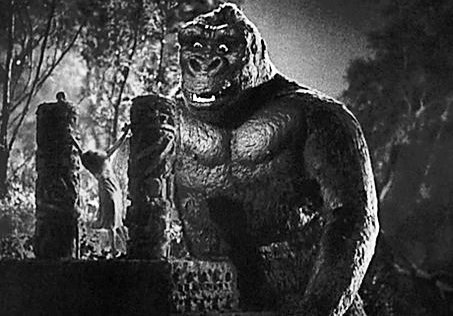
The first time was the charm. One of the few insightful comments I heard on the 2007 AFI special was when Martin Scorsese said that in many ways he finds the primitive stop-motion effects of the original King Kong more impressive than later CGI versions. He's absolutely right. The 1933 version also offers more thrills and emotions (and in half the time) than Peter Jackson's technically superior but dramatically inferior and unnecessary remake. Let’s not even discuss the 1976 version.
When L.A. Confidential debuted on this list in its first year of eligibility in 2007, I wrote, “Of the films of fairly recent vintage, this is one that grows stronger each time I see it, earning comparisons to the great Chinatown…Well acted (even if Kim Basinger's Oscar was beyond generous), well written and well directed, I believe L.A. Confidential’s reputation will only grow greater as the years go on — yet it lost the Oscar (and a spot on the AFI list) to the insipid Titanic.” When I re-watched the film recently, my prediction proved to be spot-on as it only deepens as an experience and an entertainment as time passes. It still boggles my mind that with Russell Crowe, Guy Pearce, Kevin Spacey and James Cromwell (just to name four) delivering impeccable work that only Basinger landed a nomination, but losing best picture and director to James Cameron and Titanic remains the bigger crime.
Simply put: The tensest comedy ever made and perhaps Scorsese's most underrated film. Griffin Dunne plays the perfect beleaguered straight man enveloped by a universe of misfits and oddballs in lower Manhattan when all he wanted to do was get laid. It’s hard to imagine that this movie nearly became a Tim Burton project, but thanks to the many setbacks Scorsese endured attempting to make The Last Temptation of Christ, the film ended up being his — and recharged his batteries as well. While Scorsese has made great films since, I’d love to see him step back sometime and make another indie feature like After Hours on the fly just to see what happens. Joseph Minion wrote an excellent script and this represents one case where I think the changed ending actually proves superior to the originally intended one. By the way, whatever happened to Joseph Minion?
Watchability often gets undervalued when rating a film's worth, but I never tire of sitting through this thrill ride. One aspect that has impressed me since I first saw it as a teen back in 1985 (and I went two nights in a row, dragging my parents to it on the second) was its attention to detail such as Marty arriving in 1955 and mowing down a pine tree on the farm of the deranged man trying to “breed pines.” Then, when he returns to 1985, Twin Pines Mall now bears the sign Lone Pine Mall. It’s just a quiet sight gag in the background without any overt attempt to call attention to the joke. You either catch it or you don’t. I always admire films that respect audiences like that, especially when they happen to be this much fun. With equal touches of satire, suspense and genuine emotion, Back to the Future elicits pure joy. No matter how many times I see it, the final sequence where they prepare to send Marty back to 1985 holds me in rapt attention as I wonder if this time might be the time he doesn't actually make it.
A comedy about the Vietnam War that's full of blood and set in Korea, just as a matter of subterfuge. The film that put Altman on the map and inspired one of TV's best comedies (until it got too full of itself), MASH still holds up with its brilliant ensemble and wicked wit. I still wish the TV show had kept that theme song with its lyrics. Through early morning fog I see/visions of the things to be/the pains that are withheld for me/I realize and I can see.../That suicide is painless/It brings on many changes/and I can take or leave it if I please.

Back in 1985, before Goodfellas and The Sopranos really mixed mob stories with jet black comedy, the great director John Huston, in his second-to-last film, brought to the screen an adaptation of Richard Condon's Mafia satire Prizzi's Honor, complete with great performances and some of the most memorable lines ever collected in a single film. Huston may have been in the twilight of his days, but his filmmaking prowess was as strong as ever. Jack Nicholson disappeared into the role of Charley Partanna more than he had any role in recent memory. Kathleen Turner matched well with Nicholson as Charley's love whose work outside the house causes problems. William Hickey gave an eccentric and indelible portrait of the aging don. Finally, John's daughter Anjelica made up for a misfire of an acting debut decades earlier with her brilliant performance as the scheming Maerose and took home one of the most deserved supporting actress Oscars ever given.
Before Zhang Yimou started being obsessed with spectacle and martial arts, film after film, he produced some of the greatest personal stories in the history of movies, especially when his muse was the great and beautiful Gong Li. This film was their first truly flawless effort as Gong plays the young bride of a powerful lord who already has multiple wives and who encourages the sometimes brutal competition between the women.
"The film actually is like a snail — it kind of turns in on itself and becomes itself," Altman describes his film in an interview on its DVD. One of the many "comebacks" of Robert Altman's career, this brilliant Hollywood satire holds up viewing after viewing because it's so much more than merely a satire. Thanks to Tim Robbins' superb performance as the sympathetic heel of a Hollywood executive and the cynical yet deeper emotional punch of Michael Tolkin's script, Altman wows from the opening eight-minute take to one of the greatest final punchlines in movie history. However, the more times you see it, the more you discover to see. While some specific references have aged, the movie's relevance remains — now more than ever.
Schindler’s List marked an important moment in Spielberg’s development as a filmmaker: Peter Pan finally grew up. It’s a harrowing, well-made movie that everyone should see. At the same time, I can foresee a time when it slips off this list entirely. It isn’t the fault of the film — I find it nearly flawless. However, if someone placed a gun to my head and ordered me to choose to watch either Schindler’s or one of Spielberg’s best post-1993 films such as Catch Me If You Can or Minority Report, I’d opt for one of the latter two. Are they better films than Schindler’s List? I can’t say that. However, the epic holocaust tale isn’t a film you find yourself wanting to pop a bowl of popcorn and watching on a whim. As I said earlier, for me at least, rewatchability remains an important factor. I’ve seen Schindler’s List three times but I haven’t reached the point where I want to go through that wrenching experience again.
Bergman once said that by the time he was done making Wild Strawberries, the film really belonged more to Victor Sjöström, who played Borg, the renowned professor and lauded physician about to receive an honorary degree. The film marked Sjöström 's return from semi-retirement, but he already was a legend as the first true Swedish acting-directing star. Borg decides to drive his old Packard to the event instead of flying to meet his son. The journey becomes more than just a road trip for the professor, but a metaphysical trek through his past as he questions what led him to this moment. As the car winds closer to the ceremony, Borg's inner journey does as well as he comes to realize that for all his scientific training, the only thing he can't analyze is himself. "The day's clear reality dissolves into even clearer remnants of memory," he says. Wild Strawberries represents Bergman growing into his powers as a filmmaker and while it may concern a 78-year-old man examining his life, the subject proves as timeless for people of any age as the film itself.
Tweet
Labels: Almodóvar, Altman, D. Zanuck, Dassin, Hawks, Herzog, Hitchcock, Huston, Ingmar Bergman, Kurosawa, Laughton, Lists, Murnau, Sayles, Scorsese, Spielberg, Tim Burton, Truffaut, Zemeckis, Zhang Yimou
TO READ ON, CLICK HERE


Edward Copeland's Top 100 of 2012 (60-41)

Perhaps the crowning achievement of the Italian neorealist movement. This story of Italians fighting back against fascism and the Nazis during World War II plays as powerful and moving today as it ever did, with a great cast led by Anna Magnani, who appears in one of the film's most memorable sequences. Despite being generally hard on the film, Manny Farber declared Open City the best film released in the U.S. in 1946 and called Magnani’s performance “the most perfect job by an actress in years and years.”
A breathtaking debut that launched a mostly great film series about Truffaut's screen alter ego, Antoine Doinel, and containing perhaps the most famous freeze frame in film history. It's not bad as a coming-of-age picture either. While The 400 Blows stands alone as the best of the Antoine Doinel films, it’s fascinating to watch Jean-Pierre Leaud play the character from an adolescent to an adult. In its own way, the film resembles the first installment of a fictional version of Michael Apted’s Up documentary series only focusing on a single character.
Pollack didn't just direct and act in this comic masterpiece, he really played tailor as well, stitching together multiple versions of its screenplay to come up with the exquisite finished garment. Dustin Hoffman's brilliant performance as perfectionist pain-in-the-ass actor Michael Dorsey and Dorothy Michaels, the female persona he creates to get work, stands as the crowning achievement of his acting career. It doesn't hurt to be surrounded by an equally solid ensemble that includes Teri Garr, Dabney Coleman, Charles Durning, George Gaynes, Doris Belack, Geena Davis and a nearly all-improvised role by Bill Murray.
Preminger’s crowning achievement could be a routine noirish mystery if it weren’t for its great ensemble of Dana Andrews, Gene Tierney, Judith Anderson, Vincent Price and, most of all, Clifton Webb delivering its wry and witty dialogue by Jay Dratler, Samuel Hoffenstein and Betty Reinhardt (with alleged uncredited contributions from Ring Lardner Jr.). A couple of examples: Price as Laura’s cad of a fiancé Shelby Carpenter declaring ,"I can afford a blemish on my character, but not on my clothes" and Webb as bitchy newspaper columnist Waldo Lydecker describing his work, "I don't use a pen. I write with a goose quill dipped in venom." Laura could be called the All About Eve of film noir mysteries.
Every time I hear that a friend or acquaintance is going to have a baby, I make the same simple request: Do everything in their power to keep all knowledge of this movie away from them until they see it. I would have loved to have seen it without knowing that the shower scene was coming or the truth about Norman Bates. I hope others can have that experience.

One of the biggest jumps of any films from the last list. When revisiting The Last Picture Show for its 40th anniversary last year after having not seen the movie in years, it truly captivated me with its stark beauty. Despite its setting in 1951 in a small Texas town, it contains a universality that resonates today both in human and economic terms. Plot doesn't drive the story — character, not only of the people but of the town itself, does. While you watch the movie, you aren't concerned with what happens next or how the film ends because you realize that life will go on for most of these fictional folks you've come to know. It's telling a coming-of-age story — several in fact — and not all concern the teen characters in the tale. It's also about love and loss, not always in the present tense.
Not only does Broadcast News hold up to repeated viewings, it holds such a special place in my heart that I almost can’t view it rationally. I overidentify with Albert Brooks’ character of Aaron Altman and I’ve known a couple of women with similarities to Holly Hunter’s Jane Craig. More importantly, James L. Brooks wrote and directed a very funny and touching valentine to the decline in television news standards and set it against an unrequited love triangle (with William Hurt’s Tom Grunick filling the third point as well as representing TV news’s deterioration). The supporting cast also aids the entertaining proceedings with the likes of Robert Prosky, Joan Cusack, Lois Chiles, Peter Hackes, Christian Clemenson and Jack Nicholson as the anchor of the network’s evening news.
Even people who view Capra as a sentimental sap tend to like this great madcap romantic romp thanks to the great chemistry of Clark Gable and Claudette Colbert. The first film to sweep the top five categories at the Oscar continues to hold up thanks in no small part to the chemistry between Gable and Colbert. Memorable scenes pile up one after another involving great character actors such as Roscoe Karns and Alan Hale Sr. Perhaps the most magical scene comes when Colbert’s Ellie asks Gable’s Peter if he's ever been in love while on opposite sides of the blanket and he momentarily gets serious, wistfully describing his ideal woman while Ellie slowly melts on the other side of the blanket. May the walls of Jericho always fall.
Here comes Hitch again with his most personal and, in many ways, disturbing film about love and obsession and the need to replace what one has lost. It also happens to be another of my great moviegoing experiences, having been able to see the 1996 restoration at the Ziegfeld Theater in New York. Robert Burks’ cinematography never came across as vividly, especially the reds in the scenes set at Ernie’s. James Stewart delivered one of his best performances as a former cop, already damaged psychologically, pushed further to the edge when he falls for a woman named Madeline (Kim Novak) that he’s been hired to follow and later when he meets her doppelganger and attempts to make her over in Madeline’s image.
As the years roll by, many find themselves less enthused by Tarantino's film. I am not among their ranks, finding that I'm as enthralled, entertained and as giddy as I was the first time I saw it whenever I see any part of it again. Similarly, my faith in Quentin remains strong as well, especially in the wake of Inglourious Basterds, which I definitely could see on a list like this once it reaches its eligibility if it holds up as well as it has so far.

Billy Wilder made so many great comedies with varying levels of pathos that it's hard to pick just one. I considered Some Like It Hot and One, Two Three, but this one remains for me his best film among the ones played primarily for laughs. In the wake of Mad Men, the film proves particularly interesting to watch (even if Roger Sterling thinks female elevator operators defy reality).
Even before the recent passing of Andy Griffith, I had decided that I had to make a spot for A Face in the Crowd on this list. As far as I’m concerned, it undoubtedly stands as Kazan’s best film and as a bit of a prescient one. Without this film, I’m not sure Paddy Chayefsky would have been inspired nearly 20 years later to write Network. Budd Schulberg deserves the bulk of the credit, adapting A Face in the Crowd from a short story he wrote called “Arkansas Traveler.” The film broke ground in its depiction of the convergence and intermingling of the media, corporate and political worlds. In addition to Griffith’s stellar performance as Lonesome Rhodes, the cast includes exemplary work from Patricia Neal, Walter Matthau and Tony Franciosa. Mike Wallace, John Cameron Swayze and Walter Winchell even make cameos as themselves. The film’s reputation should only grow.
When one of the early moments of a movie shows Edward Norton squeezed against the man breasts of a sobbing Meat Loaf, it boggles my mind how many people who saw Fight Club when it came out didn’t immediately recognize the film as a satire. Every time I’ve watched this film, I’ve loved it more than I did originally. To further emphasize its strength, the first time I saw it, I already knew the twist because of an out-of-nowhere comment by David Thomson in a completely unrelated article in The New York Times. Based on Chuck Palahniuk’s novel, Jim Uhl’s screenplay and David Fincher’s direction spin a funhouse tour of the consumer culture, self-help groups and machismo. Norton turns in a great performance as always as do Brad Pitt as the devil on his shoulder and Helena Bonham-Carter as a twisted kindred spirit.
A running gag between Wagstaff and I in recent years is that I believe Die Hard is the greatest film ever made. OK, I don't really believe that, but this is one of the best, especially as far as action goes and Alan Rickman remains one of the all-time great movie villains. In addition to having a great bad guy, what sets Die Hard apart from other action films is that its hero, John McClane (Bruce Willis) isn't superhuman. By the end of the movie, he looks as if he's been through hell.
This film doesn't get mentioned as often as it should, but its portrait of the perils of vigilante justice comes through as strongly today as I imagine it did when it was originally released. Henry Fonda and Harry Morgan try to speak for calm and rationality against the horde ready to inflict mob violence.

The time is over for the debate as to whether the Oscar this classic silent won in the Academy's first year was the equivalent of "best picture." All that needs to be said is that is a great film, Academy seal of approval or not. It remains both heartbreaking and beautiful 85 years after its debut.
The Godfather Part II may have won best picture in 1974, but for my money it wasn't even the best Coppola film that year, let alone the best picture (not that it isn't good). This simple tale of an eavesdropping expert (Gene Hackman giving one of his best, most restrained performances) experiencing sudden moral qualms remains riveting and thoughtful to this day.
Supposedly, Hitchcock often named this gem as his personal favorite of his films and it certainly remains one of his best with its dry, mordant wit and a great lead in Joseph Cotten as Uncle Charlie, worshipped by Teresa Wright as his niece Charlie. Much comic relief gets provided by Henry Travers as young Charlie's father and Hume Cronyn as his murder mystery-loving friend.
I'm not talking to you Travis, but about you, and Scorsese and Paul Schrader's dark, modern spin on The Searchers only grows more stunning as the years roll on. Robert De Niro gives one of his greatest performances and, for my money, this may remain Jodie Foster's finest work.
Jean Renoir made a lot of great films and at least two unquestionable masterpieces, including this one, yet you seldom hear his name come up unless you are talking with real cinephiles. Shameful — because his films don't belong to elite tastes: They belong to everyone. This vivid portrait of WWI prisoners of war proves that since it was the very first time the Academy bothered to nominate a foreign language film for best picture. It should have won too.
Tweet
Labels: Bogdanovich, Capra, Chayefsky, Coppola, Fincher, Hitchcock, Kazan, Lists, Murnau, Preminger, Renoir, Scorsese, Sydney Pollack, Tarantino, Truffaut, Wellman
TO READ ON, CLICK HERE
Tuesday, January 03, 2012
Men swarm around me like moths to a flame and if their wings get singed, I can't be blamed

By Edward Copeland
It has been a long journey for me to be able to watch and write about Josef von Sternberg's 1930 classic The Blue Angel, and I refer to the version made in German, not in English. I had tried to rent it several times on DVD through different services but the region-free disc always flaked out at the same spot. I finally watched it on Netflix streaming (as I was ending that option before I switched to DVD only and Netflix customers know that happened in September) and was able to see the entire film. Then it was just a matter of finding the time to write about it, but other projects kept getting in the way and The Blue Angel deserves more than a quickie. It's sat around about half done for months, but with a new year, I thought I should get this out of the way, especially when I noticed that the English version got wide release in the U.S. 81 years ago today. Figured that had to be a sign.
My journey to see The Blue Angel proved difficult, but it actually ended up being a breeze compared to what happened to both versions of the landmark film over the many decades since both premiered in 1930, albeit in separate parts of the world.
Why The Blue Angel gained its status as a pivotal point in film history can be attributed to several reasons, such as:

The differences in the two versions of The Blue Angel extend beyond just the language the actors in which the actors speak. When it premiered in Germany on the night of March 31, 1930, it ran 106 minutes. The raves (in addition to being able to see the as-yet-unreleased English-language version) prompted the U.S. studio Paramount to lure both von Sternberg and Dietrich, who by then were lovers, to the U.S. They made and released Morocco, which earned Dietrich the only Oscar nomination of her career for best actress, before The Blue Angel had its U.S. debut. When the English version was released in December 1930, it only ran 99 minutes, as filmed. The German version didn't play in the U.S. until 1947 and to emphasize Dietrich at the expense of Jannings' lead character (and the story itself), the film was cut to 90 minutes. It wasn't until 2001 that a new German language print, made from original negative material, restored it to 106 minutes and was re-released. Ironically, for many decades, the English-language version became considered lost until a print was discovered in a German film archive, restored and shown in 2009.

With that brief primer on the movie's history out of the way, now I can dive in to talking about the film itself which I'm glad to say stands up very well given that it's nearly 82 years old. Granted, The Blue Angel definitely shows signs of belonging to that awkward phase where silent filmmakers and performers adjusted techniques to the new sound era, but for the most part the movie and its cast clears that hurdle rather easily. Jannings stars as Professor Immanuel Rath, a strict disciplinarian as an English teacher at a boarding school in his small German town. His students mock him mercilessly (a favorite nickname is Professor Unrath, ratshit in English) but he holds a stellar reputation in the port city. (I love how in foreign
 language films, even from way back, when they update the translations of the subtitles, they put in the profanities.) He doesn't earn much respect from his live-in maid either, who offers little sympathy when Rath awakes one morning to discover his lone companion, a pet bird, dead in its cage. "It pretty much stopped singing," the housekeeper (Ilse Fürstenberg) tells the professor. Though Rath maintains the community's regard, sometimes it's easy to see how he becomes an object of ridicule for his classless pupils or others, such as when he blows his nose and emits a comically absurd honking sound. Still, he tries to teach these callow lads, on one day specifically about Shakespeare's Hamlet. The students ignore him most days, but on this day, he discovers their fascination with postcards which he confiscates bearing photos of Lola Lola (Dietrich), the bawdy performer at the German version of a speakeasy which gives the film its title, The Blue Angel. Lola's images transfix Rath. He even blows on one of the cards and imagines that the feathers on her dress move. After interrogating one of his students, Angst (Rolf Müller) — whom the other students routinely harass because he doesn't frequent the club — Rath learns of the club's location and decides to venture to it himself since The Blue Angel and its performers such as Lola Lola debase the morals of his pupils.
Backstage at The Blue Angel that night, several of Rath's pupils flirt hopelessly with Lola Lola, who plays with them until her turn comes to perform. She immediately commands the stage as well as the establishment, singing to the enthralled, lascivious men in the audience, "Guys, tonight I'm going to pick someone/I'm fed up with the young ones." As Rath stumbles his way inside The Blue Angel, he's so nervous that he gets himself caught in the mesh curtains that separate the main room of the club from its entrance. Rath might have convinced himself that he came to lecture her on moral failings, but it's Lola herself that's enticed Rath on this journey, and as she struts around the stage in stockings and garters, that isn't what's on Rath's mind. He remains enraptured as she croons "Naughty Lola," with lyrics such as "If any of you guys get too near/I'll kick you in the ribs/And punch you in the ear." The students spot their professor and flee backstage, but not before Rath spots one of them. Rath begins searching the rooms backstage trying to find the pupils, encountering a
 sad and disturbing-looking clown (Reinhold Bernt) who will be a recurring figure throughout the film. He ends up in the dressing room as Lola enters wondering why a man is in there. Rath tells her that she and this club are "corrupting my pupils." Lola brushes this off and begins to undress before Rath, leading him to begin to stumble toward the doorway, being an impediment to those trying to come in and out. Lola sees he's shy and climbs a staircase and Rath stands there, uncertain of what to do next when suddenly panties land in his hands from above. As Rath stands hapless, Kiepert (Kurt Gerron), a magician and manager of the troupe of performers appearing at The Blue Angel, enters yelling at the female performers, though he's protective of Lola until he learns who Rath is and tries to show him that he's important. He sends Lola back out on stage as Kiepert pastes on a mustache to prepare for his magic act. Rath lays into him for letting his pupils attend performances at the club. Before Kiepert can even deny such a thing, Rath spots one of this students and chases him out of the club. Things don't go so well later for the pupil Angst. (Could he be named any more appropriately?) As he sleeps in his bed, shadows approach on his bedroom wall, shapes somewhat reminiscent of Murnau's Nosferatu. Some of the other students start slapping and beating him repeatedly for telling Rath about The Blue Angel.
While it's easy to see the allure of Dietrich and how her star was born out of this film, Jannings proved he could be just as powerful with words as he was in his silent classics, even if some of his emoting continued to play as large as it did in those days when they
 didn't have dialogue. Rath, a character created in the novel Professor Unrat by Heinrich Mann, manages to be a sympathetic creation in Jannings' hands even though he doesn't take any paths to make the professor that way. He's overly proud and expects too much of others. A plaque in his apartment reads DO RIGHT AND FEAR NO MAN. He isn't above being physical with his pupils, slapping cigarettes out of their mouths. When the school's director (Eduard V. Winterstein) warns him that he "risks his future on that kind of woman," Rath ignores him, telling him, "She is my future wife." Of course, when Rath actually proposes to Lola, she laughs at him, though she ends up marrying him anyway. Watching Jannings' degradation as he goes from esteemed professor to a man making money selling those postcards of Lola Lola, now his wife, to eventually becoming a clown in Kiepert's act and a cuckold as Lola seeks affection elsewhere telling him sometimes, "What choice do I have? That's the way I was made."
The lowest point comes when after five years on the road, all of them get booked to play The Blue Angel again, which to Rath's objection, they promote as the professor's return to the town. Not surprisingly, it attracts a sellout crowd. Rath barely seems human anymore. The professor who once taught Shakespeare, now is just a fool, and not even Lear's. When he takes the stage with the magician, he gets hung up in curtains, mirroring his initial entrance to The Blue Angel. When he tries to speak, intelligible words no longer come out. Kiepert makes a mockery of Rath on stage until a group of men, including Lola's lover, rescue him. Later, Kiepert promises that he will make it up to him. It leads to a quiet and sad dénouement. The influence of the German expressionists shine throughout von Sternberg's direction, though he makes great use of the addition of sound as well. For instance, when Rath makes his return down the alley to the club, he adds the unmistakable sound of a cat in heat. While Dietrich definitely makes a magnetic debut (even if it came out second), Jannings brings the heart and magic to The Blue Angel (at least the German version).

Tweet
Labels: 30s, Emil Jannings, Foreign, Marlene, Murnau, Netflix, Oscars, Ray Top 100, Shakespeare, von Sternberg
TO READ ON, CLICK HERE
Monday, February 14, 2011
The Blood Is Still the Life

By Damian Arlyn
They may be cold to the touch, but right now vampires are pretty hot. Shows such as Vampire Diaries and True Blood, movies such as Let the Right One In and its American remake Let Me In, books such as the Twilight series (and its accompanying movie adaptations) and even a whole subculture of teenage "vampire-wannabes" serve as constant reminders to us that vampires currently are a very popular cultural phenomenon. Yet, in their various literary, movie and TV incarnations, vampires mostly are portrayed as tortured, sensitive souls cursed to continue their earthly existence through the blood sacrifice of others. I'm not entirely sure when this shift toward conceiving of vampires as sympathetic took place but I think it owes a great deal to the novels Anne Rice wrote in the '70s and '80s. Before romantic, melancholy characters like Lestat and Louis came along, vampires were seen (like werewolves, mummies and Frankenstein) primarily as monsters. They were evil, bloodthirsty beings who actually enjoyed taking the lives of others in order to survive. Almost nowhere is this is more apparent than in Tod Browning's 1931 Dracula, which celebrates its 80th anniversary today. In looking back at this horror classic, one recognizes many of the very qualities that would come to be rejected by modern-day vampire enthusiasts while simultaneously seeing several of the very aspects that entrance them with that whole dark underworld in the first place.
Browning's was not the first cinematic treatment of Bram Stoker's novel. Despite being unable to secure the rights, the great F.W. Murnau adapted it into his 1922 silent Nosferatu and was subsequently sued by Stoker's widow. Murnau's Count Orlock (sinisterly played by German actor Max Schreck in a lot of make-up) was a repulsive creature whose evil was manifested in his hideous appearance which, incidentally, more closely resembles the character described in the original book. Browning's Dracula, on the other hand, is all too human. Played by the Hungarian actor Bela Lugosi (who originated the role in a successful Broadway play written by Hamilton Deane and John L. Balderston), he's handsome, charming, poised, well-dressed, well-groomed and rather sexy. It is this version of the character that most influenced the way the public perceived vampires and Lugosi's Central European elegance and flair played a big part in that.

Though it seems somewhat campy today, Lugosi's performance is iconic and captivated people's imagination at the time. He brought a theatricality to the role that helped to establish vampires as larger-than-life beings who walk, practically glide, untouched through the world of mortals. As Roger Ebert once wrote, "Vampires are always in pose mode... The buried message of many scenes is: Regard me well, for here I am, and I am thus." Speaking in a broken English accent (which, contrary to legend, did not indicate that Lugosi had to learn his lines phonetically; by the time the film was made he spoke English very well), Lugosi welcomes an unsuspecting Renfield — played with equal theatricality by Dwight Frye — into his castle like "a spider spinning his web for the unwary fly." His lines, mostly absent from the original book, are spoken in such a slow, deliberate manner that they have become just as famous for their delivery as for their words: "I never drink... wine," "Listen to them: children of the night. What music they make," and the simple yet hypnotic introduction, "I am... Dracula."
The Deane/Balderston play served as the basis both for the interpretation of the Dracula character and for the structure/aesthetic of the rest of the film. This is why, after a spectacular opening in Dracula's Transylvanian castle, the film takes place mostly in England and takes on the feel of a typical "drawing room" mystery. Browning's approach to the look of the film is appropriately dark and moody but not especially inspired. It has been speculated that the passing of Browning's original choice for the role of Dracula, his friend Lon Chaney, so upset him that he didn't invest as much effort and care into the production as he otherwise would have and in fact left it to cinematographer Karl Freund to do most of he shooting. Interestingly, the crew that filmed the Spanish-language version of Dracula (since it was common practice at that time for studios to make a completely different film utilizing the same sets and costumes rather than simply dub the existing film with foreign languages) created a far more visually interesting product with more camera movement, better staging of certain sequences and even some special effects that made the English version seem a little hokey. What it didn't have, however, was a Dracula with the charisma and screen presence of Bela Lugosi.
There is another element that to modern audiences is noticeably absent from the film. Outside of the opening titles (where Tchaikovsky's "Swan Lake" can be heard) and a scene in a concert hall, the film is completely devoid of any music. Dracula was one of Browning's first sound pictures and his discomfort with the new technology seems apparent in his use of sound. There are long stretches of silence in the which, though they invoke an atmosphere of suspense and dread, clearly reflect a filmmaker whose training stems from silent cinema. Esteemed minimalist composer Philip Glass attempted to rectify this in 1998 by writing a score for a string quartet that he intended to accompany the film and indeed most DVD versions now have the option of viewing it with a separate audio track that includes Glass' contribution. Although Glass is undeniably talented and the score is itself worth listening to, I personally find it too distracting and intrusive. It transforms Dracula from a piece with perhaps too many silent moments to a film with practically no silent moments. Thus, whenever I sit down to watch it (which usually is every Halloween) I have to do so without Glass' music to really enjoy the experience.

It might be hard now to imagine that anyone ever thought Dracula was scary, but the truth is that people were frightened by what they saw. Decades before newspapers would report that The Exorcist had patrons fainting in the theaters, Dracula had a similar effect on audiences and, to the delight of the studio, it was an enormous box office success. Looked at today a lot of it seems amusing at best and rather silly at worst, but several things save it from being simply a relic of a bygone era: Freund's striking cinematography, some magnificent sets, a few genuinely creepy moments and memorable performances by Dwight Frye, Edward Van Sloan (as Van Helsing) and, of course, Bela Lugosi (who would become so identified with the role that he would have a lifelong love/hate relationship with it). What also cannot be ignored is the role it played in initiating a whole pantheon of cinematic vampires that would later follow. Just as Bram Stoker's book coalesced and solidified much of the language and imagery that is now associated with the mythology of vampires, Tod Browning's Dracula would establish much of what makes vampires attractive to a moviegoing audience: their mystery, their immortality, their sex appeal. They may have started out as engaging villains and ended up as angst-ridden antiheroes, but regardless of how they got that way, without the work of Browning and Lugosi, we wouldn't have any of the vampire media that we do today...though we shouldn't blame it for that.
Tweet
Labels: 30s, Browning, Ebert, Fiction, Lugosi, Movie Tributes, Murnau, Silents, Television
TO READ ON, CLICK HERE
Wednesday, July 08, 2009
Herzog Week: Nosferatu: Phantom der Nacht
By Edward Copeland
In a featurette on the DVD for Nosferatu, Werner Herzog says that it was the first time he attempted a pure genre film and boy did he pull it off. He also felt some responsibility, remaking what he considers the first great German film something that, in actuality, he did twice, making both English-language and German-language versions (on the commentary, Herzog prefers the term reversioning). I only watched the German version and it may well be the best screen telling of the Dracula story I've seen put on celluloid.
Of course, the reason Herzog made two versions was the international nature of his cast and as a result many of the actor's voices were dubbed by others in both versions. The great French actress Isabelle Adjani plays Lucy Harker, but since she spoke neither English nor German, another actress voiced her part in both versions.
The same was true of the Frenchman Roland Topor who plays Renfield, though the dubbed cackle would make Dwight Frye proud even though Herzog claims never to have seen the Bela Lugosi version. Klaus Kinski as Dracula and Bruno Ganz as Jonathan Harker could do their own voices in both versions.
Herzog, as a German child born during World War II, felt that there was no German forefathers in his immediate generation to look back to, so he and other aspiring filmmakers went back to their cinematic grandfathers like Murnau who made the silent Nosferatu in an effort to find their way to connect to German culture that didn't involve the horrors of Nazism.
Kinski's makeup, which took four hours a day, is patterned after the look Max Schreck had in the silent classic and his subdued performance boosts the creepy element that Herzog builds. What's particularly amazing for a vampire film is how much is not shown. Only a single drop of blood appears on screen throughout the entire film, yet it doesn't do anything to lessen the horror, though I'm not sure horror is the proper word.
There aren't scares as in your typical vampire story; Herzog's film concentrates on moods and atmospherics and really succeeds better than other movies that take the easier paths to spooking the audience. Kinski's Dracula contains a bit of a tragic figure within his horrific monster body, longing for the ability for human emotions such as love or even the desire just to die.
All the classic characters get a bit of a twist. Ganz's Jonathan Harker starts out as the would-be hero, out to save his wife before becoming a zombified figure shaking in a corner. Walter Landegast's Van Helsing isn't the fearsome vampire hunter of some versions, but just your average doctor who believes in science and pooh-poohs the superstition when Adjani's Lucy tries to warn him of the vampire in their midst.
Lucy changes the most. It's somewhat ironic that this version premiered in 1979, the same year that Sigourney Weaver first became Ripley in Alien, because Lucy is the character that pretty much takes charge when it comes to trying to stop Dracula.
Now, she doesn't do some Ripley-style asskicking, but it is an interesting take, especially within her village, which has been hit by the plague and provides some unusual sequences where Lucy tries to enlist help only to find the living citizens drinking and celebrating what they assume will be their last dances.
As I've dived into Herzog for this week's project, I've found his body of work to be more eclectic than you'd think while still showing some of his signatures within the different films. Of all those I've viewed, Nosferatu may be my favorite Herzog so far.
Tweet
Labels: 70s, Foreign, Herzog, Lugosi, Murnau, Sigourney Weaver, Silents
TO READ ON, CLICK HERE


