Tuesday, February 14, 2012
Truth be told, you two are both dragging me down

By Edward Copeland
By the time I finally found myself in a position to watch Shame, my expectations rested on two separate planes. The first, for the film itself, had settled on not anticipating being wowed, based not only on what I'd heard but also because (I must admit) I never managed to make it all the way through director Steve McQueen's first film, Hunger. The other plane existed on a much higher level, formed solely on what I'd witnessed of Michael Fassbender in 2011, giving great performances in movies that couldn't be more different — X-Men: First Class and Jane Eyre. I haven't even had a chance to catch him as Carl Jung in David Cronenberg's A Dangerous Method. However, I've witnessed many an actor or actress rise above mediocre material and I expected that if Shame turned out to be a subpar film, Fassbender still could deliver a superb performance. Unfortunately, thespians can do only so much with scripts as aimless, pointless and devoid of meaning as Shame. While Fassbender lets it all hang out in service to this lackluster screenplay, Carey Mulligan delivers the film's best performance, far better than Shame deserves, as Fassbender's character's sister.
Fassbender plays Brandon Sullivan, an Irish transplant to the U.S. who works as an executive in Manhattan. For what kind of business, it's never clearly stated, but it allows Brandon enough free time to leave the office for hours during the day to go to a hotel and have vigorous sex with multiple women. Now, sometimes Brandon does have to stay in the office. You might not be able to smoke inside public buildings in New York anymore, but masturbation breaks seem to be OK. At night, Brandon occasionally carouses with his married boss, David Fisher (James Badger Dale), who doesn't even try to hide his adultery from his employees. However, when loads of particularly nasty paid porn sites turn up on the hard drive of Brandon's work computer, Fisher immediately assumes that someone has hacked into Brandon's account or been using his computer when Brandon isn't there.
Based on the portrait painted in Shame, it seems that nearly all currently living in New York — including the women — carry attitudes toward sex that's more likely to be found in 14-year-old boys, only real 14-year-olds aren't getting laid at this high a percentage and the teens probably display more maturity and hold fewer fears of long-lasting relationships. Yes, I understand that Brandon is a sex addict, but the screenplay by director McQueen and Abi Morgan may depict the life of a sex addict but it never deals with the subject of sex addiction. Imagine a film about a heroin addict and the entire movie consists of the addict shooting up or snorting the drug, showing little in the way of consequence and no discussion of the addiction before the film finishes. That's almost what Shame amounts to as a film. Hell, the TV sitcom Cheers treated sex addiction more seriously and with laughs when in a later season Sam sought treatment for it.

The film's complication, i.e. Brandon's complication, stems from the arrival of his estranged younger sister, Sissy (Mulligan), who crashes at Brandon's apartment because she and her boyfriend are on the outs. Her arrival, according to the production notes and a couple of dialogue scenes inserted to break up the monotony of Brandon's boffing, throws his world into "chaos." As near as I can tell from the movie, chaos for Brandon (as well as McQueen and Morgan) equals having Sissy living in his apartment meaning he must go elsewhere to fuck. Poor baby. What also upsets Brandon is that Sissy gets a booking to sing at a New York club, which Brandon's boss David hears about, forcing Brandon to reluctantly accompany Fisher to see her show. The scene actually ends up being one of the film's few highlights as Mulligan performs the most downbeat version of Kander & Ebb's "New York, New York" you'll ever hear. It's reminiscent of the scene in Georgia when Jennifer Jason Leigh performs Elvis Costello's "Almost Blue." It certainly bears no resemblance to Liza Minnelli's version in Martin Scorsese's film of the same name that introduced the song or Sinatra's recording that immortalized it. Rubbing salt in Brandon's wound about Sissy interfering in his nightlife and his apartment, she and David end up going back to Brandon's place and having loud, boisterous sex, forcing a pissy Brandon to leave.
While visually, cinematographer Sean Bobbitt provides a cool blue tint that comes across as wholly appropriate to the film, Shame suffers from being overscored — not just by the original music composed by Harry Escott but the misuse of lots of Bach, mostly taken from Glenn Gould's recording of "The Goldberg Variations," alongside John Coltrane's instrumental cover of Rodgers & Hammerstein's "My Favorite Things" from The Sound of Music, Chet Baker's "Let's Get Lost" and Blondie's "Rapture" — all of which get played at near deafening levels at times to compensate for the largely dialogue-free sections. In a way, Shame sounds as if it's trying to be one of those late-night Skin-emax movies, only employing a classier soundtrack to play over the continuous coitus.
When Shame finally comes to a stopping place, they do allow Brandon and Sissy to have a conversation (more like a fight) to pretend that a point might have been hiding all along. Brandon has had it not being able to screw strangers in his own bed so he orders his sister out, telling Sissy that he's not responsible for her. He didn't give birth to her. "I'm trying to help you," Sissy tells him. "How are you helping me,
 huh? How are you helping me? How are you helping me? Huh? Look at me. You come in here and you're a weight on me. Do you understand me? You're a burden. You're just dragging me down. How are you helping me? You can't even clean up after yourself. Stop playing the victim," Brandon responds bitterly. I have to agree with Brandon there. The film hasn't given any indication that Sissy has arrived to stage some sort of intervention. Hell, aside for her stumbling upon some live sex chat woman calling out for Brandon on his laptop and walking in on him beating off once, nothing indicates that Sissy has clued in on her brother's lifestyle. Then again, I don't notice much of a mess. "I'm not playing the victim. If I left, I would never hear from you again. Don't you think that's sad? Don't you think that's sad? You're my brother," Sissy declares. No, what's truly sad about this situation is watching talented actors such as Michael Fassbender and Carey Mulligan attempt to squeeze some sort of emotional truth from a movie that contained nothing but artifice up until that point. Fassbender tries his best, but he's burdened with the heavy lifting since he's in every scene and the shallow script leaves him rudderless. Carey Mulligan comes off looking so much better because her part takes up less time on screen so it's easier to give Sissy life even if the screenplay doesn't provide her any more depth than it does Brandon.
That scene between the siblings toward the end of the movie reinforces what we got a slight glimpse of in an earlier scene where Brandon takes a co-worker named Marianne (Nicole Beharie) out for dinner. She's separated from her husband. While Brandon behaves meek and pliable at the restaurant, accepting every suggestion that either Marianne or the waiter (Robert Montano) makes, relationship talk brings out the opinionated side of him. He tells her that he doesn't believe in relationships — sees no point in them. When Marianne asks him how long his longest relationship lasted, Brandon answers four months. The two part for the night at her subway stop. The next day at work, we see what kind of universe Shame resides in. Marianne expressed a bit of dismissive judgment about Brandon the night before, but he takes her into the break room and kisses her passionately and Marianne willingly skips off from work with him to a hotel for a sexual tryst. This exemplifies the filmmakers' attitude toward pretty much every character in the movie.
The longer I think about Shame, the worse the film gets. If you set out to make a provocative film, it helps to have something to say. Your aim should be to provoke thought, not anger about the time wasted by talents such as Fassbender and Mulligan making it and movie lovers such as me watching it.
Tweet
Labels: 10s, Carey Mulligan, Cronenberg, Ebb, Fassbender, Hammerstein, J.J. Leigh, Kander, Liza, Music, Rodgers, Scorsese, Sinatra
TO READ ON, CLICK HERE


Monday, February 13, 2012
"I am a most strange and extraordinary person"

By Michael W. Phillips Jr.
Christopher Isherwood's Sally Bowles, first seen in an eponymous 1937 novella, has been around (if you know what I mean) for 75 years in a variety of media, perpetually on the lookout for a chance to become a star. A young British girl looking for fame and fortune in Berlin in the waning days of the Weimar Republic, just before the rise of the Nazi Party, Sally found her way to the stage with John Van Druten's 1951 play I Am a Camera, then to Broadway with John Kander and Fred Ebb's 1966 musical Cabaret, and finally to the screen with Bob Fosse's film, which turns 40 today. A bewildering array of actresses have inhabited her along the way, I'm sure to varying degrees of success: Julie Harris, Natasha Richardson, Jennifer Jason Leigh, Gina Gershon, Debbie Gibson, Teri Hatcher, Molly Ringwald, Brooke Shields, Lea Thompson, Judi Dench, Jane Horrocks. But perhaps to most people, Sally Bowles is Liza Minnelli and Liza Minnelli is Sally Bowles. Sally got her most memorable actress and Liza got an Oscar.
This wasn't Minnelli's first brush with the material: Darcie Denkert, in her lavish 2005 book A Fine Romance, tells us that Kander and Ebb had wanted Minnelli for the stage back in 1966, but director Harold Prince thought she was too young, too American, and too good a singer to play the young, British, barely talented denizen of the Berlin nightlife. In a way Prince was right: Minnelli is such an astoundingly good singer that Sally's self-confident assurances that she'll make the big time someday don't seem completely groundless. But it's still obvious that Sally won't make it, perhaps for the more subtle reason that her towering talent is unfortunately coupled with an utter lack of judgment, her impetuousness covering a sea of self-doubt.

Sally Bowles may be the focus of the film, but the most interesting character is Joel Grey's Emcee, an androgynous, grease-painted sprite with a wicked grin, which Grey originated on stage. Denkert speculates that the Emcee has his roots in a 1930 Thomas Mann novella called Mario and the Magician, about an Italian mesmerist who uses his powers to control his audience. But he reminded me more of another hypnotist, Dr. Woland (Satan in disguise) in Mikhail Bulgakov's The Master and Margarita, who, like the Emcee, seemed less of a fascist cheerleader than a bringer of chaos. The "decadence" of the Weimar Republic is on full display in the Kit Kat Club, and the Emcee gleefully whips his little corner of the world into increasing levels of the very things that the Nazis claimed to be so upset about. This connection is impossible, of course, since Bulgakov's novel wasn't published in English until after the Broadway run started, but I wouldn't be surprised to discover that Joel Grey had it in mind when he transferred his iconic character to the screen.
Because I've never seen or read any of its sources, questions of faithfulness or relative merit are thankfully not ones I can answer. Fosse and screenwriter Jay Presson Allen made several radical changes in transferring the story to the screen, starting with the music. They cut most of the "book" songs from the stage production, removing most of the secondary characters' vehicles for expression of their emotions, pushing them into the background and foregrounding Sally and the Emcee. Now all the songs (with one stunning exception) take place in the cabaret, and only Sally gets a traditional "book" song, wherein the singer gives voice to an inner monologue. This is the new addition "Maybe This Time," which Kander and Ebb had written for Minnelli back in 1963 and which, despite its magnificence, doesn't feel right in the film because Minnelli is unable to restrain her stupendous voice, and the scene starts to feel like she's making a statement about her talent in relation to her famous mother's instead of doing what's necessary for the character. Kander and Ebb wrote several other new songs, and a quick listen to the original cast recording tells me that I generally agree with the subtractions and additions.

From what I've read, this is less an adaptation than a reconceptualization into something that has roots on Broadway but also looks back to Isherwood's stories and forward into a radical new kind of film musical. It's a thing created from the raw material of the long-running Broadway sensation, but crafted into something that is first and foremost a film. Fosse uses his trademark abrupt editing to do something that would have been impossible on stage: by jarring cross-cutting between the stage and the outside world, he drives home the parallel between the increasing violence and decadence of the Emcee's show and the violence and decadence of the Nazis' rise to power. The boozers and good-time gals who hang out in the Kit Kat Club are there in part to escape reality, but Fosse and editor David Bretherton won't let us forget that the real world is still out there, and it's getting scarier by the measure. Kander and Ebb hated the film at first viewing because it wasn't what they had written, but gradually came to the conclusion that Fosse had created something completely new that was in fact a triumph.
The most triumphant thing for me is how deftly Fosse shrinks and expands the space of the stage. Most adaptations of musicals attempt to shed their "staginess" by setting scenes outdoors or adding new outdoor scenes, and this is no exception. But few, I think, play so adeptly with that staginess. Sometimes the Kit Kat Club seems as big as the Hollywood Bowl, packed to the gills with leering mutton-chopped men and bored women, and the stage seems like it's a tiny thing a mile away. Other times the club feels like it's the size of a telephone booth, and we can almost taste the sour sweat of the patrons and narrowly avoid the swinging limbs of the performers who loom above like giants. Sometimes the stage feels like the whole world. Fosse achieves this through camera placements and movements, use and eschewing of spotlights, and although it's not a perfect technique, it's more often than not a revelation. Much like the film itself: it's not the best musical ever made, and it has its flaws, but it's a wholly original creation that did much to clear away the big-budgeted, uncreative monstrosities that had come to characterize the genre in the late 1960s.
Michael W. Phillips Jr. is a Chicago-based film writer and programmer. He's the webmaster for Goatdog's Movies, and he programs films for the Chicago International Movies & Music Festival and the nonprofit film series South Side Projections.
Tweet
Labels: 70s, Dench, Ebb, Fiction, Fosse, H. Prince, J.J. Leigh, Kander, Liza, Movie Tributes, Musicals, Oscars, Theater
TO READ ON, CLICK HERE
Monday, August 30, 2010
Folie a Trois

By Eddie Selover
Fox Movie Channel recently showed Lucky Lady one weekday afternoon — the first airing of this unlucky movie anywhere in my experience since its premiere in 1975. I saw it back then, when I was — ahem — in my teens, and I thought it was pretty good… my strongest memory was of Liza Minnelli playing a Bessie Smith record (“Young Woman Blues”). I’d never even heard of Bessie Smith, but her deep growling and wailing on the soundtrack made a huge impression on me. And any movie that introduces you to Bessie can't be all bad.
So I was pretty excited to see the movie again after 35 years. As a movie buff, it’s always nice to discover a “forgotten” film and tell people about it. Maybe it would turn out to be a lost treasure. They’re out there — great little movies that most people have never heard of, and you read about them on the blogs sometimes… Two Seconds, Desert Fury, Strangers When We Meet, No Down Payment, Daisy Kenyon, just to name a few that you can find rapturous little posts about here and there.
Alas, this won’t be one of them. Lucky Lady was supposed to be Fox’s big Christmas hit of 1975: Minnelli’s first movie since Cabaret, co-starring the biggest star of the decade, Burt Reynolds, plus Gene Hackman fresh off his Oscar for The French Connection. It was only a couple of years after The Sting, which had been a hit of immense proportions, and this was an imitation — another story of darling, roguish crooks set in the Roaring '20s, with cutesy ragtime music and movie stars grinning with cigars in their mouths.
It was even a bit daring for its time: the stars play a floozy and two bums during prohibition, and as they bicker and laugh their way from down-and-outers in Mexico to filthy rich rum runners, they eventually become a ménage a trois… we even see them in bed together. You can tell that the filmmakers were trying for an update of the old '30s MGM Powell-Harlow-Tracy formula, with a raucous tart battling a tough guy and a mug. Lucky Lady, by the way, is the boat they use to transport hooch up and down the California coast, chased by the Coast Guard and murderous yet comically inept rival bootleggers.
None of it works. There’s no chemistry, for one thing. Hackman was a late replacement for George Segal (who wisely bailed at the last minute). He turned it down also, until the studio offered so much money that he couldn’t refuse, but he looks shamefaced, as if he knows he shouldn’t be there, and as the movie progresses he seems to almost disappear while you’re watching him. Burt Reynolds has a more interesting role, as a klutzy puppy dog with a sad little crush on Minnelli. He’s convincing as a total boob, but not very funny or appealing. You expect Hackman and Reynolds to do the movieish thing and scrap over the woman they both love, but nobody in the movie shows enough feeling to suggest any emotion, much less love.
You couldn’t be in love with Minnelli’s character anyway. Sour and snarling one minute, emotionally vulnerable the next, she’s pigeon-toed and graceless and utterly unappealing. Abrasive boorishness worked for Harlow because her wisecracks were witty and you could feel the joy she took when she told somebody off — she was our heroine, a no-class gal giving the snooty swells a big fat kick in the rear end. Liza Minnelli is (or was...) a very talented woman, but she can’t pull off this particular act. Four or five minutes into the movie, she’s in a dive cantina in Mexico, singing a frowzy fake-cynical Kander and Ebb song, wearing a Harpo Marx wig and a gaudy print dress, and you get the dismal but unmistakable sense that you’re watching a flop.
Not that Fox didn’t try. They poured $13 million into the movie, and there are spectacularly mounted scenes of boats racing along, gun battles, explosions, etc. Some of the sets are huge, though the Teflon-coated fake art deco looks more mid-'70s disco than Jazz Age. They shot three different final scenes, too, after test audiences rejected the original "serious" ending. One of the several attempts found the three characters many years later, still in bed together; this hastily discarded scene of the three actors in lousy old-age makeup is a minor inside-Hollywood legend.
Most catastrophically of all, the director Stanley Donen (or someone; the movie reeks of too many chefs) opted to shoot the film using “flashed” cinematography. This technique lets some extra exposure in as the film is being processed. The result washes out the colors and details, puts a smeary haze around the edges, and brightens and softens everything. Basically, it makes the movie excruciating to look at. Have you ever awakened hungover on the deck of a boat in the glaring midday sun? That’s how Lucky Lady looks, for two solid hours.
There’s one saving grace note… watching again 35 years later, I was still enchanted for the brief moments when Minnelli put Bessie Smith on the gramophone. Here was the real voice of the 1920s: smoky and defiant, steeped in rueful experience, but joyful, free and reeking of bootleg gin. When she belts out her timeless lowdown blues, the contrast with the phony, uneasy little movie surrounding her couldn’t be greater.
Tweet
Labels: 70s, Burt Reynolds, Donen, Ebb, Hackman, Harlow, Kander, Liza, Tracy, William Powell
TO READ ON, CLICK HERE
Friday, November 30, 2007
It's Good to Be Bad (Make that Really, Really Bad)

By Josh R
Here she is, boys … here she is, world … here’s Googie!

From the opening strains of “Tomorrow,” Little Orphan Annie’s sugar-coated ballad of optimism that kicks off a medley of showtunes performed (or to be more accurate, decimated) by Googie Gomez — a cabaret singer who couldn’t locate a melody if one hit her over the head — you know you’re in for something special. For Googie, a pint-size, glitter-encrusted dynamo with a king-size ego, a tin ear and the most ridiculous collection of wigs this side of Clown College, is not simply untalented — she’s untalented with a vengeance. Flanked by peppy go-go boys and bulldozing her way through the collected works of Jule Styne, Kander & Ebb and Rodgers & Hammerstein without betraying so much as a shred of musicality, she hits every wrong note with the hard-driving intensity and unshakable conviction of one who’s determined to see her name in lights, no matter who she has to step over or how many eardrums she shatters in the process. For 10 magnificently grotesque minutes, during which this legend-in-her-own-mind produces sounds alternately reminiscent of a cat being strangled, a miscalibrated foghorn and Fran Drescher, there isn’t a more joyful noise to be heard on Broadway.
Chalk this up to the fact that this tiny cyclone of terror in polyester prints and day-glo lipstick — whose woefully misplaced confidence is matched only by her ruthless hunger for success — is played by the infinitely resourceful Rosie Perez, an actress who knows exactly which notes to hit even when hitting the wrong ones. Her gut-busting, go-for-broke turn as a tone-deaf diva, hubristic and deluded enough to think she can make Streisand and Midler cower in her shadow, constitutes the only compelling reason to make a trip to Roundabout Theatre Company’s revival of The Ritz, a comedy set in a gay bathhouse and currently flexing its somewhat puny muscles at Studio 54.
Terrence McNally’s 1975 hit play, a product of the carefree era before the specter of AIDS brought an end to the heyday of the bathhouses, comes equipped with the standard trappings of farce. The helium-weight plot, which involves a lot of slamming doors, sight gags and multiple instances of mistaken identity, attempts to mine humor from the shell-shocked reactions of hetero squares dropped headlong into a flamboyantly gay universe. Gaetano Proclo, a hapless sanitation company president on the run from the mob, asks a cab driver to take him to the last place anyone would ever think to look for him; the driver duly deposits him at The Ritz, a seedy Dionysian pleasure palace populated mostly by buff specimens of manhood in teeny-tiny towels. It takes a while for Proclo to figure out that he hasn’t wandered into any run-of-the-mill health club; as played by Kevin Chamberlin as the kind of sheltered, complacent midwesterner who could listen to recordings of The Village People for hours on end without catching a whiff of irony, he registers his dawning awareness of the wonders on display with the aghast, wide-eyed befuddlement of a Benedictine novitiate trapped backstage at a Beastie Boys concert. While dodging the advances of a determined “chubby chaser” — a nimble little fellow who prefers his conquests on the portly side — and the dogged Googie, who has mistaken him for a Broadway producer, Proclo tries to evade capture by the assortment of private detectives, Mafia thugs, confused spouses and other lunatics who have descended upon The Ritz en masse for the purpose of tracking him down. Hiding in the steam room proves not to be the best idea.
The steam room is, of course, one of the prime attractions of the titular establishment, at least for the men who frequent it (and if you don’t understand why, I’m not going to spell it out for you). There is literally plenty of steam on display in Joe Mantello’s raucous new staging — kudos to the dry ice machine operators — and the result of so much moisture in a contained space is the unmistakable presence of mildew. The tradition of farce doesn’t demand much in the way of dramatic substance — if anything, it would seem to call for a complete lack of it — but it does require an element of cleverness, and humor that seems fresh even if the gags involved date back to Plautus. Most of the jokes in The Ritz are of the variety that you can see coming from a mile away, and what might have seemed titillating and risqué to audiences of the 1970s feels downright quaint in the present context. Great contemporary farces — Michael Frayn’s Noises Off! being an obvious example — can create an element of surprise in the way they frame their tried-and-true Keystone Kops style antics within a tight, ingenious structure that builds suspense through tension and release. In The Ritz, the sequence of slapstick set pieces feels haphazard and forced; nothing really fits together in the way that it’s supposed to, and the jokes feel more tired than they would otherwise — instead of a chain of firecrackers going off, The Ritz creates the impression of one slow fizzle.
The energetic cast members do as much as they can playing a broad spectrum of types … make that very broad, indeed. In addition to Patrick Kerr’s indefatigable chubby chaser, who is nothing if not dogged, there is Brooks Ashmanskas’ sashaying nymphomaniac, an irrepressible cut-up who serves as Proclo’s friendly tour guide through the realm of All Things Gay; Terrence Riordan as the dim-bulb private dick with the sculpted body of a marble Adonis and the speaking voice of a pre-adolescent girl; and David Turner and Lucas Near-Verbrugghe as a twin pair of bathhouse attendants who dispense towels and one-liners with twinkling good cheer. Among the scantily clad ensemble players — most of whom have obviously logged many hours at the gym — are actors playing characters listed simply as “Man in Chaps” and “Crisco Patron” (in reference to the shortening substitute; use your imagination). Anchoring the proceedings quite ably is the talented Mr. Chamberlin, who wrings more laughs than could be reasonably expected from McNally’s archaic set-ups. Scott Pask’s clever set design, which suggests the vast dimensions and labyrinthine twists and turns of this tacky sexual playground, abets the devices of farce in a way that the text only occasionally manages to do.
But the evening unequivocally belongs to the invaluable Ms. Perez, whose energy never flags even as the production around her tends to stall. The role’s originator, Rita Moreno, earned a Tony Award for her near-legendary performance, but her successor attacks it with a tenacity and verve that is menacingly proprietary. Brazenly trumpeting her gifts while promoting her wretched act to anyone within earshot, Googie warns that “the band sometimes plays (the song) in a different key than I sing it” — a statement which could easily qualify as the understatement of the decade (and for anyone who ever longed to hear “I Could Have Danced All Night” performed to a disco beat — and with a heavy Puerto Rican accent — your moment has come). Googie loses a stiletto pump midway through her routine — long after having lost the melody — but she soldiers on, blissfully impervious to her own shortcomings. Trouper that she is, she recognizes that the show must go on. Unfortunately, it’s a show that seems to go on without much of a point whenever its demented nightingale heads offstage for a breather. In the midst of so many half-naked men, it’s a woman — albeit one frequently mistaken for a transvestite — who stands out.
Tweet
Labels: Ebb, Hammerstein, Kander, Musicals, Rodgers, Streisand, Theater
TO READ ON, CLICK HERE
Monday, May 07, 2007
Where's Mack the Knife when you need him?
By Josh R
On paper, it looked like a slam dunk.

The concept: A musical based on the correspondence of wunderkind composer Kurt Weill, co-creator of The Threepenny Opera, and his muse and mate, the incomparable singer-actress Lotte Lenya. The material: selections taken directly from the Weill canon, framed within a libretto penned by Pulitzer Prize-winning playwright and Oscar-winning screenwriter Alfred Uhry. The talent: two of contemporary musical theater’s brightest stars, Tony winners Michael Cerveris and Donna Murphy, under the direction of the legendary Harold Prince, the man responsible for many of the most critically lauded productions of the last 40-odd years.
Sounds like a recipe for success, doesn’t it? Manhattan Theater Club, the highly esteemed not-for-profit company which produces shows both on and off-Broadway, couldn’t have put together a more tantalizing list of ingredients for their last offering of season — what they surely hoped might serve as their pièce de résistance. The failure of these elements to coalesce into a satisfying evening of theater has less to do with the merits of the creative team than with the basic manner in which the show has been conceived; which is to say that if the soufflé falls flat, it’s not something that can be attributed to any lack of effort — or ability — on the part of the kitchen staff. For all the obvious thought and care that has gone into the creation of LoveMusik, the strange, ambivalent new show currently in previews at The Biltmore Theater, the whole is ultimately much less than the sum of its parts.
The problem doesn’t stem from the subject matter, for the tempestuous history of Weill and Lenya can’t be charged with any dearth of dramatic possibility. The two luminaries didn’t always see eye to eye, in life or in love, but they complemented each other as artists — somewhat implausibly, given the fact that their unlikely union represented a striking clash in temperaments. There was nothing in the respective characters of Weill — an unprepossessing introvert whose halting, insecure manner reflected his status as a Jew in a hostile socio-political climate — and Lenya — a reformed child prostitute reinventing herself as flamboyant sensualist with a taste for the limelight — that would have logically rendered them ideally suited as companions.
Drawing from more than 20 years of correspondence, LoveMusik begins with an awkward (and awkwardly staged) sexual encounter in a rowboat, and chronicles the couple’s progress through years of struggle, triumph, misunderstanding and reconciliation. Lenya’s insistence on an open marriage is initially met with resigned acceptance by her prospective husband, but erodes the trust they share as their respective jealousies repeatedly threaten to capsize their tenuous domestic arrangement. The second act deals with the turbulent aftermath of their early success, as the couple immigrates to America to escape the rise of fascism. Weill goes on to achieve celebrity status as a composer of Broadway shows and film scores, while Lenya — considered the equal (and chief rival) of Marlene Dietrich in her native land — has difficulty adjusting to her diminished position in country where her talents remain largely unheralded. While they lead increasingly separate lives — he devotes more of his energies to film work and his Californian mistress, while she experiences eventual career rebirth as a cabaret singer — their marriage endures until the composer’s death in 1950.
There’s a good show to be fashioned from the fabric of this stormy romance, but in the context of LoveMusik, it never quite materializes. You only realize how far it falls short when you consider the inherent theatricality of what the material has to offer — namely, the iconic presence of Lenya, the thorny brilliance of Weill’s music, and the environment in which their talents took root. Weimar-era Germany, a peculiar hybrid of decadence and decay that emerged from the ashes of the First World War, was a fascinating historical anomaly — fatalistic in defeat, steeped in self-mocking debauchery, and yet not without a kind of somber, bittersweet beauty. It provided the backdrop for at least one landmark work of musical theater — it was, in fact, Harold Prince who staged the original production of John Kander and Fred Ebb’s seminal masterpiece, Cabaret, which not coincidentally featured the real Lotte Lenya in her last major career triumph. If anyone would seem to be ideally qualified to bring the life stories of these two artists, each in their own way emblematic of the cultural landscape of the Weimar Republic, to the stage, it would be Prince — something which makes his irresolute and occasionally wrong-headed approach that much more puzzling.
Prince arguably is the most venerated musical theater director of the past half-century — his reputation is based, in part, on concise interpretation and a firm hand with unwieldy material. LoveMusik, however, never settles on a clear tone, making for an erratic presentation that veers uncertainly from poker-faced biography to musical numbers that feel either like overblown Broadway pastiche or baroque exercises in Brechtian alienation technique. A smattering of these work — particularly a blistering send-up of Hitler’s rise to power using shadow puppets — but most of them are indifferently conceived and executed. The book doesn’t function on a particularly high level; like the script for a standard-issue Hollywood biopic, Alfred Uhry’s libretto serves up a tidy compendium of major events without providing any revealing insight into the personalities involved. Compounding the problem is the creators have chosen songs that don’t necessarily correspond to the action in the scenes. A conscious effort has been made to avoid many of Weill’s better-known standards — consequently, many of the songs, in addition to being of questionable relevance to the narrative, are of rather inferior quality (this is one original cast album musical aficionados would be well advised to take a pass on). And don’t even get me started on the accents.
OK, get me started. The most critical misjudgment Prince has made — and boy, is it a whopper — is to have everyone speaking (sorry, shpeaking) with German (or rather, Cherman) accents that make the Nazi villains in black-and-white films from the 1940s sound like models of phonetic forbearance. The pronunciation is over-the-top to the point that it ceases to be logical — has anyone ever met an English-speaking German who sounded like this (and wasn't a stroke victim)? The approach would have been more suitable to an enterprise which entailed some form of wild ethnic caricature — say, the kind of show which featured the likes of Nazi Franz Liebkind, the maniacal author of “Springtime for Hitler” in The Producers — but in a work that asks us to take its characters seriously, its presence is as baffling as it is jarring. Every "and" becomes an "und", every "this" becomes a "zees" and the song “Waiting for Our Wooden Wedding” becomes “Vaiting for our Vooden… You get the picture. It’s the Teutonic touch taken to the point of utter ridiculousness, and it’s hard not to find it distracting when Lenya is talking of her fondness for cake-tus (that’s cactus), her many lah-fuhsss (that lovers), und zees, zat, und zee uzzah. You expect at a certain point that your ear will adjust to this nonsense, but it never happens.
The two leads manage heroically under the circumstances, despite being saddled with accents that make them sound like relatives of Colonel Klink. An unrecognizable Michael Cerveris gives a subtle, well-modulated performance as Weill, suggesting both the burning creative ambition which drives his work and the tender, helpless sense of yearning that feeds his love for Lenya. Donna Murphy talks like Carol Kane and sings like Betty Boop, which makes for a overly stylized, yet oddly compelling piece of characterization. Very few performers can match Ms. Murphy’s aptitude for musical phrasing; her mesmerizing, delicately nuanced rendition of the torchy “Surabaya Johnny,” delivered in a shimmering blue gown against a sequined backdrop, reveals a natural affinity for the style of the period and an intuitive grasp of how to convey depths of feeling without resorting to histrionics. It’s the one moment in the show that generates any kind of electricity. If the actress relies too heavily on exaggerated mannerism during the acting portions of her performance, it stems more from the way she's been directed than from any faulty impulse on her part. The remainder of the cast tends to fade into the scenery (of which there is a lot), although David Pittu makes more of an impression playing Bertolt Brecht as a swaggering sleazeball and skulking his way through Threepenny's “Tango Ballad.”
It isn’t entirely fair to come down hard on a show when it’s still in the early stages of previews — from all reports, there’s a lot of furious re-tinkering going on behind the scenes, mainly in an effort to pare down what is a somewhat unruly running time. Perhaps the changes will make for a tighter, more cohesive presentation — but based on the looks of things, it's unlikely that any amount of last-minute surgery will get LoveMusik back up on its feet. While Kurt Weill's music has the ability to transport, the show fashioned around it remains stubbornly immobile.
Tweet
TO READ ON, CLICK HERE
On paper, it looked like a slam dunk.

The concept: A musical based on the correspondence of wunderkind composer Kurt Weill, co-creator of The Threepenny Opera, and his muse and mate, the incomparable singer-actress Lotte Lenya. The material: selections taken directly from the Weill canon, framed within a libretto penned by Pulitzer Prize-winning playwright and Oscar-winning screenwriter Alfred Uhry. The talent: two of contemporary musical theater’s brightest stars, Tony winners Michael Cerveris and Donna Murphy, under the direction of the legendary Harold Prince, the man responsible for many of the most critically lauded productions of the last 40-odd years.
Sounds like a recipe for success, doesn’t it? Manhattan Theater Club, the highly esteemed not-for-profit company which produces shows both on and off-Broadway, couldn’t have put together a more tantalizing list of ingredients for their last offering of season — what they surely hoped might serve as their pièce de résistance. The failure of these elements to coalesce into a satisfying evening of theater has less to do with the merits of the creative team than with the basic manner in which the show has been conceived; which is to say that if the soufflé falls flat, it’s not something that can be attributed to any lack of effort — or ability — on the part of the kitchen staff. For all the obvious thought and care that has gone into the creation of LoveMusik, the strange, ambivalent new show currently in previews at The Biltmore Theater, the whole is ultimately much less than the sum of its parts.
The problem doesn’t stem from the subject matter, for the tempestuous history of Weill and Lenya can’t be charged with any dearth of dramatic possibility. The two luminaries didn’t always see eye to eye, in life or in love, but they complemented each other as artists — somewhat implausibly, given the fact that their unlikely union represented a striking clash in temperaments. There was nothing in the respective characters of Weill — an unprepossessing introvert whose halting, insecure manner reflected his status as a Jew in a hostile socio-political climate — and Lenya — a reformed child prostitute reinventing herself as flamboyant sensualist with a taste for the limelight — that would have logically rendered them ideally suited as companions.
Drawing from more than 20 years of correspondence, LoveMusik begins with an awkward (and awkwardly staged) sexual encounter in a rowboat, and chronicles the couple’s progress through years of struggle,
 triumph, misunderstanding and reconciliation. Lenya’s insistence on an open marriage is initially met with resigned acceptance by her prospective husband, but erodes the trust they share as their respective jealousies repeatedly threaten to capsize their tenuous domestic arrangement. The second act deals with the turbulent aftermath of their early success, as the couple immigrates to America to escape the rise of fascism. Weill goes on to achieve celebrity status as a composer of Broadway shows and film scores, while Lenya — considered the equal (and chief rival) of Marlene Dietrich in her native land — has difficulty adjusting to her diminished position in country where her talents remain largely unheralded. While they lead increasingly separate lives — he devotes more of his energies to film work and his Californian mistress, while she experiences eventual career rebirth as a cabaret singer — their marriage endures until the composer’s death in 1950.
There’s a good show to be fashioned from the fabric of this stormy romance, but in the context of LoveMusik, it never quite materializes. You only realize how far it falls short when you consider the inherent theatricality of what the material has to offer — namely, the iconic presence of Lenya, the thorny brilliance of Weill’s music, and the environment in which their talents took root. Weimar-era Germany, a peculiar hybrid of decadence and decay that emerged from the ashes of the First World War, was a fascinating historical anomaly — fatalistic in defeat, steeped in self-mocking debauchery, and yet not without a kind of somber, bittersweet beauty. It provided the backdrop for at least one landmark work of musical theater — it was, in fact, Harold Prince who staged the original production of John Kander and Fred Ebb’s seminal masterpiece, Cabaret, which not coincidentally featured the real Lotte Lenya in her last major career triumph. If anyone would seem to be ideally qualified to bring the life stories of these two artists, each in their own way emblematic of the cultural landscape of the Weimar Republic, to the stage, it would be Prince — something which makes his irresolute and occasionally wrong-headed approach that much more puzzling.
Prince arguably is the most venerated musical theater director of the past half-century — his reputation is based, in part, on concise interpretation and a firm hand with unwieldy material. LoveMusik, however, never settles on a clear tone, making for an erratic presentation that veers uncertainly from poker-faced biography to musical numbers that feel either like overblown Broadway pastiche or baroque exercises in Brechtian alienation technique. A smattering of these work — particularly a blistering send-up of Hitler’s rise to power using shadow puppets — but most of them are indifferently conceived and executed. The book doesn’t function on a particularly high level; like the script for a standard-issue Hollywood biopic, Alfred Uhry’s libretto serves up a tidy compendium of major events without providing any revealing insight into the personalities involved. Compounding the problem is the creators have chosen songs that don’t necessarily correspond to the action in the scenes. A conscious effort has been made to avoid many of Weill’s better-known standards — consequently, many of the songs, in addition to being of questionable relevance to the narrative, are of rather inferior quality (this is one original cast album musical aficionados would be well advised to take a pass on). And don’t even get me started on the accents.
OK, get me started. The most critical misjudgment Prince has made — and boy, is it a whopper — is to have everyone speaking (sorry, shpeaking) with German (or rather, Cherman) accents that make the Nazi villains in black-and-white films from the 1940s sound like models of phonetic forbearance. The pronunciation is over-the-top to the point that it ceases to be logical — has anyone ever met an English-speaking German who sounded like this (and wasn't a stroke victim)? The approach would have been more suitable to an enterprise which entailed some form of wild ethnic caricature — say, the kind of show which featured the likes of Nazi Franz Liebkind, the maniacal author of “Springtime for Hitler” in The Producers — but in a work that asks us to take its characters seriously, its presence is as baffling as it is jarring. Every "and" becomes an "und", every "this" becomes a "zees" and the song “Waiting for Our Wooden Wedding” becomes “Vaiting for our Vooden… You get the picture. It’s the Teutonic touch taken to the point of utter ridiculousness, and it’s hard not to find it distracting when Lenya is talking of her fondness for cake-tus (that’s cactus), her many lah-fuhsss (that lovers), und zees, zat, und zee uzzah. You expect at a certain point that your ear will adjust to this nonsense, but it never happens.
The two leads manage heroically under the circumstances, despite being saddled with accents that make them sound like relatives of Colonel Klink. An unrecognizable Michael Cerveris gives a subtle, well-modulated performance as Weill, suggesting both the burning creative ambition which drives his work and the tender, helpless sense of yearning that feeds his love for Lenya. Donna Murphy talks like Carol Kane and sings like Betty Boop, which makes for a overly stylized, yet oddly compelling piece of characterization. Very few performers can match Ms. Murphy’s aptitude for musical phrasing; her mesmerizing, delicately nuanced rendition of the torchy “Surabaya Johnny,” delivered in a shimmering blue gown against a sequined backdrop, reveals a natural affinity for the style of the period and an intuitive grasp of how to convey depths of feeling without resorting to histrionics. It’s the one moment in the show that generates any kind of electricity. If the actress relies too heavily on exaggerated mannerism during the acting portions of her performance, it stems more from the way she's been directed than from any faulty impulse on her part. The remainder of the cast tends to fade into the scenery (of which there is a lot), although David Pittu makes more of an impression playing Bertolt Brecht as a swaggering sleazeball and skulking his way through Threepenny's “Tango Ballad.”
It isn’t entirely fair to come down hard on a show when it’s still in the early stages of previews — from all reports, there’s a lot of furious re-tinkering going on behind the scenes, mainly in an effort to pare down what is a somewhat unruly running time. Perhaps the changes will make for a tighter, more cohesive presentation — but based on the looks of things, it's unlikely that any amount of last-minute surgery will get LoveMusik back up on its feet. While Kurt Weill's music has the ability to transport, the show fashioned around it remains stubbornly immobile.
Tweet
Labels: Ebb, H. Prince, Kander, M. Cerveris, Marlene, Musicals, Theater
TO READ ON, CLICK HERE
Wednesday, December 06, 2006
Broadway gets some Spring in its step (and some bite marks)
By Josh R
In Annie Hall, Woody Allen famously observed how if a shark stops moving, the inevitable consequence is death. In context, this bit of oceanographic trivia served as a metaphor for the foundering relationship between Allen's onscreen alter ego, Alvy Singer, and the title character played by Diane Keaton. Noting the growing distance between them, Alvy was forced to conclude that "what we have here is a dead shark."
For a long time now, theater aficionados have lamented the state of the Broadway musical, a long-cherished institution whose fortunes have fallen precipitously over the past several decades and has arguably become about as relevant to contemporary popular culture as Viennese operetta. By the 1990s, New York's signature form of entertainment had begun to attain the haggard visage of a tired beast of burden, ready to be put out to pasture if not shipped off to the glue factory — while stalwarts such as Stephen Sondheim, Kander & Ebb and Andrew Lloyd Webber continued to put forth new offerings of diminishing quality, no fresh voices were coming forth to fill the void. Lest one might be tempted to credit the dearth of emerging new talent to lack of initiative or an absence of inspiration, it should be noted that an entire generation of musical theater artists was virtually wiped out by the AIDS epidemic of the 1980s. The Broadway community, and the musical theater community in particular, sustained incalculable losses; it's impossible to know what the barren '90s might have offered had the lost generation lived to reach maturity (a fact which is startlingly relevant to the show which is the subject of this piece, if you read on).
Devotees of the musical stage can take heart — if recent years haven't exactly marked a complete return to form, the 21st century
 has nevertheless provided eager fans with some encouraging signs of life. The 1995 season infamously offered only two "new" musicals — one a bookless review of old Leiber & Stoller jukebox standards, the other a campy rehash of a classic film penned by a composer who'd been around since the late 1960s and operated, theme-park style, via hydraulic lifts (for the uninitiated, that would be Smokey Joe's Cafe and Sunset Boulevard, respectively). For a bit of contrast, the current season is not yet half over, and already we have two bold, challenging new musicals by young composers who can actually be credited with having — gasp — a fresh and innovative approach to content and form. The first of these is Michael Korie and Scott Frankel's Grey Gardens, which I have written about in a previous post. The second is Spring Awakening, which opens at The Eugene O'Neill Theatre on Sunday. While these shows are not without their flaws, their mere presence on Broadway indicates that the shark isn't quite ready to give up the ghost. If it hasn't fully found its bearings after years of torpid immobility (it'll take a while before it starts cutting through the currents like "Jaws" again), at least it's moving in the right direction.
Spring Awakening is based on a play by Franz Wedekind, originally published in 1891 and banned in Germany (and in other parts of the world) for decades to follow. It's not hard to understand why. Teen pregnancy, teen suicide, homosexuality, abortion, incest, and the critical importance of sex education for young people beyond what can be
 provided by parents (who often fail in the efforts to execute that responsibility) are hot button issues today — one can only imagine the indignation that greeted such a frank discussion of topics at the tail end of the 19th century. The play examines a group of school children at the age of burgeoning sexual awareness, struggling to make sense of their feelings and receiving no help from a puritanical adult establishment which prioritizes virtue, or at least the appearance of it, above the emotional well-being of their young. Taught to suppress or deny their feelings rather than to understand them, this generation has no means of coping with their biological and emotional urges, and most meet with dire fates as a result of their own ignorance (the teenage heroine, for example, doesn't know about the birds and the bees until after she has become pregnant). It's incendiary stuff, and if you imagine that the creators of the musical adaptation aren't conscious of the frightening parallels that Wedekind's century-old observations have to the culture of the here and now, think again.
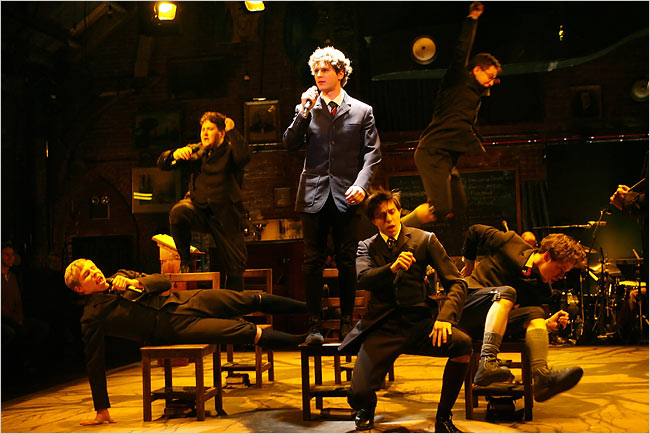
While the piece remains set in 1891, composer Duncan Sheik and lyricist Steven Sater have outfitted Wedekind's 19th century cautionary tale with a decidedly modern score which runs the gamut from rock to folk-tinged pop — the range is impressive, suggesting influences as diverse as Kurt Cobain and Ani DiFranco, yet it all blends together into a unified whole. The decision to use a contemporary sound was a wise one, lending the proceedings a feeling of edginess and currency, and providing a musical metaphor for the roiling emotions of adolescent angst (something period music might not have captured to the same degree). The obvious inspiration is Rent, the groundbreaking musical by Jonathan Larson which planted its finger firmly on the pulse of mid-90s youth culture, harnessing the pulsating rhythms of hard and soft rock, pop, grunge, hip-hop and Latin music to its re-telling of Puccini's La Boheme. That show had a palpable current of electricity coursing through its veins when it premiered in 1996; even though it may have shown some of its limitations over the passage of time, it's still a brash, bold work of theatrical showmanship which provided Broadway with a welcome jolt of energy by tapping into a new musical idiom.
Spring Awakening doesn't quite reach the breathtaking heights of its predecessor — it lacks the brazen theatricality of Rent, and Sheik's score doesn't quite grab you by the throat the way Larson's did (it's more a really great night of music in a downtown club than a headlong plunge into a rave). The show also could have used more humor to balance out the pathos, something Rent managed with surprisingly nimble dexterity, and
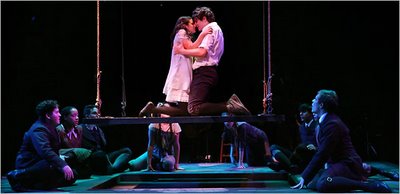
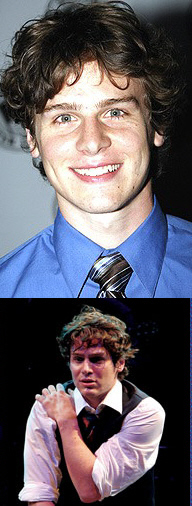 when it stops singing and starts talking, the occasionally creaky dialogue does sound like it was cribbed from a social polemic penned in 1891. Still, these are minor quibbles when you consider how rare it is to find a new work of musical theater that feels fresh, passionate, and unequivocally alive. Much of the credit for this should be given to the cast who, with exception of two actors who play all the adult roles, range in age from 16 to 23 (some look even younger). The well-selected ensemble is comprised of vastly talented performers who may seem idiosyncratic by Broadway's standards — forget about the air-brushed faces and voices of most Broadway choruses — but bring fierce, passionate conviction to their roles and serve the demands of the score beautifully. While Sater's lyrics can occasionally be abstract to the point of inscrutability (I was relieved to hear that "The Pirate Song," the most obliquely worded of the bunch, had been cut for the Broadway production), they are beautifully delivered, consequently give the words more resonance than they would on their own. Special praise must be reserved for Lea Michele, who thoughtfully portrays the confusion of an adolescent girl both fascinated and frightened by her dawning sexuality, and John Gallagher Jr., whose portrayal of the haplessly awkward Moritz verges on caricature but provides a portrait of unabated despair which becomes almost painful to witness. The standout, however, is Jonathan Groff as the intrepid Melchior, who serves as the inadvertent instigator of much of the trouble that befalls the other characters. Blessed with heartthrob looks and an expressive, supple tenor which can shift seamlessly into a rocker's bruised battle cry, Groff provides the show with its most dynamic presence, and his sensitive enactment of the character's ultimate, devastating realization is worthy of the tears it inspires.
The show is expertly staged by Michael Mayer, whose lean, spare production puts the focus squarely on the performers. When I saw the production in July during its premiere run at The Atlantic Theater Company, it didn't feel like in any way like a commercial commodity being scrupulously groomed for Broadway — in the tiny Atlantic, which is a converted church, the show was performed against the structure's original brick backdrop and stained glass windows, which suited it perfectly. I'm optimistic that it will retain some of that feeling of intimacy when it opens at The O'Neill — which is not exactly a cavern, but no cubbyhole either. In any event, I plan on making a return trip to Spring Awakening. In a sea full of mild-mannered minnows, it can sometimes be heartening to catch sight of a shark.
Tweet
Labels: Diane Keaton, Ebb, Kander, Leiber and Stoller, Musicals, Sondheim, Theater, Woody
TO READ ON, CLICK HERE
Tuesday, November 21, 2006
A Less Than Singular Sensation
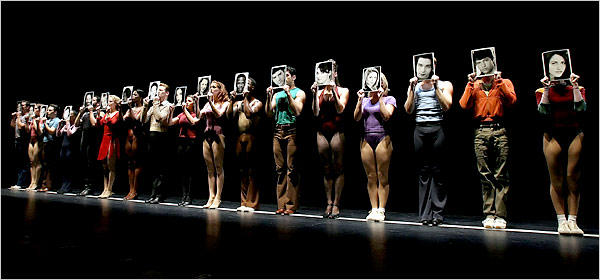
“She walks into a room and you know she’s uncommonly rare, very unique, peripatetic, poetic and chic…”
By Josh R
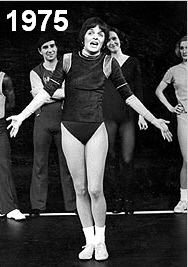
This lyric from the song “One,” penned by Edward Kleban, might well be used to describe the reaction which greeted the 1975 off-Broadway premiere of A Chorus Line. Hailed by critics of the day as an instant classic, it quickly transferred to the Shubert Theater on Broadway, where it ran and ran and ran, amassing an incredible total of 6,137 performances before hanging up its well-worn taps and fraying ballet slippers in 1990. Its storied run ensured its status as the most successful American musical of all time, although its tally was eventually eclipsed by some frolicsome felines and a disfigured opera buff imported from Great Britain (the less said about that, the better). Thirty years after its initial premiere, A Chorus Line is back on Broadway in a sleek new production helmed by Bob Avian, who co-directed the original version with Michael Bennett. While offering fleeting indications of what made the original a self-described Singular Sensation and cultural touchstone, this new incarnation ultimately falls short of duplicating that effect.
It’s still peripatetic, to be sure — the Bennett choreography, recreated by original cast member Baayork Lee (Bennett's longtime assistant), is among the very best to be seen on Broadway in this or any season, and the chic factor provided by the show’s bold concept still retains much of its galvanizing punch. In a certain respect it achieves a simple kind of poetry, thanks to the well-crafted lyrics of the late Mr. Kleban and the kinetic pop rhythms of Marvin Hamlisch. As to the qualities prescribed by the remainder of the lyric, uncommonly rare and very unique ... well, three out of five ain’t bad. When this lady walks into the room, even if you haven’t seen her before, you may very well wind up feeling as though you have. A Chorus Line can still strut its high-kicking stuff as well as any show in town, with dancers who can fly through the air with the greatest of ease — but apart from a few moments, the production as whole remains disappointingly earthbound.
If my disappointment seems more pronounced than it would with just any other revival, it need be stated that A Chorus Line is not just any show. To understand how and why it remains among the most celebrated of all stage musicals, it’s worth noting how revolutionary it was for its time. Michael Bennett, arguably the most revered director-choreographer of his generation, gathered together several Broadway dancers to discuss their lives and experiences, both on and offstage, in a series of taped sessions over the course of several years. The show that emerged as a result was culled directly from their anecdotal testimony (litigation continues to this day as to who’s owed what in terms of royalties), creating a startlingly honest portrait of a community of working professionals who practiced their trade not as stars, but as background players. The show introduced an element of realism to the Broadway musical that had previously been absent — other shows that had diverged from the template of escapist entertainment, such as Fiddler on the Roof, Hair and Company, had always seemed to favor a theatrical style based in a heightened, alternative reality. In chronicling an audition for a Broadway chorus that took place in a single afternoon in real time, A Chorus Line, with its pared-down look and naturalistic sound and feel, was a marked departure from what had come before.
The expectations in 1975 were minimal at best — the show had no built-in commercial appeal to speak of, with no name-brand stars nor element of spectacle, and sexually frank subject matter that was hardly conducive to attracting family audiences and the tourist trade (it may have been the first hit musical to feature gay characters who existed outside the realm of comic caricature). The reviews were uniformly enthusiastic. While the off-Broadway run quickly sold out, the show was still not considered a likely candidate for mainstream success. Original cast member Robert LuPone later recalled that he knew it had struck some kind of deeper nerve when he looked out his dressing room window one night an hour before curtain and saw an endless line of limousines pulling up to the tiny downtown Public Theater, stretching for blocks and blocks as far as he could see. When, within a matter of weeks, the likes of John Lennon, Jackie O, Katharine Hepburn and Henry Kissinger could all be seen in attendance, it was clear that the show had taken on a life of its own in the media and beyond. The practice of ticket scalping may have actually been born out A Chorus Line’s success off-Broadway.
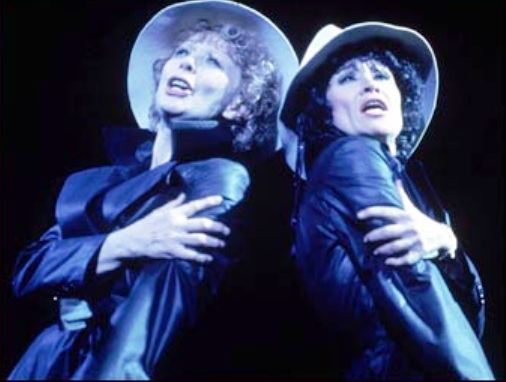
Does the show live up to its exalted reputation? Not entirely — it hasn’t aged nearly as well as Chicago, the Kander and Ebb musical that had the misfortune to make its Broadway bow in the same season as A Chorus Line and was more or less trampled in its wake (the irony here is that the current Broadway revival of Chicago stands a good chance of surpassing the original Chorus Line’s performance total). While A Chorus Line has many merits, not the least which are its outstanding score and choreography, you can’t help catching a whiff of mothballs in the air when the characters stop dancing and start talking. The retro attitudes of the script hardly derail the show, but they do make what once looked like a home run look more like what is, at best, a three-base hit. Still, the show still has the potential to deliver the goods — a potential that goes sadly unrealized for the most part at Gerald Schoenfeld Theatre.
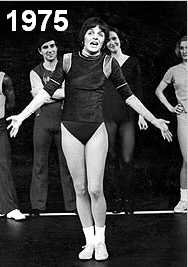
I saw the original Chorus Line late into its run, so I can’t really testify as to what the effect may have been with the inaugural cast. However, it bears mentioning that, with few exceptions, all of the principal performers in the production that opened at the Public Theatre in 1975 were playing characters directly based on themselves — the bulk of the dialogue from the show had come verbatim from the taped sessions. This clever conceit lent an element
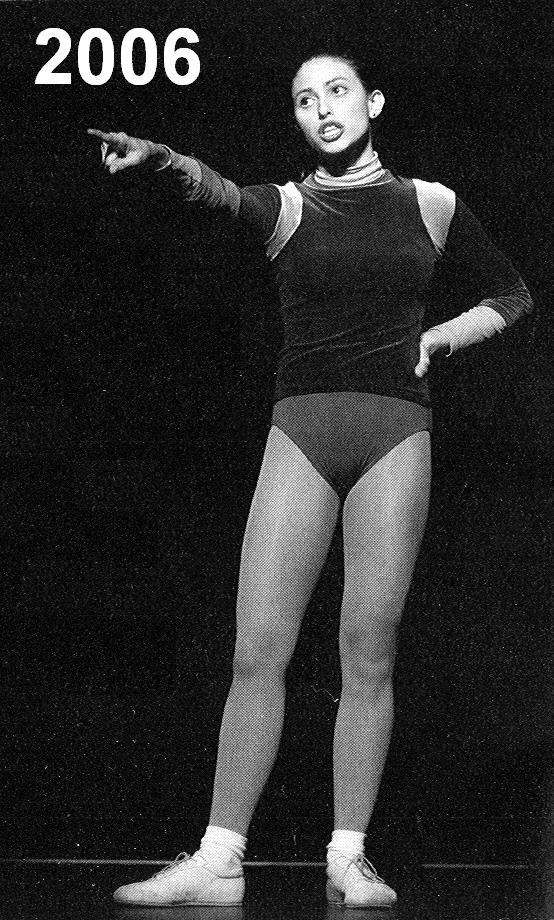 of authenticity to the proceedings that couldn’t have been faked. For the new mounting, Avian and Lee have in many cases chosen actors who sound (and often look) to a remarkable degree like their original counterparts — they’re a capable bunch, and entirely credible on their own terms, but at the same time, you’re aware that something is missing. When Natalie Cortez sings the wonderful ballad of comic frustration entitled “Nothing,” based on Tony-winner Priscilla Lopez’s wounding real-life experiences at Manhattan’s High School for the Performing Arts in the early 1960s, her delivery is assured and vocally precise. If it lacks the urgency of Lopez’s rendition, which can be heard in all its splendor on the 1976 recording, the fault can’t really be charged to Cortez. We can and should take Avian to task, however, for not encouraging his new discovery to put her own distinctive stamp on the material, rather than delivering a reasonable facsimile of the original version.
 That, in a nutshell, is the problem with this Chorus Line — in its slavish insistence on creating an exact replica of the original production, it more or less gives up the ghost as far as spontaneity is concerned. In addition to Avian and Lee, who recreate the Bennett staging right down to the poster poses, Robin Wagner and Theoni V. Aldredge have also been recruited to recreate (with minimal modification) their original sets and costumes. It’s an understandable impulse not to tamper with a winning formula, but it also indicates a certain lack of confidence in the material. It would have been a mistake to make a radical departure from the template by going in a completely different direction — Richard Attenborough’s misbegotten 1985 film version bore about as much relation to the world of Broadway musicals as a broadcast of Dance Party USA — but the anti-revisionist sentiment that fuels this production seems to have been motivated more by anxiety and trepidation than by any nobler impulse. Would contemporary audiences accept a modernized version of a piece that is, both in terms of style and execution, so specific to the 1970s? Avian’s solution is not just to treat the show as a period piece, but by maintaining it like some sort of holy shrine, its relics not to be disturbed a fraction of an inch. This is less objectionable than Gus Van Sant’s frame-by-frame reshooting of Psycho in terms of intention: this is, after all, the original creative team trying to preserve their work rather than a bunch of would-be mimics pirating someone else's vision — but their efforts only serve to make the material seem more dated than it otherwise would have. The only way this questionable strategy might have worked is if the show had been cast with performers who were charismatic enough to make the roles their own. As they are, these Broadway babies look right and sound right, but there’s no sense of genuine personality in evidence to make them come across as more than stock figures (This is a problem given that the entire point of the show is to bring human dimension to people who are traditionally written off as singing-and-dancing clones). Some of the best lines in the show belong to the acerbic Sheila — they were not the work of the show’s librettist, but came directly from the mouth of Kelly Bishop, the actress who eventually played the role in 1976 and won a Tony for her performance (as with Lopez, she was playing a character based on herself and essentially telling the audience her own life story). Deirdre Goodwin, who plays Sheila in this production, delivers the character’s dry putdowns and zingers with the requisite hauteur, but fails to make the character interesting — her behavior feels like so much empty posturing, and she commands less attention as a result. It doesn’t help if you know Bishop from her standout work on Gilmore Girls, playing a similarly caustic character — you can actually hear the actress’ natural inflections in the lines even while they’re being spoken by someone else.
The creators’ dilemma is understandable — realistically, they had no chance of recapturing the excitement of the original production, even if they had made more of an effort to bring something fresh to the proceedings. But the strategy of immaculate preservation ultimately does more harm than good — rather than living up to its billing as a Singular Sensation, this Chorus Line feels more like something off the assembly line.
Tweet
Labels: Ebb, K. Hepburn, Kander, Musicals, Theater, Van Sant
TO READ ON, CLICK HERE
Thursday, November 02, 2006
The name on everybody's lips...

By Edward Copeland
is going to be ... Roxie — or so goes the song in the Kander & Ebb/Bob Fosse Broadway musical turned Oscar-winning best picture Chicago. However, the story of "Roxie Hart," loosely based on a real 1924 murder trial of a woman named Beulah Annan, first began its fictional life as a play called Chicago before Wild Bill Wellman directed Ginger Rogers in a 1942 adaptation called Roxie Hart.
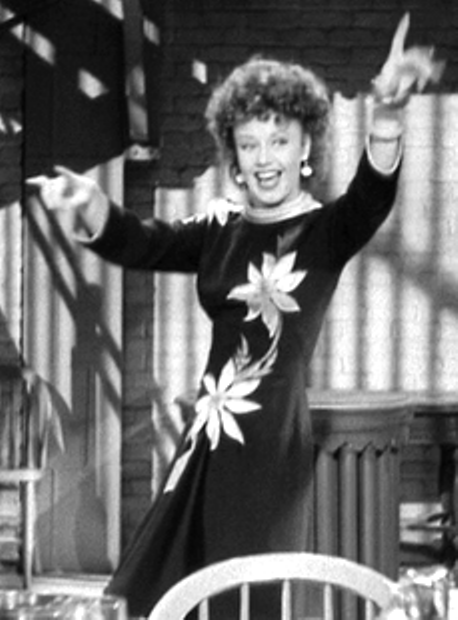
The movie, until the very end, bears striking similarities in tone and character to what eventually became the musical Chicago in 1975. While all the characters, like Roxie, are fictional pseudonyms, most of the characters will be familiar to viewers of the Broadway musical or the 2002 movie version. There's an Amos Hart (George Chandler in this case), a "Mama" Morton (Sara Algood, though the role is nowhere as pronounced as in the musical), a Mary Sunshine (Spring Byington) and a Billy Flynn (Adolphe Menjou). The murder victim even bears the same name of Fred Casely. The only notable absence: No Velma Kelly to be found. Roxie Hart tells its story in flashback as a reporter named Homer Howard (George Montgomery) recounts the case to a bar full of eager listeners 15 years after the event. Before the film even begins, a tongue-in-cheek title card dedicates the film to "all those women who filled their men full of holes in a fit of pique." Homer was a rookie reporter when the Roxie case happened and he found himself attracted to the vivacious murder defendant, though as he recounts the tale he's now a hard-drinking journalist — because that's what the public expects of reporters, he says. He also laments that Chicago hasn't had any good murder tales like Roxie's since "the Democrats took over."
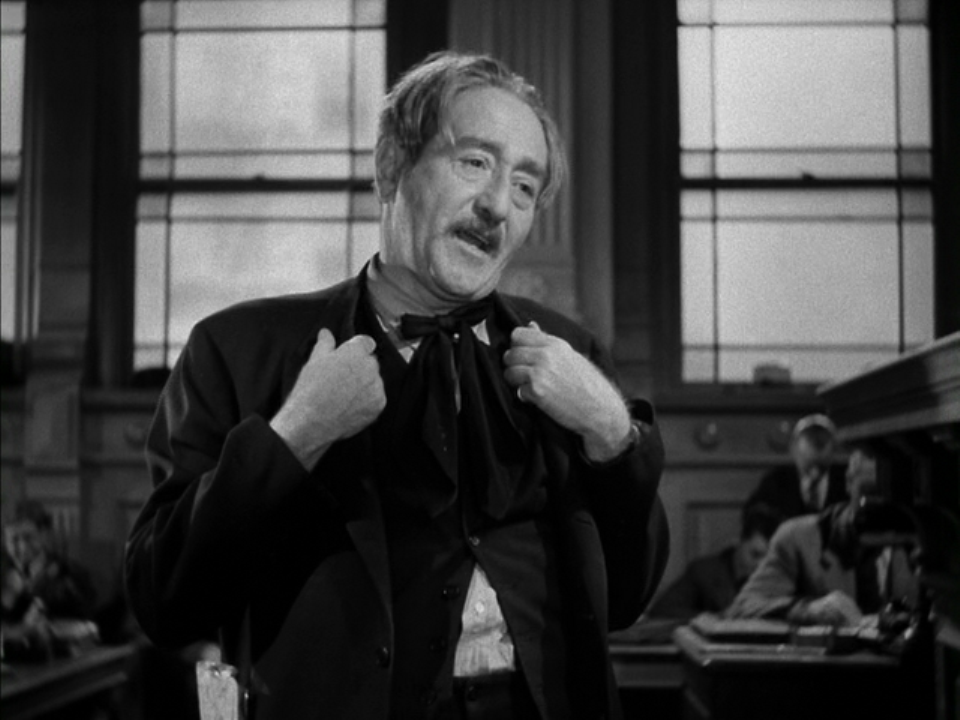
For moviegoers who only know Ginger Rogers from her classy dancing with Fred Astaire or maybe her noble Kitty Foyle, Roxie Hart is a gum-chomping, entertaining breath of fresh air from the actress. As I said previously, it is interesting how closely the outlines for the Chicago most viewers are familiar with now are clearly laid out in this film. Amos remains a milquetoast sap. Billy Flynn, though older in the form of Menjou, is nearly as manipulative, even if he lacks the razzle dazzle of the musical takes on the character. When he gets to court, he does put on the show and it's an entertaining farce, especially with the solid cast (including a small role by Phil Silvers as a newspaper photographer).
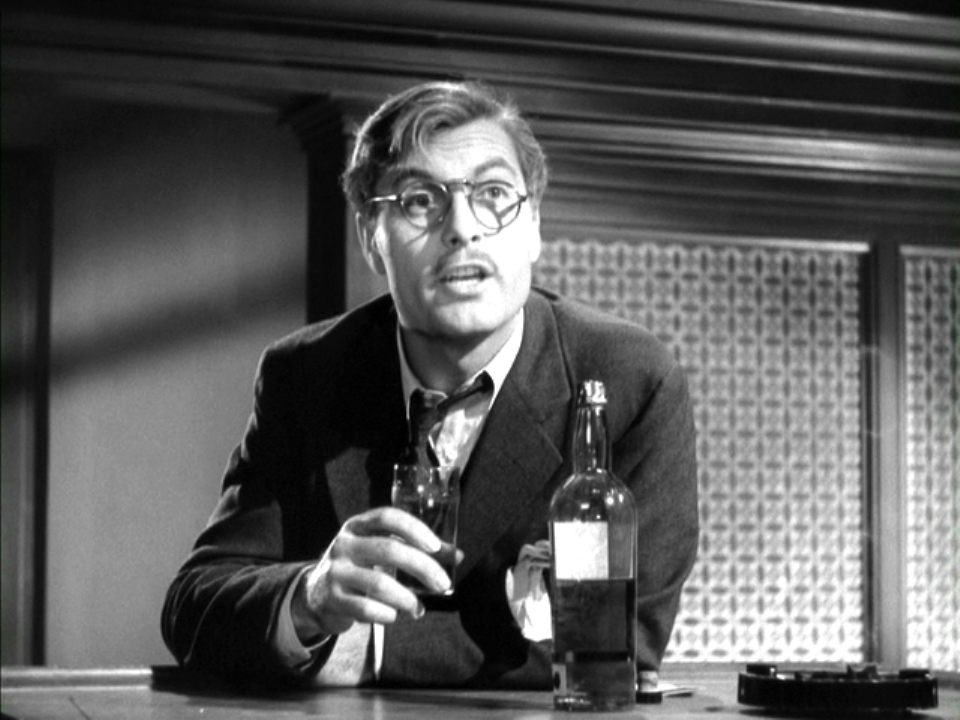
Pre-I Love Lucy William Frawley not only plays the barkeep that Homer shares his tale with, he turns out to be one of the jurors who heard Roxie's case. My good friend Josh R warned that the ending of Roxie Hart might be a disappointment, having to conform to the strict production codes of the day, but it didn't play that poorly for me. No, it's not the same cynical ending of the musical, but it is cynical in its own way, implying that Roxie ended up in a different sort of prison. All told though, Roxie Hart proves an entertaining film with a truly fun performance by Ginger Rogers. If you liked the movie or musical Chicago (or if you didn't), Roxie Hart is a fascinating artifact.
Tweet
Labels: 40s, Astaire, Ebb, Fosse, Ginger Rogers, Kander, Menjou, Musicals, Phil Silvers, Wellman
TO READ ON, CLICK HERE