Friday, March 16, 2012
Only Connect

By Josh R
Adapting a classic novel to the screen is a delicate proposition; with so many ways to go wrong, it’s always slightly unexpected when someone manages to get it entirely right. In many cases, filmmakers adopt an overly reverential stance to their source material; the approach is typified by lavish sets, swelling scores, and resplendently costumed actors speaking as though they’d learned all their lines in elocution class. The screenplays can be slavishly faithful to their source material, to the extent that the end product feels like a pop-up edition of Cliff's Notes. On the opposite end of the spectrum, there will always be certain filmmakers (or auteurs, if you please) who feel compelled to make radical departures from the original, to the point that the resulting film bears only a passing resemblance to the book that inspired it. The mentality that inspires these modifications is somewhat peculiar, in that it smacks of both overconfidence in one’s own interpretive abilities, and lack of confidence in the book. It is very rare — too rare, if we’re going to be honest — that filmmakers trust and appreciate their source material enough to bring it to the screen without treating it like a sacred relic to be handled with kid gloves, or putting it through the ringer and revamping, augmenting and revising the content beyond the point of recognition (or at least beyond the point where the authors — if still living — could resist the urge to sue.) That’s the reason why Merchant Ivory’s superlative production of Howards End, based on E.M. Forster's 1910 novel, stands as one of the best and most satisfying examples of literary adaptation ever produced for the screen. Celebrating the 20th anniversary of its U.S. release this week, it exemplifies how rich an experience a great writing-directing team can create for an audience, merely by respecting the material and keeping things simple.
Howards End followed 1986’s A Room With a View and 1987’s Maurice as the third film adapted from a Forster novel by the veteran team of producer Ismail Merchant, director James Ivory and screenwriter Ruth Prawer Jhabvala. Their affinity and affection for the material is unmistakable; one of the chief distinctions of Howards End is the ease with which the filmmakers capture the style and tone of Forster’s prose, without getting tangled up in the pursuit of trying to replicate it too faithfully. It should be said that the book — a beautifully written, thematically complex evocation of the rapidly changing social climate of late-Edwardian England — is not an ideal candidate for cinematic adaptation. While not exactly short on plot, much of the action takes the form of conversation, with Forster’s own observations about class, social politics and assorted esoterica (the magical properties of Beethoven’s compositions, for example) taking up a fair amount of space. Jhabvala’s elegant treatment expertly condenses the content of the novel without narrowing its scope; the screenplay manages to be economical without feeling cursory or abridged, or giving short shrift to any of the points the Forster hoped to convey in his illustration of the clashing temperaments, ideas and values of two very different families merging into one.

The repercussions of the unlikely, somewhat uncomfortable union of the Wilcoxes and Schlegels are mordantly humorous on one level, tragic on another. In a way, the novel anticipates what was to happen to Britain in the years immediately following its publication — while Forster couldn’t have augured what was on the horizon (the rumblings were felt in 1910, but the wolf had yet to arrive at the door), his considerations hearken to an impending war abroad that would change forever the rules at home. With the Victorian world poised on the brink of cataclysm, and its quaint, restrictive mandates about class, morality and gender roles being rendered increasingly obsolete, Howards End charts the fallout from a collision of the members of the old guard grounded in the traditions of the past with an intrepid new breed determined to topple the old world order. How far will people go in the vain attempt to hold on to what’s slipping from their grasp, Forster wonders, and how will they adapt in the face of inevitable change? Above all, how do the proponents of two wildly divergent philosophies and outlooks, meeting at the intersection of the death of an Empire and the dawn of a a new era characterized by turbulent social upheaval, not only coexist, but communicate, compromise and connect? The opening epigraph of Howards End is, in fact, “Only connect”; a simple directive in theory, if infinitely more complicated in practice.
The thorny considerations at the heart of the author’s scheme — in a work the critic and essayist Lionel Trilling, among others, considered to be Forster’s masterpiece — are neatly encapsulated in the dealings between a small circle of friends, relations and acquaintances representing three distinct social classes. At the center of the narrative are Margaret and Helen Schlegel (Emma Thompson and Helena
 Bonham Carter), two sisters with progressive leanings living on a genteel middle-class income in London — the bohemian social circle of writers, intellectuals and rabble-rousers they frequent is loosely modeled on The Bloomsbury Group, of which Forster was a member. Vacationing abroad, the Schlegels meet and befriend another pair of English tourists, the wealthy business magnate Henry Wilcox (Anthony Hopkins) and his wife Ruth (Vanessa Redgrave). When Helen accepts an invitation to join the Wilcoxes at Howards End, Mrs. Wilcox's pastoral childhood home in the English Countryside, she forms a hasty, impetuous attachment to their younger son, Paul (Joseph Bennett). When their short-lived flirtation concludes on an awkward, mutually embarrassing note, the two families are briefly estranged. Margaret reconnects with the frail Mrs. Wilcox in London, where their renewed acquaintance soon develops into a strong bond of friendship; Margaret is both intrigued and moved by Mrs. Wilcox’s deep connection to the traditions of the past and the natural world, represented by Howards End. Before her death, Ruth wills the house to Margaret — Mr. Wilcox and his two other adult children, Charles and Evie (James Wilby and Jemma Redgrave — daughter of Corin, niece to Vanessa), deliberately decide to withhold the existence of the will from Margaret’s attention, unwilling to cede ownership of what they consider to be theirs by familial right.
Through a chance encounter, Margaret and Helen strike up an acquaintance with Leonard Bast (Samuel West), a shy young clerk from a modest, lower-class background. Adopting him as a de facto protege and seeking to improve his prospects, the sisters apply to Mr. Wilcox for advice. Mr. Wilcox gives them a faulty piece of insider information about Leonard’s place of employment — which he believes to be on the brink of ruin — that will eventually result in Leonard leaving his job, and unable to obtain employment elsewhere. Meanwhile, Mr. Wilcox finds himself becoming increasingly drawn to Margaret and, after some tentative attempts at courtship, surprises her with an offer of marriage. She accepts his proposal, to the confusion and consternation of Helen, who struggles to comprehend how her sister can forsake their shared ideals to assume the mantle of a traditional wife and helpmate to a conservative capitalist.
While the prospective in-laws adjust to the shifting dynamics of their changing relationships, Helen learns that the unemployed Leonard and his wife, Jacky (Nicola Duffet), have been reduced to a life of subsistence-level poverty. An enraged Helen shows up unexpectedly at Evie’s wedding with the Basts in tow, and angrily confronts Margaret with the consequences of Mr. Wilcox’s casually given, ultimately very costly advice. Seeking to pacify Helen and avoid further conflict, Margaret applies to Henry for help — while he feels no personal responsibility for the Basts’ circumstances, Mr. Wilcox agrees to provide Leonard with a position at his company. When Mr. Wilcox and Mrs. Bast meet face-to-face, Jacky recognizes him as her former lover. A humiliated Mr. Wilcox is forced to admit to Margaret that he not only betrayed the trust of his previous wife, but did so with a woman far below his station in life, whom he subsequently (and rather callously) discarded after tiring of the relationship. Against her own misgivings, Margaret decides to forgive Henry and keep the engagement intact; in a curt, peremptory note to Helen, she informs her that Mr. Wilcox can be of no assistance to the Basts, and orders her sister to abandon her sponsorship of the couple.
As the now-married Margaret and increasingly rootless Helen drift further apart, the latter has a brief affair with Leonard, resulting in a pregnancy. Upon learning of Helen’s condition — and the status of social outcast conferred upon her as an unwed mother — Margaret asks Mr. Wilcox to allow her sister to stay at Howards End. Henry refuses, believing that Helen’s compromised position would bring disgrace
 upon the family. Margaret angrily confronts her husband with his hypocrisy, and repairs with Helen to Howards End in flagrant disregard for his instructions. When Leonard — whose identity as the father of Helen’s child has been ascertained by the Wilcoxes — arrives unexpectedly at Howards End in search of Helen, his appearance results in a violent confrontation with a tragic denouement. While no one emerges entirely unscathed, both the Schlegels and the Wilcoxes find there is room for reconciliation, forgiveness, renewal and — perhaps most critically of all — a fundamental shift in values, paired with hope for the future. While the two families, representing the traditional and the modern, will never view the world in exactly the same way, they have at least managed to achieve a measure of balance. Complete understanding can elude even the most devoted of friends, lovers and family members; if we can “only connect,” those who seek to bridge the gap can, at the very least, respect each other’s limitations and forgive each other’s frailties. Forster poses, but offers no definitive conclusion about, the question of who shall inherit England, and whose values and ideals shall give shape to the future; he only concludes that the future cannot improve upon the past in the absence of a true meeting of the minds.
 Whenever I watch Howards End — as I do periodically, when the depressingly reductive nature of most films based on books I love becomes too much for me to bear — I’m always struck by the naturalism of Ivory’s approach, atypical not only of literary adaptations, but period pieces in general. While the film certainly is beautiful to look at (Luciana Arrighi and Ian Whitaker’s production design received an Oscar, while Jenny Beaven and John Bright’s costumes and Tony Pierce-Roberts’ cinematography also were nominated), there’s nothing over-scaled, overwrought or just plain over-the-top about the visual component of the film. The world of the Howards End is drawn from recognizable reality, as opposed to a heightened fantasy version of Edwardian times (for a bit of comparison — start grinding your teeth now, Copeland — the design aspects of the following year’s The Age of Innocence were so damn amplified and prettified the thing might as well have been set in Disney World.) This blessedly unfettered approach extends to the way Ivory has managed the members of his cast. The film is refreshingly unencumbered by actors striking the romantic poses of Victorian thespians, or intoning their lines as if they were auditioning for the Royal Shakespeare Company; it seems hard for many contemporary directors to accept that, even a hundred years ago, people still spoke to each other in a conversational fashion. The characters of Howards End may find themselves in melodramatic situations, but their actions and behaviors never strike a false note, or smack of affectation. Likewise, the original score provided by Richard Robbins — augmented with a few selections by classical composer Percy Grainger — is richly evocative without being intrusive; the music underscores the action while resisting the urge to provide easy, obvious emotional cues.
It’s so easy — and really, a little exhausting — to enumerate and expound upon the plethora of acuminous decisions that went into the making of Howards End, and talk about how seamlessly its various elements fit together; but the creative team (with particular credit going to Merchant) most emphatically demonstrated their love and respect for the material in terms of their casting choices. When it comes to casting projects with ostensibly little in the way of commercial appeal, the standard practice involves enlisting the talents of bankable stars; had Howards End been made by a major Hollywood studio in the early '90s, Forster’s intrepid Schlegel sisters might well
 have been entrusted to Julia Roberts and Demi Moore (if that was the film that had been made, methinks yours truly would not be writing this 20th anniversary Tribute.) Certainly, Merchant Ivory wasn’t enough of a financial powerhouse — even in the wake of several notable successes — to afford the type of big names that a Tinseltown outfit might have foisted upon the project. Still, the men who controlled the purse strings could have advocated for more in the way of name recognition (The Silence of the Lambs had yet to be released at the time of the film’s shooting) in drafting the film’s ensemble. Instead, they chose to pair rich, challenging roles with actors of commensurate talent who fit the descriptions provided by Forster. Watching the film, you can’t shake the implausible impression that the author must have been writing these characters with these specific players in mind; every member of the cast delivers an emotionally authentic performance that not only highlights Forster’s keen observations on human nature, but embodies the descriptions contained in his prose with an uncanny degree of exactitude. Fresh from his lip-smacking tutorial on scenery-chewing as Hannibal Lecter, Hopkins showed that he was able to shift gears with surprising dexterity. His Henry Wilcox is a masterful study in restraint, rigidity and misplaced confidence. While he is often unlikable, his unflappable certainty and sense of masculine entitlement have a certain magnetic quality; an audience can still understand why the heroine would be drawn to him almost in spite of herself. It’s to the actor’s credit that by the end of the film, the viewer actually can feel a certain degree of sympathy for this hidebound specimen of Victorian prerogatives who can’t adjust to the changing times, or comprehend how little control he has over his own destiny. Samuel West, with his gawky gait and naturally downcast features, does a very fine job of fleshing out the inchoate yearnings of Leonard Bast, grounding a character conceived on a very romantic level. It would be easy for a more conventional performer to come across as too poetic and tragic for words — fortunately, West brings enough quirky specificity to his performance that he doesn’t simply register as delicate and doomed. James Wilby — who played the title role in Maurice — provides a nice vignette of unctuousness coupled with doltishness as the uncomprehending elder son, whose very lack of imagination renders him capable of destruction.
As fine as the male cast members are, Howards End really belongs to the women — and they are a wonder to behold. As the least-known member of the principal cast, Emma Thompson received fourth billing as Margaret Schlegel; for graciously ceding that status to Hopkins, Redgrave and Bonham Carter, she received the best actress Oscar, along with about every other prize the international awards-giving community had to offer. To many, her rapid ascent from virtual unknown to unstoppable trophy magnet registered as a bolt from the blue; while she had been impressive on previous occasions, most notably opposite her then-husband, Kenneth Branagh, in the BBC miniseries Fortunes of War, it was by virtue of her revelatory performance in Howards End that her film career was launched in earnest. Really, it’s very fortunate that 1992 was such a weak year for leading ladies, a fact Thompson tacitly commented on during her acceptance speech in wishing aloud for “the creation of more great female roles.” Performances this subtle don’t usually win Academy Awards; even before the voting began, the British novice already had a big advantage over her more established competition by virtue of being in the only film on voters’ radar screens (most of the people I went to school with in 1993 hadn’t even heard of the other nominees’ films, let alone seen them - I remain unconvinced that Love Field and Lorenzo’s Oil played on any screens outside of New York and Los Angeles.) In retrospect, it’s no surprise that the actress' career blossomed as quickly as it did in the wake of that acknowledgement — as Margaret Schlegel, she exhibited some of the special brand of self-possession, equal parts intelligence and radiance, that Deborah Kerr trafficked in so well for more than 20 years as a Hollywood staple, tempered with a quickness and quirkiness unique to Emma Thompson.
There are so many moments in Thompson’s performance to treasure — the staircase proposal scene alone is essential viewing for acting students — and her choices are disarmingly original. With the flashes of wit and halting sensuality she brings to the part, it’s fair to say that her creation is actually an improvement on Forster’s (the Margaret of the novel is a bit on the earnest side), and she brings a sense of dramatic coherency to a character whose motives are sometimes difficult to fully accept at the author’s insistence. Margaret is a spirited, independent woman with a lively, intelligent mind and a practical sensibility; in forsaking her values, she is not merely a sheep being led meekly to the slaughter, but the willing architect of her own moral compromise. It’s the shades of loneliness and yearning Thompson brings to the role, as well as her expert communication of Margaret’s dawning awareness of herself as a desirable, attractive woman and growing fascination with Wilcox’s dynamic clarity of mind and purpose, that make the transitions seem logical.

As great as Thompson is — and really, her performance is both the soul of the film and the motor that drives it — Bonham Carter’s contribution in the role of Helen was and remains greatly undervalued. I particularly appreciate her interplay with Thompson; the actresses complement each other beautifully, and strike up a rhythm that truly suggests (as Forster asserts) that the sisters are two halves of the same whole. When they’re finishing each other’s sentences, or reacting to things in unison with near identical physical responses, it seems natural to accept that these two women have been a constant presence in each other's lives since childhood. When the rift between the sisters goes into effect, Bonham Carter displays a fire and urgency unlike anything in her previous work. Helen’s dramatic flashes of temper, the product of being uncertain of her place in the world once she’s lost her moorings (you still feel the tug of symbiotic sibling relationships once you become a solo act), never seem overstated; the sense of hurt and confusion that fuel her character’s behavior are made explicit, without being hammered home too emphatically.

Finally, there is Vanessa Redgrave, who was initially noncommittal when offered the role of Ruth Wilcox. She relented when Merchant told her she could basically name her own price — a gutsy move for the producer of a film being made on a limited budget. Whatever figure the two resolved upon, her services were worth every pound of Merchant’s money; no other actress could have played the part with the same degree of luminousness and lyricism. There’s always been a vague, dreamy quality about Vanessa Redgrave, coupled with an air of inscrutability — a friend of mine once speculated it might be the product of her having dropped too much acid in the '60s (I don’t believe this for a second — but if drug use will help any of today’s young actresses approximate the qualities of Vanessa Redgrave, I say Get Thee to a Dealer.) The character of Ruth is more of a literary conceit than a flesh-and-blood woman; she’s a symbolic Earth Mother figure tied to the land, the properties of nature, and pre-Christian mysticism; ancestral voices are supposed to reverberate in her presence. With her lovely, elegiac performance, Vanessa Redgrave actually makes sense of Ruth as a person. The shades of wistfulness and melancholy she brings to the part lend Ruth’s predicament — that of an ethereal, isolated onlooker bewildered by the modern world, unknowable even to those who love her most — an almost unbearable element of poignancy. It’s a towering performance, delivered on a human scale.
After all this, it is with a certain degree of reluctance that I’ll admit that Howards End is not bound to be everyone’s cup of veddy British tea. For those who prefer films with less resonance — where everything is pitched faster, louder and without much in the way of subtlety — there are surely no lack of entertainments to provide satisfaction (and numbness). Speaking only for myself, I find it heartening to revisit Howards End — a prime example of how good filmmaking can be when a great director, screenwriter, producer and cast embrace and honor the novel they’re bringing from the page to the screen. Forster’s epigraph should serve as guidance for anyone attempting an exercise in literary adaptation: Only Connect.
Tweet
Labels: 90s, Books, Branagh, Deborah Kerr, Demi, Emma Thompson, Fiction, H.B. Carter, Hannibal Lecter, Hopkins, Julia Roberts, Merchant Ivory, Movie Tributes, Oscars, Vanessa Redgrave
TO READ ON, CLICK HERE


Wednesday, December 28, 2011
An antidote for the emptiness of existence — at least for 90 minutes

By Edward Copeland
Seventeen years later…
Woody Allen makes another good movie. That's not entirely true. Since Bullets Over Broadway's release in 1994, I have liked two of his films — Match Point in 2005 and Whatever Works in 2009. However, Midnight in Paris definitely deserves the label as the first great Woody Allen film since Bullets. As Donald Rumsfeld said of the Iraq war, it's been a long, hard slog for Woody fans who used to anxiously anticipate each new Allen offering before his films turned into retreads of previous works and tasted like a fifth night of leftovers. With Midnight in Paris, his muse returns and blesses us with a fully formed, funny, thoughtful piece of cinematic inspiration.
Most people heard the news that Midnight in Paris stood tall in the Allen canon months ago when the film opened, earning raves and becoming his highest-grossing film ever. I had to wait for DVD and retain a healthy skepticism until I saw it. I simply had no other choice. During the nearly two decades that Woody toiled in the artistic wilderness, people burned me far too often by insisting Allen's latest belonged in his win column only to discover the opposite when I viewed the film. After I finished watching Midnight in Paris, it seemed as if those 17 years had been erased magically. I actually had to check IMDb because my brain couldn't conjure the titles of some of the forgettable films he churned out in those years — Small Time Crooks, Melinda and Melinda, Scoop, Cassandra's Dream, You Will Meet a Tall Dark Stranger. That doesn't even take into account the ones so bad I couldn't bleach the stain they left on my cerebrum such as Celebrity, Curse of the Jade Scorpion and Hollywood Ending. Midnight in Paris washes away those transgressions, clears the slate and renews my hope that inside the 76-year-old filmmaker there still exists things worth saying and movies worth making.
As many of Allen's films that he doesn't star in do, Midnight in Paris features a Woody surrogate and, in what might appear to be an unlikely casting choice, Owen Wilson gets to be his stand-in here. Selecting Wilson as the Woody Allen substitute turns out to be the first of many grand decisions the writer-director makes. In fact, I'll go further and declare that Owen Wilson makes the best faux screen Woody yet (and let's hope we never endure one worse than Kenneth Branagh's in Celebrity). Wilson plays Gil Pender, a successful Hollywood screenwriter with an attractive fiancée named Inez (Rachel McAdams). The couple tag along with Inez's ultra-conservative parents (Kurt
 Fuller, Mimi Kennedy) on a trip to Paris where Inez plans to be lazy and sight-see while Gil hopes the City of Lights ignites his first attempt at writing a novel. Paris casts a spell on Pender almost immediately, even though it's raining at the time, something that annoys Inez. "Why does every city have to be in the rain? What's so wonderful about being wet?" asks Inez, a woman Gil unconvincingly describes to strangers as charming but who looks to outsiders as a high-maintenance, judgmental snob. It doesn't take long in France for Gil to suggest that they should move there, but Inez doesn't understand what's so terrible about living in Malibu and being a rich screenwriter, especially with as much trouble as Gil tells her he's having with his novel. "I'm having trouble because I'm a Hollywood hack who never gave literature a real chance until now," he replies. Pender hates his job because he doesn't write anything of value and before we even get to Allen's major themes in Midnight in Paris, he appears to be submitting himself for some self-criticism over his output in recent years. When he made the atrocious Hollywood Ending, the movie was a one-joke notion that the industry had devolved to the point that a director no one realized had gone blind could make a movie and still deliver a box-office smash. In Midnight in Paris, (at least I hope this is the case) he's taken the same complaint and aimed it inward and disposed of it in pieces of dialogue as appetizers to a bigger and better cinematic dinner. (Besides, as far as Hollywood Ending goes, I'd submit Kurosawa and Ran as a counterargument for what blind directors can accomplish.) Gil's novel's plot teases us as to what the main course will be as it tells the story of a man who owns a nostalgia shop, selling memorabilia relating to bygone days.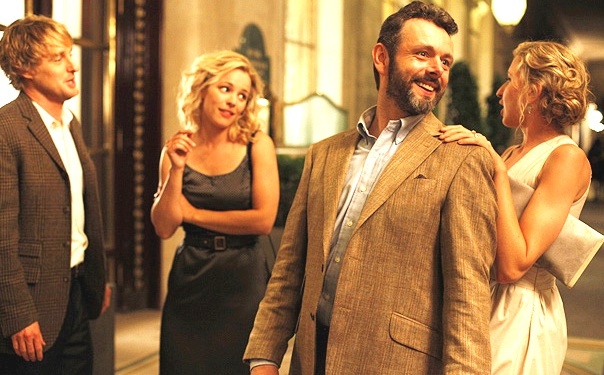
While Gil and Inez wander the city with her parents, they bump into Inez's old friends Paul and Carol (Michael Sheen, Nina Arianda) and soon the two couples visit all the sites together where Paul, an unctuous know-it-all on all subjects makes it a point to show off his expertise to anyone and everyone, even telling the tour guide at the Rodin museum (played by French first lady Carla Bruni) that she has her facts wrongs). Paul embodies a 21st century representation of the man pontificating in a movie line in Annie Hall that Alvy fantasizes about bringing Marshall McLuhan out to chastise. Watching the laid-back Wilson do the annoyed Woody dance at this character type not only proves hilarious but a refreshing twist on the familiar routine. Every word Paul utters, of course, enthralls Inez, who believes he's as brilliant as he thinks he is. It's also a nice change of pace for Sheen to play a fictional creation for a change instead of impersonating famous British people. Paul probes Gil about the subject of his novel and at first, Gil resists discussing it, but Inez spills the beans and the movie's argument gets rolling — namely, is the grass really greener in the other era? Gil romanticizes the Paris of the 1920s, when so many great artists from America and elsewhere flocked there. Paul pooh-poohs the notion immediately. "Nostalgia is denial. Denial of the painful present," Paul declares. Inez, the woman who allegedly loves Gil and wants to spend the rest of her life with him, takes Paul's side in the browbeating. "Gil is a complete romantic. I mean he would be more than happy living in a complete state of denial," she says of her fiancé. Paul isn't able to discuss any topic unless he does it at length and in long-winded lectures, so he has to show everyone what he knows of this "syndrome." "The name for this fantasy is Golden Age thinking. The erroneous notion that a different time period is better than the one one's living in now," he pronounces.

Having had enough of being a foursome one night as Paul suggests they all go dancing, Gil begs off, choosing to return to the hotel and perhaps work on his novel. Instead, he walks the streets. As he sits on some steps, a clock strikes midnight and an old yellow Peugeot pulls up as if it's the pumpkin that turned into Cinderella's carriage. The antique automobile bears '20s-era Frenchmen and Frenchwomen (who may have been mice once — who can say?) drinking champagne and beckoning Gil to climb in for a ride. That's when the real sparkle of Midnight in Paris begins and it involves another Woody Allen venture into a magical realm. Gil doesn't speak French, so he's clueless as to what his fellow passengers might be saying as they take him to a party where everyone dresses decidedly retro. Fortunately, most of the other guests appear to be American or at least speak English, so communication isn't a problem. A young man (Yves Heck) sits at a piano, playing and singing, "Let's Do It, Let's Fall in Love." He mentions to one guest that he's a writer and they introduce him to Scott (Tom Hiddleston) and his wife Zelda (Alison Pill) — the Fitzgeralds. Gil finally realizes that
 somehow, that mysterious Peugeot took him on a very long drive — one that traveled nearly 100 years in reverse to his ideal Golden Age where he could mix and mingle with his long-dead artistic inspirations. In the past, when Allen employed these fantastical devices it began to feel as if, to paraphrase one of his oldest jokes, he'd resorted to cheating by looking into the soul of the guy sitting next to him, only in these instances, he wasn't seeing another person but staring at himself in a mirror. Magic tricks which first played a key role in the "Oedipus Wrecks" short of New York Stories would return in Curse of the Jade Scorpion and Scoop or, to a lesser extent, assume the form of magical herbs in Alice. Actual Greek choruses would arrive to comment on the action in Mighty Aphrodite or see-through characters would pop up in the form of Robin Williams in Deconstructing Harry. This is a well that Woody drinks from often except that it works best when he employs it in service of larger ideas such as in Zelig, The Purple Rose of Cairo (which I still consider his best film), and, now added to that list, Midnight in Paris. As Midnight in Paris enthralled me, a small detail leaped out early on. In both Purple Rose and Midnight, he names one of the leads Gil. In the case of Purple Rose, most tellingly, the actor that Jeff Daniels plays who creates the role of Tom Baxter, the movie character who steps off the screen and into 1930s New Jersey, bears the name Gil Shepherd, only that Gil embraces his burgeoning stardom and hopes a B-picture such as "The Purple Rose of Cairo" raises his stature high enough to nab the lead in a Charles Lindbergh biopic — as long as his doppelganger in the pith helmet doesn't wreck his career. Gil Pender in Midnight in Paris may work in the same industry, but he fears he's sold his soul to it and he wants out.
The first night that Gil takes his trip back to the 1920s he also encounters Ernest Hemingway (played by Corey Stoll in the film's most entertaining performance). Fitzgerald introduces them and Gil gets the envious position of talking writing with Papa in the movie's best exchange on writing that'll appeal to anyone who has ever put pen to paper. It begins with Gil being self-deprecating about the subject of his novel (of course, no one in the 1920s has the faintest idea what a nostalgia shop is), calling it a terrible idea. "No subject is terrible if the story is true and if the prose is clean and honest, and if it affirms grace under pressure," Hemingway tells him. Gil then works up the nerve to ask if the author would look at what he's written and offer suggestionss.
HEMINGWAY: My opinion is I hate it.
GIL: But you haven't read it yet.
HEMINGWAY: If it's bad, I'll hate it because it's bad writing. If it's good, I'll be envious and hate it all the more. You don't want the opinion of another writer.
Hemingway does offer to give Gil's manuscript to Gertrude Stein (Kathy Bates) to read, because he's always trusted her opinion. They agree to meet the following night and Gil leaves but suddenly remembers he forgot to ask Hemingway where to meet him, but when he turns back the coffeehouse has turned into a laundromat and Gil finds himself in 2010 again.
In the morning at his hotel, he attempts to explain his adventure to Inez, asking her what she'd think if he told her he met Zelda Fitzgerald and she's exactly like they had read and Scott really loves her and worries endlessly, but she hates Hemingway because he's right that she's standing in the way of his writing. When Gil completes his enthusiastic rambling, Inez replies, "I'd think you had a brain tumor." Gil manages to convince Inez to go back with him the next night to wait for the Peugeot, but she grows impatient and takes off before the clock strikes midnight. After Inez has left, the Peugeot arrives and takes him to Gertrude Stein's apartment where Hemingway awaits and Pablo Picasso (Marcial Di Fonzo Bo) paints his current mistress Adriana (Marion Cotillard), who catches the eye of both Gil and Hemingway. Despite the many larger-than-life figures than circle Adriana's world, she finds herself just as drawn to Gil — until she learns of his engagement. She also shares Gil's Golden Age thinking, While he thinks that she lives in the greatest time period, she thinks it's awful and wishes she could have been in Paris during the Belle Epoque of the late 19th century. Meanwhile Gil's behavior in the 21st century becomes so bizarre that his father-in-law-to-be hires a private eye to tail him on his midnight walks to see what Gil does on them, since he doesn't trust anyone who says such nasty things about the Tea Party.

Even when Allen had fallen into his long slump, he still had the ability to attract some pretty solid ensembles, not that they were given much to do. In Midnight in Paris, the casting shines with a mix of lesser-known performers and bigger names, all bring their A game to Allen's greatest screenplay in 17 years. In addition to Wilson and Stoll who I've mentioned, the cast's standouts include a zany single scene by Adrien Brody as Salvador Dali, Kathy Bates, Michael Sheen, Rachel McAdams, Marion Cotillard in the first performance she's given that I've enjoyed and, most worth noting, Alison Pill as Zelda Fitzgerald. Pill to me proves again she's an actress just waiting to break out. She's funny and touching here after giving a good dramatic turn in Milk and being part of the fun ensemble in Scott Pilgrim vs. the World. Given how many great lines Woody's script for Midnight in Paris delivers, it's tempting to rattle them all off, but I'm resisting the urge for those who have yet to see this charmer, but I have to mention one of my favorite gags when Gil runs into a young Luis Buñuel (Adrien de Van) and gives him an idea for a movie — basically the plot of his film
If there has been any debate about Midnight in Paris, it's been where Allen comes down in the end on the question of nostalgia and Golden Age thinking. It seems pretty obvious to me based on what Gil's last line to Adriana is, even though he sends mixed signals by having Paul, the film's most pompous character, ridicule the idea of Golden Age thinking first. Also, as others have pointed out, throughout most of Allen's career his choices in music and references have screamed nostalgia, but Midnight in Paris plays as one of the most entertaining self-critical works any artist has ever made. At the same time, Allen does acknowledge the natural reflex to long for an earlier, better time — if not in another era, at least in one's own life.
Tweet
Labels: 10s, Branagh, Buñuel, Cotillard, Fitzgerald, Hemingway, Jeff Daniels, K. Bates, Kurosawa, O. Wilson, Robin, Woody
TO READ ON, CLICK HERE
Wednesday, December 14, 2011
My Week with Halle

By Eddie Selover
Nobody knows about this but me and her. The tabloids never suspected. It was private, just between us. I want to protect that. But on the other hand, several days have passed since it ended, so I guess it’s OK to finally talk about it.
I spent a week with Halle Berry. Yes, me, Eddie Selover! Just a nobody. Until now.
It happened in Spain. Halle’s over there making a movie with Tom Hanks. She’ll be there for a while longer, because she broke her leg chasing a goat. Spain, ay caramba…there are goats everywhere. And the ground is so rocky! You really have to be careful. Anyway, she’s on the mend now, that’s the important thing. Heal fast, Baby.
On the set of this picture, I was at the bottom of the food chain. The lowest of the low. I mean even lower than the screenwriter. But there must have been something about me. Maybe because we’re the same age. Well, I’m ten years older, but you know. It was a chemistry we had, and I’m not just talking about the physical, though that was certainly there on my part. We had an understanding; we knew it the minute we looked in each other’s eyes. I’ll always remember how hers narrowed when she first looked at me. And her first words.
“Could you get me a cup of tea? Right away…?”
Soon we were inseparable. A gentleman doesn’t reveal the details, but there is one thing I want to talk about, and that was the night we watched a movie together. It was that new one about how Marilyn Monroe went to England back in the 1950s to make a film with Laurence Olivier. As an Academy member, Halle had a screener from Harvey Weinstein, and she insisted on watching it in bed. With me!
Who was I to refuse? So I climbed in with her.
“Watch my leg.”
“I can’t take my eyes off it.”
“And stop with the James Bond impression. It’s getting old.”
“Someone’s in a bad mood.”
She gave me that look I’d come to know so well. And then the movie began.

So turns out it’s about this guy, Colin Clark, who wangled a job as an assistant to Olivier and then worked on The Prince and the Showgirl, a film version of a play Sir Laurence had done on stage. In it, the Showgirl was played by Marilyn Monroe, who had bought the property, and hired Olivier to co-star and direct. Here, Olivier is played by Kenneth Branagh and Monroe by Michelle Williams.
I’ve seen The Prince and the Showgirl, actually. The plot is very thin: it’s a little one-situation comedy about a middle-European prince who invites a showgirl up to his chambers with the intention of seducing her, and how she evades him through a combination of innocence and guile. Olivier plays it with a monocle and a Dracula accent, very stiff and formal, and no humor whatsoever. Monroe looks fantastic, maybe the best she ever looked, and she’s very charming. But they don’t get any chemistry going. Partly because the film is nothing more than a very long tease (the best thing about it is the original poster, which shows Olivier pinning a ribbon on Monroe’s barely-there dress, and the words “Some countries have a medal for everything!”). Partly too it’s the difference in their acting styles: his all cold surface detail and polish; hers warm, spontaneous and messy.
The new movie gets a lot of comedy, in fact most of its comedy, out of this clash. The movie’s Olivier is arrogant, egomaniacal and rude — Monroe thwarts and frustrates him at every turn, and he’s driven half mad by her lateness, her poor memory, her retinue of coaches and enablers. What finally drives him over the brink is his realization that despite her lack of formal acting training, she wipes him off the screen when they’re on it together. (This isn’t really accurate; they both come across vividly in The Prince and the Showgirl, but the film is like a gleaming gold-plated serving dish with a mackerel and a marshmallow sitting on it.) Branagh makes a very funny Olivier, biting down on every last syllable and modulating his voice from a whisper to a roar. He takes many of the Great Man’s mannerisms and gives them a campy spin, for example rolling his eyes toward heaven in supplication, then lowering them suddenly and pursing his lips. He portrays Olivier and sends him up at the same time, and he’s the best thing in the movie.
Michelle Williams is not so juicy. She does an effective, almost eerie job of evoking Monroe, both the wide-eyed mock-innocent dumbbell and the pouting, soulful little-girl-lost. But it’s all evocation. Marilyn Monroe was ferociously, incandescently alive on the screen. It’s not just that Williams doesn’t have Monroe's looks or her amazing body. She doesn’t have her feral quality, the intense aggressive sexuality that flashes out in moments that are still startling to watch. Like Elvis Presley, Monroe was an extraordinary personality who bypassed traditional notions of “acting.” At her best, as with Olivier, she made conventional acting look stilted and contrived, but at her worst (usually in drama), with no real technique or training to draw on, she could be repetitive, self-involved, and amateurish. Williams is just the opposite — she’s all brains and technique, but no fire. It’s an Indie performance, small and readable and finely wrought. But this is a movie about giants (it also includes portraits of Vivien Leigh, Arthur Miller, Sybil Thorndike) and you can’t help noticing there are no giants around to play them.
In any case, the main character isn’t really Monroe, or Olivier. Like I said, it’s about this guy Colin Clark. The movie is supposedly based on his true story, as recounted in his published diary and in his book The Prince, the Showgirl, and Me. In Clark’s account, as a fresh-faced 24 year old, he was the only one on the set Monroe could relate to, and after her new husband Miller deserted her to return to America, she turned to Clark for comfort. The only person with no agenda, it seems (though he later went on to write two books and sell them to the movies). The central part of the movie is about Colin and Marilyn’s very special week, after they sneak away from the set to go frolicking around the English countryside. They walk aimlessly through a park, they go skinny dipping, she’s turned on by his innocence, and they share a kiss. If this seems like a particularly puerile fantasy involving borrowed bits of The Misfits, Something’s Got to Give, and Bus Stop, that’s because it is. You get tired of watching Eddie Redmayne's Colin stare wonderingly at Monroe, wet eyed and open mouthed, or for variety, the other way around. She opens herself up to him and reveals her hurts, her fears and insecurities, and they fall for each other, sort of. Alas, she has to go back to being Marilyn Monroe and he has to go back to being…well, who cares, really? All they had was their one magical time together, but it’s a time that changed them both. In fact, the movie is named for it: My Week with Marilyn.
What a coincidence, right? Especially considering who I watched it with! When it was over, Halle shifted discontentedly under the covers.
“This thing is unbelievable.”
“Why thank you.”
“Cut it out, Mr. Bond. I was talking about the movie. Harvey may manage to snag Michelle an Oscar, but I don’t buy a word of it.”
She saw my expression, and gave me one of her enigmatic smiles. Then she put her face close. The eternal temptress.
“Could you go for some popcorn?”
“Great idea, I’m starving!”
“No, seriously, I can’t get out of bed. Go get me some popcorn. Now.”
It was a long week we had together, Halle and me. But I will never, ever forget it.
Tweet
Labels: 10s, Arthur Miller, Books, Branagh, Elvis, H. Weinstein, Marilyn, Michelle Williams, Nonfiction, Olivier, V. Leigh
TO READ ON, CLICK HERE
Monday, November 21, 2011
It's Still Alive

By Damian Arlyn
When the 18-year-old Mary Shelley decided to participate in a competition involving her husband and two other colleagues (including the famous British poet Lord Byron) centered on who could write the best horror story, she probably had very little notion that her story, which was reportedly based on a dream she had experienced, would be not only the obvious winner of the competition but go on to become one of the most celebrated and oft-imitated horror stories in Western Civilization. First published in 1818, Frankenstein, or the Modern Prometheus told the terrible tale of a scientist who created a monster and then suffered the disastrous consequences of such an action. Though it has been adapted for stage, screen and radio numerous times (including the campy but highly enjoyable Kenneth Branagh version made in 1994), there is one incarnation that stands above the rest: James Whale's 1931 masterpiece, which celebrates its 80th anniversary today. Released by the same studio as Tod Browning's Dracula and in the same year (a seminal one for monster movies it would seem), Universal's Frankenstein became a Hollywood classic for a variety of reasons, not the least of which was turning the unknown actor playing the large, mostly mute creature (an actor so obscure they didn't even include his name in the film's opening credits) into a major motion picture star. That actor's name was Boris Karloff.
Initially, Bela Lugosi was cast as the monster but he turned out to dislike the part so much that he soon quit the picture and Karloff stepped in. Karloff's performance is the heart of Frankenstein. His stiff, lumbering movements and vast emotional mood swings (from innocent curiosity to angry, maniacal rages) perfectly captures the early development of a newborn infant. One of the most heartbreaking
 sequences of the film also is one of the most memorable: his tragic encounter with a young girl. Though despised by everyone he comes into contact with, the child is the first and only person not to respond with fear or antagonism to his frightening appearance. She invites him to sit and play with her, tossing flowers into a nearby lake and watching them float. The giddy expression on the monster's face betrays the first real feelings of joy he's experienced since his creation, but it is short-lived. Once the flowers are all gone he stupidly picks up the girl and tosses her in the lake, drowning her in the process (a scene whose second half actually was censored upon original release). He quickly realizes he's done wrong and runs off with a look of fear, panic and confusion on his face, like a toddler who's just broken his mother's favorite vase and knows he's in trouble. It's a tremendously sad moment and not just because of the death of the child but because of the pathetic nature of the monster. Through his ignorance and foolishness, he destroyed the one thing in his life that offered him genuine unconditional love. Karloff's creature is one of the saddest and most sympathetic monsters ever put on screen. Some have speculated in recent years that the monster's lonely and persecuted existence served as a metaphor for director James Whale's own feelings of isolation as a homosexual.
The cast surrounding Karloff also is quite good. Colin Clive's portrayal of the obsessed scientist is as equally memorable as Karloff's performance (his declaration of "It's alive!" is forever etched in cinematic history). Dwight Frye plays Frankenstein's hunchbacked assistant Fritz with the same gleeful malevolence with which he played Renfield in Browning's film (it's almost as common to mistake Fritz's name for Igor as it is to assume Frankenstein is the name of the monster rather than the doctor). Another Dracula alumnus is Edward Van Sloan (Van Helsing) who once again plays a scientist in Whale's film, though one who meets a far more inauspicious end. Van Sloan also appears in a prologue warning more sensitive audience members of what they're about to see. Interestingly, Van Sloan performed a similar act at the conclusion of Dracula in its initial run.

Like the prior Dracula film, Frankenstein was based not primarily on the author's original novel but on a theatrical adaptation by John L. Balderston. Unlike Browning's film, however, it bore very little resemblance to its source material. Beside the essential premise and the names of a few of the characters, this Frankenstein was a work of total imagination. For example, details about how the creature is brought to life in the book are exceptionally few. This makes the legendary birthing sequence (brilliantly parodied in Mel Brooks' affectionate 1974 spoof Young Frankenstein), wherein Dr. Frankenstein uses the natural elements such as thunder and lightning to animate the lifeless corpse lying flat on the platform being lifted up high into the air while sparks of electricity fly noisily from various mechanical apparatuses all the more impressive. Likewise, the creature's appearance is radically different from that described in the book but no less creative and memorable. The now instantly recognizable look of the monster (the bolts on the neck, the flat head, the green skin, etc) was designed by make-up artist Jack Pierce, the man also responsible for yet another Universal monster a decade later — Lon Chaney Jr.'s Wolf Man. Needless to say, Frankenstein was a huge hit upon its release, but unlike a number of other Hollywood classics which now are dated terribly, Whale's film still holds up incredibly well.
One of the qualities that makes it so watchable are the amazing visuals. Clearly inspired by German expressionism, the stark and at times surreal look of the film contributes to the dark Caligari-like atmosphere. Whale was a theater director before he did cinema and he brings a theatricality to the film that helps make it more chilling and captivating. Whale would go on to direct the sequel Bride of Frankenstein (considered by many to be ever better than its predecessor but still unseen by me) and Universal's The Invisible Man. Whale tried to distance himself from his horror films later in his life but his career faltered and he eventually committed suicide in 1957. He even got his own film in 1998 in the form of Gods and Monsters where he was was played by openly gay actor Ian McKellen, who has admitted that he identifies very strongly with the struggles of the talented filmmaker. Regardless, however, of the obscurity or notoriety of Whale's more "serious" output, his horror work is among the best of the genre and Frankenstein wouldn't be the celebrated classic it is today without him. It also makes sense that the story of Frankenstein itself (as originally conceived by Shelley) wouldn't be as remembered today as it is without Whale's film. It's ironic that a story which warns against the dangers of man trying to achieve immortality shows no signs of "dying" anytime soon.

Tweet
Labels: 30s, Books, Branagh, Browning, Fiction, Karloff, Lon Chaney Jr., Lugosi, McKellen, Mel Brooks, Movie Tributes, Remakes, Sequels, Theater, Whale
TO READ ON, CLICK HERE
Wednesday, September 21, 2011
With the exposition out of the way, will a story be starting soon?

By Edward Copeland
I didn't think it was possible for a movie that's 1 hour and 50 minutes long (including end credits and requisite Marvel teaser scene) to end up spending all but about the last half-hour of that time on exposition, but indeed that's what Thor plays like.
As the comic book empire continues to expand its movie franchises for an inevitable film that brings the Marvel characters together under the leadership of that mysterious SHIELD organization which allows Samuel L. Jackson to earn a living by making cameos while Clark Gregg wears suits and travels from film to film so he can report to Jackson's Nick Fury. (Have no fear — there's the required Stan Lee cameo as well.) When they toss Robert Downey Jr. in as a reformed arms maker in Iron Man and Iron Man 2, it turns out to be great fun. With Thor, you literally get an hour and 20 minutes of gobbledy-gook followed by about 25 minutes of yawn-inducing action and it's over.
Kenneth Branagh directs. Yes, that Kenneth Branagh. The man once spoken of being the next Olivier in terms of bringing Shakespeare to film but he can't even be the new Olivier on an entertaining level of whoredom. His acting for cash is sporadic and not hammy enough to be a hoot and his non-Shakespeare direction results in films such as a remake of Sleuth that no one was asking for and the godawful Mary Shelley's Frankenstein where both he and Robert De Niro were so over-the-top that it turned out that John Cleese gave the film's best performance. He even marred his Shakespeare films with stunt casting that probably made the Bard in the afterlife wish the stories were true that he weren't the true author of his works.
Fortunately, Anthony Hopkins is on hand to pick up some of that U.K. actor "I'll blow anyone for cash" spirit to his role as Odin, Thor's father, the king of Asgard, the realm from which Thor (Chris Hemsworth) comes. Not that Hopkins gets much emoting to do: His job — other than making certain the check clears — consists of little more than standing (and lying) around in a fancy metallic-looking suit with a patch on his eye and seriously imparting information to both the audience and to his sons, Thor and Loki (Tom Hiddleston).
Thor tends to be a bit of an arrogant hothead and when a group of Asgard's enemies (I'd look up their names if I truly gave a damn, but I don't. They're sort of blue and icy) somehow invade their realm and violate a sacred area with sacred relics, Thor leads an unsanctioned raid on them which Odin did not approve. As a result, his father banishes Thor to Earth for his actions and, because all the exposition hasn't been revealed yet, decides this is the best possible time to let Loki know that he was adopted (though stolen seems a more accurate description) from the same realm and while he doesn't look blue and icy, he belongs to that enemy's race. Loki, now next in line to be king anyway since Thor has been jettisoned, in a fit of spite, plots a coup and throws Odin into a coma.
Meanwhile on Earth, Thor lacks his powers, but he does fall for a young researcher, Jane Foster (Natalie Portman), when he lands on the RV of her and her scientific team Erik Selvig (Stellan Skarsgard) and Darcy Lewis (Kat Dennings, who was so good in the woefully underrated Nick and Norah's Infinite Playlist). Gregg's SHIELD agent promptly steals the RV and their research and holds Thor who can't lift his sacred hammer, which has been embedded in the desert. (Speaking of hammered, getting drunk might make Thor go by quicker.)
Though it will be next to impossible, don't blink or you'll miss that Rene Russo plays Odin's wife Frigga, which as far as I know is not Norse for friggin' as in "give me a friggin' break." Poor Idris Elba, who has been good in so many things but most memorably as Stringer Bell in the first three seasons of The Wire, gets hidden by an elaborate costume as Asgard's gatekeeper who controls "the bridge" between different realms.

In fact, the costumes and design of Asgard really offer the only good things about Thor. Those parts are gorgeous to gaze upon. Bo Welch's production design and Alexandra Byrne's costumes on Asgard do leave quite an impression even if the film itself doesn't. In theaters, the film, which was shot regularly, was converted to 3-D for some showings and I can't imagine how exciting exposition plays in three dimensions. Wow — Thor and Jane lie by a campfire and point to a paper so he can show her where he comes from. It's like I'm in the scene! Their "romance" has about as much believability as the little kids' attachment to Frosty the Snowman when they've known him for about 15 minutes.
As the credits roll, before we get the requisite teaser scene with Nick Fury and the next Marvel movie, words tell us that Thor will return in The Avengers. I imagine that movie will at least have a story and, if nothing else, the IMDb cast list promises Robert Downey Jr. as Tony Stark, so that at least holds the promise of some entertainment.
Tweet
Labels: 10s, Branagh, Cleese, De Niro, Hopkins, Natalie Portman, Olivier, Remakes, Robert Downey Jr., Samuel L. Jackson, Shakespeare, The Wire
TO READ ON, CLICK HERE
Saturday, May 08, 2010
From the Vault: Mary Shelley's Frankenstein

Lots of lightning come with the territory when telling the story of "Frankenstein," but in the latest movie version, Mary Shelley's Frankenstein, it's the quieter moments that retain the most power.
This new Frankenstein film stars Kenneth Branagh (who also directed) as Victor Frankenstein, an aspiring medical student with an unhealthy interest in beating death by harnessing electricity to restore life. Unfortunately, the talented Branagh delivers a rather lackluster performance, failing to make the character's obsessive nature convincing.
In any Frankenstein tale, you need a monster and this time he stomps onto the screen in the form of Robert De Niro, who displays his increasing tendency to go over the top. De Niro makes up for it when he's given some quieter moments and nice speeches late in the film (though the monster learns to read even faster than De Niro did in Stanley and Iris).
The best moments of Mary Shelley's Frankenstein fall to the supporting players who get more subdued moments like Ian Holm, Helena Bonham Carter, Tom Hulce and, especially, a nearly unrecognizable John Cleese as Victor's medical mentor. Alas, pretty much everything else about the film disappoints with Branagh directing some scenes as if he were Mack Sennett editing a Keystone Kops comedy.
As Branagh displayed in Dead Again, he often tries to distract the viewer with flashy technique instead of solid storytelling. Perhaps the weakest of the film's weaknesses is Patrick Doyle's oppressive musical score which tends to compete for our attention against every word and sound.
Francis Ford Coppola produced Mary Shelley's Frankenstein two years after he brought us Bram Stoker's Dracula. While that film contained many faults, it looks like a masterpiece when compared to the boring botch this new film turns out to be.
Tweet
Labels: 90s, Branagh, Cleese, Coppola, De Niro, H.B. Carter, Ian Holm, Remakes
TO READ ON, CLICK HERE
Tuesday, April 20, 2010
NY theater flashbacks: 1995
It took me a year to get around to writing my second installment of my New York theater memories (if you missed the 1994 installment, click here). Of course many things have interfered in the interim and, quite honestly, the second installment doesn't contain shows that generated the excitement in me as a novice N.Y. theatergoer as the ones I saw in 1994 did. Still, I want all the years chronicled and as they go forward, the titles will become somewhat of a misnomer as well as they are identified by year but they really cover season, which always are split years in Broadway parlance. The first two outings just happened to actually occur in the post title years.

Tom Stoppard is one of the most clever, cerebral playwrights working today and sometimes that can be a hindrance. It had been so long since I'd seen this play, I was fortunate that the Playbill had some notes to give me a vague idea of its subject matter which spanned time periods and concerned itself with geometry and styles of English garden landscaping. I do remember the cast, who all did a good job with the very dense subject matter, and included Blair Brown, Paul Giamatti, Robert Sean Leonard and the play's standout, a relative newcomer on the scene named Billy Crudup. Even with the help of the notes though, my memories are but a fog beyond Crudup and Jennifer Dundas and the fact that my seats in the Vivian Beaumont Theatre at Lincoln Center were directly behind the late Garson Kanin and his wife Marian Seldes, whom I'd seen the year before in Edward Albee's Three Tall Women.


Shakespeare's great play lured Ralph Fiennes to Broadway and he picked up a much-deserved Tony for his effort. For me at least, it's damn hard to screw up Hamlet (though Kenneth Branagh tried with some of his stunt casting in his uncut film version). Admittedly, this Broadway production was the first time I'd ever seen the play staged and, as one would expect, cuts were made which I'm sure set purists' hair on fire. However, Fiennes' work was a wonder to me. Far too often, it seems to me that when people perform the Bard, they speak too deliberately, as if they are afraid the poetry will shatter in their mouths if they act too much. For the first time, Fiennes' Hamlet seemed to me as if he were spontaneously thinking the things he was saying, not just regurgitating memorized text. You can fake that on film sometimes, but in a live production, you can't and I was very impressed, even if the rest of the production didn't quite live up to Fiennes' standard.
When I was in elementary school, my first contact with Frank Loesser's musical How to Succeed in Business Without Really Trying was the movie version with Robert Morse repeating his Tony Award-winning Broadway
 role as J. Pierrepont Finch and I loved it. I'd seen it many times since, so I was anxious to see a stage version. Matthew Broderick now had the Morse role and Megan Mullally, who was new to me last year in the lame revival of Grease with Rosie O'Donnell, had the role of Rosemary that Michele Lee played in the film. For added fun, the narration of the book that gives the musical its title was recorded by none other than Walter Cronkite. The entire cast proved to be a blast from Victoria Clark as Smitty and Jeff Blumenkrantz as Bud Frump to Ron Carroll as J.B. Biggley and Jonathan Freeman as Bert Bratt. Plus, it's a show that's so entertaining with so many great songs by Loesser, that it's nearly impossible for someone to undermine it too badly, even though I thought Broderick mugged a little too much and his singing voice did leave something to be desired. The showstopper turned out to be a surprise when Lillias White, playing the secretary Miss Jones, really belted out her part of "The Brotherhood of Man" and brought the house down, despite it being a number that involved the entire company. On the celebrity sighting side, seated directly in the row behind me in the Richard Rodgers Theatre were Meat Loaf, his wife and his (I'm guessing) teenage daughter.
Terrence McNally's play about a group of gay men who gather together during three separate holiday weekends at a remote lake house about two hours outside of Manhattan won the Tony for best play. It's not a
 bad play, but it did have the misfortune, in my mind, of following on the heels of the epic two-part Angels in America. Love! Valour! Compassion even played in the same theater that Angels did, the Walter Kerr, and its director was Joe Mantello, one of the Tony-nominated actors from Angels in America. As I mentioned in my 1994 theater flashback, Angels remains my greatest Broadway experience, so returning to the same theater and, though McNally's play's ambitions were nowhere near that of Tony Kushner's, it couldn't help but feel as if I were watching Neil Simon opening a comic take on The Seagull the week after Chekhov opened his original. Granted, McNally's play leans toward the comic, but it has its serious moments as well and it really was only the strength of its cast that lifted it for me. Justin Kirk was very good as the blind member of the group and Anthony Heald did a very good job in the role that Stephen Spinella had originally played when the show began off-Broadway at the Manhattan Theatre Club. By the time I saw the show, Nathan Lane had left the show and been replaced by Mario Cantone, probably still best known for his work on HBO's Sex and the City as Anthony, Charlotte's wedding planner friend. I wasn't familiar with his work at the time and it seemed to me that Cantone was trying too hard to do a Nathan Lane impression. The show's standout (for which he deservedly won a Tony) was John Glover in the role of twin brothers, one a bitter man, the other a sweetheart dying of AIDS. It was a wonder to see him pull off a scene with himself when he's doing it live. He was even more impressive in the film version when you saw how he modulated the characters for the new medium and was still just as great.
Glenn Close owes me tickets to The Late Show With David Letterman. Let me explain. At this point, my Broadway obsession had grown beyond reason. Ignoring the fact that I disliked pretty much all things Andrew Lloyd Webber and that every instinct in my body told me that a musical made out of Billy Wilder's classic film,
 one of my 10 favorite movies of all time, was a bad idea and sacrilegious, when they opened up ticket orders, which had to be done by mail, I sent one in. The minute I received my ticket and knew the date, knowing Letterman tickets also were hard to get, I wrote off for tickets to his show for that same time period and I got them. Then damn Glenn Close decided to take a vacation for that week. If I was spending that kind of money to see the damn show, I better see her, so I canceled my tickets and asked for replacement ones. Not only did that mean I lost my chance to see Letterman live, the replacement ticket they sent me was for summer, once Betty Buckley had replaced her as Norma in the show. To make matters worse, George Hearn also was gone and I had to sit through the god-awful show as well. At the time, I used to frequent the Playbill chat room on AOL and there would be endless debates about "Who was the best Norma?" Glenn Close? Patti LuPone? Faye Dunaway? Karen Mason? Betty Buckley? Screw them all. The best Norma still is and always will be Gloria Swanson. As far as the musical goes, have you ever seen the classic Simpsons episode "A Streetcar Named Marge?" That's what I couldn't get out of my mind because a lot of the lyrics were like that, trying to incorporate the film's classic lines into songs. She's still big/it's the pictures that got small. As for Buckley as Norma, all she really played was the vulnerability. You didn't get any sense of the manipulator, let alone the psycho. An impressive staircase does not a show make. What a waste.
Widely considered the first modern American musical, Show Boat has long been a mainstay of musical theater since 1927 with its book and lyrics by Oscar Hammerstein but music by Jerome Kern prior to his more famous
 pairing with Richard Rodgers. While I was more than familiar with the many famous songs from the show, I'd never seen it staged and hadn't even seen a film version. When I read that director Hal Prince had done some tinkering with the book to modernize it even further, I guess I was thinking even more broadly than anyone else. With the character of Julie (well-played by Lonette McKee), a light-skinned African-American passing for white, I kept expecting the revelation that Cap'n Andy, the owner of the title Show Boat, would turn out to be her father, but the show wasn't that far ahead of its time. Staged in the cavern that is the Gershwin Theatre, the talented cast did their best to overcome the hurdles of such a mammoth room. Unfortunately, Prince directs the show as if he wants to make sure you know it has a director. It always was busy to the point that you weren't sure where to look. Some of the montages to cover the passage of time truly were impressive, but much of it was just too frenetic so it was a relief when it slowed down and allowed its cast to sing its great songs. It also was no way to use the unique talent that is Elaine Stritch. In another celebrity sighting, the still alive-and-kicking (then anyway) Sylvia Sidney was in the audience.
Who would think that the most satisfying theater experience I would have in this series of flashbacks would come in the revival of a 1947 play based on an 1880 Henry James novel and best known for its 1949 film
 version, but that was indeed the case in 1995. Granted, a great deal of the credit for how wonderful a night of theater The Heiress turned out to be belongs to Cherry Jones in the title role, but the entire cast shone and the play held up well. Jones won a Tony for her work as did Frances Sternhagen as her aunt and both prizes were very much deserved in this Lincoln Center production that played at the Cort Theatre and also starred Donald Moffat and Michael Cumpsty. Praise needs to be given to Gerald Gutierrez's inspired direction as well. (He also won a Tony for his work, a prize he'd win again the following year for an even greater revival.) It seems funny that when I think of Jones, this is what I think of first while nowadays, what first comes to mind for most people is the president on TV's 24. If they'd seen Jones here, that wouldn't be the case. She'd make them forget Olivia de Havilland as well: Her work as the targeted spinster was that strong; it's forever seared in my memory. As for Sternhagen, as great as she was in the play, part of her was still Cliff's mom on Cheers to me, with some left over as Charlotte's awful mother-in-law Bunny on Sex and the City.

The final play I took in for 1995 (or at least 1995 as far as this piece goes) was my only visit to off-Broadway for this year and it was a trip to the Manhattan Theatre Club at City Center to see A.R. Gurney's comedy about a romantic triangle between a husband (John Cunningham), his wife (Mariette Hartley) and his dog (Sarah Jessica Parker). Yes, Parker played a dog and this would seem, even if I were mean-spirited, an appropriate place to insert some sort of South Park joke. The play was very funny and Parker did play the bitch very well and you would think the gimmick of an actress pretending to be a dog would grow old after awhile, but Gurney and the rest of the cast managed to make it work for the entire evening. That doesn't mean Sylvia isn't a lightweight play, but I've certainly had worse nights at the theater. The real find of the evening though and the show's highlight was the least well-known member of the cast: Derek Smith. Smith played three roles, two of which were women, and he was an absolute riot. I would later to get to see him in other plays and it wasn't a fluke: Smith was a true comic acting find. Overall, my theatergoing experiences certainly were a letdown compared to 1994, but it didn't dim my enthusiasm. What's more, I was still traveling to New York from the middle of the country, which cut down on what I could see. However in the next year, I would move to Florida during the 1995-96 season, making N.Y. jaunts much easier, much more frequent and begin to spiral out of control. Hopefully, it won't take me a year to write about that year.
Tweet
Labels: Awards, Branagh, de Havilland, Dunaway, Frank Loesser, Giamatti, Glenn Close, Gloria Swanson, Hammerstein, HBO, Letterman, Matthew Broderick, Neil Simon, Ralph Fiennes, Rodgers, Shakespeare, Stoppard, The Simpsons, Theater, Wilder
TO READ ON, CLICK HERE


