Friday, April 13, 2012
Pragmatic anarchy
If you started reading here, click this and read the first part of the post before you read this.


When we met Griffin Mill (Tim Robbins), he already carried a heavy load of burdens. Rumors swirled that his financially struggling studio would replace him soon, a hot executive at Fox named Larry Levy seemed to be "in his face" all the time and a screenwriter whose calls he never returned kept sending him threatening postcards. Oh, how Griffin longs for those good old days. Now, Pasadena police suspect he killed screenwriter David Kahane (Vincent D'Onofrio) — which he did, Levy (Peter Gallagher) has landed at Mill's studio and, perhaps most distressing of all his plights, it turns out that Kahane wasn't the writer threatening him — and those continue. Only one bright spot shines in the dark hole that Griffin dug himself into and she happens to be the intriguing June Gudmundsdottir (Greta Scacchi), girlfriend to the late David Kahane. Trying to date her would look improper so soon after David's death and it wouldn't be a nice thing for Griffin to do to his girlfriend and executive assistant Bonnie (Cynthia Stevenson), the film's most decent character. My return visit to the Hollywood of Robert Altman's The Player clarified to me the pivotal roles the two women, particularly June, serve in making The Player much more than just a satire or even a thriller.

I never read Michael Tolkin's original novel The Player, but I did read his sequel The Return of The Player. While on the DVD commentary, Tolkin ultimately blamed himself for what changed in the movie from his novel, much of his tone on the disc tasted bitter, including frequent references to how he never wanted the novel turned into a film in the first place (something that sounds particularly odd given that he wrote and produced the movie as well as created and wrote a pilot for a proposed TV series version that never aired). Though Tolkin's name appears alone as the credited screenwriter, based on the sequel novel and what Robert Altman
 said on the DVD, I have to believe that the director sparked the transformation of the novel's June into the June of the film. Based on The Return of The Player, June isn't a cypher of a character who says she comes from Iceland (though when asked by Griffin at a later time if she really hails from there, she responds, "Did I say that?") Altman said that he wanted June to be like an alien, almost to the point that you could believe she exists only in Griffin's imagination. I don't think Altman meant anyone to take that literally — June Gudmunsdottir definitely exists — but she does function as the only person in the film who doesn't speak Hollywood. She and Griffin both may communicate in English, but they speak entirely different languages and that's part of the attraction. June paints and creates other types of art, but when Griffin asks where she shows her work, she tells him she doesn't. For a man who greenlights movies for production so they eventually can be seen, this makes no sense to him. He inquires why June doesn't try to display her works in a gallery and she explains that it's because she never finishes them. The reason for their renewed contact after one phone call comes courtesy of David Kahane's funeral, which Griffin feels compelled to attend. When the graveside services end, June approaches him, recognizing immediately that he doesn't look like the other mourners, all writers. When Griffin explains who he is and that they spoke the night of Kahane's death, June remembers, adding, "You're the only person I know here." Griffin offers the standard funeral apology and tells June that David "was a real talent." She looks surprised. "You think so? I always suspected he was uniquely untalented," June declares, free of emotion before begging Griffin to drive her home because she can't deal with what's expected of her from the others. These people.I don't like it here. They're all expecting me to grieve and mourn. I can't talk to them. David's gone and I'm somewhere else already," she tells Griffin, who seems to be showing more genuine regret about Kahane's death than the slain writer's girlfriend.
Cynicism seeps from the pores of all the characters in The Player to some degree, though most would call it a pragmatic and realistic attitude spawned by the industry in which they work. Bonnie Sherow and Griffin Mill speak the same language — that's why they work (and play) well together. Admittedly, Griffin keeps his guard up, even with Bonnie. As they relax in his hot tube one night where she reads him part of a horribly lurid script, Griffin tries to talk to her about the threats he's received, but he phrases it in the form of a movie pitch, making the victim someone who works in advertising. He wants her opinion on how many months of these threats it would take before the sender should be considered dangerous. Thinking he's actually discussing a pitch someone gave him, she responds sourly, "Does he have to be in advertising?" Bonnie can be tough on her assistant Whitney (Gina Gershon) and likewise Griffin can point out when Bonnie makes a social faux pas ("Never bring up script changes at a party"), but, at least at the beginning, nothing comes off as mean-spirited. She also displays a wit as cutting as anyone when the opportunity presents itself. When Larry Levy conducts his exercise in picking newspaper stories to show he can envision movies without needing a writer, Bonnie latches on to the headline, "Further bond losses push Dow down." Before Levy responds, she quickly adds, "I see Connery as Bond." Bonnie's unambiguous sense of right and wrong and her streak of moral clarity distiguish her from the rest of her universe. It almost goes without saying that some sort of doom awaits her.
 Altman always had a great eye for casting, even if he did tend to return to his unofficial repertory company time and again, but hiring Cynthia Stevenson to play Bonnie might have been the best choice since, of the performers in The Player's major roles, she was the least-known to most. I had followed her for some time, first noticing her on a very short-lived, quirky and one-of-a-kind show called My Talk Show which was an unusual sitcom where she played a young woman who hosted a Wisconsin talk show from her living room mostly with friends and neighbors as guests, often while she did other things, though celebrities wandered through town sometimes such as William Shatner and, to my joyous surprise, there's a YouTube clip. Altman said that he came close to hiring Julianne Moore for the role of Bonnie, but decided she was "too glamorous" and he wanted someone who didn't look like an actress. He'd seen Stevenson on an episode of Cheers (She appeared twice in the later seasons as Norm's secretary who suffered from extremely low self-esteem.) When Altman informed Stevenson that the role required her to take off her top for the hot tub scene, the actress couldn't believe it. "Why me? No one has ever asked me to take my top off?" Altman said she asked him. "That's the reason," he responded. As he explained, that afforded him another chance to upset expectations and Hollywood conventions. "You never see Greta Scacchi nude," he pointed out. He wanted to use Stevenson's nudity to comment on the beauty in all types of female nudity, not just the usual kind you see in movies, as well as the state of Bonnie and Griffin's relationship.
While Bonnie, like Alan Rudolph's movie pitch, has heart in the right spot, the question of whether a cardiac organ beats within June's chest remains unresolved, despite Kahane telling Griffin sarcastically that Mill and June both were "all heart." The late screenwriter's nicknames for his girlfriend and the movie executive though seem to be honest assessments: June's the Ice Queen, Griffin's The Dead Man. Bonnie gave Griffin a tenuous hold on humanity and, ironically, his killing of Kahane actually brought Mill to life. "Although the novel was very much about Hollywood, I also was really writing about guilt," Tolkin said on the DVD. June's manner, tone shows stays at a constant level no matter what has happened, almost like a flatline on a heart
 monitor. When Griffin takes her home after David's burial, she immediately starts working on the art she never finishes or sells. She asks Mill why he met with Kahane that night and Griffin tells her that he planned to share an idea he'd thought of that would improve his script. When she says, "the Japan story," Griffin fears he'll be caught, so he gets vague, suggesting that it needed an "up" ending before asking June what she thought of the ending. "I never read it. I don't like reading," she admits. This woman intrigues Griffin further. She doesn't go to movies/ She doesn't like reading. "Do you like books?" he inquires. "I like words and letters, but I'm not crazy about complete sentences," she tells him. June then asks Griffin to place his face behind this shower curtain so she can photograph it. She plans to put him in one of her paintings, one of an Icelandic hero. "He's a thief and he's made of fire. You might not like that," June says. Griffin asks her why. She figures that given his job, he couldn't see thieves as heroes. "I don't know about that. We have a long tradition of gangsters in movies," Griffin informs her with a smile. The exchange that follows illuminates Griffin's thoughts clearly, but makes June more mysterious.
JUNE: Yes, but they always have to suffer for their crimes, don't they?
GRIFFIN: We should pay for our crimes, shouldn't we?
JUNE: I think knowing you've committed a crime is suffering enough. If you don't suffer, maybe it wasn't a crime after all. Anyway — what difference does it make? It has nothing to do with how things really are.
GRIFFIN: Do you really believe that?
JUNE: I don't know what I believe, Mr. Mill. It's just what I feel.
GRIFFIN: You know what you are, June whatever-your-name-is? A pragmatic anarchist.
JUNE: Is that what I am? I never was sure.
Of course, if Griffin succeeds at juggling his women and getting away with murder, he still must contend with the matter of the shaky hold on his job and the stalking screenwriter who lurks somewhere, probably with a fair idea of why David Kahane got killed in a movie
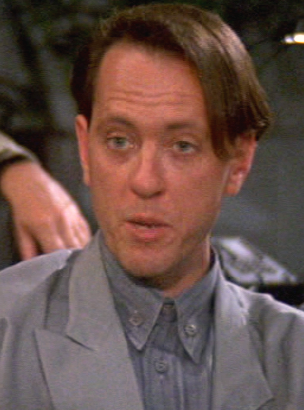
 theater parking lot and who did it. (The film never spells out explicitly the identity of the real stalker, though Altman did on the commentary track of the old Criterion laserdisc edition of The Player. I wrote about it in my sidebar Untold Stories of Robert Altman's The Player or Who the Hell is Thereza Ellis? if you haven't read that and would like to know.) While looking at dailies at the studio, he gets a message from a Joe Gillis telling him to meet him at the patio bar of the St. James Club that night alone. Griffin actually has to ask the others in the screening room if they've heard of a Joe Gillis and studio president Levison (Brion James) informs him that Gillis is the name of the character William Holden played in Sunset Blvd. "You know, the screenwriter who gets killed by the movie star." Mill tries to laugh it off, saying the guy called before claiming to be Charles Foster Kane. When he goes to the hotel that night, he runs into the two most over=the-top characters in the film — writer-director Tom Oakley (Richard E. Grant) and Andy Civella (Dean Stockwell). If the movie they corner Griffin into listening to a pitch for weren't so pivotal to one of the biggest laughs in movie history, they might a bit too annoying. Griffin does his best to get rid of them, but he relents and Tom takes over.
TOM: We open outside the largest penitentiary in California. It's night. It's raining. A limousine comes through the gate past demonstrators holding a candlelight vigil. The candles under the umbrellas glow like Japanese lanterns.GRIFFIN: That's nice. I haven't seen that before.
TOM: A lone demonstrator, a black woman, steps in front of the limousine. The lights illuminate her like a spirit. Her eyes fix upon those of the sole passenger. The moment is devastating between them.
GRIFFIN: He's the D.A. She's the mother of the person being executed.
ANDY: You're good! I told you he's good.
TOM: The D.A. believes in the death penalty and the execution is a hard case — black and definitely guilty. The greatest democracy in the world, and 42 percent of people on death row are black. Poor, disadvantaged black. He swears the next person he sees to die will be smart, rich and white. Cut from the D.A. To an up-market suburban neighborhood. A couple have a fight. He leaves in a fit, gets in a car. It's the same rainy night. The car spins out and goes into a ravine. The body is swept away. When the police examine the car, they find the brakes have been tampered with. It's murder, and the D.A. decides to go for the big one. He's going to put the wife in the gas chamber. but the D.A. falls in love with the wife.
GRIFFIN: Of course.
TOM: But he puts her in the gas chamber anyway. Then he finds that the husband is alive. That he faked his death. The D.A. breaks into the prison, runs down death row -- but he gets there too late. The gas pellets have been dropped. She's dead. I tell you, there's not a dry eye in the house.
GRIFFIN: She's dead?
TOM: She's dead because that's the reality. The innocent die.
GRIFFIN: Who's the D.A.?
TOM: No stars on this project. We're going out on a limb on this one. This story is too fucking important to risk being overwhelmed by personality. We don't want people coming with any preconceived notions. We want them to see a district attorney.
ANDY: (whispering) Bruce Willis.
TOM: Not Bruce Willis or Kevin Costner. This is an innocent woman fighting for her life.
ANDY: (whiapering) Julia Roberts.


Griffin tells Tom his pitch had more than 25 words. "But it was brilliant. What's the verdict?" Andy asks. Griffin doesn't betray his thoughts one way or the other when a waiter comes by with a postcard he says a man left for him at the front desk. It reads, "I TOLD YOU TO COME ALONE!" Mill gets up, telling Tom and Andy that the person he was waiting to meet isn't coming. Andy pushes again for an answer about a deal and Mill admits it's an intriguing idea and suggests they call him at the studio the next day. Griffin returns to his Range Rover and finds a note on his steering wheel suggesting he look beneath his raincoat, which covers something on the passenger seat's floor. He lifts the coat and finds a metal box that reads, "DO NOT OPEN TIL XMAS." He flips it open anyway and discovers a live, hissing rattlesnake inside. Scared shitless, he drives erratically until he gets to the side of the road, gets an umbrella from the back of the vehicle and beats the snake to death while cursing the mystery writer. In his rage, paranoia and vulnerability, Griffin drives to June's.

The Player remains one of Tim Robbins' best performances and the scene where he arrives disheveled in the middle of the night at June's gives him his finest in the movie. It also provides the most solid evidence of the multiple layers the movie functions on. Altman may have called The Player at one point in his commentary possibly the "most contrived" film he ever made (which, quite frankly, I can't imagine a more ludicrous statement coming from the great filmmaker who had films such as Beyond Therapy, Quintet and Ready to Wear in his filmography), but Robbins gets to a deep core of emotional truth here. His brush with death via snake prompts him to try to confess to June, but it's as if she knows intuitively and doesn't want him to confirm it. He admits that she was all he could think about when he saw the snake and thought it would kill him. "Are you making love to me?" she asks. He says he supposes that he is; he knows he wants to make love to her. "It's too soon. It's so strange how things happen. David was here, then he left. You arrived. Maybe it's just the timing, but I feel like I
 would go anywhere with you if you asked, but we mustn't hurry things. We can't hurry things any more than we can stop them," June tells him. Most of the many times I've watched The Player before, it seemed clear to me that Griffin pursued June. This time, it looked more to me as if she was pulling him into her web. Both the DVD and the dear departed laserdisc contain the same deleted scene that I found to be a rarity among deleted scenes. Most of the time, you view them and you see exactly why the scissors snipped them out of the final cut. One of The Player's cut scenes I've always thought to be an exception and I hadn't thought of it in awhile. When Griffin and June finally start dating, they go on a trip to the Two Bunch Palms resort. The film abounds with posters and references to noir and crime movies as it is, why not plant the idea that June could be a most unusual type of femme fatale? Immediately before they leave on the trip and Bonnie learns he's embarking with another woman, Altman shoots a close-up of a movie poster for M. At the resort, Griffin gets greeted as Mr. M. and his reserved seat at dinner has a card with the same shortened name and courtesy title. They stay in the cabin Al Capone used when he visited California. June leaves her purse open on a dresser and Griffin notices that she's packing a gun. She tells him that
 Kahane got it for her and, in fact, had it in his satchel the night he got killed. She wondered why David wasn't able to use it. The cut scene set at the resort cast an entirely new aura of mystery about her character. One masterful scene set kept in the film captures the consummation of Griffin and June's relationship. Not only did Altman not use nudity, he filmed their lovenaking entirely from the neck up, but it never gets the notice it deserves when it's competing with eight-minute single takes and 60 celebrity cameos. Regardless, you definitely see with certainty that as the movie progresses and Griffin spends more time with June and less with Bonnie, he becomes a more soulless creature. If June isn't a femme fatale or an alien as Altman suggested, she's some kind of vampire, and on the ethical scale of the film, June doesn't even seem to register, floating above it in an amoral cloud as Bonnie stays on the moral side and Griffin weighs down the immoral one further and further. In the DVD video interview, Altman admits that the scene was the very last one to be taken out and, if he was making The Player when they did that interview, he would probably have kept it in. The tightrope that Altman walked while juggling the various styles and genres in The Player without ending up with a complete mess boggles the mind.
The final subversion of expectations comes with Griffin's ultimate victory on all levels. First, he tricks Levy into selling Levison on producing Tom and Andy's no-stars-woman dies movie (titled Habeas Corpus). Levy sound leery at first, especially about having no name actors playing the leads, but Mill tells him that Levison made his reputation on two hits with nobodies and his motto used to be, "No stars, just talent." Afterward, he confides to his secretary Jan that he just set Levy up with a dog of a script with no second act and a downbeat ending, but Levison will do it because he's hot to make a movie with him and when they both fall on their faces, he'll sweep in and save the day. Poor Bonnie though has been seeing through Griffin for a while.
 "Why are you bullshitting me? You never used to bullshit me," she tells him at one point. The Pasadena police appear to be closing in on him, having found a witness, so Griffin faces a lineup. However, the lady with fairly poor eyesight ends up picking the police detective played by Lyle Lovett. "That's him! I swear on my mother's grave," the woman declares. Detective Avery asks the woman if she can be personal and then inquires, "Where the fuck is your mother buried?" As Griffin walks out of the courthouse a free man, his defense attorney states the obvious of how that witness really made his case by picking that cop out of the lineup. A title card appears telling us it's one year later and we see several stars, obviously playing parts before the witness room of a gas chamber. We realize that we're seeing the ending moments of Habeas Corpus. The camera moves down the hall of the execution unit and we see that, yes, Julia Roberts indeed is playing the part of the condemned wife. She's led off to the gas chamber, strapped in and fumes start to rise when suddenly a guard yells into a phone, "WHAT?!" A man comes running down the hallway. Understandably, it's Bruce Willis. He grabs a shotgun, blows out the glass of the gas chamber runs in and whisks Julia to safety. "What took you so long?" she asks. "Traffic was a bitch," he replies. THE END.
Many movies have made me laugh in my lifetime, but few offer moments so funny that just thinking about them — even months later — can cause convulsions of chuckling. Off the top of my head, I recall two. One comes from South Park: Bigger, Longer & Uncut when the Army
 general tries to show his plan to his troops, but Windows 98 keeps crashing so he orders men to bring Bill Gates to him. "You told us that Windows 98 would be faster, and more efficient with better access to the Internet!" the general yells at Gates. "It is faster! Over five million — " That's all Gates gets to say before the general blows his head off to the cheers of his troops. I didn't hear the cheers. The theater audience and I were too busy laughing and applauding. Habeas Corpus in The Player takes the prize for the other moment. When I first saw this film in a screening and I saw Julia Roberts, I started to laugh, but then when Bruce Willis barrels in and grabs the shotgun, I literally was on the floor. I had to watch
 the movie two or three times until I could concentrate on what took place after the moment. It pushed me into that heavy a fit of hysterical laughter. Eventually, I did see what happened as Bonnie turned to Tom Oakley in the screening room, asking him how he could have sold out. "What about truth? What about reality? she asks the writer-director. What about the way the old ending tested in Canoga Park? Everybody hated it. We reshot it, now everybody loves it. That’s reality," Tom tells her. Bonnie stands her ground, insisting that it didn't have to end this way. Larry Levy shakes his head, tells her it's a hit and that's why they work there before firing her. Bonnie promises to go over his head. As she marches toward the president's office, breaking a heel on the way, Claire
 tries to stop her. She begs to see him. "I'm not just me. I'm also the job." Claire informs her, before feeling sorry and going in where Walter and retrieves basketballs that Griffin shoots from his spot in the president's chair. Claire tells him that Bonnie wants to see him. "Did Levy fire her?" he asks. "Looks that way," she replies. Griffin declares he can't talk to her now and gets up to head home. On the way out the door, Jan informs him that Levy is on the phone for him. He tells her to wait a few minutes then transfer it to the car. Bonnie tries
 to get Griffin’s attention. "Bonnie, don't worry. I know you'll kind on your feet," Mill tells her as he gets in his car. He takes the Levy call and it's a pitch from a writer, but not just any writer, one who used to sell postcards. He describes a story about a movie executive who is being threatened by a screenwriter so he kills him, only he kills the wrong guy. The twist: He gets away with it. He ends up married to the dead writer's girlfriend and it's a happy ending. Mill asks Levy to get off the line so he can talk to the writer alone. "Can you guarantee that ending?" Griffin asks. "If the price is right, you got it," the writer replies. Griffin tells him that if it's guaranteed, it's a deal and inquires about the title. "The Player," the writer answers. "The Player. I like that," Griffin says as he pulls into his driveway where a very pregnant June waits. "What took you so long?" June asks. "Traffic was a bitch," Griffin replies as he puts his arm around her and leads her into the house. Altman and Tolkin's funhouse mirror has turned back around on itself again for its final, perfect closing moment. What started in flat-out satire, ends in irony with plenty of suspense, truth and reality managing to sneak into the picture along the way. Altman couldn't live forever, but don't we deserve someone close to his daring and talent? (First one to mention Paul Thomas Anderson gets spit on.) I fear a large part of my interest in new movies somehow died the moment he did.

Tweet
Labels: 90s, Altman, Books, Connery, Dean Stockwell, Fiction, Holden, Julianne Moore, Movie Tributes, Shatner, South Park, Television, Tim Robbins
TO READ ON, CLICK HERE


Thursday, December 15, 2011
“Sitzen machen!”

By Ivan G. Shreve, Jr.
The very first Billy Wilder film I watched as part of my burgeoning film education wasn’t one of his acknowledged classics such as Double Indemnity (1944) or Sunset Blvd. (1950) — or even Some Like it Hot (1959) or The Apartment (1960) but a movie I consider “second-tier” Wilder, the 1961 Cold War comedy One, Two, Three. Keep in mind that I don’t refer to the film as second-tier because I dislike it or am trying to denigrate the work; it’s just that with the passage of time, the topicality of One, Two, Three hasn’t particularly worn well, something that I’ve also noticed in Ninotchka (1939), a Wilder-scripted comedy (but directed by Ernst Lubitsch) whose plot and themes are revisited in the later feature. (One, Two, Three also contains echoes of the filmmaker’s earlier Sabrina, the 1954 romantic comedy starring Audrey Hepburn, Humphrey Bogart and William Holden.)
The dated political content of One, Two, Three doesn’t do it any favors, but this is nevertheless going to be an enthusiastic review of a film that debuted in motion picture theaters 50 years ago on this date. “Second-tier” Wilder is miles and away better than the best movie helmed by any director today, and with his longtime partner I.A.L. “Izzy” Diamond, Billy crafted a fast, frenetic and funny farce (based on a 1929 play, Egy, kettö, három, by Ferenc Molnár) that still can leave an audience breathless with laughter. The icing on this cinematic cake is that, before he returned briefly to movies for Ragtime in 1981, One, Two, Three served as the penultimate cinematic swan song for the legendary James Cagney.
C.R. “Mac” MacNamara (Cagney) is head of operations for Coca-Cola in West Berlin, a month or two before the closing of the Brandenburg Gate (and subsequent construction of the Berlin Wall). Company man Mac is extremely loyal to the Pause That Refreshes, and has been working diligently to advance himself, with an eye on assuming the post of European operations in London by shrewdly brokering a deal to introduce the soft drink to the Soviet Union. (Mac was formerly in charge of Coca-Cola’s interests in the Middle East but a mishap involving Benny Goodman resulted in Mac’s demotion after the bottling plant was destroyed in a riot.) He’s scheduled to meet Soviet representatives Peripetchikoff (Leon Askin), Borodenko (Ralf Wolter) and Mishkin (Peter Capell) to discuss introducing the soft drink behind the Iron Curtain, and is juggling that conference with plans to further his “language lessons” with luscious secretary Fräulein Ingeborg (Lilo Pulver).
The roguish MacNamara is planning to take advantage of his wife Phyllis’ (Arlene Francis) scheduled trip to Venice with their two children to dally with Ingeborg, but those plans are put on hold when Mac receives a call from his boss, Wendell P. Hazeltine (Howard St. John), in Atlanta. Hazeltine’s daughter Scarlett (Pamela Tiffin) is en route to Berlin, and he’s entrusted Mac to keep close tabs on her since Scarlett is a bit of a shameless flirt (despite being only 17). As an example of her hot-blooded tempestuousness, Mac and Phyllis meet her at the airport just in time to find her awarding herself as a lottery prize to the flight crew (the winner is a man called Pierre, prompting Phyllis to dub him “Lucky Pierre”). What starts out as a two-week assignment stretches into two months, but Mac is pleased that he’s keeping Scarlett on a tight leash.

On the day before the Hazeltines travel to Berlin to collect their daughter, Scarlett turns up missing. Mac learns from his chauffeur (Karl Lieffen) that the girl has been bribing him to let her off at the Brandenburg Gate every night to allow her to cross the border into East Berlin. Devastated by this news, MacNamara expresses relief when Scarlett turns up at his office, but then is hit by a streetcar when she announces that she’s been spending all her time with an East German Communist named Otto Ludwig Piffl (Horst Buchholz), whose political philosophy fills Mac with utter revulsion. The problem for Mac is that the fling between Otto and Scarlett has gone beyond mere puppy love — they tied the knot in East Berlin — something that will no doubt go over with her parents like flatulence at a funeral. The devious MacNamara arranges for the young Commie to be picked up by the East German authorities after they find a “Russkie Go Home” balloon affixed to his motorcycle’s exhaust pipe and a cuckoo clock (that plays “Yankee Doodle” on the hour) wrapped in a copy of The Wall Street Journal in his sidecar.
Mac’s machinations even go as far as to arranging for the couple’s marriage license to disappear from the official record, and he gloats about his triumph to a furious Phyllis, who has finally had enough of her husband’s neglect of their marriage in his pursuit of Coke advancement. The popping of champagne corks is put on hold when Scarlett faints after hearing of Otto’s arrest. An examination by a physician reveals that the girl has a Communist “bun in the oven!” Racing against an ever-ticking clock before the Hazeltines touch down in Berlin, Mac manages to spring Otto and then embarks on an extreme makeover of the hostile Bolshevik to transform him into someone whom Scarlett’s parents will approve. Against all odds, McNamars’s scheme comes off without a hitch, but his dreams of taking over as head of Coke’s European office are dashed when Hazeltine announces the job will go to his new son-in-law! Kicked upstairs to a position in the home office in Atlanta, Mac will reconcile with Phyllis and will hopefully live happy ever after.
Because the emphasis in Ninotchka is primarily on the romance between stars Greta Garbo and Melvyn Douglas, that film hasn’t dated nearly as badly as One, Two, Three, whose jibes at Cold War politics make it more of a period piece, and is likely to appeal mostly to the history majors in the audience. (Wilder’s cynicism also comes to the fore in this film in that you never really believe the romance between Scarlett and Otto. They have to stay married because there’s a “bouncing baby Bolshevik” on the way.) But if you’re able to put its topicality on a back burner, there is much to enjoy in the film; it is a spirited farce, buoyed by the participation of Cagney as the main character of C.R. MacNamara. Mac is a typical Wilder hero: not the most admirable man (he’s cheating on his wife and comes across as a bit of a jerk) but an individual who rises to the occasion when faced with a crisis. Cagney, whose screen performances were usually marked by his established persona as a fast-talking wise guy, is a marvel to watch in this film, barking out orders and, in the words of a reviewer for Time magazine, “swatting flies with a pile driver.”
Cagney did not have an easy time making the film. He was no spring chicken at the time of its production, and having to spout Wilder’s rat-a-tat dialogue at a furious pace was often difficult, particularly in one scene where the director insisted on Jimmy’s completing it in one take. Cagney was tripped up continually by the line, “Where is the morning coat and striped trousers?” It was never explained to his satisfaction why Billy refused to let him paraphrase the dialogue, and so it took 57 takes to get it done (which might explain why the finished product comes off as a little mechanical). Cagney also was not enamored of co-star Buchholz and his scene-stealing antics; Jimmy had experienced a similar incident when making Yankee Doodle Dandy (1942) and had trouble with character actor S.Z. “Cuddles” Sakall upstaging him in a scene, but he overlooked it because Sakall “was an incorrigible old ham who was quietly and respectfully put in his place by [director] Michael Curtiz.” But if Wilder hadn’t exercised his director’s prerogative and discouraged Horst to stop with the same, Cagney “would have been forced to knock him on his ass, which I would have very much enjoyed doing.”
All in all, the experience of making One, Two, Three drained Cagney and made him realize that he’d rather be enjoying retirement, and upon the movie’s completion, the actor settled in for a second career as a gentleman farmer (though he did narrate a TV special and a 1968 Western, Arizona Bushwhackers, in the interim). He was coaxed out of retirement for a small role in Ragtime in 1981 (as the police commissioner, his last big-screen appearance and a final reunion with his longtime chum/movie co-star Pat O’Brien), and an additional role in a 1984 TV movie Terrible Joe Moran where he played a retired boxer forced to used a wheelchair, but still a fighter to the core. Having suffered a stroke affected Cagney's performance somewhat and it was the final project before his passing in 1986.
In watching One, Two, Three, it almost seems like Wilder and Diamond presciently knew it would be James Cagney’s last significant silver screen work, what with all the in-jokes and references pertaining to the actor sprinkled throughout. There’s the aforementioned cuckoo clock (Cagney’s best actor Oscar was awarded for his role as George M. Cohan in Dandy), but there’s also a scene in which Jimmy picks up a grapefruit half and moves menacingly toward Buchholz’s Otto (shades of The Public Enemy!) and a funny cameo by Red Buttons as an Army MP who imitates Cagney while having a conversation with Jimmy’s MacNamara. Of course, the self-referential jokes are a staple of Wilder’s film comedies; at one point in the movie Cagney cries out “Mother of mercy, is this the end of little [sic] Rico?” as a nod toward Edward G. Robinson’s memorable last line in Little Caesar (something Billy also did in Some Like It Hot, in which George Raft asks a coin-flipping Edward G. Robinson, Jr., “Where’d you pick up that cheap trick?”).
Wilder also recycled a line used by Bogart in Sabrina, “I wish I were in hell with my back broken” (a variation of this also turns up in Wilder’s Five Graves to Cairo) and in fact, borrowed Sabrina’s “switcheroo” ending (right down to the hat and umbrella) and use of the song “Yes, We Have No Bananas” (only it’s sung in German in One, Two, Three). Music is at the center of many of the gags in the film; in addition to “Bananas,” comic set pieces use Aram Khachaturian's “Sabre Dance” (the main theme that accompanies MacNamara’s breakneck activities, described by Wilder and Diamond to be played “110 miles an hour on the curves…140 miles an hour on the straightways”), Richard Wagner’s “Ride of the Valkyries” and Brian Hyland’s “Itsy Bitsy Teenie Weenie Yellow Polka Dot Bikini.”

Though watching Cagney go through his paces is the main draw of One, Two, Three, his co-stars also rise to the occasion. Arlene Francis is probably best known as a panelist on the longtime TV show What’s My Line?, but she provides solid support as the acid-tongued, long-suffering Phyllis (“Yes, Mein Führer!”). The real-life antagonism Cagney had for Buchholz works to the film’s advantage, of course, but Horst has a certain goofy charm that makes his Otto likable despite his political leanings, and Pamela Tiffin is delightful as the ditzy Scarlett — many a classic movie buff has wondered why, despite high-profile showcases in films such as Summer and Smoke (1961) and Harper (1966), Tiffin’s film career never reached its full potential. Fans of Hogan’s Heroes will recognize Leon Askin as Comrade Peripetchikoff, but you can also hear Askin’s fellow Hogan player John “Sgt. Schultz” Banner as the voice of two of the characters in the film — in fact, when I watched One, Two, Three the other day, it was the first time I noticed that the voice for Count von Droste Schattenburg (the aristocrat who “adopts” Otto, played by Hubert von Meyerinck) is dubbed by character great Sig Ruman!
Jules White, the head of Columbia Studios’ comedy shorts department, once described his directorial style as “mak(ing) those pictures move so fast that even if the gags didn’t work, the audiences wouldn’t get bored.” Wilder and Diamond upped that ante with One, Two, Three; the film not only moves at lightning speed, the gags remain funny today. (My particular favorite has MacNamara calling one of the Russians “Karl Marx,” and when the comrade gives Fräulein Ingeborg a generous swat on her fanny, he quips, “I said Karl Marx not Groucho.”) In Cameron Crowe’s book Conversations with Wilder, the legendary writer-director observed: “The general idea was, let's make the fastest picture in the world…And yeah, we did not wait, for once, for the big laughs. We went through the big laughs. A lot of lines that needed a springboard, and we just went right through the springboard…” The film may not have been a box-office smash (both in the U.S. or Germany) but the final gag left an impression on me when I first saw it as a kid (“Schlemmer!”), and 50 years later watching the great Jimmy Cagney rush pell mell through farcical circumstances beyond his control remains a Wilder devotee’s delight.
Tweet
Labels: 60s, A. Hepburn, Bogart, Books, Cagney, Curtiz, Edward G., Garbo, Holden, Lubitsch, Movie Tributes, Nonfiction, Oscars, Raft, Television, Wilder
TO READ ON, CLICK HERE
Saturday, October 15, 2011
“And life is heaven you see…”

By Ivan G. Shreve, Jr.
A September article at The New York Times online touted a resurgence in the once-dominant form of television programming we know today as the situation comedy, or “sitcom”…and for myself and fans of my home-base weblog, Thrilling Days of Yesteryear, this sort of news was an oasis after being parched from the arid desert of inane boob tube “reality shows” the industry has seen fit to embrace in recent seasons. The sitcom, according to Wikipedia, is identified as having “a storyline and ongoing characters in, essentially, a comedic drama. The situation is usually that of a family, workplace or a group of friends through comedic sequences.” The American form of the sitcom is believed to have started in radio with the debut of The Smith Family in 1925 and Sam ‘n’ Henry a year after (a program that later morphed into Amos ‘n’ Andy) but the move toward situational comedy from the traditional vaudeville style of comedy sketches mixed with musical numbers also is credited to Jack Benny, with his best friend George Burns (along with wife Gracie Allen) later following suit and radio stalwarts such as Fibber McGee & Molly (who also “spun-off” a sitcom success in The Great Gildersleeve), Easy Aces and The Adventures of Ozzie and Harriet not far behind.
When television began rearing its (ugly) head in 1948, many radio sitcom favorites eventually would transition to the tube as well. Among early candidates were family shows such as The Life of Riley, The Aldrich Family and, with the success of her series My Favorite Husband, former B-movie queen Lucille Ball was asked by her network, CBS, to do a TV version of the hit show in 1950. Ball certainly was amenable to such an arrangement, but she insisted that the role of her husband in the new venture (actor Richard Denning had been playing her radio spouse) be essayed by her real-life husband, bandleader Desi Arnaz. It was common knowledge in Hollywood that the Arnazes’ marriage was a rocky one and Lucy felt a joint project for the couple might save it. Though CBS balked at first (there was an element of racism involved — the network was skittish that audiences might have problems with the “mixed marriage” of American Lucy and Cuban Desi), they eventually came around and it’s a good thing they did — because I Love Lucy, which debuted at 9 p.m. Monday night 60 years ago on this date, became the innovation to which modern sitcoms owe an endless debt of gratitude.
Because of CBS’ reluctance to cast Desi Arnaz in the role of Lucy’s TV husband, the Arnazes set out to prove that the idea wasn’t as screwy as it sounded by developing a stage act featuring the duo that performed on the road with Desi’s orchestra. The teaming of Lucy and Desi proved to be very successful, and their on-stage antics eventually made it into a TV pilot that turned more than a few heads at the network. The news that the team responsible for making Lucy’s radio sitcom a smash — Jess Oppenheimer, Madelyn Pugh and Bob Carroll, Jr. — also were on board made CBS a little less nervous but what ultimately convinced them to sign the couple was the revelation that their competitors (NBC, ABC and DuMont) wanted to acquire the Arnazes’ services as well. The completed pilot was shopped around and after a sweat-inducing period that suggested there might not be any takers, the Milton Biow agency convinced cigarette maker Philip Morris to take a gamble.
In the early days of “The Golden Age of Television,” production in the industry was based in New York. It was sort of the same with radio in its halcyon beginnings, but this practice gradually changed as more programming drifted out to the West Coast to take advantage of the proximity to Hollywood. During its East Coast infancy, early TV programs were telecast live and would eventually be shown to West Coast viewers in the form of kinescopes, which were camera recordings of live telecasts taken directly from a video monitor. Philip Morris, the new sponsor of what was now called I Love Lucy (a compromise title in that Lucille Ball had vociferously argued that her husband Desi Arnaz receive top billing despite her bigger celebrity), was pretty much going with tradition when it decided its property would be live on the East Coast and kinescoped out West.
But the Arnazes weren’t wild about uprooting from California to New York and Philip Morris completely dismissed the idea of shipping kinescopes eastward after I Love Lucy was telecast live out West. The sponsor believed the majority of the television audience lived east of the Mississippi and as such, should not be subjected to the poor quality of kinescopes. Lucy and Desi, on the other hand, argued that their show should be filmed in Hollywood so that they could stay put (Lucy also was expecting their first child at the time) and when CBS and Philip Morris hedged, the Arnazes agreed to take a pay cut to offset the expense — the only stipulation being that they receive ownership of the show as compensation. (Something that would come back to bite CBS in the keister in a major way.)
Lucy and Desi also decided that in filming I Love Lucy, they would eschew the single-camera format used by television comedies that were being filmed (often accompanied by a laugh track) in favor of a three-camera system that would permit the show to be performed in front of a studio audience, much as Lucy had done on radio with My Favorite Husband. Put in charge of this setup was veteran cinematographer and director Karl Freund, who innovatively worked on ways to light the sets so that no diminishment of image quality would be detected on each of the three cameras. The system also would require the Arnazes to locate a studio that could accommodate an audience. (They were fortunate that Hollywood’s General Service Studios was in a financial pickle and were only too willing to make the renovations dictated by California’s fire laws.) Furthermore, the filming of the show required that they adhere to the union regulations regarding film studio production, namely using film studio employees. (The employees at CBS were television and radio-based, and fell under completely different guidelines.) So Lucy and Desi found themselves in the TV production business and, with a little reorganization of the corporation that managed his orchestra bookings, Arnaz started what would eventually become known as a major player in the television industry: Desilu.
The practice of the three-camera system was an innovation for television comedies and many of the sitcoms that premiered in the wake of I Love Lucy would adopt the same method, including homegrown Desilu productions such as Our Miss Brooks and December Bride. But the biggest benefit in filming sitcoms was that it created what we know now today as the rerun. Traditionally, television shows would have a run of 39 shows a season, with the remaining 13 weeks devoted to their summer replacement series. Filming I Love Lucy allowed Lucy and Desi to shorten that yearly production schedule and fill the remaining time with previously televised episodes — something that came in handy during the 1952-53 season of the series, when Arnaz and Oppenheimer took advantage of rerunning first season episodes in order to allow Lucy suitable time for additional R&R after the birth of her second child. Not only did the first season repeats win their timeslots, but as the seasons went by a backlog of filmed episodes made it possible for the show to be sold in the then-burgeoning market of television syndication, which filled the pockets of Lucy and Desi since they owned the show. (Silly network.)
The concept behind the series was deceptively simple: a star-struck housewife’s (Lucy as Lucy Ricardo) weekly attempts to crash show business despite her bandleader husband’s (Desi as Ricky Ricardo) insistence that she be content to stay at home. It all sounds a little
 sexist when you think about it in a modern-day context but it was based on a successful formula that originated with radio’s My Favorite Husband (in which Lucy’s character didn’t necessarily want to be in show business, but always was angling to better herself and rise above her social status), and thanks to the script backlog generated by Oppenheimer, Pugh and Carroll, I Love Lucy never wanted for ideas (many of the My Favorite Husband broadcasts were recycled into Lucy episodes). I Love Lucy introduced two other regular characters in Ethel and Fred Mertz, the Ricardos’ older next-door neighbors/landlords and best friends who were inspired by a couple that served a similar function on Husband (the only difference being that the husband was the president of the bank where Lucy’s hubby worked), Rudolph and Iris Atterbury. The Atterburys were played by Gale Gordon and Bea Benaderet and Lucy originally had wanted both performers to repeat as the Mertzes on her TV venture, but they had to bow out due to other commitments (Benaderet already was a regular on Burns and Allen’s TV show, and Gordon was a year away from reprising his radio role as principal Osgood Conklin in a TV adaptation of Our Miss Brooks).
The hunt was then on to find actors to play the Ricardo’s neighbors…and for the part of Fred Mertz, Lucy originally suggested character great James Gleason, whom she had known from his work in a picture they made together in 1949, Miss Grant Takes Richmond. Gleason’s salary demands were a little out of the Arnazes’ price range (he wanted $3,500 an episode) so attention was directed toward another veteran of stage, screen and radio, William Frawley — who had personally called Lucy to ask if there was a part for him in her new series. Hiring Frawley would be a big gamble; he was notorious in the industry for having quite a pull on the bottle, and CBS executives tried to warn Desi off him. But Desi liked Bill, and not only cast him in the part of Fred Mertz but had the show’s writers re-tailor the character to fit Frawley’s curmudgeonly nature (lowering his economic/social status a little to boot). (Arnaz also insisted that a clause be inserted into Frawley’s contract that if he ever showed up to work spiffed on more than one occasion he’d be fired in a heartbeat…and in the nine seasons he worked on the show, Frawley’s drinking never interfered with I Love Lucy.)
If Frawley’s reputation as a lush was troubling to some industry folk, Barbara Pepper, an old crony of Lucille Ball’s from their Hollywood days as Goldwyn Girls, was even more off-putting. Despite Lucy’s wanting to work with her pal (Pepper would play Ethel Mertz) CBS put the kibosh on having two problem drinkers on the set. Marc Daniels, the primary director of I Love Lucy in its first season, was gung-ho on an actress named Vivian Vance, whose film and television resume was a little spotty but was well known to Daniels through their association working together on Broadway in the 1940s. Convinced to check out Vance’s work in a revival of The Voice of the Turtle, Desi and Jess hired her on the spot despite Vivian’s reservations about giving up her film and stage career for a spot on a weekly TV show. To add insult to injury, both Ball and Vance did not get along in the early days of I Love Lucy (Ball resented her co-star because Vance was the same age as she was and Lucy saw Viv as a more attractive threat) but over time Lucy recognized Vance’s dedication and professionalism and the two became close friends, even working together on Lucy’s post I Love Lucy project, The Lucy Show.

Lucy and Viv eventually worked through their differences…but the same cannot be said of the personal relationship between Vance and her TV hubby, Bill Frawley. Frawley once described Vance as looking like “a sack of doorknobs” and Viv was skeptical that anyone out in Television Land would believe that she actually was married to a man who looked more like her father (Vance was 23 years Frawley’s junior) than her spouse. While the two actors always behaved above board in a professional capacity, there was no love lost between them off the set and, in a way, it worked to the show’s benefit, adding to the underlying hostility always present in the marriage of Ethel and Fred Mertz. (After I Love Lucy’s original run and during the time the series’ four principals were doing hour-long specials under the title The Lucy-Desi Comedy Hour, there was talk of putting together a spin-off featuring the Fred and Ethel characters — something Frawley embraced but Vance wanted no part of. That sequence of events only upped the ante on the acrimonious relationship between the two.)

Dismissed by a majority of TV critics upon its premiere as an amusing but unremarkable domestic comedy, I Love Lucy soon would force those same pundits to ransack their vocabulary for superlatives to describe the show, particularly since it raised the bar on the art form. The character of Lucy Ricardo was unlike any previous television housewife, even though most of the show’s plots would focus on the simplest situations (Lucy needing to balance her household accounts or wanting to go someplace special for her wedding anniversary) her handling of these problems was to engage in full-blown wackiness. She resorted to fabrications, disguises…any subterfuge necessary and at her disposal to triumph in the end. Boiled down to the simplest of equations, the show was a weekly battle of the sexes; Ethel often was dragooned into being Lucy’s confidant and reluctant participant in her pal’s zany schemes, with Fred playing the role of both Ricky’s sounding board and sarcastic color commentator. At the center of it all was her all-too-patient and understanding husband Ricky, who would find himself flummoxed at the shenanigans his wife would get into, and every now and then would reach his limit, admonishing her in his fractured English: “Loo-see, you got some ‘splainin to do…”

I Love Lucy became the surprise hit of the 1951-52 season, ranking No. 3 among all shows in the Nielsen ratings and did even better in its sophomore year when it was the No. 1 show across the land. Part of this success stemmed from a storyline introduced in Year Two, in which Lucille Ball’s real-life pregnancy (with son Desi, Jr.) was worked into the show despite the reluctance of CBS to acknowledge that fictional TV characters could become pregnant. As a point of fact, the writers on Lucy were not even allowed to use the term (they substituted “expecting” since “bun in the oven” had not yet been invented) and even had to title the episode where Lucy discovers she’ll soon be great with child “Lucy is Enciente.” (A priest, a rabbi and a minister were consulted to make sure nothing objectionable appeared in any of the episodes — with all of them pretty much in agreement: “What’s so objectionable about having a baby?”) The night the fictional Lucy Ricardo gave birth coincided with Lucille Ball’s real-life Caesarean delivery and at the time set a record for television audiences tuning in — more viewers even watched Lucy than coverage of President Eisenhower’s inauguration coverage.
To offset the charge that I Love Lucy was essentially a “husband vs. wife” rehash from week to week, the creative team behind the show determinedly looked for ways to move beyond the formula, and found inspiration in the fourth season when a story arc was developed that featured the Ricky Ricardo character taking a screen test in Hollywood for the starring role in a fictional MGM film (the Arnazes coincidentally made both of their films that cashed in on Lucy’s success, The Long, Long Trailer and Forever, Darling, for the
 same studio), Don Juan…with Lucy, Little Ricky and the Mertzes in tow. The Hollywood episodes were the shot in the arm the show needed; not only did it ramp up Lucy Ricardo’s ambition to make it in show business, but it spotlighted encounters (and classic episodes) with stars such as William Holden, Harpo Marx and John Wayne. The following season found Lucy loose in Europe when Ricky’s band did an extensive tour in that country (and allowed the “crazy redhead” to engage in such antics as meeting Charles Boyer and doing classic pratfalls into a grape-stomping vat) and in its last season, the Ricardos (and the Mertzes) became suburbanites when Ricky and Lucy purchased a home in nearby Connecticut (Ricky was by this time the owner of his own nightclub). The Ricardos’ emigration from the Big Apple proved to be short-lived because after six seasons as American television’s most popular sitcom (it finished its final season at No. 1, only one of three TV comedies to do so) the Arnazes pulled the plug on the show that had made them household names. The couple continued on in a series of hour-long shows that were televised periodically on an anthology offspring entitled Desilu Playhouse, but on April 1, 1960, the last visit with the Ricardos and the Mertzes was televised, and the series was retired to the Old Syndication Home.
Lucille Ball, acknowledged by many to be “the first lady of television,” later would go on to further sitcom triumphs in The Lucy Show, a half-hour sitcom that re-teamed her with Vivian Vance, and Here’s Lucy, which replaced Lucy Show in the fall of 1968 and lasted until 1974. Her post I Love Lucy sitcom was a huge success in the ratings…and yet, there are many people who lament the fact that it just didn’t work without the chemistry that was Ball, Vance, Frawley and Arnaz. Frawley found work rather quickly after The Lucy-Desi Comedy Hour left TV, appearing as Michael “Bub” O’Casey on the popular family sitcom My Three Sons, while Arnaz enjoyed his new role as television mogul, producing such Desilu hits as The Ann Sothern Show and The Untouchables. (Illness slowly forced Desi to cutback on his Desilu activities and sell his interest in the organization to his ex-wife, though he did produce the 1967-69 sitcom The Mothers-in-Law for NBC as the head of Desi Arnaz Productions.) As for the show itself…well, I imagine there were more than a few people at CBS kicking themselves for agreeing to let Lucy and Desi own I Love Lucy just to save on the cost of weekly filming — the program refused to die even after being visited by the specter of cancellation. It can be seen in more than 77 countries (dubbed in 22 languages), and in the U.S. not only enjoys the distinction of being seen by 40 million people on national cable channels (such as Me-TV and The Hallmark Channel) but boasts of exposure on many local television outlets as well.
Sixty years ago, very few people could have foreseen that a simple situation comedy about a dizzy housewife and her musician husband would become one of television’s biggest hits. To me, the enduring legacy of I Love Lucy is its simplicity; the show took a funhouse mirror and held it up in front of married life, allowing spectators to roar with laughter at the unmatched physical comedy talents of Lucille Ball; the underrated comedic aplomb of Desi Arnaz; the lemon-like acerbic wit of William Frawley; and the peerless straight-woman support of Vivian Vance. When these four people ply their respective trades via rerun immortality you simply cannot ignore the magic that is onscreen…and if it weren’t for I Love Lucy's insistence on breaking all the sitcom rules and inventing new ones, we’d all be settling in for 24-hour marathon viewings of Jersey Shore and The Bachelorette. (I shudder at the very notion.)
Tweet
Labels: 50s, Holden, L. Ball, Marx Brothers, TV Tribute, Wayne
TO READ ON, CLICK HERE
Friday, July 01, 2011
We gave them virtue, they want vice

there lived a very successful motion picture producer named Felix Farmer.
He owned three beautiful houses, he had two lovely children and he was married to a gorgeous movie star. The people who ran the studio where he worked loved and admired him because he had never made
a movie that had lost money. Then one day he produced the biggest most expensive motion picture
of his career…and it flopped. The people who ran the studio were very angry at Felix
because they lost millions of dollars…
and Felix lost his mind.
By Edward Copeland
We see that title crawl after brief credits run while Julie Andrews as actress Sally Miles plays Gillian West in her producer husband Felix Farmer's multimillion extravaganza Night Wind. That photo above doesn't do justice to how garish that set is as Sally as Gillian cavorts with life-size toys dancing and singing "Polly Wolly Doodle" (There are even singing balloons and a Jack in the Box). It has to be seen. Click here. You can believe from that scene alone that Night Wind truly stinks as much as they say it does, though how they could calculate on its opening weekend that it's "the lowest-grossing film of all time," seems a bit suspect. I would imagine films that never open would have lower grosses. Maybe the biggest money loser in relation to cost? Oh, who cares? We're not here to be serious or particularly realistic. We're here to pay tribute to the 30th anniversary of writer-director Blake Edwards' mad spoof of the movie business. Blessed with an unbelievably large and talented cast, S.O.B. isn't as sophisticated as Robert Altman's The Player would be a little more than a decade later and its satire isn't as sharp as Sidney Lumet's film of Paddy Chayefsky's take on the television industry was in Network a mere five years earlier, but it was and remains damn funny.

That crawl scrolls against the blue sky over Malibu beach where a man (Stiffe Tanney) jogs with his dog (Troubles). He suddenly suffers a heart attack and though he manages to crawl toward the deck of a large beachhouse and the dog barks up a storm, no one notices his emergency and he collapses. It sets the tone for an underlying theme that afflicts most of the film's characters: obliviousness, mostly stemming from self-absorption. As a result, a man drops dead on a beach with his dog barking loudly even though people keep coming and going on the deck a few feet above where a catatonic Felix Farmer (Richard Mulligan) sits among the trades reporting Night Wind's failure.
 (A smaller headline in Variety reads N.Y. Critics Break 'Wind' — Edwards' humor doesn't always aim for the highbrow. Though from the descriptive crawl, you'd think that Felix is the film's main character. While S.O.B., which does not stand for what you think it does, revolves around him and his movie, the film truly stands as an ensemble piece. No character really serves as lead even though Andrews and William Holden as the film's director Tim Culley get top billing, all the other significant characters are listed alphabetically. In fact, Felix remains in his non-speaking state of depressed madness for a long time. When he does snap out of it and taks 44 minutes into the film, Mulligan at first does it in a way very reminiscent of reactions his character of Burt Campbell on television's Soap sometimes did.
While S.O.B. retains its power to make me laugh decades after I first saw the movie, I have to admit that re-watching it for the first time in a long time, I found more problems than before, but not as an entertainment rather in how it chooses to take its shots at the always worthy target of movie studios. I first saw S.O.B. on cable when I was a teenager but as I've grown up, not only have my tastes grown more refined, so has my knowledge of how the film industry works. S.O.B. works on many comic levels, but this time the ludicrous nature of its story took me out of the movie at times. The crawl set up the basic premise, but it's more complicated than that. Even though Night Wind has opened to terrible reviews and
 worse box office, Capitol Studios President David Blackman (Robert Vaughn) desperately tries to get his top executive Dick Benson (Larry Hagman, taking the relatively minor role when he was white hot as J.R. on Dallas, having just finished the season that resolved "Who Shot J.R.?") to talk to Felix so they can jerk the film out of theaters and do a major editing job on it which they can't do because of Farmer's ironclad contract that only allows him to make changes. Sure, there was a re-edited version of Leone's Once Upon a Time in America a few years later, but that wasn't a wide release. Blackman himself has been getting pressure from the chairman of the corporation that owns Capitol Studios, Harry Sandler, played by longtime dependable Hollywood character actor Paul Stewart whose first credited film role was the butler Raymond in Citizen Kane. Now, the studio and everyone involved in Night Wind had to know it was a turkey before it opened, so why didn't they try to get him to re-edit it before it opened? You can't tell me they didn't hold test screenings. He might have had a contract that stopped anyone else from making changes, but I doubt it required Capitol Studios to give it a wide release.
While that part of the movie doesn't pass the credibility test, even for a farce, other aspects do. Sally and her team worry about damage to her career and Sally would like to exit the marriage. She gets conflicting advice from her attorney Herb (Robert Loggia), her press agent Ben Coogan (Robert Webber) and her agent Eva Brown (Shelley
 Winters). While Loggia wants to help extricate her from the marriage, the agents advise against it. Eva in particular reminds her client that her image couldn't withstand a divorce or even a separation, especially now. "You know this town, sweetie. You can smoke dope and end up going steady with your Afghan and you're one of the gang, but you — you're Peter Pan," Eva tells her. Winters is a riot as is just about everyone in this sparkling cast and the cast makes the film overcome its weaknesses. There also are many hints of autobiography and inside jokes sprinkled throughout. Andrews never really played Peter Pan, but she did have that Mary Poppins/Maria von Trapp image. In real life, Edwards did cope with serious depression and supposedly studio interference on Darling Lili inspired S.O.B. Ironically, Hagman's mother Mary Martin originated the roles of both Peter Pan and Maria von Trapp when the characters made their stage musical debuts.
The studio finally dispatches his good friend and the film's director Culley (Holden) to the beachhouse to keep watch on him and see if he can pull Farmer back to the real world. Culley is a hard-drinking womanizer. Culley, always on the lookout for young women to decorate his surroundings, picks up
 two hitchhikers on the way, Lila and Babs (Jennifer Edwards, Blake's daughter; and Rosanna Arquette in a very early role). At Farmer's house, the servants and the man who mows the yard are so oblivious to what goes on around them that they don't notice when Felix heads to the garage, starts the Cadillac and closes the garage door again. The gardener (Bert Rosario) doesn't get an inkling until he finds a dead rat. When the gardener puts the mower up, he smells the carbon monoxide and sees Felix's red eyes staring at him through the car's rear window. "Not such a good idea to sit in here with the motor running," he tells Felix as he reaches inside to try to cut the engine. Instead, he shifts it into drive and the Caddy crashes through the back of the garage, down the beach and into the ocean, just in time for Culley, Lila and Babs to stare in disbelief.
Felix's attempt at suicide introduces us to the greatest asset that S.O.B. has — Robert Preston as physician to the stars, Dr. Irving Finegarten. Blake Edwards wrote Preston the part of Toddy for his next film, Victor/Victoria, and earned Preston his only Oscar nomination, but as great as he is there, I think his Irving Finegarten is even better. Once he joins the film, he enlivens every scene he's in. When Robert Webber's character Ben, though he works for Sally, starts feeling guilty and spends most of his time hanging out with Irving and Culley, a comic troika for the ages forms. Irving mildly sedates Felix and they sit around the bar. Ben has turned into a wreck. Irving suggests giving Ben a vitamin shot. As he removes bottle after bottle from his medical bag, Dr. Finegarten has second thoughts. "Come to think of it, why should I give you a vitamin shot? I'm the one with the hangover," Irving declares.
Before I forget, when Felix's car ended up in the ocean, it did attract police interest and they did discover the poor dead man and, after subduing the dog, retrieved the corpse who was identified as veteran character actor Burgess Webster. The dog escaped and continued to hang out on the beach. Irving didn't give Felix that strong a dose apparently because he wanders downstairs and that obliviousness theme continues as Ben follows him, trying to talk, not noticing as Felix sticks his head in the oven or scrounges successfully for rope and returns upstairs. Ben soon panics with the arrival of gossip columnist Polly Reed (Loretta Swit) at the front door. Everyone tries to ignore her, but then they can hear she's sneaking in the back. Irving whispers, "This reminds me of a scene in The Thing when a terrible monster is just on the other side of a door" which only sets Ben off more. Polly comes in cooing for Felix while he's upstairs trying to hang himself. The beam doen't hold and he crashes through the floor, landing on Polly below. She ends up in the hospital in traction with multiple injuries. Irving gives him a stronger dose this time and Culley sits beside him and gives him a speech that seems especially prophetic, knowing what fate awaits Holden so soon after the film's release. It's spooky, since we know that a little more than four months later, Holden would get drunk alone at home, fall, hit his head on the corner of a nightstand and bleed to death. This was his last film.
"Felix, for the last 40 years I've lived a life of dedicated debauchery. I've consumed enough booze to destroy a dozen healthy livers. I've filled my lungs with enough nicotine to poison the entire population of Orange County. I've engaged in sexual excesses that make Caligula look like a celibate monk. I have, in fact, conscientiously, day in and day out, for more years than you've been in this best of all possible worlds, tried to kill myself and I've never felt better in my life. So, if you're really going to end it all, I can show you at least a half-dozen better ways to do it."
This being Hollywood, everyone is sleeping with everyone else and cheating as one might expect. David Blackman's girlfriend Mavis (Marisa Berenson) also is seeing an up-and-coming young actor Sam Marshall (David Young) on the side. When Culley takes Lila to the store, they run into Sam who invites Culley to a party he's having in Malibu that night. Culley regretfully declines, but hits upon the idea that perhaps a party will lift Felix's spirits so Sam agrees to move the party there. It's really the key scene in the movie with most of the film's character's there. It reminds me of Blake Edwards' 1968 film The Party with Peter Sellers, which I never was that big a fan of, but it has that sort of feel with the wacky orgiastic vibe that occurs — only he could do a lot more in a R-rated 1981 film than a pre-rating system 1968 one. Lots of sex, drugs and punchlines a-plenty. Even the cops who came earlier when Felix's car ended up in the ocean, come back for the party (and one of them is Joe Penny, whom some might remember from TV's Riptide).
Also showing up at the party are studio exec Dick Benson (Hagman), Polly Reed's henpecked husband Willard (Craig Stevens), who is supposed to do the spying for his wife, and loads of hot young men and women eager to engage in scenes that would seem more at home in the "free love" era than the
 beginning of the 1980s. Felix eventually awakens from Dr. Finegarten's magic medicine and as he walks, he's too out of it to remember that there's a hole in the bedroom floor that has been covered with a rug and he steps on it and glides rather easily to the party below. He does notice that one of the partying cops took off his holster and left his gun on the bar. Felix takes the gun and returns to the refuge beneath the rug, trying to point feel the barrel so while he's covered and he can shoot himself through the rug. Before he can, a topless young woman crawls under the rug and presumably
 a different gun goes off because soon Felix has fired the gun in the air a couple of times until he appears, pants down in that Burt-esque moment I alluded to earlier shouting, "Woohoo. I've got it!" The next thing we know, Felix, who hasn't said a word and who we've only seen as slow-moving, glum and silent has transformed into a ball of energy. He bursts into a bedroom where Culley is enjoying the company of a young lady and bellows, "Sex, Culley! That's the answer. We'll give 'em a $40 million pornographic epic." Having been preoccupied at the time and not accustomed to seeing Felix up and around lately, Culley expresses a bit of understandable confusion. Felix explains that the times have passed them by. People don't want the goody-goody stuff they've fed them for years, so they'll re-shoot it. Gillian West's dream will no longer be of childhood good times but of repressed fantasies. The world wants sex.
 David Blackman, Dick Benson (wearing a cast from an injury he sustained at the party; it's a recurring gag that almost everyone ends up in a cast — Polly's husband Willard got hurt as well and ends up in the same hospital room), and two other execs (John Pleshette, John Lawlor) wait impatiently for Farmer. They begin to
 think it's a put-on until they begin to hear his voice over the speakers singing "Polly Wolly Doodle" and describing the Night Wind that they know — "But we blew it!" Felix shouts through a megaphone as he appears from behind the Jack in the Box. "Because dying fathers and lying mothers are a dime a dozen these days. Home and family have become civilization's antiques along with the flag, Sunday school, Girl Scout cookies, C.B. de Mille and virginity," Felix tells them. "We gave them virtue, they want vice. We sold them schmaltz, they prefer sadomasochism. Instead of the American dream, it should have been the American wet dream." What's funny is that, to some extent, the situation has reversed in 30 years. Movies made for adults — and I don't mean porn, but subject matter — almost have become an endangered species. Films that earn an R because they aren't for the younger set seem to be a rare breed. Live Free or Die Hard mumbled Bruce
 Willis' signature line as John McClane so it could get that all-important PG-13. The King's Speech never deserved an R for its single scene where Colin Firth unleashes a string of fucks, but when it started winning awards Harvey Weinstein cut that scene just to get a PG-13 so it would earn more money. Excuse me. Back to S.O.B. Felix explains his plan to re-shoot parts of Night Wind to change it from a woman's dream of childhood to her Freudian nightmare. Turn Gillian West into a nymphomaniac businesswoman. He just needs a few million for a re-shoot. Blackman doesn't seem to be listening, but he does pull out his pages for suggestions they have for cuts that can be made to the current version. "Cutting won't help," Felix teases. Blackman yells about how much he went overbudget and Farmer rightfully goes back at him saying he didn't go to his office and hold a gun to his head and demand more money. They approved the script and the budget. Blackman is firm and is ready to walk out — until Felix offers to buy Night Wind back. The execs whisper and then they agree to sell the movie back to Farmer.
 Apparently, Felix has been very good with his money, though he still has to do some asset shuffling to get the funds ready to shoot. Felix must fend off someone who isn't very happy with him right now: His wife. Several million dollars of that money that Felix put together to fund the Night Wind re-shoot rightfully belongs to Sally. Felix tries to explain his plan to her, including having her do a nude scene. "Peter Pan is dead. Long live Gillian West, nymphomaniac executive," he tells her. Sally seeks the advice of her attorney Herb and her agent Eva. Herb agrees that she has plenty of grounds to sue to try to get her money back but Eva, who admits she's always there to protect Sally's image, has to ask, "What if Felix is right?" Maybe it's not a bad idea for Sally to take the chance and go against her image and possibly get a lot of money out of the deal. If it doesn't work, she always can sue him for everything later. Sally reluctantly agrees that she'll film the revised Night Wind.
Of course, getting Sally to that point is easier said than done, even if she has agreed to do it. She's too nervous. Everyone wants to be there on the set to see what happens that day. Polly Reed makes them take her by ambulance but a guard that Felix has hired named Harold Harrigan (Ken Swofford) refuses to let her in. Blackman and his toadies show up in a golf cart and Harrigan tells them to shove off as well. Blackman tells
 Harrigan he won't work in Hollywood again. Felix may have control of the set, but it does reside on Capitol Studio's lot, so Blackman does succeed in having Harrigan tossed off. When Ben hears that Polly lurks, he lets her in and the two ambulance attendants are forced to hold her upright to watch. In her dressing room, nothing Felix, Culley or anyone can say can convince her to do the scene. Thankfully, Dr. Irving and his bag of tricks are on the scene (play clip above) to help and an artificially high Sally is ready to film the scene. Culley escorts her back to the set. "You know you are sexually notorious," Sally tells Culley. "A semi-fraudulent reputation which I do everything I can to encourage," Culley admits. Sally asks why he does that. "Because it's the best way for an old man to compete in a young man's world," Cully replies. Polly waves at Sally, trying to get her attention. Sally finally recognizes her, then asks, "Did you come to see my boobies?"
When S.O.B. opened, reviews varied, but it was hard to hear them above the noise about Julie Andrews baring her breasts in a film for the first time. That trumped everything else about the movie. It doesn't help that the way it happens in the movie-within-the-movie makes it all about Sally Miles baring her breasts. It's not as if it comes in a Gillian West love scene, nymphomaniac or not, but it just comes at the end of a new dark dream sequence (Jack in the Box is now Jock in the Box and a stalker). As Jock chases Gillian through a maze and she enters the devil's mouth, the music builds to a crescendo, she holds out her hand for Jock to stop and simply pulls down the front of her dress and unveils her breasts. (To see something completely bizarre, here is a YouTube clip where you can see a great deal of the sequence except it has been set to the Chris de Burgh song "Lady in Red." I recommend hitting mute and just looking at the images.) Everyone present applauds, including the ambulance attendants who drop Polly as a result. Sally smiles gratefully and covers herself, before collapsing. However, this is Hollywood and scheming usually is going on. Sally's personal secretary Gary (Stuart Margolin) never has been trustworthy but he's been talking to Eva behind Sally's back in hopes of getting a career of his own. Now that Capitol Studios has no part of Night Wind, all the buzz that has been building has made the corporate boss bug Blackman about why they don't have a piece of it in case it turns into a hit. As a result, the studio has been using Eva who has been dangling a job in front of Gary in exchange for him putting the idea in Sally's head that since she technically owns half the film, she should sell distribution rights to Capitol since Felix can't very well distribute it himself. Sally agrees to do it and a judge backs up her right to do it. Felix, however, doesn't learn of it until after he screens a final cut of it with Cully and the lights come up in the screening room to reveal Blackman and his toadies. Blackman shows him the legal documents which basically means Night Wind has been stolen from him. Since his original contract was voided, they can do what they want. Blackman asks what the running time is. When he's told 164 minutes, he says they'll have to cut that.

Felix drives like a maniac, first going to his other house looking for Sally, but she's gone somewhere in the Far East to visit some kind of swami. He does see his kids briefly who want to play with daddy and squirt him with a squirt gun, which he takes. He even plows a car through the kitchen of the Malibu home. Because he's been speeding and driving recklessly, police have been pursuing him, but somehow he's able to switch cars and escape. He drives to the office where the original negative is stored in a vault. When he gets in the building, a friendly voice surprises him: It's Harrigan. He's working security there now. Felix is too preoccupied for small talk. He goes to the office of a Mr. Lipschitz (Hamilton Camp) and makes him take him to the film at "gunpoint." As Felix leads Lipschitz and the reels to the lobby, the squirt gun aimed at Lipschitz's head, Harrigan tries to calm him since by then a lot of armed police have arrived. Some distraction makes Felix aim the gun toward the cops and he gets hit by a fusillade of bullets. Harrigan leans over the dying producer. "I'm sorry, Mr. Farmer," Harrigan says. "It's alright, Harrigan. It'll mean another $10 million at the box office," Farmer tells him before he dies.

At this point, the film divides half into Hollywood hypocrisy, half into the funniest part of the film as the three characters most disgusted by Felix's treatment band together on a bender: Culley, Irving and Ben. It begins at a bar where Sinatra's "All the Way" begins playing and Culley informs them that he just put $6 of Sinatra into the jukebox. Ben, having worked for Sally, who they feel stabbed Felix in the back, feels the worst and tries to convince Culley to beat the shit out of him in the hope it will make him feel better. It's in this scene that we learn that the S.O.B. of the title stands for Standard Operational Bullshit, according to Ben. Culley agrees, lamenting that there are "so few people in this town with a conscience." Meanwhile, the rest of the industry plans a huge memorial service where Sally plans to sing and they all will pretend they treated him decently. The drunken trio, who christen themselves The Three Muscatels at one point, all agree they won't take part in the sham, which will be presided over by the guru Sally met in the Far East (Larry Storch). Sall also will sing. The triumvirate decides that they are going to give Felix the memorial he deserves and set out to steal Felix's body from the funeral home. Apparently, this is based on a Hollywood legend that director Raoul Walsh stole John Barrymore's corpse after he died and propped him up to scare Errol Flynn, but what the fictional characters do with Felix is a bit more elaborate.
When they get to the funeral home, the first coffin they check is no one they know. The next contains the late character actor Burgess Webster. The third time turns out to be the charm and they find Felix. Feeling that Webster's death hasn't received the attention it deserved, when they remove Felix, they put Webster in
 his coffin and the other guy in Webster's. Upstairs, the couple (Byron Kane, Virginia Gregg) that owns the funeral parlor salivate over how much business the Farmer funeral will bring them when they hear a noise downstairs. They find the empty coffin but locate the body in Webster's place and Webster in Farmer's. The husband is beside himself: Their cash cow is gone. His wife slams the lid on Farmer's coffin, now holding Webster. "Who's to know?" On the streets, after initial difficulty bending Felix into the car, they make Ben sit in the back with him because he's been having a bad night of bodily functions and as Irving points out Felix is the only one who won't mind. They stick some sunglasses on Felix and proceed to drive him back to Culley's where they drink and play cards with Felix as guest. It was funny for a time when I'd see the movie because from the years 1989-2000, the only actor in these scenes who was still alive was Richard Mulligan, who was playing the corpse. As they wonder what they should do with Felix, Culley fetches something from another room and places it on Felix's head. It's a Viking helmet for a Viking funeral.
The next morning, the men take Felix out to sea on his boat to prepare for their salute. At the same time, the rest of the industry begins gathering on a soundstage at the Capitol Studio lot for Felix's funeral. The
 occasion doesn't stop anyone from continuing their deals or their affairs. Blackman congratulates Sam Harris on his new role and whispers to Mavis that he better be worth it, not noticing that Sam's hand is up Mavis' skirt. Gary and Eva finalize their deal. All the people with various injuries wheel in. Sally tells Gary that she doesn't know if she'll be able to sing. "You have to — it's the only reason everybody came," Gary says. Her guru sits up on the stage looking as if he can barely stay awake. Finally, he's roused and stands to give his eulogy. Is it full of Eastern philosophy? Not hardly. It's as show bizzy as it can be. This is where some of the unreality takes over again. Felix was shot and killed before the film was released and still in the funeral home, yet the guru gives new box office reports on the revised Night Wind. Farmer also was supposed to have had a record of nothing but hits prior to the first version of Night Wind, but when the guru reads off the list of his film titles they all sound ridiculous. Here is a clip of the eulogy so you can see what I mean.

As Culley drives the boat, Irving and Ben sit on deck with Felix in the fisherman's seat, complete with rod and reel in hand. Ben wonders what happens if he should catch something. Back at the other memorial, Sally finally rises and sings "Oh Promise Me." Irving reads the inscription on the Viking helmet which reads "From the cast and crew of The Pagan Plunder." "I don't think I saw that one," Irving says. "Terrible reviews," Ben tells him. "Grossed a fortune." Once Culley feels they've gone far enough out, they load Felix into a little wooden craft, cover him in blankets, soak it with gasoline and then Irving lights a match and drops it and Culley pulls the boat away as it starts burning. "So long pal," Culley says as they watch Felix and the little boat burn. Back on the beach, Burgess Webster's dog can see the smoke and wags his tail. Then a final crawl scrolls across the screen.


in motion picture history and Sally won another Academy Award and the people who ran the studio made
a ton of money and they all lived happily ever after…
until the next movie!
S.O.B. isn't the finest Hollywood satire ever made, but it's likely to put a smile on your face thanks to its great cast, most especially Robert Preston who I really can't say enough about here.
Tweet
Labels: 80s, Altman, Blake Edwards, Chayefsky, Colin Firth, Erroll Flynn, H. Weinstein, Holden, Julie Andrews, K. Douglas, Leone, Lumet, Movie Tributes, R. Preston, Richard Mulligan, Shelley Winters, Sinatra, Walsh, Willis
TO READ ON, CLICK HERE


