Tuesday, August 16, 2011
My Missing Picture Nominees: Sons and Lovers (1960)

By Edward Copeland
Before I begin discussing the 1960 best picture nominee Sons and Lovers, based on the famed D.H. Lawrence novel and which earned acclaimed Oscar-winning cinematographer Jack Cardiff his only nomination as a director, I'd like to use this occasion to point out yet another reason any true film lover should dump their streaming only Netflix option in favor of DVDs only. Sons and Lovers is one of the few Oscar nominees for best picture that I've never been able to see, but Netflix only carries it on streaming so I've been trying to watch any titles they have only on streaming before I switch to DVDs only. Cardiff filmed Sons and Lovers in luscious black-and-white CinemaScope (actually his d.p., the equally famous and lauded Freddie Francis was the cinematographer on the film). While you will see the opening and closing credits in the intended aspect ratio, the film in between will be cropped and squeezed for no good reason. Other streaming titles are shown in CinmaScope from beginning to end. Another strike against Netflix streaming. You won't get that on the DVD unless it's a DVD that only offers fullscreen.
As you might expect, a film being directed by Jack Cardiff, the brilliant d.p. behind the look of the Michael Powell and Emeric Pressburger classics A Matter of Life and Death aka Stairway to Heaven, Black Narcissus (for which he won the Oscar for cinematography) and The Red Shoes. He also shot Under Capricorn for Hitchcock, The African Queen for Huston, War and Peace for King Vidor (earning another Oscar nomination) and garnered his final cinematography nomination for Joshua Logan's Fanny in 1961. Believe it or not, he even served as d.p. on Rambo: First Blood Part II. The Academy saw fit to give him an honorary Oscar for his long career of exceptional work at the ceremony held in 2001.
Freddie Francis, his d.p. for Sons and Lovers, took home the Oscar for his work on the film. Despite a long list of impressive work, Francis was only nominated for the Oscar one other time — for Glory — and he won. Some of Francis' other films included Scorsese's version of Cape Fear and, his final film, David Lynch's The Straight Story. Also on Cardiff's crew as an assistant director was Peter Yates, who would go on to direct films as diverse as Bullitt and Breaking Away.

I wish I could say that I've read the D.H. Lawrence novel upon which the film is based, but the title itself makes it obvious that the adaptation by Gavin Lambert (who co-wrote Nicholas Ray's films Bigger Than Life and Bitter Victory) and T.E.B. Clarke (Oscar-winning writer of The Lavender Hill Mob) has taken some big liberties from the book. I mean the title indicates multiple sons, but aside from one brief scene that kills off Arthur (Sean Barrett), son of Walter and Gertrude Morel (the great Trevor Howard and Wendy Hiller, by far the film's greatest asset beyond its look and design), a couple of scenes with their son William (William Lucas), who lives in London, the film revolves around their son Paul (Dean Stockwell).
According to summaries of the novel online, Lawrence's book begins with a focus on the turbulent marriage of Walter, a working class miner in Nottingham, England, with a penchant for liquor and Gertrude, who develops unhealthy attachments to her sons. William still moves to London in the book, but is the eldest son and Gertrude's favorite, though he takes ill and dies. Arthur is an afterthought in the book and they also have a sister named Annie who doesn't exist in the film at all. None of the children follow dad into the mines. A near-death experience for Paul (in the novel, not the film) makes Gertrude transfer her obsession to him. Aspiring to be an artist, he gets a chance to move to London when a patron (Ernest Thesiger, who played Dr. Pretorious in 1935's Bride of Frankenstein) sees promise in Paul's work, but Paul abandons his chance to leave when he witness an incident of his drunken father mistreating his mother and stays, fearful of what his lout of a dad could do to his mom.
His mother also subtly and not so subtly interferes with Paul's romances, first with the overly pious Miriam (Heather Sears), who teases the poor lad unmercifully. and later with the married but separated suffragette Clara (Mary Ure) he meets when he takes a job at a sewing factory. (His boss is played by Donald Pleasence). While Miriam runs frigid, Clara burns hot and Paul eats her up, much to the disdain of Clara's cheating husband and his possessive mother.
Howard was nominated as best actor, though he's really supporting and deserved a nomination there. Ure was nominated as supporting actress. Hiller didn't get remembered at all, which is a shame. Given the five films up for best picture in 1960, they all were going to finish a distant second to Billy Wilder's The Apartment. John Wayne's starring in and directing The Alamo automatically lands in fifth. The middle three are tightly bunched, but I believe I'd rank Elmer Gantry second, then The Sundowners, and place Sons and Lovers fourth.
What finally brings Sons and Lovers down that low, despite its gorgeous look and design and mostly superb acting, is Dean Stockwell, who sticks out like a dandelion in a bouquet of roses. Amidst all this British authenticity, including filming on many locations that D.H. Lawrence actually traversed, Stockwell just doesn't belong. His accent isn't horrible, but he's so recognizable as an American (he was born in Hollywood and began acting as a child in the 1940s after all), you know that he wasn't spawned by Trevor Howard and Wendy Hiller. Supposedly, one of the producers, American Jerry Wald, insisted on casting an American in hopes of better U.S. box office. Stockwell can be a great actor but when you think of all the marvelous actors in the right age range circulating in the U.K at that time, what a boneheaded move. Imagine if this film had starred an O'Toole or a Finney or a Caine or a Richard Harris or an Oliver Reed or an Alan Bates or a Laurence Harvey. It could have saved the movie.
Tweet
Labels: 60s, Archers, Books, Caine, Dean Stockwell, Fiction, Finney, Hitchcock, Huston, Lynch, N. Ray, Netflix, O'Toole, Oscars, Pleasence, Scorsese, T. Howard, W. Hiller, Wayne, Wilder
TO READ ON, CLICK HERE


Sunday, April 29, 2007
Centennial Tributes: Fred Zinnemann

By Edward Copeland
If someone asks, "What is a Fred Zinnemann film like?" How would you respond? It's not that Zinnemann, who would turn 100 years old today, didn't make quite a few good and great films and at least one bona fide classic, but is there something you can point to as a Zinnemannesque film the way you might say Hitchcockian or Hawksian? Not really. This isn't to disparage Zinnemann at all. He simply was a solid, workman-like director who ended up making movies worth watching far more often than he made clunkers. He earned seven Oscar nominations as director between 1948 and 1977 and won twice. He also won an Oscar for producing A Man for All Seasons and for the documentary short Benjy in 1951. Some might call him colorless, but his body of work certainly deserves reflection today on the anniversary of his birth.

Zinnemann has directing credits stretching all the way back to 1929, but this is the earliest one I've been able to see and what a pleasant surprise it turned out to be. A simple B programmer about a blind detective (the great Edward Arnold), the mystery may be more complicated than necessary (and easy to guess what's going on in general, if not in specific), but it's a lot of fun. Arnold is great and Donna Reed gives a performance unlike any I've seen from her as a bitter, manipulative young woman at odds with her stepmother. There are some slightly racist scenes involving Arnold's butler that made me uncomfortable, but they are so few that I was able to look aside. Besides, that dog! Friday may well be the most talented dog in the history of film, being a true partner to his blind owner. In fact, in one scene where Friday ends up with the gun of a bad guy in his mouth, I was surprised the canine didn't actually know how to fire it.
Zinnemann scored his first Oscar nomination as director for this moving drama set in post-World War II Berlin where an Army private (Montgomery Clift) tries to help a lost Czech boy find his mother while she similarly searches refugee camps for him. It's a simple, stark tale, but quite compelling, painting a vivid portrait of the desolation of the German city after the war and the timeless tale of people separated by events trying to find their way back together again.
The Search brought Zinnemann his Oscar nomination for 1948, but this taut thriller may be the better film. The always-great Robert Ryan plays a wounded WWII veteran on a mission to kill his former CO (Van Heflin), whom he holds responsible for his misfortune. The film holds the details close to its vest for awhile, and to good effect. Eventually, the stench of vengeance and violence contaminates most of the characters in the film so you're really not certain who will be on the receiving end of the film's title. Unfortunately, the payoff wimps out slightly, but until then the film is riveting, led by Ryan, Heflin and able supporting work, including Mary Astor as a hooker with a heart of stone.
More than anything else, this melodramatic portrait of recovering war veterans remains best known for marking the feature film debut of Marlon Brando. Brando plays an embittered soldier paralyzed from his war injuries. Much of the dramatics do go over the top, but The Men also contains surprising frankness, given when it was made, in terms of sexuality and balancing an antiwar message with a supportive one for fighting men, something that really rings true today, both in terms of the Iraq mess our troops find themselves embroiled in as well as the recent revelations of the piss-poor medical treatment they've received when they've returned home.
In the 2003 documentary All the Presidents' Movies, it was amazing how many occupants of the Oval Office
 picked Zinnemann's Western classic as one of the films they watched in the White House screening room multiple times. (In fact, since Eisenhower, it's been the film requested most often by all presidents.) Regardless of your political persuasion, it's easy to see why this tale of one man standing alone against a cadre of villains while all his supposed allies turn tail and run would appeal to commanders-in-chief. Of all Zinnemann's movies, this one remains my favorite. Really, it's the perfect role for the stoic Gary Cooper and having its action play out in real time works better than just about any other attempt to imitate that pattern. (Come on 24 fans, you can't get anywhere in Los Angeles in an hour let alone have all the things that happen on the show in 60 minutes occur.) High Noon works as well even if you don't know or notice its allegorical background of the blacklist. It's a classic that should never be forsaken.
While The Member of the Wedding still entertains after all these years, its stage origins remain painfully apparent. Julie Harris is quite good in her Oscar-nominated turn as the tomboy Frankie Addams unhappy with her lot in life and dreaming of something more. (You almost believe that Harris, in her late 20s at the time, is a 12-year-old.) However, the performance that stands out for me is Ethel Waters, the sensible maid who becomes Frankie's confidant. She grounds the film in a realism that some of its more theatrical flairs threaten to unravel. Waters should have been the one up for an Oscar that year.
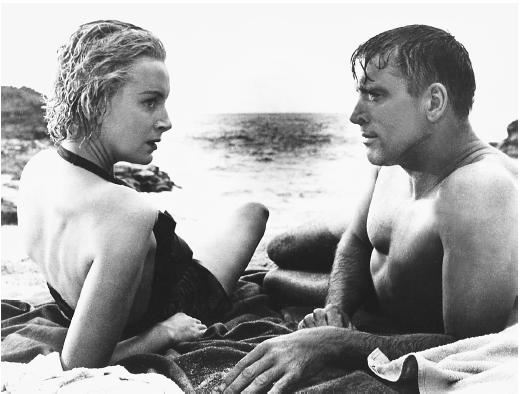
It's interesting to note that with all the people questioning whether it was too soon for films such as United 93 and World Trade Center to tackle the events of 9/11 that From Here to Eternity re-created the attack on Pearl Harbor a mere 12 years after it occurred, albeit as a glorified soap opera. (Actually, movies began referring to the attack on Pearl Harbor within months of December 1941, but I believe this is the first to actually depict the attack.) Thankfully though, Zinnemann was no Michael Bay and the film still has some teeth (and earned Zinnemann his first directing Oscar). Most importantly though, it has great performances from Burt Lancaster, Montgomery Clift, Deborah Kerr, Ernest Borgnine and Frank Sinatra's Oscar-winning turn as the doomed Pvt. Maggio. How Donna Reed won her Oscar I'm not certain. (As Josh R is fond of pointing out, she plays what must be the most virginal prostitute ever put on film.) However, enough remains to make it stand the test of time.
Zinnemann ventured into musicals and he went BIG, i.e. in full-blooded Technicolor, Todd-AO glory transferring this landmark Rodgers and Hammerstein musical to the truly big screen. In a way, Oklahoma! really is
 a stage show that should be opened up since a stage is too limiting for this tale of early settlers. Zinnemann takes true advantage of this with some nice shots, particularly the opening which moves the camera through the stalks of a corn field before coming upon Gordon MacRae singing "Oh, What a Beautiful Mornin.'" While the film is good enough, the importance of its stage version doesn't exactly transfer since Hollywood already had produced its own much better musical originals for the screen (such as Singin' in the Rain three years earlier). Despite that, there is much to admire in the songs and some of the performances, specifically Gloria Grahame's fun turn as Ado Annie. This is the performance that should have earned her an Oscar nomination and/or win, not her blink-or-you'll-miss-it work in The Bad and the Beautiful. Rod Steiger is good as the dark Jud, but his performance (and really the character himself) always has seemed somewhat out of place in what is essentially a musical comedy. Eddie Albert does what he can as Persian peddler Ali Hakim, but he's about as much a Persian as Mickey Rooney was Chinese in Breakfast at Tiffany's. (Well, Albert isn't offensive at least).
You can probably count on one hand the number of films about Catholic priests or nuns that still have them in their religious vocation by the time the film ends, and this bloated work isn't one of them. Audrey Hepburn does her best as the conflicted nun-in-training, but it's really Peter Finch who steals the show as a feisty doctor that Hepburn works with during some missionary work. It's not only an obscenely long film, it's also an eminently forgettable one.

Also too long, but immensely more fun was Zinnemann's next film, with Robert Mitchum and Deborah Kerr struggling to make ends meet in the outback as sheep drovers, with Kerr trying to be the sensible one and Mitchum's gambling spirit always getting the best of him (and their nest egg). She's tired of their wandering ways and wants to settle down, but his rambunctioness always gets in the way. There also are fine supporting performances by Peter Ustinov and Glynis Johns. Still, the cinematography by Jack Hildyard is stunning and there are some great set pieces, particularly a sheep-shearing competition. To say that its Oscar nomination for best picture was more than generous is no understatement.

Zinnemann truly created an odd one with this film that has Gregory Peck (?) playing an exiled Spanish revolutionary and Anthony Quinn as the Spanish official hoping to lure him back to the country to kill him with the news that his mother (Mildred Dunnock) is dying 20 years after the end of the Spanish civil war. Things get complicated further by a young boy named Paco (Marietto Angeleletti) who wants Peck to go back to kill Quinn to avenge his own father's death, but Peck also is torn by a possible traitor within his ranks. Despite the fact that Peck is even a less-convincing Spaniard than Eddie Albert was a Persian, the movie's overriding problem is that it's a world-class bore. It drags on and on to a truly anticlimactic ending. The most interesting thing about it is that it was based on a novel by Emeric Pressburger.
It had been a long time since I'd seen this best picture winner that earned Zinnemann his final two Oscars, one for directing and one for producing, and it plays even better than I remembered. While Robert Bolt's
 screenplay does show its stage origins, Zinnemann has turned this story of Sir Thomas More's stance on principle against the will of King Henry VIII into a sleek, compelling enterprise with the look and feel of an epic but a running time of a mere two hours. Central to the film's success of course is Paul Scofield's Oscar-winning turn as More, but Zinnemann does add a lot of nice touches as well, particularly in the great opening sequence showing the travel of a message from Cardinal Wolsey to More. There's also stunning cinematography by Ted Moore and a top-notch supporting cast that includes Wendy Hiller, Leo McKern, a young John Hurt and Robert Shaw in his Oscar-nominated turn as Henry VIII, which is a much smaller role than I recall. My 1966 Oscar preferences still lean to Who's Afraid of Virginia Woolf? but this film's win is not an embarrassment.
As Fred Zinnemann began his sixth decade as a filmmaker, he turned to yet another genre with this taut thriller starring the cool Edward Fox as a hired gun whose services are employed by embittered former members of the French Foreign Legion to assassinate French President Charles De Gaulle. The story moves on two tracks as Fox, code name The Jackal, pursues his plot and the French authorities, led by Col. Rolland (Michel Auclair) try to determine the killer's identity and to stop him before he is able to act. The film is a bit overlong, but Zinnemann does build quite a bit of suspense, even though we know De Gaulle won't be killed, and Fox is superb as the cold and calculating mercenary.
I saw Julia when it was originally released and I was in grade school, hardly the ideal audience. All I remembered really was that I was bored silly and the scene where a frustrated Lillian Hellman (Jane Fonda)
 tosses her typewriter out a window (I miss typewriters). So, in fairness, I decided I needed to take a new look, hoping that age would make me have a new view on the film the way I did a turnaround on Reds recently. Alas, 30 years later, I find Julia as boring as I did as an elementary school student. Its awards puzzle me more now than they did when I only had vague memories. Fonda at times is pretty bad. Jason Robards in his second consecutive Oscar-winning supporting turn is fine, but really doesn't have anything to do to deserve the prize. Maximilian Schell's presence is so fleeting that his nomination is a headscratcher. What shocked me the most was Vanessa Redgrave. While she is one of our finest actresses, there was more drama and suspense surrounding her nomination and her winning speech than she gets to create in the film itself. This was Zinnemann's final Oscar nomination as director (though he did direct one more film, which I haven't seen), but Julia is a bore. Pure and simple. Despite his less successful works, Zinnemann produced a lot of good and great movies in his time and I still salute him on his centennial.
Tweet
Labels: A. Hepburn, blacklist, Borgnine, Brando, Clift, Cooper, Deborah Kerr, Gregory Peck, Hammerstein, Lancaster, Mary Astor, Mitchum, Robards, Robert Ryan, Rodgers, Sinatra, Van Hefiin, Vanessa Redgrave, W. Hiller
TO READ ON, CLICK HERE


