Sunday, December 18, 2011
Centennial Tributes: Jules Dassin Part I

By Edward Copeland
With a name like Jules Dassin and some of his most classic films made in France, Turkey, Italy and Greece and mostly filmed in French with some Italian, Greek, Turkish and Russian thrown in, it's easy to assume that the great director himself hailed from Europe, probably France. In actuality, when Dassin was born 100 years ago today, that event occurred in Middletown, Conn., and he grew up in Harlem, N.Y., and went to school in The Bronx. Dassin was quintessentially American — until after working in the theater and making 11 features
 for or distributed by Hollywood studios, Dassin was one of those unfortunate artists who received the most un-American of treatments from the first round of Communist witch-hunting by the House Un-American Activities Committee (before Joe McCarthy really made blacklisting a phenomenon) and Dassin couldn't work in the U.S. so he headed to Europe where he made one of the greatest heist films ever. Eventually, he did come back to the U.S. from time to time, but his later films lacked the punch of either his early studio work or his movies made in exile. That exile also introduced him to the woman who became his second wife and the great love of his life — Melina Mercouri. So, though eventually he returned to the U.S. to make some films and direct a Broadway musical based on the couple's most famous film collaboration, Never on Sunday, Greece became his adopted home — until he and Mercouri were booted from there by a military coup led by dictators who felt they were agitators. Eventually, they were able to return to Greece as well, staying together until Mercouri's death in 1994 at the age of 73. However, Dassin lived a much longer and vibrant life, almost making it to his own centennial. He only died a little more than three years ago at the age of 96. In some of his early work in Hollywood, he directed some classic examples of film noir that also boasted elements of social consciousness, something he maintained in real life right up until the end as seen in one of the best discoveries I found preparing this piece: an interview conducted at the Los Angeles County Museum of Art in 2004 when he was 93 or 94 that Criterion included on The Naked City DVD. The invaluable Criterion Collection also includes interviews from other years with Dassin, the most recent being 2005, on DVDs of his various films, leaving us a great resource on the man, his films and the blacklist.
 As was the case with many directors, Dassin's first foray into the creative arts began as a theater actor, in Dassin's case working with The Yiddish Theater called ARTEF (acronym for the Arbeter Teater Farband or Worker’s Theatrical Alliance) in New York in the mid-1930s after studying acting at the Civic Repertory Theatre Company begun by Eva Le Gallienne. It was during this time that he joined the Communist Party, though he quit in 1939 when Stalin signed the Soviet Union's nonaggression pact with Hitler. “You grow up in Harlem where there’s trouble getting fed and keeping families warm, and live very close to Fifth Avenue, which is elegant,” he told The Guardian newspaper in a 2002 interview. “You fret, you get ideas, seeing a lot of poverty around you, and it’s a very natural process.”
Around the same time, he quit the party. Dassin decided to take his career in another direction — both literally and geographically. He headed to Hollywood where he was hired by RKO to a six-month apprentice director contract at $250 a week where Dassin got to assist directors at work but didn't actually do much in the way of hands-on participation. At least that was the way Dassin described it in the 2004 L.A. County museum interview on The Naked City DVD. One director working on the lot at the time that Dassin who Dassin was assigned to and who particularly fascinated Dassin with his technique was Alfred Hitchcock, who was making Mr. & Mrs. Smith at the time. As Dassin tells it, his awestruck gazing at Hitch at work became very noticeable — so much so that after each take Hitchcock would turn to find Dassin and ask him if the take was OK. As the RKO contract neared its end, the studio informed Dassin that he was being let go. Fortunately, MGM hired Dassin and gave him his first film assignment making shorts. Dassin said his farewells to his friends at RKO — even working up the nerve to say goodbye to Hitchcock, who already had heard that Dassin would be making his first film. Hitchcock gave Dassin these words of advice: "Don't ever make a picture with children, animals or Charles Laughton." Of course, Dassin would end up doing films with all three.
At MGM, he made short documentaries about Arthur Rubinstein and Marian Andersen. He then made a short adaptation of Edgar Allan Poe's story "The Tell-Tale Heart." Frustrated with his progress, Dassin was able to get his short of the Poe story screened theatrically and that prompted MGM to sign him to a seven-year contract. In that 2004 interview, Dassin didn't express much affection for his time at MGM, equating the contract to being a slave. While he was tied to them for seven years and had to make what they told him to make, they had the option of dumping him every six months. Dassin had tried to get time off to direct a play on Broadway, but MGM wouldn't even let him do that. (He had directed one play that ran a month in 1940 called Medicine Show.) Of the seven features and the Poe short (I have no idea if the other shorts still exist) that he made at MGM, I've only managed to see the short and two of the features. While none come close to what Dassin made later of the ones I saw, they weren't complete embarrassments.
This 20-minute adaptation of Edgar Allan Poe's famous short story proves to be quite a stylish film debut for Jules Dassin. The short opens with a biblical quote, specifically Romans II.15: "The law is written in their hearts, their conscience also bearing witness." It stars Joseph
 Schildkraut, the second person to ever win an Oscar for best supporting actor playing Captain Dreyfus in 1937's The Life of Emile Zola, as the young man who finally snaps at the abuse inflicted upon him by his tyrannical boss and kills the old man (Roman Bohnen). Dassin really pulls out the attention-getting stops: Focusing on Schildkraut's ear from the short's beginning before the killing even takes place. The boss slaps him on it and he threatens to quit, but the boss tells him he's too much of a coward to do that. He's worked for the old man since he was 14 and he's almost 30 now. Murder will out and the young killer slowly goes mad as he becomes convinced that he still hears the boss's beating heart below the floorboards where he hid his body. In his limited amount of time, Dassin creates a very atmospheric tale, helped immeasurably by cinematographer Paul Vogel, who later won an Oscar for his black & white photography in Battleground. The short's only negative is a somewhat obvious and overbearing musical score by Sol Kaplan. For some reason, The Tell-Tale Heart is included as a bonus feature on the Shadow of The Thin Man DVD in The Thin Man series box set.
 Didn't get to see this one which starred Conrad Veidt (best known as Nazi Major Strasser in Casablanca) as identical twins: one a stamp collector and rare bookshop owner, the other a ruthless Nazi. On one of the many interviews included on Criterion DVDs, Dassin said of Veidt on the French TV program Ciné Parade in 1972, "At the time, he was the big European star. He was a big actor with a personality to match." When Veidt realized he would be directed by a first-timer, he objected. Dassin sought advice and one of the crew suggested setting up dolly tracks so when Veidt returned to the set, he asked what they were for and Dassin explained that they were doing a shot that started back at one point and then zoomed up to him for a close-up. Veidt thought it sounded great and was satisfied after that.
Dassin's next film was a comedy I also haven't seen, so here's the IMDb summary by Les Adams, though I've added performers' names. "The town gossips are reporting that a household servant in exclusive Rocky Point is writing an expose of the colony. Mrs. Sophia Sommerfield (Spring Byington) is convinced it can't be either one of her maids, Martha Lindstrom (Marsha Hunt) or Mrs. McKessic (Marjorie Main), although, unknown to Sophia, she is totally unaware that her son, Jeff (Richard Carlson), is married to Martha."
Of Dassin's MGM features, this Joan Crawford vehicle happens to be the earliest one I've seen. Produced by Joseph L. Mankiewicz, Reunion in France opens telling us it's May 9, 1940, in Paris and then adds these words: The Ninth Night of the Ninth Month Too Uneventful to Be Taken Seriously and Too Far Away to Worry About. Crawford plays Michele de la Becque, a Parisian society figure with a high-profile
 beau Robert Cortot (Philip Dorn), trying to pretend that the Nazi threat isn't knocking on France's door. As Michele heads off on a train trip, an announcement at the station tells everyone to get into shelters. When Michele returns, she finds that the Nazis have not only occupied Paris — they've taken over her house as their headquarters as well, leaving her servants' quarters for use as her new home. More disturbing, she finds that Robert seems awfully cozy with the Nazi high command. Meanwhile, she stumbles across American pilot Pat Talbot working with the British (John Wayne) and hides him out, even though he's out to stop Cortot from supplying the Nazis with war machinery he's producing. It does lead to one nice dialogue exchange between Michele and Pat where Pat speaks negatively about Michele's love. "You hardly know Cortot," Michele tells Pat, defending her boyfriend's character. "I hardly know Hitler either," Pat replies. The story unfolds in a by-the-numbers fashion, but Dassin does add some nice touches. Old TV sitcom fans will spot Natalie Schafer aka Lovey on Gilligan's Island as the top Nazi's wife. On his appearance on Ciné Parade, Dassin told the interviewer about working with a huge star like Crawford and the star system in general in that era. "To explain the attitude of the time, I was young and I seemed even younger,"
 Dassin told the interviewer in 1972. "While shooting the first scene, at a certain point I said, 'Cut.' An icy silence fell over the set. She (Joan Crawford) turned as if to say, 'Who dared to say cut?' Immediately, the assistant director shouted, 'Why all this noise?' She said to me, 'Never say cut to Joan Crawford. Never.' I said, 'But it wasn't any good.' She said, 'What?' I said, 'It wasn't any good,'" the director shared with the audience. Two minutes later, Dassin found himself in Louis B. Mayer's office. "It's over," Mayer told him. "I thought I'd been fired on my very first scene, but no, she'd invited me to dinner. Joan Crawford. At her house. That was quite something," Dassin said. He went on to elaborate on what dinner at Joan Crawford's house was like, including being greeted by her three adopted children who all wore white gloves. Eventually, she asked him about why he had called cut during that scene. "Because the scene wasn't any good," Dassin told her. Crawford asked him if he thought she was a bad actress but he assured her that wasn't the case. "On the contrary. You're good," he told her "So what was wrong?" she asked. "When you're in character, and it's part of you, I love it, but when you act the grand lady, it feels fake," Dassin explained. "Really? I do that," Crawford said with surprise and Dassin confirmed it. "Fine. Let's give it another try tomorrow," Crawford agreed. Dassin got to keep his job as director on the film under the condition that he never say, "Cut." Instead, he and Crawford worked out a hand signal where he would run his finger across his forehead and then she would know.
Dassin's next film has been seen so rarely, IMDb doesn't even have a plot synopsis or summary. It's never been released on any home format, but apparently pops up on TCM now and then. I borrowed the first two grafs by Laura at Laura's Miscellaneous Musings to at least get an idea of the movie. "Young Ideas is an MGM "B" movie which starts poorly but builds to an entertaining second half, thanks largely to the talent of its fine cast. Jo (Mary Astor), a best-selling author, is swept off her feet by small-town chemistry professor Michael (Herbert Marshall), much to the dismay of Jo's college-age children Jeff and Susan (Elliott Reid, Susan Peters). Jeff and Susan don't want to leave their home in New York, and Jo's agent Adam (Allyn Joslyn) is also apoplectic. Adam conspires with Jeff and Susan to break up Jo and Michael's marriage."
When I saw The Canterville Ghost, I had no idea that it was directed by the man responsible for films such as Rififi and Night and the City. This fun little trifle teamed the charming Margaret O'Brien, the same year she stole the show in Meet Me in St. Louis as Judy
 Garland's little sister, and Charles Laughton, meaning Dassin ignored two-thirds of
 Hitchcock's advice on his fifth feature. Based on the Oscar Wilde story, Laughton plays the cowardly ghost of Sir Simon de Canterville, sealed in a wall by his father in the 17th century after running away from a duel and doomed to haunt the halls of his family's castle until some Canterville descendant commits an act of bravery while wearing the family ring. Alas, all subsequent Cantervilles have proved to be cowards as well. The charming young O'Brien plays Lady Jessica de Canterville, the 6-year-old who currently owns the castle, though she lives nearby with an aunt because Sir Simon's ghost scares her. A bunch of American soldiers take refuge in the empty castle and have first-hand experiences with the ghost when young Jessica discovers that one of the fighting men, Cuffy Williams (Robert Young), has the Canterville birthmark. After the little girl overcomes her fear enough to introduce Cuffy to Sir Simon, they decide that perhaps Cuffy is a Canterville and he might lift Sir Simon's curse. The Canterville Ghost isn't a masterpiece by any means, but it's likable enough.
 Again, I must rely on the plot summary provided by an IMDb user, this time by Kathy Li. Again, I've inserted the performers' names. "Evie's co-workers at the uniform shirt factory, and her almost-fiancée's inability to kiss, inspire Evie (Marsha Hunt) to slip a letter into a size 16½ shirt for some anonymous soldier. It's received by 'Wolf' Larson (John Carroll), who immediately throws it away, but his sensitive, dreaming — and short — buddy John McPherson (Hume Cronyn) snags it, and begins a correspondence with Evie, pretending to be Wolf. But things get complicated when Evie wants to meet her tall, handsome soldier. And even more complicated when Wolf sees Evie and likes what he sees."
Dassin finally finished his MGM contract with this film that IMDb also lacks a synopsis or summary to describe. TCM's website does, but I had to insert the performers' names there as well. "Carrying $500,000 in stolen government certificates, which are stashed in the binding of his favorite cookbook, master confidence artist Ace Connors (John Hodiak) meets with businessman Dwight Chadwick (Lloyd Corrigan) at a posh Beverly Hills hotel to discuss an oil investment deal. Chadwick's sultry friend, Ricki Woodner (Lucille Ball), a confidence artist working a phony art racket, joins the men at their poolside rendezvous and tries to sell Chadwick on some paintings she claims were smuggled out of Europe. Ricki wastes little time in souring Chadwick on his deal with Ace, to which Ace responds by identifying one of her paintings as a fake. Following the meeting, Ace receives word that detectives in New York are closing in on his bond scheme, and that a deal is being made in which he is to serve a five-year sentence in Sing Sing penitentiary in exchange for his voluntary return to New York to face trial. Assigned to escort Ace back to New York is detective Bob Simms (Lloyd Nolan), Ace's inept but persistent nemesis of many years. Ace accepts the terms of the Sing Sing deal after a menacing visit from Fly Feletti (Elisha Cook Jr.), his former partner, who is seeking his share of the half million-dollar bond deal."

With MGM's shackles removed from Dassin, you almost can say that it was at this point that his film career truly began and he began to direct the classic films that earned him his reputation. Mark Hellinger, who had achieved national fame as a New York columnist after starting out as a theater critic before trying his luck in Hollywood, spending several years at Warner Bros., where he worked on films such as They Drive By Night and High Sierra. Frustrated by the lack of social realism in films and being under the thumb of Jack Warner, Hellinger leaped at the opportunity to set himself up as an independent producer at Universal-International. The first film to come out of his new deal was The Killers starring Burt Lancaster. For his second film, he hired Lancaster again to star and Dassin to direct the prison noir Brute Force, Dassin's first great film. It also reunited the director with Cronyn from A Letter to Evie, but though I've only read the description of Cronyn's Evie character, that comedy's John McPherson bears little resemblance to Brute Force's Captain Munsey, head of the prison guards at Westgate Penitentiary and one of the all-time hissable screen villains. The film also had a screenplay by Richard Brooks, who would go on to write and direct films such as The Blackboard Jungle, Elmer Gantry, The Professionals and In Cold Blood. The opening credits for Brute Force show an imaginative flair, first listing Lancaster, Cronyn and Charles Bickford "As The Men Inside." After that, it ticks off the names Yvonne De Carlo, Ann Blyth, Ella Raines and Anita Colby "As The Women On The Outside." That hardly accounts for the entire ensemble as the credits announce that Brute Force is "Introducing Howard Duff, 'Radio's Sam Spade' as Soldier."

Though the film was made in 1947, Brute Force maintains a lot of intensity in its scenes today. Early on, there's a scene where inmates use blowtorches to drive another prisoner into a press to his death. Watch Brute Force and try to imagine The Shawshank Redemption being made without it. Granted, there isn't any shower rape in Brute Force and the warden (Roman Bohnen, the old man in Dassin's Tell-Tale Heart short) isn't corrupt as much as ineffective but the guards, led by Cronyn's Munsey are a different story. The overcrowded penitentiary has been facing political pressures from outside over a series of incidents, the most recent being a prisoner's suicide that Munsey provoked, so harsher discipline is demanded, including revoking all privileges, including paroles, and making all the men on the cell block where the suicide took place work on the prison's drain pipe. Of the prison staff, only the alcoholic Doc Walters (Art Smith) argues against a harder line doing any good. "He doesn't know that kindness is actually a weakness and weakness is an infection that makes a man a follower instead of a leader," the evil and ambitious Munsey says in the meeting. "You're worse than the worst inmates in this prison," the doctor tells Munsey.
The suspension of parole hearings even angers the generally genial Gallagher (Bickford), who runs the prison paper, The Westgate News, and is nearing release. Before Gallagher always urged the hot-head de facto inmate leader Joe Collins (Lancaster) to calm his rage, telling
 him, "Those gates only open three times. When you come in, when you've served your time, or when you're dead." Gallagher always has served as a peacemaker, even breaking up inmate fights, pissing off Munsey in the process. "I understand you're responsible for settling that little feud over in cell block J. We appreciate your assistance, of course, but…," Munsey tells Gallagher as he passes his table at breakfast. "The boys and I were only trying to help," Gallagher replies. "Gallagher, when are you gonna' remember that you're not back home, running a gang of hoodlums? Let me be the policeman. You just serve your time. And that way we'll both get paid off," Munsey warns him. "Like the good book says to us, Captain, we all get what's coming to us — all of us," Gallagher smiles at the guard. With the crackdown, Gallagher's attitude changes when Joe once again concocts an escape plan. "Look, Gallagher, I know this drum's full of crackpots. One convict's gonna' buy his way out, another knows the governor's cousin. A third guy's even gonna' float out in a homemade balloon. But I'm not buyin' any pipe dreams. It can be done. It's been done before, and it'll be done again. It can be done here — by us," Collins insists. "Collins, if I ever put in with anybody, it'll be with you," Gallagher pledges.
Brooks' dialogue overflows with memorable lines from the talented cast. Brute Force gets around the pure prison scenes when the various inmates share tales of their lives in the outside world, some touching, some funny. One of the best gets told by the inmate Spencer (John Hoyt, who decades later would play the grandfather on the Nell Carter sitcom Gimme a Break). His story becomes a first-person film noir parody within a tough prison noir drama. Spencer talks about the woman he still dreams about named Flossie (Anita Colby) back when he was a gambling fool. He delivers his voiceover monologue in the pitch-perfect style of the genre while the flashbacks play as a pantomime. Here's just the punchline excerpt: "Flossie had looks, brains and all the accessories. She was better than a deck with six aces. I regret to report that she also knew how to handle a gun — my gun…She wanted all the money I'd won and I never refused a lady — especially when she's armed." Spencer also gets one of the film's other most memorable lines when he says, "You know, I was just thinking. An insurance company could go flat broke in this prison." Brute Force really introduced Jules Dassin to the world as a director to watch. The great cast, daring producer and solid screenplay helped make Brute Force a classic, but the pulsating score by Miklos Rozsa, the crisp, stark cinematography by William H. Daniels and Edward Curtiss' film editing all contributed as well. Dassin's earlier works had shown hints of what he could do, but Brute Force was the first film where he could really show his stuff which he'd be able to do even more in his next three American-financed films.
Unfortunately, these would come just as he became a victim of the blacklist and headed to Europe so he could continue to work in film. When I started to delve into Dassin and discovered so many of the DVDS of his best films contained interviews with him, this tribute began to morph into something larger than usual. I hope to keep it two parts and I hope the second part comes today, but to do his life and work justice may end up taking three parts and two days.
Tweet
Labels: blacklist, Crawford, Cronyn, Dassin, Documentary, Foreign, Garland, Hitchcock, L. Ball, Lancaster, Laughton, Mankiewicz, Mary Astor, Musicals, Oscars, R. Brooks, Wayne
TO READ ON, CLICK HERE


Tuesday, October 18, 2011
Let's talk about the black bird


By Edward Copeland
In 1941, one man's directing debut wowed the world — and with good reason — but Orson Welles' Citizen Kane wasn't the only impressive directing debut that year. Granted, John Huston grew up around movie sets as the son of actor Walter Huston and had a decade of screenwriting experience before he helmed his first feature, but it certainly could be argued that while The Maltese Falcon isn't as groundbreaking as Kane, it did launch a far more consistent directing career for Huston than Kane did for Welles. More importantly, Falcon served as the key film that transitioned Humphrey Bogart from the criminals and thugs that stereotyped his acting career into everybody's favorite antihero and a more multifaceted range of roles. Anyone who has read much of my writing or seen my comments in various venues know my typical disdain for remakes and my simple rule: Only remake movies that were flawed in the first place. Until recently, Huston's Maltese Falcon, marking its 70th anniversary today, happened to be the only film version of Dashiell Hammett's story that I'd seen. To be fair, I felt that I needed to watch director Roy Del Ruth's 1931 film of The Maltese Falcon. Boy, did my adage hold up. So much so that I'm running a separate review tomorrow of the 1931 film adaptation of Hammett's tale, which began as a five-part serial between September 1929 and January 1930 in the magazine Black Mask before being published as a hardback novel in February 1930.
to Charles V of Spain, by sending him a golden falcon
encrusted from beak to claw with the rarest jewels -----
but pirates seized the galley carrying the priceless token
and the fate of the Maltese Falcon
remains a mystery to this day ---
After this brief written prologue crawls up the screen following the opening credits, we get a panoramic shot of where our story takes place along with the superimposed words SAN FRANCISCO. Soon, we are inside the offices of SPADE AND ARCHER. Private detective Sam
 Spade (Bogart) sits behind his desk fiddling with a tea bag and trying to roll his own cigarette when his faithful secretary Effie (Lee Patrick) comes in and tells him that there's a girl who wants to see him. "Her name's Wonderly," Effie adds. "A customer?" Spade asks. "I guess so. You'll want to see her anyway. She's a knockout," Effie tells him. Sam says to send her in. Miss Wonderly (Mary Astor) shares with Spade her concerns about her sister Corinne, who has hooked up with a no-good guy named Floyd Thursby. She wants to take her sister back home to New York. She has spoken with Thursby, but he won't tell her with Corinne is and
  claims her sister doesn't want to speak with her. This Thursby frightens Miss Wonderly, the woman admits. As she spins her tale, Spade's partner, Miles Archer (Jerome Cowan), enters, practically salivating over their new client. He and Sam both agree that they should be able to handle Thursby and Miss Wonderly lays down two $100 bills for their services. When she leaves, Miles tells Sam, "Oh, she's sweet. Maybe you saw her first, Sam, but I spoke first." Never mind that Miles is married, especially since Sam and Miles' wife Iva (Gladys George) have been having an affair, which Spade very much has tried to sever. In a very interesting and foreshadowing shot, after Miles stakes his claim in the lustful pursuit of Miss Wonderly, the sun through the windows form a shadow of the SPADE AND ARCHER sign on the carpet of their office so that it resembles a tombstone. The very next scene happens to be the only one in the entire film in which Sam Spade isn't present. In a dark setting, a smiling Miles approaches someone who pulls a gun and shoots the private eye who then tumbles down the side of a cliff.

So begins the film's mystery and its first corpse, but as of yet there has been no mention of the fabled Maltese Falcon. I've never read Hammett's story to see how closely Huston's film, which he wrote as well as directed, follows it, though some reports I've read say it follows Hammett's work nearly scene for scene and line for line except for a couple of notable changes. In discussing the The Maltese Falcon, worrying about spelling out the plot or spilling its secrets hardly seems to matter because neither the story nor its resolution strengthens the spine of what makes this movie — pardon my French, but no more accurate way exists to describe it — what makes this movie so fucking great 70 years after its release. Since I've now seen the terrible 1931 film version which shares some of the same dialogue as Huston's film, I'm guessing those lines originated with Hammett, though in some cases it's clear how Huston took some words out of either the 1931 script or the Hammett story and rewrote them to make them better. The dialogue practically sparkles when you only read it. When it's placed in the mouths of the talented cast that was assembled for Huston's movie, it sings. In addition to the five performers that I would name as the principals — Bogart, Astor, Peter Lorre, Elisha Cook Jr. and, in his Oscar-nominated performance and, believe it or not, his film debut, the 61-year-old Sydney Greenstreet — The Maltese Falcon's ensemble boasted the aforementioned Lee Patrick, Gladys George and Jerome Cowan, Ward Bond, Barton McClane and, in a wordless cameo as the dying Captain Jacoby dumping the falcon at Sam's office before expiring, none other than John Huston's father Walter himself.

All that time on sets paid off for John Huston, who managed to include a lot of interesting touches the first time he got his chance to sit in the director's chair. I love the way he films Sam in his seedy apartment receiving the news of Miles' death. He goes directly from the darkness of Archer's tumble to a dark room where you can only see the outline of a phone on a bedside table because of a little light coming through the open window. The telephone rings and we simply see an arm extend into the shot to pick up the receiver and take it back out of the frame again. That's followed by Bogart's familiar voice saying, "Miles Archer — dead." After telling the cop on the other end of the line he'll be there soon, then Spade sits up and turns on the bedside lamp so he can call Effie to give her the news and assign her the task of informing
 the widow Archer so he doesn't have to face Iva. Another visual moment I love comes late in the film when Gutman's henchman Wilmer (Cook) comes to after being knocked out by the principals when they've sequestered themselves in a hotel room all night to keep an eye on one another. Wilmer's head still spins so he awakes to distorted close-ups of Spade, Gutman (Greenstreet) and Cairo (Lorre). Huston gave great thought to how the entire film would go. After he wrote the screenplay, Huston storyboarded the entire film to prepare for the composition of scenes and the movement of the camera. He also rehearsed for two days. As I wrote earlier, so many of the lines were nearly the same as the 1931 version but turned out better here, either Huston improved on Hammett or the 1931 screenplay by Maude Hulton (who wrote the titles on John Barrymore's silent Don Juan) & Brown Holmes (who would go on to co-write I Was a Fugitive From a Chain Gang as well as the other pre-Huston Maltese Falcon adaptation, 1936's Satan Met a Lady with Bette Davis) with uncredited help by Lucien Hubbard (whose most famous film work also went uncredited — editing and production work on Wings).
Now I don't know if Huston proved to be particularly gifted when it came to working with actors or he just lucked out in the casting or how big a part he played in the casting, but the film got stellar performances out of almost all of the players, even though some such as Lorre had given career-best performances elsewhere (in Fritz Lang's M). Though Elisha Cook Jr. had been acting on stage since he was 14 and full-time in movies since 1936, Wilmer in The Maltese Falcon truly proved to be the
 breakthrough role for the man who had a career in film and television that lasted until the late 1980s. Ward Bond and Barton McClane, who played the two police detectives always questioning Spade about his possible role in the murders of Archer and Thursby, both had careers that put them in ruts of sorts. Despite his police work here, Bond mainly would be recognized for his work in Westerns such as My Darling Clementine, Fort Apache, Johnny Guitar, The Searchers, Rio Bravo and the TV series Wagon Train, though he did go back on the beat as Bert the cop in It's a Wonderful Life. McClane did his share of Westerns, but he got to go to war a lot as well such as in The Glenn Miller Story. He worked with Bogart, director Huston and his dad again in Treasure of the Sierra Madre and thanks to reruns may be best known these days for his recurring role as General Peterson on I Dream of Jeannie. Lee Patrick worked steadily in roles such as Bert Pierce's mistress Maggie Biederhof in Mildred Pierce and did lots of TV work, most notably as Henrietta Topper in the 1950s sitcom version of Topper. Patrick and Cook also were the only original Falcon cast members to appear in the 1975 spoof The Black Bird starring George Segal as Sam Spade Jr.

Speaking of spoofs, though Gladys George's part as Iva Archer, widow of Miles and scorned lover of Sam Spade, isn't that large in Huston's version, if you've ever seen The Cheap Detective, it's hard not to envision
 Marsha Mason's Georgia Merkle, especially when Gladys George's Iva wears her full mourning gear. It doesn't help that Sam doesn't take Iva seriously in the Falcon when she enters in that outfit either. The scene, where Iva comes in and basically asks Sam if he killed Miles so they could be together and he lashes out because she acts as if she hopes he did, is a joy because of the way Bogart plays it. Bogie claps his hands and says to her, "You killed my husband. Be kind to me." For those unfamiliar with The Cheap Detective, it was the second parody that Neil Simon wrote directly for the screen that featured Peter Falk playing Bogart. The more famous (and better) film, Murder By Death, had him as Sam Diamond and he was part of an ensemble of "the world's greatest detectives." Falk's performance was so hysterical they built The Cheap Detective around him doing Bogart again, only as a spoof of all Bogie movies with Falk's character named Lou Peckinpaugh. Gladys George's career dated back to the silent era and she made some other notable films including The Hard Way with Ida Lupino, The Best Years of Our Lives and Detective Story. She also earned an Oscar nomination for supporting actress in 1936 for Valiant Is the Word for Carrie.
Though now (and with good reason), Bogart would be considered the biggest name in The Maltese Falcon (and he did receive top billing), at the time Mary Astor probably had the most star wattage in the cast. Astor begin working as an actress in silent films in 1921 and was one of the fortunate ones who had a voice and talent that allowed her to make the transfer to sound pictures easily. Astor also wrote the
 often used line (just change the name) that there are five stages in the career of an actor: "Who's Mary Astor? Get me Mary Astor. Get me a Mary Astor type. Get me a young Mary Astor. Who's Mary Astor?" One of her silent vehicles included that John Barrymore Don Juan whose title writer co-wrote the 1931 Maltese Falcon. In the sound era, she went a little crazy on a rubber plantation with Gable and Harlow in Red Dust; joined Walter Huston in the underrated classic Dodsworth; and showed her penchant for comedy as well in the Billy Wilder/Charles Bracket scripted Midnight. Her career would continue in film and television for another 23 years after The Maltese Falcon and include reteaming with Bogart, Greenstreet and Huston as director the following year in Across the Pacific; Preston Sturges' The Palm Beach Story; Meet Me in St. Louis; Act of Violence; and her final film, Robert Aldrich's Hush…Hush, Sweet Charlotte in 1964. She actually won the Oscar for supporting actress for 1941, but not for The Maltese Falcon but for the melodrama The Great Lie starring Bette Davis. The award was very much deserved, but that in no way diminishes her work as Miss Wonderly alias Brigid O'Shaughnessy. Astor proves superb at balancing the seductive side of Brigid with the admittedly deadly side. Yes, she's a killer and it isn't a sister she's after, it's the black bird. Some of the conversations between her and Spade just mesmerize.
(When Sam first learns of some of her lies and she tries to keep him on her side.)
BRIGID: I've got nobody to help me if you won't help me. Be generous, Mr. Spade. You're brave, you're strong. You can share some of that courage and strength. Help me, Mr. Spade. I need help so badly. I have no right to ask you, I know I haven't…
SAM: You won't need much of anybody's help. You're good. It's chiefly your eyes I think, and that throb you get in your voice. When you say things like, 'Be generous, Mr. Spade.'
BRIGID: I deserved that, but the lie was in the way I said it, not in the words. It's my own fault you can't trust me now.
SAM: Now you are dangerous.

Once Spade deduces that it was Brigid who killed his partner Miles in a botched plan where she thought that either he or Miles would kill Thursby or Thursby would kill one of them and she could send him to jail to get rid of him. Unfortunately, Thursby ended up being murdered by Wilmer before she could set him up. When Sam lets her know that he plans to turn her in for Miles' murder, Brigid can't believe her feminine wiles didn't win him over and Sam responds, quite cruelly at times.
SAM: I hope they don't hang you, precious, by that sweet neck. Yes, angel, I'm gonna send you over. The chances are you'll get off with life. That means if you're a good girl, you'll be out in 20 years. I'll be waiting for you. If they hang you, I'll always remember you.
BRIGID: (trying to laugh) Don't, Sam. Don't say it even in fun. Ha, ha, ha. Oh, I was frightened for a minute. I really thought … You do such wild and unpredictable things.
SAM: Don't be silly. You're taking the fall.
BRIGID: You've been playing with me. Just pretending you care to trap me like this. You didn't care at all. You don't love me!
SAM: I won't play the sap for you!
…
BRIGID: You know down deep in your heart and in spite of anything I've done I love you…How can you do this to me, Sam? Surely, Mr. Archer wasn't so much to you as…(crying)
SAM: When a man's partner is killed, he's supposed to do something about it. It doesn't make any difference what you thought of him. He was your partner and you're supposed to do something about it. And it happens we're in the detective business. Well, when one of your organization gets killed, it's — it's bad business to let the killer get away with it, bad all around, bad for every detective everywhere.

Outside of Spade, Sydney Greenstreet's Kaspar Gutman grabs the lion's share of memorable dialogue, often while conversing with Sam. As I mentioned earlier, the movie amazingly was Greenstreet's film debut at 61. He's spent considerable time in the theater, mostly on the English stage, but it's miraculous that he found his way to Hollywood. At one point, Gutman says of Spade, "By gad, sir, you are a character. There's never any telling what you'll say or do next, except that it's bound to be something astonishing." That applies to Greenstreet as well. He shows up in U.S. movies at 61-years-old, weighing around 300 pounds, earns an Oscar nomination for supporting actor for his film debut, makes 22 more films in the next eight years and dies 1ess than 13 years later. When his health prevented him from acting in film or television, he spent two years starring as Rex Stout's famous sleuth in "The New Adventures of Nero Wolfe" on NBC Radio. In his 23 movies, he made three that Huston directed, six that starred Bogart and nine that co-starred Lorre.
"I do like a man who tells you right out he's looking for himself. I do not trust a man who tells you he's not."
"I distrust a closed-mouthed man. He generally picks the wrong time to talk and says the wrong kind of things. I'll tell youright now I'm a man who likes talking to a man who likes to talk."
"There are other means of persuasion other than killing or threats of killing."
"I couldn't be fonder of you if you were my own son. But, well, if you lose a son, it's possible to get another. There's only one Maltese Falcon."
"I distrust a man who says 'when.' If he's got to be careful not to drink too much, it's because he's not to be trusted when he does."
"Seventeen years I've wanted that little item and I've been trying to get it. If we must spend another year on the quest…well, sir, it will be an additional expenditure in time of only…five and fifteen seventeenths percent."
"That's an attitude, sir, that calls for the most delicate judgment on both sides. 'Cause as you know, sir, in the heat of action men are likely to forget where their best interests lie and let their emotions carry them away."

Before discussing the most important ingredient in The Maltese Falcon, a few more quick general points about the movie. One aspect that slips my mind between viewings of the film concerns its structure. Now, as I wrote at the outset, the puzzle and the plot hardly
 matters but what's so unique for a detective story, especially one that many like to claim as the start date for film noir, it sets up its denouement almost like an Agatha Christie novel with all the central characters gathered in one room. What separates The Maltese Falcon from that type of mystery resolution is that Sam Spade in no way functions like a Hercule Poirot or a Miss Marple. What makes it daring in terms of filmmaking is that Falcon runs about one hour and 40 minutes long and nearly the last 30 minutes consists of Spade, Brigid, Gutman, Cairo and Wilmer all in the same room, explaining what happened and keeping an eye on each other until the bird gets delivered by Effie the next morning. It never loses the viewer during that time as it switches tones several times such as when Spade tries to convince the crooks that they need a fall guy to pin the murders on to an angry Wilmer who Sam teases that his associates plan to sell out and Gutman playing games, trying to make it look as if Brigid stole some cash. There's humor, suspense and, of course, the payoff — when the long-sought Maltese Falcon arrives and turns out to be a lead-based fake.
The most important element of The Maltese Falcon though has to be its impact on Humphrey Bogart's career. Brought to Hollywood to re-create his bad guy role in the film version of The Petrified Forest, Bogart had long been frustrated when his Warner Bros. contract stuck him in the rut of second-string hoods, often getting the roles George Raft refused. He knew he could do more and he wanted to do more. Through some chicanery on his part (and some help from John Huston who wrote the screenplay and may well be the person who wrote best for Bogart), Bogie started his transition earlier in 1941 by playing Roy "Mad Dog" Earle in Raoul Walsh's High Sierra. Earle may have been a lifetime crook just out of prison, but he planned a final job so he could go straight but finds his heart broken by a handicapped young woman who chooses to help. For the first time, he got to play a killer that was undeniably human, whose heart could break. Later that year, when Huston got his chance to direct, Bogart got to play Sam Spade (though Huston first sough Raft) and a world-class antihero was born. Bogart enjoys the chance to break the shackles of his stereotype so much, he literally leaps off the screen in The Maltese Falcon. It may have been Huston's directing debut and Greenstreet's film debut, but it might as well have been Bogart's introduction to the public as well because watching him as Sam Spade, he looks as if he is someone that has just been discovered. Bogart made fortysomething films prior to The Maltese Falcon, but Falcon may as well have been his start. I despise the phrase, since in its proper use it means something has gone terribly wrong with your computer, but the movie gave Bogart's film acting career one helluva reboot.

Bogart's Sam Spade lives and breathes cool and witty — or at least that's the image he projects. It's great to watch as he blows up at his first meeting with Gutman because he's not getting the answers he wants and storms out of his hotel room in a rage. Once he's in the hall though, he breaks into an immediate grin and claps his hands, practically skipping to the elevator. However, the meeting did get to him because when he reaches out to push the button, he sees that his hand has the shakes — yet he laughs at that. I've mentioned his sarcastic retorts to Iva and Brigid, but he gives it to everyone. When he's hauled in by the district attorney, hia assistant and a stenographer to answer questions, he unleashes a long and fast spiel, ranting, "Now, both you and the police have as much as accused me of being mixed up in the other night's murders. Well, I've had trouble with both of you before. And as far as I can see my best chance of clearing myself of the trouble you're trying to make for me, is by bringing in the murderers all tied up. And the only chance I've got of catching them, and tying them up, and bringing them in, is by staying as far away as possible from you and the police, because you'd only gum up the works." He then pauses and turns to the stenographer. "You getting this all right, son, or am I goin' too fast for ya?" he asks the stenographer. "No, sir, I'm getting it all right," the man answers. "Good work," Sam replies.

Of course, many of the funniest moments lie in Sam's run-ins with Wilmer, the tiniest, weakest tough guy in movie history. Spade always disarms him, knocks him around or belittles him. It's no wonder that Gutman is willing to sell him out at the end even though he thinks of him as a "son" and it's implied that he may be Gutman's gay lover. When Sam shows up for a meeting and Wilmer is waiting, he needles him as usual. "Keep on riding me and they're gonna be picking iron out of your liver," Wilmer threatens. "The cheaper the crook, the gaudier the patter, huh?" Sam responds. That's one change Huston made from Hammett's story: Wilmer still sneaks out but in the story, he kills Gutman out on the street. Another change concerns the film's famous closing line. When the cops ask Sam what the black bird is, he says, "The stuff that dreams are made of." Neither Hammett nor Huston wrote that, but Bogart improvised that reference to Shakespeare's The Tempest. In his book The Films in My Life, Francois Truffaut best summed up how big an impact this film had on Bogie's career. "Now the outlaw became private eye, with a police ID in his pocket just in case. He made the switch and added up the balance: in just under 40 films, he had died a dozen times in the electric chair, and had totaled more than 800 years at hard labor. Before, the only thing that spoke was his gun. Now, he spoke." Now look what we had to look forward to from Bogart: Casablanca, Sahara, To Have and Have Not, The Big Sleep, The Treasure of the Sierra Madre, Key Largo, In a Lonely Place, The African Queen, Beat the Devil, The Caine Mutiny and Sabrina, to name but a few.
John Huston's career went on even longer (and included some overlap) and acted as well as directed. The asterisks indicate films in which he acted only. Some examples: Across the Pacific, The Treasure of the Sierra Madre, Key Largo, The Asphalt Jungle, The African Queen, Moulin Rouge, Beat the Devil, The Misfits, Freud, The List of Adrian Messenger, The Cardinal*, The Night of the Iguana, Myra Breckenridge*, Fat City, The Life and Times of Judge Roy Bean, Chinatown*, Breakout*, The Man Who Would Be King, The Wind and the Lion*, Wise Blood, Winter Kills*, Lovesick*, Under the Volcano, Prizzi's Honor and The Dead.

At 70, The Maltese Falcon remains as great as ever and it created one of the great acting-directing teams in John Huston and Humphrey Bogart. Most of their films truly were the stuff that dreams are made of.
Tweet
Labels: 40s, Aldrich, Bette, Bogart, Falk, Harlow, Huston, Lorre, Lupino, Mary Astor, Movie Tributes, Neil Simon, P. Sturges, Raft, Remakes, Shakespeare, Truffaut, W. Huston, Walsh, Welles
TO READ ON, CLICK HERE
Friday, September 23, 2011
The Beautiful American

By Eddie Selover
Why isn’t Dodsworth better known, even among film buffs? It premiered 75 years ago, in 1936 — a great year for movies — and it was nominated for the best picture Academy Award. Maybe if it had won, as it deserved to, more people would be aware of it. The actual winner, an endless, tedious “musical” biography called The Great Ziegfeld, would almost certainly be forgotten today without the dubious distinction of a best picture Oscar. Dodsworth's other unrewarded nominations were for actor, screenplay, direction, supporting actress, and sound recording, and it should have won the first three as well. The only Oscar it did receive was for Richard Day’s outstanding art direction, which conjures up a trip across Europe on a series of Los Angeles sound stages, subtly echoing and intensifying the emotional states of the characters in any given scene.

The story is about Sam Dodsworth, an auto tycoon who has just sold the company that bears his name. We first see him as he stands alone in his office looking out over his factory, with a newspaper announcing the sale…and then as he walks through a crowd of employees who offer their thanks and goodbyes. Due to the immense skill of the director William Wyler, we learn a great deal about Sam in these brief, wordless moments. In the first shot, his slightly slumped and motionless posture expresses his regret, and the fact that he has his back to us makes him seem remote and slightly larger than life. His back is still to us in the next scene, but the camera is tracking close behind, so we experience his point of view as the huge group of blue collar auto workers parts slowly and respectfully. We understand that Sam is a good and beloved man, a leader, who is on the cusp of a major life change and full of mixed feelings about it. We like him and identify with him before we’ve even met him.
He’s driven home, taking a last look at the factory receding behind him. At his big, luxurious but cavernously impersonal house, he’s greeted by Fran, his wife. Fran, at least, has no regrets about Sam's retirement. She tells him that they’re free to start life over from the beginning and she’s eager to go to Europe and leave behind “this half-baked Middle West town.” She’s spent the past 20 years raising their daughter and being a dutiful wife, belonging to dull women’s clubs and keeping up appearances. It’s supposed to be a pep talk for Sam’s sake, but there’s an edge of self pity and resentment in her voice; she brightens up when he calls her on it. She wants to start enjoying life, that’s all, while she still can. After all, she says, “no one takes me for over 32 — 30 even.” And in Europe, a woman such as her is just getting to the age when a man starts taking a serious interest in her. Sam reacts to this ludicrous assertion with a blend of incredulity, awareness and affection, but he doesn’t challenge it. He adores Fran and he’s ready to indulge her and learn more about Europe while he’s at it.

And so the stage is set. You can feel what’s about to happen. The Dodsworths are a happy, devoted couple, but for 20 years that happiness has depended on their roles — he’s had his company and his career, she’s had their daughter and social position. Now, in middle age, the differences are starting to show. He’s open-minded, curious, action oriented, plain spoken and direct, and the giver in their relationship. She’s judgmental, superficial, deeply unhappy with herself and taking it out on others. The movie shows the fissures in their relationship widening sharply and alarmingly, with his patience and affection tested by her deluded and increasingly reckless behavior. She starts out by flirting with gigolos and ends up in full-blown affairs with wildly inappropriate men, subtly and then openly blaming Sam for it all because he's middle-aged and unsophisticated.

On the surface, Dodsworth is a calm, decorous drama about the troubles of two rich white people, but just below the surface, it’s an emotional horror story. Fran isn’t the monster, exactly. It’s her selfishness that’s the beast — and it does as much damage to her as to Sam. “I’m ashamed deep down inside me,” she tells him after her first shipboard flirtation leads her into deeper waters faster than she’d expected. “I don’t trust myself. I’m afraid of myself.” Ruth Chatterton, who plays Fran, gives these lines a harrowing urgency and truth, as she lets us see the baffled, suffering person beneath the foolish, phony-baloney surface. A serious, somewhat upper-crust and “dignified” actress, she achieved greatness just once, with this performance. Not that it helped. Chatterton was 43, a shade too plump, and fiercely intelligent. Three strikes and you’re out—this was her last appearance in an American film. She didn’t even get nominated for an Oscar, probably because her dead-on portrait of vanity and self-deception made a lot of people in Hollywood very uncomfortable.

Walter Huston, as Sam, did get nominated, and won the New York Film Critics’ award for best actor. He’d played the role on stage and was legendary in it, but there’s no trace of staginess in his film performance. It’s not all that easy to play a virtuous character, and Sam isn't just virtuous but a wealthy captain of industry without a trace of greed, ruthlessness or ego. Unlikely, to say the least. Huston disarms us and draws us in by showing the eager young boy who still lives inside the 52-year old man. Sam’s enthusiasms are sudden and unguarded, and so is his vulnerability. He’s not a fool — he has a shrewd understanding of other people, and nothing much gets past him. There have been lots of movies about the Ugly American, but Dodsworth is the Beautiful American encountering corrupt, cynical, decadent old Europe. He’s the idealized American of a vanished age, the sort of guy Ronald Reagan was playing when he acted the part of the president: tolerant, wryly humorous, deceptively tough and patient with the failings of others…to a point. Except that Sam actually begins to crack under the unrelenting pressure of his wife’s emotional abuse, and as played beautifully and sensitively by Huston, he goes through some very convincing stages of grief.
The third great actor in Dodsworth is Mary Astor, playing Edith Cortright, whom the Dodsworths meet on the boat to Europe. Divorced and rootless, she lives in Italy because, she says frankly, it’s cheap. Like Fran, she has reasons to be bitter…but unlike her, she has
 accepted life’s inevitable disappointments and found a way to live with them. She’s open and direct like Sam, and becomes a friend to him as Fran begins to pull away. By the end of the film, the movie is all Astor's, and you just want to be rid of Chatterton. In her memoirs, she noted that Chatterton was unhappy with her role, and fought with Wyler, because like Fran, she was faced with losing her youth. Interestingly, both actresses turned to writing novels when their acting careers dried up. In contrast to Chatterton, of course, Astor got the chance to prove her immense talent in dozens of movies over four decades, usually as some kind of bitch: Red Dust, The Palm Beach Story, The Maltese Falcon, Desert Fury, Act of Violence, Return to Peyton Place (no, really) among them. Here, like Huston, she pulls off the difficult task of making decency interesting. She has a wonderful moment when she accidentally catches Fran murmuring sweet nothings with Arnold Iselin (Paul Lukas), a Eurotrash “financier” and ladies' man. Edith, who really does have the old-world sophistication Fran tries to fake, sizes up the situation immediately. “My dear,” she says softly and gravely, looking Fran in the eyes, “don’t.” Astor gives this one word of girl-talk warning the impact of a sudden smack in the face.
In real life, Astor was undergoing a personal ordeal during the filming of Dodsworth: her divorce and custody battle were getting ugly and a purported diary full of lurid sexual details was leaked to the press. Years later, she said that playing Edith Cortright saved her — that she drew on Edith’s serenity and groundedness throughout the court case and its screaming headlines. Among other things, Astor underwent the humiliating experience of being called to producer Samuel Goldwyn’s office and being grilled about it by all the major studio heads, for whom she was a popular free-lancer. To his credit, Goldwyn kept her on the picture. In fact, the whole movie — a courageous exploration of serious themes without big stars or any other box-office concession — is to his credit. It wasn't a financial success, but it was an artistic one; in a career full of tripe and misfires, this film and The Best Years of Our Lives are Goldwyn's monuments.
Dodsworth could have been made today, except for the sad fact that movies this beautifully written, directed and acted are rarer even now than they were then.
Tweet
Labels: 30s, Mary Astor, Movie Tributes, Oscars, Theater, W. Huston, Wyler
TO READ ON, CLICK HERE
Sunday, April 29, 2007
Centennial Tributes: Fred Zinnemann

By Edward Copeland
If someone asks, "What is a Fred Zinnemann film like?" How would you respond? It's not that Zinnemann, who would turn 100 years old today, didn't make quite a few good and great films and at least one bona fide classic, but is there something you can point to as a Zinnemannesque film the way you might say Hitchcockian or Hawksian? Not really. This isn't to disparage Zinnemann at all. He simply was a solid, workman-like director who ended up making movies worth watching far more often than he made clunkers. He earned seven Oscar nominations as director between 1948 and 1977 and won twice. He also won an Oscar for producing A Man for All Seasons and for the documentary short Benjy in 1951. Some might call him colorless, but his body of work certainly deserves reflection today on the anniversary of his birth.

Zinnemann has directing credits stretching all the way back to 1929, but this is the earliest one I've been able to see and what a pleasant surprise it turned out to be. A simple B programmer about a blind detective (the great Edward Arnold), the mystery may be more complicated than necessary (and easy to guess what's going on in general, if not in specific), but it's a lot of fun. Arnold is great and Donna Reed gives a performance unlike any I've seen from her as a bitter, manipulative young woman at odds with her stepmother. There are some slightly racist scenes involving Arnold's butler that made me uncomfortable, but they are so few that I was able to look aside. Besides, that dog! Friday may well be the most talented dog in the history of film, being a true partner to his blind owner. In fact, in one scene where Friday ends up with the gun of a bad guy in his mouth, I was surprised the canine didn't actually know how to fire it.
Zinnemann scored his first Oscar nomination as director for this moving drama set in post-World War II Berlin where an Army private (Montgomery Clift) tries to help a lost Czech boy find his mother while she similarly searches refugee camps for him. It's a simple, stark tale, but quite compelling, painting a vivid portrait of the desolation of the German city after the war and the timeless tale of people separated by events trying to find their way back together again.
The Search brought Zinnemann his Oscar nomination for 1948, but this taut thriller may be the better film. The always-great Robert Ryan plays a wounded WWII veteran on a mission to kill his former CO (Van Heflin), whom he holds responsible for his misfortune. The film holds the details close to its vest for awhile, and to good effect. Eventually, the stench of vengeance and violence contaminates most of the characters in the film so you're really not certain who will be on the receiving end of the film's title. Unfortunately, the payoff wimps out slightly, but until then the film is riveting, led by Ryan, Heflin and able supporting work, including Mary Astor as a hooker with a heart of stone.
More than anything else, this melodramatic portrait of recovering war veterans remains best known for marking the feature film debut of Marlon Brando. Brando plays an embittered soldier paralyzed from his war injuries. Much of the dramatics do go over the top, but The Men also contains surprising frankness, given when it was made, in terms of sexuality and balancing an antiwar message with a supportive one for fighting men, something that really rings true today, both in terms of the Iraq mess our troops find themselves embroiled in as well as the recent revelations of the piss-poor medical treatment they've received when they've returned home.
In the 2003 documentary All the Presidents' Movies, it was amazing how many occupants of the Oval Office
 picked Zinnemann's Western classic as one of the films they watched in the White House screening room multiple times. (In fact, since Eisenhower, it's been the film requested most often by all presidents.) Regardless of your political persuasion, it's easy to see why this tale of one man standing alone against a cadre of villains while all his supposed allies turn tail and run would appeal to commanders-in-chief. Of all Zinnemann's movies, this one remains my favorite. Really, it's the perfect role for the stoic Gary Cooper and having its action play out in real time works better than just about any other attempt to imitate that pattern. (Come on 24 fans, you can't get anywhere in Los Angeles in an hour let alone have all the things that happen on the show in 60 minutes occur.) High Noon works as well even if you don't know or notice its allegorical background of the blacklist. It's a classic that should never be forsaken.
While The Member of the Wedding still entertains after all these years, its stage origins remain painfully apparent. Julie Harris is quite good in her Oscar-nominated turn as the tomboy Frankie Addams unhappy with her lot in life and dreaming of something more. (You almost believe that Harris, in her late 20s at the time, is a 12-year-old.) However, the performance that stands out for me is Ethel Waters, the sensible maid who becomes Frankie's confidant. She grounds the film in a realism that some of its more theatrical flairs threaten to unravel. Waters should have been the one up for an Oscar that year.
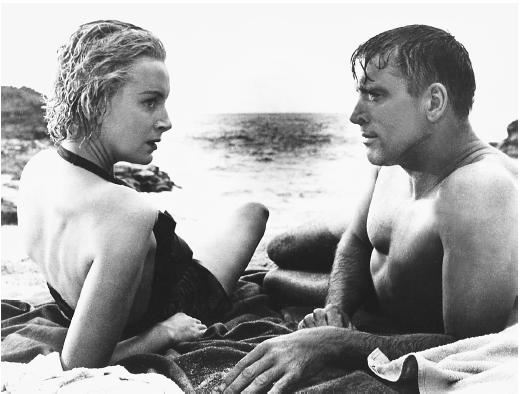
It's interesting to note that with all the people questioning whether it was too soon for films such as United 93 and World Trade Center to tackle the events of 9/11 that From Here to Eternity re-created the attack on Pearl Harbor a mere 12 years after it occurred, albeit as a glorified soap opera. (Actually, movies began referring to the attack on Pearl Harbor within months of December 1941, but I believe this is the first to actually depict the attack.) Thankfully though, Zinnemann was no Michael Bay and the film still has some teeth (and earned Zinnemann his first directing Oscar). Most importantly though, it has great performances from Burt Lancaster, Montgomery Clift, Deborah Kerr, Ernest Borgnine and Frank Sinatra's Oscar-winning turn as the doomed Pvt. Maggio. How Donna Reed won her Oscar I'm not certain. (As Josh R is fond of pointing out, she plays what must be the most virginal prostitute ever put on film.) However, enough remains to make it stand the test of time.
Zinnemann ventured into musicals and he went BIG, i.e. in full-blooded Technicolor, Todd-AO glory transferring this landmark Rodgers and Hammerstein musical to the truly big screen. In a way, Oklahoma! really is
 a stage show that should be opened up since a stage is too limiting for this tale of early settlers. Zinnemann takes true advantage of this with some nice shots, particularly the opening which moves the camera through the stalks of a corn field before coming upon Gordon MacRae singing "Oh, What a Beautiful Mornin.'" While the film is good enough, the importance of its stage version doesn't exactly transfer since Hollywood already had produced its own much better musical originals for the screen (such as Singin' in the Rain three years earlier). Despite that, there is much to admire in the songs and some of the performances, specifically Gloria Grahame's fun turn as Ado Annie. This is the performance that should have earned her an Oscar nomination and/or win, not her blink-or-you'll-miss-it work in The Bad and the Beautiful. Rod Steiger is good as the dark Jud, but his performance (and really the character himself) always has seemed somewhat out of place in what is essentially a musical comedy. Eddie Albert does what he can as Persian peddler Ali Hakim, but he's about as much a Persian as Mickey Rooney was Chinese in Breakfast at Tiffany's. (Well, Albert isn't offensive at least).
You can probably count on one hand the number of films about Catholic priests or nuns that still have them in their religious vocation by the time the film ends, and this bloated work isn't one of them. Audrey Hepburn does her best as the conflicted nun-in-training, but it's really Peter Finch who steals the show as a feisty doctor that Hepburn works with during some missionary work. It's not only an obscenely long film, it's also an eminently forgettable one.

Also too long, but immensely more fun was Zinnemann's next film, with Robert Mitchum and Deborah Kerr struggling to make ends meet in the outback as sheep drovers, with Kerr trying to be the sensible one and Mitchum's gambling spirit always getting the best of him (and their nest egg). She's tired of their wandering ways and wants to settle down, but his rambunctioness always gets in the way. There also are fine supporting performances by Peter Ustinov and Glynis Johns. Still, the cinematography by Jack Hildyard is stunning and there are some great set pieces, particularly a sheep-shearing competition. To say that its Oscar nomination for best picture was more than generous is no understatement.

Zinnemann truly created an odd one with this film that has Gregory Peck (?) playing an exiled Spanish revolutionary and Anthony Quinn as the Spanish official hoping to lure him back to the country to kill him with the news that his mother (Mildred Dunnock) is dying 20 years after the end of the Spanish civil war. Things get complicated further by a young boy named Paco (Marietto Angeleletti) who wants Peck to go back to kill Quinn to avenge his own father's death, but Peck also is torn by a possible traitor within his ranks. Despite the fact that Peck is even a less-convincing Spaniard than Eddie Albert was a Persian, the movie's overriding problem is that it's a world-class bore. It drags on and on to a truly anticlimactic ending. The most interesting thing about it is that it was based on a novel by Emeric Pressburger.
It had been a long time since I'd seen this best picture winner that earned Zinnemann his final two Oscars, one for directing and one for producing, and it plays even better than I remembered. While Robert Bolt's
 screenplay does show its stage origins, Zinnemann has turned this story of Sir Thomas More's stance on principle against the will of King Henry VIII into a sleek, compelling enterprise with the look and feel of an epic but a running time of a mere two hours. Central to the film's success of course is Paul Scofield's Oscar-winning turn as More, but Zinnemann does add a lot of nice touches as well, particularly in the great opening sequence showing the travel of a message from Cardinal Wolsey to More. There's also stunning cinematography by Ted Moore and a top-notch supporting cast that includes Wendy Hiller, Leo McKern, a young John Hurt and Robert Shaw in his Oscar-nominated turn as Henry VIII, which is a much smaller role than I recall. My 1966 Oscar preferences still lean to Who's Afraid of Virginia Woolf? but this film's win is not an embarrassment.
As Fred Zinnemann began his sixth decade as a filmmaker, he turned to yet another genre with this taut thriller starring the cool Edward Fox as a hired gun whose services are employed by embittered former members of the French Foreign Legion to assassinate French President Charles De Gaulle. The story moves on two tracks as Fox, code name The Jackal, pursues his plot and the French authorities, led by Col. Rolland (Michel Auclair) try to determine the killer's identity and to stop him before he is able to act. The film is a bit overlong, but Zinnemann does build quite a bit of suspense, even though we know De Gaulle won't be killed, and Fox is superb as the cold and calculating mercenary.
I saw Julia when it was originally released and I was in grade school, hardly the ideal audience. All I remembered really was that I was bored silly and the scene where a frustrated Lillian Hellman (Jane Fonda)
 tosses her typewriter out a window (I miss typewriters). So, in fairness, I decided I needed to take a new look, hoping that age would make me have a new view on the film the way I did a turnaround on Reds recently. Alas, 30 years later, I find Julia as boring as I did as an elementary school student. Its awards puzzle me more now than they did when I only had vague memories. Fonda at times is pretty bad. Jason Robards in his second consecutive Oscar-winning supporting turn is fine, but really doesn't have anything to do to deserve the prize. Maximilian Schell's presence is so fleeting that his nomination is a headscratcher. What shocked me the most was Vanessa Redgrave. While she is one of our finest actresses, there was more drama and suspense surrounding her nomination and her winning speech than she gets to create in the film itself. This was Zinnemann's final Oscar nomination as director (though he did direct one more film, which I haven't seen), but Julia is a bore. Pure and simple. Despite his less successful works, Zinnemann produced a lot of good and great movies in his time and I still salute him on his centennial.
Tweet
Labels: A. Hepburn, blacklist, Borgnine, Brando, Clift, Cooper, Deborah Kerr, Gregory Peck, Hammerstein, Lancaster, Mary Astor, Mitchum, Robards, Robert Ryan, Rodgers, Sinatra, Van Hefiin, Vanessa Redgrave, W. Hiller
TO READ ON, CLICK HERE


