Tuesday, March 06, 2012
“It’ll get a terrific laugh…”

By Ivan G. Shreve, Jr.
Beginning in the 1930s and continuing well into the mid-'50s on radio (and for a number of years on television afterward), The Jack Benny Program was a “Sunday night at seven” institution for millions of American households. The titular star of the broadcast, a comedian who was practically unique in his insistence on making certain his writing staff received most of the credit for his success, revolutionized humor by, not putting too fine a point on it, becoming the godfather of the modern American situation comedy. His innovations included self-referentially setting the storyline of each week’s show amongst the background of preparing his broadcast, breaking “the fourth wall” and having his “gang” (the program’s supporting characters) get the lion’s share of the laughs poking fun at the star. Above all, Benny masterfully mined humor from pettiness, vanity and miserliness while simultaneous creating a lovable “everyman” that the listening audience couldn’t help but want to hold to its collective bosom.
Benny tried to duplicate his radio and TV success on the silver screen, and though he made a number of entertaining films, the comedian never really was satisfied with the end result. A lot of this had to do with that many of his movies, such as Love Thy Neighbor (1940), Buck Benny Rides Again (1940) and The Meanest Man in the World (1943), were little more than slight variations of the character he played on radio; Neighbor and Buck Benny in particular featuring many of the regulars from his show (Eddie “Rochester” Anderson, Don Wilson, Phil Harris, Dennis Day). On occasion, Jack would get the opportunity to flex his acting muscles in vehicles such as Charley’s Aunt (1941) and George Washington Slept Here (1942) so it shouldn’t be too surprising that Benny considered these movies among his favorites. But Jack — and many others, including myself — always felt his finest hour on film was in a production released to theaters 70 years ago on this date: Ernst Lubitsch’s black comedy classic To Be or Not to Be (1942).
On the eve of the German invasion of Poland in 1939, a Warsaw theater troupe headed up by “that great, great actor” Josef Tura (Benny) rehearses a new anti-Nazi play entitled Gestapo. The troupe’s producer, Dobosh (Charles Halton), is dissatisfied with what he’s watching, arguing that Bronski (Tom Dugan), the actor playing Adolf Hitler, simply ian't convincing as the Fuehrer. In an effort to prove his authenticity, Bronski steps outside to walk among the Warsaw population…and though he gets a few stunned and anxious stares, his cover is blown when a girl timidly asks for his (Bronski’s) autograph.
Later that evening, as the troupe performs Shakespeare’s Hamlet, Josef’s wife Maria (Carole Lombard) entertains a young Polish pilot named Stanislav Sobinski (Robert Stack) in her dressing room. Sobinski is very much in love with Maria, and has been signaled to pay her a nocturnal visit at the moment when husband Josef starts Hamlet’s famed “To be or not to be” soliloquy (naturally, Josef is dismayed when he spots the young airman leaving in the middle of his performance). Maria loves her husband very much but doesn’t dismiss having an innocent flirtation with Stanislav…an “affair” that ends with the news that Germany has invaded Poland and World War II is underway.

Under the thumb of Nazi terror, Warsaw has been reduced to rubble (the theater has been closed and the troupe thrown out of work due to a curfew and other restrictions) but a vibrant Polish underground is determined to throw off the yoke of their oppressors. In England, Sobinski and his fellow pilots spend an evening of singing and revelry in the company of a Polish resistance leader, Professor Alexander Siletsky (Stanley Ridges), who generously offers to get word to the pilots’ families. Stanislav tells Siletsky that while his own family is safely out of Poland, he would like the professor to deliver a message to Maria: “To be or not to be.” But he is troubled by the fact that Siletsky — who claims to be a lifelong resident of Warsaw — is unfamiliar with Maria Tura, and after the professor starts off for Poland, Sobinski relates the incident to his superiors (Halliwell Hobbes, Miles Mander). Both men, having realized that the information on the pilots’ families would be vital to the Nazis even if Siletsky weren’t a spy, instruct Sobinski to fly to Warsaw immediately and stop the professor.
Shot down over Warsaw, Stanislav sends Maria to rendezvous with his contact, a bookseller, while he recuperates after nearly being shot by Nazi soldiers. Josef returns home and finds the young pilot in his bed (and wearing his pajamas), is naturally curious as to what Stanislav is doing there. He receives a hurried (and incomplete) explanation from Maria, who arrives in time to tell the two men that she was picked up by Nazi soldiers and taken to Siletsky’s hotel. Siletsky arrived in Warsaw before Sobinski, and after having delivered the pilot’s message, approaches Maria about joining the Nazi cause. Despite being confused by the events, Josef realizes that he needs to stop Siletsky (by killing him) before the professor delivers the information to the Nazi command: he may be angry about being cuckolded, but he still ia a patriot at heart.
Maria returns to the professor’s hotel, where she pretends to seduce Siletsky…but they are interrupted by a member of the theater troupe (George Lynn) disguised as a Nazi officer. The faux officer informs Siletsky he has an appointment with the head of the Gestapo — who also is a fake: it’s Josef in disguise. His mission is to wrest the information on the Polish underground away from Siletsky and then dispose of him…but learns during the course of their conversation that the professor has a duplicate copy of the information in a trunk back at his hotel. Stanislav and the theater group frantically try to think of a plan to obtain that extra copy but before they can formulate anything Siletsky concludes that he’s been duped by Tura. In his escape attempt from the theater, he is killed by Sobinski.
Josef must now impersonate Siletsky — and returning to the hotel, he attempts to destroy the duplicate information but is interrupted by the arrival of another Nazi officer. Captain Schulz (Henry Victor), adjutant of the Gestapo head Tura impersonated earlier, takes Tura-as-Siletsky to Colonel Ehrhardt (Sig Ruman), the genuine article. Josef is able to do some fast thinking to avoid spilling any information (identifying men who already have been shot as resistance leaders), and during this conversation he learns that Hitler himself will be visiting Warsaw the next day.
The body of the real Professor Siletsky is found in the theater the next morning…which is unfortunate for Josef, as he still is continuing his impersonation. Arriving at Ehrhardt’s office, he is ushered into a room and asked to wait until Ehrhardt has finished an appointment with two other officers. Inside the room is the corpse of Siletsky, but Tura manages to shave off the dead man’s beard and attach a false one…thus making Ehrhardt and his men think the deceased professor actually was an impostor. But when several theater members, led by hammy actor Rawitch (Lionel Atwill) in disguise, burst in and blow Tura’s cover in order to spirit Josef away from his captors, Tura and company realize it will only be a matter of time before they are rounded up by the Germans.
To escape out of Poland, Josef and his actors concoct a diversion, with Bronski in the part of Hitler and his friend Greenberg (Felix Bressart) as a defiant Jew who interrupts the Fuehrer’s appearance at the theater; the theater company and Stanislav then steal the Nazis’ transportation and head for the airport, stopping off at Maria’s just in time to rescue her from the advances of an amorous Ehrhardt. Our heroes are successful in their flight from Warsaw and land safely in Scotland, where that evening, Josef and his fellow thespians put on a production of Hamlet…and all goes well until “To be or not to be…”

The director of To Be or Not to Be, Ernst Lubitsch, was admired and respected by his peers, critics and audiences both when he was making films and long after his death in 1948. Lubitsch specialized in urbane romantic comedies that reeked of elegance and sophistication with just a touch of the risqué (daring but never smutty) that artfully avoided any complications with the Motion Picture Code, and earned his directorial style the nickname “the Lubitsch touch.” Lubitsch didn’t take a writing credit on To Be (the honor goes to Edwin Justus Mayer, based on a story by Melchior Lengel) but he devised the character of Josef Tura with Jack in mind, joking that every comedian’s dream is “to play Hamlet.” Benny would later reminisce about the experience in saying he worked well with Lubitsch because the director told him to forget everything about acting (“which wasn’t too difficult,” he cracked) and just follow his lead as Ernst acted out every gesture and vocal inflection for Benny’s benefit. “He was a lousy actor, but a great director,” was Jack’s final verdict.
What’s wonderful about watching Benny play Tura is that both the character and Jack’s radio persona share some similarities: the vanity, the hamminess (whenever Jack would do a spoof of a current movie on his show he always made sure he got the largest role) and that lovable schlemiel that resides in a world where everything terrible seems to happen to him. And yet there are differences: Tura is way out of his league playing spy, but he’s able to screw up his courage and risk certain death to help Sobinski (the man playing around with his wife) stop a dangerous man who threatens the lives of the people of Warsaw. He’s ready to fight on behalf of his country, and demonstrates tremendous courage in doing so.
The part of Maria Tura was originally conceived as a comeback role for actress Miriam Hopkins — Hopkins had worked with Lubitsch before in the vehicles Trouble in Paradise (1932) and Design for Living (1933), and in the pre-production stages of To Be or Not to Be was anxious to let the director lift her career out of its slump. But Hopkins didn’t want to work with Benny, and so her departure attracted the interest of Carole Lombard…who, despite resistance from Lombard's husband, Clark Gable, wanted very much to work with Lubitsch (and she’d also get to work alongside Robert Stack, who had been a friend of hers for many years since he was a teenager). After completing the film, Lombard would later tell friends that it was the most satisfying experience of her career…and the proof is up on the screen. Her performance as Maria is positively luminous; she simultaneously gives the character both a playful and ethereal quality — a woman deeply in love with her husband and yet naughty enough to stray a little from the fold when opportunity presents itself. Benny had nothing but the utmost affection for his co-star, whom he really got to know during their time on the movie — he later told friends: “She was one of the few gals you could love as a woman, and treasure as a friend.”
Sustaining Benny and Lombard is an outstanding “troupe” of supporting performers that include Stack, Bressart, Atwill, Ridges, Ruman and Dugan — none of these amazing actors hit a false note in their portrayals, and deliver Lubitsch and Mayer’s sparkling dialogue to perfection. Critics at the time of To Be's release lambasted Lubitsch for allowing the heroes to be nothing but a disparate group of actors…but I think it’s a brilliant concept: Josef and his friends are the only ones with ego enough to pull one over on the arrogant Nazis. And that screenplay! So many quotable passages of delicious double entendres that exemplify “the Lubitsch touch”:
MARIA: It's becoming ridiculous the way you grab attention. Whenever I start to tell a story, you finish it. If I go on a diet, you lose the weight. If I have a cold, you cough. And if we should ever have a baby, I'm not so sure I'd be the mother.
JOSEF: I'm satisfied to be the father.
MARIA: Tell me about yourself.
SOBINSKI: Well, there isn't much to tell. I just fly a bomber.
MARIA: Oh, how perfectly thrilling!
SOBINSKI: I don't know about it being thrilling. But it's quite a bomber. You might not believe it, but I can drop three tons of dynamite in two minutes.
MARIA: Really?
SOBINSKI: Does that interest you?
MARIA: It certainly does.
SOBINSKI: You see, sir, the other night Professor Siletsky was addressing us at the camp, and I mentioned the name of Maria Tura…and he never heard of her.
ARMSTONG: Neither have I.
SOBINSKI: Oh, but, he's supposed to be a Pole who lived in Warsaw and she's the most famous actress in Warsaw.
ARMSTONG: Now, look here, young man, there are lots of people who're not interested in the theater. As a matter of fact, there's only one actress I ever heard of…and I certainly hope I'll never hear from her again.
JOSEF: It's unbelievable! Unbelievable! I come home to find a man in the same boat with me and my wife says to me, "What does it matter?"
SOBINSKI: But, Mr. Tura, it's the zero hour!
MARIA: You certainly don't want me to waste a lot of time giving you a long explanation.
JOSEF: No, but I think a husband is entitled to an inkling.
JOSEF: Her husband is that great, great Polish actor, Josef Tura. You've probably heard of him.
EHRHARDT: Oh, yes. As a matter of fact I saw him on the stage when I was in Warsaw once before the war.
JOSEF: Really?
EHRHARDT: What he did to Shakespeare we are doing now to Poland.
That last line caused a little bit of concern among critics, who steadfastly argued that poking fun at a serious situation made Lubitsch guilty of cinematic high crimes and misdemeanors. My favorite line from To Be or Not to Be is one that doesn’t seem particularly funny at first hearing (in fact, it might make some viewers wince): posing as Ehrhardt, Josef responds to flattery from Professor Siletsky with the phrase “So they call me ‘Concentration Camp’ Ehrhardt…?” But as Josef desperately tries to stall for time while Sobinski and the rest of the actors dope out a way to retrieve vital documents from the spy’s hotel room, he begins to nervously repeat the phrase over and over again until it almost becomes a mantra…and it makes me laugh out loud every time I hear it.

With all these elements — solid script, first-rate cast, great director — you’d naturally assume that To Be or Not to Be cleaned up at the box office, correct? Well, it didn’t. Lubitsch’s WW2 satire had the misfortune of being released during World War II, and theatergoers didn’t particularly warm to a film that poked deadpan fun at such a serious conflict. With hindsight, we can see the brilliance of the movie — Lubitsch’s film has witty moments, to be sure, but it also contains sequences of nail-biting suspense (witness Sobinski’s arrival in Warsaw after temporarily escaping his Nazi pursuers, not to mention the tense scenes where Maria is literally being held prisoner in Siletsky’s hotel room). The director’s intention was to satirize both the Nazis and their ideology, but as George S. Kaufman famously observed, “Satire is what closes on Saturday night.” The moviegoing public simply wasn’t ready for a daring film that was able to find humor in a situation that seemed devoid of same — and a prime example of this sort of patron was Jack’s father, Mayer Kubelsky. Kubelsky went to see To Be or Not to Be…and horrified that his son was not only wearing an SS uniform but giving out with a “Heil Hitler!” in the opening scenes; he stormed out of the theater and refused to speak to his Jack. (When Jack finally convinced his father that his character was merely performing in an anti-Nazi play in the movie’s opening and that he was really the film’s hero, Mayer went back to see the movie again and again…and again. Like his famous son, it would become his favorite.)
But theatergoers also found it impossible to laugh when the movie’s female star, Carole Lombard, was killed in a plane crash about two months before the film’s premiere (she was on a World War II bond rally tour with her mother, Bess Peters, and Otto Winkler, husband Clark Gable’s press agent). Co-star Benny was devastated by Lombard’s untimely death, and refused to do his regularly scheduled program that following Sunday, substituting an all-musical half-hour. Because the actress had a line in the film — “What can happen in a plane?” — in response to Stack’s invitation to take a spin in the wild blue with him, the line was cut before the movie’s premiere (it since has been restored).
To Be or Not to Be ranks only behind Twentieth Century (1934) as my favorite Carole Lombard film, but it’s certainly my favorite of Jack Benny’s cinematic output; Jack never got another opportunity to extend his thespic range and after The Horn Blows at Midnight in 1945 (a film that he and his writers lampooned in endless jokes on his radio/TV show despite the fact that it wasn’t that bad) he limited his screen appearances to brief cameos such as It’s a Mad, Mad, Mad, Mad World (1963) and A Guide for the Married Man (1967). (He had planned to return to movies with a substantial part in The Sunshine Boys, but upon his death in 1974 his role was given to his lifelong friend George Burns). To Be is also my favorite Lubitsch film; a work of such maturity and pitch-perfect hilarity that I want to warn you: do not make the same mistake I did in watching the 1983 remake before seeing the Lubitsch version. (In all honesty, I didn’t have a choice — the Lubitsch film rarely got shown in those halcyon days before TCM). The more recent version with Mel Brooks and Anne Bancroft, heartfelt tribute though it may have been, is much too broad and slapsticky in its burlesque approach (it’s almost like watching a stage play)…and most assuredly lacks the subtlety of “the Lubitsch touch.”
Tweet
Labels: 40s, Bancroft, Gable, Jack Benny, Lombard, Lubitsch, Mel Brooks, Movie Tributes, Remakes, Shakespeare
TO READ ON, CLICK HERE


Thursday, December 15, 2011
“Sitzen machen!”

By Ivan G. Shreve, Jr.
The very first Billy Wilder film I watched as part of my burgeoning film education wasn’t one of his acknowledged classics such as Double Indemnity (1944) or Sunset Blvd. (1950) — or even Some Like it Hot (1959) or The Apartment (1960) but a movie I consider “second-tier” Wilder, the 1961 Cold War comedy One, Two, Three. Keep in mind that I don’t refer to the film as second-tier because I dislike it or am trying to denigrate the work; it’s just that with the passage of time, the topicality of One, Two, Three hasn’t particularly worn well, something that I’ve also noticed in Ninotchka (1939), a Wilder-scripted comedy (but directed by Ernst Lubitsch) whose plot and themes are revisited in the later feature. (One, Two, Three also contains echoes of the filmmaker’s earlier Sabrina, the 1954 romantic comedy starring Audrey Hepburn, Humphrey Bogart and William Holden.)
The dated political content of One, Two, Three doesn’t do it any favors, but this is nevertheless going to be an enthusiastic review of a film that debuted in motion picture theaters 50 years ago on this date. “Second-tier” Wilder is miles and away better than the best movie helmed by any director today, and with his longtime partner I.A.L. “Izzy” Diamond, Billy crafted a fast, frenetic and funny farce (based on a 1929 play, Egy, kettö, három, by Ferenc Molnár) that still can leave an audience breathless with laughter. The icing on this cinematic cake is that, before he returned briefly to movies for Ragtime in 1981, One, Two, Three served as the penultimate cinematic swan song for the legendary James Cagney.
C.R. “Mac” MacNamara (Cagney) is head of operations for Coca-Cola in West Berlin, a month or two before the closing of the Brandenburg Gate (and subsequent construction of the Berlin Wall). Company man Mac is extremely loyal to the Pause That Refreshes, and has been working diligently to advance himself, with an eye on assuming the post of European operations in London by shrewdly brokering a deal to introduce the soft drink to the Soviet Union. (Mac was formerly in charge of Coca-Cola’s interests in the Middle East but a mishap involving Benny Goodman resulted in Mac’s demotion after the bottling plant was destroyed in a riot.) He’s scheduled to meet Soviet representatives Peripetchikoff (Leon Askin), Borodenko (Ralf Wolter) and Mishkin (Peter Capell) to discuss introducing the soft drink behind the Iron Curtain, and is juggling that conference with plans to further his “language lessons” with luscious secretary Fräulein Ingeborg (Lilo Pulver).
The roguish MacNamara is planning to take advantage of his wife Phyllis’ (Arlene Francis) scheduled trip to Venice with their two children to dally with Ingeborg, but those plans are put on hold when Mac receives a call from his boss, Wendell P. Hazeltine (Howard St. John), in Atlanta. Hazeltine’s daughter Scarlett (Pamela Tiffin) is en route to Berlin, and he’s entrusted Mac to keep close tabs on her since Scarlett is a bit of a shameless flirt (despite being only 17). As an example of her hot-blooded tempestuousness, Mac and Phyllis meet her at the airport just in time to find her awarding herself as a lottery prize to the flight crew (the winner is a man called Pierre, prompting Phyllis to dub him “Lucky Pierre”). What starts out as a two-week assignment stretches into two months, but Mac is pleased that he’s keeping Scarlett on a tight leash.

On the day before the Hazeltines travel to Berlin to collect their daughter, Scarlett turns up missing. Mac learns from his chauffeur (Karl Lieffen) that the girl has been bribing him to let her off at the Brandenburg Gate every night to allow her to cross the border into East Berlin. Devastated by this news, MacNamara expresses relief when Scarlett turns up at his office, but then is hit by a streetcar when she announces that she’s been spending all her time with an East German Communist named Otto Ludwig Piffl (Horst Buchholz), whose political philosophy fills Mac with utter revulsion. The problem for Mac is that the fling between Otto and Scarlett has gone beyond mere puppy love — they tied the knot in East Berlin — something that will no doubt go over with her parents like flatulence at a funeral. The devious MacNamara arranges for the young Commie to be picked up by the East German authorities after they find a “Russkie Go Home” balloon affixed to his motorcycle’s exhaust pipe and a cuckoo clock (that plays “Yankee Doodle” on the hour) wrapped in a copy of The Wall Street Journal in his sidecar.
Mac’s machinations even go as far as to arranging for the couple’s marriage license to disappear from the official record, and he gloats about his triumph to a furious Phyllis, who has finally had enough of her husband’s neglect of their marriage in his pursuit of Coke advancement. The popping of champagne corks is put on hold when Scarlett faints after hearing of Otto’s arrest. An examination by a physician reveals that the girl has a Communist “bun in the oven!” Racing against an ever-ticking clock before the Hazeltines touch down in Berlin, Mac manages to spring Otto and then embarks on an extreme makeover of the hostile Bolshevik to transform him into someone whom Scarlett’s parents will approve. Against all odds, McNamars’s scheme comes off without a hitch, but his dreams of taking over as head of Coke’s European office are dashed when Hazeltine announces the job will go to his new son-in-law! Kicked upstairs to a position in the home office in Atlanta, Mac will reconcile with Phyllis and will hopefully live happy ever after.
Because the emphasis in Ninotchka is primarily on the romance between stars Greta Garbo and Melvyn Douglas, that film hasn’t dated nearly as badly as One, Two, Three, whose jibes at Cold War politics make it more of a period piece, and is likely to appeal mostly to the history majors in the audience. (Wilder’s cynicism also comes to the fore in this film in that you never really believe the romance between Scarlett and Otto. They have to stay married because there’s a “bouncing baby Bolshevik” on the way.) But if you’re able to put its topicality on a back burner, there is much to enjoy in the film; it is a spirited farce, buoyed by the participation of Cagney as the main character of C.R. MacNamara. Mac is a typical Wilder hero: not the most admirable man (he’s cheating on his wife and comes across as a bit of a jerk) but an individual who rises to the occasion when faced with a crisis. Cagney, whose screen performances were usually marked by his established persona as a fast-talking wise guy, is a marvel to watch in this film, barking out orders and, in the words of a reviewer for Time magazine, “swatting flies with a pile driver.”
Cagney did not have an easy time making the film. He was no spring chicken at the time of its production, and having to spout Wilder’s rat-a-tat dialogue at a furious pace was often difficult, particularly in one scene where the director insisted on Jimmy’s completing it in one take. Cagney was tripped up continually by the line, “Where is the morning coat and striped trousers?” It was never explained to his satisfaction why Billy refused to let him paraphrase the dialogue, and so it took 57 takes to get it done (which might explain why the finished product comes off as a little mechanical). Cagney also was not enamored of co-star Buchholz and his scene-stealing antics; Jimmy had experienced a similar incident when making Yankee Doodle Dandy (1942) and had trouble with character actor S.Z. “Cuddles” Sakall upstaging him in a scene, but he overlooked it because Sakall “was an incorrigible old ham who was quietly and respectfully put in his place by [director] Michael Curtiz.” But if Wilder hadn’t exercised his director’s prerogative and discouraged Horst to stop with the same, Cagney “would have been forced to knock him on his ass, which I would have very much enjoyed doing.”
All in all, the experience of making One, Two, Three drained Cagney and made him realize that he’d rather be enjoying retirement, and upon the movie’s completion, the actor settled in for a second career as a gentleman farmer (though he did narrate a TV special and a 1968 Western, Arizona Bushwhackers, in the interim). He was coaxed out of retirement for a small role in Ragtime in 1981 (as the police commissioner, his last big-screen appearance and a final reunion with his longtime chum/movie co-star Pat O’Brien), and an additional role in a 1984 TV movie Terrible Joe Moran where he played a retired boxer forced to used a wheelchair, but still a fighter to the core. Having suffered a stroke affected Cagney's performance somewhat and it was the final project before his passing in 1986.
In watching One, Two, Three, it almost seems like Wilder and Diamond presciently knew it would be James Cagney’s last significant silver screen work, what with all the in-jokes and references pertaining to the actor sprinkled throughout. There’s the aforementioned cuckoo clock (Cagney’s best actor Oscar was awarded for his role as George M. Cohan in Dandy), but there’s also a scene in which Jimmy picks up a grapefruit half and moves menacingly toward Buchholz’s Otto (shades of The Public Enemy!) and a funny cameo by Red Buttons as an Army MP who imitates Cagney while having a conversation with Jimmy’s MacNamara. Of course, the self-referential jokes are a staple of Wilder’s film comedies; at one point in the movie Cagney cries out “Mother of mercy, is this the end of little [sic] Rico?” as a nod toward Edward G. Robinson’s memorable last line in Little Caesar (something Billy also did in Some Like It Hot, in which George Raft asks a coin-flipping Edward G. Robinson, Jr., “Where’d you pick up that cheap trick?”).
Wilder also recycled a line used by Bogart in Sabrina, “I wish I were in hell with my back broken” (a variation of this also turns up in Wilder’s Five Graves to Cairo) and in fact, borrowed Sabrina’s “switcheroo” ending (right down to the hat and umbrella) and use of the song “Yes, We Have No Bananas” (only it’s sung in German in One, Two, Three). Music is at the center of many of the gags in the film; in addition to “Bananas,” comic set pieces use Aram Khachaturian's “Sabre Dance” (the main theme that accompanies MacNamara’s breakneck activities, described by Wilder and Diamond to be played “110 miles an hour on the curves…140 miles an hour on the straightways”), Richard Wagner’s “Ride of the Valkyries” and Brian Hyland’s “Itsy Bitsy Teenie Weenie Yellow Polka Dot Bikini.”

Though watching Cagney go through his paces is the main draw of One, Two, Three, his co-stars also rise to the occasion. Arlene Francis is probably best known as a panelist on the longtime TV show What’s My Line?, but she provides solid support as the acid-tongued, long-suffering Phyllis (“Yes, Mein Führer!”). The real-life antagonism Cagney had for Buchholz works to the film’s advantage, of course, but Horst has a certain goofy charm that makes his Otto likable despite his political leanings, and Pamela Tiffin is delightful as the ditzy Scarlett — many a classic movie buff has wondered why, despite high-profile showcases in films such as Summer and Smoke (1961) and Harper (1966), Tiffin’s film career never reached its full potential. Fans of Hogan’s Heroes will recognize Leon Askin as Comrade Peripetchikoff, but you can also hear Askin’s fellow Hogan player John “Sgt. Schultz” Banner as the voice of two of the characters in the film — in fact, when I watched One, Two, Three the other day, it was the first time I noticed that the voice for Count von Droste Schattenburg (the aristocrat who “adopts” Otto, played by Hubert von Meyerinck) is dubbed by character great Sig Ruman!
Jules White, the head of Columbia Studios’ comedy shorts department, once described his directorial style as “mak(ing) those pictures move so fast that even if the gags didn’t work, the audiences wouldn’t get bored.” Wilder and Diamond upped that ante with One, Two, Three; the film not only moves at lightning speed, the gags remain funny today. (My particular favorite has MacNamara calling one of the Russians “Karl Marx,” and when the comrade gives Fräulein Ingeborg a generous swat on her fanny, he quips, “I said Karl Marx not Groucho.”) In Cameron Crowe’s book Conversations with Wilder, the legendary writer-director observed: “The general idea was, let's make the fastest picture in the world…And yeah, we did not wait, for once, for the big laughs. We went through the big laughs. A lot of lines that needed a springboard, and we just went right through the springboard…” The film may not have been a box-office smash (both in the U.S. or Germany) but the final gag left an impression on me when I first saw it as a kid (“Schlemmer!”), and 50 years later watching the great Jimmy Cagney rush pell mell through farcical circumstances beyond his control remains a Wilder devotee’s delight.
Tweet
Labels: 60s, A. Hepburn, Bogart, Books, Cagney, Curtiz, Edward G., Garbo, Holden, Lubitsch, Movie Tributes, Nonfiction, Oscars, Raft, Television, Wilder
TO READ ON, CLICK HERE
Monday, August 29, 2011
"There is a vast difference between curing an ailment and making a sick person well"


By Edward Copeland
Joseph L. Mankiewicz accomplished something in 1949 and 1950 that has never been equaled in Oscar history: He won the awards for directing and writing in two consecutive years. John Ford also had won directing Oscars in consecutive years, but no one had won for both directing and writing as Mankiewicz did for A Letter to Three Wives and the incomparable All About Eve. That would be an impressive one-two punch for any filmmaker (and between those two films he co-wrote and directed the solid 1950 suspense drama No Way Out starring Richard Widmark and Sidney Poitier in his film debut) but in 1951, Mankiewicz made another great film, one that gets better each time I see it. Adapted from the play Dr. Praetorius by Curt Goetz, Mankiewicz wrote and directed People Will Talk, which was released 60 years ago today. It didn't receive any Oscar love, but it does contain one of Cary Grant's very best performances and aches to be re-discovered by film buffs or seen for the very first time by those who haven't.
Compared to Mankiewicz's previous two films, People Will Talk defies categorization at just about every step of its story. Though those title cards shown in screenshots above indicate that this will be the story of Dr. Noah Praetorius, we won't meet him in the form of Cary Grant right away. The first person we see is none other than the Wicked Witch of the West herself, Margaret Hamilton, sitting on a bench in a hallway. A man (Hume Cronyn) comes walking down the hall when the woman addresses him as Professor Elwell. He responds, though he doesn't know who she is. It soon becomes clear that she is Sarah Pickett, a woman he's been expecting from a detective agency. Professor Rodney Elwell unlocks his office door and invites her inside. The dialogue between the pair implies that we're definitely in store for a comedy.

PICKETT: If I come in, does the door stay closed?
ELWELL: Naturally.
PICKETT: Then I don't come in.
ELWELL: Why not?
PICKETT: You know why not. You're grown up.
ELWELL: My dear Mrs. Pickett —
PICKETT: Miss Pickett — and don't butter me up.
ELWELL: I have conducted my affairs behind closed doors for 20 years.
PICKETT: Not with me.
ELWELL: You overestimate both of us.
Miss Pickett joins Elwell in his office and the door remains open as the medical professor begins quizzing Miss Pickett about whether she knew a man named Praetorius in her hometown of Goose Creek. Yes, Pickett says, "He was a doc.…He healed people," Dr. Elwell asks how he did that. "If I knew how I'd be a doc myself," she replies, telling Elwell that he saved her grandmother. Elwell assumes that the old woman must have passed by now, but Miss Pickett says she's still alive. He asks her grandmother's age. "103, but I think she's lying," Pickett responds. "She's 108 if she's a day." She tells Elwell that her grandmother lay down to die four times and each time, Dr. Praetorius got her back up on her feet. Elwell inquires about the methods of this "miracle man." "Well, some healers use one thing, some use another, but Doc Praetorius used 'em all," she tells him. Elwell shows her a book of faculty members and points to a photo of Praetorius (our first glimpse of Grant) and Pickett positively identifies him, though she says he looked younger then. He asks Miss Pickett if Praetorius was a university-trained doctor.
PICKETT: When you say doctor, do you mean school doctor, out of books?
ELWELL: That is precisely what I mean.
PICKETT: Can't say. For my part I wouldn't get caught dead in a room with one of 'em.
ELWELL: Miss Pickett, I am a school doctor, out of books.
PICKETT: That's one reason why the door is open.
A student (George Offerman Jr.) interrupts the meeting to remind the professor that he's late for his anatomy class that Elwell asked Dr. Praetorius to attend. Elwell tells him to deliver the message that he's been
 unavoidably delayed. After the student leaves, he asks Miss Pickett what more she knows. Suddenly, Pickett looks around and she shuts the door. "You're a professor. It's hard to make you understand anything that ain't in the books. Well, most of what goes on in the world ain't in books." Elwell's skepticism is quite palpable. He then asks what she knows of a man named Shunderson. "I didn't know very much. Nobody did," she says with a shiver, though she admits they used to call him "The Bat" before she changes the subject, reminding him that Sergeant Canton of the detective agency that found her mentioned Elwell might have a job for her. This is a rare dropped ball in People Will Talk. It's implied that Elwell wants to plant Pickett as a housekeeper to spy on Praetorius, but her character never appears again. We really have no idea where this film is heading at this point. Is it a comedy? A mystery? As usual in a Joseph L. Mankiewicz screenplay, the dialogue comes full of gems, but since it's not an original screenplay, how much originated in the play, though it was written in German?

As we finally leave Elwell and Miss Pickett, we arrive in the lecture room of Professor Elwell's anatomy class. The infamous Dr. Noah Praetorius stands playing with the class' skeleton with his mysterious friend Shunderson (Finlay Currie) standing behind him. Praetorius keeps moving the jaw of the skull and wonders out loud, "Why should a man die and then laugh for the rest of eternity?" The student who had interrupted Elwell's meeting comes in and the doctor addresses him as Uriah and asks what he knows about Elwell. "He regrets exceedingly that he is unavoidably detained," Uriah tells him. "A meaningless phrase which could signify anything from oversleeping to being arrested for malpractice," Praetorius replies. The doctor walks to a table at the center
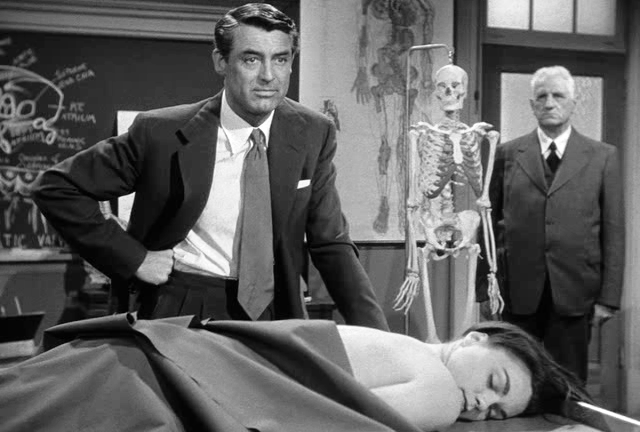 of the room where a corpse lies under a sheet. "I would be quite unable to give the lecture you came to hear and I'm not sure you should hear the lecture I'd like to give," Praetorius tells the students who all clamor, fearful he's going to leave without saying anything. Obviously, the doctor's reputation has made him a figure of fascination among the aspiring physicians and they'd be willing to hear him talk about anything. He asks them to get out their notebooks and uncovers the body, which turns out to be that of a very young woman. He gingerly strokes her long brown hair as he explains to the class, "Anatomy is more or less the study of the human body. The human body is not necessarily the human being. Here lies a cadaver. The fact that she was, not long ago, a living, warm, lovely young girl is of little consequence in this classroom. You will not be required to dissect and examine the love that was in her — or the hate. All the hope, despair, memories and desires that motivated every moment of her existence. They ceased to exist when she ceased to exist. Instead, for weeks and months to come, you will dissect, examine and identify her organs, bones,
 muscles, tissues and so on, one by one. These you will faithfully record in your notebooks and when the notebooks are filled, you will know all about this cadaver that the medical profession requires you to know." Following the doctor's introduction, a young lady (Jeanne Crain, one of the wives in Mankiewicz's A Letter to Three Wives) sitting among the students starts to flutter before she falls into the aisle. The students swarm her until Praetorius clears them away, saying, "A group of Cub Scouts would know better than to crowd like this." He asks if she's ever fainted before, but she says no. She says she's feeling better and the doctor gives her a piece of hard candy and asks another female student to escort her to the bathroom to splash some water on her face. Praetorius has grown impatient and decides to leave, bumping into Professor Elwell at the door. Elwell again apologizes for his delay. Praetorius says that Elwell wanted to ask him something about a tumor. "A malignant dysgerminoma," Elwell responds. "Professor Elwell, you are the only man I know who can say 'malignant' the way other people say 'Bingo!'" Praetorius tells his tardy colleague, unaware of Elwell's investigation into his past. The doctor and Shunderson leave with Praetorius' clinic as their destination.
At this point, a viewer still would be unclear where this story is heading, especially with the added presence of the large, mostly silent Shunderson usually near Praetorius' side. However, once we get to Praetorius' private
 clinic, which really functions more like a full-fledged hospital, the plot will start spinning in more directions. As I wrote earlier, I have no familiarity with the Curt Goetz play upon which it was based. Goetz began his career in Germany as a performer in silent films, including one directed by Ernst Lubitsch in 1918. He also began writing plays. In 1939, he went to Hollywood to try to get into filmmaking there, but got frustrated by the system and moved to Switzerland in 1945 (since he was Swiss by birth) and wrote some novels. His play Dr. Praetorius originally was written in Germany in 1934. The first English translation was called How to Die Laughing, was in seven acts and while it has some similarities to People Will Talk, the synopsis sounds quite different and even brings Sherlock Holmes and Dr. Watson into the tale. In 1949, Goetz co-directed with Karl Peter Gillmann a German-language version called Frauenarzt Dr. Prätorius that sounds exactly like People Will Talk, has Goetz himself playing the title role and is described as a "melodramatic comedy." That's probably as good a description as any of Mankiewicz's People Will Talk, which may be as idiosyncratic a film as he (or Cary Grant for that matter) ever made.
When we do get to the clinic, we do get more of a sense of what kind of doctor Noah Praetorius is and what the opening title cards meant when they said if he didn't exist, he should. If that were the case in the early 1950s, it's been multiplied exponentially by 2011. No sooner does he walk in the door that he starts getting hit by nurses and other staff with problems. One nurse informs him that a woman about to be discharged wants to take her gall bladder home with her. Praetorius finds that sweet and tells her to let her. The nurse says he knows they don't keep them after they are removed but the doctor guesses that the woman has no idea what her gall bladder looked like so just get another and "send her home happy." A bean counter talks to him about the costs of the hours for the kitchen staff and they should consider cutting back in terms of the patients' food. (That one is out of my life experience where one for-profit hospital I stayed at wanted to get their kitchen staff out early and served horrendous food out of a box for dinner.) Praetorius tells her that he has "the firm conviction that patients are sick people, not inmates." He then checks in on an older patient (Julia Dean) who doesn't look well and obviously is depressed about her condition.

PATIENT: I was thinking it's not much fun when you get old.
PRAETORIUS: It's even less fun if you don't get to be old.
PATIENT: I want to die.
PRAETORIUS: You'd like that, wouldn't you? Lie around in a coffin all day with nothing to do.
A nurse brings the good doctor a report on the final patient of the day and he asks her to show Mrs. Higgins into his office. She enters and it is the woman who fainted in class. Praetorius tells her the good news that
 there's absolutely nothing wrong with her and she can continue her studies, at least for a while. She confesses that she's not a medical student. She was just sitting in on the class to see him. Mrs. Higgins, who tells him to call her Deborah, shows signs of relief until Praetorius asks if she'll make a follow-up appointment or would she be getting her own obstetrician. Deborah breaks down, confusing the doctor, until he realizes that while she may be pregnant, he'd been mistaken to assume she was married. He inquires about the father, but she tells him that he's out of the picture. It seems he was called up to serve in Korea, which led to their coupling, and promptly got himself killed soon after arriving overseas. The doctor attempts to calm her, but Deborah isn't just worried about the shame unwed mothers faced at that time but she's convinced the news will kill her father. Praetorius tells her that parents can surprise you and be very understanding when you least expect it. Deborah insists her father is the most gentle, understanding man in the world, but his heart would be unable to take it.
After Praetorius has at least dammed the flow of Deborah's tears, she hastily exits. His receptionist returns and he asks if Deborah made another appointment but she informs her boss that she did not. The words have
 barely left her mouth when a shot is heard. Shunderson joins Praetorius in the hallway as does a nurse where they find a sprawled Deborah, derringer in hand. Miss Higgins is rushed into surgery and after much work, appears to be out of danger. Shunderson enters the operating room as Praetorius removes his surgical garb. "It's a good thing that most people don't have the foggiest notion where the heart is," the doctor says. "She missed it by a mile." Shunderson takes that to mean that her suicide attempt failed which Praetorius confirms. "Then she'll try again," Shunderson declares, giving Praetorius pause and a look of concern. At any rate, Miss Higgins will be out for awhile and Praetorius has an appointment to make. As if the doctor didn't have enough on his plate, he's also the conductor for the university's student-faculty orchestra and it's practice night.
Among the members of the orchestra is Praetorius' closest friend on the university's faculty — physics Professor Lyonel Barker (Walter Slezak) — who plays the bass violin in the orchestra, often to Praetorius' frustration. After the practice has finished, Barker asks Praetorius to stay behind because he needs to speak with him.
 Despite their playful bickering during rehearsal, Barker asks Noah if he considers him a trusted friend. Of course, Praetorius says. "Therefore I have the right to point out to you that there are occasions when you behave like a cephalic idiot," Barker tells him. He warns Praetorius that he's heard that Professor Elwell has been snooping around his past in the hopes of making a case with the university out of it. Praetorius doesn't seem concerned, but Barker admits that there are things about his past that even he doesn't know. Noah asks the physics professor if he told him everything there was to know about him, would it affect their friendship? Barker says not in the least. Noah pats Barker on the knee. "I know it's not much to have a friend who knows all about you but one who's afraid he's not quite sure, that's worth having," Praetorius smiles. He tells Barker not to worry, but he needs to drop by the clinic to check on a patient but tells his friend to drop by his house for a late supper when he returns from the clinic.

With Shunderson's words still echoing in his mind, Praetorius pays a visit to the recovering Deborah and tells her a whopper of a lie. He says they discovered that a lab error accidentally switched labels on two pregnancy tests being run at the same time and hers actually was negative while another woman's was positive. She therefore has no reason to be concerned. It still turns on the waterworks anyway. He asks her why she's crying now, but she says he wouldn't understand. He wishes her goodnight and tells her to rest because she has nothing to worry about now. When he gets home, he tells Barker what he did. The physics professor says he has to know that it's just a stall and she will learn the truth eventually. Noah says that he realizes that, but if he can ease her mind until perhaps he can talk to her father, things will be better. Barker's mind wanders off subject as he raves about how good the sauerkraut is, saying it reminds him of home. Praetorius lets him on his secret: He has his housekeeper make it. "Sauerkraut needs to come from a barrel, not a can," the doctor declares. He promises to send some home
 with Barker, but it's taken Praetorius' mind off subject as well to a pet peeve of his. He grabs a stick of paper-wrapped butter. "Our American mania for sterile packages has removed the flavor from most of our foods. Butter is no longer sold out of wooden buckets and a whole generation thinks butter tastes like paper," Praetorius complains. "There was never a perfume like an old-time grocery store. Now they smell like drug stores which don't even smell like drug stores even more." Before his tirade can go much further, the phone rings. It's the night matron at the clinic (Maude Wallace). It seems that Deborah has disappeared. She tells the doctor she doesn't know how she slipped out. Praetorius tells her that she probably walked past her and out the front door just as he did about an hour ago. When he hangs up, Barker guesses that the missing patient is the one that Noah lied to and now the doctor finds himself in a bit of a quandary.

Now as you probably can ascertain, as usually happens in films of this period and earlier, romance sparks insanely fast between Deborah and Noah, though to the film's credit you can't be certain at first if Praetorius truly has fallen for Deborah or if he simply proposes to her as a way of saving her reputation and rescuing her father Arthur (Sidney Blackmer) who lives under the thumb of his ultraconservative brother John (Will Wright) on his farm. Mr. Higgins describes himself as "an indifferent journalist, a minor poet, an ineffective teacher, a wretched businessman unable to provide for my wife and my child and then not even for my child" who ended up as his brother's dependent. In another classic Mankiewicz exchange after Praetorius has heard about all he can from Deborah's Uncle John, he and Deborah's father share this dialogue.
PRAETORIUS: How old were you when you learned to walk?
ARTHUR: I did pretty well by the time I was 4.
PRAETORIUS: When did you leave the farm?
ARTHUR: When I was 16.
PRAETORIUS: It couldn't have taken you 12 years to make up your mind.
We've got several plates spinning in the air now: A sudden marriage, a pregnant woman who doesn't know she's pregnant, a mysterious man, a professor secretly crusading against a popular doctor — no wonder if you peruse reviews written recently or when People Will Talk came out in 1951, many scratch their head because
 it doesn't fall into any standard formula. People criticize it for not being a good romance, but that's the weakest element and least interesting part of what's going on here. Praetorius admits to Deborah that he didn't marry her just to stop her from committing suicide and to save her reputation because that wouldn't be a very practical solution should a similar case arise. He can't marry all his patients. Deborah also finds the reality of the man once she lives with him and for his 42nd birthday buys him an elaborate toy train set which he sets up with her father running a line from one bedroom, Barker from another and Noah serving as chief conductor in another. Of course, there's a spectacular crash causing the three men to yell at each other and it coincides with the delivery of a message from Professor Elwell that the dean is assembling a hearing of faculty members to hear charges against Praetorius (set for the same night as the big orchestra concert no less). Deborah goes to their bedroom and collapses to the bed in tears. Noah assumes she's upset about the letter but she tells him, "It's just that I love you so much and I went and put all those candles on that cake when you're really only 9-years-old."
I think the reason People Will Talk confuses so many people comes down to three main factors: 1) Expectations for a Joe Mankiewicz film based on A Letter to Three Wives and All About Eve; 2) Expectations for a Cary Grant movie; and 3) Viewers lumping their own ideological baggage onto the film. With his two previous films, Mankiewicz truly established himself as a master of sharp, witty dialogue and that's present again in People Will Talk, only it doesn't always take the form of comedy. He has some points
 to make and I think that makes some feel uneasy, especially since the opening scene between Hume Cronyn and Margaret Hamilton sets the audience up to expect another pure comedy is on the way. When we switch to the anatomy class, though there are laughs to be found, he's subtly switching the tone to be more multi-faceted, particularly when he speaks of the cadaver's former life. By the time we get to the clinic, he's driven the point home that different approaches to medicine are what he's after here. It shouldn't have been a surprise: That's why I used the screenshots of those two title cards that start the film to start the post. There was a third, praising doctors in general, but given some of the doctors I've run across in my hellish journey through the health care system, that title card reads as hopelessly out of date because while there are good doctors today there also are a lot of greedy and incompetent bastards who don't give a shit as well. People Will Talk often is called ahead of its time because of its treatment of Deborah's out-of-wedlock pregnancy, but what really makes the film prophetic is how it pits Dr. Praetorius' commitment to healing the patient as the priority above everything else while doctors such as Professor Elwell want less to do with them and accountants try to cut costs on things such as food service for hospitals. This was made 60 years ago and it's only worse now. Imagine if the issues of billing and health insurance came into play.
By 1951, Cary Grant had been a star for a long time so most moviegoers had come to expect a certain type of role from him. Whether it be a fast-talking smoothie in a screwball comedy such as His Girl Friday, a more
 refined romancer in The Philadelphia Story, an adventurer in Gunga Din, a serious romantic with a mission that takes precedence in Notorious or even a fretful father in the weepy Penny Serenade, he always seemed to be in charge or at least care about the outcome. The only possible exception would be Bringing Up Baby where he's at Katharine Hepburn's mercy. As Praetorius, he certainly goes above and beyond when it comes to caring about his patients, but he plays the doctor at a distance from the audience, something quite unusual for him, and Praetorius seems indifferent to the investigation by Elwell. The real switch, which really I can only think of happening in Baby, is that Deborah figures out rather quickly what he's up to when he pursues her at the farm and she starts stalking him around the dairy. It's unusual to see Cary Grant be the prey and it’s to Jeanne Crain’s credit that she makes Deborah’s transition believable. Grant gave a lot of great performances and is one of Oscar's biggest crimes that he only was nominated twice, both for tear jerkers. While I love Walter Burns, I have to admit that Dr. Noah Praetorius might be the best work he ever did on film.
Now little can be done to control what people think they see in things. We live in a world where TV preachers thought certain Teletubbies were gay for crying out loud. Admittedly, the film does have some unmistakably liberal viewpoints, particularly in the scenes where Uncle John spouts his views at the farm, but I think far too
 many people mistake Professor Elwell's campaign against Praetorius as some sort of metaphor for McCarthyism. (This was based on a play originally written in Germany in 1934 after all.) People Will Talk's only concern is comparing medical philosophies. Elwell's only interested in one admittedly unusual faculty member who has an odd friend who always stands by his side. I won't give away the details of the hearing because I want more people to see this movie. It's not a perfect movie and it's certainly no All About Eve, but I think it's better than A Letter to Three Wives and I like that film a lot. The performances across the board are great and that sparkling Mankiewicz dialogue is as quotable as ever. Time and again I'm amazed how many early films addressed problems with our health care system in different ways such as 1931's Night Nurse and Mankiewicz's own No Way Out the year before, even though racism was its bigger issue. The Brits even exposed their own failings in 1938's The Citadel before they reformed their system. We in the U.S. should be ashamed. I think one great quote that Praetorius delivers during his hearing proves particularly prescient.
"The issue is whether the practice of medicine will become more intimately involved with the human being it treats or whether it is to continue to go on in its present way to become more and more a thing of pills, serums and knives until it eventually will undoubtedly evolve an electronic doctor."
Honestly, given some of the M.D.s I've encountered, I'm not so sure an electronic doctor would be worse. I do know though that what makes me like People Will Talk more each time I see it falls along the same lines as many new films that captivate me: They dare to be different and to eschew formula while employing talented casts to tell unusual stories well.
Tweet
Labels: 50s, Cary, Cronyn, John Ford, K. Hepburn, Lubitsch, Mankiewicz, Movie Tributes, Oscars, Poitier, Widmark
TO READ ON, CLICK HERE
Sunday, August 07, 2011
A soul is never lost, no matter what overcoat you put on

By Edward Copeland
As people who read me regularly know, it takes a lot to get me to see a remake of a movie I deemed very good or better because I find that it is usually A). Pointless. and B). Almost certain to disappoint. The instances where a remake turned out better than a good or great original have been few. I hadn't established this rule when I saw 1978's Heaven Can Wait starring Warren Beatty, co-written by Beatty and Elaine May and co-directed by Beatty and Buck Henry. At the time, I didn't even know it was a remake of 1941's Here Comes Mr. Jordan, which marks its 70th anniversary today. Those two films mark a rare time when the original and its remake nearly equal each other in quality (The third time was not a charm when Chris Rock tried to re-do it as Down to Earth). Today, we celebrate Here Comes Mr. Jordan on its birthday and watching it again, the movie continues to hold up, though I admit that Beatty's version bests it in some areas.
Here Comes Mr. Jordan didn't begin as an original screenplay. Sidney Buchman & Seton I. Miller adapted Harry Segall's play Heaven Can Wait and rechristened it with the new title, though Beatty brought the orignal moniker back when he remade the story in 1978. Both versions were nominated for the Oscar for best picture, though both lost. (To add a little confusion to different titles for the two best picture nominees, in 1943, Ernst Lubitsch directed the film version of the play Birthday and called it Heaven Can Wait and it received a nomination for best picture. So there are two best picture nominees called Heaven Can Wait, but they have nothing to do with one another.)
Here Comes Mr. Jordan begins with some words on the screen telling us about "this fantastic yarn" they heard from Max Corkle that they just had to share with us. Then following the credits, more words set up the movie's opening locale, telling us, just a few words at a time, accompanied by images of nature:
where all is…
Peace…
and Harmony…
and Love…


After the literal punchline, we meet boxer Joe Pendleton (Robert Montgomery) as he finishes his sparring match and climbs out of the ring to speak with his manager Max Corkle (James Gleason). Max has news for his prized fighter — it appears that he has finally managed to get Joe a chance at the world title with a bout against the current champ, only they'll have to leave their ideal New Jersey training camp immediately and hop the train to New York. Pendleton can't wait to leave, but he'll meet them there — it will give him some time for his hobby — flying his plane. Corkle begs him not to fly, but Joe tells him not to worry, he will have his lucky saxophone with him, which he begins playing much to Corkle's annoyance. Joe takes to the air, lucky sax with him. He even tries playing it and flying at the same time — until part of the plane starts to rip apart. He puts his sax down and tries to regain control of the aircraft, but it's too late — the plane spirals to earth and crashes.

With the impact with which the plane hit, leaving nothing but crumpled wreckage, it's understandable that someone such as Messenger 7013 (the always delightful Edward Everett Horton) would presume Pendleton was toast. Unfortunately, 7013 is new to his job as an afterlife guide and this is his first assignment. He
 breaks a cardinal rule: He removes Joe's soul before it's confirmed that he would have died in the crash. So, when Joe, still clutching his sax, and his guide arrive in the cloud-strewn weigh station where the newly dead board a plane to their final destination, Joe protests quite adamantly that he isn't dead. He's in great shape "in the pink," as he says. His assignment annoys 7013 quite a bit and he's making so much noise that he's attracted the attention of the man in charge of the weigh station, Mr. Jordan (Claude Rains). When Jordan finds that Pendleton isn't on the list of new arrivals, he has the plane's co-pilot (a young Lloyd Bridges) radio for information on when Joe Pendleton was due to arrive. The information comes back: Joe would have survived the crash. He wasn't scheduled to die until 1991. (Robert Montgomery almost made that in real life: He died in 1981.) Jordan chastises 7013 for being premature and decides to handle Joe's case himself: They'll have to return him to his body.
Easier said than done. When Mr. Jordan and Joe arrive at the crash scene, his body already has been retrieved, so he's been discovered and likely declared dead. Joe suggests they find Corkle so they head to New York, passing a newspaper boy touting the news of his death in a plane crash. When they get to Max's apartment, a devastated Corkle greets mourners, including a group of neighborhood kids saying what a swell guy Joe was. They'd been planning to take flowers to where Max says they took Joe, but couldn't remember what he called it. "Crematorium," Max reminds them. Uh-oh. Not only has Pendleton's death been reported already, his body no longer exists for Mr. Jordan to re-insert his soul even if a resurrection could be rationally explained at this point. Joe demands satisfaction for this screwup — they owe him 50 more years of life — so Mr, Jordan proposes that they find another body for him. Inside, he'll still be Joe Pendleton, but on the outside he'll take on another person who was due to die's identity. Joe does have some demands: He was on the verge of getting a shot at the world boxing title so whatever body they find has to be in shape so he can accomplish the same task. After previewing countless bodies around the world, none of which meet Joe's standards, Jordan takes him to yet
 another one, saying he thinks this one might be promising. Pendleton reminds him again that he needs to be in good physical condition because, "I was in the pink." Jordan, who seems an extremely patient sort, has grown tired of finicky Joe, particularly this phrase. "That is becoming a most obnoxious color. Don't use it again," Jordan tells him. They are outside the gates of a mansion. Jordan explains the wealthy banker inherited his fortune and his name is Bruce Farnsworth (though it was changed to Leo in Heaven Can Wait because in the '70s, no one liked the name Bruce for some reason. Just ask TV's The Incredible Hulk). Jordan sits down at the piano and calmly starts flipping through sheet music. Joe asks where this Farnsworth is and Jordan explains he's upstairs being drowned to death — murdered by his wife and personal secretary. Joe goes nuts. Shouldn't they be calling the police? Jordan has to remind him again that no one can see or hear them. Joe already has made up his mind not to take a body that's mixed up in murder and they should skedaddle, but Jordan has to wait and collect Farnsworth, regardless of whether Joe accepts his body or not. Jordan stops looking through the music and turns and faces Joe. "It's over," he says, indicating that Farnsworth is dead.

Jordan, though he works on Heaven's side, does have a bit of devilish manipulation in him (as Rains always played so well, and would five years later as the devil himself in another film from a story by Harry Segall, Angel on My Shoulder). Until Farnsworth's body is discovered, Jordan still has time to talk Joe into taking his body. They eavesdrop as the co-conspirators come downstairs and the personal secretary Tony Abbott (John Emery) tries to calm the nerves of Farnsworth's wife Julia (Rita Johnson), reassuring her that they won't be caught and that Bruce certainly is dead. Watching Here Comes Mr. Jordan this time, it's
 impossible not to say that Heaven Can Wait certainly did a better job in the casting of Abbott and Julia. It isn't that Emery and Johnson are bad, but their characters are far less important in the original film while in the remake when the parts were placed in the very capable hands of Charles Grodin and Dyan Cannon, not only were the roles beefed up, they also were hilarious villains. Emery and Johnson play straight-faced villains for the most part whereas Grodin and Cannon added to the comic ensemble. You're laughing as they botch attempt after attempt on Warren Beatty's Joe Pendleton. Back in the 1941 version, while Robert Montgomery's Joe finds it interesting that he can listen in on these newly minted murderers, he also finds it frustrating that he can't punish them somehow. He asks Mr. Jordan what happens if these two killed him again. Won't he be in the same predicament he's in now? Jordan describes the human body as nothing more than an overcoat. What makes a person who he or she really is resides inside. "A soul is never lost, no matter what overcoat you put on," Jordan tells Joe. Then, the game changer enters in the form of a beautiful woman (Evelyn Keyes) asking to see Mr. Farnsworth. Now, Joe is intrigued.
Her name is Bette Logan (when Julie Christie played the role in Heaven Can Wait along with many of her details being changed to explain her British accent, they also changed the spelling of her first name to Betty for some reason) and she wants to see Farnsworth because her father has been accused by the currently dead
 tycoon in a stock swindle that Farnsworth himself perpetrated and framed Bette's father for, putting the man behind bars. Bette knows her father is innocent and wants to plead to Farnsworth to look personally into the story and help prove that he didn't steal anything from him. At first, Abbott and Julia act quite sympathetic to Ms. Logan, mainly because Abbott has whispered to Julia before the butler Sisk (Halliwell Hobbes) showed her in that she'd help their story if they are meeting with her when Farnsworth's body is found. Joe and Jordan serve as invisible witnesses to Bette's story and it touches Pendleton, who tells Jordan he wishes he could help her. Jordan tells Joe he can — if he becomes Bruce Farnsworth. Joe stays on the fence, but that's when Abbott sends Sisk upstairs to fetch the dead man. Jordan reminds him that there isn't much time to decide now. As Sisk heads upstairs, Abbott and Julia turn on Bette, saying her father is guilty of all of
 which he is accused. Joe asks Jordan if he can just use Farnsworth's body long enough to help Bette and then find a body in better shape. Jordan agrees and before he knows it, the two are upstairs in Farnsworth's bathroom. Jordan wraps a robe around Joe as he climbs out of the tub, but Pendleton looks in the mirror and still sees himself and when he opens his mouth, he sounds the same. Sisk knocks on the door, asking if he's OK. Jordan assures Joe that he only looks and sounds the same to himself. The rest of the world will see and hear him as Bruce Farnsworth. Joe answers Sisk that he'll be out in a minute and Sisk doesn't appear suspicious. Pendleton remains worried as he leaves the bathroom wearing the robe, obviously too big for his body. He almost marches straight downstairs until Sisk reminds him what he is wearing and that perhaps he should get dressed first. Then Sisk notices something he's never seen before and asks his employer if it's his. Of course, Pendleton says, taking his lucky sax.
Once Sisk has helped dress Joe/Farnsworth in what appears to be a more dapper-looking robe, he heads downstairs, much to the shock of Abbott and Julia. If the conspirators weren't confused enough that he isn't dead, they become downright dumbfounded when he starts speaking to Bette in a friendly tone and indicating that he's sure they can solve her problem. Abbott, who's aware that Farnsworth committed the crime himself, steps in and tries to scuttle the inroads Joe tries to make until a frustrated Bette leaves. Joe orders Abbott and Julia out of the study so he can practice his saxophone. When they exit, he consults Mr. Jordan, dejected because Bette hates him but Jordan tells him to give it time. Then Joe sets out to get to work on his other project — getting Farnsworth's flabby body into fighting shape and he's going to need Max Corkle for that.
Gleason most decidedly deserved his Oscar nomination as Corkle. He was another in the seemingly endless line of dependable character players of the 1930s and '40s, usually in comedies, but he never seemed to let the moviegoer down even if he was in a film that did. He's joined in Here Comes Mr. Jordan with another
 example in Edward Everett Horton, but his role is a rather small one and doesn't equal the best of his work from the 1930s. Then of course, they've got the versatile Claude Rains along too, who could seemingly do it all — lead or supporting — in every possible genre: comedy, drama, action, adventure, horror, you name it. However, Here Comes Mr. Jordan is Gleason's time to shine, earning him his sole nomination the same year he was one of the best parts of Capra's Meet John Doe. His career lasted well into the late '50s, including Charles Laughton's sole directing effort The Night of the Hunter with arguably Robert Mitchum's most indelible role and his penultimate film was John Ford's great political drama The Last Hurrah starring Spencer Tracy. Gleason also has some credits as a director and a writer (which unfortunately includes being responsible for the dialogue in my choice for the worst best picture winner of all time, The Broadway Melody). The scene where Corkle shows up at the
 Farnsworth estate — and nearly gets kicked out by Abbott who doesn't know why he's there, not that Max does either — is a comic highlight as Joe inside Farnsworth's body works overtime to convince his manager that he really is Joe Pendleton and not some insane rich guy. Corkle is just convinced Farnsworth is a nutjob, especially when he begins talking to the invisible (to Max anyway) Mr. Jordan asking how to convince him. Finally, Joe thinks of the obvious and pulls out the sax. Max starts to believe. Joe explains he wants to get ready to get back in the ring, but he needs him to train him. He even promises to give Corkle 40 percent of whatever he wins. This is another area where Heaven Can Wait makes a bit more sense. Farnsworth would still have to fight his way up to get near the championship. It's a little less ludicrous when Warren Beatty's Farnsworth simply buys the football team and makes himself a player on it, but then Montgomery's Farnsworth won't have to worry about any bouts. As Corkle continues to try to believe what he's heard, Sisk interrupts to announce that Ms. Logan has returned, so Joe excuses himself for a moment and it's funny as Gleason's Corkle talks to the now-departed Jordan and feels around to see if he's there.
Needless to say, not only does Joe as Farnsworth get Bette's father off the hook, the pair fall in love as well. Bette worries, since Farnsworth has a wife, but Joe tries to explain the state of their relationship. He can't go into his real identity since she wouldn't know who Joe Pendleton is and saying that Julia and Abbott tried to kill him has risks as well, so he just leaves it as they are separated and she's cheating on him. He's very unhappy one day when Messenger 7013 shows up, telling Joe that it's time to exit Farnsworth. He orders him out, telling him he's "always gumming up the works." Now that he loves Bette, he's fine with Farnsworth. Mr. Jordan returns and reminds Joe that he asked to use Farnsworth on a
 temporary basis. Joe ignores him and proceeds to make a phone call until a shot is heard and he falls to the floor, but he's fighting. Jordan has to coax him into leaving Farnsworth's body before it's too late. Abbott and Julia are thrilled that it worked this time and hide his body. Bette is beside herself, Corkle can't believe it's happened again, commenting that "Forty percent of a ghost is forty percent of nothing" and a new character, Inspector Williams of the police department (Donald MacBride) starts investigating Farnsworth's disappearance since Corkle tells him that Abbott and Julia killed him once before, but since he phrased it that way, Williams suspects Corkle may just be a kook. Max remains persistent while Abbott and Julia try to point suspicions at Bette, even though her father was cleared. The inspector just gets frustrated with the nonsense.
Even if you haven't seen Here Comes Mr. Jordan or any of its remakes, good or bad, you probably have a good idea how things resolve themselves and while both it and Heaven Can Wait pack plenty of laughs for most of their running times and the romances in both films are rather run-of-the-mill, they still manage to be quite touching in their final moments, not just in the resolution of Joe and Bette/Betty but even more so with the realization that when Joe gets placed in his permanent body, his Pendleton memories are lost and both James Gleason and Jack Warden perfectly captured that bittersweet moment for Max Corkle in their respective films.
Admittedly, for a film I enjoy as much as I enjoy Here Comes Mr. Jordan, I never remember who directed it. Even when I see the name Alexander Hall, it rings no bells. Only one other title on his filmography sticks out and that's Rosalind Russell in My Sister Eileen. I have seen the last film he directed and it's somewhat ironic that it's that one. It's the 1956 Lucille Ball-Desi Arnaz vehicle Forever, Darling where Ball's character gets advice from a guardian angel who takes the form of her favorite actor, James Mason. I only saw the film because I was working on my centennial tribute to Mason back in 2009. Otherwise, I can't imagine any other circumstances that would have made me watch it, but it is funny that the final film Hall helmed featured Mason as a guardian angel and then 22 years later Mason would play Mr. Jordan, another character from above, in Heaven Can Wait. Mason is very good in the role, but for me, there is only one Mr. Jordan.

Tweet
Labels: 40s, Buck Henry, Capra, Grodin, Jack Warden, John Ford, Julie Christie, L. Ball, Laughton, Lubitsch, Mason, Mitchum, Movie Tributes, Oscars, Rains, Remakes, Roz Russell, Tracy, W. Beatty
TO READ ON, CLICK HERE


