Sunday, March 04, 2012
Pearl Tributes: Rex Hamilton

By Edward Copeland
No, Rex Hamilton isn't really 30 years old, but today marks the pearl anniversary of his most famous performance. Sure, many fine actors have taken a shot at playing our 16th president — Ralph Ince, Benjamin Chapin and Francis Ford practically made entire careers out of playing Honest Abe in film after film after film during the silent era. Among the better-known names to don the stovepipe hat on the big screen and TV include Walter Huston, John Carradine, Henry Fonda, Raymond Massey, Hal Holbrook, Gregory Peck, Jason Robards and Sam Waterston. Many of those names would return to the role again and again — and we still haven't even seen Daniel Day-Lewis' take in Steven Spielberg's upcoming film. What none of these greats had that made Hamilton's portrait of Lincoln so much richer than any Lincoln before or since was his supporting cast: Ed Williams as Ted Olson; the great, recently passed William Duell as Johnny; Mission: Impossible veteran Peter Lupus as Officer Norberg; Alan North as Capt. Ed Hocken and, most importantly, Leslie Nielsen as Sgt. Frank Drebin, Detective Lieutenant, Police Squad! — a special division of the police force.
The writing-directing team of brothers David and Jerry Zucker and Jim Abrahams couldn't have been hotter following the surprise hit of their no-holds-barred comedy Airplane! Made for a mere $3.5 million, it tallied a domestic gross of $83,453,539 and became the fourth-biggest moneymaker of 1980. Paramount Pictures, headed then by Michael Eisner, was eager to work with the boys again. ZAZ (shorthand for the trio) had an idea to make a parody of old TV police dramas, but Paramount had offered them such a small window they couldn't figure out a way to turn the idea into a 90-minute script. Someone suggested that if they were spoofing a type of television show, why not make a television show? The idea appealed to them immediately since it meant having to produce a shorter script. According to commentaries on the DVD on two of the episodes by ZAZ and producer Robert Weiss (whose voices all sound terribly alike and hard to distinguish from each other), they sold the Police Squad! idea to ABC based on the opening credits sequence alone. As Airplane! took its premise from the 1957 film Zero Hour! (so much so that the rights to that film had to be acquired), Police Squad! was loosely based on the police drama M Squad that ran from 1957-1960 and starred Lee Marvin. Below are two YouTube clips. First, watch the memorable opening to Police Squad!, and then below it, the credits to M Squad, and see how closely ZAZ aped it, right down to the music.
The opening credits alone leave much to discuss. First, anyone old enough to remember series from the 1960s and 1970s such as Barnaby Jones, Cannon, The Fugitive and The Streets of San Francisco recalls the announcer who would proclaim the series "A Quinn Martin Production" as well as informing the viewer the title of the night's episode. In yet another instance of inaccuracy and inconsistency found on the Incompetent Movie Database, the entry for Police Squad! claims the narrator was Marvin Miller. However, the Quinn Martin announcer was Hank Simms, who IMDb also identifies as the narrator on Police Squad!, a fact verified by multiple sources across the Internet. You don't find Miller's name associated with Police Squad! anywhere else. The other distinctions that need to be pointed out about the credits is that when Simms announces the title, as in the premiere when he says, "Tonight's episode: The Broken Promise," on screen it would read, "tonight's episode: A SUBSTANTIAL GIFT." All six episodes had dual titles like that. Then there were the special guest
 stars. In the clip, from the first episode, you saw it was Lorne Greene who rolled out of a car, a knife in his chest. It's never mentioned again. That happened each week with the special guest stars who always would be killed off and have nothing to do with the rest of that episode's story. In the second episode, they dropped a safe on Georg Stanford Brown, who made his name as an actor on The Rookies and went on to direct, including the third episode of Police Squad! In the third episode, Robert Goulet, the eventual villain in The Naked Gun 2½, bought it in front of a firing squad. The fourth special guest star honors went to William Shatner who dines with a beautiful blonde when a barrage of gunfire opens up on him. Shatner ducks, gets back up and fires back. He then smiles at his date and sips his wine and starts grabbing his throat. He points at her before keeling over. The fifth guest star death had Florence Henderson spoofing her Wesson Oil "Wessonality" commercials of the time. She's on a kitchen set holding a plate of fried chicken singing "Put on a Happy Face" when a hail of gunfire mows her down and she lets out a high note. We see her foot kicking up above the kitchen counter before it ends. The final celebrity death went to none other than an actual Quinn Martin production — William Conrad, Frank Cannon himself, doing a virtual shot-by-shot recreation of the Lorne Greene scene. The public has never seen the most infamous celebrity death scene and no one
 knows if it has been lost or purposely destroyed. ZAZ met with John Belushi, who jokingly suggested they film him lying dead with a needle in his arm. What they did film was him having rocks attached to his feet and then sinking below the water, bubbles coming out of his mouth and a fish swimming by. The eerie part is that during the filming, something went wrong with the air, and when they pulled him out of the water, he started choking. Once he was OK, everyone was joking about mock obits saying, "Belushi was best known for his work on Saturday Night Live…" Two weeks later, Belushi did die of an overdose, so they didn't air his cameo. They thought about putting it on the DVD, but the footage couldn't be found. Of course, Greene, Goulet and Conrad all have passed on now. On the DVD, it includes a two-page memo of proposed celebrity death ideas they had (if the show had gone on) that included a shark attack, getting on the Hindenburg and signing a contract with ABC. The final credit detail worth noting is that, according to the commentary, ABC was uncomfortable with a show that aired at 7 p.m. in some time zones having a man run through the squad room on fire. ZAZ ignored them, but ABC kept complaining, and after three episodes had aired with that footage, ABC made them remove it, which was dumb considering the show was pulled after the fourth episode. Apparently for the DVD, they just used the same credits with the burning man for all six episodes.
Yes, as beloved as many hold Police Squad! and Frank Drebin now, and even though less than two years earlier the comedy style employed by Abrahams and the Zucker brothers — namely having every kind of comedy running simultaneously as a nonstop bombardment of visual gags, puns, wordplay, very literal language, slapstick and more — reaped huge rewards in Airplane!, when ZAZ took that technique to TV, Police Squad! flopped badly. ABC didn't help the matter with where they placed Police Squad! on their schedule: the first show on Thursday nights opposite Magnum, P.I. on CBS and Fame on NBC (Yes Virginia, there once were only three commercial networks), filling in for Mork & Mindy. I'm uncertain what aired there for a couple weeks following its four-episode run, but then another short-lived (and truly bizarre) show, No Soap Radio, occupied the slot until Mork returned in May. While their madness appeared to be a new style of humor, on the commentaries the creators freely credit the influences of the Marx Brothers, Ernie Kovacs and MAD magazine. The trio had the right man for their star in Leslie Nielsen. In an interview on the DVD, he talked about how when he was making Airplane!, he noticed the writing-directing team watching him very closely, especially during the scene where he's trying to lift the spirits of Ted Stryker (Robert Hays) by telling him about George Zipp ("I don't know where I'll be then — but it won't smell too good, that's for sure"). "I thought, 'You know, if they watch too much, they're gonna find out I'm a fraud.' But it never turned out that way because they were watching me because they had detected in me the same wavelength in humor that they had." Indeed, aside from a few exceptions such as an early, hilarious episode of M*A*S*H, Airplane! unleashed the comic actor in Nielsen that always existed and
 Police Squad! sealed it. Rewatching the six episodes, while each episode had its share of funny bits, the premiere episode, the only episode actually written and directed by ZAZ, is a gem from beginning to end. It opens at ACME Finance Credit Union where Sally Decker (Kathryn Leigh Scott) argues with the teller Jim Johnson (Terry Wills) about skimming more money for her because she owes money to her dentist, but Jim won't steal anymore. Then poor Ralph Twice (Russell Shannon) comes in to cash his last paycheck after being laid off from his job at the tire factory, giving Sally an idea as she takes two guns from her desk. Viewers who didn't already realize this wasn't your average TV comedy started to realize it as they watched Sally prepare but still heard Jim ask Ralph the usual check-cashing questions: form of ID, two major credit cards, thumbprint. Then it gets odd as Jim asks Ralph to look into a camera, to turn his head and cough and, finally, to spread his toes. Sally finishes loading her guns and she shoots Ralph with one of them and he dies in horribly fake slow-motion before she shoots Jim with the other, though he's conscientious enough to finish his paperwork before falling dead. Sally makes it look like Ralph shot Jim in an attempted robbery, and then she shot him. This leads to Nielsen's introduction as Drebin as he's driving his car.
 "My name is Sergeant Frank Drebin, Detective Lieutenant, Police Squad, a special detail of the police department. There'd been a recent wave of gorgeous fashion models found naked and unconscious in laundromats on the west side. Unfortunately, I was assigned to investigate holdups at neighborhood credit unions," he says in voiceover. When Drebin pulls up to the crime scene, his car crashes into a garbage can. They didn't end up getting to do it through all six episodes, but in each subsequent episode they would add a trash can for Drebin's car to strike, but for whatever reason the gag only got up to four cans in the fourth episode. The visual gags begin nonstop when he arrives and his boss, Capt. Ed Hocken (Alan North), awaits. One of the corpses is being brought out of the credit union on an insanely long gurney. As they go inside, they walk past the chalk outline of Ralph's body where there also is an Egyptian hieroglyphic on the floor. Someone takes a photo of a man posing on a bench with Ralph's corpse as Drebin and Hocken go to interview Sally, where Frank introduces himself with his third rank, this time captain. What follows is another great ZAZ variation on the classic Abbott & Costello "Who's on First?" routine, which they used in Airplane! among the pilot, co-pilot and navigator. It gives a great example of the absolute straight-faced style of Nielsen and North.
Nielsen and this episode's writing earned Police Squad!'s only Emmy nominations. Nielsen was brilliant, playing Drebin more deadpan than he eventually would in the movies. In an interesting comparison to their inspiration, click here to watch a clip of Lee Marvin in an episode of M Squad alongside a young Leonard Nimoy. In his interview, Nielsen says he broached the idea of a movie when the show died so quickly, but ZAZ still couldn't imagine stretching it out for 90 minutes. At one point, there was talk of trying to edit the six episodes together into a feature. In fact, according to the ZAZ and Weiss commentary, that's what prompted the freeze frames at the end of each episode. It wasn't just to spoof the old TV shows that would do that, but to use them as planned transitions for a feature. Surely, they
 can't be serious. That would mean the Zuckers, Abrahams and Weiss would have had to know before the episodes aired that the series would flame out in the ratings so spectacularly. Nielsen summed up fairly well why the series failed. "(Tony) Thomopolous, who was the head of ABC at that time, said the series didn't work because you had to watch it. Well, it sounds funny and it sounds dumb, but it was true. You had to pay attention. You couldn't look away," Nielsen said. "You had to watch to make sure you caught the humor or where it was coming from. People don't really watch TV…That's why you can have a laugh track. You can read a book, then look up and ask, 'Oh, what are they laughing at? Oh yeah, that's funny.' Then you go back to reading or do anything you want, but you don't really watch TV." ZAZ and Weiss said that ABC tried to get them to use a laugh track, but, by contract, the final decision on that matter rested with them. An episode actually was tested with a laugh track and without one, but the results were negligible so they got to go without one. As one of the Zuckers or Weiss or Abrahams asked, "How do you put a laugh track on a sight gag?" Remember, Drebin and Hocken had told Sally Decker that she needed to go down to the station and make a "formal statement." Several minutes passed between that direction and the payoff. Nielsen also put some of the blame on the size of TV screens at the time, which made some of the sight gags too small to catch whereas in Airplane! they were huge and hard to miss. Man cannot live on sight gags alone and that first episode contained what I think was Nielsen's greatest Frank Drebin moment as he and Hocken go interview Ralph Twice's widow (Barbara Tarbuck) in the Twices' apartment in Little Italy. Something Mrs. Twice says gets Frank a little distracted and nostalgic.
In "A Substantial Gift"/"The Broken Promise," we meet two of the series' priceless recurring characters. First, we meet Mr. Ted Olson (Ed
 Williams), sort of a forerunner of all those forensic specialists on the various CSI shows, only crossed with Mr. Wizard and perhaps someone who belongs on a neighborhood watch list. As Peter Graves' Capt. Clarence Oveur liked to ask young Joey uncomfortable questions such as, "Have you ever seen a grown man naked?" in Airplane!, each week when Frank goes to Olson's lab, he's always visiting with a child (of either sex) trying to explain different scientific things that inevitably draw comparisons to their mothers getting out of showers or something along those lines. Each week, he leaves them with a hysterically odd line. For those six brief weeks, we hear Olson make these promises or requests to various kids:
What might be the biggest gag concerning Williams' great performance as Ted Olson is that it was his first acting role. Prior to auditioning for Police Squad! and winning the part, Williams had retired from a career actually teaching science. He's acted steadily in small roles ever since. Every visit to his lab, even in the lesser of the six episodes, usually proved worth it. In the perfection of the premiere, Olson discovers problems with Sally's story because of the depth and trajectory the bullets would have had to take to make her story true. He demonstrates this for Frank with a state-of-the-art ballistics test where he fires each weapon into videotapes of Barbara Walters interviews. His first firing goes all the way to her interview with Paul Newman where Walters "asks him if he's afraid to love." The bullet from the second gun goes through the entire row of tapes clear through "where she asks Katharine Hepburn what kind of tree she would be." For a first-time actor, one thing that sets Ed Williams apart is that when Police Squad! had its resurrection in the form of The Naked Gun movies, he was the only actor other than Nielsen to reprise his role. The Zuckers, Abraham and Weiss regret on the commentary not being able to bring Alan North back as Hocken, calling him "very good." The studio insisted on a better-known actor so George Kennedy got the role in the films and as (I think it was David Zucker) said, "We folded like a cheap suit."
Another recurring joke that Police Squad! spoofed from the Quinn Martin shows were mid-episode title cards that marked the start of an episode's second act. With that in mind, I will end the first half of the tribute here with my favorite second act joke. You can click here to go to Part II to read about the other recurring characters, the remainder of "A Substantial Gift/The Broken Promise," some of the best bits of the other episodes, other background tidbits and the lasting influence of Police Squad!

Tweet
Labels: 80s, Abbott and Costello, D. Zucker, G. Kennedy, J. Zucker, Jim Abrahams, K. Hepburn, Marvin, Marx Brothers, Newman, Nielsen, Nimoy, Shatner, TV Tribute
TO READ ON, CLICK HERE


"Buddy, no sax before a fight, remember."

By Edward Copeland
Since the first episode of Police Squad! remains the only flawless one, that's the only one I felt I needed to cover in a lot of detail. When we got to its second act, the first time they used the gag, it read ACT II: YANKEES ONE. I already showed you a photo from my favorite, from the second episode. (If you got here first and missed it, click here.) The remaining jokes for the other four episodes were:
Where Act II begins in "A Substantial Gift/The Broken Promise" ends up being hysterically funny, not so much for the scene itself but because one of those reactionary watchdog groups used it, combined with the rest of that episode of Police Squad!, as one of the most violent episodes of a TV series at that time.


Taking the information that Olson gave him about the discrepancies between Sally Decker's story and Olson's ballistics tests, Drebin returns to the credit union to test possible bullet trajectories — using real guns, real bullets and real people. Leslie Nielsen's deadpan narration works great again as he weighs theories in his mind, not noticing the increasing pile of corpses around him. The National Coalition Against Television Violence cited in May 1982 Police Squad! alongside such shows as The Fall Guy, The Greatest American Hero, Strike Force, T.J. Hooker and The Dukes of Hazzard as "the most violent programs," with ABC the worst network, showing "an average of 10 violent acts an
 hour." I couldn't find a report on the average times an hour a coalition member had to adjust the stick shoved up their ass for more comfortable seating or if their sense of humor ever was located. Drebin eventually gets a tip about one of Sally's old boyfriends who works at "one of those all-night wicker places." He eventually finds out about Sally's dental bills and visits her dentist, Dr. Zubatsky (Terrence Beasor), who Frank shoves against the wall, his mouth full of toothpaste so he's foaming at the mouth and Zubatsky getting Drebin to insist, "I am not an animal. I am a human being," in reference to David Lynch's The Elephant Man. If any problems exist through all the episodes of Police Squad! today, it's that the series used many very time-specific references that will be lost on many over time. When Frank and Sally have their showdown, he unmasks her multiple identities, taking off a series of wigs, before they have a shoot-out behind benches just a couple feet apart, one of many gags that would be recycled in the movies, something ZAZ freely admit in the commentaries. Once Hocken shows up to help Frank apprehend Sally (complete with other officers and a police car conveniently marked "POLICE CAR" on the hood), he asks him how he figured it out. Drebin tells his captain it was a little hunch back at the office. Hocken says he thought so and that's why he brought that little hunchback with him which, of course, leads literally to a short, hunchbacked man arriving to shake Drebin's hand.
I skipped out of order a bit because I wanted to devote a fair amount of space to the second recurring character introduced in the premiere. William Duell, the fine film, TV and theater character actor who died in December at the age of 88, should be recognizable to
 just about everyone for something. The last feature he appeared in was 2003's How to Lose a Guy in 10 Days. His first film was an uncredited appearance in The Hustler. His most famous film roles probably remain the congressional custodian in the 1972 screen adaptation of the musical 1776 and Sefelt, one of the patients in One Flew Over the Cuckoo's Nest. On TV, his last appearances were on Ed. On Broadway, he appeared frequently, including playing the same 1776 role when the musical premiered and replacing the original actor playing Caesar Rodney when 1776 was revived in the 1990s. I got to see Duell play Erronius in the 1996 revival of A Funny Thing Happened on the Way to the Forum starring Nathan Lane. On Police Squad!, Duell played Johnny the shoeshine boy who everyone went to for answers to their questions — and I do mean everyone. It always would start with Frank seeking a tip, as in that first episode. "What's the word
 on the street, Johnny?" Frank asks. "I don't know. I hear a lot of things. Pick a topic," Johnny replies. Some variation on that would be how every conversation with Johnny would begin, followed by the person in Johnny's shoeshine chair slipping him some cash. "You're barking up the wrong tree with this Ralph Twice. He's a decent family man and makes a good living. Wasn't his fault he got fired from the tire company, but who could predict Brazil would cut off the rubber supply? They're nationalizing the industry in two weeks so he would have gotten his job back anyway," Johnny informs Frank. Yes, this shoeshine man seemed to know what was going on everywhere and leads Drebin toward Sally. After Frank leaves, someone else would always step into Johnny's
 chair. In the first episode, it was a priest wanting to know if there really is life after death. "Are you talking existential being or anthropomorphic deity?" Johnny asks. Because the episodes aired out of order, the next two should have been the heart surgeon and the fireman but instead after the heart surgeon the celebrity parade began. First to sit in Johnny's chair was Tommy LaSorda, the legendary manager of the Los Angeles Dodgers seeking advice as to whether he needed to add another pitcher. Johnny explains the rigors of a season can punish a four-man rotation and he needs a left-handed swingman to fill out his long relief spot. He slips LaSorda some names and then adds, "You wouldn't be in this mess if you hadn't given up Tommy John." In the next episode, Dr. Joyce Brothers turns up wanting advice about what to tell her female patients about the Cinderella Complex. They aired the fireman after that and in the last episode, Dick Clark steps up to ask Johnny about this new form of music some of the kids talk about called ska. He also requests more of that secret formula youth cream. The Johnny scenes were the one recurring bit that always worked and it's a shame that they didn't bring Duell back for the pseudo-tipster scene they had in the first Naked Gun movie.
While the Zuckers and Abrahams served as executive producers on all six episodes, they didn't write or direct any of the other five Police Squad! installments, though according to the commentaries, they kept a presence on the set to make sure their comic style held. With that in mind, they tended to hire dramatic directors over TV comedy directors because the TV comedy directors would have their own ideas about humor that didn't necessarily jell with the ZAZ wackiness. That's why they selected directors such as Georg Stanford Brown, who helmed episodes of Hill Street Blues, Roots: The Next Generation, Family and Charlie's Angels, among others; Paul Krasny, who directed episodes of Quincy M.E., CHiPs, Mannix and Mission: Impossible; and Reza Badiyi who directed episodes of Hawaii Five-O, The Rockford Files, Mannix and Mission: Impossible, though Badiyi did start by directing comedies, specifically Get Smart and The Doris Day Show. The only director who got the chance to helm Police Squad! twice happens to be Joe Dante, who prior to his work on Police Squad! had made Piranha! and The Howling. In the second of the two episodes that Dante directed, the final episode "Dead Men Don't Laugh"/"Testimony of Evil," he even got to include one of his trademarks — cult actor Dick Miller. ZAZ had to keep a watchful eye anyway to make certain that the humor stuck close to their style. One of the trio admits on the second commentary that news of the cancellation almost came as a relief. "If we're gonna work this hard, we might as well do a feature," one of the commentary voices says he thought at the time. I can imagine. When I rewatched the first episode, I laughed nearly nonstop from beginning to end but in each of the subsequent five episodes, the laughs became more sporadic. How Police Squad! could be maintained on a weekly basis for 22 episodes a year for multiple seasons would seem to be an impossibility for that format.
Of the writers who worked on the staff of Police Squad!, one, in a way, became the fourth member of ZAZ. Prior to his work on Police Squad!, Pat Proft wrote for The Carol Burnett Show, Mel Brooks' original Robin Hood spoof, the TV show When Things Were Rotten and even the infamous Star Wars Holiday Special. (See — that was intended as a spoof.) On Police Squad!, Proft received story credit for "Rendezvous at Big Gulch"/"Terror in the Neighborhood" and wrote "A Bird in the Hand"/"The Butler Did It." When ZAZ finally decided to
 revive Police Squad! as The Naked Gun movie, which only David Zucker directed, Proft wrote the screenplay with ZAZ. (One person who couldn't have been more thrilled by the news of the Police Squad! movie was Leslie Nielsen, who had reverted to straight roles and was on the set of the Barbra Streisand drama Nuts when ZAZ contacted him about bringing Frank back.) On the sequels, Proft and David Zucker alone scripted the films. Proft also wrote Hot Shots! with Abrahams, who directed that film solo. Outside ZAZ-related projects, Proft co-wrote Bachelor Party, Police Academy and Real Genius. The other familiar name hired on the writing stuff was actor/comedian Robert Wuhl, who co-wrote both episodes that Dante directed and recorded his own commentary. He first met ZAZ when he was one of the many comics, including David Letterman, auditioning for Robert Hays' Ted Stryker role in Airplane!. The brothers and Abrahams later caught Wuhl's act at The Improv and invited him to write for Police Squad! "It was such a short period of time. We were only together for six episodes and we were gone," Wuhl says, explaining why he doesn't recall much in his commentary, which was recorded in 2006, 24 years after his time on the show. It did convince Wuhl that network television wasn't for him and the only other time he wrote for network TV was an episode of Sledge Hammer!, a series that definitely owes its beginnings to Police Squad! Wuhl did go on to create and star in Arli$$ for seven years on HBO. Insert your own joke about whether or not cable television is a place for Wuhl either.
Before I forget, I should note the last of the recurring characters on the show, Officer Norberg, portrayed by Peter Lupus, who played Willy Armitage on Mission: Impossible from 1966-73. The joke always has been that when they made The Naked Gun movies, they changed his race, but technically the two officers don't have to be the same character since the role O.J. played was named Nordberg, not Norberg. Of course, Mr. Olson's last name switched between Olsen and Olson, so consistency wasn't a paramount concern, at least that's what Capt. Sgt. Det. Lt. Drebin told me. Lupus' Norberg certainly came off as being as dumb as O.J.'s Nordberg, but the TV show didn't have any running gag about him being constantly injured as Nordberg would be in the films. On the commentaries, ZAZ and Weiss briefly discuss the decision to hire Simpson for the movie with one of the four voices saying that Lupus "didn't seem violent enough for the part, so we cast O.J." One of the remaining three admits not having seen O.J. since the wrap party for the third Naked Gun movie "when I sold him a set of knives." Lupus did get some fun moments in the series even though he didn't show up until the third installment, such as when they ask him to "put a tap on the phone," or when they want him to test suspected drugs to see if they are real and he gets high as a kite and grooves to The Mills Brothers' "Glow Worm." Perhaps his crowning achievement remains in the freeze frame when he comes in while everyone else has frozen in place and Norberg keeps changing his mind about what position to take.


In the first half of this post, I mentioned how the then-president of ABC blamed the failure of Police Squad! on the fact that you had to watch it. Thirty years later, I don't believe attention spans have grown longer, but with the expanded universe of television, you can find the influence of Police Squad! in the most unexpected places. Not just in an obvious show such as the already-mentioned Sledge Hammer!, which audiences still weren't ready for in 1986, or the not-so-obvious "It's Garry Shandling's Show." that debuted the same year but petered out, though it lasted four seasons. The most obvious direct descendant, at least in terms of having to watch to catch those sight gags, is The Simpsons, though the animated series has characters with more depth and dimensions than Police Squad! That close attention to detail can be found outside the comic realm though as well. The Wire wasn't tossing sight gags in the background, but some minor bit in an early episode of a season often came back later and you had to watch closely. That has applied to many of the recent cable dramas such as Breaking Bad and Boardwalk Empire. They demand more of their viewers and it ultimately makes the viewing experience more rewarding. You wouldn't think of Frank Drebin paving the way for Walter White but, in a way, I think he did.
I grabbed so many screenshots and wrote down so many gags, I can't possibly squeeze them all into this piece, but Police Squad! should be watched anyway. Nielsen blamed the size of television screens as another reason for the series' failure, which might be true, but one unfortunate development that happened to the ZAZ style of comedy was that it eventually lost that magic deadpan touch. Nielsen and other cast members reacted far too often to the chaos around them and it lessened the humor quotient. Nielsen's work (as well as old pros such as Robert Stack and Peter Graves) wowed in Airplane! and he maintained that in Police Squad!, but when The Naked Gun movies came about, Drebin became more about being silly and accidentally catching the crooks. I missed the Frank who could go undercover as a boxing manager in "Ring of Fear"/"A Dangerous Assignment" and have this straight-faced, fast-paced conversation with boxer Buddy Briggs (Patrick St. Esprit).
DREBIN: Buddy, I'm here to help you. Do you think you can beat the champ?
BUDDY: I can take him blindfolded.
DREBIN: What if he's not blindfolded?
BUDDY: I can still beat him.
I regret to say that improved technology actually has ruined one of the best, most subtle jokes that Police Squad! ever pulled off. Anyone
 who grew up with 1970s television probably recalls what an imperfect device color TV sets were even then. Often, you'd have to fiddle with the color and tint dials to try to get rid of inexplicable fuzziness. In that second episode, which I was watching on an old color TV set (forget the brand), Frank's suit kept driving me up the wall with fuzzy blue and green lines. I went up to the set to attempt to adjust it, but then I noticed that only Frank's suit had the problem. The rest of the screen was fine. Those clever people had designed a suit coat for him made up of subtle bands of blue and green to make viewers go nuts. Unfortunately, taking screenshots of the image of the suit from a DVD doesn't do justice to that inferior technology. That episode also had some other nice ones such as when Buddy shadowboxes and knocks his shadow out. When an earlier fighter (Thomas Rosales Jr.) managed by the crooked Cooper (Floyd Levine) is told that Martin (Rudy Solari), the man fixing the fight, will give the sign when he's supposed to take a dive, Martin signals a scuba diver in the back row who falls backward followed by a splash of water. When the undercover Frank gets in a poker game with Cooper to win Buddy's contract, he comments that the game was "as crooked as Cooper's smile" and we see that one of the players holds the Official Rules card in his hand. It also has a great freeze-frame epilogue where they bring Martin in. When he realizes that no one else is moving, he unlocks his handcuffs and tries to get out of the squad room.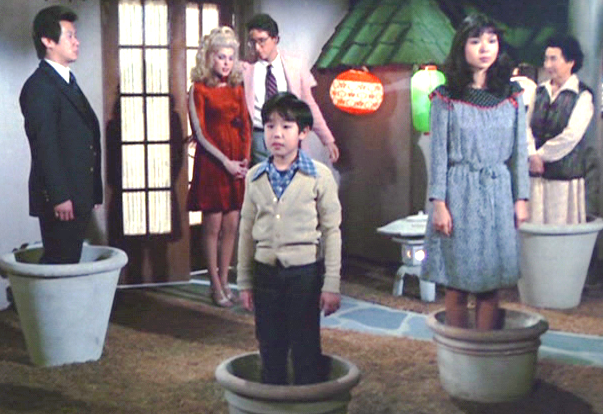
The other episodes did have priceless moments as well. In "The Butler Did It"/"A Bird in the Hand," there was an overabundance of sight gags. A young heiress named Terri (Lilibet Stern) celebrates her birthday but she gets kidnapped when visiting the family's Chinese Garden with her fiancé Kingsley (Ken Michelman). The ransom note is tied to a window and
 thrown into a rock garden. We see the typical shot of Frank driving his car except we soon realize that he's in the back seat and someone short must be driving because Frank scratches his nose while the hand stays on the steering wheel and later the driver hands the CB over the seat to Frank. Hocken decides to check a glove compartment which is, of course, filled with gloves. The kidnapper, the butler Thames (Byron Webster), holds a gun to Terri's head so Drebin tells him that "two can play at that game" and grabs a bystander and puts his gun to her hand, one of many gags that ZAZ freely admit to recycling later. Hocken asks Frank to cover him so he can sneak behind the butler so, yes, he throws a blanket over him. The final one before the epilogue is after the butler gets apprehended and Hocken announces that "the black and white is here." I'll let that photo speak for itself. This episode aired out of order. In each epilogue, they list all the criminals that have been sent to Statesville Prison and they mention a crook whose episode hadn't aired, presumably because ABC was eager to get those celebrities on to see Johnny.

Other sight gags and repeated jokes prevail, but returning to Police Squad!, what stands out above all else remains the incredible performance of Leslie Nielsen. It went beyond his deadpan delivery. In the last episode, "Testimony of Evil"/"Dead Men Don't Laugh," Drebin goes undercover as a nightclub entertainer and Nielsen performs an extended bit as a standup where we only hear punchlines such as "He looked up at her and said, 'Lady, I don't think I can take 60 more of those," and the crowd eats it up. He then segues into a medley of Judy Garland songs. He's awful of course, but it's a riot. That episode also has a great scene where a ventriloquist and his dummy pull a gun on Frank and the owner because he wasn't allowed to audition. Frank overpowers them — but he punches the doll first. The boss (Claudette Nevins), part of his investigation into a drug ring, commends him for taking such a chance. In great straight-faced delivery, Frank tells her, "You take a chance getting up in the morning, crossing the street or sticking your face in a fan." I've accumulated a lot of the gags and photos of them to share, but I should retire this tribute at some point. From the beginning, I planned to end this tribute with a YouTube assemblage of all six Epilogues and freeze frames the show employed. What other way could I?
Tweet
Labels: 80s, Boardwalk Empire, Breaking Bad, D. Zucker, Garland, HBO, J. Zucker, Jim Abrahams, Joe Dante, Letterman, Lynch, Mel Brooks, Nielsen, Star Wars, Streisand, The Simpsons, The Wire, TV Tribute
TO READ ON, CLICK HERE
Thursday, September 15, 2011
After 40 years, I have far more than just one thing to say about Columbo
"That's me — I'm paranoid. Every time I see a dead body, I think it's murder.…But that's me. I'd like to see everyone die of old age." — Lt. Columbo, "Étude in Black" (Season 2, Episode 1)

By Edward Copeland
Actually, television audiences met Lt. Columbo three times before his series debut 40 years ago on this date as part of the NBC Mystery Movie — and the first time he wasn't even played by Peter Falk. Though most who are old enough probably remember the series as part of a Sunday night rotation with NBC's other mystery series, McMillan & Wife and McCloud, the "wheel" actually started on Wednesday nights. The troika didn't move to Sunday until the second season. As far as the Columbo character goes, actor Bert Freed first played
 the cigar-chomping lieutenant in an episode of NBC's The Chevy Mystery Show , a summer anthology series hosted by Walter Slezak, that aired July 31, 1960, titled "Enough Rope." William Link and Richard Levinson, the creators of the Columbo character, adapted the teleplay from a story "Dear Corpus Delicti" that they published in Alfred Hitchcock Mystery Magazine with Richard Carlson playing a murderous doctor. Two years later, the writers expanded the story into a stage play called Prescription: Murder which starred legendary Oscar-winning character actor Thomas Mitchell as Columbo with Joseph Cotten as the homicidal physician. By 1968, they decided to return Columbo to television with a movie version of Prescription: Murder. They sought Lee J. Cobb to play Columbo, but he was unavailable, but consider this frightening possibility: Their second choice was Bing Crosby. Fortunately, Bing's golf game proved more important to him than a television series and, though they thought he was too young for the part, Peter Falk
 won the role with Gene Barry playing the killer. They did a second TV movie, Ransom for a Dead Man, that aired in early 1971 with Lee Grant as the murderer (for which she received an Emmy nomination), and come that fall Columbo became a regular series as part of that mystery wheel and Falk's portrayal of the scruffy homicide detective with his junky car, tattered raincoat and ever-present cigar became an irreplaceable TV icon. In the first season episode "Lady in Waiting," a socialite mother (Jessie Royce Landis) arrives at her son's mansion after he's been shot to death and doesn't immediately recognize exactly who or what Lt. Columbo is. When he introduces himself as a police detective, she says, "I must say you hardly look the role." That may have been true, but no one but Peter Falk could have played the role any better.
 I was too young to catch the early years in first run, but I remember how excited Henry Mancini's spooky theme music for The NBC Mystery Movie with the unknown figure waving a flashlight in all directions at whatever shows were in the rotation at the time followed by the announcer's booming voice announcing, "Tonight's episode —" It always punctured my balloon if he finished his statement with McMillan & Wife, McCloud or even Hec Ramsey. Thankfully, in this example, it is Columbo.
If you have never seen an episode of Columbo (and if that's the case, I must ask what the hell you've been doing with your life), you needn't worry that for a mystery series I'm being so carefree in identifying the various killers because what made Link & Levinson's creation (in this case the series, not the detective) so great was that you know from the outset who the murderer is. Spoiler alerts aren't necessary here because Columbo begins by showing the culprit plotting and carrying out his and her crime and Falk's intrepid homicide detective doesn't
 show up until later to play cat-and-mouse with the killer. In the first season, the movies (which, in essence, is what they were more than a series) ran 90 minutes with commercials while in later seasons they alternated between 90 minute and two hour installments. Sometimes, Columbo didn't turn up until as late as 30 minutes into the show. In the first episode when Columbo was a regularly scheduled series, "Murder By the Book," Falk's lieutenant first appears as a faint figure at the end of an office hallway as he approaches the wife (Rosemary Forsyth) of apparently kidnapped and possibly dead mystery writer Jim Ferris (Martin Milner), who is getting a drink from a water fountain. It's about 15 minutes into the story and the audience already knows that Ferris' soon-to-be-ex-writing partner Ken Franklin (Jack Cassidy) has lured Jim to his lakeside cabin, killed him and staged the entire kidnapping. Cassidy will be one of the show's favorite actors to cast as a killer: he'll play the villain two more times. Others in this rogues gallery include Robert Culp (three times as a murderer, once as the father of a murderer) and Patrick McGoohan (a killer four times, taking home Emmys for two of them; he also directed five episodes, one of which he wrote). It's also one of several Columbo mysteries that involve writers. Most interesting of all, the series premiere was written by the show's story editor at the time, Steven Bochco, who would go on to co-create Hill Street Blues, and was directed by a 24-year-old kid named Steven Spielberg.
Many directors whose names you'd recognize helmed a Columbo, though no one else who'd become a Spielberg. The other director who would probably go on to the most notable career would be Jonathan Demme, who directed an installment in its seventh season. Many known better for their acting gave it a try as well as some whose names might not ring a bell but who did direct some interesting features such as Jack Smight (No Way to Treat a Lady), Boris Sagal (The Omega Man), Richard Quine (My Sister Eileen, The Solid Gold Cadillac), Robert Butler (The Barefoot Executive, The Computer Wore Tennis Shoes), Jeannot Szwarc (Somewhere in Time), Ted Post (Hang 'em High, Magnum Force) and James Frawley (The Muppet Movie). Other writers who would pass through included the prolific Stephen J. Cannell, Dean Hargrove, who went on to create or co-create The Father Dowling Mysteries and Matlock, and Larry Cohen who would go on to write and direct such quirky horror films as It's Alive and Q.
While the two previous made-for-TV movies had set the basic mold for what a Columbo mystery would be, it
 truly wasn't until it became a regular network fixture that Falk could really cut loose as the lieutenant and the show could become a comedy as much as it was about catching the bad guy. That's really why I think Tony Shalhoub's Monk gets compared to Columbo so often — it's not because Columbo has a mental disorder but because Columbo and Monk both emphasize comedic elements. In fact, Monk tends to be more dramatic than Columbo with Monk's underlying mourning for his murdered wife while Columbo just got funnier the longer it went on. "Murder By the Book" really sets the template for the entire series and even if you have no interest in Columbo, it's fascinating to watch just as one of Spielberg's earliest credits. "Murder By the Book" opens with the sound of typing (sigh…typewriters) while the visual shows a car driving down an L.A. street. We soon see that Milner's Jim Ferris busily types away. On the wall, (Homage to Rear Window or not? You decide.) are plaques, painting and photos charting the partnership of Ferris and Ken Franklin (Cassidy). As the typing continues to be the only sound, the car we're watching pulls into the building's garage and parks on the roof. A hand reaches inside the glove compartment and removes a gun. A man exits
 the car and shuts the door and we see it is Franklin whom Spielberg films at a low angle as credits continue. The director throughout the episode uses a lot more adventurous angles and quick cuts than I've seen from him in years, but he was young and trying to gain notice. Upstairs, something only a grammarian or a copy editor would notice — Ferris types a quote but places the period outside the quotation mark. It turns out the gun was a joke — it's not even loaded — and he's not wearing gloves. Franklin was just trying a good-natured ruse to show Ferris that there aren't any hard feelings about severing their partnership and asks him Jim to his lakeside cabin near San Diego to mark the end of a fruitful relationship. Ferris doesn't know that it also will mark the end of his life.
It's obvious why they would re-team Falk with an actor such as Jack Cassidy more than once because some performers' chemistry with Falk's Columbo reached a perfection that you expect came from a lab and since the interplay between the lieutenant and the killer drove the show, why not go back to a proven winner as they did with Cassidy, who would return in seasons 3 and 5. He might have appeared again if he hadn't fallen
 asleep with a lit cigarette and died in 1976, 10 months after his third Columbo aired. Cassidy excelled at what was the most common Columbo scenario — a villain who's not only a killer, but a snob. In most cases, class comes into play with the murderer always assuming he or she is smarter and better than that rumpled lieutenant, but no one plays dumb on purpose better than this detective so when he makes the case on the cultured killer, they inevitably are surprised that this little man in the tattered raincoat, always seeming to be forgetful and driving that Peugeot 403 convertible that looks as if it could crumble into a million pieces at any moment beat them. In "Murder By the Book," it takes 35 minutes for Columbo to say his first, "There is one more thing." The comic highlight, harbinger of many to come in the series, occurs as Ken Franklin is being interviewed by a magazine writer and her photographer tries to take photos of him while in the background Falk does some great slapstick as Columbo, juggles an armful of books, cigar stuck in his mouth, looking for a place to put the books down.
The second episode of its first season had another three-time killer, Robert Culp, as Brimmer, the head of a big private investigation agency hired by Ray Milland to find out if his much younger wife (Patricia Crowley) is
 cheating on him in "Death Lends a Hand," which won Columbo creators Levinson & Link the Emmy for outstanding writing in a drama series, the only writing Emmy the series ever received though it earned a lot of nominations in that category. Brimmer proves she did, but lies (with the wife in a nearby room) and says she's faithful. She asks why he would do such a thing. "Oddly enough, I'm a moralist," he tells her. So moral that he lied to her husband to hold the truth over her head so she can feed him information about her husband's powerful friends and business interests. She balks, saying she'll expose the private eye instead and he kills her in a rage — the cleanup and coverup of which gets wonderfully filmed as reflections in the lenses of Culp's glasses. He stages her death to look like she was
 robbed and dumped in a vacant lot. Some interesting facts about L.A. life in 1971: 187 already was the police code for a homicide and when Brimmer tries to woo Columbo to take a job at his agency, Columbo learns a top position there can pull in $30,000 a year. That doesn't seem like much and in the first episode of season two, Columbo says his salary is $11,000 a year, which is the start of the poverty line for a single person today and the oft-mentioned Mrs. Columbo is a housewife. When they tried to spin her off in the form of Kate Mulgrew when Columbo ended the first time in 1978, she had a part-time job writing for a weekly neighborhood newspaper, until they decided to change her name to Callahan and forget that she was supposed to be related to Columbo at all (though at the start of Mrs. Columbo she even took their unnamed basset hound Dog with her).
Falk won the first of his four Emmys (out of 11 nominations) for playing Columbo for that first season. The sole time the show won an Emmy for best series, it actually was shared ith the other NBC Mystery Movie members for outstanding limited series. Throughout its two runs (the original NBC run from 1971-78 and the ABC return from 1989-2003), it earned 38 Emmy nominations and won 11 awards. Because of the shared time
 slot, it also meant shorter seasons than a regular series. Where a normal network show would be producing around 26 episodes a year at that time, Columbo only had seven installments in season one. Some of the other actors who played killers that year were Eddie Albert, Ross Martin, Susan Clark (in "Lady in Waiting" which featured Leslie Nielsen when he could still play it straight and was directed by veteran actor Norman Lloyd, who fell off the Statue of Liberty in Hitchcock's Saboteur and would play Dr. Auschlander on St. Elsewhere), Patrick O'Neal, who played a homicidal architect in "Blueprint for Murder," the only Columbo episode that Falk directed himself, and perhaps most fun of all, Roddy McDowall in an episode titled "Short Fuse." Did you hear the one about the exploding cigar? You will in "Short Fuse," where we also learn aboute Columbo's famous fear of heights. Because McDowall's character Roger Stanford is a playboy and a prankster (oh — and there is that murder), he does fool around with things such as those cans that spray strings of sticky colored plastic. When Columbo snoops around his darkroom, he accidentally sets it off on himself and an entire scene consists of McDowall picking the goo out of Falk's hair.
 As I mentioned when I sadly had to write my appreciation of Peter Falk when he passed away in late June, there was much more to the actor than just Lt. Columbo, as great and iconic as Columbo is. Between the time he made his first Columbo movie Prescription: Murder and prior to filming his second Ransom for a Dead Man and beginning the series, Falk began another important creative relationship — with John Cassavetes. The two actually had worked as actors in 1969 first in the Italian gangster flick Machine Gun McCain, which also featured Gena Rowlands but didn't open in the U.S. until October 1970. The important film they made together though was Husbands (subtitled A Comedy About Life, Death and Freedom) that was written and directed by Cassavetes and co-starred Ben Gazzara. Falk became a vital part of Cassavetes' unofficial repertory company appearing in A Woman Under the Influence, Opening Night (as himself) and Big Trouble. The two also co-starred in Elaine May's Mikey and Nicky. The Cassavetes troupe all played with Falk on Columbo in some capacity. Rowlands appeared as the wife of a killer, Gazzara directed two episodes and Cassavetes starred as the killer in the second season premiere, "Étude in Black," one of the series' best episodes thanks to chemistry these two fine actors already had with one another.

Cassavetes plays gifted conductor and composer Alex Benedict who kills his pianist mistress (Anjanette Comer) after she threatens to tell his wife Janice (Blythe Danner) about their affair if he doesn't leave her. Benedict
 tries to make it look like a suicide, but Columbo sees through the ruse rather quickly. He and Mrs. Columbo also are big fans of Benedict, who is prepping a big concert at the Hollywood Bowl. The scenes between Cassavetes and Falk prove positively electric as their relationship switches from a killer who thinks Columbo's swooning will save him until he figures out that the lieutenant actually has more on the ball than he ever suspected and he starts challenging the cop to find the evidence. The episode has time for laughs as well as Benedict stumbles upon Columbo waiting for him on stage at the Hollywood Bowl playing "Chopsticks" on a concert piano. The cast also includes Myrna Loy as his mother-in-law and patron of the orchestra, concerned over the P.R. when another member of the orchestra who was the murdered woman's ex-boyfriend turns out to have a criminal past. Benedict defends the musician, telling the woman who played Nora Charles that it's not like she didn't drink gin during Prohibition. This excellent episode was written by Bochco from a story by Levinson & Link and was directed by none other Nicholas Colasanto, best known as Coach on Cheers. This also is the episode where Columbo gets the basset hound that he never bothers to give a name.
For a network series to have more good episodes than bad, especially when it involves a set formula that they didn't tinker with much, Columbo truly stands as a monumental television achievement. Of course, I refer only to NBC years from 1971-1978. In a way, they had the luxury that cable series have now by not having to deliver so many episodes a year. While they call it seven seasons, it only adds up to 45 episodes. The sixth season only produced three episodes and no season made more than eight. In a way, it was the Curb Your Enthusiasm of mystery shows: A formula and a limited number of shows per season. When ABC revived Columbo in 1989, they tried originally to pair it with other mysteries, but they all eventually flopped and it just turned into occasional movies. Some were OK, but they had a hard time getting worthy killers except for the two appearances by McGoohan and had some silly outing where Columbo went undercover in disguise with accents and one where there wasn't even a murder but a kidnapping. Faye Dunaway won a guest actress Emmy for what really was a controversial one, "It's All in the Game," because Columbo purposely lets the killer get away because of the victim's loathsomeness. They had two seasons where they were regularly scheduled between 1989 and 1991 and then just TV movies. They made 24 in all.

However, those first 45, I could go on about them all. While it wasn't unusual in the NBC version to have killers who turned out to be more sympathetic than their victims, Columbo still took them to jail. Donald Pleasence's wine maker in "Any Old Port in a Storm" may be the best example. His playboy half-brother plans to sell the vineyards to another wine company, taking away his pride and joy and he kills him in a rage. He also was one of the few cultured characters who didn't look down on Columbo. When his longtime secretary (Julie Harris) figures out his guilt, she proposes he marry her to keep her quiet. Columbo solves the crime first and he gratefully confesses — finding prison preferable to marriage. "Freedom is purely relative," he tells Columbo, who brings out a special bottle of wine when he arrests him, which his high tastes approve. "You learn very well, lieutenant," he says.
 "Thank you, sir. That's about the nicest thing anyone has said to me," Columbo responds. All the Jack Cassidy episodes are great, but in the second outing, "Publish or Perish," it's neat to see him play a book publisher losing his biggest author and that they cast Mickey Spillane in the part. The episode also sends Columbo to Chasen's to interview some people and has the high-scale eatery whip him up some chili. Director Robert Butler also includes an imaginative triple split screen that shows Spillane's character at work dictating his book while the hired killer approaches down a hall and Cassidy is elsewhere, establishing his alibi. "Swan Song" from the third season proves to be another favorite of mine with probably the most unusual casting choice for a killer ever — Johnny Cash. He plays a gospel singer blackmailed by his controlling shrew of a wife (Ida Lupino) and turns in a solid acting performance. Cash's character drugs Lupino and a young girl singer that he had sex with when she was
 underage so he drugs the two of them when they are flying to the next concert site and bails out of the plane, making it look like a simple plane crash. As Columbo investigates, an air crash investigator asks Columbo if he flies. "My ears pop in an elevator. In fact, I don't even like being this tall," he replies. I can't leave out Patrick McGoohan, always great, but of his four I think his first episode, the one that got him the first Emmy, "By Dawn's Early Light," ranks first. His strict commandant at a boys' military academy would be a great performance on any series. Some of the best guest killers whose episodes I didn't have time or space to mention in detail (original 45 only): Anne Baxter, Leonard Nimoy, Laurence Harvey, Martin Landau (as twins), Vera Miles, Jackie Cooper, José Ferrer, Richard Kiley, Robert Conrad, Robert Vaughn, Janet Leigh, Hector Elizondo, Ricardo Montalban, William Shatner, Theodore Bikel, Ruth Gordon, Louis Jourdan and Nicol Williamson.
If I had to pick, the fourth season episode "Negative Reaction" might be my favorite Columbo of them all. Written by Peter S. Fischer, who would later create Murder, She Wrote and directed by Alf Kjelllin, it cast Dick Van Dyke against type as an asshole and a killer — even if what little we saw of his wife (Antoinette Bower) made it appear as if she had it coming. Van Dyke plays Paul Gallesko, an acclaimed photographer
 reduced to shooting portraits because he's under the thumb of his wife. He fakes her kidnapping and gets a recently released ex-con named Alvin Deschler (Don Gordon) he met while chronicling San Quentin to photograph possible houses for him to buy, unaware that Gallesko is setting him up to be the fall guy and eventually kills him and shoots himself in a faked ransom exchange gone awry. What makes "Negative Reaction" so great in addition to Van Dyke being a bad guy is that it also may be the funniest Columbo as well. When the lieutenant arrives in the beat-up Peugot at the junkyard where it was staged, he passes a sign that says "WE BUY JUNK CARS." It seems that Gallesko had an unexpected witness — a drunk bum played by character actor Vito Scotti who appeared in six episodes in vastly different parts. (In "Swan Song," he was a funeral director trying to sell Columbo on post-life planning.) After he gets sobered up and gives his statement, the police let him slip away and Columbo has to track him
 down at a Catholic mission where a nun (Joyce Van Patten, who will return in a later episode as a killer) mistakes Columbo as a homeless person and tries to find him a new coat and gets him a bowl of stew. Columbo keeps trying to explain that he's not homeless, but the nun replies, "No false pride between friends." When he finally finds the bum and talks with him, the nun returns with a coat and tries to take his and Columbo finally says, "I appreciate what you're doing ma'am, but I've had this coat for seven years and I'm very fond of it" and shows her his badge. The nun assumes he's undercover and compliments his disguise and promises not to blow his cover. Gallesko certainly isn't as friendly as the nun every time Columbo pops up to dig. "You're like a little shaggy-haired terrier. You've got a grip on my trousers and you won't let go. I can't turn around without you looking up at me with that blank innocent expression on your face," Gallesko growls. One of the other things that bothers Columbo is that Deschler was taking cabs everywhere until the
 last day, the day of the supposed ransom exchange, when he suddenly rented a car. It would have been a lot less expensive to rent a car earlier than taking all these cab rides, but then it dawns on the detective: He didn't have a driver's license yet. Columbo goes to the DMV to check it out and it turns out the man who gave him the driving test that day, Mr. Weekly (Larry Storch), is stuck out on a street because a car broke down. Columbo goes and picks him up to see if he can identify Deschler, but Mr. Weekly keeps being distracted over worries about the safety of Columbo's car and his reckless driving. It's a hysterical scene — and they chose to break for this bit of comedy with only 14 minutes left. On top of everything else, "Negative Reaction" contains one of those classic endings where Columbo tricks the killer by using his own arrogance against him to give himself away. That's why this YouTube clip of conductor Alex Benedict's parting words to Lt. Columbo sum him and his series up.
Tweet
Labels: Bochco, Cassavetes, Demme, Dunaway, Falk, Ferrer, Hitchcock, Joseph Cotten, Landau, Lee J. Cobb, Loy, Lupino, Nielsen, Nimoy, Pleasence, Ruth Gordon, Shatner, Spielberg, T. Mitchell, TV Tribute
TO READ ON, CLICK HERE
Friday, December 31, 2010
The Year in Appreciations
By Edward Copeland
Now this is hardly a comprehensive list of the artists who left us in the calendar year 2010, but just of those we had the time and energy to do write-ups on. Sometimes the death announcements hit at an inopportune time for me such as when we lost Dino De Laurentiis. I was on the way to a lengthy doctor's appointment and by the time I got home, I was so worn out the news was so old, I didn't have the stamina to type something out. Othertimes, even important artists who deserved mention, I wouldn't have had much to say about, even someone as great (and a Facebook friend) such as George Hickenlooper. I wouldn't have had much to say about Barbara Billingsley or Ronni Chasen, but they deserved notice as did Mitch Miller, Jerry Bock, Sally Menke and many others. It's meant as no slight on those we didn't. There are a lot of names, but I doubt that even this list is comprehensive.
_09.jpg)
Jean Simmons (January 23)

J.D. Salinger (January 28)

Peter Graves (March 14)

Robert Culp (March 24)

David Mills (March 31)

John Forsythe (April 2)

Dixie Carter (April 10)

Lynn Redgrave (May 3)

Lena Horne (May 10)

Dennis Hopper (May 29)

Rue McClanahan (June 3)

James Gammon (July 17)
in Major League

Patricia Neal (August 8)

Kevin McCarthy (September 12)

Harold Gould (September 13)
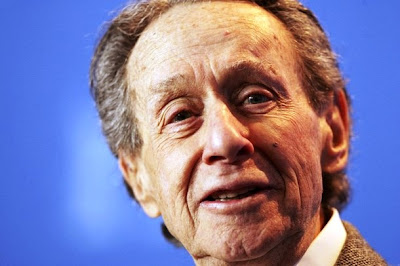
Arthur Penn (September 29)

Tony Curtis (September 30)

Stephen J. Cannell (October 1)

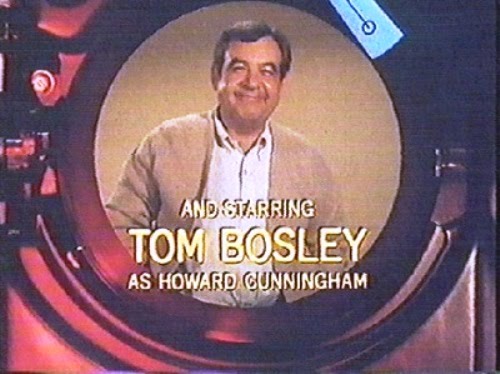
Tom Bosley (October 19)

Monica Johnson (November 2)

Jill Clayburgh (November 5)
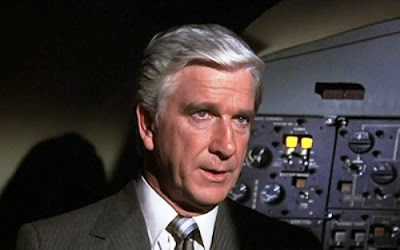
Leslie Nielsen (November 28)

Blake Edwards (December 16)
Others who deserve remembering in alphabetical order: Corey Allen, Dede Allen, Sparky Anderson, Louis Auchincloss, Beryl Bainbridge, Roy Ward Baker, Eddie Barth, Martin Baum, Captain Beefheart, Martin Benson, Luis Garcia Berlanga, Lisa Blount, Denise Borino-Quinn, Vance Bourjaily, Robert F. Boyle, David Brown, Solomon Burke, Jackie Burroughs, Christopher Cazenove, Claude Chabrol, Maury Chaykin, Chao Li Chi, Alex Chilton, John Clifford, Art Clokey, Hank Cochran, Clay Cole, Gary Coleman, Paul Conrad, Leo Cullum, Joe Deal, Jimmy Dean, Richard Devon, George DiCenzo, Ronnie James Dio, Nancy Dolman, Bernard-Pierre Donnadieu, Donal Donnelly, Clive Donner, Paul Dunlap, Doris Eaton, Bill Erwin, Doug Fieger, Eddie Fisher, Maureen Forrester, Fred Foy, William A. Fraker, Dick Francis, David Froman, Frank Giering, Jackson Gillis, Greg Giraldo, Mark Gordon, Henryk Gorecki, John Graysmark, Kathryn Grayson, Bud Greenspan, Bob Guccione, Corey Haim, Barry Hannah, Capt. Phil Harris, Peter Haskell, June Havoc, Peter Hofmann, Alan Hume, Gregory Isaacs, Marvin Isley, Peter Jamison, Mitch Jayne, Lionel Jeffries, Lamont Johnson, Elliott Kastner, Larry Keith, Irvin Kershner, Andrew Koenig, Michael Kuchwara, Steve Landesberg, Jack Levine, Marcia Lewis, Abbey Lincoln, Art Linkletter, James MacArthur, Simon MacCorkindale, Tom Mankiewicz, Joe Mantell, Teena Marie, Jim Marshall, Grant McCune, Kate McGarrigle, Vonetta McGee, Malcolm McLaren, Caroline McWilliams, Justin Mentell, Don Meredith, James Mitchell, Willie Mitchell, Mario Monicelli, Elizabeth Moody, Ronald Neame, Edwin Newman, Kazuo Ohno, Merlin Olsen, Nikos Papatakis, Fess Parker, Robert B. Parker, Robert Paynter, Harvey Pekar, Teddy Pendergrass, Charles Pierce, Ingrid Pitt, Belva Plain, Sigmar Polke, Dorothy Provine, Pete Quaife, Irving Ravetch, Corin Redgrave, Frances Reid, Pernell Roberts, Eric Rohmer, Lina Romay, Aaron Ruben, Zelda Rubinstein, Bruno S., Jose Saramago, Furio Scarpelli, Robert Schimmel, Karen Schmeer, Daniel Schorr, Erich Segal, Robert J. Serling, Glenn Shadix, Ted Sorenson, David Soyer, Joseph Stein, George Steinbrenner, Joseph Strick, Gloria Stuart, Joan Sutherland, Hideko Takamine, Billy Taylor, Derek Vanlint, Shirley Verrett, Helen Wagner, Albertina Walker, Earl Wild, Norman Wisdom, David L. Wolper, Ilene Woods, Lorene Yarnell and Howard Zinn.
Tweet
TO READ ON, CLICK HERE
Now this is hardly a comprehensive list of the artists who left us in the calendar year 2010, but just of those we had the time and energy to do write-ups on. Sometimes the death announcements hit at an inopportune time for me such as when we lost Dino De Laurentiis. I was on the way to a lengthy doctor's appointment and by the time I got home, I was so worn out the news was so old, I didn't have the stamina to type something out. Othertimes, even important artists who deserved mention, I wouldn't have had much to say about, even someone as great (and a Facebook friend) such as George Hickenlooper. I wouldn't have had much to say about Barbara Billingsley or Ronni Chasen, but they deserved notice as did Mitch Miller, Jerry Bock, Sally Menke and many others. It's meant as no slight on those we didn't. There are a lot of names, but I doubt that even this list is comprehensive.
_09.jpg)




Others who deserve remembering in alphabetical order: Corey Allen, Dede Allen, Sparky Anderson, Louis Auchincloss, Beryl Bainbridge, Roy Ward Baker, Eddie Barth, Martin Baum, Captain Beefheart, Martin Benson, Luis Garcia Berlanga, Lisa Blount, Denise Borino-Quinn, Vance Bourjaily, Robert F. Boyle, David Brown, Solomon Burke, Jackie Burroughs, Christopher Cazenove, Claude Chabrol, Maury Chaykin, Chao Li Chi, Alex Chilton, John Clifford, Art Clokey, Hank Cochran, Clay Cole, Gary Coleman, Paul Conrad, Leo Cullum, Joe Deal, Jimmy Dean, Richard Devon, George DiCenzo, Ronnie James Dio, Nancy Dolman, Bernard-Pierre Donnadieu, Donal Donnelly, Clive Donner, Paul Dunlap, Doris Eaton, Bill Erwin, Doug Fieger, Eddie Fisher, Maureen Forrester, Fred Foy, William A. Fraker, Dick Francis, David Froman, Frank Giering, Jackson Gillis, Greg Giraldo, Mark Gordon, Henryk Gorecki, John Graysmark, Kathryn Grayson, Bud Greenspan, Bob Guccione, Corey Haim, Barry Hannah, Capt. Phil Harris, Peter Haskell, June Havoc, Peter Hofmann, Alan Hume, Gregory Isaacs, Marvin Isley, Peter Jamison, Mitch Jayne, Lionel Jeffries, Lamont Johnson, Elliott Kastner, Larry Keith, Irvin Kershner, Andrew Koenig, Michael Kuchwara, Steve Landesberg, Jack Levine, Marcia Lewis, Abbey Lincoln, Art Linkletter, James MacArthur, Simon MacCorkindale, Tom Mankiewicz, Joe Mantell, Teena Marie, Jim Marshall, Grant McCune, Kate McGarrigle, Vonetta McGee, Malcolm McLaren, Caroline McWilliams, Justin Mentell, Don Meredith, James Mitchell, Willie Mitchell, Mario Monicelli, Elizabeth Moody, Ronald Neame, Edwin Newman, Kazuo Ohno, Merlin Olsen, Nikos Papatakis, Fess Parker, Robert B. Parker, Robert Paynter, Harvey Pekar, Teddy Pendergrass, Charles Pierce, Ingrid Pitt, Belva Plain, Sigmar Polke, Dorothy Provine, Pete Quaife, Irving Ravetch, Corin Redgrave, Frances Reid, Pernell Roberts, Eric Rohmer, Lina Romay, Aaron Ruben, Zelda Rubinstein, Bruno S., Jose Saramago, Furio Scarpelli, Robert Schimmel, Karen Schmeer, Daniel Schorr, Erich Segal, Robert J. Serling, Glenn Shadix, Ted Sorenson, David Soyer, Joseph Stein, George Steinbrenner, Joseph Strick, Gloria Stuart, Joan Sutherland, Hideko Takamine, Billy Taylor, Derek Vanlint, Shirley Verrett, Helen Wagner, Albertina Walker, Earl Wild, Norman Wisdom, David L. Wolper, Ilene Woods, Lorene Yarnell and Howard Zinn.
Tweet
Labels: Arthur Penn, Blake Edwards, Hopper, Jean Simmons, Nielsen, Patricia Neal, Rohmer, Tony Curtis
TO READ ON, CLICK HERE


