Sunday, March 04, 2012
"Buddy, no sax before a fight, remember."

By Edward Copeland
Since the first episode of Police Squad! remains the only flawless one, that's the only one I felt I needed to cover in a lot of detail. When we got to its second act, the first time they used the gag, it read ACT II: YANKEES ONE. I already showed you a photo from my favorite, from the second episode. (If you got here first and missed it, click here.) The remaining jokes for the other four episodes were:
Where Act II begins in "A Substantial Gift/The Broken Promise" ends up being hysterically funny, not so much for the scene itself but because one of those reactionary watchdog groups used it, combined with the rest of that episode of Police Squad!, as one of the most violent episodes of a TV series at that time.


Taking the information that Olson gave him about the discrepancies between Sally Decker's story and Olson's ballistics tests, Drebin returns to the credit union to test possible bullet trajectories — using real guns, real bullets and real people. Leslie Nielsen's deadpan narration works great again as he weighs theories in his mind, not noticing the increasing pile of corpses around him. The National Coalition Against Television Violence cited in May 1982 Police Squad! alongside such shows as The Fall Guy, The Greatest American Hero, Strike Force, T.J. Hooker and The Dukes of Hazzard as "the most violent programs," with ABC the worst network, showing "an average of 10 violent acts an
 hour." I couldn't find a report on the average times an hour a coalition member had to adjust the stick shoved up their ass for more comfortable seating or if their sense of humor ever was located. Drebin eventually gets a tip about one of Sally's old boyfriends who works at "one of those all-night wicker places." He eventually finds out about Sally's dental bills and visits her dentist, Dr. Zubatsky (Terrence Beasor), who Frank shoves against the wall, his mouth full of toothpaste so he's foaming at the mouth and Zubatsky getting Drebin to insist, "I am not an animal. I am a human being," in reference to David Lynch's The Elephant Man. If any problems exist through all the episodes of Police Squad! today, it's that the series used many very time-specific references that will be lost on many over time. When Frank and Sally have their showdown, he unmasks her multiple identities, taking off a series of wigs, before they have a shoot-out behind benches just a couple feet apart, one of many gags that would be recycled in the movies, something ZAZ freely admit in the commentaries. Once Hocken shows up to help Frank apprehend Sally (complete with other officers and a police car conveniently marked "POLICE CAR" on the hood), he asks him how he figured it out. Drebin tells his captain it was a little hunch back at the office. Hocken says he thought so and that's why he brought that little hunchback with him which, of course, leads literally to a short, hunchbacked man arriving to shake Drebin's hand.
I skipped out of order a bit because I wanted to devote a fair amount of space to the second recurring character introduced in the premiere. William Duell, the fine film, TV and theater character actor who died in December at the age of 88, should be recognizable to
 just about everyone for something. The last feature he appeared in was 2003's How to Lose a Guy in 10 Days. His first film was an uncredited appearance in The Hustler. His most famous film roles probably remain the congressional custodian in the 1972 screen adaptation of the musical 1776 and Sefelt, one of the patients in One Flew Over the Cuckoo's Nest. On TV, his last appearances were on Ed. On Broadway, he appeared frequently, including playing the same 1776 role when the musical premiered and replacing the original actor playing Caesar Rodney when 1776 was revived in the 1990s. I got to see Duell play Erronius in the 1996 revival of A Funny Thing Happened on the Way to the Forum starring Nathan Lane. On Police Squad!, Duell played Johnny the shoeshine boy who everyone went to for answers to their questions — and I do mean everyone. It always would start with Frank seeking a tip, as in that first episode. "What's the word
 on the street, Johnny?" Frank asks. "I don't know. I hear a lot of things. Pick a topic," Johnny replies. Some variation on that would be how every conversation with Johnny would begin, followed by the person in Johnny's shoeshine chair slipping him some cash. "You're barking up the wrong tree with this Ralph Twice. He's a decent family man and makes a good living. Wasn't his fault he got fired from the tire company, but who could predict Brazil would cut off the rubber supply? They're nationalizing the industry in two weeks so he would have gotten his job back anyway," Johnny informs Frank. Yes, this shoeshine man seemed to know what was going on everywhere and leads Drebin toward Sally. After Frank leaves, someone else would always step into Johnny's
 chair. In the first episode, it was a priest wanting to know if there really is life after death. "Are you talking existential being or anthropomorphic deity?" Johnny asks. Because the episodes aired out of order, the next two should have been the heart surgeon and the fireman but instead after the heart surgeon the celebrity parade began. First to sit in Johnny's chair was Tommy LaSorda, the legendary manager of the Los Angeles Dodgers seeking advice as to whether he needed to add another pitcher. Johnny explains the rigors of a season can punish a four-man rotation and he needs a left-handed swingman to fill out his long relief spot. He slips LaSorda some names and then adds, "You wouldn't be in this mess if you hadn't given up Tommy John." In the next episode, Dr. Joyce Brothers turns up wanting advice about what to tell her female patients about the Cinderella Complex. They aired the fireman after that and in the last episode, Dick Clark steps up to ask Johnny about this new form of music some of the kids talk about called ska. He also requests more of that secret formula youth cream. The Johnny scenes were the one recurring bit that always worked and it's a shame that they didn't bring Duell back for the pseudo-tipster scene they had in the first Naked Gun movie.
While the Zuckers and Abrahams served as executive producers on all six episodes, they didn't write or direct any of the other five Police Squad! installments, though according to the commentaries, they kept a presence on the set to make sure their comic style held. With that in mind, they tended to hire dramatic directors over TV comedy directors because the TV comedy directors would have their own ideas about humor that didn't necessarily jell with the ZAZ wackiness. That's why they selected directors such as Georg Stanford Brown, who helmed episodes of Hill Street Blues, Roots: The Next Generation, Family and Charlie's Angels, among others; Paul Krasny, who directed episodes of Quincy M.E., CHiPs, Mannix and Mission: Impossible; and Reza Badiyi who directed episodes of Hawaii Five-O, The Rockford Files, Mannix and Mission: Impossible, though Badiyi did start by directing comedies, specifically Get Smart and The Doris Day Show. The only director who got the chance to helm Police Squad! twice happens to be Joe Dante, who prior to his work on Police Squad! had made Piranha! and The Howling. In the second of the two episodes that Dante directed, the final episode "Dead Men Don't Laugh"/"Testimony of Evil," he even got to include one of his trademarks — cult actor Dick Miller. ZAZ had to keep a watchful eye anyway to make certain that the humor stuck close to their style. One of the trio admits on the second commentary that news of the cancellation almost came as a relief. "If we're gonna work this hard, we might as well do a feature," one of the commentary voices says he thought at the time. I can imagine. When I rewatched the first episode, I laughed nearly nonstop from beginning to end but in each of the subsequent five episodes, the laughs became more sporadic. How Police Squad! could be maintained on a weekly basis for 22 episodes a year for multiple seasons would seem to be an impossibility for that format.
Of the writers who worked on the staff of Police Squad!, one, in a way, became the fourth member of ZAZ. Prior to his work on Police Squad!, Pat Proft wrote for The Carol Burnett Show, Mel Brooks' original Robin Hood spoof, the TV show When Things Were Rotten and even the infamous Star Wars Holiday Special. (See — that was intended as a spoof.) On Police Squad!, Proft received story credit for "Rendezvous at Big Gulch"/"Terror in the Neighborhood" and wrote "A Bird in the Hand"/"The Butler Did It." When ZAZ finally decided to
 revive Police Squad! as The Naked Gun movie, which only David Zucker directed, Proft wrote the screenplay with ZAZ. (One person who couldn't have been more thrilled by the news of the Police Squad! movie was Leslie Nielsen, who had reverted to straight roles and was on the set of the Barbra Streisand drama Nuts when ZAZ contacted him about bringing Frank back.) On the sequels, Proft and David Zucker alone scripted the films. Proft also wrote Hot Shots! with Abrahams, who directed that film solo. Outside ZAZ-related projects, Proft co-wrote Bachelor Party, Police Academy and Real Genius. The other familiar name hired on the writing stuff was actor/comedian Robert Wuhl, who co-wrote both episodes that Dante directed and recorded his own commentary. He first met ZAZ when he was one of the many comics, including David Letterman, auditioning for Robert Hays' Ted Stryker role in Airplane!. The brothers and Abrahams later caught Wuhl's act at The Improv and invited him to write for Police Squad! "It was such a short period of time. We were only together for six episodes and we were gone," Wuhl says, explaining why he doesn't recall much in his commentary, which was recorded in 2006, 24 years after his time on the show. It did convince Wuhl that network television wasn't for him and the only other time he wrote for network TV was an episode of Sledge Hammer!, a series that definitely owes its beginnings to Police Squad! Wuhl did go on to create and star in Arli$$ for seven years on HBO. Insert your own joke about whether or not cable television is a place for Wuhl either.
Before I forget, I should note the last of the recurring characters on the show, Officer Norberg, portrayed by Peter Lupus, who played Willy Armitage on Mission: Impossible from 1966-73. The joke always has been that when they made The Naked Gun movies, they changed his race, but technically the two officers don't have to be the same character since the role O.J. played was named Nordberg, not Norberg. Of course, Mr. Olson's last name switched between Olsen and Olson, so consistency wasn't a paramount concern, at least that's what Capt. Sgt. Det. Lt. Drebin told me. Lupus' Norberg certainly came off as being as dumb as O.J.'s Nordberg, but the TV show didn't have any running gag about him being constantly injured as Nordberg would be in the films. On the commentaries, ZAZ and Weiss briefly discuss the decision to hire Simpson for the movie with one of the four voices saying that Lupus "didn't seem violent enough for the part, so we cast O.J." One of the remaining three admits not having seen O.J. since the wrap party for the third Naked Gun movie "when I sold him a set of knives." Lupus did get some fun moments in the series even though he didn't show up until the third installment, such as when they ask him to "put a tap on the phone," or when they want him to test suspected drugs to see if they are real and he gets high as a kite and grooves to The Mills Brothers' "Glow Worm." Perhaps his crowning achievement remains in the freeze frame when he comes in while everyone else has frozen in place and Norberg keeps changing his mind about what position to take.


In the first half of this post, I mentioned how the then-president of ABC blamed the failure of Police Squad! on the fact that you had to watch it. Thirty years later, I don't believe attention spans have grown longer, but with the expanded universe of television, you can find the influence of Police Squad! in the most unexpected places. Not just in an obvious show such as the already-mentioned Sledge Hammer!, which audiences still weren't ready for in 1986, or the not-so-obvious "It's Garry Shandling's Show." that debuted the same year but petered out, though it lasted four seasons. The most obvious direct descendant, at least in terms of having to watch to catch those sight gags, is The Simpsons, though the animated series has characters with more depth and dimensions than Police Squad! That close attention to detail can be found outside the comic realm though as well. The Wire wasn't tossing sight gags in the background, but some minor bit in an early episode of a season often came back later and you had to watch closely. That has applied to many of the recent cable dramas such as Breaking Bad and Boardwalk Empire. They demand more of their viewers and it ultimately makes the viewing experience more rewarding. You wouldn't think of Frank Drebin paving the way for Walter White but, in a way, I think he did.
I grabbed so many screenshots and wrote down so many gags, I can't possibly squeeze them all into this piece, but Police Squad! should be watched anyway. Nielsen blamed the size of television screens as another reason for the series' failure, which might be true, but one unfortunate development that happened to the ZAZ style of comedy was that it eventually lost that magic deadpan touch. Nielsen and other cast members reacted far too often to the chaos around them and it lessened the humor quotient. Nielsen's work (as well as old pros such as Robert Stack and Peter Graves) wowed in Airplane! and he maintained that in Police Squad!, but when The Naked Gun movies came about, Drebin became more about being silly and accidentally catching the crooks. I missed the Frank who could go undercover as a boxing manager in "Ring of Fear"/"A Dangerous Assignment" and have this straight-faced, fast-paced conversation with boxer Buddy Briggs (Patrick St. Esprit).
DREBIN: Buddy, I'm here to help you. Do you think you can beat the champ?
BUDDY: I can take him blindfolded.
DREBIN: What if he's not blindfolded?
BUDDY: I can still beat him.
I regret to say that improved technology actually has ruined one of the best, most subtle jokes that Police Squad! ever pulled off. Anyone
 who grew up with 1970s television probably recalls what an imperfect device color TV sets were even then. Often, you'd have to fiddle with the color and tint dials to try to get rid of inexplicable fuzziness. In that second episode, which I was watching on an old color TV set (forget the brand), Frank's suit kept driving me up the wall with fuzzy blue and green lines. I went up to the set to attempt to adjust it, but then I noticed that only Frank's suit had the problem. The rest of the screen was fine. Those clever people had designed a suit coat for him made up of subtle bands of blue and green to make viewers go nuts. Unfortunately, taking screenshots of the image of the suit from a DVD doesn't do justice to that inferior technology. That episode also had some other nice ones such as when Buddy shadowboxes and knocks his shadow out. When an earlier fighter (Thomas Rosales Jr.) managed by the crooked Cooper (Floyd Levine) is told that Martin (Rudy Solari), the man fixing the fight, will give the sign when he's supposed to take a dive, Martin signals a scuba diver in the back row who falls backward followed by a splash of water. When the undercover Frank gets in a poker game with Cooper to win Buddy's contract, he comments that the game was "as crooked as Cooper's smile" and we see that one of the players holds the Official Rules card in his hand. It also has a great freeze-frame epilogue where they bring Martin in. When he realizes that no one else is moving, he unlocks his handcuffs and tries to get out of the squad room.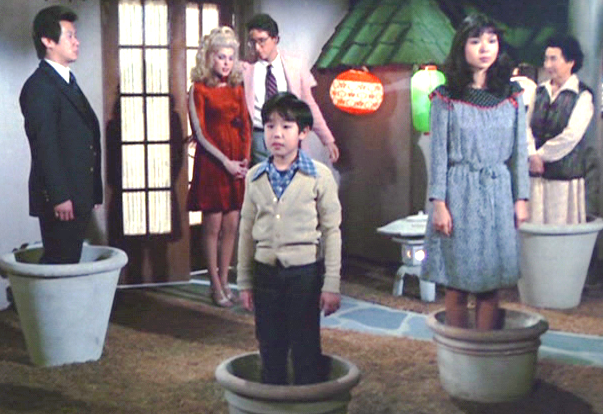
The other episodes did have priceless moments as well. In "The Butler Did It"/"A Bird in the Hand," there was an overabundance of sight gags. A young heiress named Terri (Lilibet Stern) celebrates her birthday but she gets kidnapped when visiting the family's Chinese Garden with her fiancé Kingsley (Ken Michelman). The ransom note is tied to a window and
 thrown into a rock garden. We see the typical shot of Frank driving his car except we soon realize that he's in the back seat and someone short must be driving because Frank scratches his nose while the hand stays on the steering wheel and later the driver hands the CB over the seat to Frank. Hocken decides to check a glove compartment which is, of course, filled with gloves. The kidnapper, the butler Thames (Byron Webster), holds a gun to Terri's head so Drebin tells him that "two can play at that game" and grabs a bystander and puts his gun to her hand, one of many gags that ZAZ freely admit to recycling later. Hocken asks Frank to cover him so he can sneak behind the butler so, yes, he throws a blanket over him. The final one before the epilogue is after the butler gets apprehended and Hocken announces that "the black and white is here." I'll let that photo speak for itself. This episode aired out of order. In each epilogue, they list all the criminals that have been sent to Statesville Prison and they mention a crook whose episode hadn't aired, presumably because ABC was eager to get those celebrities on to see Johnny.

Other sight gags and repeated jokes prevail, but returning to Police Squad!, what stands out above all else remains the incredible performance of Leslie Nielsen. It went beyond his deadpan delivery. In the last episode, "Testimony of Evil"/"Dead Men Don't Laugh," Drebin goes undercover as a nightclub entertainer and Nielsen performs an extended bit as a standup where we only hear punchlines such as "He looked up at her and said, 'Lady, I don't think I can take 60 more of those," and the crowd eats it up. He then segues into a medley of Judy Garland songs. He's awful of course, but it's a riot. That episode also has a great scene where a ventriloquist and his dummy pull a gun on Frank and the owner because he wasn't allowed to audition. Frank overpowers them — but he punches the doll first. The boss (Claudette Nevins), part of his investigation into a drug ring, commends him for taking such a chance. In great straight-faced delivery, Frank tells her, "You take a chance getting up in the morning, crossing the street or sticking your face in a fan." I've accumulated a lot of the gags and photos of them to share, but I should retire this tribute at some point. From the beginning, I planned to end this tribute with a YouTube assemblage of all six Epilogues and freeze frames the show employed. What other way could I?
Tweet
Labels: 80s, Boardwalk Empire, Breaking Bad, D. Zucker, Garland, HBO, J. Zucker, Jim Abrahams, Joe Dante, Letterman, Lynch, Mel Brooks, Nielsen, Star Wars, Streisand, The Simpsons, The Wire, TV Tribute
TO READ ON, CLICK HERE


Sunday, August 21, 2011
Beware the Moon and Stick To the Road

By Damian Arlyn
1981 was a seminal year for werewolf movies. First, Joe Dante's The Howling hit theaters in April followed by Michael Wadleigh's Wolfen in July and, finally, John Landis' An American Werewolf in London in August. It is the latter title with which this article will be concerned, primarily because today marks the 30th anniversary of its release but also because, in the opinion of this critic, Landis' picture not only is the best of the three werewolf films released that year but, arguably, the best werewolf film ever made. I still remember the first time I was exposed to it. I was no older than 10 and for some strange reason my parents thought it would be appropriate for me to watch. They changed their minds shortly into the film and promptly sent me to bed, but by then it was too late: the damage had been done. Though I wouldn't see the film in its entirety until years later, that opening sequence where two young Americans hikers get attacked by a vicious beast while walking through the English countryside at night had been permanently etched in my memory. To this day, it is one of the most terrifying sequences I've seen on screen and I've had many a nightmare because of it.
What makes An American Werewolf in London work so beautifully (besides how effectively scary it can be), is its tongue-in-cheek sensibility. It is commonplace to see humor blended with horror in movies nowadays but back in '81 it was far more outré. The comedy manifests itself in many different forms…such as in Landis' choice of music. He brilliantly peppers the soundtrack with classic songs that feature the word "moon" in the title ("Bad Moon Rising," "Moondance" and "Blue Moon"), thus underscoring the absurdity of many of the things
 being depicted onscreen. For example, during the now iconic transformation scene while the character David (David Naughton) thrashes about on the floor as his body slowly and painfully changes into a werewolf, we hear one of the three versions of "Blue Moon" used in the film playing in the background. The juxtaposition of the sweet and the sickening makes for a simultaneously scary and funny (not to mention incredibly memorable) sequence. Even the characters themselves comment on how ridiculous many of the things they're experiencing are. When David's friend Jack (Griffin Dunne) returns from the dead to inform David that since he will soon become a werewolf he must commit suicide, David says he will not be threatened by a "walking meatloaf"…an epithet which he later apologizes for during his metamorphosis (incidentally, throughout the course of the film every time Jack appears to David he does so in increasingly decaying forms; it is both gruesome and hysterical).
In fact, many of the lines in the film clearly are designed to poke fun at the bizarre goings-on in the story. "A naked man stole my balloons"; "Have you ever tried talking to a corpse? It's boring."; and "Sean, I think there are some hooligans in the park again" are just some of the many gems to be found in the film's dialogue. My personal favorite comes when David realizes he truly is a werewolf and thus attempts to get himself arrested, spouting off the kind of horribly irreverent nonsense that every typical American thinks would offend his uptight British neighbors ("Queen Elizabeth is a man! Prince Charles is a faggot! Winston Churchill was full of shit! Shakespeare's French!"). It is impossible for me to watch the film and hear David's anti-English rant without laughing out loud. Landis also does something that was relatively new for its time. Much as Wes Craven did years later in the first Scream, Landis populates his horror film with characters who have actually seen other horror films. When David talks to his girlfriend (Jenny Agutter) about Claude Rains and Lon Chaney Jr. in 1941's The Wolf Man, it may not be the first example of meta-cinema in a scary movie, but is a rare (for its time) case of movie characters acknowledging that their lives seem to resemble the trappings of a horror movie.
However, the laughs (of which there are plenty) that the film provokes do not in any way lessen the impact of the horror scenes. If anything, they just throw them into sharper contrast. The atmospheric opening section of the film, a suspenseful foot chase through the underground tunnels of Tottenham Court Road tube station (where the camera adopts the POV of the wolf, though it is never actually seen except briefly from a distance
 in the scene's penultimate shot) and especially some horrific nightmares experienced by David after he is bitten are all frighteningly visceral sequences. And, of course, there is the aforementioned extended transformation scene where another stellar element of the film is highlighted: namely, the superb special effects. Landis' idea was that David's change into the werewolf would be more traumatic than simply growing hair (through a cheesy optical dissolve) and then howling at the moon. It would be a more "realistic" transmogrification involving skin stretching, bones popping and cracking, cries of sheer agony and it goes on for quite a while. Landis does not let his character off the hook with a quick conversion. He also does not conceal his effects in shadows. He has it take place right out there in the open, harsh light. Nowadays the scene would be done with CGI. In the '80s, they had to use physical effects that took a great deal of time and labor to produce (often for only a second of a half of screen time). Still, the scene and the movie is the better for it. Naturally Landis owes a lot to the genius of the great Rick Baker (who also consulted on the makeup effects for The Howling). Baker's work for the film was so magnificent that it inspired the Academy of Motion Picture Arts and Sciences to create a new category for makeup (for which Baker received the first Oscar for this movie).
An American Werewolf in London opened to big box office success and generally positive reviews. It became known as a "game-changer" in the genre of horror and in particular in the makeup/special effects arena of said genre. It spawned a successful radio adaptation, a highly inferior 1997 sequel and is apparently set to be remade, proving yet again that Hollywood has completely run dry of ideas since they are remaking something that wasn't the most original concept when it was made.

Tweet
Labels: 80s, Griffin Dunne, Joe Dante, Landis, Lon Chaney Jr., Movie Tributes, Rains, Remakes, Sequels
TO READ ON, CLICK HERE
Sunday, April 10, 2011
Howlingly Scary, Howlingly Hilarious

By Phil
What can you say about a movie in which the villain digs into his own forehead to retrieve a bullet, but not before quipping to a woman unlucky enough to be witness, “I want to give you a piece of my mind”? Don’t answer that. It’s a rhetorical question. Suffice it to say that The Howling, released 30 years ago today, understood the irresistibility of dishing up horror with a dash of humor. A werewolf picture jam-packed with B-movie references and a giddy love of the genre, it quickly earned a cult following that has remained loyal since the film first hit screens in 1981.
It had to share the love from fanboys. While The Howling helped steer the career of director Joe Dante into (regrettably) safer, more mainstream fare, the movie was initially overshadowed by another man-becomes-wolf horror-comedy from 1981, John Landis’ An American Werewolf in London. Comparisons between the two flicks were inevitable. Released within four months of each other, both embraced the spirit of drive-in exploitation while boasting more polished filmmaking, and both featured onscreen werewolf transformations that would have made Lon Chaney Jr.’s head spin with envy.

Still, I prefer The Howling for its generous humor, genuine creepiness and willingness to sleaze it up. It’s a nicely calibrated blend of smart camp and lowbrow shocks, anchored by Dee Wallace’s surprisingly effective performance as a woman trapped between lycanthropy and self-help jibber-jabber. A year before she would be Elliott’s mom in E.T.: the Extra-Terrestrial, Wallace plays Karen White, a TV news reporter in Los Angeles with the misfortune of having drawn the affection of a serial killer. As the film opens, Karen has agreed to meet with the psychopath, Eddie Quist (Robert Picardo), in a peepshow stall at a seedy porn store. Eddie appears behind Karen in silhouette, hissing about what he’s going to do to her. Karen stares ahead, in mute horror, at a grainy bondage reel being projected.
Then Eddie commands Karen to face him. She turns and sees…Well, we don’t know what she sees exactly. Karen lets out a scream, the first of many in The Howling. Two police officers who have been trailing Karen open fire, killing Eddie Quist.
The incident naturally rattles our heroine. When she returns to work, Karen freezes up under the unmerciful gaze of the camera. At home, she rejects the loving arms of husband Bill Neill (Christopher Stone). Knowing she needs help, Karen is intrigued when a courtly therapist, Dr. George Waggner (Patrick Macnee), suggests she join his self-help group in Big Sur called The Colony.
The ensuing detour into quasi-psychobabble gives Dante and screenwriter John Sayles, at the time just coming off Alligator and Piranha (also helmed by Dante), a ripe avenue for satire. Karen and Bill are bemused by the goings-on of The Colony, whose inhabitants soak in Dr. Waggner’s cautionary line that “repression is the father of neurosis.” The good doctor might be on to something, but his EST-styled knockoff includes some curious aspects. The Colony appears to host more barbecue cookouts than your average pop-psych cult.

There are other red flags, too, including John Carradine as a crazy old coot and Elisabeth Brooks as a resident nymphomaniac outfitted in what looks to be an early prototype for Xena: Warrior Princess. There is more to The Colony than meets the eye. Chris and Terry (Dennis Dugan and Belinda Balaski), an intrepid pair of reporters who work with Karen, discover mysterious links between Dr. Waggner’s sanctuary and Eddie Quist. And speaking of the slain killer, his corpse has suddenly disappeared from the morgue.
It all makes for an irrepressible horror flick that delivers its jolts with a grin. Unlike a raft of slasher flicks of the late ‘70s and early ‘80s, Dante and Sayles mined the inherent absurdity of their yarn but, honestly, there’s really no other way to approach a story of werewolves who are urged on by a pop psychiatrist to embrace their inner animal.
The Howling exposes its funny bone in the opening minutes, with a sly bit involving a news anchor whose authoritative delivery masks an aw-shucks Southern twang. Dante, an avid movie buff, peppers the proceedings with knowing winks to the genre. Several characters’ names are lifted from movie directors of werewolf flicks, such as George Waggner (1941’s The Wolf Man) and Lew Landers (1944’s Cry of the Werewolf). Dante also isn’t shy about shoehorning in wolf references in everything from cartoons to literature.
Similarly, The Howling makes room for an array of B-movie icons. Kevin McCarthy of Don Siegel’s classic Invasion of the Body Snatchers portrays Karen’s boss at the TV station, while The Thing from Another
 World’s Kenneth Tobey turns up briefly as a cop. Forrest J. Ackerman, the man behind Famous Monsters of Filmland magazine, makes an appearance. Dante’s mentor, the notoriously penurious Roger Corman, has a fitting cameo as a guy checking a pay phone for forgotten change. Corman even gets a second, however peripheral, nod in The Howling. His 1959 comic-horror picture, A Bucket of Blood, is referenced when its star, Dick Miller, turns up to play a slick occult bookshop owner named Walter Paisley. The name is the character Miller played in — wait for it — A Bucket of Blood. Miller’s performance in The Howling launched what would become tradition for Dante, who went on to cast the actor in a slew of his movies.
Despite the cornucopia of inside jokes, The Howling is, above all, a monster picture and it offers a humdinger of one thanks to the inventiveness of special-effects maestro Rob Bottin. By inflating various-size bladders pasted on to the face and body of actor Picardo, Bottin fashioned an impressive, before-your-eyes transmogrification from man to beast. In today’s world of CG wizardry, where even the lamest schlockfest can be visually interesting, it is tempting to forget just how eye-popping Bottin’s feat really was. Moreover, The Howling’s fully realized werewolves are a far cry from the mega-hirsute guys who roamed the Hollywood countryside of yesteryear. Bottin’s creations, shot at oblique angles and occasionally backlit in cartoon-friendly colors, look as if they just padded in from Little Red Riding Hood’s neck of the woods. These are giant wolves, not wolf men.

The non-monster moments also are memorable. Dante assembled a strong cast; it’s a kick to see veteran character actors such as Carradine and Slim Pickens (as a yokel sheriff, of course) chewing on the scenery, especially when the aforementioned chewing involves fake fangs.
At the center of it all is Dee Wallace. With her feathery blonde hair and all-American good looks, she is an appealing damsel in distress. But she does one better, imbuing her character with melancholic vulnerability and investing The Howling with a welcome depth of emotion. It makes the film’s ending, in which Karen transforms into a werewolf for the local TV news, as heartbreaking as it is howlingly hilarious.


Tweet
Labels: 80s, Corman, Don Siegel, J. Carradine, Joe Dante, Landis, Lon Chaney Jr., Movie Tributes, Sayles
TO READ ON, CLICK HERE
Tuesday, June 15, 2010
Dante's Inferno, Part Deux

By Ali Arikan
My favorite touch in Gremlins 2: The New Batch comes early. As the returning leads Billy and Kate (Zach Galligan and Phoebe Cates, respectively) arrive to work at a skyscraper owned by Daniel Clamp (John Glover), a buffoonish fusion of Ted Turner and Donald Trump — he as an art-department lackey, she as a tour guide — they are greeted by an automated announcement: “Have a powerful day.” Later, the same monotone will deliver the news of a “Career Opportunity Advancement Window.” If you think this is too much, then you have never been in the sort of meetings I have to sit through (where, I shit you not, grown men try to find power-words to acrostically spell synergy). Hell, I just got an email earlier today with the subject line: “IMPORTANT INFORMATION MESSAGE.” Step aside, H.L. Mencken.
In his 1990 sequel to Gremlins, Joe Dante turns his malicious gaze from small-town America and Americana-as-dictated-by-Hollywood to a corporate Tower of Babel that represents the nadir of '80s culture: consumerist capitalism run amok as a slick surface barely hides a rotten core (the little contraptions in the building keep malfunctioning even before the eponymous creatures arrive at the scene). But Dante doesn’t stop there. His film is a satire of its predecessor as well as itself. Much has been made of the way the film sends up the very notion of sequels and other such Hollywood idiosyncrasies, but, 20 years on, its appeal goes beyond knowing winks at cineastes: it is a condemnation of modern metropolitan living. To paraphrase the classic poster which adorns so many office walls the world over, you don’t have to be a corporate wage slave to enjoy Gremlins 2: The New Batch, but it certainly helps.
Whereas the first film meticulously builds up an idealised image of a cinematic small-town Eden, only to take it down a peg or ten by an infestation of verdant varmints, its sequel has no such qualms in sugar-coating the battlefield: the Clamp Tower is more hellish before the gremlins start to wreak havoc. In fact, you just can't wait for them to go on their rampage. It's a sly take-down of the Randian hero: Daniel Clamp is the flipside of Howard Roark, and his most awesome creation nothing but a particularly tall house of cards. Gremlins 2: The New Batch implies, not very subtly, that the apparent triumph of individualism and objectivism is but a flimsy facade, a Pyrrhic victory, maybe, over our true selves.
All of which is why, despite the incessant, and admittedly hilarious, sideswipes at Hollywood, during my latest viewing, I found the film to be rather depressing (in a good way, I suppose). In fact, what the gremlins represent is not just absent-minded chaos but pure anarchy — the breakdown of societal order. They are the repressed ids of the working man, living from day to day, pissing on his dreams, relinquishing his last few shreds of pride — and self-esteem — with every pestiferous paycheck.
With a different director, Gremlins 2 could have turned out to be just another over-the-top sequel. Certainly, meta-commentaries have always been a constant staple of sequels (c.f. The New Testament – I hate it when they go PG-13!). But Dante is subversive without being cute or whimsical, two qualities that have ruined otherwise serviceable films, especially in the past few years. The IQ of both the viewers and the makers of run-of-the-mill Hollywood dross is the same as pond weed, and Dante is fully aware of this. When Robert Prosky’s late-night horror host-cum-anchorman asks the Brain Gremlin what it is that they want (and, seriously, what other film in the history of cinema has the balls to satirize the infamous 1968 debate between William Buckley and Gore Vidal), the latter responds: "The niceties, Fred. The fine points: diplomacy, compassion, standards, manners, tradition... that's what we're reaching toward. Oh, we may stumble along the way, but civilization, yes. The Geneva Convention, chamber music, Susan Sontag. Everything your society has worked so hard to accomplish over the centuries, that's what we aspire to; we want to be civilized." Funny? Sure. But just as he starts to talk, the camera cuts abruptly to a grotesque view of the gremlins at the bar as they watch the program on TV: dressed up as corporate lackeys, drunks, hookers, and other pleasant characters, and cackling with glee, the monsters seem to betray what Dante truly thinks of the human race: vermin. Funny as well as scary, cute as well as repulsive, intelligent as well as destructive. But vermin, nonetheless.

Tweet
Labels: 90s, Joe Dante, Movie Tributes, Sequels, Vidal
TO READ ON, CLICK HERE
Sunday, May 20, 2007
Gremlins: A Segregationist Nightmare
BLOGGER'S NOTE: We're coming a little late to the Misunderstood Blog-a-Thon party at Culture Snob, but better late than never.

By Odienator
Joe Dante's Gremlins has a place in history for several reasons. It helped usher in that destroyer of good adult-oriented Hollywood cinema, the PG-13 rating. It generated a near-brilliant satire on consumerism disguised as a sequel. It gave Phoebe Cates something else to be remembered for besides Judge Reinhold's self-abuse fantasy. And it remains the best thing Chris Columbus ever did, though Dante forced him to repeatedly rewrite his extremely gory first draft.
While watching Gremlins recently, I noticed that it was more than a product of its time, namely a movie with an '80s penchant for jokey treatments of violence and murder. It's something more sinister, subversive and creative. Everyone thought Gremlins was a monster movie with cute toy tie-ins and an early job for Howie "Deal or No Deal" Mandel. Which it is. But it also uses the best purpose of the science fiction genre: to illustrate things that could not so politely be uttered in public. The sci-fi genre uses otherworldly prestidigitation to distract you from its real messages. Science fiction doesn't get in trouble because, unlike satire, it doesn't have to be realistic; it tends to be allegorical.
Underneath Gremlins' monster movie surface bubbles a tale of the suburban paranoia over "the new neighbors," those folks who moved next door who don't look like the rest of town. At the time of its release, minorities were beginning a bigger migration to the suburbs, and the filmmakers use cute and malicious little creatures as stand-ins for the paranoia faced by suburbanites who were afraid their property values would go down once their neighborhood got a little colorized. Don Siegel gave McCarthyism its pod people in 1956, and in 1984, Joe Dante gave the Boondocks its Mogwai. Gremlins is really a tale of suburbanites freaking out over the integration of the 'burbs.
Gremlins' Kingston Falls spoofs It's A Wonderful Life's Bedford Falls right down to its own Mr. Potter, personified here by Polly "Kiss My Grits" Holliday's rich and angry Mrs. Deagle. But the rest of the town is populated by '50s types. Billy (Zach Galligan) is the Blob-era Steve McQueen of Our Town, the wide-eyed, clean cut kid who has to convince the town it is in grave danger. Phoebe Cates is Kate, the cute girl who assists the hero. Billy's Mom is a housewife who makes pies and dinner, and his father Rand is a quirky inventor, family man and the narrator of the film. There's also the wacky paranoid conspiracy guy, played by B-movie vet and Dante favorite Dick Miller, a meta tie to the '50s universe Gremlins seeks to create and destroy. The town is homogeneous save for the token Black guy (Glynn Turman) who serves the standard purpose in this type of picture.
Destruction is accidentally brought to Kingston Falls by Rand, who visits a mystical Chinese shop in Chinatown and convinces the proprietor to sell him a Mogwai, the latest hot toy from Asia. The mystical Chinaman is played by China-born Keye Luke, who was once No. 1 Son to Swedish-born Charlie Chan Warner Oland. Rand is played by the man who wrote the greatest opening line in pop music history, Hoyt Axton. Luke tries to dissuade Rand from buying Mogwai, but finally acquiesces. Before Rand leaves, Luke gives him those famous three rules for dealing with Mogwai: Keep them out of bright light, don't get them wet, and never ever ever feed them after midnight. Luke doesn't tell Rand why because he's too busy stewing in his own mythical otherness. He does paraphrase Spider-Man to Rand: "With Mogwai come great responsibility."
Rand brings Mogwai home, and Kingston Falls gets its first Asian. Billy names him Gizmo and thinks he's adorable and exotic. However, Rand should have heeded the lyrics of Ringo Starr's "The No No Song" (which, coincidentally, Axton also wrote) and passed on satisfying his addiction for weird inventions. Billy accidentally breaks one of the rules, wetting Gizmo and causing him to reproduce. Billy brings a Mogwai to Turman, who runs some experiments on him in an attempt to understand his strange culture.
Soon after, that "never ever ever" rule gets broken. The Mogwai kids get food after midnight. It is telling that some of the food they get into happens to be fried chicken. The cute brown and white Mogwai cocoon and transform into hideous looking dark green creatures with red eyes and teeth like the Zuni Fetish Doll from Trilogy of Terror. They also do stereotypically "urban" things, but more on that later. Turman's Mogwai gets food in his lab after midnight. Serving his purpose, Turman winds up being needled in the ass to death in an offscreen occurrence of black (Gremlin) on Black crime. He's the first person to die in the movie.
The first thing boondock denizens think is that their way of life will be corrupted by neighbors with cultural differences. It's like the old Western adage "this town ain't big enough for the both of us." The newly transformed Gremlins attack Billy's Mom in a scene that symbolically plays like an assault on a way of life. Mom is attacked in her kitchen — her sanctuary — and has to fend off her attackers with the tools of her trade, nuking one in the microwave and Cuisinarting another. In the original script, Mom got decapitated by the Gremlins. In Dante's forced rewrite, she is saved and escapes the vicious assault. Paranoiac xenophobe Dick Miller isn't so lucky. "You gotta watch out for them foreigners cuz they plant gremlins in their machinery," he tells Billy early in the picture. Ironically, he gets crushed by a foreigner Gremlin driving machinery.
The second fear boondock denizens have of change is that their new neighbors will bring in more people that look like them, leading to a takeover of the neighborhood. The leader of the mean Gremlins is named Stripe and wreaks all manor of havoc. Now that he's in town, he brings in his own gang courtesy of that watery reproduction method. The town is overrun with Gremlins who do those aforementioned stereotypically "urban" things. They breakdance, mimic scenes from juke joints, shoot each other, write graffiti on the walls, commit loads of crime, have too many kids and, in a great nod to the 1958 version of The Blob, invade a theater and talk during the movie.
The third fear boondock denizens fear is the lowering of property values due to those new neighbors. Stripe's gang destroys Kingston Falls, causing traffic accidents, fires and other destructive mayhem. They destroy the bar where Kate works, leading her to the infamous speech about why she's so cynical about Christmas. It's the only time in the film where the movie hints at how fucked up a suburbanite's life could be regardless of whether the neighborhood is heterogeneous.
Billy and Kate destroy the Stripe gang with help from Gizmo, the "good" Gremlin. Gizmo serves to offset all that paranoia. He's smart, resists the temptation to eat anything after midnight, and helps save what's left of the town. After the big showdown, Keye Luke returns to retrieve his Mogwai. Suddenly, the film turns into an unconvincing environmental message. "You do with Mogwai what you do with all of nature's gifts," Luke says. "You are not ready." It's the most telling line in the film: "You are not ready." Luke tells Billy that when he understands things, that is, when he and his neighbors can accept without paranoia the differences and cultural rules of "the others," he'll reap the rewards of befriending other types of people. Mogwai will be waiting.
Twenty three years later, the 'burbs are a lot more colorful and cultural than they were when Gremlins came out. Having lived in suburban Ohio, I can attest that all that paranoia still exists, but not at the level that Gremlins brought to us. It's not as unusual to see people of all shades on the block, and at least where I was, the town managed to stay in one piece despite the presence of people who looked like me and other minorities.
Gremlins is misunderstood because everyone thinks it's a horror comedy, but it's really social commentary filtered through the sci-fi genre.
Tweet
Labels: 80s, Blog-a-thons, Don Siegel, Joe Dante
TO READ ON, CLICK HERE


