Tuesday, May 08, 2012
Something familiar, something peculiar, something for everyone


By Edward Copeland
If I'd located one, a photo of the number "Everybody Ought to Have a Maid" from the first Broadway revival of A Funny Thing Happened on the Way to the Forum in 1972 that starred Phil Silvers as Pseudolus would be resting between the still from the original 1962 production starring (from left to right) John Carradine as Marcus Lycus, Jack Gilford as Hysterium, David Burns as Senex and the magnificent Zero Mostel as Pseudolus, which opened 50 years ago tonight, and the photo below it showing the cast of the second Broadway revival in 1996 that starred (from left to right) Nathan Lane as Pseudolus, Mark Linn-Baker as Hysterium, Ernie Sabella as Marcus Lycus and Lewis J. Stadlen as Senex. (Sadly, not only could I only find two black-and-white photos from the 1972 revival, they
 never made a cast recording either, so we can't hear what Silvers sounded like singing the part. The song link takes you to the 1962 original Broadway cast recording) This musical comedy registers as a theatrical landmark on many levels, the most significant being that it marked the first time Stephen Sondheim wrote both the lyrics and the music for a Broadway musical. Stellar support surrounded Sondheim on all levels: I just named some of the cast, the future director of his landmark 1970s musicals, Harold Prince, produced Forum and the legendary George Abbott (then 75) directed. Jack Cole, currently undergoing a bit of a resurrection in terms of his reputation, choreographed the show and the book, based on three works by Plautus, famed playwright of ancient Rome (c. 254-184 B.C.). came from the pens of Burt Shevelove, a writer-director from early TV, and Larry Gelbart, whose best known credit at the time was as part of the many talented writers working for Sid Caesar on Your Show of Shows but who would go on to turn Robert Altman's MASH into the hit TV series M^A*S*H, be one of the Oscar-nominated (and credited) co-writers of Tootsie, writer of one of the first great HBO movies, Barbarians at the Gate, and author of the book for the Cy Coleman/David Zippel musical City of Angels. On a personal level, Forum holds a special place in my heart because it happens to be the first musical that I ever saw performed live — and Carradine played Marcus Lycus in the production. No, I'm not much older than you thought. I was only 10 at that time and it happened to be a touring summer stock production 17 years after he created the role in the original Broadway show. Somehow, it seems only appropriate that both the first Broadway musical and the last Broadway show I saw featured scores by Sondheim (Passion and Assassins, if you're curious) and so did my irst live musical, even if at 10 I hadn't the slightest notion who Sondheim was.
Anyone who knows me personally or has read this blog for any length of time realizes what a devoted Sondheim acolyte I am and, without question, A Funny Thing Happened on the Way to the Forum certainly must be considered the most entertaining and crowd-pleasing of all musicals for which he composed the score. As much as I love his music, it's also sadly true in far too many cases that Sondheim's scores often end up being vastly superior to the books of his musicals. With Forum, that cannot be said. When you read what Sondheim wrote in his book Finishing the Hat or heard what others said in reviews, Forum may stand as the rare instance of a Sondheim musical where the book actually supersedes the score in quality. Hey, it was Sondheim's first produced show as composer as well as lyricist after all. Before that, he'd only served both functions on his unproduced musical Saturday Night. His Broadway experiences had been limited to being the lyricist (to Leonard Bernstein's music) on West Side Story and (to Jule Styne's music) on Gypsy. As we begin, I should tell you that if you see a link, by all means click on it. For example, at the top the first link on a song title takes you to the original Broadway cast recording of that song from the 1962 production. Sometimes the links direct you to videos, other times just to the songs, but I wanted to get as much comparison in as I could.
Now, a lot of funny things did occur on the way to the Forum (though, technically speaking, no character in the show ever discusses a trip to that famous location in ancient Rome), but getting the musical to Broadway proved to be an entirely different matter. That trip encountered many bumps that threatened to scuttle the production before Forum ever crossed the New York state line, let alone landed on a Broadway stage. Those associated with the show who still walk among us might be able to look back with some relief now (though in Finishing the Hat, Sondheim does deal himself some heavy self-criticism about his work on the show even now, despite the fact that Forum remains the biggest hit of his career). Sondheim writes that he, Gelbart and Shevelove wrote Forum over a four-year period and that the show went through two major producers, two major directors and a major star before getting to the rehearsal stage. Meryle Secrest's biography, Stephen Sondheim: A Life, spells out the specifics of his statement.
 Secrest quotes Sondheim about the dogged pursuit of Jerome Robbins, who would never settle on a decision about whether to direct the show or not. "The problem was we went to numbers of producers and directors. Jerry Robbins kept saying yes, then no, and then yes, and then no. We went to Joshua Logan and he wanted more naked boys and things like that. I went to Hal (Prince) and he said, 'Listen, kid, you know me. I hate farce.'…David Merrick agreed to produce. Then we were trying to get Jerry Robbins again. And Jerry said, 'OK, I'll tell you what. I'll do it, but I won't do it with David Merrick. You have to get it away from him." In Secrest's book, Sondheim expresses guilt for making up a lie to Merrick about the show not happening and returning an advance to Merrick but it did convince Prince to sign on though Robbins bailed again. Evemtually, they got George Abbott on board as director, but Robbins would return to play a pivotal role. The search for a lead also proved difficult. Their first choice, Phil Silvers, who eventually would portray Marcus Lycus in Richard Lester's 1966 film version and Pseudolus in the 1972 revival, rejected it out of hand because he couldn't perform while wearing his glasses and he'd be unable to navigate without them. Milton Berle agreed to star but when Gelbart and Shevelove turned in a draft of the book that would have run about four hours and received orders to make cuts (which they did), Berle claimed they removed his best stuff and quit. That's how Mostel got the part. In Secrest's book, Sondheim said that years later Mostel would claim that he didn't want to do Forum, but the truth was he needed the work badly and leaped at the part. Mostel's career, as had many others, had suffered during the McCarthy era, the House Un-American Activities Committee hearings and the Hollywood blacklist. One hitch: When Robbins returned to help the troubled show later, he'd face the glare of Mostel because Robbins had served as a friendly witness at the HUAC hearings. To make things worse, one of the names he named was Madeline Gilford, wife of Jack Gilford, who was playing Hysterium. Sondheim though sensed other problems.

Sondheim sought the advice of his friend James Goldman, who at this point in his career had written an original play that made it to Broadway and later would pen both the play and movie of The Lion in Winter as well as the book for Sondheim's Follies. Goldman also did some songwriting, so Sondheim let him look at the book for Forum and listen to the songs he had at that point, when the opening number was a song called "Love Is in the Air." According to what Sondheim wrote in Finishing the Hat, Goldman labeled Gelbart and Shevelove's book as "brilliant" and expressed enthusiasm about Sondheim's score. "The problem," Goldman said, "is they don't go together." Sondheim knew what Goldman meant, but he didn't start doing anything about it right then. Sondheim wrote that he'd been "trained by (Oscar) Hammerstein to think of a song as a one-act play which either intensifies a moment or moves the story the forward.…Prodded by my academic musical training as well as by Oscar, I had become accustomed to thinking of songs as being structured in sonata form: statement, development and recapitulation. For Oscar, it was first act, second act, third act. He tried to avoid writing lyrics that confined themselves to one idea, the traditional approach of every lyricist in the theater and the standard function of songs before he came along and revolutionized the way writers thought about musicals. Show Boat hadn't convinced them but once Oklahoma!, Carousel and South Pacific had become enormous hits, most songwriters converted. The success of those were not entirely beneficial however." In Finishing the Hat, Sondheim noted something Gelbart wrote in his introduction to the published libretto of Forum. "Broadway in its development of musical comedy had improved the quality of the former at the expense of a great deal of the latter," Gelbart wrote.

At one point — frustrated as he tried to unlearn all he knew about composing and fearing he did the show more harm than good — Sondheim even suggested Forum should just be a straight play, but Shevelove said it would be too frenetic and the audience would have no space to breathe (without songs). He informed the composer that the few surviving plays by Plautus sll had songs. Sondheim did end up composing an opening song more in keeping with the spirit of the show that would follow called "Invocation." That also would be dropped but would return in a 1974 farce that Shevelove "freely adapted" from Aristophanes called The Frogs and to which Sondheim added "Instructions to the Audience," which is the only way you can listen to that number now, as in this cut from its 2004 Broadway debut sung by Nathan Lane, Roger Bart and the ensemble. Sondheim writes honestly in his book that he didn't think much of George Abbott's talent or sense of humor — saying they had to explain a joke to the old man once, but Abbott's reputation for saving shows had achieved legendary status and as the show suffered in Washington to scathing reviews and small audiences in big houses (50 people filling 1,000 seats) not laughing a bit, Sondheim described to Secrest the only time Abbott made him laugh "when he said, 'I dunno. You had better call in George Abbott.'" Obviously, that wasn't an option, but given Robbins' worship of Abbott, that made it easier to call him in, though they worried about Mostel's reaction. Part of this can be seen in a clip from a one-man show called Zero Hour written and performed by Jim Brochu and presented at the West Coast Jewish Theatre.
At the time Robbins named names before the House Un-American Activities Committee, he didn't really have a career beyond New York, so his motives always have proved puzzling and he never settled the question before his death, The most pervasive theory, as seen on an American Masters profile on PBS a couple of years ago and detailed in biographies such as this one on The Official Masterworks Broadway Site that he got blackmailed into testifying out of fear that the rather open secret of his homosexuality would be revealed. (He felt secure
 enough to declare himself gay to get out of service in World War II.) The site says, "Robbins was booked for an appearance on Ed Sullivan’s Sunday night variety show (The Toast of the Town), but three weeks before the event, Sullivan, convinced that Robbins was a Communist (he had attended the notorious Scientific and Cultural Conference for World Peace at the Waldorf-Astoria in 1949), canceled the contract. It was Sullivan — threatening at one point to expose him as a homosexual if he did not deliver (directly to Sullivan himself!) a list of names of leftists in show business — who set the machinery in motion that brought Robbins under investigation by the FBI and landed him, two years later, before the House Un-American Activities Committee." Whatever the truth might be, Robbins' uncredited contributions to Forum not only saved the musical, they also changed the way new musicals got their starts forever.
 Earlier in the flirtation process, before tryouts had started and Robbins continued to flirt with the idea of directing the show, he demanded that the principals cast the show, get them all in a room to read the script for him while Sondheim performed the songs. In essence, Robbins invented the theater workshop. Prince and Sondheim actually found it helpful at pointing out flaws in the show and repeated the process with their classic collaborations in the 1970s, though Sondheim doesn't like what the practice ended up evolving into later. "What had begun as a learning experience for the authors became transmogrified into thinly disguised backers' auditions," he wrote in Finishing the Hat. As for his contributions to Forum, as soon as he saw "Invocation," Robbins recognized the problem. Secrest wrote in her biography of Sondheim, According to Sondheim, (Robbins) said, "The opening
 number is killing the show. You open with a charming number and the audience does not know what it's in for, that it's a real farce. You've got to write an opening number that says baggy pants." Sondheim went back to the drawing board and the show's most famous song, "Comedy Tonight," was born and Robbins did the staging, specifically telling Sondheim to leave the jokes to him. Sondheim wrote in Finishing the Hat that Robbins also staged the massive Act II chase, meaning that though he received no official credit, Robbins essentially choreographed the two most important pieces of movement in the show. Still, it isn't as if no one realizes he did it. When Robbins directed his own tribute show, Jerome Robbins' Broadway, re-creating his most famous stage creations the show included "Comedy Tonight" with Jason Alexander taking on the Pseudolus role for that number. In fact, three men have been nominated for Tonys for playing Pseudolus in the three Broadway productions of Forum and a fourth inhabited the role for one scene in another show and all four — Zero Mostel, Phil Silvers, Jason Alexander and Nathan Lane — took home Tony Awards. No other part in theater history can make that claim. The song has attained a level of such popularity you'd be amazed by the permutations you can find on the Internet. In fact, I did a separate post on those alone. Unfortunately, no visual record of the 1962 version exists. Instead, we'll start with a poorly shot bootleg of the 1996 revival starring Nathan Lane as Pseudolus (and Prologus, the character the lead actor plays when introducing the show.) If unfamiliar with the show or what I'm talking about, the song spells it out pretty clearly. I actually got to see the 1996 revival.
After the disastrous runs in Washington and New Haven, Conn., once Robbins had put the bug in Sondheim's ear about the opening number, he writes in Finishing the Hat that "Comedy Tonight" was composed over the course of a weekend. What is it about pressure
 and/or inspiration that some of the greatest works seem to be created when it gets to be crunch time? Most people know the story of Arthur Miller writing the first act of Death of a Salesman in less than a day. Forum opened 50 years ago tonight at The Alvin Theatre where it played through March 7, 1864 when it transferred to The Mark Hellinger Theatre for two months before completing its run through Aug. 29, 1965 at The Majestic Theatre for a total of eight previews and 964 performances. In 1966, a film version with Mostel and Gilford repeating their stage roles and featuring future Phantom of the Opera Michael Crawford opened. Richard Lester, hot off directing The Beatles' films A Hard Day's Night and Help!, helmed the Forum movie. The film eliminated some songs but it also gave Sondheim his first opportunity to design a song specifically for a movie. In Finishing the Hat, he writes about penning a different version of "Free," heard here from the 1962 cast album. He confesses to being a lifelong movie buff and having made some home movies where he especially enjoyed the editing process. (Who doesn't want to see some of these as long as they're suitable for general audiences?) Lester told Sondheim, the composer wrote, that he approved and that his idea would work but Lester never filmed the sequence. "(A)lthough in the finished print, there's a curiously clumsy cut at the place where I'd cued the song, which makes me think it was at least planned. Rereading it now, I wish he had. I didn't get the chance to design another for 26 years, when I wrote two sequences for the movie of A Little Night Music, one of which was filmed the way I wrote it, one of which was not." This clip shows Mostel doing the song during the movie's opening credits.
While Sondheim accepted Shevelove's notion that the musical numbers allowed the audience a chance to take a breath from the chaos consuming the stage, he still disagrees to this day about the suitability of stopping a farce for a song. In Finishing the Hat, he wrote, "Although I do think that the book of Forum is the tightest, most satisfyingly plotted and gratifyingly written farce I've ever encountered, I don't think that farces can be transformed into musicals without damage — at least, not good musicals. The tighter the plotting, the better the farce, but the better the farce the more the songs interrupt the flow and pace. Farces are express trains; musicals are locals." We can't see what Mostel looked like onstage singing "Comedy Tonight" in 1962, but we do have a clip of him performing a condensed version of the song at the 1971 Tony Awards.
"I had to write one-joke songs so I picked spots for them where the situations would supply substance: Songs like 'Impossible' and the drag version of 'Lovely,' which were dramatically static but theatrically funny. My mistake was that in trying to unlearn everything Oscar (Hammerstein) had taught me and write static songs which were nothing more than playful, I felt I had to justify them with cleverness, by juggling with words, leaning on rhymes, puns, alliteration and all the other boilerplate devices of light verse," Sondheim wrote. (Links: "Impossible" and "Lovely (Reprise)" both from 1962 original cast album.) Both in his own book and Secrest's, Sondheim praises producer Hal Prince's faith in the show, saying that most producers who endured the tryouts that Forum did in New
 Haven and Washington would have closed the show down and never brought it to New York. Prince didn't — and it paid off. The show would turn out to be a blockbuster, admittedly one with a few more hurdles to clear before it reached that point. When Robbins came in to help, everyone worried about the volatile Mostel's reaction. However, he'd behaved as a complete professional with nary an explosion up to this point in the chaotic production, according to Secrest's book. As they hurriedly rehearsed "Comedy Tonight" in New York, the stress weighed on the actors as Sondheim recounted in Secrest's book. "'We got to the afternoon of the first preview with our opening number, the one we hoped would change the show. And we were rehearsing and Zero kept screwing up his lines.' So once when Robbins stopped to consult with Tony Walton, the set designer, Sondheim went down to the footlights — 'I never, never give an actor a critical note in front of other people' — to correct one of Mostel's lines. 'Right, right, right,' Mostel said impatiently. They began again, and again Robbins stopped. Mostel was still making mistakes. 'And I said, "Please, I know you've got a lot on your mind, but it's the plural, not the singular." "Yeah. Yeah." The third time, Jerry stops again — 'Zero, it's the plural!' — and Mostel says in a booming voice that fills the entire theater and makes everyone start and turn around, he says, "Well, maybe if you'd write me a funny line, you cocksucker!" In front of everybody.' There was a silence that lasted for about four seconds. 'And in the back of the house, Mr. Abbott went, "All right, from the top please" and clapped his hands." Sondheim goes on to describe how Abbott defuse the tension that quickly and he realized that was part of the man's greatness. He also believes that Mostel made him the scapegoat for the anger he wanted to hurl in Robbins' direction.

In wrapping up this tribute's first half, I must praise the invention of Twitter, which introduced me to a man who not only witnessed the original production of Forum (as well as other original Broadway shows such as South Pacific with Mary Martin and Ezio Pinza, Fiddler on the Roof, also starring Mostel and featuring Bea Arthur, Bert Convy, Leonard Frey and Austin Pendleton and, the one that makes me green with envy, Ethel Merman in Gypsy — with Jack Klugman along as Herbie), but whose father became Mostel's doctor and, because of similar backgrounds, eventually the actor's good friend. Pietr Hitzig, also a doctor, wrote me briefly about his memories of those days. "I am 70 years old and as a NYC child had no idea what fantastic theater I was seeing.…Zero died at only 62 years old and had his most productive years destroyed by the witch hunters at the HUAC but is immortal for Fiddler, Forum and The Producers.…Nobody can play any of those roles today without remembering the bushy eyebrows and satanic leer," Hitzig wrote. On Twitter, Hitzig tweeted that his father saw Fiddler on the Roof at least 100 times. Imagine how inexpensive Broadway tickets cost to allow that back in the 1960s. I only paid to see one Broadway show twice (Rent) and saw another a second time because one ticket came to me as a freebie (Ragtime). (Piotr corrected me after I posted this that his father didn't pay all those times. He got free tickets.) "My father was a renowned Park Avenue doctor but lonely as hell as was Zero. They, children of the shtetl loved each other like brothers. Both were funny but had an angry side that alienated their families. After a busy day, rather than come home, my dad would head for Broadway and stand backstage as his idealized childhood in Fiddler was played out once again," Hitzig wrote. In The New York Times archives, I found a funny story that did illustrate Mostel's tendency to get riled. The British comedian Frankie Howerd, who would play Pseudolus in the London premiere of Forum in fall 1963, came to see the U.S. version earlier in 1963. Seated in the front row, Howerd tended to cover his mouth when amused so Mostel misinterpreted that he wasn't laughing at the show at all. "He is not laughing." the article says Mostel complained between numbers. The next day, Howerd, in an apologetic tone, insisted that he enjoyed the show. "I'm not a laugher. I don't lean back and flash my teeth. Actually, if anyone was frightened that night it was me, seeing how good Mostel was," Howerd told Louis Calta at The Times.
Tweet
Labels: Altman, Arthur Miller, Awards, Beatles, blacklist, Books, Gelbart, H. Prince, Hammerstein, HBO, J. Carradine, J. Robbins, Merman, Music, Musicals, Phil Silvers, Sid Caesar, Sondheim, Theater Tribute
TO READ ON, CLICK HERE


Puttering all around the house

It occurs to me that I haven't bothered to even attempt to summarize the plot of A Funny Thing Happened on the Way to the Forum, Partly, that's because Stephen Sondheim's song "Comedy Tonight" spells out most of the characters pretty well, but mainly it's because the shenanigans that Larry Gelbart and Burt Shevelove cooked up out of surviving Plautus works contain so many complications that it would
 prove damn difficult to synopsize. However, I do feel that one character in particular — Erronius — deserves separate mention since he didn't get a song of his own. In Finishing the Hat, Sondheim provides the lyrics for a cut song that had been intended for the character called "A Gaggle of Geese," which referred to his family's crest that appears on rings worn by his long-lost children, kidnapped decades earlier by pirates. He, however, persists in searching for his son and daughter. In the original Broadway production, Raymond Walburn, who made his Broadway debut in 1914 and his film debut in 1916, played the role. He played the butler Walter in Frank Capra's Mr. Deeds Goes to Town. In the 1972 revival, the part went to Reginald Owen, who first appeared on Broadway in 1925, though he started making movies in 1911 where his most famous role probably remains Scrooge in the 1938 version of A Christmas Carol. In the 1966 film version, the Erronius role found a masterful custodian in the great Buster Keaton, making his final film appearance. The reason I chose the photo above from the 1996 revival wasn't based solely on availability but because it shows its Erronius, William Duell, who just passed away in December. A very recognizable character actor of stage and screen, Duell appeared in both the original production, revival and film of 1776 as well as one of the patients in One Flew Over the Cuckoo's Nest. For many though, he'll always remain Johnny the shoeshine boy from TV's Police Squad!
After all the excised songs and subplots, the restoration of said subplots, tensions causing everyone to blame each other for the problems (such as when Shevelove yelled at Sondheim, pointing to his songs as the main reason for the show's failings) and strained relations leftover from the blacklist, the audiences loved it and most reviews praised it. Looking back at those 1962 New York reviews, thanks to a friend with access to them since The New York Times alone provides easy
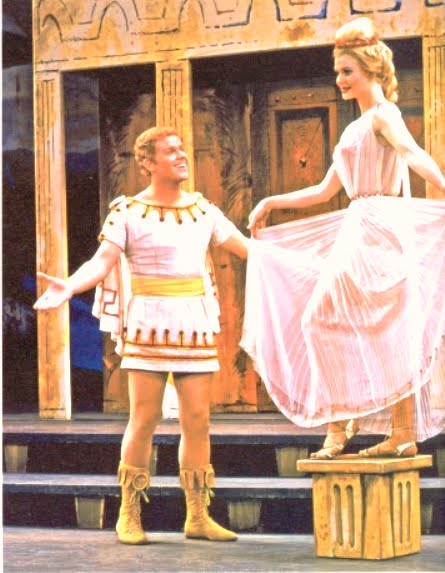 online access to its archives, not only do the critics provide interesting insight into the show's reception but it's amazing to see how many newspapers that city supported in 1962. Few of the critics, while acknowledging A Funny Thing Happened on the Way to the Forum entertained them immensely, wrote much — if anything — about Sondheim's score. The morning after it premiered, Howard Taubman, chief drama critic for The Times since Brooks Atkinson's retirement in 1960, wrote, "Know what they found on the way to the forum? Burlesque, vaudeville and a cornucopia of mad, comic hokum. The phrase for the title of the new musical comedy that arrived at the Alvin last night might be, caveat emptor. A Funny Thing Happened on the Way to the Forum indeed! No one gets to the forum; no one even starts for it. And nothing really happens that isn't older than the forum, more ancient than the agora in Athens. But somehow, you keep laughing as if the old sight and sound gags were as good as new. As for the score, Taubman said, "Mr. Sondheim's songs are accessories to the pre-meditated offense. With the Messrs. Mostel, Gilford, Burns and Carradine as a coy foursome, 'Everybody Ought to Have a Maid' recalls the days when delirious farceurs like the Marx Brothers could devastate a number. When Mr. Mostel, the slave with a nimble mind and a desire to be free, persuades Mr. Gilford, the nervous straw boss of the slaves, to don virgin's white, the two convert the show's romantic and pretty 'Lovely' into irresistible nonsense." Taubman penned one of the kinder notices to Sondheim's songs though he appears to have missed the point that even the first version of "Lovely" sung by the story's virginal courtesan Philia comes steeped in satire as the beauty sings an ode to superficiality and her own bubbleheadedness. (The first link takes you to Preshy Marker's version from 1962, the second to Jessica Boevers' from the 1996 revival; since I used the 1962 recording of "Everybody Ought to Have a Maid" at the beginning of the first half, this link goes to the BBC Proms rendition by Daniel Evans, Julian Ovendon, Simon Russell Beale and Bryn Terfel.) The score's assessment changes over the years and as of today, Sondheim may remain the toughest critic. In his book, he again wrote, "I made the subtle, though thankfully not fatal, error of being witty instead of funny." Below, watch a quite different take on "Lovely" from Putting It Together as performed by Carol Burnett and Ruthie Henshall.
Let's skip quickly through some excerpts from the other opening night reviews. Remember: Each of these came from New York newspapers and many no longer exist. Still, today, when some major cities fail to support one daily newspaper to think that this many could thrive in a single city, albeit one as large as New York, makes an old ex-journalist such as myself fill with both wonder and sadness. Walter Kerr for The New York Herald Tribune: "The funny thing about A Funny Thing Happened on the Way to the Forum is that it's
 funny. I'm not going to tell you it's anything more than that, but maybe I don't have to. For all I know, you like funny musicals. You may even like classical funny musicals, and this one is very classic.…Composer Stephen Sondheim begins by giving his lightfooted fools some rather odd recitative as substitute for melody and same vaguely Oriental wood-block effects as substitute for lively accompaniment. You wonder. Then, with a foursome in which Mr. Mostel, Mr. Burns, Mr. Gilford and a borrowed scarecrow named John Carradine, take off to a tune called 'Everybody Ought to Have a Maid,' the odd figurations Mr. Sondheim is attracted to begin to pay off. There's a faint edge of musical sarcasm to be dealt with here, and it crops up again — most effectively — in 'I'm Calm,' 'Impossible,' 'That Dirty Old Man,' and in Mr, Mostel's swooning reprise of a number that was mocking in the first place, "Lovely." The score is in and out, but wins out. The lyrics are fine. Is it me or does it seem as if Kerr keeps changing his mind as he's writing? Though a Broadway theater remains named after the critic today, I've always been leery of Kerr since he actively participated in the industry as a writer, director and lyricist at the same time he worked regularly as a critic. At least he recognized the humor in the first version of "Lovely" though, I'll give him that. (Isn't it fascinating to imagine that Broadway theater owners sometimes honor critics this way? A theater bears Brooks Atkinson's name as well and they even awarded him a special Tony after he retired. When will we see The Frank Rich Theater? Can you imagine and honorary Oscar to a film critic?) The links: "Everybody Ought to Have a Maid" from 1966 film; "Impossible" from the 1996 revival recording; "I'm Calm" and "That Dirty Old Man" both from the 1962 original cast recording. Below we have the clip from the poorly shot bootleg of the "Lovely" (reprise) from the 1996 revival performed by Nathan Lane and Mark Linn-Baker.
Others who opined about opening night. Unless they took contrarian views on the show itself, I'm limiting the comments to the score.: Except for calling Forum a musical comedy in his lead, the only other reference to the score Richard Watts Jr. made in The New York Post comes as part of the review's penultimate sentence. "…and Stephen Sondheim’s score is modest but pleasant." John McClain wrote in The Journal American, "Zero Mostel, a very animated blimp, will personally defy you not to like A Funny Thing Happened on the Way to the Forum…The clients laughed and seemed to enjoy themselves, but there was always the suggestion that had they not, Mr. Mostel would have passed among them and belabored them with a baseball bat. He is quite largely the whole show… The book by Burt Shevelove and Larry Gelbart (claiming some debt to Plautus) is a wispy affair, and Stephen Sondheim's score is less than inspired,
 but under George Abbott's slick direction the show moves and the audience roars. I should think it would succeed." At The New York Daily News, John Chapman chimed in, "(The performers) are grand muggers, leerers and slapstickers, and any old vaudeville fan will be happy to see them in operation.…The songwriter, Stephen Sondheim, comes up with an occasional bright and funny number, such as the four burlesquers song 'Everybody Ought to Have a Maid,' and Miss Kobart’s venomous hymn to Burns, 'That Dirty Old Man of Mine.'" Did he not look at his Playbill? How did he get the song title wrong? Links: "Everybody Ought to Have a Maid" performed by Carol Burnett and Bronson Pinchot in Putting It Together; "That Dirty Old Man" from 1996 revival cast recording. Another critic who didn't find it important to check song titles was Norman Nadel in The New York World Telegram, who delivered the harshest review I read. "But too high a price must be paid for entertaining moments in A Funny Thing… Much of the comedy repeats itself. Some of the players work so hard to exploit their thin materials that they generate more sympathy than laughter. The show is slow starting and sometimes heavy-footed. Stephen Sondheim’s music would have been a second-rate score even in 1940, but he has come up with some catchy lyrics. One is “All I Know is Lovely,” sung by Ms. Marker and Mr. Davies. Another is 'Bring Me My Bride,' in which Miles proclaims his own glory; this is done resonantly by baritone Holgate.…There are indications at the Alvin that A Funny Thing might have been an earthy, boisterous delight. From time to time, it is. For the most part, however, it strains too hard to achieve too little." Link: "Bring Me My Bride" from original 1962 cast recording; I've run out of versions of "Lovely." Finally, we get to Robert Colman reviewing at The New York Mirror with the nicest words for Sondheim's score. "Stephen Sondheim has supplied a score that falls pleasantly on the ears. Jack Cole has choreographed dances that would have delighted Billy Minsky’s. We suspect that A Funny Thing will prove the most controversial song-and-dancer of the season. You’ll either love it or loathe it. In our book, it looms as a hot ticket. A riotous and rowdy hit." The retired Brooks Atkinson filed a "critic at large" piece for The New York Times in July where he barely mentions that Forum contains music and Sondheim's name never appears, though the "low comedy" delights him to no end. Since "Everybody Ought to Have a Maid" comes up so often, I've reserved two video clips for you to watch. The first comes from the 1996 revival.
Before I get to the final clip of "Everybody Ought to Have a Maid," I thought it would be interesting to point out how quickly critics began to re-evaluate Sondheim's score for Forum. Granted, in these reviews I was limited to The New York Times and most come after the one-two punch of Company and Follies supersized his reputation, but the reconsideration started as early as the 1966 film version. Vincent Canby wrote in his review of the film, "Stephen Sondheim's music and lyrics hold up well, especially 'Comedy Tonight,' by which Mr. Mostel introduces the characters at the start, and the slightly bawdy 'Everybody Should Have A Maid' ('sweeping out, sleeping in')." When Clive Barnes assessed the 1972 revival for The Times, he said, "Mr. Sondheim's music is original and charming, with considerable musical subtlety but a regard for down-to-earth show-biz vigor that is precisely what is needed. And, as always, his lyrics are a joy to listen for. The American theater has not had a lyricist like this since Hart or Porter." By the time the 1996 revival arrived, Canby's beat had switched from film to theater. "This brazenly retro Broadway musical, inspired by Plautus, is almost as timeless as comedy itself. Here's a glorious, old-fashioned farce that, with its vintage Stephen Sondheim score and its breathless book by Burt Shevelove and Larry Gelbart, celebrates everything that man holds least dear but can't deny himself: lust, greed, vanity, ambition; in short, all of those little failings that make man human. Yet for all of its disguises, mistaken identities, pratfalls and leering jokes, A Funny Thing is as sophisticated as anything now on Broadway. In its own lunatic way, it's both wise and rigorously disciplined. Easy sentimentality is nowhere to be found here; in its place: the kind of organized chaos that leads to sheer, extremely contagious high spirits," Canby wrote. Now, that other clip of "Everybody Ought to Have a Maid" features original 1962 cast member Jack Gilford performing with two (well, at least one) other surprising performers in a television appearance.
I'd hoped to avoid this situation, but I got so caught up with the behind-the-scenes history that what I intended as a short tribute grew to be massive. I still need to write about the original production's performance at the Tony Awards and some tidbits concerning the two revivals, the second of which I saw, not to mention that version I saw in 1979 when I was 10. That won't be coming today I'm afraid. So, I'll leave you with the sequence for "Bring Me My Bride" from Richard Lester's film version.
Labels: blacklist, Books, Capra, Criticism, Gelbart, J. Carradine, J. Robbins, Keaton, Marx Brothers, Music, Musicals, Sondheim, Television, Theater Tribute, Welles
TO READ ON, CLICK HERE
Wednesday, December 21, 2011
Centennial Tributes: Jules Dassin Part III

By Edward Copeland
Between the years 1949-54, any opportunity Jules Dassin had to make a movie anywhere failed to materialize. Following his work on Night and the City in London, he returned to the United States only to find that people he once considered friends did their best not to be seen with him. In 1951, while Dassin attended the Cannes Film Festival he learned that he had been named by a cooperating witness during the second round of hearings of the House Un-American Activities Committee. Before he had been an unofficial blacklistee because he'd been called to testify and hadn't — being named by a friendly witness was another matter. This wasn't just any friendly witness who had named him either — it was director Edward Dmytryk, the only member of The Hollywood Ten, the 10 artists who had lost their court fight claiming that they had the constitutional right NOT to testify before HUAC. The 10 lost their appeals and received six- to 12-month jail
 sentences. Dmytryk served six months in jail, but still turned friendly witness anyway so he could work again, something for which most of the other nine men never forgave him. Dmytryk, whose best known films include Crossfire, The Caine Mutiny and Raintree County, said in his defense, "I had long been convinced that the fight of the Ten was political…I believed that I was being forced to sacrifice my family and my career in defense of the Communist Party, from which I had long been separated and which I had grown to dislike and distrust.…I would have to name names, and I knew the problems this would cause…my decision was made easier by the fact that…I couldn't name anybody who hadn't already been identified as a Party member. Weighing everything — pro and con, I knew I had to testify.…I did not want to remain a martyr to something that I absolutely believed was immoral and wrong." The Criterion DVD for Rififi contains the 2000 interview with Dassin which discusses in the most detail what the blacklist did to him and how the atmosphere affected others as well, especially the pressure families could put on the artists. "Your wife would say, 'What do you want us to do? What about raising your children? We don't care about your principles — think of your family.' A lot of that happened," Dassin said. That's one thing I've always thought about when the subject comes up now. It's easy for people like us who are discussing that era in theoretical terms to say we'd act with principles and fight against the forces of evil, but we might behave differently if we actually were in the situation and had families to support. Look how few people raise their voices against governmental abuses now. The Occupy protests have been heartening, but they've still been rather small in number and struck down by the establishment rather easily while the majority getting screwed today, as always, keep quiet. If you missed either Part I or Part II of this tribute, click on the appropriate link.

Dmytryk's main motivation was to keep working while other members of The Hollywood Ten went straight from jail to the blacklist though many, such as Dalton Trumbo, wrote screenplays using pseudonyms. Several Oscars during the 1950s went to people who either didn't exist or were fronts. In the 2000 interview, Dassin admitted that Darryl Zanuck would buy story ideas from him during this xperiod. Dassin also told, "one particular story that was really so painful." Dassin went on to discuss Robert Rossen, writer-director of All the King's Men and The Hustler and director of Body and Soul. Like so many in the creative community, Rossen found the witchhunt deplorable, the politicians behind it despicable and the studio chiefs who caved to them cowards. At first, Dassin said in the interview, Rossen declared, "You can't do this to people. I will not cooperate with these committees and questions." Dassin told of vandalism that occurred at the homes of people whose names were mentioned in passing during the hearings, a detail I'd never heard before. Rossen had kids at the time to worry about but, "He explained to them why it was wrong to name friends and betray people and made the kids understand that and they handled it well," Dassin said. Unfortunately, the pressure got to Rossen and he broke down and named names. Rossen "named all kinds of people. Now he had to explain that to his kids. Those kids — I don't know how they are now — but they were in bad shape for many years," Dassin shared with the interviewer.
For the many like him who were denied employment because in their youth, they joined a party they soon renounced and had had no part of for years, it was frustrating. Dassin said they always waited for some kind of hero who could stand against them and when the natural choices to fill that role such as Elia Kazan or Clifford Odets instead broke down and named names, "It was heartbreaking," Dassin said. The director also told of how people such as him got so use to old friends trying to avoid them that he would try to spare them the embarrassment by hiding if he saw them first. In the same 2000 interview, Dassin told of attending the Cannes Film Festival once, though he couldn't recall the year — he was 89 then; I think he'd earned the right to forget some Cannes Film Festivals — and spotting Gene Kelly, Dassin went and hid around the corner when he felt this strong grip on this arm. "What do you think you are doing?" Kelly asked and led Dassin into the party where most of the Americans were hanging out. Not everyone was as gracious as Kelly though — Dassin described one former friend who hid under a table to avoid being seen with him.
Moviemaking opportunities seemed closed to Dassin. An American producer had arranged for him to film a movie called Public Enemy No. 1 in France featuring Zsa Zsa Gabor as one of its stars. Gabor called Dassin in tears to tell him that she'd been warned that if she made a film with him, her career would be through so she was forced to back out. Soon after, the producer told him that unions had delivered
 the message that if he made the film, no film of his would ever receive distribution again. The film fell apart, though the French got angry and declared him a member of the French Director’s Union. His U.S. passport was revoked, but the French gave him papers which allowed him to travel He went to Rome with plans to make a film of the novel Mastro-don Gesualdo by Giovanni Vergan but Italy asked him to leave the country, ruling that he was an "undesirable." Dassin went to the U.S. Embassy for help, but they wouldn't even receive him. The U.S. Ambassador to Italy at the time was Clare Booth Luce who refused to see him. Dassin returned to the states and Broadway. Theater didn't recognize the blacklist and he directed Two's Company: Charles Sherman's Musical Revue starring Bette Davis. During the show's pre-Broadway tour of many U.S. cities, Dassin again received notice to appear before HUAC, but he declined because of the show's tour. By the time it opened in New York, he received a telegram informing him that his hearings had been canceled. Sherman wrote the sketches with Peter DeVries while among the various contributors to the songs in the show were Vernon Duke, Ogden Nash, Sammy Cahn and Sheldon Harnick. The dances were staged by Jerome Robbins, another person caught up in HUAC who was forced to name names by Ed Sullivan who threatened to expose his homosexuality if he didn't. One of the other members of the cast was Tina Louise aka Ginger on Gilligan's Island. It opened Dec. 15, 1952 and ran through March 8, 1953 at The Alvin Theatre before going on a road tour. Hiram Sherman won the Tony for best featured actor in a musical. Despite the musical's success, enough was enough and an offer to make a movie there combined with the warm treatment her received from the country led Dassin to move his family to France in 1953 where he was about to make his other masterpiece, Rififi.
The 2004 L.A. County Museum of Art interview on the Criterion Naked City DVD took place after a screening of Rififi, part of a retrospective on the films of Dassin, so the bulk of the conversation concerned that movie. The person asking the questions was Bruce Goldstein, founder of Rialto Pictures and repertory director at New York's Film Forum. This was four years after his long interview where he spoke about the blacklist in detail, but it did show that he still kept abreast of current issues involving civil liberties well into his 90s.
GOLDSTEIN: How did you come to make a film in France?
DASSIN: A man was producing a film called Du Rififi Chez Les Hommes and he told me I was the only man who could make this film. Now this was after five years of nada, no work at all, but he still couldn't say why he needed me. He said he had a problem with Rififi — "All the bad guys are North Africans and at this time, France is having such problems with Algerians, you can make the bad guys Americans. When I said to him, "Have you thought of making them French?", he hadn't. Well, anyhow, I got that job for the same reason I was blacklisted.
GOLDSTEIN: That's all you wish to say about the blacklist?
DASSIN: Enough. We've got other things to worry about these days. I was thinking about The Patriot Act.
In his book The Films in My Life, François Truffaut wrote about Rififi, "Out of the worst crime novels I have ever read, Jules Dassin has made the best crime film I've ever seen." I haven't read the Auguste Le Breton novel, but I don't doubt Truffaut's word. Many people have said one of the elements Dassin didn't transfer to the movie from the novel were acts of necrophilia, so I think Dassin made the right choices in his adaptation of what might be the greatest heist film ever made. Dassin structures the film like
 a solid three-act play. Act I: Planning the heist. Act II: Carrying it out. Act III: The aftermath. As has been the case since Brute Force, the technical aspects reach the highest levels of excellence from Alexandre Trauner's production design to Auguste Capelier's set decoration, from Roger Dwyre's editing (he'd go on to edit most of Dassin's films and had cut Rene Clement's Forbidden Games) to the evocative cinematography of Philippe Agostini. Much credit for the look belongs to Dassin, who admits in the 2000 interview on the Rififi DVD that he drove the producer crazy by refusing to shoot in sunlight because he wanted the film to be gray. Truffaut also wrote in his book that "Dassin revealed Paris to Frenchmen just as he revealed London to the English (Night and the City) and New York to the Americans (The Naked City)." Bosley Crowther was The New York Times film critic for 27 years until 1968. He tended to be a stick-in-the-mud who got off on meanness and dumping as many 10-cent words into a single sentence until it could hold no more, but he even managed a nice turn of praise phrase for Rififi: It has a flavor of crooks and kept women and Montmartre "boites" that you can just about smell. As great looking as Rififi is, a limited budget hampered what Dassin could do in terms of casting so for the part of Cesar the Milanese, the safecracking expert from Italy ("There's not a safe that can resist Cesar and not a woman that Cesar can resist."), he had to employ the actor Perlo Vita, which was the screen name used by a man known as Jules Dassin. In many of his later films, Dassin would end up playing a role because he'd run out of money to hire an actor with more experience.

Having "Perlo Vita" play Cesar play a significant role didn't really cause a problem because for the most part, none of the performers were known outside of France and the one who was best known there — Jean Servais, who played Tony, the leader of the jewel thieves — hadn't made a film in France in a couple of years. Servais gives the film's performance as the stoic Tony, newly released from prison after five years and mad as hell that his girlfriend Mado (Marie Sabouret) has taken up with Louis Grutter (Pierre Grasset), the sleazy owner of the night club L'Âge d'Or, named after the famous Buñuel film on which Trauner also served as production designer. When Tony first gets out, his old pals Jo (Carl Möhner) and Mario (Robert Manuel) try to talk Tony into cutting out the display window of the jeweler Mappin & Webb (a real jewelry store who agreed to let their name and store be used in the movie. Tony opts out until he learns about Mado's betrayal and sees all the gifts that Grutter lavishes on her, so he contacts Jo and Mario with plans to go for the safe instead. They enlist Cesar the safecracker for the heist which will net them about 240 million francs worth of jewels. Ahh, but nothing comes easy, does it? In a way, Servais delivers the only performance, but Dassin fine-tunes each of the film's element to the point that Rififi practically runs as a machine all its own, rendering the quality of the acting nearly irrelevant. The various characters behave more as chess pieces to be moved around as the story's game requires than as representatives of people.

Dassin holds on to this material tightly, yet he still allows for some flourishes. At the club, a singer named Viviane (Magali Noël) performs a dance and sings the song "La chanson 'Le Rififi'" while a silhouette of a man with a gun dances behind a screen behind her. Among the lyrics: "It's the lingo of the streetwise/the battle cry of real tough guys/Rififi" followed by the sound of a gun punctuating the beat. By the way, Rififi is French slang for tough guy posturing by criminal elements in Paris. (If you haven't seen Rififi — and shame on you if you haven't — spoilers will abound from here on out, so I'd look away for the rest of this paragraph.) Grutter realizes that Tony
 and his cohorts were behind the robbery when Cesar pockets a ring from the loot and shows it off to one of the girls who works at his club. First, Grutter gets rough with Cesar to get the address of Mario out of him. When Mario refuses to tell Grutter and his men where the jewels are, they demand he call Tony. Mario refuses, but his wife gives in and does it, only she warns Tony on the phone and Grutter's men kill them both. When Tony discovers the scene, he finds Cesar tied up at L'Âge d'Or, Cesar apologizes for giving up the address. In a departure from the novel, Tony tells Cesar he knows the rules for turning in your friends and kills him. Dassin admits in one of the interviews he added that because he was thinking of all those who betrayed friends by naming them to HUAC. Later, Grutter's gang kidnaps Jo's son and demand the jewels. When two of Grutter's men grab the little boy while he's in a park with his mom and push him in a car, his balloon floating aimlessly away, a passenger on a bus who witnesses the abduction warns his child, "Hold your balloon tight — see what can happen."


One single sequence though makes Rififi a landmark both in films and particularly in heist movies: the robbery itself. The way Tony and the guys steal the gems from Mappin & Webb is by breaking in to the apartment above the store and going in from above to do the rest of the safecracking, etc. Dassin films this in a 32-minute long silent sequence. No one speaks. Keeping everything as quiet as possible becomes the thieves' No. 1 priority. It's absolutely riveting. You'll be holding your breath as if you were involved in the crime yourself. Composer Georges Auric wrote Rififi's musical score.


Auric provided music for films from around the world including, up to this point in his career, Roman Holiday, The Wages of Fear, The Lavender Hill Mob, Orpheus, Beauty and the Beast and Blood of a Poet (the last three for Jean Cocteau) and Auric's first film score, Rene Clair's À Nous la Liberté. When Auric heard that Dassin had a 32-minute robbery sequence planned, he got excited and told him he was going to compose a huge piece of music for it. Dassin told him he didn't need to do this because he wanted it to play in silence, but Auric insisted and wrote the music anyway. When both the sequence and Auric's composition were done, Dassin asked Auric to come watch it with him — once with music, once without. Auric did as Dassin asked. Afterward, Auric turned to Dassin and told him to play the heist in silence.


Before Rififi began to be screened for public or professional consumption, Dassin showed it to his friend director Lewis Milestone, who won the Oscar for comedy direction the only time it was ever given for Two Arabian Knights as well as a second prize for All Quiet on the Western Front, and happened to be in Paris. His other credits included 1931's The Front Page and 1939's Of Mice and Men. Rififi wowed Milestone who advised Dassin that he should "make this film all your life and you'll be like Hitchcock." With the exception of one film in about a decade that was more or less a comic takeoff on the heist genre, Dassin did not follow Milestone's advice, compiling a quite eclectic filmography. Once Rififi began to be seen, critics kept saying Dassin owed a debt to John Huston's The Asphalt Jungle, a film that Dassin had never seen. Several years later, Dassin did see The Asphalt Jungle, but he failed to see specific comparisons except slightly in that an attractive woman becomes a character's undoing. One of the funniest revelations that Dassin made in one of the DVD interviews was that, though he is referred to as one of the masters of film
 noir, he had never even heard the term until he moved to France. Rififi received such good word-of-mouth that it was accepted into the official competition at the 1955 Cannes Film Festival. Dassin himself was so broke he could barely go. When one of the film's producers gambled at a casino, he begged for a little cash so he could play. He asked what date they started shooting the movie. "The eighteenth," he was told. Dassin put all he was given down on the number 18 on a roulette table and it hit, providing his family with funds to live on for awhile. As for the festival, the perceived front-runner was the film Stella directed by Mihalis Kakogiannis (who would soon change his name to Michael Cacoyannis before he got around to directing Zorba the Greek) and featuring the film debut of actress Melina Mercouri. The Palme d'Or ended up going to the American film Marty while best director was shared between Dassin and Sergei Vasilyev for Heroes of Shipka. Six actress from the Russian film Bolshaya semya (A Big Family) shared best actress, leaving Mercouri empty-handed but she and Dassin met and soon became lifelong collaborators in every sense of the word, though he didn't divorce his first wife until 1962 and wed Mercouri until 1966. Ironically, the 1955 Cannes jury also awarded a prize for best dramatic film to Elia Kazan for East of Eden. I don't know if he and Dassin ran into each other. Of course, Dassin couldn't avoid controversy. There were complaints that Rififi could be viewed as a how-to film for would-be thieves. Dassin said his response always was that, if anything, the film showed that the price was too high and usually ended badly for those who attempted such adventures. When they captured the culprits behind a robbery spree in Mexico, they cited the movie as an inspiration. Critics of the film accused Dassin of making the core group of thieves too sympathetic (never mind that when Tony learns that Mado took on a new lover while he was in prison, he removes his belt and beats her savagely, though offscreen). Dassin admitted in one of the interviews that he couldn't help himself. "It's what's left of the old rebel in me — I always want my guys to succeed," he said.

Dassin's next film went in an entirely different direction from anything he had made before. According to Truffaut's book, Dassin considered the movie, "'the film of my life,' the first film he really chose to make, and made with complete freedom, a film in which he succeeded in expressing totally." Based on Nikos Kazantzakis' 1948 novel The Greek Passion (which was published in England as Christ Recrucified) took place in Lycovrissi, a Greek village in the 1920s held under the rule of the Ottoman Empire. Despite being Muslim, the Agha (Grégoire Aslan) who controls the village for the Turks allows the Greeks to stage the passion play they hold every seven years, even
 though in private the Turks comment that "Allah is a cheerful artist, Jesus a melancholy god." Father Grigoris (Fernand Ledoux) picks who will play all the various roles and upsets some when he selects a stuttering shepherd named Manolios (Pierre Vaneck) to play Jesus. As you'd expect, the village's prostitute, Katerina, (Melina Mercouri, in her first film with her future husband) is cast as Mary Magdalene, An angry blacksmith Panagiotaros (Roger Hanin) who holds lots of grudges, including being passed over for the role of Christ, gets picked for the role of Judas. Outside the casting, there are other interesting characters such as the village's now figurehead of a leader, Archon Patriarcheas, who the Turks still allow to live well and for his own pleasure (played by Gert Frobe, who would go on to play Bond's best villain in the best 007 film, the title role of Goldfinger). The conflict comes when Greeks uprooted by Turks from another village arrive, starving and looking for shelter. They're led by their own priest, Father Fotis (Jean Servais from Rififi) but Father Grigoris suspects these new people aren't looking for charity but for land and spreads rumors of cholera about the newcomers, quarantining them to a mountainous area. It's all the reason the richer citizens of Lycovrissi need to ostracize them but, as you might expect, those involved in the passion play, start to take their roles seriously and Manolios dares to reach out to help the refugees. Georges Auric composed a boisterous score for the film and He Who Must Die contains many positive attributes, but I think Truffaut nailed the film's problems in his review in The Films in My Life:

"This time there is nothing but nobility, nobility, and more nobility — too much nobility for a film that displays an intellectual confusion seldom displayed in the history of cinema.…I must admit that this kind of subject, in which everyday people must transcend themselves by identifying with characters they personify, irritates me because it is so theatrical and so obvious. Knowing in advance that Judas will betray Christ, we pay attention only to how the blacksmith will betray the shepherd.…During the film, which I saw twice, I noted this sentence in the dialogue: 'The human brain is a fragile machine; one turn too many and it breaks down.' Jules Dassin gave one turn too many to his film; he has everything mixed up, tangled it all together, preaching and plasticity, reflections in mirrors, the lack of bread, rejected lovers, and children who die of cold."
He Who Must Die was in competition for the Palme d'Or at the 1957 Cannes Film Festival, but lost to Friendly Persuasion. It did receive the OCIC (The International Catholic Organization for Cinema) Award — Special Mention.

Dassin went from the all-too-literal to the all-too-obscure with his next film, which didn't open in the U.S. until 1960 (and when it did, it was called Where the Hot Wind Blows!). Though Italy kicked Dassin out the last time he tried to make a movie there, the country allowed him to film there for his adaptation of French author Roger Vailland's 1957 La loi, which won France's highest literary prize, The Prix
 Goncourt. Though the novel was written in French and Dassin would film the movie in French, it took place in a southern Italian fishing village on the Adriatic called Porto Manacore and starred Italian acting icons Gina Lollabrigida and Marcello Mastroianni and took its name from a game native to that part of Italy. Some non-Italians made the cast as well including French stars Yves Montand (The Wages of Fear) and Pierre Brasseur (Frédérick Lemaître in Children of Paradise) and, of course, Melina Mercouri. Brasseur plays Don Cesare, the aging, de facto leader of Porto Manacore. Lollabrigida is Marietta, one of the don's housekeepers, the object of lust for most of the village's men, and the object of scorn for others, especially Don Cesare's other
 female servants who torture Marietta when they can since no one dreams of them. Montand, who gives the best performance of the film, plays Matteo Brigante, the local crime boss who loves to throw his weight around, but does it in a most charming way since he wants to assume Don Cesare's place of respect and wouldn't mind Marietta as well. He has his own personal problem in that his young son Franceso (Raf Mattioli, who died of a heart attack the next year at the young age of 24) has been having an affair with the judge's wife (Mercouri) and plans to run off with her. Mastroianni is Enrico Tosso, an agronomist from morthern Italy visiting the village who falls for Marietta (and she for him) but lacks the funds for a dowry. Marietta sets out to steal cash from a Swiss tourist so they can be together while Don Cesare advises that Enrico should go observe a session of The Law to see what it's all about, since it's such a regional phenomenon he's unfamiliar with the game. Almost nightly, men gather in a town tavern to play the game, but when Enrico shows up to be a spectator, Brigante forces him to participate even though he doesn't know the rules. Explaining The Law (the movie) proves less complicated than describing the game it's based on. Author Vailland appeared on the French talk show Lectures pour tous on Dec. 4, 1957, where host Michel Butor interviewed him about the game. The two-disc Oscilloscope DVD set of The Law includes the interview.
VAILLAND: First off, it's a card game (that only exists) in southern Italy.
BUTOR: It's a card game that shows the feudal system still strong in this region…Let's say first the rules…and who plays…
VAILLAND: The rules are very simple. First, you need a winner, like in any game, but the game only starts when the winner has been designated by luck — by a card game or a dice roll — and The Law becomes an exciting and cruel game because the winner can impose The Law on the loser.
BUTOR: What does that mean?
VAILLAND: It means asking questions that they must answer which insult them in a more or less subtle way and they must endure it, even if it wounds their honor.
BUTOR: Is it the game of Truth?
VAILLAND: In the sense of honor, which is very strong in southern Italy. The same insult in real life would provoke a violent response, but in the game of Law, it's in the rules. The loser must lay his hands on the table and be subjected to The Law.
Did that clear things up? Didn't think so. It doesn't really match the movie's depictions of the game either. (He doesn't bring up the winner
 being given the title of "the boss," picking a deputy boss, naming an idiot, etc.) In the end, it hardly matters. I imagine if you hail from southern Italy, it's conceivable that additional layers of meaning might be found in The Law that escapes viewers from the rest of the world. Since that includes the overwhelming majority of us, let's just forget about the game's relevance to the plot. They might as well be playing Quintet. In spite of The Law lacking a truly coherent story, Dassin does have a great, fluid sequence toward the opening of the film that begins with the release of a pigeon from the first scene landing on a building. From there, in seemingly one take, the camera moves along the windows of the building, catching the various goings-on in the apartments as if we're Jeff in Rear Window gazing through our telephoto lens as the people in the different rooms strain to see the source of a siren's song that turns out, of course, to be Marietta warbling while she washes the don's boots on a balcony of his nearby villa. Nearly the entire cast make the effort watchable, especially the great Montand who revels in Brigante's sleaze, even if you're unsure at the end what the hell you just watched.

I didn't get a chance to re-watch this one, but when I first saw this a few years back, I was underwhelmed, but it may be Dassin's most important post-blacklist film, not in terms of quality but in what it represented. First of all, it was a huge hit. Second, 1960 more or less brought an official end to the blacklist on several fronts. Kirk Douglas released Spartacus and defied the list by allowing screenwriter Dalton Trumbo's credit to appear. When the Oscar nominations came out, Dassin was nominated for both best director and best story and
 screenplay for Never on Sunday, the only two Oscar nominations Dassin ever received. The movie as a whole received five nominations, including best actress for Melina Mercouri and won best original song for the title track. Mercouri had won best actress at Cannes, tying with Jeanne Moreau for her work in Peter Brook's Seven Days…Seven Nights (known as Moderato cantabile in France). Not everything was perfect: Nedrick Young who co-wrote Inherit the Wind was nominated under the pseudonym Nathan E. Douglas, though the Academy restored Young's name to the records in 1993. In one of the DVD interviews, Dassin told another funny anecdote. When he was making Never on Sunday, he ran short on financing and again had to cast himself, this time as the lead. Before the film had been released outside of Greece (where it was a huge hit anyway), Jack Lemmon happened to be Athens and Dassin showed it to him, hoping somehow that he could come up with money to re-shoot his scenes with Lemmon playing his part. After watching it, Lemmon told Dassin, "You're terrible in this film, but it's charming." He advised him to leave it the way it was. With Dassin's terrible performance intact, the movie was a hit everywhere, grossing an estimated $8 million as of January 1962 off a $151,000 budget.
He returned to New York briefly in early 1962 to direct a new play on Broadway by Robert L. Joseph about a dying child called Isle of Children. It starred Patty Duke, the same year she would repeat her stage success as Helen Keller in movie of The Miracle Worker. The cast also included Bonnie Bedelia. The play got mixed reviews and ran for a mere 11 performances.

This attempt to do a modern twist on the ancient Greek myth of Phaedra falls into overheated melodrama and little else. Dassin manages some nice shots and the cinematography by Jacques Natteau and especially Max Douy's art direction are exceptional. Raf Vallone does what he can as the Greek shipping magnate and Melina Mercouri floats between good and bad as the title temptress, but Anthony Perkins at times almost goes as over-the-top as Vallone's son as he did as the weirdo priest in Ken Russell's Crimes of Passion.

Sometimes it can be hysterical when someone satirizes one of their most famous roles or movies (Think Marlon Brando in The Freshman). Dassin should have been more than capable to do a comic riff on Rififi, but Topkapi is not that movie. It throws Maximilian Schell (who, by coincidence, would be hysterical in The Freshman), Melina Mercouri (as always), Robert Morley and Peter Ustinov, sweating up a storm and winning his second Oscar for supporting actor as the chase begins to abscond with a jeweled dagger from a museum in Istanbul. It's meant to be funny, but the jokes fall flat. What's most notable is that 22 years after Dassin directed his first feature film, Topkapi marked the first time he filmed in color. What always has bugged me is that, as much as I love Ustinov generally, how could he win the Oscar in 1964 for this? His official competition that he beat was John Gielgud in Becket, Stanley Holloway in My Fair Lady, Edmond O'Brien in Seven Days in May and my choice of their nominees, Lee Tracy in The Best Man. This doesn't include people who didn't make the cut such as Sterling Hayden and George C. Scott in Dr. Strangelove, Gert Frobe in Goldfinger, Richard Attenborough (Seance on a Wet Afternoon) — that's just a handful that come to mind.
I haven't seen Dassin's next film, 1966's 10:30 P.M. Summer, based on Marguerite Duras' novel Dix heures et demie du soir en été. Duras and Dassin co-wrote the screenplay. I borrowed part of a post that Roderick Heath wrote at Ferdy on Films
10:30 P.M. Summer looks to me like a transitional film. Today, spare, cryptic portraits of the psychic and sexual life are more common; how to create psychologically and emotionally penetrating works of film was a major question for earlier directors. This film, like Losey and Pinter’s Accident (1967), which possibly had an easier time of it for centering more happily on male sexual transgressions, or Tony Richardson’s Mademoiselle (1966), stand somewhere between the stylistics of the “alienation” films of the early ’60s and the playfulness of the new wave, and the approaching full-bore works of Bertolucci, Breillat, Eustache and others.
…
Whilst no masterpiece, it’s far better than its reputation reflects, and it’s a film worth finding.

Dassin and Mercouri decided for their next project to return to the material that gave them their greatest success and they turned Never on Sunday into the Broadway musical Illya Darling. Mercouri repeated her role, but Dassin was glad to stick to directing and writing the musical's book. He let Orson Bean play his part from the movie. This might have been a sign that they were making a good move: the musical was booked into The Mark Hellinger Theatre, named after the independent producer of his first two great films, Brute Force and The Naked City, but who had a career as a New York theater critic and columnist prior to that. It no longer exists as a theater as the Nederlanders has leased the theater to the Times Square Church since 1989. The musical's cast also included Hal Linden and had music by Manos Hadjidakis and lyrics by Joe Darion (who wrote the lyrics for Man of La Mancha). Illya Darling received six Tony nominations (best musical, best composer & lyricist, best director, best choreography, best actress for Mercouri and best featured actor for Nikos Kourkoulos). Though it didn't win any Tonys, the show ran for 320 performances.
While Dassin and Mercouri were in New York with the musical, a military coup took place in Greece. The couple were vocal in their opposition and accused of helping to finance the opposition so they were banned from returning to Greece for seven years. At first, they toured with the musical. Later, Dassin decided to make a documentary about the six-day war in the Middle East, another film I haven't seen. Titled Survival '67, it was filmed in Israel, written by Irwin Shaw and released in 1968. Here is an excerpt of Renata Adler's New York Times review:
By Renata Adler for The New York Times
"describes itself as 'a paean to Israel.' What gets lost is the brave, tragic war itself. (There is hardly any documentary war footage at all.) The film, which keeps crossing what little moving footage it has — wounded men, monuments to Babi Yar and Buchenwald — by an inability to shut up, is poor and ineffective propaganda.
…
It is also poor reporting — it simply does not tell us anything that we did not know already, and what it does tell — in fuzzy interviews about, for example, the Arab refugee problem — it tells unclearly. Everything about it is off."

While Jules Dassin and Melina Mercouri were exiled from their home in Greece, they lived in New York. For the first time since Thieves' Highway, Dassin contracted to make a feature for an American studio (Paramount). For the first time since He Who Must Die, he also was making a feature that didn't have Mercouri in the cast because Uptight had an all-black cast. Truly a film of the moment, Uptight takes place in Cleveland four days after Martin Luther King Jr.'s assassination. In another respect, it wasn't of the moment since Dassin was remaking The Informer, the film the won John Ford his first directing Oscar in 1935 and changing the milieu from Irish revolutionaries to black militants. It starts with a hyperactive animated credit sequence set to music by Booker T. Jones. Dassin co-wrote the screenplay with Ruby Dee and Julian Mayfield, both of whom played roles in the film. As a time capsule film, Uptight remains an interesting experience and it contains some really good performances, especially by Raymond St. Jacques as a militant leader and Roscoe Lee Browne as a smooth operator who'll sell anyone out for the right price. Dassin takes a lot of flights of fancy, particularly in one drugged-out sequence involving crazy mirrors at an amusement park.
In 1970, he directed Mercouri in Promise at Dawn. Of the film, Roger Ebert wrote:
Jules Dassin's Promise at Dawn is a warmly drawn love poem in two parts, one dealing with style and the other with the story. Of the two, the first is more interesting: Dassin's treatment of his wife, Melina Mercouri, is a marriage of script, photography and performance designed to showcase her talent and beauty. The second love story — the love Melina's character has for her son — is rather static and even a little distracting in these decades after Freud.
In 1974. as described on the Melina Mercouri Foundation website, "On the occasion of the November 1974 Athens Polytechnic student revolt, Dassin, still exiled, filmed in New York The Rehearsal, a political documentary with the free participation of Olympia Dukakis, Lillian Hellman, Melina Mercouri, Sir Laurence Olivier, Manuella Pavlidou, Maximillian Schell, Mikis Theodorakis and others. Dassin considered this to have been one of his best films. It was due to be distributed on the day of the fall of the dictatorship and became untimely. Therefore it was never released. After the collapse of the junta, Jules Dassin and Melina Mercouri returned to Greece where they settled for the rest of their lives. Melina was actively involved in the establishment and promotion of the Pan-Hellenic Socialist Party."
Dassin's penultimate film, A Dream of Passion, came out in 1978 and told the story of an actress (Mercouri) preparing to play Medea who spends time with an imprisoned American woman (Ellen Burstyn) who, like Medea, killed her own children. I'm ashamed to admit that Dassin's final film happens to be the first film of his that I saw, It was 1981's A Circle of Two starring Tatum O'Neal as a college-age student obsessed with a famous artist played by Richard Burton. This was on either HBO or Showtime soon after we had it for the first time and I was in junior high. All I knew was the girl I had a crush on since The Bad News Bears and Little Darlings took off her top in it. I couldn't tell you anything about the movie and I didn't know who the hell Jules Dassin was. I certainly do now. Everyone should.
Dassin continued to direct plays once he stopped making movies and Mercouri turned to politics, becoming the longest-serving cultural minister in Greece's history. She made it a campaign to get the Parthenon or Elgin Marbles returned to Greece from the British Museum in England that had held them for more than 200 years. Unfortunately, the debate has continued past the deaths of both Dassin and Mercouri, though popular opinion in both countries side with returning the marbles to Greece.
Tweet
Labels: Bette, blacklist, Brando, Buñuel, Burstyn, Ebert, Harold Pinter, Huston, J. Robbins, John Ford, Julie Christie, K. Douglas, Kazan, Lemmon, Mastroianni, Milestone, Montand, Olivier, Oscars, Truffaut
TO READ ON, CLICK HERE


