Friday, August 03, 2012
Edward Copeland's Top 100 of 2012 (20-1)

Charlie Chaplin was audacious enough to continue making silent films (although he did allow for sound effects and an occasional song) all the way to 1936. In my opinion, he saved the Little Tramp's best for last in this hysterical tale of man vs. the modern age. The comedy is as funny as you'd expect and even more pointed than usual. Since Chaplin knew the Little Tramp was making his swan song, he even let him waddle off into the sunrise. Sound didn't stop Chaplin, who had two great sound efforts to come with The Great Dictator and Monsieur Verdoux. Still, his early works are the most precious gifts. Truly, his silence was golden.

When compiling the 2007 list, I feared it was becoming too Hitchcock-centric, forcing the omission of other great filmmakers but dammit, he made so many films that mean so much to me, it would be dishonest to place a quota on him. In the intervening five years, seeing Strangers several more times only has lifted it in my extreme. Hitch's directing gifts come off at his most stylish and Robert Walker's wondrous performance as the sensitive sociopath Bruno who expects the wimpy Farley Granger to live up to his part of a hypothetical murder deal remains chilling (and darkly funny) to this day. One of the biggest leaps from the last list.

Buster Keaton always shares the title with Charlie Chaplin as one of the two great silent clowns and The General continues to be Keaton’s masterpiece 85 years later. However, while it doesn’t lack for laughs, the film more accurately could be called an adventure than a comedy. The realism of the film’s Civil War setting also proves quite striking and even though Keaton’s character Johnny Gray fights for the Confederacy against the Union, neither side comes off as particularly villainous and the film doesn’t contain the racist elements of something like Birth of a Nation. The film’s humor stems from Johnny’s two loves: his train and the woman he longs for who won’t love him until he joins the war effort, even though he’s been rejected as a fighter because of his skills as an engineer. The General never grows old.

When Mickey (Woody Allen), depressed and suicidal, wanders into a movie theater in Hannah and Her Sisters, it's this inspired mixture of lunacy that brings him back around. After all, who can sit through Duck Soup and not feel better afterward. The question as to which Marx Brothers vehicle was the best got settled a long time ago and Duck Soup won. With its classic mirror scene and the loosest of plots designed to make the insanity of war look even crazier, I never get tired of Duck Soup. Watch it if only for the great Margaret Dumont. Remember, you are fighting for her honor, which is more than she ever did.

As a journalist, His Girl Friday contains one of my favorite nonsequiturs in the history of film. Delivered with frantic panache by Cary Grant as unscrupulous newspaper editor Walter Burns: "Leave the rooster story alone. That's human interest." Oh yeah, this may also be one of the funniest films ever made with rapid fire dialogue, a great sparring partner for Grant in Rosalind Russell and a priceless supporting cast to boot. It's the best remake ever made (and the film it was based on, The Front Page, is pretty damn good too). Making Hildy Johnson a woman and Burns' ex-wife was a stroke of genius. Besides, when you watch any version of this story where Walter and Hildy are both men, it's clear this isn't a platonic working relationship. I don't advise any more remakes (forget Switching Channels, if you can), but I wonder how it would play if the leads were two gay men?

As I wrote when marking the 100th anniversary of Reed's birth (forgive my self-plagiarism, but it makes this enterprise go faster), "Rewatching The Third Man recently, it once again captivated me from the moment the great zither music by Anton Karas begins to play over the credits.…If you haven't seen The Third Man (and shame on you if you call yourself a film buff and you haven't), watching the Criterion DVD really is the way to go, not only for a crisp print but to be able to compare the different versions offered for British and U.S. audiences (though only the different openings are included — we don't see what 17 minutes David Selznick cut for American audiences). With its great scenes of Vienna, sly performances and perhaps the greatest entrance of any character in movie history, The Third Man stays near the top of all films ever made, even nearly 60 years after its release."

I don’t know what I was thinking ranking Seven Samurai so low on my 2007 list. Having seen it a couple more times since, I’ve rectified that error. All films this long should hold their length as well as this rollicking adventure does. Each time I see it, it transfixes me from beginning to end. Hacks like Michael Bay should look to a film such as Seven Samurai and discover how characters trump stunts, explosions and special effects in great action-adventure films. It's amazing that with such a large cast, not just of the title samurai but of the farmers they defend as well, the actors and Kurosawa develop so many distinct and worthy portraits. Granted, the running time helps, but they establish characters rather quickly from Takashi Shimura (unrecognizable from his role as the dying bureaucrat in Ikiru) as the lead samurai organizing the mission to the brilliant Toshiro Mifune as Kikuchiyo, a reckless samurai haunted by his past as a farmer's son. Full of action, humor, sadness, a bit of romance and plenty of heart, its influence on so many films that have come since can’t be calculated.

Currently, we live in a time of a vicious circle: Movies inspire theatrical musicals which in turn become movie musicals (or in most cases, don't. Don't be looking for Leap of Faith: The Musical on the big screen anytime soon). Still, there was a time when musicals were created as motion pictures. Singin' in the Rain remains the very best example of one of those. The songs soar, the dance numbers inspire and the performances evoke joy. On top of that, it's even a Hollywood story, set in the awkward time between silent film and sound and milking plenty of laughs from the situation, especially through the spectacular performance of Jean Hagen as a silent superstar with a voice hardly made for sound and a personality barely suitable for Earth. Gene Kelly gives his best performance, a young Debbie Reynolds shines and Donald O'Connor makes us all laugh. Decades later, Singin' in the Rain got transformed (if that's the right word) a Broadway stage version. It wasn't very good. Stick with the movie.

When I wrote about this film for the Screenwriting Blog-a-Thon hosted by Mystery Man on Film in 2007, I said, "As far as I'm concerned, this film is Allen's masterpiece. Others will cite Annie Hall or Manhattan or some other titles and while I love Annie Hall and many others well, over time The Purple Rose of Cairo is the Allen screenplay that has reserved the fondest place in my heart. The screenplay isn't saddled with any extraneous scenes and no sequence falls flat as it builds toward its bittersweet ending. For me, it's Woody Allen's greatest screenplay and one of the best ever written as well." I've been pleasantly surprised at the number of people who have said to me since I wrote that how they agree, even among moviegoers who declare themselves not to like Woody Allen as a rule. It's the perfect blend of comedy, fantasy and realism and one of the greatest depictions of the magic of movies ever put on film. In The Purple Rose of Cairo, when Tom Baxter (Jeff Daniels) and his pith helmet step off the screen, the repercussions end up being both hilarious, touching and painfully real.

While for me Jules and Jim stands as the high watermark of the French New Wave films, when you look objectively at the story of Jules and Jim, it may employ many of that movement's techniques but many aspects of Truffaut's film set it apart from its cinematic brethren such as its period setting and a time span that covers more than two decades separates it from the movement as well. However, that doesn’t affect the film’s magnificence. In a funny way, the 1962 film forecast the free love movement to come later that decade except its source material happened to be a semiautobiographical novel set in the early part of the 20th century. The prurience though lies in the mind of the fuddy duddy because part of what makes Jules and Jim so special comes from Truffaut's refusal to pass any judgment, be it positive or negative, upon the behavior of his characters. Despite the director's own criticism many years down the road that the film isn't cruel enough when it comes to love, the three main characters do suffer by the end but he doesn't paint it as punishment for their sins. In a 1977 interview, Truffaut said he thought he was "too young" when he made Jules and Jim. If he'd made it at any other age, it wouldn't be the same movie and probably wouldn't hold the same appeal for so many. For Jules and Jim to grab you, really grab you, I think you need to be young when you see it the first time, and that's why Truffaut, not yet 30 but captivated by the novel since 25, had to be young as well.

Wilder’s screenplay with Charles Brackett and D.M. Marshman Jr. proves surprisingly malleable, never fitting easily into one genre and playing differently in each viewing. It can be the darkest of Hollywood satires or the tragedy of a woman driven insane by a world that’s passed her by. Gloria Swanson’s brilliant performance as Norma Desmond can come off as a vulnerable madwoman or a master manipulator. Similarly, William Holden’s down-on-his-luck screenwriter Joe Gillis looks like a shallow opportunist in some scenes, an in-over-his-head dupe in others. The layers make Sunset Blvd. fresh and endlessly watchable. Wilder and his co-writers always produced great dialogue, but I believe Sunset Blvd. stands as Wilder’s greatest work as a director as well.

Hitchcock blessed us with so many classics, it’s hard to pick the best. This list contains seven Hitchcocks, but Rear Window stands tallest to me. I’ll allow two great directors to state my case. First, François Truffaut from The Films in My Life: “Rear Window is…a film about the impossibility of happiness, about dirty linen that gets washed in the courtyard; a film about moral solitude, an extraordinary symphony of daily life and ruined dreams." From David Lynch, as he wrote in Catching the Big Fish: “It's magical and everybody who sees it feels that. It's so nice to go back and visit that place." David, I couldn’t agree more.

Goodfellas rarely gets selected as the premier example of Scorsese’s brilliance as a filmmaker — and that’s a damn shame because, within its two hour and 20 minute running time, Goodfellas not only encapsulates Scorsese and filmmaking at their best but might be the director’s most personal film. If you wanted to demonstrate practically any aspect of moviemaking to a novice — editing, tracking shots, reverse pans, effective use of popular music — Scorsese disguised a film school in the form of this feature film about low-level gangsters. Goodfellas also happens to be the director’s most re-watchable film and, in a career stocked with masterpieces, it remains my favorite.

Every time I return to Paddy Chayefsky’s prescient screenplay, something new leaps out that I didn’t catch before. Most recently, it’s from one of Howard Beale’s monologues once he’s become the UBS network’s star. As part of the speech, delivered by the late, great Peter Finch, Beale tells his viewers, “Because you people, and 62 million other Americans, are listening to me right now. Because less than three percent of you people read books! Because less than 15 percent of you read newspapers!” Chayefsky died long before the Web revolution so remember that the next time someone blames the newspaper industry's death on the Internet. Better yet, watch Network and revel in the delicious words, magnificent ensemble and Lumet’s fine direction.

Many prefer the Kubrick of 2001: a Space Odyssey or later works such as A Clockwork Orange or Barry Lyndon, but I’ve always found him best when satirical, especially when that sharp humor took aim at the futility of war as in the underrated Full Metal Jacket, the great Paths of Glory and the best of the bunch, the incomparable Dr. Strangelove. To take the prospect of nuclear apocalypse instigated by a general driven mad by his impotence and produce one of the wall-to-wall funniest films ever was no small achievement, but having Peter Sellers in his multiple roles, Sterling Hayden and, most of all, George C. Scott’s hyperbolic, acrobatic and energetic work as Gen. Buck Turgidson, sure helped. That's not to mention Slim Pickens and Keenan Wynn as well and the surreal beauty of that closing of multiple mushroom clouds backed by that wonderfully ironic song.

So rarely does the best picture Oscar go to the best film, it always amazes me that the Academy recognized Casablanca (though for 1943, since it didn’t open in L.A. until a few months after its New York premiere). Claude Rains’ irreplaceable Captain Renault may say, “The Germans have outlawed miracles,” but the most miraculous thing of all was that a screenplay without an ending and based on an unproduced play managed to coalesce into the finest movie the Hollywood studio system ever produced. With a superb ensemble of character actors and stars delivering dialogue with more memorable lines than nearly any other film ever, courtesy of screenwriters Julius J. & Philip G. Epstein and Howard Koch, play it forever, Sam.

It does worry me that we seem to lack a filmmaker as ballsy as Robert Altman was (first person to suggest Paul Thomas Anderson gets punched in the face). Thankfully, he left us his body of work (some dogs to be certain, but the ecstasies we receive from his great ones allow us to forgive). For me, Nashville never wavers from its spot at the top of the Altman charts. It’s a musical, but not really. It’s about politics, but not really. We get to watch 24 characters intersect (or not) as Altman and screenwriter Joan Tewksbury design a tapestry displaying a picture of America on the eve of its bicentennial. It also presents ideas that in their own way prove as prescient as those in Network.

Many of the greatest films turn out to be examples of triumph over adversity and that certainly proved to be the case with Children of Paradise, Carné’s two-part masterpiece made during the Nazi occupation of France. When I wrote at length about this deceptively simple tale of mimes and actors, criminals and the aristocracy, I said that if I revised my 2007 list, the film likely would rise higher than its 18th rank. As you see, it most definitely has. Better to experience its beauty and magic than attempt to briefly describe it.

One wonders what the total would be if we calculated the number of words written extolling the brilliance and significance of Orson Welles’ filmmaking debut. Granted, the curmudgeons and contrarians exist and while not a day goes by that I don’t remind someone that all opinions are subjective by definition, Citizen Kane looms as the behemoth that practically defies that statement. Its status as a cinematic masterpiece comes close to being an objective truth. I have nothing new to add about this wonder. The film speaks for itself.

After what I wrote about Citizen Kane, you’d think it would rest in my top spot, but Renoir’s exquisite tragicomedy grabbed a foothold in my Top 10 as soon as I saw it in college and it took only one or two more viewings for Rules to clinch the No. 1 perch where it’s remained for more than two decades. Something personal within the film (too much identification with Renoir’s character of Octave; the character of Christine, who seems to cast a spell over all men who cross her path) hooks me in above and beyond the film’s artistry. If that explanation seems skimpy, I defer to what Octave says, "The awful thing about life is this: Everybody has their reasons."
Tweet
Labels: Altman, Carné, Carol Reed, Chaplin, Curtiz, Gene Kelly, Hawks, Hitchcock, Keaton, Kubrick, Kurosawa, Lists, Lumet, Renoir, Scorsese, Truffaut, Welles, Wilder, Woody
TO READ ON, CLICK HERE


Tuesday, May 08, 2012
Puttering all around the house

It occurs to me that I haven't bothered to even attempt to summarize the plot of A Funny Thing Happened on the Way to the Forum, Partly, that's because Stephen Sondheim's song "Comedy Tonight" spells out most of the characters pretty well, but mainly it's because the shenanigans that Larry Gelbart and Burt Shevelove cooked up out of surviving Plautus works contain so many complications that it would
 prove damn difficult to synopsize. However, I do feel that one character in particular — Erronius — deserves separate mention since he didn't get a song of his own. In Finishing the Hat, Sondheim provides the lyrics for a cut song that had been intended for the character called "A Gaggle of Geese," which referred to his family's crest that appears on rings worn by his long-lost children, kidnapped decades earlier by pirates. He, however, persists in searching for his son and daughter. In the original Broadway production, Raymond Walburn, who made his Broadway debut in 1914 and his film debut in 1916, played the role. He played the butler Walter in Frank Capra's Mr. Deeds Goes to Town. In the 1972 revival, the part went to Reginald Owen, who first appeared on Broadway in 1925, though he started making movies in 1911 where his most famous role probably remains Scrooge in the 1938 version of A Christmas Carol. In the 1966 film version, the Erronius role found a masterful custodian in the great Buster Keaton, making his final film appearance. The reason I chose the photo above from the 1996 revival wasn't based solely on availability but because it shows its Erronius, William Duell, who just passed away in December. A very recognizable character actor of stage and screen, Duell appeared in both the original production, revival and film of 1776 as well as one of the patients in One Flew Over the Cuckoo's Nest. For many though, he'll always remain Johnny the shoeshine boy from TV's Police Squad!
 After all the excised songs and subplots, the restoration of said subplots, tensions causing everyone to blame each other for the problems (such as when Shevelove yelled at Sondheim, pointing to his songs as the main reason for the show's failings) and strained relations leftover from the blacklist, the audiences loved it and most reviews praised it. Looking back at those 1962 New York reviews, thanks to a friend with access to them since The New York Times alone provides easy
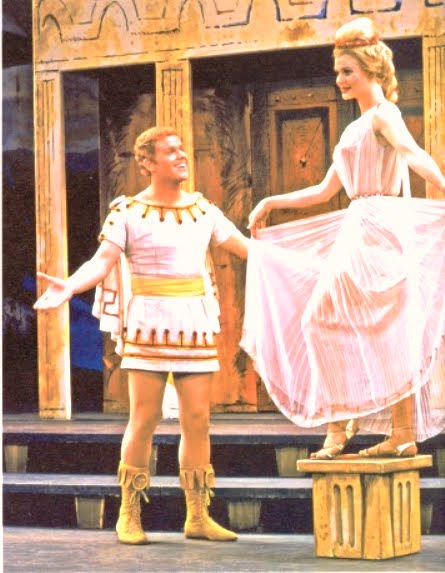 online access to its archives, not only do the critics provide interesting insight into the show's reception but it's amazing to see how many newspapers that city supported in 1962. Few of the critics, while acknowledging A Funny Thing Happened on the Way to the Forum entertained them immensely, wrote much — if anything — about Sondheim's score. The morning after it premiered, Howard Taubman, chief drama critic for The Times since Brooks Atkinson's retirement in 1960, wrote, "Know what they found on the way to the forum? Burlesque, vaudeville and a cornucopia of mad, comic hokum. The phrase for the title of the new musical comedy that arrived at the Alvin last night might be, caveat emptor. A Funny Thing Happened on the Way to the Forum indeed! No one gets to the forum; no one even starts for it. And nothing really happens that isn't older than the forum, more ancient than the agora in Athens. But somehow, you keep laughing as if the old sight and sound gags were as good as new. As for the score, Taubman said, "Mr. Sondheim's songs are accessories to the pre-meditated offense. With the Messrs. Mostel, Gilford, Burns and Carradine as a coy foursome, 'Everybody Ought to Have a Maid' recalls the days when delirious farceurs like the Marx Brothers could devastate a number. When Mr. Mostel, the slave with a nimble mind and a desire to be free, persuades Mr. Gilford, the nervous straw boss of the slaves, to don virgin's white, the two convert the show's romantic and pretty 'Lovely' into irresistible nonsense." Taubman penned one of the kinder notices to Sondheim's songs though he appears to have missed the point that even the first version of "Lovely" sung by the story's virginal courtesan Philia comes steeped in satire as the beauty sings an ode to superficiality and her own bubbleheadedness. (The first link takes you to Preshy Marker's version from 1962, the second to Jessica Boevers' from the 1996 revival; since I used the 1962 recording of "Everybody Ought to Have a Maid" at the beginning of the first half, this link goes to the BBC Proms rendition by Daniel Evans, Julian Ovendon, Simon Russell Beale and Bryn Terfel.) The score's assessment changes over the years and as of today, Sondheim may remain the toughest critic. In his book, he again wrote, "I made the subtle, though thankfully not fatal, error of being witty instead of funny." Below, watch a quite different take on "Lovely" from Putting It Together as performed by Carol Burnett and Ruthie Henshall.
Let's skip quickly through some excerpts from the other opening night reviews. Remember: Each of these came from New York newspapers and many no longer exist. Still, today, when some major cities fail to support one daily newspaper to think that this many could thrive in a single city, albeit one as large as New York, makes an old ex-journalist such as myself fill with both wonder and sadness. Walter Kerr for The New York Herald Tribune: "The funny thing about A Funny Thing Happened on the Way to the Forum is that it's
 funny. I'm not going to tell you it's anything more than that, but maybe I don't have to. For all I know, you like funny musicals. You may even like classical funny musicals, and this one is very classic.…Composer Stephen Sondheim begins by giving his lightfooted fools some rather odd recitative as substitute for melody and same vaguely Oriental wood-block effects as substitute for lively accompaniment. You wonder. Then, with a foursome in which Mr. Mostel, Mr. Burns, Mr. Gilford and a borrowed scarecrow named John Carradine, take off to a tune called 'Everybody Ought to Have a Maid,' the odd figurations Mr. Sondheim is attracted to begin to pay off. There's a faint edge of musical sarcasm to be dealt with here, and it crops up again — most effectively — in 'I'm Calm,' 'Impossible,' 'That Dirty Old Man,' and in Mr, Mostel's swooning reprise of a number that was mocking in the first place, "Lovely." The score is in and out, but wins out. The lyrics are fine. Is it me or does it seem as if Kerr keeps changing his mind as he's writing? Though a Broadway theater remains named after the critic today, I've always been leery of Kerr since he actively participated in the industry as a writer, director and lyricist at the same time he worked regularly as a critic. At least he recognized the humor in the first version of "Lovely" though, I'll give him that. (Isn't it fascinating to imagine that Broadway theater owners sometimes honor critics this way? A theater bears Brooks Atkinson's name as well and they even awarded him a special Tony after he retired. When will we see The Frank Rich Theater? Can you imagine and honorary Oscar to a film critic?) The links: "Everybody Ought to Have a Maid" from 1966 film; "Impossible" from the 1996 revival recording; "I'm Calm" and "That Dirty Old Man" both from the 1962 original cast recording. Below we have the clip from the poorly shot bootleg of the "Lovely" (reprise) from the 1996 revival performed by Nathan Lane and Mark Linn-Baker.
Others who opined about opening night. Unless they took contrarian views on the show itself, I'm limiting the comments to the score.: Except for calling Forum a musical comedy in his lead, the only other reference to the score Richard Watts Jr. made in The New York Post comes as part of the review's penultimate sentence. "…and Stephen Sondheim’s score is modest but pleasant." John McClain wrote in The Journal American, "Zero Mostel, a very animated blimp, will personally defy you not to like A Funny Thing Happened on the Way to the Forum…The clients laughed and seemed to enjoy themselves, but there was always the suggestion that had they not, Mr. Mostel would have passed among them and belabored them with a baseball bat. He is quite largely the whole show… The book by Burt Shevelove and Larry Gelbart (claiming some debt to Plautus) is a wispy affair, and Stephen Sondheim's score is less than inspired,
 but under George Abbott's slick direction the show moves and the audience roars. I should think it would succeed." At The New York Daily News, John Chapman chimed in, "(The performers) are grand muggers, leerers and slapstickers, and any old vaudeville fan will be happy to see them in operation.…The songwriter, Stephen Sondheim, comes up with an occasional bright and funny number, such as the four burlesquers song 'Everybody Ought to Have a Maid,' and Miss Kobart’s venomous hymn to Burns, 'That Dirty Old Man of Mine.'" Did he not look at his Playbill? How did he get the song title wrong? Links: "Everybody Ought to Have a Maid" performed by Carol Burnett and Bronson Pinchot in Putting It Together; "That Dirty Old Man" from 1996 revival cast recording. Another critic who didn't find it important to check song titles was Norman Nadel in The New York World Telegram, who delivered the harshest review I read. "But too high a price must be paid for entertaining moments in A Funny Thing… Much of the comedy repeats itself. Some of the players work so hard to exploit their thin materials that they generate more sympathy than laughter. The show is slow starting and sometimes heavy-footed. Stephen Sondheim’s music would have been a second-rate score even in 1940, but he has come up with some catchy lyrics. One is “All I Know is Lovely,” sung by Ms. Marker and Mr. Davies. Another is 'Bring Me My Bride,' in which Miles proclaims his own glory; this is done resonantly by baritone Holgate.…There are indications at the Alvin that A Funny Thing might have been an earthy, boisterous delight. From time to time, it is. For the most part, however, it strains too hard to achieve too little." Link: "Bring Me My Bride" from original 1962 cast recording; I've run out of versions of "Lovely." Finally, we get to Robert Colman reviewing at The New York Mirror with the nicest words for Sondheim's score. "Stephen Sondheim has supplied a score that falls pleasantly on the ears. Jack Cole has choreographed dances that would have delighted Billy Minsky’s. We suspect that A Funny Thing will prove the most controversial song-and-dancer of the season. You’ll either love it or loathe it. In our book, it looms as a hot ticket. A riotous and rowdy hit." The retired Brooks Atkinson filed a "critic at large" piece for The New York Times in July where he barely mentions that Forum contains music and Sondheim's name never appears, though the "low comedy" delights him to no end. Since "Everybody Ought to Have a Maid" comes up so often, I've reserved two video clips for you to watch. The first comes from the 1996 revival.
Before I get to the final clip of "Everybody Ought to Have a Maid," I thought it would be interesting to point out how quickly critics began to re-evaluate Sondheim's score for Forum. Granted, in these reviews I was limited to The New York Times and most come after the one-two punch of Company and Follies supersized his reputation, but the reconsideration started as early as the 1966 film version. Vincent Canby wrote in his review of the film, "Stephen Sondheim's music and lyrics hold up well, especially 'Comedy Tonight,' by which Mr. Mostel introduces the characters at the start, and the slightly bawdy 'Everybody Should Have A Maid' ('sweeping out, sleeping in')." When Clive Barnes assessed the 1972 revival for The Times, he said, "Mr. Sondheim's music is original and charming, with considerable musical subtlety but a regard for down-to-earth show-biz vigor that is precisely what is needed. And, as always, his lyrics are a joy to listen for. The American theater has not had a lyricist like this since Hart or Porter." By the time the 1996 revival arrived, Canby's beat had switched from film to theater. "This brazenly retro Broadway musical, inspired by Plautus, is almost as timeless as comedy itself. Here's a glorious, old-fashioned farce that, with its vintage Stephen Sondheim score and its breathless book by Burt Shevelove and Larry Gelbart, celebrates everything that man holds least dear but can't deny himself: lust, greed, vanity, ambition; in short, all of those little failings that make man human. Yet for all of its disguises, mistaken identities, pratfalls and leering jokes, A Funny Thing is as sophisticated as anything now on Broadway. In its own lunatic way, it's both wise and rigorously disciplined. Easy sentimentality is nowhere to be found here; in its place: the kind of organized chaos that leads to sheer, extremely contagious high spirits," Canby wrote. Now, that other clip of "Everybody Ought to Have a Maid" features original 1962 cast member Jack Gilford performing with two (well, at least one) other surprising performers in a television appearance.
I'd hoped to avoid this situation, but I got so caught up with the behind-the-scenes history that what I intended as a short tribute grew to be massive. I still need to write about the original production's performance at the Tony Awards and some tidbits concerning the two revivals, the second of which I saw, not to mention that version I saw in 1979 when I was 10. That won't be coming today I'm afraid. So, I'll leave you with the sequence for "Bring Me My Bride" from Richard Lester's film version.
Labels: blacklist, Books, Capra, Criticism, Gelbart, J. Carradine, J. Robbins, Keaton, Marx Brothers, Music, Musicals, Sondheim, Television, Theater Tribute, Welles
TO READ ON, CLICK HERE
Sunday, October 02, 2011
Boardwalk Empire No. 14: Ourselves Alone
BLOGGER'S NOTE: This recap contains spoilers, so if you haven't seen the episode yet, move along.

By Edward Copeland
"Things seem to be changing faster than I realized," a character says at one point in tonight's episode of Boardwalk Empire. While this may be true in terms of the storyline, as for the series itself, it isn't and that's the main reason I find myself enjoying the show as much as I do. First and foremost — thank whatever higher power came up with the concept of screeners. My M.S. causes fatigue issues that prevent me from writing as fast as I used to, so when I pick a show to recap, it's because I have a real interest and without being able to see that week's show early, I can't do it, especially with a series such as Boardwalk Empire, where they rarely have a scene that isn't vital or might come into play later. (Bless HBO for all its support over the years, especially on Treme this year. I wanted badly to do recaps of Breaking Bad, but I'm not good enough for AMC though they still feel free to flood my email with press releases.) That's why my recaps grow so long — I don't want to risk leaving out something that might come prove pivotal down the road. For instance, tonight's episode brings back a character playing a crucial role who hasn't been mentioned since the very first episode. Recaps have become very prevalent on the Web, but it's almost a misnomer: I seem to be one of the few who actually tell what happened in the episode, sprinkling commentary throughout. The many characters and plots can prove complicated — even for me at times — so I try to help any confused fans there might be out there.
That being said, while I admit that I think Breaking Bad is the best series on television, Boardwalk Empire also is great and I love both shows for completely different reasons. It's not as if I can only pick one as in those silly debates where you can only love Chaplin or Keaton, Astaire or Kelly — as if they all can't be appreciated for their separate gifts. The same goes with great TV dramas. Breaking Bad is well acted, directed, written and plotted, as is Boardwalk Empire, but the shows appeal to me on completely different levels. Recently, Breaking Bad has been the narrative equivalent of the crystal meth Walter White manufactures (or did) and I love every minute. Boardwalk Empire also is well acted, written, directed and plotted (with some historical context tossed in), but I feel as if I'm luxuriating as I watch it. If Breaking Bad has been meth the
 past few weeks, Boardwalk Empire might be something like Dilaudid, easing your pain and letting you relax. Making a non-drug analogy, Breaking Bad is smart and visceral while Boardwalk Empire is cerebral and intuitive, rewarding those who pay close attention. It's similar to The Wire, not in terms of quality but in its novelistic approach where its fictional characters constantly cross paths with real people. It's as if E.L. Doctorow or Gore Vidal decided to create a TV series instead of writing another historical novel. As a writer, I love words and obviously Terence Winter, even if he's not the credited writer of the episode, sends out the memo, because scenes go on without becoming boring and with language that's just a pleasure to hear. For instance, on tonight's episode, the first 10 minutes essentially cover a mere three scenes. On a DVD commentary, David Duchovny says what a pleasure it is when actors get longer scenes that let them dig into the material and the character. You can tell by how much better actors are when they get those moments. Before I begin my recap of tonight's episode "Ourselves Alone," I want to go back to something pertaining to last week's episode "21." In the great sequence where Nucky addresses both black and white church congregations, telling each one what they want to hear, some questioned that word would get around that Nucky was speaking out of both sides of his mouth and that surely a newspaper would report it. I agreed at first but thinking more about it, it makes sense. It was 1921 after all and the races practically lived separate existences. There still was a high illiteracy rate because of the terrible schools blacks had to attend and African-American communities often had newspapers of their own for those blacks who could read. Besides, no white reporter would have dared stepped into the black church with what was going on and vice versa. I'm sure Nucky didn't pick his audiences by accident and there wasn't enough interracial mingling for word to get around unless Eli shared it with the Commodore or someone else.
"Ourselves Alone" was written by Howard Korder and directed by David Petrarca and adds some interesting layers to the plots going on right now, even if it isn't as kinetically exciting as the premiere, but it does have great moments once again for Michael Kenneth Williams as Chalky, good stuff for Kelly Macdonald as Margaret and the welcome return of the phenomenal Michael Stuhlbarg as Arnold Rothstein. Honestly, someone should do a spinoff movie on Rothstein that stars Stuhlbarg. The episode opens on Valentine's Day, so we have an exact date in 1921 where we are, as Margaret rises for the day and comes down the stairs to find her maids Katy (Heather Lind) and Pauline (Amy Warren) congregating with the children's nanny Lillian (Jacqueline Pennewill) at the first floor landing looking over a newspaper. She asks if the children are up and Katy tells her they are breakfasting. Margaret starts to walk away, but stops and asks the servants if that is this morning's paper. Pauline whispers that she's going to find out anyway and hands her the paper. It bears the headline, "TREASURER THOMPSON ARRESTED." Pauline asks if they will be having dinner and Margaret asks why they wouldn't. Margaret tells Katy to make sure that the hallway rug is taken out and beaten before Mr. McGarrigle's arrival that night. She then goes into another room to use the phone and calls Eddie. Kessler tells her the paper is a lie because they left out that Mr. Thompson is innocent, but he can't talk because it's mayhem at the Ritz suite as he watches an investigator slice open the bottom of the couch in Nucky's office. Katy sticks her head in and Margaret asks her what kind of coat she has.
Last week, Nucky had Eli arrest Chalky for his own protection. Today, the two men find themselves sharing a jail cell. "You understand you are in a precarious situation," Nucky tells Chalky as the two men light up smokes. Thompson explains he had Chalky jailed to keep him safe, but it can't be coincidental that they suddenly came after him as well. "The Klan could have come for me any time," Chalky says. "Not as long as I was there to protect you," Nucky insists. Chalky asks why they thought Nucky suddenly wouldn't be there. Nucky asks where Chalky was on election night. "In the basement of the A.M.E. Church, handing out dollar bills to every able-bodied negro who came in," he replies. Thompson inquires about the whereabouts of his ward bosses that night, but White has no idea — he wasn't in the wards. Nucky quizzes him about the bosses, but Chalky has little to say about any of them except Neary. "Neary's been a sonuvabitch ever since I ran numbers" in Georgia, Chalky tells Nucky that Neary would come around for collections and enjoyed using his nightstick while taking them. Nucky continues to go down the list of his alderman, but Chalky interrupts. "You askin' the wrong question. Not one of them pikers got it in 'em to put up a squeal unless someone put 'em to it." The jailer arrives to tell Nucky that his lawyer Isaac Ginsburg has put up his bail. As Nucky gets up to leave, he advises Chalky to be patient. "I get my own Jew lawyer," White says.

"I won't pretend you're inclined to be warm to me. I won't insult you like that because before anything else, I have great respect for you, your wisdom, your achievements," a sharply dressed Jimmy says to Arnold Rothstein (Michael Stuhlbarg) who sits at the desk in his New York office, Lucky Luciano (Vincent Piazza) standing at his side. Rothstein takes a sip of his milk and smiles. "You're better spoken than I expected," he tells Jimmy. Darmody mentions that's because they have never really met, but Rothstein brings up that he and Luciano are acquainted. "We have someone in common," Jimmy admits, referring to Gillian. Rothstein turns to Luciano. "You hear, Charlie — discretion. Charlie volunteered to absent himself from this meeting. He felt his presence might be disruptive, but I counseled what?" he asks Luciano. "Never let the past get in the way of the future," Luciano responds. Jimmy tells Rothstein that they are all learning to which Rothstein inquires what he can learn from Darmody. "That things are changing in Atlantic
 City. If you are in the market for quality liquor coming in off the beaches at a reasonable price and in good supply, I can get it for you," Jimmy offers. It seems with each episode not only does the character of Jimmy Darmody mature but so does the acting of Michael Pitt as well. Then again, it never hurts to be playing opposite Stuhlbarg's Rothstein who seems as if he were born for the role. He's so damn great that the initial amazement that he played Larry Gopnik in the Coens' A Serious Man vanished long ago. I don't know Stuhlbarg's exact age, but where has he been hiding? (I know — the theater.) How he missed out an Oscar nomination for A Serious Man boggles my mind when it managed a best picture nomination. He deserved Emmy consideration here as well, but with such a large cast and a flawed award, that's more understandable, though still infuriating. Rothstein asks Jimmy if he personally can do that and Jimmy assures that he and his associates can and explains how he's expanding his business "and you are precisely the type of discerning customer I'm looking for." Rothstein asks about Nucky, who Jimmy insists is "like a father to me." After a momentary pause, Rothstein poses a question that Jimmy seems not to expect. "Who are you, Mr. Darmody?…You show up well dressed with a silk cravat and a bold proposal. A
 year ago, you were a brigand in the woods. Who are you?" Rothstein repeats the question. "I'm a businessman, a veteran. I just got married," he replies to which Rothstein congratulates him. "I have a son. He's almost four." Rothstein interjects smiling, "Cart before the horse." Jimmy asks Rothstein if he has any children. "No, but I'm told they often say unexpected and amusing things," he replies. He tells Jimmy that he appreciates him coming to him with this offer. "I applaud your own destiny and I give you my word your offer remains in this room," Rothstein says before telling him that Luciano will show him out. Before Jimmy has left the office, Rothstein speaks again to him. "Mr. Darmody, don't you find it curious that neither of us has mentioned that Nucky Thompson spent last night in jail?" Jimmy appears to be surprised by the news. "He did?" "Election fraud, apparently," Rothstein informs him. "Things seem to be changing faster than I realized." Mystified by Rothstein's lack of any response to his proposal, Luciano tells Jimmy once they are outside the office, "He doesn't like to say no." Jimmy says it appears he doesn't like to say yes either. "Not unless he has to," Lucky responds. Luciano asks if Jimmy plays poker, inviting him to a game downtown, but Jimmy suspects a setup. Luciano assures him it's Meyer Lansky's game. "That doesn't make me a simp," Jimmy tells Lucky who shows a bit of his hot-headed nature, declaring, "Go fry a fuckin' egg, Farmer John" and begins to walk off. Jimmy stops him and asks him to just give him the straight dope. Lucky hands Jimmy a card. "Meyer thinks we should meet."
Eddie assists Nucky with his shave as Ginsburg (Peter Van Wagner) gives his client a rundown of what he knows about his legal situation thus far. The lawyer tells Thompson that it all stems from Gov. Edwards seeking to make a splash. As for Solomon Bishop, the state attorney: "The man is going to try very hard to put you in prison," Ginsburg tells him. "Fine. Tell me he's poor but honest," Nucky says. "He's married to a lesser Whitney and set his salary at one dollar anum, so he's certainly not poor. As for honest…you want to ask about the indictment. I do not have a copy of it yet. However, I gleaned from the court clerk that your ship is leaking," Ginsburg informs his client. Thompson wants to know who. Ginsburg can't provide names, but says there are two confidential witnesses prepared to testify to direct knowledge of voter intimidation, fraud, theft of ballot boxes and bribery. Ginsburg warns Nucky that reporters are swarming outside and asks if he wants a reporter by his side. "That's what guilty men do," Nucky responds. Ginsburg tells him he'll get to work. Eddie informs Nucky that Margaret has read the newspaper. Nucky asks about the children, but Eddie says she did not say. "The state police have banished me from the suite," Eddie tells his boss. "They were touching your possessions in ways I considered offensive." Nucky wipes his face, his shave completed, and asks Eddie, "Don't I have a treasurer's office somewhere?"
Nearly a century separates Walter and Skyler White of Albuquerque, N.M., on Breaking Bad and the couple Enoch "Nucky" Thompson and Margaret Schroeder of Atlantic City, N.J., and while both women certainly began their introduction (to us as television viewers at least) as moral, law-abiding citizens, both Skyler and Margaret have become embroiled in the seedier if not downright criminal side of the life of
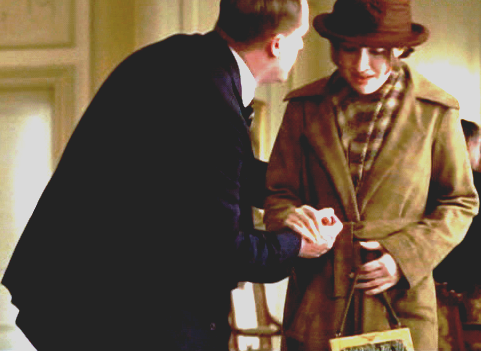 their respective mates. While Skyler still likes to get on her high horse and thinks she's smarter than she is, think how much better off Walt would be if his partner in crime were Margaret who has taken to the role as if it's her second nature. After hearing Eddie's brief description of the state investigators tearing up Nucky's suite at the Ritz, as soon as she was off the phone, she asked her maid Katy for her coat. Now, we know why. Solomon Bishop sits comfortably in Nucky's office chair reading documents when another investigator, Talmer (Alex Cranmer), tells him there's a woman outside. He goes to the office door to find Margaret who has dressed herself down and given the look of some poor downtrodden women who might be with child. When Bishop shows up at the opening to the office, she meekly says, "Mr. Thompson?" The deputy state's attorney says that no, he is not Mr. Thompson. She asks when he will return. "Do you read the papers, ma'am?" Bishop asks. "On Sundays, when the neighbors are done with it," she replies. Talmer suggests that she borrow their paper today, adding that Nucky's been arrested. Margaret starts putting on the waterworks, telling the men that she'd been told that Mr. Thompson might be able to help with her "wee ones." She begins to double over and Bishop suggests that Talmer get her a glass of water. "I think she may be with child," Talmer says as he tries to hold her up. She tells him what she really needs is to borrow their facilities and Talmer helps her in and toward the bathroom.
The Commodore has invited more officials to join his conspiracy against Nucky — all of his ward bosses: Boyd (Edward McGinty), Damian Flemming, Jim Neary and George O'Neill (William Hill) — and all four showed, discussing things with Eli in the Commodore's grand living room as they await the Commodore's arrival, that seven-plus foot grizzly overseeing the proceedings. "This is Nucky's town, Eli," Damian says as they question who takes over if Thompson goes away. Eli borrows the Commodore's line, telling them that Nucky was weaned on
 the Commodore's teat. "That's what I'm saying," Flemming continues. "It's a young man's game." At that moment, the Commodore enters, having dyed his white hair black. "How old are you, Damian?" he asks. Off to the side on a couch, Boyd whispers to O'Neill, "Is that shoe polish?" referring to whatever the Commodore used to color his hair. "Thirty-eight," Flemming answers the Commodore. The Commodore tells Flemming to pick up the large animal tusk that rests on a sofa table. Damian struggles with the bulky piece of bone but when the Commodore challenges him to lift it above his head, he can't do it. The Commodore takes it and raises the tusk over his head as if it were a broom. "You're half my age, son, I'm twice your age," the Commodore gloats. "I trust I made my point. You all showed up which says to me we all feel the same about a certain individual — the arrogance, the selfishness, the neglect." Neary interjects, "Let's me take the fall on Saint Paddy's Day." Eli piles on, "Such is his method, Jim, then a wave of his hand — 'All is forgiven.' Makes me sick — and I say this as a blood relation." Flemming remains skeptical, suggesting that it's just an indictment and Nucky's smart and could beat it. The Commodore smiles and shows the legal cards that he's holding. "Nucky Thompson is going to jail thanks to Jim Neary and —" he pauses, getting stuck
 on the name of the other man in the room who isn't a ward boss. "Patrick Ryan," the man (Samuel Taylor) says. "Patrick Ryan as eyewitnesses which nails him dead to rights on the election," the Commodore concludes. Again, Boardwalk Empire reaches into its past to reward viewers who pay attention, in this case, going all the way back to the very first episode. Ryan was the man who at that first meeting, celebrating the imminent start of Prohibition, was named the new senior county clerk by Nucky, an appointment that peeved Jimmy because he felt that he should start being more than Nucky's driver, indirectly leading Jimmy to his botched hijacking in the woods with Capone. "Which leaves the booze," Eli says. "How are you gonna handle that?" Hill asks. The Commodore explains that his role as president of the Yacht Club along with a solid guy working for them in the Coast Guard will take care of that. "What we ship comes in. What Nucky ships doesn't," he adds, telling them that his son Jimmy will run the operation. "Now this isn't going to be easy, but nothing worthwhile is," the Commodore says, winding up with the equivalent of a coach's half-time locker room speech. "Ask the man inside of you this: When you come face to face with destiny do you want to be the bear or do you want to be the one holding the shotgun?"
Lenore comes to visit Chalky at the jail saying their daughter Maybelle has a request: Her beau wants to call at the house. She asks when would be a good time. Chalky tells her a few days — he's awaiting advice of counsel. "Is he competent?" Lenore asks. Chalky tells her that he's a Hebrew gentleman. She says Lester was quite insistent about visiting him, but Chalky and Lenore agree that the teen shouldn't
 see his father behind bars. He sent his father something to read anyway: Charles Dickens' David Copperfield. We learn Chalky's real first name as the jailer tells his wife it's time for her to go and she says, "Albert, you have a family that loves you and is waiting." After Lenore has left, a prisoner (Erik LaRay Harvey) in the cell across from Chalky's starts whistling and asks, "Who is that fine piece of lambtail?" Chalky inquires if the man likes her looks to which he replies he surely does. "I'll tell my wife then the next time I see her," Chalky declares. "Meant no offense," the man says. "Got a pair of eyeballs. Can't help but use them. Name is Dunn Purnsley from Baltimore." Purnsley asks what he is reading and for the first time, we learn Chalky can't read. "Tom Sawyer." Purnsley says that he and the other men in his cell could use some entertainment, why doesn't he read to them? One of Dunn's cellmates tell Purnsley to leave him alone explaining that he is Chalky White, as if that will mean something to someone from Baltimore. "I had no idea," Purnsley replies sarcastically. "You tellin' me…walking around here like some old zip coon, fine high yellow bitch at his side — he called Chalky White 'cause that be the most bunk for a nigger horseshit I ever heard. What you say to that, Brother Tambo?" Chalky continues to pretend to read. "I say you heard my name." Purnsley shoots back, "I know you heard mine." The jailer returns with a white prisoner and tells Chalky that he must move to the other cell since they can't mix races so White joins Purnsley and the four other men.
Nucky and Eddie walk into his treasurer's office, shocking the secretary (Trisha McCormick) who Nucky mistakenly greets as Enid. She corrects him that her name is Eunice. He tells her to call the aldermen, the sheriff and the mayor and tell them to come at once. He then goes into his office and closes the door. After a moment, he opens it and adds, "I also need a florist."

As Margaret helps Katy with proper placing of the silverware, Pauline brings her a bouquet of roses for Valentine's Day, though the card isn't signed. Any joy at the gift doesn't last as Emily's shrieks interrupt the activities as her brother Teddy chases her with a hammer. Margaret grabs it and sends the boy to his room. Lillian comes in panting, saying they were building a birdhouse. A persistent knocking occurs at the back door. When Margaret answers it — hammer still in hand — a man with a thick Irish brogue (Charlie Cox) raises his hands in surrender. "I'm not a burglar, though I do confess to climbing out a window or two." He mistakes Margaret for a servant and asks for Mrs. Thompson. When told that there isn't one, he asks for the lady of the house and Margaret tells him that he's speaking to her. He introduces himself as Owen Sleater and says he works for Mr. McGarrigle. "You are quite early," Margaret declares. After Sleater puts his foot in his mouth a few more ways, Margaret asks what exactly he wants. "With your kind permission, I'm to ensure your house is secure for Mr. McGarrigle this evening," Owen replies. "We're not given to threatening our guests," Margaret tells him. "You do have a hammer." Margaret explains her son thinks it's a toy. Sleater asks where he is. "In his room," Margaret answers then, realizing that Sleater is making a serious inquiry. "He's seven." Sleater rules Teddy out as a threat and begins to survey the premises.
One cellmate's wheezing bothers a fellow prisoner, but the inmate doesn't get what he's saying at first. The wheezing inmate says he can't help it — he's catching a cold and asks where he's supposed to go. "He's got you there," Purnsley declares. "We're all in this together." Dunn describes the little place in his head where he goes that no one can get to and credits it for doing "three years in ankle chains like I was takin' a nap. Chalky White knows what I'm talkin' bout, don't he?" Chalky remains silent, keeping his book open as Purnsley continues. "I bet he up there right now, all soft and pillowy. Honeybee wife fetchin' plates of greens, roast beef, reading Tom Sawyer. Ain't that so, Chalky White?" Purnsley sits on the lower bunk next to Chalky who simply says, "Well, it could be." Purnsley deepens his voice to a threatening whisper, "Maybe I climb up there with you, jazz that woman up while you're lickin' the plate." Chalky calmly closes the novel. "You do what you want," Chalky says before turning and looking Dunn straight in the eye. "Just gonna be your right hand anyway." Purnsley pauses briefly before laughing and slapping Chalky on the arm. "That's how you play it, gentleman," Dunn proclaims as he stands. "Oh yeah, we gonna get along just fine."
Looking nervous, angry and hurt, Nucky looks out the window of the treasurer's office. He turns around as Mayor Bader rushes in asking, "Am I late?" Nucky isn't in good spirits, sternly inquiring, "Where the hell have you been?" Bader says he came as soon as he got the message. "Ninety minutes?" Bader tells him there are reporters everywhere and investigators snooping around. He's not proud to admit it, but Bader confesses that he's been hiding in his garage. Seeing only he and Nucky, he asks Thompson where everyone is. "I need you to tell me if you were approached about turning against me," Nucky states. The question stuns Bader who tells Nucky that he knows he's with him because of their business interests. "We're building things," Bader says. "Nobody came to you — not Neary, any of the bosses, not the Commodore?" Nucky asks. Nucky's nervousness infects Bader. "How bad is this?" Nucky admits he doesn't know yet while Bader wonders if they'll come after him. Nucky tries to calm Bader's worry about that. "I'm gonna beat this, Ed, and when I do I'm gonna remember who showed up here today and who didn't. Depend on that," Nucky tells him. As Nucky shows Bader out, Eunice tells him that Eddie called and that it's safe to return to the Ritz office.
After the meeting at the Commodore's, the four ward bosses hook up in an out-of-the-way spot to discuss the plot against Nucky. Neary remains the gung ho ringleader and Flemming the cautious naysayer with Boyd and O'Neill seeming to have no opinion of their own other than to end up on the winning side. "I don't see why things gotta change. Everybody's getting by," Flemming says. "Is that all you want from life, Damian?" Neary asks. "What else is there?" Flemming replies. "A pair of balls," Neary counters. Boyd questions Neary if there might be something more in it for him, but Neary says he'll get the same as everybody — "Less headaches, more green." O'Neill hasn't seen any problem with Nucky keeping the jack flowing. "Where were you last year?" Neary asks. "Armed robbery, shooting on the Boardwalk — that's not a man in control — and the election." O'Neil reminds him that they won. "Too goddamn close," Neary comments. Flemming doesn't see why a change in leadership means that Nucky has to go to jail. O'Neil wonders about the roads project that all of them have a stake in. Neary claims that will go on under the Commodore. "But it's Nucky's deal," Flemming says. Neary tells Flemming to get it through his skull — they aren't in charge. "The Commodore wants Nucky next to that fuckin' grizzly. That's what's gonna happen," Neary declares. "What's to keep us from winding up with him?" Flemming asks, referring to possible jail time. Neary assures them that the Commodore will put the fix in. Neary looks to each of the men. O'Neill and Boyd reluctantly nod that they are in while Flemming lights his cigarette and stays mum. "Damian, just say, 'Please' and 'Thank you,'" Neary tells him.
Jimmy heads to the Lower East Side where Meyer Lansky (Anatol Yusef) has set up an office for his continuous poker game behind the name of the business Schenkel & Bro. Darners & Weavers. Before he, Jimmy and Luciano begin their discussion, Meyer sends their teen worker Benny (Michael Zegen) out for cheese. The youth makes some odd noises, prompting Jimmy to ask if he's OK. Lansky assures him that he's fine, he just makes noises like that sometimes. Benny's last name happens to be Siegel. In the 1930s, he'll acquire a nickname he
 hates: Bugsy. Lansky tells Jimmy he runs the house for the poker game round the clock under Rothstein's protection. Luciano says that they have other enterprises as well. Jimmy asks if Rothstein has part of those, but the two remain silent. "You met with A.R.," Lansky says. "He can be a difficult man to read." Luciano chimes in. "That thing of yours this morning — I'd have said yes to that." Jimmy tells Luciano that he wouldn't have asked him though. "I need Rothstein, not the fella who carries his water," Darmody says. This sets Jimmy and Luciano off again, bringing Gillian into the conversation with Luciano saying she was "begging for it" and forcing Lansky to physically separate the men. "Gentlemen — I'm running a business here," Meyer tells them as they finally return to their corners. Lansky takes the seat on the other side of his desk next to Jimmy. "Charlie and I have learned a great deal from Mr. Rothstein as I'm sure you have from Mr. Thompson," Meyer says, "but nobody wants to be in school forever. As I see it, we have a lot in common. If we put aside our differences, things could happen." "Such as?" Jimmy asks. "Trading partners. We buy liquor from you, you buy something from us," Lansky answers. "What would that be?" Jimmy inquires. "We're thinking of getting into heroin," Luciano speaks up. Meyer cocks his head as he tells Jimmy, "When you run the numbers, it starts looking very attractive."
 Margaret tries to straighten the rug in the entry hall herself, unhappy with the job Katy did when Owen Sleater wanders by and lends a hand. She asks the Irishman if he's been traveling around the U.S. much. "With Mr. McGarrigle. Filling the coffers. New York, Boston, Philadelphia," he tells her of their journeys seeking support for the cause back home. "Ourselves alone," Margaret says. Sleater informs Margaret that her Gaelic translation is a bit off. "Sinn Féin — we ourselves. That's a bit closer," Sleater remarks. "Either case, that's what we're about — who else would fight for us?" Margaret inquires about what it is he does exactly for McGarrigle. "As you see — clear the path," he replies, adding that he was a livestock inspector prior to the rebellion, then he went to fight in the north. "I make you for the Lonesome West," Owen guesses about Margaret's Irish origins. She tells him she's from Kerry actually. He asks if any relatives remain in Ireland. "No — here apparently," she answers. "Then you won't have to choose sides."

Almost as soon as Nucky gets back to the Ritz, he makes a beeline for his closet but when he removes the false panel, he finds that both the ledger and the moneybag are missing. Eddie calls to him, announcing that Ward Boss Flemming has arrived to see him. Nucky returns to his office. "Nuck, I tried talking to them. I said they were making a mistake. I told them you were too smart to get sandbagged by something like this, They wouldn't listen. All they can see are dollar signs," Flemming tells Nucky. The phone on Nucky's desk begins to ring, but Flemming continues talking and Thompson seems in no rush to answer it. "It's like the Commodore has cast some voodoo spell on them," Damian says as Nucky answers the phone, "Yes." "All alone big brother?" Eli's voice can be heard. "How does it feel sitting at your fancy desk all by yourself?" Nucky speaks as calmly as he can muster. "Eli, please listen closely. If now, right now, you tell me you want to get out of this, I will help you.…I'm prepared to hear your side of it. I will help you — if you tell me right now because in a minute
 it's going to be too late." Silence. "Are you there?" Nucky asks. "The funny thing," Eli says, "nobody takes power. Nobody has to give it to them. Look around, big brother. What have you got?" Eli hangs up. Nucky tells Eddie and Flemming that he's late for a dinner engagement. Part of what pissed Eli off was when he was removed from the ballot for sheriff after his shooting at the casino. What would Eli think if Nucky told him that it was the Commodore who advised him to remove Eli from the party ticket even though Nucky felt it cold-blooded to do to his brother who was still recovering from a bullet wound? Eli made his phone call to Nucky from the Commodore's, with the Commodore watching. After he hangs up, the Commodore says, "Feels good to twist the knife." Eli smiles weakly. The Commodore tells him that now it's time for him to meet the men who built Atlantic City. He leads Eli into another room where about four bald and white-haired men sit. "Gentlemen, may I present Sheriff Elias Thompson," the Commodore announces. Leander Cephas Whitlock stands and raises his drink and says, "Propinate nobis similibusque," a Latin toast that translates to "Here's to us and those like us — damn few left." For regular viewers of The Sopranos, even with our first close-up of Dominic Chianese and his first spoken lines, albeit they are in Latin, you still can't spot Uncle Junior hidden anywhere within those muttonchops and behind that beard and mustache.
Jimmy has done well at Lansky's poker game, so he asks Benny Siegel to cash him out. He takes note of two men having a heated conversation with Meyer in his office. When they exit, one of the other players invites the pair to join the game as they are always looking for new victims. The taller Italian, Incrocci (Mario Macaluso), asks, "Why's every kike got to be a wise ass?" Benny fires back, "Why does every dago have to be dumb as fuck?" Incrocci threatens to bury Benny in his diaper and he starts making clucking noises again until Lansky comes out and says Benny's name and gets him to stop. Jimmy hands his chips to Benny who gives him a large wad of bills which he slides into his pocket. The other Italian man, Scarpelli (John Cenatiempo), distinguished by his hat and his silence, continues to stay mum. Lansky tries to keep the situation on a strictly business level, thanking them for their full and frank discussion. Incrocci isn't impressed. He's more interested in Lansky respecting the terms and tells Scarpelli they need to get going — "This place smells" — and report back to his uncle. Jimmy asks who they were after the men leave. Lansky explains that they represent Masseria. The name means nothing to Darmody. Benny describes him as a fat ass who thinks he owns the Lower East Side. "Just a simple misunderstanding," Lansky insists. Jimmy slips a tip to Benny and leaves.
*SPECIAL NOTE: Thanks to Mr. Barthelemy Atsin, who was kind enough to help me by telling me which actors played each of the other cellmates in the following scene with Chalky and Dunn Purnsley. In addition to acting, Atsin also is an artist so you might check out his website.
It's fairly clear that Purnsley, so well played by Erik LaRay Harvey, has keyed in on the fact that Chalky can't read so he decides to rub it in his face. Dunn asks Chalky, "What's that scamp Tom up to now?" Chalky points to an illustration in the copy of David Copperfield and says that Tom met this little one and they had a sweet time chatting and then she played the piano. Purnsley then sticks one of his digits into
 the text on the opposite page and asks Chalky what it says. It's the closest we've seen Chalky come to losing his cool with this man. "It say get your finger out of my face." Dunn places his hands on the top bunk and leans in to Chalky. "Know what I don't like about you? That fuckin' winged suit and that bright-skinned bitch you have with that uppity way you tell the world you better than Dunn Purnsley when all you be is a jigaboo in a jail cell," Purnsley sneers, ripping the book from Chalky and tossing it across the cell, leaving only the page with the drawing in Chalky's grasp. Chalky stays quiet for a moment, then a peaceful look crosses his face along with a smile. "Harold C. Madison, how your daddy keepin'?" Chalky asks. The inmate closest to Chalky with a sling on his arm (Omar Scroggins) stops leaning on the bunks and steps forward. "Tolerable, sir. He thanks you for the doctor bills," Harold says. "Noah Hookway, how are things going down at the Gold Room?" Chalky inquires. The prisoner wearing a wool cap and standing in the corner to Chalky's left moves to the center of the cell. "Supposed to be at work today," Noah (Bartelemy Atsin) tells him. "I'll talk to them," Chalky promises. Purnsley, standing in the cell's exact center, begins to realize what is happening. "Timothy. Cornelius," Chalky addresses the last two inmates who stand against the bars. "Mama grateful for the turkey, sir," Timothy
 (Truck Hudson) says. The four men have Dunn surrounded. "Alrighty then," Chalky declares. Purnsley isn't intent to wait and starts swinging, but it doesn't take long for the four inmates to overpower him, beating and strangling him unmercifully against the bars until he finally falls as a bloody heap to the floor. Cornelius (Jonathan Baston) retrieves David Copperfield and returns it to Chalky. "Which of you boys knows his letters?" Chalky asks. "I do," Noah replies. Chalky hands him the book and he begins to read as the camera remains glued on Michael Kenneth Williams' face.. "David Copperfield by Charles Dickens. Chapter One. I am born. Whether I shall be the hero of my own life or whether that station will be filled by anyone else…" It could be argued that these scenes with Dunn Purnsley added little and didn't forward the overall story, but look how many layers these jail scenes added to our understanding of Chalky White. Boardwalk Empire also knows how to add new shadings and depths to its characters through scenes that otherwise might not be essential to its ongoing plots.
Margaret finds herself playing hostess to John McGarrigle (Ted Rooney) and Ernie Moran alone as Nucky has yet to arrive home. Owen Sleater sits off to the side, not dining at the table but flirting with Katy each time she passes. The sour-looking McGarrigle hasn't eaten
 much, prompting Margaret to ask, "Is the lamb not to your liking, Mr. McGarrigle?" Solemnly, he replies, "I've no doubt it is properly prepared, but I eschew any flesh that walks on cloven hooves." Margaret apologizes, saying she had not been made aware of his preference. "It's no preference. It's an iron-clad principle," McGarrigle declares. Moran attempts to lighten the mood, saying John is a man with a bit of the devil in him, but McGarrigle misses the humor, insisting he would not tally with the devil at all. "It is a challenge in this town," Moran says and again the joke flies over the Irishman's head. "Mr. Moran refers to Atlantic City's reputation for pleasure," Margaret interjects. "The width of this country seems beset by licentiousness and turpitude," McGarrigle states. At this point, her guest is annoying Margaret. "Another thing not to your liking," she says. "It is none of my concern. My cause is to drive the English invaders out of a land he's occupied for 800 years. I assure you, we will succeed even if we're martyred along the way," the visitor sermonizes. Margaret calls that an extreme position. "Only to those who've forgotten from which they've come," he replies accusingly. "I know where I'm from — and where I am now," Margaret responds. "You're plainspoken — for a woman," McGarrigle says. Before tensions can get much higher, Nucky arrives to break them, apologizing for his tardiness, blaming a busy day. McGarrigle wants to discuss their business immediately, but Nucky tells him he needs to eat something first. "There's certainly plenty of lamb," Margaret grins mischievously.
As Jimmy prepares to exit the Lower East Side, he moves his knife from his boot to the back of his shirt. He must be prescient. As he walks through a park, he's confronted by Incrocci and Scarpelli, who demand his take from the poker game. Jimmy keeps his arms raised as Incrocci keeps a gun trained on him. He tells them he put the cash in his boot. As Scarpelli looks, Jimmy tells him it's in the other one. As Scarpelli switches, Jimmy kicks him hard, pulls the blade out and slits Incrocci's throat before doing the same to Scarpelli, whom he leaves bleeding into a fountain.
After Nucky and his guest have moved to another room to discuss the issues at hand, McGarrigle makes his appeal. "Mr. Thompson, the Irish people are at war against a barbaric form. The English murder us in our sleep. They set fire to our homes. Last month, they put the torch to Cork City and shot the firemen come to fight the blaze. We need guns and the money to buy them. Mr. Moran tells me you are a loyal son of Erin and I call upon that loyalty now," McGarrigle says. Nucky recommends that McGarrigle go to the next meeting of the Ancient Order of the Celts. A disappointed McGarrigle tells Nucky that "cash suits us better." Nucky says, "I say that myself, but today is not the day." Moran speaks up to inform Nucky that there is another matter. McGarrigle speaks of his man and Sleater steps forward to introduce himself. McGarrigle announces that Owen has decided to stay behind in the states. Moran asks Nucky if he might be able to help Sleater find employment. Thompson tells him to stop by the Ritz office tomorrow.

After the guests have left, Margaret sees Nucky slumping in the chair by the fireplace. She starts to leave him be, but he leans around and says they need to talk. Margaret asks if they have a case and Nucky admits that they do. "Who is against you?" she asks. "The ward bosses — all except Flemming. The Commodore is pulling the strings and I think he has Jimmy." Margaret notes that Nucky hasn't mentioned his brother. "Eli — Eli is betraying me," Nucky admits sadly. "I didn't hear a word from you since last night," Margaret says with a bit of anger in her voice. Nucky tells her that he didn't want her to find out. "How could I not?" she ask him. "I just keep people satisfied. That's what I do," Nucky justifies. Margaret tells him that he knows now that that's not possible. Nucky informs her
 that the investigators turned the suite upside down and some things are missing, including the ledger and about $20,000 in cash. Margaret walks over to a desk and unlocks it and then returns to Nucky, standing before him with the ledger and the moneybag in her hands. Nucky's eyes widen as he sees them in her hands. "You are smarter than your enemies and you will persevere, but you aren't thinking clearly now. You must concentrate and not give over to emotion," she tells him. "Where did you get those?" he asks. "From your closet today," she replies as she hands him the moneybag. She holds the ledger. "This must be burned and future transactions committed to memory, do you agree?" An amazed Nucky nods yes as Margaret pitches the ledger into the fireplace. She tells him he looks exhausted. "I sent you flowers for Valentine's. I never signed the card," Nucky tells her. "I knew who they were from," she says, adding how exhausted Nucky looks. She kisses him on the forehead. "Go get some sleep — in our bed." I told you — how much better off Walter White would be with Margaret at his side?
Tweet
Labels: Astaire, Awards, Boardwalk Empire, Books, Breaking Bad, Chaplin, Coens, Dickens, Fiction, Gene Kelly, HBO, Keaton, Oscars, The Sopranos, The Wire, Treme, TV Recap, Vidal
TO READ ON, CLICK HERE


