Tuesday, May 08, 2012
Bring on the lovers, liars and clowns!

By Edward Copeland
Without a doubt, one song stands heads and shoulders above all others written by Stephen Sondheim for A Funny Thing Happened on the Way to the Forum and "Comedy Tonight" holds that perch. Even people unaware of the movie or the stage show of Forum probably know that infectious number that opens and closes both versions. No more proof need be delivered to back this claim than the sheer number of performances, spoofs and use of the song as background music for clips and slideshows that I stumbled upon on the World Wide Web. Who knows how many more are out there? One used the song to back scenes from The West Wing, but the quality of the video was so poor, I wasn't going to use it until I stumbled upon a better version. Another person did three separate Bewitched montages, two of which employed identical moments only one used Zero Mostel's 1962 original cast recording version while the other took Nathan Lane's 1996 revival recording. I chose not to toss those in this collection because each montage only lasts 42 seconds, cutting off the song early. Never fear though, that still left me with plenty of options. Before I "open up the curtain," I thought I'd start with a clip of "Invocation and Instructions to the Audience" from The Frogs, a 1974 musical staged and "freely adapted" by Burt Shevelove (co-author of Forum) from the play by Aristophanes (written in 405 B.C.) and staged in the Yale University Swimming Pool with a cast of Ivy League students whose ranks included one Meryl Streep. Sondheim originally composed "Invocation" as the opening number for Forum when his first attempt ("Love Is in the Air") wasn't working during out-of-town tryouts. The show's legendary director George Abbott, according to Sondheim's Finishing the Hat, didn't find "Invocation" "hummable enough" — no doubt inspiring the producer's complaint in Merrily We Roll Along. Thankfully, that led to the blessing of "Comedy Tonight" and "Invocation" returned with the addition of the hysterical "Instructions to the Audience" when Sondheim and Shevelove collaborated on The Frogs. The clip below comes from the BBC Proms program given July 31, 2010, to celebrate Sondheim's 80th birthday. With the backing of The BBC Concert Orchestra conducted by David Charles Abell, Daniel Evans, a Tony nominee for best actor in the 2008 revival of Sunday in the Park with George, and Simon Russell Beale, a Tony nominee for best actor in the 2004 revival of Tom Stoppard's Jumpers, perform the number.
As I mentioned, people love to use "Comedy Tonight" as a backdrop to scenes from their favorite television shows or, in one instance, a series' cast actually performed the song themselves. I thought I'd start with TV and go chronologically from the oldest to the newest. First, this variety show's ensemble performed the number in the show's third episode ever on Oct. 18, 1976. Honestly, it's pure coincidence that I led into this with the number from The Frogs.
Anyone recall the last time they saw a rerun of this hit 1980s detective series with romantic banter between the leads? No, not Moonlighting. I refer to Remington Steele, the series that made Pierce Brosnan a star during its run from 1982-1987. What did happen to Stephanie Zimbalist?
The English certainly aren't immune to the charms of A Funny Thing Happened on the Way to the Forum. Five major productions of the musical have played London since 1963 (with its original Pseudolus, Frankie Howerd, reprising the role in a 1986 revival) and a company that toured throughout the United Kingdom. Some enterprising fan of the musical combined the song with the long-running British spy series MI-5 (originally titled Spooks) that ran 10 seasons beginning in 2002.
This West Wing fan not only sets scenes to a version of "Comedy Tonight" but tosses in some of "Love Is in the Air," the first opening song that Sondheim wrote for Forum as well.
Finally, since in some ways the farcical elements of Forum almost make it a cartoon, its final television salute should, most appropriately, pair it with an animated work, namely Avatar: The Last Airbender, which ran from 2005-2008.
The song brings out the fun in everyday folk as well as we see here where "Comedy Tonight" underscores a year-end slideshow presentation for players, coaches and fans of the Long Beach State track and field team.
What happens in Vegas doesn't stay in Vegas if you post it on YouTube as with this parody of "Comedy Tonight" performed by the master of ceremonies (officially named MC Vegas) for an annual Edwardian Ball.
Now, I haven't heard much of them lately but the concept of flash mobs shouldn't be an unfamiliar one to most reading this. Apparently, at University of Western Ontario, you might be able to get course credits for participating in them since they appear to do them so often. The campus' improv broke out once into Handel's "Messiah." They interrupted this lecture with — you guessed it — "Comedy Tonight" Impressively, they choreographed some moves as well as learning the words.
I'm not sure what's funnier: That this boy named Ben (I believe his last name is Lerner) would perform this spoof of "Comedy Tonight" at his bar mitzvah (interrupted by his younger sister Nina) or that the explanatory note by his father informs us that when dad posted it years ago, the video and audio had problems, so we're watching a corrected version that he has labeled Take 2. I didn't try to track down the promised one that Nina later sang at her bat mitzvah.
Also on YouTube sits, as you'd expect, the song playing against photos of various Republican presidential contenders. I almost included it, but that's really like shooting water in a barrel, isn't it? Why waste the space? They make the point so much more brilliantly when they open their mouths than when we just look at them, even if we do see Rick Santorum chowing down on a very phallic-looking food item. Instead, we'll skip to the movies. As with television, I'm going to do this chronologically, starting with the oldest and we're going way back to 1928 and one of the last gasps of silent German Expressionism, Paul Leni's The Man Who Laughs starring Conrad Veidt as the creepy villain Gwynplaine, 14 years before Veidt became best known as Major Strasser in Casablanca.
For pure ambition, you have to give it to the students at The College of New Jersey Musical Theatre staged at the Ewing, N.J., campus a full-fledged musical based on the original Star Wars trilogy spoofing songs from a wide variety of musicals. The show opens with "Trilogy Tonight."
The title for the single best-edited video that I found involving a single subject probably deserves to go to the true identity of puddleglum128 for mating Zero Mostel's version to scenes from Jonathan Demme's The Silence of the Lambs. I'd call it perfect if it didn't contain the strange audio splice in the middle, but the right moments of Anthony Hopkins, Jodie Foster and the rest get used.
Christopher Nolan's second take on Batman, The Dark Knight, earns two takes of "Comedy Tonight!" The first, staged by The Pauper Players of the University of North Carolina at Chapel Hill as part of the group's annual Broadway Melodies in 2009 where they parody different works. (The other two that year were Lost and Super Mario Bros.) The second video features photos from Nolan's film set to Nathan Lane singing the finale version of the song and also includes stills of Gerard Way.
For the last montage, which must have required a tremendous amount of time and effort by CRAIGSWORLD1427, he asked people about what movies throughout film history tickled their funny bones the most and then assembled various bits and pieces (including dialogue) with the song for this nearly 10-minute long package. It's worth it though. Chuck Workman, be damned.
Tweet
Labels: Animation, Books, Christopher Nolan, Demme, Hopkins, Jodie Foster, Lost, Music, Musicals, Sondheim, Star Wars, Stoppard, Streep, Television, Theater
TO READ ON, CLICK HERE


Monday, November 28, 2011
Ken Russell (1927-2011)

As a director, Ken Russell always has been a mixed bag to me. To say that he had a tendency to go over-the-top would be an understatement and I found very few of his films satisfying as a whole though he did produce many fine performances in his films even if the films themselves were so-so.

Glenda Jackson (who won her first her Oscar), Alan Bates and Oliver Reed in his adaptation of D.H. Lawrence's Women in Love; Twiggy in the musical The Boy Friend (perhaps his most enjoyable and mainstream outing); the spectacle of Tommy bringing the landmark album by The Who to cinematic life with its eclectic cast including Oscar-nominee Ann-Margret as the deaf-dumb-and-blind boy's mom (covered in beans at one point), a brief bit by Jack Nicholson as The Specialist, Tina Turner's Acid Queen and the band's late drummer Keith Moon as Uncle Ernie, to name but a few; William Hurt's experimentations with mind-altering drugs and isolation chambers to a devolved consciousness in Altered States, based ion the novel by Paddy Chayefsky who wrote the screenplay as well, but hated the film so much that he disowned it and the film credits the script to his given first and middle name, Sidney Aaron; and the loony Crimes of Passion which contains a brave but great Kathleen Turner performance. However, what I remember the most about Russell was one of his many performances as an actor (check out his filmography), particularly his supporting role as Walter in Tom Stoppard's adaptation of John Le Carre's The Russia House starring Sean Connery and Michelle Pfeiffer, an incredibly underrated Fred Schepisi film from 1990. Russell gave an entertaining and compelling turn in his rather small role. For someone whose reputation mainly is that of a director, surprisingly, that might be what I remember about him most. To read the full New York Times obit, click here.
RIP Mr. Russell.
Tweet
Labels: Books, Chayefsky, Connery, Fiction, K. Turner, Musicals, Nicholson, Obituary, Oscars, Pfeiffer, Stoppard, William Hurt
TO READ ON, CLICK HERE
Monday, April 04, 2011
Mildred Pierce Part Three
BLOGGER'S NOTE: This recap contains spoilers, so if you haven't seen Part Three yet, move along.

By Edward Copeland
LAST WEEK: Mildred Pierce looked as if she might finally be catching one of those rainbows she's always chasing during Part Two of last week's installments. When Veda cruelly mocked her after learning of her mother's waitress job, Mildred lied and said it was research into how a restaurant runs so she could open her own. Her story grew from a fib to a plan and with Wally's help, Mildred set out on the path to be a businesswoman. On her last day at the diner, she decided to accompany her handsome final customer, Monty Beragon, for a Santa Barbara swim since the kids were with their grandparents for the weekend. Then, things turned tragic. Upon her return home the next night, she learned that youngest daughter Ray had taken ill and was hospitalized. Many, such as Bert's mother, seemed to blame Mildred for the child's illness because she hadn't been home, as if Ray wouldn't have been sick if Mildred had been there. After it looked as if Ray was out of the woods, everyone left the hospital except for Mildred who stayed. Unfortunately, the poor child took a turn for the worse and died with only Mildred at her side.
Our focus begins on another circular item, though it's not a pie tin bearing either fillings or rocks: It's a hat box with a stuffed bear lying atop it. The camera slowly glides from it to two bare feet, feet belonging to Mildred Pierce still lying in bed next to the only daughter she has now. Veda's slumber continues unabated, but
 Mildred starts to stir, suddenly opening her eyes with a start and looking over at the empty and made bed that belonged to Ray. It wasn't a nightmare: Ray really died the night before. Some indeterminate amount of time later — days must have passed — Bert sits in the house, in a semi-catatonic state. Lucy tells the grieving parents that people should be arriving soon and Mildred says, sounding as if she's anesthetized, that she needs to get a dress. Lucy asks Bert if he wants a drink, but he declines. "It's right there and I'm right here," Mrs. Kessler tells him, but by the way Bert looks and wanders, it's doubtful any of her offer registered. Lucy takes a seat by Mildred who repeats her need to get a dress. Lucy volunteers to pick one out for her and asks if she wants a veil. "Do you think I should?" Mildred asks. "I wouldn't." There's a knock on the door and Lucy jumps up, telling them she'll get it. When Lucy leaves the room, Bert suddenly turns and says, "She's in heaven, Mildred. She's gotta be in heaven. She was the sweetest, most perfect kid," and Bert breaks down. "If any kid deserved to be in heaven, it's Ray." Mildred tells him that of course she is and two ex-spouses share a tear-filled, mournful embrace.
Bert watches as Mildred begins laying out clothes for Ray to be buried in. The arrival turns out to be Bert's parents who at some point had taken Veda to stay with them. Veda rushes in, full of tears, and embraces her father. Mildred joins the hug and her daughter immediately turns and asks again where she was the night Ray
 got sick. Mildred once again tells her that she was with friends. "Had I known, I never would have gone," Mildred tells the girl. Soon after, Mildred's decrepit mother arrives as well. All those gathered at Mildred's house watch as men bring Ray's tiny little coffin to the residence, which seems rather odd since Mildred was just gathering the girl's burial clothes. The next cut shows everyone in their funeral clothes at the graveyard where Ray's service is taking place. One portion of Cain's novel that I do wish they had kept was a great part involving Lucy. Mildred was so shattered that Lucy pretty much had to do everything for her and as there was the large gathering at her house, people kept whispering about her absence the night Ray took ill, but Lucy cleverly put the kibosh on it by having flowers delivered and then saying loud enough for everyone to hear that it was from those friends she was visiting telling how sorry they were and how Lucy thought they were the nicest people whenever she and Mildred had visited them before. It served its purpose and shut everyone up.

Life must go on and Mildred has a restaurant opening to prepare for — supplies to buy, though she thinks she may have purchased too many chickens. When she gets back to the restaurant, Wally has a surprise waiting for her, which he insists only cost him $2.11, and Mildred loves it: It's an illuminated glass case perfect for displaying her pies. She has Pancho (Erwin Falcon) get the groceries out of her car and gives her waitress Arline (Halley Feiffer) her vote of approval on how her uniform looks. Mildred and her staff stay busy in the kitchen getting the food ready as Mildred explains how things will be served. Mildred isn't expecting many, being the
 first night, so they wait. Then come the first arrivals — four. Then two more. "Delicious chicken," one man comments. Mildred expresses thanks and reminds him of their pies to take home. More keep coming in, including Wally and then Bert with Veda. Wally says he used the old Pierce Home mailing list and there might be a mob. Bert asks Wally if he took care of the change in beneficiary on the fire insurance and Wally, being a smart ass, replies, "No, I thought I'd wait until the joint burned down." Veda chimes in, "Mother, I think you've done very well, considering..." Mildred tells her daughter she hoped it would be something they'd be proud of and then she spots Ida coming in. Mildred goes to greet her. Ida apologizes that she's solo, but her husband got a last-minute job. She compliments her on the space and using trays. "Should save you at least one girl. At least," she tells her former co-worker. Mildred says she better get back to the kitchen, but Ida understands, probably the only person in the building who does.
To say the restaurant seems to be a success would be an understatement. To say that opening night has started to spin out of control would be accurate as Mildred and her staff struggle to keep up with a full house of customers and a growing line of patrons waiting to be seated, not to mention the food that still needs to
 be prepared in the kitchen. Everyone's nerves begin to fray, none more than Mildred's, since this is her dream and as she asks those waiting for seats to be patient and begins to notice tables that are empty, but haven't been cleared, and one with Ida, sitting quietly, apparently yet to have her order taken. When she gets back to the kitchen, Arline is on Pancho's back for washing dishes when they are behind on other things. Mildred tells Arline she needs her clearing tables, prompting a collision and broken plates that need to be cleaned up. Then Mildred spots waffles burning on the waffle iron and rushes to get them off. "Nothing is going out!" Mildred pleads and then in comes Ida to the rescue. "It's the dishes that's doing it." She throws on an apron. Referring to one of the waitresses, Ida says, "Now she ain't no good out there, so let her wipe while he washes and that'll help. Just give us a few seconds and we'll get this train back on the tracks." Mildred's face registers both amazement and gratitude. Lucy sticks her head in, "Hello. Anything I can do?" Mildred tells her no, that everything's under control, but Ida interrupts her. "Of course there is. Follow me." With Ida leading the way carrying a full tray, Lucy follows behind and gets put to work selling the pies.

With Ida serving as engineer, Mildred Pierce's Restaurant returns to running full steam ahead as the owner seemingly floats on air through the dining area, graciously and happily accepting compliments ranging from "It's just terrific" to "I haven't had waffles like that since I was a kid. I love them like that." Even a friendly face can put a brief damper on a party as a woman whom Mildred apparently knows re-introduces herself and tells Mildred how sorry she was to hear about "the little one." It's another remarkable Winslet moment as you watch the joy beaming from her face just seconds before drain from her body
 as she sadly thanks the woman and turns around to return to the refuge of the kitchen. Ida continues to lead the troops like a confident field marshal and Mildred returns to food preparation when a buoyant Veda comes dancing in, excited with the news of who has just arrived. Mildred, still reeling from the Ray reminder, seems disinterested about who would whip Veda into such a frenzy until the girl utters the name, "Monty Beragon." Mildred feigns ignorance as to who that might be, but Veda fills her in. It seems Mr. Beragon plays polo for Midwick, lives in Pasadena. is rich and good looking and all the girls just wait for new photos of him to appear in newspapers. "He's the keenest," Veda melts. As Veda seems to be getting the vapors, Wally and Bert enter the kitchen as well, also talking wildly of Beragon's appearance almost with as much enthusiasm as Veda did. "He is well known," Bert admits." "I wonder how he got wind of it," Wally asks to no one in particular. Mildred stays quiet. "Evidently, Mildred's reputation as a cook has spread far and wide" Bert chimes in. "That seems sufficient reason in my mind without doing any fancy sleuthing about it." That doesn't satisfy Wally who says, "I've got a notion to find out."
Then, they all become as silent as Mildred as they spot Monty Beragon standing inside the kitchen the door, holding in his hands a long white box wrapped in ribbon. The dumbfounded look LeGros paints on Wally's face is hysterical in its own right, even though we only see the reactions of Bert and Wally as Mildred passes them to greet Monty, who speaks first. "Why didn't you tell me about that little girl?" "I don't know," Mildred
 says. "I couldn't call anybody." Monty just learned of Ray's death a few moments earlier when Veda shared the news with him. Mildred tells him that Veda seems to be quite an admirer of his. Keeping a stern tone, Monty agrees that Veda's a delight but he wants Mildred to know that if he had had any idea, she would have heard from him. Monty removes the card from the box, which he says was in a humorous vein, and Mildred opens it to see "lovely" flowers. She introduces Monty to a still-stunned Bert and Wally when Ida comes through telling everyone to get out. "We've got two orders up and got three waiting and we're down on biscuits," Ida orders. "Now shoo." The men make their way out of the kitchen and Mildred heads over toward the oven, trying use a potholder to hide her giddy grin.

Having survived the first night, Mildred's close friends and family gather to celebrate her success. She announces that she made $46.37, $10 more than she dreamt of making. Despite her concerns of buying too many chickens when she expected to need no more than 20, Mildred ended up using 24. A thoroughly soused Bert raises a toast "to the best little woman any guy was crazy enough to let get away from him." "You oughta know, you cluck," an equally tipsy Lucy responds. A drunken Wally adds, "Yeah, cut the mush" and the reminder of Ray's favorite phrase brings everyone to a quiet halt. Ida and Monty do their part to try to quickly get the subject back on the restaurant. Mildred realizes how late it is and Ida will need a way home, so she asks Bert to take Veda home since she has school in the morning while she drives Ida back. When Mildred gets home, she's surprised not only to find Veda still up but chatting and laughing with Monty in the living room. It seems that Monty
 brought her and Bert home and when they dropped Bert off at Maggie Biederhof's, they could see her nude silhouette in the window and her breasts, as Veda put it laughing, "flopped." Soon, all three in the room find this terribly amusing. Mildred takes Veda to bed and Veda tells her how wonderful Monty he is. "He's exactly what we want," the girl says. When Mildred returns to Monty, he tells her he's been staring at her in that dress all night and resisting the urge to bite it off. Mildred proceeds to disrobe and she and Monty make love on the couch. A piano number plays over the entire scene of seduction and sex until we eventualy see that the piano playing comes from Veda playing at some other time as Mildred watches.
Monty and Mildred take another road trip in his convertible and we hear FDR speaking on the radio. As they're stopped at a gas station, Mildred tells Monty, "Don't snicker at me. I'm voting for him. Someone has to put an end to all this Hoover extravagance and balance the budget. And all these people asking for help? You can't tell
 me people couldn't get along, even if there is a depression, if they had a little gump," Mildred orates. "Yes, ma'am," Monty says with the tone of someone who just wants the person they've been listening to to shut up. Since they are referencing the election, I'm assuming at some point the story has crossed into 1932. It never says so on the screen, but other material indicates that Parts One and Two were to have taken place in 1931 and Part Three would cover 1931-33. Apparently, Mildred picked up on Monty's tone because she accuses him of not listening to her. "Of course I am," he insists. "I find your political views fascinating but we were discussing something else entirely." The gas attendant comes and Monty feigns outrage as Mildred insists she pay for it and then he gets back to the subject at hand. Veda has been discussing her piano lessons and if Mildred really is serious, she should try to get her in with a real teacher, a man he knows in Pasadena by the name of Charlie Hannen. He used to be well-known in the concert field until his lungs cracked up and he moved to Pasadena.
Much of actor Richard Easton's greatest work has been restricted to the stage and Canadian television. He won a Tony for best actor in a play for Tom Stoppard's The Invention of Love in 2001. Among the many great pleasures to be found in Todd Haynes' Mildred Pierce is Easton's single scene appearance as piano teacher Charlie Hannen. We see him as Guy Pearce's Monty continues to speak to Mildred about him in voiceover, describing him as organist and choirmaster at Monty's church, but he takes a few pupils and Monty's confident he can get him interested in Veda. We see
 Easton as Hannen pacing before a piano, arms folded behind his back. His pacing eventually leads him to a smaller piano where Veda plays furiously. "And you've never studied harmony?" Hannen asks the girl. "Just a little," she replies. Hannen grows stern. "Just a little WHAT?" "I beg your pardon," a confused Veda responds. 'I might warn you Veda with young pupils I mix quite a bit of general instruction in with the musical knowledge. Now, if you don't want a clip on the ear, you'll call me, sir." "Yes, sir," Veda responds. He then tells her to play the bit in the Rachmaninoff the way she said she always wants to play it. She doesn't get very far until Hannen leans over her and says, "Heh heh. If you did the bit like that, you'd be in a little trouble, wouldn't you?" Hannen crosses to the other piano and says, "I really think Rachmaninoff's way is better. I find a touch of banality in yours, don't you?" "What's banality?" Veda asks and then remembers to add, "Sir." "Well, it sounds corny, cheap," he answers. The scene goes on and even if you've seen it, I don't want to go into more detail because it's so wonderful not only to watch Easton act but to see Veda put in her place by someone with an earned sense of superiority. It really isn't pivotal to Mildred Pierce as a whole, but it might be one of a handful of my favorite scenes in the entire five-part miniseries.

With Veda accepted as a student of Hannen's, Mildred asks Bert if she can borrow his parents' piano for awhile. She wants to buy Veda a real grand piano, but she shouldn't take on more debt right now. She figures if she can open an account, she'll have enough saved to buy her one by next Christmas, though she makes Bert promise not to tell anyone. Mildred drives out to Pasadena to pick up Veda and endures strange stares from the other members of the Polo Club where Veda is watching Monty play, though perhaps they are in a bad mood because they can hear FDR's inaugural address on the radio, meaning we must have hit March 1933 already. Back at the restaurant later, the kitchen staff and Lucy are listening to news about the impending repeal of Prohibition and Lucy asks Mildred if she's given any thought to how that affects her. Mildred says she really hasn't, but Lucy says she should. Lucy says that people are itching to drink legally again and if she stays dry, they won't just come for the chicken. "It's going to put the restaurant industry back on its feet," Lucy tells her. Lucy tells her she'd be the bartender for 10% plus tips and guesses it would only cost $500. Mildred then tells her the financial truths she has to consider: She has loans, hasn't made much of a dent in Veda's piano fund and while everyone thinks Monty is flush, his business went bust last month and she supports him. Lucy convinces Mildred that if she doesn't sell liquor, the restaurant could be at risk.
With the restaurant remade and selling legal booze, Mildred and Monty watch the liquor-swilling customers. Monty tells her that Lucy was right: With an 80% profit on alcohol and all this business, she made exactly the right move. Mildred doesn't want to talk about it and Monty asks her why. She says Wally tells her she has no
 choice. She then asks Beragon if that's his third drink. "I don't know. Who's counting?" he asks. Mildred suddenly grills him about whether he mentioned the grand piano plan (indefinitely delayed due to the liquor makeover) to Veda. Mildred says she can't bear to disappoint Veda, but Monty swears he hasn't mentioned a word about it. Mildred asks Monty if they can leave. Once home, Mildred asks Monty if he can take Veda to get a new dress after practice. He says she doesn't need a new dress to meet his mother, but Mildred says it's for more than that, and then says he should take Veda to dinner and she'll meet them after the rush and gives him a handful of bills which she says is for dinner and gasoline. "Your paid gigolo thanks you," Monty replies, holding the cash in the air. Mildred looks for a moment as if she's going to let the comment slide, but she can't and tells Monty she doesn't think that's very nice. "Is that the only reason you come here?" she asks him. "Not at all," Monty says, actually sounding sincere. "Come what may. Swing high,
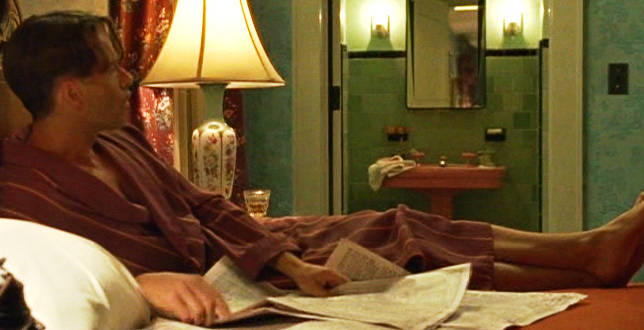 swing low, you are still the best piece of tail I've ever had — or could imagine." That sincerity meter didn't stay on long, or at least stay polite. Mildred tells Monty to go home. Now, Mildred has Monty just plain puzzled. "Baby, the time to worry is when those type of feelings just go bust not when they're going strong. I was just paying you a compliment," Beragon insists. "If you told me that and you intended it as a compliment, then it might have been one, I don't know," Mildred says, "but when you tell me that and it's the only thing you have to tell me, then it's not a compliment. It's the worst thing anyone can say." Monty decides that Mildred is after the "I love you" scene, but Mildred says no, she just wants him to go home because he looks down on her and always has because she cooks and works for a living. "I've got news for you," she tells him, "you are the one who is going to have to start working." He says he will once he sells his house and gets that settled, but she says he'd rather keep the swanky address, show up at the club, have dinner with Veda and live off her than actually look for a job. Monty sort of whispers that she's right, but he's in seduction mode now, removing his robe and trying to free Mildred of hers, which he does successfully.
Christmas time has arrived at the restaurant: Lucy tends bar; employees get bonuses; Veda dines with Monty; Wally and Bert also are present. Only Mildred seems edgy, telling the staff to keep it down. At home, she and Veda have a quiet Christmas and Mildred brings out a small box for her daughter who says something about saving the best for last with a mischievous grin on her face. Mildred tells her it's not what she wanted to get her, but she hopes she likes it and you can see the anger on Veda's face as she sees that it's a wristwatch. She gives her mother a curt thank you, but it's obvious that someone had spilled the beans and led her to expect a grand piano. Veda starts to sulk off when the phone rings. It's Bert. She tells him how much she adores the boots he got her. When Mildred gets on the phone with Bert, he asks what Veda was talking about and Mildred says someone must have tipped her off and Bert swears it wasn't him. Mildred tells him that she got her a
 wristwatch and Bert says Veda has nothing to complain about. She'll get the piano when Mildred can afford it. When Mildred goes back to the other room, she sees the other phone still off the hook, suspecting Veda had listened in on her conversation with Bert. Mildred suggest Veda make a list of who gave her what so she'll know who to thank and Veda suddenly growls, "Christ, I hate this dump." "Anything in particular you object to?" "No mother and don't start changing things around just to try to please me," the girl spits. "No, nothing in particular. Just every lousy, stinking part of it. And if it would burn down tomorrow, I wouldn't shed a tear." Veda then lights a cigarette. Mildred tells Veda
 that she'll put out the cigarette and pick up that match. "Like hell I will." Mildred marches over and slaps her daughter's face, but Veda slaps her back before bitching about Glendale some more, taking a seat and continuing to smoke. "You actually think he'd marry you," Veda says, referring to Monty. "If I were willing," Mildred fires back. "Stupid. Don't you know what he sees in you?" the daughter asks the mother. "Probably the same thing you do," Mildred guesses. "No, it's your legs," Veda replies. "He said that to you?" Mildred asks. Veda continues her class torture of her mother over what Monty has told her such as "Never take the mistress if you can get the maid" and making a point that he still wears custom shoes. Mildred is ready to slap the monster she has spawned down on that one. "They should be — they cost me enough. Oh, you didn't know that one, did you?" She tells her daughter it's not just shoes she's been paying for for the past four months. "So, no Ms. Pierce, it's not my legs he likes me for, it's my money." She also tells her that's why he carts Veda everywhere, but her money ends now too and the piano she has is the one she'll always have until she apologizes for everything she's said. Mildred then storms out of the house. It's a sad farewell, for viewers at least, because it's the final scene for the great little actress Morgan Turner. When we see Veda again, she'll be played by Evan Rachel Wood, but in my opinion Turner was phenomenal and they gave her a great final scene.
Later, on New Year's Eve during a driving rain storm, Mildred has dolled herself up to go to Monty's. Lucy warns her that with the weather the way it is, she would be just as well off sending him a wire, but Mildred tells her she promised herself she was doing it that night and she was doing it, so she hits the hazardous roads. The rain beats down so hard, she can barely see, but she makes it to Monty's. She asks when the other guests are coming, but Monty says there are no others with the storm. Mildred says she's going home then. Then she's finally out with it, demanding to know how he could tell her young daughter those things. He asks Mildred if she thinks Veda doesn't know where she's been when he takes her off at night and brings her back in the morning. She even asks him how many times they did it. "Do you tell her?" "Sure. She greatly admires my capacity and yours." Then the two start having it out about their lifestyles and how Veda actually has lots of friends, just not in Glendale, but Mildred doesn't have any except for that bartender. Beragon tries his old trick of turning it into a seduction, but it doesn't work and Mildred takes off running.
Back in the car, hardly able to see, Mildred dodges downed trees and tries to follow detour signs until her car finally gets stuck in a flooded out road. Fortunately, some policemen rescue her and bring her home wrapped in a blanket. Veda stands on the sidewalk, seeming concerned, but Mildred brushes her off and Lucy as well, who just holds the door open for her as she goes inside.

Tweet
Labels: Awards, E.R. Wood, Fiction, HBO, Melissa Leo, Pearce, Stoppard, Theater, TV Recap, Winslet
TO READ ON, CLICK HERE
Friday, November 05, 2010
Jill Clayburgh (1944-2010)

In the mid-1970s, Jill Clayburgh turned in great screen performance after great screen performance earning consecutive Oscar nominations for An Unmarried Woman and Starting Over in 1978 and 1979, then she seemed to vanish from the scene. In recent years, she had begun to reappear again in smaller roles, and I always hoped for a comeback as she always has been one of my favorites. Unfortunately, the cause for her disappearance appears to have been her health, particularly a form of chronic leukemia which has taken the actress's life at the age of 66.
She made her Broadway and film debuts practically in the same time period. In 1968, she hit the stage in the play The Sudden & Accidental Re-Education of Horse Johnson, which ran a mere five performances. That same year she had a brief part on a TV series called N.Y.P.D. before making her film debut in 1969's The Wedding Party directed by Brian De Palma and featuring Robert De Niro. That same year, she began a two-year run on the soap opera Search for Tomorrow.
She departed the soap for a starring role in the Broadway musical The Rothschilds which starred Hal Linden and with music by the Fiddler on the Roof team of lyricist Sheldon Harnick and composer Jerry Bock, who died just earlier this week. She also was an original cast member of the musical Pippin and Tom Stoppard's play Jumpers. Her last Broadway appearance was in a 2006 revival of Barefoot in the Park.
In 1972, she appeared in the film adaptation of Philip Roth's novel Portnoy's Complaint. She appeared in various roles of episodic television before starring opposite Gene Wilder and Richard Pryor in 1976's Silver Streak. She stuck to comedy again the next year in Semi-Tough with Burt Reynolds and Kris Kristofferson.
In 1978, she got one of her strongest roles and her first Oscar nomination as a sudden divorcee in Paul Mazursky's An Unmarried Woman, the part which may be the best she ever put on screen, perfectly blending the shock, humor and pathos of a woman whose husband leaves her and is forced to re-enter the dating world.
In 1979, she co-starred with Burt Reynolds again in another comedy-drama concerning divorce, Starting Over, which brought her a second consecutive Oscar nomination. That same year, she starred in Bernardo Bertolucci's controversial Luna as a decidedly nontraditional mother and opera star and recent widow with an extremely close relationship with her teenage son.
In 1980, she had to choose between boyfriend Charles Grodin and her new stepmother's son (Michael Douglas) in It's My Turn. In 1981, she starred opposite Walter Matthau as the first woman Supreme Court justice in First Monday in October, ironically the same year the U.S. got its first woman Supreme Court justice. In 1982, she played a woman addicted to prescription medication in I'm Dancing As Fast As I Can.
After that, her screen and television appearances became less frequent, though she did have a particularly good guest shot on an episode of Law & Order as a divorce attorney in 1998 and a recurring role on Ally McBeal as Ally's mom. She received an Emmy nomination for a guest appearance on Nip/Tuck. She was a regular on Dirty Sexy Money.
Clayburgh was one of the many talents wasted in the film Running with Scissors. She will be seen later this month in Edward Zwick's Love and Other Drugs starring Jake Gyllenhaal. Another film featuring Clayburgh, Bridesmaids, directed by Paul Feig and starring Rose Byrne and Jon Hamm is due next year.
She is survived by her husband, the playwright David Rabe, and their daughter, the actress Lily Rabe.
RIP Ms. Clayburgh.
Tweet
Labels: Awards, Burt Reynolds, De Niro, De Palma, Grodin, J. Gyllenhaal, Law and Order, M. Douglas, Matthau, Mazursky, Musicals, Obituary, Oscars, Roth, Stoppard, Television, Theater, Zwick
TO READ ON, CLICK HERE
Tuesday, April 20, 2010
NY theater flashbacks: 1995
It took me a year to get around to writing my second installment of my New York theater memories (if you missed the 1994 installment, click here). Of course many things have interfered in the interim and, quite honestly, the second installment doesn't contain shows that generated the excitement in me as a novice N.Y. theatergoer as the ones I saw in 1994 did. Still, I want all the years chronicled and as they go forward, the titles will become somewhat of a misnomer as well as they are identified by year but they really cover season, which always are split years in Broadway parlance. The first two outings just happened to actually occur in the post title years.

Tom Stoppard is one of the most clever, cerebral playwrights working today and sometimes that can be a hindrance. It had been so long since I'd seen this play, I was fortunate that the Playbill had some notes to give me a vague idea of its subject matter which spanned time periods and concerned itself with geometry and styles of English garden landscaping. I do remember the cast, who all did a good job with the very dense subject matter, and included Blair Brown, Paul Giamatti, Robert Sean Leonard and the play's standout, a relative newcomer on the scene named Billy Crudup. Even with the help of the notes though, my memories are but a fog beyond Crudup and Jennifer Dundas and the fact that my seats in the Vivian Beaumont Theatre at Lincoln Center were directly behind the late Garson Kanin and his wife Marian Seldes, whom I'd seen the year before in Edward Albee's Three Tall Women.


Shakespeare's great play lured Ralph Fiennes to Broadway and he picked up a much-deserved Tony for his effort. For me at least, it's damn hard to screw up Hamlet (though Kenneth Branagh tried with some of his stunt casting in his uncut film version). Admittedly, this Broadway production was the first time I'd ever seen the play staged and, as one would expect, cuts were made which I'm sure set purists' hair on fire. However, Fiennes' work was a wonder to me. Far too often, it seems to me that when people perform the Bard, they speak too deliberately, as if they are afraid the poetry will shatter in their mouths if they act too much. For the first time, Fiennes' Hamlet seemed to me as if he were spontaneously thinking the things he was saying, not just regurgitating memorized text. You can fake that on film sometimes, but in a live production, you can't and I was very impressed, even if the rest of the production didn't quite live up to Fiennes' standard.
When I was in elementary school, my first contact with Frank Loesser's musical How to Succeed in Business Without Really Trying was the movie version with Robert Morse repeating his Tony Award-winning Broadway
 role as J. Pierrepont Finch and I loved it. I'd seen it many times since, so I was anxious to see a stage version. Matthew Broderick now had the Morse role and Megan Mullally, who was new to me last year in the lame revival of Grease with Rosie O'Donnell, had the role of Rosemary that Michele Lee played in the film. For added fun, the narration of the book that gives the musical its title was recorded by none other than Walter Cronkite. The entire cast proved to be a blast from Victoria Clark as Smitty and Jeff Blumenkrantz as Bud Frump to Ron Carroll as J.B. Biggley and Jonathan Freeman as Bert Bratt. Plus, it's a show that's so entertaining with so many great songs by Loesser, that it's nearly impossible for someone to undermine it too badly, even though I thought Broderick mugged a little too much and his singing voice did leave something to be desired. The showstopper turned out to be a surprise when Lillias White, playing the secretary Miss Jones, really belted out her part of "The Brotherhood of Man" and brought the house down, despite it being a number that involved the entire company. On the celebrity sighting side, seated directly in the row behind me in the Richard Rodgers Theatre were Meat Loaf, his wife and his (I'm guessing) teenage daughter.
Terrence McNally's play about a group of gay men who gather together during three separate holiday weekends at a remote lake house about two hours outside of Manhattan won the Tony for best play. It's not a
 bad play, but it did have the misfortune, in my mind, of following on the heels of the epic two-part Angels in America. Love! Valour! Compassion even played in the same theater that Angels did, the Walter Kerr, and its director was Joe Mantello, one of the Tony-nominated actors from Angels in America. As I mentioned in my 1994 theater flashback, Angels remains my greatest Broadway experience, so returning to the same theater and, though McNally's play's ambitions were nowhere near that of Tony Kushner's, it couldn't help but feel as if I were watching Neil Simon opening a comic take on The Seagull the week after Chekhov opened his original. Granted, McNally's play leans toward the comic, but it has its serious moments as well and it really was only the strength of its cast that lifted it for me. Justin Kirk was very good as the blind member of the group and Anthony Heald did a very good job in the role that Stephen Spinella had originally played when the show began off-Broadway at the Manhattan Theatre Club. By the time I saw the show, Nathan Lane had left the show and been replaced by Mario Cantone, probably still best known for his work on HBO's Sex and the City as Anthony, Charlotte's wedding planner friend. I wasn't familiar with his work at the time and it seemed to me that Cantone was trying too hard to do a Nathan Lane impression. The show's standout (for which he deservedly won a Tony) was John Glover in the role of twin brothers, one a bitter man, the other a sweetheart dying of AIDS. It was a wonder to see him pull off a scene with himself when he's doing it live. He was even more impressive in the film version when you saw how he modulated the characters for the new medium and was still just as great.
Glenn Close owes me tickets to The Late Show With David Letterman. Let me explain. At this point, my Broadway obsession had grown beyond reason. Ignoring the fact that I disliked pretty much all things Andrew Lloyd Webber and that every instinct in my body told me that a musical made out of Billy Wilder's classic film,
 one of my 10 favorite movies of all time, was a bad idea and sacrilegious, when they opened up ticket orders, which had to be done by mail, I sent one in. The minute I received my ticket and knew the date, knowing Letterman tickets also were hard to get, I wrote off for tickets to his show for that same time period and I got them. Then damn Glenn Close decided to take a vacation for that week. If I was spending that kind of money to see the damn show, I better see her, so I canceled my tickets and asked for replacement ones. Not only did that mean I lost my chance to see Letterman live, the replacement ticket they sent me was for summer, once Betty Buckley had replaced her as Norma in the show. To make matters worse, George Hearn also was gone and I had to sit through the god-awful show as well. At the time, I used to frequent the Playbill chat room on AOL and there would be endless debates about "Who was the best Norma?" Glenn Close? Patti LuPone? Faye Dunaway? Karen Mason? Betty Buckley? Screw them all. The best Norma still is and always will be Gloria Swanson. As far as the musical goes, have you ever seen the classic Simpsons episode "A Streetcar Named Marge?" That's what I couldn't get out of my mind because a lot of the lyrics were like that, trying to incorporate the film's classic lines into songs. She's still big/it's the pictures that got small. As for Buckley as Norma, all she really played was the vulnerability. You didn't get any sense of the manipulator, let alone the psycho. An impressive staircase does not a show make. What a waste.
Widely considered the first modern American musical, Show Boat has long been a mainstay of musical theater since 1927 with its book and lyrics by Oscar Hammerstein but music by Jerome Kern prior to his more famous
 pairing with Richard Rodgers. While I was more than familiar with the many famous songs from the show, I'd never seen it staged and hadn't even seen a film version. When I read that director Hal Prince had done some tinkering with the book to modernize it even further, I guess I was thinking even more broadly than anyone else. With the character of Julie (well-played by Lonette McKee), a light-skinned African-American passing for white, I kept expecting the revelation that Cap'n Andy, the owner of the title Show Boat, would turn out to be her father, but the show wasn't that far ahead of its time. Staged in the cavern that is the Gershwin Theatre, the talented cast did their best to overcome the hurdles of such a mammoth room. Unfortunately, Prince directs the show as if he wants to make sure you know it has a director. It always was busy to the point that you weren't sure where to look. Some of the montages to cover the passage of time truly were impressive, but much of it was just too frenetic so it was a relief when it slowed down and allowed its cast to sing its great songs. It also was no way to use the unique talent that is Elaine Stritch. In another celebrity sighting, the still alive-and-kicking (then anyway) Sylvia Sidney was in the audience.
Who would think that the most satisfying theater experience I would have in this series of flashbacks would come in the revival of a 1947 play based on an 1880 Henry James novel and best known for its 1949 film
 version, but that was indeed the case in 1995. Granted, a great deal of the credit for how wonderful a night of theater The Heiress turned out to be belongs to Cherry Jones in the title role, but the entire cast shone and the play held up well. Jones won a Tony for her work as did Frances Sternhagen as her aunt and both prizes were very much deserved in this Lincoln Center production that played at the Cort Theatre and also starred Donald Moffat and Michael Cumpsty. Praise needs to be given to Gerald Gutierrez's inspired direction as well. (He also won a Tony for his work, a prize he'd win again the following year for an even greater revival.) It seems funny that when I think of Jones, this is what I think of first while nowadays, what first comes to mind for most people is the president on TV's 24. If they'd seen Jones here, that wouldn't be the case. She'd make them forget Olivia de Havilland as well: Her work as the targeted spinster was that strong; it's forever seared in my memory. As for Sternhagen, as great as she was in the play, part of her was still Cliff's mom on Cheers to me, with some left over as Charlotte's awful mother-in-law Bunny on Sex and the City.

The final play I took in for 1995 (or at least 1995 as far as this piece goes) was my only visit to off-Broadway for this year and it was a trip to the Manhattan Theatre Club at City Center to see A.R. Gurney's comedy about a romantic triangle between a husband (John Cunningham), his wife (Mariette Hartley) and his dog (Sarah Jessica Parker). Yes, Parker played a dog and this would seem, even if I were mean-spirited, an appropriate place to insert some sort of South Park joke. The play was very funny and Parker did play the bitch very well and you would think the gimmick of an actress pretending to be a dog would grow old after awhile, but Gurney and the rest of the cast managed to make it work for the entire evening. That doesn't mean Sylvia isn't a lightweight play, but I've certainly had worse nights at the theater. The real find of the evening though and the show's highlight was the least well-known member of the cast: Derek Smith. Smith played three roles, two of which were women, and he was an absolute riot. I would later to get to see him in other plays and it wasn't a fluke: Smith was a true comic acting find. Overall, my theatergoing experiences certainly were a letdown compared to 1994, but it didn't dim my enthusiasm. What's more, I was still traveling to New York from the middle of the country, which cut down on what I could see. However in the next year, I would move to Florida during the 1995-96 season, making N.Y. jaunts much easier, much more frequent and begin to spiral out of control. Hopefully, it won't take me a year to write about that year.
Tweet
Labels: Awards, Branagh, de Havilland, Dunaway, Frank Loesser, Giamatti, Glenn Close, Gloria Swanson, Hammerstein, HBO, Letterman, Matthew Broderick, Neil Simon, Ralph Fiennes, Rodgers, Shakespeare, Stoppard, The Simpsons, Theater, Wilder
TO READ ON, CLICK HERE
Friday, February 08, 2008
Cut Out the Carbs


By Josh R
It takes more to stay in shape these days than an exercise bike and a moratorium on dessert. It wasn’t until the 1980s that the health-and-fitness craze truly began to shift into hyperspeed — you could glean as much just by watching commercials. Since neither Richard Simmons nor Jane Fonda made house calls to provide on-site coaching, people began descending upon Jack LaLanne franchise gyms like invalids to Lourdes and downing nutrient-loaded shakes with artificial flavoring in place of balanced meals. Recent times have seen the rise of a new breed of guru, known as The Nutritionist, so much so that the focus seems to have shifted from pumping iron and miracle dieting to eating right. Health is, after all, a science, and modern health nuts seem more willing to place their trust in people with Ph.D.s than in spandex-sporting drill sergeants bent on taxing their musculature to the limit.
I spent most of my high school health class doodling in the margins of my notebook and fantasizing about the yearbook editor (it wasn’t until the discussion turned to the acquisition of STDs that I bothered to pay any real attention), so I honestly have no idea what constitutes healthy practice as far as eating is concerned. I know that everything that grows out of the ground, with the exception of that which can be smoked, is presumably good for you, while everything that comes off an assembly line is more likely than not bound straight for your hips. Dr. Atkins and his apostles have impressed upon us the fact that it takes our digestive system longer to break down certain kinds of foods as opposed to others — supposedly, complex carbohydrates decompose at an only slightly more rapid rate than styrofoam, but again, when it comes to the science, I’m as much in the dark as a Bible-belting Huckabee booster at an economic summit.
Even though I’m no Ph.D., I can state with a relative degree of certainty that it may take your brain just as long to break down certain plays as it does for your digestive system to dissolve certain kinds of starches. Rock ‘N’ Roll, the nearly great, nearly indigestible new offering by the venerated British dramatist Tom Stoppard, is a complex conglomeration of history, philosophy and sociopolitical ideology dealing with the rise and fall of Czech communism, the manner in which popular culture (specifically rock music) embodies and reflects the spirit of freedom, dissidence and upheaval, and the gap between not only political theory and human practice, but the “brain” and the “mind.” It’s a full-scale banquet of a play — perhaps more than can be safely consumed within the time allotted — and even theatergoers who come to The Bernard B. Jacobs Theatre with their thinking caps on may ultimately find themselves suffering from the intellectual equivalent of heartburn.
Like his ambitious trilogy The Coast of Utopia, which was the toast of the 2006-07 season, Stoppard’s most recent work charts the intertwined fates of several characters over a period of nearly three decades, examining the manner in which their lives are shaped by the capricious currents of history and the shifting fortunes of the Communist movement in Europe. At the center of the action is Jan (Rufus Sewell), a Czech emigree in England who has become the protégée of Max (Brian Cox), a Cambridge professor and political firebrand who stubbornly clings to his hard-line Communist philosophy even as the oppressive regimes springing up behind the iron curtain undermine the ideals he espouses. Jan, a supporter of the Dubcek regime, returns to his native country after the Soviet occupation begins — his optimism gives way to disillusionment as sweeping political reform leads to the curtailing of personal freedoms. Along the way, the playwright notes the rise of the dissident movement, spearheaded by the underground rock music that fuels the spirit of defiance amongst agitators for change, led by eventual Czech president Vaclav Havel. One Czech band in particular, The Plastic People of the Universe, had a far-reaching impact; banned by the ruling Communist powers for their subversive influence, they came to represent the power of art to not only reflect the mood of political unrest, but to stimulate reform (The playwright suggests that Charter 77 — Havel’s human rights campaign and an international cause celebre — may have been a direct outgrowth of a meeting he had with The Plastic People). The play ends in 1990, after the collapse of European communism, at a Rolling Stones concert. The fact that the Stones have finally come to Prague represents a cataclysmic shift in values, and the occasion for the playwright to observe the great irony that paved the way for the dissolusion of the communist block. An overhead projection informs us that the concert has been “presented by Anheuser-Busch” — ultimately, it is capitalism, not socialism, that has made possible the kind of freedom that communism was originally intended to produce.
This skeletal outline of Rock 'N' Roll doesn’t cover so much as a quarter of the distance in terms of what is addressed within the space of the play — perhaps a generous estimation, since really, it barely makes a dent. The playwright’s interests are nothing if not far-ranging; his scheme encompasses everything from the etymological nuances of the poetry of Sappho to the life and times of Pink Floyd’s Syd Barrett, who is likened to the Greek god Pan and treated as a highly symbolic presence (he’s at once both emblematic of his era, while his subsequent decline is meant to say something about the extent to which the boomer generation has lost its bearings in the years to follow). Stoppard is a master of drawing together disparate strands of fact-based subject matter and literary allusion when tackling big themes, and Rock 'N' Roll is embellished with such copious quantities of historical, cultural, philosophical and political minutiae that it seems to come equipped with its own appendixes; everything seems cross-referenced and footnoted in a such a way that the total effect is overwhelming. There are so many ideas bouncing off one another that after a while your head begins to feel like the inside of a pinball machine — there simply isn’t time to assimilate everything, and those on the receiving end are likely to wind up feeling a bit punch-drunk.
Trevor Nunn's streamlined production, which takes place on a rotating turntable in clever tribute to the vinyl discs being spun for the enjoyment of both the people onstage and in the audience, features many of the original cast members from the play’s premiere staging at London’s Royal Court Theatre. As Jan, Rufus Sewell seems to favor a somewhat antic style when playing his character as a young man, overplaying his awkward enthusiasm, but attains a heartbreaking gravity as his youthful idealism is eroded by events that put his entire system of beliefs into question. With his booming voice and somewhat blustery delivery, Brian Cox believably creates a larger-than-life presence as a dogmatic, self-styled warrior who can’t admit the extent to which his intractable positions are out-of-step with the world beyond his door — the only character who remains immune to the charms of The Rolling Stones, Pink Floyd and their hard-rocking progeny, he turns a deaf ear to the music of change since to absorb it would be akin to acknowledging his own fallibility. Best of all is the remarkable Sinead Cusack, who doubles in two different roles and locates the warmth and the humor in both. As the scholar Eleanor, who refuses to loosen her grip on life even as her body is failing her, she provides the play with its emotional touchstone; as Eleanor’s daughter Esme, she offers an equally poignant consideration of a former flower child struggling to find her place in the modern world. The ten other cast members provide excellent support, particularly Stephen Kunken as a true believer who stays in Czechoslovakia to fight the good fight, and Nicole Ansari as his skeptic countrywoman who finds refuge in more hospitable environs.
When I reviewed The Coast of Utopia for this site last year, I remarked of Stoppard’s work that “there are moments when dramatic concision gets lost in a tangle of knotty verbiage, while considerations of character and plot take a back seat to the myriad of ideas floating in the ether.” That’s true to a greater extent of Rock 'N' Roll than it was of the play which I was then writing about, which unfolded at a more leisurely pace and consequently had more time to develop the human drama at the play’s core. As it is, there’s enough material in Stoppard’s newest offering for three plays, and that’s the problem — it’s all been shoehorned into one. Whereas Utopia could be experienced on the same level as engrossing seminar course, trying to keep up with Rock 'N' Roll often feels like cramming for an exam (tellingly, the program comes equipped with its own set of Cliff’s Notes). This is not to say that Rock 'n' Roll is a bad play — on the contrary, it’s an extremely good play that simply bites off more than audiences can chew. Certainly, no other contemporary playwright gives us as much food for thought. It may therefore seem a tad ungrateful to suggest that the playwright favor a slightly less academic approach in the future, or at least simplify the intellectual content just enough so that it can be processed in bite-size morsels.
That’s a polite way of saying that it may be time to go on a diet.
Tweet
Labels: J. Fonda, Stoppard, Theater
TO READ ON, CLICK HERE
Friday, January 18, 2008
The Best on Broadway in 2007
Compiling a list of the Top 10 achievements in Theater for 2007 presented me with a bit of a challenge. Theatergoing is not a poor man’s pursuit, so the number of things I’ve been able to see has been limited, to say the least — sadly, I wasn’t able to come up with the cash to pay for a full price ticket to the critically lauded production of Cyrano de Bergerac with Kevin Kline that just wrapped up its limited run on Broadway (the news that it was taped by PBS for a Great Performances airing sometime later this year provides some consolation). The fact that many of the productions which received Tony Awards and nominations this past June technically premiered in 2006 further winnowed down the field. Well there were many shows I liked, it was difficult coming up with ten that I genuinely loved.
Since two of the fall season’s most well-reviewed productions, Tom Stoppard’s Rock 'N' Roll and Conor McPherson’s The Seafarer, while not without merit, didn’t impress me to the extent they did others — and I have yet to see the revival of The Homecoming that everyone is raving about — I’ve decided instead to focus on the performances that made 2007 such a memorable year on the Broadway stage. Paring down that field necessitated some difficult cuts.
With apologies to the egregiously overlooked — including the legend at whose altar I worship, Ms. Angela Lansbury (it hurts me more than it does you, babe) - here are the 10 Best Broadway Performances of 2007, listed in ascending order:
Ms. Perez’s gut-busting, go-for-broke turn as a tone-deaf diva constituted the only compelling reason to make a trip to Roundabout Theater Company’s somewhat mildewed revival of the 1975 Terence McNally farce set in a gay bathhouse. In the midst of so many half-naked men, it was a woman — albeit one frequently mistaken for a transvestite — who stood out.
While the luminous Jennifer Ehle gets MVP honors for her sterling work over the entire 8½ span of Tom Stoppard’s ambitious three-play cycle, Salvage was the only one to premiere in 2007. The standout performance in the trilogy’s concluding installment was giving by Ms. Plimpton who, as the emotionally volatile Natasha, confirmed her status as a stage actress of remarkable presence and charisma.
In Mark Twain’s cross-dressing farce, the Tony-winning Mr. Butz once again proves himself to be a clown par excellence, with a talent for slapstick that transforms run-of-the-mill sight gags into bravura feats of comic ingenuity. If his scenes as a man don’t give him quite as much opportunity to really let loose, once he straps on the hoopskirts, he’s pretty much unstoppable.
The sublime Ms. Cusack performs double duty in Tom Stoppard’s intriguing examination of rise and fall of communism in his native Czechoslovakia. As the scholar Eleanor, who refuses to loosen her grip on life even as her body is failing her, she provides the play with its emotional touchstone; as Eleanor’s daughter Esme, she offers an equally poignant consideration of a former flower child struggling to find her place in the modern world.
Ms. Redgrave breathed life into Joan Didion’s dramatization of her prize-winning book, investing it’s chilly prose with such resonance that she seemed to alter the very space around her. The words may have communicated steely intellectual control, the principle of mind of matter, but the actress was working from a place of pure feeling. The thinking was unmistakably Didion’s — but the magic was all Redgrave’s.
Mr. Gaines’ quietly shattering turn as the battle-weathered embodiment of stiff-upper-lip decency beautifully anchored Michael Grandage’s heartbreaking revival R.C. Sheriff’s decades-old play, an astonishingly clear-eyed view of the insanity of warfare and its unbearable cost. The actor was the best thing among many great things in a Tony-winning production that deserved a much longer life than it ultimately enjoyed.
In Peter Morgan’s somewhat slick recapitulation of the saga of David Frost’s legendary interviews with the disgraced former President, Mr. Langella delivered a ferocious performance which went much further toward unraveling the mysteries of Nixon than any amount of academic postulation could. Beyond giving a mere impersonation, the actor skillfully revealed harrowing psychological wreckage of a vanquished warrior who could neither comprehend nor accept his fall from grace.
If anyone thought the four-time Tony winner was in danger of coasting on her reputation for the remainder of her career, the glorious working of talent and emotion being unleashed nightly in Roundabout’s revival of this 1964 musical unequivocally and permanently put the matter to rest. Since she burst onto the Broadway scene some 13 years ago, Ms. McDonald’s talent has matured and her command of the stage has become more absolute — while her burnished soprano remains as coruscating as ever.
In Robert Falls’ searing revival of Eric Bogosian’s 1988 play, Mr. Schreiber was truly remarkable in a performance that made brilliant use of the aloof, mercurial qualities that have distinguished many of the actor’s screen appearances, yet revealed terrifying depths of pain and self-loathing as the character’s descent into hell was made physically and verbally explicit. As tormented as he is tormenting, his radio shock-jock was rendered with a searing clarity that ripped right through the fourth wall and grabbed the audience by the throat.
Some will accuse me of cheating by citing the entire cast of Tracy Letts’ brilliant, biting family drama/mystery/black comedy currently baring its fangs (and tickling the funny bone) in a sensational staging at The Imperial Theater — but singling out any one member of its 15-member cast, which functions on such a miraculous level that it makes the nonexistence of an Best Ensemble Tony Award seem criminally negligent, just wouldn’t be fair. I’ve decided I can’t do any justice to this singularly inspired piece of work — or its spectacular gallery of performances — until I’ve seen it again, so my full review will be pending. Brace yourself for an onslaught of superlatives.
Tweet
Labels: Awards, Kevin Kline, Lansbury, Lists, Musicals, Stoppard, Theater Tribute, Twain, Vanessa Redgrave
TO READ ON, CLICK HERE


